China's one-child policy has been criticized in both the Western popular press and academic works for a long list of associated ills, ranging from human rights abuses in the form of forced abortion and sterilization, to the aging of the population and the creation of a generation of spoiled, antisocial “little emperors.” These criticisms are well deserved. However, an associated claim found in the conventional wisdom established by journalists and generalist China scholars should be treated with more scepticism: that the one-child policy, more properly called the birth planning policy, is the main factor behind China's sex imbalance, and that, as a corollary, relaxing the policy would normalize China's sex ratio.
In this article, we argue that examining China's sex ratio in historical, comparative and domestic regional perspective shows the weakness in that argument. While some permutations of the birth planning policy contribute to sex ratio at birth (SRB) imbalances, another crucial driver of the skewed sex ratio is “son preference,” a term used for a complex of cultural, social and economic institutions and practices that make it likely that families will choose to have sons instead of daughters. In making this argument, we propose that son preference be treated as an observable and measurable explanatory variable, rather than as an immutable constant. Such an analysis suggests that returning China's sex ratio to natural levels would require attacking the institutional and socio-cultural practices that create incentives for families to prefer having sons.
How Skewed is China's Sex Ratio?
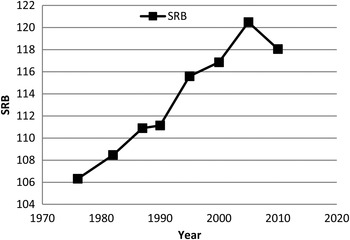
A country's natural sex ratio is calculated using its SRB, sex differentials in mortality, and sex selective migration. Most countries have natural sex ratios that fall within the range of 97.0 to 100.3 males per 100 females.Footnote 1 Of greater interest here is SRB, which is defined as the number of male live births for every 100 female births. While the worldwide average SRB is 105–107, China's SRB rose dramatically starting in the early 1980s and has remain highly skewed, as Figure 1 shows.
Sex Ratio at Birth (SRB) in China, 1970–2010
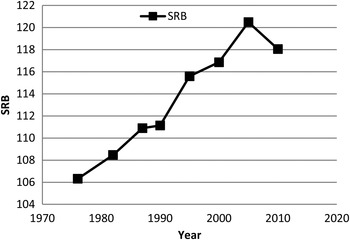
The official Chinese statistics in Figure 1 tell a shocking story, with SRB peaking at over 120.Footnote 2 International sources report a somewhat less startling, but still significant, level of skewing. In the CIA World Factbook, China's SRB is reported to have decreased slightly, from 112 in 2005 and 2006 to 111 in 2007 and 2008, and then risen to 114 in 2009 and 2010, and then dipped slightly back down to 113 in 2011 and 2012.Footnote 3 Discrepancies between these figures can be attributed to differences in the sources of data (i.e. national census or representative surveys) and in adjustments researchers made to the data to reflect undercounting or under-registration of female infants.Footnote 4
China's SRB deviates from the world's natural average ratio significantly enough that it has clearly been manipulated. The highly skewed SRB indicates a problem of “missing girls” caused by non-registration of girls at birth, female infanticide, sex selective abortions, or more likely, a combination of the three.Footnote 5 Whatever the method, many families in China seem to have decided that having a daughter, or registering her, may not be the most socially or economically beneficial choice.
China's skewed sex ratio is one of the most important demographic problems facing the nation. Already, the effect of many years of imbalance is discernable: in 2005, there were more than 32 million excess males in the population under the age of 20.Footnote 6 As this trend continues, there may be serious social consequences. First, unregistered girls have no access to education or other social services and must live on the margins of society. Second, it will be increasingly harder for men to marry, violating the Chinese cultural norm that every adult should marry and have children. Some analysts even assert that the skewed SRB will create a surplus of “bare branches,” the historical name for unmarriageable, ungovernable, antisocial men, leading to social problems such as increased violence, social unrest and the trafficking of women.Footnote 7 Some argue that the decreasing number of women should mean the overall “value” of daughters will increase,Footnote 8 resulting in an improvement of women's position in society; but this has not happened in rural areas, where much of the skewing occurs. Rather, both prenatal and postnatal discrimination have risen since the 1970s.Footnote 9 Scarce rural daughters have become more valuable commodities, susceptible to being traded, sold or trafficked, worsening women's status in society and the family rather than improving it. What, then, is the cause of the SRB imbalance?
The Conventional Wisdom: Policy as the Driver of Skewing
Scholars who specialize in this area of research make subtle and fine-grained arguments about the multiple factors interacting to unbalance SRBs, including some policy effects. However, journalists and some scholars have persisted in making a much cruder argument about the source of China's SRB imbalances: that the one-child policy is the main driver of SRB skewing, and that, therefore, relaxing it would return China's SRB to normal levels. Unfortunately, this argument has become “conventional wisdom” in the press and popular imagination because it has been repeated so often, in spite of specialists' efforts to explain the more complex interplay of forces. This article attempts to complicate this conventional wisdom by pointing out the weaknesses in its logic. In doing so, we will, where appropriate, build on the nuanced work of the ethnographers, demographers, public health and other specialists in the field; but we will engage primarily with the less nuanced, policy-focused argument at a high, structural level, on its own terms.
During the past decade, as China's skewed SRB has finally made the Western news, it has become increasingly common to see respected news outlets state with great certainty that “the one-child policy” is the cause of the sex imbalance, given that Chinese culture prefers boys to girls. For example, in 2004, US online news service, MSNBC, reported that, since Chinese favour boys, “China's draconian one-child policy … produced … the largest, the highest, and the longest gender imbalance in the world.” The article further implied that the SRB imbalance was unprecedented in China's history.Footnote 10 The BBC reported in 2007, and again in 2009, that the policy had pushed women to abort girls.Footnote 11 When the topic of China's SRB once again hit the news cycle in 2010, journalists were even more forthright in blaming the one-child policy: The Times Online led with the headline “One-child policy condemns 24m bachelors to life without a wife,”Footnote 12 and Fox News followed suit, titling their piece “China's one-child policy to leave 24 million men single.”Footnote 13 In 2011, journalist Mara Hvistendahl published Unnatural Selection, in which she documented how Western governments and organizations, hoping to prevent the spread of communism, funded birth planning in South Korea, Taiwan, Singapore, India and China. This move coincided with increased SRB skewing in the region; Hvistendahl therefore concluded that the Western-supported one-child policy must be the cause of the skewed SRB in China.Footnote 14 Throughout 2013, news sources such as National Public Radio and The New York Times continued to identify the policy as the main cause of China's problem of excess males.Footnote 15 These arguments reappeared with new vigour after November 2013, when the Chinese government announced that it would allow couples in which both parents were only children to have two children – something that was already enshrined in some local birth-planning policies. Many major news outlets took this opportunity to discuss the negative side-effects of the three-decade long policy, including SRB imbalances. The Washington Post, Bloomberg Businessweek, Slate Magazine and The Wall Street Journal all suggested that, because the policy is the main cause of China's skewed SRB, its relaxation would result in a normal ratio in the future.Footnote 16
Some non-specialist scholars, too, are willing to claim a straightforward causal connection between China's population policy and sex imbalance. Mungello and Mosher, two somewhat controversial critics of birth planning, both make such claims.Footnote 17 But, similar arguments also appear in widely used Chinese politics and history textbooks that double as general interest scholarly works about China. To cite a few examples, Schoppa's popular modern Chinese history textbook mentions that, given presumably immutable and inevitable son preference, the policy has led to female infanticide and excess males.Footnote 18 Dreyer's enduring Chinese politics textbook mentions sex ratio skewing as a straightforward product of the family planning policy.Footnote 19 Similarly, Saich's respected undergraduate Chinese politics text states that SRB imbalances are “another adverse consequence of the family-planning policy.”Footnote 20 Larus's textbook notes that “the one-child policy has resulted in a gender imbalance” because “Chinese culture prefers sons.”Footnote 21 In all these cases, sex ratio skewing is mentioned only in the context of the birth planning policy and is presented as an unintended side-effect of the policy, given that Chinese culture now valourizes, and apparently always has valourized to the same extent, boys. The argument has become, in short, a trope in general discussions of the birth planning policy in which the one-child policy equals sex ratio imbalance.
Specialists, in contrast, are much more nuanced in their connection of the two phenomena. Their claims correctly complicate the matter with statements such as Zhu, Lu and Hesketh's comment that “the relation between the sex ratio and the One-Child Policy is a complex one” and that “data do suggest that the sex ratio is related to the way in which the policy is implemented.”Footnote 22 This more nuanced literature makes a compelling argument that there is a causal connection, supported both by ethnographic research and statistical data, between how the policy is implemented and higher levels of SRB skewing.Footnote 23 In particular, they argue that a 1.5-child policy produces a greater imbalance than either a one-child or two-or-more-children policy because it is gendered, since it allows for a second child only if the first child is a girl. This is one way in which one permutation of the policy induces families to desire sons; but the one-child and two-children permutations do not in and of themselves have gendered effects. In these latter instances, the policy writ large is not what causes skewing; it is one among a number of contributing factors. In the words of Greenhalgh and Winckler, “birth planning, in conjunction with China's male-centered culture and market economy, has masculinized the social order, making a big gender gap in numbers a constitutive feature of Chinese modernity.”Footnote 24
Based on their findings, the specialists suggest that changes to the policy might decrease, but not eliminate, SRB imbalances. For example, work by Zeng Yi et al. argues that modification of the policy to “two children plus birth spacing” would partially restore the sex balance, but would not eliminate sex-selective abortions.Footnote 25 Likewise, Ebenstein argues that “a relaxation in the One Child Policy could reduce the sex ratio at birth by allowing more parents to have a son without resorting to sex selection.”Footnote 26 Others also identify relaxation of the policy as a crucial way to improve, but not eliminate, the skewed SRB.Footnote 27 The cruder conventional wisdom, on the other hand, holds that since the policy is the cause, relaxing the policy would eliminate the skewing altogether. It is this argument that we wish to challenge using a broad-stroke comparative approach.
In this article, we interrogate the claims of journalists and generalist scholars that the birth planning policy is the crucial factor behind China's skewed SRB and that, as a result, its reversal would normalize the imbalance. Using international, historical and domestic comparisons rather than the fine-grained empirical analysis of specialists, we find that the causal effect of birth planning policy on SRBs is more limited than the conventional wisdom holds. Indeed, we find that the comparisons point towards son preference as an important explanatory variable for China's skewed SRBs, something we elaborate in this article's second half.
Putting China's Sex Ratio in Comparative International Perspective
The “conventional wisdom” argument that the birth planning policy drove China's SRB imbalance can be broken down into two logical steps: (1) the fertility decline in China was caused by the birth planning policy; and (2) decline in fertility leads to SRB imbalances. We will focus on China's neighbours in East Asia in testing this argument, largely for the sake of convenience, but also on the assumption that this journal's readership may be most familiar with that region. However, the same patterns would hold if we were to cast our net worldwide. Comparisons with other East Asian countries show that (1) is not necessarily true: many of China's neighbours have remarkably low fertility regardless of whether they have family planning policies. As for (2), variation in SRBs among China and its neighbours with low fertility rates suggests that low fertility itself is not the main driver of SRB imbalances. Together, these observations support the argument that the birth planning policy writ large is likely not the only important factor behind China's skewed SRB.
First, region-wide trends suggest that factors other than strict family planning policies, such as financial costs and smaller-family preference, may be at work in causing a decline in fertility rates. According to 2010 estimates, China's neighbours now have among the lowest total fertility rates (TFR) reported in the world: 1.20 for Japan, 1.10 for Singapore, 1.15 for Taiwan, 1.04 for Hong Kong, and 1.22 for South Korea.Footnote 28 Although some of these countries, such as South Korea, have had state-led programmes to encourage lower fertility, none have had strict family planning policies akin to China's.Footnote 29 Thus, we need to look to other factors to explain the fertility decline in the region, including development-related economic factors such as the rising levels in education of women, the rising cost of raising children, or cramped urban living quarters.
The implication for China is that, given its patterns of industrialization and urbanization over the last 30 years, “the fertility rate may have continued to fall from the 2.9 seen in 1979 even without the One-Child Policy.”Footnote 30 Indeed, the growing preference for smaller families, which we see expressed in shrinking ideal family sizes, may explain China's fertility decline. A 2006 survey in Jiangsu, where couples were allowed two children if either parent was an only child, asked women what they would consider “the ideal number of children not considering the government's birth control policy.”Footnote 31 Among those eligible for a second child, 55 per cent of women said one child was ideal; the average ideal family size among all women was 1.46 children. These results indicate that a “norm of very low fertility [had] taken root.” A 2010 follow-up study asked what these women thought would be the ideal size for any family as opposed to their own family. The average ideal family size (number of children) was 1.59 for all families and 1.34 for one's own family. That is, when women took into account their own circumstances, they preferred even fewer children.Footnote 32 Likewise, Milwertz found that 62.9 per cent of urban women reported that they would only have one child, even without the birth planning policy.Footnote 33
According to Cai Yong et al., shrinking ideal family size can be attributed to economics. Among parents who were eligible for, but decided not to have, a second child, “about 70 per cent cited economic cost of childrearing, and 30 per cent cited poverty”; interviews revealed that “raising a second child involved too much resource and time commitment.”Footnote 34 Even if, as Johnson argues, Chinese parents view having one son and one daughter as the ideal combination of children, they remain constrained by limited resources.Footnote 35 With economic development, limited housing, improved educational access and increased employment opportunities for women during the first two decades of the PRC, Chinese couples had more incentives to use birth control.Footnote 36 The result was more couples choosing to have smaller families, even before the government established nationwide birth planning policies.Footnote 37 Therefore, as Cai argues, “policy is not the key factor behind the very low fertility that has emerged [in China]”; rather, “socioeconomic development plays the decisive role in the transition to below-replacement fertility in China, as it does in other societies.”Footnote 38 Findings by Zheng et al. drive home this point: “extremely low fertility is accounted for mainly by economic and social factors, not the government's birth-control policy.”Footnote 39
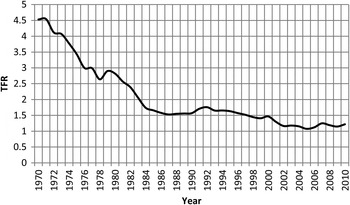
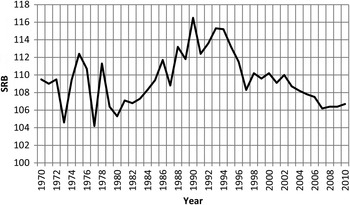
The second step involved in tying the birth planning policy to China's SRB is the assumption that decreased fertility leads to skewed SRBs. Countries with a highly skewed SRB are often observed to have low fertility; this makes sense given that in societies with high son preference, lowered fertility exerts pressure on couples to ensure the birth of a son in fewer attempts. Studies by Das Gupta and Baht, and Guilmoto, Hoàng and Van, have discussed this “squeeze effect.”Footnote 40 However, declining fertility does not automatically lead to a skewed sex ratio. Evidence of this is that no countries in Western Europe have skewed SRBs, although many of them have below-replacement fertility, and neither does Japan, which had one of the lowest TFRs in the world – 1.39 in 2013.Footnote 41 Some periods of South Korea's demographic data even show that a falling TFR can be accompanied by declining sex ratio imbalance. From Figure 2, we can see that South Korea began to experience a sharp decline in fertility around 1970. Beginning around 1985, coinciding with the introduction of sex-selection technology, the country experienced a sustained increase in SRB skewing (see Figure 3). However, the relationship between SRB and fertility was not strictly an inverse one: after 1995, South Korea's SRB returned to more normal levels, even though the fertility rate continued to decline. The reason for the normalization of SRBs in South Korea is neither a less restrictive family planning policy nor a fertility increase: low fertility rates do not uniformly result in unbalanced SRBs, and thus there is not a predictable relationship between fertility decrease and skewed SRBs.
Total Fertility Rate (TFR), South Korea, 1970–2010

Sex Ratio at Birth, South Korea, 1970–2010

To sum up, international comparisons show that the two parts of the argument linking China's birth planning policy to its skewed SRB are problematic. First, international comparisons indicate that several countries in East Asia have consistently reported low fertility, even without strict family planning policies. What these countries share with China is a growing concern for financial costs and a smaller-family preference, constituting a more likely explanation for the region-wide decline in fertility. Second, in spite of a similar decline in fertility in both China and its neighbours, there is a wide variation in SRBs across the region, suggesting that some other factor is likely at work in unbalancing the SRBs; in China, this is likely occurring in tandem with the policy-related effects.
Putting China's Sex Ratio into Historical Perspective
Looking at China's SRB in historical perspective casts further doubt on the conventional wisdom about birth planning and sex ratio imbalances. The current situation is not the recent phenomenon the popular press makes it out to be; in fact, as demographers well know, a skewed SRB has been the norm in China for the past two hundred years at least. The period roughly between 1960 and 1985, during which China's SRB approached the natural range of 104–106, was anomalous in Chinese history. The resumption of sex ratio skewing did coincide with the implementation of the birth planning policy but, logically, it is unlikely to be the crucial process behind SRB imbalances if the skewing was occurring, at high levels and for long periods of time, in the absence of the policy.
Although putting together a complete picture of China's historical SRB is impossible for empirical reasons, indications are that the sex ratio was highly skewed going back perhaps as far as the 17th century. While it is only since the first nationwide census in 1953 that accurate statistics have been available and can take into account not only both sexes but also data for all age groups, we can still form impressions about China's SRB trends by piecing together what we do know about smaller populations before 1953. Province-specific, lineage-specific and all-age sex ratios allow us to infer some historical trends in the SRB.
Regional and lineage-level studies demonstrate that the sex ratio in China from the 17th century onwards was almost certainly impacted by female infanticide. Studies of the Qing lineage show that about 10 per cent of female infants were likely killed shortly after birth between 1700 and 1830.Footnote 42 Female infanticide was probably even more widespread in the general population: Lee and Campbell estimate that in the area of Liaoning that they studied, between the end of the 18th century and the 1860s, 20 to 25 per cent of female infants were the victims of infanticide.Footnote 43 If these estimates are correct, then in all likelihood the more impressionistic reports of “bare branches” are, too, and the sex ratio was highly skewed at that time. The literature indicates that female infanticide decreased during the late imperial period to the point where there was “only” a 10 per cent excess of male births in the early 20th century, and the sex ratio declined from “114 in 1936 to 109 in 1949.”Footnote 44 The SRB did not enter the natural range until 1960, when it was 107, and it remained there until the mid-1970s, when it began its current ascent. The remarkable point revealed here is that the only period during the 20th century when China's SRB approached the natural range was roughly between 1960 and 1985, as Huang and Yang have argued.Footnote 45 Given this fact, it seems unlikely that the birth planning policy is the only important variable at work behind China's current skewed SRB. The real question becomes why was it not skewed from 1960 to 1985? We will return to this question in the second half of this article.
The Variation in Sex Ratios in Different Parts of China
The SRB imbalance is not uniform across China – for example, there are urban–rural differences, regional/provincial differences, and so on. Any argument about the causes of the skewed sex ratio must therefore explain these domestic differences. The scholarly policy-oriented argument has focused on how variations in the level of policy restrictiveness have affected SRB. As noted above, China's birth planning policy generally comes in three forms, with varying degrees of restrictiveness: 1) a one-child-only policy, applied in most cities; 2) a “1.5-child” policy, in which families with only one daughter may be allowed a second child, commonly applied in Han-majority rural areas; and 3) a two-or-more-children policy, applied primarily to ethnic minorities in poor areas. The areas reporting greatest SRB imbalances are those that enforce a 1.5-child policy, followed by areas with a one-child policy, and then areas with a two-or-more-children policy.Footnote 46 Based on 2000 census data, the SRBs were 119.2 for 1.5-child areas, 115.3 for one-child areas, and 112.4 for two-or-more-children areas.Footnote 47 Similar patterns were found in the 2005 inter-census survey.Footnote 48
Applying statistical analyses to this data has allowed scholars to suggest a policy effect at work on SRB skewing, but its magnitude remains a subject of debate in the literature. Bulte, Heerink and Zhang argue that from 1981 to 2000, “between 38% and 48% of the female deficit during this period can be explained by the OCP [one-child policy].”Footnote 49 Similarly, Li, Yi and Zhang argue that “[t]he effect of the one-child policy accounts for about 57% and 54% of the increase in sex ratios for the 1991–2000 and 2001–2005 birth cohorts, respectively.”Footnote 50 We take from these studies that policy does contribute to SRB imbalances, perhaps even as much as 50 per cent. However, we suspect that the numbers may be inflated because the policy differences these studies rely on align with Han versus non-Han populations, introducing the possibility that multiple other factors such as culture, land, and other policies or practices associated with ethnicity might also be at work here. In short, cultural or economic factors associated with ethnicity and affecting SRB could be co-varying with policy restrictiveness in these studies. Yang's compelling quantitative analysis illustrating that the 1.5-child policy produces the most unbalanced SRB does control for a number of factors including ethnicity, and finds that the best predictor of whether a family will have a son is whether it is subject to the 1.5-child policy.Footnote 51 Yang's study does not, however, quantify exactly what amount of the variance can be explained in this way, although it seems substantial.
Based on these studies, we might conclude that because areas that allow a second child have the lowest SRB levels, a switch to a national two-child policy would eliminate SRB skewing. However, as Yang notes, retreating to a two-child policy would still leave China with a considerable SRB problem, since the SRB in 2000 for those areas was 112.4.Footnote 52 Thus, relaxing the policy might go a long way towards eliminating many missing girls, but still at least half of the imbalance would remain to be explained and addressed. So, although the conventional wisdom gets it partly right, there is still quite a lot of variation to be explained.
Using international, historical and domestic comparisons, we have attempted to highlight problems in the conventional wisdom that birth planning policy is the crucial driver of China's skewed sex ratio. Across East Asia, countries without strict family planning policies also experience highly skewed SRBs. Furthermore, lowered fertility does not always correlate with SRB imbalances; SRB imbalances in China occurred historically in the absence of birth planning and at high fertility levels. Finally, while statistical analyses of domestic variations show that the birth planning policy does have some effect on SRBs, much of the increase in skewing still needs to be explained. All of these things challenge the logic of the conventional wisdom.
Son Preference as a Better Explanation
We offer a corrective to the conventional wisdom by proposing that a crucial factor in explaining the skewed SRB in China is the level of son preference, which we treat as an observable, measurable causal variable rather than as a cultural value that is held constant. We find support for this argument not only within the current Chinese domestic context, but also over time and in the international context. That is, SRB skewing is greater within China in locations with stronger son preference; it varies over time in China with the rise and decline of son preference; and it is more skewed in East Asian countries with higher levels of son preference. This argument focuses on structural incentives for son preference; only further on-the-ground research can confirm whether individuals or families would say that these incentives actually drive their choices.
What actually is “son preference”? The term is shorthand for the incentives to have sons created by patriarchal institutions and practices. Borrowing from Das Gupta et al., we focus on four kinds of social and economic incentives that families consider when thinking about the necessity of having sons.Footnote 53 These incentives include factors related to labour, ritual life, inheritance and property ownership, and old-age security – things which can be observed and measured.
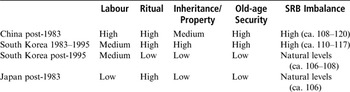
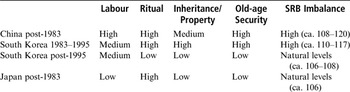
To illustrate the relationships between SRB imbalances and incentives for son preference, we created a metric for measuring both of these factors. First, we designated cases as having a “natural” SRB if the ratio was in the 103–107 range, and “high” if it exceeded 107. Son preference is more complex. Different incentives related to labour, ritual life, inheritance and property ownership, and old-age security received values of high, medium and low, as follows.
Labour-related incentives to have sons
• High: a son's labour is necessary for sufficient family income, e.g. because of exogamous patrilocal marriage practices, or labour policies that inhibit or devalue women's work.
• Medium: a son's labour is preferred but not necessary for household income, e.g. where women make significant, recognized contributions to the household economy.
• Low: families either (a) prefer a daughter to fulfil labour needs, e.g. where there is a high demand for women's labour in certain sectors; or (b) have no labour incentive to have either girls or boys, e.g. if many older people continue to participate in the labour market, making parents more self-reliant and less dependent on their children's income.
Ritual-related incentives to have sons
• High: a son is necessary to carry out a family's ritual obligations, e.g. religious or cultural traditions require sons to perform ancestor worship or other familial devotions.
• Medium: sons are not necessary, although perhaps preferred, for performance of a family's ritual obligations, e.g. daughters may serve as replacements for sons.
• Low: sons are not required to perform familial rituals or there is no widespread practice of familial rituals.
Inheritance and property ownership-related incentives to have sons
• High: only men may own and inherit property, making sons necessary to preserve familial property, e.g. exogamous patrilocal marriage or inheritance laws require property to pass from father to son.
• Medium: daughters can legally own and inherit family property, although sons are still the common or preferred choice.
• Low: daughters are the preferred inheritors of family property, or law or practice dictates that sons and daughters may inherit equally, or government policy does not allow for the inheritance of private property.
Old-age security-related incentives to have sons
• High: sons are required to secure parents' future economic and emotional support, e.g. exogamous patrilocal marriage practices mean that daughters do not contribute to their parents' old-age care, intensified by the absence of government pension schemes.
• Medium: sons preferable, but not required, to ensure old-age security, e.g. government-sponsored pensions provide some old-age support.
• Low: (a) daughters thought more likely to provide old-age security; or (b) parents expect no difference in the support they will receive from daughters and sons; or (c) old-age security seen as not depending on having children, e.g. a comprehensive, nationwide old-age pension plan exists.
We find that when a particular society scores a “low” in three out of four categories, a natural SRB is most likely. A single “high” score in the ritual category is compatible with a normal SRB, suggesting that ritual-related incentives may be less important. Clearly of most importance, however, is old-age security. Where there are high incentives for son preference in planning for old-age support, skewed SRBs are likely to occur.
Changes in Son Preference
In our earlier examination of historical trends in China's SRB, we noted that between roughly 1960 and 1980 China experienced natural SRBs. If high levels of son preference increase the sex imbalance, then we should see decreasing incentives for son preference marking the starting point of normal SRBs, and increasing incentives marking the end of it. We find that government policies relating to the organization of production and residence, and in particular, collectivization and decollectivization, did indeed affect incentives for having sons, adding credence to the importance of son preference in skewing the SRB.
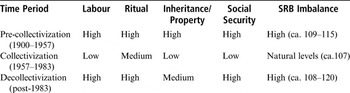
Table 1 puts together a brief overview of son preference incentives over time in 20th-century China. The first half of the 20th century was characterized by strong son preference incentives, reinforced through patrilineal, patrilocal marriage practices and patriarchal values. Women transferred their economic and emotional support to their husband's family, so parents knew that only sons could fulfil the family's ritual, property and social security needs. Chinese families further believed that only men were strong enough to toil in the fields.Footnote 54 Father-to-son inheritance practices, upheld by the 1911 Civil Code, made it necessary for families to have male heirs and left women with no direct or non-custodial rights to property or inheritance. Along with family property, sons inherited the responsibility of caring for parents in their old age. Even when sons had no land, they were the ones to shoulder this responsibility because it was assumed that they, not daughters, would be more likely to earn a living.Footnote 55 In short, son preference was high across the board during this time period, and, unsurprisingly, so was sex ratio skewing.
Son Preference and SRB in China during the 20th Century

Source: SRB numbers based on estimates in Lee, James Z., and Wang Reference Lee and Wang1999, 53ff; Li, Shuzhuo Reference Li2007, 2.
Things changed with collectivization in the 1960s. The importance of having a son to work the land and provide economic support for the family diminished since all production was now collective rather than based on the family economy.Footnote 56 While a woman's household registration still transferred immediately to her husband's home upon marriage, such a transfer was not such a blow to her natal family because it could receive social and economic support from the collective.Footnote 57 Women were mobilized to participate regularly in fieldwork, and this made them more valuable contributors to the family economy. The practice of patrilocal marriage, however, mitigated this effect considerably, preserving some labour-related incentives to have sons.Footnote 58 Collectivization also caused the erosion of the traditional exchange whereby sons inherited land and in return cared for their aging parents, reducing land and old-age security-related incentives to have sons. Care for the elderly was no longer strictly a household burden, but a collective responsibility.Footnote 59 Finally, a son's ritual importance was reduced as political controls made it difficult for families to practise ancestor worship. Collectivization thus mitigated many of the incentives for families to have sons, and the SRBs were strikingly, and unusually, normal during this period.
After 1978, incentives to have sons increased when the communes were dismantled and the rural economy was re-structured around the family. Sons regained ritual importance as the practice of ancestor worship re-emerged. The household responsibility system replaced a relatively small number of communes with millions of small family farms. For the most part, land was re-allocated based on the size of the family, including both women and men. While there were regulations in place to guarantee women rights to their share, in practice, enforcement of such laws was spotty. Leaders of townships and villages justified inequality in land distribution using the logic of patrilocality: “an unmarried son … should be allocated a larger share of farmland than a daughter to support his future family … In contrast, since an unmarried daughter would eventually marry out of her natal family and usually leave the village, she was … only allowed a smaller share of farmland.”Footnote 60 In short, the household responsibility system created new property-related incentives for families to prefer sons to daughters in spite of some efforts to create equality in this area. Furthermore, the household responsibility system removed the economic safety net of a collective economy and left the elderly without guaranteed support. As a result, rural parents now looked to their children for financial and emotional security in their old age.Footnote 61 However, declining fertility rates have increased the proportion of elderly in the population, and as both urban and rural families have become smaller, parents have fewer and fewer options for a social security net.Footnote 62
On one hand, declining fertility has increased the value of children regardless of gender.Footnote 63 At the same time, all else being equal, families still prefer sons, because parents need them for old-age security.Footnote 64 Therefore, it comes as no surprise that China's SRB after decollectivization reflects high levels of expressed son preference, with official numbers as high as 120. Almond, Li and Zhang's study on how SRBs responded to decollectivization employs data from more than 1,000 counties to support this point: decollectivization, not the birth planning policy, was the driving force behind the skewing of the sex ratio in the early 1980s.Footnote 65 They found that “a second child following a daughter was 5.5 percent more likely to be a boy after [decollectivization], doubling the prevailing rate of sex selection.”Footnote 66 In short, from the 1950s to the 1980s, the SRB fell and rose in concert with the fall and rise of son preference incentives.
Domestic Comparisons of Son Preference Levels
If son preference is a key factor behind the unbalanced sex ratio in China, then we should expect to find that, in the recent past, the SRB has been less skewed in areas where son preference is lower, and more skewed in areas where it is higher. And, indeed, studies have confirmed, for example, that localities where uxorilocal, rather than patrilocal, marriage is common have lower SRB skewing.Footnote 67 But, perhaps of more interest is the urban–rural discrepancy: cities, which have lower levels of SRB skewing, have lower son preference incentives than rural areas, just as our argument would predict (see Table 2).
Son Preference and SRB in China's Rural versus Urban Areas

Source: SRB numbers based on Li, Shuzhuo, Reference Li2007, 2.
The root of this difference likely comes down to two factors: first, the higher levels of education, economic contributions and social status of urban women, and, second, the marital and residential patterns of younger urban couples. Care for the elderly in urban areas has increasingly fallen on children since the deepening of economic reform in the 1990s, but, interestingly, this has not raised the value of sons. Urban women are more educated than rural women and thus generally enjoy better and higher paid jobs. Although they are generally paid less than men, they can contribute to the family financially, and they tend to do so because they remain closely tied to their natal families. As a result, urban families are more likely to believe that their daughters can provide adequate financial, medical and emotional old-age support, reducing the necessity of having a son.Footnote 68 Ritual and property/inheritance-related incentives do not seem to be major concerns in urban areas. Land distribution is not relevant, women can and do inherit property equally, and the psychological/emotional element in parent–child relations seems to be more relevant to contemporary urban life than considerations of ancestor worship.
Across the board, urbanites have lower levels of son preference than rural dwellers, confirming the importance of son preference in skewing SRBs. However, skewing is still high in urban areas, in fact, considerably higher than we might expect. While overall son preference ratings are medium/low, Li Shuzhuo reports that the urban SRB was still about 115 in 2005.Footnote 69 This disparity is a challenge to the son preference argument and needs to be explained by further research.
Son Preference in an International Context: South Korea and Japan
If it is the case that incentives for preferring sons are a crucial driver of sex ratio imbalances, then we should find that countries with higher son preference incentives have skewed SRBs, and those with lower incentives for son preference have normal SRBs. We evaluate the persuasiveness of the son preference argument by looking at two of China's neighbours: South Korea, which has had high levels of SRB skewing since the 1980s, and Japan, which has had a normal SRB. The South Korean case is disaggregated into two time periods, one with high SRB skewing and one with SRBs in the naturally-occurring range. Our findings are as follows.
Table 3 shows that low SRB skewing occurs where medium/high values of son preference occur in a maximum of one category. In addition, son preference and SRB imbalances both increase in a roughly linear fashion.
Son Preference Incentives and SRB in China, South Korea, and Japan, ca. 1983–Present
Source: SRB numbers based on Li, Shuzhuo Reference Li2007, 2; Korean Statistical Information Service 2010; and National Institute of Population and Social Security Research 2004.
South Korea
Son preference was strong in South Korea and there was a greater imbalance in SRBs prior to 1995; however, there has been a steady weakening of both. Before 1995, South Korean families favoured sons owing to patriarchal values that were embedded in the family legal system and culture. The rigidly patrilineal and patrilocal Korean marital system was actively promoted by the state following its embrace of neo-Confucianism in the 16th century.Footnote 70 The state formally legalized “the rules of patrilineal social organization … into the Korean Civil Code in 1958 … in provisions also referred to as the Family Law.”Footnote 71
In the period 1980–1995, South Korea ranked high on all the son preference measures. Because women did participate in the South Korean labour force and helped to provide at least subsidiary income to a family, the necessity of sons was moderate with regard to labour needs.Footnote 72 Sons carried on the family line and took sole responsibility for ancestor worship, which was actively practised.Footnote 73 In the 1980s, it was commonly said in rural areas that the ghosts of people who never married or who did not have male offspring to worship them could cause trouble for their survivors.Footnote 74 Ritual-related son preference was therefore high during this period. As for property and inheritance, there were strong incentives to have sons because the continuity of a family line depended on patrilineal succession, with rights, responsibilities and the majority of property transferred from father to eldest son.Footnote 75 These practices were formalized under the Korean Civil Code of 1958, which stipulated that inheritance was through the male line.Footnote 76 In return for their share of land, sons were expected to provide economic security for their parents in their old age; thus, son preference was also high with regard to old-age security.
Since 1995, South Korea's SRBs have dropped back to normal levels. This has not been accompanied by increased fertility, so we suggest that declining incentives for son preference provide a better explanation for the normalizing of the SRB. After 1995, labour-related incentives dropped from “high” to “medium.” Until recently, few women engaged in professional, long-term employment because of the expectation that they would leave their positions when they married or had children.Footnote 77 Since the mid-1990s, more women have embarked on the career track, although the concept of a male bread-winner still lingers, creating a medium level of son preference. Additionally, as the government sought to ameliorate the skewed SRB, it made amendments to the South Korean Family Law that directly addressed factors related to patrilineality and patrilocality. Starting in the early 1990s, these amendments gave women equal rights in matters of marriage and children. For example, the law specified that couples should decide where to reside rather than automatically reside with the husband's parents. In addition, it gave girls equal rights to inheritance, rather than only a 25 per cent share.Footnote 78 Furthermore, in 2005, “the Supreme Court ruled that women could remain members of their natal household after marriage, and that women and men have equal rights and responsibilities to care for their ancestors.”Footnote 79 Taken together, these changes moved South Korea from high to low levels of son preference incentives in the areas of ritual, inheritance, and old-age security.Footnote 80
Post-1995 South Korean family policies thus address the socio-cultural factors that underlie son preference. Instead of focusing on limiting births, which families seemed to be doing on their own, or banning sex-selective abortion practices, which has been largely unsuccessful, the revisions to the Family Law are an attempt to chip away at the male-dominated values found in the 1958 law as well as in cultural norms. The policies have been successful in reversing the country's skewed SRB precisely because they address the components of son preference.
Japan
In recent years, Japan's SRB has remained within the naturally occurring range of 105–106. As we have noted, this has happened even though Japan has extremely low fertility, hitting an historical low of 1.25 children per woman in 2005.Footnote 81 What sets Japan apart from China and pre-1995 South Korea is its low level of son preference. Since Japan made the transition away from an agricultural economy in the post-war period, labour-related incentives to have sons have declined considerably. Because of the societal expectation that women will leave the workplace for at least a few years when they have their first child, women's pay, promotion and career possibilities have been limited; however, the smaller contribution that daughters are likely to make to the family economy has apparently not caused families to prefer sons.Footnote 82 The ritual of ancestor worship, in the form of the firstborn son's responsibility to care for the ancestral shrines and graves, persists till this day. If a family has no son, the responsibility passes to the “adopted” husband of a daughter.Footnote 83 For this reason, Japan still has high levels of ritual-related incentives for son preference. As for land and inheritance practices, families generally prefer the eldest son to inherit, although families may pragmatically and flexibly choose a daughter, another son, or an adopted son-in-law.Footnote 84 This lowers the necessity for having sons. Finally, although the majority of elders reside with their children, they receive economic support primarily from the government. Japanese social security has grown extensively such that, by 1994, its benefits equalled about 16 per cent of national income. Its old-age pension accounted for 51 per cent of that amount, and is expected to grow owing to the rapidly aging population.Footnote 85 This situation lends itself to another set of problems, but it lessens the need for economic support from children. The state provides old-age security, creating no incentives for families to prefer sons on that account. Altogether, then, Japan has both low son preference and low SRB skewing, bolstering our hypothesis.
Conclusion: How Can SRB Skewing Be Normalized?
How can the highly skewed SRB in China be brought back to normal levels? Many of the solutions proposed by journalists, advocacy groups and generalist scholars have involved relaxing the birth planning policy. The Chinese government's recent decision to move to a more relaxed policy has therefore been met with optimism.Footnote 86 The rationale is that the pressure to have a son will be eased by allowing families the freedom to have a second child under certain conditions (e.g. both parents being only children). However, the scholarly evidence suggests that, owing to the high cost of raising a second child, many Chinese families would prefer one child even in the absence of birth planning. Certainly, eliminating the 1.5-child policy would reduce much of the skewing caused by that permutation of birth planning. Nevertheless, we would still expect significant skewing to occur in areas where two children are allowed because of high levels of son preference. Setting aside the merits of policy revision for multiple other reasons, including the aging of the population and human rights issues, we suggest that relaxing the birth planning policy might produce disappointing results with regard to SRB skewing because it would not address one crucial driver of China's sex imbalance.
Over the past two decades, the Chinese government has already tried to reduce SRB skewing by forbidding sex-selective abortions.Footnote 87 However, this effort has proven to be largely unsuccessful both because of weak enforcement and because the ban does not address the underlying incentives. Son preference, created largely through patrilocality and measurable in terms of labour, ritual, inheritance and old-age security needs, has to be reduced if families are to choose to have more daughters. In our view, normalizing sex ratios will require targeting son preference through policies that give value to women's employment and economic contributions, allow daughters to carry out family rituals, encourage property inheritance to daughters, and provide support for the elderly through pension programmes. And, indeed, a recent study conducted on old-age care shows that a “rural old-age pension program mitigated the increase in the sex ratio in the areas where the program was available.”Footnote 88
Finally, not only should initiatives work to negate son preference, they should also promote the value of daughters. Therefore, initiatives would need to be combined with social policies that seek to change the value society places on girls. The Chinese government has enacted two pilot interventions targeting many of these structural incentives. Both the “Chaohu experimental zone improving girl-child survival environment” (Chaohu gaishan nühai shenghuo huanjing shiyan qu 巢湖改善女孩生活环境实验区) in Anhui from 2000 to 2003, and the Care for Girls programme piloted in 24 counties in 24 provinces in 2003–2005 and then rolling out nationwide starting in 2006, have apparently met with success in improving skewed SRBs.Footnote 89 Given our findings, we think that this approach is a necessary element of any attempt to normalize the SRB.