Although risk-sharing may be a questionable term, it is commonly used to describe pricing and reimbursement agreements depending on patient outcomes. These arrangements appear to be actively supported by manufacturers willing both to shorten time to market access and to obtain a better price than the accepted cost-effectiveness thresholds set by health authorities for price-volume negotiations. To our knowledge, only a few countries have matured substantial experience of risk-sharing agreements so far (e.g., Australia, Canada, Italy, and the UK). As several other countries are planning to introduce performance-based agreements, it may be of interest to report a personal, independent view of the Italian situation.
THE ITALIAN SCHEME
The first performance-based arrangement was agreed in July 2006 (2), and as of October 2010, eighteen contracts for two medicines for age-related macular degeneration and fifteen cancer drugs (sorafenib has two different contracts for RCC and hepatocarcinoma) have been in force. There are different types of agreement: “cost-sharing” (n = 6) was used at the beginning but then was replaced by “risk-sharing” and “payment-by-results” (n = 12). Cost sharing includes no efficacy evaluation; there is just a price discount usually limited to the first 2–3 months or cycles of therapy. These discounts are usually monetary: manufacturers are expected to pay-back half of the reimbursed price. The other two types of contracts are based on the rates of “nonresponders,” defined as disease progression or progression-related death, unacceptable toxicity not allowing continuation of treatment or toxicity-related death. Non-responders have to be identified within a pre-set time for each drug/indication, usually from 4 to 12 weeks (median, 8 weeks). The manufacturer is expected to pay-back half (risk-sharing) or the full price (payment-by-results) for each nonresponder.
The complex management of discount schemes is entirely based on Web registries run by AIFA, the Italian drug agency (3). Hospital doctors are required to fill in a prescription e-form, with the patient's identification data, indication for use and dosages. The system validates each prescription and automatically requests the hospital pharmacy by e-mail to release the drug. Every single prescription for each patient is tracked, to monitor appropriate use. In addition to the prescription, the registry requires the treating physician to record follow-up clinical data and outcomes. If a patient meets nonresponder criteria, the hospital pharmacist should apply for pay-back to the manufacturer, who can accept or reject the proposal (requiring arbitration).
QUESTION MARKS
Against this background, there are still some important question marks. First, the Italian choice of requesting refunding for nonresponders instead of paying for responders casts doubts. Although it might appear interchangeable at a first glance, it actually makes a major difference from the Italian National Health Service (INHS) viewpoint because each hospital pharmacy buys the drug at full price in daily practice, then nonresponders have to be documented, otherwise any undocumented nonresponder will be paid as a success. Another question concerns pre-set timing: according to information to date, it can be argued that time frames appear too short to allow a reliable assessment. For instance, only a small proportion of CML patients resistant to nilotinib or dasatinib can be detected within 4 weeks; assessing hematologic and cytogenetic tests over a longer period (e.g., 3 to 6 months) might be a more sensible “threshold” to distinguish nonresponders from patients who are more likely to benefit from treatment. Unfortunately, the scientific rationale of the nonresponder criteria for each drug has not been made public, so it is impossible to discuss their reliability and applicability, also in the light of continuing scientific progress.
Although outcome models targeting treatment failure are not unique to Italy, being in force in other countries too (Canada, the United States, England, and Wales), focusing on performance rather than nonperformance would be preferable from payers’ perspective. A general common-sense suggestion is that any arrangement should be based only on clinical success defined as a significant improvement over available treatments to admit premium prices only for innovations that actually improve health. Moreover, criteria should be based exclusively on objective measures, publicly disclosed and discussed.
To our knowledge, the Italian Web database is an innovative tool, being centrally managed by health authorities rather than referring to several specific product registries held by manufacturers like in the United Kingdom (5). A key question is whether all patients are registered in the national database: if a drug is administered outside the registry, the INHS reimburses the product outside any outcome-based arrangement, de facto. The last official report on the registry of cancer drugs covers the period April 2006 to September 2007 (4). According to unofficial figures, there were around 95,000 cancer patients registered at the end of May 2010. Half were in northern regions, particularly Lombardy (the largest Italian region), where the regional authority reimburses only registered treatments. Overall compliance with registry procedures still seems to vary widely between regions: just recently, two regions officially reminded hospital pharmacists to make sure all patients are recorded and pay-back procedures are actually applied (7).
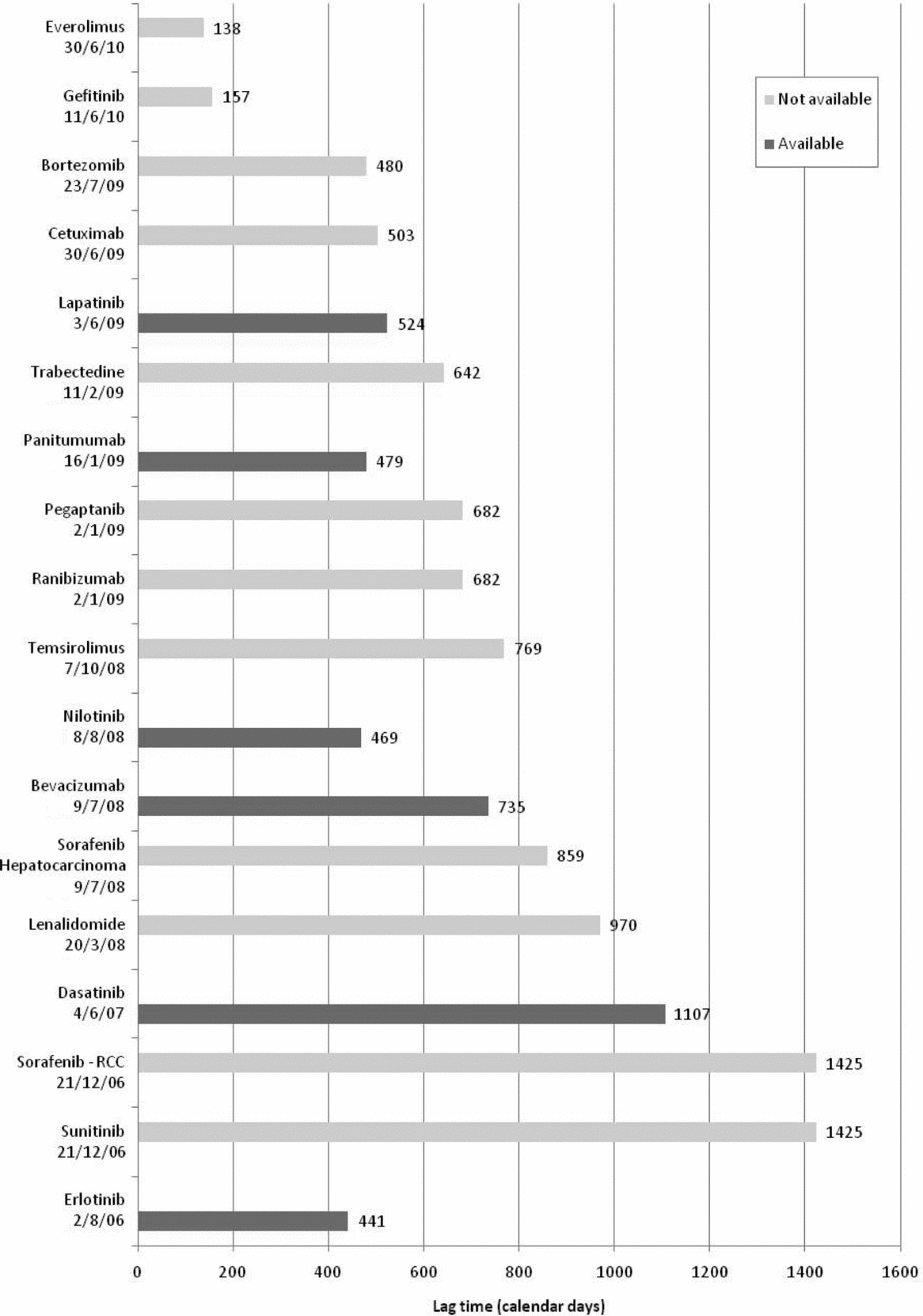
Another question is whether regions, which are financially accountable in Italy for health care expenditure (including hospital drug budgets), are really able to claw back refunds from manufacturers. Unfortunately here again there, are no official figures and regions do not seem yet able to quantify the amount of pay-back matured in the 4 previous years. National availability of pay-back procedures may be one explanation. Assuming that hospital pharmacists can apply for refunds only through the Web-system, we have computed the time spent between the market access of each cancer drug (i.e., the publication date of the e-form) and the availability of the pay-back procedure. We saw that, while e-forms were available for all drugs within 17 days on average (range, 0–42 days), so far pay-back procedures are available for only six contracts (mean lag-time 625 days; range, 441–1,107 days), and not yet for the remaining twelve arrangements (mean waiting time 737 days as of 15 November 2010; range, 138–1425 days) (Figure 1). In 2009, the turnover of cancer drugs involved was €422 million, around €234 million for products where no e-refund procedure is yet available. In November 2009, AIFA stated it had started to release automated procedures for most cancer products (1) and this is expected to be completed soon. However, the question of how and when hospitals will be able to collect their refunds is still there, becoming even more important if performance-based arrangements speed up market access of high-priced products, as recently evidenced (Reference Russo, Mennini, Siviero and Rasi8).
Products reimbursed in Italy under risk sharing arrangements. Lag time between publication date of each e-form drug (day 0) allowing product prescription and i) availability date of refund procedures (n = 6) or ii) up to November 15, 2010 for the twelve products for which no procedures were available at the time of manuscript submission. Drugs are listed bottom-up according to the date of publication of their e-forms. (1, accessed November 15, 2010)

POLICY IMPLICATIONS
In conclusion, concerns have been voiced recently about whether outcome arrangements should be preferred to the easier-to-manage price-volume agreements (Reference Raftery6). The experience in Italy seems to support these doubts: despite their “science appeal,” the so-called innovative pricing arrangements are likely to represent a new but more complicated way of discounting and rebating, and the burden ties mainly on payers (i.e., the health authorities). Full transparency on the reliability of nonresponder criteria and actual compliance with registry requirements is needed to understand whether the current Italian experience can evolve toward a credible and consistent tool for assessing cost-effectiveness, and the impact on public expenditure should be transparent too. This could serve as a useful lesson for all countries interested in knowing whether and how risk-sharing arrangements can contribute to the overall sustainability of a national health service.
CONTACT INFORMATION
Livio Garattini, BA (lgarattini@marionegri.it), Gianluigi Casadei, MD (casadei@marionegri.it), CESAV – Center for Health Economics, “Mario Negri” Institute for Pharmacological Research, Villa Camozzi, 20040 Ranica (BG), Italy
CONFLICT OF INTEREST
G Casadei is a consultant for Novartis. The other author does not report any potential conflicts of interest.