INTRODUCTION
Most studies of host-parasite interactions are uni-directional and usually deal with the effect of parasites on hosts, including the virulence of parasites, the way parasites affect their hosts, and their transmission mode (for review see Clayton and Moore, 1997). Since the host constitutes an important component of the environment of parasites, it might also be important to examine how hosts may influence the fitness and survival of their parasites. Factors that constitute the environment of a parasite are host features like condition, body temperature, morphology, age, sex or variation in behavioural and immunological defence (depredation) which may influence the occurrence and population dynamics of parasites in a variety of ways (Clayton and Moore, 1997). For instance, they have been shown to affect sex, age and species composition, reproductive output and the condition and morphology of parasites (Marshall, 1981; Clayton, 1991; Crompton, 1997). Furthermore, inter- and intraspecific competition can influence parasite species diversity and intensity (Simberloff and Moore, 1997).
In this study we have tried to identify determinants of the population biology in the chewing louse Brueelia apiastri, which may be related to its host, the European bee-eater Merops apiaster. This parasite is abundant and occurs on 69·9% of adult bee-eaters but does not occur on nestlings (Eichler, 1963; Krištofík et al. 1996). We investigated whether and how host morphology, condition, age and sex are related to parasite intensity, sex ratio, reproductive success estimated by adult/nymph ratio and size (condition) in terms of body length and head size (for a description of the biology of chewing lice, see Blagoveschtschenskii, 1959; Marshall, 1981 and Hoi et al. 1998). In contrast to many other chewing lice species, the transmission mode of chewing lice on the European bee-eater is mainly horizontal but is less important between parents and their offspring (Darolová et al. 2001).
MATERIALS AND METHODS
Host species and study area
The European bee-eater is a semi-colonial bird species nesting in cavities at the end of deep, usually horizontal burrows (Glutz von Blotzheim and Bauer, 1980). Bee-eaters are aerial insectivorous birds overwintering in southern Africa that are socially monogamous, with males and females investing equally in parental care (Cramp, 1985). They are parasitized by 3 frequent ectoparasite species Meropoecus meropis, Brueelia apiastri and Meromenopon meropis (for details, see Krištofík et al. 1996; Hoi et al. 1998). Colony size and breeding density of the host has already been shown to explain some of the variation of chewing lice intensity of infestation (Hoi et al. 1998).
We conducted the study in Southern Slovakia (47 °48′N to 47 °58′N and 18 °16′E to 18 °45′E) in 1996. Data were obtained from different colony sites of bee-eaters comprising single breeding pairs and colonies of up to 79 breeding pairs (see Hoi et al. 1998 for a detailed description of the colony sites). For this study we used in total 50 adult bee-eaters (27 males and 23 females) from 11 different locations (see Hoi et al. 1998). Adult breeders were caught during the feeding period (first 2 weeks in July) by means of small clap-traps attached to the entrance of the nest burrow. We provided the birds with numbered metal rings using the Czech ringing scheme. None of the investigated breeding pairs had helpers at the nest (Lessells and Ovendon, 1989).
The following morphological measurements were taken irrespective of sex: wing-, tail- and bill lengths according to Svensson (1992), and the length of the pin-tail. Pin-tail length was the length of the middle feathers rising the other tail feathers. We measured bill and pin-tail length to the nearest 0·1 mm with callipers. Body mass was measured with an electronic balance to within 0·1 g, and sexed on the basis of plumage characteristics and morphology (see Lessells and Ovendon, 1989). The age of birds was determined on the basis of specific colour patterns (Glutz von Blotzheim and Bauer, 1980; Cramp, 1985; Hoi et al. 1998; Darolová et al. 2001). We used the extension of the white forehead patch as an age determinant. We found a positive correlation between the age of known age birds and the extension of the white forehead patch (rs=0·72, P<0·0001, n=37).
Parasite counts
B. apiastri, which are about 1 mm in length and move very slowly, were collected from the throat and belly of adult bee-eaters, the only areas infested by this species (Hoi et al. 1998), by means of forceps. To obtain comparative data, 3 persons intensively searched each individual for 10 min. One person held the bird and all three carefully examined the infested areas by gently blowing feathers aside. The parasites of each individual bird were then stored in tubes containing 75% alcohol and were later identified to species level. Since parasite counts were restricted to 2 weeks in July 1996, during the chick feeding period, we did not address seasonal changes in parasite populations.
Parasite measurements
We identified the sex and stage of development (adult/nymph) of each chewing louse. Fecundity in other ectoparasites seems to depend on age and size. Larger individuals may take larger meals and produce more or larger eggs (Johnson, 1942; Bell and Schaefer, 1966; Marshall, 1981).
To calculate the body size of B. apiastri, we prepared the parasites on slides and used a computer program (Lucia M) connected to a microscope (Nikon SMZ-U) to measure head length and width and abdomen length and width. Head length and width (r=0·81, P<0·0001, n=411) and abdomen length and width (r=0·86, P<0·0001, n=411) are highly correlated. We therefore used body length (head+abdomen) as an overall size measurement. Sex and body length were gathered from a total of 412 adult individuals and additionally we determined body length of 76 nymphs.
Furthermore, we used an adult/nymph ratio and sex ratio as a measure of the population structure of B. apiastri on each host. To investigate differences in parasite parameters in relation to host characteristics we examined the role of host sex, host age, size (wing and tail length) and body condition (residual body mass not explained by size in terms of wing length) and finally, its relation to bill-length of the birds, since the bill has been shown to be an important tool in reducing ectoparasite numbers (Clayton, 1991).
Statistical analyses
Parametric tests have been used and no data transformation was necessary.
As parasite features we used mean values per bird for parasite intensity, body size, and larvae intensity and additionally adult to nymph ratio, and sex ratio. We compared these parasite features between male and female bee-eaters. A discriminant function analysis revealed no difference in any of these parameters. For this reason we pooled data from male and female bee-eaters for further analyses. A generalised linear model (GLM) was used to examine variation in parasite intensity (dependent variable) between bee-eaters of different breeding localities (fixed factor) and to examine variation in male and female parasite body size respectively (dependent variable) between host individuals and host breeding locations as independent variables.
A stepwise multiple regression analysis, using a backward selection procedure, was used to determine the relationship between host parameters, namely wing, tail, bill, and pin-tail length, body mass, residual body mass, extension of the white forehead (age indicator) as independent variables and mean parasite intensity, mean body size (males and females separately), adult/nymph ratio, sex ratio and mean residual nymph intensity as dependent variables respectively.
Reproductive output of B. apiastri on host individuals seems to be directly related to the number of adult females, since there was a positive correlation between the number of nymphs and the number of females (r=0·57, P<0·001, n=50). As a measure for reproductive output per host we therefore calculated the residual nymph intensity not explained by the number of adult B. apiastri females found on each host individual. For this reason we regressed the number of nymphs as dependent variable against the number of females per bird.
RESULTS
On average, our bee-eaters (n=27 males and 23 females) host 9·1±1·4 S.E. (ranging from 1 to 42) Brueelia apiastri (see also Krištofík et al. 1996; Hoi et al. 1998). An analysis of variance revealed that B. apiastri intensity significantly varied between bee-eaters from different breeding locations (Anova: F=2·09, P<0·04, D.F.=10, 44).
In contrast, when examining body size of adult B. apiastri, an analysis of variance revealed significant variation among bee-eater individuals (Anova: F=2·29, P<0·0001, D.F.=41, 204) but this variation was not explained by breeding location (Anova: F=0·78, P>0·6, D.F.=9, 206).
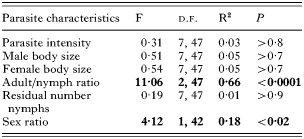
B. apiastri intensity and body size were not related to any host parameter. None of the host variables, including wing-, tail-, bill- and pin-tail length, body condition, body mass and white forehead extension entered into a stepwise regression model using parasite intensity, or body size of male and female chewing lice (see Table 1) as dependent variables.
Table 1. Results of stepwise multiple regression analyses with host body features (wing-, tail-, bill- and pin-tail length, body condition, body mass and white forehead extension) as independent variable and different parasite characteristics, respectively, as the dependent variable (Given are F, R2 and P values and the degrees of freedom for each regression model. Details about variables which entered the significant regression models are given in the Results section.)

However, the adult/nymph ratio was related to host parameters. Host size in terms of bill length and host condition (residual body mass not explained by body size) entered into a stepwise regression model with the adult/nymph ratio as the dependent variable (see Table 1). The partial correlation coefficient suggests a negative relationship between the adult/offspring ratio and bill length (rpart=−0·75, P=0·0008) as well as between the adult/nymph ratio and host condition (rpart=−0·62, P=0·0005), which indicates that bee-eaters with longer bills and in better condition harbour relatively more larvae than adult chewing lice.
Nymph intensity in contrast was not related to host parameters. No host variable entered into the stepwise multiple regression model using the residual number of nymphs not explained by the number of adult female Brueelia apiastri as dependent variable (Table 1).
Parasite sex ratio seems to be related to host age (Table 1), as adult bee-eaters with bigger foreheads have a more male-biased parasite sex ratio (rpart=0·37, P=0·01).
Female body size of B. apiastri is negatively related to the number of females and total number of parasites. Both female lice number and overall parasite intensity entered into a stepwise multiple regression model with female size as dependent variable (F=4·98, P=0·01, D.F.=1, 45, R2=0·19). The partial regression coefficient suggests a negative relation between female body size and overall parasite intensity (rpart=−0·18, P=0·02) and between female body size and the number of females (rpart=−0·4, P=0·006). For males no variable entered the regression model (F=2·1, D.F.=2, 45, R2=0·05).
DISCUSSION
Host breeding density has already been shown to influence parasite intensity in the European bee-eater (Hoi et al. 1998), and Darolová et al. (2001) showed that horizontal transmission between adult bee-eaters was one important factor explaining variation in parasite intensity between breeding sites. Here we found that variation in intensity and body size of B. apiastri between host individuals may not only be explained by host colony size. The suitability of an individual host as an environment for parasites is not only determined by transmission rate in relation to host colony size and breeding density (Darolová et al. 2001). According to our results, host sex and age do not seem to be important determinants of parasite intensity and condition (size, reproductive success). However, the number of nymphs to adult parasites increases with host bill length and body condition. This outcome might be interpreted in 2 ways. (i) B. apiastri produces more offspring on better hosts or, (ii) this variation is the consequence of differential depredation. Grooming has been shown to be an important behavioural host defence mechanism, which could influence the population structure of ectoparasites (Clayton, 1991). So birds in better condition may spend more time grooming, with grooming more likely affecting adult parasites because they are bigger and hence easier to collect. We found no relationship between residual nymph intensity, not explained by the number of parasite females, which could be interpreted as a measure of reproductive success and host parameters. Therefore, differential predation is the more likely explanation for this result. Clayton (1991) and Clayton and Cotgreave (1994) pointed out that bill shape/length and special structures on the bill tip (hook) can be important for ectoparasite defence. Bee-eaters have long curved bills without a hook and B. apiastri lives on the belly of bee-eaters and one might argue that birds with longer bills are more effective in ectoparasite defence because they can consider a bigger area. The role of legs for preening might be less important since bee-eaters have very short tarsi and very fleshy and thick toes and we did not observe bee-eaters using their legs for preening the belly. In fact, we found a relationship between bill length and adult/nymph ratio which further supports a role of size dependent depredation. A male-biased sex ratio of chewing lice on apparently older bee-eaters, birds with bigger white forehead patches which seem to be an indicator for bird age (unpublished data), additionally supports size-dependent depredation. Theoretically one would predict a female-biased sex ratio because usually female chewing lice live longer (see Eichler, 1963; Marshall, 1981, Clark et al. 1994). We found the opposite for B. apiastri. The reason for this could be that the significantly smaller males are less frequently caught by the host. If this is the case, the increased relative presence of male chewing lice with host age may be due to the fact that older birds spent more time preening or are more efficient in preening.
Competition may be another important determinant affecting parasite intensity and condition. For example, infestation levels of an ectoparasite tend to be lower on a host, when another ecologically similar parasite species occurs (Marshall, 1981). Sometimes parasite species even exclude each other from a common host species (Marshall, 1981). From an earlier study on bee-eaters we know that there is a non-significant negative relationship between intensity of B. apiastri and Meropoecus meropis, which is the most abundant ectoparasite on bee-eaters (Hoi et al. 1998).
Intraspecific competition on the other hand seems to be less important for parasites, at least when hosts are in good condition (Marshall, 1981). There is some evidence that also for lice, crowded situations may cause intraspecific competition for food resources or oviposition and pupation sites (Usinger, 1966; Marshall, 1981). The negative relationship between parasite intensity of infestation and female body size may point to such a negative effect of intraspecific competition. Again size-dependent depredation by the host could explain this result as well. Increased parasite intensity may elicit preening behaviour which consequently reduces the larger cohorts of the parasite which are mainly female.
In conclusion, we found significant variation in body size of parasites between different hosts but there is no evidence that variation in host quality may directly affect parasite intensity and body size. There is evidence that host quality affects their preening behaviour and consequently size-dependent depredation affects the population structure (sex ratio and adult/nymph ratio) of the parasite. Thus, future studies should examine the role of size-dependent depredation, specifically the behavioural defence mechanisms and aspects like the forceps function of the bill.
The study was supported by the grant 95/5305/360 of the Slovakian Ministry of Education. We thank two anonymous referees for their very useful comments, and R. Wagner and R. Hengsberger for improving the manuscript.