Significant outcomes
Chronic exposure to the ARV drug nevirapine impairs spatial learning and memory in mice.
TDF and nevirapine increase level of lipid peroxidation and Aβ1-42 concentration.
Nevirapine upregulates BACE1 and Aβ deposition in hippocampus.
Limitations
ARV drugs treatments were (TDF and nevirapine) administered to naive mice; therefore, the synergistic effects of HIV and ARV treatment on cognitive function are lacking.
Although doses of ARV used in this study were comparable to human therapeutic doses, they do not account for differences in drug metabolism rates.
We only conducted a cognitive assessment on the Morris water maze. More behavioural assessments are needed in future studies to test other cognitive domains.
Introduction
Among HIV comorbidities, HIV-associated neurocognitive disorder (HAND) is commonly observed in persons living with HIV (McArthur et al., Reference Mcarthur, Steiner, Sacktor and Nath2010). Recent clinical observations during the antiretroviral therapy (ART) era have indicated that HAND may occur in 15–50% of HIV-infected patients (Bryant et al., Reference Bryant, Ellis, Umlauf, Gouaux, Soontornniyomkij, Letendre, Achim, Masliah, Grant and Moore2015). The introduction of combination ART (cART) has improved the well-being of HIV patients, and the prevalence of severe HIV-associated dementia has decreased significantly (Sacktor et al., Reference Sacktor, Lyles, Skolasky, Kleeberger, Selnes, Miller, Becker, Cohen and Mcarthur2001). Despite this promising outcome, the prevalence of milder forms of HAND which includes mild dysfunctions in attention, learning/memory, working memory, executive function and fine motor skills (Woods et al., Reference Woods, Moore, Weber and Grant2009) has increased significantly (Gannon, Reference Gannon2014; Shah et al., Reference Shah, Gangwani, Chaudhari, Glazyrin, Bhat and Kumar2016). However, it remains unclear whether the increased prevalence of mild forms of HAND is due to the intrinsic risk of developing dementia with age or other direct or indirect factors of the condition itself such as the prolonged exposure to antiretroviral (ARV) drugs (Ciccarelli et al., Reference Ciccarelli, Fabbiani, di Giambenedetto, Fanti, Baldonero, Bracciale, Tamburrini, Cauda, de Luca and Silveri2011; Giunta et al., Reference Giunta, Ehrhart, Obregon, Lam, Le, Jin, Fernandez, Tan and Shytle2011). Studies investigating the potential adverse effects of ARVs in the central nervous system (CNS) remains surprisingly few, and even less in females, despite the emerging evidence linking certain ARVs to adverse neuropsychiatry outcomes. For instance, Ciccarelli et al. (Reference Ciccarelli, Fabbiani, di Giambenedetto, Fanti, Baldonero, Bracciale, Tamburrini, Cauda, de Luca and Silveri2011) found that 47% patients receiving efavirenz and tenofovir disoproxil fumarate (TDF) had cognitive impairments. A recent study found that efavirenz treatment in adolescents cause fronto-striatal dysfunction indicated by blunts proactive inhibitory behavioural responses (Du Plessis et al., Reference du Plessis, Perez, Fouche, Phillips, Joska, Vink, Myer, Zar, Stein and Hoare2019). This finding suggests that ARV may contribute to the persistence of HAND. Therefore, is a need to understand the molecular mechanisms underlying these neuropsychiatric dysfunctions for the proper management of HIV-infected individuals.
There are at least six commonly prescribed classes of drugs available for the treatment of HIV infection: (1) nucleoside reverse transcriptase inhibitors (NRTIs), (2) non-nucleoside reverse transcriptase inhibitors (NNRTI), (3) protease inhibitors (PI), (4) maturation inhibitors, (5) integrase inhibitors and (6) entry inhibitors (Ene et al., Reference Ene, Duiculescu and Ruta2011; Davies & Taylor, Reference Davies and Taylor2013). NRTIs and NNRTIs are widely used and are considered the backbone of ART. TDF is a commonly used NRTI and part of the regime of first-line drugs. The most common side effect of TDF is nephrotoxicity (Kohler et al., Reference Kohler, Hosseini, Hoying-Brandt, Green, Johnson, Russ, Tran, Raper, Santoianni and Lewis2009; Lebrecht et al., Reference Lebrecht, Venhoff, Kirschner, Wiech, Venhoff and Walker2009; Cote et al., Reference Cote, Magil, Harris, Scarth, Gadawski, Wang, Yu, Yip, Zalunardo, Werb, Hogg, Harrigan and Montaner2006). Further, it was reported some adults experience adverse neuropsychiatric events after switching from a regimen of efavirenz without TDF to a regimen of EFV with TDF (Allavena et al., Reference Allavena, Le Moal, Michau, Chiffoleau and Raffi2006). Nevirapine, on the other hand, is one of the first NNRTI’s to be introduced and has been the key drug to prevent mother to child transmission of HIV. Nonetheless, nevirapine has also been associated with adverse effects such as gastric complications, hepatotoxicity, and neuropsychiatric complications including cognitive impairments and hallucinations in HIV-infected individuals (Wise et al., Reference Wise, Mistry and Reid2002). Further, an in vivo study showed that nevirapine treatment impair recognition (Romão et al., Reference Romão, Lemos, Moreira, de Chaves, Moretti, Castro, Andrade, Boeck, Quevedo and Gavioli2011). These studies suggest that ARV drug contribute to the neuropathogenesis of HAND. However, molecular mechanism remains undefined.
There growing evidence that HIV infected individuals may present intraneuronal amyloid beta (Aβ) accumulation or perivascular diffuse Aβ depositions, whereas extracellular amyloid plaques are predominant features in Alzheimer’s disease (Andras & Toborek, Reference Andras and Toborek2013; Ortega & Ances, Reference Ortega and Ances2014). Although the molecular underlying is unknown, in vitro studies have shown that ARV expose increase reactive oxygen species (ROS) production initiating endoplasmic reticulum stress in culture cells (Akay et al., Reference Akay, Cooper, Odeleye, Jensen, White, Vassoler, Gannon, Mankowski, Dorsey, Buch, Cross, Cook, Pena, Andersen, Christofidou-Solomidou, Lindl, Zink, Clements, Pierce, Kolson and Jordan-Sciutto2014b; Nooka & Ghorpade, Reference Nooka and Ghorpade2017). The increased ROS production triggers a cascade of events including increased lipid peroxidation and β-site amyloid precursor protein (APP) cleaving enzyme 1 (BACE1) (Tamagno et al., Reference Tamagno, Guglielmotto, Aragno, Borghi, Autelli, Giliberto, Muraca, Danni, Zhu, Smith, Perry, Jo, Mattson and Tabaton2008, Reference Tamagno, Guglielmotto, Monteleone and Tabaton2012). The BACE1 is a key enzyme involved in the breakdown of the membrane bound amyloid-β precursor protein (AβPP) to generate Aβ. Also, Cerebral Aβ deposition-induced impairment of cognitive behaviour has previously been reported to be greater in female than in male mice (Wang et al., Reference Wang, Tanila, Puoliväli, Kadish and Van Groen2003; Howlett et al., Reference Howlett, Richardson, Austin, Parsons, Bate, Davies and Gonzalez2004).
Aim of this study
The present study, therefore, investigated whether chronic administration of ARV drugs, TDF and nevirapine to naïve BALB/c mice induce molecules changes linked to cognitive impairments. We hypothesised that chronic administration of these drugs would cause lipid peroxidation and upregulate BACE1 to process AβPP and increase Aβ production in the hippocampus.
Materials and methods
Experimental approach
To investigate the effects TDF and nevirapine on cognitive function, lipid peroxidation and Aβ generation, we performed an in vivo experiment using BALB/c mice. A total of 30 BALB/c female mice were assigned randomly by allocation into 3 groups (n = 10 per group) in this order: (1) Control, (2) TDF and (3) nevirapine. Animals were administered their respective treatments for a period of 8 weeks. On week 7 of treatment, they were subjected to behavioural assessment. After 8 weeks animals were sacrificed, hippocampal tissue (n = 6 per group) were used for biochemical investigations. Lipid peroxidation was assessed by 4-hydroxynonenal (4-HNE) and Aβ1-42 measurement by ELISA, BACE1 expression was assessed by Western Blotting. Immunohistochemistry (n = 4 per group) was used to measure Aβ deposition in the hippocampus.
Animals
The 30 female BALB/c mice (8–12 weeks old) used in this study were obtained from the Biomedical Resource Unit (BRU) at the University of KwaZulu-Natal. Female BALB/c mice were chosen firstly because preclinical studies investigating the long term effects of ART in this gender, are limited, in spite of this gender being more susceptible to drug toxicity than males (Zopf et al., Reference Zopf, Rabe, Neubert, Gaßmann, Rascher, Hahn, Brune and Dormann2008; Amacher, Reference Amacher2014) and secondly, because previous studies have shown that the formation of Aβ aggregates can be induced in this mouse strain (Boelen et al., Reference Boelen, Stassen, van der Ven, Lemmens, Steinbusch, Bruggeman, Schmitz and Steinbusch2007; Little et al., Reference Little, Joyce, Hammond, Matta, Cahn, Appelt and Balin2014). Animals were housed under standard laboratory conditions with a 12-h light-dark cycle, 23–25 °C room temperature, humidity of 55 ± 5, food and water available ad libitum. Animal’s oestrus cycle was synchronised 7 days before experiments were initiated (Schank & McClintock, Reference Schank and Mcclintock1992; Zuena et al., Reference Zuena, Giuli, Venerosi Pesciolini, Tramutola, Ajmone-Cat, Cinque, Alema, Giovine, Peluso, Minghetti, Nicolai, Calamandrei and Casolini2013). All experimental protocols and care of animals were approved by the University of KwaZulu-Natal Ethics Committee (Protocol reference number AREC/075/015D).
Drugs and treatment
ARV drugs were purchased from Pharmed Pharmaceutical (Pty) Ltd, South Africa. Mice were administered dose of 5 mg/kg/day TDF or 3.3 mg/kg/day Nevirapine for 8 weeks. These drugs (TDF and nevirapine) have been approved by the FDA as therapy for HIV infected humans and are administered orally by patients. Therefore, to remain clinically relevant, animal dosing was performed daily (morning) via oral gavage. There is limited information in the literature regarding ARV drug metabolism and clearance in animal models, hence a dose equivalent to human therapeutic dose was used (dose calculation- human TDF daily dose: 300 mg/60 kg human = 5 mg/kg; 30 g mouse = 0.150 mg/day). Treatments included TDF (0.150 mg/day), Nevirapine (0.1 mg/day), or vehicle (distilled water). This treatment regime also allowed comparison to previous studies which evaluated ARV toxicity mouse models (Kohler et al., Reference Kohler, Hosseini, Hoying-Brandt, Green, Johnson, Russ, Tran, Raper, Santoianni and Lewis2009; Romão et al., Reference Romão, Lemos, Moreira, de Chaves, Moretti, Castro, Andrade, Boeck, Quevedo and Gavioli2011; de Oliveira et al., Reference de Oliveira, Damiani, Dias Rde, Romao and Andrade2014). Drugs treatments were freshly prepared daily by dissolving tablets (TDF and nevirapine) in distilled water and then administered to the animals via oral gavage. The control group received distilled water also via oral gavage. The weight of the animals was recorded daily, and drug volumes were adjusted accordingly (10 ml/kg).
Morris water maze
On week 7 of treatment, all mice were subjected to the Morris water maze which is an established test used to assess spatial learning and memory in rodents (Vorhees & Williams, Reference Vorhees and Williams2006). Our Morris water maze consisted of a circular pool with a 120 cm diameter and a wall height of 85 cm. It had a hidden platform of 10 × 10 cm located in one of the quadrants. The pool was filled with water to a depth of 30 cm (22 ± 1 °C) that was 1 cm above the level of the platform. Visual cues were attached to the walls of the pool and to the walls of the testing room to orientate the animals to the location of the platform. Each mouse was positioned with its face towards the wall and released from each of the four different quadrants of the maze to find the hidden platform. A time interval of 60 s was allowed for the animal to find the platform. If the animal failed to locate the platform, it was guided to the platform and allowed to remain on the platform for 15 s to orientate itself. This training session was repeated for 5 consecutive days. Time to reach the hidden platform was recorded and is reported as escape latency. On the sixth day, the platform was removed, and memory retention of the platform location was assessed. The time spent in the target quadrant was therefore recorded. Behavioural assessments were manually scored during the test by an experience investigator.
Tissue collection for respective assays
On the final day of drug administration 6 hours after the final drug dosage, animals to be used for ELISA analysis were euthanised and immediately decapitated, dorsal hippocampal tissue was harvested, snap frozen in liquid nitrogen and stored in a bio-freezer at −80 °C for subsequent biochemical analyses. For the immunohistochemistry procedure, whole brains were collected following transcardial perfusion.
Mouse 4-HNE ELISA
4-HNE levels were quantified using an ELISA kit (Elabscience Biotechnology Co., China). Hippocampal tissue was homogenised in phosphate-buffered saline (0.01 M, pH = 7.4). The tissue homogenate was centrifuged for 5 min at 5000 g. The supernatant (100 µl) of each sample or HNE standards were added to each well of a 96-well plate and incubated for 10 min at 37 °C. After incubation, wells were washed and 100 µl of biotinylated antibody was added to each well and incubated at 37 °C for a further 1 h on an orbital shaker. After incubation, wells were washed after which a 100 µl of horseradish peroxidase (HRP) conjugated working solution was added to each well. The plate was then incubated for 30 min at 37 °C. The wells were once again washed, and the substrate solution was added to each well. The optical density (OD) of each well was measured using a micro-plate reader set to 450 nm as per the manufacturer’s protocol.
Western blotting
Dorsal hippocampal tissue was lysed in RIPA lysis buffer (w/v) (Sigma, USA). The homogenates were centrifuged at 3578g for 10 min at 4 °C. Thereafter, supernatants were extracted and their protein concentration determined using the Bradford method (Kruger, Reference Kruger2009). Samples were then denatured for 5 min at 95 °C. Equal amounts of protein (20 µg) were resolved by electrophoresis on a 10% sodium dodecyl-sulfate polyacrylamide gel in running buffer (Bio-Rad, South Africa), at 200 V for 1 h. Proteins were transferred onto nitrocellulose membrane (Bio-Rad, South Africa) using a transfer buffer (Bio-Rad, South Africa) at 100 V for 1 h. The membrane was blocked with blocking buffer (Li-COR, Germany) for 2 h and thereafter incubated with primary monoclonal BACE rabbit antibody (Cell Signaling, USA) and monoclonal β-actin mouse antibody (Cell Signaling, USA) (1:1000 dilution in blocking buffer) overnight. After completion of incubation with primary antibodies, the membrane was washed three times with 0.1 M PBS-Tween for 10 min. The secondary antibodies IRDye 800CW goat anti-rabbit and IRDye 680RD goat anti-mouse (LI-COR, Germany) (1:10,000 dilution in blocking buffer) were then added to the membrane and incubated for 2 h at room temperature. Afterwards, the membrane was washed three times with 0.1 M PBS-Tween and washed once with PBS. Finally, the membrane was viewed on an Odyssey CLx LI-COR infrared fluorescence imaging system (Biosciences, Germany). The intensities of signals on the blots were normalised to β-actin in a single channel using the LI-COR Odyssey Image Studio software (LI-COR Biosciences).
Mouse Aβ1-42 ELISA
The concentration levels of Aβ1-42 were quantified using an ELISA kit (Elabscience Biotechnology Co., China). Dorsal hippocampal tissue was homogenised in phosphate-buffered saline (0.01 M, pH = 7.4). The tissue homogenate was centrifuged for 5 min at 5000 g. A volume of 100 µl of supernatant or Aβ1-42 standards were added to each well and then incubated for 90 min at 37 °C. After incubation, the liquid was removed and 100 µl of biotinylated antibody was added to each well and incubated at 37 °C for 1 h on an orbital shaker. After 1-h incubation, wells were washed three times with wash buffer and 100 µl of HRP-conjugated working solution was added to each well. The plate was then incubated for 30 min at 37 °C. The liquid was aspirated and wells were washed. Substrate solution was added to each well and then finally stop solution was added. Optical density of each well was measured using a micro-plate reader set to 450 nm as per the manufacturer’s protocol.
Immunohistochemistry
Mice were anaesthetised with an intraperitoneal injection of pentobarbital (100 mg/kg) and then transcardially perfused with physiological saline (0.9%) containing protease inhibitors followed by 4% paraformaldehyde before removal of brains. Whole brains were post-fixed in 4% paraformaldehyde for 24 h. All brains were then cryopreserved in 15% (w/v) and 30% (w/v) sucrose in PBS for 24 h at 4 °C. Brains were embedded in optimal cutting temperature compound and then frozen in liquid nitrogen. Coronal sections (30 μm) were cut using a cryostat (Leica, Germany). Frozen sections were air-dried at room temperature for 15 min and covered with 4% paraformaldehyde for 10 min. The sections were then rinsed with PBST (0.25% Triton-X100 in PBS) and blocked for 30 min at room temperature in 5% goat serum. After incubation with monoclonal mouse APP/β-amyloid antibody (NAB228) (Cell Signaling, USA) diluted in PBS, for 24 h at 4 °C, sections were washed with PBS and incubated with anti-mouse HRP-linked secondary antibody (Cell Signaling, USA) for 1 h at room temperature. The DAB substrate kit (Cell Signaling, USA) was used for detection. Sections were washed again and mounted. The images were captured using a microscope (Leica, Germany) and analysed using ImageJ software (National Institutes of Health, USA). A measure of amyloid load was determined as follows: Aβ deposits in each of five representative sections of the dorsal hippocampus of each of the four animals per group were counted, and an average Aβ deposits number per animal was recorded. This number of Aβ deposits occupying in the investigated dorsal hippocampal area was taken as a measure of hippocampal amyloid deposit load per mouse.
Statistical analysis
Data were analysed using GraphPad Prism version 5 software. The Shapiro–Wilk test was used to test the data for normality. The results are presented as mean ± standard error of the mean. The escape latencies in the Morris water maze were analysed with two-way repeated measures ANOVA with drug treatment as main factor and days as repeated measure, followed by Bonferroni post hoc comparisons to determine differences between groups. All other data were analysed by one-way ANOVA followed by Bonferroni post hoc test to determine differences between groups. Differences were considered statistically significant when p < 0.05.
Results
Morris water maze
We assessed spatial learning by analysing the time taken to find the hidden platform (escape latency) and subsequently looked at memory retention as indicated by the time spent in the target quadrant during the probe test. Repeated measures ANOVA showed a main effect of treatment on spatial learning [F (2, 108) = 8.834, p = 0.01]. Bonferroni post hoc comparisons showed no significant differences in escape latency between groups on day 1; however, on day 2, the escape latency of the nevirapine-treated group (n = 10) was significantly increased compared to control group (n = 10) (p < 0.05) or TDF (n = 10) (p < 0.01, Fig. 1A). On day 3 and 4, the latency was not significantly different between the groups; however, there is a trend towards an increased latency in mice treated with nevirapine. On day 5, the latency to escape of the nevirapine-treated group was again significantly increased compared to the control group (p < 0.01).
The effect of chronic administration of TDF and nevirapine on spatial learning and memory in mice. (A) Learning in the Morris water maze, that is, time to locate the hidden platform. Nevirapine-treated mice showed significantly greater escape latencies in the hidden platform test compared to control mice (*p < 0.05; **p < 0.01) or TDF (##p < 0.01). (B) Probe trials to assess spatial memory retrieval, that is, time spent in the target quadrant in the Morris water maze. Nevirapine-treated mice spent significantly less time in the target quadrant compared to control group (**p < 0.01). Data are presented as means ± SEM (n = 10 per group).

In the probe test, one-way ANOVA data analysis showed a significant impairment of memory retention [F (2, 27) = 7.123, p = 0.0033]. Bonferroni post hoc test showed no significant differences were observed for the TDF-treated group compared to the control group (p > 0.05); however, a significant decrease in time spent by the nevirapine-treated group in the target quadrant compared to the control group (p < 0.01, Fig. 1B).
Lipid peroxidation (4-HNE) concentration
4-HNE is a cytotoxic lipid-derived aldehyde often used as an indicator of lipid peroxidation (Ayala et al., Reference Ayala, Muñoz and Argüelles2014). 4-HNE increase in the brain is also associated with increased Aβ production and is used as a key indicator of neurodegenerative pathologies (Di Domenico et al., Reference di Domenico, Tramutola and Butterfield2017). HNE concentration in hippocampal tissue was measured in all groups after 8 weeks of drug administration. One-way ANOVA showed a main effect of treatment on HNE concentrations [F (2, 15) = 11.83, p = 0.0008]. Bonferroni post hoc test showed a significantly higher concentration of HNE in the TDF-treated group (p < 0.05) and nevirapine-treated group (p < 0.001) compared to the control group (Fig. 2).
Long-term administration of antiretroviral drugs, TDF and nevirapine, increased the concentration of 4-hydroxynonenal in the hippocampus. The TDF group (*p < 0.05) and the nevirapine group (***p < 0.001) had significantly higher levels than the control group. Data are presented as means ± SEM (n = 6 per group).

BACE1 expression
Hippocampus BACE1 expression was measured using Western blotting in all groups. One-way ANOVA revealed a significant difference in BACE1 expression in the hippocampus [F (2, 15) = 10.66, p = 0.0013]. Bonferroni post hoc test showed a significant increase in the expression of BACE1 in the nevirapine-treated group compared to control (p < 0.01) and TDF groups (p < 0.05, Fig. 3).
Effect of TDF and nevirapine treatment on BACE1 expression in the hippocampus of mice. BACE1 expression was measured by Western blot and band intensity was normalized against β-actin. Results revealed a significant increase in BACE1 expression in the nevirapine-treated group when compared to the control group (**p < 0.01) and TDF (#p < 0.05) groups. Data are presented as means ± SEM (n = 6 per group).

Aβ1-42 concentration
The Aβ1-42 peptide is considered to be more neurotoxic than Aβ1-40 (Tamagno et al., Reference Tamagno, Guglielmotto, Monteleone and Tabaton2012); therefore, we thought that measuring the longer version of the peptide would be more relevant to our current study. One-way ANOVA showed a significant difference [F (2, 15) = 10.56, p = 0.0014] in the Aβ1-42 concentrations of the various groups of animals. Bonferroni post hoc test showed a significantly high Aβ1-42 concentration in the TDF (p < 0.05) and nevirapine-treated (p < 0.01) group compared to controls, Fig. 4.
The effects of TDF and nevirapine treatment on amyloid-β 1-42 peptide concentration in the hippocampus. Data showed significantly higher levels of Aβ1-42 in the hippocampus of TDF-treated group compared to the control (*p < 0.05) and nevirapine group (**p < 0.01). Data are presented as means ± SEM (n = 6 per group).

Aβ deposition
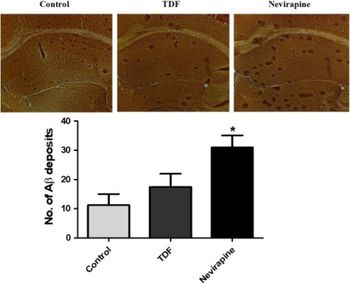
The last objective of the present study was to determine, through immunohistochemical analysis, whether ARV drugs affect Aβ deposition in the hippocampus. One-way ANOVA showed a main effect of treatment on the number of Aβ deposits in the hippocampus [F (2, 09) = 5.957, p = 0.0255]. Bonferroni post hoc test showed a significant increase in the number of Aβ deposits in the nevirapine group compared to control mice (p < 0.05, Fig. 5).
Effect of chronic administration of antiretroviral drugs, TDF and nevirapine, on Aβ deposition in the dorsal hippocampus (scale bar = 200 µm). Immunohistochemical staining for Aβ showed no significant increase in Aβ deposit number in the TDF-treated group compared to control animals. A significant increase in the number of Aβ deposition was observed in the nevirapine-treated group when compared to the control group (*p < 0.05). Data are presented as means ± SEM (n = 4 per group).

Discussion
Understanding the aetiology of HAND is critical for better management of HIV. Whether ARV drugs contribute to the development of HAND has not yet been clarified. This study subsequently set out to investigate whether chronic exposure to anti-HIV drugs (TDF and nevirapine) per se can negatively impact cognitive function. Since Aβ accumulation is among the neuropathologies observed in post-mortem brains of patients that were infected with HIV (Turner et al., Reference Turner, Chadwick, Horton, Simon, Jiang and Esposito2016; Solomon et al., Reference Solomon, de Girolami, Chettimada, Misra, Singer and Gabuzda2017), the present study tested the hypothesis that ARV drug treatment promote of Aβ and cognitive impairment. We further proposed that the accumulation of the Aβ is associated with drug-induced lipid peroxidation and the upregulation of the enzyme BACE1.
In the Morris water maze test, our findings showed that chronic exposure to nevirapine impaired spatial learning and memory. This finding is in line with a previous study by Romão et al. (Reference Romão, Lemos, Moreira, de Chaves, Moretti, Castro, Andrade, Boeck, Quevedo and Gavioli2011) which showed nevirapine treatment impaired recognition memory formation evaluated in the object recognition test in male CF-1 mice aged 60 days. These impairments were associated with lipid peroxidation (4-HNE), upregulation of BACE1 and increased Aβ in the hippocampus. Similarly, TDF treatment impaired learning and induced lipid peroxidation, but the effects were not as profound as nevirapine. Further, TDF did not affect BACE1expression and in Aβ deposition, despite an increase in Aβ. In overall, animals that were treated with TDF showed milder neurochemical changes than nevirapine-treated mice. These findings are consistent with previous in vitro studies showing that neuronal cell exposed to ARV had an increase Aβ production (Giunta et al., Reference Giunta, Ehrhart, Obregon, Lam, Le, Jin, Fernandez, Tan and Shytle2011; Brown et al., Reference Brown, Jin, Ferrell, Sadic, Obregon, Smith, Tan and Giunta2014b; Hui et al., Reference Hui, Ye, Soliman, Lakpa, Miller, Afghah, Geiger and Chen2019). Although the mechanisms by which ART promote Aβ are still unclear, a recent study by Hui et al. (Reference Hui, Ye, Soliman, Lakpa, Miller, Afghah, Geiger and Chen2019) found that nevirapine and TDF cause de-acidification endolysosomes and inhibited clearance of Aβ. Our findings are corroborate previous studies which showed that ARV treatment induce oxidative damage in mice (Zuena et al., Reference Zuena, Giuli, Venerosi Pesciolini, Tramutola, Ajmone-Cat, Cinque, Alema, Giovine, Peluso, Minghetti, Nicolai, Calamandrei and Casolini2013; de Oliveira et al., Reference de Oliveira, Damiani, Dias Rde, Romao and Andrade2014). We speculate that differences in effect between the two drugs can be attributed to (1) metabolisation of these drugs and (2) weak inhibition of DNA polymerase by TDF, as well as TDF previously reported limited penetration into the central nervous system (Birkus et al., Reference Birkus, Hajek, Kramata, Votruba, Holy and Otova2002; Ferrer & Rakhmanina, Reference Ferrer and Rakhmanina2013). On the other hand, the considerable deleterious effect of nevirapine on spatial learning and memory may be related to its ability to produce greater lipid peroxidation in the hippocampus. Lipid peroxidation indicated by 4-HNE in the present study signify a greater intensity of oxidative stress in the hippocampus leading to pathological conditions that may include cognitive dysfunction. This reasoning is plausible as several studies have associated with oxidative stress with brain ageing and neurodegenerative processes (Mariani et al., Reference Mariani, Polidori, Cherubini and Mecocci2005; Reddy et al., Reference Reddy, Reddy, Manczak, Calkins, Shirendeb and Mao2011; Montgomery et al., Reference Montgomery, Buttemer and Hulbert2012).
Studies suggest that NRTIs inhibit mitochondrial DNA polymerase-γ causing the depletion of mitochondrial DNA. This aberration in DNA quantity leads to excessive production of mitochondrial ROS which in turn may be responsible for oxidative damage to lipid, amino acid and DNA components of the cell (Bienstock & Copeland, Reference Bienstock and Copeland2004; Apostolova et al., Reference Apostolova, Blas-Garcia and Esplugues2011). Similarly, NNRTIs have shown to mediate cellular toxicity by inhibition of creatine kinase and cytochrome C complex IV activity in the brain (Apostolova et al., Reference Apostolova, Gomez-Sucerquia, Moran, Alvarez, Blas-Garcia and Esplugues2010; Streck et al., Reference Streck, Ferreira, Scaini, Rezin, Goncalves, Jeremias, Zugno, Ferreira, Moreira, Fochesato and Romao2011). Preclinical and clinical studies have linked NRTIs and NNRTIs exposure with cognitive dysfunction in HIV-1-infected individuals through mechanism involving oxidative stress (Akay et al., Reference Akay, Cooper, Odeleye, Jensen, White, Vassoler, Gannon, Mankowski, Dorsey and Buch2014a; Brown et al., Reference Brown, Jin, Ferrell, Sadic, Obregon, Smith, Tan and Giunta2014a; Sharma, Reference Sharma2014). It seems however that alternative downstream molecular mechanisms may be recruited by the different classes of ARVs resulting in the one drug (NNRTIs) showing greater iatrogenic damage than the other (NRTIs).
The aetiology of Alzheimer’s disease has been closely linked to oxidative stress and Aβ neurotoxicity (Hardy & Selkoe, Reference Hardy and Selkoe2002). BACE1 is regarded as a key enzyme in Aβ peptide synthesis (Vassar et al., Reference Vassar, Bennett, Babu-Khan, Kahn, Mendiaz, Denis, Teplow, Ross, Amarante, Loeloff, Luo, Fisher, Fuller, Edenson, Lile, Jarosinski, Biere, Curran, Burgess, Louis, Collins, Treanor, Rogers and Citron1999), and cleavage of APP by BACE1 is the initial step towards Aβ production. Different studies have shown that 4-HNE upregulates BACE1 in neuroblastoma cell lines and primary cortical cultures (Tamagno et al., Reference Tamagno, Parola, Bardini, Piccini, Borghi, Guglielmotto, Santoro, Davit, Danni, Smith, Perry and Tabaton2005, Reference Tamagno, Guglielmotto, Aragno, Borghi, Autelli, Giliberto, Muraca, Danni, Zhu, Smith, Perry, Jo, Mattson and Tabaton2008; de O’Leary et al., Reference de O’Leary, Obregon, Fernandez, Tan and Giunta2012), a finding supported by another study that showed elevated Aβ in wild-type mice following intracerebral infusion of 4-HNE (Arimon et al., Reference Arimon, Takeda, Post, Svirsky, Hyman and Berezovska2015). The link between lipid peroxidation, BACE1 expression and Aβ production has previously been established (Mouton-Liger et al., Reference Mouton-Liger, Paquet, Dumurgier, Bouras, Pradier, Gray and Hugon2012; Muche et al., Reference Muche, Arendt and Schliebs2017) (Fig. 6).
Diagram representing the sequence of events on antiretroviral drugs promoting Aβ production. (1) Antiretroviral promote reactive oxygen species (ROS). (2) ROS induce lipid peroxidation. (3) BACE1 expression and activity increased by lipid peroxidation. (4) Amyloid peptide (Aβ) generated following the sequential cleavage of its precursor, the amyloid-β precursor protein (AβPP) by BACE1.

Further support for our postulate comes from histopathological studies that identified Aβ accumulation in the central nervous system of HIV-positive patients on ART (Esiri et al., Reference Esiri, Biddolph and Morris1998; Brew et al., Reference Brew, Pemberton, Blennow, Wallin and Hagberg2005; Green et al., Reference Green, Masliah, Vinters, Beizai, Moore and Achim2005). Our results, therefore, support evidence that ART may contribute to the formation of Aβ in the brains of HIV-infected persons and that the observed Aβ deposits may partially stem from ARV treatment. We have also previously shown that TDF and nevirapine upregulate neuroinflammatory cytokine and astrogliosis in vivo (Zulu et al., Reference Zulu, Simola, Mabandla and Daniels2018). As such our findings point to a possibility that ART may be one of the aetiological factors of HAND and suggest that it may be worthwhile to investigate whether the supplementation of ARVs with agents that reduce oxidative stress hold any benefit to HIV-infected individuals on ART with respect to the possible development of HAND. In conclusion, this study demonstrated that ARV drugs, TDF and nevirapine, induce lipid peroxidation. Also, nevirapine promotes Aβ by upregulating BACE1 and AβPP production in the hippocampus and subsequently cause spatial learning and memory impairments. Therefore, consideration should be given to HIV medication since it might be among the factors that contribute to the persistence of neurocognitive disorders in HIV-infected persons on cART.
Supplementary material
To view supplementary material for this article, please visit https://doi.org/10.1017/neu.2020.19
Authors contributions
SSZ, WMUD and MVM conceived of the presented idea.
SSZ and OA carried out the experiments.
SSZ wrote the manuscript with support from WMUD, OA and NS
NS, WMUD contributed to the interpretation of the results
Critical revision of the article was done by MVM and OA.
All authors discussed the results and contributed to the final manuscript.
Financial support
The authors wish to thank the National Research Foundation of South Africa and the College of Health Sciences from the University of KwaZulu-Natal for their financial support. NS wishes to thank the Italian Ministry of Foreign Affairs (MAE) for financial support.
Statement of interest
Authors declare no competing interests.
Ethical standards
The authors assert that all procedures contributing to this work comply with the ethical standards of the relevant national and institutional guides on the care and use of laboratory animals.