INTRODUCTION
In coastal areas, hypoxia has increased in frequency, duration and severity during recent decades (Diaz & Rosenberg, Reference Diaz and Rosenberg2008), and is emerging as a major threat to marine biodiversity (Vaquer-Sunyer & Duarte, Reference Vaquer-Sunyer and Duarte2008). The onset of hypoxia is followed by a number of changes in the ecosystem that significantly affect conditions determining future survival (Conley et al., Reference Conley, Carstensen, Vaquer-Sunyer and Duarte2009). In particular, as hypoxia progresses, benthic microbial communities shift to sulphate reduction, and thus, sulphide concentrations increase in the environment (Conley et al., Reference Conley, Carstensen, Vaquer-Sunyer and Duarte2009). As a consequence, benthic macrofauna are exposed to sulphide, which may result in benthic mass mortality and diversity loss.
Since in situ sulphide accumulation and oxygen deficiency generally occur together, and both are stressors for marine organisms, it is likely that they have an additive negative effect on survival (Diaz & Rosenberg, Reference Diaz and Rosenberg1995). In fact, a stronger decrease in the survival of various benthic invertebrates (including bivalves, echinoderms, crustaceans and polychaetes) has been observed during hypoxic/anoxic periods in the presence of sulphide (e.g. Theede et al., Reference Theede, Ponat, Hiroki and Schlieper1969; Shumway et al., Reference Shumway, Scott and Shick1983; Levitt & Arp, Reference Levitt and Arp1991; Marcus et al., Reference Marcus, Lutz and Chanton1997; Laudien et al., Reference Laudien, Schiedek, Brey, Pörtner and Arntz2002). A meta-analysis of published experimental data revealed that combination of oxygen deficiency and exposure to sulphide reduced the survival times of several benthic invertebrates by 30% (Vaquer-Sunyer & Duarte, Reference Vaquer-Sunyer and Duarte2010).
Sulphide is a highly toxic substance for aerobic organisms. Nanomolar concentrations of sulphide reversibly bind to cytochrome c oxidase, inhibiting the respiratory chain (Nicolls & Kim, Reference Nicolls and Kim1982; Powell & Somero, Reference Powell and Somero1983, Reference Powell and Somero1986; Grieshaber & Völkel, Reference Grieshaber and Völkel1998). Exposure to sulphide induces adaptive mechanisms to avoid toxicity. Some of these mechanisms include sulphide oxidation by mitochondria and blood compounds, sulphide immobilization by precipitation with metal compounds, presence of sulphide-insensitive cytochrome c oxidase, and exclusion of sulphide at the body wall (Vetter et al., Reference Vetter, Powell, Somero and Bryant1991; Vismann, Reference Vismann1993; Diaz & Rosenberg, 1995; Grieshaber & Völkel, Reference Grieshaber and Völkel1998; Windoffer et al., Reference Windoffer, Jahn, Meyberg, Krieger and Giere1999; Hildebrandt & Grieshaber, Reference Hildebrandt and Grieshaber2008). These mechanisms are thought to be linked to energy consumption (Arp et al., Reference Arp, Childress and Vetter1987; Vetter et al., Reference Vetter, Wells, Kurtsman and Somero1987; Levitt & Arp, Reference Levitt and Arp1991). Therefore, up-regulation in anaerobic metabolism in order to compensate for the additional energy expenditure and subsequent faster glycogen consumption are likely to occur, resulting in an acceleration of hypoxia-driven mortality. Moreover, anaerobic metabolism results in the accumulation of protons and metabolic end-products (Hochachka & Somero, Reference Hochachka and Somero2002), and therefore, acid-base disturbance may also lead to the accelerated mortality. The fact that acceleration of anoxia-driven mortality and intensification of anaerobic metabolism in the presence of sulphide have been reported for some marine invertebrates, such as the surf clam Donax serra and the polychaete worms Arenicola marina, Nephtys hombergii and Marenzelleria wireni (Völkel et al., Reference Völkel, Auschild and Grieshaber1995; Arndt & Schiedek, Reference Arndt and Schiedek1997; Schiedek et al., Reference Schiedek, Vogan, Hardege and Bentley1997; Laudien et al., Reference Laudien, Schiedek, Brey, Pörtner and Arntz2002), supports this reasoning.
To test the hypothesis, we examined ark shell Anadara kagoshimensis (Tokunaga, 1906), a hypoxia-tolerant bivalve whose blood contains haemoglobin. The ark shell is indigenous to the Indo-Pacific region, inhabiting the sediments of intertidal and subtidal zones along the coasts of central and southern Japan, Korea and China (Yurimoto et al., Reference Yurimoto, Mori, Ito and Maeno2008). The clam used to be a dominant benthic species and a major target for fisheries in the brackish lagoon Lake Nakaumi in western Japan (Moriwaki & Michine, Reference Moriwaki and Michine2007). However, from the 1920s to the early 1930s, mass mortality of the clams was frequently observed during summer, whereas no such decline had been reported earlier (Ishii, Reference Ishii1931; Shimane Prefecture, 1934). Moreover, sulphide build-up in bottom waters in summer was first recorded during this period (Kitamura, Reference Kitamura1935), suggesting that the lagoon became increasingly exposed to severe hypoxia. In the 1950s, the stagnant portions covering nearly half the area of the lagoon became ‘dead zones’ (Shimane Prefecture, 1958; Kikuchi, Reference Kikuchi1964), and fishery harvest of the clams eventually ended in the early 1960s (Moriwaki & Michine, Reference Moriwaki and Michine2007). The stagnant bottom water became anoxic, accumulating >3 mmol L−1 sulphide (Sakai et al., Reference Sakai, Nakaya, Sampei, Dettman and Takayasu2013); hence, a recent study has speculated that the occurrence of sulphidic anoxia is a factor inhibiting the survival of the ark shell (Suzuki et al., Reference Suzuki, Yamaguchi and Seto2011).
In the present study, we examined whether sulphide exposure enhances anaerobic metabolism at summer temperatures, using the ark shell A. kagoshimensis, formerly misidentified in the Adriatic Sea as Scapharca inaequivalvis (Lipej et al., Reference Lipej, Mavrič, Orlando-Bonaca and Malej2012). In this species, accelerated anoxic mortality under sulphide exposure has been observed in the Northern Adriatic Sea population (De Zwaan et al., Reference De Zwaan, Cattan and Puzer1993), however; the combined effect of sulphide and oxygen deficiency on anaerobic metabolic activity has not been elucidated. To this end, we compared anoxic survival time at different sulphide-accumulation levels, and also assessed whether anaerobic metabolism was more pronounced under sulphidic anoxia than under anoxia incubation alone by conducting a series of anoxic incubations and biochemical analyses. The proliferation of anaerobic bacteria is known to occur under anoxic incubation, often resulting in sulphide accumulation even in frequently renewed incubation media (De Zwaan et al., Reference De Zwaan, Cattani, Vitali and Cortesi2001b, Reference De Zwaan, Babarro, Monari and Cattani2002; Babarro & De Zwaan, Reference Babarro and De Zwaan2008). Such exogenous sulphide accumulation will be an obstacle for comparisons between sulphide addition and no-addition (control) treatments; hence, we used antibiotic chloramphenicol (CA) to prevent this uncontrolled sulphide accumulation.
MATERIALS AND METHODS
Individuals
Cultured A. kagoshimensis individuals were used in this study, since the natural population in the lagoon Lake Nakaumi (35°27′59″N 33°11′29″E) is endangered. The ark shell was cultured in pearl nets at a depth of 1.0–1.5 m (temperature 4.9–28.4°C, salinity 17.3–24.6) (Uye et al., Reference Uye, Shimazu, Yamamuro, Ishitobi and Kamiya2000) in the lagoon, for a period of ~ 1.5 years after larval settlement. Mean shell length and wet weight of the clams were 19.3 ± 0.09 mm and 2.3 ± 0.04 g (mean ± SE), respectively. After collection in May 2010, individuals were immediately transported to the laboratory, placed in an aquarium containing well-aerated seawater (60 L) and acclimated to experimental conditions simulating the natural habitat of the clam during summer (temperature 28°C, salinity 30) over a period of 7 days. The salinity is known not to affect long-term survivorship, when compared with the salinity in the environment from which the test animals are collected, described above (Nakamura et al., Reference Nakamura, Shinagawa, Toda and Nakao1997). Seawater was obtained from the shore nearby the laboratory. During the acclimation period, dissolved oxygen (DO) was maintained at 100% by bubbling with air-stones, and animals were fed the diatom Chaetoceros ceratosporus. About 40% of the water was replaced daily to prevent ammonia accumulation.
Effect of sulphide accumulation on anoxic survival (Experiment 1)
The survival of A. kagoshimensis was investigated under anoxic conditions in three treatments: (i) a sulphide accumulation inhibition treatment, (ii) a low sulphide accumulation treatment and (iii) a high sulphide accumulation treatment. Filtered seawater was made anoxic in a 20-L reservoir by bubbling for 2 h with nitrogen gas. The salinity and pH of the anoxic seawater were ~30 and 8.2, respectively. Anoxic seawater was then transferred into nine 2-L incubation bottles under a continuous nitrogen flow. The sulphide inhibition (inhibited H2S) treatment was prepared by adding the antibiotic chloramphenicol (5 mg L−1) (CA) to the incubation media every 5 days. These media were not exchanged until the incubation was completed (i.e. static systems). CA has often been used to inhibit sulphide accumulation in anoxic/hypoxic bivalve incubations, by preventing the growth of facultative anaerobic bacteria such as Desulfobacteria and Desulfobulbus spp. (De Zwaan et al., Reference De Zwaan, Schaub and Babarro2001a, Reference De Zwaan, Cattani, Vitali and Cortesib; Babarro & De Zwaan, Reference Babarro and De Zwaan2008). The treatment of low sulphide accumulation (decreased H2S) was obtained by replacing 75% of the incubation media daily with freshly prepared anoxic seawater. The high sulphide accumulation (accumulated H2S) treatment was carried out as a static system using anoxic seawater without adding antibiotic CA throughout the experiment. In total, 90 animals were tested, 10 under the inhibited H2S, 10 under the decreased H2S and 10 under the accumulated H2S treatments each, with three replicates. The incubation bottles were sealed with rubber stoppers and incubated at 28°C mimicking summer anoxic conditions in the clam's natural habitat. No food was provided during the experiment.
In all treatments, the bottles were only opened shortly once a day to measure water variables (concentrations of oxygen and sulphide) and monitor the number of surviving individuals. Oxygen concentrations were recorded using a Hydrolab DS5 multiparameter sonde (calibrated by Winkler method), and DO never exceeded 0.3 mg O2 L−1. A 10-mL water sample was collected from each bottle with a syringe, in order to determine the sulphide concentration in incubation media. This was done using a modification of the methylene blue method (Cline, Reference Cline1969), aimed to avoid volatilization of hydrogen sulphide and simplify the sampling procedure (Sakai et al., Reference Sakai, Nakaya and Takayasu2004). Mortality was assessed by the failure of constriction after the mantle edges of gaping bivalves were touched. Dead animals were removed from the incubation bottles.
Effect of CA on survival under sulphidic anoxia (Experiment 2)
The survivorship of A. kagoshimensis was compared under anoxic conditions for (i) sulphide addition and (ii) sulphide addition with the addition of CA, with three replicates consisting of 10 clams per 2-L incubation bottle. Incubation media were prepared by adding washed crystals of Na2S × 9H2O to the anoxic seawater and dissolving by stirring to give an initial total sulphide concentration (sum of H2S, HS− and S2−) of ~ 2 mmol L−1. CA (5 mg L−1) was added to the latter treatment at the onset of the experiment. The incubation bottles were maintained at 28°C, and DO never exceeded 0.3 mg O2 L−1. Other details were as described in experiment 1.
Effects of sulphide accumulation on energy metabolism (Experiment 3)
Changes in the anaerobic substrate glycogen and the metabolic end-product propionate in the tissues of ark shells under anoxia were quantified in inhibited and accumulated H2S treatments, after 0.5–7 days incubations. Three replicates, consisting of four clams, were kept in the inhibited and accumulated H2S treatments during five different periods (0.5, 1, 2, 4 and 7 days). In total, 30 groups of animals (three replicates × 2 H2S treatments × 5 time periods) were investigated. In this experiment, 1-L incubation bottles were used. Mortality was assessed once a day, as described in experiment 1, and dead animals were immediately removed from the incubation bottles. After 0.5, 1, 2, 4 and 7 days, 3 bottles from each treatment were randomly selected (e.g. three out of 15 bottles were chosen at the first sampling event while at the last sampling event the 3 remaining bottles were sampled), and animals were collected for further analysis after measuring water variables (DO, pH and sulphide) in the incubation media. Nine individuals from the acclimation aquarium were sampled at the beginning of the experiment and considered as the 0-day individuals, and water variables from the prepared anoxic seawater were considered as the 0-day data. DO and pH were recorded using a Hydrolab DS5 multiparameter sonde. DO never exceeded 0.3 mg O2 L−1. Sampling and quantification of sulphide were conducted as described above.
The sampled clams were rapidly dissected by excising the posterior adductor muscle. If ≥3 animals per bottle survived at the end of the incubation, 3 individuals were pooled as a replicate. If fewer than 3 individuals survived, the animals were pooled. The nine 0-day animals were treated the same way. The adductor muscle samples were stored and frozen at −40°C until further analysis. The samples from the 7-days accumulated H2S incubation were not used for the following metabolite analyses due to insufficient sample size (only 1 animal of the three replicate treatments survived).
Extraction and analysis of metabolites
Frozen samples from experiment 2 were homogenized (1 g mL−1) in ice-cold 5% trichloro-acetic acid (TCA) using a Polytron homogenizer (PT 10–35; Polytron, Ltd). The homogenate was centrifuged (10 min, 10,000 g ) at 4°C. The resulting pellet was re-homogenized in four volumes of 5% TCA and centrifuged again. The first and second supernatants were then combined and neutralized with KOH for metabolite analysis. Propionate was determined by High Performance Liquid Chromatography (HPLC), according to Miyamoto & Iwanaga (Reference Miyamoto and Iwanaga2012), on a Shimadzu LC10. Glycogen was quantified as glucose by the anthrone-sulphuric acid method (Carroll et al., Reference Carroll, Longley and Roe1955) after precipitation of glycogen with 100% ethanol. Standard propionate and glucose were purchased from Wako Pure Chemical Industries, Ltd.
Statistical analysis
One-way analysis of variance (ANOVA) was performed to determine whether antibiotic CA affects survival of ark shell and sulphide concentration in incubation media at each day in experiment 2. Prior to the analyses, survival data was arcsine transformed in order to achieve normality and homoscedasticity. To determine whether sulphide accumulation affects survival, anaerobic metabolites in ark shell tissues (glycogen (G), propionate (P), and P:G ratio), and water variables (sulphide concentration and pH) in incubation media at each sampling event in experiment 3, one-way ANOVA was conducted. For the survival analyses, 0.5–7 days data were used, while for analysis of water variables and metabolites, the 7-days data were excluded as explained above. Survival and sulphide concentration data were, respectively, arcsine and log transformed, and glycogen and propionate data were square-root transformed. All statistical analyses were conducted using the statistical package R 2.13.1 (R Development Core Team, 2011).
RESULTS
Effect of sulphide accumulation on anoxic survival (Experiment 1)
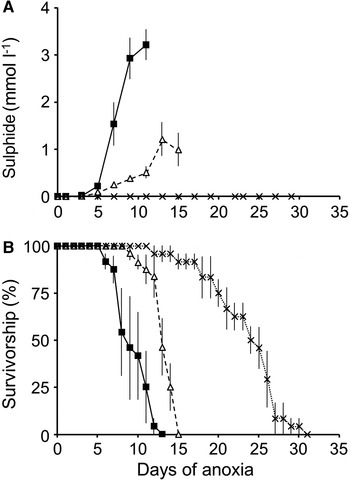
In the accumulated H2S treatment, sulphide accumulation was first detected on the fifth day and eventually attained a concentration of 3.2 ± 0.32 mmol l−1 at day-11 (mean ± SE) (Figure 1A). In the decreased H2S treatment, similar to the accumulated one, sulphide levels began increasing on the fifth day but this increase was lower (1.0 ± 0.36 mmol L−1 at day-15) (Figure 1A). In the inhibited H2S treatment, in contrast, sulphide accumulation was below detection limit throughout the experiment (Figure 1A).
Changes in the concentration of sulphide in incubation media (A) and survival of Anadara kagoshimensis (B) under accumulated-H2S (■), decreased-H2S (△), and inhibited-H2S (×) incubation treatments in experiment 1 (Mean ± SE). In the inhibited-H2S incubation, sulphide accumulation remained undetected throughout the experiment and is thus not apparent in Figure 1A.

The sulphide treatment also affected the anoxic survival time of A. kagoshimensis (Figure 1B). The mean survival time (LT50) in the accumulated H2S treatment was 8.9 ± 1.88 days (mean ± 95% bootstrapped CI). On the other hand, the LT50 in the decreased and inhibited H2S treatments were 13.1 ± 0.74 days (1.5 times higher than the accumulated H2S treatment) and 24.3 ± 1.88 days (2.7 times higher than the accumulated one), respectively (Figure 1B). The lack of overlap between CIs indicates that both the decreased and the inhibited H2S treatments significantly increased the anoxic survival time of this species, when compared with the accumulated H2S treatment.
Effect of CA on survival under sulphidic anoxia (Experiment 2)
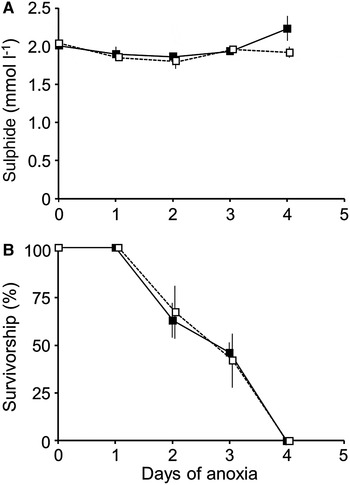
The initial concentration of ~2 mmol L−1 sulphide decreased during the 4-days incubation; however, it never decreased below 1.8 mmol L−1. When the bivalves were dying, there was an increase in sulphide concentration, especially in the absence of CA (Figure 2A). The sulphide level on each day did not differ significantly between the treatments (Figure 2A).
Changes in the concentration of sulphide in incubation media (A) and survival of Anadara kagoshimensis (B) under H2S addition (■) and H2S addition with the addition of CA (□) incubation treatments in experiment 2 (Mean ± SE). ANOVAs did not detect significant difference (P < 0.05) between the treatments at each day for the sulphide concentration and the survivorship.

A decrease in survival was observed from day 2 to day 4 for both treatments, and the survivorship on each day did not differ significantly between the treatments (Figure 2B). The mean survival time (LT50) in the absence and presence of CA did not differ significantly (LT50 (−CA): 2.7 ± 0.18 days (mean ± SE); LT50(+CA): 2.6 ± 0.43 days, 1-way ANOVA: F = 0.20, P = 0.68).
Effects of sulphide accumulation on energy metabolism (Experiment 3)
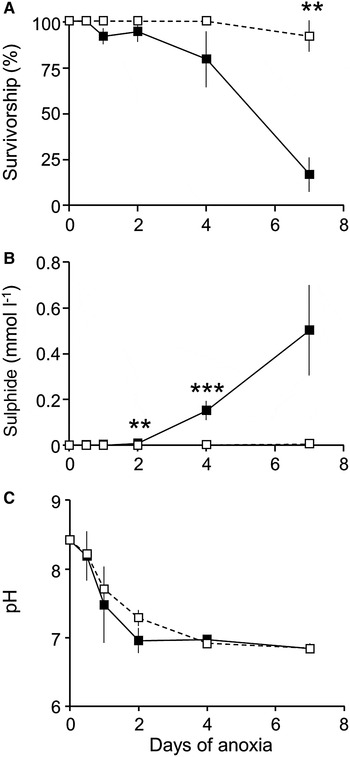
A rapid decrease in survival was observed from day 4 to day 7 in the accumulated H2S treatment, whereas, in the inhibited H2S one, most individuals (>90%) survived during the entire experimental period (7 days) (Figure 3A). This significant difference in survival between the two treatments was detected only at the final sampling event (Figure 3A). An increase in sulphide level was detected in the accumulated H2S treatment from day-2, before mortality was observed. However, no significant sulphide accumulation was detected in the inhibited H2S treatment throughout the experiment (Figure 3B). Significant effects of H2S accumulation were detected after day 2 (Figure 3B). Mean pH decreased from 8.4 to 6.8 in both the accumulated and the inhibited H2S treatments, whereby no significant difference was detected between treatments at all sampling events (Figure 3C).
Survival of Anadara kagoshimensis (A), changes in concentration of sulphide (B), and pH (C) in incubation media under accumulated-H2S (■) and inhibited-H2S (□) incubation treatments in experiment 3 (Mean ± SE). ANOVA results: **: significant difference between H2S treatments at P < 0.01; ***: significant difference at P < 0.001.

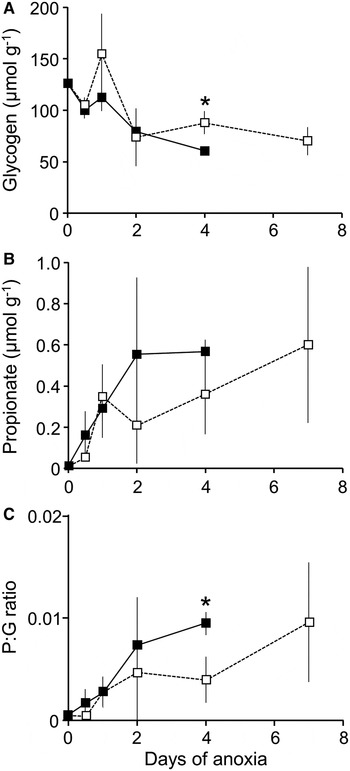
Glycogen concentration in the ark shell decreased during the anoxic period in both the accumulated and the inhibited H2S treatments. However, significantly larger glycogen consumption occurred in the accumulated H2S treatment on day 4, after the significant increase in sulphide was detected (Figures 3B & 4A). Tissue glycogen content in survivors from the accumulated H2S treatment after 4 days of incubation was about 0.7 times that in the inhibited H2S treatment. In contrast, propionate concentrations gradually increased in both treatments (Figure 4B), and no significant treatment effects were detected. The P:G ratio, i.e. the relative propionate concentration per unit of glycogen, showed almost identical temporal changes to propionate, but a significantly larger value was observed at day 4 in the accumulated H2S treatment (Figure 4C). The P:G ratio in live bivalves from the accumulated H2S treatment after 4 days of incubation was about 2.4 times that in the inhibited H2S treatment (Figure 4C).
Changes in the concentration of anaerobic metabolites in the adductor muscle of Anadara kagoshimensis under accumulated-H2S (■) and inhibited-H2S (□) incubation treatments. (A) glycogen, (B) propionate, (C) propionate relative to a unit of glycogen (P:G ratio) in experiment 3 (Mean ± SE). ANOVA results: *: significant difference between H2S treatments at P < 0.05.

DISCUSSION
Both media replacement and the addition of the antibiotic CA successfully decreased and inhibited sulphide accumulation in incubation media, when compared with control (accumulated H2S) incubation (Figure 1A). Moreover, both the decreased and inhibited H2S incubations prolonged the anoxic survival times of A. kagoshimensis; the decreased and inhibited H2S resulted in ~ 1.5- and 3-fold increases in LT50, respectively, over the LT50 of the accumulated H2S treatment (Figure 1B). Similar results in the CA-added anoxic incubation were observed for the Northern Adriatic Sea population; CA addition resulted in delayed sulphide accumulation and increased anoxic LT50 (De Zwaan et al., Reference De Zwaan, Cattani, Vitali and Cortesi2001b, Reference De Zwaan, Babarro, Monari and Cattani2002). These results, including those of this study, appear to suggest that the increased anoxic survival time is due to the suppressed accumulation of the exogenous sulphide. However, de Zwaan et al. (Reference De Zwaan, Cattani, Vitali and Cortesi2001b, Reference De Zwaan, Babarro, Monari and Cattani2002) concluded that the suppressed sulphide accumulation had less effect on the positive CA effect on anoxic survival than did the inhibition of the proliferation of pathogenic bacteria by the antibiotic. Indeed, de Zwaan et al. (Reference De Zwaan, Cattani, Vitali and Cortesi2001b) found that the anoxic LT50 of the clam increased as a result of CA addition, despite adding sulphide to the incubation media.
In contrast, we did not detect this beneficial effect of CA addition on LT50 under sulphidic anoxia in the second experiment (Figure 2B), which simulated the sulphide concentration when the clams started dying in the accumulated H2S incubation in the first experiment (Figure 1A, B). Hence, our results suggest that the increased survival times in the decreased and inhibited H2S incubations were mediated not by the pathogenic bacteria, but by sulphide toxicity. The absence of the CA effect implies that the deleterious effect of sulphide is much greater than the beneficial effect of the antibiotic (i.e. that of the inhibition of pathogenic bacterial proliferation) on the clam's survival. This is probably due to the greater toxicity of the sulphide in our incubations, owing to the addition of higher concentrations of sulphide (2 mmol−1) at higher incubation temperatures (28°C), when compared with the incubations in the study by de Zwaan et al. (Reference De Zwaan, Cattani, Vitali and Cortesi2001b) (who added 0.4 mmol−1 sulphide and incubated at 18°C).
During sustained anoxia, the ark shell is known to consume glycogen and accumulate volatile fatty acids (propionate and acetate) in tissue cells owing to anaerobic respiration, whereas aspartate consumption and the accumulation of succinate, malate, and alanine occur only in the early stage of anaerobiosis (De Zwaan et al., Reference De Zwaan, Isani, Cattani and Cortesi1995; Miyamoto & Iwanaga, Reference Miyamoto and Iwanaga2012). In prolonged anaerobiosis, a larger (three times more) amount of propionate accumulates than of acetate (De Zwaan et al., Reference De Zwaan, Isani, Cattani and Cortesi1995), suggesting that propionate is a major product of the fermentation. In this study, the progressive accumulation of propionate and depletion of glycogen in the adductor muscle of the ark shell were detected in the inhibited and the accumulated H2S treatments (Figures 4A, B), indicating that anaerobic metabolism was activated under both anoxic conditions (with sulphide-accumulation and without). This is not surprising because anaerobic energy metabolism can be triggered by either environmental oxygen deficiency or by inhibition of the respiratory chain due to exposure to sulphide (De Zwaan et al., Reference De Zwaan, Cattan and Puzer1993; Grieshaber & Völkel, Reference Grieshaber and Völkel1998).
However, the pattern of glycogen depletion differed between the two treatments. After the detection of significant amounts of sulphide in the accumulated H2S treatment (Figure 3B), on day-4, a greater amount of glycogen consumption was observed in this incubation than in the inhibited H2S one (Figure 4A). In addition, a higher P:G ratio was also observed in the accumulated H2S treatment on the same day (Figure 4C), suggesting that the anaerobiosis was more pronounced in the presence of sulphide under anoxia. Anaerobic metabolism in the ark shell is also known to be enhanced under sulphide exposure even in the presence of oxygen. De Zwaan et al. (Reference De Zwaan, Cattan and Puzer1993) reported that the anaerobic pathways clearly operated at higher rates in the presence of sulphide under oxic conditions than under anoxic condition alone. Therefore, it is likely that the presence of sulphide accelerates anaerobic metabolism in the clam. However, it is not evident whether the anaerobic metabolism is more accelerated by sulphide under anoxia than a normoxic environment.
A similar reduction in anoxic survival and more pronounced anaerobic metabolism in the presence of sulphide has also been reported in other marine invertebrates, including the surf clam D. serra and the polychaete worms Arenicola marina, Nephtys hombergii and Marenzelleria wireni (Völkel et al., Reference Völkel, Auschild and Grieshaber1995; Arndt & Schiedek, Reference Arndt and Schiedek1997; Schiedek et al., Reference Schiedek, Vogan, Hardege and Bentley1997; Laudien et al., Reference Laudien, Schiedek, Brey, Pörtner and Arntz2002). However, a different metabolic response to exposure to sulphide under anoxia has been reported in some bivalve species. For instance, anoxic conditions in the presence of sulphide did not affect the utilization of glucose, glycogen and aspartate reserves in M. secta, while sulphide tolerant M. nasta displayed higher contents of these energy reserves under sulphidic anoxia than in anoxia alone (Levitt & Arp, Reference Levitt and Arp1991). Despite the different anaerobic metabolism responses to sulphide exposure (e.g. increase, equilibrium and decrease in metabolic rates), the survival times of these species decreased after exposure to anoxia in the presence of sulphide than to anoxia alone (Vaquer-Sunyer & Duarte, Reference Vaquer-Sunyer and Duarte2010). This may suggest that the way the presence of sulphide affects anaerobic metabolism is species-dependent, while survival time is generally shortened under oxygen-depletion.
In summary, our study illustrated that sulphide accumulation in the environment accelerates anoxia-driven mortality and leads to more pronounced anaerobic metabolism in the ark shell A. kagoshimensis. It seems possible that the enhanced anaerobic metabolism results in a more rapid breakdown of glycogen, consequently leading to the observed accelerated mortality in the presence of sulphide accumulation. However, we could not find evidence that the more pronounced anaerobiosis was a cause of the accelerated mortality. Further experiments are required to establish the link between energy metabolism and anaerobic survival under sulphide exposure.
ACKNOWLEDGEMENTS
The authors would like to thank H. Semura, T. Sasaki and H. Hirakiuchi at the Inland Water Fisheries and Coastal Fisheries Division in Shimane Prefecture for providing ark shells, A. Kato at the Tottori Institute of Industrial Technology for the organic acid analysis, and Dr A Shinagawa at Gakusyuin Woman's College for his advice on biochemical analyses. Reviewers provided valuable comments on the manuscript.
FINANCIAL SUPPORT
This work was supported by research project funds from the Agriculture, Forestry and Fisheries Research Council (Operation to Develop Practical Technology to Promote New Agriculture, Forestry, and Fisheries Technology 21007).