INTRODUCTION
Cryptosporidium spp. are parasitic protists that infect a wide range of vertebrates including humans (Xiao and Ryan, Reference Xiao and Ryan2004; Xiao, Reference Xiao2010). The parasite causes self-limiting diarrhoea in immunocompetent individuals but may be chronic and life threatening to those that are immunocompromised (Hunter et al. Reference Hunter, Hadfield, Wilkinson, Lake, Harrison and Chalmers2007). Humans can acquire Cryptosporidium infections through various transmission routes, such as direct contact with infected persons (person-to-person transmission) or animals (zoonotic transmission) and ingestion of contaminated food (foodborne transmission) or water (waterborne transmission) (Karanis et al. Reference Karanis, Kourenti and Smith2007; Xiao, Reference Xiao2010). Molecular data indicate that 7 Cryptosporidium species/genotypes are responsible for most human cryptosporidiosis cases, including C. hominis, C. parvum, C. meleagridis, C. felis, C. canis, C. ubiquitum, C. cuniculus (Xiao and Feng, Reference Xiao and Feng2008; Xiao, Reference Xiao2010; Chalmers et al. Reference Chalmers, Elwin, Hadfield and Robinson2011) with C. parvum and C. hominis by far the most common species in humans worldwide (Xiao, Reference Xiao2010).
In Australia, 3 Cryptosporidium species (C. hominis, C. parvum and C. meleagridis) have been identified in humans in Western Australia (WA), New South Wales (NSW), Victoria (VIC) and South Australia (SA), with C. hominis being the most frequently identified species of the 3 (Robertson et al. Reference Robertson, Sinclair, Forbes, Veitch, Cunliffe, Willis and Fairley2002; Chalmers et al. Reference Chalmers, Ferguson, Cacciò, Gasser, Abs EL-Osta, Heijnen, Xiao, Elwin, Hadfield, Sinclair and Stevens2005; Jex et al. Reference Jex, Whipp, Campbell, Caccio, Stevens, Hogg and Gasser2007; Ng et al. Reference Ng, Eastwood, Durrheim, Massey, Walker, Armson and Ryan2008; O'Brien et al. Reference O'Brien, McInnes and Ryan2008, Jex et al. Reference Jex, Pangasa, Campbell, Whipp, Hogg, Sinclair, Stevens and Gasser2008; Alagappan et al. Reference Alagappan, Tujula, Power, Ferguson, Bergquist and Ferrari2008; Waldron et al. Reference Waldron, Ferrari, Gillings and Power2009a, Reference Waldron, Ferrari and Powerb; Ng et al. Reference Ng, MacKenzie and Ryan2010a,Reference Ng, Pingault, Gibbs, Koehler and Ryanb; Reference Ng, Eastwood, Walker, Durrheim, Massey, Porigneaux, Kenp, McKinnon, Laurie, Miller, Bramley and Ryan2012; Waldron and Power, Reference Waldron and Power2011; Waldron et al. Reference Waldron, Dimeski, Beggs, Ferrari and Power2011a,Reference Waldron, Ferrari, Cheung-Kwok-Sang, Beggs, Stephens and Powerb). Recently, C. fayeri, C. andersoni and C. bovis have been identified in individual human cases in NSW (Waldron et al. Reference Waldron, Cheung-Kwok-Sang and Power2010, Reference Waldron, Dimeski, Beggs, Ferrari and Power2011a; Ng et al. Reference Ng, Eastwood, Walker, Durrheim, Massey, Porigneaux, Kenp, McKinnon, Laurie, Miller, Bramley and Ryan2012).
A major mode of transmission of Cryptosporidium is via contaminated drinking and recreational waters. The oocyst is the environmentally stable stage and is able to survive and penetrate routine wastewater treatment and is resistant to inactivation by commonly used drinking water disinfectants (Fayer et al. Reference Fayer, Morgan and Upton2000). Of the waterborne protozoan parasitic outbreaks that have been reported worldwide between 2004 and 2010, Cryptosporidium was the aetiological agent in 60·3% (120) of the outbreaks (Baldursson and Karanis, Reference Baldursson and Karanis2011). Oocyst transport to surface water can occur by deposition of manure directly in the water or by wash off in surface runoff. Humans, wildlife and domestic livestock all potentially contribute Cryptosporidium to surface waters. A significant knowledge gap in assessing microbial risks to surface waters is the lack of genotyping data on the contribution of animal hosts to human pathogenic strains of Cryptosporidium in drinking water catchments in Australia. Identification of the sources/carriers of human pathogenic strains is essential for accurate risk assessment and catchment management.
This review examines the current information from Australia on the prevalence and genotypes of Cryptosporidium identified in wildlife and domestic livestock to assist our understanding of the key host species contributing human pathogenic Cryptosporidium species to Australian water catchments.
SPECIES AND STRAINS OF CRYPTOSPORIDIUM INFECTING WILDLIFE
Wildlife population density
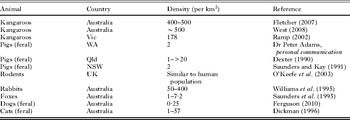
Animal density by area is an important determinant of pathogen loadings as higher animal density results in a larger volume of manure excreted per unit area. Thus there is an increase in pathogen source material that may be transported in runoff to surface waters and/or deposited directly to streams (Ferguson, Reference Ferguson2010). It is difficult to quantify animal densities for wildlife, because animal movement is uncontrolled and because animal populations vary with season and environmental conditions, with many species being migratory but published values and estimates are summarized in Table 1.
Estimates of wildlife animal density for native vegetation land use areas

Volume of wildlife manure
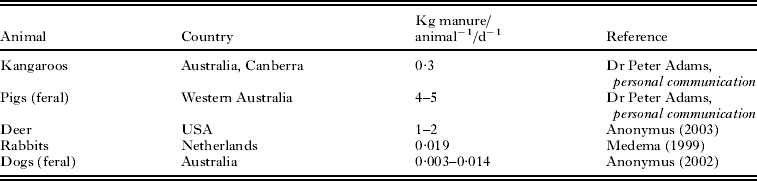
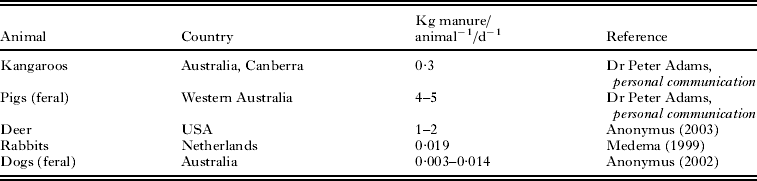
Manure excretion rates and volumes for wildlife are less well documented than for domestic animals. An estimate of the volume of manure produced by wildlife, however, is important to assess the impact of wildlife manure on catchments. Estimates of manure production rates for wildlife are shown in Table 2.
Manure production rates for wildlife animals
Marsupials
In Australia, marsupials are the dominant animals inhabiting many water catchment areas (Power, Reference Power2010) with densities >500 per square km sometimes recorded (West, Reference West2008). Therefore, it is important to determine the potential role that marsupial species play in the dissemination of Cryptosporidium to drinking water sources and the associated human health risks associated with this. To date, Cryptosporidium has been identified in 15 Australian marsupial species and 7 of these host species belong to the family Macropodidae (kangaroos and wallabies) (Power, Reference Power2010; Yang et al. Reference Yang, Fenwick, Potter, Ng and Ryan2011; Dowle et al., unpublished observations).
The prevalence of Cryptosporidium in marsupials varies, as does the oocyst shedding rate. In New South Wales (NSW), the prevalence of Cryptosporidium in fecal samples from eastern grey kangaroos (Macropus giganteus) was 6·3% (239/3,557) (Power et al. Reference Power, Sangster, Slade and Veal2005). Oocyst shedding ranged from 20/g feces to 2·0 × 106/g feces (Power et al. Reference Power, Sangster, Slade and Veal2005). Another study in NSW on common brushtail possums (Trichosurus vulpecula) reported that Cryptosporidium occurred with a higher prevalence in possums from urban habitats (11·3%) than in possums from woodland habitats (5·6%) (Hill et al. Reference Hill, Deane and Power2008). In Western Australia (WA), the prevalence of Cryptosporidium in wild western grey kangaroos (Macropus fuliginosus), was 9·3% (Yang et al. Reference Yang, Fenwick, Potter, Ng and Ryan2011). Prevalences can be seasonal with one study in NSW on eastern grey kangaroos reporting the highest rate was found in autumn (Power et al. Reference Power, Slade, Sangster and Veal2004), while a study in WA on western grey kangaroos reported that the highest prevalence was detected in summer (Yang et al. Reference Yang, Fenwick, Potter, Ng and Ryan2011).
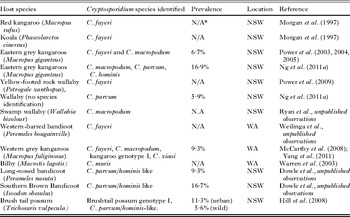
The main species identified in marsupials are C. fayeri and C. macropodum (previously marsupial genotype I and II) (Morgan et al. Reference Morgan, Constantine, Forbes and Thompson1997; Power et al. Reference Power, Slade, Sangster and Veal2004, Reference Power, Sangster, Slade and Veal2005, Reference Power, Cheung-Kwok-Sang, Slade and Williamson2009; McCarthy et al. Reference McCarthy, Ng, Gordon, Miller, Wyber and Ryan2008; Power and Ryan, Reference Power and Ryan2008; Ryan et al. Reference Ryan, Power and Xiao2008; Power, Reference Power2010; Ng et al. Reference Ng, Yang, Whiffin, Cox and Ryan2011a). Cryptosporidium fayeri and C. macropodum have been reported in a red kangaroo (Macropus rufus), a koala (Phascolarctos cinereus), eastern grey kangaroos, (M. giganteus), western grey kangaroos (M. fuliginosus), a yellow-footed rock wallaby (Petrogale xanthopus), a swamp wallaby (Wallabia bicolour), a wallaby (no species identification) and a western-barred bandicoot (Peremeles bougainville) (Morgan et al. Reference Morgan, Constantine, Forbes and Thompson1997; Power et al. Reference Power, Slade, Sangster and Veal2004; Reference Power, Cheung-Kwok-Sang, Slade and Williamson2009; McCarthy et al. Reference McCarthy, Ng, Gordon, Miller, Wyber and Ryan2008; Ryan et al., unpublished observations; Weilinga et al., unpublished observations; Yang et al. Reference Yang, Fenwick, Potter, Ng and Ryan2011; Ng et al. Reference Ng, Yang, Whiffin, Cox and Ryan2011a) (Table 3). Neither of these species is associated with diarrhoea in their marsupial hosts (Power and Ryan, Reference Power and Ryan2008; Ryan et al. Reference Ryan, Power and Xiao2008); however, C. fayeri has recently been identified in a 29-year-old woman in Sydney in 2009 (Waldron et al. Reference Waldron, Cheung-Kwok-Sang and Power2010). The woman was immuno-competent but suffered prolonged gastrointestinal illness. The patient resided in a national forest on the east coast of New South Wales, Australia, an area where marsupials are abundant. She had frequent contact with partially domesticated marsupials (Waldron et al. Reference Waldron, Cheung-Kwok-Sang and Power2010). Identification of C. fayeri in a human patient is a concern for water catchment authorities in the Sydney region. The main water supply for Sydney, Warragamba Dam, covers 9050 km2 and is surrounded by national forest inhabited by diverse and abundant marsupials. The same C. fayeri subtype (IVaA9G4T1R1) was also identified in eastern grey kangaroos in Warragamba Dam (Power et al. Reference Power, Cheung-Kwok-Sang, Slade and Williamson2009).
Cryptosporidium species identified in marsupial hosts in Australia

* N/A, not attempted (in many cases only 1 sample was available).
In addition to C. fayeri and C. macropodum, there have been several other host-adapted strains identified in Australian marsupials. Possum genotype I has been described in brush tail possums, a host species found in a range of habitats throughout Australia (Hill et al. Reference Hill, Deane and Power2008) and the novel kangaroo genotype I in western grey kangaroos (Yang et al. Reference Yang, Fenwick, Potter, Ng and Ryan2011). These Cryptosporidium genotypes were genetically distinct and the range of genetic similarities to all other Cryptosporidium species at the 18S rRNA locus was 87·4–97·4% and at the actin locus it was 77·9–86·5%. This is within the range of the percentage similarities between currently accepted Cryptosporidium species at the 18S rRNA locus (89–99·8%) and the actin locus (76–98·7%) and is one of the criteria used to delimit species within the genus Cryptosporidium (Xiao and Ryan, Reference Xiao and Ryan2004). Possum genotype 1 and kangaroo genotype I have not been reported in humans or other animals, and the zoonotic potential is unknown.
Cryptosporidium species typically found in non-marsupial mammalian hosts have also been reported in marsupial species. Cryptosporidium muris, commonly found in rodents, has been identified in bilbies (Macrotis lagotis) (Warren et al. Reference Warren, Swan, Morgan-Ryan, Friend and Elliot2003). In that report, oocyst morphology combined with molecular analyses confirmed the presence of C. muris in 11/28 (39·2%) bilbies housed at a captive breeding colony in WA (Warren et al. Reference Warren, Swan, Morgan-Ryan, Friend and Elliot2003). One mouse was trapped in the breeding enclosures and found to be positive for C. muris. It is likely that the bilbies acquired the infection from mice by fecal contamination of food and water. Cryptosporidium xiaoi, commonly found in sheep, has been identified in 6 wild western grey kangaroos in WA (Yang et al. Reference Yang, Fenwick, Potter, Ng and Ryan2011). The identification of C. xiaoi in the kangaroos suggests that they may have picked up the infection from grazing on sheep pastures. In a previous study on sheep, C. fayeri was identified in 4 sheep fecal samples (Ryan et al. Reference Ryan, Bath, Robertson, Read, Elliot, McInnes, Traub and Besier2005), indicating that grazing on contaminated pastures can result in transmission. Whether the kangaroos were actually infected or simply mechanically transmitting the organism remains to be determined.
There have also been reports of C. parvum and C. hominis in kangaroos (M. giganteus, a wallaby (no species identification), possums (Trichosuris vulpecula) and bandicoots (Isoodon obesulus) (Ng et al. Reference Ng, Yang, Whiffin, Cox and Ryan2011a; Hill et al. Reference Hill, Deane and Power2008; Dowle et al., unpublished observations). These identifications were based on direct DNA extraction from feces and subsequent PCR screening. In all cases Cryptosporidium could only be amplified at the multi-copy 18S rDNA locus, other loci tested were single copy targets (Ng et al. Reference Ng, Yang, Whiffin, Cox and Ryan2011a; Hill et al. Reference Hill, Deane and Power2008; Dowle et al., unpublished observations). The inability to amplify other loci may be due to low levels of Cryptosporidium present in the samples. Immunomagnetic separation coupled to cell sorting was used to determine oocyst numbers in C. parvum and C. hominis positive fecal samples in bandicoots and possums (Hill et al. Reference Hill, Deane and Power2008; Dowle et al., unpublished observations). The authors reported that most samples contained less than 10 oocysts per gramme of feces. In those studies, the marsupial hosts were inhabiting areas associated with humans. It remains to be determined whether these marsupials were actually infected with C. parvum or C. hominis or whether they were simply passively transmitting the oocysts. Further studies are required to clarify the potential role that marsupials play in contamination of the catchment with human-infectious oocysts.
Feral and domestic pigs
Pigs were introduced to Australia with the First Fleet in 1788 and today domestic pigs are agriculturally important, in addition to being pest species. Feral pig populations are now found within 40% of Australia's ecosystem (West, Reference West2008) and represent a potential risk to drinking water supplies. It has been reported that Australia has the largest number of wild pigs in the world with an estimated 23 million feral pigs (Hampton et al. Reference Hampton, Spencer, Elliot and Thompson2006). The high density of feral pigs, their foraging and wallowing behaviour of pigs, which can markedly increase the turbidity of water supplies and their ability to transmit and excrete a number of infectious waterborne organisms pathogenic to humans have made them a target for intense management for the protection of source (drinking) water supplies (Atwill et al. Reference Atwill, Sweitzer, Pereira, Gardner, Van Vuren and Boyce1997; Hampton et al. Reference Hampton, Spencer, Elliot and Thompson2006).
Little is known about the prevalence of Cryptosporidium in feral pigs. A study in California reported that 12 (5·4%) of 221 feral pigs were shedding Cryptosporidium oocysts (Atwill et al. Reference Atwill, Sweitzer, Pereira, Gardner, Van Vuren and Boyce1997). The authors also reported that younger pigs (<or = 8 months) and pigs from high-density populations (>2·0 feral pigs/km2) were significantly more likely to shed oocysts compared to older pigs (>8 months) and pigs from low-density populations (<or = 1·9 feral pigs/km2) (Atwill et al. Reference Atwill, Sweitzer, Pereira, Gardner, Van Vuren and Boyce1997). This trend makes reduction of feral pig abundance in high-density catchment areas even more important to reduce the risk of waterborne feral pig pathogens being introduced to reservoirs. In Spain, a prevalence of 7·6% was reported for wild boar and infections were significantly higher in juvenile male wild boars (22%) than in adult males (6%) (Castro-Hermida et al. Reference Castro-Hermida, García-Presedo, González-Warleta and Mezo2011). The mean intensity of infection by Cryptosporidium was 5 to 200 oocysts per gramme of faeces (Castro-Hermida et al. Reference Castro-Hermida, García-Presedo, González-Warleta and Mezo2011). A study in WA reported a prevalence of 0·3% (1/292) (Hampton et al. Reference Hampton, Spencer, Elliot and Thompson2006). Genotyping attempts were unsuccessful. A more recent study of 237 wild pigs in WA, did not identify Cryptosporidium by PCR (Pallant et al., unpublished observations).
Studies in Australia on domestic pigs have identified prevalence rates of 6–22·1% (Ryan et al. Reference Ryan, Samarasinghe, Read, Buddle, Robertson and Thompson2003, Reference Ryan, Monis, Enemark, Sulaiman, Samarasinghe, Read, Buddle, Robertson, Zhou, Thompson and Xiao2004; Johnson et al. Reference Johnson, Buddle, Reid, Armson and Ryan2008). The main Cryptosporidium species identified in pigs in Australia and worldwide are C. suis and pig genotype II, although C. muris, C. tyzzeri and C. parvum have also been reported (Ryan et al. Reference Ryan, Samarasinghe, Read, Buddle, Robertson and Thompson2003; Xiao et al. Reference Xiao, Moore, Ukoh, Gatei, Lowery, Murphy, Dooley, Millar, Rooney and Rao2006; Zintel et al. Reference Zintl, Neville, Maguire, Fanning, Mulcahy, Smith and De Waal2007; Johnson et al. Reference Johnson, Buddle, Reid, Armson and Ryan2008; Kvác et al. Reference Kvác, Hanzlíková, Sak and Kvetonová2009a; Jeníková et al. Reference Jeníková, Němejc, Sak, Květoňová and Kváč2010; Jenkins et al. Reference Jenkins, Liotta, Lucio-Forster and Bowman2010; Sevá Ada et al. Reference Sevá Ada, Funada, Souza Sde, Nava, Richtzenhain and Soares2010; Xiao, Reference Xiao2010; Wang et al. Reference Wang, Qiu, Jian, Zhang, Shen, Zhang, Ning, Cao, Qi and Xiao2010a; Budu-Amoako et al. 2012; Chen et al. Reference Chen, Mi, Yu, Shi, Huang, Chen, Zhou, Cai and Lin2011; Farzan et al. Reference Farzan, Parrington, Coklin, Cook, Pintar, Pollari, Friendship, Farber and Dixon2011; Fiuza et al. Reference Fiuza, Gallo, Frazão-Teixeira, Santín, Fayer and Oliveira2011a; Yin et al. Reference Yin, Shen, Yuan, Lu, Xu and Cao2011). Cryptosporidium suis has been reported in humans (Xiao et al. Reference Xiao, Bern, Arrowood, Sulaiman, Zhou, Kawai, Vivar, Lal and Gilman2002a; Xiao, Reference Xiao2010) and has frequently been recovered from water samples (Feng et al. Reference Feng, Zhao, Chen, Jin, Zhou, Li, Wang and Xiao2011a). Pig genotype II has also been reported in an immunocompetent human (Kvác et al. Reference Kvác, Kvetonová, Sak and Ditrich2009b).
Cryptosporidium parvum has been reported once in pigs from an indoor farm in Western Australia, in four 19-day-old pre-weaned piglets with diarrhoea (Morgan et al. Reference Morgan, Buddle, Armson, Elliot and Thompson1999a). There have been 4 additional reports of C. parvum in pigs internationally; in asymptomatic sows from intensive commercial pig production units in Ireland (Zintel et al. Reference Zintl, Neville, Maguire, Fanning, Mulcahy, Smith and De Waal2007); in 2 piglets from Prince Edward Island, Canada (Budu-Amoako et al. Reference Budu-Amoako, Greenwood, Dixon, Barkema, Hurnik, Estey and McClure2012), in piglets in Ontario where it was the post prevalent species detected (55·4%) (Farzan et al. Reference Farzan, Parrington, Coklin, Cook, Pintar, Pollari, Friendship, Farber and Dixon2011) and in pig slurry lagoons in the US (Jenkins et al. Reference Jenkins, Liotta, Lucio-Forster and Bowman2010). This suggests that pigs may play an important role in the transmission of zoonotic Cryptosporidium. However, further research is required to understand the prevalence of Cryptosporidium species in feral pigs.
Deer
Cryptosporidium species have been found in various species of deer and the prevalence rates differed by study locations and animal species ranging from 0–100% (cf. Feng, Reference Feng2010). Cryptosporidium ubiquitum, the deer genotype, C. parvum and a C. hominis-like genotype have been reported in wild deer (cf. Amer et al. 2009; Jellison et al. Reference Jellison, Lynch and Ziemann2009; Feng, Reference Feng2010).
Few studies have been conducted in wild deer in Australia (Cinque et al. Reference Cinque, Stevens, Haydon, Jex, Gasser and Campbell2008; Ng et al. Reference Ng, Yang, Whiffin, Cox and Ryan2011a). In a recent study in NSW, only 1 deer was positive out of 137 isolates screened (0·7%) (Ng et al. Reference Ng, Yang, Whiffin, Cox and Ryan2011a) and the target 18S rRNA sequence was identical to Cryptosporidium environmental sequence isolate 8059 (GenBank Accession no. AY737603) from water previously identified in New York storm water in the US (Jiang et al. Reference Jiang, Alderisio and Xiao2005). The other study was conducted on Sambar deer (Cervus unicolor) from Melbourne catchments (Cinque et al. Reference Cinque, Stevens, Haydon, Jex, Gasser and Campbell2008). In that study, 16/32 pooled fecal samples were positive for Cryptosporidium and 7 of these were identified as C. parvum by sequence analysis of the 18S ribosomal RNA gene (Cinque et al. Reference Cinque, Stevens, Haydon, Jex, Gasser and Campbell2008). Analysis of a further 600 samples using PCR-based (single strand conformation polymorphism (SSCP) analysis and selective sequencing of the second internal transcribed spacer (ITS-2) as well as 18S rRNA and the glycoprotein 60 (gp60) gene did not identify C. parvum (Cinque et al. Reference Cinque, Stevens, Haydon, Jex, Gasser and Campbell2008). As both C. parvum and C. ubiquitum are infectious to humans, further research is required to understand the contribution of deer to catchment contamination with human-infectious species of Cryptosporidium.
Rodents
Mice are closely associated with human activity and are now distributed throughout the Australian continent, especially in agricultural and urban areas. The black rat (Rattus rattus), which originated in tropical mainland Asia and, later spreading to Europe and the rest of the world (Musser and Carleton, Reference Musser, Carleton, Wilson and Reeder1993), is now found throughout much of coastal Australia including urban and peri–urban habitats (West, Reference West2008). Rodents, which are abundant and widespread, have been considered reservoirs of cryptosporidiosis in humans and farm animals (Lv et al. 2009). Nearly 40 rodent species belonging to 11 families (Sciuridae, Muridae, Cricetidae, Castoridae, Geomyidae, Hystricidae, Erethizontidae, Myocastoridae, Caviidae, Hydrochoeridae, and Chinchillidae) have been reported as hosts of Cryptosporidium spp. (cf. Lv et al. 2009; Feng, Reference Feng2010). These include mice (Mus musculus, M. spretus Apodemus flavicollis, A. sylvaticus, A. speciosus, Peromyscus sp.), rats (Rattus norvegicus, R. rattus), voles (Clethrionomys glareolus, Clethrionomys gapperi, Microtus arvalis, M. agrestis, M. pennsylvanicus, Myodes gapperi), muskrat (Ondatra zibethicus) and squirrels (Spermophilus beecheyi, Sciurus carolinensis, Tamiasciurus hudsonicus, Sciurus vulgaris) (Lv et al. Reference Lv, Zhang, Wang, Jian, Zhang, Ning, Wang, Feng, Wang, Ren, Qi and Xiao2009; Feng, Reference Feng2010).
Prior to genotyping studies, it was thought that rodents were infected with C. parvum and C. muris (Feng, Reference Feng2010). However, it is now believed that most infections in house mice are C. tyzzeri (formerly mouse genotype I), which differs significantly from C. parvum (Xiao et al. Reference Xiao, Ryan, Graczyk, Limor, Li, Kombert, Junge, Sulaiman, Zhou, Arrowood, Koudela, Modry and Lal2004; Ren et al. Reference Ren, Zhao, Zhang, Ning, Jian, Wang, Lv, Wang, Arrowood and Xiao2011). Thus, house mice are commonly infected with C. muris and C. tyzzeri, and occasionally with the mouse genotype II (Morgan et al. Reference Morgan, Sturdee, Singleton, Gomez, Gracenea, Torres, Hamilton, Woodside and Thompson1999c, Reference Morgan, Xiao, Monis, Fall, Irwin, Fayer, Denholm, Limor, Lal and Thompson2000; Foo et al. Reference Foo, Farrell, Boxell, Robertson and Ryan2007). Confirmed C. parvum infections have been reported in only a few rodents (Morgan et al. Reference Morgan, Sturdee, Singleton, Gomez, Gracenea, Torres, Hamilton, Woodside and Thompson1999c; Lv et al. Reference Lv, Zhang, Wang, Jian, Zhang, Ning, Wang, Feng, Wang, Ren, Qi and Xiao2009; Feng, Reference Feng2010).
Several species/genotypes have been identified in rats including C. tyzzeri and 4 rat genotypes (1-IV) (Lv et al. Reference Lv, Zhang, Wang, Jian, Zhang, Ning, Wang, Feng, Wang, Ren, Qi and Xiao2009). Rat genotype 1 has previously been identified in a boa constrictor in the US (Xiao et al. Reference Xiao, Ryan, Graczyk, Limor, Li, Kombert, Junge, Sulaiman, Zhou, Arrowood, Koudela, Modry and Lal2004) and in wastewater in Shanghai (Feng et al. Reference Feng, Li, Duan and Xiao2009) and the UK (Chalmers et al. Reference Chalmers, Robinson, Elwin, Hadfield, Thomas, Watkins, Casemore and Kay2010). Rat genotypes II and III have previously been described from brown rats (Rattus norvegicus) and Asian house rats (Rattus tanezumi) from China (Lv et al. Reference Lv, Zhang, Wang, Jian, Zhang, Ning, Wang, Feng, Wang, Ren, Qi and Xiao2009). Rat genotype IV (previously W19) has been identified in storm-water (Jiang et al. Reference Jiang, Alderisio and Xiao2005; Lv et al. Reference Lv, Zhang, Wang, Jian, Zhang, Ning, Wang, Feng, Wang, Ren, Qi and Xiao2009). Despite the identification of Cryptosporidium rodent genotypes from stormwater and wastewater (Jiang et al. Reference Jiang, Alderisio and Xiao2005; Feng et al. Reference Feng, Li, Duan and Xiao2009; Lv et al. Reference Lv, Zhang, Wang, Jian, Zhang, Ning, Wang, Feng, Wang, Ren, Qi and Xiao2009; Chalmers et al. Reference Chalmers, Robinson, Elwin, Hadfield, Thomas, Watkins, Casemore and Kay2010), the contribution of rodents to contamination of drinking water supplies with Cryptosporidium is not well understood.
In Australia, C. tyzzeri, mouse genotype II and rat-like genotypes have been identified in mice (Morgan et al. Reference Morgan, Xiao, Sulaiman, Weber, Lal, Thompson and Deplazes1999b, Reference Morgan, Sturdee, Singleton, Gomez, Gracenea, Torres, Hamilton, Woodside and Thompsonc; Foo et al. Reference Foo, Farrell, Boxell, Robertson and Ryan2007) and rat-like genotypes have been identified in black rats (Paparini et al. Reference Paparini, Jackson, Ward, Young and Ryan2012). Recent evidence suggests that C. tyzzeri, however, could be a human pathogen, as subtype analysis at the hypervariable gp60 locus identified a C. tyzzeri subtype in a symptomatic Kuwaiti child (Sulaiman et al. Reference Sulaiman, Hira, Zhou, Al-Ali, Al-Shelahi, Shweiki, Iqbal, Khalid and Xiao2005; Feng et al. Reference Feng, Lal, Li and Xiao2011b). Further studies are needed to determine the zoonotic potential of C. tyzzeri. This species was previously assumed to be C. parvum but subsequent re-analysis identified it as C. tyzzeri (Feng et al. Reference Feng, Lal, Li and Xiao2011b). Cryptosporidium parvum has not been identified in Australian rodents but has been identified in mice in the UK (Morgan et al. Reference Morgan, Sturdee, Singleton, Gomez, Gracenea, Torres, Hamilton, Woodside and Thompson1999c). Limited studies of Cryptosporidium in rodents have been undertaken in Australia. Given the occurrence of zoonotic species in this host in other countries, it may represent an important reservoir for human infective species and requires further study.
Rabbits
Rabbits (Oryctolagus cuniculus) were introduced in the mid- to late 1800s, are presently found in all states and territories throughout Australia and are one of the most widely distributed and abundant mammals in Australia. Rabbits presently inhabit an estimated 70% (i.e. 5·33 million square kilometres) of Australia and populations can reach 300–400 per square kilometre (Williams et al. Reference Williams, Parer, Coman, Burley and Braysher1995).
Our current knowledge and understanding of Cryptosporidium in rabbits is limited. In Australia, only 2 studies have been conducted. One study screened 176 fecal samples from rabbits from 4 locations northeast of Melbourne (<90 km apart) in Victoria. The prevalence rate was 6·8% and all positives were identified as C. cuniculus (Nolan et al. Reference Nolan, Jex, Haydon, Stevens and Gasser2010). Another screened 3 rabbits near the Denmark River in WA and found 1 positive, which was identified as C. cuniculus (Ferguson, Reference Ferguson2010). The prevalence of Cryptosporidium in rabbits in other countries ranges from 0·9 to 42·9% (Robinson and Chalmers, Reference Robinson and Chalmers2010; Shi et al. Reference Shi, Jian, Lv, Ning, Zhang, Ren, Dearen, Li, Qi and Xiao2010) and genotyping studies have all have identified that rabbits habour C. cuniculus (previously the ‘rabbit’ genotype (cf. Robinson and Chalmers, Reference Robinson and Chalmers2010; Nolan et al. Reference Nolan, Jex, Haydon, Stevens and Gasser2010; Ferguson, Reference Ferguson2010; Shi et al. Reference Shi, Jian, Lv, Ning, Zhang, Ren, Dearen, Li, Qi and Xiao2010).
Cryptosporidium cuniculus was initially thought to be host-specific until the recent discovery that C. cuniculus was linked to a human cryptosporidiosis outbreak in the UK (Chalmers et al. Reference Chalmers, Robinson, Elwin, Hadfield, Xiao, Ryan, Modha and Mallaghan2009), which has raised considerable awareness about the importance of investigating rabbits as a source of Cryptosporidium transmissible to humans. A recent study in the UK reported that C. cuniculus was the third most commonly identified Cryptosporidium species in patients with diarrhoea (Chalmers et al. Reference Chalmers, Elwin, Hadfield and Robinson2011). Cryptosporidium cuniculus has a close genetic relationship with C. hominis with limited differences at the 18S rRNA, hsp70 and actin genes (0·51%, 0·25% and 0·12%, respectively) and only 0·27% of base pairs when combined multiple loci (4469 bp) were investigated (Robinson et al. Reference Robinson, Wright, Elwin, Hadfield, Katzer, Bartley, Hunter, Nath, Innes and Chalmers2010). C. cuniculus has also recently been identified in children in Nigeria (Molloy et al. Reference Molloy, Smith, Kirwan, Nichols, Asaolu, Connelly and Holland2010).
Rabbits are susceptible to experimental infection with C. cuniculus, C. parvum and C. meleagridis (Robinson and Chalmers, Reference Robinson and Chalmers2010). All these species are human pathogens and the role of rabbits as a potential source of zoonotic Cryptosporidium must be considered, although direct contact with rabbits or their feces has not been identified as a risk factor for human cryptosporidiosis (Robinson and Chalmers, Reference Robinson and Chalmers2010). However, our understanding of the potential risks from rabbits for human infection with Cryptosporidium is still at an early stage and its genetic similarity to C. hominis and the recent finding of the parasite in humans in the UK and children in Nigeria, indicate that rabbits can be a potential reservoir of zoonotic cryptosporidiosis. More systematic characterization of the parasite is needed to understand the taxonomic status of C. cuniculus and its public health significance.
Foxes, wild dogs and feral cats
The wild dog population of Australia comprises all wild-living dogs and includes dingoes (Canis lupus dingo), feral dogs (Canis lupus familiaris) and their hybrids. They are distributed widely throughout the country and are pests in many agricultural areas. Wild dogs presently inhabit an estimated 82·8% (i.e. 6·3 million square kilometres) of Australia (West, Reference West2008). Dingoes are thought to be descendants of East Asian dogs that were first introduced to Australia about 3500–4000 years ago (Corbett, Reference Corbett1995). Feral dogs are descendants of European domestic dogs that were introduced over the past 200 years.
The European red fox is one of the most widely spread feral animals in Australia and Australia's number one predator threatening the long-term survival of a many native wildlife species. The fox is found ranging from Australia's arid centre to the alps and coastal areas, and is also abundant in urban areas (West, Reference West2008).
Domestic cats (Felis catus) were introduced to Australia either before or during European settlement and have been released deliberately in many areas to control rabbits, mice and rats (McLeod, Reference McLeod2004). Feral cat populations have now established in almost every significant habitat type throughout Australia, they also inhabit many of Australia's small islands. It is estimated that there are about 18 million feral cats (McLeod, Reference McLeod2004) and populations can reach as high as 57 cats per square kilometre (Dickman, Reference Dickman1996).
Recently published studies of Cryptosporidium infection in cats and dogs, worldwide, have reported prevalence rates in dogs ranging from 0·5% to 44·1% and in cats from 0% to 29·4% (cf. Lucio-Forster et al. Reference Lucio-Forster, Griffiths, Cama, Xiao and Bowman2010). In foxes, prevalence rates of 7·9–8·5% have been reported (Feng, Reference Feng2010). Genotyping studies of Cryptosporidium oocysts in feces of dogs and cats, have demonstrated that most infections in these animals are caused by C. canis and C. felis, respectively. Cryptosporidium felis has a restricted host range and has been identified in cats, immunocompetent and immunocompromised humans and a cow (Bornay-Llinares et al. Reference Bornay-Llinares, da Silva, Mourna, Myjap, Pietkiewicz, Kruminis-Lozowska, Graczak and Pieniazek1999; Lucio-Forster et al. Reference Lucio-Forster, Griffiths, Cama, Xiao and Bowman2010). Similarly, C. canis has been identified in dogs, foxes, wolves and immunocompetent and immunocompromised humans (Lucio-Forster et al. Reference Lucio-Forster, Griffiths, Cama, Xiao and Bowman2010). In children in developing countries, C. felis and C. canis are responsible for as much as 3·3% and 4·4% respectively of overall cryptosporidiosis cases (Lucio-Forster et al. Reference Lucio-Forster, Griffiths, Cama, Xiao and Bowman2010). Cryptosporidium muris and C. parvum have also occasionally been reported in dogs and cats (cf. Lucio-Forster et al. Reference Lucio-Forster, Griffiths, Cama, Xiao and Bowman2010). Cryptosporidium muris has a wide host range and has also been identified in a few humans in developing countries (Palmer et al. 2003; Gatei et al. Reference Gatei, Wamae, Mbae, Waruru, Mulinge, Waithera, Gatika, Kamwati, Revathi and Hart2006; Muthusamy et al. Reference Muthusamy, Rao, Ramani, Monica, Banerjee, Abraham, Mathai, Primrose, Muliyil, Wanke, Ward and Kang2006). However, most human cases of cryptosporidiosis, worldwide, are associated with C. hominis and C. parvum (Xiao, Reference Xiao2010) and therefore C. muris, C. canis and C. felis are likely to be of low zoonotic risk to humans.
In Australia, a prevalence of 22·7% (n = 44) was reported for dingoes and wild dogs and genotyping identified C. canis and a C. hominis-like genotype (Ng et al. 2011a). In domestic dogs in Australia, only C. canis has been identified and C. felis and C. muris have been identified in domestic cats in Australia (Sargent et al. Reference Sargent, Morgan, Elliot and Thompson1998; Morgan et al. Reference Morgan, Sargent, Elliot and Thompson1998, Reference Morgan, Xiao, Monis, Fall, Irwin, Fayer, Denholm, Limor, Lal and Thompson2000; Palmer et al. Reference Palmer, Traub, Robertson, Devlin, Rees and Thompson2008; FitzGerald et al. Reference FitzGerald, Bennett, Ng, Nicholls, James, Elliot, Slaven and Ryan2011).
Of the few genotyping studies have been conducted in foxes, 3 species have been identified; the Cryptosporidium fox genotype, C. canis fox subtype (a variant of C. canis), and C. canis (Xiao et al. Reference Xiao, Sulaiman, Ryan, Zhou, Atwill, Tischler, Zhang, Fayer and Lal2002b). In Australia, a prevalence of 10·5% (n = 19) was reported in foxes and C. canis and a C. macropodum-like genotype were identified (Ng et al. 2011a). Foxes, wild dogs and feral cats are unlikely to be a major source of zoonotic Cryptosporidium in catchments but further research is required.
SPECIES AND STRAINS OF CRYPTOSPORIDIUM INFECTING DOMESTIC LIVESTOCK
Over the past 20 years, sheep and and particularly pre-weaned cattle have been identified as being one of the main reservoir hosts for the zoonotic C. parvum (Davies et al. Reference Davies, Kaucner, Deere and Ashbolt2003, Reference Davies, Ferguson, Kaucner, Krogh, Altavilla, Deere and Ashbolt2004, Ferguson et al. Reference Ferguson, de Roda Husman, Altavilla, Deere and Ashbolt2003; Fayer et al. Reference Fayer, Santín, Trout and Greiner2006, Reference Fayer, Santin and Trout2007, Reference Fayer, Santín and Trout2008; Santin et al. Reference Santín, Trout, Xiao, Zhou, Greiner and Fayer2004, Reference Santín, Trout and Fayer2008; Xiao and Feng, Reference Xiao and Feng2008; Xiao, Reference Xiao2010). However, studies worldwide suggest that cattle are infected with at least 5 Cryptosporidium parasites. In sheep a total of 8 species/genotypes of Cryptosporidium have been reported (Fayer et al. Reference Fayer, Santin and Xiao2005, Reference Fayer, Santín and Trout2008; Xiao and Feng, Reference Xiao and Feng2008; Xiao, Reference Xiao2010).
Conclusive molecular evidence linking contamination of water supplies by sheep or cattle with outbreaks of cryptosporidiosis in human populations is scant; however, there have been several studies in which outbreaks of cryptosporidiosis have been strongly linked with sheep and cattle grazing near the implicated reservoir, catchment or river (Anonymus, 1999; Qamruddin et al. 1999; Yang et al. Reference Yang, Chen, Villegas, Landy, Kanetsky, Cama, Dearen, Schultz, Orndorff, Prelewicz, Brown, Young and Xiao2008; Ruecker et al. Reference Ruecker, Braithwaite, Topp, Edge, Lapen, Wilkes, Robertson, Medeiros, Sensen and Neumann2007). In addition, many studies have reported that C. andersoni, which is predominantly a parasite of adult cattle, C. ubiquitum, which is a common Cryptosporidium species in sheep and C. parvum are the dominant Cryptosporidium species detected in watersheds and raw and drinking water (Yang et al. Reference Yang, Chen, Villegas, Landy, Kanetsky, Cama, Dearen, Schultz, Orndorff, Prelewicz, Brown, Young and Xiao2008; Ruecker et al. Reference Ruecker, Braithwaite, Topp, Edge, Lapen, Wilkes, Robertson, Medeiros, Sensen and Neumann2007; Nichols et al. Reference Nichols, Connelly, Sullivan and Smith2010; Smith and Nichols, Reference Smith and Nichols2010). In addition, the high density of cattle and sheep across Australia, which contribute a large volume of manure to catchments indicate that they are the main species that present a risk to public health in Australian catchments.
Population density of domestic livestock
An assessment of stock numbers within Australia was obtained from the Australian Bureau of Statistics Agricultural Commodities, Australia, 2009/2010 (Table 4). In 2009/2010, NSW had the highest number of sheep (24·3 million), followed by WA (14·6 million) and Victoria (Vic) (14·3 million). Dairy cattle were reported at 2·5 million for 2009/2010, with Victoria continuing to dominate the dairy industry with 62% of Australia's total dairy herd at 1·5 million. Meat cattle were reported as 24 million in 2009/2010 with the highest number in Queensland (Qld) (11·1 million), followed by NSW (5·1 million), and WA (2·2 million). Pigs were reported as 2·2 million in 2009/2010, with the highest density in NSW at 0·58 million.
Livestock numbers in Australia by State

Volume of domestic livestock manure
Livestock excretion rates and volumes are reasonably well documented compared to those for wildlife. Estimates for manure production rates for domestic livestock were obtained from a 2003 revision of the Manure Production and Characteristics produced by the American Society of Agricultural Engineers (Anonymus, 2003). The data was combined from a wide base of published and unpublished information on livestock manure production and characterization (Anonymus, 2003). It has been estimated that a 400 kg adult beef cow will produce on average 23 kg of feces per day and a 400 kg dairy cow 34·4 kg of feces per day. A 45 kg adult sheep will produce on average 1·8 kg of feces per day and a 40 kg pig will produce on average 3·4 kg of feces per day (Anonymus, 2003).
Cattle
In cattle, cryptosporidiosis causes significant neonatal morbidity, resulting in weight loss and delayed growth, which leads to large economic losses (McDonald, Reference McDonald2000). Contamination of food or water by cattle manure has been identified as a cause of several foodborne and waterborne outbreaks of cryptosporidiosis (Glaberman et al. Reference Glaberman, Moore, Lowery, Chalmers, Sulaiman, Elwin, Rooney, Millar, Dooley, Lal and Xiao2002; Blackburn et al. Reference Blackburn, Mazurek, Hlavsa, Park, Tillapaw, Parrish, Salehi, Franks, Koch, Smith, Xiao, Arrowood, Hill, da Silva, Johnston and Jones2006). In case–control studies, contact with cattle was implicated as a risk factor for human cryptosporidiosis in the United States, United Kingdom, Ireland and Australia (Robertson et al. Reference Robertson, Sinclair, Forbes, Veitch, Cunliffe, Willis and Fairley2002; Goh et al. Reference Goh, Reacher, Casemore, Verlander, Chalmers, Knowles, Williams, Osborn and Richard2004; Hunter et al. Reference Hunter, Hughes, Woodhouse, Syed, Verlander, Chalmers, Morgan, Nichols, Beeching and Osborn2004; Roy et al. Reference Roy, DeLong, Stenzel, Shiferaw, Roberts, Khalakdina, Marcus, Segler, Shah, Thomas, Vugia, Zansky, Dietz and Beach2004).
The environmental loading rate of Cryptosporidium in cattle has been estimated at between 3900 and 1·7 × 105 oocysts cow−1 day−1 (Hoar et al. Reference Hoar, Atwill and Farver2000; Atwill et al. Reference Atwill, Hoar, das Graças Cabral, Tate, Rulofson and Nader2003). In eastern Australian cattle feedlot manures, the occurrence of Cryptosporidium and other pathogens was quantified using quantitative PCR. High counts of Cryptosporidium (>105 g−1) were sporadically identified in all manures (Klein et al. Reference Klein, Brown, Tucker, Ashbolt, Stuetz and Roser2010). Cattle can therefore potentially contribute significantly to contamination of drinking water catchments with Cryptosporidium. It is essential, however, to determine the proportion of oocysts shed that are infectious to humans. Studies worldwide suggest that cattle are infected with at least 5 Cryptosporidium parasites: C. parvum, C. bovis, C. andersoni, C. ryanae (previously called deer-like genotype) and C. suis (Santin et al. Reference Santín, Trout, Xiao, Zhou, Greiner and Fayer2004; Fayer et al. Reference Fayer, Santín, Trout and Greiner2006, Reference Fayer, Santin and Trout2007; Starkey et al. Reference Starkey, Zeigler, Wade, Schaaf and Mohammed2006; Coklin et al. Reference Coklin, Farber, Parrington and Dixon2007; Feng et al. Reference Feng, Ortega, He, Das, Xu, Zhang, Fayer, Gatei, Cama and Xiao2007; Geurden et al. Reference Geurden, Berkvens, Martens, Casaert, Vercruysse and Claerebout2007; Langkjaer et al. Reference Langkjaer, Vigre and Maddox-Hyttel2007; Mendonça et al. Reference Mendonça, Almeida, Castro, de Lurdes Delgado, Soares, da Costa and Canada2007; Plutzer and Karanis, Reference Plutzer and Karanis2007; Halim et al. Reference Halim, Plutzer, Bakheit and Karanis2008; Nuchjangreed et al. Reference Nuchjangreed, Boonrod, Ongerth and Karanis2008; Wielinga et al. Reference Wielinga, de Vries, van der Goot, Mank, Mars, Kortbeek and van der Giessen2008; Liu et al. Reference Liu, Wang, Li, Zhang, Shu, Zhang, Feng, Xiao and Ling2009; Keshavarz et al. Reference Keshavarz, Haghighi, Athari, Kazemi, Abadi and Mojarad2009; Santin et al. Reference Santín, Trout and Fayer2008, Reference Santín, Trout and Fayer2009; Xiao and Feng, Reference Xiao and Feng2008; Ondrácková et al. Reference Ondrácková, Kvác, Sak, Kvetonová and Rost2009; Paul et al. Reference Paul, Chandra, Ray, Tewari, Rao, Banerjee, Baidya and Raina2008, Reference Paul, Chandra, Tewari, Banerjee, Ray, Raina and Rao2009; Amer et al. Reference Amer, Honma, Ikarashi, Oishi, Endo, Otawa and Nakai2009, Reference Amer, Harfoush and He2010; Ayinmode et al. Reference Ayinmode, Olakunle and Xiao2010; Diaz et al. Reference Díaz, Quílez, Chalmers, Panadero, López, Sánchez-Acedo, Morrondo and Díez-Baños2010; Silverlås et al. Reference Silverlås, Näslund, Björkman and Mattsson2010; Fayer et al. Reference Fayer, Santín and Dargatz2010; Karanis et al. Reference Karanis, Eiji, Palomino, Boonrod, Plutzer, Ongerth and Igarashi2010; Khan et al. Reference Khan, Debnath, Pramanik, Xiao, Nozaki and Ganguly2010; Xiao, Reference Xiao2010; Kváč et al. Reference Kváč, Hromadová, Květoňová, Rost and Sak2011; Maikai et al. Reference Maikai, Umoh, Kwaga, Lawal, Maikai, Cama and Xiao2011; Meireles et al. Reference Meireles, de Oliveira, Teixeira, Coelho and Mendes2011; Muhid et al. Reference Muhid, Robertson, Ng and Ryan2011; Nazemalhosseini-Mojarad et al. Reference Nazemalhosseini-Mojarad, Haghighi, Taghipour, Keshavarz, Mohebi, Zali and Xiao2011). Of these only C. parvum is a major human pathogen (Xiao, Reference Xiao2010).
There also appear to be geographical differences in the age-related prevalence of different Cryptosporidium species in cattle (Table 5). Few longitudinal studies have been conducted but a study in the US reported that the highest prevalence of infection occurs in calves <8 weeks of age (45·8%), followed by post-weaned calves (3–12 months of age) (18·5%) and heifers (12–24 months of age) (2·2%) (Santin et al. Reference Santín, Trout and Fayer2008). Other studies have reported prevalences as high as (75·9%) in 11 to 22-day-old calves, which subsequently decreased (Coklin et al. Reference Coklin, Farber, Parrington, Coklin, Ross and Dixon2010). In parts of the US, Belgium, Ireland, Germany, Malaysia, the UK and Sweden, it has been reported that the zoonotic C. parvum is responsible for the majority of Cryptosporidium infections in pre-weaned calves and only a small percentage of Cryptosporidium infections in post-weaned calves and heifers (Santin et al. Reference Santín, Trout, Xiao, Zhou, Greiner and Fayer2004, Reference Santín, Trout and Fayer2008; Brook et al. Reference Brook, Anthony Hart, French and Christley2009; Coklin et al. Reference Coklin, Farber, Parrington and Dixon2007; Geurden et al. Reference Geurden, Berkvens, Martens, Casaert, Vercruysse and Claerebout2007; Thompson et al. Reference Thompson, Dooley, Kenny, McCoy, Lowery, Moore and Xiao2007; Xiao et al. Reference Xiao, Zhou, Santin, Yang and Fayer2007; Broglia et al. Reference Broglia, Reckinger, Cacció and Nöckler2008; Halim et al. Reference Halim, Plutzer, Bakheit and Karanis2008; Paul et al. Reference Paul, Chandra, Ray, Tewari, Rao, Banerjee, Baidya and Raina2008; Fayer et al. Reference Fayer, Santín and Dargatz2010; Silverlås et al. Reference Silverlås, Näslund, Björkman and Mattsson2010). Post-weaned calves were mostly infected with C. bovis, C. andersoni and C. ryanae (Fayer et al. Reference Fayer, Santín and Dargatz2010). Other studies in China, India, Georgia, Nigeria and western North Dakota however, have reported that C. bovis was the most common species found in pre-weaned calves (Feng et al. Reference Feng, Ortega, He, Das, Xu, Zhang, Fayer, Gatei, Cama and Xiao2007; Feltus et al. Reference Feltus, Giddings, Khaitsa and McEvoy2008; Maikai et al. Reference Maikai, Umoh, Kwaga, Lawal, Maikai, Cama and Xiao2011). A recent study in Nigeria reported that there were no significant differences (P > 0·05) in Cryptosporidium infection rates by sex, herd location, management system, breed of calves, or fecal consistency but that calves 180 days or younger had a higher infection rate of Cryptosporidium than older calves (P = 0·034) and that younger calves also had higher occurrence of C. bovis and C. ryanae (P = 0·022) (Maikai et al. Reference Maikai, Umoh, Kwaga, Lawal, Maikai, Cama and Xiao2011).
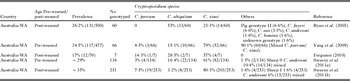
Prevalence and species of Cryptosporidium identified in pre- and post-weaned cattle in Australia

* Mixed C. parvum/bovis/ryanae infections.
In Australia, the prevalence of Cryptosporidium in cattle ranges from 2 to 58·8% (Becher et al. Reference Becher, Robertson, Fraser, Palmer and Thompson2004; Nolan et al. Reference Nolan, Jex, Mansell, Browning and Gasser2009; Ng et al. Reference Ng, Yang, McCarthy, Gordon, Hijjawi and Ryan2011b; Izzo et al. Reference Izzo, Kirkland, Mohler, Perkins, Gunn and House2011). The most recent study reported that the total prevalence of Cryptosporidium in calves from 84 dairy and dairy beef properties across Australia was 58·5% (Izzo et al. Reference Izzo, Kirkland, Mohler, Perkins, Gunn and House2011) (Table 6). In Victoria, the prevalence of Cryptosporidium in fecal samples from 268 individual calves on pasture-based dairy farms in three regions (Northern Victoria, South Gippsland and Western District) was 46·3% (124/268) (Nolan et al. Reference Nolan, Jex, Mansell, Browning and Gasser2009). The detection tool employed, however, (PCR analysis of the gp60 locus) was specific to C. parvum/C. hominis and therefore only C. parvum was detected in all samples typed (Nolan et al. Reference Nolan, Jex, Mansell, Browning and Gasser2009). Cryptosporidium andersoni is usually only found in older cattle and is morphologically distinct (7·4 × 5·5 μm) from the intestinal species, which includes C. parvum (5·0 × 4·5 μm) (Ralston et al. Reference Ralston, Thompson, Pethick, McAllister and Olson2010). The prevalence of C. andersoni in fecal samples from 10 groups of feedlot beef cattle in Western Australia ranging in age from 11 to 36 months, ranged from 0% to 26% (Ralston et al. Reference Ralston, Thompson, Pethick, McAllister and Olson2010). Cryptosporidium andersoni is commonly detected in water samples in the US and UK but is not considered a human pathogen (Xiao and Feng, Reference Xiao and Feng2008; Xiao, Reference Xiao2010; Wang et al. Reference Wang, Ma, Zhao, Lu, Wang, Zhang, Jian, Ning and Xiao2011).
Prevalence and species of Cryptosporidium identified in pre- and post-weaned sheep in Australia

* Combined data from several samplings and farms.
A recent study screened a total of 364 fecal specimens from randomly selected pre-weaned calves, aged up to 4 months, from 5 different farms in the south of Western Australia and 1 farm from New South Wales (Ng et al. Reference Ng, Yang, McCarthy, Gordon, Hijjawi and Ryan2011b). There were substantial differences in prevalence between the farms with the highest prevalence in a WA farm (37·5%). The overall prevalence was 22·3% (81/364) (Ng et al. Reference Ng, Yang, McCarthy, Gordon, Hijjawi and Ryan2011b). Cryptosporidium bovis was the most common species detected (39·5%) followed by C. parvum (38%) and C. ryanae (21%) (Ng et al. Reference Ng, Yang, McCarthy, Gordon, Hijjawi and Ryan2011b).
In NSW, a preliminary study in 2006 that examined the species/genotypes and subgenotypes of Cryptosporidium in 7 human and 15 cattle cases of sporadic cryptosporidiosis in rural western NSW, reported that 4 of the 6 C. parvum subtypes found in humans were also found in the cattle, indicating that zoonotic transmission may be an important contributor to sporadic human cases of cryptosporidiosis in rural NSW (Ng et al. Reference Ng, Eastwood, Durrheim, Massey, Walker, Armson and Ryan2008). A more extensive study conducted in 2009, screened 196 fecal samples from diarrhoeic (scouring) calves on 20 farms and 63 fecal samples from humans on 14 of these farms (Ng et al. Reference Ng, Eastwood, Walker, Durrheim, Massey, Porigneaux, Kenp, McKinnon, Laurie, Miller, Bramley and Ryan2012). The overall prevalence of Cryptosporidium in cattle and humans by PCR and sequence analysis of the 18S rRNA was 73·5% (144/196) and 23·8% (15/63) respectively. Three species were identified in cattle; C. parvum, C. bovis and C. ryanae, and from humans, C. parvum and C. bovis (Ng et al. Reference Ng, Eastwood, Walker, Durrheim, Massey, Porigneaux, Kenp, McKinnon, Laurie, Miller, Bramley and Ryan2012). This is only the second report of C. bovis in humans. The previous report C. bovis was in a dairy farm worker in India, where the infection was asymptomatic (Khan et al. Reference Khan, Debnath, Pramanik, Xiao, Nozaki and Ganguly2010). Subtype analysis at the gp60 locus identified the same C. parvum subtype in the calves in some of the humans, suggesting that zoonotic transmission may have occurred but more studies involving extensive sampling of both calves and farm workers are needed for a better understanding of the sources of Cryptosporidium infections in humans from rural areas of Australia.
Sheep
In sheep, cryptosporidiosis presents as a mild to severe yellowish liquid diarrhoea with a strong odour, loss of weight, depression, abdominal pain, and death usually involving animals up to 1 month of age and is associated with reduced lamb carcase productivity (cf. Fiuza et al. Reference Fiuza, Cosendey, Frazão-Teixeira, Santín, Fayer and de Oliveira2011b; Sweeny et al. Reference Sweeny, Ryan, Robertson and Jacobson2011a). Cryptosporidium has been reported in sheep worldwide, with prevalences ranging from 2·6 to 82% for Cryptosporidium (cf. Ryan et al. Reference Ryan, Bath, Robertson, Read, Elliot, McInnes, Traub and Besier2005; Yang et al. Reference Yang, Jacobson, Gordon and Ryan2009, Wang et al. Reference Wang, Feng, Cui, Jian, Ning, Wang, Zhang and Xiao2010b; Sweeny et al. Reference Sweeny, Ryan, Robertson, Yang, Bell and Jacobson2011b). In Australia, reported prevalences for ewes in Western Australia ranged from 6·3–8·3% (Sweeny et al. Reference Sweeny, Ryan, Robertson, Yang, Bell and Jacobson2011b) and for lambs from 9·3–56·3% on different properties (Ryan et al. Reference Ryan, Bath, Robertson, Read, Elliot, McInnes, Traub and Besier2005; Yang et al. Reference Yang, Jacobson, Gordon and Ryan2009; Sweeny et al. Reference Sweeny, Ryan, Robertson and Jacobson2011a, Reference Sweeny, Ryan, Robertson, Yang, Bell and Jacobsonb).
A total of 9 species/genotypes of Cryptosporidium have been reported in sheep and lambs in Australia; C. parvum, C. hominis, C. xiaoi, C. bovis, C. ubiquitum, sheep genotype I, C. andersoni, pig genotype II, C. fayeri and C. suis and sheep genotype I (Ryan et al. Reference Ryan, Bath, Robertson, Read, Elliot, McInnes, Traub and Besier2005; Giles et al. Reference Giles, Chalmers, Pritchard, Elwin, Mueller-Doblies and Clifton-Hadley2009; Yang et al. Reference Yang, Jacobson, Gordon and Ryan2009; Robertson, Reference Robertson2009; Sweeny et al. Reference Sweeny, Ryan, Robertson and Jacobson2011a, Reference Sweeny, Ryan, Robertson, Yang, Bell and Jacobsonb), with C. xiaoi and C. ubiquitum most common although Yang et al. (Reference Yang, Jacobson, Gordon and Ryan2009) found high proportions of C. parvum isolates in pre-weaned sheep in Western Australia when a C. parvum-specific PCR was used. In that study, using both 18S and a C. parvum-specific PCR for Cryptosporidium produced very different results. At the 18S locus, C. bovis was the most common species identified (95% of positives) in the pre-weaned lambs and C. parvum was only identified in two samples (0·4%) (Yang et al. Reference Yang, Jacobson, Gordon and Ryan2009). However, using a C. parvum-specific PCR and additional 53 C. parvum-positives were identified (mostly mixed C. bovis/ C.parvum infections). Quantitative PCR revealed that C. parvum was present in low numbers compared to C. bovis and it is likely that the 18S PCR preferentially amplified the more abundant template. It may be that the use of C. parvum-specific primers is necessary to determine the true prevalence of C. parvum. In a previous study on post-weaned sheep (Ryan et al. Reference Ryan, Bath, Robertson, Read, Elliot, McInnes, Traub and Besier2005), C. parvum was not detected; however, C. parvum-specific primers were not used and it is possible that C. parvum was present in those animals.
Cryptosporidium ubiquitum (previously known as the cervine genotype) has been identified in humans worldwide (Ong et al. Reference Ong, Eisler, Alikhani, Fung, Tomblin, Bowie and Isaac-Renton2002; cf. Xiao, Reference Xiao2010) but has not been detected in any human cryptosporidiosis cases in Australia to date. Quantification analysis using quantitative PCR (qPCR) and microscopy indicated that oocyst output in sheep feces varies widely and ranges from ∼1 to 106 oocysts per gramme (Yang et al. Reference Yang, Jacobson, Gordon and Ryan2009; Ryan et al., unpublished observations). Because sheep can harbour C. parvum, they should be considered a potential source of infection of Cryptosporidium either by direct transmission or by contamination of the environment.
As with cattle, there appears to be both geographical and age-related differences in the prevalence of zoonotic and non-zoonotic genotypes in sheep based on recent molecular characterization studies worldwide (Santin et al. Reference Santín, Trout and Fayer2007; Geurden et al. Reference Geurden, Thomas, Casaert, Vercruysse and Claerebout2008; Quilez et al. Reference Quílez, Torres, Chalmers, Hadfield, Del Cacho and Sánchez-Acedo2008; Mueller-Doblies et al. Reference Mueller-Doblies, Giles, Elwin, Smith, Clifton-Hadley and Chalmers2008; Paoletti et al. Reference Paoletti, Giangaspero, Gatti, Iorio, Cembalo, Milillo and Traversa2009; Diaz et al. Reference Díaz, Quílez, Chalmers, Panadero, López, Sánchez-Acedo, Morrondo and Díez-Baños2010; Robertson et al. Reference Robertson, Gjerde and Furuseth Hansen2010; Wang et al. 2010; Fiuza et al. Reference Fiuza, Cosendey, Frazão-Teixeira, Santín, Fayer and de Oliveira2011b; Shen et al. Reference Fiuza, Cosendey, Frazão-Teixeira, Santín, Fayer and de Oliveira2011). A recent longitudinal study of Cryptosporidium in meat lamb farms in southern Western Australia reported that Cryptosporidium prevalences at individual samplings ranged between 18·5 and 42·6% in lambs and were <10% in the ewes. Cryptosporidium xiaoi was the most prevalent species detected at all 5 samplings and was also isolated from lamb dam water on 1 farm. Cryptosporidium ubiquitum was most commonly detected in younger lambs and Cryptosporidium parvum was detected in lambs at all 5 samplings, typically in older lambs and as part of a mixed species infection with C. xiaoi. The novel sheep genotype I, was identified in 6 Cryptosporidium isolates from 1 farm. The longitudinal study revealed that sampling a random selection of animals from a flock/herd on 1 occasion (point prevalence), underestimates the overall prevalence of these parasites in the flock/herd across an extended time-period (Sweeny et al. Reference Sweeny, Ryan, Robertson, Yang, Bell and Jacobson2011b).
CONCLUSIONS AND PERSPECTIVES
Wildlife host-adapted species of Cryptosporidium are likely to have evolved in close association with marsupials. Confirmation of human-infectious species in these animals is rare, with detection of such isolates based on sequence data from direct fecal DNA extraction. There is a need to confirm whether molecular detection of zoonotic Cryptosporidium species is associated with actual infections. Additionally the presence of an atypical species in one or two individual marsupial hosts does not indicate that the parasite will be successful in all marsupials. The low abundance detected in individuals and low prevalence of human-infectious species in marsupial host groups, suggests that even if marsupial hosts are infected, it may not be a very successful host parasite interaction. However, marsupial hosts should still be monitored given the risk of emergence and the public health implications.
Non-marsupial hosts in Australia fall into 2 categories. (1) Those that have been introduced and become feral (cats, deer, dingos, foxes, pigs, rabbits, rodents, etc.) and (2) those that have become domesticated (sheep, cattle and pigs). Many of these hosts represent important agricultural resources. Although there have been limited studies in Australia, deer, rabbits and rodents appear to be potential reservoirs of human infectious species and more systematic studies of the prevalence, oocyst numbers and species infecting these hosts are essential to understand the public health significance.
Cattle and sheep are present in high numbers across Australia, contribute a large volume of manure to catchments and can shed oocysts in high concentrations. It has been reported that manure from cattle and sheep are the second-most significant source of pathogens that cause waterborne disease (Hrudey and Hrudey, Reference Hrudey and Hrudey2004). Preliminary evidence suggests that pre-weaned lambs and cattle in Australia may be an important source of C. parvum, which is of concern for public health. Larger numbers of both pre-weaned and post-weaned sheep and cattle from different geographical areas within Australia need to be screened at different times of the year at multiple loci and the numbers of oocysts quantified to confirm this.
The 2011 Australian Drinking Water Guidelines recommend managing water quality risks at source, within the catchment. Therefore management practices, particularly of cattle and sheep (including vegetation management of riparian zones) play a major role in reducing the risk of water contamination with Cryptosporidium. This can be achieved by compulsory land acquisition by government and drinking water companies, but this is an expensive option that is not widely practiced. It is more usually achieved by restricting stock access to riparian areas. In areas where permanent fencing is not an option, minimizing infection (and Cryptosporidium shedding) rates in stock – especially calves and lambs, by implementing good animal health practices such as excluding calves from pastures grazed by infected cows, is important.
Australia has a unique ecosystem with wildlife species specific to the continent. The introduction of non-marsupial animals and their parasites has resulted in complex and often devastating effects on the endemic fauna. It is therefore important to understand these intricate associations between wildlife, domestic animals and humans in the Australian context to enable management of the zoonotic risk of Cryptosporidium.