Introduction
Sudden sensorineural hearing loss (SNHL) is characterised by the sudden onset of unilateral hearing loss. It has been defined as ≥30 dB sensorineural hearing loss over at least three contiguous audiometric frequencies, occurring within three days or less. One in every 10 000 to 15 000 individuals will suffer from this condition, with the peak incidence occurring between 50 and 60 years of age.Reference Byl1 It is commonly accepted that there is no single aetiology of sudden SNHL. Such hearing impairment is most likely to be the final outcome of several insults to the inner ear. Different pathogenetic factors have been discussed, including viral infections, labyrinthine membrane rupture, autoimmune disease and ototoxic causes (e.g. ototoxic drugs).Reference Hughes, Freedman, Haberkamp and Guay2 Vascular occlusions that induce alterations of the vestibulocochlear blood flow have also been discussed as a possible pathogenetic mechanism.Reference Lee and Baloh3 In rare cases, underlying systemic disease may present with sudden SNHL, for example, systemic lupus erythematosus, intracranial neoplasm, Wegener's disease or Cogan's syndrome.Reference Gluth, Baratz, Matteson and Driscoll4 In such circumstances, sudden SNHL may be considered a symptom of the pre-existing disease.
Treatment options for cases with known aetiology involve addressing the underlying condition (e.g. treatment of acoustic neuroma with excision or radiation, of embolic disease with anticoagulants, of sickle cell crisis with oxygen, and of bacterial meningitis with antibiotics). However, the majority of cases of sudden SNHL treated by otolaryngologists have no known cause.
Fibromuscular dysplasia is a multifocal, non-atherosclerotic, non-inflammatory vascular disease of unknown aetiology. It causes segmental occlusion of arteries due to medial dysplasia with proliferation of the extracellular matrix and disruption of the internal elastic lamina.Reference Perdu, Gimenez-Roqueplo, Boutouyrie, Beaujour, Laloux and Nau5 Arteries may be affected multifocally, with frequent involvement of the cervicocranial and renal vessels. Cervicocephalic fibromuscular dysplasia generally affects the extracranial internal carotid artery. While the pathophysiology of fibromuscular dysplasia is not fully understood, several aetiological possibilities have been discussed, including mechanical, endocrine, immunological and genetic factors.Reference Sang, Whelton, Hamper, Connolly, Kadir and White6 Ten per cent of cases have been reported as familial.Reference Perdu, Gimenez-Roqueplo, Boutouyrie, Beaujour, Laloux and Nau5 In such families, inheritance seems to follow an autosomal dominant trait with reduced penetrance.Reference Gladstien, Rushton and Kidd7
Case report
A 50-year-old woman presented initially with sudden hearing loss in her right ear.
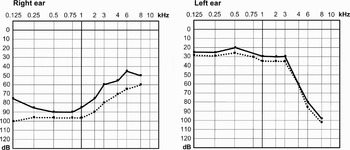
On admission, the pure tone audiogram revealed a profound low- and mid-frequency hearing loss of the right ear (Figure 1).
Pure tone audiograms (bone conduction) on admission (dashed line) and after 10 days of intravenous therapy with steroids and pentoxyphyllin (black line). On admission, pure tone audiography showed a profound low- and mid-frequency hearing loss on the right side (fourth episode). The left side showed a significant drop at 3 kHz to 100 dB at 8 kHz. Intravenous therapy failed to improve the hearing thresholds.

The patient reported that she had already experienced sudden SNHL in her left ear at the ages of 35, 48 and 50 years, all of which were in the high frequency range. She reported that her left ear hearing had not recovered after all episodes. In contrast, audiograms taken during these episodes of sudden SNHL showed recovery after the first and second episodes (which had occurred on the left side) but no recovery after the third episode (which had occurred on the left side, three months before the current, right-sided episode). The third, right-sided episode had been accompanied by the acute onset of rotary vertigo. No other bout of sudden SNHL had been combined with vertigo or tinnitus. After the fourth episode, despite immediate therapy with steroids and pentoxyphylline, hearing did not recover on the right side.
The patient had repeatedly suffered from infarctions of the right middle cerebral artery with contralateral hemiparesis in March and April 1988. The first infarction had been in the region of the basal ganglia. The patient had suffered pareses of the left face and the left arm as well as speech problems. During the second episode, computed tomography had shown demarcation in the area of the right temporal lobe. Common risk factors had been excluded, including hyperlipidaemia, hypertension, diabetes and cardiovascular disease. Magnetic resonance imaging had excluded an intrameatal or intracranial lesion. Ultrasonography of both carotid arteries had revealed a high grade stenosis of the right extracranial internal carotid artery and a high grade stenosis of the right intracranial internal carotid artery. After the second stroke, the patient had been treated surgically with extracranial internal carotid angioplasty. Histopathology had revealed fibromuscular dysplasia. A mild paresis of the left arm and leg had not recovered despite treatment.
The patient had experienced two further episodes of prolonged, reversible ischaemic neurological deficits of the left circulation in 1992 and a transient ischaemic attack in 2002. In 2003, her treatment had consisted of aspirin 500 mg twice daily and betahistine dihydrochloride 12 mg twice daily. This medical treatment had stabilised the patient's hearing threshold.
Family history
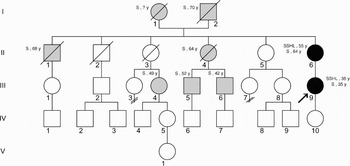
The patient's family history revealed multiple relatives with a history of stroke (see Figure 2). Seven relatives were reported to have been affected by strokes (at 42, 49, 52, 55, 64, 68 and 70 years, and one person at an unknown age). These findings are typical of a familial form of fibromuscular dysplasia. The pedigree suggested autosomal dominant inheritance with a reduced penetrance: individual III 4 had a stroke at the age of 49 years, but her mother (II 3) did not show any symptoms of fibromuscular dysplasia until she died.
Patient's family pedigree (moderately encrypted to protect confidentiality, without compromising scientific accuracy). The patient is indicated by an arrow. Filled black symbols = affected subjects (sudden sensorineural hearing loss (SSHL), stroke (S)); filled grey symbols = affected subjects (S); ? = unknown age; y = years

Discussion
It is well known that cerebrovascular fibromuscular dysplasia can be associated with a variety of non-specific symptoms, such as vertigo, unsteadiness, lightheadedness, transient ischaemic attacks and amaurosis fugax.Reference Mettinger and Ericson8 These symptoms are mostly related to critical stenosis or occlusion of the major arteries, ruptures of intracranial aneurysms, or emboli originating from thrombotic material. In the presented patient, diagnosis of fibromuscular dysplasia was histologically proven by dissection of the extracranial internal carotid artery. In addition to infarction of the right middle cerebral artery, the patient developed two episodes of prolonged, reversible, ischaemic neurological deficits as well as a transient ischaemic attack, indicating that further extra- or intracranial vessels may be involved by fibromuscular dysplasia.
Circulatory disturbance is a well described aetiology for sudden SNHL. In particular, temporal arteritis, Wegener's granulomatosisReference Kempf9 and polyarteritis nodosaReference Rowe-Jones, Macallan and Sorooshian10 have been reported as underlying causes of sudden SNHL.
Temporal arteritis is characterised by chronic inflammation of large blood vessels, and it presents with diverse symptoms depending on the distribution of the involved arteries. Usually, a severe headache which is temporal and occipital in location is a leading symptom. The aetiological factors are unknown thus far.
Wegener's granulomatosis is characterised by inflammatory perivascular exudates and fibrin deposition in small arteries. The typical location is the upper and/or lower respiratory tract, but rarely the involvement of the internal auditory artery might result in sudden SNHL. The exact aetiology is unknown, but a multifactorial pathogenesis is assumed and genetic markers in the human leukocyte antigen region have been strongly associated with the disease.Reference Jagiello, Gross and Epplen11
In addition, ischaemia of the vertebrobasilar artery has been repeatedly reported as a pathogenetic cause for sudden SNHL.Reference Lee and Baloh3 Bilateral sudden SNHL is frequent in such patients, commonly accompanied by nuchal pain and delayed neurological deficits.
Cerebral autosomal dominant arteriopathy with subcortical infarcts and leukoencephalopathy has been described as a rare underlying cause of sudden SNHL.Reference Phillips, King, Chandran, Prinsley and Dick12 Mutations in the Notch3 gene cause this systemic, non-atherosclerotic angiopathy, which is characterised by dementia, recurrent stroke and migraine.
In the light of the above evidence, our patient's repeated episodes of sudden SNHL may be strongly related to fibromuscular dysplasia. This hypothesis is supported by the fact that the patient did not respond significantly to steroids and pentoxyphylline (Figure 1).
• Fibromuscular dysplasia is a multifocal, non-atherosclerotic, non-inflammatory vascular disease of unknown aetiology
• It causes segmental occlusion of arteries due to medial dysplasia with proliferation of the extracellular matrix and disruption of the internal elastic lamina
• This paper describes the case of a 50-year-old woman with fibromuscular dysplasia, presenting with sudden onset sensorineural hearing loss in her right ear
• The clinical implications are discussed
As the audiological findings of sudden SNHL in fibromuscular dysplasia do not differ from those seen in other forms of sudden SNHL, audiometric assessment is unable to indicate the underlying aetiology. Therefore, careful analysis of patients' personal and family histories is essential. In the current case, such careful history-taking provided further evidence for a diagnosis of sudden SNHL as a secondary manifestation of fibromuscular dysplasia. The patient's family pedigree implied an autosomal dominant inheritance of fibromuscular dysplasia (online Mendelian Inheritance in Man (OMIM) 135580). This condition is known to be present in 10 per cent of affected families.Reference Perdu, Gimenez-Roqueplo, Boutouyrie, Beaujour, Laloux and Nau5 In such patients, further diagnostic evaluation of the cerebral vessels should be performed in order to prevent additional infarction.