Introduction
High-temperature structural materials are widely used in aeronautics and astronautics due to the high melting point, high-temperature strength, and excellent thermal stability [Reference Hu, Bi, Liu, Li, Su, Gao and Hu1, Reference Pan, Wang, Zhang and Jia2, Reference Wang, Wang, Wei and Zou3, Reference Pan, Guan and Li4, Reference Chang, Lin and Huang5, Reference Pan and Guan6, Reference Beake and Harris7, Reference Pan and Wen8]. However, the harmful influence of hydrogen on the phases and the related mechanical properties of high-temperature structural materials severely hinders the development of the future high-temperature structural materials because hydrogen in high-temperature structural material destroys the cohesive force among atoms and thus results in hydrogen embrittlement (HE) [Reference Yoshikawa, Takayanagi, Kimizuka and Shiga9, Reference Pan and Jin10, Reference Guo11, Reference Kulkov, Bakulin and Kulkova12, Reference Pan, Wang and Zhang13, Reference Stenerud, Wenner, Olsen and Johnsen14]. Therefore, the improvement of HE becomes a key problem for high-temperature structural material. To promote the development of high-temperature structural materials, it is necessary to reveal their mechanism of HE. In particular, we should explore the improvement of HE to meet the requirement of future high-temperature structural materials.
Among the previously reported high-temperature structural materials, the hexagonal C40 transition metal disilicides (such as NbSi2, MoSi2, and WSi2) have received great attention because of their high melting point, superior mechanical properties, high thermal conductivity, excellent oxidation, and corrosion resistances etc. [Reference Todai, Hagihara, Kishida, Inui and Nakano15, Reference Pan16, Reference Mehrizi, Shamanian, Saidi, Razazvi and Beigi17, Reference Pan, Mao, Jiang, Wan and Guan18, Reference Hagihara, Hama, Yuge and Nakano19, Reference Pan, Lin, Xue, Ren and Wang20, Reference Li, Sun, Wang, Lei and Yi21, Reference Zhang and Guo22, Reference Wang, Pan, Wu and Lin23, Reference Pan and Wang24]. For example, the hexagonal C40 NbSi2 shows better oxidation resistance at the range of temperature (1000–1450 °C) due to the formation of SiO2 particle [Reference Choi, Yoon, Kim, Yoon, Doh and Hong25, Reference Pan, Zhang, Jin and Chen26]. In particular, the first-principles calculations have shown that the calculated shear modulus, bulk modulus, and Young’s modulus of NbSi2 are 142 GPa, 174 GPa, and 335 GPa, respectively, which are larger than that of the other Nb–Si compounds [Reference Shi, Zhu, Jia, Zhang and Sun27]. The recent experimental works have shown that the melting point of C40 MoSi2 is up to 1900 °C and this structure exhibits excellent high-temperature thermal stability [Reference Xu, Wu, Li, Munroe and Xie28, Reference Schneibel and Sekhar29]. Liang et al. have found that the calculated Young’s modulus and bulk modulus of C40 WSi2 are 467.9 GPa and 222.4 GPa, respectively [Reference Liang, Ling, Zheng, Feng, Fang and Zhou30]. In particular, Kang et al. have pointed out that the experimentally measured hardness and fracture toughness of WSi2 are 8.2 MPa and 3.2 MPa/m2, respectively [Reference Kang and Shon31]. As mentioned above, these results indicate that hexagonal C40 TMSi2 is a potential high-temperature structural material for the applications of future turbine blades and gas turbines.
However, numerous works have shown that hydrogen is a harmful element for C40 TMSi2 disilicides because hydrogen in TMSi2 changes the interaction between TMSi2 and the hydrogen, and then forms the harmful phases [Reference Koyama, Akiyama, Lee, Raabe and Tsuzaki32, Reference Yamabe, Takagoshi, Matsunaga, Matsuoka, Ishikawa and Ichigi33]. As a result, hydrogen will obviously deteriorate the structural feature and mechanical properties of transition metal silicides. For high-temperature structural material, the improvement of HE is a daunting challenge. Unfortunately, until the present work, the HE mechanism of hexagonal C40 disilicides is unknown. In particular, the effect of hydrogen on the structural configuration, elastics modulus, and Vickers hardness of hexagonal C40 disilicides is entirely unclear.
By means of first-principles calculations, in this work, we explore the hydrogen occupied mechanism of TMSi2. Importantly, we investigate the effect of hydrogen on the elastic modulus and Vickers hardness of the hexagonal C40 disilicides. Based on the d-orbit effect, in this article, we consider three C40 TMSi2: NbSi2, MoSi2, and WSi2, respectively. Additionally, we mainly consider four H-doped sites: H-SI(1), H-SI(2), H-SI(3), and H-SI(4) to reveal the HE mechanism. The lattice parameters, volume, and density of H-doped and the parent TMSi2 are discussed. The nature of H-doped mechanism and the mechanical properties of H-doped and the parent TMSi2 are analyzed by the electronic structures. Our work predicts that hydrogen will decrease elastic modulus and Vickers hardness of C40 TMSi2. As mentioned above, our works provide a theoretical framework for understanding the HE mechanism of transition metal silicides and provide powerful guidelines for further improving the HE of transition metal silicides and high-temperature materials.
Results and discussions
To reveal the mechanism of HE, we first study the H-doped mechanism in C40 TMSi2. We will then study the stability of H-doped TMSi2. The stability of H-doped TMSi2 is calculated by the impurity formation energy (E f) [Reference Pan and Guan34, Reference Sun, Fu, Liin, Guo, Lei and Wang35, Reference Pan and Wen36]:
 $${E_{\rm{f}}} = E_{{\rm{TMS}}{{\rm{i}}_{\rm{2}}}}^{\rm{H}} - {E_{{\rm{TMS}}{{\rm{i}}_{\rm{2}}}}} - {1 \over 2}{E_{{{\rm{H}}_{\rm{2}}}}}\quad ,$$
where  $E_{{\rm{TMS}}{{\rm{i}}_{\rm{2}}}}^{\rm{H}}$,
 ${E_{{\rm{TMS}}{{\rm{i}}_{\rm{2}}}}}$, and
 ${E_{{{\rm{H}}_{\rm{2}}}}}$ are the calculated total energy of H-doped TMSi2, the parent TMSi2, and hydrogen molecules, respectively.
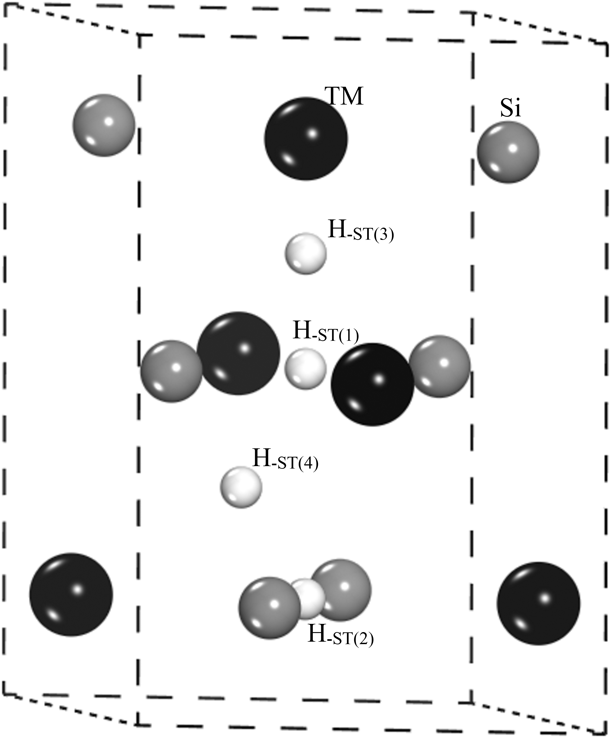
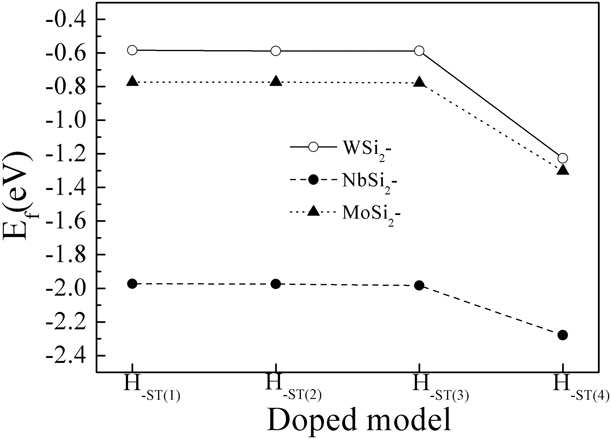
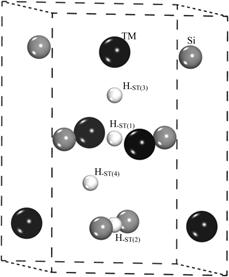
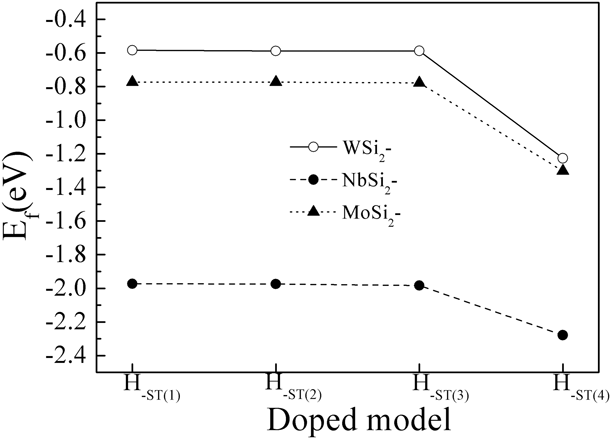
Figure 2 shows the calculated impurity formation energy of H-doped TMSi2. It is found that the calculated impurity formation energy of H-doped TMSi2 is smaller than zero. Importantly, the calculated impurity formation energy of H-ST(4) site is smaller than that of the other H-doped sites, indicating that hydrogen is favorable to occupy the H-ST(4) site in comparison to the other sites. It is suggested that the stability of hydrogen depends on the interstitial radius and interaction between hydrogen and the TMSi2. As shown in Fig. 1, it is found that hydrogen-occupied H-ST(4) site is a octahedral interstice, which is composed of three TM atoms and three Si atoms. As a result, the localized hybridization among H, Si, and TM, forms the Si–H bond and TM–Si bond, respectively. For example, the calculated length of Si–H bond and Mo–H bond is 1.663 Å and 1.736 Å, respectively.
Structural model of H-doped TMSi2.

From Fig. 2, on the other hand, the calculated impurity formation energy of H-doped NbSi2 (−2.279 eV) is smaller than that of the H-doped MoSi2 (−1.302 eV) and H-doped WSi2 (−1.226 eV). This result indicates that C40 NbSi2 is easy to produce hydrogenation in comparison to C40 MoSi2 and C40 WSi2.
Calculated impurity formation energy of H-doped TMSi2.
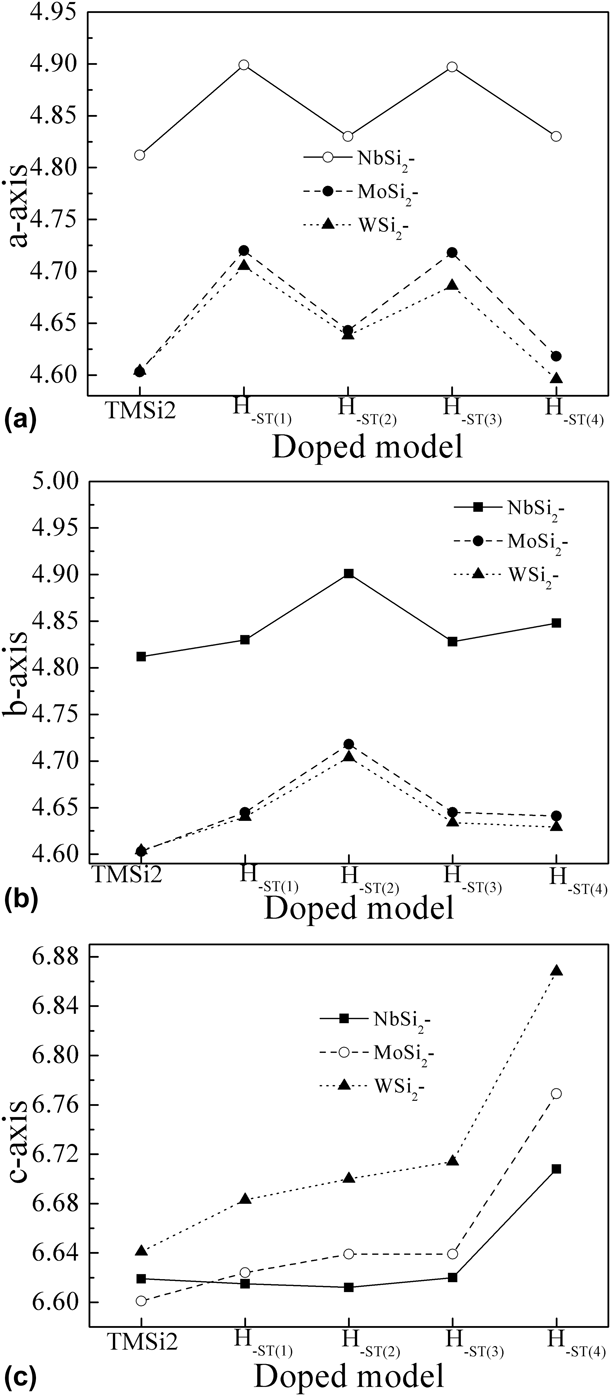
To reveal the nature of H doping, it is necessary to investigate the lattice parameters, volume, and density of H-doped TMSi2. Figure 3 displays the calculated lattice parameters of H-doped TMSi2 and the parent TMSi2. Here, it is found that the calculated lattice parameters of the parent NbSi2 are a = 4.812 Å and c = 6.619 Å, respectively, which are close to the other experimental and theoretical data [Reference Pan, Zhang, Jin and Chen26, Reference Chu, Lei, Maloy, Petrovic and Mitchell37, Reference Erturk and Gurel38]. In this article, the calculated lattice parameters of the parent MoSi2 are a = 4.603 Å and c = 6.601 Å, which are in good agreement with the experimental result [Reference Mattheiss39]. The calculated lattice parameters of the parent WSi2 are a = 4.604 Å and c = 6.641 Å, respectively, which are in excellent agreement with the other results [Reference Mattheiss39].
Calculated lattice parameters of H-doped TMSi2, (a) a-axis, (b) b-axis, and (c) c-axis.

As shown in Fig. 3, it can be seen that the H-doping results in lattice expansion of C40 TMSi2 along the a-axis, b-axis, and c-axis, respectively. It is obvious that H-occupied interstitial site can promote the localized hybridization among H, Si, and TM. In particular, the atomic radius of hydrogen atom is larger than that of the interstitial radius, which is easy to lead to lattice expansion of C40 TMSi2. For the H-ST(4) model, the calculated lattice parameters of a-axis and b-axis are slightly larger than that of the a-axis and b-axis of the parent TMSi2. However, the value of c-axis is much larger than that of c-axis of the parent TMSi2. This result indirectly demonstrates the strong interaction between H and TMSi2 along the c-axis.
Naturally, this discrepancy is determined by the structural feature. According to our previous work, C40 TMSi2 is composed of the alternative stacking of the Si–TM–Si layered structure. The layered structure provides a large interstitial space to store hydrogen. In addition, the cohesive force between layers is weaker than that of the bond strength of TM–Si bond at the layer. Why hydrogen is easy to occupy the layered interstitial site (H-ST(4) model) is well explained.
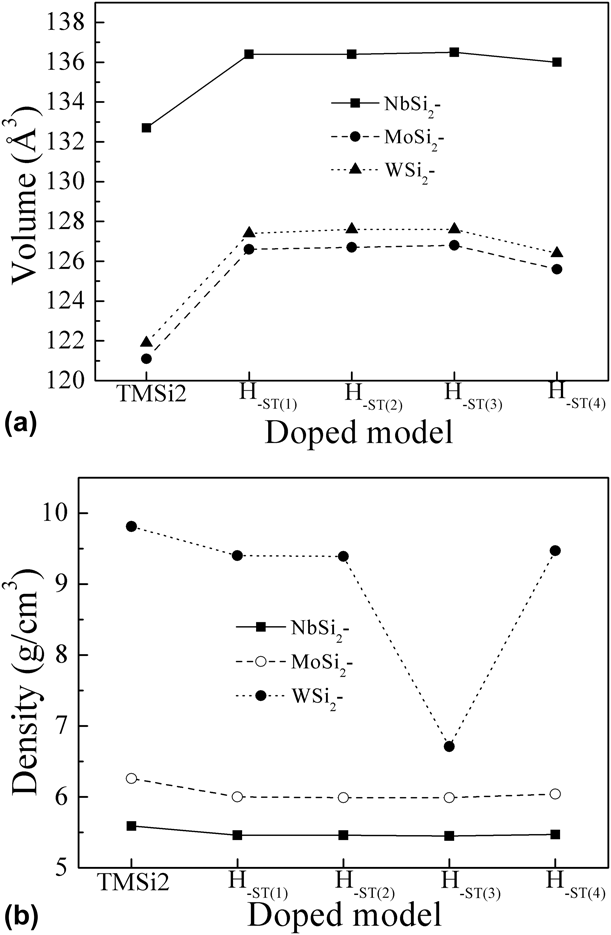
In fact, the variation of lattice parameters of H-doped TMSi2 is confirmed by the volume and density. Figure 4 displays the calculated volume and density of H-doped TMSi2 and the parent TMSi2. It is found that the calculated volume of H-doped TMSi2 is larger than that of the parent TMSi2, demonstrating that the H-doping gives rise to the lattice expansion of C40 TMSi2. It is further noted that the obtained volume of H-ST(4) model is smaller than that of the other doped sites. Importantly, it is concluded that the calculated density of C40 TMSi2 follows the order of NbSi2 < MoSi2 < WSi2. It is obvious that this discrepancy is attributed to the d-orbit effect of TM (TM = Nb, Mo, and W). We further note that the density of H-doped TMSi2 is smaller than that of the parent TMSi2. In other words, H-doping decreases the density of C40 TMSi2.
Calculated structural information of H-doped TMSi2, (a) volume, and (b) density.

It is well-known that the mechanical properties of C40 TMSi2 are influenced by the hydrogenation [Reference Wang, Cheng, Qin, Li, Zhan, Chen, Li, Hu, WU and Zhang40]. Hence, we will further investigate the influence of hydrogen on the mechanical properties (elastic properties and hardness) of TMSi2 transition metal disicilides. Generally speaking, the mechanical properties of TMSi2 are measured by the elastic modulus: Young’s modulus (Y), shear modulus (G), and bulk modulus (B) [Reference Liu and Zhan41, Reference Wu, Zhang and Zhan42, Reference Pan43, Reference Pan and Guan44]. Moreover, the elastic modulus of high-temperature structural material is calculated by the elastic constants (C ij). In this article, the elastic constants of C40 TMSi2 transition metal disicilides is calculated by the stress versus strain method. For high-temperature structural material, there is a set of strain, ε = (ε1, ε2, ε3, ε4, ε5, and ε6), both stress and strain have three normal strains (ε1, ε2, and ε3), and three shear strains (ε4, ε5, and ε6). As a result, the corresponding stress of high-temperature structural material is represented as σi = C ijεi. Therefore, the linear elastic constants form 6 × 6 symmetric matrix. According to the Hooke’s law, the elastic constants of a solid are calculated by [Reference Pan, Wang and Zhang45, Reference Wu, Zhao, Xiang, Hao, Liu and Meng46]:
 $$C = {\varepsilon ^{ - 1}}\sigma = \left\{ {\matrix{ {{C_{11}}} & {{C_{12}}} & {{C_{13}}} & 0 & 0 & 0 \cr {{C_{21}}} & {{C_{22}}} & {{C_{23}}} & 0 & 0 & 0 \cr {{C_{31}}} & {{C_{32}}} & {{C_{33}}} & 0 & 0 & 0 \cr 0 & 0 & 0 & {{C_{44}}} & 0 & 0 \cr 0 & 0 & 0 & 0 & {{C_{55}}} & 0 \cr 0 & 0 & 0 & 0 & 0 & {{C_{66}}} \cr} } \right\}\quad .$$
Based on the above equation, the elastic constants of high-temperature structural material are obtained by first-principles calculations for the deformed crystals. As a result, the elastic constants of high-temperature structural material are calculated by using the variations of the equilibrium energy with respect to applied strain, which is defined as [Reference Wu, Zhao, Xiang, Hao, Liu and Meng46]:
 $${C_{ijkl}} = {{{\partial ^2}E} \over {\partial {\delta _{ij}}\partial {\delta _{kl}}}}\quad ,$$
where the total energy of deformed crystal E(V) under a strain can be expanded as the Taylor expansion for the system with respect to a small strain δ and the unit-cell volume V. The energy of a strained system is given by:
 $$E\left( V \right) = E\left( {{V_0},0} \right) + {V_0}\sum\limits_{ij} {{\delta _{ij}}{\delta _{ij}}} + {{{V_0}} \over 2}\sum\limits_{i,j,k,l} {{V_{ijkl}}{\delta _{ij}}{\delta _{kl}}} + \Lambda \quad ,$$
where V 0 is the volume of unstrained crystal and E(V 0, 0) is the corresponding ground state energy. The strain tensor subscripts (ij, kl) represent the Voigt notation scheme.
When we obtain their elastic constants, the bulk modulus, and shear modulus of H-doped TMSi2 and H-undoped TMSi2 are calculated by the Voigt Reuss Hill approximation [Reference Hill47, Reference Pan and Zhou48]. The Vickers hardness (H v) of H-doped TMSi2 and the parent TMSi2 are calculated by [Reference Chen, Niu, Li and Li49]:
 $${H_{\rm{v}}} = 2{\left( {{k^2} \cdot G} \right)^{0.585}} - 3\quad ,$$
where k is the G versus B.
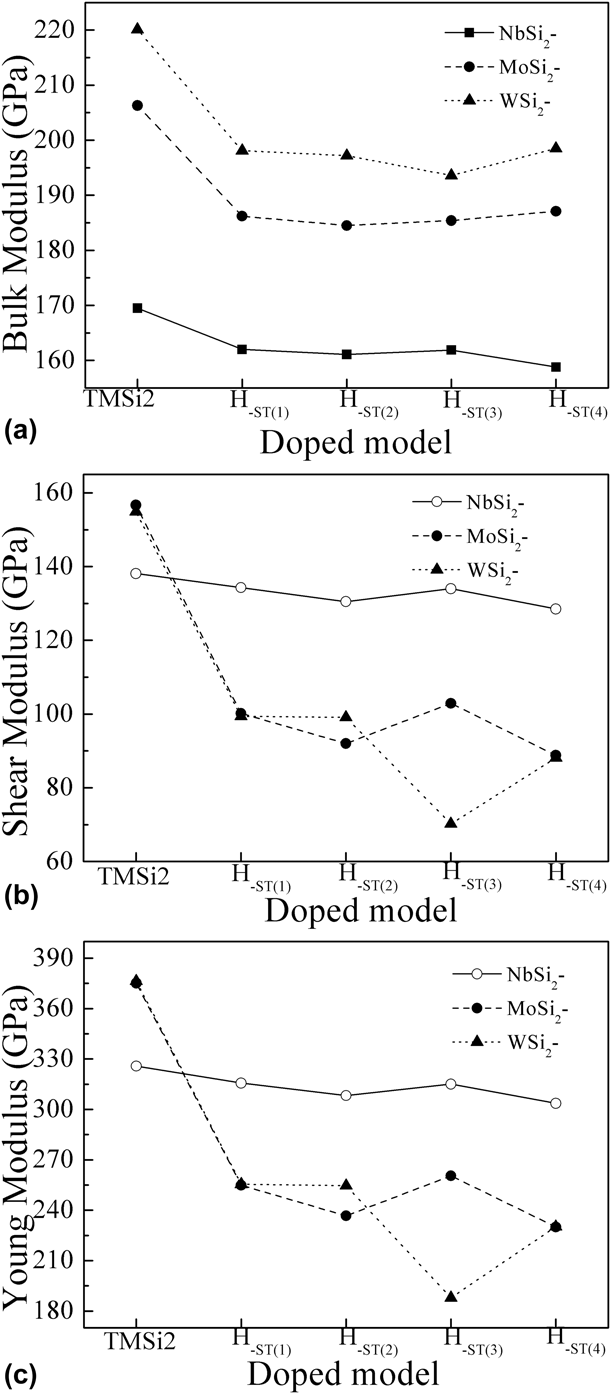
To explore the mechanical properties of H-doped TMSi2, Fig. 5 shows the calculated elastic modulus of H-doped TMSi2 and the parent TMSi2, respectively. In our work, the calculated Young’s modulus, bulk modulus, and shear modulus of C40 NbSi2 are 325.8 GPa, 169.5 GPa, and 138.1 GPa, respectively, which are in good agreement with the other results [Reference Papadimitriou, Utton, Scott and Tsakiropoulos50]. The calculated Young’s modulus, bulk modulus, and shear modulus of C40 MoSi2 are 375.1 GPa, 206.3 GPa, and 156.7 GPa, respectively. The calculated Young’s modulus, bulk modulus, and shear modulus of C40 WSi2 are 376.4 GPa, 220.1 GPa, and 154.9 GPa, respectively. It is found that the calculated elastic modulus of C40 TMSi2 is larger than that of the other Nb–Si compounds [Reference Aoki, Manh, Pettifor and Vitek51], meaning that TMSi2 shows high deformation resistance in comparison to TM5Si3. It is further noted that the bulk modulus and Young’s modulus are calculated to be in a sequence of WSi2 > MoSi2 > NbSi2. It is suggested that this discrepancy derives from the d-orbit effect of TM metal.
Calculated elastic modulus of H-doped TMSi2 and the parent TMSi2, (a) bulk modulus, (b) shear modulus, and (c) Young’s modulus.

Importantly, it is found that the calculated Young’s modulus, bulk modulus, and shear modulus of H-doped TMSi2 are lower than that of the elastic modulus of the parent TMSi2. Those results mean that the H-doping weakens the elastic stiffness, volume deformation, and shear deformation resistances of the parent TMSi2. For H-ST(4) model, the calculated Young’s modulus, bulk modulus, and shear modulus of H-doped NbSi2 are 303.6 GPa, 158.8 GPa, and 128.5 GPa, respectively, which are lower than that of the elastic modulus of C40 NbSi2. Hence, it is concluded that the hydrogenation decreases the mechanical properties of TMSi2.
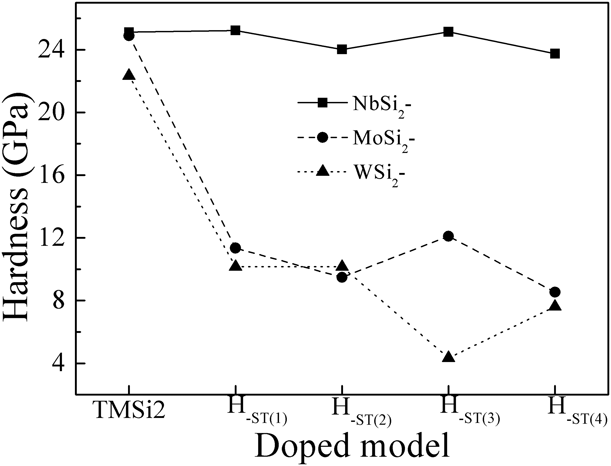
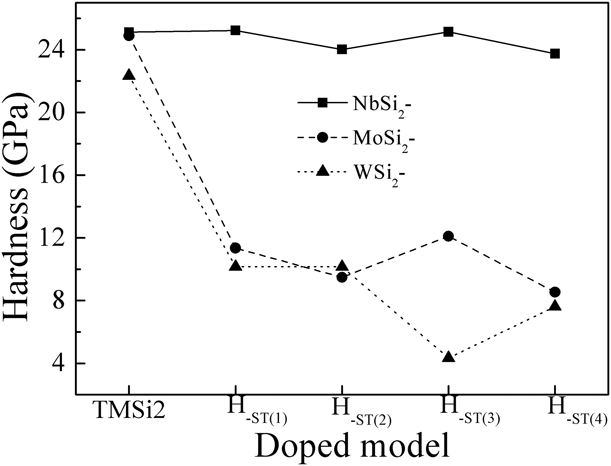
Figure 6 shows the calculated Vickers hardness of H-doped TMSi2 and the parent TMSi2, respectively. First, it can be seen that the calculated Vickers hardness of the parent NbSi2, MoSi2, and WSi2 is 25.1 GPa, 24.9 GPa, and 22.3 GPa, respectively. Note that the calculated Vickers hardness of C40 NbSi2 is larger than that of the MoSi2 and WSi2. Importantly, the calculated Vickers hardness of H-doped TMSi2 is much lower than that of the parent TMSi2. It is obvious that the variation of Vickers hardness of H-doped TMSi2 is similar to that of the elastic modulus. For H-ST(4) model, the calculated Vickers hardness of H-ST(4)-doped NbSi2, H-ST(4)-doped MoSi2, and H-ST(4)-doped WSi2 is 23.7 GPa, 8.5 GPa, and 7.6 GPa, respectively. In other words, the hydrogenation markedly reduces the deformation resistance of C40 MoSi2 and C40 WSi2. Based on the electronic structure, this distinguish derives from the interaction between H atom and the C40 TMSi2. When hydrogen occupies the octahedral interstitial site, the interaction between H and the C40 TMSi2 will form the H–Si bond and H–TM bond, respectively. As a result, those bonds markedly weaken the cohesive force of layered structure and then reduce the elastic modulus and H v of C40 TMSi2.
Calculated hardness of H-doped TMSi2 and the parent TMSi2.
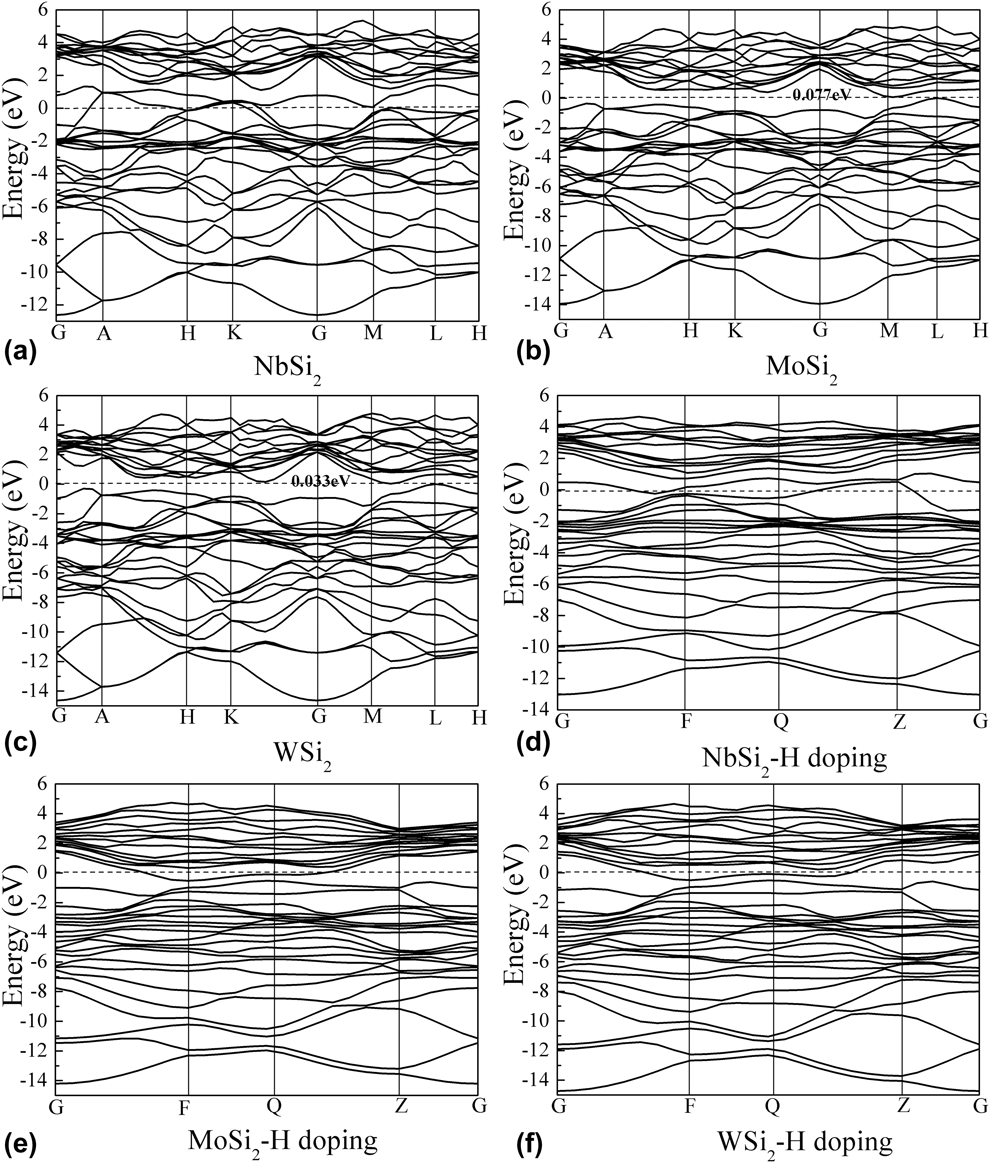
Naturally, the variation of mechanical properties of H-doped TMSi2 and the parent TMSi2 is related to the electronic structure. To explore the nature of mechanical properties, we further discuss and analyze the band structure and density of state (DOS) of H-doped TMSi2 and the parent TMSi2. Figure 7 shows the calculated band structure of H-doped TMSi2 and the parent TMSi2. We find that NbSi2 shows metallic behavior because some band across the Fermi level (E F). This result is similar to our previous theoretical result [Reference Pan, Zhang, Jin and Chen26]. However, the calculated band gap of MoSi2 and WSi2 is about 0.077 eV and 0.033 eV, respectively. In other words, MoSi2 and WSi2 are potential semiconductor materials. When TMSi2 is hydrogenated, H-doping enhances the charge interaction of a system at the Fermi level. Therefore, it is concluded that H-doping can improve the electronic properties of MoSi2 and WSi2. These results are demonstrated by the DOS.
Calculated band structure of H-doped TMSi2, together with the parent TMSi2, (a) NbSi2, (b) MoSi2, (c) WSi2, (d) NbSi2-H doping, (e) MoSi2-H doping and (f) WSi2-H doping, respectively.
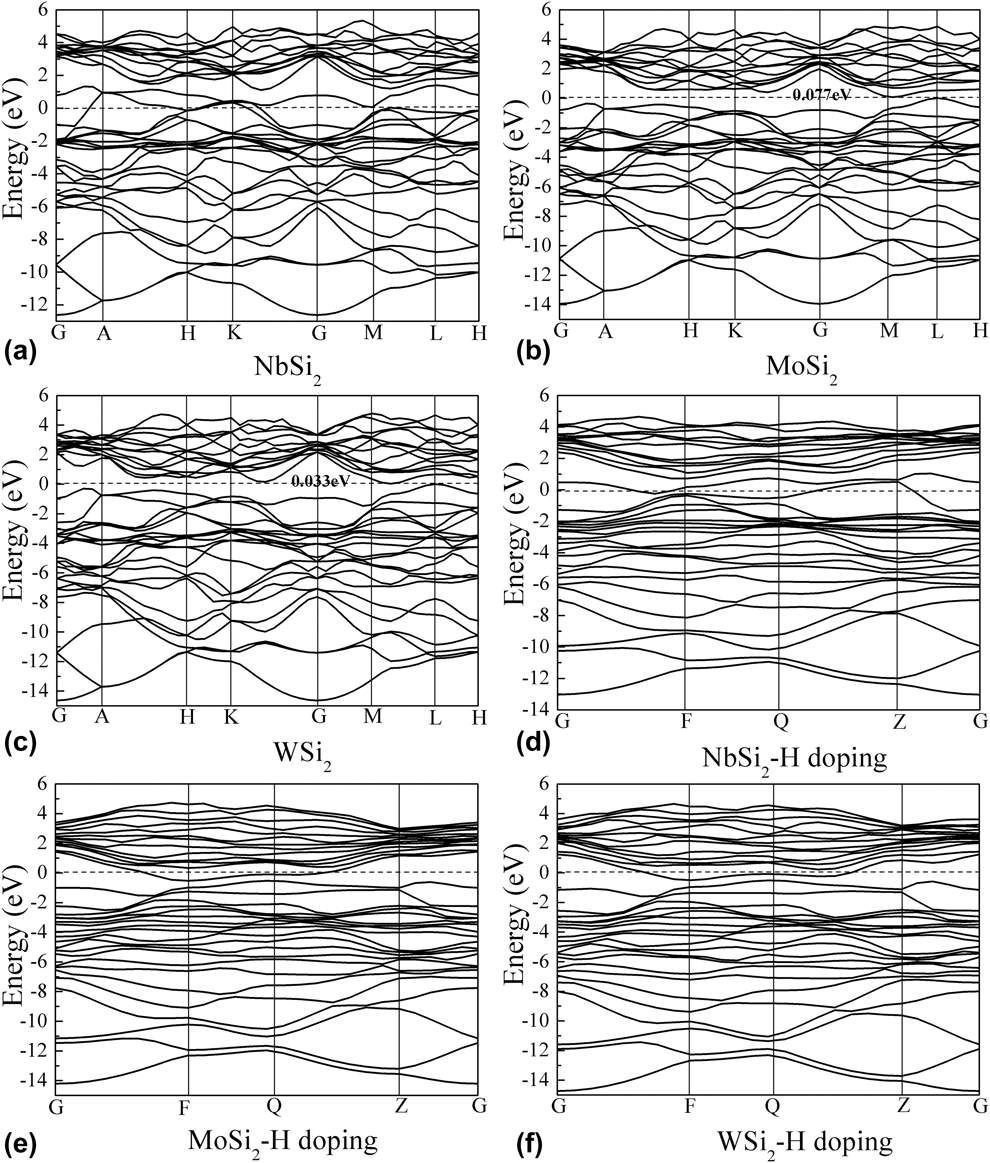
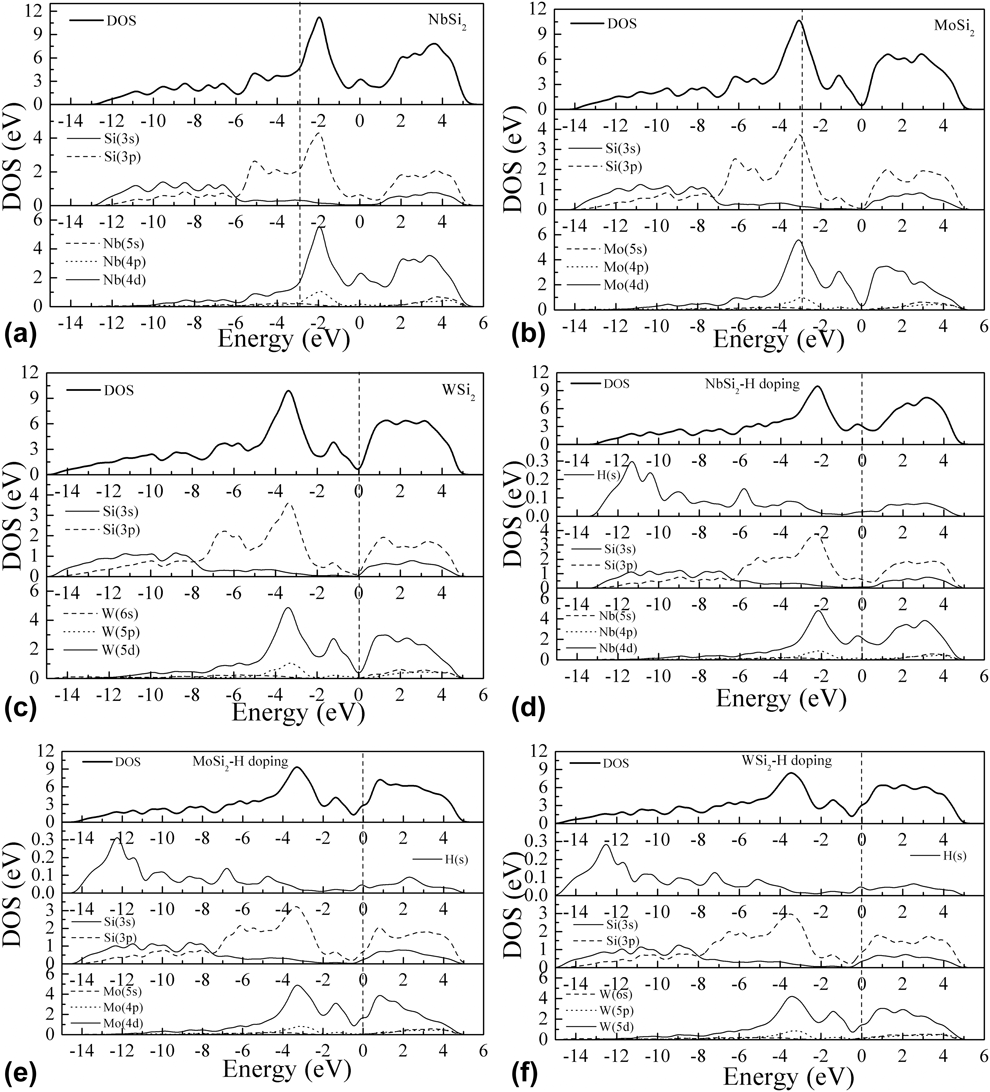
Figure 8 displays the calculated total and partial DOS of H-doped TMSi2 and the parent TMSi2, respectively. It is found that there is a strong localized hybridization between TM atom and Si atom, which forms the TM–Si bond. The calculated bond length of Nb–Si bond is 2.624 Å, which is close to the theoretical result [Reference Pan, Zhang, Jin and Chen26]. The calculated bond length of Mo–Si bond and W–Si bond is 2.576 Å and 2.589 Å, respectively, which are in good agreement with the previous theoretical results [Reference Pan, Wang, Zhang and Jia2, Reference Wang, Pan and Lin52]. In particular, the cohesive force of the layered structure depends on the TM–Si bond. Therefore, it is proposed that the mechanical properties of TMSi2 rely on the bond strength of TM–Si bond.
Calculated total and partial DOS of H-doped TMSi2, together with the parent TMSi2, (a) NbSi2, (b) MoSi2, (c) WSi2, (d) NbSi2-H doping, (e) MoSi2-H doping and (f) WSi2-H doping, respectively.

On the other hand, it is found that Nb-4d state and Si-3p state of NbSi2 across the Fermi level (E F), which can promote the electronic interaction between valence band and the conduction band. However, there are sharp valleys of MoSi2 and WSi2 at the Fermi level. This is why NbSi2 shows the metallic behavior. MoSi2 and WSi2 exhibit semiconductor properties.
When TMSi2 is hydrogenated, H-doping changes the charge equilibrium of TMSi2 because of the extra valence electron. Fig. 8 shows a remarkable feature that H-doping leads to band shift from the Fermi level to the low energy region. In particular, there is a strong interaction among H, Si, and TM atoms. As a result, the interaction among those atoms will form Si–H bond and TM–H bond, respectively. For H-doped NbSi2, the calculated bond length of Si–H bond and Nb–H bond are 1.676 Å and 1.822 Å, respectively. As mentioned above, it is suggested that the formation of hydrides will weaken the deformation resistance of C40 TMSi2 because those hydrides break the cohesive force of the layered structure. In addition, it is further found that H-doping can promote the interaction between conduction band and the valence band. This is well explains why H-doping improves the electronic properties of C40 MoSi2 and C40 WSi2.
Conclusions
By using the first-principles with theory functional method (DFT), we symmetrically study the HE mechanism and the effect of hydrogen on the structural configuration, elastic modulus, Vickers hardness, and electronic properties of C40 TMSi2. In this article, we consider three transition metal disicilides: NbSi2, MoSi2, and WSi2, respectively. According to the structural feature, we consider four H-doped sites (H-SI(1), H-SI(2), H-SI(3), and H-SI(4)), respectively.
The calculated results show that the calculated lattice parameters of H-undoped TMSi2 are in good agreement with the other experimental data and theoretical result. In particular, it is concluded that the C40 TMSi2 is easy to produce hydrogenation because the calculated impurity formation energy of H-doped TMSi2 is lower than zero. The calculated impurity formation energy of H-ST(4) site is smaller than that of the other doped sites, indicating that hydrogen is favorable to occupy the H-ST(4) site. The calculated impurity formation energy of H-doped NbSi2 is smaller than that of the H-doped MoSi2 and H-doped WSi2. H-doping leads to lattice expansion of c-axis compared with the other axis. Importantly, H-doping markedly weakens the elastic stiffness, Vickers hardness, shear deformation resistance, and volume deformation resistances of C40 TMSi2. Here, the calculated Young’s modulus, bulk modulus, and shear modulus of C40 TMSi2 are in good agreement with the other theoretical results. The calculated Young’s modulus, bulk modulus, and shear modulus of H-doped NbSi2 are 303.6 GPa, 158.8 GPa, and 128.5 GPa, respectively, which are lower than the elastic modulus of C40 NbSi2. The calculated electronic structure shows that the low elastic modulus and Vickers hardness of H-doped TMSi2 are attributed to the formation of Si–H bond and TM–H bond at the layered structure.
Theoretical methods
It is well-known that the space group of C40 TMSi2 with hexagonal structure is the P6222 [Reference Tanaka, Nawata, Inui, Yamaguchi and Koiwa53]. For this C40 transition metal disilicide, hydrogen is easy to occupy the interstitial site or layered site because of the correlation between interstitial radius and the atomic radius of hydrogen atom. In particular, the atomic radius of hydrogen is much smaller than that of the transition metal (Nb, Mo, and W). Hence, we consider four H-doped sites: H-SI(1), H-SI(2), H-SI(3), and H-SI(4), based on the structural feature. The structural model of H-doped TMSi2 is shown in Fig. 1.
In this article, the total energy, elastic modulus, Vickers hardness, electronic structure, and structural optimization of H-doped TMSi2 and the parent TMSi2 were calculated by the first-principles calculations within the CASTEP code [Reference Segall, Lindan, Probert, Pickard, Hasnip, Clark and Payne54, Reference Pan, Li, Zheng and Xu55]. The exchange correlation functional of H-doped TMSi2 and the parent TMSi2 were used by the generalized gradient approximation (GGA) with Perdew–Burke–Ernzerhof (PBE) functional [Reference Perdew and Wang56, Reference Pan57]. The interaction between the valence electrons and ionic cores was used by the ultrasoft pseudopentional [Reference Vanderbilt58]. Here, the electronic configuration was 3s 23p 2 for Si, 5p 65d 46s 2 for W, 4p 64d 45s 1 for Nb, and 4p 64d 55s 1 for Mo. The cutoff energy of 400 eV was selected in this study. In addition, the 12 × 12 × 7 mesh grids were treated for H-doped TMSi2 and the parent TMSi2. The Broyden Fletcher Golddarb Shanno (BFGS) scheme was introduced. All internal coordinates, unit-cell, and atomic positions were relaxed for H-doped TMSi2 and the parent TMSi2 [Reference Pan and Guan59, Reference Guo, Li, Li, Shao, Chen, Ma, Sun and Zeng60, Reference Pan and Guan61, Reference Huang, Liu, Liu and Tuo62]. For their mechanical properties, we used the strain versus stress method [Reference Pan and Wen63, Reference Bi, Hu, Jiang and Li64, Reference Pan, Li and Zheng65, Reference Todorova, Gaier, Zwanziger and Plucknett66] to treat the elastic properties of H-doped TMSi2. The convergence thresholds that were treated for structural optimization are as follows: the total energy, maximum ionic Hellmann Feynman force, and maximum stress within 1 × 10⁻⁶ eV/atom, 0.01 eV/Å, and 0.02 GPa, respectively.
Acknowledgments
This work is supported by the Sichuan Provincial College’s Sate Key Laboratory of Oil and Gas Reservoir Project (X151518KCL26) and the National Natural Science Foundation of China (No. 51274170). We acknowledge the help from Lady Yun Zheng and Runxi Pan.