Introduction
The 1918–1919 influenza pandemic (Influenza A, H1N1 subtype) was notoriously virulent, causing symptomatic infections in one-third of the USA across all ages and killing about 0.6% of the total population.Reference Morens, Taubenberger and Fauci1–Reference Morens, Taubenberger and Fauci3 If uncomplicated, the flu was a mild ‘3-day fever’, with full recovery and low mortality.Reference Morens, Taubenberger and Fauci1 The lethality came from secondary bacterial infections that caused severe pneumonias, particularly among pregnant women.Reference Morens, Taubenberger and Fauci1, Reference Brundage and Shanks2
In addition, there are indications of long-term impairments in those exposed prenatally. Cohorts born in and around the pandemic incurred lifetime socioeconomic and physical consequences, as shown by Almond.Reference Almond4 From US Census data, those born in early 1919 who were exposed prenatally to the most virulent phase in the Fall of 1918, had lifetime deficits in economic productivity and in education, as well as excess work disability, which suggests developmental impairments or lifetime health issues. Subsequent influenza pandemics and epidemics, while less virulent, have been specifically associated with neurodevelopmental defects, for example, schizophrenia risk was three-fold higher in US cohorts exposed prenatally to influenza during 1959 to 1966.Reference Brown, Begg and Gravenstein5, Reference Patterson6 Developmental deficits from influenza have been modeled in rodent maternal infections during pregnancy with H1N1 viral strain, which caused abnormal brain development and adult cognitive dysfunctions.Reference Patterson6, Reference Fatemi, Earle and Kanodia7 Thus, the 1919 influenza birth cohort may have incurred a range of developmental impairments with consequences to adult health and mental and physical capacities.
Prenatal pathophysiology can accelerate chronic diseases of aging as discussed in the Barker theory of developmental origins of adult disease (fetal programming). Maternal health, nutrition and stress are linked to subsequent development of cardiovascular disease, stroke and diabetes in prenatally exposed offspring.Reference Barker8–Reference Finch11 We therefore hypothesized that the 1918–1919 influenza cohorts also incurred increased adult cardiovascular and other diseases.
Several mechanisms are indicated from experimental studies. First is a link of influenza infections to interleukin-6 (IL-6) elevations during pregnancy that are related to increased adult blood pressure, a major risk factor in cardiovascular disease. In human and laboratory animals, influenza infections activate innate immunity and elevate blood IL-6 and other cytokines.Reference Hampton12, Reference Heltzer, Coffin and Maurer13 Although IL-6 during maternal influenza has not been reported for humans, injection of pregnant mice with high doses of IL-6 caused the offspring to develop progressive increases in systolic pressure after puberty.Reference Samuelsson, Ohrn and Dahlgren14 Moreover, maternal IL-6 injection caused brain developmental abnormalities like those from gestational influenza.Reference Smith, Li, Garbett, Mirnics and Patterson15 Injection of bacterial endotoxin (lipopolysaccharide, LPS) in later gestation as a model for systemic infection increased IL-6 and other cytokines.Reference Gayle, Beloosesky, Desai, Amidi, Nuñez and Ross16 Influenza-related maternal corticosteroid elevations are another candidate risk factor in adult hypertension: the offspring of pregnant rats injected with dexamethasone (synthetic corticosteroid) also developed postmaturational systolic blood hypertension and kidney deterioration (glomerulosclerosis), with a stronger effect in males.Reference Ortiz, Quan, Zarzar, Weinberg and Baum17 Thus, rodent models of pathophysiological changes during gestational influenza predict increased adult hypertension and cardiovascular sequelae.
We therefore examined cohorts born in and around the 1918–1919 pandemic for evidence of excess cardiovascular and other chronic disease. Seasonal effects were statistically controlled because the season of birth influences the later prevalence of cardiovascular diseases and diabetes.Reference Doblhammer and Vaupel18, Reference McEniry, Palloni, Dávila and Gurucharri19 We also evaluated the size of the effects in relation to the proportion of pregnancies that survived influenza in relation to complication by pneumonia. Adult height was considered because of its association with early infections that can impair growth.Reference Finch11, Reference Crimmins and Finch20
Materials and methods
The 1918–1919 birth cohorts are represented at 63 to 78 years of age in the 1982–1996 National Health Interview Surveys (NHIS), conducted by the National Center for Health Statistics (USA). This annual survey of about 100,000 individuals collects data on the health of the civilian US non-institutionalized population. Individuals report on the presence of various medically important conditions including diabetes and heart disease, including subcomponents of rheumatic, ischemic and hypertensive conditions.
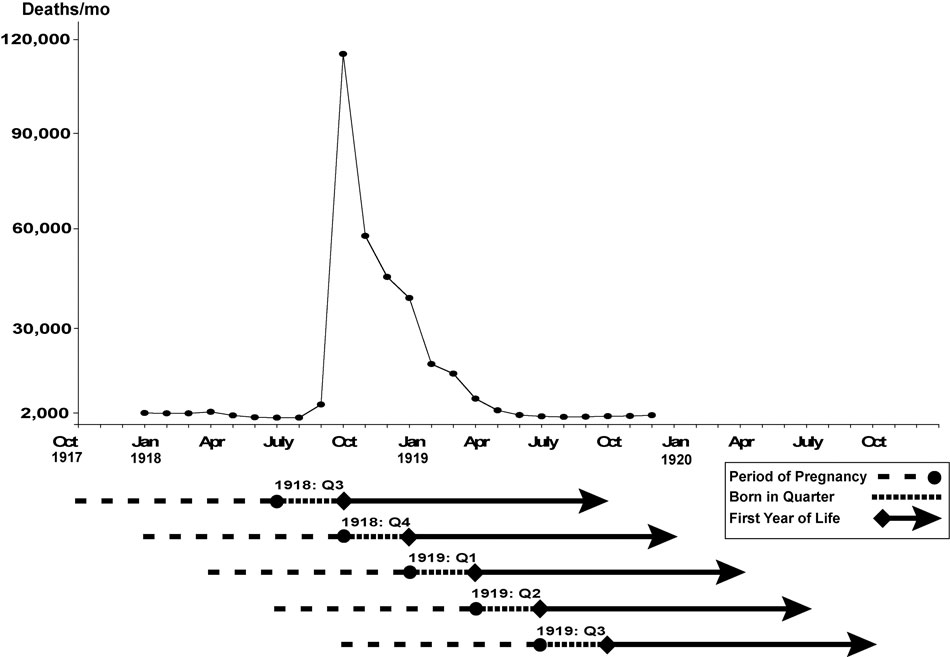
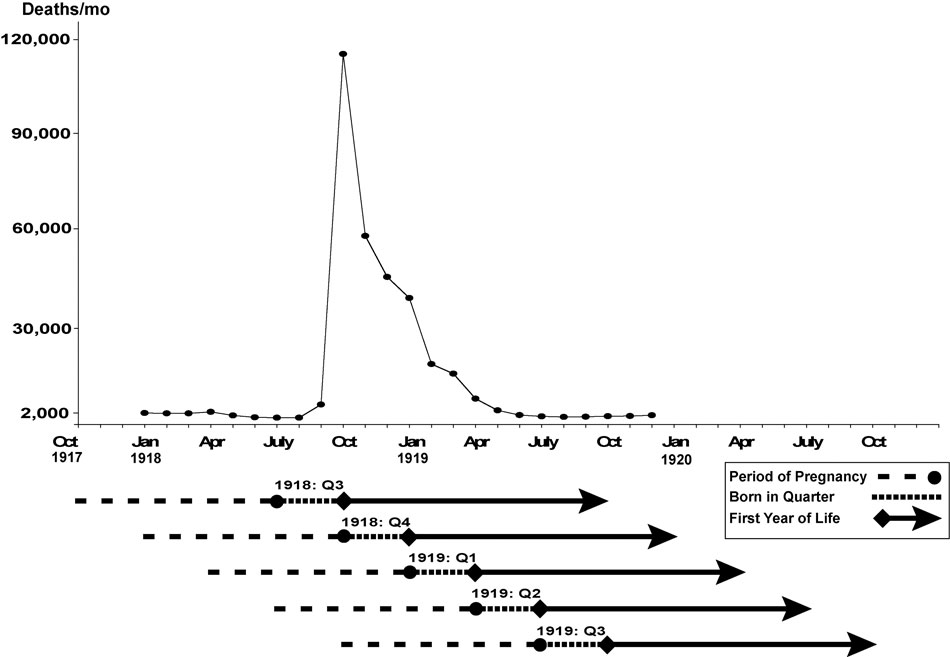
This analysis evaluates the later presence of heart disease and diabetes in the birth cohorts born in and around the period of the 1918–1919 influenza pandemic. The analysis is confined to a sample of 101,068 NHIS respondents born between 1915 and 1923, and surveyed from 1982 to 1996. Besides evaluating disease prevalence by annual birth cohort, we also estimated the effect of specific quarters of birth in 1918 and 1919 on the presence of cardiovascular disease, using multiple regression to control for various factors that might affect time trends in disease. We estimate the prevalence of heart disease, types of heart disease and diabetes relative to quarter of birth during the influenza pandemic v. being born before or after the pandemic. As outlined in Figure 1, births before 1918: Q4 were not exposed to influenza in utero, but as infants and small children. Those born in 1918: Q4 and 1919: Q1–Q2 comprise the vast majority of those in utero during the peak of the influenza mortality pandemic. Births in 1919: Q3 should have had minimal exposure in utero and no exposure postnatally to the worst phase of the epidemic. Births in 1919: Q4 and later should have had little-to-no exposure to the 1918 pandemic. The regressions include indicators of the timing of birth, for those born from 1915 through 1918: Q3, 1918: Q4, 1919: Q1, 1919: Q2 and 1919: Q3. The omitted category is of those with no exposure, born in 1919: Q4 or later. We controlled for seasonality, common across all birth years in the statistical model by including indicators of calendar quarter of birth for all years. Regression estimates were made using linear regression in SAS statistical software (version 9.13); logistic and probit specifications gave similar results (not shown). The difference in the estimated disease prevalence for persons in a specified birth period relative to those born in 1919: Q4 and later was determined by the estimated coefficients.
US influenza deaths by month and periods of pregnancy, birth, and infancy for birth cohorts. Influenza deaths, redrawn from Almond and MazumderReference Almond and Mazumder25 (top), with schema for pregnancy and birth in the corresponding year and birth quarter (bottom).
Because growth retardation is associated with arterial and metabolic disease, we examined height at World War II army enlistment for 2.7 million men who were born between 1915 and 1922; data on birthweight are lacking for these cohorts. Enlistment data for 1941 and 1942 from the National Archives and Records Administration with heights at 19 to 27 years of age; we did not use height at older ages because shrinkage in height is common during later adulthood. As we know only the year of birth, these data do not allow analysis by birth quarter for effects as found for heart disease and diabetes. Height was regressed on a set of age categories and a dummy indicating birth in 1919 to determine the effect of year of birth. An equation was also estimated which included dummy variables for month of enlistment to account for any changes in army selection criteria over time.
Results
The monthly deaths from influenza in the USA were concentrated in October 1918 through April 1919 (Fig. 1). Below the deaths are shown the periods of pregnancy, births and early infancy by quarter of birth (the overlap of these periods is not shown).
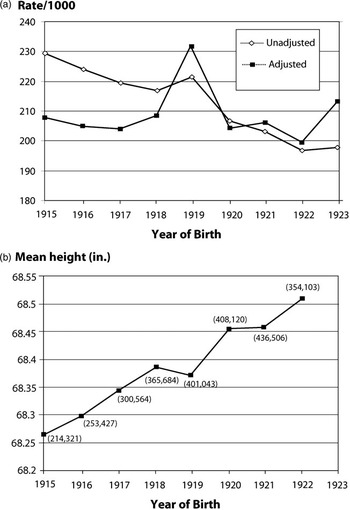
Figure 2a plots the prevalence of reported heart disease (per 1000) by birth year for 101,068 individuals in the 1982 to 1996 NHIS at 60 to 82 years of age. Note the spike in heart disease rates for 1919 births above the level of adjacent cohorts. The downward trend by birth year is expected because younger individuals, and those in more recent cohorts, have progressively less heart disease. The 1919 birth cohort, most of which was exposed prenatally to influenza and co-infections, shows accelerated cardiovascular aging with 5% excess cardiovascular disease at the ages of 63 to 77 years (unadjusted) and deviates from the declining trend during the four birth years before and after 1919. These effects remained after controlling for period and age, specifically by a separate cubic function of age in each year of the NHIS (Fig. 2a).
Cardiovascular disease (1982–1996) and mean height (1941–1942) by birth year: (a) National Health Interview Surveys (NHIS) of 1982–1996 (USA), shown as unadjusted, or adjusted for cohort trend and year for sample aged 60 to 82 years. (b) Male height at ages 19 to 27 years, by birth year at enlistment in 1941 and 1942; from the National Archives and Records Administration (numbers of registrants in parenthesis).

Men born in 1919 were shorter by about 0.05 inches, relative to surrounding cohorts (Fig. 2b). This effect, while small, is highly significant and aligns precisely with the period of increased heart disease.
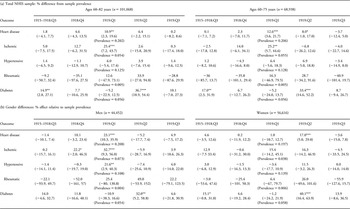
Estimates of the effect of the timing of birth relative to being born in the fourth quarter of 1919 (1919: Q4) up through 1923 are shown for the entire sample ages 60–82 years in Table 1a. Those born during the first quarter of 1919 (1919: Q1), who were more likely to be exposed to the pandemic during the second trimester of pregnancy, had 10.9% excess heart disease; restricting the analysis to 60 to 75 years of age increased the effect to 12.6%. Analyzing by disease type, the 1919: Q1 cohort had 25.4% excess ischemic heart disease; this effect was similar when the sample was limited to those aged 60 to 75 years (25.2%). Rheumatic or hypertensive heart disease did not show these effects, however, there was excess diabetes in those born from 1915 to 1918: Q3 (14.9%) and those born in 1919: Q2 (36.7%).
Effect of birth date on prevalence of heart disease and diabetes

NHIS, National Health Interview Surveys.
*P < 0.10, **P < 0.05, ***P < 0.01.
95 % confidence intervals are shown in brackets; prevalence rates for omitted group are shown in parentheses.
Sample from the NHIS of 101,068 births 1915–1923, surveyed 1982–1996. Columns show specific birth quarters, except for combined quarters of 1915–1918:Q3. Row entries are estimated from separate regressions of each outcome (0/1 indicators) on indicator variables for birth date in 1915 through 1918:Q3, 1918:Q4, 1919:Q1–Q3. Regressions also include indicators of quarter of birth to control for seasonality, age, age squared, and survey year. Estimates in panel (a) also include an indicator for females. Estimates were made using linear regression in SAS; logistic and probit formulations yielded similar results. Effect sizes were estimated using birth quarter coefficients to indicate the change in prevalence from that in the omitted group of those born after the third quarter of 1919. For example, the prevalence of heart disease for men aged 60–82 years (Table 1b) is 0.208 (208 out of 1000); the coefficient on the indicator variable for birth in 1919:Q1 is 0.0480, yielding a 23.1% effect relative to the omitted group.
Because the season-of-birth has known effects on later life disease,Reference Doblhammer and Vaupel18, Reference McEniry, Palloni, Dávila and Gurucharri19 we also estimated seasonal effects in the above analysis. Heart disease was elevated for Q2 births in all years (b = 9.03; P = 0.021) and reduced for Q3 births (b = −8.89; P = 0.020) relative to Q1 births in all years. Thus, the transient increase in heart disease prevalence in the birth cohort of 1919: Q1 described above remained significant after controlling for season-of-birth, with an effect size 2.5-fold (b = 22.09, P = 0.013) above the effect of being born in the Spring.
Gender differences for ages 60 to 82 years also showed differential birth quarter effects (Table 1b). Only men had significant excess heart disease for 1919: Q1 – total heart disease (23.1%) and ischemic heart disease (32.7%). Men born in 1919: Q1 also have more hypertensive heart disease (21.6%). A possible gender difference in timing of the effect is the 17% excess heart disease for women born in 1919: Q2. However, both sexes show excess diabetes for births in 1919: Q2; effects for 1915 to 1918: Q3 were marginally significant for women.
The inclusion of an interaction term for gender and cohort in the model for both men and women indicated that the differences in heart disease prevalence related to birth in 1919: Q1 and 1919: Q2 were highly significant (P-values of 0.01 and 0.014, respectively). For ischemic heart disease, the interaction term indicating a differential effect of 1919: Q1 birth was marginally significant (P = 0.076). For hypertensive heart disease, the difference in 1919: Q1 exposure was marginally significant at the 0.056 level. Finally, for diabetes, we found no statistically significant difference in any exposure period.
These effects of timing of birth on later life health may be underestimated for two reasons. If the pandemic effect is a ‘culling’ of the weakest fetuses then, all else equal (i.e. if there were no exposure effects on health), the average surviving newborn would be in better health and not worse health and therefore, the selection of surviving children works against our finding long-term adverse health effects during adulthood. Some evidence for this is the fact that infant mortality in 1919 was below that in 1917 and 1918.Reference Linder and Grove24 This effect was addressed by Almond in a latent variable model which incorporated both the threshold effect and a shift in unobserved health because of influenza exposure; it was concluded that if early life mortality during the pandemic occurred among those in the very weakest health, then long-term health outcomes are likely to be underestimated.Reference Almond4 Second, the expected higher mortality before the age of 60 years, from premature heart disease, in our sample may attenuate effects at older ages.
Lastly, we inquired if the excess cardiovascular disease could be accounted for by the fraction of pregnancies that involved influenza complicated by pneumonia. Maternal health during the pandemic peak in the present sample is likely to have varied widely from no clinical infection, mild uncomplicated flu or flu with severe secondary pneumonia that still permitted normal birth. Most flu cases were described as mild with little mortality, with most mortality ensuing from pneumonias caused by secondary bacterial infections.Reference Morens, Taubenberger and Fauci1–Reference Morens, Taubenberger and Fauci3 Pregnancy markedly increased the risk of secondary infections: about half of the 1918 influenza pandemic pregnancies developed secondary pneumonias which, in this pre-antibiotic era, increased maternal mortality and stillbirths.Reference Morens, Taubenberger and Fauci1, Reference Harris21, Reference Titus and Jamison22 Assuming that the incidence of influenza infection (33% of the adult population) was not affected by pregnancy, about 33% of all births should have experienced maternal influenza. Of these, pneumonia developed in about 50%. Thus the fraction of pregnancies exposed to both influenza and pneumonia approximates 0.5 × 0.33, or 16%, but only 8% of all births because 50% of mothers with both flu and pneumonia died before giving birth in a major hospital.Reference Harris21 Because this fraction (8%) is much smaller than the total excess of heart disease (24%), the other 50% of flu pregnancies with low mortality could comprise at least 16% of all infected by flu. Thus, a total of 8% + 16%, or about 24% of the surviving births were exposed prenatally to influenza. This proportion approximates the 25% excess prevalence observed in cardiovascular disease for births in 1919: Q1 that were in their second and/or third trimester during the peak pandemic (Table 1a). Thus, it appears that uncomplicated flu can explain most of the excess heart disease and diabetes. The remaining 75% of the births not affected by maternal influenza were still at risk for childhood infections, both from influenza and from other pathogens that were not related to this epidemic, throughout their childhood. Our estimate of higher levels of chronic disease among those exposed to influenza is thus not related to the lifetime level of infection, but to the prenatal timing of this maternal infection. These calculations must be considered a first approximation because of the use of subnational estimates for maternal mortality and for the proportion of pregnancies that developed both influenza and pneumonia. In subsequent epidemics, influenza during pregnancy also increased vulnerability to secondary bacterial infections.Reference Freeman and Barno23
Discussion
Prenatal exposure to the 1918 influenza pandemic was associated with ⩾20% excess ischemic heart disease after the age of 60 years, as compared to birth cohorts with little or no prenatal exposure to influenza. In contrast, there was no excess heart disease in earlier born cohorts and those born in periods with only postnatal exposure to influenza or with both late fetal and postnatal exposure. Men showed markedly greater risk of heart disease from prenatal exposure.
These effects may be underestimated because of expected higher mortality from premature heart disease before 60 years of age. A caveat is that our analysis is based on self-reported data. Nonetheless, several studies using medical records show that self-reported data on heart conditions such as these are accurate,Reference Almond and Mazumder25–Reference Engstad, Bønaa and Viitanen28 particularly for ischemic heart disease.Reference Kehoe, Wu, Leske and Chylack29 The NHIS data on diabetes have also been validated.Reference Edwards, Winn and Kurlantzick30
We hypothesize that these far-reaching associations of arterial disease with time of birth are causally linked to pathophysiological maternal disturbances. The cardiovascular associations of older adults with the birth quarter correspond to the stage of the epidemic in the USA at that time. After the mild 1918 Spring influenza wave, mortality from influenza nearly vanished, but soon resurged to an unprecedentedly virulent October–December peak, and then eventually vanished after June 1919.Reference Morens, Taubenberger and Fauci1–Reference Morens, Taubenberger and Fauci3 The surge of excess cardiovascular disease is generally associated with gestational exposure during the hyper-virulent wave. About 80% of prenatal exposures during the worst wave were born in 1918: Q4 and 1919: Q1–Q2, which corresponds to exposure in early- to mid-gestation. Diabetes also showed marked excess in two birth periods (1915–1918: Q3, 14.9% and 1919: Q2, 36.7%), which notably did not show increased heart disease. The increase of diabetes cannot be easily explained with shared risk factors in cardiovascular disease. The small but significant effect on height for all males born in 1919 could not be further resolved by birth quarter with available data. These findings suggest the 1918–1919 influenza pandemic cohort had persistent impairments of multiple organ systems from an early age.
Postnatal exposure to influenza was not associated with later heart disease risk, because those born before and during the Fall peak mortality had lower disease than those born 3 to 6 months later. This is somewhat surprising because infant mortality surged by about 10% in 1918 relative to the trend for progressive declines across 1916–1923.Reference Luk, Gross and Thomson31 While this increased mortality implies that some surviving infants would have had clinical flu, effects of the postnatal exposure appear statistically weaker than those for prenatal exposure. As noted above, infant mortality was lower in 1919 than 1918 or even 1917. Passive immunization from maternal antibodies to influenza would be expected from recent studies of maternal immunization with H1N1-like antigens during pregnancy: the evoked fetal adaptive immune responses are expected to be protective.Reference Rastogi, Wang, Mao, Lendor, Rothman and Miller32 Therefore, we focus our discussion on prenatal pathways.
Prenatal flu exposure is likely to involve multiple paths to adult health. Low birthweight, which is a risk factor of later heart disease and diabetes,Reference Barker8, Reference Gluckman, Hanson, Beedle and Raubenheimer9, Reference Finch11 could not be examined because data for US births before the mid-20th century are lacking.Reference Drevenstedt, Crimmins, Vasunilashorn and Finch33 Recent influenza epidemics of less-virulent strains were associated with a risk of lower birthweight from maternal infection in some studies,Reference Ramsey and Ramin34, Reference Goodnight and Soper35 but not in another.Reference Ács, Bánhidy, Puhó and Czeizel36 Although fever can cause transient anorexia, there should be little effect on fetal growth during uncomplicated infections if the mother was well nourished, as were most US civilians. Reproductive tract infections (e.g. bacterial vaginosis, chorioamnionitis), which were more common in this pre-antibiotic era, are also associated with lower birthweight.Reference Svare, Schmidt, Hansen and Lose37
There is ample evidence of the effects of prenatal nutrition, stress of maternal infection and immunity. Seasonal effects are relevant to the associations described here. In early 20th-century cohorts from Europe and Australia, the Spring births for that hemisphere had shorter life expectancy by 0.6 months, with corresponding excesses in heart and cerebrovascular disease (P < 0.001), which are attributed to seasonal variations in stresses from poor nutrition and infection.Reference Doblhammer and Vaupel18 These findings on adult heart disease were confirmed and extended in a rural Puerto Rican population for seasonal exposure to infections and poor nutrition during gestation; postnatal exposure and gender effects were not significant.Reference McEniry, Palloni, Dávila and Gurucharri19 The present study controlled for the season of birth in the statistical model. The significantly higher heart disease among Spring births is similar to findings in Europe. The longest-lived European cohorts were born in Q4; however, the US cohorts showed the lowest level of heart disease among those born in Q3. This difference could reflect differences in urbanization, timing of harvest or timing of infections, as the effect of season of birth varies with climate.Reference Doblhammer and Vaupel18, Reference McEniry, Palloni, Dávila and Gurucharri19
Our findings also correspond to some prenatal effects of the Dutch Hunger Winter of 1944 to 1945, which caused 10% lower mean birthweight.Reference Finch11, Reference Stein, Susser, Saenger and Marolla38, Reference Painter, de Rooij and Bossuyt39 By the age of 50 to 58 years, prenatal famine exposure early in gestation was associated with 13% excess ischemic heart disease (three-fold more), while low birthweight had a marginal association (P = 0.13).Reference Painter, de Rooij and Bossuyt39 There was also increased risk of schizophrenia and major affective disorders.Reference Painter, de Rooij and Bossuyt39, Reference Hoek, Brown and Susser40 Low birthweight, as expected,Reference Barker8, Reference Gluckman, Hanson, Beedle and Raubenheimer9 increased the risk of impaired glucose tolerance at 50 and 58 years of age.Reference de Rooij, Painter and Roseboom41 Additionally, those exposed peri-conceptually had hypermethylation of the Igf2 gene,Reference Heijmans, Tobi and Stein42 which is implicated in epigenetic mechanisms in fetal programming of cardiovascular and metabolic disease.Reference Gluckman, Hanson, Buklijas, Low and Beedle43 Prenatal exposure in the Dutch Hunger Winter and the 1918 influenza pandemic thus share increased risk of cardiovascular disease and metabolic dysfunction.
There may be a further shared factor of infections in the 1918–1919 influenza and the Dutch Hunger Winter. Diverse infections were rampant in war-time Holland, in association with malnutrition and deteriorated hygiene.Reference Finch11, Reference Svare, Schmidt, Hansen and Lose37, Reference Burger, Drummond and Sandstead44, Reference Hemmes45 However, maternal infections have not been studied in relation to adult disease in these populations. The stress of maternal infections can elevate cortisol, at least transiently, with transplacental effects on fetal cortisol and persisting effects on the hypothalamic-pituitary-adrenal axis that are linked to adult vascular healthReference Hampton12–Reference Samuelsson, Ohrn and Dahlgren14, Reference Ortiz, Quan, Zarzar, Weinberg and Baum17 (Introduction). Maternal IL-6 elevations in association with endotoxin (LPS) treatment in rodent models can also impair development.Reference Gayle, Beloosesky, Desai, Amidi, Nuñez and Ross16 Moreover, in mice, maternal infections can also alter placental Igf2 expression and promoter methylation,Reference Bobetsis, Barros and Lin46 which, as noted above, can alter fetal growth and later health. Transplacental immune interactions are also implicated because maternal immunity can influence postnatal immune responses which are also implicated in atherosclerosis.Reference Barker8, Reference Finch11, Reference Yamashita, Freigang and Eberle47 While none of these mechanisms can be adequately tested in the few survivors of the 1918 influenza, recent influenza birth cohorts could be considered.
The educational attainment deficits associated with the 1918 maternal influenza infectionsReference Almond4 may also be due to impaired brain development. Mice exposed to maternal H1N1 infections have postnatal behavioral and neuroanatomical abnormalities.Reference Patterson6, Reference Fatemi, Earle and Kanodia48, Reference Shi, Tu and Patterson49 Although fetal brains did not have detectible viral RNA from maternal infection, H1N1 was found occasionally in the placenta, suggesting sporadic viral escape from the respiratory system.Reference Shi, Tu and Patterson49 Feto-placental infection may not be required for developmental defects, because sterile activation of maternal immunity in the absence of pathogens causes similar brain damage.Reference Shi, Smith, Malkova, Tse, Su and Patterson50
Finally, we consider the greater male vulnerability to cardiovascular disease from prenatal influenza exposure. This example adds to the huge literature of excess male vulnerability to vascular disease, which is multi-factorial. Human arteries at birth already have microscopic lesions with activated macrophages and oxidized lipids,Reference Finch11, Reference Napoli, D’Armiento and Mancini51 this may differ by fetal sex or maternal pathophysiology, but data are lacking. Male behaviors, such as the higher levels of smoking, may also synergize more adversely with early damage.
In conclusion, the lingering influences from the 1918–1919 influenza pandemic extend the hypothesized roles of inflammation and infections in cardiovascular diseaseReference Finch11, Reference Crimmins and Finch20, Reference Franceschi, Capri and Monti52, Reference Ward, Wilson, Francis, Crossman and Sabroe53 to prenatal infection by influenza. We cannot, of course, know the range of inflammatory responses in the 1918–1919 prenatal exposure to influenza and secondary infections that may have triggered inflammatory responses of varying duration and severity. Nonetheless, some maternal stress responses during influenza that promote later vascular aging and metabolic disorders are modeled by experimental elevations of glucocorticoids and IL-6, and sterile inflammation. The influence of maternal infections on brain development, which has been separately recognized for autism and schizophrenia,Reference Fatemi, Earle and Kanodia48, Reference Ward, Wilson, Francis, Crossman and Sabroe53 could have contributed to the education and health deficits of the 1919 influenza birth cohort. Future studies may also consider the relationships of maternal infections to gene imprinting in the fetal programming of adult disease.
Acknowledgements
We are grateful for the support extended by the National Institute on Aging (R03 AG023939 to D.A.; P30 AG17265 to E.M.C.; P01 AG026572 to C.E.F.), the Ellison Medical Foundation (C.E.F.) and the Ruth Ziegler Fund (E.M.C. and C.E.F.). Bernard Steinman generously constructed the final graphs.
Statement of Interest
None.