In July and August 2016, hundreds of thousands of Chileans took to the streets across the country to express their anger at the incapacity of Augusto Pinochet’s signature privatized pension system to meet its promise of paying decent pension benefits. In the largest demonstrations since the return of democracy in 1990, protesters rallied against the companies at the heart of the system, the AFPs (Administradoras de Fondos de Pensiones), converging under the slogan “No More AFPs.”Footnote 1 The surprising emergence of this new social movement around the issue of pension reform in Chile is the most visible episode of slow-moving change built up over almost three decades. In the world’s first and most notable case of pension privatization, citizens became disenchanted with the capacity of the privately run system, set up during the dictatorship, to provide social protection (Brooks Reference Brooks2008, 324–25).
A survey conducted in the early 2000s showed that 50 percent of the workers belonging to pension funds stated that the system was “bad” or “very bad,” and only 6 percent had a positive view (CAPRP 2006, 85). As early as 1998, the Latinobarómetro survey reported that 83 percent of Chilean respondents believed that pensions should be mostly in the hands of the state rather than in those of private companies; by 2008 that proportion had risen to 90 percent (Latinobarómetro 1998, 2008). Yet in 2018, democratic Chile maintains essentially the same privately run pension system that the Chicago Boys designed in the late 1970s.
Why, despite such long-term majoritarian discontent among voters, culminating in the recent outburst of massive protest, has pension regulation been so remarkably resilient during the three-decade democratic period? What explains the endurance in Chile of such an unpopular policy, imposed by the dictatorship, even as recent evidence from multiple countries in Latin America and Central and Eastern Europe suggests that pension privatization reversal is a highly likely outcome, and even as the international epistemic communities that once portrayed the Chilean model as an exemplar have become increasingly critical of privatized pensions?
This article argues that the reproduction of the policy status quo in Chilean pensions can be understood only by looking at the combined effect of the pension industry’s long-term power-building investments and its short-term political actions. This study ultimately aims to contribute to the elucidation of still-pressing analytical puzzles in political economy: how does business get what it wants in the political arena? How can business continue to prevail, even with high issue salience and massive antibusiness voter sentiments, conditions under which the conventional wisdom (Culpepper Reference Culpepper2011; Smith Reference Smith2000) predicts that firms will lose regulatory battles? This study contends that in order to trace, both analytically and empirically, how business power shapes policy outcomes, we need—paraphrasing Pierson (Reference Pierson2004)—to study business power in time. This is especially important when the outcome to be explained is characterized by a series of nondecisions that cumulatively reproduce the policy status quo over time.Footnote 2
Based on extensive archival research, multiple datasets, and 24 interviews with top-level informants from the public and private sectors, this study traces the process by which the private pension industry first accumulated and then used power in the political arena to secure the continuity of Pinochet’s regulation during the three-decade democratic period.Footnote 3
The empirical findings of this study will contribute to a refinement and extension of the newly vibrant comparative political economy literature on business power. By adding a temporal dimension, this study takes a new step in this scholarship’s incipient quest to understand the relational nature of business power and its effects on the policy process (Fairfield Reference Fairfield2015a; Fairfield and Garay Reference Fairfield and Garay2017). If we take our research far enough back in time, we will be able to track down the early instances in which business actors patiently invest in the political arena, arguably with the expectation that building a large stock of power will generate political influence in later rounds of the game, through the individual calculus of policymakers. The resilience of the policy status quo in the face of visible and widespread public pressure originates in business actors’ decisions, made significantly earlier in time, to increase their stocks of power, which they then leverage when other actors put business under threat.
Placing the study of power in time allows us to connect dots that would otherwise remain unconnected, building on insights from both pluralist and antipluralist traditions. The three cases of contention studied here are nested within the long-term case study of pension regulation in postauthoritarian Chile, so we deal at the same time with an overall trend marked by nondecisions—the main concern for critics of pluralism (Bachrach and Baratz Reference Bachrach and Baratz1963)—and with episodes of open contestation, events typically at the heart of the pluralist agenda (Dahl Reference Dahl1961). Breaking down the within-case analysis this way provides more instances in which to test the impact of the variables highlighted as drivers of regulatory continuity.
This article proceeds to make the case for studying business power in time, bridging the literature on instrumental and structural power with recent advances in historical institutionalism. The case study of pension regulation in Chile is conducted in two steps. First, it takes the long period as a whole (1990–2018) to uncover the construction and expansion of business power. Second, it presents within-case analyses of three key contentious episodes in which the pension industry and the regulatory status quo were challenged by state leaders and officials, other business actors, and social movements. Through these, we examine business power in action. Then we consider alternative factors that could explain the resilience of pension regulation in postauthoritarian Chile. The article concludes by exploring potential contributions of these findings to future studies of business power over time and across space and policy domains.
Business Power in Time
In order to trace analytically and empirically how powerful business actors shape long-term policy outcomes, we must place business power in time. The existing literature’s tendency to adopt a static focus on the sources of business power leaves us only halfway in the attempt to empirically substantiate the processes through which business actors build their power, and how, when, and why that power is put in action. How do business actors initially expand their stocks of power? How is such power leveraged in successive rounds of challenges that put business interests under threat? What explains variation over time in the strategies business actors choose, even in cases in which aggregate levels of business power score comparatively high? The lack of analytic precision to address these important questions, even after the impressive rebirth of the business power literature during the last decade, motivates our exploration through a case study purposely designed to make the intertemporal dynamics of business power more tractable and to distinguish the construction of business power and its translation into influence as two distinctive processes.
Early contemporary political economy theories stress that in democratic capitalism, business is structurally powerful because the fate of elected government leaders depends on firms’ investment decisions, which critically affect the economic cycle (Lindblom Reference Lindblom1977, Reference Lindblom1982). In these classical theories, business is conceived as a multitude of uncoordinated, profit-maximizing firms that determine policy outcomes without having to act in the political arena. In contrast, instrumental power stems from firms’ deliberate actions in the political arena in their attempt to bring policy outcomes closer to their preferences (Hacker and Pierson Reference Hacker and Pierson2002). Fairfield (Reference Fairfield2015a) greatly refined the previous scholarship’s take on this second aspect of firms’ influence by conceptualizing multiple sources of instrumental power, ranging from partisan linkages and recruitment into government to technical expertise and media access, among others.
Although Fairfield’s inventory of sources of business power seems exhaustive, key issues still demand closer scrutiny, including how instrumental power is constructed in the first place and why the types of power sources that root business influence vary as strategic contexts change. By distinguishing between what they call automatic and strategic power, Culpepper and Reinke (Reference Culpepper and Reinke2014) paved the way for considering how structural power can be deployed during contentious episodes and how even instrumental power does not always require conscious activation in order to function. This understudied dimension was labeled automatic instrumental power. Even though the idea of “automaticity” is highly controversial, it invites us to look carefully at instrumental power in longer time sequences.Footnote 4 Our case study of the influence mechanisms of an indisputably powerful industry intends to contribute to this ongoing discussion.
A major implication of situating business power in time for conducting empirical research is that we will be able to reveal how the construction and the use of business power are two different processes. As Pierson vividly argues, “power is like an iceberg; at any moment in time most of it lies below the waterline, built into core institutional and organizational structures of societies” (2015, 124). We therefore need to separate the empirical analysis of the actions aimed at increasing the stock of power—which tend to be less visible—from those aimed at deploying those power resources to influence policy.
Over long periods of time, business actors engage in various strategies to increase their stocks of power, including investing resources to reshape the preferences of state or societal actors, affecting socialization processes (Adolph Reference Adolph2013), and building strong ties with state actors. In the long run, those investments contribute to defining the policy space and the agenda, determining what is politically “viable” to enter the policy debate. Assessing the causal leverage of business power in these early stages of the policy process is most challenging for researchers because it requires uncovering less-visible resources below the waterline, such as those resulting from the long-term construction of private sector career opportunities for politicians.
As our analysis of the political economy of pension regulation in Chile will illustrate, business actors, even when they succeed in building significant stocks of power over a long period of time, may need to innovate on existing strategies to leverage their power when open conflict emerges. When the continuity of a probusiness policy status quo is threatened, as it was in Chilean pensions after nearly three decades of unchallenged continuity, business actors may need to leverage structural or instrumental power to attempt to outweigh the power of nonbusiness actors in the state and society. At this point, we expect business actors not to be just patiently waiting for the power they have built to have indirect effects through policymakers’ anticipated reactions; instead, as they confront open challenges, we should observe a rise in the quantity, diversity, and intensity of business actions to push policy toward its preferred outcome.
Our perspective also reintroduces a focus on the relative nature of business power that has been blurred in the recent theoretical debates.Footnote 5 We need to situate business in relation to a broad set of nonbusiness actors, which have been considered separately in the literature so far. Business has been analyzed in relation to state actors, especially career bureaucrats and technocrats (Adolph Reference Adolph2013; Dargent Reference Dargent2015; Fairfield Reference Fairfield2015a); voters (Culpepper Reference Culpepper2011; Smith Reference Smith2000); and social movements (Fairfield Reference Fairfield2015b). Our study of Chile suggests that business actors change their strategies as a reaction to a broad variety of challenges made by societal and state actors across different strategic contexts. Through a within-case analysis that takes time seriously, this study paves the way for further rounds of theorization in the business power research agenda and, more broadly, in the scholarship that inquires into the relative influence of organized interest groups, voters, and other actors in policymaking (Culpepper Reference Culpepper2011; Fairfield and Garay Reference Fairfield and Garay2017; Hacker and Pierson Reference Hacker and Pierson2010; Trumbull Reference Trumbull2012).
How the Pension Industry Shapes Regulatory Continuity in Democratic Chile
In contrast to the multiple cases of pension privatization reversal in Latin America and Central and Eastern Europe, pension regulation has proven surprisingly resilient in democratic Chile (1990–2018), despite decades of majoritarian voter discontent with Pinochet’s privatization, multiple reformist attempts by center-left governments, and even under increasingly high issue salience, which conventional wisdom expects to diminish business power. Such a puzzling long-term policy outcome offers an excellent opportunity to illustrate the importance of studying business power in time in order to gain insight about how business exerts influence across changing strategic contexts. Our study starts with the privatization of Chile’s state-run, pay as you go (PAYGO) pension system in 1980 and traces the causal leverage of business power as a mechanism of policy reproduction over the following decades.
In November 1980, Pinochet signed Decree Law 3,500, setting a landmark in the global history of pension reforms.Footnote 6 Chile’s pioneering privatization radically retrenched the publicly administered PAYGO defined-benefit pension system. Authoritarian reformers set up an individual savings scheme with defined contributions, privately managed by for-profit pension fund administrators (AFPs). Under this pension system, 10 percent of workers’ monthly salary is transferred to an AFP; the private pension fund, in turn, charges a commission fee. By 1983, 77 percent of all formal civilian workers no longer belonged to the state-run pension system: their future pension benefits had come to depend on the returns of the mandatory savings managed by the AFPs (Acuña and Iglesias Reference Acuña and Iglesias2000). As the dictatorship was coming to an end, the Concertación coalition—which, led by the Christian Democratic and Socialist Parties, would occupy the presidency from 1990 to 2010—included the issue of pension reform in its electoral platform (Programa Básico de Gobierno, 1989). Yet by 2018, nearly four decades after Pinochet’s structural reform, the defining features of the Chilean pension system remain unchanged.
We examine next how, over a long time period, the pension industry patiently—and rather “invisibly”—built its influence by focusing on the expansion of its stocks of structural and instrumental power.
Structural Power: AFPs’ Increasingly Prominent Position in the Chilean Political Economy
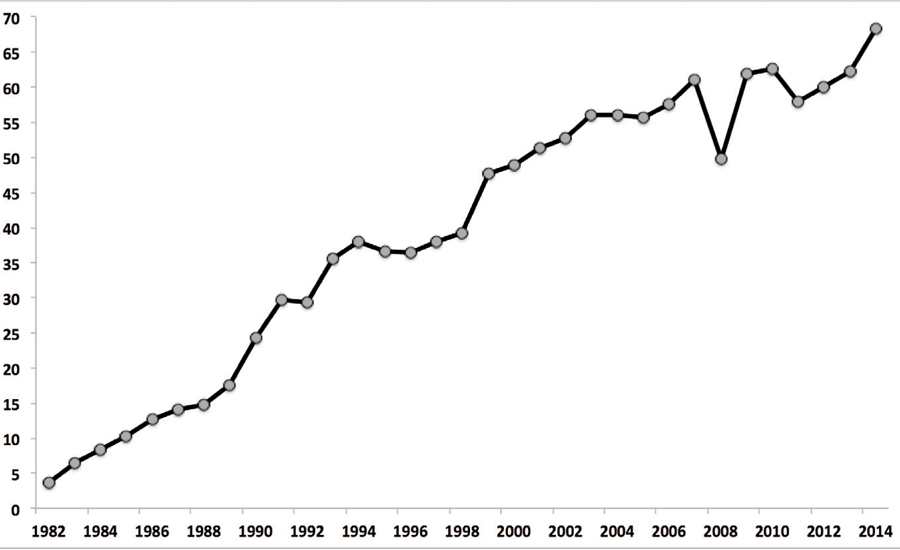
As the postauthoritarian period unfolded, the pension industry attained an increasingly prominent position in the Chilean economy. This, in turn, became the basis of AFPs’ structural power, making policymakers reluctant to upset newly pivotal economic actors in Chilean capitalism. Privately run pension funds progressively accumulated an impressive amount of capital under their control. When the Concertación took power in 1990, the privately run pension system managed financial assets equaling 23 percent of GDP. This figure has continued to grow since then, reaching roughly 70 percent in 2014 (figure 1).
Assets Under Privately Run Pension Fund Management as a Percentage of GDP, Chile, 1982–2014

Pension funds became an important underpinning of the domestic banking system. Between 1990 and 2016, pension funds allocated, on average, a quarter of their massive portfolios to the domestic financial system. In 2007, for instance, that amount was equivalent to US$33 billion, and the vast majority of it was allocated to fixed-term deposits and bank-issued bonds.Footnote 7 This source of liquidity is essential for Chilean banks to expand credit and thereby, profits.
The process by which AFPs accumulated structural power is inextricably linked to the impressive expansion of Chile’s capital markets. The AFPs have constantly been the most important institutional investors. Between 1990 and 2016, pension funds allocated, on average, 25 percent of their portfolios to corporate equity and bonds traded in Santiago; in 2010, these investments peaked, reaching US$36 billion.Footnote 8 AFPs have been a consistent and critical source of capital for equity and corporate bond markets, where many of the largest Chilean firms obtain financing. Moreover, pension funds’ continuous demand for these assets pushed prices up, benefiting the companies that participate in Santiago’s markets. As a result, the largest Chilean firms—which are powerful not just in and of themselves but also as the dominant actors in the powerful, multisectoral business associations (Silva Reference Silva2002, 341–42)—came to be increasingly invested in the maintenance of the privately run pension system.
By becoming strong financiers of both banks and big, nonfinancial corporations and business groups, AFPs, over time, achieved what Young (Reference Young2015) denominates as a position of structural prominence in the Chilean economy. In a strategic use of structural power, the pension industry regularly intervenes in the public debate to emphasize that the private capitalization system is a key underpinning of “economic development” and job creation in Chile (see, e.g., AAFP 2006, 246) or to make the case that any profound pension reform would “severely affect one of the pillars of Chilean development, compromising economic growth, the development of capital markets, and future equilibriums” (Rodríguez Reference Rodríguez and Mauricio2014). Government leaders, facing the evidence that any regulatory change affecting pension funds could have an impact on the economic cycle, would automatically think twice before proposing a pension reform bill (see Pribble Reference Pribble2013, 79). However, structural prominence is not enough to explain favorable outcomes (Young Reference Young2015). AFPs’ power was not solely based on structural sources; since the 1980s, it was reinforced by the patient building of instrumental power.
AFPs’ Instrumental Power in the Making
Since the early 1990s, the Chilean private pension industry has provided ample, well-paid career opportunities to the political elite. Members of the elite enjoyed a patterned circulation between high-level state offices and executive positions in the AFPs or on the company boards where AFPs are shareholders. Revolving-door dynamics are first noticeable in the immediate aftermath of the authoritarian period and have continued into the democratic era. This understudied source of instrumental power can arguably produce automatic effects over policy by interacting with campaign finance, a mode of pension fund investment in politics widely covered in the media and other studies (e.g., Matamala Reference Matamala2015).
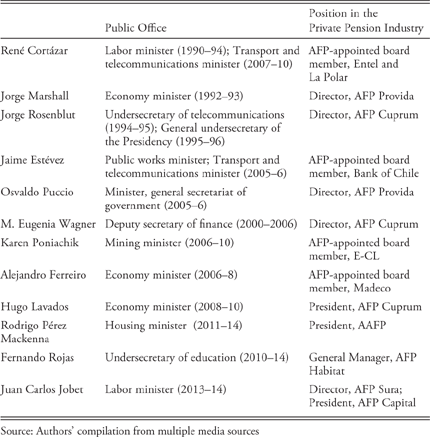
On leaving public office with the end of the dictatorship, at least 12 of Pinochet’s ministers received top positions in the AFP industry, including 3 former finance ministers and a former labor minister, Guillermo Arthur, who would serve as president of the Association of Private Pension Funds (AAFP) between 1999 and 2014 (Matamala Reference Matamala2015). As the democratic period progressed, the AFP industry’s hiring of politicians not only continued but also extended its reach across the political spectrum. Table 1 illustrates this broader tendency, focusing on prominent cases of executive branch officials who moved on to be directly hired by AFPs—or indirectly, coming to serve as AFP representatives in the boards of firms where pension funds hold equity.
Sample of Former Executive Branch Elite Officials Recruited by the Private Pension Industry

Source: Authors’ compilation from multiple media sources
The reach of revolving-door dynamics in the Chilean pension arena is larger than what is conveyed in table 1. Many top politicians are not included there because they do not meet our criteria: having occupied a position at the ministerial level or immediately below that. We also detect revolving-door dynamics affecting superintendents, the top officials in charge of regulating the pension system. For instance, the first superintendent of the democratic era, Julio Bustamante, had contributed to setting up two AFPs in the 1980s and went back to this industry after leaving public office in 2000. All his successors, with one exception, seem to have had ties with the AFP association, as their participation in AFP-organized public activities and publications suggests (AAFP 2015, 2016). In light of these patterns, a former finance minister stated that some of “the officials in charge of overseeing the private pension system have become enthusiastic promoters of it” (Arenas Reference Arenas2010, 27).
We have good theoretical reasons to believe that this patterned circulation of the Chilean political elite from the state to the private pension industry—and, often, back to the state—may have contributed to gatekeeping deep reform proposals. Adolph (Reference Adolph2013) utilized formal and statistical models to demonstrate that policymakers’ career perspectives deeply affect the decisions they make while in office—and, most likely, we can add, they influence nondecisions, too. In that sense, Chilean pension funds’ patterned recruitment of key political figures may reveal the industry’s systematic effort to build a constituency of business-friendly policymakers—or, in other words, a process for crafting instrumental power.
A precise identification of the sequence of events is key to making such an inference. AFPs started to invest in the hiring of political figures many years before any serious challenge to the continuity of pension regulation emerged. Arguably, the pension industry patiently signaled to elite political actors—especially those with expertise in financial regulation—that the decisions and nondecisions they made could be rewarded through their future hiring in the industry itself. It is quite likely that pension funds’ investments in shaping policymakers’ career incentives may have biased the discussion on pension reform among the Chilean political elite—even within the center-left parties that have occupied the presidency during 24 of the last 28 years. In such contexts, our expectation is that business ideas will prevail, as an automatic effect of instrumental power. The remarks of a former Finance Ministry official, later minister of finance, illustrate the bias in pension reform discussions during the 1990s, which ultimately made highly unlikely any regulatory change that would hurt the AFPs.
The idea that individual capitalization was the great solution to the pensions issue, and one of [Chile’s] most successful nontraditional exports, prevailed throughout almost all of that decade. Criticizing the [pension] system that was making Chile famous across the world was considered a boycott, an antipatriotic act. (Arenas Reference Arenas2010, 29)
Similarly, in a confidential interview, a presidential adviser said that pension reform was a “taboo” in Chilean politics during the early Concertación administrations (Garay Reference Garay2016, 285).
Center-left governments restrained themselves from pension reforms, anticipating business reactions. In 1999 the Finance Ministry and the United Nations Economic Commission for Latin America and the Caribbean (ECLAC) co-organized an expert seminar to analyze pension reforms in Latin America. On that occasion, a top-level Finance Ministry official gave a presentation that showed the high fiscal cost of Pinochet’s privatization to the Chilean state and how the system’s low coverage called into question whether the reform itself was successful. Extreme precautions were taken so that these findings, considered highly controversial at the time, did not reach the Chilean mass public. “As we were aware that the publication of such a critical diagnosis elaborated within government could generate much trouble,” the Finance Ministry official recalled years later, it was decided—“unprecedentedly for events held at ECLAC” headquarters—that the press would be restricted and that this document would be embargoed (Arenas Reference Arenas2010, 37–38).
The AFP industry’s control of the agenda was so tight during the 1990s and early 2000s, even as public opinion polls consistently indicated that voters strongly opposed the privately run pension system, that the adjustments that were made during the period were pushed by the AFPs themselves.Footnote 9 Real threats to the policy status quo would emerge only after the mid-2000s. In 2005, during her presidential campaign, center-left candidate Michelle Bachelet stated, “This time the AFPs will not define the reforms that need to be made” (2005, 27). Foreshadowing the unprecedented challenges that AFPs would meet in the late 2000s and 2010s, Bachelet’s statement hinted, in terms familiar to business power scholars, that pension regulation had ceased to be an arena of “quiet politics” in Chile.
Under those circumstances, current theory predicts (Culpepper Reference Culpepper2011), even powerful business actors tend to lose. This was not the case in Chile, at least up to the time of this writing. These contentious episodes allow us to examine the conditions in which business actors with long-accumulated stocks of power might exert sufficient influence to secure the translation of their preferences into policy outcomes, as well as how hostile contexts trigger change in business strategies and methods for acting in the political arena.
Cases of Contention: How Powerful Business Actors Prevail in Hostile Political Environments
So far we have shown how the Chilean pension industry’s power grew silently and steadily over time. Borrowing from Pierson’s metaphor, we have analyzed the submerged part of the iceberg. Since the mid-2000s, the power that AFPs successfully built into the Chilean political economy has met unprecedented and increasingly challenging tests. In these situations, the pension industry’s slowly constructed power was rapidly deployed to ensure regulatory continuity during visible contentious episodes in which the policy status quo was forcefully called into question.
The Bachelet Pension Reform (2008): Worried State Officials and Cautious Politicians
As the democratic period progressed, top-level officials at the Finance Ministry became increasingly concerned about the private pension system’s capacity to deliver its foundational promise of well-paying pensions for Chileans. They eventually succeeded in receiving future President Ricardo Lagos’s attention: in a book launched during the electoral campaign, Lagos said, “Almost half of the workers in the privately run pension system will not even receive a minimal pension [upon retirement. … This] is a time bomb both for families and for [public] finances” (Lagos Reference Lagos1999, 64).
Addressing these growing concerns, the Lagos administration (2000–2006) drafted reform proposals that would deal with various issues (Maillet Reference Maillet2013), none of which threatened the defining features of the Chilean privately run pension system. Still, those proposals that would marginally affect the industry generated staunch AFP opposition—and were therefore canceled altogether.Footnote 10 While our evidence suggests that top-level state officials, in drafting an incipient reform agenda, were relatively autonomous from the private industry’s interests (Maillet Reference Maillet2013), AFPs still enjoyed strong agenda power and, during the Lagos administration, were ultimately able to delay the adoption of reforms that could affect them.
Bachelet made pension reform her top priority during the 2005 electoral campaign. Her arrival in the presidency thus finally opened a period of contention. On taking office, Bachelet created the Marcel Commission, an advisory committee (named for its chairman, former budget director Mario Marcel) in charge of preparing the pension reform. Yet as our analytic framework highlights, powerful business actors can—often automatically—secure a highly constrained policy space and thus safeguard their interests. In the case of Chile, the pension industry’s power arguably exerted influence early in the policy process by shaping the committee’s membership and mandate. Most of Bachelet’s appointees to the commission had ties with the AFP industry, while the few Social-Democratic appointees received instructions about what was discussable and what would be left off the agenda. Marcel Commission member Jaime Ruiz-Tagle, for instance, later said, “the mission we received from President Bachelet … was to present reform proposals within [the limits] of [Pinochet’s] Decree-Law 3,500, because going beyond those limits was not perceived as possible” (Mostrador 2016a; see also Clark Reference Clark2007, 76).
A member of the later Bravo Commission, the advisory committee created during Bachelet’s second term, highlighted the importance of selection processes of presidential advisory committee members in circumscribing pension reform agendas.
The composition of the [Pension Reform] Commission was the crucial factor influencing the result of its work. In practice one could foresee this result at the very beginning. (Personal communication, November 25, 2017)
The inferential value of this quote seems significant, since, as we will see, the pool of experts selected for the Marcel Commission was more favorable to AFP interests than the pool of advisers chosen for the Bravo Commission.
By the time the Marcel Commission started deliberating, the crucial part of the decisionmaking process in Bachelet’s pension reform had already ended.Footnote 11 As could be anticipated by looking at its composition, the Marcel Commission recommended reforms on the margins of the existing regulation. The rest of the policy process hinged on choosing within a narrow subset of policy alternatives, none of which put the AFP business in danger. In this final stage, the pension industry used instrumental power to block the passage of the only aspect of the reform under discussion that implied a significant deviation from AFPs’ preferences. For instance, during the congressional debates that followed the so-called Marcel report, a proposal was introduced to allow the state-owned BancoEstado to set up an AFP. The proposal came not from the Marcel Commission but from left-wing legislators in the governing Concertación coalition, who had not been part of the revolving-door dynamics when AFPs were expanding their stocks of power. The passage of this proposal would have had the side effect of benefiting the Chilean private banking industry by allowing banks to enter the profitable pension fund management business for the first time.
Revealingly, AFPs’ ties with the partisan right were so strong that right-wing senators sided with the pension fund industry against bankers—represented by the powerful Association of Banks (ABIF)—and voted to preserve the policy status quo. The pension industry’s stance against any form of direct state participation in the AFP market ultimately prevailed in the Senate (BCN 2008, 1264–67, 2591–94; Ewig and Kay Reference Ewig and Kay2011, 86–87; Garay Reference Garay2016, 289; Pribble Reference Pribble2013, 81). This episode illustrates that when long-accumulated stocks of power are not enough to constrain the agenda, instrumental power is more likely to be observed in action, as powerful business actors visibly attempt to veto the alternatives they dislike.
The only significant change resulting from Bachelet’s 2008 pension reform was the creation of a state-financed “solidarity pillar” to extend the coverage to lower-income individuals and to increase the minimum pension. However, this change took place in an area of pension regulation in which AFPs had no strong preference against or in favor of such reform. Although the pension industry faced an increasingly hostile situation, the AFPs’ challengers were successfully contained, and the policy status quo underpinning private capitalization was maintained.
As Ewig and Kay (Reference Ewig and Kay2011, 85) put it, the 2008 reform reflected continuity rather than reinvention. In short, Bachelet chose to restrict the agenda even though she stood left of center on the political spectrum; she was very popular in the public opinion; she, unlike her predecessors, enjoyed a congressional majority; and she was aware of AFPs’ massive unpopularity. In line with our analytical expectations for regulated industries where business grows increasingly powerful over time, during Bachelet’s first government, the policy status quo was reproduced through policymaker choices that cautiously anticipated business reactions.
Bachelet’s Second Administration (2014–2018): The Experts Rebel
During Sebastián Piñera’s administration (2010–14)—the first since the return of democracy to be led by a right-wing coalition for which business was a core constituency—AFPs did not face state-driven challenges. Even so, in this period we find the origins of a second round of challenges that would put the pension industry’s power to a harder test. In 2011, Chile was shaken by the largest protests since the democratic transition (Donoso and Von Bülow Reference Donoso and Von Bülow2017; Fairfield and Garay Reference Fairfield and Garay2017; Niedzwiecki and Pribble Reference Niedzwiecki and Pribble2017). Although the student movement did not focus on the pension issue, these massive mobilizations, as Fairfield (Reference Fairfield2015a, 267–71) shows, started to counterbalance Chilean business power, opening new space to question how the center-left Concertación governments (1990–2010) had dealt with Pinochet’s policy legacies.
This unprecedented cycle of contention set the scene for the 2013 presidential campaign, when Bachelet proposed to establish a state-owned AFP. After a landslide victory and with a large majority in Congress, President Bachelet, on starting her second administration (2014–18), rapidly sent a bill to fulfill the promise of creating a state-run AFP and summoned a new advisory committee, the Bravo Commission, to make proposals for a new pension reform.
The political situation in which AFPs operated had changed dramatically in a few years. The control of the presidency shifted from a right-wing coalition led by a billionaire, with business as a core constituency, to a renewed center-left coalition that, empowered by large-scale mobilizations from below, promised to make reforms that the Concertación governments had not dared to propose at the return of democracy. On the basis of our analytic framework, in such contexts we would expect a rise in business actions to push policy toward its preferred outcome. Evidence is in line with these observable implications. In fact, the AFP industry made several decisions arguably intended to reinforce its power sources should new challenges arise. The leadership of the Association of Private Pension Funds (AAFP) was renewed: former Pinochet minister Guillermo Arthur handed power to Rodrigo Pérez, who had not occupied public office during the dictatorship and was widely seen as more prone to dialogue with the center-left government than his predecessor (Urquieta and Carcamo Reference Urquieta and Carcamo2014). Moreover, the AAFP shifted its media strategy in 2014 from targeting the Chilean elite to targeting the mass public.Footnote 12
The AFPs’ concerns were fueled by the unexpected establishment of the Bravo Commission and rumors about its initial proposals. In a strategic use of structural power, the new AAFP president preemptively stated, “No industry would resist three structural changes in such a short time period” (Rodríguez Reference Rodríguez and Mauricio2014). The industry also criticized the criteria chosen for the selection of the Bravo Commission members: in the AAFP periodical, a columnist later complained that the committee had not included “any libertarian” and that the Communist Party had been “overrepresented” (AAFP 2016, 37).
As opposed to what happened with the Marcel Commission, in the appointment phase preceding the Bravo Commission, the pension industry’s power did not suffice to exert gatekeeping influence on experts who would be likely to criticize the regulatory status quo. Out of 24 members, none was directly related to the AFP industry; moreover, 9 had full-time academic appointments outside Chile, 3 had appointments in international organizations not associated with orthodox economic ideas (ILO, UNDP, and UNICEF), and 2 members were closely associated with the partisan left.
Under these circumstances, pro–status quo commissioners were very active. A member of the committee retrospectively argued, “I think that from the very beginning the main goal of some members of the commission was to water down the public impact of more audacious reform proposals.” Critical of the policy status quo, this informant added,
Some [university] professors were strongly supporting me in private. Then I understood that an open support was not an easy option for them, especially taking into account the pervasive influence of the financial elites and institutions in society, the media, universities, the job market, etc. (Personal communication, November 25, 2017)
Yet as a result of AFPs’ unprecedented failure to exclude critical voices from the commission, the growing disagreements within the political and economic elites—until then kept with great discretion in closed meetings—still reached the press and the public eye.
The final vote within the Bravo Commission was split between two major reform alternatives. Proposal A gathered 12 votes and advocated maintaining the private capitalization pension system with a number of reforms on the margins. Proposal B, with 11 votes, significantly challenged the private capitalization principle by recommending the creation of a hybrid system, in which an important portion of the Chilean workforce would no longer save in AFPs but instead in a new state-run Solidarity Fund (CAPSP 2015). Because AFP fees are tied to the flow of funds under management, had Proposal B won and turned into law, the AFPs would have seen their profits curtailed and their prominent position in the Chilean economy eroded. Though Proposal C was voted for by only one commission member, its very publication was symbolically relevant, as it was the first time that, within the confines of an executive branch technical commission, an expert called for the demise of the private capitalization pension system altogether and its replacement by a state-run PAYGO system.
From the 1990s through the 2006 Marcel Commission, path-departing pension reform ideas had been excluded from the policy debate, but by the time the Bravo Commission handed in its final report in 2015, it was clear that this apparent consensus within the Chilean elite had broken. What was previously seen as outside the set of feasible options became subject to in-depth discussion, suggesting that the pension industry’s capacity to constrain the policy space had declined over time. The international setting had changed, too, as other countries that had earlier emulated the Chilean pension privatization were now renationalizing their systems (Argentina in 2008, Bolivia in 2010, and Hungary in 2010, among others), and as even the protagonists of the epistemic communities that once portrayed the Chilean model as an exemplar, like the World Bank, had become increasingly critical of privatized pensions (Orenstein Reference Orenstein2013).
In the aftermath of the Bravo Commission, the AFPs responded in a number of ways. First, the AAFP changed its general manager. Instead of continuing its longstanding tradition of hiring members of the partisan right, this time the AAFP innovated by hiring Fernando Larraín, a former adviser to Socialist president Lagos with wide networks of contacts in the center-left government (Mostrador 2015). Second, AFPs deepened their efforts to court the mass public. The association developed a new corporate image and a new campaign to “educate” Chileans about the benefits of private capitalization (AAFP 2016), while AFP CEOs and the AAFP president regularly appeared on television to argue that the AFPs were not responsible for the low pension benefits that retiring Chileans were receiving. In their media appearances, AFP representatives acknowledged that the public was right to be angry with low pensions, but attempted to shift the blame for the poor performance of the privately run pension system to factors beyond AFPs’ control, including the retirement age stipulated in the law and various characteristics of the Chilean labor market. Third, the AAFP went public to argue about the perils associated with Proposal B in the Bravo Commission report or any other form of direct state involvement in the AFP market (AAFP 2016).
In closing this within-case analysis, it is important to note that after the AFPs took these actions, even in the much more hostile post–Bravo Commission scenario, the regulatory status quo was reproduced once again. Lacking energetic support from the executive branch, the bill that would set up a state-owned AFP ultimately did not advance in Congress. Moreover, a year after the Bravo Commission’s recommendations were released, the executive branch had made no progress in introducing a pension reform bill.
The Pension Industry’s Nightmare Comes True: An Anti-AFP Social Movement
On a Sunday morning in July 2016, hundred of thousands of Chileans gathered in protests across the country under the slogan “No More AFPs.” This was the first of several demonstrations, the largest since the return of democracy in 1990. Unexpectedly, a new, large-scale social movement—not linked to any political party—was born to demand the creation of a state-run, PAYGO pension system. The salience of the issue of pension reform thereby reached a historic peak in postauthoritarian Chile. Although the private pension industry had accumulated power over time, the end of quiet politics put business on the defensive. Having confronted elite politicians and officials during earlier contentious episodes, this time AFPs faced their major test with this broad mobilization from below.
In August 2016, President Bachelet went public to address the mounting popular discontent. In a speech televised nationwide, she promised to send a bill to Congress based on the work of the Bravo Commission, including a 50-percent increase in employer contributions to workers’ pension savings. Contrary to AFPs’ interests, Bachelet proposed that this new flow of funds should be under the control of a new state agency. Facing this threat, the AFPs, having already lost their previous ideational supremacy, intensified their use of instrumental power in ways previously unseen, so as to retain some capacity to frame the public debate.
The AAFP changed its leadership once again, this time closing ranks with Chile’s powerful encompassing business association, the Confederation of Production and Commerce (CPC).Footnote 13 The appointment of the outgoing CPC president, Andrés Santa Cruz, as the new AAFP leader was the immediate antecedent of the CPC’s decision to become actively involved itself in the defense of the regulatory status quo for pensions. In December 2016, the CPC released a so-called technical report that was a thinly veiled political statement. The CPC report acknowledged citizens’ discontent, due to the gap between expected and actual pension benefits, and welcomed President Bachelet’s decision to introduce reforms. However, the CPC stated that the private pension system should not be changed, arguing in favor of pursuing incremental rather than structural reforms (CPC 2016, 5–6). In addition to sectoral and cross-sectoral strategies, AFPs became individually active in their attempt to regain legitimacy. Actions included significant fee reductions, assemblies with clients and future pensioners (Weissman Reference Weissman2017), and the creation of committees on which AFP members could express their voice (Mostrador 2017).
As the introduction of the Bachelet bill approached, AFPs intensified their efforts to attempt to mobilize AFP members—by sending letters or polling them on the issue of pension reform—as if they were constituents rather than their clients. Moreover, a set of videos defending the pension industry were filmed and distributed through the social media. These videos showed common citizens confronting grotesquely characterized public servants who asked them to hand in the new employer contributions that the Bachelet bill would create. At the end, the main character says, “I’m an AFP contributor, but I’m not stupid” (Reforma la Reforma. 2017).
In August 2017, as her term was coming to an end, President Bachelet sent three bills to Congress. The key proposed change was a five-percentage-point increase in employer contributions that would be managed by a new Council of Collective Saving. In what can be interpreted as a strategic misrepresentation of preferences (Broockman Reference Broockman2012), AFPs vociferously decried Bachelet’s reform proposal, even though its passage would not hurt their current profits. A member of the Bravo Commission, referring to why Bachelet had presented such a moderate reform proposal, said, “There are interest groups, economic interests, you need a strong political backing to make the tough changes that need to be made.” And he criticized the government for having made “such a rushed decision,” which “sets the limits of the field, tying the hands of those of us who want a different reform. This will not satisfy the citizenship” (Mostrador 2016b).
The massive protests and voter discontent indicate a majoritarian societal coalition in favor of dismantling the private capitalization system altogether. Nevertheless, AFPs could consider Bachelet’s proposal a victory because it maintains a core element of Pinochet’s landmark pension privatization: AFPs would continue to charge fees for the management of 10 percent of workers’ wages. Furthermore, while, contrary to the AFPs’ first-order preference, the issue of “collective savings” entered the policy agenda, the pension industry succeeded in delaying the introduction of the reform proposal up to the very end of Bachelet’s term. As a consequence, AFPs ensured that the bills were discussed not under Bachelet but in a new political scenario in which the partisan right could make significant inroads in Congress and obtain the presidency.Footnote 14 The new round of contestation that is opening up will allow us to test whether the pension industry’s investments, during the second Bachelet administration, to enhance its power by targeting the mass public will turn into another source of advantage in the Chilean political arena.
Alternative Explanations
The resilience of pension regulation in democratic Chile cannot be explained without tracing the causal leverage of one critical factor: business power. This section considers alternative explanations that emphasize other causal drivers. By discussing why these alternative factors actually complement—rather than challenge—our narrative, we strengthen the plausibility and persuasiveness of an argument on policy resilience centered on the long-term effect of business power.
Since we expect institutions to be “sticky,” it could be argued that regulatory continuity in Chilean pensions is no puzzling outcome. Yet the comparative evidence suggests otherwise, because pension privatization reversals do occur often. During the last decade, multiple countries that had once emulated Pinochet’s reform either fully renationalized their pension systems (Argentina, Bolivia, Hungary, Kazakhstan) or significantly scaled back their mandatory private capitalization accounts, restoring the role of public provision (e.g., Poland and Russia) (Naczyk and Domonkos Reference Naczyk and Domonkos2016). Moreover, drawing on the literature on gradual institutional change (Mahoney and Thelen Reference Mahoney and Thelen2010; Streeck and Thelen Reference Streeck and Thelen2005), we could expect layering dynamics to take place in the pensions arena; however, as this study shows, even reform through layering has been difficult in Chile.
Although we acknowledge that Chilean policymaking has exhibited a general propensity to maintain the status quo, such durability needs to be explained. Engaging with the insight that it is crucial to examine the mechanisms of reproduction that drive path-dependent institutional evolution (Pierson Reference Pierson2004; Thelen Reference Thelen1999), the focus here on business power is thus an important step toward unraveling the puzzle of regulatory continuity in Chilean pensions.
A second alternative explanation would hold that the executive branch’s preferences drove pension regulation resilience. Yet looking at this process over the long term helps uncover evidence that casts doubt on such an argument. The Concertación’s future founders were highly critical of the pension regulation status quo before taking office in 1990. For example, a book published in the 1980s by a large group of Christian Democratic técnicos called for the dismantling of AFPs and the restoration of a state-run pension system (SPTHC 1984, 284). Meanwhile, the CIEPLAN think tank, where most of future president Patricio Aylwin’s economic advisers worked in the 1980s, was critical of the privatized pension system (Arellano Reference Arellano1985). However, in the context of the transición pactada, there was no room for inscribing those proreform preferences into policy. “The direction the Concertación took on social policy,” Silva argues, can be understood as “an act of self-censorship; a recognition of the structural power of Chilean … capitalists” (1996, 232).
While we acknowledge that certain Concertación economists supported the private capitalization system because of its positive effect on capital market expansion, this factor alone cannot explain the outcome, as such preference for regulatory continuity is not independent from the AFPs’ strong power. One of Bachelet’s advisers illustrates the point: “Pinochet’s private system was well entrenched and had accumulated a lot of capital.…The prospect of eliminating the AFPs scared us because that could damage the economy” (quoted in Pribble Reference Pribble2013, 79). As for chief executives’ preferences, although moderate Christian Democratic presidents led the first two Concertación administrations (1990–2000), the coalition governments of 2000–2010 and 2014–18 were led by Socialist presidents, Lagos and Bachelet, who, as we have seen, favored introducing reforms to pension regulation. In short, while it is undeniable that some factions within the center-left administrations praised the privately run pension system, there is sufficient evidence indicating that policy continuity cannot be attributed to the executive branch’s preferences.
Another alternative explanation would argue that since labor and social movements typically trigger the expansion of the state’s role in the provision of social protection, in Chile, the absence of large-scale social mobilization and the organizational weakness of popular sector actors explain the resilience of pension privatization. As is well documented, during the 1990s and through the end of the 2000s, social mobilization in Chile was weak (Garay Reference Garay2016), while the labor movement never recovered from the dictatorship’s success in disempowering unions (Etchemendy Reference Etchemendy2011). Certainly, these factors contributed to policy resilience in the 1990s and 2000s—but they alone are not sufficient to explain it.
As our framework underscores, all power is relative: in the postauthoritarian Chilean setting, the powerful private pension industry enjoyed the advantage of playing the regulatory game without significant opposition from any well-organized popular sector actor that could counterbalance its influence. The weak proposals for pension reform emerging from civil society in the 1990s—for instance, the trade union Central Unitaria de Trabajadores early on demanded that regulation be changed to enable the creation of a state-run AFP (CUT 2000)—did not receive serious discussion. During that period, the powerful private pension industry could rely on its capacity to forestall reform proposals, circumscribing the policy space. That advantage declined in the mid-2010s with the outburst of large-scale, sustained mobilization.
In line with hypotheses stressing the role of popular sector actors in welfare state expansion, the emergence of the No More AFPs social movement, counterbalancing business power, opened the opportunity to discuss pension reforms in Chile that had, until then, been excluded from the government’s decision agenda. Yet this assessment of the trajectory of popular sector politics in Chile does not weaken our argument; instead, it strengthens both our empirical inferences and our analytical insights for future research.
That the policy status quo was preserved even after a Socialist president—taking advantage of the outburst of such an impressive period of contentious politics—championed path-departing reform proposals bolsters our claim that the trajectory of pension regulation in Chile cannot be explained without analyzing the private industry’s capacity to veto reforms. Tracking variation over time in the strategic context sheds light on the importance of business agenda control in scenarios characterized by popular sector actor weakness and on the relevance of new business political strategies in scenarios where popular sector challengers emerge. The analytical implication is that in future research we need to strengthen our efforts to study business power in time.
Conclusions and New Research Agendas
This study of the political economy of pension regulation in Chile, the world’s pioneer in pension privatization, illustrates the importance of time-sensitive analytical approaches in accounting for the continuity of the policy status quo in regulatory arenas where powerful business actors are involved. In moving from correlational to causal inference by taking processes and mechanisms of political influence seriously, this study unpacks how business power was patiently and quietly built over time and how firms visibly leveraged such power in multiple episodes of contention that took place after pension regulation ceased to be an arena of “quiet politics.”
This article’s research strategy was based on the conviction that adding a temporal dimension to the renewed literature on business power could be fruitful for sharpening our understanding of business as a prominent actor in political economy. The analysis, spanning nearly four decades, provides a clear example of the analytical payoffs of crossing the borders between historical institutionalism and the business power literature. Although these two traditions have always been associated, we can still do more to discover the potential for cross-fertilization.
With regard to the issue of time, for instance, this study’s take on the Chilean pension case suggests a need to look systematically at the study of specific rounds of open contestation, while also looking deeper at the processes through which business actors craft and expand their power. Even in cases like Chile, where business power undeniably scores high (Fairfield Reference Fairfield2010, Reference Fairfield2015a), there is no easy answer for the perennial question of how business gets what it wants in the political arena. This study’s time-sensitive approach allowed us to uncover key mechanisms in the causal chain that connects business power with policy outcomes. By separating the study of the crafting of power and the observation of business influence in Chile’s pension policymaking arena, we hope to have motivated other colleagues to strengthen future efforts to trace, empirically and analytically, how business actors’ early actions can underpin influence much later in time.
Building on the classical distinction between instrumental and structural power (Hacker and Pierson Reference Hacker and Pierson2002) and the more recent preoccupation of distinguishing automatic from strategic sources of influence (Culpepper and Reinke Reference Culpepper and Reinke2014), this study made an original case to consider business influence in politics as a process that unfolds over time. By placing these classical categories in a time frame longer than what is usual in business power analyses, we showed how power patiently built in the past could be leveraged and have effects in later rounds of the game. “Indirect” aspects of business power (Fairfield Reference Fairfield2015a) are underresearched and yet to be theorized. This study of Chile suggests that when business actors succeed in building significant stocks of power, this becomes a built-in advantage that can secure business influence over policy even if issues attain high salience. In hostile situations or open contestation, the empirical study suggests, business efforts tend to focus on damage control, as firms—or the associations representing them—attempt both to circumscribe the content of the policy changes under debate and to delay the pace of reform processes. In the case of Chilean pensions, such business strategies were sufficient to restore the pension industry’s control of the agenda and have arguably enhanced the prospects for strong business influence in the future.
We hope that our contribution will open multiple opportunities to refine current knowledge about how business shapes political economy outcomes in Latin America and beyond. In strengthening the links between the study of the causal status of business power and historical institutionalism, we need to move toward thinking analytically about the multiple feedback effects between firms’ past and present actions in the political economy.
A key insight of this analysis of Chile for future theory development is to underscore a need to examine which sources of business power do the causal work as the strategic context shifts. While firms’ and business associations’ long-term investments in political influence can undoubtedly produce lock-in effects, a gradual change in business power sources is also apparent. Daunting questions lie ahead. Why do business actors privilege the deployment of certain sources of power in some contexts while they choose other sources in different settings? Are some combinations of power sources more effective than others in specific strategic contexts? How can this time-sensitive perspective be applied to explain variation in business influence across policy arenas and countries? Once considered a dead end in political research, the business power agenda is at the dawn of a thriving revival.