INTRODUCTION
The rate of influx of Red Sea organisms into the Mediterranean via the Suez Canal shows no sign of deceleration (Golani, Reference Golani, Golani and Appelbaum-Golani2010). Hundreds of species have crossed the Canal and are considered lessepsian migrants. Fricke et al. (Reference Fricke, Golani and Appelbaum-Golani2012) who reported the most recent lessepsian fish migrant, Stolephorus insularis Hardenberg, 1933, enumerated 85 such species with substantiated records in the Mediterranean. Lessepsian migration of fish and other biota is a fascinating phenomenon with many and varied possible ecological and economic consequences and has been discussed in numerous publications (see: Golani & Appelbaum-Golani, Reference Golani and Appelbaum-Golani2010).
MATERIALS AND METHODS
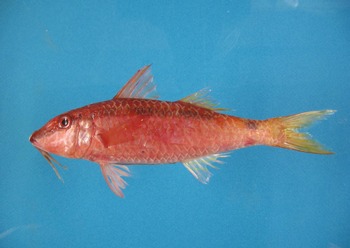
On 24 January 2013 a 138 mm standard length (SL) (174 mm total length) specimen of the Red Sea goatfish, Parupeneus forsskali (Fourmanoir & Guézé, 1976) (Figure 1) was collected in the Mediterranean by the trawler FV ‘Aliya', Captain M. Zamel, at a depth of 45 m at the southern edge of Haifa Bay (32°51′01″N 34°56′13″E). The specimen which was kept in a freezer before being presented to the authors was deposited in the Hebrew University Fish Collection and received the catalogue number HUJ 20165.
Parupeneus forsskali, 138 mm standaed length, 24 January 2013, southern edge of Haifa Bay, Mediterranean, Israel (photograph: D. Golani).

Specimen description (HUJ 20165)
Body elongated, depth at origin of first dorsal fin 24.7%; pointed head 31.6%, both percentage of SL. Upper profile of head slightly concave. Moderate eye (18.8%), located at the upper part of the head. Narrow interorbital (29.8%), long right barbel (80.0%) (the left barbel slightly damaged), both located on the chin, pointed snout (52.7%), all percentage of head length. Two larger canine teeth on each side of the anterior of upper jaw, followed by a row of stout conical teeth. Teeth on the lower jaw similar, lacking canine teeth. Seven gill rakers on the upper arm and 18 on the lower arm including the rudiments.
Two dorsal fins, the first with eight spines, the first spine minute, the second and third longest. Second dorsal fin with six rays, the last elongated. Anal fin with seven rays, last elongated. Pectoral fin with 15 rays; ventral fin with one spine and five rays. 28 lateral line scales
COLOUR
Body rose-pink with grey stripe from tip of snout running through the eye along the upper side, one and a half scales below the dorsal midline and ending under the end of second dorsal fin base. A dark-grey spot, about eye size on the upper caudal peduncle. The rays of first dorsal, pectoral and ventral fins are pink with pinkish-transparent membranes. Second dorsal and caudal fins with a touch of yellow; anal fin with light-pink rays and transparent membrane. After a week in formaldehyde and three weeks in 70% alcohol the rose-pink body colour became white.
Note: the body background colour of P. forsskali is typically whitish. The pinkish colour of the Mediterranean specimen is probably due to the relatively deep depth of collection or due to the four days being frozen prior to it being photographed.
REMARKS
The first mention of this species in the Mediterranean was by Lythgoe & Lythgoe (Reference Lythgoe and Lythgoe1975) as Pseudupeneus barberinus. This clearly mistaken record was based on Kosswig (Reference Kosswig1950) who believed that Steinitz (Reference Steinitz1927) reported it from the eastern Mediterranean. Lythgoe & Lythgoe's (Reference Lythgoe and Lythgoe1975) photograph (No. 46) was evidently taken elsewhere (Golani et al., Reference Golani, Orsi-Relini, Massuti, Quignard and Briand2002). Cilia (Reference Cilia1979) reported a record of Pseudupeneus barberinus from the Island of Gozo near Malta but the specimen was not preserved. This species is currently assigned to the genus Parupeneus and does not occur in the Red Sea (Golani et al., Reference Golani, Orsi-Relini, Massuti, Quignard and Briand2002). Çinar et al. (Reference Çinar, Bilecenoğlu, Öztürk and Can2006) reported observation of this species at Mersin, Turkey in the year 2000 and provided a photograph (their figure 10) of a fish resembling P. forsskali that was taken in August 2004, at Silifke Bay on the southern shore of Turkey. This specimen was not collected and therefore was not available for taxonomic verification. In addition, there have been numerous observations of this species by underwater divers off the coast of Israel. In December 2012, Bariche et al. (Reference Bariche, Bilecenoğlu and Azzurro2013) collected north of Beirut a specimen of Parupeneus forsskali that confirmed its occurrence in the Levant. As the present specimen was collected at a depth of 45 m, it represents a new depth record. According to Randall & Heemstra (Reference Randall and Heemstra2009) the species was previously known from depths of 1–30 m; Bariche et al. (Reference Bariche, Bilecenoğlu and Azzurro2013) reported that the Lebanese specimen had been collected at 40 m depth. The present record, which was collected only one month after the Lebanese specimen, constitutes the first record from Israel and, together with that of Bariche et al. (Reference Bariche, Bilecenoğlu and Azzurro2013), may constitute the signal of a potential settlement of a P. forsskali population in the Mediterranean.
Parupeneus forsskali is endemic to the Red Sea. It is the most common mullid in the northern Red Sea where adults are found in sandy habitats among rocks and coral reefs to a depth of 30 m (Golani & Darom, Reference Golani and Darom1997). Juveniles are found in large numbers in shallow sandy beaches (Golani, Reference Golani1993). Similar to other goatfish they search for food, mainly benthic invertebrates, by probing sand with their chemosensory barbels.
Parupeneus forsskali can be distinguished from other mullids in the Mediterranean by having stout conical teeth in the upper jaw vs no teeth in the upper jaw of Mullus spp. and bands of small teeth in the upper jaws, vomer and palatine of Upeneus spp., which also have dark bands on the caudal fin (both lobes in U. pori and only on the lower lobe of U. moluccensis) vs no marks in P. forsskali. The Atlantic Pseudupeneus prayensis is very rare in the Mediterranean and was recorded only in its western basin; it lacks a longitudinal dark band and its teeth on the upper jaw are visible when the mouth is closed vs non-visible teeth in the closed mouth of P. forsskali.
It is worth noting that young specimens of the Mediterranean indigenous Mullus surmuletus often bear a dark longitudinal band that might resemble that of P. forsskali (see: Can & Bilecenoğlu, Reference Can and Bilecenoğlu2005, p. 111(1); Louisy, Reference Louisy2005, p. 286) and therefore might possibly result in misidentifications.
In the Red Sea, P. forsskali differs from the externally similar P. macronema (Lacépède, 1801) by lacking a broad blackish band at the second dorsal fin base and by shorter barbels (59–65% of head length vs 80–100% of head length). All other confamilials in the Red Sea lack the dark longitudinal stripe (Randall, Reference Randall2004; Randall & Heemstra, Reference Randall and Heemstra2009).
ACKNOWLEDGEMENTS
We are grateful to Mr M. Zamel for providing the specimen and to Ms B. Appelbaum-Golani for assistance in editing the manuscript.