Chronotype or diurnal preference is an important inter-individual variable in circadian rhythms and related to psychological and physiological differences among human beings (Hofstra & de Weerd, Reference Hofstra and de Weerd2008; Smith, Reilly, & Midkiff, Reference Smith, Reily and Midkiff1989). There are three major chronotypes or morningness-eveningness preferences: morning, intermediate and evening. Morning type individuals prefer arising early and prefer morning hours for intellectual and physical activities. On the other hand, evening type individuals prefer arising later, feel and perform best at late afternoon or in the evening. In morningness eveningness continuum, individuals who fall in between morningness and eveningness extremes are named intermediate or neither type.
Many studies have pointed out that age and gender both influences morningness. Concerning age groups, adolescents show a preference for evening hours while older adults prefer morning hours. The relation between gender and morningness scores remains unclear (Adan, Caci, & Prat, Reference Adan, Caci and Prat2005). So far, some researchers have not obtained significant differences between men and women (Chelminski, Petros, Plaud, & Ferraro, Reference Chelminski, Petros, Plaud and Ferraro2000; Greenwood, Reference Greenwood1994), whereas some others have found (Roenneberg et al., Reference Roenneberg, Kuehnle, Pramstaller, Ricken, Havel, Guth and Merrow2004; Tonetti, Fabbri, & Natale, Reference Tonetti, Fabbri and Natale2008). Meanwhile, Randler (2007) in a meta-analysis indicating that girls and women were significantly more morning oriented than boys and men.
Circadian preference has practical implications in diverse fields. School start time (Escribano, Diaz-Morales, Delgado, & Collado, Reference Escribano, Diaz-Morales, Delgado and Collado2012), schedule of the tests (Beşoluk, Reference Beşoluk2011; Beşoluk, Önder, & Deveci, Reference Beşoluk, Önder and Deveci2011), scheduling sportive activities (Drust, Waterhouse, Atkinson, Edwards, & Reilly, Reference Drust, Waterhouse, Atkinson, Edwards and Reilly2005), designing working hours and work shift periods (Pisarski et al., Reference Pisarski, Brook, Bohle, Gallois, Watson and Winch2006) can be arranged in coherence with individuals’ chronotype. Therefore, it is important to specify the chronotype of individuals and this specification was generally done by questionnaires or scales designed to associate individuals to tendencies that were coined “morningness” or “eveningness”. The development and adaptation of instruments for identifying chronotype has taken up a large number of works in this area (Diaz-Morales & Sanchez-Lopez, Reference Diaz-Morales and Sanchez-Lopez2004). Several self-reporting instruments to identify chronotype are Morningness Eveningness Questionnaire (MEQ; Horne & Östberg, Reference Horne and Östberg1976), Diurnal Type Scale (DTS; Torsvall & Åkerstedt, Reference Torsvall and Åkerstedt1980), Composite Scale of Morningness (CSM; Smith et al., Reference Smith, Reily and Midkiff1989) and Early/Late-Preference Scale (Smith et al., Reference Smith, Folkard, Schmieder, Parra, Spelten, Almiral and Tisak2002). Although MEQ is the most used instrument in chronopsychological research, its psychometric properties were questioned (Adan et al., Reference Adan, Caci and Prat2005; Randler, Reference Randler2008a) because of not having a homogeneous measure of morningness and not specifying the reasons for differential weighting assigned to some items (Smith et al., Reference Smith, Reily and Midkiff1989). CSM was constructed in order to achieve more reliable and valid measure of morningness. The scale was constructed by taking the best items of MEQ and DTS. CSM is composed of 13 items, nine of which were taken from MEQ and four of which were taken from DTS. The psychometric properties of the instrument were described by Smith et al. (Reference Smith, Reily and Midkiff1989) and, since then, subsequent studies confirmed its good psychometric properties, stability and predictive validity. CSM was translated into French (Caci, Nadalet, Staccini, Myquel, & Boyer, Reference Caci, Nadalet, Staccini, Myquel and Boyer1999), German (Randler, Reference Randler2008a), Spanish (Adan et al., Reference Adan, Caci and Prat2005), Thai (Pornpitakpan, Reference Pornpitakpan1998), Romanian (Voinescu, Coogan, Thome, & Orasan, Reference Voinescu, Coogan, Thome and Orasan2010), Korean (Song, Reference Song2009) but was not adapted into Turkish till now. The only instrument adapted into Turkish in order to determine circadian preference is MEQ and there is no other instrument developed in Turkish to identify chronotype. CSM has few items, can more easily be administered and has better psychometric properties compared to MEQ [such as internal consistency, see Adan et al., (Reference Adan, Caci and Prat2005)]. Furthermore, some differences were reported in the subsequent categorization of chronotypes and in CSM scores in previous studies (Voinescu et al., Reference Voinescu, Coogan, Thome and Orasan2010). Therefore it is important to conduct reliability and validity study of the CSM in different cultural and age groups. The aim of the study was to provide the psychometric properties of the Turkish version of the CSM based on a sample of high school and university students.
Method
Participants
The CSM was administered to 543 high school and 650 university students. In high school sample 48.4% were female, 51.6% were male while in university sample 52.6% were female, 46.2% were male and there were eight missing data regarding gender in university sample. The age of the high school sample was between 15-18 years and the age of the university sample was between 19-30 years.
Ethical concerns
The study was conducted in accordance with ethical recommendations for human chronobiological research (Portaluppi, Smolensky, & Touitou, Reference Portaluppi, Smolensky and Touitou2010), and all subjects provided informed consent.
Instruments
Composite Scale of Morningness (CSM; Smith et al., Reference Smith, Reily and Midkiff1989)
The CSM comprises 13 items having four or five choices. Since it is an added-score scale, the theoretical total score ranges from 13 (extreme eveningness) to 55 (extreme morningness). The items of CSM refer to preferred rising and bed times, preferred times of physical and mental performance, subjective alertness after rising, and subjective evaluation of morningness and eveningness. The internal consistency coefficient of full scale was reported as .87. The internal consistency and the transcultural validity of the CSM have been well established (Caci et al., Reference Caci, Adan, Bohle, Natale, Pornpitakpan and Tilley2005; Smith et al., Reference Smith, Folkard, Schmieder, Parra, Spelten, Almiral and Tisak2002). In the present study, Cronbach’s Alpha coefficients of the CSM were .73 in high school sample, and .80 in university sample. Smith et al. (Reference Smith, Reily and Midkiff1989) suggested 10th and 90th percentile as cut off scores while defining the chronotype categories.
Morningness Eveningness Questionnaire (MEQ)
The questionnaire was developed by Horne and Östberg (Reference Horne and Östberg1976) and adapted into Turkish by Pündük, Gür, and Ercan (Reference Pündük, Gür and Ercan2005). MEQ consists of 19 mixed-format questions, such as wake-up times, bed times and preferred times for physical activity or cognitive performance. The Cronbach’s Alpha for the MEQ of the current study was .73.
Additional measurements
Students that participated in external validation process of Turkish CSM were asked for their rise and bed times in their free days to calculate mid-point of sleep and sleep length.
Procedures
CSM was translated into Turkish and then back translated into English by three bilingual English speakers to ensure translation quality. In order to ensure language equivalence 21 high school and 43 university students received both Turkish CSM and English CSM over a 3-week interval. The correlation between Turkish CSM total scores and English CSM total scores was .89 (correlation of the same items in two instruments ranged from .69 to .96) in high school sample and was .91 (correlation of the same items in two instruments ranged from .82 to .98) in university sample. High correlations obtained in both samples were treated as a sign of language equivalence. In order to perform exploratory and confirmatory factor analysis, the Turkish CSM was administered to 543 high school and 650 university students. Meanwhile, another sample of students (high school: N = 30; university: N = 40) received the Turkish CSM twice over a 1-month interval for test retest reliability check. Moreover, for external validation of Turkish CSM another group of students (high school: N = 93; university: N = 200) received both Turkish CSM and MEQ. From these students rise and bed times were also obtained for the validation of Turkish CSM. Although students’ rise and bed times in their free days do not give precise sleep duration and midpoint of sleep and just presents the time spent in bed, rise and bed times can be used as a proxy for sleep duration and midpoint of sleep.
Results
Descriptive statistics
The mean morningness scores (CSM total) in high school sample (N = 543) and university sample (N = 650) were 34.01 (SD = 5.78), 34.38 (SD = 6.17) respectively. The mean age was 15.92 (SD = 0.87) in high school and 22.58 (SD = 3.13) in university sample. The descriptive statistics in both samples regarding CSM total scores and with respect to gender was presented in Table 1. The distribution was negatively skewed in both samples indicating that in both samples the subjects were relatively morning types. A very similar skewness was reported by Adan et al. (Reference Adan, Caci and Prat2005), Caci et al. (Reference Caci, Nadalet, Staccini, Myquel and Boyer1999), and Greenwood (Reference Greenwood1994). In addition, the distribution shapes were similar between genders in both samples.
Descriptive statistics for morningness (CSM total score)

In order to compare whether CSM total scores in both samples differ with respect to gender ANCOVA analysis was performed. In ANCOVA analysis CSM total score was a dependent variable, gender was a fixed factor and age was a covariate. In comparing gender differences, age was used as a covariate, because age effects may mask gender effects (Caci, Deschaux, Adan, & Natale, Reference Caci, Deschaux, Adan and Natale2009; Tonetti et al., Reference Tonetti, Fabbri and Natale2008). There was not a significant effect of gender on CSM total score in both high school sample, F(1, 540) = .022, ns, and university sample, F(1, 639) = .245, ns.
Exploratory factor analysis (EFA)
Principal component analysis was performed using the orthogonal rotation (varimax) method. Kaiser-Mayer-Olkin (KMO) test was first done to test the sampling adequacy. The KMO value was found to be .79 (high school sample) and .84 (university sample) showing that the patterns of correlation are relatively compact, and so factor analysis should produce distinct and reliable factors. According to Green and Salkind (Reference Green and Salkind2005), since KMO value is greater than .70, factor analysis can be done. Bartlett’s Sphericity test (high school sample: χ 2 (78) = 1107.61, p < .001; university sample: χ 2 (78) = 1965.02, p <.001), indicated that correlations between items were sufficiently high for the analysis.
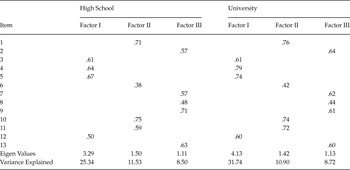
In EFA conducted both on high school and university sample, three components were extracted based on the eigenvalue greater than one criterion. The eigenvalues, percentage of variance explained and factor loadings were presented in Table 2. The extracted three components accounted for 45.37% of the total variance in high school sample and 51.36% of the total variance in university sample. The structure of the three factors is presented in Table 2 for both samples. Factor loadings higher than .30 were presented in order to have a cleaner factor structure. The magnitude of the factor loading reflects the importance of the variable for the factor. Variables with loadings higher than .71 can be considered excellent measures of the factor, .63 very good, .55 good, .45 fair and .32 poor (Comrey & Lee, Reference Comrey and Lee1992). The factor loadings in this study ranges from .38 to .75 in high school sample and from .42 to .79 in university sample.
Rotated component matrix for CSM

Both in high school and university sample items are loaded on the same factors. Items 3, 4, 5 and 12 loaded on Factor I, items 1, 6, 10, 11 loaded on Factor II and finally items 2, 7, 8, 9 and 13 loaded on Factor III.
Confirmatory factor analysis (CFA)
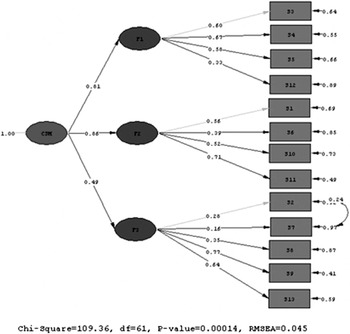
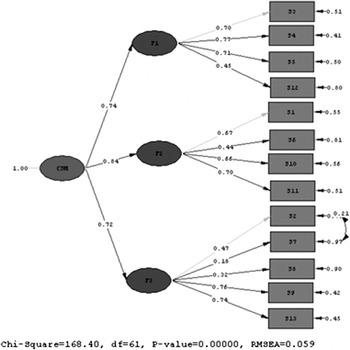
The data were split randomly using SPSS random sampling tools in order to perform CFA (N = 400 in high school sample; N = 500 in university sample). CFA was used to explore the goodness of fit of the three factor model obtained through EFA in the randomly specified data set using LISREL 8.54. Path diagrams were generated, fixing one factor loading per variable to 1.00, and a number of goodness of fit indices were obtained using maximum likelihood estimation. Based on EFA analysis three factor structure was tested in this study both in high school and university sample. The second order three factor model tested in high school sample was presented in Figure 1 and in university sample was presented in Figure 2.
Second order three factor model of high school sample.

Second order three factor model of university sample.

The fit of the model should be interpreted on the basis of a range of the fit indices. In evaluating the fit of the models, recommendations by Schermelleh-Engel, Moosbrugger, and Müller (Reference Schermelleh-Engel, Moosbrugger and Müller2003) were followed.
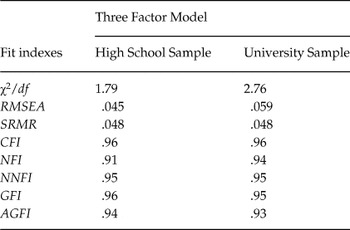
The CFA analysis of the second order three factor models provided the following goodness of fit indexes for the two samples. For high school sample: χ2/df = 2.22, RMSEA = .053, SRMR = .054, CFI = .94, NFI = .89, NNFI = .92, GFI = .95, AGFI = .93 and for university sample: χ2 /df = 3.14, RMSEA = .066, SRMR = .053, CFI = .95, NFI = .93, NFI = .94, GFI = .94, AGFI = .92. Before making final decisions, it is recommended to examine modification indices as well. An inspection of the modification indices suggested the addition of an error covariance between items 2 and 7 in both high school and university sample. These items are both asking for “retiring time” and therefore it is likely that they have similar error in their measurement. Allowing the errors in these two items to co-vary provided a better fit. The model data fit indexes are provided in Table 3 for both samples (high school and university) after the aforementioned modification was done.
Goodness of fit indexes for the three factor model of the CSM

Note:
AGFI = Adjusted Goodness-of-Fit-Index, CFI = Comparative Fit Index, GFI = Goodness-of-Fit Index, NFI = Normed Fit Index, NNFI = Nonnormed Fit Index, RMSEA = Root Mean Square Error of Approximation, SRMR = Standardized Root Mean Square Residual.
The analyses showed that the three factor solution in both samples (high school and university) fits the data well. All fitted indices obtained were in good or acceptable ranges.
Reliability
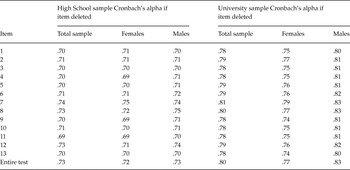
Tables 4 and 5 show the mean scores of all the 13 items of the CSM, Cronbach’s alpha coefficients, the corrected item-total correlations, and if-item-deleted with regard to gender for the high school and university sample. Among the item total correlations given in Table 4 the lowest correlation as presented in many previous studies appears with Item 7 (At what time in the evening do you feel tired and, as a result, in need of sleep?) in both samples. The highest correlation in high school sample appears with Item 11 and in university sample appears with Item 9 and 13. In high school sample females had higher scores on items 2, 7, 8, 9, 12 and 13 whereas men had higher scores on items 1, 3, 4, 5, 10 and 11. In university sample females had higher scores on items 6, 7, 9 and 13 whereas men had higher scores on items 1, 2, 3, 4, 5, 8, 10, 11 and 12. The internal consistency of the CSM is acceptable for both groups. The alpha coefficient for the high school students was .73 (item-total correlation range was .31–.60) in females it was .72 (item-total correlation range was .26–.61) and in males it was .73 (item-total correlation range was .27–.62). The alpha coefficient for the university students was .80 (item-total correlation range was .33–.64) in females it was .77 (item-total correlation range was .26–.66) and in males it was .83 (item-total correlation range was .39–.67). Test-retest reliability of the CSM over a 1-month interval is .89 in high school sample and .84 in university sample. The correlations between CSM total scores at test and retest are highly significant and the correlations between the same items at test and retest are in between .52 and .97 in high school sample and are in between .61 and .81 in university sample.
Mean and standard deviations and item-total score correlation coefficients of CSM

Reliability of the entire CSM

External validity
The correlation between MEQ and the Turkish CSM is sufficiently high for both high school (r = .75, p < .001) and university sample (r = .74, p < .001). Also the correlation of Turkish CSM scores with some sleep parameters (sleep length, mid-point of sleep, rising and retiring time) are significant and presented in Table 6. As expected, all correlations with sleep parameters were negative since morningness is associated with earlier times of the day.
The correlation of CSM total score with MEQ, sleep length, midpoint of sleep, rising time and retiring time

Cut off scores of the CSM
Smith et al. (Reference Smith, Reily and Midkiff1989) suggested a percentage split at 10% and at 90%. The values of the 10th and 90th percentiles in this study for high school students were 26 and 41, respectively. Meanwhile for the university sample the values were 26 and 42, respectively. Less restrictive cut off scores can also be used, such as 20th and 80th percentiles. The values corresponding to the 20th and 80th percentiles were 29/39 and 29/40 for high school and university sample, respectively. The cut off scores (10th and 90th percentile) reported for CSM in some studies conducted in other countries are; 27–41 (Natale & Alzani, Reference Natale and Alzani2001), 27–44 (Greenwood, Reference Greenwood1994), 26–43 (Randler, Reference Randler2008a), 30–45 (Caci et al., Reference Caci, Nadalet, Staccini, Myquel and Boyer1999), 23–43 (Smith et al., Reference Smith, Reily and Midkiff1989), 21–39 (Adan et al., Reference Adan, Caci and Prat2005).
Discussion
This study presents the Turkish version of the CSM a widely used diurnal preference scale and validates it in both high school and university samples. The results indicated that the Turkish CSM is a valid and reliable instrument to measure circadian preferences.
The mean CSM scores of females were 33.98 (SD = 5.61) in high school and 34.25 (SD = 5.75) in university sample. Meanwhile, mean CSM scores in males were 34.05 (SD = 5.94) in high school and 34.58 (SD = 6.59) in university sample. The mean CSM scores found in this study lie in the range of score reported by Caci et al. (Reference Caci, Adan, Bohle, Natale, Pornpitakpan and Tilley2005), Caci et al. (Reference Caci, Deschaux, Adan and Natale2009), Randler (Reference Randler2008a) and Smith et al. (Reference Smith, Folkard, Schmieder, Parra, Spelten, Almiral and Tisak2002). Cross cultural studies conducted by Caci et al. (Reference Caci, Adan, Bohle, Natale, Pornpitakpan and Tilley2005) and Smith et al. (Reference Smith, Folkard, Schmieder, Parra, Spelten, Almiral and Tisak2002) presented differing mean CSM scores in various countries. Obtaining differing scores in various countries is an expected result since CSM scores depend on some factors such as social life, culture, climate and biological factors (Randler, Reference Randler2008b).
The cut off scores of Turkish CSM were found as 26 and 41 in high school and 26 and 42 in university sample. Similar results were reported by Greenwood (Reference Greenwood1994), Natale and Alzani (Reference Natale and Alzani2001) and Randler (Reference Randler2008a). However, some other studies reported slightly different cut off scores (Adan et al., Reference Adan, Caci and Prat2005; Caci et al., Reference Caci, Nadalet, Staccini, Myquel and Boyer1999; Smith et al., Reference Smith, Reily and Midkiff1989). Factors such as sample size, age and cultural differences might affect the distribution of CSM scores and therefore cut off scores may change.
The internal consistency coefficients and test retest reliability constants were acceptable in both samples and were comparable with those found in other studies (Diaz-Morales & Sanchez-Lopez, Reference Diaz-Morales and Sanchez-Lopez2004; Pornpitakpan, Reference Pornpitakpan1998; Smith et al., Reference Smith, Folkard, Schmieder, Parra, Spelten, Almiral and Tisak2002). In accordance with the results reported in Greenwood (Reference Greenwood1994) and Pornpitakpan (Reference Pornpitakpan1998) the largest improvement in internal consistency was observed when the item 7 is deleted. Meanwhile item 7 demonstrated the lowest item-total correlation in both samples.
For the CSM structure, one factor (Caci et al., Reference Caci, Nadalet, Staccini, Myquel and Boyer1999), two factor (Smith et al., Reference Smith, Folkard, Schmieder, Parra, Spelten, Almiral and Tisak2002; Voinescu et al., Reference Voinescu, Coogan, Thome and Orasan2010) and three factor (Caci et al., Reference Caci, Adan, Bohle, Natale, Pornpitakpan and Tilley2005; Reference Caci, Deschaux, Adan and Natale2009; Pornpitakpan, Reference Pornpitakpan1998; Randler, Reference Randler2008a; Song, Reference Song2009) solutions have been described. In this study, three factors were extracted. Factor structure and the distribution of the items in the factors were the same as findings of Song (Reference Song2009). Moreover, results of second order CFA indicated that three factor structure of CSM explains morningness.
The correlation between Turkish CSM and MEQ was sufficiently high in both samples (r = .75, p < .001; r = .74, p < .001). Randler (Reference Randler2008a) reported a correlation coefficient of .89 between German CSM and MEQ. Furthermore, moderate correlations were observed between Turkish CSM and some sleep parameters. Similar results were reported in some studies (sleep length: −.256, rising time: −.536, retiring time: −.478 in Caci et al. Reference Caci, Nadalet, Staccini, Myquel and Boyer1999; rising time: −0.60, retiring time: −.19 in Diaz Morales & Sanchez-Lopez, 2005). A high correlation of CSM with MEQ and acceptable correlations between CSM and sleep parameters reinforces the validity of Turkish CSM.
While testing whether CSM scores change with gender, we have controlled the age variable since age may mask gender effect. We found no effect of gender like many other studies (Adan et al., Reference Adan, Caci and Prat2005; Caci et al., Reference Caci, Deschaux, Adan and Natale2009; Greenwood, Reference Greenwood1994) on morningness but a meta-analysis conducted by Randler (Reference Randler2007) reported a significant overall effect of gender.
In conclusion the CSM is a psychometrically valid instrument in its Turkish version also. The factor structure was constituted by three factors. Considering suggestions of Smith et al. (Reference Smith, Reily and Midkiff1989) while determining cut off scores, evening type students obtain the score of 26 or less in both samples, and morning type students have the score of 41 or more in high school sample and 42 or more in university sample. No gender effect was found on total CSM scores in both samples. Future works should be conducted to obtain normative data and involve other population groups with wider age range. The limitation of the study is that no biological marker was used while validating the Turkish CSM. Morningness-eveningness was self-assessed with psychological instruments that are not as reliable as objective measurements.