


1. Introduction
The incorporation of Precambrian orogenic provinces in younger Phanerozoic mobile belts poses a challenge for reconstructing the build-up and tectonic evolution of Precambrian orogens. Yet, although displaced out of their original crustal context, Precambrian bedrock in younger thrust sheets hold key evidence on the evolution of the continental paleomargin. This information is easily overlooked in tectonic models of orogens that are solely based on research within the Precambrian shields. The enigma applies to this study which focuses on the parts of the late Paleoproterozoic active margin of the Fennoscandian continent that have been incorporated and reworked in the Scandinavian Caledonides.
In mid-Paleozoic time, the Caledonian orogeny involved long distance thrusting of nappes onto the margin of the Fennoscandian continent (Gee, Reference Gee, Stephens and Bergman Weihed2020). The Lower Allochthon (LA) and Middle Allochthon (MA) include Precambrian crystalline basement nappes that are unique remains of the late Neoproterozoic continental margin of Fennoscandia (Figure 1; Lamminen et al. Reference Lamminen, Andersen and Nystuen2011; Grimmer et al. Reference Grimmer, Hellström and Greiling2016; Gee and Stephens, Reference Gee, Stephens, Stephens and Bergman Weihed2020a; Gee et al. Reference Gee, Klonowska, Andréasson, Stephens, Stephens and Bergman Weihed2020; Wang et al. Reference Wang, Wiest, Jacobs, Bingen, Whitehouse, Elburg, Sørstrand, Mikkelsen and Hestnes2021). These ancient continental fragments contain information essential for reconstructions of the Proterozoic active margins of Fennoscandia and for the tectonic build-up of the Caledonian orogen and nappe emplacement distances in this orogenic system.
Lithotectonic domain map showing lithodemic megaunits in the Precambrian orogenic provinces in western Fennoscandia and the Caledonides with Precambrian basement units highlighted. The map is based on the bedrock map database of Sweden at scale 1:1 million (SGU, 2022) and the bedrock map of Norway at scale 1:1 350, 000 (NGU, 2023). The location of major lithotectonic boundaries is based on Bergman et al. (Reference Bergman, Sjöström and Högdahl2006), Stephens and Bergman (Reference Stephens, Bergman, Stephens and Bergman Weihed2020) and Bingen et al. (Reference Bingen, Viola, Möller, Vander Auwera, Laurent and Yi2021). (For interpretation of the references to colour in this figure legend, the reader is referred to the web version of this article).

The Precambrian crystalline basement sheets in the Caledonian orogen north of the Grong-Olden culmination and the Western Gneiss Region formed mainly between 1.81 and 1.77 Ga (Figure 1); they represent equivalents to the early phases of the alkali-calcic magmatism of the Transscandinavian Igneous Belt (TIB) that is exposed in situ in the Fennoscandian shield to the east of the Caledonides (Figure 1; Greiling et al. Reference Greiling, Gayer and Stephens1993; Grimmer et al. Reference Grimmer, Hellström and Greiling2016; Greiling et al. Reference Greiling, Kathol and Kumpulainen2018; Gee and Stephens, Reference Gee, Stephens, Stephens and Bergman Weihed2020b; Gee et al. Reference Gee, Klonowska, Andréasson, Stephens, Stephens and Bergman Weihed2020). In places, these rocks record Sveconorwegian (1.1–0.9 Ga) and/or late Neoproterozoic (c. 0.60 Ga) reworking (Rehnström et al. Reference Rehnström, Corfu and Torsvik2002). The Precambrian crystalline basement nappes in the western and southern part of the orogen have a more complex history. Principal lithodemes include: (I) the younger 1.74–1.62 Ga phases of TIB, (II) metaigneous rocks formed during the Gothian (1.66–1.52 Ga) and Telemarkian (1.52–1.47 Ga) orogenies and (III) 1.05–1.02 Ga and 0.98–0.93 Ga Sveconorwegian (meta-)intrusions (Figure 1; Tucker et al. Reference Tucker, Krogh, Råheim, Gower, Rivers and Ryan1990; Lamminen et al. Reference Lamminen, Andersen and Nystuen2011; Røhr et al. Reference Røhr, Bingen, Robinson and Reddy2013; Kjøll et al. Reference Kjøll, Andersen, Corfu, Labrousse, Tegner, Abdelmalak and Planke2019; Wang et al. Reference Wang, Wiest, Jacobs, Bingen, Whitehouse, Elburg, Sørstrand, Mikkelsen and Hestnes2021; Slagstad et al. Reference Slagstad, Skår, Bjerkan, Coint, Granseth, Kirkland, Kulakov, Mansur, Orvik, Petersson and Roberts2024). The age and affinity of the basement nappes in the east-central Caledonides, within and south of the Grong-Olden culmination (Figure 2), are less well known; only a few and loosely constrained chronometric ages (U-Pb and Rb-Sr) are available for the igneous crystallization of granites (Figure 2c; Claesson, Reference Claesson1980; Stuckless et al. Reference Stuckless, Hedge, Nkomo, Simmons and Troeng1982; Åberg Reference Åberg1985; unpublished SGU data in Stephens et al. Reference Stephens, Thelander and Karis2005) and none for the volcanic rocks that dominate the LA (the Östberget porphyries; cf. Strömberg, Reference Strömberg, Karis and Strömberg1998). Based on field appearance, geochemistry and textural characteristics, these rocks have been interpreted to represent a continuation of the 1.74–1.66 Ga TIB in the Caledonian allochthons, in places overprinted by 1.1–0.9 Ga Sveconorwegian reworking (Grimmer et al. Reference Grimmer, Hellström and Greiling2016; Gee and Stephens Reference Gee, Stephens, Stephens and Bergman Weihed2020b; Gee et al. Reference Gee, Klonowska, Andréasson, Stephens, Stephens and Bergman Weihed2020) and correlated with rocks in the Dalarna magmatic Province, i.e. the 1.71–1.69 Ga Dala porphyries and 1.71–1.68 Ga intrusives (Rätan-type granites) in the adjacent shield (Karis and Strömberg, Reference Karis and Strömberg1998; Lundqvist and Persson, Reference Lundqvist and Persson1999; Ripa and Stephens, Reference Ripa, Stephens, Stephens and Bergman Weihed2020). The latter is supported by a conspicuous positive magnetic anomaly that extends across the Dalarna Magmatic Province into the Caledonides (e.g. Dyrelius Reference Dyrelius1980; Ripa and Stephens, Reference Ripa, Stephens, Stephens and Bergman Weihed2020). Firm evidence, such as age determinations and geochemistry to support that the Precambrian crystalline basement rocks in the Caledonian nappes and the underlying basement are identical to rocks in the adjacent Fennoscandian Shield, is, however, lacking.
Main tectonostratigraphic units of the Caledonian orogen in Scandinavia with (a) overview map based on Gee et al. (Reference Gee, Andréasson, Li and Krill2017), (b) NW–SE-profile revised from Gee et al. (Reference Gee, Andréasson, Li and Krill2017) across the central Caledonides, with vertical scale exaggerated. Note large-scale folding forming basement culminations, and (c) Overview of the east-central Caledonides with major Precambrian antiforms (culminations) and sample locations with U-Pb zircon dating results from this study indicated. Location of profile refers to large-scale profile in (b). Outline of tectonostratigraphic megaunits in Norway is based on the bedrock map of Trøndelag at scale 1:400 000 (NGU, 2022) and in Sweden the bedrock map database at scale 1:1 million (SGU, 2022). U-Pb igneous crystallization ages of zircon and monazite referring to data in the literature are given for reference. The number in parenthesis after quoted U-Pb ages refers to the following references: (1) Stuckless et al. (Reference Stuckless, Hedge, Nkomo, Simmons and Troeng1982); (2) Andersson et al. (Reference Andersson, Claesson and Kooijman2022); (3) Stephens et al. (Reference Stephens, Thelander and Karis2005); (4) Wilson et al. (Reference Wilson, Hamilton, Fallick, Aftalion and Michard1985); (5) Lundqvist and Antal-Lundin (Reference Lundqvist and Antal Lundin2003); (6) Ahl et al. (Reference Ahl, Andersson, Lundqvist and Sundblad2004); (7) Högdahl ( Reference Högdahl2000); (8) Högdahl and Sjöström (Reference Högdahl and Sjöström2001); (9) Delin and Aaro (Reference Delin and Aaro1994); (10) Elming et al. (Reference Elming, Layer and Söderlund2019); (11) Delin and Aaro (Reference Delin and Aaro2002); and (12) Roberts et al. (Reference Roberts, Nissen and Walker1999). Discrepancies in interpretations of tectonostratigraphic position of nappes along the national border regarding the position in the MA or LA have been adjusted following Gee et al. (Reference Gee, Andréasson, Li and Krill2017) and the bedrock map database of the Geological Survey of Sweden at scale 1:250 000. (For interpretation of the references to colour in this figure legend, the reader is referred to the web version of this article).

Although the Precambrian basement in the northern and eastern Caledonides has been interpreted as part of the TIB, the crystalline basement in the western Caledonides (the Jotun Nappes and the Western Gneiss Region in western Norway) have more commonly been correlated with rocks in the Gothian (Kongsbergian) orogenic segments of the Sveconorwegian Province (the Idefjorden, Bamble and Kongsberg lithotectonic terranes; e.g. Austrheim et al. Reference Austrheim, Corfu, Bryhni and Andersen2003; Røhr et al. Reference Røhr, Bingen, Robinson and Reddy2013; Corfu et al. Reference Corfu, Austrheim and Ganzhorn2014; Stephens and Wahlgren Reference Stephens, Wahlgren, Stephens and Bergman Weihed2020; Wang et al. Reference Wang, Wiest, Jacobs, Bingen, Whitehouse, Elburg, Sørstrand, Mikkelsen and Hestnes2021). The interpretation of these basement units as former parts of the TIB or the Gothian magmatic belts is crucial both for the reconstruction of the Sveconorwegian orogen and for the pre-Caledonian and pre-Sveconorwegian Fennoscandian active margins. To test this further, we have investigated the crystalline basement in the MA and LA and the underlying basement beneath the nappe complex within the east-central Scandinavian Caledonides using U-Pb zircon geochronology and whole-rock chemical analysis. The results are reconciled with petrography and field documentation of these rocks and evaluation with respect to their crustal affiliation, tectonothermal evolution and relation to the pre-Caledonian Fennoscandian margin. In this paper, the term ‘syenitoid’ refers to syenitic to monzonitic rocks including also quartzmonzonitic compositions (i.e. the granite–quartzmonzonite–monzonite compositional trend; cf. Le Maitre et al. Reference Le Maitre, Streckeisen, Zanettin, Le Bas, Bonin, Bateman and Keller2002).
The study area of this paper extends from the Grong-Olden culmination in the north to the Oviken antiform in the south (Figure 2c); including also samples from the basement underlying the Caledonian nappe complex accessed at 1.2–2.3 km depth by the deep drilling Collisional Orogeny Scandinavian Caledonides (COSC) project (Lorenz et al. Reference Lorenz, Rosberg, Juhlin, Klonowska and Lescoutre2022). The aim of this study has been to investigate the lithological character and obtain well-constrained U-Pb zircon ages for igneous crystallization of Precambrian rocks in the Lower (Jämtlandian Nappes) and Middle (Offerdal Nappes) Allochthons of the east-central Scandinavian Caledonides. Those data are needed to understand the crustal affinity and transport distances of the Caledonian basement nappes and for Precambrian terrane analysis in the Caledonides. It also forms the basis for tracing principal Precambrian lithotectonic terranes and terrane boundaries across the Caledonides, which is a key for reconstructions of the 1.0 Ga (Sveconorwegian), 1.6–1.5 Ga (Gothian) and 2.0–1.7 Ga (Svecokarelian) active Fennoscandian continental margins. These data enable reconstruction of the active margin of Fennoscandia prior to its disaggregation and reworking in the Paleozoic.
2. The Caledonides
The early Paleozoic Caledonian continental collisional orogeny involved ocean basin closure, accretion of outboard oceanic and exotic continental terranes, deep subduction of the hyperextended Fennoscandian margin and extensive lateral transport of thrust sheets far onto the Fennoscandian continent (Gee, Reference Gee, Stephens and Bergman Weihed2020). Based on tectonic provenance and pre-Caledonian relation to the Fennoscandian (proto-Baltica) paleomargin, the nappe complex that developed in the process is sub-divided in four principal tectonostratigraphic megaunits: the Lower, the Middle, the Upper, and the Uppermost Allochthons (Figure 2; Gee et al. Reference Gee, Fossen, Henriksen and Higgins2008; Gee and Stephens, Reference Gee, Stephens, Stephens and Bergman Weihed2020a). The LA is composed of Precambrian igneous rocks and sedimentary platform cover rocks derived from the inner continental margin and their deformed and low-grade metamorphic equivalents (Gee and Stephens, Reference Gee, Stephens, Stephens and Bergman Weihed2020b). The MA includes deformed and metamorphosed Precambrian intrusions and foreland basin sedimentary rocks from the hyperextended Fennoscandian margin (Kumpulainen et al. Reference Kumpulainen, Hamilton, Söderlund and Nystuen2021). The base of the MA is dominated by crystalline basement thrust sheets (Strömberg, Reference Strömberg, Karis and Strömberg1998). The upper and middle parts of the MA are dominated by Neoproterozoic metasedimentary rocks intruded by c. 600 Ma dykes, which increase in abundance towards the continental margin (Gee et al. Reference Gee, Klonowska, Andréasson, Stephens, Stephens and Bergman Weihed2020; Kumpulainen et al. Reference Kumpulainen, Hamilton, Söderlund and Nystuen2021). Mafic intrusions, including gabbro, dominate the outermost parts at the continent–ocean transition zone (Gee and Stephens, Reference Gee, Stephens, Stephens and Bergman Weihed2020a). The lower parts of the MA show a lower metamorphic grade, lack 600 Ma dolerites and include deformed and metamorphosed basement rocks endemic to Fennoscandia (Kumpulainen et al. Reference Kumpulainen, Hamilton, Söderlund and Nystuen2021). The uppermost part locally records Caledonian ultrahigh-pressure (UHP) metamorphism reflecting deep subduction of the outermost Fennoscandian continental margin beneath Laurentia (Fassmer et al. Reference Fassmer, Klonowska, Walczak, Andersson, Froitzheim, Majka, Fonseca, Münker, Janák and Whitehouse2017; Klonowska et al. Reference Klonowska, Janák, Majka, Petrik, Froitzheim, Gee and Sasinková2017, Bukała et al. Reference Bukała, Klonowska, Barnes, Majka, Kośmińska, Janák, Fassmer, Broman and Luptáková2018). The Upper Allochthon is composed of marine volcanosedimentary rocks, granitoid crystalline rocks and oceanic crust from outboard of Fennoscandia, whereas the Uppermost Allochthon includes exotic terranes of Laurentian affinity (Stephens, Reference Stephens, Stephens and Bergman Weihed2020). The tectonic provenance of thrust sheets suggests that the further up in the tectonic stratigraphy, the farther transported are the nappes (Gee et al. Reference Gee, Andréasson, Li and Krill2017; Gee and Stephens, Reference Gee, Stephens, Stephens and Bergman Weihed2020a).
Three principal phases of continental subduction during the Caledonian orogeny have been recognized so far. Each of these included high-to ultrahigh-pressure metamorphism and eclogitization of continental crust. The two first phases occurred at 490–480 Ma and 460–450 Ma (Klonowska et al. Reference Klonowska, Janák, Majka, Froitzheim and Kośmińska2016; Fassmer et al. Reference Fassmer, Froitzheim, Janák, Strohmeyer, Bukała, Lagos and Münker2021) and are interpreted to reflect collision between Fennoscandia and an island arc or a microcontinent. The final phase (‘Scandian’; 425–400 Ma) marks closure of the last remnants of former Iapetus and terminal collision between Laurentia and Baltica (Gee, Reference Gee, Stephens and Bergman Weihed2020). The Scandian phase includes ESE-directed tectonic emplacement of nappes far onto the Fennoscandian platform, as well as imbrication and thrusting of the Precambrian parautochthonous basement (Bender et al. Reference Bender, Ring, Almqvist, Grasemann and Stephens2018). Scandian thrusting was followed by W-to NW-directed extensional faulting, the development of large-scale open folds (Fossen, Reference Fossen2000; Bender et al. Reference Bender, Ring, Almqvist, Grasemann and Stephens2018) and post-orogenic erosion and uplift in the Devonian, and later, during the opening of the Atlantic Ocean in the Cenozoic (Anell et al. Reference Anell, Thybo and Artemieva2009; Vetti and Fossen, Reference Vetti and Fossen2012).
The age, composition and tectonometamorphic imprint on the basement units in the Scandinavian Caledonian differ across the orogen, as well as from north to south. This is due to differences in both the pre-Caledonian and Caledonian lithotectonic build-up along the orogen. This paper focuses on the Precambrian crystalline basement within the LA and MA in the east-central part of the orogen (Figures 1, 2).
2.a. Precambrian basement in the lower and Middle Allochthons of the east-central Caledonides
The combined effects of late-Scandian extensional faulting, large-scale buckling and Cenozoic uplift produced roughly NS-trending antiformal culminations that expose Precambrian basement cores (see NW-SE profile in Figure 2b). In the east-central Caledonian nappe complex, three conspicuous basement-cored antiforms are identified (from east to west): the Grong-Olden, the Mullfjället and the Skardöra antiforms (Figure 2c). The largest is the Grong-Olden culmination, which forms the eastern part of a Precambrian basement window that extends to the Norwegian coast (Figures 1, 2a–c). The crystalline basement rocks of the LA are volcanic felsic rocks, in places deformed and metamorphosed at greenschist-to epidote-amphibolite-facies conditions. Although Precambrian metamorphism and deformation affected Precambrian basement thrust sheets to the north and south of the study area, e.g. immediately to the south in the MA in the Tännäs-Funäsdalen area (Valmåsen complex of Strömberg Reference Strömberg, Karis and Strömberg1998) and to the north in the Sarek National Park in Norrbotten (Syenite Nappe Complex, Skárjá Gneiss of Rehnström et al. Reference Rehnström, Corfu and Torsvik2002), it has not been reported in the study area (cf. Sjöström and Talbot, Reference Sjöström and Talbot1987).
2.a.1. Precambrian igneous rocks in the Lower Allochthon
Porphyritic volcanic rocks (Östberget porphyries) dominate the Precambrian crystalline basement of the LA in the study area (Figure 3). They are typically dark grey with a whitish weathering surface; the phenocrysts are commonly 1–2 mm across and difficult to see with the naked eye in the field (Figure 3a). Distinct feldspar porphyritic varieties, such as the characteristic volcanic porphyries in Dalarna (Älvdalen porphyries), are rare and typically occur as lenses or enclaves in a finer grained matrix (Figures 3b, c). The undeformed volcanic porphyries have angular to subangular phenocrysts of both plagioclase and K-feldspar, and minor quartz (Figures 3d–f). The undeformed varieties typically have strings of dark to opaque organic rich matter (bitumen) along micro-fractures and grain boundaries, possibly derived from the mid-Cambrian alum shales (cf. Sandström et al. Reference Sandström, Tullborg, Torres and Ortiz2006). Similar deposits of organic matter are not seen in the deformed and metamorphosed equivalents. Locally, the non-deformed volcanic rocks are distinctly rich in carbon-rich material (Figure. 3g and h; see detailed sample description for locality JAN180041 in online Supplementary material available at http://journals.cambridge.org/geo). Volcanic rocks that are pervasively deformed and metamorphosed are proto-to mesomylonitic rocks (Figure 4). Their mineral assemblages reflect upper greenschist to epidote-amphibolite-facies metamorphic conditions, comprising epidote ± blue-green amphibole ± biotite ± chlorite (Figure 4a–d). The compositional range spans from rhyolite to dacite and trachyte. The felsic volcanic rocks have been interpreted to represent thick ignimbrite deposits akin to the 1.71–1.69 Ga Dala volcanic rocks (Nyström, Reference Nyström1983; Lundqvist and Persson, Reference Lundqvist and Persson1999; Ripa and Stephens, Reference Ripa, Stephens, Stephens and Bergman Weihed2020).
Field appearance and thin section microphotographs showing textural and mineralogical features of 1.67–1.66 Ga undeformed and unmetamorphosed to weakly metamorphosed volcanic rocks in the LA (Östberget porphyries). (a) Quartz and feldspar porphyritic rhyolite at Hoverberget with characteristic whitish weathered surface (sample JAN180017A). Phenocrysts are very fine-grained generally < 1 mm across and set in an aphanitic matrix. (b) Phenocryst-rich (white angular feldspars) porphyritic volcanic/sub-volcanic rock in the Mullfjället antiform (southern shore of the Indalsälven river (sample JAN180014A). (c) Volcanic breccia in the Mullfjället antiform (southern shore of the Indalsälven river, sample JAN180014). (d) Cuspate and lobate contact between a layered aphanitic enclave enclosed in porphyry at Mullfjället. (e) Angular to subangular feldspar phenocrysts in a quartz-feldspar dominated matrix, characteristic of the undeformed and unmetamorphosed LA porphyries (plane-polarized light (PPL), rhyolite at Gräftåvallen, sample JAN180028A). (f) Photomicrograph (crossed polars) showing partly fractured angular plagioclase and perthitic feldspar phenocrysts in quartz-feldspar matrix in rhyolite at Östberget (sample JAN180016). (g) Intermingled rhyolite (whitish weathering surface) and trachydacite (dark) with substantial impregnation of non-crystalline organic material at Djupberget, Stora Grässjön (sample locality JAN180041). A-C indicate sample location of samples JAN180041A-C. The feldspar-rich trachydacite (sample JAN180041B) is more strongly impregnated. (h) Photomicrograph (plane light) illustrating extensive impregnation of non-crystalline organic matter in altered feldspar and along grain boundaries and in trachy-dacite at Djupsjöberget, Stora Grässjön (sample JAN180041B). (For interpretation of the references to colour in this figure legend, the reader is referred to the web version of this article).

Upper greenschist to lower amphibolite-facies deformational features of 1.67–1.66 Ga metavolcanic rocks in the LA: (a) Metatrachyte in the Mullfjället antiform in a road cut along road E14 at Duved (sample JAN180012A). The greenish tint of the rock is due to high contents of epidote and chlorite. (b) Photomicrograph of the metatrachyte in a PPL showing rotated and sheared feldspar porphyroclasts in a fine-grained quartz-feldspar matrix. Fe-Mg minerals are epidote, chlorite and opaques. (c) Close-up of deformation texture in (b) (crossed polarized light, XPL). Rotated plagioclase porphyroclasts with inclusions of epidote are set in a fine-grained quartz-feldspar matrix with ribbon quartz and chlorite-epidote-rich shear planes. (d) Close up of the sample in (a–c) (PPL) showing aggregate rich in epidote, chlorite and opaque. (e) Mylonitic metavolcanite at Enån (sample JAN180034B). Note strong WNW stretching lineation (Ltrend/plunge = 290/4). (f) Foliation and lineation parallel microstructure of the metavolcanite in (e) (PPL). Asymmetrical feldspar porphyroclasts are set in a fine-grained mylonitic quartz-feldspar matrix with a C-S fabric (layer parallel foliation and C-type shear bands). Samples not orientated; no sense of shear inferred). (For interpretation of the references to colour in this figure legend, the reader is referred to the web version of this article).

Figure 4. Long description
Panel A: A photograph of metatrachyte in the Mullfjället antiform, showing a greenish tint due to high contents of epidote and chlorite. Panel B: A photomicrograph of the metatrachyte in plane-polarized light (PPL), displaying rotated and sheared feldspar porphyroclasts in a fine-grained quartz-feldspar matrix. Fe-Mg minerals include epidote, chlorite, and opaques. Panel C: A close-up of the deformation texture in crossed polarized light (XPL), showing rotated plagioclase porphyroclasts with epidote inclusions in a fine-grained quartz-feldspar matrix with ribbon quartz and chlorite-epidote-rich shear planes. Panel D: A close-up of the sample in PPL, showing an aggregate rich in epidote, chlorite, and opaque minerals. Panel E: A photograph of mylonitic metavolcanite at Enån, displaying a strong WNW stretching lineation. Panel F: A photomicrograph in PPL showing foliation and lineation parallel microstructure of the metavolcanite, with asymmetrical feldspar porphyroclasts in a fine-grained mylonitic quartz-feldspar matrix with a C-S fabric.
The intrusive rocks in the LA are granophyric or weakly porphyritic granite in the eastern Olden antiform (Stuckless et al. Reference Stuckless, Hedge, Nkomo, Simmons and Troeng1982; Strömberg, Reference Strömberg, Karis and Strömberg1998), and partly porphyritic granite to quartz monzonite in the Hotagen nappe (Strömberg, Reference Strömberg, Karis and Strömberg1998; Stephens et al. Reference Stephens, Thelander and Karis2005). Igneous emplacement of the Olden granite has been estimated at c. 1650 Ma (whole rock Rb-Sr and Pb-Pb data; Stuckless et al. Reference Stuckless, Hedge, Nkomo, Simmons and Troeng1982). A similar age has been obtained for a partly deformed granitoid at Hotagen (U-Pb zircon; Stephens et al. Reference Stephens, Thelander and Karis2005). A weakly deformed coarse-grained granite at Blåfjellhatten in the NW part of the Grong-Olden culmination yielded 1633 ± 3 Ma (U-Pb zircon, Roberts et al. Reference Roberts, Nissen and Walker1999). In contrast, granite gneisses beneath the Grong-Olden basement yielded a zircon U-Pb age of c. 1800 Ma (Johansson et al. Reference Johansson, Schöberg and Solyom1993). The felsic basement rocks in the LA have been intruded by dykes and sheets of dolerite and gabbro. Based on petrography and geochemistry, one group of dolerites (‘Olden-2’) has been correlated with the 1270–1250 Ma Central Swedish Dolerite Group (Åsby dolerites; Söderlund et al. Reference Söderlund, Isachsen, Bylund, Heaman, Jonathan Patchett, Vervoort and Andersson2005), whereas another group of dolerites (‘Olden-1’) has been tentatively correlated with the 970–940 Ma Blekinge Dalarna Dolerites (Johansson, Reference Johansson1980). Dolerites in the shield further to the south crystallized at c. 1460 Ma (the Tuna dykes in Dalarna; Söderlund et al. Reference Söderlund, Isachsen, Bylund, Heaman, Jonathan Patchett, Vervoort and Andersson2005). None of the dolerites in the Precambrian basement nappes in the study area show geochemical or petrographical similarities with the c. 600 Ma plagioclase porphyritic dolerites that are present in the overlying nappes (i.e. the Ottfjäll dolerites; Kumpulainen et al. Reference Kumpulainen, Hamilton, Söderlund and Nystuen2021). Such dolerites have, however, been observed to cross-cut gneissic structures in Precambrian basement rocks south of the study area in the Valmåsen complex at the base of the Särv Nappe of the MA (Strömberg, Reference Strömberg, Karis and Strömberg1998). Mafic volcanic rocks are subordinate in the Precambrian volcanic deposits, which instead are dominated by felsic ignimbrites (Stuckless et al. Reference Stuckless, Hedge, Nkomo, Simmons and Troeng1982; Strömberg, Reference Strömberg, Karis and Strömberg1998).
2.a.2. Metaintrusive rocks in the middle Allochthon
Precambrian basement in the MA makes up distinct thrust sheets within as well as outside of the antiformal culminations and are commonly referred to as the granite–mylonite nappes (Strömberg, Reference Strömberg, Karis and Strömberg1998). In the study area, proto-mylonitic to mylonitic porphyritic meta-intrusives occur in the basement core of the Skardöra antiform at Storlien and in thin sheets stacked in between the Mullfjället and Olden antiforms (The Gråsjö complex along the shores of Lake Anjan and Lake Kallsjön, Figure 2c). Variably deformed intrusive rocks, partly well preserved, partly gneissic to in places mylonitic, also occur at the northern shore of Lake Ottsjön and southeast thereof along the Vålån river banks (Figure 2c). The metaintrusions at Ottsjön and Vålån are granitic to monzonitic and gabbroic in composition, in places injected by aplite.
The granite-dominated nappes in the study area have been interpreted to belong to the lowermost unit of the MA, corresponding to the tectonostratigraphic level of the Offerdal Nappe (Gee and Kumpulainen, Reference Gee and Kumpulainen1980; Bergman et al. Reference Bergman, Stephens, Andersson, Kathol and Bergman2012; Gee et al. Reference Gee, Klonowska, Andréasson, Stephens, Stephens and Bergman Weihed2020). Consistent with this interpretation, the thrust sheets lack the c. 600 Ma old dolerite dykes that typify the middle and upper parts of the MA, i.e. the Särv and the Seve Nappes (Figure 2). They also seem to lack the 1.49–0.94 Ga mafic sheets and dyke intrusions that occur in the LA basement, e.g. in the Olden and Mullfjället antiforms (Johansson, Reference Johansson1980; Stuckless et al. Reference Stuckless, Hedge, Nkomo, Simmons and Troeng1982; Strömberg Reference Strömberg, Karis and Strömberg1998) and in the underlying basement that have also been identified as prominent seismic reflectors at depth and confirmed by deep drilling at Järpen (Figure 2c; COSC2 borehole, Juhlin et al. Reference Juhlin, Hedin, Gee, Lorenz, Kalscheuer and Yan2016; Lescoutre et al. Reference Lescoutre, Almqvist, Koyi, Berthet, Hedin, Galland, Brahimi, Lorenz and Juhlin2022a). South of the study area, a nappe unit comprising augen gneiss with a 1650–1640 Ma granitic to granodioritic protolith occur at the base of the MA (‘Tännäs augen gneiss’; Figure 2c; Claesson, Reference Claesson1980; Andersson et al. Reference Andersson, Claesson and Kooijman2022). A similar augen gneiss nappe (‘Risberget nappe’) occurs at the base of a sequence of infolded thrust nappes in the strongly reworked crystalline basement units of the Western Gneiss Region (Robinson, Reference Robinson1995).
3. Sampling and analytical methods
The basement units in the study area were sampled to cover the variety of Precambrian igneous rocks present in the LA and MA described in Sections 2.a., 2.a.1. and 2.a.2., with the exception for dolerite dykes. Twenty-two localities were investigated in a transect from the Caledonian nappe front at Östersund to the east-central nappe complexes of the Skardöra antiform at Storlien, along the Norwegian–Swedish national border in the west (Figure 2, Table 1). In addition, samples were also obtained from the 2276 m deep borehole drilled in 2020 by the COSC project at the southern shore of Lake Liten, south of Järpen that penetrated both the LA Caledonian nappes and the underlying Precambrian crystalline basement reached at 1215 m depth (COSC2 borehole; Figure 2c; Lorenz et al. Reference Lorenz, Rosberg, Juhlin, Klonowska and Lescoutre2022). Samples subjected to U-Pb-Th geochronological and geochemical analyses are listed in Table 1.
Samples analysed for whole rock composition and U-Pb igneous crystallization zircon age

Table 1. Long description
The table lists samples analyzed for whole rock composition and U-Pb igneous crystallization zircon age, including sample ID:s and locations given in SWEref99 coordinates. The table provides detailed information on the lithological and mineralogical composition and igneous crystallization age of the analysed samples.
* Geochemical rock classification based on Middlemost (Reference Middlemost1994).
† Mineral abbreviations after Whitney and Evans (Reference Whitney and Evans2010).
‡ A compilation of U-Pb zircon analyses is given in Table 2.
Twenty-four samples from surface exposures and five from the COSC2 borehole were selected for thin section petrography and analysis of the whole rock geochemical composition. Between 1 and 5 kg samples were sent to ALS Scandinavia in Piteå for sample preparation and passed on to ALS Ireland for whole rock geochemical analysis. The samples from the COSC2 borehole were significantly smaller, between 0.1 and 0.3 kg. Details on the bulk rock geochemistry analytical procedures and analytical data are presented in Supplementary material S1 and Table S1, both available in the online Supplementary material at http://journals.cambridge.org/geo.
Eighteen samples were selected for U-Pb zircon geochronology, including three samples from the COSC2 borehole (Table 1). In situ U-Pb zircon analyses were conducted using the Cameca IMS 1280 Secondary Ionization Mass Spectrometry instrument at the NordSIMS laboratory and a laser ablation inductively coupled plasma mass spectrometry (LA-ICP-MS) instrument at the Vegacenter, both located at the Swedish Museum of Natural History in Stockholm, Sweden. The U-Pb zircon data and descriptions of the SIMS and ICP-MS analytical procedures are given in Supplementary material S1 (analytical procedures) and Tables S2 (SIMS) and S3 (ICP-MS) available in the online Supplementary material at http://journals.cambridge.org/geo.
4. U-Pb zircon chronology: sample descriptions, results and interpretation
Samples used for geochronological and geochemical analyses and a compilation of the U-Pb results are listed in Tables 1 and 2. Detailed descriptions of samples and sample localities, U-Pb zircon analytical results and interpretations of these results are provided in Supplementary material S2 available online at http://journals.cambridge.org/geo.
Compilation of results from U-Pb zircon analyses
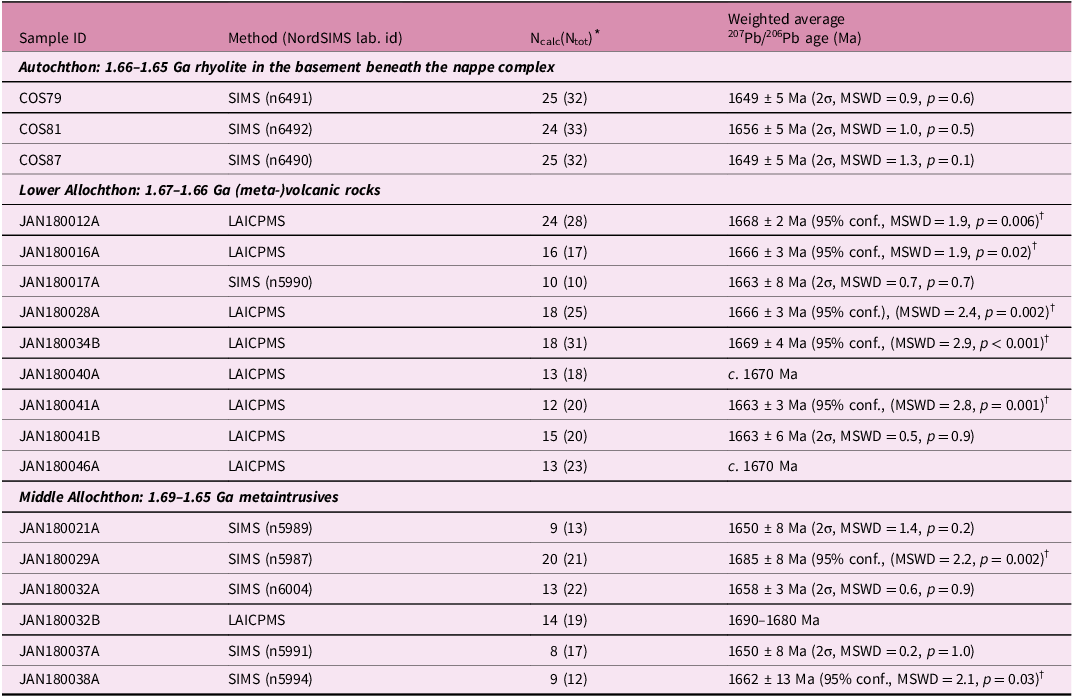
Table 2. Long description
* The number of analyses used for age calculation with total number of analyses within paranthesis.
† Tukey’s Biweight mean for weighted average 207Pb/206Pb ages with a probability of fit (p) <0.05.
All samples contain oscillatory zoned igneous zircon. Secondary recrystallization and formation of metamorphic zircon were not observed in any of the samples, and no major disturbance of the U-Pb-Th isotopic composition of zircon after igneous crystallization was recorded. Zircon in the volcanic rocks is on average euhedral colourless and clear crystals with sharp terminations, and with few inclusions and cracks. They are oscillatory zoned in back scattered electron and cathodoluminescence images, in places with convoluted zoning, but without complex growth patterns or textural features indicative of secondary alteration. Zircon in the metaintrusions occurs as subhedral translucent prismatic crystals with slightly rounded terminations. They are oscillatory zoned but some grains show textural complexity with oscillatory zoned cores mantled or discordantly overgrown by unzoned rims. Such textural complexity in zircon may be observed also in unmetamorphosed alkali-calcic rocks of the TIB and is not accompanied by resetting of the U-Pb isotopic system (e.g. Chen et al. Reference Chen, Wang, Zhu, Weinberg, Zhang and Zhao2021).
4.a. Felsic porphyries in the autochthonous basement beneath the nappe complex (COSC2 borehole)
Felsic porphyries constitute the bulk of the basement sampled by the COSC2 borehole at Järpen. These rocks are deep brownish red to light grey and greenish (Figure 5a–c), and their matrix is fully aphanitic (e.g. Figure 5d). Phenocrysts vary in abundance, morphology, size (1–6 mm), and mineralogy, and feldspar is typically sericitized (Figure 5d–g). The most common phenocrysts are angular felspar, 1–4 mm in size (Figure 5d–e). In places, when strongly altered, the phenocrysts are impregnated by fine-grained opaques (Figure 5a, g). The porphyries are unaffected by ductile deformation, also at the basement-cover transition where they are fractured and altered (Figure 5a; Lorenz et al. Reference Lorenz, Rosberg, Juhlin, Klonowska and Lescoutre2022; Lehnert et al. Reference Lehnert, Almqvist, Anderson, Andersson, Cuthbert, Calner and Ziemniak2024). An irregular compositional banding, which could represent flow banding, is locally observed (Figure 5b). In addition, the borehole sampled thick sections of mainly pristine dolerite between 1591–1848 m and 1859–1935 m depths (Lescoutre et al. Reference Lescoutre, Almqvist, Koyi, Berthet, Hedin, Galland, Brahimi, Lorenz and Juhlin2022a; Lorenz et al. Reference Lorenz, Rosberg, Juhlin, Klonowska and Lescoutre2022), and 1–3 m wide dolerite sheets are found both above and below these sections. The dolerites show an ophitic texture with clinopyroxene + plagioclase + ilmenite ± olivine and accessory apatite, opaques, and biotite. In places, apatite forms a major mineral constituent. Baddeleyite U-Pb data from the thick dolerite sections indicate intrusive ages of the upper and lower dolerite sections at 1.27–1.26 Ga and 1.49–1.47 Ga, respectively (Lescoutre et al. Reference Lescoutre, Söderlund, Andersson and Almqvist2022b). The contacts between the dolerites and the porphyries are generally sharp with no ductile deformation in the porphyry. Locally, 1–2 cm wide irregular undeformed apophyses from the dolerite inject the porphyry (Figure 5h). Along some of the contacts, the porphyry has a thin 0.5–1 cm wide bleached zone (Figure 5h), but other contacts show no visible alteration. Granitic rocks similar to TIB-type granites in the shield east of the nappe front were not seen in the borehole.
Photographs of drill core samples (a–c) and thin sections (microphotographs, d–h) of undeformed and unmetamorphosed porphyry from the COSC2 borehole south of Lake Liten, Järpen, Jämtland. (a) Grey rhyolitic porphyry close to the altered contact zone to the Paleozoic cover (sample COS87). (b) Rhyolite with irregular dark streaks (sample COS81). Matrix and phenocryst mineralogy are the same as in (c). (c) Feldspar phenocryst-rich rhyolite (sample COS79). Unaltered angular K-feldspar phenocrysts and strongly altered plagioclase with extensive replacement of epidote (light green) in dark purple aphanitic quartz-feldspar matrix. (d) Angular and sub-angular feldspar and oxide and oxide-rich phenocrysts in an aphanitic quartz-feldspar matrix, same sample as in (c) PPL. (e) Close-up of feldspar phenocrysts in (d). Well-preserved perthitic feldspar and sericitized plagioclase upper left. Extensive sericitization of plagioclase in the lower left (XPL). (f) Grey porphyry with light (feldspar) and dark oxide-and chlorite-dominated phenocrysts (PPL; sample COS87, same as in a). (g) Close-up of grey porphyry in (d) showing light (K-feldspar) and dark (oxide-and chlorite-rich) phenocryst in grey porphyry (PPL). (h) Drill core at 1570 m depth with irregular dolerite apophysis in porphyry showing no ductile deformation along the contact. Photographs in (a–c) show sawed rock surface covered with a thin layer of oil, photographer Oliver Lehnert, Erlangen, Germany. (For interpretation of the references to colour in this figure legend, the reader is referred to the web version of this article).

Zircon U-Pb analyses were conducted on euhedral, oscillatory zoned grains from three porphyry samples from the COSC2 borehole (Table 1). (I) A greenish-grey porphyry sampled at 1229 m depth close to the contact to the overlying Paleozoic sedimentary sequence was dated at 1649 ± 5 Ma (sample COS-87, Figures 5a, 6a). Streaky greenish-grey porphyry sampled at 1418 m depth was dated at 1656 ± 5 Ma (sample COS-81; Figures 5b, 6b), and a purple-brown porphyry at 2272 m depth sampled at the bottom of the borehole was dated at 1649 ± 5 Ma (sample COS-79; Figures 5c, 6c) (Table 2).
Results from U-Pb zircon geochronology of volcanic and metavolcanic rocks in the LA and the underlying subsurface autochthonous basement (COSC2 borehole) in the east central Caledonides plotted with representative electron microscope images of analysed zircon. Concordia age error ellipses illustrated in dense solid black lines and analyses excluded from age calculation in stippled lines. (a) Rhyolitic porphyry in the COSC2 borehole at 1229 m depth (COS87); (b) Rhyolitic porphyry in the COSC2 borehole at 1418 m depth (COS81); (c) Rhyolitic porphyry in the COSC2 borehole at 2272 m depth (COS79). (d) Rhyolitic porphyry, Östberget Nappe (JAN180016A). (e) Rhyolitic porphyry, Hoverberget Nappe (JAN180017A). (f) Trachydacitic volcanic porphyry, Hovdhävlarna, Olden window (JAN180046A). (g) Deformed metatrachydacite, Djupsjöberget window (JAN180040A). (h) Rhyolitic porphyry, Djupsjöberget window (JAN180041A). (i) Trachydacitic porphyry, Djupsjöberget window, same locality as in h (JAN180041B). (j) Rhyolitic porphyry, Ovilken antiform (JAN180028A). (k) Deformed metatrachyte-trachydacite, Mullfjället antiform (JAN180012A). (l) Mylonitic rhyolite, Skardöra antiform (JAN180034B).

4.b. Felsic (meta-)porphyries in the lower Allochthon
4.b.1. Rhyolite in the Östberget and Hoverberget Nappes
The Precambrian basement in the Östberget Nappe makes up c. 50 m thick sheets of rhyolite, partly in an inverted sequence and tectonically interlayered with thin, less than 20 m thick slivers of Cambrian platform sediments (Kläppe shale and Vemdalen quarzite; Strömberg, Reference Strömberg, Karis and Strömberg1998). It is tectonically under-and overlain by folded and thrusted Cambrian to Early Silurian sedimentary rocks and bounded by a mylonitic basal thrust at the bottom and Cambrian shale at the upper tectonic contact.
The Hoverberget klippe crops out east of the Caledonian nappe front (Figure 2). The lithotectonic stratigraphy of the klippe is described in detail by Karis and Strömberg (Reference Karis and Strömberg1998). The klippe comprises rhyolite tectonically overlying Cambrian shale and quartzite (Kläppe alum shale and Vemdalen quartzite). Cambrian alum shale also occurs at the tectonic contact between the thrust stack and the underlying autochthonous basement which is composed of the Rätan granite dated at 1702 ± 6 Ma (Figure 2c; U-Pb zircon, Delin, Reference Delin and Lundqvist1996).
Aphanitic, dark grey near-leucocratic rhyolites with a characteristic microporphyritic texture defined by scattered angular fragments of quartz and feldspar were sampled at the top of the Östberget (reference locality for the Östberget porphyries) and Hoverberget mountains (Figure 2c, 3a, Table 1). U-Pb analyses of oscillatory zoned zircon in these rocks date igneous crystallization of the rhyolites at 1666 ± 3 Ma (Figure 6d, Östberget, sample JAN180016A) and 1663 ± 8 Ma (Figure 6e, Hoverberget, sample JAN180017A), respectively (Table 2).
4.b.2. Undeformed to penetratively deformed porphyries in the Olden and Djupsjöberget basement windows
The NS-trending Grong-Olden antiform is the most extensive exposure of Precambrian crystalline basement in the east-central Caledonides (Figure 2). The eastern part of the antiform, the Olden window, is composed of rhyolite to trachyte, intruded by, or in tectonic contact with granite (Olden granite) and microgranite (Stuckless et al. Reference Stuckless, Hedge, Nkomo, Simmons and Troeng1982). The volcanic rocks have been interpreted as ash-flow tuffs and ignimbrites; the volcanic and granitic rocks have a slightly peraluminous composition characteristic for evolved granites (Troëng, Reference Troëng1982; Roberts, Reference Roberts1997). The felsic igneous rocks are intruded by sills, dykes, and larger bodies of dolerite and gabbro, some of which have been correlated with the 1.27 Ga Central Swedish Dolerite Group (Johansson, Reference Johansson1980). Previous U-Pb analyses of zircon from the Olden granite indicated a minimum igneous crystallization age of c. 1570 Ma, however, based on highly discordant data (Stuckless et al. Reference Stuckless, Hedge, Nkomo, Simmons and Troeng1982).
A dark brownish grey undeformed and unmetamorphosed trachyte with sparse white 1–5 mm large feldspar phenocrysts in an aphanitic matrix was sampled at Hovdhävlarna, c. 2.5 km southwest of south of Lake Bergsjön, in the southeastern part of the main Olden antiform (sample JAN180046). Igneous zircon in the trachyte was dated at c. 1670 Ma (Figure 6f, Table 2). Three samples (JAN180040A, 41A and B) were selected in the Djupsjöberget window, a small c. 3 × 1 km large basement window c. 18 km to the south of the main Olden window (Figure 2c). A penetratively foliated grey metatrachy-dacite with quartz and feldspar phenocrysts in an aphanitic matrix gave a loosely constrained U-Pb zircon age at c. 1670 Ma (Figure 6g, Table 2; sample JAN180040A). Two additional samples were selected in a sequence of rhyolitic to trachy-dacitic porphyries partly penetratively dusted with disseminated carbon that also fill fractures and grain boundaries (Figure 3g, h). Here, a grey feldspar porphyritic rhyolite (sample JAN180041A) intermingling with rhyolite and trachydacite strongly impregnated with carbon matter was dated at 1663 ± 3 Ma (Figure 6h, Table 2). The dark trachydacite, nearly black in colour due to extensive dissemination of carbon, gave an identical U-Pb ignepous zircon age of 1663 ± 6 Ma (Figure 6i, Table 2; sample JAN180041B).
4.b.3. Rhyolite in the Oviken antiform
The Oviken antiform exposes slices of Precambrian crystalline basement with felsic volcanic rocks in a southern isolated continuation of the Olden antiform, c. 50 km south of the main Grong-Olden culmination (Figure 2c; cf. Olden-Oviksfjäll antiform of Hedin et al. Reference Hedin, Malehmir, Gee, Juhlin and Dyrelius2014). In the north-eastern part of the antiform, the crystalline basement is tectonically intercalated with allochthonous Cambrian sedimentary platform rocks (Vemdal quartzite). In the east, it is tectonically overlying allochthonous Silurian greywacke (turbidites of the Föllinge formation, see fig. 14 in Strömberg Reference Strömberg, Karis and Strömberg1998). Crystallization of igneous zircon in a purplish-grey unmetamorphosed and undeformed rhyolite with sparse c. 2–3 mm large feldspar phenocrysts in an aphanitic matrix was constrained at 1666 ± 3 Ma (sample JAN180028A; Figures 2c, 6j; Tables 1, 2).
4.b.4. Penetratively deformed metatrachyte in the Mullfjället antiform
The Mullfjället antiform is a prominent NS-trending culmination with a crystalline basement core composed of Paleoproterozoic volcanic rocks (Östberget porphyries). It is the lowermost tectonostratigraphic unit in the Storlien-Östersund profile (Figure 2b) and is tectonically overlain by the Jämtland (LA), Offerdal, Särv and Seve (MA) nappes. In places, the volcanic rocks are directly overlain by Ediacaran quartzite, although the intermittent contact has been interpreted as dominantly tectonic (Strömberg, Reference Strömberg, Karis and Strömberg1998). Deformation zones and imbrications internal to the Mullfjället antiform and geophysical reflectors at depth suggest that the Mullfjället crystalline basement is also an allochthonous thrust sheet detached from the underlying autochthonous basement and transported eastwards during Caledonian thrusting (Beckholmen, Reference Beckholmen1978; Hedin et al. Reference Hedin, Juhlin and Gee2012; Reference Hedin, Malehmir, Gee, Juhlin and Dyrelius2014). The Mullfjället volcanic rocks vary in grain size, colour and texture. They occur both as feldspar porphyritic non-layered rocks and as aphanitic compositionally banded and finely laminated rocks (Figure 3b, d). Undeformed varieties typically have a purplish-brown groundmass (Figure 3b), whereas deformed varieties occur with a greenish tint caused by abundance of chlorite and epidote (Figure 4a, b). A pervasively deformed greenish-grey metavolcanic rock, trachytic to-trachydacitic in composition, with sparse injections of light-red pegmatite veins (c. 1 dm wide and winding vein) was sampled in a large road cut at Duved (Table 1; Figures 2c, 4a; sample JAN180012A). Igneous zircon in the deformed volcanic rock yielded a U-Pb age of 1668 ± 2 Ma (Figure 6k; Table 2).
4.b.5. Mylonitic rhyolite in the Skardöra antiform
The Skardöra antiform is the westernmost of the NS-trending basement ridges in the study area and can be followed c. 100 km along the Swedish-Norwegian border (Figure 2c). The easternmost ridge, the Enan antiform of Sjöstrand (Reference Sjöstrand1999), has a core composed of variously strongly deformed felsic volcanic rocks with subordinate sheets of metamafic rocks of unknown age, deformed and metamorphosed in the lower amphibolite to greenschist-facies. A strongly deformed, grey mylonitic rhyolite, with a pronounced EW-trending stretching lineation (L(trend/plunge) = 197/4) was sampled in the northern part of the Enan antiform (Table 1; Figures 2c, 4e, f; Sample JAN180034B). The rhyolite zircon yielded a U-Pb zircon age of 1669 ± 4 Ma (Figure 6l; Table 2).
4.c. Metaintrusives in the Middle Allochthon
The lower parts of the MA (the Offerdal nappes) include strongly deformed and partly mylonitic metaintrusions that have been correlated with 1.74–1.66 Ga TIB intrusions in the shield (Strömberg, Reference Strömberg, Karis and Strömberg1998). Four types localities for MA metaintrusions were sampled: (I) partly mylonitic monzonite gneiss at the Vålån riverbank (Gee and Kumpulainen, Reference Gee and Kumpulainen1980), (II) metagabbro and partly mylonitic granitic augen gneiss at Lake Ottsjön, (III) protomylonitic to mylonitic orthogneisses with K-feldspar porphyroclasts of the granite-mylonite nappe in the Storkluken part of the Skardöra culmination at Storlien and (IV) protomylonitic to mylonitic orthogneisses in a northern flank of the Mullfjället antiform, in the Gråsjö complex on the northern shore of Lake Anjan (Figure 2c, Table 1).
4.c.1. Protomylonitic orthogneiss at the Vålån riverbank
A strongly deformed to protomylonitic monzonitic orthogneiss was sampled at the riverbanks of Vålån (Table 1; Figures 2c, 7a–d; sample JAN180029A). The rock has a gneissic fabric defined by strung-out and flattened feldspar aggregates demonstrating ductile deformation of feldspar at relatively high temperatures (Figure 7a, b). The rock is heterogeneously deformed with discrete NNW-striking protomylonitic to mylonitic deformation zones-dipping moderately to the NE (Sstrike/dip = 333/63). At the sampling locality, sparse 1–3 cm wide bands of both mafic and leucogranitic composition occur concordant to the gneissic foliation. About 200 m up stream, however, preserved lenses of metamonzonitic gneiss contain mafic and felsic dykes that cut the gneissic foliation (cf. Gee and Kumpulainen, Reference Gee and Kumpulainen1980). In places, c. 1–2 cm wide leucocratic segregations indicate incipient partial melting (Figure 7b). The rock microtexture and the mineral assemblage, however, suggest penetrative deformation and metamorphic recrystallization at epidote amphibolite-facies conditions (Figure 7c, d), i.e. temperatures lower than what is indicated by the ductility of the macroscopic gneissic fabric. The protomylonitic orthogneiss sampled at the Vålån riverbank provided a U-Pb zircon age of 1685 ± 8 Ma (sample JAN180029A), dating igneous crystallization of the protolith (monzonite intrusion; Figure 8a, Table 2).
Outcrop and thin section photographs of 1.69–1.66 Ga metaintrusions in the Vålån and Ottsjön units. (a) Outcrop photo of top surface of lower strain zone in protomylonitic metamonzonite at the Vålån riverbank (sample JAN180029A). Note ductile deformation of K-feldspar-rich aggregates. Arrowhead points at continuous K-feldspar-rich thin string, which may indicate early incipient melting. (b) Leucogranitic veins (segregations?) in 1.69 Ga orthogneiss at Vålån in a tectonic lens c. 400 m upstream from sample locality JAN180029A. (c) Microfabric in the Vålån orthogneiss (sample JAN180029A) with anhedral feldspar porphyroclasts in a fine-grained matrix with ribbon textured quartz and a very fine-grained ground mass (XPL). (d) Close-up of (c) showing trails of coarse-grained titanite in a fine-grained matrix composed of epidote, green biotite, chlorite, feldspar, oxide and apatite. Feldspar porphyroclasts to the upper left (PPL). (e) Metagabbro at Ottsjön with mafic and felsic enclaves (sample JAN180032A). Sample taken at upper end of hammer. (f) Mineral assemblage in the Ottsjön metagabbro (sample JAN180032A) with blue-green amphibole, epidote, green biotite, titanite, quartz, oxide and chlorite (PPL, very fine-grained). (g) Metagranite in the Ottsjön unit (sample JAN180032B) at the contact to the metagabbro in (e). (h) K-feldspar and sericitized plagioclase porphyroclasts in fine-grained matrix composed of ribbon-textured quartz, feldspar, epidote, biotite, muscovite, oxide and chlorite (XPL). (For interpretation of the references to colour in this figure legend, the reader is referred to the web version of this article).

U-Pb zircon geochronology of metaintrusive rocks in the MA plotted with representative electron microscope images of analysed zircon. Concordia age error ellipses illustrated with dense solid black lines and analyses excluded from age calculation with stippled lines. (a) Metamonzonite in the Vålån unit (JAN180029A); (b) Enclave-rich metagabbro in the Ottsjön unit (JAN180032A); (c) Metagranite in the Ottsjön unit (JAN180032B); (d) Protomylonitic porphyritic metagranite, Skardöra antiform at Storlien (JAN180037A). (e) Protomylonitic metagranite, Skardöra antiform at Storlien (JAN180038A). (f) Protomylonitic porphyritic metagranite, Gråsjö complex close to Lake Anjan (JAN180021A). (For interpretation of the references to colour in this figure legend, the reader is referred to the web version of this article).

4.c.2. Metagabbro and protomylonitic granite at Lake Ottsjön
A weakly foliated medium-grained metagabbro was sampled on the northern shore of Lake Ottsjön (Figure 2c, sample JAN180032A). The metagabbro is rich in 5–20 cm large leucocratic to mafic and ultramafic enclaves with both rounded and angular morphology (Figure 7e). The sample has a mineral assemblage dominated by green-blue amphibole surrounded by fine-grained streaks of green-brown biotite and chlorite, and subhedral coarse epidote, in places forming the core of strongly saussuritized plagioclase (Figure 7f). Together with the occurrence of thin undulating streaks of fine-grained undulous quartz, the metamorphic texture and mineral assemblage indicate deformation at epidote amphibolite-facies conditions. Igneous zircon in the metagabbro provided a U-Pb age of 1658 ± 3 Ma (Figure 8b, Table 2; sample JAN180032A).
A grey to red-grey protomylonitic granite with strung-out feldspar aggregates defining a stretching lineation (Ltrend/plunge =110/10) was sampled c. 2 m from the contact to the metagabbro (Table 1; Figure 7g; sample JAN180032B). Rounded, sericitized remnants of K-feldspar phenocrysts, in places with micro-cline twinning, are surrounded by fine-grained quartz-rich domains with sutured grain boundaries and streaks with coarser epidote, light brown biotite, olive green chlorite, anhedral fragments of titanite with internal striation, and sub-ordinate muscovite (Figure 7h). The foliation planes are enriched in fine-grained mica and sericite. Zircon in the metagranite was dated at between 1690 Ma and 1680 Ma, which sets a maximum age for the igneous crystallization of the granite protolith (Figure 8c, Table 2; sample JAN180032B).
4.c.3. Mylonitic granitic augen gneisses in the Skardöra antiform at Storlien
Mylonitic light to dark grey granitic gneisses from the Skardöra antiform were sampled along the railroad track at Lillhelvetet, west of Storlien (Table 1; samples JAN180037A and 38A; Figures 2, 9a, b). Pre-kinematic leucocratic bands and veins in the gneisses show intense isoclinal folding (Figures 9a, b). In places, 1–5 cm wide pegmatitic dykes occur in a discordant structural relation to the foliation. The sampled mylonitic granites have fractured tartan twinned feldspar porphyroclasts set in a matrix of quartz, feldspar, light greenish brown biotite, altered epidote and sparse muscovite, calcite and fragments of titanite (Figures 9c, d). Calcite also occurs as replacement and fracture fillings in feldspar porphyroclasts. Zircon in the granitic augen gneisses yielded igneous crystallization ages of 1650 ± 8 Ma (Figure 8d; sample JAN180037A) and 1662 ± 13 Ma (Figure 8e; sample JAN180038A), respectively (Table 2).
Outcrop and thin section photographs of 1.66–1.65 Ga mylonitic porphyroclastic metaintrusions in the MA in the Skardöra antiform at Storlien (a–d) and the Gråsjö Complex on the northern shore of Lake Anjan (e–h). (a) Strongly deformed mylonitic granite with isoclinally folded quartz-feldspar veins (indicated with white arrow; sample JAN180038A). (b) Close-up view of isoclinally folded veins in strongly stretched mylonitic feldspar porphyritic granitic gneiss (sample JAN180037A). (c) Feldspar and epidote porphyroclasts in quartz-rich matrix in mylonitic granite (XPL, same sample as in b). Note the sutured and irregular grain boundaries in the fine-grained matrix. (d) The dark mineral phases in mylonitic granite (same as in b and c) composed of epidote, titanite and light brownish-green biotite. (e) Mylonitic metagranite, view along stretching lineation (sample JAN180021A). (f) Tectonic lens at the same locality as in (e), showing an apparent porphyroclastic fabric in a cut perpendicular to WNW plunging shallow stretching lineation (L = 302/32). (g) Feldspar porphyroclasts in quartz-rich matrix, including ribbon-textured quartz in mylonitic granite (XPL, same locality as in e and f). (h) The dark mineral phase in mylonitic granite (same as e–g) composed of green biotite, epidote, oxide and titanite (PPL). (For interpretation of the references to colour in this figure legend, the reader is referred to the web version of this article).

4.c.4. (Proto-)Mylonitic augen granites in the Gråsjö complex, northern Mullfjället antiform
The northern section of the Mullfjället antiform includes a stack of N-dipping crystalline basement sheets tectonically intercalated with allochthonous Ediacaran quartzite (Vemdalen quartzite), Cambrian alum shale (Kläppe formation) and Ordovician turbidites (cf. profile A in fig. 31 in Strömberg, Reference Strömberg, Karis and Strömberg1998). The basement nappes along the northern shores of Lake Anjan between Styrsundet and Haranäset are made up of grey protomylonitic-to-mylonitic granite (Figure 9e, f; Table 1, samples JAN180021–24). These rocks are pervasively deformed, with textures ranging from schistose in tectonic lenses to gneissic and mylonitic. The rocks resemble the granitic gneisses in the Skardöra-Sylarna antiform at Storlien (cf. section 4.c.2 above) in that they show strung-out, rounded K-feldspar porphyroclasts in a matrix composed of quartz (as matrix and as quartz ribbons), feldspar, epidote, titanite fragments with characteristic striation and accessory amounts of biotite, chlorite and muscovite (Figure 9g, h). In places, calcite occurs as a matrix mineral or as infillings in fractured feldspar porphyroclasts (Figure 9g). Thinned-out 1–2 cm wide leucocratic bands and veins are tightly folded. The high strain fabric is in places cut at a high angle by 5–10 cm wide pegmatite dykes. A protomylonitic grey granite was sampled on the northern shore of Lake Anjan (sample JAN180021A, Figures 2, 9e, f). In the sampled outcrop, strain varies from a gneissic fabric characterized by strong shallowly plunging WNW-stretching (Ltrend/plunge = 316/26) to high strain zones with EW-trending, NNE-dipping mylonitic foliation (Sstrike/dip = 279/38). The augen texture is lost in the mylonitic high-strain deformation zones (Figure 9e). Outside the high-strain zones, the rock is strongly deformed but mainly lineated, whereas the foliation is well developed in the discrete mylonitic deformation zones. Igneous zircon in the protomylonitic granitic gneiss from the Gråsjö Complex at Lake Anjan (sample JAN180021A) yielded a U-Pb zircon age of 1650 ± 8 Ma (Figure 8f).
5. Geochemistry: results and interpretation
5.a. Volcanic rocks in the Autochthon (Parautocthon) and the Lower Allochthon
Fourteen volcanic rocks from the LA and five porphyries from the COSC2 borehole penetrating the (presumed) autochthonous basement beneath the nappe stack were selected for geochemical analyses. The results are shown in Figures 10 and 11, together with geochemical data from (near-)coeval volcanic rocks in the autochthonous basement east and south of the Caledonian nappe front (the Dala volcanites; Ripa and Stephens, Reference Ripa, Stephens, Stephens and Bergman Weihed2020) and the 1.64–1.59 Ga Åmål volcanites in the Idefjorden terrane of the Sveconorwegian Province (Bergström et al. Reference Bergström, Stephens, Wahlgren, Stephens and Bergman Weihed2020) for reference. All analysed samples have ≥65 wt.% SiO2 and classify as rhyolite to trachydacite and trachyandesite (Figures 10 and 11) following the classifications by Middlemost (Reference Middlemost1994) and Winchester and Floyd (1997). The porphyries from the COSC2 borehole are all rhyolitic to rhyodacitic in composition (Figure 10a, b). The volcanic rocks in the LA and underlying basement (COSC2 samples) overlap with the Dala volcanic rocks (Figure 10). The 1.64–1.59 Ga Åmål volcanic rocks are less enriched in alkali at similar SiO2 concentrations; they include dacitic rocks and show an overall slightly more calc-alkaline and magnesian composition (Figure 10). The trace-element compositions are similar with negative trending slopes from large-ion lithophile elements to the high field-strength elements and negative Nb, Ta, Sr, P and Ti anomalies for most samples, but not for all (Figure 11). Barium concentrations differ significantly among samples from the three groups. The samples show high La/Sm, distinctly negative Eu-anomalies and unfractionated heavy rare earth elements (HREE) compositions (Figure 11b). The Dala volcanites have slightly higher La/Sm and a more prevalent negative Eu anomaly.
Whole-rock compositions of volcanic and metavolcanic rocks in the Precambrian basement nappes and the underlying basement (COSC2 borehole), in the east central Caledonides (data from this study) plotted with 1.71–1.69 Ga volcanic rocks in the Dalarna Magmatic Province (Ripa and Stephens, Reference Ripa, Stephens, Stephens and Bergman Weihed2020), and 1.63–1.61 Ga metavolcanic rocks in the Idefjorden terrane of the Sveconorwegian Province (Åmål Group; Bergström et al. Reference Bergström, Stephens, Wahlgren, Stephens and Bergman Weihed2020). (a) K2O + Na2O versus SiO2 diagram after Middlemost (Reference Middlemost1994). (b) Zr/TiO2 versus Nb/Y classification diagram after Winchester and Floyd (Reference Winchester and Floyd1977); (c) modified alkali-lime index (MALI) vs SiO2 diagram after Frost and Frost (Reference Frost and Frost2008); (d) Fe# vs SiO2 after Frost and Frost (Reference Frost and Frost2008). (For interpretation of the references to colour in this figure legend, the reader is referred to the web version of this article).

Trace-element compositions of igneous and metaigneous rocks from the nappes, the underlying basement (COSC2 borehole) and the adjacent shield to the east and south. Data in diagrams (a) and (c) are normalized after Wood et al. (Reference Wood, Joron and Treuil1979), and the rare earth element (REE) data in (b) and (d) are normalized after Nakamura (Reference Nakamura1974). Literature data are taken from the SGU lithogeochemical database and Andersson et al. (Reference Andersson, Möller, Lundqvist, Bastani and Antal-Lundin2019). (a) and (b) 1.67–1.65 Ga volcanic and metavolcanic rocks in LA and 1.66–1.65 Ga volcanic rocks in the subsurface autochthonous basement in the east central Caledonides (this study) plotted with 1.71–1.69 Ga volcanic rocks in the Dalarna magmatic Province (Ripa and Stephens, Reference Ripa, Stephens, Stephens and Bergman Weihed2020), and 1.63–1.61 Ga metavolcanic rocks in the Idefjorden terrane of the Sveconorwegian Province (Åmål Group; Bergström et al. Reference Bergström, Stephens, Wahlgren, Stephens and Bergman Weihed2020). (c) and (d) 1.69–1.66 Ga metaintrusive rocks in the MA of the east central Caledonides (this study), plotted together with 1.71–1.68 Ga intrusive rocks in the Dalarna Magmatic Province (Ripa and Stephens, Reference Ripa, Stephens, Stephens and Bergman Weihed2020), 1.74–1.66 Ga metaintrusive rocks in the Eastern Segment (Andersson et al. Reference Andersson, Möller, Lundqvist, Bastani and Antal-Lundin2019; Wahlgren and Stephens, Reference Wahlgren, Stephens, Stephens and Bergman Weihed2020) and 1.63–1.59 Ga metaintrusions (Göteborg batholith) in the Idefjorden Terrane (Bergström et al. Reference Bergström, Stephens, Wahlgren, Stephens and Bergman Weihed2020) of the Sveconorwegian Province. (For interpretation of the references to colour in this figure legend, the reader is referred to the web version of this article).

Figure 11. Long description
Panel A: A line graph showing trace-element compositions normalized after Wood et al. (1979). The x-axis lists elements such as Ba, U, Ta, La, Sr, P, Zr, Ti, and Y, while the y-axis represents the sample/primordial mantle ratio on a logarithmic scale. Different colored lines represent data from various geological units, including 1.66-1.65 Ga autochthonous basement, 1.67-1.65 Ga lower allochthon porphyry, and 1.69-1.65 Ga middle allochthon metaintrusives. Panel B: A line graph showing rare earth element (REE) compositions normalized after Nakamura (1974). The x-axis lists REEs such as La, Pr, Pm, Eu, Tb, Ho, Tm, and Lu, while the y-axis represents the sample/REE chondrite ratio on a logarithmic scale. Different colored lines represent data from various geological units. Panel C: A line graph similar to Panel A but for different geological units, including 1.69-1.66 Ga metaintrusive rocks in the middle allochthon, 1.71-1.68 Ga intrusive rocks in the Dalarna Magmatic Province, and 1.74-1.66 Ga metaintrusive rocks in the Eastern Segment. Panel D: A line graph similar to Panel B but for different geological units, including 1.69-1.66 Ga metaintrusive rocks in the middle allochthon, 1.71-1.68 Ga intrusive rocks in the Dalarna Magmatic Province, and 1.74-1.66 Ga metaintrusive rocks in the Eastern Segment.
The porphyries in the COSC2 borehole show similar composition along the 1.2 km long basement borehole section, even for Rb and Ba, and do so regardless of rock colour and texture.
5.b. Metaintrusions in the Middle Allochthon
The compositions of the MA metaintrusions are plotted in Figures 11 and 12, together with geochemical data from (near-)coeval metaintrusive rocks from the Caledonian basement in the Western Gneiss Region (the c. 1.65 Ga Hustad complex of Austrheim et al. Reference Austrheim, Corfu, Bryhni and Andersen2003), the western part of the LA Grong-Olden culmination (the c. 1.63 Ga Blåfjellhatten intrusions of Roberts et al. Reference Roberts, Nissen and Walker1999) and TIB rocks in the Fennoscandian Shield east and south of the Caledonian nappe front. The latter include the 1.71–1.68 Ga Dala intrusives in the east (Ripa and Stephens, Reference Ripa, Stephens, Stephens and Bergman Weihed2020), the 1.74–1.66 Ga metaintrusives in the Eastern Segment and the 1.64–1.59 Ga metaintrusives in the Idefjorden Terrane of the Sveconorwegian Province in the south (Andersson et al. Reference Andersson, Möller, Lundqvist, Bastani and Antal-Lundin2019; Stephens and Wahlgren, Reference Stephens, Wahlgren, Stephens and Bergman Weihed2020, Bergström et al. Reference Bergström, Stephens, Wahlgren, Stephens and Bergman Weihed2020). The MA orthogneisses all show a syenitoid compositional trend ranging from granite to monzonite, with the exception for one strongly deformed mylonitic orthogneiss with a loss of ignition of more than 2% indicating significant alteration of this sample (Sample JAN180023A in Figure 12). The compositions overlap with those of the 1.71–1.68 Ga igneous rocks in the Dalarna Magmatic Province, the metaintrusions in the Western Gneiss Region, the western Grong Olden basement window and with orthogneisses in the Eastern Segment of the Sveconorwegian Province (Figure 12a, b). These rocks show a more syenitoid compositional trend and are overall slightly more alkaline than the metaintrusions in the Idefjorden Terrane of the Sveconorwegian Province (Figure 12a, b). There is no distinct difference in ferroan-magnesian character between the metaintrusions in the Caledonian nappes and (meta-) intrusions in the Fennoscandian Shield (Figure 12c). With the exception for a high-silica mylonitic orthogneiss in the Gråsjö Complex (c. 77 wt.% SiO2, JAN180022A) and a granophyre from the eastern Olden window (JAN180045A), the MA metaintrusions overlap with rocks with a lower Fe-index. Similarity exists between intrusions and metaintrusions from the Caledonides and the Fennoscandian Shield in terms of Zr/TiO2 versus SiO2 plot (Figure 12d), with the exception for metaintrusions in the Sveconorwegian Idefjorden Terrane (Figure 12d).
Whole-rock compositions of metaintrusive rocks in the Precambrian nappes in south-central Jämtland and Härjedalen plotted with data from 1.69–1.63 Ga metaintrusions in the estern Gneiss Region (WGR) (Roberts et al. Reference Roberts, Nissen and Walker1999; Austrheim et al. Reference Austrheim, Corfu, Bryhni and Andersen2003), 1.71–1.68 Ga intrusives in the Dalarna Magmatic Province (Ripa and Stephens, Reference Ripa, Stephens, Stephens and Bergman Weihed2020) and metaintrusions in the Internal section of the Eastern Segment (Andersson et al. Reference Andersson, Möller, Lundqvist, Bastani and Antal-Lundin2019; Wahlgren and Stephens, Reference Wahlgren, Stephens, Stephens and Bergman Weihed2020) and the Idefjorden Terrane of the Sveconorwegian Province (Bergström et al. Reference Bergström, Stephens, Wahlgren, Stephens and Bergman Weihed2020). (a) K2O + Na2O versus SiO2 diagram after Middlemost (Reference Middlemost1994). (b) Mali vs SiO2 diagram after Frost and Frost (Reference Frost and Frost2008); (c) Fe# vs SiO2 after Frost and Frost (Reference Frost and Frost2008); (d) Zr/TiO2 vs SiO2 diagram. (For interpretation of the references to colour in this figure legend, the reader is referred to the web version of this article).

Most MA samples have trace-element patterns similar to those of the LA volcanic rocks. Exceptions are the gneissic intrusions in the Ottsjön and Vålån units, which have lower concentrations of Th, U, Ta and Nb – features typical for the 1.74–1.66 Ga TIB rocks in the Eastern Segment of the Sveconorwegian orogen (Figure 11c; cf. Stephens and Wahlgren, Reference Stephens, Wahlgren, Stephens and Bergman Weihed2020). The rare earth element (REE) patterns of the MA samples also resemble those obtained for the LA volcanic rocks but show a wider span in concentrations, especially for the HREE (Figure 11d). The protomylonitic metagranite sampled at Ottsjön (JAN180032B) and the mylonitic granite from the northern shore of Anjan (JAN180022A) are relatively REE-depleted (Figure 11d). The Ottsjö metagranite also lacks a distinct negative Eu anomaly, much like TIB granites within the shield (Ripa and Stephens, Reference Ripa, Stephens, Stephens and Bergman Weihed2020; Stephens and Wahlgren, Reference Stephens, Wahlgren, Stephens and Bergman Weihed2020). The LA and MA intrusions collectively have REE patterns that are similar to those of the 1.71–1.68 Ga granites in the Dalarna Magmatic Province and 1.74–1.66 Ga granitic orthogneisses in the Eastern Segment of the Sveconorwegian Province, and thus more REE-enriched than those observed for the metaintrusions in the Idefjorden Terrane of the Sveconorwegian Province (Figure 11d).
6. Discussion
Igneous rocks and their metamorphic equivalents in the MA and LA of the east central Scandinavian Caledonides and the basement underlying the nappe complex at depth provide U-Pb zircon ages for igneous crystallization at between 1685 ± 8 Ma and 1649 ± 5 Ma (Table 1, Figure 2d). Most samples, 16 of totally 18, give igneous crystallization ages at between 1670 and 1650 Ma; none of the LA rocks are older than 1670 Ma (Tables 1, 2, Figure 13). The chemical composition of these rocks is identical to that of the TIB-type rocks in the shield, indicating that they have a similar provenance, and that they were likely once part of the same coherent magmatic province in the Fennoscandian continent (Figure 14). U-Pb zircon ages for igneous crystallization of TIB rocks younger than 1670 Ma are rare in the shield and ages younger than 1660 Ma are missing (Figure 13; Ripa and Stephens, Reference Ripa, Stephens, Stephens and Bergman Weihed2020; Stephens and Wahlgren, Reference Stephens, Wahlgren, Stephens and Bergman Weihed2020). The east central Caledonian basement thrust sheets and the underlying (para-?) autochthonous basement may thus belong to a prolonged phase of TIB magmatism down to 1649 ± 5 Ma, representing the remains of a western branch of the TIB with a potential substantial pre-Caledonian extent to the WNW (Figure 14). The implications of these results for the extent and orogenic context of the TIB magmatism in Fennoscandia and the tracing of Sveconorwegian lithotectonic units and terrane boundaries in the Caledonian basement are discussed below.
Bar chart showing igneous crystallization ages of TIB rocks in the Precambrian nappes in the LA and MA, and the autochthonous basement underneath the nappe complex in the east-central Caledonides investigated in this study. Time span of igneous crystallization ages of TIB rocks in the central WGR of the Caledonian orogen, the Eastern Segment of the Sveconorwegian Orogen and the Dalarna Magmatic Province in the Fennoscandian Shield are included for reference (data from Stephens and Wahlgren, Reference Stephens, Wahlgren, Stephens and Bergman Weihed2020; Bingen et al. Reference Bingen, Viola, Möller, Vander Auwera, Laurent and Yi2021; Slagstad et al. Reference Slagstad, Skår, Bjerkan, Coint, Granseth, Kirkland, Kulakov, Mansur, Orvik, Petersson and Roberts2024, and the geochronological map viewers of the Norwegian and Swedish geological surveys). (For interpretation of the references to colour in this figure legend, the reader is referred to the web version of this article).

Figure 13. Long description
Panel A: A map showing the geographical locations of the Caledonides, Fennoscandian Shield, and other regions with labeled geological time periods. Panel B: A bar chart displaying igneous crystallization ages in million years (Ma) on the x-axis and different geological regions on the y-axis. The chart includes data points for volcanic and intrusive rocks, with labels for the West-Central Caledonides, East-Central Caledonides, Dalarna Magmatic Province, and Sveconorwegian Province. The chart shows the time spans of igneous crystallization ages for these regions, with specific data points marked for each region.
Schematic map of Precambrian lithological units and Caledonian supracrustal nappes in SW Fennoscandia, highlighting the spatial distribution of TIB rocks, 1.05–0.92 Ga Sveconorwegian intrusions and principal Precambrian lithotectonic boundaries and their tentative continuation in the WGR. Map based on the bedrock map database of the Geological Survey of Sweden at scale 1:1 million (SGU, 2022), and Norway at scale 1:1,350 million (NGU, 2023). Schematic cross-section across the south-western Fennoscandia is modified from Möller and Andersson (Reference Möller and Andersson2018). (For interpretation of the references to colour in this figure legend, the reader is referred to the web version of this article).

6.a. The Fennoscandian active margin in the late Paleoproterozoic
6.a.1. A Transscandinavian Igneous belt affinity for Precambrian thrust sheets in the central Caledonides
A TIB affinity for Precambrian basement rocks in the LA and MA in the study area has been proposed in several studies (e.g. Strömberg Reference Strömberg, Karis and Strömberg1998; Roberts et al. Reference Roberts, Nissen and Walker1999; Ahl et al. Reference Ahl, Andersson, Lundqvist and Sundblad2004; Nyström, Reference Nyström, Högdahl, Andersson and Eklund2004; Rehnström and Corfu, Reference Rehnström and Corfu2004; Bingen et al. Reference Bingen, Belousova and Griffin2011; Grimmer et al. Reference Grimmer, Hellström and Greiling2016; Ripa and Stephens, Reference Ripa, Stephens, Stephens and Bergman Weihed2020). Significantly younger ages for the TIB rocks constituting the basement nappes have, however, not been recognized and they have been interpreted to be direct correlatives to 1.71–1.68 Ga TIB rocks in the Dalarna Magmatic Province immediately east of the Caledonian nappe front. In the south-easternmost Caledonides, however, Lamminen et al. (Reference Lamminen, Andersen and Nystuen2011) reported Precambrian basement thrust sheets composed of TIB rocks as young as 1620 Ma, and whole-rock compositions and Hf isotopes in zircon that indicated a clear genetic link with the Western Gneiss Region (WGR) basement in the western Caledonides. A correlation of the TIB basement in the pre-Sveconorwegian Fennoscandia with the reworked Precambrian basement in the WGR is further supported by consistencies in whole-rock composition and U-Pb and Hf zircon data from the Precambrian basement units in the western Caledonides (Wang et al. Reference Wang, Wiest, Jacobs, Bingen, Whitehouse, Elburg, Sørstrand, Mikkelsen and Hestnes2021; Slagstad et al. Reference Slagstad, Skår, Bjerkan, Coint, Granseth, Kirkland, Kulakov, Mansur, Orvik, Petersson and Roberts2024). Taken together, there is compelling evidence that the Precambrian basement in the central Caledonides constitutes a western continuation of the TIB including rocks as young as 1620 Ma.
6.a.2. The 1.74–1.62 Ga Transscandinavian Igneous Belt in an orogenic context
Late Paleoproterozoic subduction along a progressively thickened Fennoscandian continental margin resulted in extensive alkali-calcic magmatism forming the western coherent part of the TIB, increasing in volume and decreasing in age towards the active continental margin (Stephens and Bergman, Reference Stephens, Bergman, Stephens and Bergman Weihed2020). In the shield, this magmatism is recorded in three discrete time intervals at 1.87–1.84 Ga (TIB0), 1.81–1.77 Ga (TIB1) and 1.74–1.66 Ga (TIB2-3). Each phase appears to be separated by a c. 30 Ma interlude following the subdivision originally proposed by Larson and Berglund (Reference Larson and Berglund1992, later modified by new U-Pb zircon data e.g. Stephens and Jansson, Reference Stephens and Jansson2020; Wahlgren and Stephens Reference Wahlgren, Stephens, Stephens and Bergman Weihed2020; Stephens and Wahlgren Reference Stephens, Wahlgren, Stephens and Bergman Weihed2020). Accepting that the Caledonian thrust sheets include an extended phase of TIB magmatism, the TIB2-3 phase age interval may be extended to 1.62 Ga. The Svecokarelian continental arc may thus have evolved into a protracted period of more or less continuous TIB magmatism spanning over 120 Ma. Together, the TIB rocks in the shield and the Caledonides represents the remnants of a 1.74–1.62 Ga granite-rhyolite province covering over 250,000 km2 of the continent. This area includes the shortened parautochthonous basement of the Sveconorwegian and Caledonian orogens as well as the Caledonian nappes thrusted towards the east and south-east onto the Fennoscandian continent. The areal extent was likely way more extensive in the late Paleoproterozoic (Figure 14). The original areal extent of the TIB may likewise have been even more extensive when taking into consideration that the Eastern Segment once was underthrusted beneath the allochthonous western Sveconorwegian segments (Sveconorwegia), which it most likely still underlies at depth as illustrated in the cross section in Figure 14 (cf. models of Möller et al. Reference Möller, Andersson, Dyck and Lundin2015; Tual et al. Reference Tual, Pitra and Möller2017; Möller and Andersson, Reference Möller and Andersson2018). The extensive remains of active margin magmatism at 1.74–1.62 Ga in the Caledonides and the Sveconorwegian orogenic Province contradicts a quiescence of orogenic activity upon entering the Statherian and the so-called ‘boring billion’, at least in Fennoscandia. Also in other continents, extensive parts of the Statherian active margins have been incorporated in younger orogens and are partly covered by Phanerozoic platform sedimentary rocks, for example, the 1.72–1.69 Ga Yavapai and 1.68–1.60 Ga Mazatzal orogens in Laurentia (Hillenbrand et al. Reference Hillenbrand, Gilmer, Williams, Karlstrom, Souders, Jercinovic and Premo2024). As a result, these active margins are partly poorly investigated, and the tectonic activity in the Statherian and the onset of a ‘boring billion’ remains to be better constrained.
A correlation between continental arc tectonism along the 1.66–1.52 Ga Gothian active margin and coeval intracratonic rifting in Fennoscandia has been repeatedly proposed (e.g. Åhäll et al. Reference Åhäll, Connelly and Brewer2000; Roberts and Slagstad, Reference Roberts and Slagstad2015; Ripa and Stephens, Reference Ripa, Stephens, Stephens and Bergman Weihed2020). As the remains of the Gothian Orogen are limited to the Sveconorwegian Allochthons (Idefjorden, Bamble and Kongsberg terranes in Figures 1 and 14), its pre-Sveconorwegian location relative to the Fennoscandian continent is unclear and therefore casts doubt on direct correlations with intracratonic stress fields in Fennoscandia. Instead, the 1.66–1.65 Ga felsic porphyries analysed here, as well as their correlatives in the overlying allochthons and further west in the WGR thus may provide a direct link between the late 1.74–1.62 Ga TIB magmatism along the Paleoproterozoic active margin and the intracratonic 1.67–1.62 Ga Rapakivi magmatism in south-eastern Finland (Wiborg massif; Rämö et al. Reference Rämö, Turkki, Mänttäri, Heinonen, Larjamo and Lahaye2014).
6.a.3. A coherent 1.74–1.62 Ga magmatic belt?
Ripa and Stephens (Reference Ripa, Stephens, Stephens and Bergman Weihed2020) proposed that the TIB rocks in the Dalarna Magmatic Province, the Eastern Segment of the Sveconorwegian Province, and the basement beneath the Caledonian Nappes represent a continuation of the Svecokarelian accretionary orogenic system with an active continental arc developing west of the 1.8 Ga Svecokarelian margin at 1.7 Ga. The results of the present study indicate a temporal extension of this accretionary system down to 1.62 Ga, if including also the WGR basement and the south-eastern Precambrian basement nappes (Lamminen et al. Reference Lamminen, Andersen and Nystuen2011; Wang et al. Reference Wang, Wiest, Jacobs, Bingen, Whitehouse, Elburg, Sørstrand, Mikkelsen and Hestnes2021; Slagstad et al. Reference Slagstad, Skår, Bjerkan, Coint, Granseth, Kirkland, Kulakov, Mansur, Orvik, Petersson and Roberts2024). The 1.74–1.62 Ga TIB rocks define the end of near-continuous continental arc magmatism along the southwestern Fennoscandian margin related to the Svecokarelian orogeny. Larson and Berglund (Reference Larson and Berglund1992) speculated on a subdivision of the 1.74–1.66 Ga TIB2-3 interval suggesting a predominance of 1.68–1.66 Ga rocks towards the present-day west. Mapping and geochronological work in the TIB2-3 basement has failed to recognize a hiatus in the 1.74–1.62 Ga TIB2-3 magmatic record, at least not similar to the conspicuous 30 Ma interludes between the TIB0, TIB1 and TIB2-3 phases (Petersson et al. Reference Petersson, Scherstén, Andersson and Möller2015a; Stephens and Wahlgren, Reference Stephens, Wahlgren, Stephens and Bergman Weihed2020; Slagstad et al. Reference Slagstad, Skår, Bjerkan, Coint, Granseth, Kirkland, Kulakov, Mansur, Orvik, Petersson and Roberts2024). In the shield, the youngest known TIB rocks (1.74–1.66 Ga) are located in the Eastern Segment of the Sveconorwegian Province (Wahlgren and Stephens, Reference Wahlgren, Stephens, Stephens and Bergman Weihed2020). Most of these rocks are dated to 1.70–1.68 Ga, and they are thus coeval with TIB rocks in the Dalarna magmatic province. Younger, c. 1.66 Ga, ages are rare in the Eastern Segment and almost exclusively loosely constrained ages of strongly reworked rocks (e.g. Welin Reference Welin1994; Connelly et al. Reference Connelly, Berglund and Larson1996; Söderlund et al. Reference Söderlund, Karlsson, Johansson and Larsson2008; Brander et al. Reference Brander, Appelquist, Cornell and Andersson2012). This is also true for the oldest ≥ 1.70 Ga rocks (i.e. Johansson, Reference Johansson, Gower, Rivers and Ryan1990; Brander et al. Reference Brander, Appelquist, Cornell and Andersson2012). Exceptions are two localities with stromatic orthogneisses in the internal Eastern Segment, which yielded igneous protolith ages of 1.74–1.73 Ga (Möller et al. Reference Möller, Andersson, Dyck and Lundin2015; Johansson et al. Reference Johansson, Möller, Lundqvist and Sukotjo2006). Deformed and metamorphosed basement rocks of TIB affinity in the LA and MA across the central Caledonides give igneous crystallization ages between 1720 and 1620 Ma, with most rocks yielding at ages 1670–1630 Ma (U-Pb zircon, Fig. 13, Tucker et al. Reference Tucker, Krogh, Råheim, Gower, Rivers and Ryan1990; Bingen and Solli, Reference Bingen and Solli2009; Wang et al. Reference Wang, Wiest, Jacobs, Bingen, Whitehouse, Elburg, Sørstrand, Mikkelsen and Hestnes2021; Slagstad et al. Reference Slagstad, Skår, Bjerkan, Coint, Granseth, Kirkland, Kulakov, Mansur, Orvik, Petersson and Roberts2024; and this study). The older 1720–1670 Ma ages typically derive from polymetamorphic and migmatitic orthogneisses in the WGR and are a common upper incept age for discordant zircon that otherwise indicates Caledonian or Sveconorwegian age components (e.g. Tucker et al. Reference Tucker, Krogh, Råheim, Gower, Rivers and Ryan1990, Gordon et al. Reference Gordon, Whitney, Teyssier and Fossen2013; Røhr et al. Reference Røhr, Bingen, Robinson and Reddy2013; Corfu et al. Reference Corfu, Austrheim and Ganzhorn2014; Slagstad et al. Reference Slagstad, Skår, Bjerkan, Coint, Granseth, Kirkland, Kulakov, Mansur, Orvik, Petersson and Roberts2024).
A combination of recent Pb-loss and modification of the U-Pb systematics due to recrystallization during partial melting could result in spuriously old upper intercept ages (cf. Söderlund, Reference Söderlund1996). It is thus possible that at least some of the ≥1670 Ma intercept ages are likewise spurious. Well-constrained igneous crystallization ages of 1675 ± 10 Ma in the LA in the southeasternmost Caledonides, however, demonstrate the presence of pre-1670 Ma TIB rocks in these basement nappes (Osen Røa Nappe in southern Norway, correlative to the Vemdalen/Hede Nappe of the Jämtland Nappes in Sweden; Lamminen et al. Reference Lamminen, Andersen and Nystuen2011), and this study presents igneous zircon at ages 1690–1680 Ma in the Middle Alllochthon in Jämtland (Ottsjön and Vålån metaintrusions in this study). All this considered, a scarcity of 1690–1670 Ma ages of TIB rocks in the Caledonian basement units precludes direct correlation between TIB rocks in the Eastern Segment of the Sveconorwegian Province and the Dalarna magmatic Province in the shield.
6.a.4. The structural grain of the pre-Sveconorwegian western margin of Fennoscandia
A westward younging of magmatic belts resulting in an NS-trending geological and structural trend for the western Fennoscandian margin has been frequently proposed (Lindh, Reference Lindh1987; Åhäll et al. Reference Åhäll, Persson and Skiöld1995; Åhäll and Connelly, Reference Åhäll and Connelly2008; Roberts and Slagstad, Reference Roberts and Slagstad2015; Slagstad et al. Reference Slagstad, Skår, Bjerkan, Coint, Granseth, Kirkland, Kulakov, Mansur, Orvik, Petersson and Roberts2024). The original geographical distribution of the different phases of magmatism in the TIB is, however, difficult to access due to tectonic displacements during the 1.5–1.4 Ga Hallandian, 1.1–0.9 Sveconorwegian and 0.5–0.4 Ga Caledonian Orogenies. Nevertheless, the extensive set of U-Pb data that has been obtained for zircon in TIB rocks in the Sveconorwegian and Caledonian Orogens (e.g. Lamminen et al. Reference Lamminen, Andersen and Nystuen2011, Wang et al. Reference Wang, Wiest, Jacobs, Bingen, Whitehouse, Elburg, Sørstrand, Mikkelsen and Hestnes2021; Slagstad et al. Reference Slagstad, Skår, Bjerkan, Coint, Granseth, Kirkland, Kulakov, Mansur, Orvik, Petersson and Roberts2024; and this study) defines a framework for reconstructions. Old (1.87–1.77 Ga) TIB rocks (TIB 0–1) are present in the northern WGR and dominate the Caledonian basement north thereof (Figures 13 and 14; Schouenborg et al. Reference Schouenborg, Johansson and Gorbatschev1991; Johansson et al. Reference Johansson, Schöberg and Solyom1993; Slagstad et al. Reference Slagstad, Skår, Bjerkan, Coint, Granseth, Kirkland, Kulakov, Mansur, Orvik, Petersson and Roberts2024). The southern extent of >1.70 Ga TIB rocks appears to coincide with the location of the major NE-trending Caledonian high-strain zones separating the central WGR from the northern WGR (Figure 14; the Møre-Trøndelag Fault Zone). It is thus possible that the older (>1.77 Ga) TIB basement is fringing the younger ≤ 1.74 Ga TIB basement to the north, the NW and the east (cf. Figure 14). With a Caledonian nappe transport direction to the ESE and SE (Figure 14; Gee, Reference Gee, Stephens and Bergman Weihed2020), a pre-Sveconorwegian and pre-Caledonian SE-to NE-trending structural grain of the 1.74–1.62 Ga TIB is feasible and would be in line with the structural grain and growth zoning in the interiors of the Fennoscandian continent that escaped Caledonian and Sveconorwegian reworking (cf. the tentative outline of the pre-Caledonian and pre-Sveconorwegian extent of the TIB belts and the major Paleoproterozoic deformation zones in the Caledonian and Sveconorwegian foreland in Figure 14). The present-day apparent N–S-trending growth zoning could be a result of shortening and tectonic displacements of the crust during the Sveconorwegian (E–W-trending) and Caledonian (WNW to NW-trending) orogenies.
6.a.5. Interpretation of magnetic anomaly patterns – the Rätan magnetic anomaly
The Rätan magnetic anomaly is a conspicuous crustal-scale NW-trending positive magnetic anomaly across the east central Caledonides that have been interpreted to reflect a continuation of the highly magnetic granitic TIB basement (Rätan type granites) beneath the Caledonian nappes (Dyrelius, Reference Dyrelius1980; Juhojuntti et al. Reference Juhojuntti, Juhlin and Dyrelius2001). Based on potential field modelling and data from the COSC2 deep drilling at 1.2–2.3 km depth, Lescoutre et al. (Reference Lescoutre, Almqvist, Koyi, Berthet, Hedin, Galland, Brahimi, Lorenz and Juhlin2022a) proposed that the basement underneath the east central Caledonides is composed of a c. 10 km thick low magnetic volcanic sequence similar to the Dala porphyries. The same authors interpret the magnetic anomaly to be caused by partly highly magnetic mafic sills. Our observations in the field and the COSC2 drill core and the geochemical and petrological data confirm a reinterpretation of the east-central Caledonian basement to be composed of Dala type volcanic rocks intercalated with mafic intrusions. Results from this study show that both the allochthonous and the autochthonous Caledonian basement is about 20–50 Ma younger than the highly magnetic granitic basement in the shield (Rätan batholith). Although the age of magmatism in the southern and central Dalarna Province is well constrained (Lundqvist and Persson, Reference Lundqvist and Persson1999; Ripa and Stephens, Reference Ripa, Stephens, Stephens and Bergman Weihed2020), few dates are available for the northern part of the province (Figure 2c). It is possible that the Rätan batholith includes intrusive rocks coeval with the 1670–1650 Ma volcanic porphyries in the Caledonides.
The lithological characteristics of TIB rocks in the shield, emplaced in different phases between 1.87 and 1.66 Ga, are similar (cf. Petersson et al. Reference Petersson, Scherstén, Andersson and Möller2015a; Wahlgren and Stephens, Reference Wahlgren, Stephens, Stephens and Bergman Weihed2020). The data for 1.69–1.65 Ga TIB-type basement rocks in the east central Caledonian nappes presented in this study confirm a restricted variation of their geochemistry with time (Figures 10–12). Therefore, as the lithological characteristics of igneous TIB rocks of different ages are similar, different magmatic events are not likely to be recognized in the potential field data. Therefore, the Rätan magnetic anomaly may well reflect the presence of an igneous province composed of diachronous magmatic units, of similar lithological character, formed in response to different phases of the 1.87–1.62 Ga tectonic activity along the active Fennoscandian margin.
6.b. The record of pre-Caledonian metamorphism and deformation in the crystalline basement thrust sheets
6.b.1. Ductile deformation structures in the autochthonous and the lower allochthonous basement rocks
The subsurface autochthonous basement and the basement slices of the LA in the study area are composed of volcanic and granitic rocks that have been deformed and recrystallized at greenschist to epidote amphibolite-facies conditions or that have escaped reworking (Strömberg, Reference Strömberg, Karis and Strömberg1998, and this study). Imbrication and infolding of Paleozoic sedimentary rocks in the deformed Precambrian basement have been interpreted in favour of a Caledonian age of this deformation and metamorphism (e.g. Stuckless et al. Reference Stuckless, Hedge, Nkomo, Simmons and Troeng1982; Sjöström and Talbot Reference Sjöström and Talbot1987; Strömberg, Reference Strömberg, Karis and Strömberg1998). Deep drilling into the basement revealed a c 1000 m section (1200–2200 m depth) beneath the nappe complex comprising unmetamorphosed and undeformed basement and basement–cover contact (the COSC2 borehole, cf. Lorenz et al. Reference Lorenz, Rosberg, Juhlin, Klonowska and Lescoutre2022). In addition, sills and dykes of dolerite and gabbro are unmetamorphosed or show low-temperature alteration only. Contacts between the mafic intrusions and the porphyries are undeformed (Figure 5h). All of these observations indicate that the basement beneath this part of the Caledonian nappe complex represents a Precambrian igneous province that was unaffected by Precambrian and Caledonian tectonic processes. Although it is unclear how representative the geology of the COSC2 borehole is in a larger perspective, the lack of deformation and metamorphism in many of the exposed LA porphyries (cf. Table 1) supports such unaffected state for large parts of the east-central Caledonian basement. With the exception of low-grade burial metamorphism in the volcanic rock pile estimated to a thickness of c. 10 km (Nyström, Reference Nyström, Högdahl, Andersson and Eklund2004), there is no record of metamorphism or post-igneous emplacement ductile deformation of rocks in the 1.71–1.68 Ga Dalarna Magmatic Province just east of the Caledonian nappe front (Ripa and Stephens, Reference Ripa, Stephens, Stephens and Bergman Weihed2020). The absence of Precambrian metamorphism and deformation in the Dalarna Magmatic Province and equivalent (but partly younger) basement rocks in the LA indicates the presence of an extensive late Paleoproterozoic 1.74–1.62 Ga granite-rhyolite province in this part of Fennoscandia, which have remained unaffected by tectonic reworking throughout Precambrian time.
The LA porphyries are in part deformed and metamorphosed at greenschist to lower amphibolite-facies conditions and partly mylonitic (e.g. Enån, locality JAN180034, this study). This deformation has been interpreted as Caledonian (Sjöström et al. Reference Sjöström, Bergman and Sokoutis1991; Strömberg, Reference Strömberg, Karis and Strömberg1998; Bender et al. Reference Bender, Glodny and Ring2019). It is, however, possible that some of the deformation structures in the basement nappes studied here include relict Precambrian tectonic fabrics that were transposed by later Caledonian deformation. For example, 1.67 Ga mylonitic deformation zones, interpreted to represent syn-magmatic ductile deformation structures related to the Storsjön-Edsbyn Deformation Zone (SEDZ in Figure 14), have been documented in the shield east of the Caledonian front (Bergman et al. Reference Bergman, Sjöström and Högdahl2006). This deformation has been attributed to a back-arc deformation zone system along the same accretionary margin along which the TIB rocks once formed. Inheritance of the 1.67 Ga magmatic emplacement structures in the Caledonian basement have previously been refuted as the magmatism was assumed to have occurred already at 1.71–1.68 Ga (Ripa and Stephens, Reference Ripa, Stephens, Stephens and Bergman Weihed2020). The new age data for igneous rocks in the Caledonian basement nappes presented here show that they are concomitant with 1.67–1.66 Ga transpressive deformation in the Storsjön-Edsbyn Deformation Zone and that structural inheritance is thus possible.
6.b.2. Ductile deformation of metaintrusions of the Middle Allochthon
The Precambrian basement in the MA comprises schistose to gneissic metaintrusions that are partly protomylonitic to mylonitic. Regardless of the macroscopic texture and structure of these rocks, their mineral assemblage is almost identical with the dark mineral phases composed of epidote, light-green chlorite, light-brown to brown-green biotite, opaques and titanite. Mafic rocks in the area also have bluish-green amphibole and are rich in epidote and titanite. The mineral assemblages suggest recrystallization at upper greenschist-to epidote-amphibolite-facies conditions. Remnants of higher-temperature mineral assemblages have not been observed. This is also the case for basement rocks with a macroscopic high-temperature gneissic fabric. For example, a monzonitic gneiss at Vålån (sample JAN180029A) has an apparent high-temperature deformation fabric defined by strung-out K-felspar aggregates and local segregations of feldspar-rich veins indicative of incipient partial melting (Figure 7a, b). The rock is nevertheless dominated by green biotite, epidote (abundant) and titanite, indicating a pervasive overprint at epidote-amphibolite-facies conditions, i.e. at temperatures below ductile deformation of K-feldspar and well below conditions for partial melting. It is possible that the high-grade deformation fabrics represent an earlier tectonic event, syn-emplacement or possibly later but presumably Precambrian in age, which was later overprinted by Caledonian (Scandian) lower-temperature metamorphism. Well-preserved Precambrian high-grade ductile deformation structures have been documented in the basement thrust sheets at the base of the MA in the south-eastern Caledonides (overlying the Tännäs augen gneiss nappe at the base of the Särv nappe in Härjedalen; Röshoff, Reference Röshoff1978; Strömberg, Reference Strömberg1961, Reference Strömberg, Karis and Strömberg1998). A Precambrian age of this high-grade gneissic fabric was demonstrated by a high-angle discordant structural relationship to the unmetamorphosed plagioclase porphyritic dolerites that correlate with the 600 Ma Ottfjäll dolerite dyke swarm (Strömberg, Reference Strömberg, Karis and Strömberg1998). The age of the Precambrian high-grade deformation at Vålån and in Härjedalen, however, remains to be constrained. Titanite from the orthogneiss basement in the northern WGR north of the approximate Sveconorwegian boundary of Tucker et al. (Reference Tucker, Krogh, Råheim, Gower, Rivers and Ryan1990) shows little disturbance between c 1660 Ma and 395 Ma, which argues against a substantial high-grade overprint during the Precambrian in this part of the TIB belt (Tucker et al. Reference Tucker, Robinson, Solli, Gee, Thorsnes, Krogh and Bickford2004).
6.c. Tracing Sveconorwegian terranes across the central Caledonides
Correct geological ‘barcodes’ for the timing and character of igneous and tectonometamorphic events in lithotectonic units of cratons constitute the starting points for tracing old terranes and terrane boundaries in younger, in this case Paleozoic, orogens. Even minor differences in age or lithological character of displaced tectonic slices may provide key information in this regard. The 1.66–1.62 Ga TIB components identified in the basement nappes of the Scandinavian Caledonides are absent inside the Fennoscandian shield, but likely represent a former part of the Dalarna Magmatic Province and the Eastern Segment of the Sveconorwegian province (Lamminen et al. Reference Lamminen, Andersen and Nystuen2011; Slagstad et al. Reference Slagstad, Skår, Bjerkan, Coint, Granseth, Kirkland, Kulakov, Mansur, Orvik, Petersson and Roberts2024; and this study). The latter forms the eastern lithotectonic unit of the Sveconorwegian Province and is overlain by the western allochthonous parts of the orogen, Sveconorwegia (as of Brueckner, Reference Brueckner2009), and bounded by the Mylonite Zone (Figure 14; Berthelsen, Reference Berthelsen1980; Andersson et al. Reference Andersson, Möller and Johansson2002; Viola et al. Reference Viola, Henderson, Bingen and Hendriks2011; Möller and Andersson, Reference Möller and Andersson2018; Slagstad et al. Reference Slagstad, Skår, Bjerkan, Coint, Granseth, Kirkland, Kulakov, Mansur, Orvik, Petersson and Roberts2024). Crustal units east and west of the Mylonite Zone show principal differences in composition and age of the crust (Figures 1 and 14; Andersson et al. Reference Andersson, Möller and Johansson2002; Petersson et al. Reference Petersson, Scherstén, Andersson and Möller2015a, b; Bingen et al. Reference Bingen, Viola, Möller, Vander Auwera, Laurent and Yi2021; Slagstad et al. Reference Slagstad, Skår, Bjerkan, Coint, Granseth, Kirkland, Kulakov, Mansur, Orvik, Petersson and Roberts2024). The Eastern Segment exposes a c 150 km long E–W-trending metamorphic field gradient with progressive Sveconorwegian reworking towards the west of the same Paleoproterozoic crust comprising mainly TIB rocks. These rocks record variable metamorphic overprint from localized and cold (<300°C) recrystallization and deformation at the orogenic front at 10–15 km depths, to pervasive ductile deformation and partial melting at high temperatures in the west (> 800°C; Möller and Andersson, Reference Möller and Andersson2018; Urueña et al. Reference Urueña, Andersson, Möller, Lundgren, Göransson, Lindqvist and Åkeson2021). The bulk of the Eastern Segment is composed of 1.81–1.66 Ga TIB rocks with minor 1.47–1.38 Ga and 1.22–1.18 Ga (meta) granite-syenitoid-anorthosite and gabbro (Petersson et al. Reference Petersson, Scherstén, Andersson and Möller2015a; Stephens and Wahlgren, Reference Stephens, Wahlgren, Stephens and Bergman Weihed2020). Rocks older than 1.74 Ga only occur in the Frontal Wedge of the orogen and includes 1.91–1.84 Svecofennian supracrustal belts and granitoid metaintrusions (Figure 14). The 1.81–1.77 Ga and 1.74–1.66 Ga TIB rocks in the Frontal Wedge have similar geochemical compositions, petrological characteristics and field appearance and cannot be separated by field criteria (Eliasson et al. Reference Eliasson, Scherstén, Andersson, Bergström and Petersson2012; Petersson et al. Reference Petersson, Scherstén, Andersson and Möller2015a). There are no Sveconorwegian intrusions in the Eastern Segment except for c. 0.95 Ga dolerite and pegmatite dykes. The fact that the pre-Sveconorwegian crust can be followed from the Fennoscandian foreland across the Eastern Segment supports the classification of this orogenic segment as endemic to the pre-Sveconorwegian Fennoscandian continent (Petersson et al. Reference Petersson, Scherstén, Andersson and Möller2015a; Möller and Andersson, Reference Möller and Andersson2018; Bingen et al. Reference Bingen, Viola, Möller, Vander Auwera, Laurent and Yi2021). In addition, an important component of the Eastern Segment geological record, commonly overlooked in reconstructions of the Precambrian evolution of Fennoscandia, is the extensive deformation, high-grade metamorphism and regional-scale partial melting that took place during the 1.47–1.38 Ga Hallandian orogeny, accompanied by granite-anorthosite-mangarite-gabbro and syenitoid magmatism (Ulmius et al. Reference Ulmius, Andersson and Möller2015). By contrast, the Sveconorwegian Province west of the Mylonite Zone is made up of rocks formed during the 1.66–1.52 Ga Gothian (Kongsbergian) and 1.52–1.48 Ga Telemarkian accretionary orogenies in continental arcs with an unclear relation to the pre-Sveconorwegian Fennoscandian margin (Bingen et al. Reference Bingen, Viola, Möller, Vander Auwera, Laurent and Yi2021; Slagstad et al. Reference Slagstad, Skår, Bjerkan, Coint, Granseth, Kirkland, Kulakov, Mansur, Orvik, Petersson and Roberts2024). TIB-type rocks are not known from crustal units west of the Mylonite Zone, but 1065–920 Ma Sveconorwegian intrusions are abundant (Figure 14; cf. compilation in Bingen et al. Reference Bingen, Viola, Möller, Vander Auwera, Laurent and Yi2021).
With reference to the age and composition of Precambrian lithotectonic units in the Fennoscandian Shield (cf. Figures 13, 14), the basement in the Western Gneiss Region can be subdivided in three principally different units. These are from south to north:
I) Southern WGR: 1.66–1.47 Ga Telemarkian-Gothian mainly granitoid basement with Sveconorwegian intrusions.
II) Central WGR: 1.72–1.62 Ga TIB granite to syenitoid basement without Sveconorwegian intrusions.
III) Northern WGR: 1.87–1.62 Ga TIB granite to syenitoid basement without Sveconorwegian intrusions.
Following this scheme, the southern WGR (I) corresponds to the Sveconorwegian Province west of the Mylonite Zone (Sveconorwegia), and the central WGR (II) the eastern Sveconorwegian Province including the penetratively reworked transitional and high-grade internal sections of the Eastern Segment. The northern WGR (III) corresponds to the low-grade easternmost parts of the Sveconorwegian Province (the Frontal Wedge) and the Svecokarelian and the Dalarna Magmatic Provinces, east and northeast thereof. Geological and potential field data from the shield identify the Mylonite Zone as a prominent deformation zone system, likely rooted in the mantle and defining the boundary between the Eastern Segment and the western allochthonous Sveconorwegia (Figure 14; Magnusson, Reference Magnusson1937; Eugeno-S Working Group, 1988; Stephens et al. Reference Stephens, Wahlgren, Weijmars and Cruden1996; Andersson et al. Reference Andersson, Möller and Johansson2002; Viola et al. Reference Viola, Henderson, Bingen and Hendriks2011; Bingen et al. Reference Bingen, Viola, Möller, Vander Auwera, Laurent and Yi2021). This boundary zone can be correlated across the Caledonides into the WGR as the boundary zone between the Telemarkian-Gothian basement in the southern WGR and the 1.69–1.62 Ga TIB basement in the central WGR as tentatively outlined in Figure 14 (see also Slagstad et al. Reference Slagstad, Skår, Bjerkan, Coint, Granseth, Kirkland, Kulakov, Mansur, Orvik, Petersson and Roberts2024). Although a strong and complex Caledonian tectonic overprint must be accounted for, structural inheritance of this prominent crustal scale deformation zone may have had influence on the tectonic build-up and crustal affinity of the Precambrian basement nappes in this part of the Caledonides.
6.c.1. Remnants of the 1.66–1.52 Ga Gothian-Kongsbergian magmatic belts in the Caledonian nappes?
Although there has been a consensus on a TIB affinity for the Precambrian basement units in the eastern Caledonides, the Precambrian basement in the Jotun Nappes and the WGR in western Norway have, as a rule, been attributed to be affiliated with the Gothian (Kongsbergian) segments of the Sveconorwegian Province, i.e. Sveconorwegia comprising the Idefjorden, Bamble and Kongsberg lithotectonic terranes (e.g. Austrheim et al. Reference Austrheim, Corfu, Bryhni and Andersen2003; Røhr et al. Reference Røhr, Bingen, Robinson and Reddy2013; Corfu et al. Reference Corfu, Austrheim and Ganzhorn2014; Stephens and Wahlgren Reference Stephens, Wahlgren, Stephens and Bergman Weihed2020; Wang et al. Reference Wang, Wiest, Jacobs, Bingen, Whitehouse, Elburg, Sørstrand, Mikkelsen and Hestnes2021). There is increasing evidence that the Precambrian basement in the Caledonian orogen constitutes an extended phase of TIB magmatism down to 1.62 Ga (Lamminen et al. Reference Lamminen, Andersen and Nystuen2011; Slagstad et al. Reference Slagstad, Skår, Bjerkan, Coint, Granseth, Kirkland, Kulakov, Mansur, Orvik, Petersson and Roberts2024; and this study). Even younger igneous protolith ages, down to 1.60 Ga, have been reported for augen gneiss in the central WGR (Tännäs augen gneiss/Risberget augen gneiss, Røhr et al. Reference Røhr, Bingen, Robinson and Reddy2013), and the latter are, however, poorly constrained from discordant U-Pb ages of protolith zircon in migmatitic leucosome. The youngest 1.66–1.62 Ga TIB rocks in the Caledonides are younger or coeval with the oldest rocks in the 1.66–1.52 Ga Idefjorden Terrane of the Sveconorwegian Province that have been interpreted as formed during the Gothian accretionary orogeny (Figure 14; Brewer et al. Reference Brewer, Daly and Åhäll1998; Åhäll and Connelly, Reference Åhäll and Connelly2008; Petersson et al. Reference Petersson, Scherstén, Bingen, Gerdes and Whitehouse2015b; Bingen et al. Reference Bingen, Viola, Möller, Vander Auwera, Laurent and Yi2021). The absence of 1.65–1.52 Ga TIB rocks in the shield and the similarity in intrusive ages to the Gothian rocks have formed the basis for correlation of the basement in the WGR with the Gothian rocks in the Idefjorden terrane of the Sveconorwegian Province. There are, however, several aspects of relevance when considering this correlation: (I) The Gothian magmatism is more calc-alkaline, in general more magnesian and has more juvenile isotopic signatures (e.g. Hf in zircon) than the rocks in the TIB; these are two distinctly different lithodemic units (Petersson et al. Reference Petersson, Scherstén, Andersson and Möller2015a, b; Bingen et al. Reference Bingen, Viola, Möller, Vander Auwera, Laurent and Yi2021; Slagstad et al. Reference Slagstad, Skår, Bjerkan, Coint, Granseth, Kirkland, Kulakov, Mansur, Orvik, Petersson and Roberts2024). In addition, the Gothian and TIB rocks occur in different lithotectonic units: the Idefjorden Terrane and the Eastern Segment of the Sveconorwegian Province, respectively. These lithotectonic units record fundamental differences in both pre-Sveconorwegian and Sveconorwegian igneous and tectonometamorphic evolution. (II) The 1.66–1.63 Ga rocks of the Gothian belt occur in the easternmost part of the Idefjorden Terrane where they form only a minor component in a crust otherwise dominated by 1.62–1.56 Ga and 1.34–1.28 Ga granitoids (Bergström et al. Reference Bergström, Stephens, Wahlgren, Stephens and Bergman Weihed2020). The latter components appear to be absent (?) in the central and northern WGR, the Jotun Nappes and the eastern Caledonian basement (Bingen, Reference Bingen2013; Corfu, Reference Corfu2023; Slagstad et al. Reference Slagstad, Skår, Bjerkan, Coint, Granseth, Kirkland, Kulakov, Mansur, Orvik, Petersson and Roberts2024). (III) Although researched and debated for decades, the pre-Sveconorwegian location of the 1.66–1.52 Ga Gothian orogen relative to the Fennoscandian continent and the TIB is still unclear (Slagstad et al. Reference Slagstad, Roberts, Marker, Røhr and Schiellerup2013; Reference Slagstad, Kulakov, Kirkland, Roberts and Ganerød2019; Reference Slagstad, Skår, Bjerkan, Coint, Granseth, Kirkland, Kulakov, Mansur, Orvik, Petersson and Roberts2024; Möller et al. Reference Möller, Bingen, Andersson, Stephens, Viola and Scherstén2013; Möller and Andersson, Reference Möller and Andersson2018; Wahlgren and Stephens, Reference Wahlgren, Stephens, Stephens and Bergman Weihed2020; Bingen et al. Reference Bingen, Viola, Möller, Vander Auwera, Laurent and Yi2021). These uncertainties indicate that any interpretation of the crustal affinity of Sveconorwegian basement units in the Caledonides requires careful evaluation of the composition, age spectrum and structural and metamorphic characteristics of the lithotectonic units of the Sveconorwegian province in the shield.
6.d. Tracing Sveconorwegian terrane boundaries
It is well known that the Precambrian basement in the central and southern parts of the WGR represents reworked Sveconorwegian orogenic crust (e.g. Bingen et al. Reference Bingen, Davis and Austrheim2001; Wang et al. Reference Wang, Wiest, Jacobs, Bingen, Whitehouse, Elburg, Sørstrand, Mikkelsen and Hestnes2021). Detailed correlations with lithotectonic units inside the Sveconorwegian Province, the Sveconorwegian foreland, and their structural boundaries remains to be established. Tucker et al. (Reference Tucker, Krogh, Råheim, Gower, Rivers and Ryan1990) defined a tentative boundary for Sveconorwegian high-grade metamorphism and partial melting in the WGR referred to as the Sveconorwegian boundary (Figure 14). This north-eastern boundary for Sveconorwegian reworking of the WGR basement has also been used to define the remnant of the Sveconorwegian Front in the area. The definition of the boundary was based on disturbance of the U-Pb isotopic system in zircon, monazite and titanite, which are generally highly resistant to resetting by volume diffusion (Cherniak and Watson, Reference Cherniak and Watson2003; McFarlane and Harrison, Reference McFarlane and Harrison2006; Holder et al. Reference Holder, Hacker, Seward and Kylander2019). As initially pointed out by Tucker et al. (Reference Tucker, Krogh, Råheim, Gower, Rivers and Ryan1990), the Sveconorwegian boundary denoted the approximate extent of high-temperature reworking including migmatization and gneissification. By implication, it is neither the boundary of the Sveconorwegian orogen, i.e. the Sveconorwegian Front, nor the boundary for Sveconorwegian ductile deformation. In the shield, Sveconorwegian high-grade metamorphism and partial melting of the TIB basement are only found in the internal high-grade sections of the Eastern Segment (Möller and Andersson, Reference Möller and Andersson2018). The Transitional section and the Frontal wedge of the Eastern Segment preserve a TIB basement metamorphosed at greenschist (east) to amphibolite-facies conditions (west), or that even stayed inert during the Sveconorwegian orogeny. Sveconorwegian metamorphic zircon in felsic rocks has only been found in the Internal section of the Eastern Segment, where igneous titanite – preserved in crustal sections to the east – is completely reset at 950–920 Ma (Söderlund et al. Reference Söderlund, Persson, Stephens and Wahlgren1996; compilation of Stephens and Wahlgren, Reference Stephens, Wahlgren, Stephens and Bergman Weihed2020). Thus, the Sveconorwegian boundary of Tucker et al. (Reference Tucker, Krogh, Råheim, Gower, Rivers and Ryan1990) more likely corresponds to the boundary between the high-grade internal section of the Eastern Segment and the less reworked medium-to lower-grade rocks in the lithotectonic sections to the east. This boundary is distinct in the shield and easily recognized in the field and in the magnetic anomaly field pattern.
The high-grade internal section of the Eastern Segment is mainly exposed south of Lake Vänern (Bingen et al. Reference Bingen, Viola, Möller, Vander Auwera, Laurent and Yi2021). To the north, high-grade rocks are confined to a restricted (<100 km2) area along the northwesternmost shore of Lake Vänern (including the Hammarö Shear Zone). Farther north, the Transitional section is found immediately beneath the Mylonite Zone and the western Sveconorwegian segments (Figure 14, cf. Stephens and Wahlgren, Reference Stephens, Wahlgren, Stephens and Bergman Weihed2020). Correlation of the high-grade internal section of the Eastern Segment across the Caledonides into the central WGR, roughly to the north of the Devonian Nordfjord-Sogn Detachment Zone and south of the Sveconorwegian boundary of Tucker et al. (Reference Tucker, Krogh, Råheim, Gower, Rivers and Ryan1990), implies that the deep and hot sections of the eastern Sveconorwegian orogen re-appear in the basement further to the north and northwest. The boundary between the Transitional section and the Frontal Wedge of the Eastern Segment as well as the location of the Sveconorwegian Front is more difficult to trace into the Caledonides. Within the shield, the Transitional section of the Eastern Segment does not include TIB rocks older than 1.74 Ga. The extent of >1.74 Ga rocks in the northern WGR may thus be indicative of a basement correlative to the Frontal Wedge of the Eastern Segment, and lithotectonic units east thereof in the Dalarna Magmatic and Svecokarelian Provinces which include TIB intrusions dated at both 1.81–1.77 Ga and 1.69–1.66 Ga (Lundqvist and Persson, Reference Lundqvist and Persson1999; Ripa and Stephens, Reference Ripa, Stephens, Stephens and Bergman Weihed2020; Skyttä et al. Reference Skyttä, Weihed, Högdahl, Bergman, Stephens, Stephens and Bergman Weihed2020).
6.d.1. Tracing the Sveconorwegian front
The Sveconorwegian Front is not a lithological boundary, but represents the tentative boundary for the easternmost extent of Sveconorwegian ductile deformation in the Frontal Wedge of the Sveconorwegian Province. The Front manifests as non-penetrative, sparse and narrow (<1 m wide) epidote-amphibolite-to greenschist-facies shear zones suggested to have developed at upper-to mid-crustal levels (10–25 km depths, Wahlgren et al. Reference Wahlgren, Cruden and Stephens1994; Urueña and Möller, Reference Urueña and Möller2024). With the overprinting Caledonian deformation and metamorphism increasing towards the north, tracing the Sveconorwegian Front in the Caledonides is challenging at this stage. Slagstad et al. (Reference Slagstad, Skår, Bjerkan, Coint, Granseth, Kirkland, Kulakov, Mansur, Orvik, Petersson and Roberts2024) interpreted large-scale N–S-trending structures in southwestern Fennoscandia defined by potential field data to possibly mark the location of the Sveconorwegian Front, but this inference is considered tentative. In the east-central part of the Caledonides, structural inheritance of other Precambrian deformation zones that are major lithotectonic elements must also be accounted for, such as, for example, the Storsjön Edsbyn Deformation Zone and the Hassela Shear Zone (cf., Figure 14). An N–S-oriented structural grain alone cannot be taken as a structural remnant of the Sveconorwegian Province (c.f., discussion in Section 6.a.4).
Future research involving detailed field work and analytical approaches integrating (micro-) structural analysis, age dating and elemental analysis of Precambrian crystalline basement rocks in the Caledonian nappes would provide further steps towards resolving the evolution of the active margins of Fennoscandia. Such studies are fundamental also for the understanding of the role of Fennoscandia in the assembly of Rodinia. At the same time, such information would yield further insight into how these rocks were displaced during the Caledonian Orogeny and how this orogenic system, at a local, regional and orogen scale, developed from its infancy in the Ordovician to its culmination during the Silurian.
7. Conclusions
-
1. The Precambrian crystalline basement thrust sheets in the east-central Caledonides and the underlying basement constitute rocks of the TIB with U-Pb zircon ages between 1685 ± 8 Ma and 1649 ± 5 Ma. These rocks represent a prolonged phase of TIB magmatism that is seemingly absent in the Fennoscandian shield.
-
2. Correlation of the TIB rocks in the east-central Caledonides with TIB-basement units in the Western Gneiss Region and the south-eastern Caledonian nappes allows recognition of a large-scale, coherent, 1.74–1.62 Ga magmatic province that formed along the active Fennoscandian margin with a pre-Caledonian extent to the WNW consistent with the inferred Caledonian nappe transport direction.
-
3. The main part of the 1.74–1.62 Ga TIB belt has been incorporated in the 1.1–0.9 Ga Sveconorwegian (Eastern Segment) and the 0.5–0.4 Ga Caledonian orogens. Together with an inferred continuation underneath the western Sveconorwegian terranes (Sveconorwegia), it constitutes one of the most extensive (> 400 000 km2) magmatic provinces in Fennoscandia. This 1.74–1.62 Ga TIB magmatism formed in a crustal-scale accretionary orogenic system along the active Fennoscandian margin in the Statherian, at the onset of the so-called ‘boring billion’, to be accounted for in models of the orogenic evolution of Fennoscandia and in correlations with orogenic events in other continents.
-
4. The autochthonous Precambrian basement underlying the east-central Caledonian nappe complex at 1.2–2.3 km depth constitutes undeformed and unmetamorphosed 1.66–1.65 Ga ignimbrite rhyolite unaffected by post-1.65 Ga reworking. The absence of metamorphism and deformation in the 1.71–1.68 Ga Dalarna Magmatic Province and the partly younger, crystalline basement rocks in the lower Caledonian allochthons indicate the presence of an extensive late Paleoproterozoic (1.71–1.65 Ga) granite-rhyolite province in this part of Fennoscandia that remained unaffected by tectonic reworking throughout the Precambrian. Relics of high-grade metamorphic deformation fabrics in 1.69–1.64 Ga Precambrian orthogneiss in the MA nappes may, however, represent Precambrian metamorphism.
-
5. The 1.66–1.65 Ga felsic porphyries in the Fennoscandian basement beneath the Caledonian nappe complex and correlative lithologies in the overlying LAs and further to the west, in the WGR, provide a direct temporal link between the late 1.67–1.62 Ga TIB magmatism along the Paleoproterozoic active margin and the intracratonic 1.67–1.62 Ga Rapakivi magmatism in south-eastern Finland.
-
6. The extent of the 1.74–1.62 Ga TIB basement in the Caledonides can be used to trace the location of the Mylonite Zone and the boundaries of the Internal and Transitional sections of the Eastern Segment across the Caledonides – lithotectonic boundaries that may have influenced the structural grain in this part of the Caledonides. The TIB affiliation of Precambrian basement nappes in the east-central Caledonides further underlines the scarcity of 1.66–1.52 Ga Gothian-Kongsbergian rocks of the western Sveconorwegian terranes in the Caledonides. The Precambrian nappes in the east-central Caledonides do not include >1.74 Ga rocks present in the of the Frontal Wedge of the Eastern Segment.
Supplementary material
The supplementary material for this article can be found at https://doi.org/10.1017/S0016756826101034.
Acknowledgements
This study was initiated after excursions in the east-central Caledonides led by David Gee (the Transscand profile) who continued to inspire the work through discussions on the affiliation and tectonothermal characteristics of the Precambrian crystalline basement in this part of the Caledonides. Oliver Lehnert, Erlangen, is greatly thanked for fruitful discussions and assistance with preparation and documentation of COSC2 drill core samples. Monica Beckholmen and the late Sven Tirén are thanked for sharing knowledge of the Precambrian basement in the Mullfjället and Ottsjön areas, and for invaluable assistance with decoding unpublished map manuscripts. The NordSIMS-Vegacenter is acknowledged for provision of facilities, we thank Kerstin Lindén, Melanie Kielman-Schmitt and Heejin Jeon for assistance with analytical work and in particular Martin Whitehouse for providing support, guidance and details on the NordSIMS analytical procedures. NordSIMS-Vegacenter is funded by the Swedish Research Council as a national research infrastructure (Dnr. 2021-00276). Thanks go to two journal reviewers for constructive comments, which helped to improve the manuscript. The study was financed by a mobility grant from the Swedish Foundation for Strategic Research (J.A., grant number SM20-0013) and also benefited from the financial support for the COSC2 drilling programme from the National Science Centre, Poland (Iwona Klonowska, grant number 2018/29/B/ST10/02315). This is the NordSIMS contribution 831 and Vegacenter contribution 102.

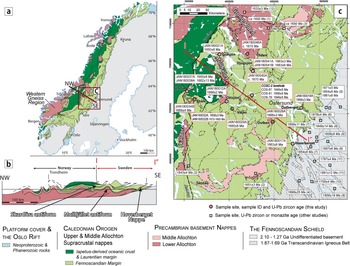


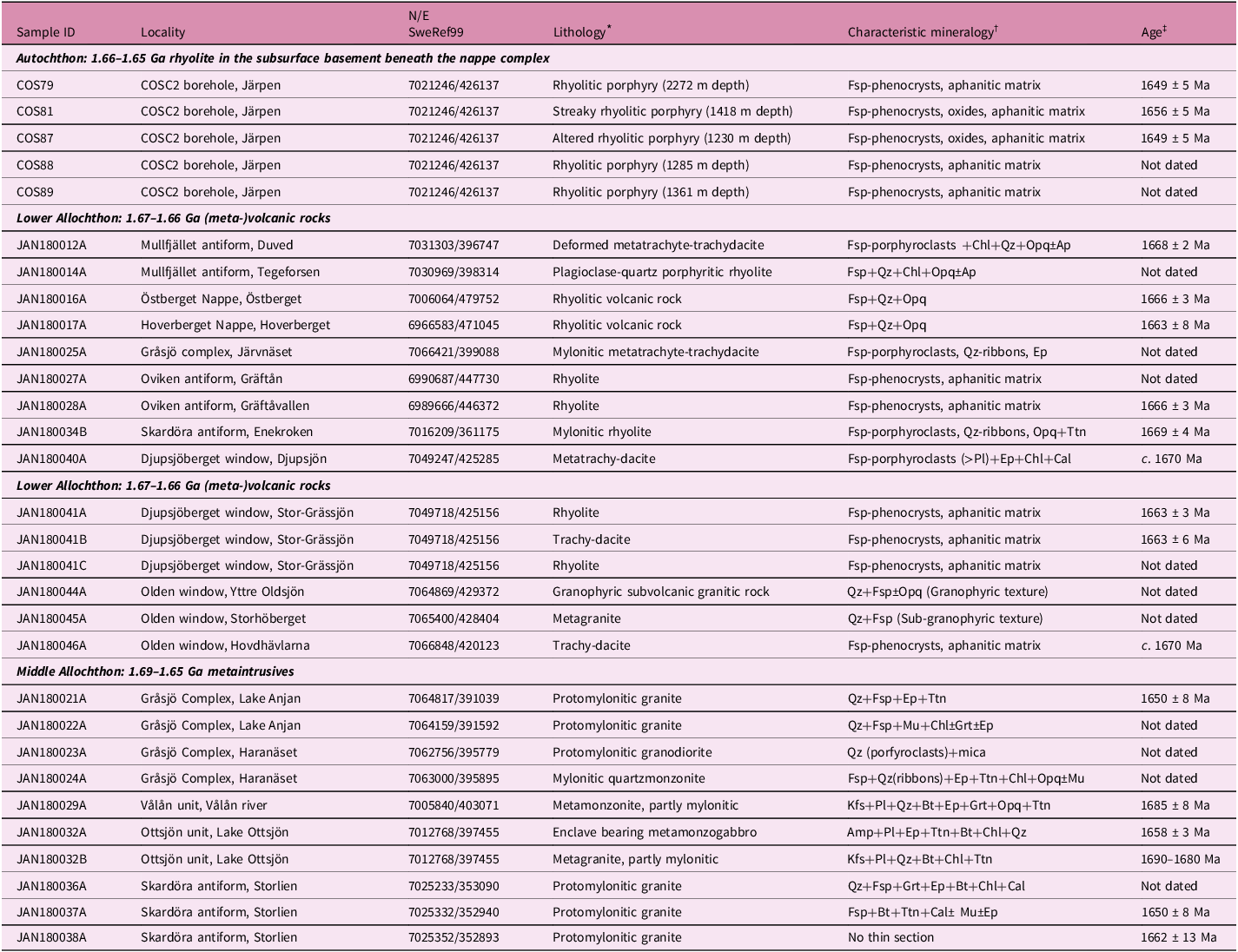
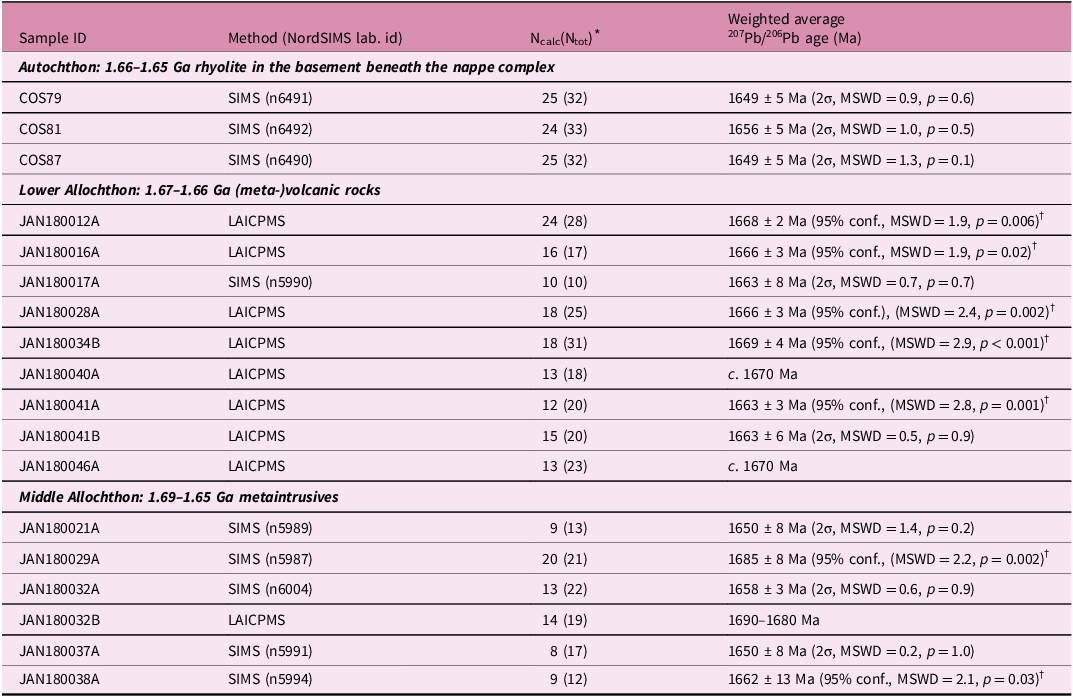


 Open access

