Despite the ongoing attention devoted to the cultural impact of the Great War, almost nothing has been written about A World Requiem by John Foulds.Footnote 1 Subtitled ‘A Cenotaph in Sound’, it was performed on four consecutive Armistice Nights between 1923 and 1926 as the centrepiece of the British Legion's original Festival of Remembrance. Had it entered the musical canon, the work would surely have featured in historians' debate about modernity and memory. Its appeal to the spiritual unity of mankind could have supported Jay Winter's claim that the cultural forms summoned in response to the war were not as straightforwardly ‘modern’ as Paul Fussell made out.Footnote 2 Yet Foulds's tribute to the war-dead of all nations did not simply fade from view. It was deliberately suppressed and written out of history by those who objected to the very intentions that now mark it out for special attention. When the Daily Express took over the running of the Festival of Remembrance in 1927, replacing Foulds's internationalist requiem with patriotic singing, the British Legion distanced itself so completely from the original format that historians have subsequently found little record of its existence.Footnote 3
The work was composed during and immediately after the war to a text drawn from the Bible, Bunyan's Pilgrim's progress, and the works of the Hindu poet, Kabir.Footnote 4 This eclectic mix was the product of Foulds's involvement, along with many other early twentieth-century thinkers, with the alternative spiritual movement of Theosophy. Although movements such as Theosophy first emerged as a reaction to the ‘materialist’ rationalism of the late Victorian period, a number of historians have pointed to their continuing relevance and popularity in the interwar years as means of coping with the emotional legacy of the conflict.Footnote 5 Winter, for example, takes them as evidence of continuity between pre- and post-First World War culture, aiming to show that a ‘traditional vocabulary of mourning’, rather than modernist irony, was predominant in commemoration of the war.Footnote 6 The Theosophy evident in A World Requiem's spiritual message of peace is certainly suggestive of such cultural continuity, but on the other hand, the work was described by leading Catholic magazine, The Tablet, as ‘tremendously modern’ in its use of ‘unrelated chords’, ‘quarter-tones’,and ‘synthetic melody’, techniques that Foulds adopted as self-consciously modernist gestures.Footnote 7 In this respect, Winter's argument that modernist art could not offer healing to a traumatized public does not fit the bill.
Foulds imagined a war requiem that was simultaneously modernist and spiritually cathartic. The idea of fashioning a cenotaph in sound, an empty tomb from the physical vibrations of music, drew upon an ancient occult tradition revived by Theosophy in which music, above all other forms of human expression, was thought to connect mankind with the natural workings and divine inspiration of the universe. Understanding this ‘speculative’ tradition of music theory, shown by Joscelyn Godwin and Penelope Gouk to have featured in various cultural contexts from antiquity to modernity, requires us to think beyond our familiar assumptions about music.Footnote 8 For Foulds and many other British composers influenced by Theosophy, music was not simply an art form or a mode of representation, but an objective physical phenomenon with an active occult agency in social, psychological, and spiritual life.Footnote 9 Foulds considered modernist style to be an extension of Theosophy's quest to experiment in this occult science.Footnote 10 So, although Winter was correct to identify Theosophy as a conduit through which ‘older romantic, religious, and spiritualist motifs’ were revived, its spiritual model, far from being irreconcilable with modernism, was often assimilated into experimental aesthetics. Unfamiliar representational forms were, in turn, embraced by Theosophy as symbols of a world yet to be realized, a world in which ‘the religion of unity’ could be formed.Footnote 11
This strand of musical modernity has been all but forgotten by historians and musicologists. This article demonstrates that Theosophy had a wide currency in the intellectual life of early twentieth-century Britain and that, particularly through the medium of music, it played a significant part in the cultural conflict over the commemoration of Armistice Night in the 1920s. An excavation of Foulds's lost ‘Cenotaph in Sound’ provides a timely case study given the growing interest in auditory aspects of the past.Footnote 12 Historiography on the modernity of commemoration has focused overwhelmingly on the material, visual, and literary cultures of memoryFootnote 13 and despite their traditional wariness of dealing with musical form, historians have much to gain from embracing music as a meaningful agent in the social world. Music offers perspectives on the politics of nationality, subjectivity, and spirituality that are essential to understanding the contested nature of Britain's culture of commemoration. A World Requiem's esotericism proved to be both unpalatable and unintelligible to those who wielded cultural authority. Music critics thought it musically ‘empty’ and presumptuous in its religiosity and the British Broadcasting Corporation, which had begun regular music broadcasts in 1922, could not categorize its idiosyncratic style and refused to legitimize it as ‘serious’ music.
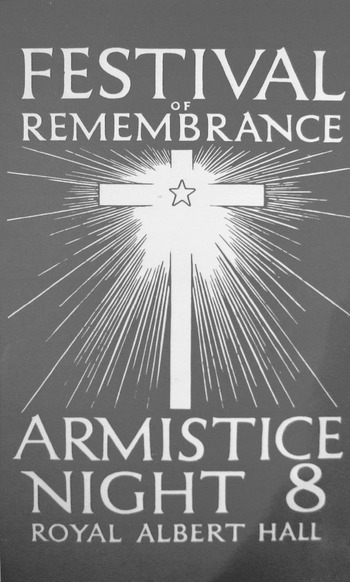
To make matters worse for Foulds, the Festival of Remembrance which he had established at his own expense (a 1926 flyer for which is shown in Figure 1) was caught in a national debate about the proper musical commemoration of Armistice Night in which religious solemnity and secular celebration came to loggerheads. After the Requiem's abrupt and unexplained axing in 1927, Foulds's wife and close collaborator, Maud MacCarthy, was left convinced of a high-level conspiracy against them involving the British Legion, the Daily Express, and the BBC.Footnote 14 The mystery of this axing returned to public attention in 2007 when, as part of a wider rediscovery of Foulds's music, the BBC Symphony Orchestra announced that it would perform the work for the first time since 1926. Journalists pondered why it had disappeared so completely in the first place.Footnote 15 The answer to their question, presented here for the first time, offers a unique insight into the politics of musical modernity and a fresh perspective on the cultural legacy of the First World War.
Promotional flyer from the 1926 Festival of Remembrance, BL 56478.

I
The idea of composing a requiem for the mass commemoration of the war came to Foulds whilst doing his officially allocated work, performing in Ciro's Club for servicemen and directing the musical activities of the Central London YMCA. Several years before the war he had met Maud MacCarthy, once a well-known concert violinist, but now a disciple of Annie Besant, social reformer and president of the Theosophical Society.Footnote 16 Founded in 1875 by Helena Blavatsky and Henry Olcott, Theosophy drew on the traditions of Buddhism and Hinduism and pointed to the unity of these Eastern religions with Western Christianity. Realization of such cultural unity, Theosophers hoped, would lead to a ‘universal brotherhood of humanity’.Footnote 17 The pursuit of esoteric tradition and occult knowledge which accompanied this geopolitical stance was part of a broader ‘flight from reason’ that had gathered pace in British culture since the 1880s.Footnote 18 As personal friends of the architect Edwin Lutyens, designer of Whitehall's iconic cenotaph, and his wife Emily, a senior figure in English Theosophy, Foulds and MacCarthy were part of an esoteric network in which commemoration of the war-dead and the call for international peace were urgent spiritual issues.Footnote 19
The combination of Foulds's community work with MacCarthy's knowledge of practical occultism sparked the idea for an annual Festival of Remembrance at which music could be used to unite and heal. Annie Besant's 1908 lecture on ‘Religion and music’ reveals why music in particular was essential to this cause. ‘Why does music exercise so great an influence over the passions and the emotions of man?’ she asked her audience. ‘Why is it that religion has ever found in music one of its strongest helpers, one of its most inspiring agencies?’ For answers she turned to the birth of the Hebrew race; ‘the birthplace also of these strange sequences of musical notes that produce the most extraordinary results on the physical bodies of the hearers’.Footnote 20 Following Pythagoras (who believed that planetary motion had its only earthly equivalent in musical vibration), Besant identified the physical vibration of certain sound waves as key to the mysterious power of music. Musical vibrations, she argued, impact upon the ‘subtle body’, that is, the part of the human body ‘finer than physical matter’. This subtle body responds to ‘subtle matter’ which includes ‘the waves caused by the vibrations that are musical notes’. The change in vibration which music causes in the subtle body brings about a simultaneous change in consciousness. ‘As vibrations of matter and changes in consciousness correspond’, explained Besant, ‘the vibrations of the subtle matter are answered by changes in the embodied consciousness, and the hearer feels the passions, the emotions, represented by the music.’Footnote 21
Foulds's familiarity with this theory is evident in his suggestion that ‘We incline to forget that music is a force in Nature as is Light, or Heat, or Electricity.’Footnote 22 His Sanskrit opera Avatara (1930) was an attempt to demonstrate music's occult power. Each overture, or ‘mantra’ as he described them, was intended to ‘set in motion the basic vibration-type of the whole act’, each one of which raised the listener to new regions of consciousness. Each type of vibration, associated with a particular musical scale or mode, corresponded to a state of consciousness, from mental, to intuitional, to spiritual, and finally to full consciousness of the divine.Footnote 23 This spiritual-psychological effect of music, according to MacCarthy, is achieved by composers who ‘catch the deeper harmonies of the cosmogonic order’.Footnote 24 In addition to its effects on consciousness, musical vibrations were also thought to benefit the physical health of the hearer. The medicinal properties of ‘magical sound’ had always interested MacCarthy, and there is no doubt that she hoped A World Requiem would soothe both the mental and physical pain of the war. She later wrote that
A widespread practicing acquaintance with the lovely Sound-Mystery could liberate immense forces for the healing of the nations. Thus, for instance, we may permit ourselves to imagine accurate reproductions of the sounds made by celestial choirs – which are most healing on any plane – reaching and re-creating millions through radio, and in other ways, and bestowing new leases of life on all who would truly hearken.Footnote 25
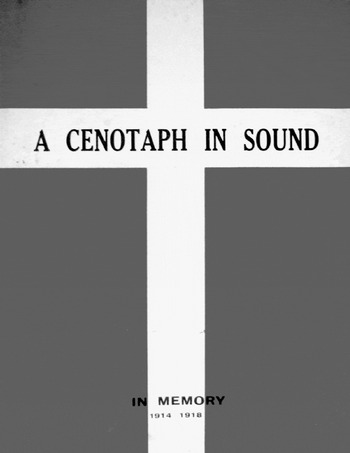
The ‘Cenotaph in Sound’ subtitle of the Requiem was certainly no gimmick. Given prominence on the front cover of the Festival of Remembrance concert programme in 1923 (Figure 2), it referred to Theosophy's belief that musical sound could alter the physical and spiritual state of the listener. The need to create a sonic war memorial whose effects would bring healing and spiritual uplifting to the masses was lent greater urgency by the damage thought to have been caused by the war's fearful soundscape. Besant wrote of the need to make the human body ‘impervious to the jangling noises of earth’ and Cyril Scott, another British composer influenced by Theosophy, lamented that upon their return from the trenches, British soldiers were greeted by noises of a newly mechanized urban modernity: ‘The jarring sounds of motor-horns, whistles, grinding brakes and so forth exercise a cumulative and deleterious effect upon the entire organism. In order to counteract this’, he explained, ‘certain composers will be used to evolve a type of music calculated to heal where these discordant noises have destroyed’.Footnote 26
Front cover of the 1923 Festival of Remembrance concert programme, BL 56478.

The imperative to protect and disseminate the sonically beautiful was crucial to the conception of the Requiem. MacCarthy's pencil annotations on the original composer's score reveal much about this mystical process. Parts of the music came to Foulds clairaudiently, or, as MacCarthy put it, ‘in a psychically objective way’. One passage of music, she recalled,
was heard by me, as it were enfolding our entire house. I was at the top of the house, and John was in his study two floors below. I went down to tell him, and found him writing the same passages in the same keys. Sometimes the house seemed to be shaken by this heavenly music, and angelic choirs sang, and angelic musicians played to us.Footnote 27
Independent corroboration of this is to be found in the memoirs of Elisabeth Lutyens, daughter of Edwin and Emily, who received music lessons from Foulds. She recalled that ‘Foulds and a group of fellow-Theosophists were trying to make contact with the Devas [Hindu Gods] or angels and to receive messages or music from them. This was to be achieved by meditation of an undefined sort in the attempt to render oneself psychic.’Footnote 28 MacCarthy's annotations also reveal that the occult fiction writer Algernon Blackwood visited their home whilst this clairaudience was taking place. His 1921 book The bright messenger was, according to her, ‘an account, in the main, of what he found at our house’.Footnote 29
As so often with Theosophy, the mystical element of clairaudience was balanced by an appeal to occult science. The physicality of sound waves had been popularized through the work of German physicist, Hermann von Helmholtz, who was among the first to measure the resonance produced by music. His book On the sensations of tone as a physiological basis for the theory of music (1863) was cited by Foulds as an example of how previously occult knowledge about music gradually became widely acknowledged scientific fact.Footnote 30 If the world is full of vibrating sounds, then it seemed reasonable to Foulds that these sounds sometimes align themselves in such a way as to provide access to the sounds of the cosmos. This realization had proved crucial to him in 1915:
Whilst retiring I heard a very fine subtle [sic] melody which seemed to expand my consciousness enormously. It easily included all sounds which I would otherwise have considered as accidental noises: children at play, locomotive whistling, church bell, workmen cracking wood in basement, railway sound ‘puff, puff’, dog barking, the regular and very slight creak of the mattress spring caused by my heart-beats, even a motor hooting – all these mere noises seemed to be perfectly in place as harmonious parts of the never-ceasing rhythmic music of the world, and I now easily realised the Pythagorean theses:- the whole universe is but an ordered sound.Footnote 31
Theosophy's theory of sound also explains the idiosyncrasy of Foulds's brand of modernism. In contrast to a work such as Stravinsky's The rite of spring (1913), often taken as the pre-eminent expression of early musical modernism, Foulds's style is strikingly minimalist. It placed greater emphasis on the physical quality of sound than on traditional components of music composition – melody, harmony, and rhythm. He thought that timbre, the aural equivalent of texture, was the most important building block of the music of the future, describing it as ‘one of the most dynamic and magic-making constituents of the sound-art’.Footnote 32 ‘I have seen a far greater effect produced by a single note of a certain timbre’, he explained, ‘than by whole symphonies comprising uncountable thousands of notes.’Footnote 33 This emphasis on timbre was a product of the Theosophical interest in vibration and the physicality of sound waves. Foulds believed that musical composition, far from being a simple matter of form, should be allied to psychological and biological inquiry: ‘One has but to consider the intricacies of the subconscious and unrevealed self, and of its physical instrument the brain and nervous system … and the effects of timbre upon the whole to realize the field that is before us.’Footnote 34
An example of the ends to which Foulds was willing to venture in order to create the ideal timbre is his use in the Requiem of the ‘sistrum’, a musical instrument which he invented to recreate a sound heard clairaudiently. ‘We heard a sound which could not really be described as a “musical sound” but rather as a “musical noise”’ wrote MacCarthy. It suggested, ‘a breathing through myriads of gossamer – fine tiny wafers of precious metals, but with no particular pitch’.Footnote 35 The sistrum which recreated this sound was similar to a harp in appearance but consisted of a multitude of small cymbals. In anticipation of its first use in 1923 the Daily Mirror printed a photograph of Foulds proudly displaying his creation.Footnote 36 His aim in using the sistrum was to build up the precise timbre, and thus also vibration rate, which would bring about the magical effects that Besant had attributed to music in 1908. Although it bore little resemblance to that of other experimental techniques of the period, Foulds's musical aesthetic was no less modernist in outlook. He rejected the formalism of European modernists, such as Berg and Schoenberg, because he thought their music devoid of vibratory process and spiritual purpose: ‘The moment we discern the mainspring of a piece of music to be a mere intellectual device, its magical spell is broken.’Footnote 37
His book Music to-day (1934) is a defence of musical modernism and its connection to the occult. In it, he bemoaned the British habit of ‘discounting in advance any work by a composer who is not content to purvey stereotyped emotional stimulant via the old-established melodic and harmonic routes’.Footnote 38 He sought a music of the future, but one that had a purpose connected to the ideals of Theosophy. He believed in the value of musical simplicity because his primary aim was to affect the body and mind of the listener. ‘Certainly the beauty and the magic of music can be enshrined in factors far more simple and at the same time more potent than we of this complicated age are apt to assume’, he explained.Footnote 39 Repetition, stasis, and a deliberately limited harmonic vocabulary were used in the Requiem as a means of recreating the meditative effects of the mantra, described by Besant as ‘a sequence of sounds arranged so as to bring about a definite result’. ‘When the subtle body is made to vibrate according to this sequence’, she explained, ‘it is vibrating with the vibrations of the Devata [the Hindu equivalent of an angel], and thus is more susceptible to his influence, more open to receive impressions from him.’Footnote 40
MacCarthy was equally scathing of artists who relied too heavily on the aesthetic paradigms of the past:
There is something pathetic in the condition of the modern artist, tying to nourish his soul upon the spiritual food of bygone ages. Why should the gates of heaven be closed to-day? Why should we not be able to reach and know the deeper regions of life, the habit of the Ideal, ere yet we lay aside these garments of flesh – as did the apostles and disciples, in all lands, in all religions, of old? Ah! That men might produce the outlines of these loftier worlds – none the less real and human, because they are hid from sense – for the enheartening of those who cannot yet pierce the veil, for the purifying of the labours of the world!Footnote 41
Heaven is accessible to the human senses, according to MacCarthy, but only to those people who have cultivated fine-tuned perception through study of the occult. Progress in the arts and sciences is equated to an ever-closer bond with God and His Kingdom. Those artists who achieve such progress have a duty to share it with the world.
II
A World Requiem was intended for just this purpose. It was composed in two distinct parts, each of ten movements. The first part follows ‘the more orthodox thought connected with the Requiem’, but is ‘interwoven with thoughts prompted by international wars’.Footnote 42 It reassures the audience that ‘Blessed are the dead which die in the Lord’, but pleads with the nations of the world to find peace with one another: ‘Nation shall not lift up sword against nation,/Neither shall they learn war any more.’ The second part ‘departs altogether from tradition as expressed in the Requiem music of the past’, and, in contrast to the first part, deals entirely with the mystery of the afterlife.Footnote 43 Its second movement, ‘Elysium’, at which point the music ‘becomes more and more other-worldly’ is set to Kabir's description of heaven in which, ‘Sorrow is no more,/The terror of death is no more.’ Death is a recurring theme of the work as a whole and is represented in the musical score by the use of the quarter-tone, a technique which Foulds claimed to have been the first to deploy.Footnote 44 Conventionally, musical notes are divided into divisions no smaller than a semi-tone (sharpened and flattened notes, as with the black keys on a piano). By sliding the finger along the string of a violin or a cello, however, smaller intervals can be produced and Foulds used their uncanny sound in the Requiem to represent the journey to the afterlife.
Quarter-tones are the most remarkable stylistic feature of the work. It otherwise adheres to Foulds's ideal of simplicity, building up patterns of chromatic chord progressions, rather than developing epic melodies as might be expected of a work that calls for a full symphony orchestra and a chorus of a thousand voices. Attaining the correct vibration types was more important to Foulds than formally pleasing harmonies, melodies, and rhythms. The 1926 concert programme admitted as much: ‘[I]ts address is to the spiritual rather than to the emotional in man. Hence to some who do not breathe easily in a more rarefied atmosphere, much of the music may seem to be remote, bleak, lacking the human touch and the personal appeal. There is little trace of a set melody, or of the ordinary aids to emotional stimulus.’Footnote 45 Far from finding their state of mind altered or their wartime trauma healed, however, music critics were baffled by the lack of musical material. ‘I find it, as music, extremely dull’, wrote The Observer's music critic. He continued by explaining that this dullness is
down largely to an extravagant lack of both harmonic variety and melodic vitality. It is one of the functions of harmony to convey or enhance a sense of progression, but much of Mr Foulds' harmony does not attempt to press forward or, at any rate, does not long maintain the attempt to do so.Footnote 46
An internal BBC report on the Requiem confirmed the general feeling that the work was
simply not good enough. And this is the reason why it has fallen into oblivion since its performance in 1923. Apart from the defects in the libretto, the music itself is boring, one would call it ‘empty’ music. A series of accompaniments without a strong theme to them. And endless repetition. And always in the same key.Footnote 47
The Times went further in its damnation of the work:
Once the ear has become accustomed to the solemn sensation produced by certain salient chord progressions, and one is no longer overawed by the grandiloquence of its large-scale presentation, the poverty of the musical ideas and the empty spaces where there is no musical idea at all, but merely the declaration of words which carry hallowed associations, become painful.Footnote 48
Describing the work as painful must have particularly upset MacCarthy, given her belief in the healing power of music. This was symptomatic of the incompatibility of her and Foulds's occult ideas with the mainstream culture of elite British music-making. Audiences, on the other hand, responded in a deeply emotional fashion to the work's performance. One of many enthusiastic attendees wrote to explain that, ‘Your music floated through my being … and to me there was healing in every note. The very state of mind produced was one of quiet ecstasy which I shall never forget.’Footnote 49 The discrepancy between music critics' hostility and that of the apparently well-disposed audience can perhaps be explained by the particular class appeal of alternative spiritualities between 1890 and 1930. Although Theosophy was spearheaded by artists and intellectuals, spiritualism had a wide and popular currency.Footnote 50 It may account for the enthusiasm of the many ordinary men and women who wrote to Foulds to express their enjoyment of his Requiem.Footnote 51
It could also have been that an objection to the work's textual commitments clouded judgement about its musical score in the minds of music critics. In contrast to the musical minimalism of the score, the internationalist and pacifist tone of the Requiem's text, assembled by MacCarthy, is unambiguous. The call for international understanding in ‘Audite’, movement five of the first part, is one of the work's centrepieces. ‘Give ear, all ye nations of the world!/Give Ear, all ye peoples of the earth!’ exclaims its opening line. Consecutive stanzas are then devoted in turn to the peoples of the North, South, East, and West. These stanzas are accompanied by a brass fanfare which comes, to the audience's surprise, from the balcony of the Albert Hall, each time at different compass points. This spatialization of the musical score served to remind the audience of their relativity to the rest of the world. ‘Be of one mind, live in peace/And the God of love and peace shall be with you’, concludes the stanza devoted to the people of the West. ‘For the Prince of Peace cometh,/And he will speak peace to His people …’. In the next section the music again comes from the balcony. In place of the fanfares of distant nations come the heavenly voices of a boys’ chorus and the mysterious sound of the sistrum. Happening above the heads of the audience, the clear intention is to associate international reciprocity with divine ordination. The musical theme first introduced by the boys' chorus returns in the second movement as ‘the motive of the Coming Christ’.Footnote 52
This internationalism owed more to Theosophy's appeal for the cultural unity of ‘Aryan’ traditions than to the Christian pacifism which became prevalent in the 1930s. MacCarthy's 1912 lecture on Indian music, for example, concluded that the similarities to be found between Eastern and Western music pointed to the shared origins of a single Indo-European culture.Footnote 53 She inferred that nation states, national cultures, and religious factions, particularly those that divided Europe and India, were artificial constructs. Although Theosophy was particularly interested in India, it nonetheless developed a more general commitment to mutual toleration and reciprocity among all nations and religions of the world. Foulds hoped that his Requiem would capture a genuinely universal humanity. ‘It has been the composer's aspiration’, explained the 1923 concert programme, ‘to produce a work which might belong to many nations and creeds, so that amid the clash and conflict of the races, of the religions, and of the factions, some expression might be found for the indestructible spiritual unity of mankind.’Footnote 54
Whilst the work's text succinctly encapsulated this aim, the search for a universal and international musical style was more problematic. Foulds hoped to achieve this through a fusion of European and Indian musical traditions. Quarter-tones, for example, were an attempt to Westernize Indian micro-tones. This search for musical universalism set Foulds apart in a period dominated by the English national folk music revival of Stanford, Parry, and Vaughan Williams. Although Foulds was interested in Celtic folk idioms, he resisted a wholesale adoption of Britain's folk music revival because,
for present-day composers and protagonists to concentrate upon such, or any other narrow nationalistic phenomena, goes clean against the main evolutionary trend of the art. Only out of a new realization of world-wide emotional-mental solidarity – even solidarity – can the real music of the future be born.Footnote 55
He added later that
It is just because so many of our composers have responded to the English national vibration that they have done so little work which may be described as universal. No creative artist who cannot transcend the levels at which (up to which) nationality manifests, can be capable of work of universal appeal.Footnote 56
The quest for universal music which led Foulds to reject nationalism meant that his Requiem was not easily categorized by contemporaries in an age in which genre became increasingly significant. The BBC, in particular, mistook Foulds's humanism for a thinly veiled popularism of which it remained deeply suspicious. The composer was obviously sensitive to such criticism: the 1926 Festival of Remembrance concert programme explained that the Requiem's ‘universal appeal demands that its broad basis and central themes be of the utmost simplicity, even at the risk of seeming, to more musically tutored minds, too obvious in statement and progression’.Footnote 57 By universal appeal, Foulds also meant that his Requiem should be comprehensible to ordinary Britons. The Observer's music critic, writing on Foulds's instruction, noted that ‘The composer has deliberately adopted a harmonic scheme which can be appreciated “by the average musical intelligence of the day”’, and The Times recognized that ‘On the whole, Mr. Foulds has aimed at those who know less, and for a good reason.’Footnote 58
Yet this did not fit the BBC's emerging ‘divisive taxonomy’ of music. Meirion Hughes and Robert Stradling have argued that its dichotomy between ‘light’ and ‘serious’ music became increasingly crystallized in the interwar period as a result of the growing suspicion of mass consumerism and its impact upon the sanctity of art.Footnote 59 The folk revival of mainstream British composers, while it was intended to popularize classical music, remained legitimate ‘serious’ music because it represented essential characteristics of the British people, as opposed to the corrupting influences of mass entertainment. Since his occultism led him to reject the historicism and nationalism of the folk revival and because he was also willing to score for the theatre and to write popular tunes for the musical market, Foulds's work embodied a dangerous modernity in the minds of the British musical elite, particularly the BBC. Their reaction was to relegate him to light music radio programmes, ultimately a successful means by which to deny him legitimacy as a serious British composer.
In an angry letter written in 1933 to Adrian Boult, the BBC's director of music, Foulds pointed out that
Within the last two years I have submitted four works to the BBC. These, in my opinion, contain some of my most valuable work. In each case they were rejected by your Selection Committee. The position, therefore, is that while my principal serious works have received the approval of some of the greatest names in the musical world, and also of practical conductors, it would appear, judging from past experience, that any serious work of mine has a poor chance of winning the approval of the BBC Selection Committee.
In the mean time my light works are continually broadcast. These light works number a dozen or so, as compared with the total of 50 of my serious works. This state of affairs, I think you will agree, is rather a galling one for a serious artist.Footnote 60
An internal circulating memo within the BBC in 1932 appears to confirm Foulds's fear that he had been relegated to ‘light’ status. ‘We have been worried a good deal in the past off and on by this Composer. The difficulty has always been that we think that almost all his music is very dull stuff, and the more serious it is the duller it becomes.’Footnote 61 Boult wrote in another internal report that ‘The man is quite a good composer, and I believe “The Requiem” made a deep impression’, but after the comma is a telling handwritten insertion, ‘of lighter stuff’.Footnote 62
Foulds's credibility as a serious composer was seriously damaged by the BBC's pigeon-holing. A. H. Haggard, a friend of the composer, testified that the BBC's preference for his ‘light’ works, ‘resulted in their creator being labelled “light composer” and seen in quite the wrong perspective by the musical world’.Footnote 63 Yet while Foulds made clear that light works such as the much-broadcasted Keltic Lament (1911) were intended only to pay the bills, he did not necessarily make such a sharp separation between ‘serious’ and ‘popular’ as the BBC. In a letter to his friend and collaborator George Bernard Shaw in 1925, Foulds objected to the writer referring to his ‘style’: ‘I think I have a greater diversity of styles’, he replied, ‘than almost any other composer I know of. Certainly I have dealt faithfully and lovingly with many a tune “straight from the hearts of the people” as your soldier says [referring, presumably, to Saint Joan].’Footnote 64 The Requiem was certainly an attempt to communicate to the broadest possible social spectrum. This was consonant with Theosophy's social commitments in general, which were strongly affiliated with the reforming left of British politics (particularly the Fabian Society), but adopting a simple and universal musical language was also necessary given that Foulds conceived of his work as an experiment in occult healing as much as a piece of music. This esotericism did not communicate to an elite audience more used to the Englishness of Vaughan Williams and to the formalism of Stravinsky. Foulds's attempt to forge a social and international universalism was quarantined by the British musical elite under the charge of ‘popularism’.
III
Ultimately, however, it was neither music critics' boredom nor the BBC's animosity that caused the British Legion to withdraw its support for the Requiem in 1927. The work had become a pawn in a wider cultural conflict played out in national newspapers about the correct format for Armistice Night. The British Legion Journal showed its awareness of this conflict in 1923 in writing that ‘Armistice Day will ever stand out as marking the greatest glory and the greatest tragedy of the war.’Footnote 65 The problem of striking a balance between celebration of the glory and commemoration of the tragedy came to divide British society in the mid-1920s. Prior to 1923, the Albert Hall had hosted ‘armistice jazz’ on the evening of 11 November. Foulds's Requiem, with its opening lines, ‘Requiem aeternam/Lord, grant them rest eternal … All those who have fallen in battle … Men of all countries who died for their cause,/Lord, grant them rest eternal’, marked a significant change in the culture of Armistice Night: a turn towards solemn commemoration rather than rejoicing. Newspapers such as the Daily Mail thought that Armistice Day should indeed be reserved for just such commemorative acts. Other papers, in particular the Daily Express, thought that the solemnity of eleven a.m. was sufficient commemoration of the dead, and that the evening should be given over, as in 1918, to celebration of the war's end and victorious outcome.
It is no surprise, then, that the Daily Mail was a keen supporter of the Requiem. It assured its readers in 1925 that it had ‘established itself for the musical celebration of Armistice Day’.Footnote 66 This statement was timed to have a political impact. It was in 1925 that Foulds and MacCarthy were forced to move their Festival to the Queen's Hall in order to accommodate a revival of the ‘victory ball’ tradition at the Albert Hall. This event was proposed by a committee led by Lord Northampton and the duchess of Sutherland in aid of the Royal Northern Hospital. Although it had been de rigueur in the immediate post-war years, a victory ball caused great controversy when proposed again in 1925. For example, one anonymous letter to The Times in October read:
It is of course possible to make a plausible cause for anything – even for dancing on Armistice Day. Whether ‘that victory feeling’ is the real motive or only the excuse is for each to settle with his own conscience. The fact remains that most of us regard an Armistice Day ball as an outrage on decency. It does not prove callousness, it betokens a painful lack of imagination.Footnote 67
The archbishops of Canterbury and York both denounced the planned ball, and in the light of the support they received, the ball was duly cancelled. Lord Northampton wrote to The Times on 5 November expressing his surprise that, despite victory balls having taken place annually at various venues since 1918, ‘This year, however, during the last week, it has become apparent that a section of the community has a strong feeling against public rejoicing on Armistice Day.’Footnote 68 The conflict, he suggested, seemed to be not so much about whether victory balls should be tolerated but whether one should take place at the Albert Hall, a symbol of national culture, on Armistice Night. The planned ball of 1925 was moved to another day and replaced at the Albert Hall with a Remembrance Service led by the Reverend H. R. L. Sheppard who had led the campaign for a purely commemorative Armistice Day and later became a leader of the Peace Pledge Movement.Footnote 69 Sheppard's letter to The Times on 20 October 1925, which called for a need to ‘retain for Armistice Day the setting of a solemn reverence and gratitude in which a people may remember its duty both to the living and to the dead’, had sparked the national debate about the proposed ball.Footnote 70
Sheppard's victory was followed by the return of Foulds's Requiem at the Albert Hall in 1926, leading to a clear association in many people's minds between religious authority – Sheppard had given the very first religious broadcast on the BBC in 1924 – and the return of the Requiem. This conflict over the correct marking of Armistice Night in 1925 signalled a significant split between secular and religious culture in interwar Britain. The Daily Express took exception to religious leaders vetoing celebratory events:
From the earliest times – until this year, when an unwholesome and unnatural change is sought to be made – mankind has signalised its gratitude and joy for its successes in war, and its release from the travails which war brings, by prayer and by merrymaking. The two courses are not inconsistent.Footnote 71
The correct course, according to the Express, was to commemorate the war with solemnity at the cenotaph in the morning and to celebrate its victorious outcome with singing and dancing in the evening. There was no place for another cenotaph in the evening, let alone a musical variety of cenotaph which sounded too much like a victory for religion over Britishness. In this sense, A World Requiem was unfortunate to have adopted such obvious religious content, for it was not to its esotericism that the Express objected, but to its religion, which was erroneously assumed to be aligned with the church's objection to Armistice celebration.
The Manchester Guardian had brought a similar objection to bear on the religious content of the Requiem as early as 1923. ‘Why Mr. Foulds should call his work a “World Requiem” I do not know’, wrote the paper's music critic Ernest Newman.
During the last three or four years more than one zealous body has made the mistake of trying to put a purely Christian inscription upon the local war memorial, and has had to be reminded that among the men who died for their country were Freethinkers, Jews, and others who had either no religion at all or a religion other than Christian.Footnote 72
Yet it was not to religion as such that the Express objected, but to a form of pacifist Christianity that later grew in stature under the leadership of movements such as the Peace Pledge and its white poppies. The Express sought a form of established religiosity compatible with national pride and the necessity of war. For this reason, the paper had taken a dim view of the Requiem since 1923, on which occasion it had described the work as ‘purely “occasional” music, depending for its effect on circumstances, on the public's predisposition, on the suggestiveness of many sublime words rather than any inherent musical interest’. The music, it thought, was ‘facile’ and ‘glib’, but tellingly it also noted that ‘The evening proved how desirable an Armistice Day concert might be each year.’Footnote 73
When the British Legion announced that Armistice Night 1927 would be marked by the first ‘Daily Express Remembrance Festival’ at the Albert Hall it came as a surprise to Foulds and MacCarthy. Although they made no public attack on the Legion, MacCarthy later wrote that its founder, Field Marshall Earl Haig, ‘stooped’ to a ‘conspiracy of silence’ in the full knowledge that ‘The original intention was an annual nation-wide Festival of Remembrance. By intrigue’, she adds, ‘this was stopped, as the British Legion well knows.’Footnote 74 The original intention was, in fact, to establish annual performances of A World Requiem throughout the towns and cities of Britain. In 1923 Haig wrote of his hope that, ‘on each Armistice Day many thousands will sing the work throughout the land’.Footnote 75 The British Legion Journal went so far as to suggest that it hoped for annual performances of the Requiem ‘throughout the Empire’.Footnote 76 In 1924, The Times reported that, in addition to the annual Festival at the Albert Hall, simultaneous Armistice Night performances of A World Requiem were to take place in Birmingham and Bristol.Footnote 77 By 1927, however, this position had changed radically, and it was the Daily Express that played the key role in convincing the British Legion to withdraw its support.
Haig's silence after 1926 explains the lack of details in MacCarthy's account of the axing. She wrote only that ‘Some back door business was brought to bear on high officials and the thing was stopped as if my husband had been an impostor. I found out later that this injustice was engineered through one “jealous person”.’Footnote 78 That person may well have been another composer who felt that an occasion such as Armistice Night should have provided a platform for someone with a musical reputation to match. That was certainly the feeling of the Express in 1923: ‘Great events do not inevitably call forth the supreme artist fitted to celebrate them’, stated its reviewer.Footnote 79 It is significant that, on Armistice Night 1923, the BBC had chosen to broadcast an alternative concert rather than Foulds's Requiem, which included a rendition of God Save the King and two pieces, Imperial March and Land of Hope and Glory, by Edward Elgar, already established as the foremost British composer of his generation. A year later in 1924, the BBC again decided not to broadcast the Requiem, preferring instead, ‘Two works by British composers who were killed in action’, A Shropshire Lad by George Butterworth and English Pastoral Impressions by Ernest Farrar. This suggests a strong preference at the BBC for music of the English pastoral mould and the extent to which a lack of military experience and shortfall in ‘serious’ music credentials worked against Foulds's cause. The Express considered him to have staged a coup d'état on Armistice Night music-making, taking advantage of the British Legion's lack of wherewithal in failing to take central control of Armistice events in the early years of its existence.
Despite the BBC's general hostility to Foulds as a serious composer, Boult's correspondence with MacCarthy on the topic of the Requiem was correct in pointing to the Express's enigmatic owner, Lord Beaverbrook, as the key protagonist in the axing.Footnote 80 Beaverbrook was well known for such interventions in cultural and political life and his paper was already strongly associated with the promotion of community singing. In 1926, for example, it had promoted an event entitled ‘Beauty of English hymns’ in Birmingham at which the audience's participation, it was hoped, would ‘serve to revive and repopularise many of the grand old songs of England’, and ‘reveal the great national wealth of Beauty that lies in our hymns and sacred chorus’.Footnote 81 A year later, the paper adopted this same format at the Albert Hall on Armistice Night. Captain Mike Wardell, the paper's black eye-patch-wearing and later fascist-sympathizing business manager, was responsible for organizing the new event.Footnote 82 With the support of the Legion, he replaced the Requiem with ‘wartime and other popular songs and choruses’ which were sung by reunited servicemen.Footnote 83 The paper appropriated the ‘Remembrance Festival’ label without Foulds's and MacCarthy's permission. ‘The festival’, it explained, ‘has been organised to recapture the splendid comradeship of the war years.’Footnote 84
Despite the conflict over the proposed victory ball in 1925, the Festival's new format, which remains relatively unchanged to this day, was far from irreligious. The 1928 version directed by Malcolm Sargent included an address by the bishop of London and future Festivals were undertaken with a giant crucifix on the Albert Hall's stage. Indeed, the Official History of the British Legion recalls that the Express established a Festival that later assumed ‘the character of a religious ceremony’.Footnote 85 In contrast to Foulds's and Sheppard's pacifism, the Express adopted a format in which patriotism and military solidarity were shown to be compatible with religion. In terms of their global politics, though, the contrast between the new Remembrance Festival and Foulds's Requiem could not have been greater. While Foulds and MacCarthy called for international unity and peace, the Express sought to promote British cultural traditions and a worldview based on the continued power of the British Empire. This was part of Beaverbrook's pro-Empire agenda and particularly his campaign for Empire protectionism of which the Express's crusader emblem was representative.Footnote 86
‘The air was blue with the smoke of our pipes and fags – how could we sing war songs without fags? – when we came at last to “Tipperary”’, recalled an attendee of the 1927 Festival. ‘That was our final song. We sent it round the world.’Footnote 87 The meaning of this final remark no doubt refers to the volume at which the song was sung, but it is also resonant with a national pride in the worldwide achievements of the British Armed Forces. The author must also have been aware that the Express's 1927 Festival was chosen, in contrast to the BBC's earlier reluctance to broadcast A World Requiem, as the very first broadcast of the BBC Empire Service, later to become the World Service, so ‘Tipperary’ was indeed heard across the world.Footnote 88 During the 1930s and 1940s, the annual event was temporarily renamed ‘A Festival of Empire and Remembrance’, suggesting a global politics far removed from Foulds's original intentions of 1923.
The abrupt axing of the Requiem and its replacement with patriotic singing was only part of the indignity for Foulds and MacCarthy. In 1931, the Radio Times ran an article on the history of the Festival of Remembrance which suggested that 1927 was its year of inauguration and that the Daily Express was its founder:
An Albert Hall Festival has become traditional in Armistice Day programmes. In 1927 and 1928 the Festival was organized by the Daily Express; since then it has been held under the auspices of the British Legion. Stirring music and the singing of war-time songs distinguish this annual reunion of ex-Service men.Footnote 89
By making no mention of A World Requiem in this feature, the Radio Times effectively wrote Foulds's and MacCarthy's contribution out of history, confirming the latter's conclusion that the Requiem was ‘not only stopped but every reference to it … stopped and stamped out since’. She rightly pointed out that ‘We created the festival, and by much hard work. I would not weary you with all we did and suffered to create that National Festival’, reads her letter to the BBC, parent company of the Radio Times. ‘We had no organisation. It was private voluntary help. The Requiem was a mere lever – we gave our services entirely at personal loss which I will not detail.’ Furious with the Radio Times, she explained to Boult that ‘There is such a thing as hitting below the belt, and the Radio Times appears to do this in this week's Armistice Article. I do wish you could get a little fair play for John Foulds.’Footnote 90
IV
Recognition of Foulds's and MacCarthy's role in the establishment of the Festival of Remembrance has never been forthcoming from the (now Royal) British Legion. When A World Requiem was revived on 11 November 2007 few people seemed to realize that it was the precursor to the military bands that now perform annually at the Royal Albert Hall's Remembrance Festival. Critics are still divided about whether the Requiem should be admitted to the canon of English choral music, and for this reason it will probably never receive the attention it deserves from musicologists.Footnote 91 Yet A World Requiem allows historians to make useful connections between an enduring fin-de-siècle occult spirituality on the one hand, and a political conflict over the musical commemoration of Armistice Night on the other. Foulds's and MacCarthy's Theosophy was an attempt to universalize religion on peaceful and transnational terms; the Daily Express's agenda drew upon an equally enduring tradition in which religion and patriotism were wholly compatible.Footnote 92 This was ultimately the more powerful of the two and was bolstered by the bureaucratization of national culture at the BBC. Nonetheless, the history of A World Requiem adds greatly to our understanding of the homogeneous rituals and aesthetics of memory during the formative decade of the 1920s.
Foulds's Requiem also poses difficult questions of the historiography of British modernism. Music has rarely featured in it because the narrative of ‘national folk revival’ has so thoroughly pervaded the history of early twentieth-century art music.Footnote 93 Although this revival accounts for Foulds's outsider status in the musical culture of the 1920s, his Theosophical brand of modernism is intellectually important because it was designed first and foremost to harness the physicality of sound as an agent of medicinal and psychological healing. That the inspiration for this project came from an ancient tradition of musical mysticism is evidence that modernism does not represent as sharp a break from the past as some historians would have us believe.Footnote 94 Precisely because it has neglected music, the study of modernism and modernity has taken too simplistic a view of what constitutes innovation and progress. As a consequence, the question of what amounted to the dominant artistic reaction to the First World War has been distorted. The extraordinary sensitivity to sound demonstrated by Foulds and MacCarthy also suggests the need for historians to pay great attention to the sensory dimensions of culture. Music is more than an expression of ideology or of social discourses of power. A World Requiem was an engagement with, and an attempt to reshape, the perceptual experience of everyday aurality in the aftermath of total war.