Pathological gambling (PG) is a disorder characterized by a loss of control over gambling behavior that persists despite its severe impact on the affected individuals, their families, and society at large. The disorder was included in the American Psychiatric Association’s Diagnostic and Statistical Manual of Mental Disorders [DSM-IV-TR], (2000) and in the World Health Organization’s (1992) International Classification of Diseases [ICD-10] as an impulse control disorder not elsewhere classified. Recently, has been included disordered gambling as a behavioral addiction under the Addictive Disorders section (APA, 2013).
In Spain, the ratification of the 1977 Gaming Act (i.e. Real Decreto-Ley, de 7 de marzo, por el que se regulan los aspectos penales, administrativos y fiscales de los juegos de suerte, envite o azar y apuestas), legalized gambling in this country and authorized the opening of casinos and bingo halls. Slot machines were made legal in 1981 and soon appeared in bars and restaurants. These changes in legislation promoted general social acceptance of the practice and led to an increase in gambling. Nonetheless, although few epidemiological studies have focused on the prevalence of pathological gambling in Spain since its legalization, the prevalence rates obtained range from 0.2% to 3.3% (Becoña, Reference Becoña2004). Results between prevalence studies are difficult to be compared due to methodological differences. A recent meta-analysis conducted by Williams, Volberg, and Stevens (Reference Williams, Volberg and Stevens2012) standardize worldwide trends problem gambling prevalence rates and obtain ranges from 0.5% to 7.6%.
The prevalence of pathological gambling in men is described approximately; double the rate than in women (Blanco, Hasin, Petry, Stinson, & Grant, Reference Blanco, Hasin, Petry, Stinson and Grant2006). In Spain, few studies have focused on female pathological gamblers compared to male pathological gamblers, and only a small number have compared samples of women and men help-seeking populations (Echeburúa, González, De Corral, & Polo, Reference Echeburúa, González-Ortega, De Corral and Polo2011; González-Ortega et al., Reference González-Ortega, Echeburúa, Corral, Polo-López and Alberich2013; Granero et al., Reference Granero, Penelo, Martínez-Giménez, Alvarez-Moya, Aymamí, Bueno and Jiménez-Murcia2009).
Previous studies have shown that there are differences in the socio-demographic profiles between sexes: male pathological gamblers are more likely to be single, tend to be younger, and have higher incomes and gambling-related debts than female pathological gamblers (Desai & Potenza, Reference Desai and Potenza2008; Grant, Kim, Odlaug, Buchanan, & Potenza, Reference Grant, Kim, Odlaug, Buchanan and Potenza2009).
As to the reasons for gambling, men do so more to seek excitement and women more to escape from negative emotional states (De Corral, Echeburúa, & Irureta, Reference De Corral, Echeburúa and Irureta2005; Granero et al., Reference Granero, Penelo, Martínez-Giménez, Alvarez-Moya, Aymamí, Bueno and Jiménez-Murcia2009; Lesieur & Blume, Reference Lesieur, Blume and Van Den Bergh1991; Potenza et al., Reference Potenza, Steinberg, McLaughlin, Wu, Rounsaville and O’Malley2001). In fact, studies focusing on pathological gambling and comorbidity have reported associations with affective or anxiety disorders in women and associations with substance use disorders and a higher level of impulsivity and sensation seeking in men (Blanco et al., Reference Blanco, Hasin, Petry, Stinson and Grant2006; Echeburúa et al., Reference Echeburúa, González-Ortega, De Corral and Polo2011; Ibáñez et al., Reference Ibáñez, Blanco, Donahue, Lesieur, Pérez de Castro, Fernández-Piqueras and Saiz2001).
Another distinctive feature of female pathological gamblers is that they start to gamble at a later age than males, but develop a pattern of dependency in a shorter time (Echeburúa et al., Reference Echeburúa, González-Ortega, De Corral and Polo2011; Ladd & Petry, Reference Ladd and Petry2002; Potenza et al., Reference Potenza, Steinberg, McLaughlin, Wu, Rounsaville and O’Malley2001; Tavares, Zilberman, Beites, & Gentil, Reference Tavares, Zilberman, Beites and Gentil2001). This tendency, which was initially described in alcohol addiction and referred to as a telescoping effect (Lisansky, Reference Lisansky1957) has also been identified in pathological gambling (Grant et al., Reference Grant, Kim, Odlaug, Buchanan and Potenza2009; Tavares et al., Reference Tavares, Martins, Lobo, Silveira, Gentil and Hodgins2003).
Given that few studies have focused on the characteristics of pathological gambling in women, the objective of the present study is to provide more data examining and comparing the socio-demographic and clinical variables in male and female pathological gamblers. These gender differences would have implications for the development and implementation of specific treatment programs for pathological gamblers help-seeking populations.
Method
Subjects
A retrospective study of the medical records of males and females help-seeking pathological gamblers admitted during January 2004 and December 2008 was performed. A total of 869 patients were attended at 3 Pathological Gambling Units of Spain. The female sample included all the females seeking treatment during the studied period, while the male sample was selected from 869 medical records, based on an age-matched criteria corresponding to the female sample. The study was carried out following the ethical standards of the Declaration of Helsinki.
Procedures
Data was collected from a semistructured interview face to face (first session treatment) applied by three clinical psychologists with a Master’s degree and more than 10 years’ experience in the diagnosis and treatment of PG.
These data was categorized in three blocks; socio-demographic, gambling behavior and clinical data. The socio-demographic data included age, marital, schooling, and employment status. The following data were compiled on gambling behavior: PG DSM-IV-TR criteria, main and secondary game of choice, age gambling onset, age gambling disorder onset, years taken to develop addiction, gambling frequency, weekly amount spent and financial debts in absolute values, legal problems, self-exclusion from bingo halls, whether subjects gambled at the start of treatment (we considered that abstinence is more than a month without gambling) and, time of abstinence. The diagnosis of pathological gambling was established based on DSM-IV-TR criteria, according to the classification of gambling behavior along a continuum proposed by Toce-Gerstein, Gerstein, & Volberg (Reference Toce-Gerstein, Gerstein and Volberg2003). This classification distinguished between at-risk gamblers (those meeting 1 or 2 DSM-IV-TR criteria), problem gamblers (3–4 criteria), and pathological gamblers (more than 5 criteria). Finally, clinical data included psychiatric comorbidity and previous history in first degree relatives were also assessed during the semistructured interview, according to the DSM-IV-TR criteria, and confirmed by the relatives.
Statistical analysis
Statistical analyses were carried out with SPSS 20 for Windows. For quantitative variables, data are given as the mean ± SD, and for qualitative variables, as the absolute value or percentage. The chi-square test was used to evaluate the relationships between categorical variables and, when not applicable, Fisher’s exact test was used. The Bonferroni test was applied when multiple comparisons were done (as 5 per groups of variables). 95% confidence intervals (CI) for mean differences were obtained for chi-square test (only calculated for 2x2 tables). The Student t test was used to analyze continuous variables. 95% confidence intervals (CI) were also obtained for quantitative variables. When significant differences were obtained, the effect size estimations of pairwise comparisons were calculated using Cohen’s d. Statistical significance was set at a p value of < .05, except when Bonferroni correction was applied, considering in these cases p value of < .01.
Results
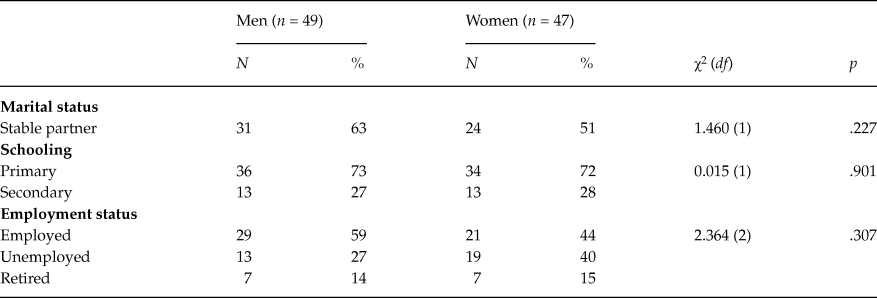
A total of 47 female and 49 age- matched male pathological gamblers were included. The mean age of men was 44.59 (SD 12.69) years, and the mean age of women was 44.49 (SD 13.23). The socio-demographic data for male and female are shown in Table 1. No statistically significant differences were found for any of the analyzed variables.
Socio-Demographic Data

Note: Df = degrees of freedom.
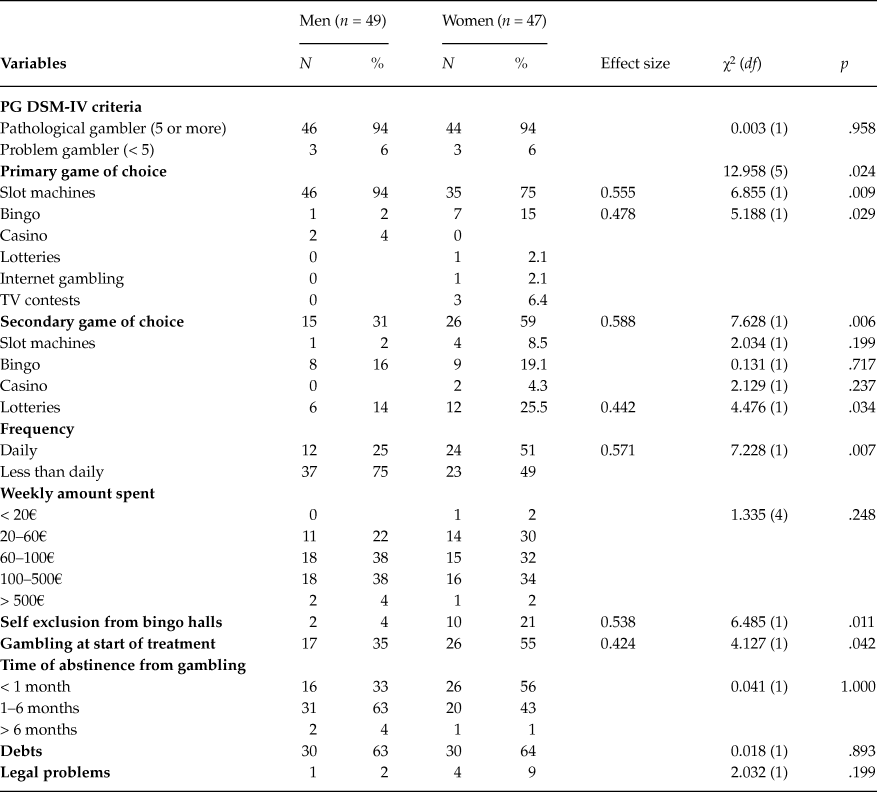
Of the total sample, 94% met the diagnostic criteria for pathological gambling and 6% for problem gambling. Data on gambling behavior are shown in Table 2. In relation to the primary game of choice, slot machines were the more preferred type of gambling (84%), although gender differences were found: men showed higher proportion of problems with slot machines than women (p < .009). There were also gender differences regarding the presence of a secondary game of choice (p = .006).
Data on Gambling Behaviour

Note: df = degrees of freedom.
Significant differences were found for age of gambling onset (p = .004) and years taken to develop addiction (p = .004). Women in the studied sample began gambling at a later age than men (women 32.21 [± 11.9] years vs men 25.69 [± 9.8] years; t (94) = 2.95, p = .004; Cohen’s d = 0.60), but developed problems faster (women mean of 5.5 [± 5.6] vs men mean of 9.6 [±7.8] years to develop gambling addiction; t (94) = 2.95, p = .004; Cohen’s d = –0.61). There were also significant differences for gambling frequency (χ2 (1,2) = 7.228, p = .007): women were more likely to gamble daily, whereas men gambled less frequency. No significant differences were found between sexes in money spent on gambling or gambling-related debt.
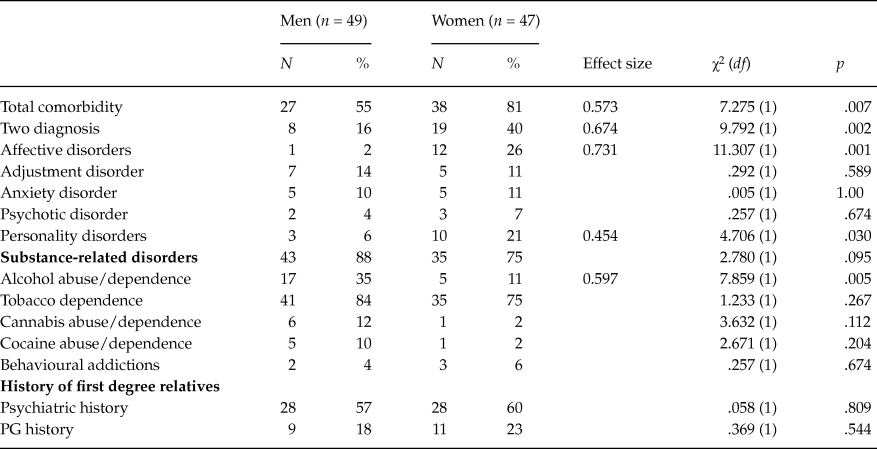
The clinical variables analyzed are summarized in Table 3. At the psychopathological level, women had greater overall psychiatric comorbidity than men (χ2 (1,2) = 7.275, p = .007) and a higher percentage of two comorbid diagnoses (χ2 (1) = 9.792, p = .002). Differences in affective disorders (p = .001) and in Personality disorders (p = .030) were significant between sexes. Significant differences were also found for substance-related disorders with men presenting a higher frequency of alcohol abuse and/or dependence (χ2 (1,5) = 7.859, p = .005). Differences regarding family psychiatric history or family history of pathological gambling were not significant.
Clinical Data

Note: df - degrees of freedom.
Discussion
The results of this study clearly show that there are gender differences in pathological gambling in help-seeking populations, particularly in the age of gambling onset, years taken to develop pathological gambling, frequency of gambling and psychiatric comorbidity.
Previous studies have indicated differences in the socio-demographic profile of men and women with pathological gambling problems, particularly in marital status, employment, and economic level. Men were found to have more gambling debts and were more likely to be single and employed (Desai & Potenza, Reference Desai and Potenza2008; Grant et al., Reference Grant, Kim, Odlaug, Buchanan and Potenza2009). In our study, however, we found no significant differences in any of the socio-demographic variables examined. This discrepancy may be due to methodological differences between studies, since in our study we have recorded data in an age-matched sample. Several authors have highlighted the need to carry out comparisons controlling for age because of the potential influence of this variable not just on socio-demographic data but on characteristics of the disorder as well (Fong, Reference Fong2005).
We found several differences associated with gambling patterns between sexes, such as gambling behavior at baseline and gambling type and frequency. Women were more likely than men to maintain their gambling behavior at the time treatment was started. Although there is no clear explanation for this finding, social factors may well be involved. In general, gambling behavior is less obtrusive in women than in men: men have more legal and financial problems, and therefore their families tend to control their gambling behavior more at the time treatment is initiated (Echeburúa et al., Reference Echeburúa, González-Ortega, De Corral and Polo2011; Ladd & Petry, Reference Ladd and Petry2002; Potenza et al., Reference Potenza, Steinberg, McLaughlin, Wu, Rounsaville and O’Malley2001). Women in the studied sample were more likely to gamble every day, whereas men tended to gamble two to four times a week. Despite we did not analyze frequency in relation to the type of gambling in our study, the fact that women gambled more often may be related to the finding that they are more likely to have a secondary game of choice. This feature must be tested in future research, but it may turn out to be a significant factor in the functional analysis and treatment of gambling disorder.
Although gaming machines are the most popular type of gambling in Spain for men and women (Echeburúa, Reference Echeburúa2005), women in our sample maintained their preference for bingo in comparison with men, as has been widely reported in the literature. Previous studies have found that bingo provides women with a more relaxing atmosphere for isolating and escaping from problems (LaPlante, Nelson, LaBrie, & Shaffer, Reference LaPlante, Nelson, LaBrie and Shaffer2006; Potenza et al., Reference Potenza, Steinberg, McLaughlin, Wu, Rounsaville and O’Malley2001; Tavares et al., Reference Tavares, Zilberman, Beites and Gentil2001). Several authors have linked the higher percentages of female bingo players with the main reasons that men and women cite for their gambling: for example, it is known that women gamble mainly to avoid negative emotional states while men gamble more competitively (Echeburúa et al., Reference Echeburúa, González-Ortega, De Corral and Polo2011; Granero et al., Reference Granero, Penelo, Martínez-Giménez, Alvarez-Moya, Aymamí, Bueno and Jiménez-Murcia2009; Grant & Kim, Reference Grant and Kim2002). These behaviors may be related with a higher percentage of affective disorders in women, particularly depression, which was described in a previous study (Echeburúa et al., Reference Echeburúa, González-Ortega, De Corral and Polo2011; Granero et al., Reference Granero, Penelo, Martínez-Giménez, Alvarez-Moya, Aymamí, Bueno and Jiménez-Murcia2009) and is corroborated in the present research.
Our data indicated that pathological gamblers presented a higher prevalence of psychiatric disorders compared with Spanish and Occidental countries general population data (Alonso et al., Reference Alonso, Angermeyer, Bernert, Bruffaerts, Brugha, Bryson and Volleberg2004; Haro et al., Reference Haro, Palacín, Vilagut, Martínez, Berbal, Luque and Alonso2006). This finding is in agreement with other studies realized with pathological gamblers (Kessler et al., Reference Kessler, Hwang, LaBrie, Petukhova, Sampson, Winters and Shaffer2008; Petry, Stinson, & Grant, Reference Petry, Stinson and Grant2005). The studied sample also confirms a higher overall comorbidity with other psychiatric disorders in women than in men (Desai & Potenza, Reference Desai and Potenza2008) moreover we found a higher presence of two comorbid diagnoses. The finding regarding that affective disorders are more frequent in women than in men is consistent with results from other studies with pathological gamblers (Echeburúa et al., Reference Echeburúa, González-Ortega, De Corral and Polo2011; Granero et al., Reference Granero, Penelo, Martínez-Giménez, Alvarez-Moya, Aymamí, Bueno and Jiménez-Murcia2009) and with the studies of epidemiological data in general population (Alonso et al., Reference Alonso, Angermeyer, Bernert, Bruffaerts, Brugha, Bryson and Volleberg2004; Haro et al., Reference Haro, Palacín, Vilagut, Martínez, Berbal, Luque and Alonso2006), whereas studies focusing on personality disorders are difficult to compare because of the use of different measuring instruments and classifications (Granero et al., Reference Granero, Penelo, Martínez-Giménez, Alvarez-Moya, Aymamí, Bueno and Jiménez-Murcia2009). The small number of available studies mainly analyze personality traits, and suggest that male gamblers are more impulsive and sensation seeking, whereas female gamblers show low self-esteem and anxiety traits (Echeburúa et al., Reference Echeburúa, González-Ortega, De Corral and Polo2011).
Some authors have reported a higher rate of substance-related disorders in men than in women (Echeburúa et al., Reference Echeburúa, González-Ortega, De Corral and Polo2011). In our study, this was true only in the case of alcohol use disorders. No gender differences were found on consumption of other substances, in keeping with the findings of Granero et al. (Reference Granero, Penelo, Martínez-Giménez, Alvarez-Moya, Aymamí, Bueno and Jiménez-Murcia2009) and others (Martins, Tavares, da Silva Lobo, Galetti, & Gentil, Reference Martins, Tavares, da Silva Lobo, Galetti and Gentil2004). Our data also support the results obtained by Echeburúa et al. (Reference Echeburúa, González-Ortega, De Corral and Polo2011) and Granero et al. (Reference Granero, Penelo, Martínez-Giménez, Alvarez-Moya, Aymamí, Bueno and Jiménez-Murcia2009), who reported high variability in terms of comorbidity between pathological gambling and other psychopathological disorders and substance-related disorders.
With regard to age at onset of gambling behavior, women in our sample began to gamble at a later age than men, but developed problems with gambling in a shorter time, showing a more rapid progression. This result, known as the telescoping effect, is in agreement with most published studies on gender differences between male and female pathological gamblers (Echeburúa et al., Reference Echeburúa, González-Ortega, De Corral and Polo2011; Ladd & Petry, Reference Ladd and Petry2002; Potenza et al., Reference Potenza, Steinberg, McLaughlin, Wu, Rounsaville and O’Malley2001; Tavares et al., Reference Tavares, Zilberman, Beites and Gentil2001) and studies investigating chemical addictions, such as alcohol, cannabis or opiates (Greenfield, Back, Lawson, & Brady, Reference Greenfield, Back, Lawson and Brady2010). In the case of pathological gambling, this effect has been attributed to a series of variables that are found mainly in women such as a higher level of stigma, lower economic status, preferences for continuous forms of gambling, greater difficulty hiding debts and gambling behavior from relatives, and greater exposure or difficulty coping with psychosocial stressors (Boughton & Falenchuk, Reference Boughton and Falenchuk2007).
The main limitation of our study is that the variables were recorded retrospectively and we couldn’t design a standard protocol for data collection including clinical questionnaires.
Therefore, the results must be confirmed in larger samples in future prospective studies that also control for confounding variables such as age. In our study we did not control age for the all variables, and in some cases it could be very relevant, such as the case of patterns of gambling. Moreover, we have not analyzed the results of the types of gambling in a risk model. Future works may address these issues in order to increase knowledge about gambling features in men and women. Despite these limitations, this study has shown that the role of emotional variables and gambling patterns should be considered in the design and implementation of treatments for pathological gambling.
These findings support the notion that the characteristics of gambling behavior in women differ from those in men and are linked to factors that justify different treatment and prevention measures.
We thank Dr. Joan Taberner, and Yolanda Martínez for revising the manuscript and the rest of the staff members of the Mental Health Division of Althaia, Xarxa Assistencial Universitària de Manresa, Fundació Privada, for their collaboration in the study.