INTRODUCTION
Scarcity of essential nutrients has led to the evolution of alternative strategies of nutrition in plants, such as myrmecotrophy and carnivory, which allow them to obtain nutrients from animals (Juniper et al. Reference JUNIPER, ROBINS and JOEL1989, Thompson Reference THOMPSON1981). Myrmecotrophy refers to ant-fed plants (Beattie Reference BEATTIE1989, Solano & Dejean Reference SOLANO and DEJEAN2004). Most myrmecotrophic plants are also myrmecophytes, i.e. plants that harbour ants in specialized cavities called domatia (McKey et al. Reference MCKEY, GAUME, BROUAT, DI GIUSTO, PASCAL, DEBOUT, DALECKY, HEIL, Hartley, Burslem and Pinard2005). These plants, often epiphytes, assimilate the decomposition products of the ant faeces and debris accumulated in modified stems, rhizomes or leaves (Huxley Reference HUXLEY1978, Janzen Reference JANZEN1974, Treseder et al. Reference TRESEDER, DAVIDSON and EHLERINGER1995).
Carnivorous plants derive some key nutrients, such as nitrogen, from arthropods that they capture and digest in their traps (Ellison & Gotelli Reference ELLISON and GOTELLI2001, Juniper et al. Reference JUNIPER, ROBINS and JOEL1989). The carnivorous genus Nepenthes comprises more than 100 species (Clarke Reference CLARKE1997, McPherson Reference MCPHERSON2009), mainly distributed in South-East Asia. Its traps are leaves modified as pitchers filled with an enzymatic fluid and a community of mostly dipteran and bacterial ‘infauna’ involved in the digestion process (Beaver Reference BEAVER, Frank and Lounibos1983, Clarke & Kitching Reference CLARKE and KITCHING1993, Cresswell Reference CRESSWELL2000). The pitchers exhibit various combinations of characters involved in insect attraction and capture, such as UV patterns (Moran Reference MORAN1996) and sweet odours (Di Giusto et al. Reference DI GIUSTO, BESSIÈRE, GUÉROULT, LIM, MARSHALL, HOSSAERT-MCKEY and GAUME2010, Moran Reference MORAN1996), wettable rims (Bauer et al. Reference BAUER, WILLMES and FEDERLE2009, Bohn & Federle Reference BOHN and FEDERLE2004), slippery waxy surfaces (Gaume & Di Giusto Reference GAUME and DI GIUSTO2009, Gaume et al. Reference GAUME, GORB and ROWE2002, Juniper et al. Reference JUNIPER, ROBINS and JOEL1989) and viscoelastic digestive liquid (Di Giusto et al. Reference GIUSTO, GROSBOIS, FARGEAS, MARSHALL and GAUME2008, Gaume & Forterre Reference GAUME and FORTERRE2007). A few Nepenthes species have been shown to display unusual N-sequestration strategies, obtaining nitrogen from plant debris (Moran et al. Reference MORAN, CLARKE and HAWKINS2003) or vertebrate faeces (Clarke et al. Reference CLARKE, BAUER, LEE, TUEN, REMBOLD and MORAN2009).
Nepenthes bicalcarata Hook. f., endemic to the peat-swamp forests of northern Borneo, is the only Nepenthes species known to be a myrmecophyte: it harbours in its tendrils the species-specific ant Camponotus schmitzi Stärke. In this study we explore the hypothesis that N. bicalcarata uses both carnivory and myrmecotrophy to circumvent nutrient scarcity.
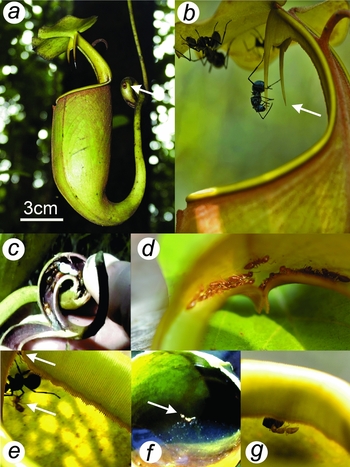
This ant-plant association still remains intriguing. It was first proposed to be a mutualism in which the ants gain nectar and nest sites (Figure 1a–c) from their host-plant and confer on it some protection against pitcher putrefaction (Clarke & Kitching Reference CLARKE and KITCHING1995). The authors reported that C. schmitzi ants were unaggressive but able to safely swim into the digestive liquid and remove large dead prey items, which paradoxically benefits the plant in avoiding sudden ammonium releases and subsequent pitcher putrefaction. In a later study, these ants were shown to aggressively defend their host-plant against a specific weevil that feeds on pitcher buds (Merbach et al. Reference MERBACH, ZIZKA, FIALA, MERBACH, BOOTH and MASCHWITZ2007).
Overview of the ant–plant interaction. Upper pitcher of Nepenthes bicalcarata. The arrow indicates the domatium within the coiled tendril which harbours Camponotus schmitzi ants (a). Polyrhachis pruinosa workers feeding on the extrafloral nectar produced by the pitcher on the inner side of the lid and by the two thorns (arrow) surrounding the pitcher (b). Sectioned domatium showing workers, alates and brood of Camponotus schmitzi (c). Camponotus schmitzi workers in ambush position under the peristome (d). A fallen Polyrhachis pruinosa ant being attacked (arrows) by two Camponotus schmitzi (e). Camponotus schmitzi (arrow) can safely swim in the digestive liquid from which it removes prey items (f) that are then consumed under the peristome (g).

These apparently two contradictory observations on the aggressiveness of Camponotus schmitzi towards insects raises the fundamental question of how these ants interact with insects visiting the mature and open pitchers for their nectar, hereafter called nectar visitors. Do they dissuade, as do most plant-ants, these visitors which are also potential prey of the pitcher plant or do they conversely facilitate their capture? Another not completely resolved question concerns their feeding behaviour and its impact on the plant's intake. To what extent do these ants consume the prey inside the pitcher and could they play a role in its breakdown and digestion by the plant?
The answers to these questions might help unravel the nature of the interaction between C. schmitzi and its host-plant and explore the hypothesis that the carnivorous plant obtains a nutritional benefit from its ant symbiont. To this end, we first tested the hypothesis that the ants hunt and help the plant to catch its prey, by quantifying the patrolling behaviour and aggressiveness of C. schmitzi towards pitcher visitors and fallen prey and by measuring their impact on prey capture using an ant-exclusion experiment. We then tested the hypothesis that they regularly consume part of the prey and help in the plant's digestion. Using a 15-d long prey-deposition experiment, we studied the frequency of their feeding behaviour towards experimental prey of two size-categories and its impact on prey breakdown. We also analysed the prey contents of pitchers and measured the pH of the fluid, to obtain data respectively on the plant's prey intake and on its digestive ability.
STUDY SPECIES AND STUDY SITE
Nepenthes bicalcarata is a liana that climbs up to 20 m and has enormous leaves with pitchers that are long-lived in comparison to other Nepenthes species (Cheek & Jebb Reference CHEEK and JEBB2001, Clarke Reference CLARKE1997). The tendril that sustains its trap is swollen (Figure 1a) and inhabited by the small ant Camponotus schmitzi (Formicinae), that has never been reported living outside its host-plant (Clarke & Kitching Reference CLARKE and KITCHING1995, Jolivet Reference JOLIVET1986). The most characteristic structures of N. bicalcarata are the two giant nectaries shaped like thorns that overhang the pitcher's mouth (Figure 1b) and are exploited by C. schmitzi and other ants (Merbach et al. Reference MERBACH, ZIZKA, FIALA, MERBACH and MASCHWITZ1999).
All experiments were carried out in July–August 2009 in a mixed peat swamp and heath forest (4°44ʹN, 114°35ʹE) of Brunei Darussalam (northern Borneo) on N. bicalcarata upper pitchers that were all occupied by C. schmitzi.
METHODS
Measure of ant territoriality and pitcher fluid acidity
To assess the territoriality and patrolling behaviour of C. schmitzi outside the pitchers, we counted over 1 min the total number of C. schmitzi workers and arthropod visitors on nectariferous external parts of the pitchers on a total of 67 functional pitchers of different age classes belonging to 10 plants. All observations were made around 10h00 in sunny conditions over 10 d, i.e. in rather homogeneous conditions of nectar production and insect activity. After each observation, the pH of pitcher fluid was measured using pH-indicator strips (Acilit® pH 0–6.0, Merck Chemicals, Darmstadt, Germany). We wished to examine on a large sample, representative of the different age-classes of pitchers, if the pH of this fluid was not very acidic as already observed by Clarke & Kitching (Reference CLARKE and KITCHING1993) and if such a low acidity was maintained throughout the pitcher life span. Constant neutral pH or moderate acidity would mean that the fluid is inoffensive towards the swimming ant symbiont but also not very efficient in dissolving the prey.
Insect retention experiment
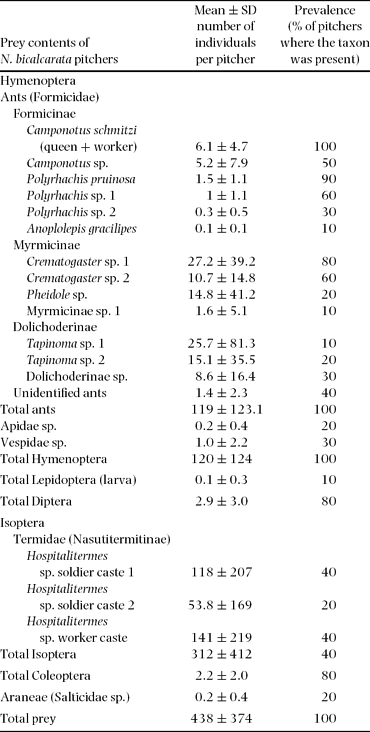
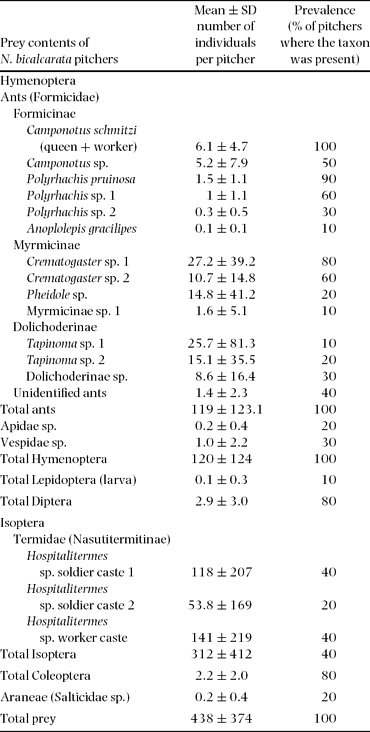
We then tested the aggressiveness of C. schmitzi towards other insects inside the pitchers and tested their effect on prey retention. We selected, as experimental prey, ants commonly found feeding on the extrafloral nectaries of N. bicalcarata. We first tried to use a small-bodied ant species (Crematogaster sp. 1, total length = 3.5 mm, Table 1), one of the two most common visitors and prey of N. bicalcarata, but workers of this species were never observed to escape from the digestive liquid even when the pitchers were deprived of their C. schmitzi ants. Hence they could not be good candidates to test whether C. schmitzi deployed aggressiveness toward fallen prey. We thus chose Polyrhachis pruinosa Mayr, another common visitor and prey item of the plant (total length = 1.2 cm, Table 1, Figure 1b), as they were easier to handle and they usually succeeded in escaping from the liquid.
Prey composition of 10 pitchers of Nepenthes bicalcarata from a mixed peat swamp and heath forest of Brunei Darussalam (Northern Borneo).
Five C. schmitzi-occupied pitchers belonging to five different plants were haphazardly selected. A Polyrhachis ant was dropped into the digestive liquid of each pitcher, and the fate (retained/escaped) and behaviour (time needed to escape from the pitcher, the number of times the ant fell back into the liquid) of this ant were observed and sometimes video-recorded. To drop the ant into the pitcher's digestive liquid, we first drew it into a soft tube and then blew it onto the digestive liquid without direct manipulation. We repeated this experiment with 10 different ants for each pitcher. Intervals between successive trials were less than 5 min when the ant succeeded in escaping within the 5 min. When the ant did not escape within 5 min, we observed it for more than 20 min, to check that it was effectively killed. The ant was then removed from the pitcher before the next trial. The results of this experiment were subsequently compared with the fate and behaviour of 10 Polyrhachis ants on the same pitchers but deprived of C. schmitzi. We used smoke produced by burning dead leaves to deter the latter. Twenty trials were thus conducted per pitcher (10 trials with and 10 trials without C. schmitzi). An ant was considered as retained if it did not escape within 5 min. The ants that did not successfully escape within 5 min were observed to die, except for two ants that were observed to be exhausted, exhibiting very slow movements.
Data were analysed using the software package SAS v.9.1. We tested for an effect of C. schmitzi (fixed factor) and pitcher (random factor) on the percentage of ants trapped using a mixed logistic regression by using the macro GLIMMIX with a binomial error distribution. We tested for an effect of C. schmitzi (fixed factor) and pitcher (random factor) on the number of times the experimental ant slid back into the digestive fluid after an escape attempt with a mixed Poisson regression model by using the macro GLIMMIX with a Poisson error distribution. Correction for over-dispersion was applied using the square root of the ratio of Pearson's χ2 to the associated number of degrees of freedom. We tested for an effect of C. schmitzi (fixed factor) and pitcher (random factor) on the time required to escape, by using a mixed-model analysis of variance with the GLM procedure. For model selection backward procedures were adopted, starting with the removal of non-significant interactions.
Feeding behaviour of Camponotus schmitzi
A second experiment investigated the feeding behaviour of C. schmitzi towards deposited prey of two different sizes and comparable to the sizes of the prey we observed inside the pitchers of N. bicalcarata. Ten upper pitchers were haphazardly selected, each belonging to a different plant. Their arthropod contents were removed by filtering the liquid with a mesh and the digestive liquid was then returned to the pitchers. Tanglefoot© insect glue was applied on the leaves bearing the pitchers and on the vegetation in contact with the tendril so that no crawling insects other than C. schmitzi could reach the prey items. In each of the 10 arthropod-free pitchers, we introduced 10 entire bodies of a Crematogaster species and 10 gasters (abdomens) of Polyrhachis pruinosa. Neither of these prey items could be mistaken for any other insect that could have fallen – despite our precautions – into the pitchers. Firstly, the Crematogaster species used in this experiment comes from another site and was never observed in the site where the experiment was conducted. Secondly, we only used gasters of Polyrhachis pruinosa to be sure that they belong to our experimental prey items and not to the bodies of possibly newly fallen workers of this species, common in this site. The two prey items measured respectively 2 mm and 5 mm, both within the main size range of prey of Nepenthes bicalcarata. Camponotus schmitzi ants were removed from two of these 10 pitchers, as well as from their associated domatium. These two pitchers were used as controls to check that in the absence of C. schmitzi, no prey was removed from pitchers. Fifteen days later, the content of each of these 10 pitchers was collected, counted and observed using a binocular microscope. As the total numbers of experimental prey items were equal (=10) for each pitcher and each prey category, we tested for an effect of prey category (fixed factor) and pitcher (random factor) on the number of items presenting obvious signs of ant predation by using a mixed Poisson regression model with the macro GLIMMIX specifying a Poisson error distribution.
Analysis of prey contents
The prey contents of 10 old but still functional pitchers (the pitcher borne by the node immediately below being senescent), all inhabited by Camponotus schmitzi and belonging to different individuals were collected in the same site in September 2008 in 10 vials filled with 70% alcohol, then analysed and counted in the laboratory using a binocular microscope. The necromass was composed of plant and animal parts as well as of small ‘pellets’ of fine particles that might be the faeces of C. schmitzi or of mosquito larvae, although we never observed such kinds of faeces in the pitcher fluid of other Nepenthes species that all bore mosquito larvae. Only the animal parts were considered in this analysis. The prey items found in these pitchers were highly disintegrated compared to those in other Nepenthes species. Almost no entire bodies were present, but only pieces of exoskeleton. Identification was often only possible by comparing the remains of head capsules and body parts with insects collected alive on the nectariferous parts of the pitcher plant. The dipterans were not sufficiently well preserved to be identified further than the order level and this was often true for the coleopterans, as well. Only the ants were distinguished to morphospecies and identified to genus, when possible, using the identification key of Hölldobler & Wilson (Reference HÖLLDOBLER and WILSON1990).
RESULTS
Absence of dissuasive patrols of Camponotus schmitzi towards nectar visitors
We observed on average 4.8 ± 3.8 (mean ± SD given hereafter, on 67 pitchers) nectar visitors (4.5 ± 3.9 ants and 0.3 ± 1.0 flying insects) on the outer part of pitchers during each observation. Most of these arthropods, including ants (belonging to the genera Crematogaster (Crematogaster sp. 1: 2.4 ± 3.7), Polyrhachis (Polyrhachis pruinosa: 1 ± 1.5), Oecophylla, Pheidole, Anoplolepis and Tapinoma), midges, mosquitoes and lepidopterans were found feeding on nectar of the lower face of the lid (Figure 1b). By contrast, no C. schmitzi workers were found walking on the pitcher body, although these ants were present on each of the pitchers observed, hidden under the peristome all around its edges (13.2 ± 6.3 workers, ants counted on a subset of 10 out of the 67 pitchers, Figure 1d). The digestive liquid had a mean pH of 4.9 which was rather constant despite pitcher age differences (SE = 0.05, N = 67 pitchers).
Effect of Camponotus schmitzi on ant retention
Camponotus schmitzi-occupied pitchers retained about three times more Polyrhachis pruinosa ants (mean = 26%, SE = 6.8%, 50 ants) than did the same pitchers when deprived of their symbiotic ant (mean = 8%, SE = 3.7%, 50 ants), as shown by the logistic regression (fixed effect of the C. schmitzi treatment: F 1,98 = 4.7, P = 0.03, no random effect of pitcher: variance estimate = 0.08 vs. residual = 1.08).
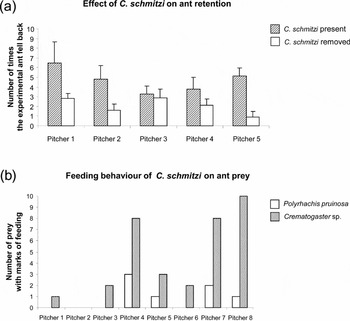
Indeed, when Polyrhachis pruinosa ants attempted to escape from the digestive liquid, they were in almost all cases (47 ants out of 50) attacked by C. schmitzi, which ambushed them from under the peristome. We regularly observed one or several C. schmitzi ants biting the legs of Polyrhachis ants. The small C. schmitzi ants mainly attack the intruders from the peristome, the curved and sharp teeth of which form a protective shield, but they sometimes also leave their refuge to attack the intruder from underlying parts of the pitcher (Figure 1e, on-line video clip, http://umramap.cirad.fr/amap3/cm/index.php?page=films). As a consequence of these attacks, the Polyrhachis ants slipped more often in C. schmitzi-occupied than in C. schmitzi-deprived pitchers, in which they only had to cope with the slipperiness of the pitcher walls and with the previous lubrication of their tarsal pads by the digestive fluid (Poisson regression on number of falls: F 1,98 = 15.8, P < 0.0001; no random effect of pitcher: variance estimate = 0.001 vs. residual = 3.08, Figure 2a). The ants that did not escape from the digestive liquid usually died from exhaustion and drowning following numerous unsuccessful attempts to escape from the pitcher and/or numerous bites from C. schmitzi. Furthermore, when the Polyrhachis ants succeeded in escaping the pitchers within the 5-min observation time, the time required for them to escape was significantly longer in the presence of C. schmitzi ants (mean ± SD = 127 ± 75 s, range 12–282 s, N = 37) than when these ants were absent (83 ± 64 s, range 3–250 s, N = 46). Time required to escape also significantly varied among pitchers (mixed-model ANOVA on time to escape: fixed effect of C. schmitzi treatment: F 1,77 = 9.01, P = 0.004; random effect of pitcher: F 4,77 = 3.52, P = 0.01). Polyrhachis pruinosa used in the bioassays, one of the two most common prey species, was also the largest prey item recorded in the analysis of prey contents and probably the hardest to catch for C. schmitzi. Hence our results probably underestimated the effect of C. schmitzi on prey retention and our tests are therefore conservative in that respect.
Experimental results showing the effect of the ant symbiont on both prey retention and breakdown in Nepenthes bicalcarata. Effect of Camponotus schmitzi on ant retention (a). The x-axis refers to the different experimental pitchers. The y-axis refers to the number of times the experimental ant fell back into the digestive liquid, attempting to escape from the pitcher, during a 5-min session. The error bars refer to 1 SE. Evidence of feeding behaviour of Camponotus schmitzi on dead ants of two different sizes (b). The x-axis refers to different experimental pitchers. The y-axis refers to the number of prey (out of 10) which bore marks of ant feeding and breakdown after the 15-d experiment. No prey breakdown was observed in the control pitchers (not shown) where C. schmitzi was excluded.

Feeding behaviour of Camponotus schmitzi towards dead prey in the pitchers
Camponotus schmitzi were occasionally observed to swim in the digestive liquid and pull an ant prey item, such as Crematogaster or Polyrhachis, out of the liquid. They then hauled it up to the underside of the peristome and consumed part of the dead insect, dropping into the pitcher the cuticular remains and other uneaten parts (Figure 1f, g). No flying insect was observed to be trapped in any of the 10 pitchers during the 15-d experiment.
Thus in the presence of C. schmitzi, on average 42.5% of the experimental Crematogaster ants were either entirely removed from the liquid (1 Crematogaster ant found underneath the peristome) or presented traces of mandibles on the remaining body parts (34 ants, SE = 13.5), and 8.7% of the Polyrhachis ants (7 ants, SE = 4). Such dismemberments could not have resulted from plant digestion, since none of the 40 ants in the control pitchers deprived of C. schmitzi showed any sign of such dismemberments. Moreover, flying insects constituted only 6% of the nectar visitors and less than 1% of the prey, and we never observed any flying insects feeding on prey in the pitcher. As crawling insects were excluded from the experiment by the glue, the feeding activity on dead prey was attributed to C. schmitzi. Our data indicate that C. schmitzi fed preferentially on the small Crematogaster prey items (parts or entire bodies) rather than on the bigger Polyrhachis prey items and that there was globally more such feeding activity in some pitchers than in others (Poisson regression on number of insect items with signs of ant feeding: fixed effect of ant species: F 1,7 = 35.9, P = 0.0005, Figure 2b; random effect of pitcher: variance estimate = 1.39 vs. residual = 0.40).
Analysis of the Nepenthes bicalcarata prey spectrum
Ants were found in 100% of the traps, with up to 386 individuals per pitcher (Table 1). Among them, 13 morphospecies were identified. The most frequently represented ant species included Camponotus schmitzi itself (remaining heads of queens or workers were found in 100% of the pitchers), Polyrhachis pruinosa (small numbers of individuals found in 90% of the pitchers) and Crematogaster sp. 1 (in 80% of the pitchers and up to 124 individuals found in a pitcher). Large numbers of small myrmicines were more occasionally observed in the pitchers. Large numbers of termites (up to 946 per pitcher) of a Hospitalitermes species were found in 40% of the pitchers. Ants and termites thus constituted 98% of the prey of N. bicalcarata, the flies and midges 1% and the beetles 0.5% (Table 1). Hundreds of minute pellets, never found in the pitchers of other Nepenthes species we analysed (unpubl. data) were found in each pitcher.
DISCUSSION
Our behavioural observations and our experiments showed that Camponotus schmitzi participates in the process of prey capture by its host-plant, Nepenthes bicalcarata, and may also contribute to the process of prey digestion. This plant-ant systematically attacks trapped visitors that attempt to escape from the pitcher and scavenges on dead prey items that it collects from the digestive liquid of its carnivorous host-plant. It consumes part of the prey within the pitcher under the peristome and returns to the digestive liquid substantial non-eaten pieces and maybe also its faeces.
Here, we report new data that may reconcile the apparently conflicting observations reported by Clarke & Kitching (Reference CLARKE and KITCHING1995) and Merbach et al. (Reference MERBACH, ZIZKA, FIALA, MERBACH, BOOTH and MASCHWITZ2007) concerning the behaviour of C. schmitzi towards insects: the ants combine times of passivity and aggressiveness which seems to be part of a unique adaptive strategy. On one hand, the C. schmitzi ants were shown, at least during daytime, to be unaggressive on open, nectar-producing mature pitchers. Such an absence of territoriality is very unusual for plant-ants, which often exhibit specialized behaviours, such as systematically patrolling nectar-producing sites which dissuades intruders including herbivorous insects (Gaume et al. Reference GAUME, ZACHARIAS, GROSBOIS and BORGES2005, Reference GAUME, SHENOY, ZACHARIAS and BORGES2006; McKey et al. Reference MCKEY, GAUME, BROUAT, DI GIUSTO, PASCAL, DEBOUT, DALECKY, HEIL, Hartley, Burslem and Pinard2005), or such as pruning their host-plant neighbours to avoid competition from other ants (Federle et al. Reference FEDERLE, MASCHWITZ and HÖLLDOBLER2002). On the contrary, Camponotus schmitzi ants conceal themselves and allow numerous insects, mainly other ants, to visit and feed on pitcher nectar. Conspicuous activity of the ants would deter potential prey, reducing benefits to both the carnivorous host-plant and its ant colony. On the other hand, our data provide further evidence that aggressiveness can be part of the behaviour of C. schmitzi ants but that the ants display a ‘delayed’ aggressiveness which only occurs once the visitors fall into the trap. Attacks by this ant prevent insects from escaping the pitcher and its experimental exclusion decreases the prey retention rate of its host-plant. Hunting by ambush from the shelter of the curled lip of the peristome, this ant has also escaped the attention of most observers. The often unnoticeable aggressiveness that they deploy from this shelter might explain why in other studies, insects attempting to escape from the pitcher had so much difficulty in crossing the peristome (Bohn & Federle Reference BOHN and FEDERLE2004). The behaviour of C. schmitzi is quite similar to the ambushing behaviour of a tiny Amazonian myrmicine Allomerus decemarticulatus, which constructs holed platforms on its host-plant, Hirtella physophora, to catch and kill large insects (Dejean et al. Reference DEJEAN, SOLANO, AYROLES, CORBARA and ORIVEL2005). Complementary experiments with other prey species should provide further information on the effect of C. schmitzi on its host-plant efficiency at capturing diverse prey.
Although the reciprocal effects on fitness of the two partners will not be easy to demonstrate experimentally, mainly because long-term exclusion of the ants would also imply an exclusion of potential crawling prey, we provide here several results which support the hypothesis of a nutritional mutualism between N. bicalcarata and its ant. Our results clarify the benefits of the interaction for the ants. In addition to nesting structures and sugar-rich nectar offered by the plant, our results show that the diet of C. schmitzi includes a regular protein meal obtained from plant-trapped prey. Indeed, the ants not only feed on large prey items, as already observed by Clarke & Kitching (Reference CLARKE and KITCHING1995) but also (and probably more often) on smaller ones, as supported by our insect bioassays. Although the retention experiments focused on one type of prey – the biggest and probably the most difficult to trap – our results suggest that the plant benefits from a food surplus provided by the symbiotic ants through their hunting behaviour. The ants only eat a small part of the prey and drop the non-metabolized parts into the pitchers. Furthermore, their activity of prey-breakdown and their metabolic activity should facilitate nutrient assimilation by the plant as does the living infauna of the digestive liquid (Beaver Reference BEAVER, Frank and Lounibos1983).
It is probably not a coincidence that ants and termites were found to be abundant and numerically dominant among the prey items of N. bicalcarata. Indeed, they are typically the kind of prey that can be easily targeted by C. schmitzi, which is probably much less effective against flying insects, which do not need to climb on the inner wall or on the slippery peristome to escape from the pitcher. Termites of the genus Hospitalitermes (Nasutitermitinae) are nocturnally active processional termites (Jones & Gathorne-Hardy Reference JONES and GATHORNE-HARDY1995). This is probably why we did not record them as pitcher visitors. They forage in large numbers and climb at night on the surrounding vegetation in search of food. Since they are virtually blind, they should be attracted by the odour cues of the pitchers, probably as in N. albomarginata (Merbach et al. Reference MERBACH, MERBACH, MASCHWITZ, BOOTH, FIALA and ZIZKA2002). However, because of their nomadic way of life, they are likely to be less reliable prey than ants, although termites have been recorded in the pitchers of N. bicalcarata (Cresswell Reference CRESSWELL2000). Since ants, the most consistently reliable prey of N. bicalcarata, have been estimated to provide 70% of the nitrogen used in several Nepenthes species (Moran et al. Reference MORAN, MERBACH, LIVINGSTON, CLARKE and BOOTH2001, Schultze et al. Reference SCHULTZE, SCHULTZE, PATE and GILLISON1997), the additional proteins provided to the plant by the hunting behaviour of C. schmitzi should represent a fitness advantage for the host-plant in the nutrient-poor environments in which it occurs. In addition, the plant could probably benefit from direct myrmecotrophy since dead bodies of C. schmitzi were systematically found in the pitcher contents (Table 1). Because these ants rarely leave their pitcher refuge, their faeces are likely dropped into the digestive liquid and could constitute another source of nutrients assimilable by the plant. However, the ant-origin of the observed pellets in the digestive fluid remains to be demonstrated by further experiments and its participation to the plant nutrition needs to be demonstrated by isotopic analyses. Added to the anti-herbivore (Merbach et al. Reference MERBACH, ZIZKA, FIALA, MERBACH, BOOTH and MASCHWITZ2007) and anti-putrefaction (Clarke & Kitching Reference CLARKE and KITCHING1995) benefits mediated by the ant, this nutritional benefit provided by the ant supports the hypothesis of a multi-faceted mutualism between this symbiotic ant and its carnivorous host-plant.
The association with a hunting plant-ant also constitutes a novel specific trapping strategy in the genus Nepenthes, which already displays a large spectrum of insect-trapping devices. The peristome was demonstrated to be very wettable in this species and to be the major surface responsible for insect fall due to aquaplaning following rain or nectar secretion (Bohn & Federle Reference BOHN and FEDERLE2004). We never saw any nectar spreading over the peristome of N. bicalcarata during our study time, contrary to other Nepenthes species such as N. rafflesiana, but we showed that the concealed ants play a crucial role in preventing the ascent of the peristome of N. bicalcarata by trapped insects. Moreover, the association with a hunting ant makes sense in relation to the absence in N. bicalcarata of costly and efficient trapping features such as a slippery waxy layer made of long-chain aldehydes (Gaume & Di Giusto Reference GAUME and DI GIUSTO2009), or a viscoelastic fluid made of giant polymers (Gaume & Forterre Reference GAUME and FORTERRE2007).
We confirm the results reported by Clarke & Kitching (Reference CLARKE and KITCHING1993) on a smaller sample of pitchers that the digestive fluid of N. bicalcarata is less acidic than the fluid of several of its congeners, such as N. rafflesiana (Bauer et al. Reference BAUER, WILLMES and FEDERLE2009), N. alata (An et al. Reference AN, FUKUSAKI and KOBAYASHI2002) or N. gracilis (Clarke Reference CLARKE1997), all of which have been shown to have a pH close to 2.5, optimal for the activity of nepenthesin proteases (Athauda et al. Reference ATHAUDA, MATSUMOTO, RAJAPAKSHE, KURIBAYASHI, KOJIMA, KUBOMURA-YOSHIDA, IWAMATSUI, SHIBATA, INOUE and TAKAHASHI2004). This elevated pH might have an adaptive significance and protect the plant-ant symbiont (Moran et al. Reference MORAN, HAWKINS, GOWEN and ROBBINS2010) but it also suggests that N. bicalcarata might not have the same pool of enzymes as the other Nepenthes. As N. bicalcarata has one of the richest and most diverse aquatic infauna in the genus (Clarke & Kitching Reference CLARKE and KITCHING1993, Cresswell Reference CRESSWELL2000), it might be heavily dependent on its infauna, and on C. schmitzi, to digest its prey. The additional work of pre-digestion by C. schmitzi could also compensate for a potentially weak digestive efficiency of the plant itself, due to the low acidity of its digestive fluid. Furthermore, the very long life span of N. bicalcarata pitchers and the plants’ large size (Clarke Reference CLARKE1997) are undoubtedly advantageous for their ant inhabitants, as they provide reliable nest-site and food resources for these permanent residents. It is tempting to hypothesize that these traits have evolved in the context of coevolution between the two partners. Long-term experiments need to be carried out to test these hypotheses and to assess whether the ant-plant mutualism is the outcome of reciprocal adaptation of the two partners.
ACKNOWLEDGEMENTS
We thank U. Grafe, D. Marshall, Z. Hj Sulaiman and H. Y. K. Pang for their helpful assistance in the University of Brunei Darussalam and M. Guéroult for his assistance from France. We also thank H. and I. Tinggal for their kind hospitality at Kampong Telamba, as well as the Forestry Department, who delivered us permits to carry out this research in the field. We thank V. Grosbois for his statistical advice and D. McKey for his English correction, as well as three anonymous reviewers for their helpful comments on the manuscript.