


1. Introduction
At the heart of representative democracy lies the relationship between citizens and policymakers (Dahl, Reference Dahl1971; Manin, Reference Manin1995). In theory, citizens relay their preferences to electorally minded policymakers who, in turn, translate them into policy. Scholars commonly consider the connection on specific issues, but foundational research by Stimson (Reference Stimson1991) shows that public preferences on different issues tend to move in parallel over time, forming what he referred to as a policy “mood.” Yet, the degree to which the issues sync together varies across domains and countries (Bartle et al., Reference Bartle, Dellepiane-Avellaneda and Stimson2011, Reference Bartle, Dellepiane-Avellaneda and McGann2019, Reference Bartle, Bosch and Oriolls2020; Van Hauwaert and English, Reference Van Hauwaert and English2019; Romero‐Vidal, Reference Romero‐Vidal2020; Van Hauwaert, Reference Van Hauwaert2023; Van Hauwaert and Vegetti, Reference Van Hauwaert and Vegetti2025). Research in the tradition of Page and Shapiro (Reference Page and Shapiro1992) suggests such variation cannot be merely explained by distinct opinion dynamics across societal groups (see also Soroka and Wlezien, Reference Soroka and Wlezien2010; Enns and Wlezien, Reference Enns, Wlezien, Enns and Wlezien2011; Romero-Vidal and Van Hauwaert, Reference Romero-Vidal and Van Hauwaert2022). Taken together, these findings point to a fundamental but unresolved question: what is the origin of parallel movement in preferences? What moves mood?
We set out to answer this question by examining four separate but complementary mechanisms. First, we may see parallel movement in relative policy preferences because the public’s preferred levels of policy have changed similarly across domains. Second, relative preferences may move in parallel because they are responding, thermostatically, to parallel movement in policy across domains. Third, relative preferences in different domains may respond in a parallel way to general policy trends for the domains taken together. Fourth, public preferences may respond in parallel not to policy in particular domains or across domains but, rather, to governing parties, thermostatically lowering (raising) preferences when, for example, a Democrat (Republican) is in the White House. Identifying which of these mechanisms are at work will help us further understand the dynamics of public opinion and, more specifically, how citizens respond to their environments. This has direct implications for democratic representation itself.
In this study, we develop our theoretical account of mood and provide an empirical test, focusing on social spending domains in the United States of America (USA). Reliable time series of both preferences for spending and budgetary policy permit a systematic analysis between 1973 and 2019. We find evidence that shared overtime variation in public preferences for social spending about equally reflects parallelism in the underlying preferred levels of policy and in the responsiveness to social spending. At the same time, we reject pervasive thermostatic response to parallel movement in policy across different domains. Finally, partisan control of the White House produces common “thermostatic” preference change but does not drive responsiveness to spending. These findings map nicely onto previous scholarship and yet mark a significant advance in our knowledge. While not the last word on the subject, our analysis reshapes our interpretation of opinion change and its consequences.
2. Public opinion and policy mood
Since the beginning of polling, survey organizations have gauged public opinion on policy issues. Traditionally, scholars viewed aggregate opinion as specific to a policy area, be it welfare, health, or education (Geer, Reference Geer1996). Stimson (Reference Stimson1991) challenged this wisdom in his now classic, Public Opinion in America. Building on Almond’s (Reference Almond1950) earlier conceptualization of foreign policy mood, he posited that a river of policy sentiment flows through time, encompassing a wide range of issues. Parallelism is the defining feature, where publics behave in systematic, seemingly coherent ways across issue domains. His analysis bears out the patterned mood he imagined, a major contribution made possible by Stimson’s ingenuity in combining time series of public opinion data and creating methodological tools to analyze them.
It may be tempting, based on this work, to conclude that the public does not have preferences for policy in different areas but has a single, very general preference for government activity instead. Although some scholars have made this claim (e.g., Hill and Hinton-Anderson, Reference Hill and Hinton-Anderson1995), it is not quite right. Stimson (Reference Stimson2004) himself showed that opinions on some issues, like abortion, are largely unrelated to opinions on others. Even the issues that do load on a single, overarching public mood do so to varying degrees. Given the potential consequences for policy representation and elections (Wlezien, Reference Wlezien2004; Reference Wlezien2017a; Grossmann and Wlezien, Reference Grossmann and Wlezien2024), this warrants further investigation. After all, the factors that explain why opinion flows together may also explain why parallelism varies across issues.
We furthermore note that the idea of parallel opinion movement is firmly entrenched in American scholarship (Durr, Reference Durr1993; Erikson et al., Reference Erikson, Wright and McIver1993; Jacoby, Reference Jacoby1994; Ellis and Faricy, Reference Ellis and Faricy2011; Brulle et al., Reference Brulle, Carmichael and Jenkins2012; Enns, Reference Enns2014; Faricy and Ellis, Reference Faricy and Ellis2014; Caughey and Warshaw, Reference Caughey and Warshaw2016). Evidence of equivalence with several alternative operationalizations of public opinion only adds to its validity (e.g., Kim and Fording, Reference Kim and Fording1998; Stevenson, Reference Stevenson2001; Enns and Kellstedt, Reference Enns and Kellstedt2008; Lax and Phillips, Reference Lax and Phillips2009), as do recent applications beyond the American context. Indeed, we see similar patterns in Great Britain (Bartle et al., Reference Bartle, Dellepiane-Avellaneda and Stimson2011, Reference Bartle, Dellepiane-Avellaneda and McGann2019), France (Stimson et al., Reference Stimson, Thiébaut and Tiberj2012), Italy (Bellucci and Pellegata, Reference Bellucci and Pellegata2017), Japan (Ohmura, Reference Ohmura2018), Russia (Matovski, Reference Matovski2018), Scotland (McGann et al., Reference McGann, Dellepiane-Avellaneda and Bartle2019), Spain (Bartle et al., Reference Bartle, Bosch and Oriolls2020), Mexico (Baker, Reference Baker, Dominguez, Greene, Lawson and Morena2015), the Netherlands (McGann et al., Reference McGann, Dellepiane‐Avellaneda and Bartle2023), and Uruguay (Álvarez et al., Reference Álvarez, Bogliaccini, Opertti and Velasco2022). Thus, mood is not a uniquely American concept but, perhaps, a more general feature of modern representative democracy.
It is also worth noting that much research demonstrates parallel publics in policy mood across subgroups of society. Page and Shapiro (Reference Page and Shapiro1992) first demonstrated that when one group of Americans, say, high-income earners, shifts its preferences in a conservative direction, low (and middle) income earners typically do so as well, even if the levels of preferences among these groups differ (see also Soroka and Wlezien, Reference Soroka and Wlezien2008; Ura and Ellis, Reference Ura and Ellis2008). This holds for other societal divisions, such as education (Enns and Kellstedt, Reference Enns and Kellstedt2008), ideology (Page and Jacobs, Reference Page and Jacobs2009; Ellis and Stimson, Reference Ellis and Stimson2012; Ura and Ellis, Reference Ura and Ellis2012), and gender (Kellstedt et al., Reference Kellstedt, Peterson and Ramirez2010; Eichenberg and Stoll, Reference Eichenberg and Stoll2012), both in Anglo-Saxon countries (Soroka and Wlezien, Reference Soroka and Wlezien2010; Enns and Wlezien, Reference Enns, Wlezien, Enns and Wlezien2011) and across Europe (Romero-Vidal and Van Hauwaert, Reference Romero-Vidal and Van Hauwaert2022, Reference Romero-Vidal and Van Hauwaert2025). Altogether, an extensive literature demonstrates a striking structure to public preferences for policy.
3. Absolute preferences, relative preferences and the thermostatic model
Surveys almost never ask people about their absolute policy preferences, i.e., their preferred levels of policy, but ask about their relative preferences instead. Are governments doing too much? Should spending be decreased? Expressed public opinion thus registers preferences for policy change. In theory, these preferences (R) tap the difference between the public’s preferred level of policy (P*) and policy (P) itself:
 \begin{equation}{R_t} = P_t^*\, - \,{P_t},\end{equation}
where the subscripted t indicates time.Footnote 1 This is the well-known thermostatic model (Wlezien, Reference Wlezien1995) that applies across both space and time, though the latter is of special interest given our focus on the structure of policy mood.
Now, the equation makes clear that measured relative preferences are not the same as absolute preferences, and the degree to which they differ can vary across domains. That said, given available data, we rarely observe P* and must rely on proxies. In his original study, Wlezien (Reference Wlezien1995), following Durr (Reference Durr1993), proxied P* with the University of Michigan’s Index of Consumer Sentiment. Other proxies include unemployment (Wlezien and Soroka, Reference Wlezien and Soroka2012), the misery index (Franklin and Wlezien, Reference Franklin and Wlezien1997; Wlezien, Reference Wlezien2004), support for government action (Wlezien and Soroka, Reference Wlezien and Soroka2012), public consumption (Bartle et al., Reference Bartle, Dellepiane-Avellaneda and Stimson2011), and GDP and the Gini coefficient (Wlezien and Soroka, Reference Wlezien and Soroka2021).
By implication, the three variables in the previous equation are not measured using the same metric, so it is necessary to rewrite the equation as follows:
 \begin{equation}{R_t}_{} = {a_o} + {B_1}{U_t} + {B_2}{P_t} + {\text{ }}{e_t},\end{equation}
where ao and et represent the intercept and error term, respectively, and U is a set of exogenous proxies for P*. Thus far we have (implicitly) modeled preferences in a single domain, but we are interested in a set of domains j, and so adjust our equation as follows:
 \begin{equation}{R_{jt}}_{} = {a_{oj}} + {B_{1j}}{U_{jt}} + {B_{2j}}{P_{jt}} + {\text{ }}{e_{jt}}.\end{equation}
This simple extension of the model highlights the primary mechanisms of parallel preference change, or “policy mood,” namely, preferred policy (Uj) and policy (Pj) itself. Let us now consider these different components in more detail, beginning with the former.
3.1 Parallel (underlying) preferred levels of policy
Parallel relative preferences could reflect parallel movement in the underlying preferred levels of policy across domains j. For example, people’s preferences for welfare may increase alongside increases in support for health and education owing to the pro-cyclical effects of an expanding economy (Durr, Reference Durr1993). As the economy increases (decreases), people may want to spend larger (smaller) amounts on a variety of government programs (Stevenson, Reference Stevenson2001).Footnote 2
If this mechanism is at work, we will observe that social preferences respond equally to a common Ut, referring back to equation (3). Specifically, the coefficients B1j relating Ut and Rjt would be similar across domains; if there is perfect parallelism, the coefficients will be identical. There are, of course, reasons to expect Ujt to vary across domains and for the responsiveness to a common Ut to vary, which could help explain the variation in the inter-correlations among Rjt over time. We can assess this empirically.
3.2 Public responsiveness to parallel policy
Parallel relative preferences also could reflect public responsiveness to parallel movement in policy. Perhaps policymakers increase policy on welfare alongside increases on health and education, so that we observe a common policy trend. This could result in part from changes in the party control of government, which may independently impact preferences, as we have raised and consider more fully below.
If this mechanism is at work, we will observe two things. First, there will be a high degree of parallelism among policies in different domains (Pjt). Second, preferences will respond equally to Pjt, referring back to equation (3). Specifically, the coefficients B2j relating Pjt and Rjt would be similar across domains; if there is perfect parallelism, the ebb and flow of Pjt will be identical and the estimated effects (B2j) on Rjt will be as well. There are, of course, reasons to expect Pjt to vary across domains and for the responsiveness to parallel Pjt to vary, which also could help explain the variation in the inter-correlations among Rjt over time. We can directly assess this, as well.
3.3 Parallel public responsiveness to global policy
Parallel relative preferences could reflect public responsiveness even if policy in different domains does not change in unison. Perhaps welfare policy does not shift alongside policy for health and education, but the public responds similarly in different domains to the global shift in policy across domains. Here, different policy domains are effectively substitutable to the public (see also Hicks and Swank, Reference Hicks and Swank1992; Jankowski and Wlezien, Reference Jankowski and Wlezien1993). Such “global” responsiveness may still vary across domains, but when publics do respond to policy, it represents a generalized feedback of policy flows in the different domains taken together.
This may be especially true in less publicly salient policy areas. Almost by definition, policymakers and media outlets spend less time on such issues and so there is less available information about related policy decisions and outputs (Franklin and Wlezien, Reference Franklin and Wlezien1997; Soroka, Reference Soroka2003). When issues are not salient, and information environments are opaque, people may be more likely to recognize general policy patterns and use these to update their preferences.
The two forms of public responsiveness—domain-specific and global—we have theorized may both be at work. To assess the structure, we must include the separate signals in our preference models, as follows:
 \begin{equation}{R_{jt}} = {a_{0j}} + {B_{1j}}{U_{jt}} + {B_{2j}}{P_{jt}} + {B_{3j}}{\bar P_t} + {e_{jt}}\end{equation}
where  ${\bar P_t}$ represents the sum of policy across domains j.
As in the initial model, the coefficient B2j captures domain-specific thermostatic feedback, but here the coefficient B3j taps global thermostatic feedback. If public responsiveness is domain-specific, B2j would be less than 0 and B3j would be equal to 0, indicating that the public reacts only to policy within each domain. If responsiveness is global, by contrast, B2j would equal 0 and B3j would be less than 0, as the public would use information about policy across all domains, not just within each domain. At the same time, responsiveness is also global when both B2j and B3j are less than zero and significantly different from each other. In this scenario, citizens use information about policy within and across domains to form their opinions, essentially combining specific and global policy signals. Again, the B2j’s would account for parallelism only to the extent policy (Pj) in different domains flows together (and the coefficients converge). The B3j’s would account for parallelism to the extent they are the same across domains. We can assess this empirically.
3.4 Parallel public responsiveiness to partisan control of government
Of course, people may respond not to policy in particular domains or globally across domains, but to the partisan orientation of political actors. For instance, in the USA, people may cue off the party of the president, adjusting preferences for more social spending downward (upward) when a Democrat (Republican) is in office under the assumption that such spending is increasing (decreasing). This is how some scholars interpret the thermostatic model to work, at least in policy areas subject to consistent partisan conflict and cueing (Atkinson et al., Reference Atkinson, Coggins, Stimson and Baumgartner2021). While early research found no such effects (Wlezien, Reference Wlezien1995), more recent work does (Soroka and Wlezien, Reference Soroka and Wlezien2022; Romero-Vidal and Van Hauwaert, Reference Romero-Vidal and Van Hauwaert2025), implying that partisan cueing increased—and emerged—over time.
There is reason to think this tendency may be more likely in lower salience domains, where information about policy is less readily available to the public. But it may happen in more salient domains, particularly where party control is decisive for policymaking, i.e., where the added information from policy decisions and outputs is minimal (Caughey and Warshaw, Reference Caughey and Warshaw2018).Footnote 3 We can directly assess whether party control helps account for the public’s thermostatic responsiveness to policy across spending domains.
4. Public spending mood: An illustration
Our theorization not only identifies the origins of policy mood but provides an account of parallel policy preferences. Our analysis focuses on a set of spending domains for which we have regular survey data over a long period of time within the USA. These series have been frequently studied because they afford dynamic analysis of preferences and can be directly matched up with policy. Spending preferences also closely track Stimson’s policy mood (Enns and Kellstedt, Reference Enns and Kellstedt2008). So, while our analysis will necessarily be incomplete, as mood is broader both in conceptualization and measurement, it informs our understanding of mood. There also are benefits to focusing on the same items over the same period, as we can avoid the complications that result from changing the number and, especially, types of issues. Indeed, the dimensionality of mood can change as the issues themselves change, e.g., as social and cultural issues increase relative to more traditional economic ones.
The General Social Survey (GSS) regularly asks the American public about their preferences for spending. They use the same, now-familiar question wording:
Are we spending too much, too little, or about the right amount on [welfare]?
The question has been asked 31 times between 1973 and 2019, which allows us to construct regular time series of preferences.Footnote 4 Though respondents are asked about various categories, we focus on education, the environment, health, and welfare because these preferences demonstrate patterned movement over time (Wlezien, Reference Wlezien1995, Reference Wlezien2004; Soroka and Wlezien, Reference Soroka and Wlezien2010). For each domain, we create measures of net support by taking the percentage of respondents who say we are spending “too little” and subtracting it from them the percentage of respondents who say we are spending “too much.” This is by no means a perfect measure, but it allows us to capture variation in public support for “more” or “less” spending over time, i.e., both direction and magnitude.Footnote 5
Before moving on, we note that these questions do not impose a budget constraint. People can express preferences in particular domains without consequence for spending in other domains or taxes, i.e., unconstrained preferences. Forcing people to take constraints into account, however defined, may not only change preferences (Hansen, Reference Hansen1998) but could dampen the common variation we observe (Wlezien, Reference Wlezien2017b).Footnote 6 In addition, the apparent economic effects could be associated with preferences for—and the actual size of—the overall budgetary pie. All of this said, imposing a budget constraint on respondents presumably would not increase the observed parallelism and could decrease it.
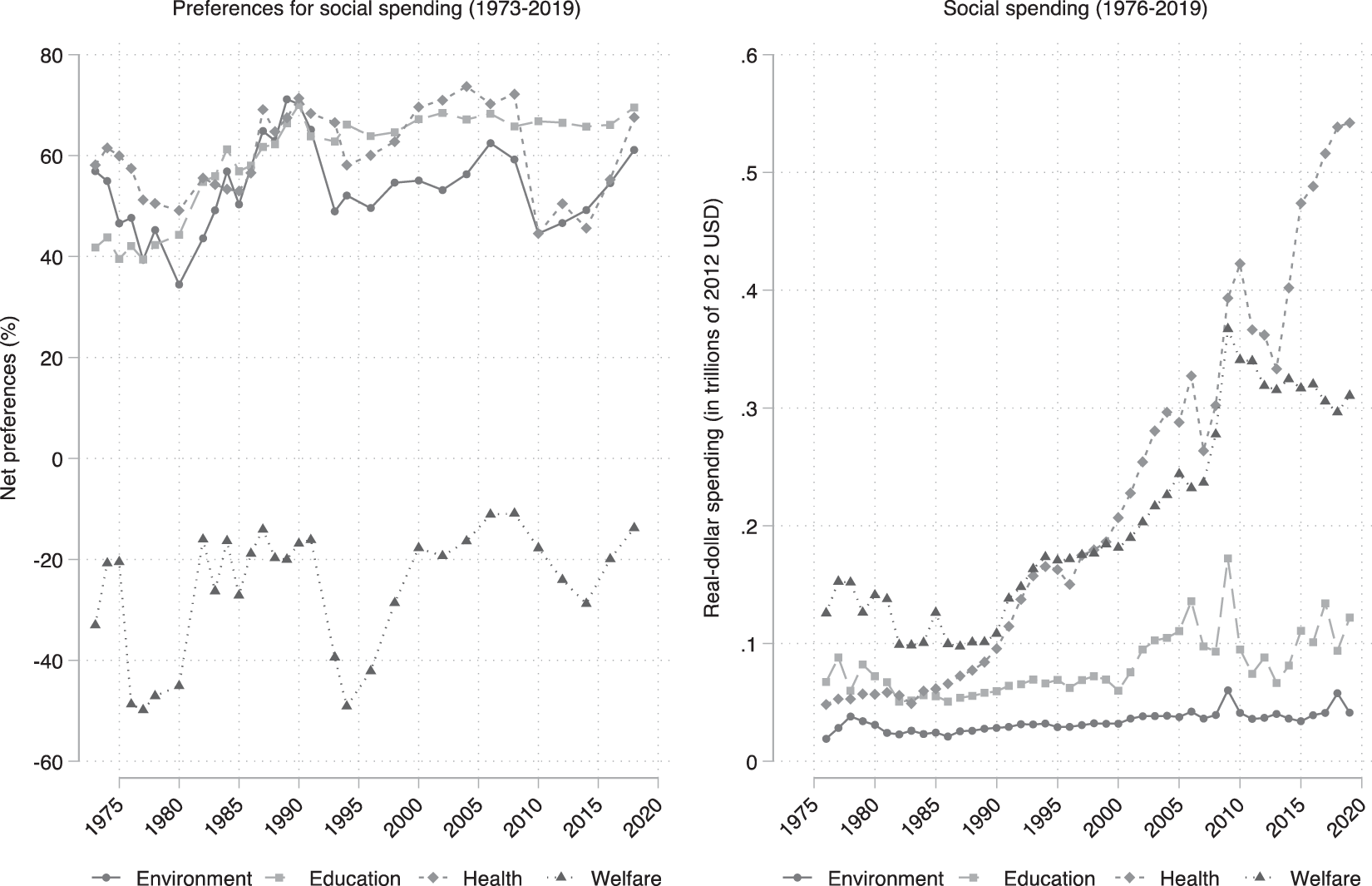
Figure 1 plots spending preferences for the four domains between 1973 and 2019 in the left frame. Here we observe differences in the level of net support, particularly between welfare and the other social domains.Footnote 7 Table 1 reports descriptives by domain. Welfare (and to a lesser extent education) preferences tend to be more variable, per their larger standard deviation(s). This may partly be explained by the greater responsiveness of welfare preferences to spending (Wlezien, Reference Wlezien1995, Reference Wlezien2004), but also by the sensitivity of welfare opinions to other information (Page and Shapiro, Reference Page and Shapiro1983; Shapiro and Young, Reference Shapiro and Young1989, Reference Page and Shapiro1992; Soroka and Wlezien, Reference Soroka and Wlezien2022).Footnote 8
Net preferences for social spending and levels of social spending, different domains.

Figure 1 Long description
Preferences for social spending (1973 to 2019). The horizontal axis is years, from 1975 to 2020. The vertical axis is Net preferences (percent), from minus 60 to 80. Legend labels: Environment, Education, Health, Welfare. Line styles use different marker shapes and dash patterns. Environment series coordinate pairs: (1975, 56), (1976, 54), (1977, 47), (1978, 46), (1979, 40), (1980, 35), (1981, 39), (1982, 44), (1983, 50), (1984, 55), (1985, 52), (1986, 58), (1987, 62), (1988, 66), (1989, 70), (1990, 68), (1991, 50), (1992, 52), (1993, 50), (1994, 52), (1995, 55), (1996, 55), (1997, 54), (1998, 53), (1999, 55), (2000, 55), (2001, 54), (2002, 55), (2003, 56), (2004, 58), (2005, 62), (2006, 61), (2007, 60), (2008, 58), (2009, 45), (2010, 46), (2011, 47), (2012, 48), (2013, 49), (2014, 50), (2015, 52), (2016, 55), (2017, 58), (2018, 61). Education series coordinate pairs: (1975, 42), (1976, 44), (1977, 46), (1978, 40), (1979, 45), (1980, 40), (1981, 45), (1982, 50), (1983, 55), (1984, 60), (1985, 55), (1986, 58), (1987, 62), (1988, 65), (1989, 68), (1990, 70), (1991, 66), (1992, 65), (1993, 64), (1994, 63), (1995, 62), (1996, 63), (1997, 64), (1998, 66), (1999, 67), (2000, 68), (2001, 68), (2002, 68), (2003, 69), (2004, 69), (2005, 69), (2006, 69), (2007, 68), (2008, 68), (2009, 67), (2010, 67), (2011, 67), (2012, 67), (2013, 66), (2014, 66), (2015, 66), (2016, 66), (2017, 66), (2018, 67), (2019, 70). Health series coordinate pairs: (1975, 58), (1976, 61), (1977, 59), (1978, 55), (1979, 50), (1980, 45), (1981, 44), (1982, 50), (1983, 55), (1984, 52), (1985, 55), (1986, 60), (1987, 65), (1988, 68), (1989, 70), (1990, 68), (1991, 66), (1992, 65), (1993, 64), (1994, 63), (1995, 62), (1996, 63), (1997, 64), (1998, 66), (1999, 70), (2000, 72), (2001, 73), (2002, 75), (2003, 72), (2004, 70), (2005, 72), (2006, 70), (2007, 72), (2008, 70), (2009, 45), (2010, 46), (2011, 47), (2012, 45), (2013, 48), (2014, 50), (2015, 55), (2016, 60), (2017, 65), (2018, 70). Welfare series coordinate pairs: (1975, minus 32), (1976, minus 20), (1977, minus 20), (1978, minus 48), (1979, minus 50), (1980, minus 45), (1981, minus 15), (1982, minus 18), (1983, minus 25), (1984, minus 15), (1985, minus 25), (1986, minus 18), (1987, minus 20), (1988, minus 15), (1989, minus 18), (1990, minus 15), (1991, minus 40), (1992, minus 50), (1993, minus 42), (1994, minus 28), (1995, minus 18), (1996, minus 20), (1997, minus 18), (1998, minus 18), (1999, minus 18), (2000, minus 18), (2001, minus 18), (2002, minus 15), (2003, minus 10), (2004, minus 12), (2005, minus 10), (2006, minus 10), (2007, minus 12), (2008, minus 15), (2009, minus 18), (2010, minus 25), (2011, minus 28), (2012, minus 22), (2013, minus 20), (2014, minus 18), (2015, minus 15). Key values visible in the plotted points include Environment reaching 70 at 1989, Health reaching 75 at 2002 and Welfare remaining below 0 across the listed years. The image B showing Social spending (1976 to 2019). The horizontal axis is years, from 1975 to 2020. The vertical axis is Real dollar spending (in trillions of 2012 USD), from 0 to 0.6. Legend labels: Environment, Education, Health, Welfare. Line styles use different marker shapes and dash patterns. Environment series coordinate pairs: (1976, 0.02), (1977, 0.03), (1978, 0.035), (1979, 0.03), (1980, 0.025), (1981, 0.025), (1982, 0.02), (1983, 0.02), (1984, 0.02), (1985, 0.02), (1986, 0.02), (1987, 0.025), (1988, 0.025), (1989, 0.03), (1990, 0.03), (1991, 0.03), (1992, 0.03), (1993, 0.03), (1994, 0.03), (1995, 0.03), (1996, 0.03), (1997, 0.03), (1998, 0.03), (1999, 0.03), (2000, 0.03), (2001, 0.03), (2002, 0.035), (2003, 0.035), (2004, 0.04), (2005, 0.04), (2006, 0.04), (2007, 0.04), (2008, 0.04), (2009, 0.06), (2010, 0.04), (2011, 0.04), (2012, 0.04), (2013, 0.04), (2014, 0.04), (2015, 0.04), (2016, 0.04), (2017, 0.05). Education series coordinate pairs: (1976, 0.06), (1977, 0.09), (1978, 0.07), (1979, 0.06), (1980, 0.06), (1981, 0.05), (1982, 0.05), (1983, 0.05), (1984, 0.05), (1985, 0.05), (1986, 0.05), (1987, 0.06), (1988, 0.06), (1989, 0.06), (1990, 0.06), (1991, 0.06), (1992, 0.06), (1993, 0.06), (1994, 0.06), (1995, 0.07), (1996, 0.07), (1997, 0.07), (1998, 0.07), (1999, 0.07), (2000, 0.07), (2001, 0.07), (2002, 0.07), (2003, 0.09), (2004, 0.10), (2005, 0.11), (2006, 0.14), (2007, 0.10), (2008, 0.10), (2009, 0.17), (2010, 0.10), (2011, 0.08), (2012, 0.07), (2013, 0.08), (2014, 0.10), (2015, 0.11), (2016, 0.10), (2017, 0.13), (2018, 0.10). Health series coordinate pairs: (1976, 0.05), (1977, 0.06), (1978, 0.06), (1979, 0.06), (1980, 0.05), (1981, 0.05), (1982, 0.05), (1983, 0.05), (1984, 0.05), (1985, 0.06), (1986, 0.06), (1987, 0.07), (1988, 0.08), (1989, 0.09), (1990, 0.10), (1991, 0.12), (1992, 0.14), (1993, 0.16), (1994, 0.17), (1995, 0.16), (1996, 0.17), (1997, 0.18), (1998, 0.18), (1999, 0.19), (2000, 0.20), (2001, 0.22), (2002, 0.25), (2003, 0.28), (2004, 0.30), (2005, 0.29), (2006, 0.30), (2007, 0.32), (2008, 0.35), (2009, 0.40), (2010, 0.42), (2011, 0.35), (2012, 0.33), (2013, 0.32), (2014, 0.40), (2015, 0.48), (2016, 0.50), (2017, 0.53), (2018, 0.55). Welfare series coordinate pairs: (1976, 0.13), (1977, 0.15), (1978, 0.15), (1979, 0.14), (1980, 0.14), (1981, 0.10), (1982, 0.10), (1983, 0.10), (1984, 0.10), (1985, 0.10), (1986, 0.10), (1987, 0.10), (1988, 0.10), (1989, 0.10), (1990, 0.12), (1991, 0.14), (1992, 0.16), (1993, 0.17), (1994, 0.17), (1995, 0.17), (1996, 0.18), (1997, 0.18), (1998, 0.18), (1999, 0.18), (2000, 0.19), (2001, 0.20), (2002, 0.21), (2003, 0.22), (2004, 0.23), (2005, 0.24), (2006, 0.25), (2007, 0.27), (2008, 0.28), (2009, 0.30), (2010, 0.37), (2011, 0.34), (2012, 0.33), (2013, 0.32), (2014, 0.32), (2015, 0.32), (2016, 0.31), (2017, 0.30), (2018, 0.30). Visible tick labels on the vertical axis include 0, 0.1, 0.2, 0.3, 0.4, 0.5, 0.6. Key values visible in the plotted points include Health reaching 0.55 at 2018, Welfare reaching 0.37 at 2010, Education reaching 0.17 at 2009 and Environment reaching 0.06 at 2009.
Mean net preferences across years, different domains (1973–2019)

Table 1 Long description
Mean net spending preferences are summarized across 31 years for four domains, with each domain reporting a mean, standard deviation, factor loading, and uniqueness. Health has the highest mean at about 60.3, followed closely by education at about 59.1, with environment lower at about 53.7. Welfare stands out with a negative mean near minus 25.7, indicating net preferences in the opposite direction from the other domains. Variation is greatest for welfare with a standard deviation around 12.3, while environment and health vary less at about 8.5 and 8.4. Factor loadings are highest for environment at about 0.85, suggesting it aligns most strongly with the common factor, while education is lowest at about 0.64. Uniqueness is highest for education at about 0.57 and lowest for environment at about 0.28, implying more domain-specific variance for education than for environment. The reported eigenvalue for the factor is about 2.15, and results reflect raw preference series using a principal-factor approach, so values may differ under alternative scaling or extraction methods.
Note: Results pertain to the raw spending preference series, and the factor analysis is based on the principal factor method.
More importantly for our purposes, net preferences in different social domains covary over time. When support for more spending increases in one area, it tends to increase in the others. An average pairwise correlation of 0.55 indicates that while social spending preferences track together, they do not move in perfect sync, i.e., public opinion in the different domains exhibits considerable independent movement.
The factor analysis of preferences in Table 1 nicely captures this pattern. Each item loads positively onto a single factor that accounts for slightly more than 50% of the variance in spending preferences across the four social domains.Footnote 9 This confirms our priors regarding parallelism, or common variance, in social spending preferences over time. Nonetheless, the results in Table 1 indicate substantial domain-specific movement. Based on the uniqueness estimates in the final column, between 28% (in the case of the environment) and 57% (in the case of education) of the variance in preferences remains unique to the domain. Although some of the uniqueness may be due to sampling error, much owes to other domain-specific features.Footnote 10 It may be that the underlying causes of policy preferences vary somewhat across domains, and that responsiveness to policy does as well, as we have discussed. Let us now see what the analysis reveals.
5. What moves spending mood? Testing four mechanisms
Recall that we are interested, to begin with, in estimating a model following equation (4). We have preference measures (Rt) in our four domains but need measures of our two spending variables (Pjt and  ${\bar P_t}$) along with a set of predictors (Ujt) of underlying absolute preferences. To (partly) capture the latter, we use real GDP (in trillions of chained 2012 USD) following Wlezien and Soroka (Reference Wlezien and Soroka2021).Footnote 11 They found that it structures welfare spending preferences over time, both the trend and the variation around it.
To measure spending within and across domains, we use budget authority figures specified in appropriations bills. These better capture policy decisions than the outlays that result and, most importantly, drive media coverage and thermostatic public responsiveness. We use data for functions specified in the Budget Act, which closely match our four social spending categories.Footnote 12 We use real-dollar valued appropriations (in trillions of chained 2012 USD) for fiscal years 1976–2019.Footnote 13 Mean values in Table 2 indicate that health and welfare are clearly the largest spending domains; they exhibit the most variance over time as well. This also can be seen in the second frame of Figure 1, where spending in all domains has increased, though to differing degrees. Largely because of this trend, spending in the different areas tends to be highly correlated (average Pearson’s r = 0.73).Footnote 14
Mean spending in policy domains, real-dollar values in trillions of chained 2012 USD (1976–2019)

Table 2 Long description
Mean real-dollar spending by policy domain is summarized across 44 years, with values in trillions of chained 2012 US dollars and variability shown by standard deviation. Health has the highest mean at about 0.220 trillion and also the greatest variation, with a standard deviation of about 0.155. Welfare is next at about 0.201 trillion with a standard deviation near 0.084. Education averages about 0.081 trillion with a standard deviation around 0.026, while Environment is lowest at about 0.034 trillion with a standard deviation near 0.008. The overall average across domains is about 0.134 trillion, with a standard deviation around 0.118. Comparisons reflect averages over the full period rather than year-by-year changes, so the table does not indicate whether spending rose or fell within the timeframe.
To measure total social spending, we construct a variable that sums domain-specific spending across our four social domains, for which descriptive statistics are reported in the final row of Table 2. With the two measures we can compare responsiveness to spending within each domain and more global responsiveness to total social spending. If responsiveness is domain-specific, people would adjust preferences based only on spending within the domain. If responsiveness is global, they would react only to total social spending. Of course, people may not respond to spending at any level, in which case we would observe that neither measure matters for preferences.
5.1 Preferred levels of policy, parallel policy or global policy?
We estimate models where preferences in year t are expected to respond to spending in that fiscal year, following previous research. To avoid spurious regressions, we must ensure stationarity on both sides of the equation. As previous research suggests (see footnote 1), there is reason to suppose that preferences are stationary and also that spending and our economic variables are cointegrated, and so the combination is stationary. Diagnosis of the preferences variable is complicated by missing data (see footnote 4), but there is support for the hypothesis of stationarity, particularly for the environment, health, and welfare; for education, the results are less clear (see Supplementary Material, Section A).
The results for education are not surprising given the analysis that follows, which shows that preferences in that domain do not respond to economic conditions or spending in the area or the other social domains. The results of cointegration tests for the spending and GDP variables are clearer in each of the other domains. Even as education preferences may be an exception, we begin by assuming equation balance in all four domains, and regress preference levels in the four domains on GDP and the two measures of spending, then add the party of the president, and report results excluding education from our (pooled) regressions in Supplementary Material, Section C. Equations include domain fixed effects and a lagged preference variable to account for dynamics (and autocorrelation).Footnote 15
Following our initial evidence that preferences between domains share a common structure, we estimate a pooled model combining the four domains for the period 1976–2019. Table 3 summarizes the results from two analyses that follow from equation (4), first without the party of the president and second with that variable. To be clear, Table 3 reports the results of preference regressions that include domain-specific spending (Pjt) and total spending across all social domains taken together ( ${\bar P_t}$), along with our measure of GDP (Ut).
Pooled model of net preferences across domains, 1976–2019

Table 3 Long description
Pooled regression results estimate how net preferences relate to prior net preferences, spending measures, GDP, and presidential party across two model specifications. Prior-year net preferences are strongly positive in both models, about 0.74 and 0.66, indicating substantial persistence over time. Total social spending is negative and statistically reliable in both models, about minus 24.33 and minus 21.05, suggesting higher overall social spending is associated with lower net preferences. GDP is positive and statistically reliable in both models, about 1.84 and 1.77, indicating higher GDP aligns with higher net preferences. Domain-specific spending is negative in both models but not statistically reliable, with estimates around minus 2.71 and minus 4.08. Adding a Democratic president indicator in the second model yields a negative, statistically reliable association of about minus 3.07. Model fit is high and slightly better in the second specification, with within R squared about 0.78 versus 0.80, based on 176 observations in each model.
Note: Standard errors in parentheses. Both spending and GDP are in trillions. Results are from a pooled OLS regression model with domain-specific fixed effects. *p < 0.05.
The positive, statistically significant coefficients for real GDP indicate that more (less) favorable economic conditions lead to increased public support for more (less) social spending. This well-known “pro-cyclical” pattern (Durr, Reference Durr1993; Stevenson, Reference Stevenson2001; Wlezien and Soroka, Reference Wlezien and Soroka2021) implies that the public’s underlying preferred levels of social spending change—seemingly quite dramatically—in response to the state of the economy, our main proxy.
Those preferences also reflect spending itself. The thermostatic response is generally global, not domain-specific: while the coefficients for both spending measures are, appropriately, negatively signed, only total social spending is significant. While this does not rule out domain-specific thermostatic responsiveness in particular areas, most notably welfare, it does imply that domain-specific responsiveness does not account for parallel opinion flows. The parallelism in preferences we observe thus appears to reflect similar responsiveness across domains to economic conditions and total social spending. In sum, regarding the three mechanisms we raised above, the results imply that two predominate: parallel (underlying) preferred levels of spending and parallel responsiveness to total social spending.
5.2 Policy or party control?
Although guided by equation (4), we also need to consider the possibility that people respond not to policy but cue off party control of the presidency instead. If party control is driving thermostatic public response, people’s preferences for more spending will decline under Democrats and increase under Republicans. To the extent the party of the president drives policy change, the variable will also (correspondingly) diminish the direct estimated effect of spending policy. Of course, the president’s party may produce positive feedback instead, e.g., leading people to favor more (less) spending under Democrats (Republicans). We settle this empirically by inserting a dummy variable for the party of the president, where “0” = Republican and “1” = Democrat, into the equation.
Is the observed responsiveness to global policy just masking public cueing off of party control? Results in the second column of Table 3 indicate not. Although the negative, statistically significant coefficient (−3.069) for the party of the president indicates that the public responds “thermostatically” to that control, it does not meaningfully dampen the response to spending policy itself. The coefficient for total social spending increases only slightly, from −24.33 to −21.05, and remains equally reliable. Party control, thus, appears to matter but does not drive the public’s thermostatic response to spending policy. It still appears to help account for the parallelism in public preferences over time, as people adjust based on which party holds the White House. Note that the estimate may not entirely reflect direct public responsiveness to the president’s party, as it may be that the public reacts to relevant legislative and executive actions that are associated with the president’s party but not captured by our measure of spending.
5.3 Do results vary by domain?
Given our focus, it is important to consider variation across domains.Footnote 16 For ease of presentation, we report results of regression models in each of the four spending areas. Do note that our key inferences broadly hold if we estimate a single equation with interaction terms between the spending area and our variables of interest (see Supplementary Material, Section G). These results further confirm our initial observations regarding economic conditions—they systematically move preferences pro-cyclically in the different domains. The coefficients for GDP are all positively signed, though the estimated effect is difficult to distinguish from zero in the case of education.Footnote 17 The pattern helps explain the spending preference mood we observe; that the size of the coefficients varies across domains helps explain why preferences in the different domains do not move in perfect unison.
Results in Table 4 also show a patterned global thermostatic response to total social spending in the different domains.Footnote 18 To begin with, notice that each of the four total social spending coefficients is negatively signed. The estimates for environment and health are significantly different from 0, which implies that in those domains the public is responding to total social spending. For welfare and education, the coefficients are not statistically significant, but still predict a (weaker, less reliable) thermostatic public response to spending in all social domains. That is, we expect a degree of parallelism across the social domains based on the ebb and flow of total social spending.
Models of net preferences by domain, 1976–2019

Table 4 Long description
Regression results relate net preferences in four policy domains to prior-year net preferences, total social spending, gross domestic product, and whether the president is Democratic. Prior-year net preferences are positive and sizable in every domain, strongest for education and weakest for welfare. Total social spending is negative in all domains, with the largest negative associations for health and environment and smaller negatives for education and welfare. Gross domestic product is positive across domains, with the largest positive associations in welfare and health and the smallest in education. A Democratic president is associated with lower net preferences in every domain, most strongly in welfare and least in education. Model fit is highest for education and lowest for welfare, with 44 observations in each model. Coefficients should be read as associations from panel ordinary least squares models, and uncertainty is indicated by the reported standard errors.
Note: Results are from paneled OLS regression models. Standard errors in parentheses. Both spending and GDP are in trillions.
Also note there are hints of domain-specific responsiveness in the welfare spending domain.Footnote 19 This is of consequence given that welfare spending accounts for nearly 40% of total social spending. The same is not true for education (but see footnote 19). This absence of reliable thermostatic feedback in that domain should not surprise us, as previous research shows it is not evident in all areas and the effect varies even where it is (Soroka and Wlezien, Reference Soroka and Wlezien2010).
The effects of party of the president in Table 4 largely parallel what we see for GDP. That is, the corresponding coefficients are negative in each domain and statistically significant for the environment, health, and welfare. They are also largely indistinguishable from each other. Here, again, education does not reliably fit the pattern—though negative, the coefficient (−0.701) is substantially smaller in absolute terms and not statistically significant.
While results are not uniform across domains, they nevertheless imply that responsiveness in the non-education domains is substantially global. That is, people adjust their preferences within domains in response to spending across the social spending domains. This is especially true for the environment and health and to a lesser degree welfare. For education, there are only hints of thermostatic response. The pattern of results thus partially confirms what we found in the pooled analysis in Table 3, and—together with the effects of GDP and party of the president—helps explain the parallelism in public preferences. That responsiveness to global policy differs across domains helps clarify why preferences are not perfectly parallel, even more so than the variation in the effects of GDP and presidential party.
5.4 The structure of social spending mood
Let us now consider how much variation in spending preferences in the different domains is common, and how much each factor contributes to social spending mood. We first reestimate the model in Table 3 without the measure of domain-specific spending, which is implied by the results of that analysis showing that the coefficient is not statistically significant. Although, as we have seen, this model will conceal differences in global responsiveness to total social spending, it nevertheless provides an indication of how much is explained by the variation in GDP, spending, and party of the president (and lagged preferences).
The results are shown in the first column of Table 5. Not surprisingly, they are quite similar to what we saw in Table 3. Perhaps most importantly, both models account for about 80% of the within-domain variance, i.e., the temporal variation, across domains. This is telling about the structure to these preferences—most is common—but it overstates what GDP, total social spending, and the party of the president contribute, as the model includes lagged preferences, which inflates the explained variance because it captures the effects of other (omitted) variables.
Pooled models with total social spending, 1976–2019

Table 5 Long description
Pooled regression results estimate how net preferences relate to lagged net preferences, total social spending, GDP, and whether the president is Democratic, using 176 observations in each of two model specifications. Lagged net preferences are strongly positive in the first model, with a coefficient of 0.668 and a standard error of 0.044. Total social spending is negative in both models, at minus 21.96 (standard error 4.392) and minus 37.32 (standard error 6.609), indicating lower net preferences when spending is higher. GDP is positive in both models, at 1.758 (standard error 0.296) and 3.430 (standard error 0.426), indicating higher net preferences when GDP is higher. A Democratic president is associated with lower net preferences in both models, at minus 3.034 (standard error 0.745) and minus 7.710 (standard error 1.050). Model fit differs: within R squared is 0.801 in the first model and 0.521 in the second, and the second model shows larger unexplained unit-level variation (sigma u 42.016 versus 13.984). Coefficients should be interpreted as associations from pooled models with fixed effects and reported uncertainty, not as definitive causal effects.
Note: Results are from pooled OLS regression models with domain-specific fixed effects. Standard errors in parentheses. Both spending and GDP are in trillions. *p < 0.05.
5.5 Assessing contributions to social spending mood
One simple, albeit conservative way to isolate the contribution of our independent variables is to reestimate the model dropping lagged preferences. The results of doing so are summarized in the second column of Table 5. They indicate that the three variables account for about 50% of the over-time variance in preferences across the four domains. This is substantially less than in the first column and implies that GDP, total social spending, and the party of the president “explain” about half of preference change across the four domains.
However, just as the results in the first column overstate the influence of the variables, the results in the second column understate their influence, as part of their effects will persist through time and thus be captured in lagged preferences. We can to some extent capture these effects using distributed lag models, that is, by incorporating an additional lag of each independent variable into the second equation in Table 5. Doing this increases the explained variance to nearly 58%.Footnote 20 This almost exactly matches the estimated mood in social spending preferences from the factor analysis in Table 1.
How much does each of the variables contribute to the social spending mood? Does GDP matter more? Or spending? Although the coefficients in Table 5 are not directly comparable, the standardized coefficients offer some information, and these are fairly equal and opposite—−0.36 and −0.26 based on results in the second column (for party of the president, it is −0.10). While this may tell us something about the similarity of effects, their contributions to social spending mood remain unclear. We can attempt to estimate these using the explained variance by excluding each variable (with replacement) from the models. The problem is that the effects of the two variables hold only when included together, per the thermostatic model itself (see equations 1–4).Footnote 21 About all we can say from this analysis is that all variables contribute substantially, where there is some reason to suppose that spending and GDP matter a little more.
This has important implications for what social spending mood actually represents. It is more than just a homeostatic process, in which the public prefers a fixed spending amount and the variation in support for more or less spending only reflects spending. Rather, given the (substantial) trend in GDP over time, the public’s underlying preferred levels of social spending have increased significantly. This is clear from the positive pairwise correlation of 0.95 between real GDP and total social spending over time.Footnote 22 As we have seen, the party of the president remains an important driver of spending preferences and provides an additional thermostatic effect beyond what we see in actual budgetary policy.
5.6 From domain-specific preferences to aggregate preferences
As a final step, we model aggregate social preferences as a function of GDP, total social spending, and the party of the president in Table 6. This allows us to examine how well the by-domain results we see in Tables 4 and 5 apply to social spending preferences more generally. We do this by using two dependent variables—first average social preferences across domains and then the social mood (the first factor) predicted using the analysis in Table 1.
Models of aggregated social preferences, 1976–2019

Table 6 Long description
Regression results compare two outcomes: average social preferences and spending mood, each modeled with the same predictors. Lagged net aggregated preferences are positive and sizable in both models, about 0.56 for average preferences and 0.59 for spending mood. Total social spending is strongly negative for average preferences at about minus 24.44, but only mildly negative for spending mood at about minus 3.05. GDP is positive in both models, larger for average preferences at about 2.03 than for spending mood at about 0.24. A Democratic president is associated with lower values in both outcomes, about minus 3.79 for average preferences and minus 0.46 for spending mood. Model fit is high and similar across outcomes, with R squared near 0.90, based on 44 observations; interpret coefficients with caution because they come from observational regression estimates with uncertainty shown by standard errors.
Note: Results are from OLS regression models. Standard errors in parentheses. Both spending and GDP are in trillions.
The results look different because of the different dependent variables, but they are substantively quite similar. In fact, they effectively summarize the results in the different domains, as GDP has substantial pro-cyclical effects, while social spending and the party of the president have thermostatic effects. The three variables (together with lagged aggregated preferences) account for almost 90% of the variance in aggregate social spending preferences over time.Footnote 23 The pairwise correlation of 0.90 between the predicted values of the second equation in Table 6 and the measured social spending mood further confirms the fit. And, as we suggested above when describing results in Table 5, all variables appear to contribute substantially, though spending and GDP matter slightly more.Footnote 24
6. Discussion
Foundational research on policy preferences argues that preferences in different policy domains move in parallel through time. When preferences change in one domain, they tend to change in other domains (Stimson, Reference Stimson1991; Wlezien, Reference Wlezien1995). Our results of spending preferences match the findings in these earlier works in two respects. First, we find considerable parallelism between preferences across four social spending domains—education, the environment, health, and welfare. Second, the patterned movement in preferences does not constitute a single, general preference for government activity. That is, even though preferences in different spending domains move in parallel, their movement is not entirely common. On average, nearly half of the variance of preference movement is unique to the domains, and this has implications for analysis of representation in the spending domains (Wlezien, Reference Wlezien2004; Soroka and Wlezien, Reference Soroka and Wlezien2010).
But our study goes beyond earlier works by addressing a more fundamental question: what are the origins of this parallel preference structure? Differently put, what moves mood, particularly for spending? Building on the thermostatic model and largely in line with our theoretical expectations, we find initial support for the proposition that the public’s underlying preferred levels of spending move together and that people’s preferences in different domains respond similarly to total social spending. Specifically, we find evidence across domains that GDP moves preferences pro-cyclically. While the size of the effect varies across the domains, the public’s underlying preferred spending levels change commonly in response to economic conditions, which supports previous research on broader policy mood (Durr, Reference Durr1993; Stevenson, Reference Stevenson2001). We also find evidence of parallel thermostatic responsiveness to total social spending, particularly in the environment and health domains. There is some hint of domain-specific responsiveness in welfare, which helps produce parallelism because welfare spending is a large part of total social spending and is highly correlated with spending in the other social domains (see footnote 19).
The two factors—GDP and social spending—account for much of the observed covariation in spending preferences and their impacts appear to be similar. This is important for how we interpret mood, as preference change combines innovations in both the underlying preferred levels of spending and spending itself. It is not that the public has specific amounts in mind. Rather, the amount with which the average voter is indifferent changes over time, i.e., it is not a constant and the variation closely tracks economic conditions. Given the trend in GDP, the public’s underlying preferences for social spending have increased substantially. And, as we have seen, to the extent social spending has not increased correspondingly, the public has sent signals to change spending accordingly. The thermostatic model works even as the public’s (underlying) preferred policy “temperature” has changed (dramatically) over time (see also Wlezien and Soroka, Reference Wlezien and Soroka2021).
Lastly, we find that partisan control of the presidency matters. It acts as an additional thermostatic force above and beyond that reflected in spending, and also helps produce the mood we observe in the social spending domains, though seemingly to a lesser degree than GDP and spending itself. Whether it helps explain broader patterns across other spending and non-spending domains remains to be seen.
While we think that we have moved things forward, there remains a rich agenda for future research on the structure and determinants of public policy mood in the USA and other countries. This is interesting and important unto itself, but also because it informs our understanding of policy actions, election outcomes, democratic representation, and the other aspects of political life for which public preferences matter.
Supplementary material
The supplementary material for this article can be found at https://doi.org/10.1017/psrm.2025.10024. To obtain replication material for this article, https://doi.org/10.7910/DVN/N3RKRZ.
Acknowledgements
A very early version of this paper was presented at the 2018 ECPR Joint Sessions in Nicosia as part of the “Macro Opinion in Comparative Perspective” workshop. We would like to thank John Bartle and Tim Hellwig for organizing this workshop and all the panel participants for their constructive comments. We also would like to thank Xavier Romero-Vidal for his continuous support and insights, as well as our editor, Sara Hobolt, for her support and guidance. Last but not least, we are grateful for the invaluable comments and feedback we received from the various anonymous reviewers, probably at the expense of other academic tasks that are more easily and explicitly validated in academia.


 Open access

