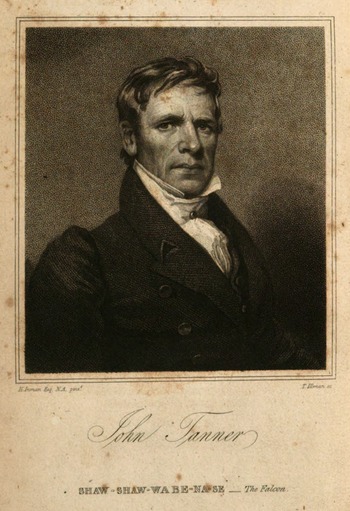



A Narrative of the Captivity and Adventures of John Tanner (U.S. Interpreter at the Saut de Ste. Marie) during Thirty Years Residence among the Indians, tells the story of John Tanner, or Zhaazhaawanibiisens (see Fig. 1), who lived a fully Anishinaabe life from the time of his captivity as a boy in 1790 until he decided to seek out his family of origin in 1819.Footnote 1 Looking back on those years, Tanner claimed that he had always been skeptical of the Indigenous visionaries whom he had come to see as false prophets. On one occasion, in his life as Zhaazhaawanibiisens, he learned of an Ojibwe visionary named Manidoogiizhig who was offering new modes of prayer, new instructions, and new revelations to his people. “Many of [his] maxims and instructions,” Tanner acknowledged, “were of a kind to be permanently and valuably useful to them.” But when a relative informed Zhaazhaawanibiisens that “the Great Spirit had come down again,” he replied in a mocking tone: “What, has he come again so soon? He comes often of late, but I suppose we must hear what he has to say.” At least in retrospect, Tanner described Manidoogiizhig as a fraud who “pretended to have visited the abode of the Great Spirit,” although “some of the traders informed me, he had only been to St. Louis, on the Mississippi.” The traders, doubting that the “Divine Will” could ever be revealed to an Indian, seem to have reinforced hesitations that Zhaazhaawanibiisens already harbored. The Narrative thus positions Tanner as a believer in true religion but a skeptic toward the “Indian prophets.” “Though my skepticism might not be offensive to the Great God, in whose name these revelations were made to us,” Tanner wrote, “it was very much so to those who were pleased to style themselves his messengers.” Foreshadowing conflicts with his Anishinaabe family, he noted, too, that the “ill will” of such visionaries could lead to “much inconvenience and danger.”Footnote 2
“John Tanner, Shaw-shaw-wabe-nase—The Falcon,” from Tanner, A Narrative, frontispiece. Portrait by Henry Inman in 1828.

Ojibwe novelist Louise Erdrich, introducing a recent edition of Tanner's Narrative, notes that although the book was marketed as a captivity narrative, a genre eminently familiar to readers of the time, its main narrative arc is not one of captivity and redemption. Rather, Tanner offers an entrée into the vast Anishinaabe worlds of the western Great Lakes region.Footnote 3 Seized from his family of origin, white settlers along the Ohio River in Kentucky, the nine-year-old John was adopted by an Anishinaabe family and renamed Zhaazhaawanibiisens, the Swallow, a name mistranslated in the Narrative as “the Falcon.” He grew up fully integrated into a far-flung extended family, and devoted to his adoptive mother Naadinookwa, whose wisdom and leadership he praised. As a young man, he married an Ojibwe woman, Miskwabunokwa, and had three children with her. Although curious about the white American world from which he had come, he deferred several opportunities to find his family of origin. He joined in the ongoing wars between the Anishinaabeg and the Dakotas (Sioux), but his people were British allies and stayed far clear of the United States during the War of 1812. Around that time, he separated from Miskwabunokwa and married another Ojibwe woman, Therezia, with whom he eventually had six more children. When he finally sought out his family of origin, he struggled to fit in. In the late 1820s, while working as an interpreter for the U.S. Indian Agency first in Mackinac and then in Sault Ste. Marie, Michigan, he collaborated with an army doctor, Edwin James, to write the story of his most unusual life.Footnote 4
Tanner's voice in the Narrative wavers between his Anishinaabe and American selves. Culturally formed as an Anishinaabe man, fully Anishinaabe for most of his life, he problematizes assumptions that whites and Indians are essentially, racially distinct, or, in other words, that a man born to a white family could not also be an Indian. Often, he seemed to long for the Indigenous modes of sociality that he had abandoned. His full acceptance into his adoptive family suggests that Anishinaabe identity in the late eighteenth century was not defined along lines of phenotype or biological ancestry. Across Anishinaabe lands, as in the Ohio and Mississippi River Valleys, where scattered French and métis settlements coexisted and blended with Indigenous communities, most people still defined their identities not as “white” or “Indian” but through local and family ties that extended outward in interlocking networks of affiliation.Footnote 5 This cultural system began to change after the American Revolution as new white American settlers entered the region and, with the full support of the U.S. government, seized and settled on more and more Indigenous lands. Zhaazhaawanibiisens's life coincided with the layered traumas that ensued. Epidemics of smallpox and measles swept the country and devastated Native American populations, killing up to half of some communities. White settlers increasingly denigrated Indians—and waged war upon them—as an essentially distinct and inferior race, bound to tragically disappear as “civilization” spread across the continent. Guided in part by visionaries like Manidoogiizhig, Native people reacted with a new racial consciousness of their own. From either side of this growing divide, Zhaazhaawanibiisens's Anishinaabe identity became harder and harder to sustain. The Narrative was, in part, Tanner's attempt to explain and vindicate himself as he struggled to return to the white world. As the literary scholar Andy Doolen explains, Tanner was trying to refute those who considered him irredeemably savage.Footnote 6
The Narrative is doubly mediated by Tanner's retrospective views of his own life and by the editorial hand of Edwin James, a scientist, writer, and doctor at Fort Mackinac and at Fort Brady in Sault Ste. Marie. Despite its initial presentation as a captivity narrative, then, the text fits perhaps more closely into the genre of the Indigenous autobiography—texts such as the Life of Black Hawk, or, much later, Black Elk Speaks—many of which were, like Tanner's, written in collaboration with white editors who also shaped their stories along the way. The interpretive conundrums of Tanner's text are similar to others in this genre.Footnote 7 James insisted that he had not changed a word, beyond trimming out accounts of traveling and hunting that he (though perhaps not Tanner) thought repetitive or mundane. Whatever his intent, James would have had to do some wordsmithing. Tanner never learned to read and write in English; his daughter Martha later penned letters on his behalf. He must have relayed his story in a mixture of Odawa and English, which James then rendered into the polished English of the published account. Still, according to historian John Fierst, the details of the Narrative reflect Anishinaabe ways of organizing time and space, suggesting that James did not substantively change Tanner's stories.Footnote 8 James saw himself as an ally, both to Tanner and to Indians generally. He wanted to present Native Americans as redeemable, capable of becoming both Christian and “civilized,” and his introduction argued strenuously against the Jacksonian policy of Indian removal, which Congress was debating even as the book went to press. James also added a series of lengthy appendices, titled “Part II” in the original edition, which included ethnological data on Anishinaabe religious practices, vocabulary lists, and translations of Christian prayers and biblical texts into several Indigenous languages. These additions seamlessly blended James's reform agenda, his interests in philology and comparative religions, and the project of Christian missions.
From Tanner's conflicted depictions of Indigenous visionaries to James's evangelical take on comparative religions, the Narrative includes extensive reflections on the topic of religion. The literary scholars, historians of the fur trade, and historians of the Anishinaabe who have worked extensively on this text have paid relatively little attention to these themes. Among scholars of religion, meanwhile, the book remains almost entirely unknown.Footnote 9 I think this text merits our attention not only for what Tanner tells us about Anishinaabe religious history but also as an entrée into the circulation and the real-world impact of ideas about religion in early nineteenth-century North America. The Narrative describes how Zhaazhaawanibiisens participated in the Midewiwin, the Great Medicine Society of the Ojibwe; cultivated the practice of medicine hunting, which helped him sustain his family through hard winters; held back his own developing skepticism at the messages of those he called “Indian prophets”; and discussed the differences (solidified in the telling) between white and Indigenous religions. James's appendices drew on comparative scholarship about “mythology” and “religion” around the world to defend his own preferred theories about the religio-racial character of Indigenous peoples. (Drawing on the work of Judith Weisenfeld, I use the term religio-racial to describe how race and religion are co-constituted by various communities as they define and redefine their collective identities on the ground.Footnote 10) The Narrative thus documents dialogues about religion and the circulation of ideas about religion in a time and place from which we have few such records. It illuminates the impact of these ideas and dialogues in White settlers’ attitudes toward Native people; in the lived realities of Native communities; and, more generally, in the cultural politics of race and settler colonialism in the early nineteenth-century United States.
Religion has long been theorized far beyond the academy and the imperial centers of Europe and North America. Historians of religion have asked not only how everyday people practiced religion but also how they conceptualized it in conversation with globally circulating theories of religion, and how these ideas impacted the lives of individuals and communities on the ground. Our histories of “religion” as a category need to include not only the familiar works of imperial elites but also the traces of everyday theorizing about religion—among people like fur traders, army officials, Baptist missionaries, or Anishinaabe visionaries—that can be found in less familiar accounts. We can learn much from Tanner and James about the webs of knowledge that engaged and (re)configured religion across the far-flung imperial borderlands of early America, and even more about the human consequences of this local theorizing for people caught in the crosshairs of a transforming world.Footnote 11
This essay develops three interlocking arguments about the circulation and the stakes of knowledge about religion in Tanner's world. The first two sections use the Narrative to interrogate the colonial and racializing work of early American ideas about credulity, rationality, and religion. Working within the racialized oppositions of colonial governance, white Christian leaders in early America typically insisted on their own ability to civilize—in other words, to form rational, self-possessed, and well-ordered citizen-subjects. From this point of view, and within the Narrative itself, credulity appeared as an attribute of the (gendered and racialized) nonmodern subject. Emily Ogden has shown how credulity could operate in this period as a secularizing discourse, with the “credulous” marked as gullible and susceptible to presumably false religious claims. Many appeals to the miraculous, or to claims of divine intervention, had to defend themselves against such skeptical assaults. But Ogden's is not simply a story of secularization. She explains that faith/credulity and skepticism/debunking operated in a kind of dialectic. Debunkers exhorted their own believers toward what they saw as deeper truths about the universe or the human psyche, only to find themselves targeted by a new round of skeptics. Because the credulous were generally coded as female or nonwhite, this dialectic was always entwined with the colonial hierarchies of gender and race. Because the charges of credulity and deception were so often wielded within Christianity, as competing groups tried to discredit each other, this discourse also shaped the internal dynamics of American Christianity and the larger contours of American religion.Footnote 12
Tanner wrestled at length with the problem of credulity: of how to articulate a skeptical posture, to identify himself as a man of reason and self-control, while remaining true both to his own experiences of Indigenous enchantment and to his growing Christian convictions. Given the circumstances of the text's production, it is impossible to tell how much of the discourse of credulity—a word used repeatedly in the text itself—came from James. Most likely, as we will see, the dialogue between James and Tanner sharpened a skeptical posture that the latter had already begun to cultivate. Even as Zhaazhaawanibiisens participated in Indigenous religious practices, the text portrays him as always skeptical of Indian “superstitions.” By virtue of his whiteness and yet also in tune with the “natural” reverence of the Indians, Tanner claimed to have consistently heard and followed the guiding hand of God. He thus framed his past experiences as a rational reverence for the divine that he distinguished from the superstitions and “credulity” of the Indians. By positioning himself as a reverent skeptic, a self-possessed subject, soon to become a baptized Christian, Tanner sought desperately to vindicate himself, to lay claim to a whiteness that he could never quite secure. Along the way, the language of credulity helped establish the racialized boundaries of good (reverent but rational) religion and those who practiced it—in stark contrast to those whose credulity and superstition marked them as not truly religious at all. Tanner's Narrative thus reveals how widely this discourse circulated and how painfully its colonial dialectic could impact lives on the nineteenth-century borderlands of U.S. empire.
Second, this essay shows how some Anishinaabeg—a large people group, with closely related languages, that includes the “Three Fires” of the Ojibwe, Odawa, and Potawatomi nations—theorized race and religion in and through dialogues within their own communities and with white settlers, missionaries, and colonial officials. Especially in Zhaazhaawanibiisens's conversations with other Anishinaabeg, developing Indigenous conceptualizations of religion come glancingly into view. Set against the backdrop of an expanding U.S. settler empire and the consequent sharpening of white settler hierarchies of race and religion, this Indigenous theorizing was intertwined with a rising Anishinaabe nationalism and an emergent racial identity along pan-Indian lines. For Tanner and his Anishinaabe family, these competing Indigenous and settler models of comparison had painful and life-changing results. Despite the complexities of its editorial production, then, Tanner's Narrative helpfully reveals the contours and consequences of Anishinaabe as well as white settler ways of theorizing religion.
Third, and finally, I use Edwin James's editorial framing of Tanner's Narrative to illuminate the developing colonial discourse of comparative religions as it circulated and operated on the western borderlands of the early nineteenth-century U.S. empire. Tomoko Masuzawa has ably tracked the emergence of the construct of “world religions” among European scholars, some of whom were conversation partners for James.Footnote 13 The discipline of comparative religions was not simply invented and performed by armchair intellectuals in the universities of Europe or the eastern United States. As David Chidester has shown in the South African context, new religious comparisons were often first articulated not by distant elites but by missionaries or military officers, like James, who lived and worked on the front lines of imperial expansion.Footnote 14 These borderlands theorists mobilized religious comparisons toward what many of them saw as benevolent and Christian ends. Their theories, nevertheless, supported a racialized hierarchy with whiteness and Christianity at its peak. By way of conclusion, I offer a short reception history of the Narrative that reveals its continuing reverberations not only in white settler depictions of so-called “Indian prophets” but also, and perhaps more durably, for new Anishinaabe generations who are retheorizing religion for new Indigenous futures in the twenty-first century and beyond.
Becoming Anishinaabe
John Tanner was born in 1780 to a Presbyterian settler family who moved when he was still a toddler to farm near Boonesborough, Kentucky, along the Ohio River. In the wake of the American Revolution, the region's Native nations, now abandoned by the British, continued fighting in hopes of keeping white settlers from crossing north of the Ohio. At nine, young John was seized by Ojibwe raiders from Saginaw, Michigan, who, he later learned, aimed to replace a son who had recently died. Adopting captives was a time-honored Indigenous way to fill the places of family members lost to war or disease. Writing in the Narrative four decades later, Tanner remembered his first adoptive father as abusive, occasionally violent, and never quite accepting of the presence of this strange white boy. Given this harsh treatment, he was relieved to be moved after two years into a new family who named him Zhaazhaawanibiisens, the Swallow. His new mother, Naadinookwa, was an Odawa woman from Waganakising, also known as L'Arbre Croche, south of Mackinac Island on the shores of Lake Michigan. It was she, Tanner wrote, and not her husband Tawgaweninne, an Ojibwe from the far northwest, who “had the direction in all affairs.” Respected by all, Naadinookwa was recognized from afar by “a flag in her canoe” and “saluted by a gun from the fort” whenever she arrived at the trading hub of Mackinac. Naadinookwa offered him love, acceptance, and a meaningful place within Anishinaabe society.Footnote 15
Zhaazhaawanibiisens grew to be fully integrated into this Anishinaabe family. Several years after his adoption, Tawgaweninne died from injuries sustained in a fight. Naadinokwa decided to join many of her Odawa kin in a move northwest to the flourishing fur trade of the Red River region, her husband's homeland, in what is now southern Manitoba. Along the way, the family suffered another tragedy with the death of Naadinookwa's second son, Giiwedin, from injuries sustained in a fall. Without a mature hunter to support them, the family had to spend a harsh winter west of Lake Superior. Zhaazhaawanibiisens, then thirteen, and his older brother, the seventeen-year-old Wamegonibiew, only barely managed to find enough food to keep the family alive. They survived with help from strangers, a band of Ojibwe with whom they traveled to an island on Lake Superior with plentiful game. That spring they returned with one of Naadinookwa's distant relatives, Wagemahwub, to the trading hub of Grand Portage. The support they found from friends and relatives on these travels hints at the well-developed networks of mobility and communication in this far-flung Anishinaabe world. By the end of that harsh winter, the boy Zhaazhaawanibiisens was completely devoted to his Odawa mother, Naadinookwa.Footnote 16
Especially in reference to these early years, the Narrative portrays Anishinaabe prayers and offerings as a beneficent, if primitive, “natural” religion. As the party of ten canoes passed through Lake Superior, the “old chief” Wagemahwub halted the group to offer up a prayer of gratitude “to the Great Spirit.” Tanner's memories of this childhood incident were understandably unclear, but he did recall that after this prayer, Wagemahwub “threw into the lake a small quantity of tobacco,” and then sang a “religious song.” The passage concludes:
I can remember, that this address of the chief to the Great Spirit, appeared to me impressive and solemn, and the Indians seemed all somewhat impressed by it, or perhaps by their situation, being exposed, on the broad lake, in their frail bark canoes, they could not but feel their dependence upon that Power which controls the winds and the waves.Footnote 17
This account, while suggesting an admirable and even natural purity in Indigenous spiritual life, attributes little in the way of rational thought to Wagemahwub or his audience. In the grandeur of the setting and in their vulnerable position, these Indians simply, naturally, “feel their dependence upon” the divine. Crafted in part by James, this passage suggested post-Enlightenment debates in Europe and North America about the qualities of “natural religion,” which, some theorists argued, could be found among supposedly “primitive” people who lacked the accretions of history or civilization. In their supposedly untainted purity, some theorists believed, Native Americans might maintain traces of the “natural religion” that God had originally instilled in all humanity. This sort of romantic primitivism—even as it attributed “primitive” virtues to Native people—froze them into a timeless past and denied them an active role in the “modern” present.Footnote 18
Tanner's authorial voice, shaped more or less by James, seems determined to create some distance between himself and the Indians. He depicts his teenaged self as a rational religious subject, never fully immersed in Anishinaabe religious practice. The Narrative suggests that the young Zhaazhaawanibiisens maintained an appropriate kind of reverence even as he remained subtly different from his adopted family. He could not be blamed for his inability to remember his “mother tongue” or any “ideas of the religion of the whites.” He had been right to be impressed by the solemnity of Wagemahwub's prayers and to share the Indians’ reverence. At the same time, Tanner slightly distanced himself from the “Indians” and their emotional response. He acknowledged that, as a boy, he had not been able to recall much about Christianity. Still the Narrative positions him racially as always having been a keen observer, already able as a thirteen-year-old to understand the true sources of the Indians’ awe. James's introduction explains: “The powerful mind of our narrator, was at all times strongly influenced by a belief in the ubiquity, and frequent interpositions in the affairs of men, of an over-ruling Providence. His may have been a purer and more consistent Theism, than that of many of his untaught companions, but in many important particulars his belief was the same as theirs.” Zhaazhaawanibiisens appears throughout as more reflective and more rational than his Anishinaabe family, at a slight remove from the allegedly “primitive” quality of their devotions. At the same time, the scene with Wagemahwub at the lake demonstrates a salutary Indigenous connection to the divine, a natural piety that the young Zhaazhaawanibiisens had been right to share. Thus, the Narrative defends his regular participation in Anishinaabe religious practices and devotions.Footnote 19
At several points, Tanner describes how both Naadinokwa's and his own dreams and visions saved the family from starvation. During another harsh winter, Zhaazhaawanibiisens began to gain the status of a hunter by fulfilling one of his mother's dreams. Early one morning, Naadinokwa said to her older son Wamegonibiew, “Last night I sung and prayed to the Great Spirit, and when I slept, there came to me one like a man, and said to me, ‘Net-no-kwa, tomorrow you shall eat a bear.’” She told Wamegonibiew the location that the man in the vision had conveyed to her. Instead of following her directions, the rebellious teenager “spoke sneeringly to the other Indians of [his mother's] dream.” But Zhaazhaawanibiisens “followed the directions she had given” and found a bear hibernating in a deep hole. He killed it and then returned home to tell her. His mother “caught me in her arms, hugging and kissing me with great earnestness,” Tanner recalled, and then sent some men to retrieve the body. It was the first bear he had killed, and so according to custom “the hunters of the whole band [were] invited to feast with us.” This story demonstrates Naadinokwa's pride in Zhaazhaawanibiisens's growing maturity and his growing acceptance as a contributing member of the band. The Narrative does not use this episode as an occasion to demean Indigenous “superstitions.” Instead, the story highlights Naadinokwa's kindness, her perspicacity, and the purity of her devotion. Like Wagemahwub, she seemed to communicate directly, naturally, with the divine. In contrast, her son Wamegonibiew appeared as a sneering skeptic, mocking the wisdom of his mother's devotions. The figure of Wamegonibiew thus demonstrates the presence of an Indigenous skepticism. Rather than positioning that skepticism as evidence of Indigenous rationality, however, the Narrative identifies it as a corruption of the natural purity of Indigenous life.Footnote 20
Tanner repeatedly described the introduction of alcohol at the hands of white traders as a destroyer of Anishinaabe fortunes. Many Indigenous leaders at the time were advancing the same critique.Footnote 21 Yet Tanner invariably presented himself, in contrast to the Indians, as both rational and sober. His brother Wamegonibiew, with whom he regularly conflicted, appears as particularly susceptible to drunkenness and corruption. Once, for example, when “the Indians . . . were assembling at Pembinah, to dispose of their peltries, and have their usual drunken frolic,” Zhaazhaawanibiisens is described as attempting to convince Wamegonibiew “and others, which were particularly my friends, not to join in this foolish and destructive indulgence.” To no avail. While Zhaazhaawanibiisens took his time, productively hunting along the way, the others rushed ahead to Pembinah. By the time he arrived, they were all intoxicated and fighting. “Some Indians came to tell me that Wamegonibiew had lost his nose; another had a large piece bitten out of his cheek; one was injured in one way, another in another.” Not long thereafter, a resentful Wamegonibiew even attempted to murder his mother's relative Waukazoo, simply because Waukazoo had a distant connection to the man who had, years earlier, killed their father Tawgaweninne. Disgusted by this behavior, Zhaazhaawanibiisens broke his ties with Wamegonibiew. Across these stories, Tanner associated his brother's failures of respect and reverence with a corruption of Indigenous purity. In the arc of the Narrative, meanwhile, this break foreshadows his future alienation from his Anishinaabe relations.Footnote 22
More immediately, however, Zhaazhaawanibiisens's decision to marry strengthened and expanded his Anishinaabe ties. The Narrative explained that he initially resisted marriage, declining Naadinokwa's early matchmaking efforts, because he had the idea that he would eventually return to the United States. In fact, he repeatedly chose not to pursue that option. When a trader suggested to the teenaged Zhaazhaawanibiisens that he should go to Kentucky to seek out any natal connections there, he decided against it, in part because he believed that his original captors had killed his family of origin. He explained that, while Indians would never let a stranger or orphan go hungry, he knew that as an orphan he was unlikely to fare well in the white world. And whatever his reluctance to marry, Zhaazhaawanibiisens became romantically involved in his early twenties with a lovely and irreverent young woman named Miskwabunokwa. When he came home one morning after a night with her, Naadinokwa shamed him into formalizing the relationship. The marriage lasted at least long enough to bear three children, and Tanner made it clear that one reason he continued to indefinitely postpone the idea of returning to the United States was that he now had a wife and children whom he loved and for whom he felt responsible. The Narrative is strangely silent about the dissolution of this first marriage, and even vaguer on the subject of his second wife, who is not even named in the text. (She is identified in their daughter Martha's baptismal records as Therezia, but historians have found no record of her Ojibwe name.) Tanner remarried for a third time while he was working on the Narrative, so he may have wanted to deemphasize the strength of his attachments to these first two wives and, by extension, to the Anishinaabe world of which they were a part.Footnote 23
Tanner wavered in the Narrative between respect and ridicule, alternately affirming and unmasking Indigenous practices that his editor, James, unequivocally dismissed as superstition. Zhaazhaawanibiisens once decided to camp at a place that the Indians called “the place of the two dead men.” There, he was told, a man had once killed his brother in a quarrel and then, for the horror of the crime, was himself slain by the band. No Indian would camp in that place, Tanner claimed, because it was said that these brothers would “come out of the ground, and reenact the quarrel and the murder, or in some other manner annoy and disturb their visitors.” (Similar accounts, it seems important to note, were also common among white settlers at the time.) Zhaazhaawanibiisens hoped to prove the story false. But as soon as he tried to sleep, “the two dead men appeared,” and proceeded to laugh and poke at him with sticks. “In all subsequent journeys through this country,” he wrote, “I carefully shunned ‘the place of the two dead,’ and the account I gave of what I had seen and suffered there, confirmed the superstitious terrors of the Indians.” His own experience credited the truth of this haunting. Still, the Narrative uses the story to evidence his superior courage in contrast to Indian credulity, irrationality, and superstition. “I had fewer fears than the Indians,” he wrote, “but I was not entirely free from the same unfounded apprehensions which so constantly pursue them.” Thus Tanner acknowledged the influence of his Anishinaabe upbringing but associated the ideal of an emotionally controlled and bounded self with whiteness. “Fears” and “apprehensions” were, like credulity, supposed to be racial traits of the Indians. Through these stories, Tanner struggled to locate himself in these oppositions and to make sense of his own religio-racial identity.Footnote 24
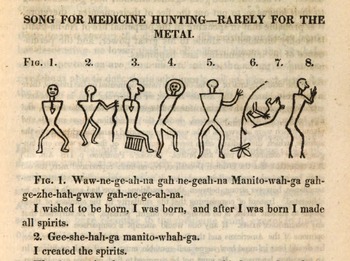
The Narrative denigrates many Anishinaabe practices as false religion and, even as Zhaazhaawanibiisens participated in them, constructs him as a rational subject skeptical of Indian “superstitions.” “At this time,” Tanner wrote, “the Waw-be-no [Wabeno] was fashionable among the Ojibbeways, but it has ever been considered by the older and more respectable men, as a false and dangerous religion.” Here, Tanner acknowledged Anishinaabe skepticism as a way to explain and validate his own. He made sharp distinctions between such practices and others that he held in high regard: “The ceremonies of the Waw-be-no differ very essentially from those of the Metai [Midēwiwin],” he wrote, “and are usually accompanied by much licentiousness and irregularity.” The more elaborate the ritual performance, it seems, the more suspect he found it. He described the Wabeno as a transparently deceptive event, a spectacle for the credulous. Performers “are able to withstand the effects of the fire and of heated substances, by what they would persuade the ignorant to be a supernatural power,” he explained, “but this is nothing else than a certain preparation, effected by the application of herbs.” Unlike his editor James—more on this below—Tanner respected the Medicine Society of the Midēwiwin for its effective healers and the reverence he saw in its practice. The detailed ethnographic accounts and medicine songs that James compiled in Part II of the Narrative reflected Tanner's intimate knowledge of these traditions. But beyond this contrast to the Wabeno, Tanner avoided mentioning the Midē in the body of his account. Perhaps he hoped that his sneering dismissal of the Wabeno would prove him appropriately skeptical, allowing him to justify (if only to himself) his prior participation in the Midēwiwin and in the practice of medicine hunting, the efficacy of which he would never deny.Footnote 25
Zhaazhaawanibiisens's medicine hunting served in the Narrative to reveal his consistent reliance on a higher power. One winter when he was in his early thirties, the sparse snow made it difficult to track game and his family had run out of food. “[I] had recourse, in the last resort,” he writes, “to medicine hunting,” the same practice that Naadinokwa had employed. “Half the night I sung and prayed, and then lay down to sleep. I saw, in my dream, a beautiful young man come down through the hole in the top of my lodge, and he stood directly before me.” The young man in the vision pointed Zhaazhaawanibiisens to the tracks of moose and bear, which he then successfully hunted. Several winters later, when many families were suffering once again from hunger, “the Indians called on me to make a medicine hunt.” As before, he prepared for the hunt with drumming, prayers, and songs. But he offered no further details on the specifics of this practice. Instead the passage continues:
I have always been conscious of my entire dependence on a superior and invisible Power, but I have felt this conviction most powerfully in times of distress and danger. I now prayed earnestly, and with the consciousness that I addressed myself to a Being willing to hear and able to assist, and I called upon him to see and to pity the sufferings of my family. The next day I killed a moose, and soon after, a heavy snow having fallen, we were relieved from the apprehension of immediate starvation.
For Tanner, medicine hunting could not be superstition, or false religion, because he had found it so efficacious. He knew that James and other white people in Sault Ste. Marie viewed this Indigenous practice with disdain. And yet he folded it into his account as further evidence that he had found and followed divine guidance even before he knew the true name of this “superior and invisible Power.” By the time he wrote the Narrative, Tanner was beginning to understand himself as a Christian. Like any memoirist, he narrated his life to make sense of his current circumstances and commitments. Within this framework, the specifics of medicine hunting—its songs, prayers, and images—could be included only as ethnographic data, as they were in James's appendices, but not as a living practice to which Tanner remained committed.Footnote 26
The Trouble with Prophets
By the early 1810s, Zhaazhaawanibiisens was becoming skeptical of the Indigenous visionaries that he would later identify as prophets. Historian Jennifer Graber has tracked the problematic associations of what she calls “prophet talk” in reference to Native visionary traditions. In using this term, she explains, white settlers drew on a much older “rhetorical arsenal.” English-speaking Protestants, convinced that the biblical age of true prophets had long since ended, drew on language of “false prophets” from the King James Bible to discredit movements that they considered dangerously radical. Prophet talk surged in the early nineteenth century as debates over trade and treaties with the majority-Muslim Barbary States of North Africa led to new anxieties around the “false prophet” of the “Mohammedans.” The tumult of a new settler republic sparked an array of visionary leaders, in both settler and Indigenous societies, who similarly came to be condemned by established Protestants as false prophets. Within this discursive world, as white Americans moved west to seize and settle on still more Indigenous lands, prophet talk became a useful way to facilitate violent acts of dispossession. In the Creek (Muskogee) War of 1813, for example, where visionary leaders helped mobilize the Muskogee Redstick resistance movement, General Andrew Jackson, whose success in this war propelled his eventual rise to the presidency, remarked that “the Indians must be made to know that their prophets are imposters, & that our strength is mighty & will prevail.” Attributing Native resistance to the deceptions of “prophets” helped Jackson dismiss their grievances. In contrast to the implied rationality of white settlers, the Indians’ alleged credulity suggested a racial incapacity to properly govern themselves or their lands. Neither Tanner nor James intended their talk of prophets in this way. But as we will see, the Narrative would easily be mobilized for this purpose.Footnote 27
As Tanner tells the story, Zhaazhaawanibiisens's skeptical stance toward three different Indigenous visionaries contributed to his alienation from his Ojibwe family. The first of these was Tenskwatawa, known to white Americans as the Shawnee prophet. Indeed, Tenskwatawa would become the very image of the scurrilous “Indian prophet.” In describing his first encounter with Tenskwatawa's message, however, Tanner did not use this term. “News came of a great man among the Shawneese who had been favoured by a revelation of the mind and will of the Great Spirit,” he explained. Native people in the region consistently saw Tenskwatawa as the “great man,” more so than his brother Tecumseh, who as the military leader was better known to white officials.Footnote 28 Zhaazhaawanibiisens had just returned to Anishinaabe lands after a battle against the Dakota (Sioux), when an unfamiliar man approached his lodge, appearing “strange and peculiar in his manner.” The messenger, one of many traveling through Indian country at this time, brought new instructions relayed through Tenskwatawa from the Great Spirit. The people must never allow their fires to be extinguished, he said, because “the life in your body, and the fire in your lodge, are the same.” Further instructions followed: “You must not suffer a dog to live; you must never strike either a man, a woman, a child, or a dog,” and, “from this time forward, we are neither to be drunk, to steal, to lie, or to go against our enemies.” Their lives and their livelihoods would depend on their response. “While we yield an entire obedience to these commands of the Great Spirit,” he promised, “the Sioux, even if they come to our country, will not be able to see us: we shall be protected and made happy.” It is significant that this messenger promised an end to Indigenous warfare. Tenskwatawa aimed to build a pan-Indian alliance in order to defeat the United States. For Zhaazhaawanibiisens's community, though, war with the Dakota was a far more immediate concern. Either way, Tenskwatawa's messenger promised that by following his message they could end their proliferating conflicts and restore the balance of their world.Footnote 29
According to the Narrative, Zhaazhaawanibiisens was, once again, a rare skeptic in his community. Testing the veracity of the message, he refused to kill his dogs and, defiantly, allowed the fire to go out overnight. No immediate consequences ensued. Still, like others in his northern Anishinaabe society, he was compelled by the visions and instructions that this messenger conveyed. “I did not rest entirely easy in my unbelief,” Tanner recalled. “The Indians, generally, received the doctrine of this man with great humility and fear. . . . Many killed their dogs, and endeavoured to practice obedience to all the commands of this new preacher, who still remained among us.” Zhaazhaawanibiisens's skepticism wavered slightly as he was drawn to the shared convictions of his Anishinaabe community. He tried to remain aloof, but inconspicuously so.Footnote 30
In Tanner's retrospective view, he was beginning subtly to set himself apart. Uncertain of his own judgement, he sought out counsel from the traders:
As was usual with me, in any emergency of this kind, I went to the traders, firmly believing, that if the Deity had any communications to make to men, they would be given, in the first instance, to white men. The traders ridiculed and despised the idea of a new revelation of the Divine will, and the thought that it should be given to a poor Shawnee. Thus was I confirmed in my infidelity.Footnote 31
In this religio-racial formation, whiteness bestowed rationality as well as divine favor, qualifying the traders to cast judgment on the validity of visionary revelation. The Narrative sought to establish Zhaazhaawanibiisens's whiteness, then, by portraying him as an appropriately skeptical subject. Any present-day prophet was, almost by definition, a false prophet; and all the more so if the claimant was “a poor Shawnee,” a lowly Indian. Although Zhaazhaawanibiisens mostly tried to keep his opinions to himself—his Anishinaabe community would no doubt have been offended by such claims—his conversations with the traders ultimately “confirmed” his growing “infidelity,” his disbelief not in “the Deity” but in the Indigenous teachers and visionaries whom he would retrospectively dismiss as Indian prophets.
Reading against the grain, the Narrative reveals that Anishinaabe society had plenty of room for skeptics. Tenskwatawa's messenger was quite clearly prepared for a skeptical response, explaining that Zhaazhaawanibiisens's failure to obey instructions had not led to the predicted consequences only because Zhaazhaawanibiisens “had not yet shaken hands with the prophet.”Footnote 32 And he was far from the only skeptic. Many other Native people doubted Tenskwatawa's message, especially after his defeat by William Henry Harrison in the Battle of Tippecanoe (1811). A Sauk warrior, Winnehea, recalled in 1823 that he had never been a believer. “[Tenskwatawa] convinced all our chiefs,” Winnehea said, “that the medicine in our bags, which had been good in its time, had lost its efficacy,” and that he had the power to restore the dead to life, bring victory to allied Native forces in battle, and perform many other “astonishing deeds.” In the eyes of Winnehea and many others, this message was proven false by the military failures of the alliance.Footnote 33 Many Anishinaabeg similarly turned against Tenskwatawa when his predictions went unfulfilled. Even before his loss in the Battle of Tippecanoe, some Anishinaabe were disillusioned after many who visited the prophet's town died of a coughing sickness that did not seem to affect the Shawnee. Opinions were divided at Naadinokwa's home community of Waganakising, where the influential Le Maigois had helped spread Tenskwatawa's message, only to see some of his followers stricken in the epidemic. Hedging their bets after the Battle of Tippecanoe, the Odawa headmen Macatebinessi and Kininitigagan informed the US Secretary of War that they had now rejected the one “who pretends to be a prophet among us.” Because of the richness of Tanner's relational memories, the Narrative itself sometimes works against its own construct of an inherent Indian credulity. At times, Tanner credits the “sensible and respectable men” among the Indians who, like him, saw through the “frauds” and the “false prophets” in their communities.Footnote 34
Zhaazhaawanibiisens's growing frustration with Native visionaries played out against a backdrop of violence and dispossession. His people, the northern Anishinaabeg of Lake Superior, had not (yet) seen the numbers of white settlers who were moving into the Ohio River valley and the lower Great Lakes region. The manipulative and often coerced treaties that transferred so much land from the Potawatomis, Miamis, Shawnees, Kickapoos, Weas, and so many other Native nations in these years did not yet directly threaten them. Yet as their alliance with Tecumseh suggests, the northern Anishinaabeg were concerned not only for their relatives to the south but also for their own livelihoods. They, too, were impacted by colonial violence and its reverberations. New settlers, sponsored by the Hudson's Bay Company, were showing up in the Red River valley. The Anishinaabe-Dakota wars were intensified by competition for land and for the furs that drew such high prices in European markets. High demand led to overhunting and decimated beaver populations, further heightening these conflicts and sparking occasional violence between trading companies and their various Indigenous allies. Zhaazhaawanibiisens participated on and off in this warfare—Tanner described joining in several war parties against the Dakota—and it shaped his and his extended family's decisions about where to live and move from one year to the next.Footnote 35
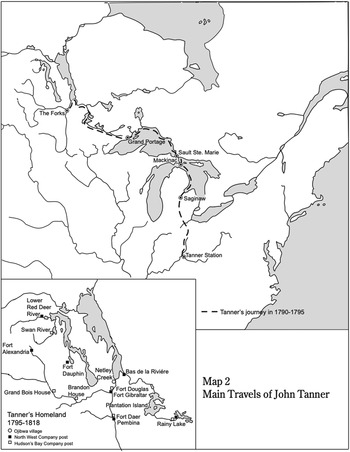
The disputes between trading companies, which competed for the allegiance of Indigenous trappers, added to Zhaazhaawanibiisens's troubles. He shifted affiliations several times in the 1810s between the North West Company and Hudson's Bay Company, which vied for the most profitable trade. Tanner condemned the rapacious behavior of traders such as William Wells of the North West Company, who “built a strong fort on Red River, near the mouth of the Assinneboin,” in present-day Winnipeg (Fort Gibraltar; see Fig. 2). He described how Wells plied the Indians with kegs of rum and then, when they were drunk, refused to provide the customary advance credit and persuaded them to accept a pittance for their furs. Once again in the flow of the Narrative, Zhaazhaawanibiisens's ability to see through such tactics served as further evidence of his superior capacity for reason. Witnessing Wells's duplicity, he refused to do business with the North West Company and chided his friends for “submitting to such terms.” Wells reacted by throwing him out of the house and then attempting to steal his furs. Zhaazhaawanibiisens was disgusted and shifted his trade to the Hudson's Bay Company instead. Several years later he would join in a war between these rival companies, each of which urged their Native allies to fight on their behalf. “Many of the Indians obeyed the call,” Tanner explained, “and many cruelties and murders were committed.” He described himself across these episodes as a rational actor who, although immersed in the hunting and trading world of the Anishinaabe, was unlike them in his lack of credulity, his ability to see through the duplicity of corrupt traders as well as “Indian prophets.”Footnote 36
“Main Travels of John Tanner,” Map 2 in Catton, Rainy Lake House. Reprinted with permission from Johns Hopkins University Press.

The Ojibwe visionary Manidoogiizhig spoke directly to this situation. Soon after the conflict between Zhaazhaawanibiisens and Wells, Eshkebuk-kekoosa of the Leech Lake Ojibwe called allied bands together in Pembinah to tell them “of the recent revelation of the Great Spirit to Manito-o-geezhik.” While assembled there, they heard gunfire and learned that a Sioux (Dakota) war party had shot and killed a horse belonging to one of the traders. Informed that the war party was small, they considered a pursuit. But Eshkebuk-kekoosa advised against it. Manidoogiizhig “tells us we must no more go against our enemies,” he said. “And is it not manifest, that in this instance the Great Spirit has protected us,” by misleading the Sioux to the “Frenchman's horse” when they, the Ojibwe, had been “feasting in security, without our arms?” Perhaps the Great Spirit had even used the Dakota to avenge Anishinaabe grievances against the traders. Eshkebuk-kekoosa encouraged the people to purify themselves, to follow the new revelations that had been given, in hopes of a more secure and peaceful future. In other words, like Tenskwatawa, he and Manidoogiizhig envisioned new Indigenous futures within a changing colonial world.Footnote 37
Zhaazhaawanibiisens's resistance to these innovations can be read as a characteristically Anishinaabe skepticism, grounded in experience and the practical efficacy of traditional Ojibwe practice. Eshkebuk-kekoosa gave a series of instructions from Manidoogiizhig that resembled those from Tenskwatawa just a few years before. With Dakota warriors still in the area, Zhaazhaawanibiisens decided to leave the encampment to make sure his family was safe. Eshkebuk-kekoosa made him promise to return with his medicine bag. When he did so, Tanner recalled, the chief “ordered the contents of my medicine bag, except the medicines for war and hunting, to be thrown into the fire.” Zhaazhaawanibiisens complied with these instructions but resented the loss. As a replacement, Tanner wrote, Eshkebuk-kekoosa “gave me a small hoop of wood to wear on my head like a cap. On one half of this hoop, was marked the figure of a snake, whose office, as the chief told me was to take care of the water; on the other half, the figure of a man, to represent the Great Spirit.” Inscribed with powerful images, this wooden hoop offered a material reminder of Manidoogiizhig's visionary authority. Tanner's Narrative retrospectively represented this object as misguided if not absurd, and identified his own skepticism with the superior rationality of whiteness. But for Zhaazhaawanibiisens, at the time, Manidoogiizhig's instructions also violated his own experience with the efficacy of his medicine bag and other time-tested Anishinaabe practices. In other words, his skepticism was not a departure from but was entirely consistent with Anishinaabe ways of knowing and being in the world.Footnote 38
Leaving Anishinaabewaki: Indigenous Theories of Race and Religion
In a pivotal passage in the Narrative, Tanner related a conversation with Waukazoo, Naadinookwa's relative from Waganakising. Now heading back home after “ten years in the Rocky Mountains, and the country near them,” Waukazoo had “been much among the whites, and was well acquainted with the various methods of gaining a subsistence among them.” He advised Zhaazhaawanibisens, kindly, that he “would be much better situated” among white people, where he could make a living as an interpreter. Then Waukazoo told a story—versions of which circulated widely among Anishinaabeg at the time—that warned against crossing religio-racial lines:
He gave us . . . some account of a missionary who had come among the Ottawwaws of Waw-gun-uk-kezie [Waganakising], or some of the Indian settlements about the lakes, and urged them to renounce their own religion, and adopt that of the whites. . . . He told us the anecdote of the baptized Indian, who, after death, went to the gate of the white man's heaven, and demanded admittance; but the man who kept watch at the gate told him no redskins could be allowed to enter there. ‘Go,’ said he, ‘for to the west there are the villages and the hunting grounds of those of your own people, who have been on the earth before you.’ So he departed thence; but when he came to the villages where the dead of his own people resided, the chief refused him admittance. ‘You have been ashamed of us while you lived; you have chosen to worship the white man's God. Go now to his village and let him provide for you.’ Thus, he was rejected by both parties.
The moral of the story was clear. The Anishinaabe must not “renounce their own religion,” for to do so was to risk a fate of eternal loneliness, banishment from the afterlives of both white and Indigenous worlds. As in Waukazoo's parable, when Indigenous visionaries like Tenskwatawa and Manidoogiizhig called on their people to abandon white American material culture and affiliations, they sharpened religio-racial distinctions between Indians and whites that had not always been relevant to Native societies. As a result, some people in Zhaazhaawanibiisens's community were beginning to see him as an outsider, one of the “Long Knives” rather than one of them.Footnote 39
The story of the Odawa convert to Christianity was personal for Waukazoo. Within the next decade, his brothers Macatebinessi and Assiginac would play a key role in bringing Catholicism to their home community at Waganakising. Waukazoo himself later moved his band south, near the site of what is now Holland, Michigan, to affiliate with a Congregationalist mission.Footnote 40 The story thus hints at an ongoing debate within Anishinaabe communities about the utility and the risks of conversion to Christianity. It also represents an Indigenous model of religious comparison and an emerging consciousness of Indigenous traditions as distinct religions that could not be reconciled with the “white” religion of Christianity. What did Waukazoo intend by telling this story to Zhaazhaawanibiisens, immediately after advising him to return to the white world? Where did he locate Zhaazhaawanibiisens in this story—as an Indian or as a white man?—and with whom did Zhaazhaawanibiisens identify? Perhaps, at the time he worked with James on the Narrative, Tanner saw in this parable a metaphor for his own profoundly hybrid life.
Conflicts with a third Indigenous visionary, Aiskawbawis, led to new tensions between Zhaazhaawanibiisens and his wife Therezia's family. Aiskawbawis claimed “that he had been favoured by a new revelation from the Great Spirit,” Tanner recalled, and showed those who visited him “a round ball of earth . . . smeared with red paint.” The visionary explained that after many days in his lodge, “crying, and praying, and singing,” the Great Spirit had answered: “I give you this ball, and as you see it is clean and new, I give it to you for your business to make the whole world like it, even as it was when Na-na-bush first made it. All old things must be destroyed and done away; everything must be made anew, and to your hands, Ais-kaw-ba-wis, I commit this great work.” Given the challenges faced by the Anishinaabeg at this time, given the violence of U.S. and British imperial encroachments, disease epidemics, and loss of land that many Native nations had already suffered, Aiskawbawis's vision of a suffering world in need of renewal seems very much relevant to Ojibwe concerns. According to the Narrative, however, Zhaazhaawanibiisens “betrayed [his] want of credulity” immediately after leaving the lodge with his friends. Once again, the language of credulity distinguishes him from the Indians. Tanner explains that he had never respected Aiskawbawis, who was a poor hunter and had been accused of mistreating his wife. “It is well that we may be made acquainted with the whole mind and will of the Great Spirit, at so cheap a rate,” Zhaazhaawanibiisens said mockingly to his friends. “Here we have one too poor, and indolent, and spiritless, to feed his own family, yet he is made the instrument of the Great Spirit, as he would have us believe, to renovate the whole earth.” In the weeks that followed, Zhaazhaawanibiisens did not hesitate “to ridicule [Aiskawbawis's] pretensions wherever I went.” But despite his best efforts, this new visionary “gained a powerful ascendancy” over the people.Footnote 41
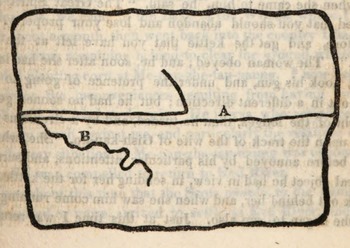
Where Zhaazhaawanibiisens had seen some value in the teachings of Tenskwatawa and Manidoogiizhig, he saw only “insolent hypocrisy” in Aiskawbawis. The two men developed a mutual antipathy. When Zhaazhaawanibiisens once again demonstrated his hunting prowess by killing several moose, enough to feed the entire band, Aiskawbawis attributed the success to his own prayers. When Zhaazhaawanibiisens publicly denounced these claims, Aiskawbawis announced a new revelation, illustrated with a drawing (Fig. 3) that showed the consequences for one who has “turned aside from the right path.” “This short and crooked line [B] represents your life,” he told Zhaazhaawanibiisens. You are to attain only half the age of men.” The long and straight line (A) depicted the long lives of those who would follow the true path revealed in Aiskawbawis's visions. Finally, according to Tanner, the top line, turning sharply away from the rest, indicated the fate of “the young wife of Bapowash,” who had recently offended Aiskawbawis. Tanner called Aiskawbawis hopelessly corrupt, and claimed that he was found soon after this revelation shamelessly chasing after another man's wife. And yet Zhaazhaawanibiisens still could not convince the people that this “pretended prophet” was a fraud. Jennifer Graber reads the drawing by Aiskawbawis, outside the context of Tanner's Narrative, as an example of how Native visionaries used visual media to “project sacred histories into the future.” The instructional imagery of a straight and blessed path, set in contrast to a perfidious, crooked one, was also common at this time across white Protestant cultures. This similarity hints at the possibility of prior interreligious exchange and, more generally, suggests how widely such imagery circulated. Tanner's account of its production once again illuminates his immersion in Anishinaabe social worlds—and reveals how Anishinaabe visionaries, like white settlers, drew boundaries of inclusion and exclusion at this time.Footnote 42
Drawing by Aiskawbawis, from Tanner, A Narrative, p. 197.

Zhaazhaawanibiisens's decision to move into the white world was gradual and fraught with ambiguities. He was pushed out of the local Ojibwe community more than he was attracted by the prospect of life as a white man. It was Aiskawbawis, Tanner writes, who “prejudiced the Indians so much against me, and particularly the relatives of my wife,” that he and Therezia decided to move away from Rainy Lake, their home in what is now northern Minnesota, back to the Red River. By this time, several hundred “Scots people” had arrived to settle at Fort Douglas through the Hudson's Bay Company. The economics of the fur trade were shifting. He took a job with the company but found the Scottish men “rough and brutal.” “Even when they had plenty,” he wrote, “they ate like starved dogs, and never failed to quarrel over their meat.” They were unwelcoming and lewd. Therezia was unhappy. But he made a useful contact in the British Lord Selkirk, the colony's sponsor. After hearing his story, Selkirk invited Zhaazhaawanibiisens to accompany him back to England. “But my attachments were among the Indians,” Tanner wrote, “and I knew it was too late for me to form new associations.” He was interested in establishing contact with any surviving members of his family of origin, though, or anyone who might remember him as a child. And so, when Selkirk departed, he “took with him a letter . . . written in my name, to my friends in the states, giving . . . the particulars of my early history.” This message, he later discovered, reached his Tanner siblings and inspired them to renew their own search for him.
Zhaazhaawanibiisens tried and ultimately failed to reconcile with his wife Therezia's family. Her parents urged the couple to return to live near them again. Several of her younger siblings had fallen ill and died—victims of another disease epidemic—and her parents wanted their surviving children back home. Therezia was eager to go. But the friend who relayed the message warned Zhaazhaawanibiisens that the visionary Aiskawbawis was blaming the children's deaths on him. After several delays—first he and Therezia were also sick with a disease they contracted at Fort Douglas, and then he joined another war party against the Dakota—they rejoined her family. Zhaazhaawanibiisens found their “ill will,” influenced “principally by the unfriendly offices of Aiskawbawis,” set so strongly against him that he decided he could not stay. But that spring, as he cleared a field for planting, he fell from the top of a tall tree, broke several ribs, and was disabled for many months. He found help not from his suspicious Anishinaabe in-laws but from the nearby traders of the North West Company. When he finally recovered, he found that the family still held him responsible for the deaths of Therezia's siblings, and even she temporarily deserted him. They briefly reconciled after his hunting supported the family through another difficult winter. Hunting was satisfying for Zhaazhaawanibiisens and it brought him prestige. But he was far from content.Footnote 43
Although Tanner blamed his problems on Aiskawbawis, his own behavior at a time of rising tensions with both Canada and the United States may also have given the family reasons to resent him. One young man named Wawbebenaissa, jealous of Zhaazhaawanibiisens's success in hunting, berated him as an outsider: “‘You are a stranger,’ said he, ‘and have no right among us; but you set yourself up for the best hunter, and would make us treat you as a great man. For my own part, I have long been weary of your insolence, and I am determined you shall not live another day.’” Wawbebenaissa's brother had been killed by the “Long Knives,” the Americans, with whom he associated Zhaazhaawanibiisens. And, as we have seen, Zhaazhaawanibiisens did tend to set himself apart, perhaps even seeing himself as racially superior. Several months after their first hostile exchange, Wawbebenaissa pulled a gun on Zhaazhaawanibiisens and directed his young son to “stop here while I go and kill this white man.” Zhaazhaawanibiisens wrestled the gun away and then insulted his assailant in gendered terms as a coward, “not a man,” lacking “the heart even of a squaw, nor the courage of a dog.” Not long thereafter, when Zhaazhaawanibiisens was visiting his mother-in-law's lodge, Wawbebenaissa attacked again, this time with an ax, and fractured Zhaazhaawanibiisens's skull. Severely wounded and convinced that his in-laws had facilitated the attack, Zhaazhaawanibiisens fled to find help from other friends. These incidents suggest a growing racial consciousness interlaced with Anishinaabe nationalism. As the Anishinaabeg grew more worried about the expanding reach of both Canada and the United States, as Indigenous visionaries exhorted their people to purge themselves of Long Knives and to make the world anew, both Zhaazhaawanibiisens and his Ojibwe community wondered if he could be truly Anishinaabe, or if he would need to return to the white American world from which he had originally come.Footnote 44
After he recovered from Wawbebenaissa's attack, Zhaazhaawanibiisens finally decided to seek out his family of origin in the United States. It would be a long and hard road. He left “a great store of meat” for his wife and children and set out in the summer of 1818 for the trading post of Mackinac Island, where the U.S. Indian agent gave him provisions and a letter of introduction to Governor Lewis Cass in Detroit. His Anishinaabe traveling companions mocked his ambiguous affiliations. Hungry and walking alongside “a white man's corn field,” they told him: “Shaw-shaw-wane-base, you have come very far to see your relations; now go in and see whether they will give you anything to eat.” When the white family refused and “drove me away,” Tanner wrote, “the Indians laughed at me.” Another white community along the Miami River similarly refused to help them, while “a settlement of Indians” generously provided for their needs. In the flow of the Narrative, these stories offered an Indigenous critique of white inhospitality. They also foreshadowed the troubles that Zhaazhaawanibiisens would encounter in American society. Long after he learned to speak English, the white people would never quite see him as one of them.Footnote 45
In the meantime, the Tanner family was also searching for him. In Detroit, Governor Cass had replenished Zhaazhaawanibiisens's supplies and published a brief version of his story in the newspaper. When this account reached his sister in Kentucky, she dispatched her son to find him. Zhaazhaawanibiisens and his nephew, who had never met and needed an interpreter to communicate, somehow found each other along the Miami River. When he finally reached his sister's home, the exhausted Zhaazhaawanibiisens lay sick for a month. Then, learning that his brother Edward had set out separately from Missouri to look for him at Red River, Zhaazhaawanibiisens set off again to find his brother there. On the road to Detroit, he passed a man “whose strong resemblance to my father immediately arrested my attention.” He was sure it must be his brother. But Zhaazhaawanibiisens was still dressed as an Ojibwe and unable to communicate in English. Try as he might, he could not get the man to “stop and take notice of me.” Some traders down the road informed Edward of his mistake, and several days later the brothers finally met in Detroit.Footnote 46
Zhaazhaawanibiisens then tried his best to reclaim an identity as John Tanner. He and Edward embraced but, at first, could only speak through an interpreter. His brother “next cut off my long hair,” Tanner wrote, “on which, till this time, I had worn strings of broaches, in the manner of the Indians,” and gave him new clothes to wear. The transition was never complete. “The dress of a white man was extremely uncomfortable to me,” he explained, “so that I was, from time to time, compelled to resume my old dress for the sake of convenience.” The brothers traveled together to Edward's home in New Madrid, Missouri, then to visit another sister in Jackson, Missouri, and then back to Kentucky. The family did their best to welcome this long-lost brother, but they struggled to incorporate him into their lives. They were small-scale slaveholders in a racially stratified society, with all-too-recent memories of Indian wars. They viewed Indigenous people and lifeways as racially inferior, “heathen” and “savage.” John Tanner, the “white Indian,” was an exotic, a curiosity, an object of pity. At his sister's home in Kentucky, friends and relatives “crowded around to witness” the siblings’ reunion, and all assembled “shed many tears.” Readers are reminded of the role that Christianity played in this white settler social formation: the family held worship services in their home, with “greater numbers than usual” in attendance. Tanner's brother-in-law took him to the courthouse in the vain hope that they would find “some provision” for him in his deceased father's will. His stepmother gave him some money and other relatives raised a collection; later, as the Narrative all too casually mentions, they sold a few enslaved people for his support. But he missed his wife and children, preferred Anishinaabe foods and lifeways, and simply did not feel at home in this racially stratified settler world.Footnote 47
Tanner was determined to return to Anishinaabe lands once again. The Narrative explains that he wanted to retrieve his children, but it is clear that he also missed his home. His brother Edward offered to go along and—reflecting his view of Indians as the enemy—suggested taking a company of soldiers to seize the children by force if need be. Tanner refused. After a months-long journey, he found Therezia and their four children alive and well. But provisions were scarce and yet another epidemic threatened. Soon after his arrival, their youngest son died of the measles. As he had so many times before, Zhaazhaawanibiisens prepared for a medicine hunt. “In my dream I saw the same young man I had before seen . . . come down in the usual manner, and stand before me,” he wrote. The young man informed him this time would be the last. “‘Henceforth,’ said he, ‘you shall see me no more, and that which remains before you, of your path, shall be full of briers and thorns.’” This one last time, the young man showed him a flock of ducks, a sturgeon, and a reindeer. “This dream was fulfilled, as usual, at least as much of it as related to my hunting and fishing,” Tanner recalled. Zhaazhaawanibiisens had already spent almost a year in Kentucky with his white family of origin, and he faced the prospect of living as a white man. On this occasion he found that he could still summon the power of the medicine hunt, only to learn within the vision itself that he would not be able to do so again. He would have to find a new way.Footnote 48
The final chapters of the Narrative describe Tanner's efforts to extricate his children from their Anishinaabe families and bring them into a white American world. Becoming a white man apparently also meant assuming a coercive paternal authority. Very much against Therezia's wishes, he moved his three young children to Missouri. She accompanied them for part of the journey and then turned back. But he and the children were not “content among [his] friends,” and so two years later he moved them once again to Mackinac, where he worked for about a year as a hunter and trader for the American Fur Company. In this more familiar location, Therezia rejoined the family, and soon thereafter their last child was born.Footnote 49 Still restless, Tanner set out again for the Red River to find his three older children. Now teenagers, these children had no interest in moving to Mackinac, and their mother, Miskwabunokwa, was firmly opposed. Others in the band “were determined to kill me,” Tanner wrote, if he tried to take them away. This time he enlisted military aid. At his request, the captain at Fort Douglas called “all the principal men” of the band to a council and then paraded “a considerable armed force” in front of them. The assembled men “promised to surrender the children.” Tanner took his daughters but not his son, who was “of age to act for himself.” Miskwabunokwa, who refused to be parted from the girls, joined the party. Tanner's whiteness, however precarious, had allowed him to wield the threat of imperial violence. But this victory was only temporary. Several days downriver, a young man who had accompanied the family shot Tanner at close range from a separate canoe. Bleeding heavily, Tanner found his arm “shattered” and a bullet lodged in his side. Miskwabunokwa and their daughters fled the scene. Calling to the Great Spirit for help, Tanner was sure he would die. But some traders traveling the river found him and took him to the North West Company headquarters at Rainy Lake, where he spent most of the next year in recovery.Footnote 50
When he was well enough to return to his family on Mackinac Island, Tanner faced the task of rebuilding his life once again. He took a position as interpreter for the U.S. Indian Agent at Mackinac, where, in the mid-1820s, he began to work with James on the story of his life. He concluded his Narrative on a poignant note. “I have some hope,” he writes, “that I may yet be able to go and make another effort to bring away my [older] daughters.” When the book was almost complete, he traveled to New York and convinced G. & C. & H. Carvill, a sizable publishing house known for historical, literary, and scientific works, to publish it. In the meantime, Therezia had joined the Catholic Church and wanted him to formalize their marriage. He refused and the marriage dissolved. In 1828 he moved to the Ojibwe town of Bow-e-ting, or Sault Ste. Marie, where he worked as an interpreter for the U.S. Indian Agent, Henry Rowe Schoolcraft, and then also for the local Baptist mission.Footnote 51 Tanner had not been able to find a comfortable home among his relatives in Kentucky and Missouri. Both of his marriages had ended badly and his surviving children were scattered. Still, he felt relatively comfortable in the in-between and still largely Anishinaabe societies of Mackinac and Sault Ste. Marie. Perhaps he could yet make sense of his own hybrid identity and make a way forward in a white settler world.Footnote 52
Christianity played a significant part in that effort. We've seen that the Narrative stressed Tanner's lifelong reliance on a “Divine Power.” He and James also worked together on an Ojibwe-language translation of the New Testament that was used in Baptist and Presbyterian missions.Footnote 53 Tanner married for a third time in 1831, to a widowed white woman he met in Detroit, who moved with him to Sault Ste. Marie. The Baptist missionary Abel Bingham reported that August to his superiors in Boston that Tanner had “recently obtained a hope.” His biblical translations were “extensively useful to the farthest extremities of the Ojibwa Nation,” Bingham enthused. In an evangelical revival that touched both white and Indigenous communities in northern Michigan, Tanner was baptized along with a soldier from Fort Brady into the Baptist church. For two years he was an active member, and worked with another missionary to translate some Odawa-language hymns into Ojibwe. Bingham's letters described him as an interpreter and an effective evangelist, meeting “with the Indians in one of the lower rooms” of the mission house in Sault Ste. Marie. “Our assembly moderately increased till about the 20th Nov. when Mr. Tanner moved up,” Bingham wrote. “They then rapidly increased & our meetings soon became quite interesting.” Despite all that Tanner had suffered and lost, perhaps he could make his own way, shaping a new life in the church for himself and for his children.Footnote 54
In sharp contrast to their representations of Indigenous people and traditions, James and Tanner did not see the evangelical Christianity of the Baptist missions as evidence of credulity. More to the point, the trope of credulity was part of a colonial racial ideology in which Christianity, whiteness, rationality, and civilization were assumed, for the most part, to fit seamlessly together. Tanner's Narrative is a layered text that simultaneously inscribes and pushes back against these associations. Zhaazhaawanibiisens's medicine hunting, for example, appears in the text as an effective and meaningful practice through which he has always found divine guidance. In Sault Ste. Marie, Tanner helped foster an Anishinaabe Christian community that had the potential, within the constraints of settler colonialism, to resist religio-racial binaries by making Christianity serve Indigenous needs. Readers of his Narrative are well advised to reverse the lens of credulity. White settlers in the nineteenth century sneered at the gullibility of Indians who, they believed, had been taken in by false “prophets.” But from where I sit, it would seem that the colonial hierarchies of race and religion—and the white elites who peddled them—were the biggest frauds of all.Footnote 55
Evangelical Benevolence, Settler Science, and Comparative Religions
When Edwin James took on the project of editing Tanner's Narrative, he was already known to the American reading public for his Account of an Expedition from Pittsburgh to the Rocky Mountains (1823). Led by Major Stephen Long of the U.S. Army Corps of Engineers, this expedition, like others of the time, had been commissioned by the Department of War in order to map Indigenous territories that the United States hoped one day to claim. James had served as expedition botanist and geologist, aptly illustrating the role of settler science in mapping the continent for conquest. Tanner likely met him for the first time in 1820, when he encountered “some of the gentlemen of Major Long's party” in Cape Girardeau, Missouri, “on their return from the Rocky Mountains.”Footnote 56 When Tanner arrived on Mackinac Island several years later, James was working as an army doctor. He wanted to be an ally, both to Tanner and to the cause of the “Indians” as he understood it. He did his best throughout the Narrative to position Tanner as a white man, to distance him racially from the Indians with whom he had lived for so long. That effort undercut James's desire, at the same time, to present the Narrative as a defense of the Indians’ racial character and in opposition to their forced removal. In his references to divine Providence and his inclusion of short prayers and Bible passages translated into the Ojibwe language, James hinted at the evangelical goals that he had by this time embraced. These various goals reflected his posture both as a settler scientist, now moving from his earlier interests in botany and geology into the fields of ethnology, philology, and comparative religions; and as an evangelical Christian reformer. His introduction and appendices to Tanner's Narrative provide a valuable entrée into the colonial circulation of knowledge about religion and its role in debates around the racial character and future prospects of Native Americans.
James anticipated that readers would judge Tanner harshly. His introduction, more insistently than the main text of the Narrative, deployed the tropes of rationality and credulity to racially distinguish Tanner from the Indians. When Tanner “tells of prophetic dreams” and of “the interference of invisible and spiritual beings,” James wrote, “he will appear to some, weakly credulous—to others, stupidly dishonest.” James urged his readers not to judge Tanner too quickly and to recall that the early histories of all races were littered with “credulity; closely resembling that which we feel disposed to ridicule or to pity in the savage.” In white society, he claimed, the advances of civilization had long ago converted such fantasies “to old wives fables.” Not so for the Indians among whom Tanner had lived most of his life. Credulity, in this account, was an attribute of uneducated women and racial inferiors, intellectual weaklings stuck in the primitive past, incapable of discerning truth from falsehood or controlling their own minds. Living as an Indian, James reasoned, Tanner had been socialized into credulity and could not always trust his own mind. But according to James, he had never lost the abilities of rational discernment that came with whiteness: “If he was less entirely than his Indian associates the dupe of those crafty Prophets, who are constantly springing up among them, yet he had not, at all times, entire confidence in the decisions of his own mind, which taught him to despise their knavery, and ridicule their pretensions.” To be restored to the full measure of whiteness, Tanner had to show that he had never really been taken in by the false prophets and superstitions that allegedly consumed the Indians’ lives. James believed he had, just barely, succeeded in that attempt.Footnote 57
It is difficult in the body of the Narrative to disentangle James's voice from Tanner's. In the introduction and appendices, however, James drew much clearer religio-racial lines than those inscribed by their collaboration. (If my own tone changes in this section of the essay, it is because the appendices shift from the autobiographical register of the Narrative into the classificatory schemes of settler science.) True religion for James was rational, reverent, and racially linked to whiteness. It was entirely compatible with a racialized critique of credulity. James's introduction therefore described Tanner as a white man who was racially predisposed to “a purer and more consistent Theism” than his “untaught companions,” the Indians. “The powerful mind of our narrator,” he explained, “was at all times strongly influenced by a belief in the ubiquity, and frequent interpositions in the affairs of men, of an over-ruling Providence.” Tanner could not be blamed if his naturally rational faith had at times been confused with Indigenous practice, or if he had expressed his piety in Indigenous ways. “We believe there is nothing inconsistent with true religion, or sound reason,” James wrote, “in supposing that the same Lord over all, is gracious unto all who worship him in sincerity.” Indians could be sincerely devout, perhaps, but they lacked the “powerful mind” of a white man, like Tanner, who could never truly be at home among them.Footnote 58
James hoped that the Narrative would inspire readers to benevolent Christian action. But in the end his appeals only reinforced the racial lines that also motivated anti-Indian violence. “Few will read it [the Narrative] without some sentiments of compassion for a race so destitute, so debased, and hopeless,” he wrote. Sounding a familiar evangelical chord, he called “the attention of an enlightened and benevolent community to the wants of those who are sitting in darkness.” There is a familiar dialectic here between the evangelical conviction that all men were equally deserving and beloved by God, and a benevolent imperial whiteness that judged its racialized others to be perpetual heathens, permanently in need of redemption and likely fated to disappear.Footnote 59 “The truth is, it has been, and still is, convenient to consider this a devil driven race,” James acknowledged, “doomed by inscrutable destiny to sudden and entire destruction.” Contact with “civilization” had only made the situation worse, and perhaps in the end it would be “impossible for us to avoid displacing the Indians and occupying their country.” Like many northern Protestants, James considered the Jacksonian policy of Indian removal heartless and cruel. The designated land west of the Mississippi was “inhospitable” and would “soon reduce [even] civilized men who should be confined to it, to barbarism.” The only benevolent solution, James thought, was at least to try to civilize them in their current homes.Footnote 60
According to James, Tanner's Narrative suggested this potential because it demonstrated the full humanity and essential goodness of Indigenous people. Ironically, he was accused of being too credulous in this conviction. U.S. Indian Agent Henry Rowe Schoolcraft, who never liked Tanner and was an enthusiastic advocate for Indian removal, tried to delegitimize the Narrative by calling Tanner a villain who had hoodwinked James for his own profit and entertainment. But James, too, thought that Indigenous people had no real future without a civilizational transformation. If the project of missions succeeded, he wrote, then “a portion of the remnants of these people might be preserved, by becoming embodied with the whites.” It would not be possible for Native Americans to survive “as separate and independent tribes,” he wrote. Their children would have to be Christianized, “civilized,” and ultimately whitened. To make all of this possible, their tribal affiliations and identities would have to be erased. Cultural genocide by way of missions was, in the eyes of James and many of his peers, the benevolent solution.Footnote 61
James wrote the lengthy ethnographic appendices to the Narrative, titled only “Part II,” as a scientific investigation of the “Indians” in Tanner's story. These investigations—featuring Ojibwe-language vocabulary lists along with James's explorations into the emerging colonial science of comparative religions—also served his evangelical goals. He began with this list of contents for the first appendix: “Of feasts—of fasts and dreaming—their idea of the human soul, and of a future existence—customs of burial—of their knowledge of astronomy—traditions concerning the sun and moon—of totems—of their acquaintance with plants, animals, and minerals.” The first and most important of the profiled feasts was what James calls the “Metai-we-koon-de-win, or that feasting which forms a part of their great religious ceremony, the Metai [Midewiwin].” James immediately dismissed the “priests” or “medicine men” of the Mide as “crafty imposters, who subsist, in a great measure, by practicing on their credulity. . . . When one of these has been so fortunate as to gain an ascendance over their superstitious and credulous minds,” he explains, “he sometimes sets up for a prophet, and claims intercourse with superior and invisible beings.” Where Tanner had avoided discussing the Midewiwin—and when he did mention it, contrasted it favorably to the “false and dangerous religion” of the Wabeno—James linked the “priests” of this “religious ceremony” with the “prophets” who played such a negative role in Tanner's story. Tanner allowed space for the validity of certain Anishinaabe practices, particularly the Midewiwin and the medicine hunting that had been so important to his own experience. But in James's evangelical-colonial project of debunking, Indigenous priests, prophets, and dreamers were all false pretenders playing on the credulity of their people.Footnote 62
Through the chapters that followed, James wove comparative materials drawn from then current scholarship on Native American traditions and the broader study of religion. Indeed, elements of this text would later become part of that wider circulating body of knowledge. Perhaps most significantly, the item “of totems,” from the preceding list, helped inspire the invention, within the developing nineteenth-century discipline of the anthropology of religion, of the concept of “totemism.” Theresa Schenck explains that anthropologists building on the work of James and other early nineteenth-century writers in the region misinterpreted the Anishinaabe doodem and linked it with other concepts—the equally misinterpreted Aboriginal Australian kabong and the African (Sotho and Tswana) siboko—to posit allegedly universal patterns of “primitive religion.” According to this invented anthropological concept, Schenck writes, “men regarded their totemic animal with religious—even superstitious—reverence, believed they were descended from this animal, and were forbidden to hunt or eat the totem.” And yet James and Tanner had been quite clear that the Anishinaabe totem, or doodem, simply functioned as an extended family name that brought certain social obligations. Heidi Bohaker has shown that the doodem played a significant role in Anishinaabe treaty-making and political geography, and did not involve worshipping the totemic animal. Early anthropologists of religion, nevertheless, would universalize the term “totem” to serve as further grist for their dismissive accounts of Indigenous credulity.Footnote 63
James drew on a variety of sources in developing religious comparisons. At times he cited his own earlier publications on the Menominee, as well as texts by other U.S. officials such as Commissioner of Indian Affairs Thomas McKenney and the U.S. Indian Agent at Sault Ste. Marie, Henry Rowe Schoolcraft, who was already seen as an emerging authority on Indians and would become another source for anthropologists on the totem.Footnote 64 James portrayed Anishinaabe “fasts and dreaming” as a self-evidently ridiculous practice. For example, he offered a lengthy account of an Ojibwe man who had once dreamed about a bat, “wore the skin of a bat tied to the crown of his head” thereafter, and attributed all his successes in warfare “to the protecting influence of [this] medicine.” Then he provided a wider comparative lens: “The belief, that communications take place in dreams from superior beings to men, is not peculiar to this people, or this age of the world. . . . Men, particularly, when their minds are little cultivated, are ever ready to believe themselves objects of particular attention, and the subjects of especial solicitude to their divinities.” Here again, he aimed at a benevolent sympathy with those he deemed primitive. To those with “cultivated” minds these beliefs might appear absurd but, viewed comparatively, they held much in common with other “primitive” peoples around the world and, indeed, with any Christian who believed in divine intervention. And yet, once again, his effort at sympathy assumed a colonial hierarchy in which credulity marked the boundary of the truly civilized. Gradually, unsystematically, James was building a comparative theory of the religions that he deemed primitive and, he assumed, more or less the same all around the world.Footnote 65
Working within a broadly Christian intellectual framework, James explored the question of racial origins through the exercise of comparative religions. Like many colonial ethnologists, he pointed to the beliefs or “mythology” of a people for information on their racial history. It was a difficult problem, he warned, because Native Americans had “no store house of ancient learning.” The Indians had “traditional items, bearing manifest and strong resemblance to those of the great Asiatic family, from whom we have adopted many of our religious opinions,” and must therefore be connected to the “primeval stock” of Asia that had “sent forth its branches into all parts of the earth.” Thus, he concluded that Native Americans were “essentially of the same race with the Peruvians, the Mexicans, and the Natchez; between whom and the ancient inhabitants of Greece and Italy, and that portion of the present population of India who worship Brama, Boudd, Ganesa, Iswara, &c., a near relationship has already been ascertained.” Formal similarities in religious practice could serve as evidence of common racial origins; these hypothetical family trees could then provide the rationale for further religio-racial comparisons.Footnote 66
Next, James weighed in on the much-theorized possibility of a historical link to the ancient Hebrews. Acknowledging that Indigenous mythology included “distinct allusions to a general deluge” and “other particulars” associated with “the Mosaic history,” he cautioned that similar tales were widespread “among all known races of man.” It was therefore doubtful that Native Americans had “derived [them] from the historical books of the Hebrews.” Instead, these similarities reflected “the glimmerings of that primitive light, which, at the first great division after the flood… must have been in possession of all mankind.” Those who posited that Native Americans descended directly from the Hebrews were making too much of parallels that were, after all, shared across much of humankind. James's insistence on shared human origins also intervened in the politicized racial science of the day. Leading scientists in this era of escalating proslavery ideology argued, against older Biblical views of shared human origins, that human races had entirely disparate beginnings and that racial differences were therefore immutable. James, as a benevolent evangelical settler scientist, hoped with his comparative study of religion to instantiate a biblical view of the underlying unity of all humankind. Religious comparison could reveal that unity, he believed, even as it illuminated a religio-racial hierarchy that upheld the superiority of Christianity and of the Europeans who claimed it as their racial inheritance.Footnote 67
James mobilized Tanner's accounts of the Ojibwe Midewiwin into this project of comparative religions. His appendices included a number of “medicine songs” with Ojibwe-language verses and accompanying illustrations that could only have been drawn by Tanner. James's commentary on the “Song for Medicine Hunting” (Fig. 4), in particular, posited similarities to Christianity and even more powerfully to the religious traditions of India. These figures, he wrote, “represent Na-na-bush [Nanabozho], the intercessor, the nephew of mankind. They seem designed to carry back the thoughts towards the beginning of time . . . when this mysterious and powerful being exercised a wish to assume the form of a man.” James represented Nanabozho, a central figure in Anishinaabe origin stories, as the divine incarnate, much like Jesus Christ. Then he pivoted to a different comparison. “In the sitting figure of Na-na-bush,” he wrote, “there is some resemblance to the Asiatic Iswara, or Satyavrata, who, in the eastern mythology, is connected with one of their deluges. Like Noah, like Saturn, and like Iswara, Na-na-bush preserved, during the inundation, those animals and plants, which the Indians often repeat, remind us of the age when one language was common to men and brutes.” Readers should not be surprised, he wrote, to find “that the characters of all pagan deities, male and female, melt into each other,” for they all had shared origins in a primal devotion to “the powers of nature, and principally those of the sun.” Again, James compared between ancient “pagan deities” and the contemporary peoples he judged “primitive.” And again, the post-Enlightenment quest for the origins of religion, easily compatible with James's evangelical convictions, served the colonial project of racializing “Indians.”Footnote 68
“Song for Medicine Hunting,” from Tanner, A Narrative, p. 351.

Theories of comparative religion circulated widely within and across colonial contexts. Like the South African colonial officials that David Chidester has profiled, and the late nineteenth-century researchers working with the Bureau of American Ethnography, James collected his raw material in conversation with Indigenous people, consulted a wide range of comparative materials, and contributed to a global circulation of knowledge about religion.Footnote 69 His most important source on the wider field of comparative religions was the Asiatic Researches, a five-volume work published in 1799 in London by the Asiatic Society of Bengal and authored primarily by the society's president, Sir William Jones. Jones served as James's only source on “Asiatic” mythology, including an image that he borrowed from Jones and retitled “Iswara of India, the Saturn of Italy, the Nanabush of the Algonquins” (compare Figs. 5 and 6). Jones was a colonial official and world-renowned philologist, now remembered for theorizing the Indo-European family of languages, including Sanskrit, Latin, and Greek. As in James—and in fact shaping James's approach—his questions about linguistic family trees were entwined with the origins of race and religion. Jones offered influential methods for such comparisons. “When features of resemblance, too strong to have been accidental, are observable in different systems of polytheism,” he wrote, “we can scarce help believing that some connection has immemorially subsisted between the several nations who have adopted them.” Although he found echoes in ancient Sanskrit texts of the opening passages of Genesis, Jones judged the latter far superior—indeed, he judged it the most sublime text ever written—and thought their power “considerably diminished by the Indian paraphrase of it.” Like any form of “paganism,” East Indian “polytheism” could offer only a degraded substitute for Christian truth. Jones wrote well before the height of Orientalism and held considerable respect for the sophistication of India's languages and traditions. As with his efforts to map a genealogy of the world's languages, his comparative mapping of religions pointed to an ultimate unity of origins that nevertheless supported a racialized hierarchy with Christianity at the summit. As Tomoko Masuzawa has described, Jones and the kind of philology he represented provided much of the intellectual grounding for the emerging paradigm of world religions.Footnote 70
Ganesa and Iswara, from Asiatic Society of Bengal, Asiatic Researches, p. 249.

“Iswara of India, the Saturn of Italy, the Nanabush of the Algonkins,” from Edwin James, Part II in Tanner's Narrative, p. 362.

Edwin James shared these basic convictions and found a great deal to admire in Jones's work. James was far less systematic and more openly evangelical than Jones. In his appendices to the Narrative, alongside his interventions into the emerging sciences of philology, ethnology, and comparative religions were long vocabulary lists: a twenty-page “Catalog of Plants and Animals,” common phrases in both Ojibwe and Menominee, and a study of Ojibwe verb conjugations. His linguistic and religious concerns came together in the final section of the book, which offered up an Ojibwe version of the Lord's Prayer, sample Biblical passages in several different Indigenous languages (including a sample from Elliot's Bible, the famous seventeenth-century missionary translation into Massachusett), and a new Ojibwe translation, in collaboration with Tanner, of the first chapter of Genesis. James's introduction had clearly stated his evangelical intent. In this final portion of the book, his studies in comparative religion provided a wide-ranging historical and comparative account of the Indians’ degradation. By way of conclusion, then, he wrapped up the text with linguistic resources for Christian missions.Footnote 71
Afterlives
John Tanner never quite secured the respect he felt he deserved. A few years after the publication of the Narrative, he began to lash out in anger at those around him. U.S. Indian Agent Henry Rowe Schoolcraft took advantage of his lack of a formal education, paid him only irregularly as agency interpreter, and favored his own relatives when the budget had to be cut. As noted previously, Schoolcraft thought that James had been hoodwinked by Tanner into crafting a book that treated him far more sympathetically than he deserved. The high-handed agent came to despise Tanner, denigrating him as “inveterately savage,” an embittered freeloader who was “on ill terms with the civilized world . . . more suspicious, revengeful, and bad tempered than any Indian I ever knew.”Footnote 72 Nor was Tanner's work at the Baptist mission secure. The missionary Abel Bingham failed to convince his mission board in Boston to adequately fund his position. “Tanner as interpreter can't live on what I give him, wants to stay but will go elsewhere if the mission does not employ him,” Bingham wrote. “We can do nothing without him.” The board considered hiring him as an evangelist, but the funds never materialized.Footnote 73 Tanner and his third wife, with a new baby in 1832, struggled to make ends meet. Tempers flared. Another Baptist missionary, boarding with the Tanners, journaled about an unspecified conflict with “Br. Tanner” that required Bingham's mediation. Then Tanner's marriage began to fall apart. He thought his wife was flirting with the soldiers who came to church from the nearby Fort Brady. She resented his suspicions and his jealousy. One day, angry at the world, Tanner severely beat his ten-year-old son James for running away—perhaps the boy had hoped to return to his mother, Therezia, in Mackinac—and then was jailed for cruelty to his son. Tanner's wife, fearing that he would take his anger out on her, took the opportunity, with help from the missionaries, to flee with the baby to Detroit. Tanner, enraged at what he saw as a series of betrayals, fell out of favor with the church. After a short-lived attempt at reconciliation, he was permanently “excluded” from fellowship in the fall of 1833.Footnote 74
The Narrative did not land in the way that either Tanner or James had hoped it would. Initially, some readers thought it supported the case against removal. One review lamented the newly implemented Indian Removal Act—which passed Congress, after vigorous debate, a few weeks after the Narrative appeared—and concluded that the book demonstrated the shared humanity of Indigenous people. The flaws of the Indians in Tanner's story were all too human, the reviewer said, and white Americans who considered themselves “civilized” should not be so quick to judge. But these benevolent sentiments were easily compatible with (and even facilitated) the idea that Native people were essentially incapable of achieving “civilization.” Indeed, the same reviewer opined in tragic tones about the inevitability of Native American disappearance. Above all, Tanner was an object of fascination for white American and European readers who found it impossible to imagine a white man living as an Indian. The Narrative was soon translated into French—taken to France by none other than Alexis de Tocqueville, who met Tanner in 1831 in Sault Ste. Marie, and judged him essentially “savage”—as well as into German and Russian, and reprinted many times in the United States. Was Tanner irredeemably tainted by his close association and formation as an Indian, readers wondered? Or had his hereditary whiteness protected him from the “savagery” and “heathenism” around him? While the book offered tantalizing details about Indigenous life and lifeways, Tanner himself was a curiosity, a problem, an object lesson for the widening racial divides of Jacksonian America. Many saw him as living proof of the circulating theory—which sometimes became a self-fulfilling prophecy—that crossing racial lines could only end in tragedy.Footnote 75
The rest of Tanner's life is harder to trace. His story is tempting to read as a parable of Indigenous dispossession. He lived for some years in a small house near Sault Ste. Marie, where the missionary Abel Bingham's daughters later recalled him as a frightening figure. His eyes were haunting, people said. He built ties with the nearby Ojibwe community at the Little Rapids; he reportedly remarried once more, to an Ojibwe woman from the region. Several times he tried to reclaim the back pay that he believed the U.S. Indian Agency still owed him. Allegedly, he threatened to kill both Schoolcraft and the missionaries. After one such incident in 1836, Bingham “had him arrested and confined” for several weeks. He was accused of killing cattle belonging to the mission. Then he became the prime suspect in the 1846 shooting of James Schoolcraft, Henry's younger brother, but the murder was never conclusively solved. Local people also suspected an officer from Ft. Brady, Lieutenant Bryant Tilden, who had argued bitterly with James Schoolcraft and threatened to kill him. Years later, Tilden allegedly confessed on his deathbed to the murder. Whatever the truth of the matter, Tanner remained absent from the historical record thereafter. Perhaps he died in isolation; perhaps he found refuge once again in Anishinaabe society and avoided further contact with a white world that now saw him as a villain. John Fierst reads his story as a clash of worldviews within an increasingly racialized settler colonial world. Coming from a basically Indigenous perspective, Tanner reacted in anger to the structural injustices and the settler racism that made it so hard for him to compete. As with so many individuals in colonized and racialized communities, he was increasingly criminalized by white society in Sault Ste. Marie.Footnote 76
As time went on, most published references to Tanner's Narrative involved attacks on Tenskwatawa and others misnamed as “Indian prophets.” Nineteenth-century accounts of the Shawnee brothers Tecumseh and Tenskwatawa—key leaders in the early nineteenth-century pan-Indian resistance to U.S. expansion—demonstrate how the “prophet” motif worked to dismiss and discredit Indigenous claims. In books such as Benjamin Drake's Life of Tecumseh and of His Brother the Prophet (1852) and Edward Eggleston's Tecumseh and the Shawnee Prophet (1878), Tanner's Narrative was mobilized to serve these discursive goals. Where Tecumseh was increasingly valorized as a “noble savage,” brave and patriotic, if misguided and fated to lose, Tenskwatawa became the very figure of the conniving prophet. With long quotes from Tanner, Drake judged the popularity of the Shawnee “prophet” as proof of the Indians’ “superstitious credulity.” Eggleston characterized Tenskwatawa as full of “ignorance, persecuting fanaticism, and imposture,” with perhaps a glimmer of positive “ambition to be a benefactor to the Indians.” The prophet's “system of religion,” Eggleston wrote, was merely “a farrago compounded of Indian prejudices and scraps of ideas gathered here and there from the missionaries.” In this way, Tanner's Narrative served most visibly as part of the larger body of circulating settler colonial knowledge about Indian “superstitions,” “false prophets,” and “credulity” that served to racially denigrate Native Americans and discredit their claims to land and sovereignty.Footnote 77
At the same time, Tanner's story also continued to circulate and to resonate in Anishinaabe social worlds. Ojibwe children were warned to be wary of an angry and still sharp-eyed Tanner, wandering the woods and likely to lash out at anyone he encountered. “There are still Ojibwa who were frightened into good behavior, as children by the threats of Tanner's ghostly appearance,” writes Louise Erdrich. “He is said to haunt certain rivers.” Not unlike the Indian in Waukazoo's parable, the convert to Christianity who was denied access both to the white man's heaven and to an Indigenous afterlife, this “white Indian” became a haunting image, a ghost who could never quite come to rest, an unsettling specter of settler colonialism's racializing violence. At a time when Indigenous identity was being (re)forged in opposition to settler whiteness, some Anishinaabeg had been unable to accept him any longer as one of them, and forced him to leave their community to seek his fortunes elsewhere. Even the young man who appeared to him in his last medicine vision had told him that he could no longer secure help in this profoundly Anishinaabe way. Later, attempting to claim the privileges of whiteness, he embraced Christianity, only to be judged insufficiently white and insufficiently Christian. His story might well have been remembered within Anishinaabe communities as another parable about the perils of crossing colonial lines of religio-racial difference.Footnote 78
The afterlives of Tanner's Narrative thus offer further glimpses into Indigenous as well as white settler theorizing about religion. Like Waukazoo, some nineteenth-century Anishinaabeg concluded that Indians were essentially different from white people. Christianity might be good for the white man, they argued, but Indians already had religions of their own. They must follow their own ways, those given to them by the Great Spirit and passed down to them from earlier generations. In response to their dire circumstances—and to fend off the colonizing work of Christian missions—some Native leaders articulated theories of religion that helped them shape a new religio-racial identity across tribal lines. The instructions from Tenskwatawa and Manidoogeezhig for their followers to throw away their medicine bags reflected widespread fears that the old ways of accessing sacred power were no longer working. A new message, a new revelation from the Great Spirit, was needed to unite and purify the people and to renew the balance of their world. Did these visionaries offer the best way forward for Indigenous futures? Or were they frauds who betrayed time-tested ways of knowing and doing, as the Anishinaabe Zhaazhaawanibiisens and the Sauk Winnehea contended? In either case, many Anishinaabeg articulated their religio-racial identity in opposition to the Christianity that had come to them as a colonizing force. Long after Tenskwatawa's movement had petered out, many Anishinaabeg continued to reject Christianity. In Tanner's day, the majority of Odawa people rejected both Protestant and Catholic missions, and many remained “unconverted ‘traditionalists,’” as James McClurken puts it, throughout the nineteenth century.Footnote 79
But these were not the only models for Anishinaabe futures. Tanner's short-lived missionary career hinted that Christianity too could provide a new path forward in difficult times. While Tanner himself did not stay within the Baptist fold, a growing number of Anishinaabeg chose to join Methodist, Presbyterian, or Baptist churches. In the early 1830s, Waukazoo and his band moved to southern Michigan where he managed to buy some land and, for a time, affiliated with a Presbyterian mission. Near Waganakising, meanwhile, an Ojibwe Methodist preacher named Peter Greensky (Showskawageshik) founded a Methodist church led by and for Odawa and Ojibwe people. In southern Ontario and the Lake Superior region, too, the famous Ojibwe evangelist Shawundais brought many Anishinaabeg into a style of Methodism that strengthened Indigenous communities.Footnote 80 Others affiliated with the Catholic Church. Tanner's ex-wife Therezia and their daughter Martha were both baptized Catholics, and Martha served for many years as a teacher in Catholic Indian schools.Footnote 81 Waukazoo's brothers, the Odawa headmen Assiginac and Macatebinessi, had already made the calculated decision in the mid-1820s to invite a Catholic priest to Waganakising. Faced with disease epidemics, coerced treaties, and the threat of removal, they hoped that their children could gain an education that would help them better navigate an uncertain future. Catholicism became a key part of their strategy to secure Odawa homelands against the looming threats of removal and dispossession. These Native Christians refuted the religio-racial binary that had made Tanner such a haunting figure. Indians and Christianity were not necessarily a contradiction in terms.Footnote 82
In the late twentieth and early twenty-first centuries, however, many Anishinaabeg turned against Christianity once again. While honoring the decisions and strategies of their ancestors—strategies that had in fact enabled their survival—young Odawa and Ojibwe people began to voice their anger at the missionaries’ ongoing assaults on Anishinaabe languages and cultural traditions. In Harbor Springs, Michigan, Odawa historian Eric Hemenway showed me the current grounds of Holy Cross Catholic Church, the legacy of Assiginac and Macatebinessi's decision to invite the Catholic Church into Waganakising so long ago. Until the Holy Cross boarding school closed in 1983, many Anishinaabe children were traumatized by the cultural, physical, and sometimes sexual abuse that they suffered there. Students were not allowed to speak their Native languages and were trained to be docile, not to speak up and speak out. For these reasons and more, younger Odawa generations have for the most part rejected Christianity, turning instead to reconfigure Indigenous religious traditions and so to remake their futures once more.Footnote 83
In the twists and turns of this story, one final afterlife for John Tanner comes into view. In her introduction to the 2000 edition of the Narrative—which omits James's introduction and appendices—Louise Erdrich writes that her family prized Tanner's account as an essential source on nineteenth-century Anishinaabe life. In Erdrich's description, Tanner is a heroic figure, honest and courageous, devoted to his extended Odawa and Ojibwe families, and rightly “disgusted with the false religious prophets who, from time to time, appear among the stressed and suffering Ojibwe.” “His life,” Erdrich concludes, “was a paradigmatic quest to belong, a restless search for peace and place.” On a similar note, Eric Hemenway told me that as a young adult he read Tanner almost every year as a moving portrait of a thoroughly Anishinaabe world. Tanner was right, Hemenway said, to reject the prophets like Tenskwatawa who offered fraudulent visions of the future and drew their people away from older Anishinaabe ways. Unlike the young Anishinaabeg of Tanner's day, some of whom rejected him as nothing but a “Long Knife,” a white American, Erdrich and Hemenway see Tanner as fully Anishinaabe and a trustworthy guide to Anishinaabe history. “He challenges all easy assumptions about race and nurture,” Erdrich writes. If Tanner was a tortured soul in his final years, the torments were derived from the settler hierarchies of race and religion that so thoroughly excluded him. In embracing Tanner—and in pushing back both against Christianity and against the Indigenous visionaries who once countered colonialism with their own religio-racial divides—these Anishinaabe thought leaders are also retheorizing race and religion in hopes of decolonizing all of our worlds.