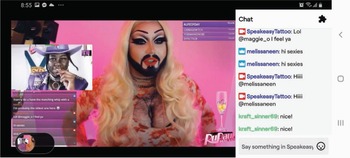
Allysin Chaynes’s Drag Race Viewing Party on the Speakeasy’s Twitch Channel with special guest Manny Dingo, March 2020. (Photo courtesy of Reid Millar)

Drag on Lock Down
On 31 March 2020, a mere 15 days into the Covid-19 lockdown, I tune in to Buddies in Bad Times Theatre’s Instagram Live feed to watch a digital performance by my favorite local queer artist. Gay Jesus (the drag name of Heath V. Salazar) is a Latinx, trans nonbinary poet and drag king who has been performing in Toronto since 2016. Jesus’s work draws on elements of burlesque and protest art, often involving stripteases and erotic dance underlined with deeply political messaging. On this occasion, Buddies has invited Jesus to take the virtual stage as part of the theatre’s quarantine response festival Queer, Far, Wherever You Are. The performance falls on the International Trans Day of Visibility, a programing decision entirely timely given Jesus’s personal identity and politically rooted artistic mandate.
Jesus spends much of the hour-long drag show just talking to the audience via the chat function. They establish the interactive nature of the performance early on, asking their audience to help with their technical set up. “I’m going to need you to participate. Sound check: if it’s good send me a peach emoji, if it’s terrible send me a knife… I see peaches!”Footnote 1
Jesus explains with a giggle and a wink, “I’m performing in my closet so as to not disturb my neighbors.” As they reflect on the irony of performing in a closet on a day about visibility, they recall the first time they heard they/them pronouns used—“I didn’t know trans was an option”—and share how their understanding of themselves and their community has expanded since coming out. This process, they explain, has been bolstered by their artistic practice as a drag king and member of the queer performance community.
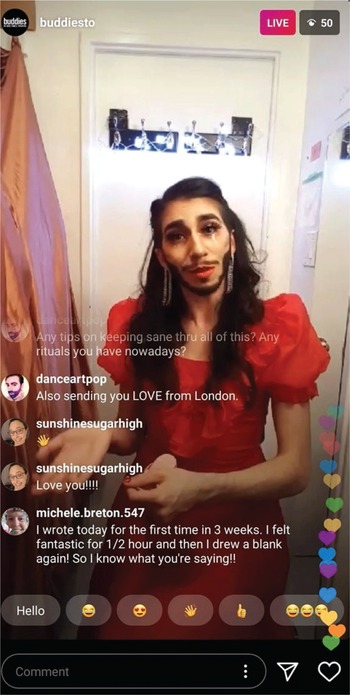
This discussion leads Jesus into their first performance, a lip-synch to a mashup of “Rise Up” by Andra Day, “Hold Back the River” by James Bay, and “All These Things That I’ve Done” by the Killers. Jesus begins the performance in a warm gray suit over a silky red shirt with matching red gloves. They dance slowly to the music, moving their hips and arms but maintaining their footing in the center of the screen.
As they dance, they slowly begin to undress, first removing their red gloves in time to the music, followed by their gray dress pants and then their matching blazer. As the suit is fully discarded the red “shirt” unfolds and is revealed to be a full-length ball gown. The length of the skirt and puffed red sleeves unfurl from the blazer. Jesus, who has a full beard, stands in their red prom dress with matching nail polish and glittering red lipstick. At the song’s climax, they reach into the bodice of their dress and pull out a trans flag with the words “Protect Trans Kids” written in black ink against the soft pink, blue, and white. As Andra Day’s lyrics swell, Jesus raises the flag high above their head before letting it float to their side. They silently bow to the camera amidst a chat-box flood of texted cheers and praise from the audience.
Queer, Far was initially conceived as a 10-day festival but ended up running for three months due to the success of the program during the evolving pandemic. The show stands out in my mind for both the speed with which Buddies created online content amid the indefinite suspension of live performance, and the poignancy of how harmoniously Jesus’s distinctly queer content adapted to synchronous digital performance.
In the first month of Covid-19 restrictions, live performers from opera singers to Broadway actors quickly took to social media platforms to find alternate ways of engaging their audiences. Drag artists, I argue, are in a unique position in relation to other live performers in this moment of digital performance. The historic relationship between queer performance and recorded media, the history of LGBTQ2+ community-building through social media, as well as the citational nature of queer coding fuels drag as an art form. For most live performers, Covid-19 represents an interruption and suspension of their traditional artistic practice, but for queer artists and audiences, the recent influx of digital performance during quarantine creates a uniquely reflexive moment in the history of drag.
Queer coding, the citational practice of communicating queer values through the coopting of mainstream media, has functioned as a form of covert communication and community building since the early 1900s (Meyer 1993:66). The practice of drag artists lip-synching to prerecorded music dates back to the early 1950s (Senelick Reference Senelick2000:354). Drag’s history of creating performance by impersonating, parodying, and paying homage to queer-coded media like old Hollywood film, television, and recorded music speaks to the history of queer coding in drag, a history that relies on blending live performance in shared community spaces using mass-produced, widely accessible recorded media. In days when overt representation of openly queer characters was impossible, queer artists and their fans built queer communal exchanges out of coded fragments of readily available mainstream media.
The liveness of drag’s performance has always been citational and cyclical, harkening back to and queering a mainstream original—a practice coopted by generations of artists. The very citationality of drag’s use of queer coding has always put the concept of “liveness” in quotes. Thus, digital drag during the quarantine of Covid-19 connects to a history of drag as a hybrid live-mediatized art form. As such, digital drag offers new insights into the history of the conditions that have enabled the performance of queer culture for nearly a century.
In order to trace some trends in the phenomena of online drag during the Covid-19 pandemic, I examine and compare three case studies from local drag artists in my own community of Toronto, Canada: Miss Conception’s Where in the World Is Miss Conception; Buddies in Bad Times’ Queer, Far, Wherever You Are featuring Gay Jesus; and Allysin Chaynes’s Drag Race Viewing Party. To contrast these performances from early in the pandemic, I will also consider works by these artists from December 2020: Miss Conception’s Holiday Hangover, and finally, Speakeasy Tattoo’s Spelling Bae, featuring Gay Jesus and Allysin Chaynes.
In January 2021 I Zoom-chatted with Conception, Jesus, and Chaynes, as well as Lizzie Renaud of Speakeasy Tattoo and Aidan Morishita-Miki and Jonathan MacArthur of Buddies in Bad Times, asking them about their experiences of a year performing digitally under Covid-19 restrictions.
I select just the Toronto cases despite the fact that with the proliferation of virtual performances I have unprecedented access to drag performance from around the world because I want to compare these live, digital versions to in-person versions. Moreover, these artists have all prioritized synchronous performance in order to augment liveness, while using social media platforms to preserve the interactive, communal ethos of drag performance.
Where in the World Is Miss Conception?
Miss Conception began performing in Toronto in the late 2000s and quickly established herself as a campy “nostalgia queen.” Conception became known for her shows featuring old Hollywood and classic Broadway characters. In the past 10 years, Conception has based herself outside of Canada, touring the US and Mexico. These tours typically feature live singing of curated song cycles based on specific themes like Disney, Old Hollywood, or television classics. In March 2020, like so many artists, Conception saw the majority of her summer touring gigs canceled as performance in bars or clubs shut down.
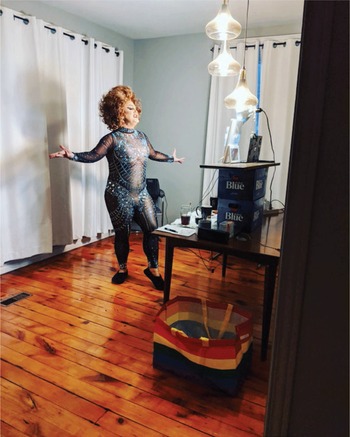
Conception’s first online show was simple and spontaneous: she lip-synched to a half-dozen songs in her friend’s living room. Her phone, propped up on three beer cases, functioned as camera crew. As Conception put it:
I had flown in from Puerto Vallarta on March 20th. My friends picked me up from the airport, drove me right to their house. I was just going to go quarantine there, I hadn’t even thought about doing a show, until I got there and after a few days of just sitting around, and my friend said, “you should do an online show.” And I said, “like on Facebook?” and he said “yeah.” And I’m like “…really?” [Laughs] And I thought, I guess everyone’s home, and bored, and they don’t know what to do. So, we put together a little show. (2021)
Over a thousand viewers tuned in for Conception’s first Instagram performance. Once out of quarantine, Conception turned her efforts towards adapting one of her live touring shows for a digital platform. Three weeks later, now living with her sister in Perry Sound, Ontario, she performed a livestream version of Where in the World Is Miss Conception?
The show, whose title is a play on the video game (1985) and game show Where in the World Is Carmen Sandiego? (1991–96), centers on global travel. Where in the World? premiered in 2016 in Mexico and has since been performed in Canada and the US in nightclubs, theatres, and on cruise ships. However, in April 2020, Conception performed in her sister’s living room via Instagram. The platform allows an unlimited number of fans to join the stream and communicate with the performer via an in-platform chat option.
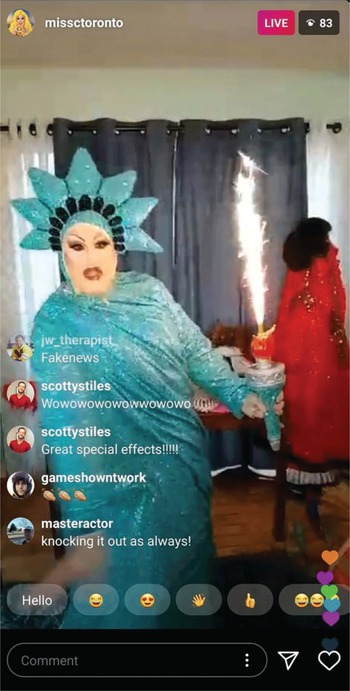
Miss Conception performing “New York, New York” dressed as the Statue of Liberty in Where in the World Is Miss Conception?, Instagram Live, April 2020. (Photo courtesy of Kevin Levesque)

Throughout a series of songs, Conception shed a layer of costume between each number, each time revealing a new look. In this international travel-themed show, Conception dons national costumes of Canada, Mexico, France, England, the US, and Italy. Each is paired with a song sung live to prerecorded music, karaoke-style, evoking pop-cultural references to their respective cultures. Rather than creating a new show for Instagram, Conception staged her existing show. To be sure, a main reason is logistical. Creating a new show even using a similar dramaturgic frame would take more time and effort than Conception wanted to spend. Additionally, using an established, tested show provided a sense of continuity for Conception and her audience.
The choice to restage previously produced shows online with little change is how many drag shows have met the contemporary digital moment. Bree Hadley’s Theatre, Social Media, and Meaning Making observes that telematic, networked, or cyber performance “is often explicitly characterized as experimental” often pushing aesthetic and dramaturgical boundaries as well as the boundaries of technological access (2017:76). Historically, the decision to opt for digital was deliberate. However, during Covid-19, performers turned to livestream out of necessity, as a placeholder for in-person shows.
Conception begins her April 2020 Instagram Live performance of Where in the World Is Miss Conception? by greeting familiar faces in the group chat, calling out specific fans by name, and introducing them to other viewers. “This is my dear friend Bruce from Puerto Vallarta; we haven’t seen each other in over a year. Hello my darling!” She tells her audience that she’s staying with her sister and asks us where we are. Audience members share cities and countries. Through this preshow exchange, Conception uses the interactive potential of her social media stage to evoke shared memories with her fans. She does not use the digital platform to experiment with form and content but rather attempts to fill the void left by the closing of performance spaces by (re)creating a performance that looks and feels familiar. The technological tools that Conception utilizes—live chat and streaming—do not add to the original show but enhance what might be lost by going digital. Conception tries to create in-person intimacy by providing something like the experience of liveness—a conversation.
A hallmark of Conception’s shows are her onstage quick-changes. She sheds costumes between each number to become a completely different character without ever leaving the stage. Between each song she removes a tier of clothing revealing the next look underneath, transforming before her audience’s eyes from, for example, Carmen Miranda into the Statue of Liberty in one fluid motion. During these changes, Conception keeps up her stage prattle, remaining fully engaged with her audience. Her physical costume change is underscored with anecdotes. She shares stories about the show’s development while attaching a new head piece to prepare for her next song. Conception never stops the show. She maintains her energy, infectiously bouncing from song to banter to song, never resting her voice, her feet, or her smile. In addition to her vocal talent and crowd-pleasing manner, fans admire Conception’s stamina. She maintains such a high degree of energy that she seems as live as when she performs in person.
Instagram Live allows viewers to communicate in real time not only with Conception but also with each other. Visually, Instagram positions its chat function within the frame so that the bottom of the screen that Conception occupies fills with comments as she performs. As each new line of text from a viewer appears, older texts scroll up, gradually fading until the fifth line from the bottom fades, leaving the top half of the screen unobstructed. As she performs, viewers send messages including: “Wow!”; “yaaaaaaaaaaaaas”; and “knocking it out as always.” Footnote 2 At the bottom right corner viewers can choose and send Conception emojis; the multicolored hearts and happy faces float up the screen towards Conception and evaporate like blown kisses for some digital interaction:
The hardest part of performing online for me is that I love to interact with my audience. One of my favorite parts of performing is getting the microphone and going into the audience and sitting on people’s laps and asking them questions and I miss that part because it really adds to the show. (Conception Reference Conception2021)
A drag audience does not sit quietly in a darkened theatre. They do not just laugh and applaud in unison at appropriate moments. They call out, talk to each other, shout their approval and their affection. They actively participate from chairs and bar stools, or as a mass of bodies on a dance floor. Instagram’s chat function does its best to stand in for that shared audience experience.
Conception’s digital audience is active through each number. Silent textual calls of “werk!” and “amazing!” continue to float up towards the performer along with an endless stream of digital hearts. In between each number Conception uses a phone that both films the performance and connects her to the audience. She communicates via chat as she changes costumes, just as she did with a live audience in her in-person shows. She tries to thank fans by name:
So many people are like “Hi! Hi! Give me a shout out!” and I love it, but I can’t shout out everyone and I’m trying to sing at the same time, and those comments go by so fast. So, there’s a lot of different challenges with performing online but it’s definitely a new way of interacting with the audience. (2021)
Like Conception, her audience is in quarantine—cut off. We cannot travel, we cannot share space, we cannot meet. So, a show about traveling around the world, performed by an artist known for her tours, now confined to a rural Ontario living room, increases the nostalgia for a pre-Covid world:
The reason why I chose Where in the World was because the world itself was shut down. It was a pandemic of the world, it wasn’t just one country so I thought, this would be just a great show to do because it would give people hope that the world’s in this together. (2021)
Conception performs the longing to travel, to be in different places, to move digitally across borders, and to share space in the age of social distance, all while recreating her signature live performance via social media.
And yet, even this continuous re-creation of liveness harkens back to a live “original” that is heavily predicated on a relationship with recorded media. Although she sings live, Conception’s repertoire is built on songs popularized by recording artists, often featured in films. Like the majority of drag artists, Conception relies on her audience’s familiarity with the songs she performs in order to evoke a nostalgic, queer-coded affect, songs like “New York, New York” (1977, Liza Minnelli) and “Mambo Italiano” (1954, Rosemary Clooney). Conception’s live singing in its original context is a live re-enactment of music recorded and popularized by artists and film actors like Minnelli and Clooney. Thus, the liveness that Conception seeks to re-create in her digital performance is based on the live performance of recorded media; a live event predicated on her audience’s familiarity with recorded media. This additional phenomenological layer constitutes a productive complication: though it challenges the simple relationship between live and digital, original and re-creation, it simultaneously connects Conception’s live digital drag to the legacy of drag, foregrounding the citational nature of drag performance.
Gay Jesus in Queer, Far, Wherever You Are
In late March 2020, Buddies in Bad Times Theatre canceled the rest of its 2020 season. That same week Buddies announced that it was launching Queer, Far, Wherever You Are, a daily one-hour performance series featuring queer artists. Aidan Morishita-Miki of Buddies explains:
The lockdown happened, and our programming was postponed…indefinitely. So, we were looking for ways of reaching out to the community of queer people who are performers and audiences. We wanted to help artists who were in this very ambiguous time, and give them a way to connect with audiences, our audiences, and promote them. (Morishita-Miki and MacArthur Reference Morishita-Miki and MacArthur2021)
Originally conceived as a three-week series, the festival continued for three months with a different queer artist signing on to the Buddies Instagram account each night for a one-hour performance.
Gay Jesus went on Buddies’ virtual stage in the first weeks of Queer, Far. I asked Morishita-Miki and MacArthur how they approached Gay Jesus’s livestream event. MacArthur explained:
Gay Jesus has this fabulous way of pulling together a story and bringing sex and emotional connection and curiosity and intrigue and glamour. But Heath [Gay Jesus] is also a really incredible writer who can talk and deliver so, if you tuned in, there was a lot of conversation about trans identity, and their story, mixed in with their set of drag. It was unique in that sense because it’s not totally just performance. (Morishita-Miki and MacArthur Reference Morishita-Miki and MacArthur2021)
Morishita-Miki continued: “Heath’s performances at Buddies are beautiful and they’re powerful but they [Heath] also have this super warm bubbly side to themselves as well that I think you don’t always see if you’re seeing them perform on a stage” (2021). These observations made by the producers mirror my own experience when tuned in to Jesus’s online performance. Following their first lip-synch to the mix by Day, Bay, and the Killers, Jesus returns to a seat in front of the camera and shares the story of the performance we’ve just seen:
When I first made this piece, I was in a place of despair and powerless and it’s a piece that’s transformed over the years. The first time I performed this piece, which was years ago [2016], I knew there was a room of people who had to listen to me for 5 minutes, and I didn’t tell the producer what I was doing, and I thought I was going to get black balled from drag and people would be like “we just wanna dance” and I was like POLITICS!
Gay Jesus, sitting down to chat directly with their audience between numbers during Buddies in Bad Times Theatre’s Queer, Far, Wherever You Are, Instagram Live, March 2020. (Photo courtesy of Heath V. Salazar)

Jesus pauses for a moment to reflect that they usually don’t get a chance to go into such detail about their work. They theorize that both the physical space of their own closet, and the “confessional” nature of speaking to an internet audience via their phone, has perhaps opened up space for them to “get into it.” Jesus explains that a central theme of their practice is the tension between art and politics, and that this piece helped them grapple with that tension. In their late teens they struggled with the decision to study law or theatre. The crux of this decision was identifying which path would allow them to best engage their passion for activism and social change, a decision that eventually led them to theatre and drag: “sometimes the way you change the world is by doing a really political piece and screaming at the top of your lungs. And sometimes it’s taking off your clothes and sometimes it’s making people laugh.”
Jesus reflects on performing this piece that they’ve done so many times live but are now performing on social media from their closet. They explain that while Q and As are not uncommon in theatre and drag performance, there’s an intimacy and slower pace on social media that allows them to really delve into the inspiration and history of the piece. In my interview, I asked Jesus more about the way digital performance opens up space for different kinds of discussion:
There’s a lot of details in drag shows that you don’t really talk about with your [live] audience. You’re not going to be like “and this is how I edited my songs” while you’re onstage. So, it was nice to get to talk to people about the choices behind it because it is very much a multimedia, multidisciplinary art form, and we don’t really talk about it that way a lot. Getting to talk to people about that was great but also just getting to be a person and see their questions and chat in that way created—which I didn’t expect—a new sense of intimacy. (2021)
The closet as performance space, facilitated by the social media platform on International Trans Day of Remembrance (31 March), also adds intimacy to Jesus’s performance. The innovation derived from social media, notes Hadley, is its capacity for a reciprocal experience. Early forms of broadcasting like television are “one way: your role, and your response, is not immediately visible to the producer, fellow spectators or the public at large, so your presence does not really matter” (2017:23). Social media, however, allows for two-way liveness. The artists see, or at least are aware of, their audiences. Audiences can interact with and be seen by both the performers and other spectators. Jesus’s intimate talk with their audience fully embraces this two-way live experience. The closet as performance space adds an additional layer of copresence and affective synchronicity.
Most of Hadley’s case studies involve theatre companies connecting their audience at home to actors in professional performance venues. But in quarantine, the performers are confined to their homes too. As Jesus observes:
I worried it would feel awkward and impersonal to sit alone in my closet and talk to my phone. But it was nice because in a weird way, which I’ve realized in the past year, the audience and the performer are inviting each other into each other’s homes. (2021)
The two-way experience of social media performance deepens reciprocal intimacy between artists and audiences. Even as the artists perform for us in their living rooms, bedrooms, and closets, we are participating from our own private spaces via laptops and smart phones.
LGBTQ2+ drag was born in underground clubs and bars operating under the radar of homophobic and transphobic laws and were essential to the creation and organization of early queer subcultures. Because of the scarcity of public spaces available to queers in the early-to-mid 20th century, bars and clubs became crucial environments fostering familial, romantic, and sexual bonds, places to celebrate queer art and performance, and to mobilize politically. Clubs and bars remain an important cornerstone for contemporary queer communities. Closing these spaces during quarantine has been devastating for queer people. However, since the early 1990s queers have also used social media to form networks and connect across great distances. Andre Cavalcante notes:
Queer individuals and communities were some of the first digital pioneers, venturing onto the Web in its early days to find like-minded others (Gross, 2003). The Web seemed like an optimal site for community building given the limited and scattered options available in the physical world. In the past 15 years, social media in particular has afforded fertile ground for queer cultural archipelagos to develop. (2019:1719)
Like pre-Stonewall gay bars, chat rooms and later social media sites like Myspace, Tumblr, and YouTube provided queers around the world with ways of connecting. These platforms gave access to peer support, queer representation, and information on sexual health and gender identity. Social media was particularly transformative for queer youth and queers in rural communities who could not access bars, nightclubs, and other “traditional” queer spaces. Thus, for queer artists like Gay Jesus and their fans, to perform and view drag on social media is to meet and interact in an already known queer space.
Much like Conception, the liveness that Jesus seeks to (re)create is that of an original performance based on recorded media. Indeed, as a lip-synching drag artist, the connection between liveness and recorded content is perhaps even more explicit in Jesus’s performance. A long-standing convention of drag, live lip-synching to prerecorded music gives shape and form to the covert practice of queer coding. Members of queer subcultures have, for generations, circulated songs and other forms of pop culture media with coded queer values as a way of creating a covert network of meaning. Footnote 3
Each of the songs Jesus performs in their medley evokes notions of vulnerability, defiance, and resilience, all of which are concepts traditionally associated with queer-coded music (Brett and Wood [Reference Brett, Wood, Brett, Wood and Gary1994] 2006:369). They do not, on the other hand, have any direct or lyric references to queerness, nor are they performed by queer artists. However, when a queer performer engages with and embodies these coded songs, that relationship to queer culture becomes visible. Drag performances of queer-coded music thus use the live bodies of the artists performing in a queer communal space to make visible the relationship between the queer audience and the coded recorded music. The shared space of the queer performance venue, traditionally a bar or nightclub, further underscores that the artist is a member of the community for which they perform. By occupying the same space, the performer bridges a gap between the coded meanings in the mainstream recorded music and the lived experience of their queer audience. Thus, the liveness and indeed the intimacy that Jesus seeks to recreate in their digital performance is connected to a deep and important history of drag’s relationship to live performance and recorded media.
Allysin Chaynes’s Drag Race Viewing Party
The importance of the replication of liveness in digital drag shows is especially noteworthy given the particular mechanics by which drag moved into mainstream media. Mainstream interest in drag has been developing at least since Jennie Livingston’s 1990 film Paris Is Burning. But few can deny its rapid uptake with the Emmy award–winning reality television competition RuPaul’s Drag Race, which premiered in 2009. Since 2016, Toronto-based drag artist Allysin Chaynes has hosted live viewing parties of Drag Race at the Gladstone House in Toronto’s West End. This boutique hotel-turned-art space has become synonymous with queer culture in what is affectionately referred to by locals as Queer West. Every Thursday at 7:00 p.m., Chaynes, Champagna, and a rotating list of special guests ascended a small stage to talk about the current season of Drag Race, discussing their thoughts on contestants, the politics of the show, and popular audience reactions. Chaynes and company then each performed a lip-synch for the packed crowd of fans until 8:00 p.m., when Drag Race began on a big screen behind the stage. Chaynes and her team retired to a small table at the back of the space. The team returned at each commercial break and provided quip-filled commentary on the action. At the program’s conclusion, they reclaimed the stage for more extended conversation and lip-synching performances.
The concept of viewing parties is not unique to Drag Race. However, the preponderance of Drag Race viewing parties at bars and nightclubs, featuring live performances and celebrity guests, has transformed this intimate niche practice into a global phenomenon. Prior to Covid-19, gay bars and nightclubs in nearly every major city hosted Drag Race screening events. Each week patrons from Toronto to Vancouver, London to Berlin, arrived hours early to secure seats to watch local queens host these screenings and experience collective witnessing with other community members. As with Chaynes and her team, these events typically offered a preshow performance followed by commentary and criticism of the episode during commercial breaks, ending with a post-screening performance.
Using social media to re-create collective viewing has been one of the most surprising artistic responses to Covid’s restrictions. The competitive nature of the show lends itself to communal viewing, creating an experience not unlike watching a football game at a local pub. Fans root for individual contenders, discuss the performances of the contestants, and make predictions about both short- and long-term outcomes. A crowd at a Drag Race viewing party will gasp in unison as fan favorites are eliminated and cheer when queens win weekly challenges. In the earliest weeks of quarantine, online Drag Race viewing parties were among the first examples of digital drag. One might think the consumption of Drag Race could continue on its own in quarantine since the show has no live element that needs to be recreated using social media. But it’s the collective viewing of Drag Race that is crucial. The instigation of shared online viewing parties highlights the importance of copresence to drag as an art form.
Chaynes recalls that when the Covid lockdown was announced on the morning of Tuesday 17 March she sprang into action in the hopes of finding an online option for her upcoming Friday viewing party:
My thought immediately was ‘how can we do this?’ because I had seen people already start to talk about having to do shows over Zoom. My first thought was that my good friend Lizzie Renaud, who owns Speakeasy Tattoo, is a Twitch streamer and has an entire studio setup in her shop. (2021)
Chaynes credits Renaud’s work as a producer both for the speed with which she was able to reach her audience and the sustained success of her online drag work.
By 2019, Renaud was a self-taught digital producer who had built her own streaming PC for her Twitch channel. Renaud used Twitch, which had its origins in gaming culture, to showcase her tattoo designs, and eventually started livestreaming tattoo sessions to boost the profile of her shop. She notes that while the timing of her Twitch career intersected perfectly with the need for digital performance platforms, it was also collaborating with Chaynes that led to the wildly successful transformation of Speakeasy Tattoo into a digital drag production company:
I had been trying to ask drag queens around the city since December 2019, “Hey if you want a Twitch show let me know and I can help you out.” And people were just super, super resistant, nobody wanted to trust it. I had people tell me that they can’t bring their art down by being involved in something like that. People were so defensive about trying something outside of on-stage drag. And then Allysin needed it and I thought, “Oh this is amazing, I can show all the drags my skills and how I can actually facilitate sustaining their income in this time with this tool.” I just needed one influential drag queen to need it and trust me. And it was super successful right out of the gate. (2021)
Much like Miss Conception and Gay Jesus, Chaynes’s first thought was to create something familiar for her audience that, like her, was reeling from the overnight loss of their normal lives:
My approach in terms of show planning was that people are going to be feeling a lot of immediate culture shock. And so we wanted to make sure we were doing something for our audience that felt familiar. Lizzie had great things that she could bring to the table. People could send tips of a certain amount and I would do shots with them, and it was still very much that sort of live interactivity that really kept it feeling true to that Drag Race event vibe. It feels the closest to our old reality as anything I’ve done online. (2021)
During their digital preshow on Speakeasy’s Twitch channel, Chaynes and her team perform lip-synch to recorded music, doing their best to recreate the “real thing” of their original viewing party. The paradox of a digital re-creation of a live collective viewing party of a prerecorded television show may seem, at first glance, comically absurd. But Drag Race’s content over the past decade reflects the tension between liveness and mediatization at the heart of drag performance. Since its inception, Drag Race has included live performance elements to emulate the connection between drag and liveness. Contestants perform weekly challenges and lip-synchs on a stage facing judges positioned in front of them like an audience. Contestants rarely, if ever, perform directly for the camera, instead directing their performances to the live audience of judges with the camera cutting back and forth between the queens and the panel of viewers. When episodes involve challenges modeled on other forms of live performance such as stand-up comedy, comedy roasts, or variety shows, live studio audiences are frequently brought in to further increase the feeling of liveness. Yet Drag Race also leans heavily on the history of queer-coded media, frequently creating challenges and performances that parody film, music, and television programs. Given the degree to which Drag Race has attempted to preserve the impression of liveness within its episodes, it is perhaps not surprising that communal, live viewing has become such an integral part of the show’s cultural impact.
To be sure, part of Chaynes and her team’s motivation for continuing their weekly event is to sustain their incomes. Chaynes, like many drag performers, also finds a way to digitally incorporate the cultural practices of tipping. In a live show, as performers dance and lip-synch, audience members will approach the stage and offer cash tips. There is a certain stylized interaction that requires a cultural literacy to partake in. The tipper will approach the stage, wait for the performer to acknowledge them before reaching out to them with a bill in their hand. From there, the performer guides the interaction by acknowledging the tipper, incorporating them into the performance momentarily. Sometimes this is as subtle as reaching out to receive the bill and giving the fan a grateful nod. A performer might also embrace the tipper, ranging from a gentle hug to a kiss, or direct them to insert the bill into their waistband, bra, or even their mouth. They may descend from the stage or pull the tipper up onstage, incorporating the fan temporarily into their choreography. Some performers and venues even set the precedent that tippers may walk onto the stage to approach the performer as long as they have cash in hand. The interaction permits them a moment to dance with the performer according to an unspoken strict set of protocols. Those who transgress and take more than their share of time are escorted off the stage by the performer or member of the bar staff. While tipping is undoubtedly about money—performers receive scant fees—it is also a vital part of the performance, not an interruption. The exchange highlights that both performer and audience are members of the same queer culture. The stage is a shared queer space.
Chaynes and many other performers create digital versions of tipping. Chaynes explains that in some ways she and Champagna had primed their audience for digital tipping while they were still performing at the Gladstone:
We went around with a tip bucket and I had a Square for my phone so I could take debit and Visa tips from people. We would still have a few people come up to the stage and hand us money, but the thing that made Champagna and I able to sustain ourselves as performers was that we would walk around to every table—we would form a personal relationship with everyone who came to that bar on a regular basis. (2021)
Moving to online performance has been motivated in no small part by the need to maintain income for artists. Providing her PayPal account details, Chaynes encourages online audiences to tip during their lip-synchs. Individual performers receive tips based on time stamps during the livestream. Before her guest takes the virtual stage, Chaynes announces, “Any tips received starting now until I say will go to [the guest]” (2021).
Chaynes’s PayPal account never actually closes. Fans can tip at any point during the show, or throughout the week. However, as the MC of the evening, Chaynes directs viewers to perform the tipping ritual in a manner congruous with traditional practices. Tipping happens in relation to a lip-synch performance, in the same time if not the same space. This detail of the online experience allows audiences to retain the feeling of drag as an interactive art form. The result has been an overwhelming success. Renaud reports the tips that Chaynes and team receive online have matched or exceeded the average amounts they received during their in-person shows at the Gladstone.
Following the performances, the “viewing” portion of the show commences. Chaynes provides a time stamp based on the uploaded version of the episode available on various streaming sites such as OUTtv and Crave. Chaynes coordinates audience members to press play on their respective streaming services at the same time in order to facilitate a more or less synchronized viewing. Chaynes and her team watch the episode with earbuds to avoid echoes for the audience, but participating viewers can both watch the episode on one screen (or window) while watching Chaynes watch and comment on the video in real time and use the chat function to offer their own comments. Chaynes’s commentary is not overwhelming; it has the feel of a director’s feature commentary on a DVD. By utilizing these social media tools and strategies, Chaynes and her team provide a digital version of the collective viewing experience they once created at the Gladstone.
Miss Conception’s first performance over Instagram Live in her friends’ home in Lyndhurst, Ontario, during quarantine after returning from Puerto Vallarta, March 2020. (Photo courtesy of Kevin Levesque)

Still at Home for the Holidays
A Quarantine Year in Review
On 27 December 2020, I, along with another thousand viewers, tune in to watch Miss Conception’s Holiday Hangover broadcast live from her Puerto Vallarta living room. Miss Conception has done her annual Holiday Hangover show at Woody’s in Toronto for the past five years. This year, it’s streaming on Facebook and Instagram Live. As with Where in the World back in April, Conception greets familiar names in the chat section and reads messages of love and support.
The show officially begins with Conception discussing her history of performing this piece live in Toronto, and further reflecting on the difficulty of being unable to see her family and friends over the holidays. She declares with her characteristic charm and optimism, “We’ll be back together one day soon but until then we’ll party”! After five minutes of introductions and virtual mingling via the chat, Conception announces that we’ll be “moving to the stage.” The feed then cuts to a theatre stage, filmed at the nightclub where Conception is the “performer in residence,” the Palm in Puerto Vallarta, bathed in green light against a backdrop of sparkling tinsel. Conception emerges from the tinsel curtain dressed in a faux fur green onesie and belts out the lyrics to “You’re a Mean One, Mr. Grinch” into her mic while prancing around the stage.
When the song concludes we return to Conception live in her living room, wearing the Grinch costume. She addresses the audience, reminiscing once again of the days when she could perform this show in person and reading comments from the chat. Conception slowly removes the green Grinch onesie to reveal a Cindy-Lou Who costume, complete with a wig of upturned pigtails characteristic of the 2000 film How the Grinch Stole Christmas. The feed then cuts back to the stage scene, now lit in a neutral soft white light where Conception, still dressed as Cindy-Lou Who, is joined onstage by her assistant Alex in a purple hippopotamus costume and roller skates. Conception sings “I Want a Hippopotamus for Christmas.”
Throughout the evening, Conception’s livestream from her living room is intercut with prerecorded musical numbers filmed at the Palm. Each live segment shows Conception stripping away the costume she’s worn in the previous recorded number to reveal a new costume for her next cut away to the stage. Conception is able to retain her signature conceit of layered, live costume reveals as part of her performance, while simultaneously creating the effect that the cutaways to the stage are happening live and in real time:
I didn’t want anyone to give me flack like “girl, you pre-recorded your numbers” and so I thought, how do I do this to make this look more realistic and more live: I’ll wear the costumes that I’m wearing off stage and then I’ll switch them live on camera and say, “let’s go to the stage” so it’s like we’re changing locations together. (2021)
Conception is aware that few if any spectators would truly mistake these prerecorded performances and livestream scenes for a single contiguous live performance. Indeed, many of the transitions are performed with a wink and a nod. The point, rather, is to preserve the feeling of liveness.
Conception recalls that while her earliest online shows were largely about getting content out quickly, later shows like Holiday Hangover gave her time to think more conceptually. A sincere desire to create a more professional product, coupled with the added technical requirements of live singing necessitated the recorded segments that Conception filmed at the Palm. However, Conception was clear from the beginning that she wanted to retain the live heart of drag performance.
In addition to chatting live with her audience around the world, Holiday Hangover features a video chat visit from her friend Scarlet Fever (Cameron Rennie), and her parents, both in Toronto. “I loved going live in Toronto with my parents, for Christmas. And going back and forth to me live in my living room with my Christmas tree. It was like making a holiday special like Judy Garland” (2021).
The choice to produce Holiday Hangover online, and the specific evocation of a Judy Garland holiday special, are integral in relating the online shows to their live origins. Like Where in the World Is Miss Conception?, Holiday Hangover is an adaptation of a live show. And while it uses recorded elements, it does so to simulate liveness. Conception endeavors to create the illusion of liveness during the onstage sections by means of costume continuity. Whereas Conception had her own sound equipment in Ontario, facilitating her live singing during her early online shows, she had no such tech in her home in Puerto Vallarta. She did, however, have closer access to a nightclub space than she had in rural Ontario. Thus, filming at her home nightclub allowed Conception to appear to sing live. Much like Gay Jesus, Conception noted that performing live from her home created an enhanced intimacy that she felt was particularly important to her work.
In our conversation, Conception repeatedly described her vision for the online version of Holiday Hangover as “my own holiday special” similar to those hosted by Judy Garland (1963) or Andy Williams (1962–1971). Conception specifically evokes a nostalgic television tradition, itself rooted in the simulation of live performance. In the 1950s and ’60s, such live Christmas specials were touchstones of broadcasting that emphasized the domestic intimacy of television as a medium. Sets looked like living rooms with roaring (fake) fires and windows with falling (fake) snow. Special guests “dropped by” for the holidays. Stars like Garland spoke directly to her audience (Wilson Reference Wilson2013). By modeling the online version of her annual Christmas show on these Christmas specials, Conception nostalgically evokes the live broadcast as she pays loving homage to queer icons like Garland. Moreover, Conception marries the necessity of online performance to a familiar cultural product consistent with her tradition of performing these icons. In doing so, Conception uses the occasion of her forced online performance to dig further into the queer-coded canon and connect to a part of Garland’s archive, her television show, that live performance might never have produced. Thus, Holiday Hangover further reflects drag’s history of blending live performance, mainstream media, and queer coding.
Two days after Miss Conception’s Holiday Hangover, Lizzie Renaud and her team at Speakeasy hosted Spelling Bae, a live, synchronous spelling bee featuring nine drag performers (two opposing teams of four and a host), as well as Renaud and her coproducer Chris MacAulay. Renaud reports that to date Spelling Bae is Speakeasy’s most technically ambitious online show. The screen layout or “skin” Renaud designed for the event featured ten hexagonal windows, each one connected to the live feed of a drag performer, with Renaud and her coproducer occupying the bottom-center hexagon. The top-center hexagon is occupied by the host, Bom Bae, flanked on either side by the team captains, Allysin Chaynes to her right and Ivory Towers to her left. Beneath Chaynes, in slightly smaller hexagons, are her teammates: Manny Dingo, Fisher Price, and Gay Jesus. Beneath Ivory Towers on their left are the opposing team: Sugar Stixxx, Gei Ping Hohl, and Jada Hudson. The six-sided shapes evoke a honeycomb, a gentle nod to the bee motif, set against a purple background with the title “Spelling Bae 2020” emblazoned across the top. To the right side of the image the chat function remains active, reacting in real time to the on-screen shenanigans at such a frantic speed that at times it’s difficult to read the posts forcing the scroll upward. Behind the scenes, Renaud and MacAulay, Bom Bae, Chaynes, and Towers are streaming in separate rooms at the Speakeasy shop and share control of the event at their stations. The six team members connect from their homes via livestream.
The evening, which clocks in at just over two hours, proceeds much like a traditional spelling bee. Rounds that run for about 45 minutes consist of Bom Bae providing words for the teams to spell. There is a random assortment of comically difficult words like pterodactyl, gesundheit, mashugana, affidavit, Schwarzenegger, rhinoplasty. With few correct answers, it becomes clear that the focus of the evening is on the banter and laughter between contestants and the general frenetic, highly entertaining chaos generated by nine queer artists sharing a virtual space in real time.
Gay Jesus recalls their experience as a participant:
I don’t know how to describe it other than to say, probably one of the funnest nights of quarantine for me. Like the fact that doom scrolling is a regular thing we have right now. And so to have a place where you can just come and be queer and have permission to laugh, is weirdly so needed. (2021)
For Jesus, the rare experience of copresence with eight other performers in a year defined by isolation was a central source of this joy, something deeply connected to the pre-Covid live copresence of the performers.
What is particularly compelling about Spelling Bae’s technical complexity is that Renaud and her team created a fully synchronous live performance experience. After a year of producing online drag content, Renaud also has a theory of the way liveness is experienced by drag audiences of an online performance:
In a big open bar space with tons of people where you move around, you’re talking, and you might only look at the stage here and there. The audience on an online stream, at home, has their eyes directly on you, headphones on, so the interactivity is a lot more intense. I feel like over the past year a lot of drag enthusiasts have gotten closer to their favorite performers in a different way. Because you can tip and your name comes up on screen and your performer is directly thanking you every time, and you’re having chitchats back and forth while they’re hosting. I just feel like, especially during Covid when everybody’s feeling so detached, this new form of drag is awesome for people’s mental health. (2021)
Not only does Spelling Bae represent a culmination of a year-long digital production experience; it also recalls the importance of drag as a live art form.
I asked both Chaynes and Renaud why, as they continued to grow as digital producers, creating more ambitious and sophisticated online products, liveness remained a central priority in their work. Chaynes explains that, for her, the decision is as much about time as it is about the experience of liveness:
I’ve done a couple of prerecorded things. I did a show for Pride and one around Halloween. But I don’t love to spend a lot of my time video editing. I also think I never end up with a product that is exactly like what I picture in my head. So, I feel like I get an equal if not more fulfilling high for myself just doing a livestream. And I really do thrive off the live energy, especially in Covid. (2021)
Conception, Jesus, and Chaynes all talked about the energy they receive from a live crowd. Each performer also discussed the eerie silence that follows a digital number, which when performed live is followed by applause, and the difficulty in pushing through that silence as they attempt to create the feeling of liveness on a digital platform. Chaynes: “I literally tell everyone who’s doing online performing to download an applause sound effect and have it cued up next to your track, and when you’re done just hit that. Because it does give you a synthetic high. It’s like applause methadone” (2021).
Renaud notes that her chosen digital platform, Twitch, has been a major contributing factor in preserving the liveness of her productions. Twitch is fundamentally about liveness and the long-form performance of games, which Renaud credits for Speakeasy’s success as an online drag platform. Renaud believes that the success and value of her channel has been in providing an interactive, digital queer space during a time when mental health challenges caused by isolation have been significant:
I get messages all the time that [our channel] is the only thing that kept people grounded during this time. About how people’s mental health stayed in check because they had a regular community event where everybody they knew would be there. So, the feedback from audiences made me feel like I’m doing something necessary. (2021)
For artists like Renaud, a year of digital performance during Covid has revealed the importance of drag as an interactive art form truly tied to communal practice.
Still Live
The response of drag artists to the challenge of engaging live performance during quarantine is all the more important when we consider drag’s recent mainstream turn. The success of RuPaul’s Drag Race in particular has led to the mass popularization and exposure of drag. What was for so long a live, subcultural art form is now being streamed into homes around the world. Critics and scholars have expressed dismay at the degree to which RuPaul has diluted drag for the mainstream, potentially robbing it of its queer cultural importance (see Ferrante Reference Ferrante, Brennan and Gudelunas2017; Kohlsdorf Reference Kohlsdorf and Daems2014; Burns Reference Burns2019; Montgomery Reference Montgomery2019; and Schottmiller Reference Schottmiller and Crookston2021). At the center of this debate is the role that the shift from live to digitized has played in drag’s 21st-century move from marginal to mainstream (Brennan and Gudelunas 2017:9; Daems 2014:91). As such, the prevalence of synchronous “live” digital drag during Covid-19 is both surprising and encouraging for the future of drag as a queer live art form.
This new breed of livestream performance may seem like a sudden and spontaneous adaptation. However, digital drag during Covid-19 connects to drag’s history of combining live, communal performance with forms of recorded and broadcast media. Indeed, from the first queens to draw inspiration from early Hollywood actresses to the gradual spread of lip-synching in the post-WWII era, the way drag performs liveness has been a complex hybrid experience for nearly a hundred years. Thus, while many artists during quarantine experience the prohibition of liveness as a loss, drag artists experience the move to digital performance as a variation on a deep historical legacy. Much of the current anxiety around the loss of liveness during Covid-19 (and the insufficiency of synchronous digital performance) speaks to a rhetoric of the purity of liveness. But drag, in this sense, has never been pure. Drag has always been a queer hybrid, a phenomenological Frankenstein of grassroots liveness and technological augmentation.
In the year after Covid-19 first closed performance spaces, drag artists went from rapidly assembled makeshift adaptations of live content to technologically sophisticated productions planned weeks and months in advance. And yet over the course of that year and the continuing development of online production skills, many of the priorities from the earliest first wave of performances remain. Drag artists have prioritized interactivity, intimacy, and liveness in their creation of digital drag. What this means for the future of live drag and digital drag remains to be seen. What seems clear at this point is that we may emerge from the pandemic with a renewed appreciation for the importance of liveness and copresence. Ironically, queerly, we have digital performance to thank.