INTRODUCTION
The radiocarbon (14C) dating method was introduced as the result of research undertaken at the University of Chicago immediately following World War II. The research was initiated by Willard F Libby (1908–1980) and carried out by two colleagues, James R Arnold (1923–2012), then a post-doctoral fellow, and Ernest C Anderson (1920–2013), Libby’s first graduate student at Chicago (Taylor and Bar-Yosef Reference Taylor and Bar-Yosef2014). The first published indication of Libby’s idea for using 14C for dating was a short note in Physical Review that appeared in 1946 (Libby Reference Libby1946). Arnold (Reference Arnold1981:609) later noted that this article was published despite the view of one reviewer who stated that the article was of “insufficient general interest.”
Historical Overview
In their first measurements, Anderson et al. (Reference Anderson, Libby, Weinhouse, Reid, Kirshenbaum and Grosse1947) were able to demonstrate that it was possible to measure 14C in a modern sample (“biomethane”) and also in samples that should be 14C-free (petromethane) (Libby et al. Reference Libby, Anderson and Arnold1949). The method was almost immediately applied to the dating of many interesting samples originating from archaeological and geological sources (Arnold and Libby Reference Arnold and Libby1951; Libby 1952, 1953). One the reasons for the abundance of archaeological material was that James Arnold’s father had a considerable interest in the subject. An interesting account of how some of the measurements were obtained is given by Marlowe (Reference Marlowe1980). At this time, 14C dating was in its early stages and a complex procedure of coating amorphous carbon onto a metal screen was used (Anderson et al. Reference Anderson, Arnold and Libby1951). This procedure was later abandoned due to the susceptibility of this method to contamination from other beta-emitting nuclides during the period of atmospheric nuclear testing. Hence, the second generation of 14C measurements used gas proportional counting and scintillation counting, while the third generation of accelerator mass spectrometry (AMS) was not established until 1977 (Taylor and Bar-Yosef Reference Taylor and Bar-Yosef2014).
After Libby received the Nobel Prize for his work on 14C dating, a rumor was circulated that the idea for 14C dating originally came from an offhand comment that Enrico Fermi had made in a 1946 Chicago seminar (Segrè Reference Segrè1993:150) although there had been no mention of this assertion in the same author’s earlier biography of Fermi (Segrè Reference Segrè1970). That this rumor has some credibility is perhaps due to the fact that Fermi’s 1938 Nobel Prize was for the discovery of nuclear reactions induced by slow neutrons which, of course, is how most natural 14C is produced. Those accepting that interpretation of the origin of the idea of 14C dating might wish to take into consideration a later statement of Libby that the idea for 14C dating came to him in 1939 after reading an article by Serge Korff (Korff and Danforth Reference Korff and Danforth1939) reporting that there were free neutrons existing in the upper atmosphere (Libby Reference Libby1979:33, 40). Libby already knew from his residence at Berkeley in the 1930s, that colleagues there had determined that the most favored means of producing 14C was by neutrons on 14N and that, theoretical reasons to the contrary, 14C was a “long-lived [carbon] isotope” (Kamen Reference Kamen1963).
At the beginning of his 14C research at Chicago, Libby set out to address three critical questions. Two of these required a more efficient way to measure natural levels of 14C, but the first question, mentioned above, was whether the amount of 14C contained in contemporary carbon was significantly different to the amount of 14C contained in fossil carbon, and if it was, by how much? Having determined that indeed, there was a difference and the degree of difference was about what Libby had predicted (Anderson et al. Reference Anderson, Libby, Weinhouse, Reid, Kirshenbaum and Grosse1947), a problem became evident.
The problem was that this experiment required the use of a relatively expensive and time-consuming isotopic enrichment process because the concentration of natural 14C was extremely low in comparison with a high background of environmental ionizing radiation. Some practical approach was needed that would reduce the background so that enrichment would not be required. Until some effective alternative means of measuring natural 14C could be found, 14C dating would not be a practical method to implement on a routine basis.
Libby considered a number of strategies, including employing a hydrocarbon-filled GM counter and putting all of his counters in a cave to reduce the background. His final decision was to use a screen-wall GM detector using solid carbon. This type of counter was similar to the one he had built for his dissertation research at Berkeley in the early 1930s to study beta emissions in rare earth minerals (Libby 1932, Reference Libby1933, Reference Libby1934). The advantage of a screen-wall counter was that counting 14C contained in the sample and then in the background could be accomplished by just sliding a sleeve containing the sample in and out of the sensitive part of the detector. No change in counting gas was required. Libby knew that, at the beginning, counts from the natural 14C signal would be very close to the background counts and thus counter stability would be an important consideration.
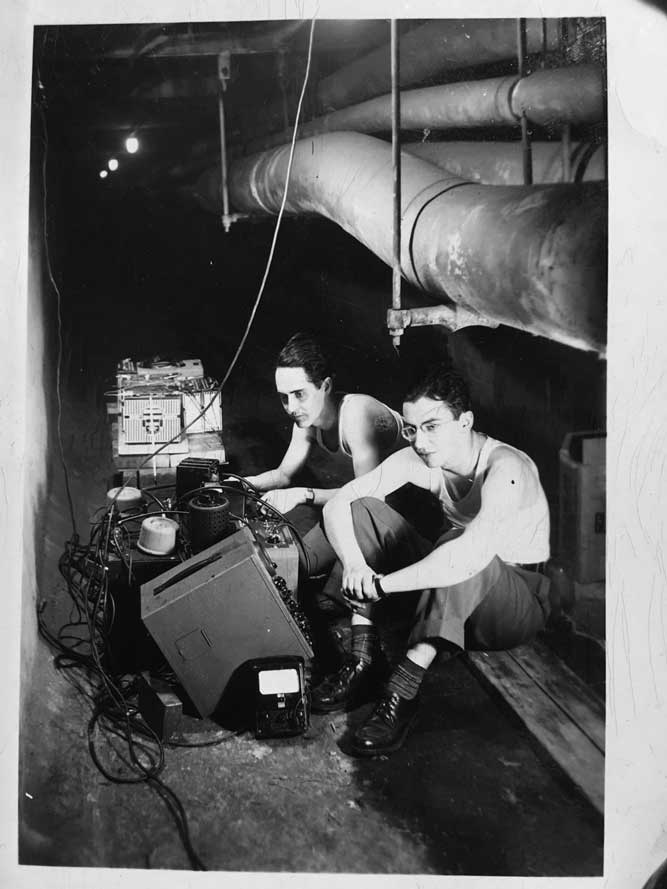
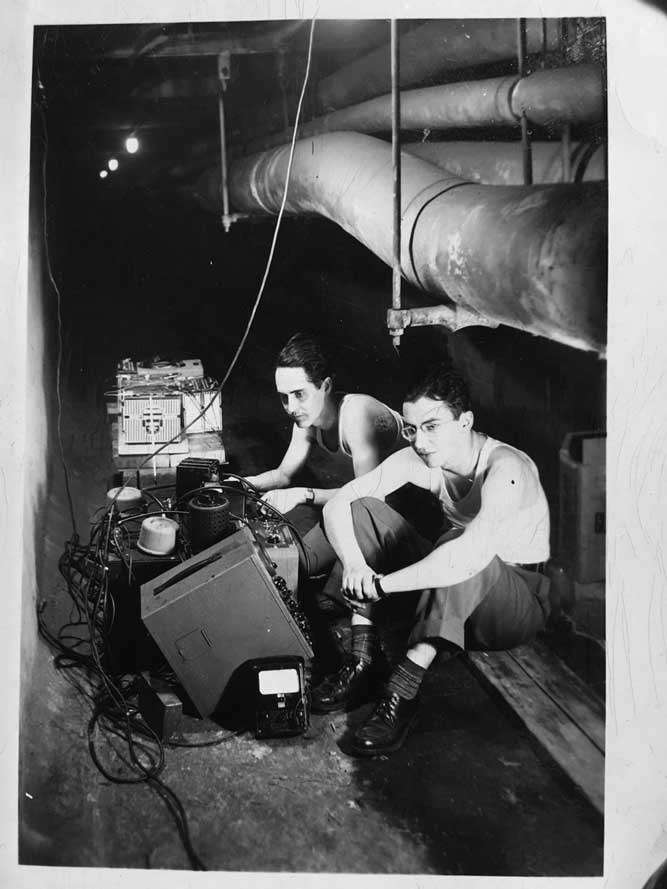
While the use of solid carbon was considered by Arnold as a method conceived of “in Hell,” Anderson considered it simply a “cantankerous” means of decay counting (Figure 1). However, the most important feature adopted at this point that made this counting system practical in terms of detecting natural 14C without enrichment was the use of an anticoincidence (A/C) arrangement. This A/C system would reduce the effective background in the counter containing the sample by electronic means (Taylor Reference Taylor2014).
Ernest Anderson (left) and James Arnold (right) performing early radiocarbon measurements in the basement of 60th and Woodlawn, University of Chicago. Photo courtesy of Bob Arnold, used with permission.
The A/C arrangement required that a ring of “guard” GM counters be placed around the detector holding the sample and pulses from the outside counters be compared with those coming from the central counter holding the sample. Anderson’s efforts, in combination with several other changes with shielding, proved successful in reducing the backgrounds to manageable levels. For example, Anderson recorded in his laboratory book on September 22, 1948, that he had measured a background count rate of 15.15±0.15 counts per minute (cpm) and an average count rate for a sample of 17.55±0.15 cpm for a net count rate for the sample of 2.40±0.21 cpm. (Taylor and Bar-Yosef Reference Taylor and Bar-Yosef2014:Table 8.2). This illustrates the roughly±10% counting precision that was being obtained at this time (Anderson et al. Reference Anderson, Arnold and Libby1951).
The second critical issue involved determining if the amount of natural 14C in living organisms at various latitudes and altitudes in different regions of the earth were approximately equal. This was critical if the method was to have any chance of having a worldwide applicability. Again, “approximately equal” at this stage was at the level of about±10%. This topic was the subject of Anderson’s doctorial dissertation (Anderson 1949). He measured the 14C contents on recently living organics which had been collected from locations situated at geomagnetic latitudes from about 65°N to 45°S, and at elevations from sea level to about 3050 m (roughly 10,000 feet). The data obtained allowed him to conclude that indeed modern living biologicals exhibited approximately equal 14C levels within the statistics of his measurements. His data were reported in terms of the amounts of 14C contained in samples expressed as “disintegrations (counts) per minute per gram of carbon” (d/min/gm). The average value he calculated for contemporary 14C, with modifications by Libby in his figures to take into account later corrections, were used in dating calculations employed in the reports of the results of 14C measurements undertaken to address the third issue on Libby’s list (Anderson et al. Reference Anderson, Arnold and Libby1951).
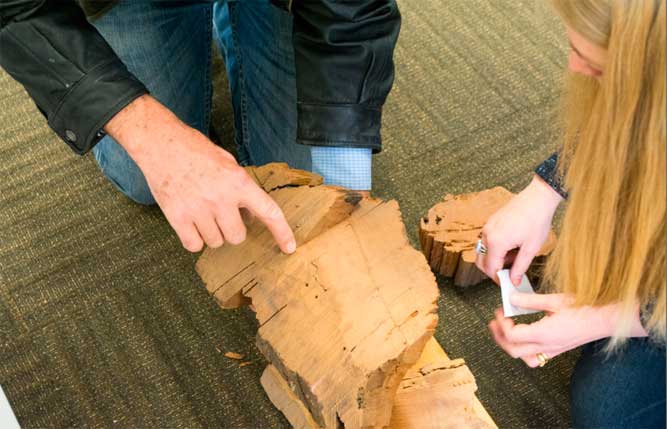
The third critical issue was to be able to demonstrate that there was a correlation between the “known age” of a series of samples and a calculation of 14C ages based on the measured residual 14C activity exhibited in these samples. This is where the samples re-dated in our study enter the picture. Arnold’s father, the United States representative of the English Egyptian Exploration Fund, had provided a series of samples associated with various periods in ancient Egyptian history using his contacts with curators at several major American museums. The first of these samples, reused in the current study, were provided by Ambrose Lansing, then a curator in the Department of Egyptian Art at the Metropolitan Museum in New York (Marlowe Reference Marlowe1980; Arnold Reference Arnold1992) but were originally obtained by Professor Keith Seele of the Oriental Institute of Chicago. They were several pieces of acacia wood (referred to as C[hicago]-1), from the large funerary complex of the Egyptian ruler Zoser, whose name is more generally rendered as Djoser and is thought to have reigned from 2667 to 2648 BC (based on inscriptions and the archaeological record). We note that the sample numbering of the original samples (Arnold and Libby Reference Arnold and Libby1949, Reference Arnold and Libby1951) did not include the designation “C-”, which was added later in subsequent publications by Libby (Reference Libby1952a, Reference Libby1952b, Reference Libby1954)Footnote 1 .
At the time, samples from this context represented the world’s first set of structures built entirely of stone (Figure 2) and the earliest set of monumental structures with an age derived from historical records. In Libby’s first “Curve of Knowns” the 14C age of C[hicago]-1 (Djoser) was combined with another 14C value obtained on a sample of wood from the tomb of an Egyptian king that had ruled Egypt about a generation after Djoser (Arnold and Libby Reference Arnold and Libby1949:Fig. 1). In an updated “Curve of Knowns,” the Djoser 14C date was cited by itself (Libby Reference Libby1955:Fig. 1).
The burial complex of Djoser (Zoser) at Saqqara in 2017. Photo credit: C Kohl.

The “Curve of Knowns” also included other archaeologically dated samples of wood from the pyramids of Sneferu and Sesostris III (Libby Reference Libby1951, 1952), along with some samples of “tree-rings” (actually Douglas fir—Pseudotsuga menziesii) and “redwood” (actually giant sequoia— Sequoia giganteum) dated by the more secure and then, relatively new science of dendrochronology, or tree-ring dating (Douglass Reference Douglass1929). Contrary to the archaeologically placed wood samples, these dendrochronologically anchored tree rings offered a radiocarbon archive with a fixed, exact calendar date, precise and accurate to a year. The “redwood” sample was taken from a giant sequoia cross-section of the “Centennial Stump”, from California (a sample which would go on to see much further use for 14C work owing to a combination of longevity and wide rings, see Leavitt and Bannister Reference Leavitt and Bannister2009). The Douglas fir specimen was from a now iconic sample collected from Broken Flute Cave, Arizona. Both were provided by the Laboratory of Tree-Ring Research at the University of Arizona where tree-ring dating was first systematized and scientifically applied.
Following on from the “Curve of Knowns”, Libby, Arnold, and Anderson went on to work on a number of other archaeological materials and dated tree-ring samples, which were central to the development of the calibration method. Among these were a number of textiles and ropes. This study came about following discussions with the family of the late Prof. James Arnold, which resulted in the provision of three items from his personal teaching collection. (1) Several large pieces of the acacia wood from the tomb of Djoser, dated to be 4650±75 yr old in Arnold and Libby’s original study (1949); (2) A sample of linen textile; and (3) a sample of rope. Samples 2 and 3 had little identifying information apart from being labeled as “300BC” and “1000BC”. After some research, we have identified these samples as those given in Libby’s Nobel address (Libby Reference Libby1960) and the textile we took to be samples no. C-576 wrapping of the Book of Isaiah, since it is the old item like this mentioned by Libby (Reference Libby1951). Libby’s second 14C date report (Libby Reference Libby1951) mentions two rope samples, one no. C-619, labeled “Mochico rope” and also C-323 “Peruvian rope”. Since Libby (Reference Libby1951) quotes different 14C ages for these two samples of 1838±190 and 2632±300 yr, respectively, an aim of our study became identifying the sample represented by a re-dating of the material.
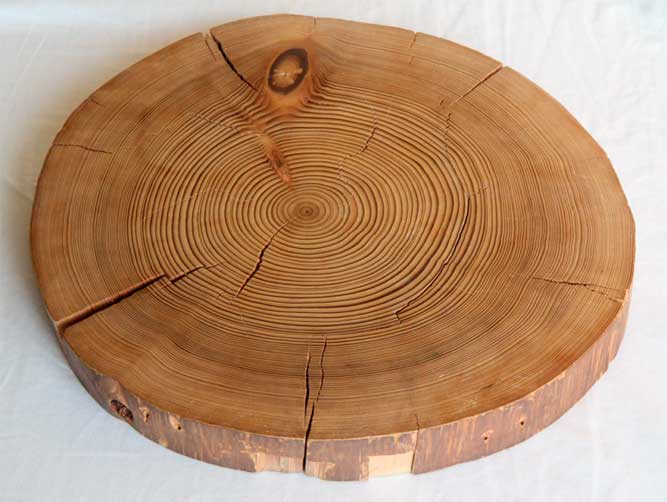
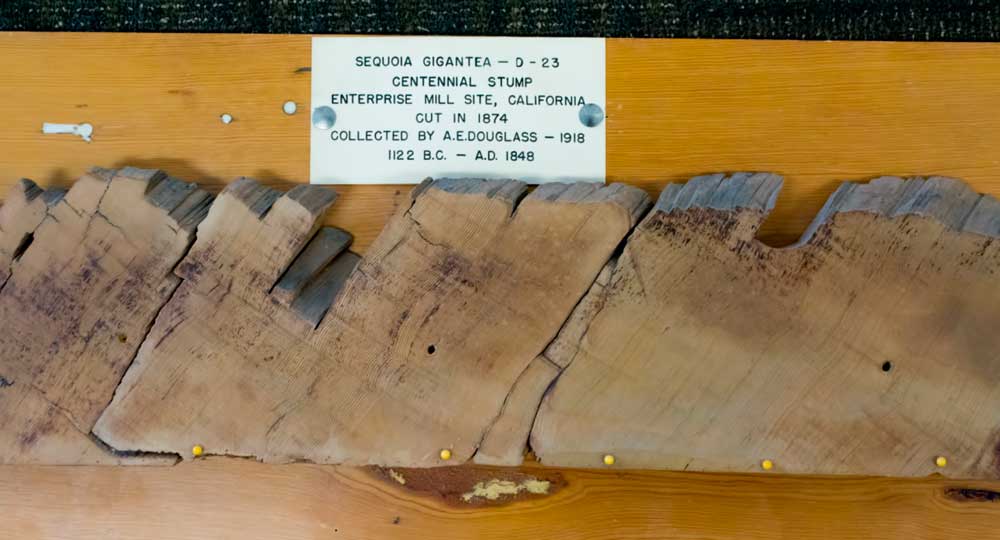
In pursuing dates for these important historical materials, we also expanded our study to include further samples listed by Arnold and Libby (Reference Arnold and Libby1949), two of which are still on display at the Laboratory of Tree-Ring Research, University of Arizona—the tree rings from the Broken Flute Cave sample (C-103; Figure 3) and Centennial Stump (C-159; Figure 4). Additionally, the group at the UC Irvine KCCAMS lab was able to obtain samples of the archaeological wood from the tombs of Sneferu and Sesostris III from the University of California archives.
Sampling of the Broken Flute cave slice. The slice covers the period from AD 533 (inner ring) to AD 623 (outer ring). Photo credit: P Brewer (LTRR).

Centennial Stump. Photo credit: LTRR photo archive.

SAMPLE PREPARATION
The Acacia sections from Djoser’s tomb were sampled at the University of Arizona, at the Laboratory for Tree-Ring Research. Acacia does not typically form regular annual rings but the material was sampled by visible growth increments of which there were 21 for Zoser 3 and 17 for Zoser 2. The two samples were clearly sectioned from the same original tree based on examination of the increments present and an apparently intact outer edge. Samples of the inner (1) and outer increments (1 and 21 and 1 and 17, respectively) were divided and sent to the four laboratories participating in this study. Three laboratories converted the samples to holocellulose and then combusted the cellulose to CO2 before conversion to synthetic graphite. The fourth laboratory (UC Irvine) used an acid/base/acid (ABA) pretreatment protocol (Southon and Magana Reference Southon and Magana2010; Santos and Ormsby Reference Santos and Ormsby2013) before converting the ABA-treated woods and other samples to CO2 and conversion to synthetic graphite. The UCI and Arizona laboratories accept the view that, for almost all samples examined, there appears to be no measurable difference in the 14C values obtained on cellulose and ABA fractions extracted from well-preserved Holocene age wood samples. The synthetic graphite powder was then pressed into AMS target holders and measured according to the procedures of the relevant laboratory. Two laboratories (Arizona and Irvine) also measured the δ13C values of the samples using conventional stable-isotope mass spectrometry instruments. Similar protocols were followed for the rope and linen samples.
Further samples were only processed at one particular laboratory. The UCI laboratory processed samples of wood from Sneferu and Sesostris III tombs using an ABA pretreatment. For the samples from Broken Flute Cave and Centennial Stump, annual tree rings matching the original sampling as closely as possible but at the annual resolution now possible with AMS dating, were selected and processed to holocellulose at the University of Arizona laboratory.
MEASUREMENTS
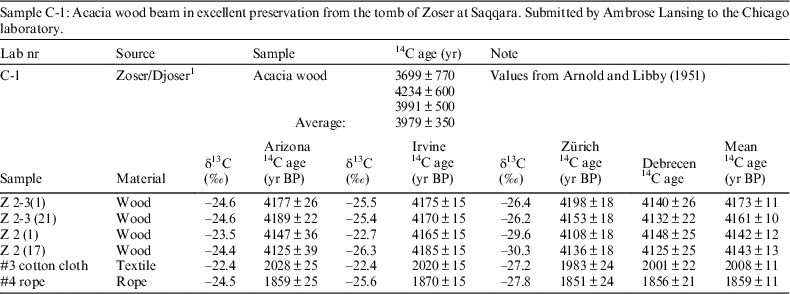
Measurements were done independently at the four AMS laboratories at Arizona, Irvine, Zürich, and Debrecen. These laboratories operate different AMS machines: A 3MV NEC Pelletron at the University of Arizona (Jull et al. Reference Jull, Burr, Beck, Hodgins, Biddulph, Gann, Hatheway, Lange and Lifton2006), a 0.5MV NEC Pelletron at University of California-Irvine (Beverley et al. Reference Beverly, Beaumont, Tauz, Ormsby, von Reden, Santos and Southon2010), and two MICADAS machines in Zürich (Wacker et al. Reference Wacker, Bonani, Friedrich, Hajdas, Kromer, Nemec, Ruff, Suter and Synal2010) and Debrecen (Molnár et al. Reference Molnár, Rinyu, Veres, Seiler, Wacker and Synal2013), which operate at 200kV terminal voltage. The results were communicated to the lead author, so the measurements were a blind test for the other three laboratories. Results are given in Table 1. All results are in good agreement. Some small differences are apparent, but they are within errors. We performed a Student’s t-test across each group of data to confirm that all data are consistent.
Radiocarbon measurements on acacia wood from the tomb of Zoser (Djoser) made at four different AMS laboratories.

RESULTS AND DISCUSSION
Measurements at Multiple Laboratories
We decided to compare our results to those expected from samples published by Arnold and Libby (Reference Arnold and Libby1949, Reference Arnold and Libby1951) and Libby (Reference Libby1951). In the case of the Acacia wood sample, the documentation was very clear, for the other two samples there are some possible alternatives. We also use the terminology 14C yr BP for these early results, which already used the “Libby” half-life of 5568 yr and therefore, can be stated in this way. Interestingly, the first paper of Arnold and Libby (Reference Arnold and Libby1949) used a half-life of 5720 yr. Of course, at this time (1948–1951), there was no calibration curve, although the two “Curves of Knowns” were the beginning of this process.
1. Acacia wood from the tomb of Zoser (Djoser) at Saqqara
This sample is well-documented. The sample is discussed in Arnold and Libby (Reference Arnold and Libby1949) and an updated series of 14C dates are given in Arnold and Libby (Reference Arnold and Libby1951). Our results are in good agreement with the revised (1951) value of 3979±350 14C yr BP. Arnold and Libby (Reference Arnold and Libby1951) were already using the “Libby half-life” still in use today, but they had not yet considered the fact that 14C varies with time on the calibration curve. In 1949, they had proposed a value of 4750±250 14C yr BP, based on the measured activity and a half-life of 5720±47 yr.
We have also performed wiggle-matches using OxCal (Bronk Ramsey et al. 2009) on both the 21-yr segment and the 17-yr segment, as follows:
 $$\eqalignno{ & 21\!{\hbox -}{\rm yr}\,\colon\,2787-2694\,{\rm BC}\,\left( {1\sigma } \right)\;\,\,\,\, 2858-2679\,{\rm BC}\,\left( {2\sigma } \right) \cr & 17\!{\hbox -}{\rm yr}\,\colon\,2846-2665\,{\rm BC}\,\left( {1\sigma } \right)\quad 2855-2642\,{\rm BC}\,\left( {2\sigma } \right) $$
The wiggle-matching should be treated with caution as the assumption for the model used is that the growth increments counted represent individual years, which of course we cannot absolutely confirm, however the results of the 14C dating and the wiggle-matching give identical results, so the observation that these are from the same section of wood is certainly supported. The calibrated ages also agree well with the age estimate of J. Wilson of 4650±75 yr (Arnold and Libby Reference Arnold and Libby1951). Other studies have discussed the age of other Zoser tomb materials. Ramsey et al. (Reference Ramsey, Dee, Rowland, Higham, Harris, Brock, Quiles, Wild, Marcus and Shortland2010) reported on 6 short-lived plant species giving a mean of 4136±35 14C yr BP and 4 short-lived wood samples which gave 14C ages of 4132±36 14C yr BP, essentially identical to our results on the Acacia wood, especially given the plateau in the calibration curve for this period. The plateau may complicate things slightly but it seems reasonable to presume that the Acacia was felled in a contemporary period with the short-lived plant materials.
2. Textile sample
The textile is a coarse cotton cloth, identified by the characteristic twist of cotton fibers. The only cotton cloth sample in the early date list is sample (C-271), listed as Paracas cloth from a mummy wrapping, which was “brought to New York in 1949 by Rebecca Carrion, National Museum of Anthropology and Archaeology, Peru.” The age given by Arnold and Libby (Reference Arnold and Libby1951) for this sample is 2257±200 14C yr BP. Our consensus result of 2008±11 14C yr BP is certainly within the range of these large errors.
3. Rope sample
The sample of rope was well preserved and appears to be the same rope shown in Libby (Reference Libby1960)’s Nobel lecture. Two samples of rope from South America were discussed by Libby (Reference Libby1951) in “Chicago Radiocarbon Dates II”. The first is Peruvian rope, dated to 2632±300 14C yr BP, C-323 and described as “ in excellent condition from cache in lowest layer (D) of Huaca Prieta Mound No. 1”. The second was referred to as “Mochica rope” (no. 619) “from a late Mochica burial at Huaca de la Cruz in the Viru Valley” and was dated to 1838±190 14C yr BP (Libby Reference Libby1951). Our consensus result of 1859±1114C yr BP would clearly indicate that this sample is the “Mochica rope” sample.
All these results show excellent agreement between the laboratories. Some minor divergences can be seen, but they are all within the quoted errors of the measurements. We are confident that measurements at all these four laboratories can be considered identical.
Single-Laboratory Measurements
4. Samples from Sneferu and Sesostris (Senusret) III
The samples of a cedar decking board from the funerary boat of the Egyptian Sesostris III, and a piece of acacia from the tomb of Sneferu of Meydum were originally reported by Arnold and Libby in 1951. A summary of other measurements by Arnold and Libby, as well as re-dating of the material by the UC Irvine group are shown in Table 2. Results on Sneferu show good agreement with Ramsey et al. (Reference Ramsey, Dee, Rowland, Higham, Harris, Brock, Quiles, Wild, Marcus and Shortland2010), who determined a mean of two measurements at 4096±30 yr BP for short-lived species compared to 4120±15 on the wood. These results are also consistent with the measurements on Djoser already discussed. These younger results agree with the current chronology and are considerably younger than the original measurements of the Chicago group, which varied substantially.
Irvine Laboratory re-dating of Senferu and Sesostris (Senruset) III samples.

1 Libby WF. 1952. Radiocarbon Dating. Chicago: University of Chicago Press. p 70.
2 Taylor RE, Bar-Yosef. 2014. Radiocarbon Dating: An Archaeological Perspective. 2nd edition. Walnut Creek: Left Coast Press/London: Routledge. p 327, footnote 144.
3 Known age: 4575±75 yr according to John Wilson (Oriental Institute, University of Chicago), see Arnold and Libby (Reference Arnold and Libby1951) and Libby (1952).1
4 Known age: 3750 yr according to John Wilson (Oriental Institute, University of Chicago), see Arnold and Libby (Reference Arnold and Libby1951) and Libby (1952).1
5 Radiocarbon ages are calibrated using CALIB 7.0 protocols and the IntCal13 data set. Single interval 2σ range calibration values are expressed for intercepts representing ≥0.95 of the relative area under the probability distribution. If relative area is ≥0.1, that value is listed in parenthesis. In cases of multiple intercepts, the 2σ ranges with relative areas under probability distribution of ≥0.05 are noted in parenthesis for intercept separations of ≥20 yr. Calibrated age ranges are rounded to nearest 5-yr increment.
6 Median calibrated age.
The results for Sesostris III are in better agreement, and agree within errors. We have also compared the new UCI result of 3580±20 yr BP with the mean of 10 values on papyrus measurement by Ramsey et al. (Reference Ramsey, Dee, Rowland, Higham, Harris, Brock, Quiles, Wild, Marcus and Shortland2010) for Sesostris/Senusret III. That mean is 3531±11 yr BP for the short-lived papyrus. The slightly older age for the wood could be because the outer edge of the sample was missing due to shaping for use in construction. This would mean the most recently formed rings were removed.
5. Broken Flute Cave
The sample of wood from Broken Flute Cave (Figure 3), was recovered from the Red Rock area of the Navajo Nation in northern Arizona during archaeological studies by Earl Morris and provided to the first Tree-Ring Laboratory director, A E Douglass in 1933. Our samples of the inner and outermost rings from this sample, measured at the University of Arizona, plot remarkably above the decay curve first shown by Arnold and Libby in 1949, although later “Curves of Knowns” (Libby 1952, Reference Libby1956) incorporate a second tree-ring sub-sample from the material which is closer to the trend line. Our results, shown in Table 3, fit well with the 2013 IntCal curve as determined using OxCal v.4.3, but an intriguing small offset of the median values to older side of the calibration curve, of about 30 years appears to be present for these annual samples. A wiggle-match on these two samples confirmed exactly the measured value for the outer rings of the wood, with the same small offset.
University of Arizona results of radiocarbon dating of historical tree-ring samples.

1 Calculated fraction modern based on original data of Arnold and Libby (Reference Arnold and Libby1949) and Libby et al. (Reference Libby, Anderson and Arnold1949).
2 This is the value quoted by Arnold and Libby (Reference Arnold and Libby1949). Based their data (and F14C), the age in the original paper should be 1030±170.
3 Values given in Arnold and Libby (Reference Arnold and Libby1951).
4 Age calculated from values stated in Arnold and Libby (Reference Arnold and Libby1951). The stump was felled in 1874 AD and the sample was taken from an interior section, 2905–2802 rings from the exterior.
5 Median value.
6. Centennial Stump
The “redwood” sample from “Centennial Stump” (D-23), was collected by A E Douglass in 1918. Arnold and Libby (Reference Arnold and Libby1949) obtained tree rings from 1031–928 BC from Edward Schulman of the Tree-Ring Laboratory (Leavitt and Bannister Reference Leavitt and Bannister2009). In our re-sampling at University of Arizona, we took the younger end of the section of interior rings sampled by Schulman, the ring representing the calendar year 928 BC (Figure 5). The results are shown in Table 3. Our 14C age of 2835±21 yr BP agrees well with the average of a number of measurements by Arnold and Libby (Reference Arnold and Libby1949, Reference Arnold and Libby1951), which sampled different parts of this material, ranging from 2400 to 3000 14C yr BP but with an average of 2710±130 14C yr BP (Arnold and Libby Reference Arnold and Libby1951). Discrepancies noted in this case are more likely due to sampling differences rather than the radiocarbon methodology.
Sampling of the Centennial Stump at the location originally sampled by Schulman, by C Pearson and C Baisan. Photo credit: Noreen Doyle (LTRR).

CONCLUSIONS
Two samples dated by Arnold and Libby (Reference Arnold and Libby1949, Reference Arnold and Libby1951) from Broken Flute Cave and the tomb of Sneferu disagree with more recent determinations. We conclude that this is probably due to the difficulties in the early solid-carbon counting system. The early measurements had considerable sources of error. We note that these samples plot off the “Curve of Knowns” in its earliest iterations (Arnold and Libby Reference Arnold and Libby1949, Reference Arnold and Libby1951) although later versions display slightly different fits (Libby Reference Libby1954, Reference Libby1960). Our new measurements on both these samples confirm that the original results for these two samples were spurious as our data now plot closer to the original “Curve of Knowns” and also give 14C calibrated ages that agree with the known ages of these materials. Indeed, all the known-age materials studied by Arnold and Libby (Reference Arnold and Libby1949) now give 14C calibrated ages that are consistent with their known age.
We believe there is great value in reinvestigation of these early measurements. Not only do they show that Arnold, Libby, and Anderson overcame immense technical challenges in their early 14C measurements, but that their results were in quite good agreement with the values we measure today, with the noted exceptions readily explained by difficulties in the solid-carbon counting system. Given that early radiocarbon researchers were only learning about the problems of the calibration curve, this is quite remarkable itself and it is a testament to the scientific process that the original samples selected were well-suited to their purpose and archived for future use. It is also interesting to note that within the study we see excellent agreement between labs using different procedures and instrumentation, built on the legacy of Libby, Arnold, and Anderson. Finally, as we investigated the old tree-ring samples to take advantage of the capacity for annual analysis made possible by AMS we note, that our observed small off-set to the current calibration curve is in line with other off-sets currently being observed in a new surge of annually resolved radiocarbon research.
ACKNOWLEDGMENTS
We are most grateful to the Arnold family for their graciousness in providing these samples to us for further study, as well as locating historical photographs. We also thank Pearce Paul Creasman for processing our sampling request to the Laboratory of Tree-Ring Research (LTRR) Archive and to the U.S. National Park Service for access to these collections. Radiocarbon measurements were carried out with thanks to the able assistance of colleagues at the University of Arizona AMS Laboratory, Keck Carbon Cycle AMS Laboratory, Isotope Climatology and Environmental Research Centre, and ETH Zurich. This study is a contribution of the Center for Mediterranean Archaeology and Environment (CMATE) and the ICCP at the University of Arizona, with thanks to the Malcolm H Wiener Foundation, Merops Foundation and anonymous donor support. The research in Debrecen was supported by the European Union and the State of Hungary, co-financed by the European Regional Development Fund in the project of GINOP-2.3.2.-15-2016-00009 “ICER”. Work at Irvine was in part supported by the Gabriel R Vierra Memorial Fund to RET.