A key step in the systematic review process is the development of a search strategy to identify all pertinent research studies (Reference Karimi, Pohl, Scholer, Cavedon and Zobel1;Reference McGowan and Sampson2). This process comprises several exhaustive steps, including brainstorming relevant search terms and iteratively modifying the search query to produce a targeted yet comprehensive citation list. To assemble error-proof queries for use in commonly used biomedical search engines, such as PubMed (www.pubmed.com) and Embase (www.embase.com), users must have prior knowledge of field codes (i.e., text word = [tw], medical subject headings = [MeSH Terms], publication type = [pt], language = [la]), Boolean operators (i.e., “AND”, “OR”, and “NOT”), and rules for proper parenthetical grouping. For example, for a review investigating the association of migraine headaches with incident stroke, a PubMed search string limited to research manuscripts in the English language could appear as follows: (“migraine headache” [tw] OR headache [MeSH Terms]) AND (“cerebrovascular disorders” [MeSH Terms] OR stroke [MeSH Terms]) NOT (review[pt]) AND (english[la]) AND (humans[All Fields]). Without detailed knowledge of search syntax and phraseology, constructing such a string could be time-consuming, confusing, and prone to typographical errors.
Despite these complexities, few automated tools currently exist to assist users with the syntax involved in the assembly of search strings. Moreover, the available builder tools offered from PubMed and Embase, which can be accessed using “Advanced” links on their respective homepages, do not allow users to easily share search stings. Such limitations subsequently add time and complicate the systematic review search process (Reference Montori, Swiontkowski and Cook3;Reference Allen and Olkin4), and may discourage co-authors from assisting each other on this lengthy task.
DEVELOPMENT
Context
Search Builder version 1.0 was created by a member of the authorship team (B.B.K.) as part of a systematic review and meta-analysis course at the Johns Hopkins Bloomberg School of Public Health in Baltimore, Maryland. During this course, four- to five-member student teams produced systematic review manuscripts with guidance from skilled experts in systematic review methodology. For the search strategy process, the student teams were instructed to use traditional search methods, including manually listing relevant search terms (using keywords from literature on the topic, medical subject headings [“MeSH”] indexed on PubMed, and search strategies from previous systematic reviews), constructing a search text string using appropriate syntax, and iteratively testing the search string in online biomedical search engines such as PubMed and Embase. Because all team members were expected to perform this step, individual efforts to construct search strings resulted in person-to-person variability in search terms included, syntax used, and observed search results, thus slowing an already cumbersome process. Moreover, attempted use of available online search builder tools offered by PubMed and Embase revealed them to be inefficient for use as a group, and difficult to save due to the online-only, login-required interface.
To overcome the inconveniences of the search strategy process, the first author (B.B.K.) created a file in Microsoft Excel® that could automatically add search string syntax to a user-provided list of search terms. A prototype-version of this file was quickly adopted by the systematic review team and lauded as a valuable time-saving tool due to features such as offline usage, rapid inclusion and exclusion of search terms, and the ability to save, share, and repeatedly edit versions of the search string. After successful use of the search builder prototype for the systematic review course, the first author (B.B.K.) received assistance from an engineer and Microsoft Excel® expert (B.S.K.) who fine-tuned the builder program, and a team of research associates (P.A.S., S.S., J.O.) tested the builder product. After completion of pilot testing, Search Builder 1.0 was finalized for public dissemination.
Description
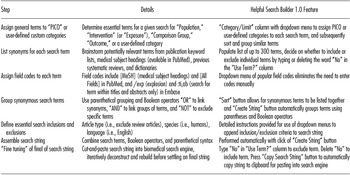
Search Builder 1.0 is a Microsoft Excel® tool that takes a user-defined list of search terms and automatically assembles a search string that can be copied and pasted into PubMed or Embase (see Table 1). Users of Search Builder 1.0 enter desired search terms into the spreadsheet and subsequently assign each with a “PICO” (Population, Intervention, Comparison group, and Outcome) category, limit (i.e., language, article type, species), or a custom user-defined category, and a field code (i.e., PubMed: title/abstract = [tiab], [All Fields], medical subject headings = [MeSH Terms], Embase: explosion = /exp, synonym = /syn, title/abstract = :ti,ab). Once the term list is populated, simple buttons on the spreadsheet instantly sort and group the terms, assign Boolean operators, create the search string, and copy the string to the clipboard for pasting into PubMed or Embase. For search terms not falling under traditional “PICO” categories, users can manually enter custom category labels for Search Builder 1.0 that can automatically be sorted, grouped, and processed in a similar manner as PICO terms. Once the search string is generated, users may quickly add or subtract terms to the string using a yes/no option, facilitating the rapid iterative search string edits necessary to reach a desired search result. Importantly, users do not need to directly edit the search string text, minimizing the possibility of parenthetical and Boolean typographical errors that may cause search errors. To ensure the reproducibility of search strategies for future searches, the user can save, archive, and share the search string file at any time, and in any location on their personal computer.
Developing a Search Strategy for Systematic Review

DISCUSSION
Search Builder 1.0 is a tool that streamlines the time-consuming process of using complicated syntax to assemble search strings for systematic reviews. Given its straightforward user interface and Microsoft Excel® file-based platform, Search Builder 1.0 is a simple freestanding alternative to existing Web-based builders that require users to login to save searches and lack tools for search string sharing. While Search Builder 1.0 is designed for use with searches in PubMed or Embase, future versions may include other biomedical search engines such as CINAHL, PsychInfo, and Web of Science.
At this time, we are pleased to offer Search Builder 1.0 (Microsoft Excel® file with User Guide) to the readers of the International Journal of Technology Assessment in Health Care (Supplementary Files 1 and 2). Users of Search Builder 1.0 must have a macro-enabled version of Microsoft Excel® (version 2003 and later for Personal Computer (PC), version 2011 for Macintosh). The PC and Macintosh versions of Search Builder 1.0 are available at: hopkinsmedicine.org/pulmonary/ research/outcomes_after_critical_illness_surgery/oacis_ publications.html#SysReviewMeta.
CONCLUSION
Search Builder 1.0 is a novel Microsoft Excel®-based tool used to generate, archive, and share complex search strings for use in PubMed and Embase. This user-friendly tool can save considerable time in the systematic review process.
SUPPLEMENTARY MATERIAL
Supplementary Files 1 and 2 http://dx.doi.org/10.1017/S0266462315000136
CONFLICTS OF INTEREST
The authors have no conflict of interest to report.