It was 3 August 1933. The port at Danzig was busy and rumours were flying. A loudspeaker declared the news: ‘The Chancellor has landed at the port in Danzig!’ Telephones rang in the offices of the Waldoper, the open-air theatre dedicated to Wagner in the nearby city of Sopot. The magistrate of Danzig called again and again: ‘Hitler is coming to the Waldoper! The Führer is visiting the Waldoper tonight!’ But it was not true – or, according to the Waldoper’s general manager, Hermann Merz, it was only ‘half true’; nevertheless, ‘The rumour, once there, was believed. It took on a life of its own.’Footnote 1
This story appeared in a 65-page collection of essays, illustrations and anecdotes about the Waldoper edited by Friedrich Albert Meyer and published in 1934 to mark the twenty-fifth anniversary of the festival; he wrote and published a second collection in 1939, the Waldoper’s thirtieth anniversary.Footnote 2 Perhaps such a tale was intended to appeal to visitors from Danzig, which had only recently elected a Nazi majority parliament, or to emphasize the Waldoper’s political and cultural connections with the Reich and with Hitler. Whatever the reason, in their contributions to Meyer’s first anthology, Reichsleiter Alfred Rosenberg called the Waldoper paradigmatic of the National Socialist vision of ‘German cultural rebirth’ in eastern Europe, while Reichsminister Joseph Goebbels referred to the stage as an ‘important festival site for the Reich’, a title that appeared in much of its advertising.Footnote 3
Merz’s conclusion that this story was at best ‘half true’ and Meyer’s statement that it ‘took on a life of its own’ is an apt summation of the persistence of mythologies of the efficacy, consistency, distinctiveness, organization and uniformly totalitarian nature of the Third Reich’s cultural programmes in historiographies of the period. These mythologies have been queried and dismantled since the late 1990s as scholars have attempted (in Pamela Potter’s words) to ‘navigate between long-standing paradigms and ever-increasing amounts of evidence that erode the credibility of those paradigms’.Footnote 4 In this article, I proffer the Waldoper and its cosmology of accompanying texts, iconography and dramaturgical practices as a case study for exploring how the Reich conceived open-air mass spectacle as facilitating effective social reform in Poland – particularly through the appropriation of existing paradigms of environmentally driven coercion – and in what ways the Waldoper served to inflect Wagner’s role within the Reich’s cultural and political machine. As I show, rhetoric of ‘climatic determinism’ – a theory popular since 1810 which held that climatic zones conditioned their inhabitants’ every feature – was a ready-made system of thought to which mind control and indoctrination had long been so central that climate’s ‘deterministic’ authority was practically scientific fact.Footnote 5 Climatic deterministic language was appropriated by Meyer’s contributors and grafted onto their claims about Wagnerian drama and the Waldoper’s indoctrinating powers, aligning this festival via multiple, imbricated strands of coercive rhetoric and myth with Joan Clinefelter’s argument that ‘art supportive of the Third Reich was less an aesthetic and more a rhetorical practice’.Footnote 6
This article begins by situating the Waldoper’s activities within the history and conventions of the German open-air opera and theatre movements. Popular throughout the first decades of the twentieth century, open-air opera and theatre in German-speaking regions had much in common with similar practices elsewhere. As Katherine Ellis and Suzanne Aspden have shown, outdoor opera in France and Britain was a popular vehicle of myth-making, tourism and expression of political and cultural identity across social registers in the early decades of the twentieth century.Footnote 7 I suggest that open-air opera in Germanic regions – including at the Waldoper – often held a similar function, but designated an idiosyncratic role to the natural environment: critical reception suggests that outdoor opera braided operatic experience together with discourses of environmental determinism to cultivate specific notions of Germanic identity in the first half of the twentieth century around shared mythologies of nature and culture.
I go on to show that under the Reich, open-air theatre and mass spectacle embraced and expanded practical and social conventions underlying this and other outdoor theatrical practices. According to Rainer Schlösser, Reichsdramaturg and head of the Theatre Chamber (Reichstheaterkammer), open-air theatre – particularly the short-lived Thingspiele project – was viewed by the Reich as a vehicle for renewing and reconstituting the nation as a ‘blood brotherhood’ (Blutsbrüderschaft).Footnote 8 I argue that Meyer’s two volumes of essays align the Waldoper with this aim, while also suggesting that the Reich envisioned it as fulfilling a distinctly imperialist function in Poland. Contributors to Meyer’s books – who included pro-Nazi Danzig government leaders and high-ranking members of several of the Reich’s ministries – described this ‘new form of art’ (‘neuer Form Kunst’). The president of the Danzig senate, Hermann Rauschning, for instance, writes that this theatre fused Wagnerian drama with the natural environment; it cultivated the ‘inner needs and wants of the German spirit’ by facilitating their ‘true unity with nature itself’.Footnote 9 Further delineating the imperialist function of the theatre, Carl Lange, in his contribution to Meyer’s 1934 collection, claimed that the theatre was a ‘national cultural act of the German East’. Sopot’s open-air theatre presented a Wagnerian ‘cloud of nature’, its ‘atmospheric change’ and ‘nature-music’ exerting a ‘powerful influence on the development of Germanic listeners’.Footnote 10 In another essay in the 1934 volume, Wilhelm Zarste suggested that the Sopot theatre ‘attested with a strength born of the deepest conviction to the true German-ness of our homeland following the separation of Danzig from its motherland. Today, the Sopot Forest Festival has become a consecrated place and Soppot has thus become a cultural centre in the German East’, extended through the Danzig region into eastern Europe.Footnote 11 Through festival literature, dramaturgy and iconography, the Waldoper not only participated in what Michael Kater has described as the Reich’s use of German music as a means to ‘forcibly Germanize’ occupied peoples but, as I argue, could also be understood as representing an artistic prong of the Reich’s Volksdeutsche project, a set of initiatives implemented in occupied regions to eradicate existing ethnic identities and ‘create more ethnic Germans’, in Heinrich Himmler’s words.Footnote 12
As I show throughout this article, the Reich’s administrative and bureaucratic practices were chaotic or, at the very least, inconsistent and superficial, deeply ‘eroding the credibility’ of paradigms of ‘effective’ Polish social reform espoused from on high in festival literature and imagery. In the post-war period, Günter Grass lay bare the superficial nature of the Waldoper’s mythologies in his magical realist novel The Tin Drum (Die Blechtrommel, 1959). In the final section of the article I suggest that by exposing the Waldoper in this way, Grass’s Waldoper vignette could be read both as part of his ‘recovery mission’ aimed at retroactively reclaiming Polish space, memory and experience from Nazi occupation and mythologization, and as literary performance of some embodied or imagined inhumanity he may have believed led him to pursue active military service in 1944.Footnote 13 But I argue that this vignette is not just a reflection of Grass’s grappling with his own memories of war. Instead, it could be read as narrativizing critical challenges around writing on the Reich’s cultural projects, like the Waldoper: his vignette animates historiographical pitfalls that surround these projects’ mythologies and unearths their phantasmagoric bearing on historical actors and historians alike.
Naturbühnen, tourism and climate: opera and drama in the German forest
When I visited Sopot, Poland, in August 2017, I asked my tour guide if she knew anything about the circumstances of the Waldoper’s founding, and she replied with the following origin story. In 1909, a man from Sopot was walking in the woods. He soon began singing and found a place under the trees that seemed to have the ‘perfect’ acoustic, and it was in that place that the Waldoper was built.Footnote 14 It retained the reputation of having an ideal acoustic, especially for Wagnerian drama, into the 1960s.Footnote 15 Various German operas, as well as some operettas and comedic and tragic dramas, were performed there until the stage was dedicated almost entirely to Wagner’s Waldspiele in 1922, earning it the moniker ‘Bayreuth of the North’.Footnote 16 The idea that German sound (particularly Wagnerian sound) resonated more fully and more naturally in the German forest air attracted spectators to Sopot from across Europe, all keen to hear the German forest’s resonance for themselves when urban opera houses were closed for the summer.Footnote 17
Throughout the early decades of the century, open-air stages were common across Germany and a popular part of operatic and theatrical culture.Footnote 18 In 1906 there were about 30 Naturtheater in Germany, and by 1937 that number had swelled to about 235;Footnote 19 by way of contrast, there were about 50 such venues in France in the 1920s.Footnote 20 Some acted as summer festivals for urban opera houses, while others operated within and were subsidized by pneumatic spa complexes, offering aural therapy to vacationers in search of leisure, entertainment and bodily cures.Footnote 21 Sopot’s Waldoper was incorporated into one such health resort, providing visitors with the opportunity to breathe clean air and hear curative sounds during their visit to Sopot’s popular resort on the Baltic coast. At the Waldoper, as one commentator suggested in the 1931 Deutscher Bäder Kalendar, spectators not only basked in the resonant forest acoustic, but imbibed a fresh dose of vitality, carried upon the air, among the trees.Footnote 22
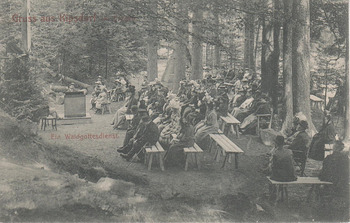
As the theatre critic Heinrich Mettin explained in 1937, German nature stages were divided into categories based on their natural surroundings – there were Felsenbühne, Strandbühne and Waldbühne, among other categories; and repertoire was often chosen on the basis of its relevance to those surroundings. Works set against cliffs should be performed only on Felsenbühne, for example, while those that thematized the forest should find their homes only on Waldbühne, he claimed.Footnote 23 Spectators can be seen assembled before one Waldbühne in Figure 1. Intervention in the natural environment was discouraged, Mettin suggested, the natural setting ideally sufficing as backdrop for the works on offer. In practice, however, intervention – in the form of cloth backdrops obscuring ‘real’ nature and adorned with tableaux that facilitated performance of a particular work, or in the form of various supporting, non-natural stage elements – was common.
‘Gruss aus Kipsdorf – Ein Waldgottesdienst’. Waldbühne at Kipsdorf, near Dresden (c.1908). The text may be translated as: ‘Greetings from Kipsdorf – A forest-god service’.

At some Naturbühnen, new repertoire was commissioned that not only reflected its intended setting but also directly commented upon that setting to enact a localized aesthetic education and appeal to regional consciousness – even after the achievement of nationhood – rooted in shared experience and the mythologization of local nature.Footnote 24 Ellis has described a similar phenomenon in early twentieth-century French open-air theatre: there, new works were commissioned to appeal to local audiences with localized imagery and thematization of familiar social tropes.Footnote 25 In German-speaking regions, these ruralist, regional works were sometimes referred to as Heimatspiele: as George Mosse and Gerwin Strobl explain, such works often portrayed ‘a historical episode that had taken place in the locality’ in order to exalt the region, or recounted a story popular with local audiences that was sometimes even adapted to their interests, such as that of Wilhelm Tell, Götz von Berlichingen or the Nibelungenlied. During the Nazi period, this term was applied to amateur theatre performed by members of the Hitler Youth (Hitlerjugend), the ‘Strength through Joy’ (Kraft durch Freude) movement and the Labour Service (Reichsarbeitsdienst).Footnote 26
One example of this localized, outdoor dramatic genre in Bavaria is Die Losburg (1892). In three acts and seven scenes, this Bergfestspiel’s text was composed by the local historian and poet Ludwig Hacker and included incidental music by Heinrich Schmidt.Footnote 27 Die Losburg was performed annually at the base of the Luisenberg (or Losburg) in Alexandersbad, Bavaria, where an outdoor stage was incorporated into pneumatic spa activities. In Hacker’s drama, personifications of the natural landmarks visible near the stage were assigned lines about how to treat nature with respect and about the intimate bond between nature and the cultural identity of the audience, which probably consisted of Bavarian locals and predominantly German tourists. Lessons expressed (literally) by nature itself were reinforced by claims from Teutonic heroes, including Tannhäuser and Siegfried, who stood just inches from listeners intimately assembled among the trees. As Hacker explained, at the mountain stage natural scenery (which, for the character Die Losburg, included ‘pure air’), words and music were ‘bound together towards a higher unity’.Footnote 28 This Bergfestspiel was also a Volksspiel: the mountain’s ‘native, incomparable nature’, in combination with Germanic poetry and music, cultivated ‘the pure joy of the Volk’ and inspired ‘all [to] honour the fatherland’.Footnote 29 Inviting spectators to join mythic and ecological characters (including the character Die Losburg and the Forest’s Rocks) in that act of consecration, the play concludes with a communal rendering of the Deutschlandlied. Footnote 30
Perhaps owing to the Luisenberg’s mythological reputation and geological significance (about which Goethe had written in 1820), Hacker’s narrative reads as both nationally and locally orientated.Footnote 31 Grafting völkisch mythologies of German nature onto local landmarks, it could be read as narrating a reterritorialization of local nature (and its local communities), implicating them as part of both a local and a collective Heimat in a moment when large-scale urban development, industrialization and shifts in energy resourcing and labour distribution was transforming agrarian regions.Footnote 32 As such, Hacker’s play might register as querying the role of outdoor theatre and cultural tourism in considering the status of regional loyalties, the meaning of provincialism and the social function of tourism in fin-de-siècle Bavaria.Footnote 33 In keeping with Adam Rosenbaum’s claims, Hacker seems to be speaking to and even thematizing the role of outdoor theatre and tourism as a vehicle, particularly in Bavaria around 1900, for ‘reconcil[ing] civilization with its discontents, anchoring urban society in the natural environment and a common past’.Footnote 34
In 1926, the physiologist Fritz Kahn described cultural and social conditioning of the nation via environmental exposure as central to the experience and politics of Naturtheater. Such conditioning was a product not simply of persuasive narrative or the observation of aesthetically pleasing surroundings but, as Hacker’s text also implies, an inevitable consequence of experiencing the natural climate while sitting among the trees, breathing deeply and listening closely. In his Das Leben des Menschen, Kahn wrote that Germany was fundamentally, even biologically, refreshed at these stages. Germans’ shared cultural identity was physically renewed as Naturbühne immersed them in German nature and German music.Footnote 35 The notion that spectators’ cultural values, social and civic orientation and even physiology might be reformed at nature stages – and by the musical and dramatic mimesis of those same natural and climatic elements in the works performed – is indebted to ‘climatic determinism’, discussed above. In German-speaking regions, environmental determinism was one climate theory perpetuated throughout the nineteenth century by natural scientists and cultural geographers, including Wilhelm Heinrich Riehl, who argued in Die Naturgeschichte des Volkes that Germans ‘genetically inherit’ their culture from the infallible ‘soil of the German Fatherland’.Footnote 36 Even Wagner drew on climatic deterministic principles in conceiving his theory of Gesamtkunstwerk, writing in his 1850 essay ‘Kunst und Clima’ that music drama should ‘bear a right relation to climate’ in cultivating a ‘universal’ humanity, redirecting those rendered ‘slovenly cripples’ by the vices of modern civilization into ‘hale and hearty Teutons’.Footnote 37
Even as it faded elsewhere, environmental determinism gained ground among German thinkers in the first decades of the twentieth century.Footnote 38 By 1938, ‘climatic deterministic’ thinking previously associated with Naturbühne had been extended to other German artistic and cultural products: that year, the physician, psychologist and politician Willy Hellpach published a treatise on Germanic culture and climate. His concept, the ‘climate of the Volk’ (Klima des Volk) associated climatic conditioning with völkisch art and culture.Footnote 39 Hellpach argued that German art embodied the northern, German climate and could therefore racially improve those that came into contact with it, including those without Aryan ancestry, a theory that aligned with his work on Völkerpsychologie, which identified biological, racial and environmental factors as participating in the production of ‘national identity’ or ‘national habitus’.Footnote 40 Hellpach’s concept of ‘cultural climate’ expands the scope and rationale of the social, racial and cultural conditioning that might be associated with German art under the Reich, including open-air theatres: he provides rhetorical authorization for the claim that the Reich’s open-air theatres might ‘renew’ not just Germans but racial ‘others’ too, ushering them into a larger, unified Volksgemeinschaft by way of deterministic art, its powers of conditioning exponentially augmented by the presence of ‘real’ climate.
Contributors to Meyer’s anthologies applied these ideas to the Waldoper. Essay after essay attests to performances cultivating a unified Volksgemeinschaft, the long-standing deterministic terms of open-air opera acquiring a distinctly imperialist bearing as the region came under local Nazi control, Hitler sought to negotiate the region’s ‘return’ to the Reich, and Goebbels and Rosenberg became – and would remain – enamoured with the Waldoper as an expansionist, racializing vehicle in Poland.Footnote 41 Declaring the Reich’s entitlement to the region and its people, Rosenberg, leader of the Ministry for the Occupied Eastern Territories (Reichsministerium für die besetzten Ostgebiete), made similar statements in the same anthology of texts, writing that the Waldoper’s ‘harmony between the natural environment and drama’ positions the theatre as a ‘symbolic site of German art in the East’ and allows it to play ‘a greater purposeful role in German cultural rebirth’ in the East.Footnote 42 In his 1939 volume of essays, Meyer echoed his contributors’ earlier sentiments post-invasion, writing that the Waldoper ‘grew by all these means into a German mission in the East, as new boundaries were delineated on the map in the wake of war’.Footnote 43 ‘The Germanic forest [the natural home of the Waldoper] is a world of wonders, and in it we find the roots of Germanic power. Whosoever wishes to tell of the old Germanic warriors, of their lives and their beliefs’ – an array of German, Polish and international visitors, as Meyer suggests earlier in the text – ‘must enter the dense forest, where the secrets of the Germanic bloodline can be revealed to him.’Footnote 44
As early as 1934, when Meyer’s first volume of essays appeared, and continuing until the suspension of the Waldoper’s operations in 1944, the festival participated in what Erik Levi has described as the Reich’s ‘imposition of an almost exclusively German culture’ upon Czechoslovakia and Poland as part of its effort to ‘ensure the permanency of this tradition’.Footnote 45 In their contributions to Meyer’s volume, Rosenberg, Gotthold Frotscher, Goebbels and local officials such as the Danzig Gauleiter Albert Forster (appointed to this role when a National Socialist majority gained control of the Danzig parliament in 1933) position Wagner and the Waldoper as a vehicle for Germanizing Polish people.Footnote 46 Through a combination of exposure to climate and Wagnerian music drama, as Rauschning, president of the Danzig senate, claimed, Polish spectators’ consciousness would be rewired.Footnote 47
During their occupation of eastern and central Europe, the Reich implemented a range of programmes intended not just to coerce Poles, Ukrainians, Czechoslovakians and other occupied peoples into joining the National Socialist Party, but to repatriate and reclassify them as ‘ethnic Germans’ or Volksdeutsche. Footnote 48 The Waldoper may have been envisioned as the artistic arm of this programme in Poland, where this set of initiatives was designed to eradicate Polish identity as Poland was absorbed into Germany, to which Hitler believed it firmly belonged.Footnote 49 After being classified in this way, Volksdeutsche were subjected to a range of new duties that included signing away their Polish names, heritage and ethnicity (and accepting German alternatives); participating in the deportation of Jewish neighbours and the resettlement of Volksdeutsche in Jewish homes after occupants had been deported; and serving in the German army or as guards at extermination camps.Footnote 50 At the Waldoper, the Reich aspired to weaponize outdoor theatre and Wagnerian drama: Goebbels, Rosenberg and others sought to deploy sound, space and (importantly) rhetoric to do the work of an army and to further Polish eradication – and relied on spectators, eventually attracted from across Europe, to believe that climate, in combination with Wagnerian drama, could facilitate racial, cultural and social change and Germanization.
From Thingstätten to the Waldoper: myths of theatrical success under the Third Reich
In 1933, Goebbels declared that 500 new outdoor stages would be built across Germany under the auspices of the League for German Open-Air and Volk Theatre (Reichsbund der deutschen Freilicht und Volksschauspiele).Footnote 51 While these plans never reached completion on their intended scale, at least 60 new amphitheatres were constructed by members of the Reich’s Labour Service.Footnote 52 These new stages, along with some existing amphitheatres, were dubbed Thingstätten, the invented word Thing (‘oak clearing’ or ‘oak grove’) referring to the open-air amphitheatre space and making use of a symbolic ecological reference associated with the renewal of the German Volk since Tacitus’s Germania. Footnote 53 The presence of actual oak trees generally had no bearing on the selection of building sites (though they were sometimes present): scattered throughout Germany, the stages’ locations are often thought to have been selected for their historical significance and the attractiveness of the scenery.Footnote 54
Erika Fischer-Lichte explains that between 1933 and 1935 Thingstätten were ‘pulpits’ of National Socialist values, where populist Thingspiele describing the renewal of the nation were presented to massive crowds of as many as 60,000 viewers that, as Strobl surmises, ‘suggested the nation in numerical terms alone’.Footnote 55 Described by Henning Eichberg as ‘assuming the character of an oratorio’, Thingspiele consisted of ‘rhythmic music and choruses’, ‘musical and gestural effects’ and the ‘choreography of dance’.Footnote 56 William Niven has argued that this formula was intended to bring about cultural renewal on a mass scale, its rhythmic components acting as cues for physically engaging thousands of bodies and ushering them into a ‘cult of participation’.Footnote 57 As Niven writes, the physiological authority of commissioned Thingspiele would, according to Schlösser, ‘activate’ Aryan values in the throngs of assembled spectators, which he also referred to as a ‘blood brotherhood’, granting this form of theatre ‘racial definition’.Footnote 58
Building on conventions of populist and völkisch theatre (from Naturtheater and the ‘national plays’ of outdoor Volkstheater to populist National Socialist rallies), Thingspiele told of the heroism and renewal of the Reich’s ‘natural’ Volksgemeinschaft. Footnote 59 As Otto Laubinger, leader of the Theatre Chamber from 1933 to 1935, explained, Thingspiele focused solely on the Third Reich and ‘expressed the rhythm of our times’ and ‘the longing of our people’.Footnote 60 Texts were produced by expressionist, pro-Nazi writers, including Richard Euringer, Max Halbe, Heinrich Harrer, Kurt Heynicke, Eberhard Wolfgang Möller and Heinrich Zerkaulen. As Karl Toepfer suggests, the protagonist of Thingspiele was ‘the people’ (animated by choruses), struggling with the vices of capitalism, Jews, industrialization, intellectualism, famine and the political forces behind the Versailles Treaty and the Weimar Republic.Footnote 61 Salvation came in the form of the Führer, SS (Schutzstaffel) or SA (Sturmabteilung) officials, or various symbols of the Aryan past becoming present.Footnote 62 Performances supervised by SS or SA officials but produced by local amateurs, Thingspiele were often multimedia undertakings which included choruses that moved, sung or spoke, their message augmented by narrators, banners, marches, loudspeakers, spotlights, music and even film projections.Footnote 63 While historians often consider this practice to have been a failed revolutionary undertaking, some Thing venues were so important to the Reich that they were labelled ‘important festival sites for the Reich’, an official status that came with state subsidies.Footnote 64
The outdoor environment (so-called ‘oak groves’) may have been intended to participate in the imagined process of nationalistic activation and acculturation that Schlösser described, the ‘oak grove’ symbolically assuming the coercive role that natural surroundings held at other open-air theatres throughout Germany. As Robert Taylor explains, ‘The oak tree itself was often part of architectural planning and landscaping, as on the Nuremberg Party Rally Grounds, where it symbolized “German” strength rooted in the “German” earth.’Footnote 65 Not just symbolic, the ‘oak grove’ long bore specific deterministic associations for German thinkers. Historicizing this environmental symbol and its determinism, Jakob Grimm claimed in 1846 that exposure to oaks would ‘refresh’ Germans and ‘rouse [them] to a higher devotion’ after having been ‘brought to ruin by their own delusions’.Footnote 66 As Jochen Thies has argued, the imaginary ‘oak grove’ at Thingstätten was ‘an assembly area for the “swaying” of the intoxicated masses’ – intoxicated by environment and the ‘activating’ elements of mass spectacle.Footnote 67
In 1935, Thingspiele and Thingstätte were largely abandoned by the Reich – they were, as Nadine Rossol has claimed, ‘a spectacular failure’.Footnote 68 A range of factors contributed to the shift away from the Thing project. As Fischer-Lichte explains, Thingspiele had been intended to foster a community-driven didacticism embodied in choral address, but Goebbels viewed this approach as no longer tenable as Hitler sought consolidation of unilateral power.Footnote 69 Goebbels also suggested that Thingspiele had grown ‘amateurish’ over the course of just two years, partly for the lack of consensus and consistency around what Thingspiele (and Volkstheater more generally) really meant in practice.Footnote 70 Speaking to Potter’s delineation of the procedural and administrative complexities (and failures) surrounding this practice, Rainer Stollmann has suggested that the Thing project was abandoned because Thingspiele ‘were not able to gain any real function of their own. Their purpose, the formation of a mass consciousness with full dedication to the National Socialist ideology, the “folk community”, and the Führer, overlapped with the party celebrations and political ceremonies in the Third Reich.’Footnote 71 In the years that followed, the Reich’s Plays Committee (Reichsausschuß für deutsche Volksspiele) was dismantled, and the terms Thing and Thingspiele were ordered to be struck from the German language; Thingstätten were also stripped of their title as important festival sites for the Reich.Footnote 72
Several Thingstätten were completed after 1935 for localized political purposes, however. In 1936, a Thingstätte was completed in ethnically diverse, Catholic Upper Silesia as part of a push by the Nazis, as Michael Burleigh explains, ‘to intrude their own cult and rites’ – including Hitler Youth recruitment and rallies at the Thingstätte – into the lives of the faithful. Its location strategic, the physical site served to disrupt the traditional path of pilgrimage to St Annaberg.Footnote 73 The Loreley Thingstätte overlooking the Rhine at St Goarshausen was not completed until 1939 owing to financial, organizational and technical delays.Footnote 74 As Rossol explains, instead of presenting National Socialist theatre, it exemplified a different strain of Nazi art, one that (much like the Waldoper) placed ‘a stress on entertainment and tourism’, and sought connection with local people by casting citizens of St Goarshausen in performances of Schiller’s Wilhelm Tell and inviting the entire assembly to join in the recitation of the famous Rütli oath.Footnote 75
Following the decline of the Thingstätte programme, as Jost Hermand has explained, Goebbels and the Ministry of Public Enlightenment and Propaganda (Reichsministerium für Volksaufklärung und Propaganda) devoted Thing funding to existing state and local theatres under the jurisdiction of the ministry, as per the Reich Theatre Law (Reichstheatergesetz) approved by Goebbels in May 1934.Footnote 76 Between 1934 and 1942, funding for these theatres increased from nine million to thirty-four million Reichsmarks (RM).Footnote 77 In 1939, at least nine Polish theatres came under the Reich’s control and received funding, including the eighteenth-century Greco-Roman ‘Theatre on the Isle’ at Łazienki Park in Warsaw, where in 1940 German officers enjoyed open-air performances of Goethe’s Iphigenie by an entirely German cast.Footnote 78
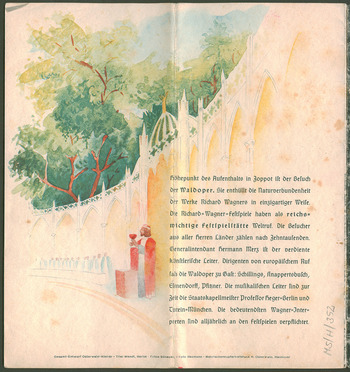
Having elected a National Socialist majority parliament in 1933, Danzig maintained a significant Nazi presence prior to Hitler’s invasion of Poland in November 1939. As such, nearby Sopot and its Waldoper was an early Polish recipient of Goebbels’s financial action and one of the few stages that retained its ‘important festival site for the Reich’ status (see Figure 2).Footnote 79 In his 1939 anthology, Meyer clarifies that Hitler and Goebbels, long supportive of the festival’s activities in the region, had assigned this lofty title to the Waldoper in 1934 as it celebrated its twenty-fifth anniversary.Footnote 80 These financial and symbolic gestures towards Danzig and the Polish Corridor’s integration into the Reich avant la lettre not only register the extent of local pro-Nazi sentiment (and Hitler’s, Rosenberg’s and Goebbels’s stoking of it, as per their contributions to Meyer’s 1934 volume and their bestowing of the all-important title to the stage), but also reflect Hitler’s extended campaign to pressure the Polish government to relinquish the region prior to his invasion, for, in his words, ‘Danzig is German, has always been German, and will always remain German.’Footnote 81 By 1939, visitors to the Waldoper would be greeted by swastikas.
Sopot Tourism Pamphlet, ‘Zoppot: Das Weltbad an der Ostsee’ (1935). Reproduced by kind permission of the Muzeum Sopotu (Sopot, Poland). For a translation of the inset text, see note 79.

Sopot city budgets from 1937 show 310,000 RM allocated to the Waldoper in 1937, an increase of 10,000 RM from 1936; by comparison, the police force operated with just a third of that budget (109,500 RM).Footnote 82 (Significantly, Sopot’s city ledgers from 1936 and 1937 were enumerated in RM, not in Danzig gulden or Polish złotys, which were only ‘officially’ replaced by the Reichsmark in 1939.) These substantial financial resources probably subsidized Meyer’s essay collections, advertising, the hiring of prominent singers, conductors and musicians from Germany and abroad, the creation of sets and an expanded orchestra pit, and even radio broadcasts.Footnote 83 Goebbels initiated the Waldoper’s radio broadcasts ‘from the open air’ when the Reich took control of the region in 1939, making idiosyncratic use of one of Hitler’s favoured means of communication to spread both natural and Wagnerian sounds – and, perhaps, their imagined power of conditioning – far and wide, floating through the air on radio waves.Footnote 84
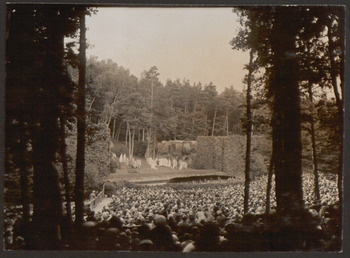
Following the conventions of German Naturbühnen, performances at Sopot were held in the open air, rain or shine, the forest itself acting as backdrop for works performed and as intimate enclosure for the assembled spectators (see Figure 3). Singers and conductors engaged there – both during the Nazi period and prior to it – confirmed that the acoustics at the Waldoper were particularly well suited to Wagnerian vocal and orchestral demands and timbral qualities, more fitting for Wagnerian sound than indoor stages and less straining for the voice.Footnote 85 Ellis remarks that some performers and composers – including Saint-Saëns – ‘loved the acoustics’ of some French open-air theatres too, but generally only for large-scale operatic performance, not for spoken theatre.Footnote 86 Perhaps the monumental forces required for many Wagnerian music dramas helped to support their apparently compelling performance outdoors at the Waldoper. As Desider Zador recounted of his experiences singing there, ‘It is something extraordinary to sing in the woods. Those who have not experienced it cannot imagine this feeling and may assume singing in the open air only possible with the greatest vocal power and physical strain. Quite the contrary, singing there is easier and you can produce the tone with less strength than in an opera house.’Footnote 87
Parsifal at the Waldoper (c.1928). Reproduced by kind permission of the Muzeum Sopotu (Sopot, Poland).

In addition to boasting impressive acoustic affordances, contributors to Meyer’s anthology and festival participants also described Waldoper stagings as utterly realist, adhering to the conventions of Naturbühnen by using only the natural surroundings with limited dramaturgical additions only as needed. As Heinrich Knote, the Waldoper’s first Siegfried, recounted, at Sopot, ‘You found real “forest murmurs” when the wind swept silently through the treetops; you really felt like the figure you were impersonating in the opera.’Footnote 88 Echoing these sentiments, Zador recalled, ‘Every stage direction, every traditional effect, had to be omitted or changed. Whatever at the theater was illusion: here it became real life.’Footnote 89
Occasionally referred to as a ‘blood theater’ (Bluttheater) in Meyer’s 1934 anthology, the Waldoper seemed to provide access to real German nature and Wagnerian sound. Inviting spectators to share in a Wagnerian fantasy made real, the Waldoper’s combination of resonant sound and equally resonant climate were cast by Meyer’s pro-Nazi contributors as potent vehicles for ‘forcibly Germanizing’ the Danzig region, transforming Poles into Volksdeutsche and facilitating what Schlösser referred to as the ‘blood brotherhood’ that naturally formed around Volkstheater. Leo Boeck, a member of the Danzig senate, claimed in 1934 that the Waldoper ‘belongs to the collection of ideas central to our National Socialist movement. Under it shines the dawn of a great cultural community of our German Volk. This art form provides the fulfilment of an inner rebirth of the German people.’Footnote 90 Nonetheless, in keeping with Potter’s scepticism surrounding the Reich’s paradigms of efficacy, organization, distinctiveness and consistency, Waldoper organizers’ bureaucratic and administrative practices often undermined even the most basic attributes of the festival’s identity espoused in festival literature (not to mention its mythologies of musical–environmental unity, the realism of Wagnerian fantasy and Polish spectatorial absorption into a pact of German cultural exclusivity), exposing the Reich’s hollow rhetoric for what it was.Footnote 91
Even as Zador, Knote and others remarked that these works became ‘real life’ in Sopot, stagings often included clearly artificial, exposed wood-framed additions covered with artificial foliage (which caught fire during one performance of Tannhäuser). The Waldoper even programmed Wagnerian dramas that were not intended to be set against the forest, including Die Meistersinger (1934, 1935, 1942), Das Rheingold (1938, 1939) and Der fliegende Holländer (1940, 1941). This decision generated conflict between Karl Tutein (conductor and festival director between 1924 and 1943) and other festival proprietors who insisted the Waldoper match the Bayreuth Festival in terms of completeness of Wagnerian repertoire, partly (as Frotscher explained in his contribution to Meyer’s 1934 anthology) because the ‘deepest intention of Wagner’s reform in the concept of theatre’ – that of ‘fertilizing the vitality of the community’ and of effecting the ‘cleansing of lower natural drives and the victory of natural purity, such that humanity and nature are bound together into a higher unity’ – could be achieved only at Naturbühnen. It was only logical, then, to perform all Wagnerian drama where it really belonged and could cultivate community as the Master intended.Footnote 92 By way of compromise, some of Tutein’s colleagues, as he recalled in a 1966 interview, suggested that Der fliegende Holländer be performed as a ‘dry land’ version of the tale. Tutein protested but did not succeed in keeping festival management from moving forward with their plans.Footnote 93
Not only does Tutein portray the festival as more irreverent in its operations than Meyer’s anthology implies, but also he identifies the aim of the festival as lying not solely in implementing deterministic reform upon residents of eastern Europe via pure forest air and its Wagnerian mimesis. Implanting as it did a new, major German operatic institution – an open-air version of the Bayreuth Festival that ‘truly’ animated Wagnerian aesthetic principles – in Polish territory, the Waldoper could also be understood as a pre-existing companion to those German cultural institutions founded shortly after the 1939 invasion in order formally to ‘impose’ German art upon Poland in such a way as to ‘ensure its permanence’.Footnote 94 The Waldoper may have represented an institution that imposed German cultural identity upon Poland as early as 1924, pointing towards pro-German sentiment in the Danzig area during a period of German–Polish tension and mutual resentment in the Polish Corridor. Max von Schillings, co-founder of the Richard Wagner Gesellschaft für Germanische Kunst und Kultur in 1905 – a society established to ‘assist Germanic art and culture to victory in its struggle against inartistic and culturally adverse endeavors in the larger circles of the German people and also in the other Germanic countries’ – was a constant presence at the Waldoper, conducting almost every performance from 1924 to 1931 (he is listed as a previous ‘guest conductor’ in Waldoper advertising in 1935; see Figure 2).Footnote 95 In 1933, its members promised to ‘complete the organization of the German people […] in the national Germanic spirit of Richard Wagner’.Footnote 96 Schillings was referred to as the Waldoper’s ‘prophet’ by Meyer in 1939; his aim of spreading ideology via Wagnerian aesthetic experience probably extended to activities at the Waldoper, dedicated to imposing German culture upon occupied peoples.Footnote 97
Despite its advertising and treatment as a ‘Wagner festival’ (see Figure 2), indexed not just by Tutein’s allegations of Bayreuth mania at Sopot and Schillings’s prophetic (or physical) presence, but also by Karl Elmendorff apparently splitting his time between conducting at Bayreuth and at Sopot, Wagner was not the only composer performed at the Waldoper. Significantly expanding repertoire performed at Naturtheater or Thingstätten (Wagner’s Rienzi, Gluck’s Orfeo and Handel’s oratorio Heracles were all performed at the Dietrich-Eckart Open-Air Theatre between 1937 and 1939),Footnote 98 Waldopernkonzerte or Festkonzerte were scheduled at the Waldoper from 1934 to 1944. Programmes included excerpts from Wagner’s operas alongside extracts from the operatic, vocal or instrumental works of Beethoven, Gluck, Goetz, Liszt, Mozart, Puccini, Rossini, Richard Strauss, Verdi, Weber and Wolf, conducted by Waldoper regulars including Robert Heger and Hans Pfitzner.Footnote 99 Rauschning had claimed in Meyer’s 1934 volume that a ‘new form of art’ had been created at the Waldoper, one that bound together forest and music to alter the consciousness of viewers in a way that, for Frotscher, fully accorded with Wagner’s aesthetic sensibilities. What place did Rossini have among the German trees, a climate in which only this ‘new form’ of ethnically persuasive Wagnerian art truly belonged?Footnote 100 Taking into account the Reich’s support of Italian operatic repertoire (particularly Verdi), the diversity of the Waldoper’s offerings speaks to what may have been the true aim of the festival: the implantation of a prominent, versatile German artistic institution – as the Reich defined it – in newly acquired territory.Footnote 101
From spectators to trees and back again: Waldoper iconography and the stylization of nature
In many ways, what was really being staged at the Waldoper was, as David Hinton put it, an ‘image of nature’ and art,Footnote 102 produced by pro-Nazi Polish leaders and members of the Reich around environmental, political and cultural paradigms long associated with outdoor theatre, open-air opera and mass spectacle that assumed völkisch ascension to a greater collective, involuntarily impelled by German forest, music and community experience. Although, as Potter points out, the Nazi aesthetic was often inconsistent, iconography associated with the Waldoper could generally be understood as attempting to render festival rhetoric visually. Much like Leni Riefenstahl’s post-1939 films, its photographic advertisements and illustrated posters ‘stylize[d] reality’, using a ‘realistic medium […] to present something more than reality’, nature that has ‘transcended itself’ to form ‘idealized representations’ of nature and nation to observers.Footnote 103
However, while the Waldoper’s bureaucratic and administrative practices undermined the festival’s lofty ideologies and rhetoric, its iconography harbours visual signs of nature being manipulated for ideological purposes: like Riefenstahl’s films, it can be excavated for indications of the constructed nature of the Waldoper’s message, borne out when that rhetoric was translated into visual terms.Footnote 104 I argue that these images lay bare the mechanics of the means of production and address the festival’s ideologies of nature and culture, making visible the metaphorical procedures and mental connections required for an observer to understand and perhaps even capitulate to the Waldoper’s deterministic rhetoric of nature and society. As Sabine Wilke has argued, Riefenstahl’s treatment of nature was meant to seem ‘imaginary’, even individuated.Footnote 105 Perhaps Waldoper iconography was not necessarily designed to fool observers into submitting to a powerful ideology. Perhaps, instead, it was intended to invite them to participate, by following iconographic grammar grounded in a shared cultural lexicon of symbols and signifiers, in what was obviously a fantasy of völkisch power and collective ascendency. Such a fantasy had real consequences for the region that many pro-Nazi, pro-German Poles may have desired as the Reich sought to annex Poland, as it eventually succeeded in doing.
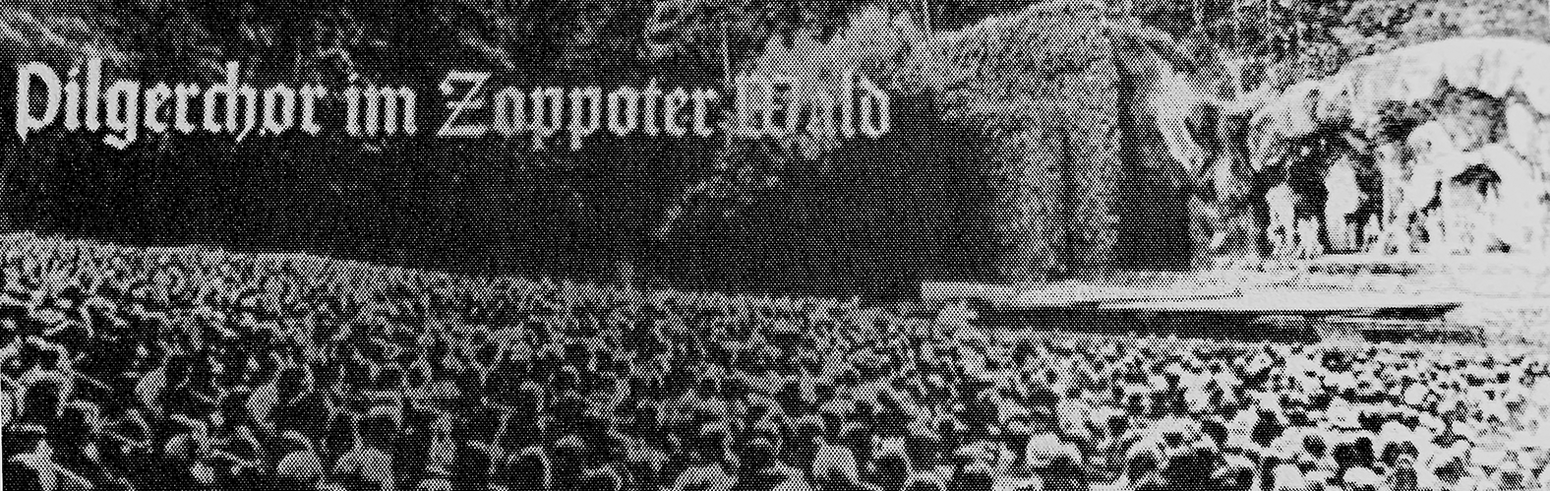
Common among Waldoper imagery are photographs that display spectators sitting deep in the forest surrounding the stage. In them, the audience is made to look as if it was disappearing into the forest and turning into trees, or as if it consisted of trees becoming spectators. While this visual trick might seem heavy-handed, it was a common iconographic tactic used by the Reich Forestry Protection Agency (Reichforstschutz) to depict a central tenet of its policies in action – that the forest can teach anyone to be a National Socialist.Footnote 106 (As Frank Uekötter notes, however, Nazi policy, rhetoric and, no doubt, iconographic practices associated with conservation and forestry were inconsistent.Footnote 107) Animating this motto, Hanns Springer’s 1936 film Ewiger Wald, produced for the Forestry Protection Agency, includes a disembodied chorus of trees that seems to repeat again and again, ‘From the multitude of species, create the new community of the eternal forest, create the eternal forest of the new community … excise what is foreign and sick.’Footnote 108 This was part of the mythology of reform with which the Reich surrounded the Waldoper: ‘excising’ the ‘foreign and sick’ from Germany by surrounding visitors with trees that might transform them into a Volksgemeinschaft, ethnic Germans in Poland revived as such through the cleansing of their blood in Sopot forest air and Wagnerian sound.
This visual strategy was used again in an advertisement for the 1939 Tannhäuser production (see Figure 4). This image does something more with this visual trick, however. The phrase ‘Pilgrims’ Chorus in the Sopot Forest’ (‘Pilgerchor im Zoppoter Wald’) splashed over the image of spectators and disappearing into the trees implies that Wagner would help guide spectators back to this originary state. In keeping with festival rhetoric, this image suggests that as spectators sat among Sopot’s trees, they would ostensibly transform into modern-day versions of those wayward pilgrims that traversed the Germanic Wartburg in search of salvation with Wagner’s hero. Here, spectators are cast not as an opera audience at all, but as Teutonic pilgrims who have flocked to Sopot from near and far, the Waldoper and guiding hands of Wagner, his heroes (like Tannhäuser) and the Reich granting invisible absolution for genetic flaws and moulding the masses into a Volksgemeinschaft – and Polish land into a Teutonic Wartburg – with a shared heritage rooted in nature itself.
‘Pilgerchor im Zoppoter Wald’ (1939), Waldoper advertisement reproduced in Luther, Die Zoppoter Waldoper, 288.

This Tannhäuser advertisement neatly renders the mental and metaphorical steps an observer might take to understand the process and product of the aspirational deterministic logic central to the Reich’s imperialist Waldoper operation. Ordinary opera-goers – an admixture of locals, Germans and tourists – are clearly made out to be ‘more than’ themselves, an imaginary völkisch collective of pilgrims reified by Romantic ideologies of nature and culture repurposed by the Reich in service of an obvious fantasy of large-scale renewal.Footnote 109 The forest, of course, is similarly stylized as it merges with the crowd before it, an idealized visual index of nature that is ‘more than’ itself, too, holding powers of renewal and redemption.Footnote 110 As was typical of Wagnerian ‘party hacks’, as Hans Rudolf Vaget has called them, this image celebrates the ‘aesthetic aura’ of Wagnerian drama (as well as, more unusually, appealing directly to knowledge of Tannhäuser’s plot and form), grafting that ‘aura’ onto ‘real’ nature as the image invites spectators to embody elements of festival ideology by sitting, breathing and listening in the ‘Sopot forest’.Footnote 111 An observer, playing along with the obviously ‘imaginary’ nature of these visual metaphors, might envision the absorption of the pseudo-Wagnerian community of Poles, who may have desired German identity and Nazi occupation, into a proud, historicized Teutonic community granted by this particular forest and the Wagnerian ‘aesthetic aura’. Casting Wagner as a figure of renewal (as, again, was typical of pro-Nazi Wagnerians), this image positions the Reich’s theatre, the works on offer and the environment as fostering Polish renewal in the spirit of Tannhäuser’s pilgrims, who desire ‘atonement for [their] sins; for blessed is he who truly believes; he shall be saved through penitence and repentance, weighed down by the burden of sin’.Footnote 112
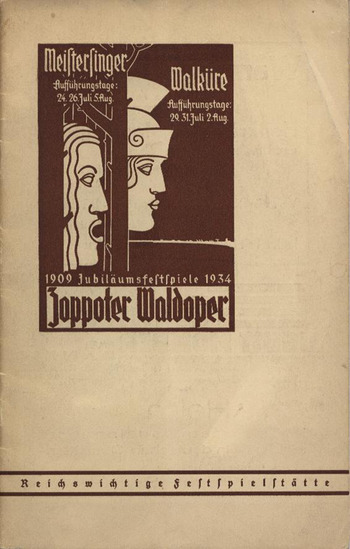
This Wagnerian political ethos can be perceived in the iconography of Waldoper festival posters, the first of which appeared in 1934 (see Figure 5). As if to depict local support for the Reich’s anticipated occupation (and reinforce Wagner’s role in that mission), a Valkyrie and a Meistersinger stoically stare out from among the forest’s trees towards Sopot and the Baltic coast, as if they are standing in for army officers appraising their territory. The Meistersinger does not just survey the coast, but sings to it, calling out to Poland from among the trees with universal truths of German nature – equally embedded in the Wagnerian ‘aura’ and nature itself – that might teach the Polish people to be National Socialists.Footnote 113 The placement of these singing faces, one imbricated over the other (and both, in turn, set into the forest’s trees), recalls a motif common in the Reich’s iconography: as Mark Neocleous has pointed out, the Reich’s propagandistic images often depicted German political icons – often a swastika, a Valkyrie, a Greco-Roman bust or Hitler himself – set alongside mortal representatives of the National Socialist political platform, including German soldiers or Aryan children.Footnote 114 This visual index of equivalency was a coded reference to shared lineage, the Teutonic Valkyrie or Hitler himself being seen as genetic and cultural ancestor of the Aryan people, past, present and future.
Zoppoter Waldoper, poster (1934).

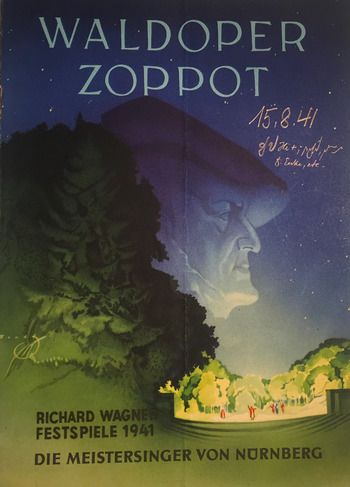
Seven years later, the Waldoper, still labelled an ‘important festival site for the Reich’, had long replaced the 1934 poster depicting occupation in action, anticipated or fantasized, with an image suggesting that that occupation had been successful (see Figure 6). By 1941, the Danzig area had long been politically sympathetic to the Reich, and as suggested by this image, the Waldoper was an established institution dedicated to helping to bring about German cultural revolution in Poland. Adapting a motif common in images published by the Reich, this poster depicts Wagner – in the place of a swastika or Hitler’s bust – as a luminous sun, rising over the Sopot forest and leading Poland towards a new German dawn. Institutional artifices such as an audience or an orchestra are not visible. Instead, there is only Wagner, a symbol of German renewal, hovering over the stage, blanketing Poland in his ‘aesthetic aura’, an aural climate of resonant, German air. That Wagnerian air, as the Reich advertised in the Waldoper’s accompanying images and texts, could biologically compel the Polish people to want and implement a new social and political order; climate and Wagnerian sound were more persuasive than military force.Footnote 115
Zoppoter Waldoper, poster (1941). Reprinted in Waldoper Zoppot: Richard Wagner Festspiele (Danzig: A. W. Kafemann, 1941).

Iconography accompanying the Waldoper could be read, as a whole, as visually rendering those rhetorical fantasies of deterministic nature and attendant cultural cohesion central to the Waldoper’s image as a vehicle for ‘forcible Germanization’.Footnote 116 In the 1939 advertisement (see Figure 4), that fantasy is articulated via obvious stylization of nature’s realism to elicit an impression of nature and ordinary opera-goers as ‘more than’ themselves. In the posters from 1934 and 1941 (see Figures 5 and 6), those fantasies of German–Polish unity and lineage that photographs merely analogize are rendered through recognizable, often Wagnerian, symbols and cultural signifiers, assuming a shared iconographic lexicon between observers and these images’ creators. But, despite its positioning as a vehicle for reinforcing, even strengthening, the Waldoper’s mission of environmental and cultural conditioning in Sopot (a mission many local festival-goers, given the extent of pro-Nazi sentiment in the region, probably embraced), the festival’s iconography could also be read as undercutting its own relational ontology. These images visually render and reveal the metaphorical means of phantasmagoric control that underwrote the Nazi mission in Sopot, exposing the theatre and its underlying rhetoric as little more than Illusionstheater built around shared knowledge, rhetoric, ideology and willingness to capitulate to obvious fantasies of power and hierarchy.
Günter Grass, The Tin Drum and the phantasmagoric aesthetics of post-war memory
In March 1945, Danzig was annexed by Poland as the result of agreements made at the Yalta and Potsdam conferences. Many Germans still living there fled to post-war Germany as Danzig struggled to redefine its sovereignty under shifting leadership. In the years that followed, the Waldoper, a symbol of the occupied past, was torn down and Polish residents of Sopot built a new stage on the old site.Footnote 117 The new stage, now called Opera Lesńa, was filled with performances of popular music, jazz and a Eurovision-like festival – the Sopot International Song Festival (previously called the Intervision Song Contest) – that continues today.Footnote 118
During this process of deconstruction and reconstruction, the Danzig-born novelist Günter Grass (1927–2015) produced his magical realist, semi-autobiographical first novel, The Tin Drum, which includes a short vignette that follows his protagonist-narrator to Sopot and to the Waldoper, where mayhem unfolds. Grass’s moral status and personal history during the Third Reich were ambiguous, making it difficult to position this passage historically and historiographically. In the months preceding the publication of his autobiography Peeling the Onion (2006), he admitted in an interview in the Frankfurter Allgemeine Zeitung to having served with the Waffen SS in 1944–5, when he was 17 years old.Footnote 119 Grass recounted his complicated past in a personal testimonial published in the New Yorker, ‘How I Spent the War: A Recruit in the Waffen S.S.’ (2007).Footnote 120 In it, he explains that at the age of 15 he was a proud member of the Luftwaffe auxiliary, revelling in playing soldier; within a year, he was conscripted into the Labour Service, where he was assigned the task of sketching pastoral illustrations to line the mess hall. He sought purpose with an elite unit, and conscription to active duty finally came in late 1944. ‘Was I frightened by what was obvious then in the recruitment office, as I am terrified now by the double “S”, even as I write this sixty years later?’ he asks his readers and himself.Footnote 121 He cannot remember, searching for reason within his youthful mind as he reminds himself that, in his six months of service, he ‘never fired a shot’, the ‘best way of alleviating the shame that remains’.Footnote 122 In 2007, he insisted that Michael Jürgs’s biography emphasize that his ‘conscription into the Waffen-SS happened without [his] active participation’ (an over-simplification of his own story), and he even sought an injunction against Random House over a line in Jürgs’s text – already in print – which implied that he had joined willingly.Footnote 123
This aspect of Grass’s past subjects his comical, uncanny novel to almost limitless, necessarily conflictual readings that can neither fully confirm nor dismiss Grass as representing a ‘moral authority’ in confronting the Nazi past.Footnote 124 A further challenge to situating and reading The Tin Drum historically lies in Grass’s tendency towards simultaneous working-through of what Nicola King has defined as three modes of memory: the event itself, the memory of the event and the writing of the memory of the event.Footnote 125 The text could be understood, as Katharina Hall argues, as continuously presenting shifting ‘restructurings’ of memories of past events, mediated by conflicting language and conflicting treatment of his own memories as recollection and/or as testimony, giving voice to divergent, converging facets of his complex past and persona, wracked with guilt, confusion and resolve.Footnote 126
Grass’s Waldoper vignette could be read as narrating conflicted memories as testimony – of Polish-ness or German-ness, Polish or German suffering, victim or perpetrator, humanity or inhumanity, shame at his ‘stupid pride of youth’ or peace with it, or a combination of all of these registers – which in turn shape his representations of the Waldoper in 1933, its attendees and its Wagnerian subject matter.Footnote 127 The text is a panoply of imbricated, discordant retellings of memories of the past.Footnote 128 But, as I argue, this passage might also be read as performing broader challenges associated with writing historiographies of the Third Reich’s cultural activities that ‘navigate between long-standing paradigms and ever-increasing amounts of evidence that erode the credibility of those paradigms’, paradigms that, as Grass deftly demonstrates, sought phantasmagorically to extinguish the free will of the individual in favour of a collective reality for historical actors and historians alike.Footnote 129
The Tin Drum recounts the memories of Danzig-born Oskar, a half-German, half-Polish child born as pro-Nazi sentiment took hold of his native city. Through sheer force of will, Oskar halts his physical development at the age of three, discovering shortly thereafter that, even though his body has stopped growing, his vocal cords have changed such that he has the power to break glass through what he calls ‘long-distance song effects’ or high-pitched cries from a great distance.Footnote 130 By way of his ultrasonic voice, its disorderly sonic power extended by way of the technology of his tin drum, Oskar not only disrupts the sensory systems of those around him by mediating their perceptual interactions with the world, but uses those disruptive moments to intervene – often violently – into the German–Polish tensions gripping Danzig and shaping the hostile dynamics within his own dysfunctional family. Similar tensions were, of course, central to Grass’s own moral and personal identity, his memories of this period and his literary treatment of them.
In 1933, Oskar and his family travel to Sopot and to the Waldoper. As Oskar sits on the beach, he compares the scene to a ‘circus’, revelling in description of the Polish nobility parading by in their ‘fur capes’, ‘blue sunglasses’ and ‘violet fingernails’ en route to the casino, the spa or, indeed, the opera.Footnote 131 Here, Grass firmly associates the Waldoper with the mundane and socially acquisitive aspects of opera-going, sharply demystifying the idea of a hallowed, Teutonic ground described in the Reich’s propaganda. As Oskar and his family take their seats at the theatre, Oskar narrates the evening’s events:Footnote 132
It was not until the summer of 1933 that I went to the theater. It was a profound experience that stayed with me. The thundering surge still rings in my ears. No, I am not exaggerating, all this took place at the Sopot Opera-in-the-Woods, where summer after summer, Wagner was poured forth upon nature beneath the night sky.
It was the Flying Dutchman … Sailors began singing at trees. I fell asleep. […] Mama, gliding with the waves and breathing in the true Wagnerian spirit, was taking so much interest in the Dutchman. She failed to notice that Matzerath and Jan had covered their faces with their hands […] and that I, too, kept slipping through Wagner’s fingers […] Then, suddenly Oskar awoke for good because a woman was standing all alone in the forest, screaming for all she was worth … She was screaming because a spotlight […] was blinding her. ‘No!’ she cried. ‘Woe is me!’ and ‘Who hath made me suffer so?’ […] The screams of the solitary woman subsided into a muffled whimper, only to rise again in a silvery bubbling fountain of high notes which blighted the leaves of the trees before their time … a brilliant voice, but its efforts were of no avail. It was time for Oskar to intervene, to locate that importunate source of light and, with a single long-distance cry, destroy it.Footnote 133
What happens next amounts to a ‘short circuit’ leading to a ‘forest fire’, ‘darkness’, ‘panic’ and ‘confusion’ – Oskar even loses his tin drum in the ensuing chaos.Footnote 134 As stage and forest burn, Oskar’s so-called vocal ‘art’ takes precedence over Wagner’s, as the erstwhile temple of Aryan nature and art burns to the ground, leaving nothing but ashes.
Grass begins this passage by dutifully mythologizing Wagner, Oskar’s mother relishing the unqualified profundity of the experience in the ‘true Wagnerian spirit’ and Oskar himself recalling Wagner being ‘poured forth upon nature’. This language even serves to identify Grass, Oskar’s ventriloquist, as a ‘true’ Wagnerian, too, using the ‘right’ language to prove reverence to the composer and all he represents.Footnote 135 As the passage continues, Grass could be understood as poking fun at his Polish characters, eviscerating them for being too dull to appreciate Wagner or to be moved by the ephemeral, profound strains that ‘rang in [his] ears’ years later. His attempts at ‘intervening’ against the suffering of the ‘solitary woman’, Senta, could be understood as an effort to rescue a Wagnerian heroine from needless pain caused by a coordinated attack of Polish characters (the lighting technicians and their co-conspirators, Jan and Matzerath).Footnote 136 As the passage ends, Oskar/Grass, having proved his loyalty to Wagner with mythologizing language, transforms into a Teutonic hero himself (albeit an unorthodox one) and rescues Senta from an assault by a Polish uprising. Grass’s tale might be read, then, as narrating one dimension of his memories of war and perceived involvement in it: it animates his own complicity in the tragedies of occupation, identifying his participation as capable of being cast at once as heroic and inhumane. What, he seems to be asking, were the limitations of his own humanity/inhumanity as a 17-year-old soldier fighting a murderous, unethical war, and what bearing does his past have on his humanity/inhumanity years later?
But this passage could also be read as a recovery effort, a testimony to another dimension of Grass’s memories of his wartime experience, conflicting with the alternative reading of the same passage as an explicit performance of his own imagined past (or present) inhumanity, derived from a place of deep regret. This vignette might reflect Grass’s desire to revise his own shameful memories and reclaim physical territory for Poland, virtually wrenching it away from the Reich’s rhetorical, psychological and physical occupation. Here, he might be read as writing characters who are not too dull to appreciate Wagner but refuse to be hoodwinked by the phantasmagoric bearing of Wagnerian myth. Cloaking the Waldoper in language of ineffectuality, ignorance, artificiality and confusion – offsetting his rhetoric of Wagnerian profundity – in this passage, Grass writes characters with little interest in hearing or seeing what is happening on stage, deriving more pleasure from the resort town’s more populist, acquisitive attractions and its carnival-like atmosphere.Footnote 137 During their visit to the Waldoper, Grass’s Polish characters ‘slip through Wagner’s fingers’: to escape the Wagnerian phantasmagoric spell, Grass seems to suggest, one only needed to go to sleep or to cover one’s eyes and ears.
As the passage continues, Oskar is cast as both Wagnerian hero and autonomous, omniscient seer of Wagnerian deception among the snoozing collective – a role of heroic individuality Grass wished he had fulfilled as a teenager, in response both to the attraction of military service and to Nazi visual culture, ‘whose insidious appeal served to corrupt his political views’, as Nicolas Thesz has explained.Footnote 138 Laying bare the means of production of the theatre’s many illusions, Grass ‘short-circuits’ them, rendering them comically obsolete to rescue his youthful self and others.Footnote 139 The stage’s spotlight is revealed as nothing more than an artificial, malleable instrument instead of a natural source of light, its limpid beams illuminating Senta as a mere ‘solitary woman’, not a Wagnerian heroine. Grass forces her to relinquish her balladic formulations as they devolve into pure, guttural sound and articulations of tortured affective states, her pure sound ‘blighting’ the forest instead of merging seamlessly with it.Footnote 140
As the vignette concludes, Oskar uses his destructive voice to demolish the Waldoper’s phantasmagoric assemblage of stimuli, asserting his individual will into a set of already deconstructed illusions, ensuring visitors’ individual realities fail to merge into a collective one that might be instrumentalized for political evil. Perhaps in an effort cathartically to rescue or redeem Polish space and people (as well as his youthful self), Oskar’s ultrasonic vocal cords – and Grass’s pen – prove to be more powerful than German nature, Wagnerian sound and the local, pro-Nazi propaganda machine determined to hoodwink the masses, but not Oskar or Grass.Footnote 141 The passage might be understood, then, as crafting a new myth out of an old one, one that celebrates a more independent youth for Grass as it unearths the true images of phantasmagoric mind control and indoctrination central to the Reich’s mythologies and treatment of this space.
A passage that precedes this scene might serve to clarify its role for Grass in mediating his own conflicted identity and memories, suggesting that this vignette speaks to Grass’s ‘recovery effort’ and treatment of memory as testimony to past suffering. As the Waldoper burns, it takes something from Oskar – his drum, an extension of his sonically and socially disruptive body. Earlier in the novel, Oskar shares with readers what it is that his drum is for, a description that points to Grass attempting through the process of composing The Tin Drum to locate the ‘lost territory’ of Poland and, perhaps, repent for his own wrongdoing during the war:Footnote 142
He [Oskar] cannot help but look for Poland […] How does he look for it? With his drumsticks. Does he also look for Poland with his soul? He looks for it with every organ of his being, but the soul is not an organ. I look for the land of the Poles that is lost to the Germans, for the moment at least […] I, meanwhile, conjure up Poland on my drum. And this is what I drum: Poland’s lost but not forever, all’s lost but not forever, Poland’s not lost forever.Footnote 143
If Oskar’s antics at the Waldoper allow him (and Grass) to reclaim that space for Poland by exposing its artificiality and tearing it away from the Reich’s imperialist efforts, what does it mean that he loses his drum in the process, the instrument he has been using to call out across the void in search of Poland and affirm that it is ‘not lost forever’? Perhaps this loss indicates that the drum is no longer needed: Oskar’s destruction of this temple of German nature and its claims over spectators’ senses have rendered it obsolete. ‘Poland’s not lost forever’ for Oskar – and Grass, seeking cathartically to purge his shame, finds it in the ashes of the Waldoper.
In his Waldoper vignette, Grass performs a ‘recovery mission’ alongside ‘absolute inhumanity’,Footnote 144 Oskar’s memories of the event rotating and restructuring around the duelling halves of his own – and Grass’s – identity. In addition to grappling with the shame and guilt that underwrites his wartime memories, Grass also seems to be performing a rhetorical mythologization of Romantic music, nature and identity coming into violent contact with its own historiographical deconstruction. This explosive tension queries the distinction between ‘event’, ‘myth’ and ‘memory’. Oskar is not much of a historian, but emphasizes the historiographical power of myth by performing, deconstructing and destroying the Waldoper’s myths of conditioning and grandeur to clear space for the reconstruction of demythologized ‘event’ and truer, less insidious ‘memory’ in their wake.
Postscript
Open-air stages constructed or utilized by the Third Reich are still in use. The Waldbühne in Berlin – completed in 1936 for the Olympic Games but used for populist spectacle as well – maintains a regular performance calendar, as do the Waldoper and the Lorelei Freilichtbühne. While the Waldoper and Lorelei stage almost exclusively programme popular music, local artists and some operetta, the Waldbühne continues to provide performances of Wagner and other German Romantic and late Romantic composers’ works, alongside popular music, hip hop, film and musical theatre. In programming and advertising for these stages, there is limited discussion of the Nazi mass spectacles that once took place there, or of the dovetailing of environmental and theatrical paradigms intended to serve mind control and indoctrination.
The continued use of the Waldbühne for the performance of Wagner can serve as a litmus test for recent response to Leon Botstein’s querying of Wagnerian ‘historical responsibility’ for Nazism and Dirk Kurbjuweit’s related question of Wagnerian reclamation, proffered in Der Spiegel as recently as 2013: ‘Can Germans enjoy any part of [Wagner’s] history in a carefree way?’Footnote 145 While Kurbjuweit gives no clear answer to this question, interviewing Wagner enthusiasts (and detractors) with wildly conflicting views, efforts to ‘reclaim’ spaces like the Waldbühne by continuing to perform Wagner there, unfettered by history, align with Grass’s views on post-war recovery efforts. By continuing to perform Wagner at the Waldbühne, this site’s administrators could be understood as seeking to recover the space itself, to expunge the uneasy social and political associations of performing Wagner in Germany on ‘Nazi ground’, and to refuse to allow the horrifying past, its mythologies and questions of the ‘historical responsibility’ (of Wagner, of Germany and of Germans) for Nazism and its war crimes dictate their activities.
On the other hand, without paratextual support that exposes its transhistorical lineage, the Waldbühne’s practices could also be understood as suppressing the historicity of a practice that, at least for Grass, required consistent recognition in order for recovery to be possible. But, in keeping with Potter’s arguments, presenting the history of Nazi stages must be approached with care: as this article has shown, the mythologies of singularity of vision, total organization, efficacy and efficiency that the Reich sought to build around its artistic and linked environmental practices – including at the Waldbühne or the Waldoper – obscure the disorganized, inefficient realities of these projects and of Nazi artistic practices more broadly.
APPENDIX
TRANSCRIPT OF CONTENTS PAGES OF MEYER’S
DIE ZOPPOTER WALDOPER (1934 AND 1939)
(1) Die Zoppoter Waldoper: Ein Weg zum neuen deutschen Theater, ed. Friedrich Albert Meyer (Berlin: Schlieffen, 1934)
| Inhalts-Verzeichnis | |
|---|---|
| Verzeichnis der Bilder | 6 |
| Geleitworte von Reichsminister Dr. Joseph Goebbels Reichsleiter Alfred Rosenberg Dr. Walter Stang Kultussenator Boeck – Danzig Gauleiter Staatsrat Forster Propagandasenator Baker – Danzig Präsident des Danziger Senats Dr. Rauschning Wilhelm Zarste, Vorsitzender des Danziger Presseverbandes |
7–12 |
| Erich Kemp, Staatskommissar der Stadt Zoppot, 25 Jahre Zoppoter Waldoper | 12 |
| Richard Wagners Werke im Walde. Eine Unterredung mit dem Gestalter eines neuen Stils für die Wagner-Kunst auf der Bühne. Vom Herausgeber. | 13 |
| Hugo Socnick, von der Waldoper zur Wagner-Festspiel-Bühne | 20 |
| Carl Lange, Begründung und Entwicklung der Zoppoter Waldoper. Eine nationale Kulturtat des deutschen Ostens | 24 |
| ¼ Million Besucher der Waldoper | 27 |
| Robert Heger, Staatskapellmeister, Professor: Die Zoppoter Waldoper – eine wirkliche Festspielstätte | 28 |
| Erich Kleiber, Generalmusikdirector, Das akustische Wunder der Zoppoter Waldoper | 29 |
| Karl Tutein, Staatskapellmeister, 11 Jahre Waldoper-Entwicklung | 30 |
| Friedrich Albert Meyer, wie Max von Schillings mit der Zoppoter Waldoper verwuchs | 31 |
| Friedrich Albert Meyer, als der Führer in der Waldoper erwartet wurde | 35 |
| Die Riesenbühne der Zoppoter Waldoper – einige Zahlen | 38 |
| Friedrich Albert Meyer, Hermann und Etta Merz | 39 |
| Gotthold Frotscher, Professor, Die Naturbühne als Kultstätte (Das Erlebnis des Parsifal in der Zoppoter Waldoper) | 46 |
| Urteile über die Parsifal-Aufführung im Zoppoter Walde 1928 | 49 |
| Berühmte Wagner-Sänger der Zoppoter Waldoper | 50 |
| Berühmte Sängerinnen der Zoppoter Waldoper | 53 |
| Julian, der Alte vom Berge | 55 |
| Mitarbeiter an der Bühnengestaltung von 1909–1934 | 58 |
| Zoppoter Waldopernhumor | 59 |
| Was das Waldopernbuch erzählt | 61 |
| Weitere Bekenntnisse zum Waldoperngedanken | 62 |
(2) Friedrich Albert Meyer, Die Zoppoter Waldoper: Ein kleiner Führer für die reichswichtige Festspielstätte (Sopot: Verlag Zoppoter Waldoper, 1939)
| Inhaltsverzeichnis | |
|---|---|
| Zoppot, die Stadt und das Bad | 3 |
| Die Zoppoter Waldoper | 4 |
| Der Wald und Wagners Werk | 7 |
| Aus der Geschichte der Waldoper | 12 |
| Die Festspielbühne | 20 |
| Klangprobleme. Die Dirigenten, Parsifalglocken, Berühmte Sänger und Sängerinnen | 22–28 |
| Hermann Merz und seine Mitarbeiter | 30 |
| Die bauliche Ausgestaltung | 33 |
| Das Verzeichnis der Aufführungen | 3. Umschlagsseite |