Infant security systems are frequently utilized in newborn nurseries to guard against infant abduction. These devices typically emit radiofrequency waves and alert providers if a baby is moved beyond a defined care area.Reference Burgess, Carr, Nahirny and Rabun 1 – Reference Hiner, Pyka, Burks, Pisegna and Gador 3 The device may be placed on the body or attached to the umbilical cord clamp. Herein, we report the occurrence of several cases of periumbilical skin or soft-tissue infection (PSSTI) associated with the use of such devices on newborn babies.
METHODS
On August 15, 2014, a doctor (K.J.K.) notified the Department of Infection Prevention and Control (DIPC) at Harbor-UCLA Medical Center (HUMC) of her concern that some newborns had developed “omphalitis recently” and that these cases were related to a tracking device (TotGuard, GuardRFID Solutions, Delta, British Columbia, Canada) placed on patients at birth. This device was introduced on March 13, 2014, for newborns in the well-infant nursery (level 1) or the intermediate-care nursery (level 2). Babies admitted directly to the neonatal intensive care unit did not receive the device. Nursing staff received training, and a device was attached to the umbilical cord clamp of each infant per the manufacturer’s instructions. Newborn umbilical care was not altered in any way. The umbilical device was discontinued 3 days after the potential PSSTI problem was noted.
The DIPC performed an investigation to clarify the possibility of PSSTI as a direct consequence of the tracking device. We performed case ascertainment by reviewing (1) International Classification of Disease, Ninth Revision, Clinical Modification (ICD-9-CM)–based discharge coding data (including the general pediatric ward and the outpatient nursery clinic to capture babies who may have developed PSSTI after discharge) and (2) an existing pediatric infectious disease consult tracking system. We restricted our analysis to infants <56 days of age born at HUMC who had been admitted to the level 1 or 2 nursery between September 1, 2012, and December 31, 2014. We identified a probable case of PSSTI if the child (1) was identified by at least 1 of several ICD-9 codes (see Supplemental Material) or (2) was diagnosed with omphalitis, funisitis, cellulitis, or other skin infection from the infectious disease consult ledger, and (3) standardized medical record review revealed at least 2 of the following umbilical signs: swelling, redness, pain on palpation, and/or warmth. We obtained unit-specific census data from the Department of Nursing.
RESULTS
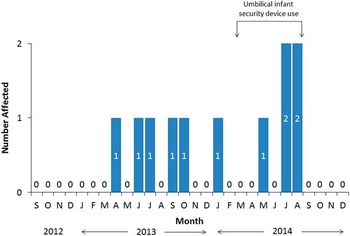
The device was used on 282 babies and 1,138 babies did not receive the device; each device was worn until discharge unless PSSTI developed. We identified 109 potential cases of PSSTI, 11 of whom (10%) met our case definition. Among these babies, 5 (46%) wore the device and 6 (54%) did not. PSSTI incidence was 7.1 per 1,000 device days versus 2.1 per 1,000 hospital (non-device) days, respectively (risk ratio [RR], 3.4; 95% confidence interval [CI], 1.0–11). The distribution over time is noted in Figure 1. All affected newborns received antimicrobials specifically for the PSSTI for a median of 7 days (range, 5–9 days). In each case, gentamicin and oxacillin were administered, except for a single baby who had metabolic acidosis and bradycardia and received vancomycin and cefotaxime. All babies had at least 1 blood culture, and only 1 baby had a periumbilical culture. None of the babies had overt umbilical discharge. All cultures were negative. All of the babies had an increase in the length of hospital stay (3–7 days) directly attributable to the therapy required for PSSTI.
Neonatal periumbilical skin or soft-tissue infection, September 2012 through December 2014.

Several characteristics did not differ between babies with PSSTI who did or did not have the device: day of life at diagnosis (mean, 2 vs 2.7 days; maximum 2 and 5 days, respectively), male:female ratio (~1:1 in both groups), gestational age (all >38 weeks), initial admission unit (level 1 vs level 2), and clinical outcome (all were successfully treated).
DISCUSSION
Infant abduction prevention systems may be affixed to various parts of the body.Reference Burgess, Carr, Nahirny and Rabun 1 , Reference Lorenzi 2 In this report, we provide the first description of PSSTI associated with the use of an umbilical infant security device. Its use increased the risk of PSSTI by more than 3-fold, thereby prolonging hospital length of stay and exposure to antimicrobial therapy. Fortunately, all of the affected newborns had successful clinical outcomes.
We believe the pathogenesis of the PSSTI in our newborns related to physical microtrauma of the skin from the combined weight of the device and cord clamp to which it was attached. The problems related to this device may have resulted from overt skin abrasion and/or bacterial seeding from normal umbilical and skin flora. Anecdotally, our nursery nurses reported that the device and clamp, together, at times created a certain torque or stretch on the cord which may have altered the bacterial milieu over the first few days of life. We do not believe the device was used incorrectly; use was verified by interviews with the nursing staff responsible for their placement and communications with the manufacturer to verify the training procedure.
The clinical presentation and outcome of our newborns with PSSTI were consistent with other skin and soft-tissue infections in this age group.Reference Hester, Hersh and Mundorff 4 , Reference Kharazmi, Hirsh, Simon and Jain 5 Importantly, these cases were distinct from omphalitis, an infection of the umbilical remnant, which is usually polymicrobial and is often associated with significant clinical morbidity and may even be lethal.Reference Mason, Andrews, Ross and Wright 6 , Reference Fraser, Davies and Cusack 7 In this disease, the umbilical cord itself may be a portal of entry for infection and when combined with necrotic tissue and/or thrombosed vessels may provide access to bloodstream.
Our case ascertainment may be incomplete insofar as mild periumbilical redness or warmth may not have been documented and thus escaped our surveillance. Regardless, among cases we identified, the diagnosis and treatment was convincingly confirmed via medical record review. Clinicians should be aware of the possibility of infant security device–associated infection.
ACKNOWLEDGMENTS
Financial support: No financial support was provided relevant to this article.
Potential conflicts of interest: All authors report no conflicts of interest to this article.
SUPPLEMENTARY MATERIAL
To view supplementary material for this article, please visit https://doi.org/10.1017/ice.2016.288