I. INTRODUCTION
Solar electricity including solar photovoltaics is expected to contribute as the main energy with a share of about 20% and 70% in 2050 and 2100, respectively, in total energy of the world, according to the recommendation (World Energy Vision 2100) by the German Advisory Council on Global Change.1 To realize this vision, further research and development of high-efficiency, low-cost, and highly reliable solar cells is necessary. Various solar cells and materials have great potential as future generation solar cells and materials including crystalline Si. Si tandem solar cells such as III–V/Si tandem, II–VI/Si tandem, chalcopyrite/Si tandem, and perovskite/Si tandem solar cells are expected to have great potential of terrestrial applications because of high efficiency, light weight, and low cost potential. Especially, crystalline Si solar cells are thought to contribute as the major solar cells and materials in the future.
This paper presents analytical results for high efficiency potential of crystalline Si solar cells. In addition, nonradiative recombination loses in crystalline Si solar cells are discussed.
II. ANALYSIS FOR EFFICIENCY POTENTIAL OF CRYSTALLINE SI SOLAR CELLS
KanekaReference Yoshikawa, Kawasaki, Yoshida, Irie, Konishi, Nakano, Uto, Adachi, Kanemitsu, Uzu and Yamamoto2 has recently achieved a record 26.7%-efficiency Si solar cell by using the heterojunction and back contact (HBC) structure. It is worth noting that the bulk minority carrier lifetime in that Si wafer is around several microseconds. It is expected that the efficiency of this record solar cell can be further increased to 27.5 by improving the bulk minority-lifetime to more than 100 ms. In this paper, the efficiency potential of crystalline Si solar cells is analyzed by using external radiative efficiency (ERE) and voltage and fill factor losses.
One of the problems to attain higher efficiency crystalline Si solar cells is the higher minority-carrier lifetime in Si. Radiative recombination lifetime τrad is expressed by
 $${\tau _{{\rm{rad}}}} = {1 / {BN}}\quad ,$$
where N is the carrier concentration and B is the radiative recombination probability. For Si, the B valueReference Ahrenkiel, Ahrenkiel and Lundstrom3 is 2 × 10⁻¹⁵ cm3/s. Therefore, optimization of carrier concentration in solar cell layers is necessary by considering minority-carrier lifetime and series resistance. In addition, photon recycling is also important to reduce the impact of radiative recombination and to give lower effective B. Effective lifetime τeff is expressed by
 $${1 / {{\tau _{{\rm{eff}}}}}} = {1 / {{\tau _{{\rm{rad}}}}}} + {1 / {{\tau _{{\rm{nonrad}}}}}}\quad ,$$
where τnonrad is the nonradiative recombination lifetime and given by
 $${1 / {{\tau _{{\rm{nonrad}}}}}} = \sigma v{N_{\rm{r}}}\quad ,$$
where σ is the capture cross section of minority-carriers by nonradiative recombination centers, v is the minority-carrier thermal velocity, and N r is the density of nonradiative recombination center. Therefore, improvements in Si crystalline quality and reduction in densities of defects such as dislocations, grain boundaries, and impurities that act as nonradiative recombination centers are very important.
To realize higher efficiency of various solar cells, improvements in short-circuit density J sc, open-circuit voltage V oc, and fill factor FF are substantially necessary.
The open-circuit voltage V oc is given by
 $${V_{{\rm{oc}}}} = {{kT} \over q}\ln \left( {{{{J_{\rm{L}}}} \over {{J_0}}} + 1} \right)\quad ,$$
where k is the Boltzmann constant, T is the absolute temperature, q is the electronic charge, J L is the photon generated current density, and J 0 is the saturation current density. To increase V oc, a decrease in saturation current density J 0 is essential.
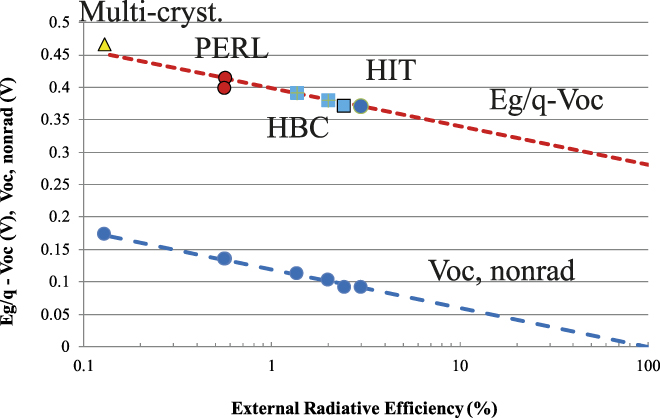
One of the problems to attain the higher efficiency solar cells is the higher minority-carrier lifetime in various materials and thus reduction in voltage loss. Figure 1 shows open-circuit voltage drop compared to band gap energy (E g/q − V oc) and nonradiative voltage loss (V oc,nonrad) in Si solar cells as a function of ERE.Reference Yamaguchi, Yamada, Katsumata, Lee, Araki and Kojima4 Open-circuit voltage is expressed byReference Yamaguchi, Yamada, Katsumata, Lee, Araki and Kojima4–Reference Yao, Kirchartz, Vezie, Faist, Gong, He, Wu, Troughion, Watson, Bryant and Nelson7
 $${V_{{\rm{oc}}}} = {V_{{\rm{oc,rad}}}} + {{kT} \over q}\ln \left( {{\rm{ERE}}} \right)\quad ,$$
where the second term shows nonradiative voltage loss and V oc,rad is the radiative open-circuit voltage and is given byReference Yamaguchi, Yamada, Katsumata, Lee, Araki and Kojima4–Reference Yao, Kirchartz, Vezie, Faist, Gong, He, Wu, Troughion, Watson, Bryant and Nelson7
 $${V_{{\rm{oc,rad}}}} = {{kT} \over q}\ln \left( {{{{J_{\rm{L}}}\left( {{V_{{\rm{oc,rad}}}}} \right)} \over {{J_{0{\rm{,rad}}}}}} + 1} \right)\quad ,$$
where J L(V oc,rad) is the photo-current at open-circuit in the case of only radiative recombination and J 0,rad is the saturation current density in the case of only radiative recombination and 0.86 V was used as the V oc,rad valueReference Yao, Kirchartz, Vezie, Faist, Gong, He, Wu, Troughion, Watson, Bryant and Nelson7 in this study.
Open-circuit voltage drop compared to band gap energy (E g/q − V oc) and nonradiative V oc (V oc,nonrad) in Si solar cells as a function of ERE. (Adapted with permission from Ref. Reference Yamaguchi, Yamada, Katsumata, Lee, Araki and Kojima4 [Cambridge Core], [2017]).

In Fig. 1, V oc values for PERL (Passivated Emitter and Rear Locally diffused) cell,Reference Green6,Reference Zhao, Wang, Green and Ferrazza8 HIT (Heterojunction with Intrinsic Thin-layer) cell,Reference Taguchi, Yano, Tohoda, Matsuyama, Nakamura, Nishiwaki, Fujita and Maruyama9 HBC (Hetero-junction Back Contact) cell,Reference Nakamura, Asano, Hieda, Okamoto, Ohnishi, Kobayashi, Tadokoro, Suganuma, Matsumoto, Katayama, Higashi, Kamikawa, Kimoto, Harada, Sakai, Shigeta, Kuniyoshi, Tsujino, Zou, Koide and Nakamura10,Reference Masuko, Shigematsu, Hashiguchi, Fujishima, Kai, Yoshimura, Yamaguchi, Ichihashi, Yamanishi, Takahama, Taguchi, Maruyama and Okamoto11 and multicrystallineReference Green, Emery, Hishikawa, Warta and Dunlop12 Si solar cells and ERE values in the references and values estimated by using Eqs. (3) and (4) are plotted. As shown in Fig. 1, crystalline Si solar cells have still nonradiative loss and further improvements in efficiency are thought to be possible by improving minority-carrier lifetime and reducing recombination losses.
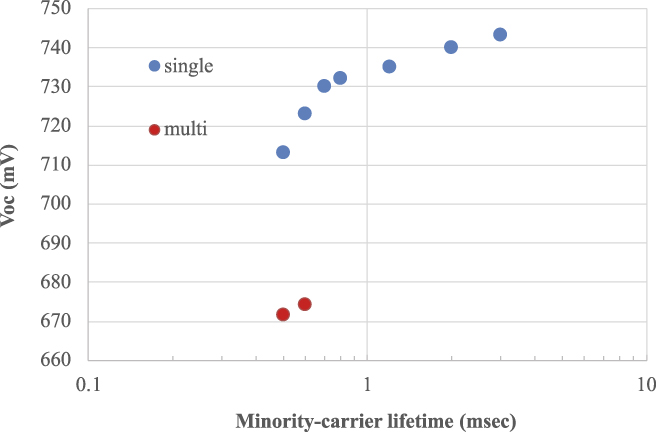
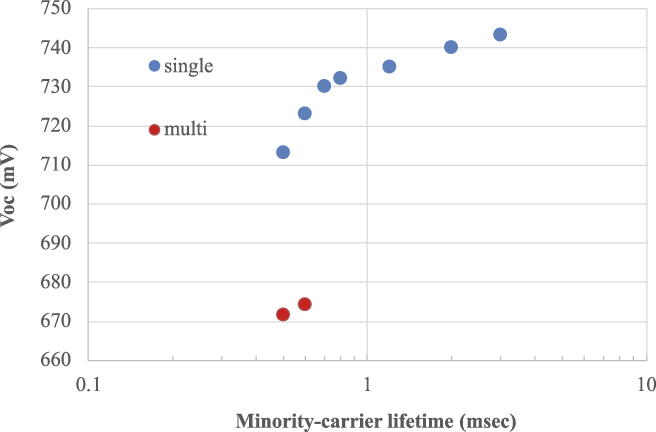
Figure 2 shows minority-carrier lifetime dependence of open-circuit voltage V oc in single-crystallineReference Yamamoto13 and multicrystallineReference Glunz, Richter, Muller, Schindler, Hauser, Feldmann, Krenckel, Riepe, Benick, Schubert and Hermle14,Reference Jin15 Si solar cells. V oc in multicrystalline Si solar cells is lower than those in single-crystalline Si solar cells because the average minority-carrier lifetime values are used in multicrystalline Si solar cells. To improve the V oc, increasing ERE shown in Eq. (5) is necessary. That is, reduction in nonradiative voltage loss is necessary. One of the most important issues for improving the V oc is to reduce nonradiative recombination loss and thus to increase minority-carrier lifetime in solar cells because the nonradiative open-circuit voltage is given by the following equation:
 $${V_{{\rm{oc,nonrad}}}} = {{kT} \over q}\ln \left[ {{{{\tau _{{\rm{nonrad}}}}} / {\left( {{\tau _{{\rm{rad}}}} + {\tau _{{\rm{nonrad}}}}} \right)}}} \right]\quad .$$
Minority-carrier lifetime dependence of open-circuit voltage V oc in single-crystalline and multicrystalline Si solar cells.
Therefore, efficiency potential of crystalline Si solar cells is analyzed by considering nonradiative recombination loss and minority-carrier lifetime in this study.
Figure 3 shows calculated efficiencies of crystalline Si solar cells as a function of EREs in comparison with state-of-the-art efficiencies of PERL cell,Reference Green6,Reference Zhao, Wang, Green and Ferrazza8 HIT cell,Reference Taguchi, Yano, Tohoda, Matsuyama, Nakamura, Nishiwaki, Fujita and Maruyama9 HBC cells,Reference Ahrenkiel, Ahrenkiel and Lundstrom3,Reference Masuko, Shigematsu, Hashiguchi, Fujishima, Kai, Yoshimura, Yamaguchi, Ichihashi, Yamanishi, Takahama, Taguchi, Maruyama and Okamoto11 and multicrystalline solar cells.Reference Green, Emery, Hishikawa, Warta and Dunlop12 Single-crystalline Si solar cells have an efficiency potential of more than 28.5% by realizing ERE of 20% from about 5% and normalized resistance of less than 0.05 from around 0.1. However, nonrecombination and resistance losses in multicrystalline Si solar cells are shown to be higher than those of single-crystalline cells.
Calculated efficiency of crystalline Si solar cells as a function of ERE in comparison with obtained efficiencies of PERL cell, HIT cell, HBC cells, and multicrystalline solar cells.

Fill factor is dependent upon V oc and ideal fill factor FF0 used in the calculation is empirically expressed byReference Green16
 $${\rm{F}}{{\rm{F}}_0} = {{{\nu _{{\rm{oc}}}} - \ln \left( {{\nu _{{\rm{oc}}}} + 0.72} \right)} \over {{\nu _{{\rm{oc}}}} + 1}}\quad ,$$
where νoc is the normalized open-circuit voltage and is given by
 $${\nu _{{\rm{oc}}}} = {{{V_{{\rm{oc}}}}} / {\left( {{{nkT} / q}} \right)\quad .}}$$
The fill factor is decreased as an increase in series resistance R S and decrease in shunt resistance R Sh of solar cell increases and expressed byReference Green16
 $${\rm{FF}} = {\rm{F}}{{\rm{F}}_0}\left( {1 - {r_{\rm{s}}}} \right)\left( {1 - {1 / {{r_{{\rm{sh}}}}}}} \right)\quad ,$$
where r s is the normalized series resistance and r sh is the normalized shunt resistance and are given byReference Green16
 $${r_{\rm{s}}} = {{{R_{\rm{S}}}} / {{R_{{\rm{CH}}}}}}\quad ,$$
 $${r_{{\rm{sh}}}} = {{{R_{{\rm{CH}}}}} / {{R_{{\rm{Sh}}}}}}\quad .$$
The characteristic resistance R CH is expressed byReference Green16
 $${R_{{\rm{CH}}}} = {{{V_{{\rm{oc}}}}} \over {{I_{{\rm{sc}}}}}}\quad .$$
In the analysis, nonradiative voltage loss as expressed by the following equation was estimated and nonradiative recombination lifetime τnonrad was estimated by using Eqs. (2), (3), (5), and (14).
 $${V_{{\rm{oc,nonrad}}}} = {{kT} \over q}\ln \left[ {{{{\tau _{{\rm{nonrad}}}}} / {\left( {{\tau _{{\rm{rad}}}} + {\tau _{{\rm{nonrad}}}}} \right)}}} \right]\quad .$$
In the calculation, 43 mA/cm2 was used as J sc. V oc was estimated by using Eqs. (2), (3), (5), and (13) and FF was estimated by using Reference RauEqs. (5) and (Reference Yao, Kirchartz, Vezie, Faist, Gong, He, Wu, Troughion, Watson, Bryant and Nelson7)–Reference Glunz, Richter, Muller, Schindler, Hauser, Feldmann, Krenckel, Riepe, Benick, Schubert and Hermle(14).
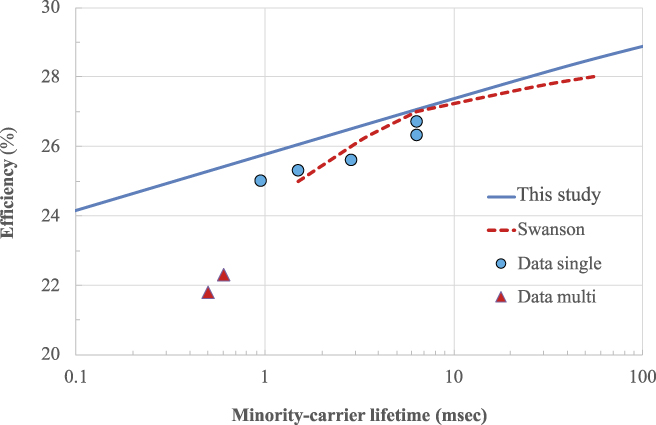
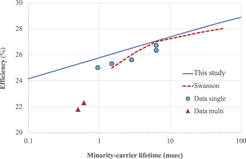
Figure 4 shows the calculated efficiencies of single crystalline Si solar cells as a function of minority-carrier lifetimes in comparison with efficiencies of PERL cell,Reference Green6,Reference Zhao, Wang, Green and Ferrazza8 HIT cell,Reference Taguchi, Yano, Tohoda, Matsuyama, Nakamura, Nishiwaki, Fujita and Maruyama9 HBC cells,Reference Ahrenkiel, Ahrenkiel and Lundstrom3,Reference Masuko, Shigematsu, Hashiguchi, Fujishima, Kai, Yoshimura, Yamaguchi, Ichihashi, Yamanishi, Takahama, Taguchi, Maruyama and Okamoto11 and multicrystalline solar cells.Reference Green, Emery, Hishikawa, Warta and Dunlop12 Analytical resultsReference Swanson17 calculated by Swanson are also plotted in this figure. Limiting efficiencies of crystalline Si solar cells are 28.4% by SwansonReference Swanson17 and 29.4% by Ritcher et al.Reference Richter, Hermle and Glunz18 In this study, efficiency potential of crystalline Si solar cells of 27.4%, 28%, and 28.5% from 26.7% is shown by improving minority-carrier lifetime from 3 to 4 ms, to 10 ms, 20 ms, and 50 ms and thus ERE from about 3% to 5%, 10%, and 20%, respectively.
Calculated and obtained efficiencies of single crystalline and multicrystalline Si solar cells as a function of minority-carrier lifetime in crystalline Si.

III. DISCUSSION ABOUT FURTHER IMPROVEMENTS OF CRYSTALLINE SI SOLAR CELLS
As shown in Figs. 2–4, crystalline Si solar cells have still nonradiative loss and further improvements in efficiency are thought to be possible by improving minority-carrier lifetime and reducing recombination losses.
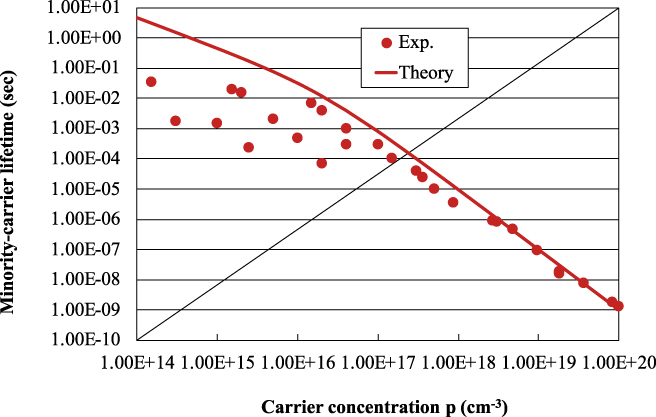
Figure 5 shows changes in minority-carrier lifetime in p-type SiReference Dziewior and Schmid19,Reference Richter, Glunz, Werner, Schmidt and Cuevas20 as a function of carrier concentration. In the figure, calculated values of minority-carrier lifetime were also shown by using the following equation:
 $${1 / \tau } = BN + C{N^2}\quad ,$$
where B is the radiative recombination probability and is 2 × 10⁻¹⁵ cm3/s for Si3, N is the carrier concentration, and C is the Auger coefficient and is 9.9 × 10⁻³² cm6/s for p-type Si.Reference Dziewior and Schmid19 Carrier concentration dependence of minority-carrier lifetime in n-type SiReference Dziewior and Schmid19,Reference Richter, Glunz, Werner, Schmidt and Cuevas20 is similar with that in p-type-Si. As shown in Fig. 5, further improvement in minority-carrier lifetime is expected to be realized, especially in low carrier concentration range of 1015 to 1016 cm−3.
Changes in minority-carrier lifetime in Si as a function of carrier concentration.

Really, high bulk lifetime of around 100 ms has been obtained by the magnetic-field-applied Czochralski (MCZ) method and low carbon concentration with 2–3 × 1013 cm−3 in Si by the Global Wafers Japan Co.Reference Higasa, Nagai, Nakagawa and Kasima21 As shown in Fig. 4, if one can keep 30-ms lifetime after cell processing, high efficiency crystalline Si solar cells of more than 28% will be realized. However, because obtained minority-carrier lifetime is lower than radiative recombination lifetime as shown in Fig. 5, nonradiative recombination loss is thought to exist even in low carrier concentration range of less than 1016 cm−3. Especially, improvement in minority-carrier lifetime in the carrier concentration range from 1015 to 1016 cm−3 is thought to be very important for high-efficiency solar cell applications. Therefore, understanding behavior of defects such as carbon-related defects, oxygen precipitates, SiC precipitates, dislocations, and so forth in Si is very important for further improvements of Si crystals and solar cells, and decreasing those defects’ density are suggested for realizing higher bulk lifetime and for higher efficiency Si solar cells of more than 28%.
In high carbon concentration exceeding the solubility limit, generation of SiC precipitates and dislocations as a result of elastic strain in Si crystals is knownReference Arafune, Sasaki, Wakabayashi, Terada, Ohshita and Yamaguchi22,Reference Arafune, Ohishi, Sai, Ohshita and Yamaguchi23 and thus minority-carrier lifetime is thought to decrease with an increase in dislocation density in Si. In low carbon concentration, homogeneous and heterogeneous nucleation of oxygen precipitates (SiO2) is known to be occurred by carbonReference Osaka, Inoue and Wada24,Reference Kishino, Matsushita, Kanamori and Iizuka25 and thus dislocations are known to be generated in Si crystals as a result of elastic strain.Reference Shinoyama, Hasebe and Yamauchi26,Reference Kakimoto, Miyamura, Harada and Nakano27 Really, dislocation generation due to elastic strain by oxygen precipitates even in CZ-Si has been observed by using a high resolution transmission electron microscope by Tokuyama Co.Reference Masada28 According to studies by Global Wafers Japan Co.Reference Higasa, Nagai, Nakagawa and Kasima21 and Tokuyama Co.,Reference Masada28 oxygen precipitation concentration in FZ (Floating Zone)-, MCZ-, and CZ-Si is shown to increase almost linearly with the increase in carbon concentration in the oxygen concentration range of more than 1015 cm−3. Dislocation density in CZ-Si is shown to increase almost linearly with an increase in oxygen precipitation concentration.Reference Masada28 Therefore, even in single crystalline Si, oxygen precipitates are thought to generate dislocations during solar cell fabrication processing and dislocations are thought to act as nonradiative recombination center and decrease minority-carrier lifetime in Si.
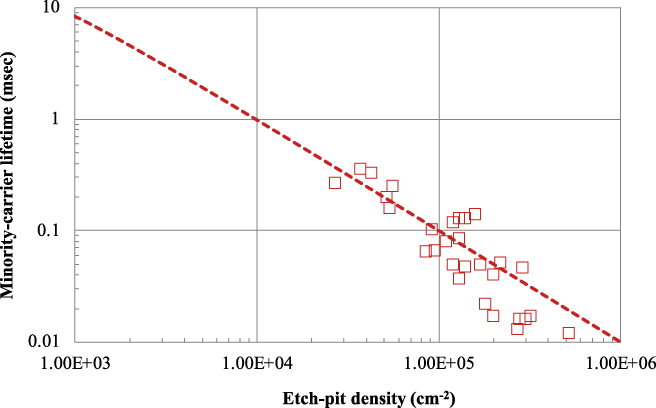
In the case of multicrystalline Si solar cells, one of the major problems for realizing higher efficiency is higher dislocation density. Figure 6 shows our results for changes in minority-carrier lifetime in multicrystalline Si as a function of etch-pit (dislocation) density.Reference Arafune, Sasaki, Wakabayashi, Terada, Ohshita and Yamaguchi22 Because metallic impurities such as iron are known to cause additional nonradiative recombination in Si solar cells, high-quality multicrystalline Si substrates provided by JFE Steel were used in our studies. Dislocation density N d dependence of effective lifetime τeff is given from Eq. (2) by
 $${1 / {{\tau _{{\rm{eff}}}}}}\left[ {{{\rm{s}}^{ - 1}}} \right] = BN + 0.1 \times {N_{\rm{d}}}\left[ {{\rm{c}}{{\rm{m}}^{ - 2}}} \right]\quad .$$
Changes in minority-carrier lifetime in multicrystalline Si as a function of etch-pit density. (Reproduced with permission from Ref. Reference Arafune, Sasaki, Wakabayashi, Terada, Ohshita and Yamaguchi22 [Elsevier], [2006]).

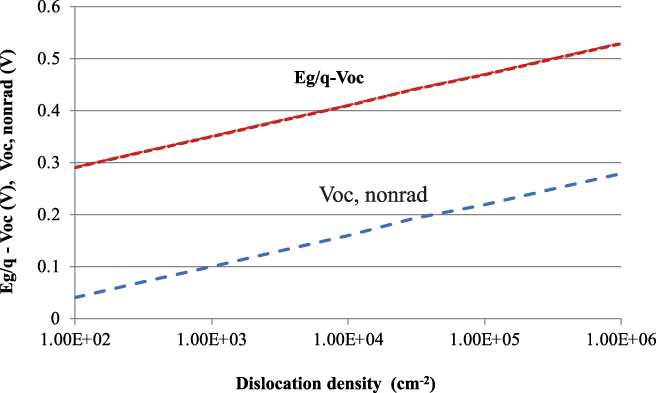
In this study, nonradiative recombination minority-carrier life time was assumed to be limited by dislocation density in multicrystalline Si solar cells. Figure 7 shows changes in open-circuit voltage drop compared to band gap energy (E g/q − V oc) and nonradiative V oc (V oc,nrad) estimated from Eqs. (5), (14), and (16) in multicrystalline Si solar cells as a function of dislocation density in Si. Figure 7 suggests that a lower dislocation density of less than 3 × 103 cm−2 will provide a lower voltage drop of less than 0.4 V and a higher V oc of more than 700 mV. Decreasing dislocation density is suggested for realizing higher bulk lifetime and for higher efficiency multicrystalline Si solar cells of more than 24%.
Changes in open-circuit voltage drop compared to band gap energy (E g/q − V oc) and nonradiative V oc (V oc,nonrad) in multicrystalline Si solar cells as a function of dislocation density in Si.

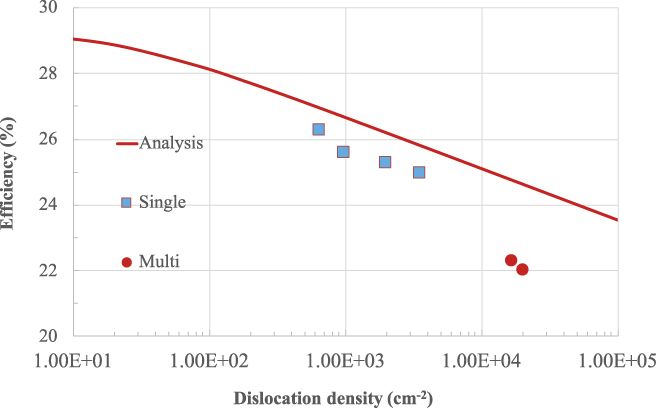
Figure 8 shows calculated dislocation density dependence of efficiency for single-crystalline and multicrystalline Si solar cells in comparison with efficiencies obtained for single-crystallineReference Yoshikawa, Kawasaki, Yoshida, Irie, Konishi, Nakano, Uto, Adachi, Kanemitsu, Uzu and Yamamoto2,Reference Zhao, Wang, Green and Ferrazza8,Reference Masuko, Shigematsu, Hashiguchi, Fujishima, Kai, Yoshimura, Yamaguchi, Ichihashi, Yamanishi, Takahama, Taguchi, Maruyama and Okamoto11 and multicrystallineReference Glunz, Richter, Muller, Schindler, Hauser, Feldmann, Krenckel, Riepe, Benick, Schubert and Hermle14,Reference Jin15 Si solar cells as a function of dislocation density estimated from V oc values. In the calculation, 43 mA/cm2 was used as J sc. V oc was estimated by using Eqs. (2), (3), (5), (13), and (16), and FF was estimated by using Eqs. (5), (7)–(14), and (16).
Calculated dislocation density dependence of efficiency for single-crystalline and multicrystalline Si solar cells in comparison with efficiencies obtained for single-crystalline and multicrystalline Si solar cells as a function of dislocation density estimated from V oc values.

Efficiency in multicrystalline Si solar cells is lower than analytical results because efficiency was calculated by using average minority-carrier lifetime values in multicrystalline Si solar cells. Figure 8 suggests that a lower dislocation density of less than 3 × 103 cm−2 will provide a lower voltage drop of less than 0.4 V and a higher V oc of more than 700 mV in multicrystalline Si solar cells. Decreasing dislocation density is suggested for realizing higher bulk lifetime and for higher efficiency multicrystalline Si solar cells of more than 24%. Even in single-crystalline Si solar cells, reduction in dislocation density of less than 100 cm−2 by realizing lower carbon concentration of less than 1 × 1014 cm−3 will provide a lower voltage drop of around 0.3 V and a higher V oc of around 780 mV. Understanding behavior of point defects such as oxygen precipitates, dislocations, and so forth in Si and decreasing those defects density are suggested for realizing higher bulk lifetime and for higher efficiency Si solar cells of more than 27.5%.
Figure 8 also suggests additional losses such as resistance loss in addition nonradiative recombination loss discussed in this study and optical loss. Efficiency loss analyses presented by SwansonReference Swanson17 for PERL solar cells and Yoshikawa et al.Reference Yoshikawa, Kawasaki, Yoshida, Irie, Konishi, Nakano, Uto, Adachi, Kanemitsu, Uzu and Yamamoto2 for HBC solar cells show 1.04 and 0.5% for optical loss, 2.12 and 1.2% for nonradiative recombination loss, and 0.95 and 1% for resistance loss. High efficiency crystalline Si solar cells of more than 28% will be realized by reducing optical loss from 0.5 to 0.3%, nonradiative recombination loss from 1.2 to 0.6%, and resistance loss from 1 to 0.5%.
IV. SUMMARY
Efficiency potential of crystalline Si solar cells is analyzed by considering ERE, voltage, and fill factor losses. 28.5% by realizing ERE of 20% from about 5% and normalized resistance of less than 0.05 from around 0.1. Nonradiative recombination losses in single-crystalline and multicrystalline Si solar cells are also discussed. Especially, nonrecombination and resistance losses in multicrystalline Si solar cells are shown to be higher than those of single-crystalline cells. Importance of further improvement of minority-carrier lifetime in crystalline Si solar cells is suggested for further improvement of crystalline Si solar cells. High efficiency of more than 28.5% will be realized by realizing high minority-carrier lifetime of more than 30 ms. Key issues for those ends are reduction in carbon concentration of less than 1 × 1014 cm−3, oxygen precipitated and dislocations even in single-crystalline Si solar cells, and reduction in dislocation density of less than 3 × 103 cm−2 in multicrystalline Si solar cells. High efficiency crystalline Si solar cells of more than 28% will be realized by reducing optical loss from 0.5 to 0.3%, nonradiative recombination loss from 1.2 to 0.6%, and resistance loss from 1 to 0.5%.
ACKNOWLEDGMENTS
This work was partially supported by the NEDO under the METI. The authors thank members in the NEDO and METI, and Dr. H. Yamada, NEDO, Dr. Y. Hayashi, Dr. T. Kamioka, and H. Lee, Toyota Tech. Inst., Prof. K. Arafune, Kobe Univ., Dr. J. Nakamura, Sharp, Dr. M. Tanaka, Dr. M. Taguchi, Dr. S. Yata, Dr. Masuko, and Mr. Hashiguchi, Panasonic, Prof. K. Kakimoto, Kyushu Univ., Prof. A. Ogura, Prof. K. Nakamura, and Dr. T. Kojima, Meiji Univ., Dr. K. Kashima, Global Wafers Japan for their cooperation and providing fruitful information.