1. Introduction
That institutions channel human behavior, and are therefore crucial for the economic performance of nations is now practically part of conventional wisdom. With the availability of new comparative data, a considerable literature explores empirically effects of formal and informal institutions on economic outcomes, such as growth, trade, or financial development (e.g. Acemoglu and Robinson, Reference Acemoglu and Robinson2012; Algan and Cahuc, Reference Algan and Cahuc2013; Berggren and Eliner, Reference Berggren and Elinder2012; Bjørnskov, Reference Bjørnskov2012; Guiso et al., Reference Guiso, Sapienza and Zingales2006; Kovac and Spruk, Reference Kovac and Spruk2016; Mathers and Williamson, Reference Mathers and Williamson2011; Putnam, Reference Putnam1993; Rode and Coll, Reference Rode and Coll2012; Yoo and Steckel, Reference Yoo and Steckel2016; Zak and Knack, Reference Zak and Knack2001). Along these lines, a growing number of investigations find that ‘individualistic values’ provide a more favorable background for promoting wealth and prosperity than ‘collectivistic values’ (Ball, Reference Ball2001; Davis, Reference Davis2016; Gorodnichenko and Roland, Reference Gorodnichenko and Roland2011a, Reference Gorodnichenko and Roland2011b; Greif, Reference Greif1994; Hansen, Reference Hansen2013; Harrison, Reference Harrison2013; van Hoorn, Reference van Hoorn2014; Williamson, Reference Williamson2009).Footnote 1
Following authors such as Licht et al. (Reference Licht, Goldschmidt and Schwartz2005), Guiso et al. (Reference Guiso, Sapienza and Zingales2006), Williamson (Reference Williamson2009), Tabellini (Reference Tabellini2010), and Harrison (Reference Harrison2013), culture influences economic performance via two interrelated, but distinct routes: First, social norms exert a direct motivational effect by impacting on eligible and rational behavior through ‘internal rules’. For example, as Weber (Reference Weber1930) forcefully noted, by shaping attitudes toward profit-making and capital accumulation, Calvinism had a deep impact on individual work ethics and economic activities. Second, a country's laws and institutional framework naturally tend to reflect a significant part of its cultural values and heritage (e.g. Harrison, Reference Harrison2013; Kyriacou, Reference Kyriacou2016).Footnote 2 For example, Bjørnskov (Reference Bjørnskov2010) points out that generalized trust, as an integral part of a country's social capital, impacts on the quality of formal institutional settings both through improved policy implementation capabilities in the public sector, and through enhanced ability of citizen-voters to systematically demand ‘better’ policies and hold politicians accountable (see also Boix and Posner, Reference Boix and Posner1998; Jottier and Heyndels, Reference Jottier and Heyndels2012).
The purpose of this paper is to explore whether individualistic cultural traits shape attitudes toward government interventions, apart from the hypothetical effect of social trust. All else equal, are more individualist cultures also less inclined to support government interventionism? We thus add an aspect that is placed primarily at the political demand side of the transmission from culture to formal institutions. However, instead of searching for a macro-impact of cultural traits on governance quality, we aim to identify the micro-association of individualism and political preference formation. Building on a recent paper by Pitlik and Kouba (Reference Pitlik and Kouba2015) on social trust and interventionist attitudes, we explore if the impact of different individualistic traits is conditional on perceived governance quality. We consider some key components of an ‘individualistic culture’, namely values related to non-obedience and personal independence (i.e. self-direction), as well as beliefs in control of one's own life course (i.e. self-determination), to be particularly relevant for attitude formation. Results indicate that both elements are negatively associated with interventionist preferences. Interestingly, effects of self-direction values on intervention attitudes are much weaker though, than the effects of a strong belief in self-determination.
The paper is structured as follows: Section 2 gives a brief overview or related literature, section 3 describes our data generation process. Section 4 proceeds with an individual-level empirical analysis of intervention preferences, and section 5 concludes.
2. Related literature and hypotheses
Recent decades have witnessed a significant increase of scholarly interest in the role that an individualistic culture plays for the economic success of nations. Even though exact definitions differ slightly from one another, individualism is generally conceptualized as a worldview which emphasizes the individual, i.e. personal goals, uniqueness and control, while collectivism emphasizes the group or the society as the core unit, and individuals must fit into the groups.Footnote 3
Current psychological research supports the idea that individualism and collectivism prime the way people think about the social world (e.g. Oyserman and Lee, Reference Oyserman and Lee2008). Gorodnichenko and Roland (Reference Gorodnichenko and Roland2015a) provide a survey of cultural psychology literature on differences between individualism and collectivism, concerning visions of self, and differences in cognitive behavior and motivation. The key characteristic of individualistic cultures is to reward personal endeavor and effort, innovation, or other achievements, with higher social status. Individualism is thus strongly associated with capitalist entrepreneurship (Mokyr, Reference Mokyr1990).Footnote 4 Collectivism instead fosters conformity and an internalization of collective goals while discouraging individuals from striving for outstanding results that challenge group hierarchy.Footnote 5
Boettke et al. (Reference Boettke, Coyne and Leeson2008) argue that it is decisive that a country's formal institutions map onto its informal rules in order for the former to become a source of economic success. Systematic differences in (cultural) belief systems toward government intervention may be responsible for slow and long-run changes of governance structures. In individualistic societies, one should therefore observe a stronger ‘demand’ for formal institutions that provide a framework to unfold incentives for personal achievement, creating a more growth-friendly environment that is in line with protection of property rights, the rule of law, and economic freedom (Greif Reference Greif1994). Storr (Reference Storr2013) argues that formal rules and institutions not only emerge from a society's cultural system but are viewed and interpreted through a cultural filter.
Recent research indeed reveals a match of individualistic traits and the quality of the economic and political institutions. Licht et al. (Reference Licht, Goldschmidt and Schwartz2005, Reference Licht, Goldschmidt and Schwartz2007) and Kyriacou (Reference Kyriacou2016) provide evidence of a positive relationship of measures of individualism and the rule of law, absence of corruption, and democratic accountability. Inglehart and Welzel (Reference Inglehart and Welzel2010) report that ‘self-expression values’ exert pressure for improvements in democracy. Gorodnichenko and Roland (Reference Gorodnichenko and Roland2015b) also find individualistic values to be positively related to the development of democratic institutions.
Tabellini (Reference Tabellini2008, Reference Tabellini2010), Williamson (Reference Williamson2009), and Williamson and Kerekes (Reference Williamson and Kerekes2011), consider (1) social trust, (2) tolerance, (3) life control (self-determination), and (4) obedience, to be particularly important for an ‘economic culture’. All these components are related to individualistic values, although to different degrees. Following Tabellini (Reference Tabellini2010: 683), self-determination and non-obedience stand for ‘an entrepreneurial environment where individuals seek to take advantage of economic opportunities’, and symbolize ‘confidence in the virtues of individualism’. Trust and tolerance are vital for the operation of personal interactions and governmental institutions, but are only indirectly related to individualism, as they are typical for societies where individualism is not suppressed.Footnote 6
Arguably, one could also defend the standpoint that individualistic traits are the result of a process of ‘crowding in’ (cf. Janssen and Mendys-Kamphorst, Reference Jenssen and Mendys-Kamphorst2004), where formal institutions that are conducive to growth over time shape the accompanying attitudes. Even though there is some merit in the hypothesis that formal institutions are reinforced by informal practice, seeing formal institutions as the sole creators of civic norms would also ultimately mean that creating governmental institutions favorable to development is purely an outcome of chance, which is at odds with most of the institutional development literature. Individualistic ideas and values yet certainly impact on the mind-set, shaping attitudes toward the direction of formal institutional change. Several ideas all point to the fact that government intervention and productivity growth are ultimately the consequence of pre-existing cultural values, rather than values being created by formal institutions.
For instance, Mokyr (Reference Mokyr1990) documents that the Industrial Revolution first occurred in parts of Western Europe and North America, also because of civic norms already in place, favoring the free relationship of entrepreneurs and investors. Rather than a momentary shift to capitalism, the Industrial Revolution is seen as a culmination of centuries of technical and institutional innovation with higher ‘openness to new information’ at its roots. Also, Harrison (Reference Harrison2013) highlights tolerance, education, and rationality as a basis for industrialization and development. Fevre (Reference Fevre2016) claims that ideas of classical liberal individualism and economic inequality are linked. By establishing a vision of individualism in most Western societies, where inequality is seen as a natural outcome that reflects differences in capability and motivation, individualist values have endorsed the idea that governments should only promote the conditions of meritocracy, entrepreneurship, and fair market-dealings, instead of intervening in the economy on behalf of the poor. Such relationships also hold at the firm level. Van Hoorn (Reference van Hoorn2014) finds individualistic values to be positively related to the quality of management practices, by promoting positive attitudes toward performance-related pay and merit-orientation. Moreover, individualistic culture is the main determinant for the implementation of productivity enhancing management practices. This is surely also in line with the interpretation of the decision-making-culture-nexus by Storr (Reference Storr2013: 55), who argues that culture should not be seen as a tool or production item, but that culture instead frames the decision set, ‘. . . regarding which tools (strategies) available to us and which tools we should utilize as we pursue our goals’.
To summarize, while people with strong individualistic attributes are expected to want governments to refrain from interventions into the personal economic sphere, collectivist traits may be, as a general rule, associated with a more pro-interventionist view. This leads us to
Hypothesis 1: Individualistic cultural traits are negatively related to interventionist attitudes.
A related strand of the literature is concerned with the relationship of social trust and attitudes toward intervention and the regulatory state (Aghion et al., Reference Aghion, Algan, Cahuc and Shleifer2010; Tirole, Reference Tirole1988). People who distrust others tend to abstain from economic transactions, if they are not facilitated by government regulation as an implicit third party guarantee (Aghion et al., Reference Aghion, Algan, Cahuc and Shleifer2010). However, people are less willing to assign a strong interventionist and regulating role to the state, if they expect that government is unwilling or unable to perform that role properly. Svallfors (Reference Svallfors2013) finds that people who perceive state institutions to be efficient and fair have a more positive attitude toward higher taxes and government spending. For post-soviet transition economies, Dimitrova-Grajzl et al. (Reference Dimitrova-Grajzl, Grajzl and Guse2012) report that the general public's attitude toward regulation is driven both by trust in market participants and concerns about government corruption. Using European Social Survey data for 29 countries, Daniele and Geys (Reference Daniele and Geys2015) find a more pronounced effect of social trust on welfare state support in countries where government institutions are perceived to be uncorrupted. Pitlik and Kouba (Reference Pitlik and Kouba2015) analyze the impact of trust for public support of government intervention, arguing that a lack of confidence in companies will intensify demand for regulation. If people have no confidence in policymakers, this is associated with a stronger appeal of self-regulation or refusal of any intervention at all. Transferring this idea to the context on individualistic traits, we formulate the following additional hypotheses:
Hypothesis 2: High trust in state institutions and low trust in companies are positively related to interventionist preferences.
Hypothesis 3: Higher trust in state institutions, as compared to trust in companies, mitigates the negative relationship of individualistic values to interventionist preferences.
3. Data and measurement
Our empirical analysis of the association of individualistic values and government intervention attitudes is largely based on data from the integrated World Values Surveys/European Values Studies (WVS/EVS) file. The WVS is a global network of social scientists studying changing values and their impact on life perceptions. It consists of representative surveys conducted in almost 100 countries since 1981 using a common questionnaire. The combined dataset is currently made up of 6 WVS, and 4 EVS waves. Due to missing questions, we only use observations since 1990.
The focus is on individual-level analyses, for two reasons. First, our hypotheses are formulated on an individual level, and main variables of interest are defined there. We look at individuals with different characteristics within countries, which would be impossible if we estimated with WVS averages on the country level. Second, at the margin, it is quite unlikely that individual attitudes are pivotal for the design and quality of national policies and institutions, thus eliminating at least one potential source of reverse causality.
It should further be mentioned that critique of literature attempting to measure the elusive concept of culture via surveys is almost as old as the WVS itself, originally focusing on the question whether culture is something measurable at all (e.g. Lavoie and Chamlee-Wright, Reference Lavoie and Chamlee-Wright2000; Storr, Reference Storr2013). While a measurement strategy is necessarily ‘reductionist’, we attempt to combine different value questions that fit important aspects of the individualist/collectivist-scale in our approach, in order to cover more than just one single dimension of the concept.
Individualistic traits
Based on the main ideas of the individualism–collectivism distinction, and the literature discussed in section 2, we identify two different but closely related values and beliefs from WVS/EVS survey questionnaires that are supposed to capture essential dimensions of individualism. These are self-direction and self-determination.
Selfdirection
The first measure captures the ideal of autonomous, self-directed decision making for important life choices (selfdirection). To compose an indicator for self-direction we rely on two variables, namely noobedience and independence, which are derived from the following WVS/EVS question: ‘Here is a list of qualities that children can be encouraged to learn at home. Which, if any, do you consider to be especially important? Please choose up to five’. We assigned a value of ‘1’ to selfdirection if a respondent did select the item ‘independence’ and did not select the item ‘obedience’ from the list.Footnote 7
noobedience and independence both refer to the disapproval of hierarchical decisions without scrutinizing the underlying structures that make institutional cooperation possible. Following Tabellini (Reference Tabellini2010: 685), people who claim obedience to be important also follow the idea that ‘good behavior is deemed to result [mainly] from coercion’. Thus, obedience stands in opposition to social trust, where individuals expect non-opportunistic behavior from others. Yet, obedience is not simply ‘distrust’; it stands also contrary to Schwartz's (Reference Schwartz, Vinken, Soeters and Ester2004) notion of ‘intellectual autonomy’. Rather than encouraging people to pursue own ideas, obedience is associated with accepting obligations within a legitimately perceived unequal distribution of power, roles, and resources. This perspective supports the idea that selfdirection is associated with a higher propensity to reject government intervention, because regulation is associated with constraints on individualized personal decision making. Due to the focus on personal intellectual autonomy, we would also expect selfdirection to better reflect the valuation of freedom in the social and political sphere, rather than in the economic dimension.
Selfdetermination
Individualistic traits are further reflected by values of selfdetermination, or self-efficacy. Following Bandura (Reference Bandura1977), self-efficacy is the extent or strength of one's belief in one's own ability to complete tasks and reach goals. Closely related is Rotter's (Reference Rotter1966) notion of internal vs. external locus of control, which refers to the degree to which individuals expect outcomes to be contingent on own behavior or characteristics, or as a function of pure chance or fate. Individuals who have an internal locus of control believe in their own ability to control their life course. They interpret personal choices as the main cause of individual success or failure. As one of the first, Feldman (Reference Feldman1988) argues that ‘economic individualism’, measured by the belief that people should get ahead on hard work, is related to a less interventionist attitude. Feldman and Zaller (Reference Feldman and Zaller1992) find that so-defined individualistic values provide a basis for welfare state critique. Most people seem to differentiate between incomes acquired effortless, or pure ‘luck’, and those acquired by personal ‘effort’. This distinction matters for postures toward redistribution (Alesina and Angeletos, Reference Alesina and Angeletos2005; Bavetta and Navarra, Reference Bavetta and Navarra2012; Benabou and Tirole, Reference Bénabou and Tirole2006), and supposedly matters also for interventionist attitudes. According to D'Orlando et al. (Reference D'Orlando, Ferrante and Ruiu2010), the belief of fatalism is linked to a stronger demand for job security from labor market institutions. Kouba and Pitlik (Reference Kouba and Pitlik2014) find that people who interpret their life course as not being at their disposition, have a more positive attitude toward income equalization.
To measure selfdetermination, we again selected two items from the WVS/EVS database: First, lifecontrol is based on the survey question: ‘Some people feel they have completely free choice and control over their lives, while other people feel that what they do has no real effect on what happens to them. Please use this scale [between] “none at all” and. . . “a great deal” to indicate how much freedom of choice and control you feel you have over the way your life turns out’. On a 1–10 scale, we coded lifecontrol as ‘1’ if the respondent chose a score of 7, or higher, otherwise we assigned a ‘0’. Second, success is based on a survey question whether hard work brings success or not, again coded on a 1–10 scale. success gets assigned a ‘1’, if the respective response was 4 or smaller, meaning that one believes in a positive relationship of effort and success. Accordingly, the compound indicator selfdetermination gets a value of ‘1’ if (and only if) both lifecontrol and success are assigned a ‘1’, otherwise ‘0’. In comparison with selfdirection, we expect the values of selfdetermination to reflect individualism in the economic sphere, due to the focus on effort and achievement.
In an auxiliary principal component analysis, all four variables load on two distinctive factors with Eigenvalues > 1. noobedience and independence load heavily on one factor, lifecontrol and success on the other. From a purely statistical standpoint, it thus appears reasonable to construct two separate compound indicator variables.
Government intervention attitudes
Individual attitudes toward government intervention are also assessed by using WVS/EVS data from all survey waves since the 1990s,Footnote 8 where we focus on universal attitudes regarding the appropriate role of government. Responses to three distinct survey questions are used:
-
• Government responsibility: ‘People should take more responsibility to provide for themselves vs. The government should take more responsibility to ensure that everyone is provided for’.
-
• State ownership: ‘Private ownership of business should be increased vs. Government ownership of business should be increased’.
-
• Competition attitudes: ‘Competition is good. It stimulates people to work hard and develop new ideas vs. Competition is harmful. It brings out the worst in people’.
Original responses are Likert-scaled on a 1–10 point ladder. A principal component factor analysis over all available observations (across time and countries) confirms that the three variables load on a single principal factor (EV = 1.3), and can therefore be aggregated to a single measure. The resulting factor variable govintervention, with a mean of zero and standard deviation of one, is employed as dependent variable in the empirical analysis, where higher values indicate a more positive view of government intervention.
Trust in formal institutions
Institutional trust is derived from confidence data of the WVS/EVS dataset. Confidence measures fairly reflect institutional quality, as corruption, fraud, unlawful, and unethical behavior are clearly associated with an erosion of both, trust in state institutions (Clausen et al., Reference Clausen, Kraay and Nyiri2011; Grönlund and Setälä, Reference Grönlund and Setälä2012), and trust in major private companies (Shleifer, Reference Shleifer2004).
To proxy for confidence in formal institutions, the compound variable stateconfidence employs information on trust in parliament, government, civil service, political parties, and the justice system by calculating the mean of the related confidence questions from the WVS.Footnote 9 All responses are re-coded to scores between 0 and 1, where higher values also indicate higher confidence. We further employ data on confidence in major companies (companyconfidence), also re-coded to a 0–1 scale, as a proxy for trust in the private sector. The variable trustdifference denotes the difference between stateconfidence and companyconfidence, lying in a range between −1 and +1. Values greater than zero indicate that respondents have more trust in government institutions than in private companies, while values smaller than zero indicate that respondents have more confidence in private companies than in government institutions.
4. Results of individual level estimates
Estimation approach
In this section, we estimate determinants of attitude formation at the individual level. To test Hypotheses 1 and 2, government intervention preferences (govintervention) of person i living in country j at time t are regressed on individualistic values, confidence in state institutions and major companies, plus a set of individual level covariates (Xijt ):
 $$\begin{eqnarray}
&& {\rm{GOVINTERVENTIO}}{{\rm{N}}_{ijt}} \nonumber\\
&&\quad = {\alpha _0} + {\alpha _1}{\rm{INDIVIDUALIS}}{{\rm{M}}_{ijt}} + {\alpha _2}{\rm{STATECONFIDENC}}{{\rm{E}}_{ijt}} \nonumber\\
&&\qquad+\, {\alpha _3}{\rm{COMPANYCONFIDENC}}{{\rm{E}}_{ijt}}\ + {\alpha _4}{X_{ijt}} + {\alpha _5}{Z_{jt}} + {\varepsilon _{ijt}}.
\end{eqnarray}$$
We expect coefficient α1 of the individualism variables to be negative, whereas for stateconfidence we expect α2 > 0, and for companyconfidence α3 < 0.
Individual covariates X include sex, age groups, household income (low and high income groups, middle income as reference group), educational status (low and high education, middle education as reference group), and employment status (self-employed, unemployed). We also include dummy variables for protestant, roman-catholic, and orthodox Christian denomination, recognizing the notion that economic views and personal characteristics are influenced by religious denomination (Chadi and Krapf, Reference Chadi and Krapf2015). These covariates are included in all specifications.
Further individual controls are included in some specifications. socialtrust is a dummy variable that indicates generalized trust toward unknown and anonymous others. As explained in section 2, we expect people who trust others to also have a lower propensity to demand regulatory interventions. Moreover, we control for political ideology effects on interventionist attitudes by adding dummy variables for self-reported political left-wing or right-wing orientation (centrist as reference group). Leftist attitudes are frequently and very strongly associated with a pro-interventionist stance, but for right-wingers this is less clear. Provided that interventionist attitudes are closely related to trust and political orientation on a left-right scale, we gain additional confidence in our results, if the central variables of interest survive the introduction of both indicators.
To test Hypothesis 3, we further examine if the effects of individualistic traits on intervention attitudes are conditional on relative trust, by introducing an interaction variable of individualistic traits and institutional trust.
 $$\begin{eqnarray}
&&{\rm{GOVINTERVENTIO}}{{\rm{N}}_{ijt}} \nonumber\\
&&\quad = {\beta _0} + {\beta _1}{\rm{INDIVIDUALIS}}{{\rm{M}}_{ijt}} + {\beta _2}{\rm{TRUSTDIFFERENC}}{{\rm{E}}_{ijt}} \nonumber\\
&&\qquad+\, {\beta _3}({\rm{INDIVIDUALIS}}{{\rm{M}}_{ijt}} \times {\rm{TRUSTDIFFERENC}}{{\rm{E}}_{ijt}}) + {\beta _4}{X_{ijt}} \nonumber\\
&&\qquad+\, {\beta _5}{Z_{jt}} + {\eta _{ijt}}.
\end{eqnarray}$$
Hence, the marginal conditional effect of individualism is given by
 $$\begin{equation*}
\frac{{\partial {\rm{GOVINTERVENTIO}}{{\rm{N}}_{ijt}}}}{{\partial {\rm{INDIVIDUALIS}}{{\rm{M}}_{ijt}}}} = {\beta _1} + {\beta _3} \times {\rm{TRUSTDIFFERENC}}{{\rm{E}}_{ijt}}.
\end{equation*}$$
We expect the coefficient β1 of the individualist cultural variable to show a negative sign, if we do not control for the interaction effect. This would indicate that people with more individualistic values are indeed more skeptical toward government interventions. On the other hand, coefficient β2 is expected to be positive, if we do not control for the interaction effect, indicating that people who trust state actors more than major companies will prefer interventions. In case of individualistic cultural traits one would expect β3 > 0, i.e., an individualistic prior against intervention is mitigated by a higher relative trust in state institutions.
We do not include specific country-level covariates in our estimations for two reasons. First, there are almost certainly countless idiosyncratic country-specific factors, which could impact on intervention preferences, and it is hardly possible to control for all of them. To account for this unobservable heterogeneity in the cross-country dimension, country fixed effects are recommended. However, if we include such country effects, we are running into the problem that for some variables of interest, such as democracy levels, there is only very little variation over time. Second, for some countries, we only have one observation, as they only took part in one survey wave. In this case, country-dummies absorb all cross-section information for economic and political variables such as GDP per capita, democracy, or policies at the time of the survey. For countries with two or more observations, a fixed effects within-transformation effectively changes the interpretation of the respective coefficients from a ‘level perspective’ to a ‘change-over-time’ perspective. Put differently, including covariates such as GDP per capita or democracy measures simultaneously with country fixed effects provides us information about the effects of changes in GDP or changes in political institutions, while we are interested in level effects. Moreover, there are probably additional country idiosyncrasies at certain points in time that influence responses, but which are impossible to account for. One may think of political scandals, or particular economic events, driving attitudes toward government intervention. To control for these unknown factors, we include country-year-effects Zjt , which simultaneously account for all country-level aspects at the time the opinion survey was conducted.
Baseline results
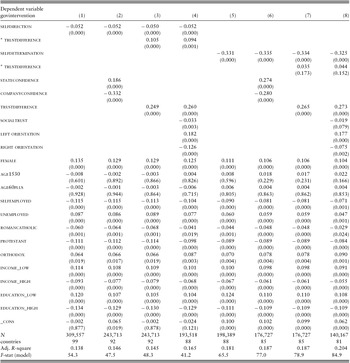
Table 1 displays results of pooled OLS estimates. Standard errors are clustered at the country level to correct for the Moulton bias (Moulton, Reference Moulton1990). Robust P-values are reported in parentheses.
Determinants of individual government intervention attitudes (individual base model)

Pooled OLS with standard errors clustered at country level. Cluster-robust P-values reported below coefficients in parentheses. All estimates include fixed country-year dummies.
Before turning to our covariates of interest, we take a brief look at the control variables where we find the following: Women are more inclined to government intervention than men, in line with the well-known fact that they are more risk averse. While we never find age-related attitudes, unemployed people are more, and self-employed are less in favor of intervention. Roman Catholics and especially Protestants prefer less, while people with Orthodox Christian denomination prefer more intervention.Footnote 10 We also find significant negative effects of higher income and higher education, as compared to middle or low level income and education.
Turning to the variables of special interest, we observe the expected negative association of both selfdirection and selfdetermination with govintervention, in all specifications (Hypothesis 1). There is, however, a notable difference with respect to coefficient size, as selfdetermination is substantially stronger (−0.33, which is one-third of a standard deviation of govintervention) than selfdirection (−0.05, or 5% of a standard deviation of the dependent variable).
Results for stateconfidence and companyconfidence in specifications (2) and (6) are stable and clear: The higher individual trust in state actors and the lower trust in major companies, the stronger are pro-interventionist attitudes. To calculate effects of individualism conditional on confidence in state and major companies, we use trustdifference in specifications (3) and (7). As expected, the ‘base term’ trustdifference and the interaction variable are both positive. However, it is well known that in models with interaction terms the total marginal effect that a variable exerts on the dependent variable consists of two parts: the coefficient on the interaction term multiplied by the interacting variable, as well as the coefficient on the individual variable of interest (Brambor et al., Reference Brambor, Clark and Golder2006; de Haan et al. Reference de Haan, Jong-A-Pin and Mierau2013). For easier interpretation, we prefer a graphical illustration of marginal effects.
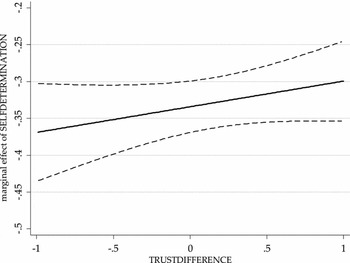
Figure 1, based on (3), shows that at low levels of confidence in state actors and high confidence in companies, selfdirection is associated with a lower demand for interventions, while at high trustdifference levels it is even positively related to govintervention. What is important to take into account here is that, given our standard deviation of trustdifference, the region that we can safely make a claim about is roughly between −0.5 and 0.5. This means that at very low levels of confidence in state actors, and high confidence in companies, selfdirection is associated with a lower demand for government interventions, while the contrary situation of very high state confidence and low company confidence is probably driven by outliers and should not be overemphasized, as the effects are not statistically significant in this region.
Marginal effects of selfdirection on government intervention attitudes.

In Figure 2, based on (7), the interaction of selfdetermination with trustdifference is positive, but not significant. This suggests that the negative impact of selfdetermination on interventionist attitudes is prevalent regardless whether trust in state institutions is low and/or confidence in major companies is high, or not. The respective marginal effect is around −0.35 in the relevant regions of trustdifference.
Marginal effects of selfdetermination on government intervention attitudes.

An important question raised by our results is why the association of selfdirection with govintervention is mediated by trustdifference, while the association of selfdetermination and govintervention is not? A possible answer might be that absence of selfdirection (i.e. social individualism) reflects a personally more coercive environment. If individuals value obedience and reject independence they systematically support the view that decision-making capabilities in important matters of life should be delegated to a higher authority. Hence, changes in selfdirection views of such individuals and their impact on attitudes toward govintervention will greatly depend on how these people perceive authority of the state and major companies, as either positive or negative. In turn, neither the normative belief that hard work should bring success, nor the feeling of being in control of one's own life have a lot to do with personal views on authority. Therefore, selfdetermination values and its association with attitudes toward govintervention are not mitigated by personal views on governmental trust as compared to confidence in companies, and the legitimacy of its authority.
In specifications (4) and (8), we add controls for ideological orientation and social trust, as a kind of sensitivity test. As expected, political left orientation is positively related to intervention attitudes. The coefficient is rather strong (+0.18). Right-leaning people have a negative view of intervention (−0.13 in specification (4) and −0.08 in (8)) as compared to centrists. socialtrust has the expected negative sign, but the coefficient is small. Most importantly, including these control variables does not change previous results.
In further tests, we checked robustness for the several sub-components of individualistic traits and controls.Footnote 11 The two components of selfdirection, noobedience, and independence, behave exactly as the compound variable. Isolated effects are negative and weak; interaction with trustdifference is positive and significant. The size of the effects is also similar to selfdirection. We find negative effects of individualistic traits that disappear slowly when people have higher trust in state authorities as compared to major companies. Regarding the components of selfdetermination, our general results are confirmed in separate regressions of govintervention on lifecontrol and success. The negative signs of both components are much stronger than for selfdirection components. However, this exercise reveals that lifecontrol is weakly conditional on trustdifference, while this is not the case for success.
Estimating the country-year group level effects
Concerns might be raised about potential endogeneity of interventionist attitudes and individualistic values. One may certainly argue that all types of cultural values and interventionist attitudes are driven by an unknown factor, such as wealth or per capita income, reflecting the notion that cultural change is ultimately driven by changes in living standards. In essence, this reflects a debate summarized by Paldam and Gundlach (Reference Paldam and Gundlach2008) on the two basic views that link institutional development and long run growth: One strand of literature sees development as a process where steady economic growth causes transitions of all institutions, the other understands an exogenous selection of institutions as a driver of development. While our paper would be part of the latter notion, this does not mean that we can rule out the existence of the first, nor is this in any way desirable. Overall, Paldam and Gundlach (Reference Paldam and Gundlach2008) demonstrate convincingly that neither view can be proven to be right or wrong with available data or empirical techniques, and conclude that both views tell us important details about the complex process of development.
To get at least an idea of some of the main country level factors, we proceed by estimating
 $$\begin{equation}
\widehat {{Z_{jt}}} = {\gamma _0} + {\gamma _1}{\Gamma _{jt - 1}} + {\delta _t} + { \in _{jt}},\vspace*{-13pt}
\end{equation}$$
where
 $\widehat {{Z_{jt}}}$
are estimated country-year fixed effects from (2), and Γ
jt − 1 is a vector of country-year-level variables, lagged by one year.
 $\widehat {{Z_{jt}}}$
are ‘unexplained’ group effects adjusted for differences in individual level variables, including individualistic traits. δ
t
denote time effects to account for unobserved overall heterogeneity. Following Angrist and Pischke (Reference Angrist and Pischke2008) group effects are estimated by WLS. We confine the exercise to three covariates of major interest:
-
(1) gdp per capita to account for Wagner's Law effects of higher nation's wealth (Bird, Reference Bird1971; Lamartina and Zaghini, Reference Lamartina and Zaghini2011). GDP data are from the World Development indicators data base (in 10,000 constant 2005 US-$).
-
(2) An indicator of democracy from Freedom House (2016) to account for democratic versus autocratic structures.Footnote 12 One may expect that in democratic regimes voters expect more interventions from their government; however, in less democratic regimes, we might observe an underprovision of public goods and people therefore are inclined to demand more services.
-
(3) An indicator for actual government intervention. We use the Economic Freedom of the World summary index score (Gwartney et al., Reference Gwartney, Lawson and Hall2016) to measure the overall market-orientation of a country's policies (efwindex).Footnote 13 The idea is that if we already observe substantial market-orientation of policies, people may ceteris paribus demand less additional liberalization.
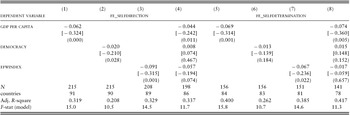
Table 2 shows results of WLS estimates of country-year group level effects of individualistic traits. The country-year averages (
 $\widehat {{Z_{jt}}})$
fe_selfdirection and fe_selfdetermination are calculated from the individual estimation equations (3) and (7) in Table 1. gdp per capita is the only variable that is statistically significant in all specifications. In contrast to expectations based on Wagner's Law, the coefficient is negative, indicating that we have a more positive view of government interventions in countries at lower levels of development. Effects are quite strong, as indicated by a standardized beta-coefficient around −0.3.
Country-level determinants of government intervention attitudes

Pooled WLS with standard errors clustered at country level. Standardized (beta)-coefficients in brackets. Cluster-robust P-values in parentheses, reported below beta-coefficients. All estimates include time period dummies.
democracy shows a negative sign, meaning that higher levels of political freedom are associated with a less positive view of government interventions. The effect is substantially weaker than for gdp per capita and significant in only one specification.
The economic freedom measure efwindex also has a negative sign, which implies that economic freedom is associated with a reduced demand for government intervention. The effects are significant at a 5%-level when we do not control for the two other variables, but it turns insignificant when gdp per capita and democracy are included.
5. Conclusions
Several culture-based explanations of successful development claim that individualistic values provide a more favorable background for promoting the wealth of nations, and are conducive to the establishment of ‘good’ institutions and policies in line with rule of law and economic freedom. A potential channel through which these values may influence formal settings is a pre-disposition to a market-friendly mind-set. In the present paper, we investigate the relationship of values associated with individualism and personal attitudes toward government intervention. In particular, we consider ideas of autonomous and independent decision-making (self-direction values), and a belief in the relevance of own efforts and control for personal success (self-determination values) as interrelated but conceptually separable facets of individualistic values.
Results indicate that all individualistic traits are associated negatively with government intervention attitudes. The effects of self-direction values on intervention preferences are nevertheless weaker than the effects of self-determination. This might be due to the fact that self-determination values are more directly linked to personal economic interests that can be affected by government intervention. For example, high taxes that deprive the individual of enjoying the benefits of an elevated income generated by effort would be perceived to be especially unfair if this individual believes in hard work as a driver of personal success. Likewise, interventions are perceived as particularly negative by those who have a strong belief in self-determination, as economic regulation will ultimately shift control from the individual in the hands of government. In turn, self-direction values probably have more of a bearing on the political sphere, where they are likely to be more strongly associated with the defense of free speech and other negative rights, rather than being related to non-interventionist values of government in the economy. Effects of self-direction on intervention preferences are mitigated through higher confidence in state actors and lower confidence in major companies, while that is not the case for self-determination values.
Some caveats must be kept in mind when interpreting the results of our exercise, however. First, although there are good reasons to assume that the causal relationship goes from fundamental values to attitudes, it cannot completely be excluded that the link between the two is affected by endogeneity. Here, a major problem of all such investigations is that deeper (i.e. biological) personality aspects could very well be the ultimate drivers of values and attitudes, but these cannot easily be quantified (Haidt, Reference Haidt2012). For the time being, the present study shows the strong clustering of individualistic values and government intervention attitudes at the individual level. Second, our results do not imply that individualistic values are ‘superior’ in that they automatically cause ‘better’ institutional quality. Put into perspective, the relationship between informal and formal institutions is a much-too-complex phenomenon, so as to be reduced to a simple bilateral relationship, or to interpret cultural values as a toolkit for producing superior economic outcomes (Lavoie and Chamlee-Wright, Reference Lavoie and Chamlee-Wright2000; Storr, Reference Storr2013). Our exercise also does not aim to predict a certain institutional configuration. Nonetheless, according to our results, by framing the search process for improvements, individualistic values may be an important element of cultural preconditions that allow formal institutions conducive to markets to be built easier, and with lower reform costs to society.
Acknowledgements
We are grateful for valuable comments by two anonymous referees, and input on previous versions presented at the Research Institute of Industrial Economics (IFN) workshop on Culture, Institutions and Development, June 2015, Vaxholm/SWE, the Annual Meeting of the European Association of Law and Economics, September 2015, Vienna/AUT, and the Tuborg Research Centre Seminar at Aarhus University/DNK, December 2015.
Appendix
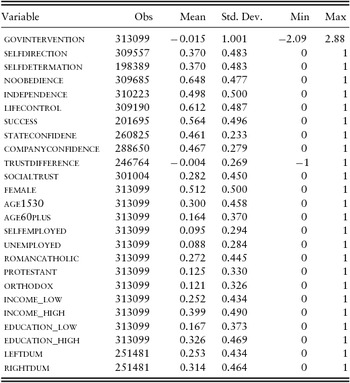
Summary statistics (individual level)