

1. INTRODUCTION
This paper will look at negation in Finnish dialects from a typological perspective. Focus will be on standard negation, i.e. the negation of declarative main clauses with a verbal predicate. The data will be mainly drawn from Savijärvi's (Reference Savijärvi1977a) work on the dialectal variation Finnish shows in its negative construction. In recent years, the relationship between typology and dialectology, two mutually independent subdisciplines of linguistics, has received a fair amount of attention. The contributions in Kortmann (Reference Kortmann2004) and also some authors in Nevalainen, Klemola & Laitinen (Reference Nevalainen, Klemola and Laitinen2006) address the points of contact between these disciplines and how bringing them closer together could benefit each of them.
Typology can be charactierized as world-wide comparative linguistics or the systematic study of cross-linguistic variation. Dialectology, on the other hand, typically looks at variation within a language or, in other words, studies variation between non-standard linguistic varieties that can be, according to given criteria, considered as dialects of one and the same language. As has been made clear in the many contributors to Kortmann (Reference Kortmann2004), dialectologists and typologists can learn from each other in many ways. To take some examples at a general level, typologists should make sure that their language samples are not biased towards standardized varieties in areas such as Europe, and dialectology could help in providing data on non-standard varieties. Dialectology can also provide typologists with a better understanding of the micro-level areal spread of linguistic features. Work in typology, on the other hand, enables dialectologists to see the micro variation in the broader context of cross-linguistic variation, which, in turn, helps them to see the theoretical significance of the observed phenomena, and functional principles emerging from typological work may provide tools for understanding the nature of the variation. I will not engage in a longer discussion of the potential ways in which typologists and dialectologists might benefit each other's work, but I will take up some issues pertaining to the present topic in the discussion section of this paper.
The paper is structured as follows. Section 2 provides an overview of the relevant aspects of the typology of negation and looks at developmental trends in Uralic languages, and serves as a background for the examination of negation in Finnish dialects in Section 3. Section 4 discusses issues at the interface of typology and dialectology arising from the treatment of negation in Finnish dialects, and concludes the paper.
2. STANDARD NEGATION: TYPOLOGY, FINNISH AND URALIC LANGUAGES
Typological work on negation has mainly concentrated on standard negation, but some other aspects of negation have also been addressed, most notably the negation of imperatives, the negation of existentials and non-verbal sentences, as well as negative indefinite pronouns (for an overview, see Miestamo Reference Miestamo2007). In this paper I will focus on standard negation. The term standard negation refers to the basic ways that languages have for negating declarative verbal main clauses. A more precise definition to identify standard negation cross-linguistically is given in Miestamo (Reference Miestamo2005:42):
A [standard negation] construction is a construction whose function is to modify a verbal declarative main clause expressing a proposition p in such a way that the modified clause expresses the proposition with the opposite truth value to p, i.e. ~p, or the proposition used as the closest equivalent to ~p in case the clause expressing ~p cannot be formed in the language, and that is (one of) the productive and general means the language has for performing this function.
Standard negation can be seen as a comparative concept in the sense of Haspelmath (Reference Haspelmath2010). Note that identifying correspondences between affirmatives and negatives is not straightforward in all languages, which is taken into account in formulating the definition of the comparative concept.
Typological work on standard negation has paid attention to the type and position of negative markers, as well as to the structural differences between negatives and affirmatives beyond the presence of negative markers. Dahl (Reference Dahl1979) and Payne (Reference Payne and Shopen1985) have identified three main types of negative markers: negative particles, negative affixes and negative (auxiliary) verbs. Dryer (Reference Dryer, Hammond, Moravcsik and Wirth1988, Reference Dryer1992) has observed that negative particles tend to precede the verb but that the placement of negative auxiliaries tends to correlate with basic word order: preverbal in VO languages and postverbal in OV languages.
In Miestamo (Reference Miestamo2005), I looked at the structure of negatives more holistically and paid attention to structural differences between negatives and affirmatives in addition to the presence of negative markers, proposing a basic distinction between symmetric and asymmetric negation. Symmetry and asymmetry can be observed in constructions on the one hand and in paradigms on the other. In symmetric constructions, the only structural difference between negatives and their affirmative counterparts is the presence of the negative marker(s), whereas in asymmetric constructions, further structural differences are found. In symmetric paradigms, the correspondences between the members of the paradigms used in affirmatives and negatives are one-to-one, whereas in asymmetric paradigms they are not, and grammatical distinctions are often neutralized.
The Romanian examples in (1) exemplify both symmetric constructions and paradigms. The negatives differ from the corresponding affirmatives by the mere presence of the negative marker nu and every affirmative form has its own unique negative counterpart.
(1) Romanian (Indo-European, Romance; constructed examples)Footnote 1


Asymmetric constructions are found, e.g. in Diola-Fogny and Apalaí. In Diola Fogny, illustrated in (2), the negation of the future is expressed by a portmanteau marker combining the categories of future and negation. The marking of the future is thus different from its marking in the affirmative. In Apalaí, in (3), the negative marker is a deverbalizing suffix on the lexical verb, and the copula is added to carry the finite inflections.
(2) Diola-Fogny (Niger-Congo, Northern Atlantic; Sapir Reference Sapir1965:33)
(3) Apalaí (Cariban; Koehn & Koehn Reference Koehn, Koehn, Derbyshire and Pullum1986:64)
In both Diola-Fogny and Apalaí, the negative construction is not a simple matter of adding a negative marker to an otherwise identical clause. The negatives differ from the affirmatives in ways other than by the mere addition of negative markers and the constructions are thus asymmetric.
Asymmetric paradigms are found in, for example, Maung, illustrated in (4) below, and in Burmese, in (5). In Maung the affirmative paradigm makes a distinction between realis and irrealis, but the negative has to use the irrealis verb form (the negative construction is symmetric since the negative marker is simply added before the irrealis verb form). The distinction between the realis and the irrealis is therefore lost in the negative. In Burmese, the affirmative can make a distinction between the actual, potential and perfect, but the suffixal negative marker replaces these markers and the distinctions are lost in the negative.
(4) Maung (Australian, Iwaidjan; Capell & Hinch Reference Capell and Hinch1970:67)
(5) Burmese (Sino-Tibetan, Burmese-Lolo; Cornyn Reference Cornyn1944:12–13)
In both cases, the correspondences between the members of the affirmative and negative paradigms are not one-to-one and the paradigms are therefore asymmetric. In Miestamo (Reference Miestamo2005), I found asymmetry in the construction in 46% of the sample languages and asymmetry in the paradigm in 30%, while 40% did not show asymmetry at all.Footnote 2
Asymmetric negation can be divided into subtypes according to the nature of the asymmetry (the percentages indicate how many of the sample languages exhibit each type of asymmetry): subtype A/Fin, in which the lexical verb loses its finiteness in the negative (25%, e.g. Apalaí), A/NonReal, in which the negative differs from the corresponding affirmative in that it is marked for a category that denotes non-realized states of affairs (13%, e.g. Maung), A/Emph, in which the negative differs from the corresponding affirmative in that it is marked for a category that expresses emphasis in non-negatives (2%, thus marginal and not exemplified here), and A/Cat, in which the marking of grammatical categories differs between affirmatives and negatives in other ways (33%, e.g. Diola Fogny and Burmese) – in this subtype, grammatical distinctions are often neutralized (as in Burmese). In Finnish, standard negation shows A/Fin asymmetry, and the remainder of this section will focus on that subtype.
In Standard Finnish, illustrated in (6), standard negation is expressed by a construction in which the negative auxiliary verb acts as the finite element of the clause, carrying person-number inflection, and the lexical verb loses its finiteness. Note that the impersonal passive form can be taken to be part of the person-marking paradigm and it is therefore included in the examples in (6). The present, past, conditional and imperative paradigms serve to illustrate the main aspects of the negative construction.
(6) Standard Finnish (constructed examples)
The negative auxiliary is e- in all other tense-aspect-mood (TAM) categories except the imperative in which it is äl-. In the present paradigm (6a), the lexical verb is in the connegative form, which consists of the verb stem without person-number inflection and involves the doubling of the initial consonant of the following word or, if the following word starts with a vowel, an optional glottal stop at the word boundary. In the past paradigm (6b), the non-finite form of the lexical verb is the past participle form, which thus marks past tense in the negative and is itself also marked for number. The conditional paradigm (6c) shows that mood is also marked on the lexical verb, which is in the connegative form of the conditional. Finally, in the imperative paradigm (6d), the lexical verb is in the imperative connegative form, except in the 2nd singular, in which the simple connegative form is used. The negative construction is asymmetric since the structure of the negative differs from the affirmative in ways other than the mere addition of a negative marker.Footnote 3 The paradigm is symmetric since every affirmative form has its unique negative counterpart.Footnote 4 The negative auxiliary construction of the Standard Finnish type is generally found in Finnish dialects, but the dialects also exhibit some interesting variation to this construction. Before going into the dialectal variation, I will briefly address cross-linguistic variation in negative verb constructions.
Negative verb constructions belong to subtype A/Fin of asymmetric negation. A preliminary characterization of the subtype was given above, but a more detailed definition is needed. In subtype A/Fin, the negative differs from the corresponding affirmative in that the lexical verb loses its finiteness, partly or totally, in one or more of the following ways: it becomes syntactically dependent on a finite element added in the negative, it is in a form primarily used as a syntactically dependent verb in the language, or it has nominal characteristics. Furthermore, a new finite element (copula, auxiliary verb) is added in most cases.
Subtype A/Fin can be divided into further subtypes. On the one hand, there are constructions in which the negative marker is the finite element added in the negative clause, i.e. it is a negative verb. On the other hand, there are constructions in which the negative marker is not the finite element of the negative clause, a non-negative finite element is usually added in the negative, and the negative marker is attached either to the lexical verb (as in Apalaí) or to the added non-negative finite element. Since the Finnish construction is a negative verb construction, I will focus on negative verb constructions (labeled as subtype A/Fin/NegVerb in the typology), and I will not pay further attention to the other subtypes of A/Fin here.
In Miestamo (Reference Miestamo2005), I found negative verb constructions in 9% of the languages, most commonly in northern Eurasia and North America (more specifically in northwestern USA and southewestern Canada, as well as southern Mexico); they are also found in many Oceanic languages. The negative construction in Evenki, illustrated in (7), features the negative verb e- as the finite element of the negative clause, and the lexical verb is in a participial form. In Tongan, in (8), the negative verb is not an auxiliary but a higher-clause verb taking the clause expressing the negated content as its clausal complement.
(7) Evenki (Tungus; Nedyalkov Reference Nedyalkov, Kahrel and van den Berg1994:2)
(8) Tongan (Austronesian, Oceanic; Churchward Reference Churchward1953:56)
The distinction between negative auxiliaries and higher negative verbs is a salient division within the negative verb type. Since the negative verbs in Finnish are auxiliaries, higher negative verbs will not be treated in more detail here. Another point of variation that we may pay attention to is how the different verbal categories are distributed between the negative verb and the lexical verb. In the Standard Finnish negative construction, illustrated by the examples in (6), the negative verb carries person and number marking but all other verbal categories are marked on the lexical verb. Evenki shows a rather different picture, with almost all inflections carried by the negative auxiliary.
Finnish is not the only language in the Uralic family to exhibit a negative verb construction. The original negative construction reconstructed for Proto-Uralic is a negative verb construction in which inflectional categories appear on the negative auxiliary and the lexical verb is in the uninflected connegative form. This pattern is still found in some Uralic languages, e.g. in Nenets, the examples in (9) illustrating the marking of person and tense on the auxiliary.
(9) Nenets (Uralic, Samoyed; Hajdú Reference Hajdú and Sinor1988:19)
The negative construction has developed in different ways in different Uralic languages, and the distribution of inflectional categories on the auxiliary vs. the lexical verb varies from one Uralic language to another. In some of them, e.g. Estonian, as in (10), the negative auxiliary has lost all inflectional marking.
(10) Estonian (Uralic, Finnic; Kasik Reference Kasik1994:41–42)
In Estonian, despite the invariant form of the negative word, the lexical verb is still in a non-finite form. It is thus clear that we are dealing with A/Fin asymmetry, and since the negative word has the effect of requiring a non-finite form of the lexical verb, it can be seen as the finite element of the negative clause, i.e. a negative auxiliary verb. In Mansi, in (11), the negative marker has lost its auxiliary status, and has been reanalysed as a negative particle and, at the same time, the lexical verb has become fully inflected, just as in affirmatives. The negative construction is now symmetric.
(11) Mansi (Uralic, Ugric; Kálmán Reference Kálmán1965:45, 53)
There is a drift in the Uralic language family from an original negative auxiliary construction with all categories marked on the auxiliary towards a non-inflected negative auxiliary, and ultimately to a symmetric construction with a negative particle (see also Tauli Reference Tauli1966; Honti Reference Honti1997a, Reference Hontib, Reference Hontic). A similar drift leading from a negative verb construction to a particle construction can be observed in Yuman languages (southwestern USA and northwestern Mexico). Many Yuman languages still have a negative verb construction, but, in Maricopa (Hokan, Yuman), for example, the negative verb has become a suffix on the lexical verb and the construction has become symmetric (see Gordon Reference Gordon1986:154–156).
Comrie (Reference Comrie and Ikola1981:354) proposes a hierarchy regulating the appearance of verbal categories on the negative auxiliary vs. the lexical verb:
Comrie's hierarchy
imperative < {tense / person / number} < mood < aspect < voice
According to the hierarchy, the imperative is the most likely of inflectional categories to be marked on the negative auxiliary, and voice is the least likely one to be marked on the auxiliary, and vice versa for the lexical verb. If a category is marked on the negative auxiliary in a language, the categories to the left of it are also marked on the auxiliary. The Uralic drift from a fully inflected negative auxiliary to a non-inflected auxiliary follows the hierarchy.
Comrie's hierarchy is based on a survey of negative verb constructions in Uralic languages. In Miestamo (Reference Miestamo2004), I showed that the hierarchy is valid for other language families as well, and not only for negative verb constructions, but also for the distribution of inflectional categories between the finite element and the lexical verb in other subtypes of A/Fin. In fact, apart from the special treatment of the imperative, it is in accordance with similar hierarchies concerning the distribution of categories between auxiliary/superordinate and lexical/subordinate verbs more generally than just in negative constructions (e.g. Noonan Reference Noonan and Shopen1985; Cristofaro Reference Cristofaro2003). Much more could be said about the typology of standard negation in general and about negative verb constructions in particular, but this brief overview should suffice as a background for the treatment of Finnish dialects that we now turn to.
3. STANDARD NEGATION IN FINNISH DIALECTS
This section will look at standard negation in Finnish dialects against the typological background set in the preceding section. Savijärvi (Reference Savijärvi1977a) has done thorough work on negation in Finnish dialects. The work is based on a comprehensive survey of the dialect materials available in archives, theses and publications.Footnote 5 His analysis and organization of the data provides an excellent basis for a typologically-oriented treatment of the topic.
In typological studies looking at the cross-linguistic variation in the encoding of a functional domain, the identification of the domain in each language is primarily based on function. In a typological study of negation, for example, one is looking for constructions the function of which is to express negation; recall the definition of standard negation given in Section 2 above. The same approach could naturally be adopted in a dialect study, looking at all constructions expressing standard negation in Finnish dialects. In this paper, however, focus is on one construction type – the negative verb construction – even if other construction types expressing standard negation might be found in Finnish dialects. Unlike in general typological studies, such an approach is possible and justified in a study focusing on related languages or dialects (see also Bisang Reference Bisang2004:19–20). In the present case, the focus is also dictated directly by Savijärvi's (Reference Savijärvi1977a) focus on the negative verb construction.
Savijärvi pays primary attention to the marking of inflectional categories on the auxiliary and the lexical verb. Furthermore, he also classifies his data according to the order of the subject and the auxiliary, as well as the presence vs. absence of an overt subject (full NP or pronoun). In what follows I will not pay attention to word order, but it may be noted that the order of the auxiliary and the lexical verb shows practically no variation in Finnish: the auxiliary precedes the lexical verb except in very rare cases that play no role in Savijärvi's material. Since Finnish is a VO language, the order of the negative auxiliary and the lexical verb conforms to the word order generalization mentioned in Section 2 above. Note also that Savijärvi only discusses cases in which the general form of the negative auxiliary, i.e. the e- form, is used, but leaves imperative negation with the äl- form outside his study. Furthermore, his focus is on indicative mood and no systematic observations are made on mood marking. These choices are also reflected in the focus of this paper.
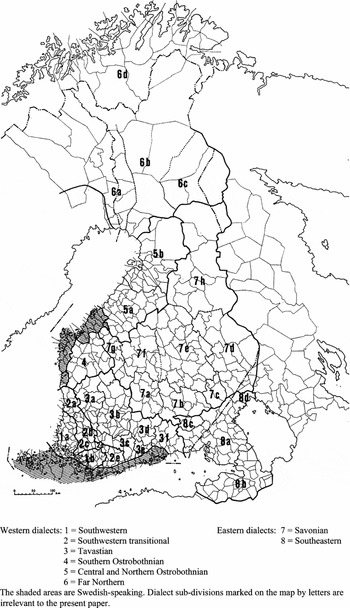
Opinions on the classification of Finnish dialects differ to some extent among researchers. Following Savijärvi (Reference Savijärvi1977a:48–49), this paper adopts the division of Finnish dialects into two main dialect groups: Western and Eastern. The Western dialect group may be further divided into Southwestern, Southwestern transitional, Tavastian, Southern Ostrobothnian, Central and Northern Ostrobothnian, and Far Northern dialects. The Eastern group is further divided into Savonian and Southeastern dialects. The dialectal divisions are shown on the map in Figure 1. Standard Finnish is not, as such, based on the speech of any specific dialect group, but incorporates elements from various dialects.
Finnish dialect map (from Savijärvi Reference Savijärvi1977a:48).

The pattern familiar from Standard Finnish in (6) above, whereby the negative auxiliary carries the marking of person and number and the lexical verb is responsible for the other categories, is generally found in dialects. A few examples from different dialects are given in (12).Footnote 6
(12) Finnish, various dialects (Savijärvi Reference Savijärvi1977a)
However, to make things more interesting, Finnish dialects also show a fair amount of variation in their negative auxiliary constructions. I will now go through the types of variation giving examples of each. Attention is paid, on the one hand, to how the dialectal forms differ from the standard Finnish negative verb constructions exemplified above and, on the other hand, following the principles of the above typological classification, to how they differ from what would be the affirmative counterparts of the negatives in the dialects. The affirmative counterparts are, naturally, not available in the authentic materials from which the examples are drawn, and cannot therefore be given in the examples. It can, however, be noted that in general finite/lexical verbs in affirmatives distinguish three persons and two numbers; if the affirmatives corresponding to the negatives in the dialects discussed deviate from this standard pattern, this will be commented on in the text where relevant.
Firstly, it is quite common in many dialects to find a non-inflected negative verb. Examples from various dialects are given in (13).
(13) Finnish, various dialects (Savijärvi Reference Savijärvi1977a)
As can be seen in these examples, the negative auxiliary is in its unmarked form, identical to the 3rd person singular form, irrespective of the person and number of the subject. Typologically speaking, despite the fact that the negative auxiliary is not inflected, these examples still show A/Fin asymmetry, since the lexical verb is in a non-finite form and syntactically dependent on the negative marker. As the negative word is syntactically the finite element of the clause, acting as the head for the dependent lexical verb, it may be analysed as an auxiliary rather than a particle. In terms of Comrie's (Reference Comrie and Ikola1981) hierarchy, another category has been lost on the negative auxiliary (person-number) but none gained on the lexical verb.
This variant of the negative construction is parallel to the Estonian pattern in (10) above. An interesting point of typological comparison outside the Uralic family is found in Maasai, in (14), where past tense negatives use the invariant negative auxiliary eitu and the lexical verb loses the marking of tense, thereby becoming less finite.
(14) Maasai (Nilo-Saharan, Nilotic; Mol Reference Mol1995:60, 70)
Historically, the Maasai past negative marker consists of the 3rd person singular prefix and the negative auxiliary, but synchronically it is a frozen form.
Returning to Finnish, the extent of the use of the non-inflected (3rd singular) form in 1st and 2nd person is the largest in the easternmost Southwestern dialects, in the wedge of Savonian dialects separating Southern and Central Ostrobothnian dialects, in the transitional dialects between eastern Savonian and Southeastern dialects, and in the (now extinct) Savonian dialect of the Finnish population in Värmland in west central Sweden (a Finnish dialect spoken by settlers of Savonian origin in the middle of otherwise Swedish speaking territory) (see Savijärvi Reference Savijärvi1977a:183f.). In these dialects, the non-inflected form can be used in all persons, but its frequency of use varies – only in the (now extinct) Värmland dialect did it become the dominant pattern, it occurs quite often in the Southwestern and Ostrobothnian dialects mentioned, but its use is much rarer in the transitional dialects in the east. In dialects adjacent to these, the distribution of the non-inflected negative auxiliary is restricted to some person-number combinations. In a large part of Finnish dialects the use of the non-inflected auxiliary in 1st and 2nd person is sporadic or non-existant. Note that the question does not arise in the 3rd person singular, which uses the unmarked form anyway, and that in the 3rd person plural, the unmarked form may be analysed either as being completely uninflected or as showing only person but not number marking. In the 3rd plural, its use is very common in all dialects, and especially in Southwestern, Southwestern transitional, Far Northern, and in the Southeastern dialect of the Kannas area (Savijärvi Reference Savijärvi1977a:180). Note also that the use of a 3rd singular verb form for 3rd plural is not specific to negation, but happens commonly in affirmatives as well. According to Savijärvi (Reference Savijärvi1977a:191–192), a non-inflected negative auxiliary is more common when followed rather than preceded by the subject; an overt subject is necessary with these non-inflected auxiliary forms.
The negative auxiliary may be unmarked for number, but still show person marking, as in (15). This type is widespread in Southwestern dialects and also attested in the Southeastern dialects of Ingria. The paradigm of the negative verb in (16) is typical of Southwestern dialects (the paradigm is given with the subject pronoun following the negative verb).
(15) Finnish, Southwestern (Savijärvi Reference Savijärvi1977a:59)
(16) Finnish, Southwestern (Savijärvi Reference Savijärvi1977a:70)
According to Savijärvi (Reference Savijärvi1977a:59, 61, 70), the loss of number marking in the 1st and 2nd persons is due to regular sound changes, and since the use of 3rd singular instead of 3rd plural is a common development in Finnish dialects in general, the paradigm has ended up looking like (16). The presence of the subject pronoun naturally becomes more important in expressing the identity of the subject when the negative verb is not marked for number. Savijärvi (Reference Savijärvi1977a:182) notes that these forms get a singular reading when no overt subject is present.
Yet another point of variation concerns the form of the lexical verb in past tense negatives: the participle form is often unmarked for number, i.e. a singular participle is used even with plural subjects, see examples in (17).
(17) Finnish, various dialects (Savijärvi Reference Savijärvi1977a)
According to Savijärvi (Reference Savijärvi1977a:193–194), non-agreeing participles are very common in Finnish dialects. In 1st and 2nd person plural examples in the materials examined by Savijärvi, the dialects of Southern and Central Ostrobothnia show only singular participles. Plural participles have been best preserved in the dialects of northern Finland and eastern border areas. To some extent, the number marking on the participle is dependent on the marking of number elsewhere in the construction (on the auxiliary and the subject NP), but there is no hard and fast correlation between these. It should also be noted that the loss of number marking on the participle does not concern only negative constructions but is common in other, non-negative, verbal constructions using participles, e.g. perfects and pluperfects.
All the dialectal variants of the negative construction seen so far can be analysed as A/Fin negative verb constructions, albeit with somewhat different distributions of inflectional categories on the negative auxiliary and the lexical verb, in accordance with Comrie's hierarchy (see Section 2). We have seen that the variants have all involved reductions in the marking of either person or number on the negative auxiliary or of number on the participle in past tense forms. However, in the Savonian dialect of Värmland, some examples are also found where the loss of marking on the auxiliary is compensated by a fully inflected lexical verb (18).
(18) Finnish, Savonian dialect of Värmland Forest Finns (Savijärvi Reference Savijärvi1977a:153)
As the negator is no longer inflected, and the lexical verb is in a finite form – thus no longer syntactically dependent on the negator – the negator cannot be analysed as a verb, but instead as a negative particle. The only structural difference between the negative and its affirmative counterpart is now the presence of the negative marker ei. In these examples, we are therefore dealing with a symmetric negative construction formed with a negative particle, in the same way as in the Mansi example (11) above.
In some Tavastian dialects a construction is found in the 3rd person plural with an uninflected negative auxiliary and the lexical verb bearing the 3rd plural person-number ending (19).
(19) Finnish, Tavastian (Savijärvi Reference Savijärvi1977a:96–97)
Looking at (19b), we can see that the negative differs from the affirmative by the mere presence of the negative marker. However, lexical verbs that involve morphophonological changes like consonant gradation reveal that the person-number ending is added to the connegative form rather than to the inflectional verb stem as such. Thus, in (19c), the verb stem has the weak-grade r rather than the strong-grade t that would appear in the 3rd person form taitavat and the construction seems to be a contamination of the 3rd person negative ei taira and the 3rd plural taitavat (see Savijärvi Reference Savijärvi1977a:95–100 for discussion). This is an unusual variant in the Finnish negation system, but judging from the form of the lexical verb, it still seems to involve A/Fin asymmetry, and can thus be analysed as a negative verb construction, not as a case of symmetric negation.
Further examples that resemble symmetric negation are found in Southwestern dialects in the passive present tense forms, illustrated in (20).
(20) Finnish, Southwestern (Savijärvi Reference Savijärvi1977a:64)
This form is due to the effect of sound changes that have caused the passive present and passive connegative to merge. The apparent symmetry concerns only an isolated item in a paradigm the other members of which are clearly A/Fin negative verb constructions.Footnote 7 Therefore, we can hardly draw the conclusion that this would be a genuine case of symmetric negation with a negative particle (recall the case of the 3rd singular conditional in the Standard Finnish paradigm in (6c) above).
In Southwestern dialects, according to Savijärvi (Reference Savijärvi1977a:64), it may happen that in the passive when both the connegative and the active past participle of the verb ‘be’ get apocopated (or shortened) to ol, the distinction between these forms is lost. Consequently the perfect and the pluperfect that both use this verb as auxiliary are no longer distinguished. The example in (21) illustrates.
(21) Finnish, Southwestern (Savijärvi Reference Savijärvi1977a:64)
The apocopated past participle form of the verb ‘be’ oll is homophonous with its apocopated connegative form ol in this dialect and this sentence could thus also get a perfect reading; cf. Standard Finnish: pass.perfon sanottu ‘has been said’ – pass.pluperfoli sanottu ‘had been said’ vs. pass.perf.negei ole sanottu ‘has not been said’ – pass.pluperf.negei ollut sanottu ‘had not been said’. Apocope does not affect the distinction between the perfect and the pluperfect in the affirmative. This is the only point in the dialect material where paradigmatic asymmetry is found, and it is a straightforward result of phonological processes. It should, however, be emphasized that the paradigmatic asymmetry is a marginal phenomenon in these dialects and speakers can use fuller forms to disambiguate.
Savijärvi (Reference Savijärvi1977b, Reference Savijärvi and Leskinen1981) has also paid attention to the occasional ellipsis of the negative auxiliary in negatives in the dialectal material. Sometimes the negative auxiliary is absent. If it is absent, the asymmetry in the form of the lexical verb and possible negative polarity items present in the clause convey the meaning of negation. Kotilainen (Reference Kotilainen2007) shows how these dialectal cases of ellipsis have given rise to a colloquial construction expressing emphatic negation without an overt negator. In this context I will only note that (non-elliptical) negative constructions without overt negators are typologically extremely rare, see Miestamo (Reference Miestamo, Wohlgemuth and Cysouw2010) for more discussion.
The main types of dialectal variation in the Finnish negative verb construction have now been illustrated. These were: negative auxiliary and lexical verb inflected as in the standard language, non-inflected auxiliary, participle not marked for number in past negatives, and the Southwestern paradigm in which the negative auxiliary marks person but not number. In addition examples of symmetric negation were found in the Värmland dialect, as well as a marginal case of paradigmatic asymmetry in the Southwest. In the following section, this variation will be discussed in a broader typological-functional context.
4. DISCUSSION AND CONCLUSION
In this section, some interesting aspects of the dialectal variation in Finnish negation will be discussed in a broader context. I will start by going back to the drift observed in the Uralic language family from a fully inflected negative auxiliary towards a non-inflected one and ultimately to symmetric negation (see Section 2 above). It has been observed that some dialects of Finnish have taken this development further than others, i.e. they have reduced or lost person-number marking on the negative auxiliary. Non-inflected forms were also present in early literary Finnish (16th and early 17th centuries). Early literary Finnish is based on Southwestern dialects (see Savijärvi Reference Savijärvi1977a:267f.), which show non-inflected auxiliaries. The non-inflected forms of the auxiliary have been replaced by the fully inflected forms in the course of the development of the standard language. It may be speculated that the drift towards non-inflected auxiliaries might have been able to progress further in spoken forms of Finnish without the effect of standardization slowing it down and stopping it.
The areal spread of non-inflected negative auxiliaries was briefly described above as culminating in the Southwestern dialects, in the Savonian dialects between Southern and Central Ostrobothnia, and in the Värmland Savonian dialects. It is notable that these are areas of high contact with Swedish. Swedish expresses standard negation with a negative particle in a symmetric negative construction and Swedish influence is an obvious candidate for an explanation of the non-inflected forms. In the case of the Värmland dialect, in which the non-inflected auxiliary became the dominant pattern and even symmetric negatives with fully inflected lexical verbs were found, heavy contact with Swedish, possibly accompanied by effects of language attrition, seems a plausible explanation indeed. For the other cases, as discussed by Savijärvi (Reference Savijärvi1977a:188f.), it is more difficult to show that language contact could have been the main cause of the change, and developmental tendencies intrinsic to these dialects must also be taken into account. In any case, contact with Swedish has certainly supported and strengthened the development. Whatever the weight of the different factors at different stages of the development, this can be seen as part of the Uralic drift from fully inflected negative auxiliaries towards non-inflected negative words. Regular sound changes that are blind to the direction of the structural development may act as carriers of such a drift. In this case, the gradual change whereby fewer and fewer categories are marked on the negative auxiliary does not lead to a change in the basic type of the construction. Only when reanalysis of the negative auxiliary as a negative particle has happened and the lexical verb has simultaneously become fully inflected, has the construction shifted into the symmetric type.
Any asymmetry means more structural complexity vis-à-vis the symmetric type in which negative markers are simply added to the corresponding affirmative (see Miestamo Reference Miestamo, Suominen, Arppe, Airola, Heinämäki, Miestamo, Määttä, Niemi, Pitkänen and Sinnemäki2006 for discussion). The shift into the symmetric type in the Värmland dialect can also be seen as a process of simplification.Footnote 8 Given that this development has not been attested in any other dialect of Finnish, it seems legitimate to attribute it not only to heavy contact with Swedish – a language with symmetric negation – but also to language attrition among the Värmland forest Finns; Värmland Finnish was a vanishing language when the data were gathered and the last speakers died in the 1960s (Andersson & Kangassalo Reference Andersson, Kangassalo, Jönsson-Korhola and Lindgren2003:62–63).
In Miestamo (Reference Miestamo2005), I proposed functional motivations for the existence of symmetric and asymmetric negation in terms of the notions of language-internal and language-external analogy (see Itkonen Reference Itkonen2005). Symmetric negatives copy the structure of the corresponding affirmatives and are thus language-internally analogous to these; language-internal analogy is driven by pressure for cohesion in the system. Asymmetric negatives reflect, by language-external analogy, aspects of the functional-level asymmetry between affirmatives and negatives. These functional-level differences include the different discourse context of negatives vs. affirmatives and the more stative nature of the states of affairs reported by negative statements. A/Fin structures reflect the stativity of negation in their structure; this is clearer in cases in which the finite element added in the negative is a stative copula, but in negative verb constructions, too, stativity can be shown to have played a role since they can usually be traced back to a negative copular construction (see Honti Reference Honti1997c for Uralic and Miestamo Reference Miestamo2005:221–222 for more discussion). Language-internal analogy is doing its work in the drift leading towards symmetric negation.
A concern is sometimes raised about how representative the variants described in the grammars consulted by typologists are. Descriptive grammars can only address a small portion of the dialectal and social variation in a language if at all, and hence the picture that a typologist consulting these grammars gets is incomplete. Even worse, grammars dealing with standard written languages may not only miss the variation, but also describe a language variety that is an artificial construct and does not reflect the natural tendencies of that particular language or in language in general. Many authors have emphasized the importance of taking dialectal data into account to remedy the situation. Seiler (Reference Seiler2004:368–369), for one, sees the benefits of dialectology for typology in that dialectology provides typologists with more grammars to compare and with grammars of non-standardized varieties, and adds a third aspect, namely that dialectology covers the whole continuum of areal variation and thus equips typologists with more comprehensive data to tackle areal patterns. Returning to negation in Finnish dialects, we have seen that the dialectal data does indeed give a richer picture of how negation works in Finnish. Furthermore, we find interesting areal patterns, with simplification of the morphology of the negative verb in high-contact areas, and signs of a development of a completely different negation type – symmetric negation – in a dialect isolated from other Finnish dialects and surrounded by Scandinavian languages with symmetric negation.
One particular point in which dialect studies could help typologists working on negation to complement their data is the ellipsis of negators briefly mentioned above: descriptive grammars do not necessarily pay attention to such phenomena, and detailed dialect studies could benefit typologists in giving them material that would be hard to find in standard grammars.
How well a language variety described in a grammar – a doculect – represents the real linguistic variety of a given language is, however, not necessarily a problem from the point of view of typological sampling. Different typological studies have different aims and research questions, and different types of samples are used for different purposes. A study that aims at a general picture of the world-wide cross-linguistic variety in a structural feature uses a sample with a balanced representation of languages from different families and geographical areas. Adequate sampling methods should guarantee that the big picture is correct, although micro-variation gets obscured in the sampling process. By saying this I do not mean to undermine the importance of looking at dialectal variation in many other types of typological studies, let alone downplay the danger of standardized languages biasing the results of typological studies especially in their treatment Europe – a problem raised, e.g. by Fleischer (Reference Fleischer2004:236–237) and Himmelmann (Reference Himmelmann and Siemund2000:10–11).
I hope to have shown in this paper that, on the one hand, typology can offer new perspectives for understanding the nature of the negative verb construction in Finnish and the dialectal variation that it shows, and, on the other hand, that looking at dialectal variation gives a more complete picture of the typology of Finnish.
ACKNOWLEDGEMENTS
I am grateful to the audience at the Typology and Nordic Dialect Variation Workshop in Helsinki (June 2008) and the three anonymous referees for their comments, to Pål Eriksen and Camilla Wide for their editorial work, and to Ewa Jaworska for careful copy-editing. For financial support, I am grateful to the Academy of Finland and also to the Helsinki Collegium for Advanced Studies, where I worked at the time of writing this paper.