


Personal recovery has been defined as ‘a deeply personal, unique process of changing one's attitudes, values, feelings, goals, skills, and/or roles. It is a way of living a satisfying, hopeful, and contributing life even with limitations caused by illness’. Reference Anthony1 Supporting personal recovery has become a mental health policy goal in many countries. 2 Research in recent years has helped to further define recovery Reference Leamy, Slade, Le Boutillier, Williams and Bird3 and propose a conceptual framework of recovery-oriented practice. Reference Le Boutillier, Leamy, Bird, Davidson, Williams and Slade4 Measures are required to evaluate and assess how staff and services can support recovery, from the viewpoint of people who use these services. Outcome measures have been developed to assess personal recovery. Reference Shanks, Williams, Leamy, Bird, Le Boutillier and Slade5,Reference Sklar, Groessl, O'Connell, Davidson and Aarons6 Only one measure of recovery has been developed in England – the Questionnaire about the Process of Recovery (QPR). Reference Neil, Kilbride, Pitt, Nothard, Welford and Sellwood7 Initial psychometric evaluation of the QPR by its developers showed good internal consistency, construct validity and test–retest reliability. An exploratory factor analysis identified two factors that were labelled ‘intrapersonal’ and ‘interpersonal’. A subsequent re-evaluation of the QPR, conducted by its developers, found similar results and a 15-item one-factor solution. Reference Law, Neil, Dunn and Morrison8 The current study was undertaken to investigate whether these findings could be replicated in a different sample, and whether the original 22-item version or the 15-item version can be recommended. The aims were to independently evaluate the internal consistency, convergent validity, 2-week test–retest reliability, 3-month and 12-month sensitivity to change of both the 22- and 15-item versions of the QPR, and to explore the factor structure of both versions.
Method
Design
Data from two studies were used. Data-set 1 came from a psychometric evaluation study in South London, with data collected between March 2011 and May 2012. Data-set 2 is pooled baseline and 1-year follow-up data from a cluster randomised controlled trial of a pro-recovery intervention Reference Slade, Bird, Le Boutillier, Williams, McCrone and Leamy9 (trial registration: ISRCTN02507940), with data from each team (cluster) collected between April 2011 and December 2013. Ethical approval was obtained for both studies.
Participants
Participants were recruited from adult community mental health teams. Inclusion criteria were (a) aged between 18 and 65, (b) well enough to participate and able to complete measures in the view of staff, (c) able to give informed consent, and (d) able to speak and understand English well enough to complete the measures. Additional inclusion criteria for data-set 1 was any mental disorder and for data-set 2 was a diagnosis of psychosis.
Procedures
Participants were recruited via their care coordinator from community adult mental health teams in South London (data-sets 1 and 2) and Gloucestershire (data-set 2). All participants received payment of £10 for each round of data collection.
Data-set 1 comprised a convenience sample with care coordinators identifying people on their case-load who matched the inclusion criteria and who would be willing to participate. Willing participants were then contacted by a researcher who explained the study and answered any questions, before taking informed consent. Participants completed measures with a researcher at three time points: baseline, 2 weeks and 3 months. At baseline, participants completed a battery of measures including the QPR (22-item version), the Recovery Assessment Scale (RAS) Reference Corrigan, Giffort, Rashid, Leary and Okeke10 and the Warwick-Edinburgh Mental Well-being Scale (WEMWBS). Reference Tennant, Hiller, Fishwick, Platt, Joseph and Weich11 Two weeks later, they completed the QPR. Three months after baseline they completed the QPR and WEMWBS. If participants did not complete the measures at the 2-week point, they were still invited to complete the measures at the 3-month point.
For data-set 2, the case-load for each team was randomly ordered. Researchers then contacted the care coordinator of each randomised person in sequence until the required 15 participants per team were recruited. The recruitment procedure was as per data-set 1. Participants completed an extensive assessment battery including the QPR (22-item version) and WEMWBS at baseline. One year later participants completed the same assessment battery including the QPR and WEMWBS.
Measures
The original QPR is a 22-item, service user-rated measure of personal recovery developed in the UK. Reference Neil, Kilbride, Pitt, Nothard, Welford and Sellwood7 The measure was developed from a qualitative study led by service user–researchers. Each item is scored using a 5-point Likert scale ranging from 0 (disagree strongly) to 4 (agree strongly). The initial version comprised two subscales: QPR intrapersonal (17 items) (range 0–68) and QPR interpersonal (5 items) (range 0–20), with higher scores indicating increased recovery on both subscales. Adequate internal consistency (intrapersonal α = 0.94, interpersonal α = 0.77), construct validity and test–retest reliability (intrapersonal r = 0.87, interpersonal r = 0.76) were shown. A subsequent evaluation by the developers of the psychometric properties using a new data-set found a 15-item (range 0–60) one-factor solution called QPR total, which demonstrated adequate internal consistency (α = 0.93) and test–retest reliability using Pearson's correlation (r = 0.70). Reference Law, Neil, Dunn and Morrison8 In our study both data-sets were collected using the 22-item QPR, with the 15-item QPR total score being extrapolated. In this analysis we refer to the two subscales of the 22-item QPR as QPR intrapersonal and QPR interpersonal, and the 15-item QPR as QPR total.
The RAS is a 41-item service user-rated measure assessing five domains of recovery: personal confidence and hope, willingness to ask for help, goal and success orientation, reliance on others and no domination by symptoms. Reference Corrigan, Giffort, Rashid, Leary and Okeke10 Each item is scored on a 5-point Likert scale ranging from 1 (strongly disagree) to 5 (strongly agree) with the total score ranging from 41 (low recovery) to 205. Good internal consistency of α = 0.93 and test–retest reliability using Pearson's correlation of r = 0.88 have been demonstrated. Reference Corrigan, Giffort, Rashid, Leary and Okeke10
The WEMWBS is a 14-item self-report measure assessing well-being. Reference Tennant, Hiller, Fishwick, Platt, Joseph and Weich11 Respondents rate their experience regarding each statement over the past 2 weeks. Each item is scored using a 5-point Likert scale ranging from 1 (none of the time) to 5 (all of the time) with the total score ranging from 14 (low well-being) to 70. In the initial validation study, good content validity, internal consistency of α = 0.89, and test–retest reliability using intraclass correlation coefficients (ICC) of r = 0.83 were demonstrated. Reference Tennant, Hiller, Fishwick, Platt, Joseph and Weich11 The measure has also been validated with adolescent and minority ethnic groups. Reference Maheswaran, Weich, Powell and Stewart-Brown12
Analysis
Using data-set 1, convergent validity was assessed using Pearson's correlation between RAS and QPR intrapersonal, QPR interpersonal and QPR total at baseline. Test–retest reliability was assessed by exploring agreement at the individual level using two-way random effects ICCs between QPR intrapersonal, QPR interpersonal and QPR total at baseline and 2 weeks. Sensitivity to change was assessed using the correlation between QPR intrapersonal, QPR interpersonal and QPR total and WEMWBS change scores from baseline to 3-month follow-up.
Using data-set 2, internal consistency was assessed using Cronbach's alpha. Sensitivity to change was assessed using the association between QPR intrapersonal, QPR interpersonal and QPR total and WEMWBS change scores between baseline and 12-month follow-up. This was achieved by regressing each QPR scale change score onto the WEMWBS while accounting for clustering at the team level by using the ‘xtmixed’ command with maximum likelihood estimation in Stata version 11. Site and study arm were entered as covariates in the model to reflect the study design. Prior to conducting the regression analysis, change scores were standardised (mean 0, s.d. = 1) to obtain a standardised regression coefficient that is equivalent to a regression coefficient. All analyses were conducted on complete cases using Stata version 11.
Two separate confirmatory factor analyses (CAF) were conducted to assess the fit of baseline data (a) to QPR total (using the one-factor solution previously identified Reference Law, Neil, Dunn and Morrison8 ), and (b) to QPR interpersonal and QPR intrapersonal (using the 2-factor solution previously identified Reference Neil, Kilbride, Pitt, Nothard, Welford and Sellwood7 ). The CAF were conducted in Mplus 7.2 using the weighted least-squares mean variance (WLSMV) estimator, Reference Muthén and Muthén13 taking into account clustering at the team level and adjusting the model for National Health Service (NHS) trust as this captures the study design. A goodness of fit was assessed using several fit indices: χ2 (P>0.05), root mean square error of approximation (RMSEA<0.06), Tucker–Lewis Index (TLI>0.95) and comparative fit index (CFI>0.95).
Results
Participants
Demographics and QPR scores for both samples are shown in Table 1. The two samples did not differ in sociodemographic characteristics, other than data-set 1 had a higher number of participants from a Black ethnic background (χ2 (2) = 10.7, P= 0.005).
Baseline characteristics

| Data-set
1 (n = 88) |
Data-set
2 (n = 399) |
|
|---|---|---|
| Gender, a n (%) | ||
| Men | 62 (70.4) | 256 (64.2) |
| Women | 26 (29.6) | 142 (35.6) |
| Age, years: mean (s.d.) | 42.3 (10.5) | 43.8 (10.9) |
| Diagnosis, n (%) | ||
| Schizophrenia | 43 (48.9) | 234 (58.6) |
| Bipolar disorder | 21 (23.9) | 50 (12.5) |
| Schizoaffective disorder | 0 | 46 (11.5) |
| Depression | 2 (2.3) | 0 |
| Personality disorder | 2 (2.3) | 0 |
| Not known | 3 (3.4) | 0 |
| Other | 11 (12.5) | 69 (17.3) |
| More than one | 6 (6.8) | 0 |
| Ethnicity, b n (%) | ||
| White | 37 (42.0) | 228 (57.1) |
| Black | 40 (45.5) | 109 (27.3) |
| Other/mixed | 10 (11.3) | 59 (14.8) |
| Unemployed, n (%) | 63 (71.6) | 291 (73.1) |
| Single, n (%) | 63 (71.6) | 306 (76.7) |
| QPR, mean (s.d.) | ||
| Intrapersonal | 46.33 (9.6) | 48.83 (10.1) |
| Interpersonal | 13.73 (2.8) | 13.27 (2.6) |
| Total | 41.17 (8.6) | 38.72 (9.1) |
QPR, Questionnaire about the Process of Recovery.
a. For data-set 1, missing n = 1.
b. For data-set 1, missing n = 1; for data-set 2, missing n = 0.8.
Convergent validity
In data-set 1 (n = 76), the baseline RAS score was positively correlated with baseline QPR interpersonal (r = 0.46, 95% CI 0.26–0.67, P<0.001), QPR intrapersonal (r = 0.75, 95% CI 0.63–0.83, P<0.001) and QPR total (r = 0.73, 95% CI 0.61–0.82, P<0.001), indicating adequate convergent validity for each scale.
Test–retest reliability
The ICCs in data-set 1 (n = 88) between baseline and 2 weeks were ‘good’ for QPR interpersonal (ICC = 0.66, 95% CI 0.53–0.77) and QPR intrapersonal (ICC = 0.75, 95% CI 0.64–0.83), and ‘fair to good’ for QPR total (ICC = 0.74, 95% CI 0.63–0.82).
Sensitivity to change
The sensitivity to change of QPR was tested using WEMWBS as a comparator, as shown in Table 2. Sensitivity to change in both data-sets was moderate for QPR intrapersonal and QPR total, and low for QPR interpersonal.
Questionnaire about the Process of Recovery (QPR) sensitivity to change

| Warwick-Edinburgh Mental Well-being Scale, r (95% CI) | ||
|---|---|---|
| Data-set
1 (n = 57) |
Data-set
2 (n = 267) |
|
| QPR intrapersonal | 0.50 (0.28 to 0.67) | 0.39 (0.27 to 0.49) |
| QPR interpersonal | 0.18 (−0.09 to 0.42) | 0.18 (0.07 to 0.31) |
| QPR total | 0.47 (0.24 to 0.64) | 0.40 (0.27 to 0.49) |
Internal consistency
Cronbach's alpha coefficients for baseline scores in data-set 2 (n = 399) indicated excellent internal consistency for QPR total (α = 0.89) and the QPR intrapersonal subscale (α = 0.90). However, internal consistency for QPR interpersonal was poor (α = 0.49).
Factor structure
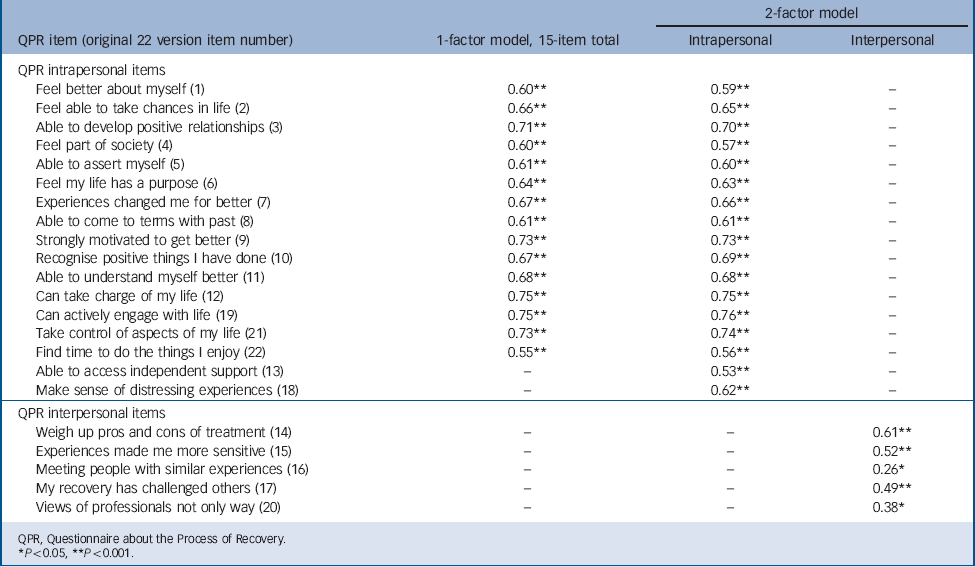
As a first step, we fitted a one-factor model in data-set 2 (n = 399) for QPR total, finding an adequate fit (χ2 (90) = 233.2, P<0.001, RMSEA = 0.063, 90% CI 0.05–0.07, CFI = 0.97, TLI = 0.97). Table 3 shows the standardised loadings for all 15 items showing that all items load onto the factor.
Item loadings in confirmatory factor analysis
| 2-factor model | |||
|---|---|---|---|
| QPR item (original 22 version item number) | 1-factor model, 15-item total | Intrapersonal | Interpersonal |
| QPR intrapersonal items | |||
| Feel better about myself (1) | 0.60** | 0.59** | – |
| Feel able to take chances in life (2) | 0.66** | 0.65** | – |
| Able to develop positive relationships (3) | 0.71** | 0.70** | – |
| Feel part of society (4) | 0.60** | 0.57** | – |
| Able to assert myself (5) | 0.61** | 0.60** | – |
| Feel my life has a purpose (6) | 0.64** | 0.63** | – |
| Experiences changed me for better (7) | 0.67** | 0.66** | – |
| Able to come to terms with past (8) | 0.61** | 0.61** | – |
| Strongly motivated to get better (9) | 0.73** | 0.73** | – |
| Recognise positive things I have done (10) | 0.67** | 0.69** | – |
| Able to understand myself better (11) | 0.68** | 0.68** | – |
| Can take charge of my life (12) | 0.75** | 0.75** | – |
| Can actively engage with life (19) | 0.75** | 0.76** | – |
| Take control of aspects of my life (21) | 0.73** | 0.74** | – |
| Find time to do the things I enjoy (22) | 0.55** | 0.56** | – |
| Able to access independent support (13) | – | 0.53** | – |
| Make sense of distressing experiences (18) | – | 0.62** | – |
| QPR interpersonal items | |||
| Weigh up pros and cons of treatment (14) | – | – | 0.61** |
| Experiences made me more sensitive (15) | – | – | 0.52** |
| Meeting people with similar experiences (16) | – | – | 0.26* |
| My recovery has challenged others (17) | – | – | 0.49** |
| Views of professionals not only way (20) | – | – | 0.38* |
QPR, Questionnaire about the Process of Recovery.
* P <0.05
** P <0.001.
We then fitted a two-factor model for the two QPR subscales (intrapersonal and interpersonal), also shown in Table 2. This model also offered a good fit (χ2 (208) = 407.5, P<0.001, RMSEA = 0.049, 90% CI 0.04–0.06, CFI = 0.96, TLI = 0.96), although items 20 and 22 had low factor loadings, indicating they are weakly associated with the latent construct.
Discussion
The study used two samples to evaluate the psychometric properties of the two subscales of the 22-item version (QPR intrapersonal and QPR interpersonal) and the 15-item version (QPR total). Both QPR intrapersonal and QPR total demonstrated adequate psychometric properties, whereas QPR interpersonal did not demonstrate psychometric adequacy.
The QPR intrapersonal subscale demonstrated excellent psychometric properties in all areas tested, apart from moderate sensitivity to change. All items had a loading above 0.5 in the CFA, indicating they capture the intrapersonal scale. By contrast, the QPR interpersonal subscale had poor internal consistency and sensitivity to change and the factor analysis found that two of the five items – item 16 ‘meeting people who have had similar experiences makes me feel better’ and item 20 ‘I realise that the views of some mental health professionals is not the only way of looking at things’ – had a factor loading below 0.5. This indicates that they are weakly associated with the latent construct and, therefore, do not describe it very well. Anecdotally, we found that item 20 was more difficult for participants to answer, because it asked about the view of ‘some’ professionals, which participants found confusing. Overall, these results indicate that QPR interpersonal is not well defined, and constructs with five of more items are generally recommended to define a robust construct. Reference Costello and Osborne14
The 15-item QPR total demonstrated excellent internal consistency and test–retest reliability, adequate convergent validity and moderate sensitivity to change. These findings reflect those of Law and colleagues in their paper that recommended the 15-item version of QPR. Reference Law, Neil, Dunn and Morrison8 In their paper the 15-item version had a Cronbach's alpha of 0.93 and good test–retest reliability (r = 0.70). In our paper the CFA found that all items loaded above 0.5. As all of the 15 items are in the QPR intrapersonal subscale, there is a great deal of overlap between QPR total and QPR intrapersonal.
Strengths and limitations
The study provides a comprehensive and independent psychometric evaluation of the QPR, including being the first study to evaluate sensitivity to change. It is also the first study to compare the two versions of the QPR. A limitation of this study is that one of our samples was relatively small. The use of two data-sets (although similar in demographic characteristics) can also be seen as a limitation, as can the non-collection of important clinical descriptive data such as illness severity and duration. However, each data-set had advantages, with data-set 1 allowing evaluation of test–retest reliability at 2 weeks, and the sample in data-set 2 sufficiently large to allow CFA.
QPR in clinical practice
We identify three clinical implications. First, the QPR can be used to measure the effectiveness of services in supporting recovery. Evidence on how best to support recovery is still developing, Reference Le Boutillier, Leamy, Bird, Davidson, Williams and Slade4,Reference Slade, Bird, Le Boutillier, Williams, McCrone and Leamy9 and there is as yet little evidence about the impact of recovery support on recovery outcomes. Having a robust tool to measure recovery will contribute to this goal.
Second, the results suggest that the QPR may have a role in benchmarking services and comparing the effectiveness of interventions. Sensitivity to change for QPR total was moderate. Although this provides stronger evidence than for other recovery measures, Reference Shanks, Williams, Leamy, Bird, Le Boutillier and Slade5 a robust understanding of processes that have an impact on sensitivity to change is needed. The absence of longitudinal studies of personal recovery mean that the level of likely change in recovery is unknown. At one extreme, recovery may be a highly stable construct, consistent with set point theory that finds that subjective ratings of well-being quickly return to baseline levels, even after life events cause a temporary change. Reference Lykken and Tellegen15 At the other extreme, recovery may be highly unstable and influenced by a range of intrapersonal, interpersonal and social determinants. Given the measurement challenges inherent to subjective rating scales, the minimally important difference estimate of responsiveness should be established before QPR is used for service evaluation. The QPR has been recommended by the Implementing Recovery through Organisational Change (ImROC) initiative as part of a suite of measures to assess recovery support. Reference Shepherd, Boardman, Rinaldi and Roberts16 Robust measures of recovery support such as INSPIRE Reference Williams, Leamy, Bird, Le Boutiller, Norton and Pesola17 can be used in conjunction with the QPR to assess the relationship between recovery support and the experience of recovery.
Third, government policy in England has become more outcome-focused 2 and the introduction of the payment by results funding system in mental health services may lead to outcome measurement being more widely introduced. As recovery is a policy aim, services may need to routinely measure recovery. Furthermore, there is a growing interest in the use of Patient Reported Outcome Measures (PROMs) such as the QPR in mental health services. Reference McCabe, Saidi and Priebe18
QPR in research
The relationship between recovery and other outcomes in mental health is still being explored, Reference Andresen, Caputi and Oades19 and standardised measures of recovery are needed. One issue for the measurement of recovery is ensuring that recovery measures have a robust conceptual underpinning. Reference Burgess, Pirkis, Coombs and Rosen20 An empirical understanding of key recovery processes is emerging, such as the CHIME framework, which identifies recovery processes of Connectedness, Hope, Identity, Meaning and purpose, and Empowerment. Reference Leamy, Slade, Le Boutillier, Williams and Bird3 A systematic review of recovery measures that used the CHIME framework to identify the breadth of coverage of recovery measures, indicated that the QPR had the best spread of items covering the five processes, suggesting that the QPR is measuring these aspects of recovery. Reference Shanks, Williams, Leamy, Bird, Le Boutillier and Slade5
We identify two key knowledge outcomes from this study. First, the 15-item QPR total scale can be recommended for use in research and clinical practice. Our recommendation reflects its adequate psychometrics, lower burden compared with the 22-item version, and easier interpretation (as a total score, rather than two subscales). A shorter version reduces the burden on respondents, which is an advantage Reference Reininghaus and Priebe21 as people who use services do not like having to complete long outcome measures. Reference Crawford, Robotham, Thana, Patterson, Weaver and Barber22 Specifically, a shorter measure makes it more feasible for use, thus increasing the likelihood of completion. Reference Slade, Thornicroft and Glover23 Future work could evaluate the implications of measuring recovery as a unidimensional construct, using analytic methods such as item response theory or Rasch measurement theory.
Second, we found preliminary evidence of sensitivity to change. This is a key psychometric property currently under-researched in measures of recovery change. Reference Shanks, Williams, Leamy, Bird, Le Boutillier and Slade5 Our results provide some evidence of the ability of the QPR to measure change, suggesting that QPR can be used in longitudinal research and to assess change in a clinical setting. Future research will need to identify a gold standard for evaluating this property, but it is encouraging that there was a correlation with change in two measures assessed at two different time points.
Measuring the recovery of people using mental health services with a standardised measure is one method that can be used to assess the effectiveness of services in supporting recovery. Robust measures of recovery are needed to do this. Overall, the 15-item QPR version is a valuable contribution to the measurement of recovery.
Funding
This article presents independent research funded by the National Institute for Health Research (NIHR) under its Programme Grants for Applied Research (PGfAR) Programme (Grant Reference Number RP-PG-0707-10040), and in relation to the NIHR Biomedical Research Centre for Mental Health at South London and Maudsley NHS Foundation Trust and Institute of Psychiatry, Psychology & Neuroscience, King's College London. The project will be published in full in the NIHR PGfAR journal. The views expressed in this publication are those of the authors and do not necessarily reflect those of the NHS, the NIHR, Medical Research Council, NIHR Central Commissioning Facility, NIHR Evaluation, Trials and Studies Co-ordinating Centre, the PGfAR programme or the Department of Health. Further information available at researchintorecovery.com/refocus.
Acknowledgements
We acknowledge the support of the PICuP Clinic at the Maudsley Hospital and the other mental health teams in recruiting participants.




eLetters
No eLetters have been published for this article.