Introduction
Hookworm infection is a neglected tropical disease caused by nematodes Ancylostoma spp., and it assumes in dogs its most pathogenic role. In terms of public health, this nematode also plays an important role in the aetiology of cutaneous larva migrans (CLM), due to the presence of infective larvae (L3) in the soil, and its evolutionary cycle ends up accidentally occurring in humans (Jourdan et al., Reference Jourdan, Lamberton, Fenwick and Addiss2018). Globally, it is estimated that 440 million people are infected with hookworms, and the overall damage is estimated to be as high as $139 billion annually (Hu et al., Reference Hu, Chilton and Gasser2002). In Brazil, the literature is quite vast when it comes to CLM; in practically the entire national territory, the rates are alarming and require not only parasitic but also effective public control measures (Carvalho et al., Reference Carvalho, Braga and Araújo2011).
There is already evidence of resistance to anthelmintics in canine hookworm populations (Kopp et al., Reference Kopp, Kotze, McCarthy and Coleman2007; Sunderkötter et al., Reference Sunderkötter, Stebut, Schöfer, Mempel, Reinel, Wolf, Meyer, Nast and Burchard2014). On the other hand, the importance of knowing Ancylostoma caninum epidemiology, and not only treating infections, should be highlighted. In CLM treatment, effective anthelmintic drugs such as ivermectin and albendazole are administered orally (Veraldi et al., Reference Veraldi, Angileri, Parducci and Nazzaro2017; Gao & Liu, Reference Gao and Liu2019). In this sense, Veraldi et al. (Reference Veraldi, Bottini, Rizzitelli and Persico2012) evaluated and proved, in a retrospective study, the efficacy and tolerability of oral albendazole in patients with CLM. On the other hand, Fischer & Nenoff (Reference Fischer and Nenoff2016) demonstrated, for the first time, the topical use of ivermectin in the treatment of a patient with CLM. However, data on the use of topical ivermectin in the treatment of CLM require further studies (Gelmetti et al., Reference Gelmetti, Brena and Veraldi2019).
In this sense, the search for collaborative measures against L3 may prove to be an interesting strategy (Carvalho et al., Reference Carvalho, Braga and Araújo2011; Ferraz et al., Reference Ferraz, Sobral and Senna2019). In topical treatments, ointments, gels and creams are used, above all, as vehicles to help facilitate drugs and other substances through the epidermis. Examples of these vehicles include glycerine and Vaseline, which are widely used in industry. In this way, studies aimed at the combined use of acknowledged treatments (Sunderkötter et al., Reference Sunderkötter, Stebut, Schöfer, Mempel, Reinel, Wolf, Meyer, Nast and Burchard2014), as well as effective biological control (Carvalho et al., Reference Carvalho, Braga and Araújo2011) of A. caninum L3, may in the future fight the cause of CLM, and thereby reduce the problem of this infection.
The present study aimed to evaluate the combined use of ivermectin, albendazole, glycerine and Vaseline with the nematophagous fungus Monacrosporium thaumasium (NF34) on L3 of A. caninum.
Material and methods
Obtaining A. caninum larvae
The third-stage larvae of A. caninum were obtained from fresh faeces of naturally infected dogs; to process the faeces, the Willis test was performed to find positive samples. Subsequently, coprocultures were prepared and then kept in an incubation chamber for ten days at 26°C. After this period, the larvae were extracted by the Baermann technique and identified as A. caninum according to the criteria described by Taylor et al. (Reference Taylor, Coop and Wall2016).
Treatment
In the present study, 1% ivermectin (Merial, Brazil), 1% albendazole (Vetnil, Brazil), 100% glycerine (Dinâmica, Brazil) and 100% Vaseline (Chemical Union, Brazil) were used. These compounds have been used in topical treatment protocols against CLM and were obtained from local stores.
In addition to these compounds, a nematophagous fungus isolate was used: M. thaumasium (NF34), which is present in Brazilian soil and came from the Parasitology Laboratory of Universidade Federal de Viçosa, Brazil. The isolate was cultured in 9-cm-diameter Petri dishes containing 2% potato–dextrose–agar culture medium. Mycelial growth across the plate was observed after seven days of culture. To obtain a conidia solution of NF34, 5 ml of distilled water was added to each Petri dish and, with the aid of a spatula, the conidia and mycelial fragments were poured into 15 ml Falcon tubes (Ferraz et al., Reference Ferraz, Sobral and Senna2019).
Experimental test
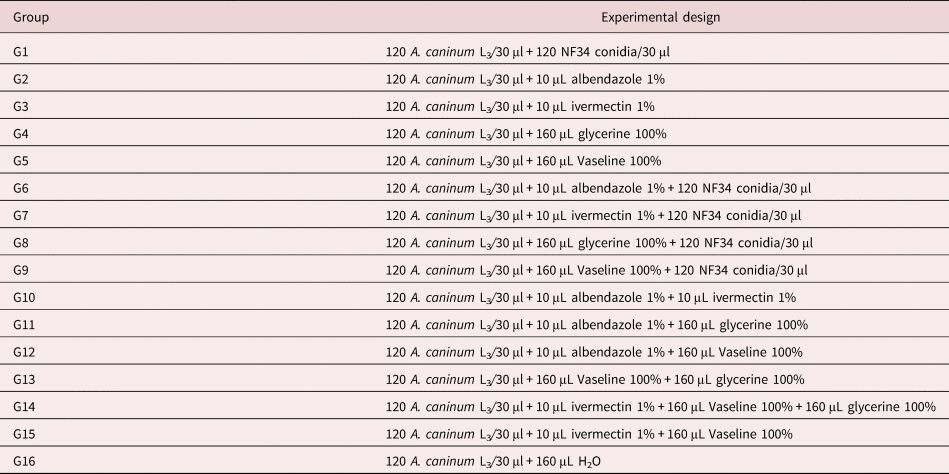
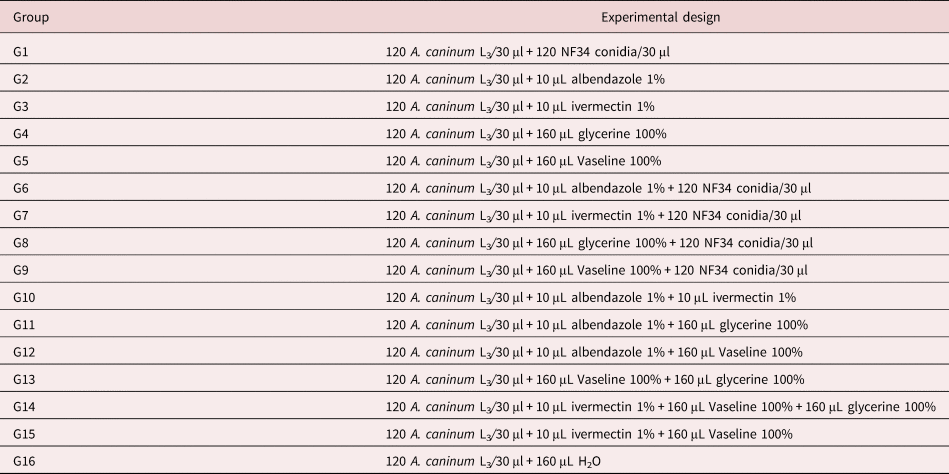
Sixteen experimental groups were formed in microtubes, each one having five replicates. The numbers of A. caninum L3 and conidia used in the groups were standardized using aliquots maintaining concentrations of the following: 120 nematodes; 10 μl albendazole; 10 μl ivermectin; 160 μl glycerine; 160 μl Vaseline; and 120 μl conidia. The experimental groups are presented in table 1. After 24 h of L3 interaction with ivermectin, albendazole, glycerine, Vaseline and NF34, the content of all microtubes in groups G1 to G16 was read using 10× light microscopy, and the number of living L3 was counted (Ferraz et al., Reference Ferraz, Sobral and Senna2019).
Experimental groups (G1 to G16) designed to evaluate the combined use of albendazole 1%, ivermectin 1%, glycerine 100%, Vaseline 100% and conidia of Monacrosporium thaumasium (NF34) against Ancylostoma caninum infective larvae.
Statistical analysis
The results obtained were evaluated by means of analysis of variance and Tukey post-test at a 1% level, using the BioEstat 5.0 software (Ayres et al., Reference Ayres, Ayres, Ayres and Santos2003). The reduction percentage was calculated using the following equation: % reduction = average of living L3 recovered in the treated group/average of living L3 recovered in the control group × 100 (Mendoza-De Gives & Vazquez-Prats, Reference Mendoza-De Gives and Vazquez-Prats1994).
Results and discussion
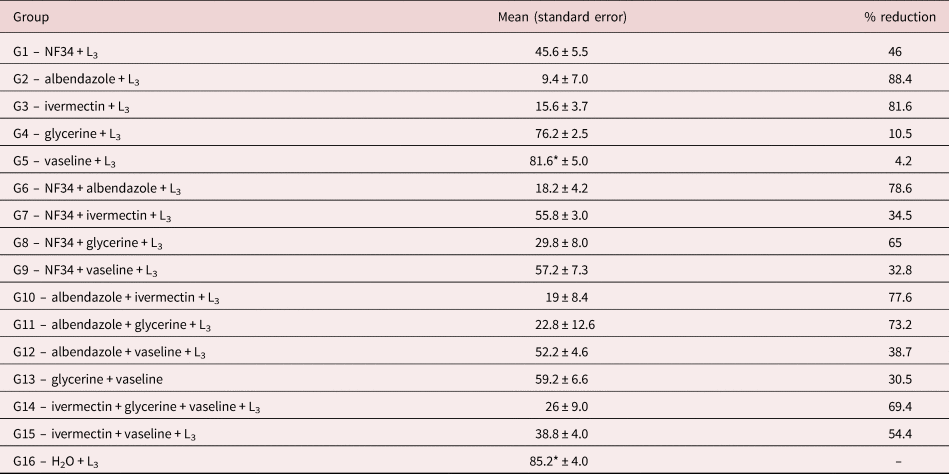
In the present work, the action of chemical (albendazole, ivermectin, glycerine and Vaseline) and biological (NF34) compounds on A. caninum L3 after a period of 24 h was verified (table 2).
Means, standard error and reduction percentage of Ancylostoma caninum larvae recovered in the experimental groups G1 to G16 after 24 h of interaction.
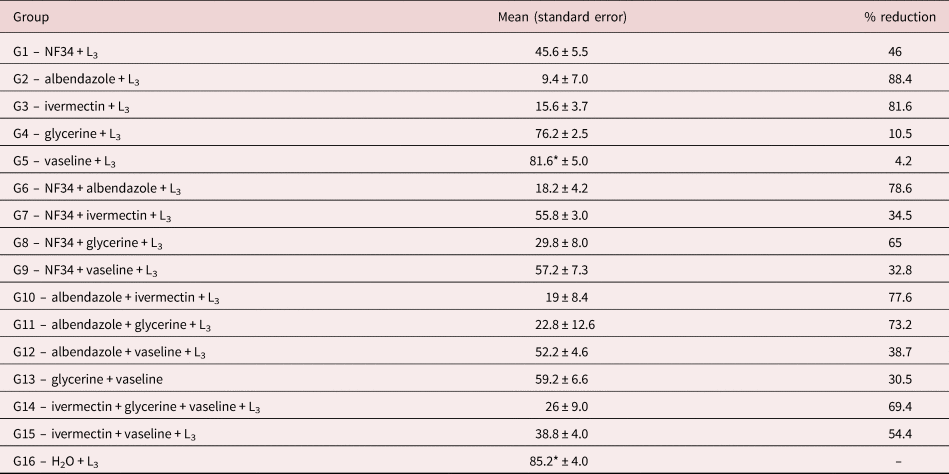
* No statistical difference (P > 0.05).
As previously described, the effective environmental control of A. caninum L3 still needs further research (Carvalho et al., Reference Carvalho, Braga and Araújo2011). Additionally, the chemical treatment recommended for infection caused by L3 in human skin (CLM) is based on the use of oral anthelmintic drugs; although effective, it may present some side effects, contraindication by age and even drug resistance and/or ineffectiveness (Veraldi et al., Reference Veraldi, Angileri, Parducci and Nazzaro2017).
Thus, in this work, one of the objectives was to evaluate the combined use of anthelmintic drugs (chemical control) with the fungus M. thaumasium (biological), glycerine and Vaseline, perhaps envisioning their combined use in the future. On the other hand, the authors recognize that there are no studies that could justify the use of a group composed of NF34 + albendazole + ivermectin + glycerine + Vaseline, since there is no report on the topical use of nematophagous fungi in humans.
Corroborating this fact, the work of Araújo & Guimarães (Reference Araújo and Guimarães2002) was a pioneering study in using a solution containing NF34 fungus directly in the auditory canal of cattle infected by the nematode Rhabditis spp., which causes parasitic otitis. In a recent study, Ferraz et al. (Reference Ferraz, Sobral and Senna2019) proved that the combined use of 1% dimethyl sulfoxide, 100% mineral oil and fungal conidia was efficient in controlling this nematode; however, there was already the premise of NF34 topical use applied at that time by Araújo & Guimarães (Reference Araújo and Guimarães2002) only in animals. The results obtained by Ferraz et al. (Reference Ferraz, Sobral and Senna2019) will be used in another design under field conditions.
In contrast, it was observed once again that, in the future, the use of NF34 with anthelmintic drugs might prove to be a strategy to be better studied (Ferraz et al., Reference Ferraz, Sobral and Senna2019), since the literature suggests that albendazole and ivermectin have a possible fungicidal action. Vieira et al. (Reference Vieira, Maia Filho, Ferreira, Mendes, Gonçalves, Villela, Pereira and Nascente2017) mentioned that antiparasitic compounds have an in vitro inhibitory effect on nematophagous fungi, compromising their activity as biological control agents – something that can be observed in group G7.
The G5 group – Vaseline without combinations – showed no difference (P > 0.01) in L3 reduction in relation to the control group. This fact can be explained by its hydrophobic property – that is, it practically does not dissolve in water, since the conidia/chlamydospore solution used was liquid. But, as Vaseline is used as a base in many cosmetic products, we decided to include it in this study. Furthermore, glycerine has emollient, lubricating, moisturizing and hygroscopic properties that contribute to water absorption, and, thus, there may have been a certain ‘compensation’ between the compounds. Either way, both glycerine and Vaseline are present in topical pharmaceutical products and have been tested here as vehicles, foreseeing their combined use in the future.
Due to the presence of drug resistance of hookworms (Kopp et al., Reference Kopp, Kotze, McCarthy and Coleman2007) in dogs and to the worrying increase in CLM cases in the world (Alcântara et al., Reference Alcântara, Soldevila, Valerio, Roure, Pérez-Quílez, Martinez-Cuevas and Villanova2019), the study of alternatives that can help in controlling the cause of this infection is justified – that is, the destruction of A. caninum L3. The innovative character of this study was to cast light on the challenges of the combined use, even on an experimental basis, of anthelmintic drugs and the nematophagous fungus M. thaumasium, thus collaborating more and more with studies that can elucidate the synergistic action between chemical and biological control against the problems caused by hookworms.
Financial support
This study was supported by the Coordenação de Aperfeiçoamento de Pessoal de Nível Superior (CAPES) (J.A.C.L., grant number 001); the Conselho Nacional de Desenvolvimento Científico e Tecnológico (CNPq) (F.R.B., productivity grant); the Fundação de Amparo à Pesquisa e Inovação do Espírito Santo (FAPES); and the Fundação de Amparo à Pesquisa de Minas Gerais (FAPEMIG).
Conflicts of interest
None.
Ethical standards
The authors assert that all procedures contributing to this work comply with the ethical standards of the relevant national and institutional guides on the care and use of laboratory animals.