The development of African varieties of English has been attributed to a variety of factors, and the emergent forms of English spoken in various African countries have been the subject of study for several decades now. Among the factors mentioned as leading to the ‘Africanness’ of African Englishes is the exposure to written language, which tends to lead to the observation of linkages between spelling and pronunciation in some of these varieties of English (Schmied, Reference Schmied1991a, Reference Schmied, Kachru, Kachru and Nelson2006). The argument has been that due to exposure to the written word, second language learners reproduce elements of written language in speech, leading, for example, to the pronunciation of silent letters in words such as ‘heir’, ‘tomb’ etc. This phenomenon of ‘spelling pronunciation’ is more pronounced in some varieties than in others, and the practice may not be confined to non-native environments. In general, spelling pronunciation has been shown to lead to cross-cultural miscommunication and therefore has implications for English as a global language.
The aim of this article is to focus not on spelling pronunciation, but on another feature that I want to argue is characteristic of (written) African English: the phenomenon of pronunciation spelling. According to Wikipedia (last accessed: 1 February 2013) ‘[a] pronunciation spelling is considered to be an ad hoc spelling of a word that has no standard spelling. Most instances of pronunciation spelling are coinages but some eventually may become standardized. Pronunciation spellings are used informally to indicate the pronunciation of foreign words or those whose spelling is too irregular or unfamiliar to deduce the pronunciation from, a process referred to as respelling. Pronunciation spellings are also frequently used in narratives to represent nonstandard dialects or idiolects, often to create an impression of backwardness or illiteracy.’ This means that the use of pronunciation spelling is not usually deemed acceptable in formal language use, especially not in a written university examination. Indeed, one reason why pronunciation spelling has not received as much attention as that of spelling pronunciation may be because instances of it can be dismissed as simple spelling mistakes which may be occasional in the writing of a second language learner. However, this practice is now becoming increasingly noticeable among university students in Africa, and it is the aim of this paper to consider what might be causing this upward trend. I will argue that this emerging trend of pronunciation spelling is due not to exposure to written language as is the case of spelling pronunciation, but to the lack of it. The paper is based on a corpus of words and expressions taken from written examinations by first and third year education students at the university.
Research into the variety of English spoken in Kenya (hence forth KenE) has focused on different aspects of the variety. A number of linguists have dedicated themselves to the description of KenE (e.g. Hancock and Angogo, Reference Hancock, Angogo, Bailey and Görlach1982; Zuengler, Reference Zuengler and Kachru1982; Okombo, Reference Okombo1986; Sure, Reference Sure1989, Reference Sure1991; Schmied, Reference Schmied1986, Reference Schmied1991a, Reference Schmied, Kachru, Kachru and Nelson2006; Skandera, Reference Skandera2003; Mwangi, Reference Mwangi2003; Furaha, Reference Furaha2007). Taken together, the results of these studies indicate that there are distinct features of KenE in the areas of phonology, vocabulary and grammar:
Reliable findings on phonological features were provided by Schmied (Reference Schmied and Cheshire1991b). By means of a quantitative analysis, he showed for each phoneme to what extent Kenyan pronunciation varies from Standard English. As a result, his study shows that there are distinct national features of KenE. He argues that KenE pronunciation features can be divided into national and sub-national features. Schmied indicates that the pronunciation of vowels differentiates KenE from Standard English at the national level, while the pronunciation of consonants expresses differentiation within KenE. He summarizes the features that characterize the pronunciation of vowels in KenE into three broad areas:
A. The leveling of quantitative distinctions between vowels;
B. The lack of central vowels; and
C. The monophthongization of diphthongs.
These features continue to be observed in the English spoken and written by a majority of Kenyans irrespective of their linguistic backgrounds. It must however be acknowledged that these features are not unique for Kenyan English, since they are prominent in many varieties of English as, for example, Jamaican English or Black South African English.
In the corpus collected for this paper, there was considerable evidence that second language learners in Kenya have taken the substrate influence a step further – from spoken to written forms, i.e. writing words as they pronounce them, especially when they are influenced by their L1s.
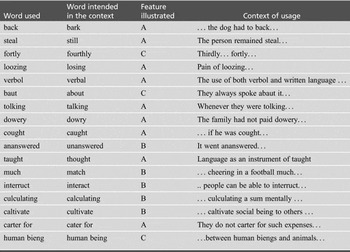
As indicated by feature (A) above, speakers of Kenyan English generally do not make distinctions between vowels. As a result, the differences between long and short vowels, back and front vowels are often lost especially in speech. However, the tendency to transfer this lack of vowel distinctions into writing, apparently based on the spoken forms, is becoming very common as shown in Table 1, which contains words extracted from students' written examinations.
Pronunciation Spellings involving Vowels

It may be argued that most of the expressions in Table 1 are indeed spelling mistakes which can be made by learners of English as a second language not only in Kenya but in other ESL environments as well. However, it is the frequency with which they appear that is significant. Nearly every other examination script exhibited instances of pronunciation spellings, which means that the practice is not confined to a few students. The fact that the corpus was also taken from students training to become teachers of English in Kenya means that it is even more likely that the apparent trend identified here will continue to increase, as these pronunciation spellings may be passed from one generation to another through the education system.
In terms of the pronunciation of consonants, the following characteristics, which are specific to the four linguistic groups Central Bantu, Western Bantu, Kalenjin and Luo, are often cited. They have been termed ‘subnational features' (Schmied, Reference Schmied1991a: 425–6) and are, unlike national features, stigmatized (Mwangi, Reference Mwangi2003: 2).
A. The devoicing of voiced sounds and vice versa among some Nilotic and Bantu speakers:
a. /k/ vs. /g/ – pen/ben, boy/poy
b. /t ʃ / vs. /ʃ/ – chair/share, wash/watch
B. The pronunciation of /l/ as /r/ by the Central Bantu:
a. fry/fly, pray/play
C. The insertion or deletion of nasals before voiced stops by some Central Bantu:
a. *saland (salad)
b. *goond (good)
c. *had (hand)
D. The dropping of initial /h/ and its inclusion where it does not exist by some Central Bantu:
a. hair/air, air/hair
E. The intrusion of vowels in consonant clusters:
a. *againist (against)
b. *filim (film)
At this point it is important to mention that most of the examples of pronunciation spelling used in this paper were collected from students who were mainly from the Kalenjin group of languages. These form the majority of the students who had sat the examination from which the samples were taken. However, there were also a few from students from other ethnic communities, especially from among the Luhya community who are Bantu speakers. This shows that the use of pronunciation spelling is not confined to specific ethnic groups but cuts across both ethnic and linguistic boundaries.
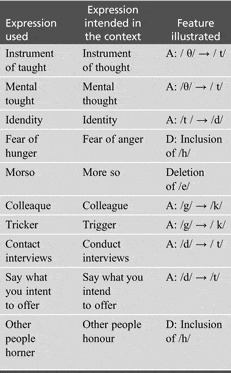
Table 2 shows that the substitution between the voiced and voiceless velar plosives /g/ and /k/ is the most common. This may be explained by the fact that, as indicated above, the majority of the students who provided the data for this paper are from the Kalenjin group of languages where these two plosives are often used interchangeably in speech. They also tend to substitute the voiceless alveolar plosive /t/ for the voiced dental fricative /θ/ in speech and, as is clear from this corpus, they transfer this to writing as well.
Pronunciation spelling involving consonants

From the two tables above, it seems reasonable to conclude that pronunciation spelling may be becoming common among university students in Kenya. Of course, this claim needs to be treated with considerable caution as the corpus used here is very small, and contains no diachronic dimension that would categorically prove that such a trend exists. However, if these results are confirmed by a larger-scale study, this would have far-reaching implications for the Kenyan education system. The two groups of students that provided the data for this paper are all teacher trainees, meaning that sooner or later they will join the Kenyan school system as teachers. Accordingly, they are likely to pass on the practice to their students by not penalizing it when it occurs in their students' written work. Indeed, they may not even recognize that it is (from an official standpoint) incorrect in the first place. The end result would be a cumulative effect with future generations of English learners diverging more and more from the standard variety of written English in Kenya. Whether this is to be viewed positively or negatively, or simply as a neutral development in varietal terms, is clearly a matter for discussion and debate among academics, educationalists and policymakers.
This paper therefore serves as an eye-opener to various stakeholders within the Kenyan education system and also calls for more research in this area in order to find out what measures could be taken to nip the problem in the bud – if (as seems highly likely) it is deemed to be a problem. For instance, it would be interesting to find out which categories of words are affected most and whether or not certain ethnic groups use pronunciation spelling more than others. This would provide both educationists as well as linguists with data which they can use to improve the teaching and learning of English in Kenya.
As indicated at the beginning of this paper, the growing trend of using pronunciation spelling may be explained by the lack of a reading culture in Kenya. This results in a situation whereby students are exposed to spoken English more than written English. In situations where the spoken English they are exposed to has any form of mother tongue influence, then the students are likely to transfer what they hear into what they write. However, if they read widely, they would be exposed to the said words not only in speech but also in writing, therefore making them familiar with the spellings of such words or expressions. It is therefore important to put in place policies and practices within the education system which encourage more reading than is currently the case. This should be done from the earliest stage within the education system since it may be too late to try to inculcate it at the highest level of learning.
 SERAH WAITIKI has a PhD in English Studies from Chemnitz University of Technology in Germany. She is also a Fellow of the Higher Education Academy of the UK, having been trained in academic practice by York St John University. She has been a university lecturer for the last sixteen years, with her main areas of specialization being sociolinguistics, semantics and special interest in varieties of English around the world. Currently, she is the coordinator of the Linguistics, Media and Communications program at the Nairobi campus of Moi University in Kenya. Email: waitikiserah@yahoo.com