





Činwad is the name of a bridge that, according to Zoroastrian eschatological myth, reflected in Pahlavi texts, leads from the Peak of DāytīFootnote 1 in the center of the world to the next, and must be crossed by the souls of the departed;Footnote 2 it is said that when the righteous soul wishes to cross Činwad Bridge, it becomes wide, and for the wicked it will remain narrow like a razor blade.
As far as I know, no scholars have spoken about the mechanism used to reshape Činwad Bridge. I also have noticed that there is a general impression that this reshaping is something of a magical move. This understanding likely is based on the account that scholars have established in modern works on the issue. But is that the way Činwad Bridge works?
A review of extant literature reveals that the mechanism of the Činwad Bridge is described in Pahlavi texts. One reason this information has been widely overlooked is that modern works generally do not consider phenomena and affairs of the other world to be the product of metaphorization of this-world counterparts. It is not my intention to imply that magical occurrences should be disregarded within an eschatological framework. However, when the textual sources explicitly contradict this perspective, the position can be reconsidered.
Some Pahlavi passages, like Ardā Wīrāz Nāmag 5.1 and Mēnōy Xrad 1.123, just mention that for the righteous soul the bridge becomes wide.Footnote 3 In other words, these texts do not talk about the bridge reshaping itself for the wicked soul. In Great Bundahišn (hereafter GBd) 30.23, it is stated that for the righteous soul the bridge becomes wide, and in 30.25 it is specified that for the wicked it will remain the same, that is, like a sharp blade.Footnote 4
GBd 30.25
agar ān ruwān druwand, ka pad ǰuγ abar ōy čagād āyēd, ān tēx ī tēz pad ham tēx bē estēd ud widarag nē dahēd u-š a-kāmagīhā abar ham tēx raftan abāyēd.
If the soul is wicked, when, through the beam [of Rašn’s balance], it reaches to the Peak [of Dāytī], the sharp blade remains at the very (edge of) blade and does not allow any passage and (the soul) must walk on the very (edge of) the blade against its will.
Therefore, despite repeated accounts in contemporary literature, for the evil soul the bridge does not become as narrow as a razor blade, but it remains so. In other words, the default mode is sharp. Also, in the following passage of Kerdīr’s inscription (from the third century CE) the same notion is stated.
Kerdīr’s inscription in Sar-Mašhad (hereafter KSM) 41–43; Kerdīr’s inscription in Naqš i Rustam (hereafter KNRm) 65–66
u-šān ōh guft kū, “ōy čāh dār-ē [abar nihād] owōn čiyōn puhl ud ān zan ud mard ī kerdīr hangerb frāz [ō čāh raft] hēnd ud ānōh puhl ēstād, ud ān puhl [abēr] pahndar būd ud nūn pad pahnā meh paydāg kū čiyōn pad dranā, ud ān zan ud mard [ī kerdīr hangerb …] ēstēd.”
And they said thus, “A cutting bladeFootnote 5 [has been set over] that pit like a bridge. And that woman and the man, Kerdīr’s double, [went] forth [to the pit] and there the bridge was located. And that bridge became [much] wider and now it appears greater in width, (as great) as it is in length.Footnote 6 And that woman and the man, [Kerdīr’s double,] have [… .].”Footnote 7
A thorough examination of Middle Persian (MP) texts reveals that they contain further insights into Činwad. However, one should consider that different texts might account for various narratives.Footnote 8 So, the following arguments and conclusions might not apply to all of the narratives.
The following passage from Dādestān ī Dēnīg offers a more comprehensive and lucid explanation of the bridge’s structure. As is evident in the following representation, the ambiguous word was-pahlūg is used as an adjective for Činwad (see below), and it is articulated that the bridge has facades exhibiting disparate widths, some more expansive than others, and potentially characterized by acute edges. Interestingly, the bridge is capable of rotating (gardēd) to align with the appropriate face for the soul traversing it. This configuration can be interpreted as a movable bridge, probably with a polygonal shaft, featuring multiple flat faces that function as pedestrian pathways. As the shaft rotates, the corresponding pedestrian emerges, thereby enabling either the passage of individuals or the prevention thereof.
Dādestān ī Dēnīg (hereafter DD) 20.1–7
1) 20-om pursišn ān ī pursēd kū činwad puhl ud čagād ī dāytī ud rāh ī ahlawān ud druwandān čiyōn ud ka ahlaw čiyōn ud ka druwand čiyōn bawēd
The 20th question asks how the Činwad Bridge and the Peak of Dāytī are and how the path of the righteous and the wicked are and what they are like when (the one who crosses is) righteous, and what they are like when (the one who passes is) wicked.
2) pāsox ēd kū dastwarān ēdōn guft kū čagād ī dāytī andar ērānwēz pad mayān ī gēhān. tā nazdīkīh ī ān čagād ayāft ān dār kerb mēnōy ī činwad puhl ī az war ī harburz abāz ō čagād ī dāytī abgand estēd
The answer is that the authorities said that the Peak of Dāytī is in Ērān-wēz, in the center of the world. The spiritual form of the cutting blade, which is Činwad Bridge, is found in the vicinity of the Peak of Dāytī and has been laid from the War of Harburz,Footnote 9 back to the Peak of Dāytī.
3) čiyōn ān puhl? dār homānāg ī was-pahlūg kē-š pušt ast ī frāx ud ast ī bārīk ī tēz.
u-š frāx-sōgīhā ast ī ēdōn wuzurg ī-š 27 nāy pahnāy
u-š tēz-sōgīhā ēdōn tang ī pad bārīkīh ēdōn čiyōn awestarag tēx
How is the bridge? It is like a was-pahlūg cutting blade whose surface can be wide and can be sharply thin.
In (the mode of) its wide side it can be so large that its width is 27 nāy-s,
in (the mode of) its sharp side (it can) be so narrow that its thinness is like a razor blade.
4) ud ka ahlawān druwandān ruwān rasēnd ō ān sōg ī-šān niyābagīhā ast gardēd
When the souls of the righteous and the wicked arrive, it turns to the side which is appropriate for them.
5) pad wuzurg xwarrah ī dādār ud framān ī ōy ī rāst-āmār ud puhlbān
ahlawān frāx-puhlīh bawēd čand 9 nēzag bālāy ud drahnāy kē-š ǰud ǰud dagrandīh 3 nāy
druwandān tang-puhlīh bawēd ī tā-z hangōšīdag ī ān ī awestarag tēx
By the great glory of the Creator and the command of the precise-reckoning one and the guard of the bridge,
The bridge will be wide for the righteous people: as 9 lances in length and (9 lances) in width, the lengthFootnote 10 of each (lance) being 3 nāy-s.Footnote 11
For the wicked, the bridge will be narrow, even to the degree that it will be like a razor blade.Footnote 12
6) ud ān ī ahlawān pad puhl widerēd …
He who is righteous crosses the bridge …
7) ān ī druwandān čiyōn gām ō puhl nihēd dabrīh ud tēzīh rāy az mayān ī puhl ōbadēd ud nigūn gardēd …
The wicked one falls from the middle of the bridge and turns downward as soon as he steps on the bridge, because of (its) ruggednessFootnote 13 and sharpness.
In the following pages, I will describe that the pathway of the bridge, being a plate or a polygonal shaft, was connected to the beam of the balance and the pathway was “automatically” rotated as a result of pulling the beam down. This is what I describe as the automation of Činwad Bridge. This structure may be the metaphorical reflection of a(n automated) movable bridge in the source domain of the metaphor, namely in the real life of the people, most likely in the Sasanian era. Leaning on conceptual metaphor theory, the cognitive linguistics premise that our understanding of abstract concepts is fundamentally structured by metaphorical mappings from more concrete domains of experience. Religion, which can never put its ultimate subject—the transcendent—directly into words, is especially dependent on this principle.Footnote 14 In other words, even if no archaeological trace or historical account regarding movable bridges can be found in Iranian history, based on textual confirmations of the existence of such a structure, conceptual metaphor theory can still meaningfully propound the possibility of the existence of, or at least the imagination of, (automated) movable bridges in the life of Iranian people.
Although it is challenging to ascertain with certainty which narratives in the Zoroastrian Pahlavi texts included this mechanism, it is noteworthy that the ninth-century text Dādestān ī Dēnīg appears to be the continuation of a narrative in which the existence of such a mechanism is, to a certain extent, evident. It is plausible that the Iranian people might have utilized a comparable mechanism in preceding centuries. Although metaphorical language provides an important clue, further corroboration may come from archaeological or textual evidence, strengthening the case for the historical presence of movable bridges and similar automated mechanisms.
It is probable that non-fixed bridges were known to humankind quite earlier than fixed ones. The concept can easily be developed out of a piece of wood over a very small river or stream. Such a concept was familiar, on a larger scale as well (e.g., over a moat), to Indo-Iranians from very early times. At the site of Sintashta, over a moat around the fortified settlement, we find an example of a bridge that could probably be removed.Footnote 15 Centuries later in Babylon and to protect the city against Medians, queen Nitocris, as described by Herodotus,Footnote 16
dealt with the river Euphrates, which flows through the middle of her city; … near the middle of the city she built a bridge with the stones that had been dug up, binding them together with iron and lead. Each morning, she laid square-hewn logs across it, on which the Babylonians crossed; but these logsFootnote 17 were removed at night, lest folk always be crossing over and stealing from one another.Footnote 18
Also, the pontoon bridge of seven hundred ships built by Xerxes to let his gigantic army pass the river Strymon and the HellespontFootnote 19 followed the concept of a movable bridge, but this form is not relevant in this case. Such pontoons could later be seen in several places in the Iranian world,Footnote 20 for example, in the Sasanian period in the south of Ctesiphon at Wehkawād.Footnote 21
Consequently, the question arises of why such a technical attitude should be part of a scene of afterlife judgment. The answer will be the same as the answer to the question of why scales had already been deployed in the judgment scene. I have discussed both questions in another article.Footnote 22 In essence, the reason was to increase the share of mechanical, or even automated, systems in the process of afterlife judgment and assure believers that any subjective and undue interference in the process had been eliminated, thereby enhancing its perceived legitimacy and fairness.Footnote 23 The incorporation of mechanical or quasi-automated elements into the conceptualization of afterlife judgment served a theological and rhetorical function.
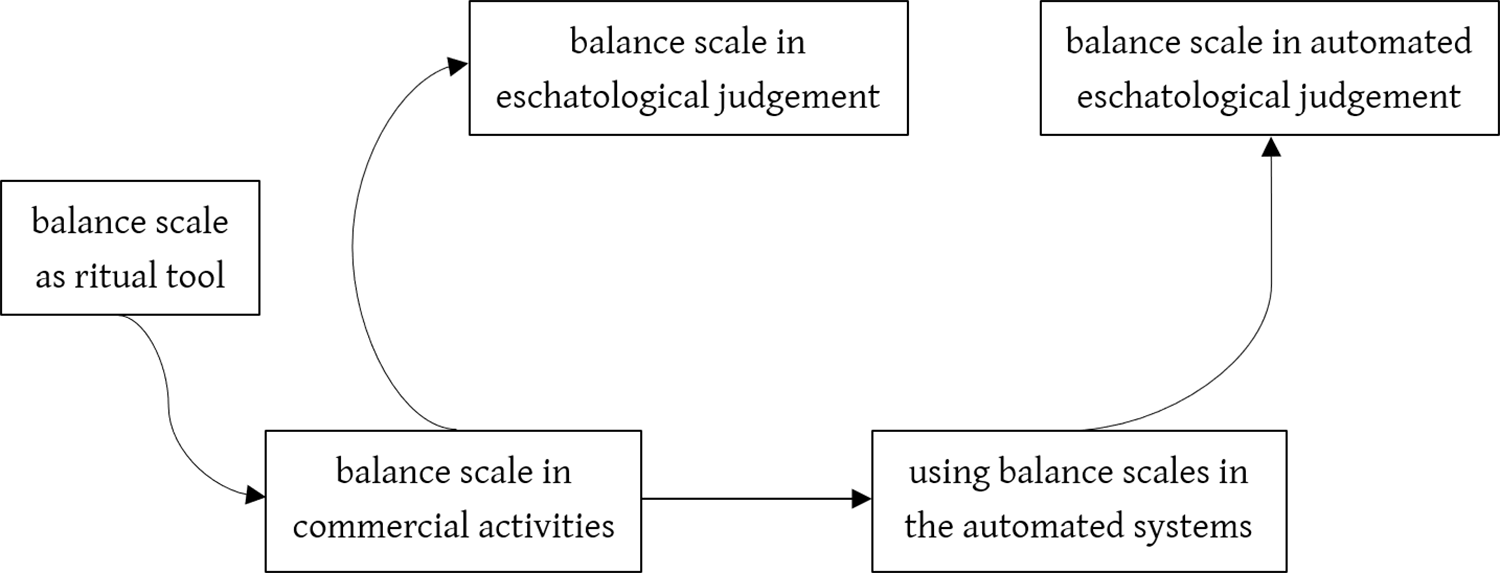
The implementation of a simple automated system based on the concept of a balance scale to establish a particular religious belief may appear to be a significant ambition. However, it is imperative to recognize that the fundamental element of this system was none other than the balance scale itself. The objective of the balance scale was to ascertain the equivalence of objects A and B, independent of human intervention or judgment. Even in this phase, this process can be regarded as a paradigm of automation. It is worth remembering that, given the predominance of automated measurement in the functionality of balance scales, they were, as Seidenberg and Casey showed, utilized primarily in ritual contexts prior to 4000 BCE. Subsequently, there was a transition to their incorporation into commercial activities and the fabric of daily life.Footnote 24 Thus, in Iranian tradition, the concept of the balance scale is mapped twice onto the eschatological target domain, as illustrated in Figure 1.
Oscillation of the concept balance scale between immanence and transcendence.

The apparatus in the source domain might take the form of a balance scale or lever, which would be positioned on a fulcrum. Applying a weight to one side of the lever would result in the downward movement of the relevant arm. This force might then be utilized to rotate a rod or plate at the fulcrum/axis. One potential example of this mechanism’s application might be the technology utilized in the water management systems of the Sasanian period.Footnote 25 As societies advanced, they innovated and integrated existing tools to create more complex instruments. Examples of automatic mechanical devices that use scales in their design can be found in the Book of Ingenious Devices (Kitāb al-Ḥiyal), which was written by the sons of Mūsā in the ninth century CE.Footnote 26 This period corresponds to the time that Dādestān ī Dēnīg was written. The sons of Mūsā were three brothers of Iranian origin, who were raised and educated in Baghdad from a young age. Their father died early, and the three sons were entrusted to the care of the Abbasid caliph al-Maʾmūn. Donald Hill specifies that:
In the light of recent investigations, it is permissible to speak of a Greek school of mechanical engineering, stemming from Ctesibius (300–270 B.C.) and continuing through Philo and Hero, probably into Byzantium, whence it passed into Sasanid Persia… . In Sasanid Persia the Greek system may have merged with Iranian, Indian and Chinese elements, and it was this composite tradition that came to the attention of the Banū Mūs[ā] in Khurāsān and later in Baghdad.Footnote 27
It stands to reason that in a more sophisticated society, higher levels of technological concepts (including their subdomains) might be used as source domains for the generation of religious metaphors. Hans Blumenberg, in an essay on the Geistesgeschichte der Technik (The Intellectual History of Technology), remarks that:
The question of evaluation of technology represents a separate chapter in the intellectual history of technology. For this history includes not only the intellect that brings about a technology, but also the intellect that the technology brings about.Footnote 28
In this light, conceptual metaphor theory allows us to hypothesize that the idea of movable bridges was one embedded in the cognitive and cultural landscape of Iranian societies, suggesting that such technologies may indeed have existed or at least been imaginatively available.
Let us return to the Middle Persian texts. The opening of GBd 30 (and select other paragraphs within the chapter) expounds upon the structure of Činwad Bridge. However, the succinct nature of the text and the presence of ambiguous terminology can impede comprehension. A review of previous translations reveals a tendency toward vagueness or imprecision in the interpretation of this section (see below). Considering the aforementioned factors, it is possible to interpret this chapter from a novel perspective and thereby gain a more profound understanding of the mechanisms of Činwad.
GBd 30.1-2
(1) gōwēd pad dēn kū čagād-ē ī 100 mard bālāy mayān ī gēhān kē čagād ī dāytī xwānēnd.
It says in the DēnFootnote 29 that: “There is a peak in the center of the world, as tall as the height of one hundred men, which is called the Peak of Dāytī.
ǰuγ ī tarāzūg ī rašn yazad
tēx-ē pad bun ī kōf ī Harburz pad kust ī abāxtar ud
tēx-ē pad sar ī kōf ī Harburz pad kust ī nēmrōz
mayān abar ān Čagād ī Dāytī
estēd.
(Of) the beam of deity Rašn’s balance,
one arm is located over the beginning of Mount (range) Harburz in the north region, and
one arm is located over the end of Mount (range) Harburz in the south region (and)
the center (of the beam) rests upon the Peak of Dāytī.
(2) pad ān mayānag gyāg-ē ī tēz ī šamšēr homānāg estēd kē-š 9 nēzag drahnāy ud pahnāy.
In the middle, there is a sharp place that is like a sword, and its length and width are nine lances.”
The meaning of ǰuγ (or maybe ǰōg) and the interpretation of its syntactic role has led to translation problems in the works of scholars who have previously examined this passage. In Bailey’s translation, he employed the term “yoke” for ǰuγ,Footnote 30 apparently indicating that the precise translation of the word remained ambiguous for him (see below). However, in his translation, the word is utilized in a manner strikingly similar to the “beam (of a balance scale).” It appears that he harbored uncertainty regarding this translation and contemplated an alternative interpretation for ǰuγ. This time he confused ǰuγ with zīh “cord” in his note on this passage.Footnote 31 However, he correctly distinguished that ǰuγ is the first word of a new sentence, although again in GBd 30.2 he confused Činwad Bridge with Rašn’s balance. Anklesaria read the word of our concern as gô (?) and understood it to be the MP word for fulcrum.Footnote 32 He regarded the phrase gô-î tarâzûg-î Rašnû as the continuation of the preceding sentence. Agostini and Thrope provided a similar translation.Footnote 33 However, their translation also does not elucidate the rationale behind the decision to translate ǰuγ as “fulcrum.” In Widengren’s translation,Footnote 34 the word ǰuγ is omitted. Bahār also, in his admirable translationFootnote 35 of GBd into Persian, similarly considered ǰuγ the MP word for fulcrum. Adding a pronoun in parentheses, he took the sentence beginning with ǰuγ as the continuation of the preceding sentence. Years later, in another book that contained many chapters of his translations of GBd, in a chapter with the title “On the Činwad and the Souls of the Deceased,” Bahār repeated a very similar translation.Footnote 36 In both books, he translated ǰuγ into New Persian (NP) yūgh, which means “yoke.” In fact, he just repeated the Middle Persian word in his New Persian translation. However, it is striking that in his former book, in a note on a different topic, he wrote,
Yūgh, Pahlavi ǰuγ, is a long wooden stick that is the length of two hands. It is carried on both shoulders. This stick was placed on the shoulders and, as is customary in the coastal regions of the Caspian Sea, was loaded with a hanging weight on both sides. Also, two shāne-s (lit. “shoulders”) of the balance are called ǰuγ in Pahlavi.Footnote 37
A similar note is repeated in his latter book: “shāhīn or two shāne-s of the balance are called ǰuγ in Middle Persian.”Footnote 38 According to the information contained in his notes, Bahār regards ǰuγ as the beam of a balance scale, rather than the fulcrum that appears in his translations. In the latter book, in a note on a different topic, Bahār provided a different translationFootnote 39 of GBd 30.1 that notably bears a striking resemblance to my own. In this translation and its succeeding explanation, it is confirmed that ǰuγ is not the fulcrum, rather it is the beam.Footnote 40
The word ǰuγ/ǰōg originally meant “yoke,” and it could easily be used for the beam or bar of a set of balance scales, which, like a yoke, has two arms, each one connected to an element, both the same (i.e., the dishes in a set of balance scales and the necks of oxen in a yoke), to distribute power or weight in a balanced way. Another important point is that in the above passage, as in the following one, the word tēx, in addition to the meanings “blade,” “sword,” and “edge,” also may have the meaning “extended part (either plate or rodFootnote 41),” which could be developed from the senses “blade” and “sword.” Therefore, it also may yield the sense “arm.” The schematic in Figure 2 may provide a better understanding of some of the aforementioned subjects.
Cosmic balance scale.

From GBd 30.1 we know that the center of the beam is placed on the Peak of Dāytī, and there the Činwad Bridge is located. In GBd 30.2 we learn that its length and width are nine lances, that is, a square (Fig. 3).
Soul’s path toward Činwad Bridge.

Accordingly, the ensuing passage from GBd 21–25 will be more readily understood and serve to elucidate the circumstances. In this version of Zoroastrian eschatological judgment, we see that the form of a cow, the form of a maiden, and the form of a garden lead the soul to the beginning of Mount Harburz; in the next lines the text explains that the Fire Farnbay will continue to do the duty of passing the soul along the “arm” (tēx). In other words, the cow, the garden, and the maiden will first take the soul toward the pan of Rašn’s balance scale that is hung from the northern arm of the balance scale, because from GBd 30.1 we already know that “one arm of the beam of Rašn the God’s balance is located over the beginning of Mount (range) Harburz in the north region.” There the cow, the garden, and the female figure will most probably be placed in the pan of balance on that side, and that subsequently will, depending on their weight, push the pan and that arm of the balance scale down.Footnote 42 Then the Fire Farnbay will pass the soul along the arm toward the center of the beam.
GBd 30.21–25
(21) ēd paydāg kū har kas kunišn ī xwēš padīrag bawēd.
It is revealed that (the manifestation of) the deeds of everyone will come to meet the person.
(22) pas ān ruwān rāyēnēnd tā bun ī kōf ī harburz kū tēx-iz ī ǰuγ abar ān rawēd tā bālist ī čagād ī kū ān tēx ī tēz estēd
Then (the form of a cow, the form of a maiden and the form of a garden)Footnote 43 conduct the soul till the beginning of Mount (range) Harburz, (from) above which also (one) arm of the beam [of the balance] is stretched to the top of the Peak, where that sharp blade [i.e., Činwad in its default mode] is located.
23) pas agar ahlaw, ān tēx ī tēz pad pahnāy bē estēd,
Ādur ī Farnbay ī pērōzgar tārīkīh bē zanēd pad ātaxš kerb ān ruwān pad ān tēx widārēd
—u-š ān mēnōyān yazadān yōǰdahrēnēnd mēnōyīgīhā pad ǰuγ—
ī didīgar widārēd tā ō bālist ī harburz.
Then if (the soul) is righteous, the sharp blade (will) stand on the width,
the victorious Fire Farnbay overcomes the darkness and in the form of fire he conducts the soul over that arm (of the beam that is stretched from the beginning of the mountain range Harburz toward the Peak of Dāytī)
—and the spiritual deities spiritually purify it (i.e., the soul) on the beam (of the balance)—
(and the Fire Farnbay is the one) who again conducts (the soul, over Činwad Bridge) to the crest of Harburz.
u-š Way ī weh dast abar gīrēd ō gyāg ī xwēš barēd …
(The deity) Good Way holds the hand of that (soul) and takes it to his own place… .
25) agar ān ruwān druwand, ka pad ǰuγ abar ōy čagād āyēd, ān tēx ī tēz pad ham tēx bē estēd ud widarag nē dahēd u-š a-kāmagīhā abar ham tēx raftan abāyēd.
If the soul is wicked, when, through the beam [of Rašn’s balance], it reaches the Peak [of Dāytī], the sharp blade remains at the very (edge of) blade and does not allow any passage and (the soul) must walk on the very (edge of) blade against its will.
In fact, the entire structure is reviewed very briefly when in GBd 30.22 it is stated that the soul is conducted to the beginning of the Harburz mountain range (which means a point on the circumference of the circle around the earth). This review immediately precedes the phrase “then if the soul is righteous, the sharp blade (i.e., Činwad Bridge) stands on the width.” The reason is that, in this version of the myth, at the top of the Peak of Dāytī (which is located in the center of the earth) the square blade of Činwad must be connected to the beam of the balance scale. When the pan of the balance scale in the north is empty, the blade of Činwad is at a slope (at an angle to a horizontal surface). When the pan lowers from the weight of the forms (that functions as a counterweight), Činwad will turn, and the angle of the blade to the horizontal surface will decrease to ultimately provide an even and wide surface. This is not far from the concept of a bascule bridge.Footnote 44 It is notable that the direction of the blade of Činwad is toward the bālist ī harburz “the crest of Harburz” (GBd 30.23), which is called the war ī harburz in DD 20.2.
We should have in mind that the soul itself is still by the pan in the north; therefore GBd 30.23 continues by speaking about the next phase, in which the Fire Farnbay lights the way up and undertakes the responsibility of passing (widārēd) the soul (from the pan in the north and) along the relevant arm of the balance (toward the Peak of Dāytī), and again passes (didīgar widārēd) the soul (on Činwad Bridge) toward the top of Harburz (i.e., to the other side of the bridge). In Figure 3, the soul’s path is depicted with a curve. It is noteworthy that the cow and the garden will probably stay in the pan and will not accompany the soul on its way toward Činwad Bridge. As we can see in other versions of the myth, as in Kerdīr’s inscriptions (KSM 44, KNRm 67), just the female figure continues to accompany the soul to pass Činwad Bridge.Footnote 45
As indicated by the aforementioned texts, the cosmic balance scale has two arms. Nevertheless, an examination of the texts reveals no indication of a pan affixed to the second arm.Footnote 46 This may provide an answer to the question, “What will be put in the other pan of the balance?” Maybe in this particular variant of the myth, the presence of a second pan was not a prerequisite; that means that the balance, as part of the bascule bridge, might be something like a steelyard, with the counterweight (here the deck of the bridge) connected to the beam. In other words, the force necessary to rotate the movable bridge is provided by the counterweight that would be placed in the second pan.
Despite the narrative in GBd in which the movable bridge is described as a square blade, as mentioned above, in DD 20.3 it is described as was-pahlūg, which is not quite clear. As reflected in my translation, I hesitantly supposed that the word pahlūg, which literally means “side, flank,” might, in a term like was-pahlūg, be understood as “face, -hedron”—especially in light of the succeeding explanatory phrase: “whose surface/side can be wide and can be sharply thin” (DD 20.3), in which “surface”/”side” are translations of pušt.Footnote 47 Therefore, was-pahlūg could be understood as “polyhedron.” According to DD 20.5, “the bridge will be wide for the righteous people: as 9 lances in length and (9 lances) in width, the length of each (lance) being 3 nāy-s.” The bridge can schematically be depicted as in Figure 4.
Činwad Bridge in the shape of a polyhedron.

As to the origin of some of the descriptions, it can be posited that the cosmic image of the Činwad Bridge may have been derived, at least in part, from the following Avestan passage:
Wīdēwdād 19.30
c) … hā aṣ̌āunąm uruuānō tarasca harąm bərəzaitīm āsənaoiti …
She (Daēnā) raises the souls of the righteous over the high (mountain) Hara.
d) tarō cinuuatō pərətūm viδāraiieiti haētō mainiiauuanąm yazatanąm
[She] holds them across Činwad Bridge at the haētu- of the spiritual divinities.Footnote 48
Pahlavi Wīdēwdād 19.30
c) ān ān ī ahlawān ruwān tarist harburz wizīhēnēd
She (will) separate the souls of the righteous people (by raisingFootnote 49 them) over Harburz,
d) tarist čiš-widarg widerēnd [[kē-šān]] xwēš mēnōyān yazadān [[2 sar-iš 1 ō čagād ī dāytī estēd ud ēk ō harburz]]
(The souls) [[whose]] relatives are the spiritual gods (will) cross the Činwad Bridge [[(which) has two ends: one is at the peak of Dāytī, and one is at Harburz]].
Conclusions
In Zoroastrianism, if a person acts according to religious teachings throughout his life, after death his soul will easily cross a bridge called Činwad to reach heaven. However, if the person has not lived a pious life, he will not succeed in crossing the bridge and will instead fall to hell. The present study posits that certain Zoroastrian Middle Persian texts from the Sasanian period portray this bridge as both movable and somewhat automated in nature. Because of the intricacies inherent within these passages, along with their brevity—characteristics that are hallmarks of Pahlavi texts—this fact has remained hitherto unidentified. This article reads and retranslates the passages containing these descriptions. This finding introduces entirely new information to the study of the history of Zoroastrianism.
A very important point is that such a description could be the metaphorical reflection of a movable and partially automated bridge in the source domain of the metaphor, namely in the real life of the people, most probably in the Sasanian era. Leaning on conceptual metaphor theory, the cognitive linguistics premise that our understanding of abstract concepts (e.g., religious concepts) is fundamentally structured by metaphorical mappings from the more concrete domains of real-life experiences. In other words, even if no archaeological evidence or historical account regarding movable bridges in Iranian history is found, conceptual metaphor theory can still meaningfully propound the possibility of the existence of such a structure in the life of Iranians in the Sasanian period.
Accordingly, the present article puts forth the notion that conceptual metaphor theory can be incorporated into the array of instruments that facilitate identification of certain aspects of social and technical life in bygone centuries in instances in which direct historical and archaeological data are unavailable. In this instance, the utilization of Conceptual Metaphor Theory is proposed not solely for descriptive purposes, but also as a method for elucidating historical realities.
A review of Iranian historical sources reveals that the Iranian people might be familiar with the concept of movable bridges. As demonstrated in sources concerning the history of science, Iranian engineers were familiar with automated systems. A thorough examination of the available data (in conjunction with the findings of another article in which the present author demonstrated that the afterlife judgment process in Zoroastrian belief is executed by weighing a female figure who embodies an individual’s deeds) suggests that in certain narratives (likely during the Sasanian period) a mechanism was conceptualized that utilized the technological advancements available in society, probably in irrigation systems, to explain the passage of the pious across the Činwad Bridge and the descent of the impious into hell. This mechanism is outlined as follows.
The bridge of Činwad, or at least its movable component, was shaped like a square plate (in some narratives, perhaps a polygonal shaft). At the summit of a mountain known as the “Peak of Dāytī” (lit., the “peak of justice”), one vertex of the square component was linked to the center of the beam of a cosmic scale. When the scale had no load, with the beam in a horizontal position, one side of the square, characterized by a notably sharp edge, was horizontal and perpendicular to the beam. This configuration represented the initial state of the scale. When the embodiment of the actions of a wicked person was placed on the pan of the scale, due to its light weight, the pan did not drop significantly, and the beam did not deviate greatly from the horizontal position. Consequently, the bridge maintained its sharp edge, and when the soul of the sinner stepped on it, it split into pieces, falling toward the gate of hell, which was located beneath the bridge. If the individual was pious, the weight of the embodiment of their actions would be significant, exerting a strong gravitational pull on the scale’s pan, deviating the beam greatly from the horizontal position. This would cause the square plate (or the polygonal shaft) of the bridge to rotate and reach a horizontal position, facilitating the passage of the pious soul across the bridge.
The integration of scales into the process of judgment in this world, along with its automation, was intended to provide religious adherents with greater certainty regarding the precise relationship between an individual’s actions and their postmortem destiny. In essence, this approach ensured that all factors unrelated to the embodiment and accumulation of an individual’s actions were excluded from the judgment process. The utilization of scales in the afterlife judgment process across diverse cultural contexts has been a subject of inquiry in prior studies. In the present study, an additional example is presented that represents a progression beyond the conventional approach of incorporating the scale. This advancement is characterized by integrating automation into the weighing process, a development that aligns with the technological advancements of Iranian society under the Sasanians. This innovation not only enhanced the precision and reliability of the weighing process but also provided a scientific and logical foundation, fostering trust and confidence among believers. From a religious studies perspective, this development is of significant importance.
Acknowledgements
This research has been conducted in the framework of CRC 1475 “Metaphors of Religion,” funded by the German Research Foundation, SFB 1475, project ID 441126958. I would like to sincerely thank my dear colleagues Prof. Kianoosh Rezania and Dr. Neda Mohtashami for their precious comments and suggestions on an earlier version of this text. The present article has encountered significant challenges in its attempt to comprehend certain passages from the Middle Persian book Great Bundahišn. This comprehension was derived from a collaborative effort and discourse with Prof. Kianoosh Rezania. I also would also like to express my gratitude to the anonymous reviewer for their suggestions and for drawing my attention to some useful articles on the history of science.


 Open access

