Introduction
In many developed countries, societies are ageing and face a growing need to foster productivity and continuous learning throughout the lifecourse. Accordingly, understanding the cognitive and motivational antecedents of successful work outcomes for middle-aged and older workers is highly relevant. Meta-analytical evidence refutes the notion of a universally negative association between age and job performance (e.g. McEvoy and Cascio Reference McEvoy and Cascio1989; Ng and Feldman Reference Ng and Feldman2008; Waldman and Avolio Reference Waldman and Avolio1986). The relevance of experience to job performance mostly compensates for age-related losses in cognitive abilities. However, other variables link age to individual differences in work outcomes (cf. Kanfer and Ackerman Reference Kanfer and Ackerman2004). For example, Maurer (Reference Maurer2001) concluded that age is negatively related to key antecedents of high self-efficacy for learning and development in work contexts. Other research found that older workers report a lower person-to-environment fit following organisational change (Caldwell et al. Reference Caldwell, Herold and Fedor2004) – with fit referring to the perceived match between their abilities and work demands as well as a lower congruence between their values and those of the organisation. In explaining such findings, motivational variables play an important role. Accordingly, we aim to examine how age is related to motivational antecedents of work performance, namely workplace achievement goals (Payne, Youngcourt and Beaubien Reference Payne, Youngcourt and Beaubien2007). In fact, initial evidence exists to suggest that learning-avoidance may become a more dominant class of goals among older workers (de Lange et al. Reference de Lange, Van Yperen, Van der Heijden and Bal2010). Such a finding deserves attention because of its negative implications for successful work outcomes in an ageing workforce. However, little information is available on age differences in achievement goals.
The concept of goals is a key component of major theories used to explain engagement and performance in achievement settings (for an overview, see Farr, Hofmann and Ringenbach Reference Farr, Hofmann, Ringenbach, Cooper and Robertson1993; Payne, Youngcourt and Beaubien Reference Payne, Youngcourt and Beaubien2007). Goals specify the purpose for which a person engages in a task (for an overview, see Farr, Hofmann and Ringenbach Reference Farr, Hofmann, Ringenbach, Cooper and Robertson1993; Payne, Youngcourt and Beaubien Reference Payne, Youngcourt and Beaubien2007). From educational and organisational research with students and adults, we know that achievement-related goals predict performance differences between individuals of otherwise equal ability. The ‘2×2’ framework of achievement goals (Elliot Reference Elliot1999; Elliot and McGregor Reference Elliot and McGregor2001; Elliot and Murayama Reference Elliot and Murayama2008) distinguishes four classes of goals that are defined by two dimensions; namely their valence and their definition as performance or learning goals. The valence of goals denotes whether achievement goals are focused on approaching a positive possibility (i.e. success) or on avoiding a negative possibility (i.e. failure). Whereas approach goals are associated with adaptive effects, avoidance goals have mostly negative implications for performance and wellbeing (de Lange et al. Reference de Lange, Van Yperen, Van der Heijden and Bal2010; Elliot Reference Elliot1999). The definition of achievement goals as learning or performance goals denotes whether individuals focus on enhancing their competence through learning or on performance in comparison to others (Dweck and Leggett Reference Dweck and Leggett1988; Dweck and Wortman Reference Dweck and Wortman1982; Elliott and Dweck Reference Elliott and Dweck1988). If these distinctions are fully incorporated, four classes of goals result: learning-approach, learning-avoidance, performance-approach and performance-avoidance. Of these four classes, learning-approach goals are the only class that is unequivocally associated with desirable outcomes. In work contexts, learning-approach is known to be positively associated with outcomes like motivation to learn and self-efficacy (Ford et al. Reference Ford, Smith, Weissbein and Gully1998; Payne, Youngcourt and Beaubien Reference Payne, Youngcourt and Beaubien2007), job performance (Potosky and Ramakrishna Reference Potosky and Ramakrishna2002), seeking feedback (VandeWalle et al. Reference VandeWalle, Ganesan, Challagalla and Brown2000) or training transfer (Brett and VandeWalle Reference Brett and VandeWalle1999; Kozlowski et al. Reference Kozlowski, Gully, Brown, Salas, Smith and Nason2001).
However, learning goals can also be driven by avoidance tendencies. By definition, workers pursue learning-avoidance goals if they perceive their skills to be in a state of stagnation or deterioration (Elliot Reference Elliot1999). Particularly in an ageing workforce with growing demands for lifelong learning, learning-avoidance goals are a relevant class of goals to consider because they have negative implications for one's engagement and performance in competence-relevant settings (for meta-analytical evidence, see Baranik et al. Reference Baranik, Stanley, Bynum and Lance2010). Through performance goals, individuals aim to outperform others and seek positive evaluations of their competence by others. Individuals who adopt performance-approach goals may set high goal levels for themselves and experience approach motivation in achievement situations as long as they believe that success is likely. Only when success is doubtful do performance-approach goals become associated with anxiety and a tendency to avoid competence-relevant situations. An important underlying reason is that performance goals are related to the belief that ability is fixed (Dweck and Wortman Reference Dweck and Wortman1982). Thus, (possible) failure is experienced as threatening and is followed by low self-efficacy (Elliot Reference Elliot1999; Pintrich Reference Pintrich2000). Finally, the most maladaptive class of achievement goals is performance-avoidance (Elliot Reference Elliot1999; Payne, Youngcourt and Beaubien Reference Payne, Youngcourt and Beaubien2007). Workers who adopt performance-avoidance goals are generally apt to avoid competence-relevant situations, which would easily elicit feelings of worry and anxiety (Elliot and Harackiewicz 1996; Elliot and McGregor 1999).
We aim to contribute to the sparse knowledge base regarding age differences in achievement goals (de Lange et al. Reference de Lange, Van Yperen, Van der Heijden and Bal2010). Whereas research has accumulated much evidence regarding the antecedents as well as the consequences of achievement goals (Payne, Youngcourt and Beaubien Reference Payne, Youngcourt and Beaubien2007), individual differences in achievement goals have not received much research attention. In view of an ageing workforce and often unspoken concerns that an increasing share of older workers may pose a threat to productivity, examining age differences in the motivational preconditions of learning and performance is warranted. Our article reviews work from organisational and developmental psychology to identify bodies of theory that may explain age-related differences in the level of achievement-related goals, their relative strength within individuals, as well as the implications that these goals have for performance and wellbeing (Martocchio Reference Martocchio1994).
Goal level (2×2 framework)
Longitudinal and meta-analytic research on motives and thought content suggests that themes associated with achievement, excellence and power become less relevant with age (Franz Reference Franz, Heatherton and Weinberger1994; Kanfer and Ackerman Reference Kanfer and Ackerman2000; Kooij et al. Reference Kooij, de Lange, Jansen, Kanfer and Dikkers2011; McClelland and Franz Reference McClelland and Franz1992). For instance, Kanfer and Ackerman (Reference Kanfer and Ackerman2000) reported developmental decline in the achievement trait complex (i.e. personal mastery and competitive excellence). A meta-analysis conducted by Kooij et al. (Reference Kooij, de Lange, Jansen, Kanfer and Dikkers2011) arrived at a similar conclusion through the study of motivational themes, including achievement, social motives, security needs, as well as work-related intrinsic and extrinsic motivation (Deci Reference Deci1975). Achievement and growth (i.e. striving for a higher level of functioning) became less important motives with age. Age was unrelated to social motives and was positively associated with work-related intrinsic motivation. Intrinsic motivation is involved if work tasks allow for the expression of psychological needs (e.g. the expression of interest) as opposed to outcomes that occur as a consequence of work (e.g. a promotion or a pay raise). By examining achievement goals, we focus on cognitively based motivational processes rather than motives. Setting a goal means that individuals commit attentional resources and effort to the attainment of goals. In this case, comparisons of the current state with the goal are associated with affective reactions and self-efficacy expectations (cf. Kanfer Reference Kanfer1990). Based on this mechanism, achievement goals act as antecedents of self-efficacy and affect at work, which in turn links achievement goals to desirable workplace outcomes. Referring to evidence about the declining importance of motivational themes associated with achievement and growth (Kooij et al. Reference Kooij, de Lange, Jansen, Kanfer and Dikkers2011), we expect that learning achievement goals (growth) and performance achievement goals (achievement) become less important with age. More precisely, we expect age to be negatively associated with achievement goal level (i.e. the degree to which workers endorse achievement goals) for all four classes of the 2×2 framework of achievement goals. In testing this expectation, we considered alternative explanations for age differences. We controlled for task complexity, because older workers are more likely to work in less skilled jobs in which achievement goals are less relevant for performance (Bell and Kozlowski Reference Bell and Kozlowski2002). As a proxy for experience we also included tenure (i.e. the length of time participants had held their position with their current employer). Furthermore, we controlled for sex. Social role theory suggests that people hold beliefs about ideal behaviour for each sex (Eagly and Karau Reference Eagly and Karau2002), which suggests that males have a greater inclination to adopt performance goals (Midgley and Middleton Reference Midgley and Middleton2001). Finally, because older workers hold more positive work attitudes (Ng and Feldman Reference Ng and Feldman2010), we examined how motivational characteristics of work influence achievement goals. That is, we examined age differences in achievement goals controlling for skill level, tenure, sex, affective commitment and satisfaction with the opportunity to engage in intrinsically satisfying work.
• Hypothesis 1: Age is negatively related to goal level (controlling for skill level, tenure, sex, affective commitment and intrinsic satisfaction with work tasks).
Dominant achievement goals (2×2 framework)
The four classes of achievement goals are usually positively correlated (see e.g. Elliot and McGregor Reference Elliot and McGregor2001; Elliot and Murayama Reference Elliot and Murayama2008). This positive correlation reflects an individual's general level of achievement motivation. As a consequence, analysing the absolute level of goals across individuals conceals an important aspect of an individual's goal structure; namely the relative strength of the 2×2 classes of achievement goals within an individual. Van Yperen (Reference Van Yperen2006), for instance, proposed that researchers examine which achievement goals in the four classes of the 2×2 framework are dominant goals. We determined which of the 2×2 classes of goals an individual endorsed to the relatively greatest degree (for details, see Method section) to test whether age is related to an individual's dominant goal. Indeed, findings from developmental psychology suggest that age could be associated with dominant goals. There is evidence that avoidance motivation (i.e. the aim to avoid negative outcomes) increases with age. Accordingly, we tested the expectation that learning-avoidance and performance-avoidance goals are more likely to be dominant goals among older workers. Adults perceive increasing risks of decline and decreasing potential for gains over the lifecourse (Heckhausen, Dixon and Baltes Reference Heckhausen, Dixon and Baltes1989). The development of regulatory focus (promotion and prevention) parallels these changes. Regulatory focus theory (Higgins Reference Higgins1997; Higgins and Silberman Reference Higgins, Silberman, Heckhausen and Dweck1998) has elaborated the cognitive and behavioural consequences of two distinct self-regulatory systems: promotion and prevention focus. Promotion and prevention are based on different needs (growth versus security), which motivate goals striving toward possible gains or toward preventing possible losses. With age, preventing losses becomes more relevant (Freund Reference Freund2006; Higgins and Silberman Reference Higgins, Silberman, Heckhausen and Dweck1998) although prevention does not necessarily replace promotion. With regard to health behaviours, for example, Lockwood et al. (Reference Lockwood, Alison, Chasteen and Wong2005) found that older adults had a more balanced focus on both promotion and prevention, while young adults focused primarily on promotion.
In achievement settings, age differences in regulatory focus may contribute to older adults' inclination to adopt avoidance achievement goals. Providing evidence in this direction, de Lange et al. (Reference de Lange, Van Yperen, Van der Heijden and Bal2010) found that a comparatively large percentage of older workers (39%) reported dominant learning-avoidance achievement goals. Learning-avoidance achievement goals are driven by the wish to avoid stagnation or the deterioration of one's competence. In an ageing workforce, it would clearly be problematic if older adults were inclined to endorse learning-avoidance achievement goals because they correlate negatively with workplace outcomes including performance, help-seeking, positive affect (Baranik et al. Reference Baranik, Stanley, Bynum and Lance2010), intrinsic motivation, work engagement and the meaning of work (Cury et al. Reference Cury, Elliot, Da Fonseca and Moller2006; de Lange et al. Reference de Lange, Van Yperen, Van der Heijden and Bal2010). A tendency to focus on performance relative to others may also become more problematic with age. With age, such a focus may become driven by the wish to avoid being outperformed by others. This is problematic because performance-avoidance goals are associated with less effective learning strategies, lower self-set goals and anxiety in achievement settings (Payne, Youngcourt and Beaubien Reference Payne, Youngcourt and Beaubien2007). However, evidence that avoidance goals are more likely to be dominant goals among older workers is sparse (de Lange et al. Reference de Lange, Van Yperen, Van der Heijden and Bal2010) and alternative explanations for age-related differences have not been considered.
• Hypothesis 2: Older workers are more likely to report dominant learning-avoidance and dominant performance-avoidance achievement goals (controlling for skill level, tenure, sex, affective commitment and intrinsic satisfaction).
Age, entity theory and striving for control
Striving for control plays an important role for goal setting and goal disengagement. Primary control is defined as the attempt to gain control by bringing the environment in line with personal needs and wishes. Secondary control refers to exerting control by bringing the self in line with forces of the environment (Morling and Evered Reference Morling and Evered2006; Rothbaum, Weisz and Snyder Reference Rothbaum, Weisz and Snyder1982). Example strategies of secondary control include a reinterpretation of events that imply failure, downward goal adjustment, goal disengagement or flexible engagement in attainable goals. Theories of lifespan development hold that changes in lifecourse opportunities are associated with changes in the goals that adults select (Heckhausen, Wrosch and Schulz Reference Heckhausen, Wrosch and Schulz2010). Over the lifecourse, the capacity to exert primary control is reduced and strategies of secondary control become more prevalent and important (Brandtstädtter and Renner Reference Brandtstätter and Renner1990; Brandtstädtter, Rothermund and Schmitz Reference Brandtstätter, Rothermund, Schmitz, Heckhausen and Dweck1998; Heckhausen and Schulz Reference Heckhausen and Schulz1995; Wrosch, Bauer and Scheier Reference Wrosch, Bauer and Scheier2005).
Applying this notion to the realm of achievement, we expect performance-goal orientation to be more problematic with age. Note that we use the term ‘goal orientation’ to refer to two dimensions of goal orientation (learning-goal and performance-goal orientation; Button, Mathieu and Zajac Reference Button, Mathieu and Zajac1996), whereas we use the term ‘achievement goals’ to refer to the 2×2 framework of achievement goals (e.g. Elliot and Murayama Reference Elliot and Murayama2008). This was done because we did not expect the valence of performance goals (i.e. their definition as avoidance or approach goals) to be relevant to understanding the moderating role of age. Rather, we aimed to test the expectation that defining goals in terms of competitive excellence becomes more problematic with age. A performance-goal orientation is related to perceptions of ability as being a fixed personal attribute (‘entity theory of ability’) rather than an attribute that can be altered through continuous learning and persistent effort (‘incremental theory of ability’; see e.g. Dweck, Hong and Chiu Reference Dweck, Hong and Chiu1993). While a learning-goal orientation generally has adaptive effects, a performance-goal orientation may interfere with strategies of secondary control in achievement settings due to its links to entity theory (Hall et al. Reference Hall, Perry, Chipperfield, Clifton and Haynes2006). In the face of obstacles or failure, performance-oriented individuals become vulnerable to a ‘helpless’ response. This implies that people may fail to readjust goals to bring the self in alignment with the environment (i.e. to exert secondary control), which is associated with low ability attributions, negative emotions and impaired performance (Dweck and Wortman Reference Dweck and Wortman1982; Elliot and Dweck Reference Elliot, Dweck, Elliot and Dweck2005). Based on these mechanisms, we expect performance-goal orientation to be associated with lower self-efficacy and less positive and/or more negative affect at work. Crucially, these negative effects are likely aggravated among older workers. To test these expectations, we examined self-efficacy for learning and emotional experiences in the workplace. Self-efficacy and emotions at work are important outcomes, because they are known to mediate the effects of achievement goals on desirable workplace outcomes, such as learning and job performance. For example, self-efficacy beliefs were found to carry the effects of achievement goals on job performance (Potosky and Ramakrishna Reference Potosky and Ramakrishna2002), career satisfaction (Pan, Sun and Chow Reference Pan, Sun and Chow2010), career success (Day and Allen Reference Day and Allen2004) and feelings of burnout (Van Yperen Reference Van Yperen1998). From a longitudinal study of college students, Daniels et al. (Reference Daniels, Stupnisky, Pekrun, Haynes, Perry and Newall2009) concluded that students' emotions mediated the relationships between achievement goals and academic achievement.
• Hypothesis 3a: A learning-goal orientation is associated with higher self-efficacy for learning and more positive/less negative affect at work.
• Hypothesis 3b: A performance-goal orientation is associated with lower self-efficacy for learning and less positive/more negative affect at work.
• Hypothesis 3c: The adverse effects of a performance-goal orientation are pronounced among older workers.
Method
Sample
A total of 747 employees were sampled from three large companies in the automotive industry. Work teams were the primary unit of sampling. Teams stemmed from a number of different units within the companies (financial services, research and development, production lines, the personnel department and administration). Accordingly, the sample was heterogeneous with regard to job-type and level of education. Participants were informed that feedback about the study's results would be provided in a manner that made identifying individual records impossible. Seventy-three per cent of the participants were male and 27 per cent were female. The average age was 38.7 years, ranging from 21 to 62 years old; 139 employees (19%) were younger than 30 years old, 206 (28%) were between 30 and 39 years old, 273 (38%) were between 40 and 49 years old, and 109 (15%) were older than 49. Since age is a continuous variable, we used it as such in our analysis. One per cent of the participants had no high school degree, 14 per cent possessed a high school degree, 35 per cent a trade or technical high school degree, 20 percent a bachelor's degree and 29 per cent a master's degree or higher. Of the ten groups of occupations described by the International Standard Classification of Occupations, ISCO-88 (see International Labor Office 1990), five were represented in our sample: researchers and professionals (16%), technicians and associate professionals (29%), clerks (40%), craft and related workers (10%), and machine operators and assemblers (5%). ISCO assigns occupations to four skill levels, which were also represented in our data: the highest skill level 4 (professionals, 13%), the third level (technicians and associate professionals, 26%) and skill level 2 (60%). Only one per cent of participants were classified into the lowest skill level 1. Thus, for the purpose of data analysis, we collapsed skill levels 1 and 2 into a single category.
Measures
Achievement goals
The 2×2 framework has previously been used by other researchers to study age differences in work-related achievement goals (cf. de Lange et al. Reference de Lange, Van Yperen, Van der Heijden and Bal2010). The four classes of goals, performance-approach, performance-avoidance, learning-approach and learning-avoidance, were each assessed by three items. These were adapted from the revised version of the Achievement Goal Questionnaire (AGQ; Elliot and McGregor Reference Elliot and McGregor2001) that was presented by Elliot and Murayama (Reference Elliot and Murayama2008). Academic expressions like ‘in this class’, ‘course material’ and ‘students’ were replaced by ‘in my job’, ‘tasks required by my job’ and ‘colleagues’, where necessary. Example items of the learning-approach and learning-avoidance scales were: ‘My goal is to learn as much as possible in my job’ (α=0.78) and ‘I am striving to avoid an incomplete understanding of the tasks required by my job’ (α=0.72). Example items representing performance-approach and performance-avoidance were: ‘My aim is to perform well relative to my colleagues’ (α=0.84) and ‘My aim is to avoid doing worse than my colleagues’ (α=0.69).
Furthermore, taking on a within-person perspective, we determined which of the 2×2 classes of goals was dominant for each individual. For that purpose, we transformed ratings for the 2×2 classes of achievement goals into z-scores. By standardising ratings, we took differences between goals in the mean and the dispersion of ratings into account. In this way, we determined the position of individuals within the distribution of ratings for each class of goals. To decide which achievement goal was dominant within individuals, we compared an individual's z-scores on the 2×2 classes of goals to identify the class with the relatively highest z-score.
Goal orientations
Button, Mathieu and Zajac (Reference Button, Mathieu and Zajac1996) proposed two scales that capture dispositional learning-goal and performance-goal orientation. The respective items represent global behavioural tendencies and are not tailored to a specific context. The performance-goal orientation scale comprises items that tap the degree to which the opinion of others and outperforming others is important as well as the tendency to seek out situations that make success likely. Two example items of the performance-goal orientation scale read: ‘The opinions others have about how well I can do certain things are important to me’ and ‘I like to work on tasks that I have done well on in the past’ (1=strongly disagree, 5=strongly agree; α=0.82). The learning-goal orientation scale taps whether participants view the opportunity to learn new things as important and whether they seek out challenges. An example item of the learning-goal orientation scale reads: ‘I prefer tasks that require learning new skills’ (α=0.74). For both scales, factor analysis supported a one-factor solution.
Self-efficacy for learning
Self-efficacy refers to beliefs about one's ability to achieve desired outcomes in a specific domain, such as successful learning at work. We assessed self-efficacy for learning using three items that were adapted from scales used to measure self-efficacy in academic contexts (Mone Reference Mone1994). These items were written to reflect the definition of self-efficacy proposed by Bandura (Reference Bandura1991) and were tailored to assess efficacy for learning on a job: ‘I feel confident in my ability to continuously learn new things, on the job’, ‘I have difficulties constantly learning new things at work (reversed)’ and ‘In as much as learning new things is important to my job, I have all it takes to be successful’. Ratings were made on five-point scales (1=strongly disagree, 5=strongly agree).
Positive and negative affect at work
We assessed positive and negative affect at work using the PANAS scales (Watson, Clark and Tellegen Reference Watson, Clark and Tellegen1988). Respondents reported how frequently they had experienced positive and negative emotional states at work during the last few weeks. Ratings were made for six items that captured positive affect at work and six items that captured negative sentiments on five-point scales (1=never, 5=very often; α=0.85/0.85).
Motivational characteristics of work
We assessed workers' affective commitment to the organisation using an eight-item scale that was developed and validated by Allen and Meyer (Reference Allen and Meyer1990). Responses were made on seven-point scales (1=strongly disagree, 7=strongly agree; α=0.70). An example item reads: ‘I would be very happy to spend the rest of my career with this organisation’. Participants' satisfaction with their opportunities to engage in intrinsically satisfying work was measured by five items. Participants rated how satisfied they were with: (1) job content, (2) variety of tasks, (3) possibilities to use unique skills and abilities, (4) extent of responsibility and (5) opportunities to contribute ideas. Responses were made on five-point scales (1=very dissatisfied, 5=very satisfied; α=0.85). Results from an exploratory factor analysis (principal components analysis with varimax rotation) provided evidence that these five items represented a single latent dimension, which explained a total of 62 per cent of the observed variance. The number of factors extracted was determined by the Kaiser (Eigenvalues >1) criterion. Detailed results can be obtained from the first author.
Results
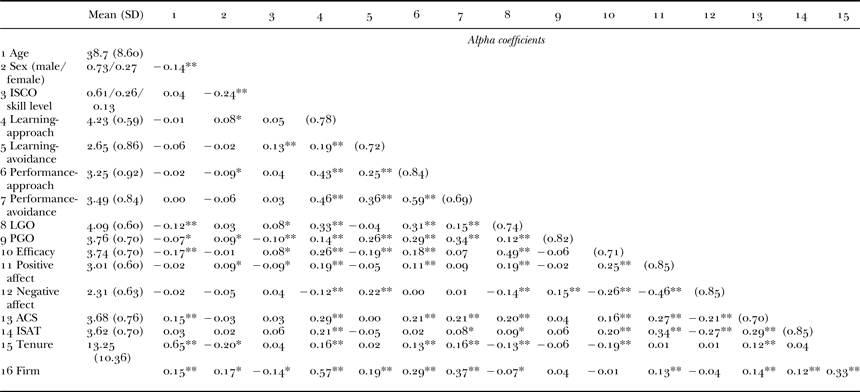
Table 1 displays descriptive statistics for all study variables (i.e. bivariate correlations, means, standard deviations and alpha coefficients). Bivariate correlations among the 2×2 classes of achievement goals were positive. This finding is in accordance with previous findings that goals are positively correlated (Elliot and Murayama Reference Elliot and Murayama2008) and reflect individual differences in achievement motivation. Unexpectedly, bivariate correlations between age and the 2×2 classes of achievement goals proved to be insignificant. The respective coefficients were mostly negative but not of a substantive magnitude. However, older employees scored lower on learning-goal and performance-goal orientation. Learning self-efficacy was significantly lower among older employees whereas age was uncorrelated with positive and negative affect at work. Age was also unrelated to intrinsic satisfaction with work tasks. But, in agreement with extant findings (Ng and Feldman Reference Ng and Feldman2010), age was associated with higher affective commitment. Older workers did not differ from their younger colleagues in skill level. But age was correlated with gender because the percentage of women who participate in the workforce tends to be lower in older cohorts. The three participating companies differed from each other with regard to the proportion of females employed, age, average skill level, motivational characteristics of work and average tenure of employment.
Inter-correlation matrix

Notes: SD: standard deviation. ISCO: percentage of participants working on International Standard Classification of Occupations skill levels 1/2, 3 and 4. LGO: learning-goal orientation. PGO: performance-goal orientation. ACS: affective commitment scale. ISAT: intrinsic satisfaction.
Significance levels: * p<0.05, ** p<0.01.
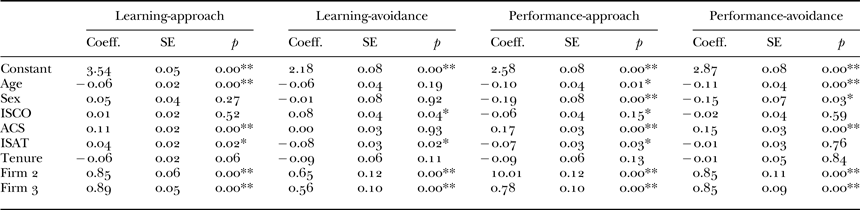
We used multivariate linear regression to test the expectation that age is negatively related to goal level (hypothesis 1). Table 2 displays results with goal level for the four classes of achievement goals serving as dependent variables. Age was associated with lower scores on each class of goals, but the effect of age on learning-avoidance was not significant. In conclusion, when controlling for variables that may confound the effects of age in a multivariate analysis, we found age differences in goal level that were not apparent in bivariate correlations. Goal levels were lower among older workers when gender, skill level and motivational characteristics of work were controlled. Affective commitment was related to a higher goal level. Female employees scored lower on the two classes of performance achievement goals. Controlling for firm membership proved to be appropriate since the average level of goals differed across firms.
Explaining goal level (2×2 framework of achievement goals)
Notes: Linear regression. Coeff.: fully standardised coefficient. SE: standard error of the coefficient. ISCO: complexity level. ACS: affective commitment scale. ISAT: intrinsic satisfaction. Firms 2 and 3 are dummy-coded control variables representing differences between the three firms in the sample.
Significance levels: * p<0.05, ** p<0.01 (two-tailed).
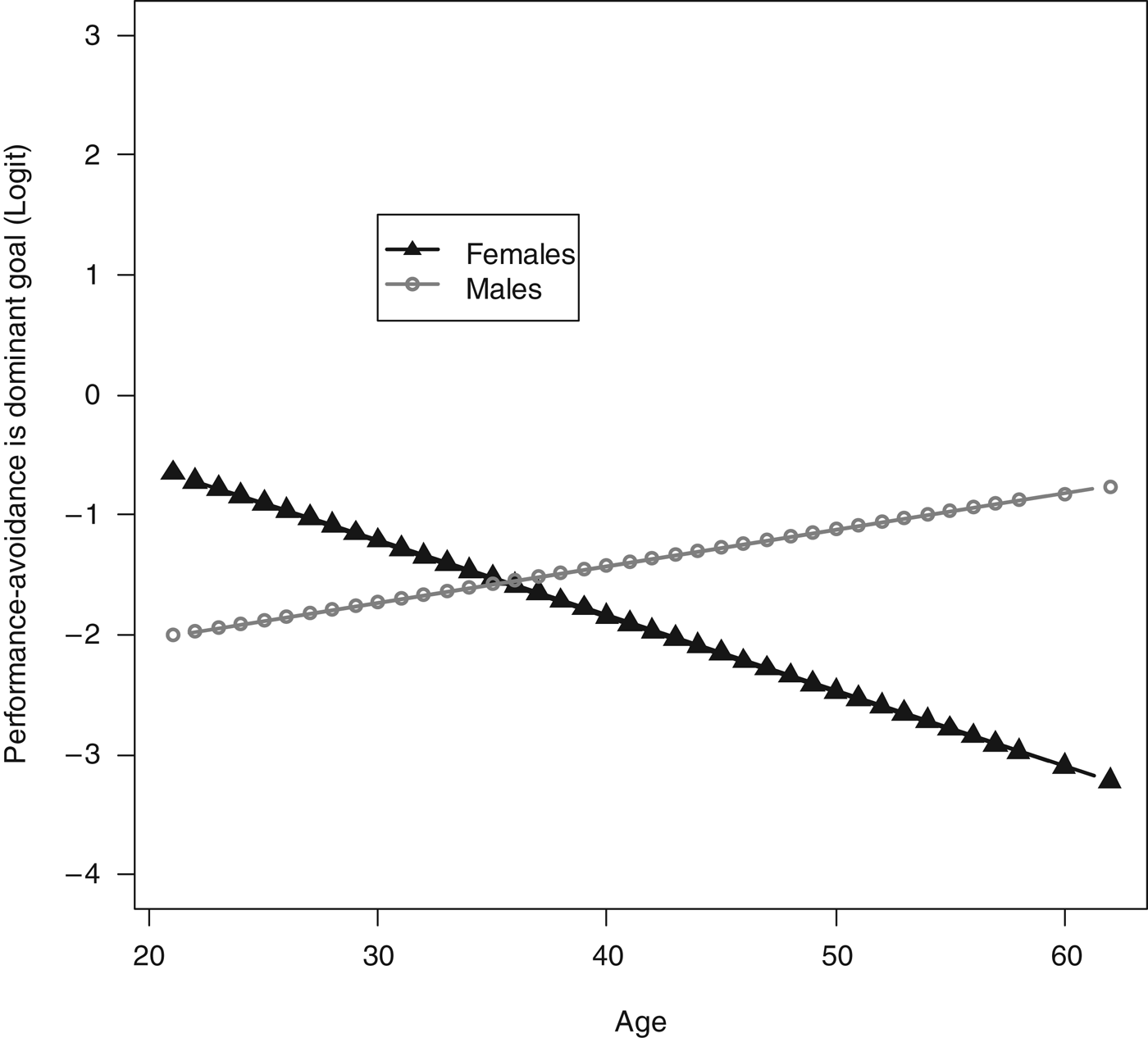
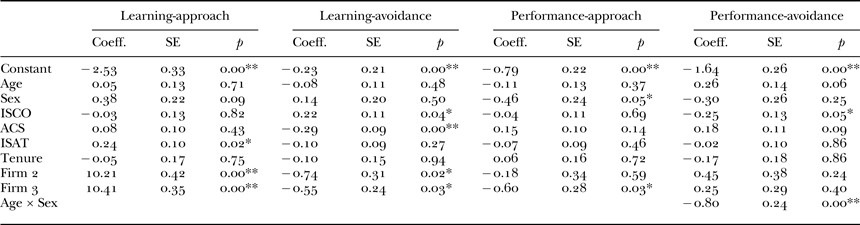
So far, we found evidence of systematic differences in the mean level of achievement goals. To examine dominant achievement goals, we examined the relative strength of the 2×2 classes of goals within individuals (for details, see Method section). Using logistic regression, we then tested whether age predicted dominant achievement goals while controlling for skill level, gender, employer and motivational characteristics of work. The results are given in Table 3. Age was unrelated to dominant learning-approach achievement goals. Only satisfaction with the opportunity to engage in intrinsically satisfying work was positively associated with dominant learning-approach achievement goals. We also did not find evidence that age was associated with dominant learning-avoidance achievement goals (hypothesis 2). Instead, dominant learning-avoidance achievement goals were more common among highly skilled workers and those who scored low on affective commitment to the workplace. Performance-approach achievement goals were more likely to be dominant goals among males but were unrelated to age. However, age was associated with dominant performance-avoidance achievement goals. Dominant performance-avoidance goals were more prevalent among older workers and males. Therein, we found a significant interaction of age and sex as predictors of dominant performance-avoidance achievement goals (Figure 1). Older males were the most likely to report dominant performance-avoidance achievement goals while women were less likely to adopt these goals with age. That is, overall, we found partial support for the expectation that avoidance achievement goals are positively associated with age (hypothesis 2). Dominant learning-avoidance goals were related to motivational characteristics of work rather than socio-demographic variables. Dominant performance-avoidance goals were related to both age and gender.
Age and sex interact to explain dominant performance-avoidance goals.
Explaining dominant achievement goals (2×2 framework of achievement goals)
Notes: Logistic regression. Dummies indicating whether a goal is dominant are the dependent variables. Coeff.: fully standardised coefficient (Logit). SE: standard error of the coefficient. ISCO: complexity level. ACS: affective commitment scale. ISAT: intrinsic satisfaction. Firms 2 and 3 are dummy-coded control variables representing differences between the three firms in the sample.
Significance levels: * p<0.05, ** p<0.01 (two-tailed).
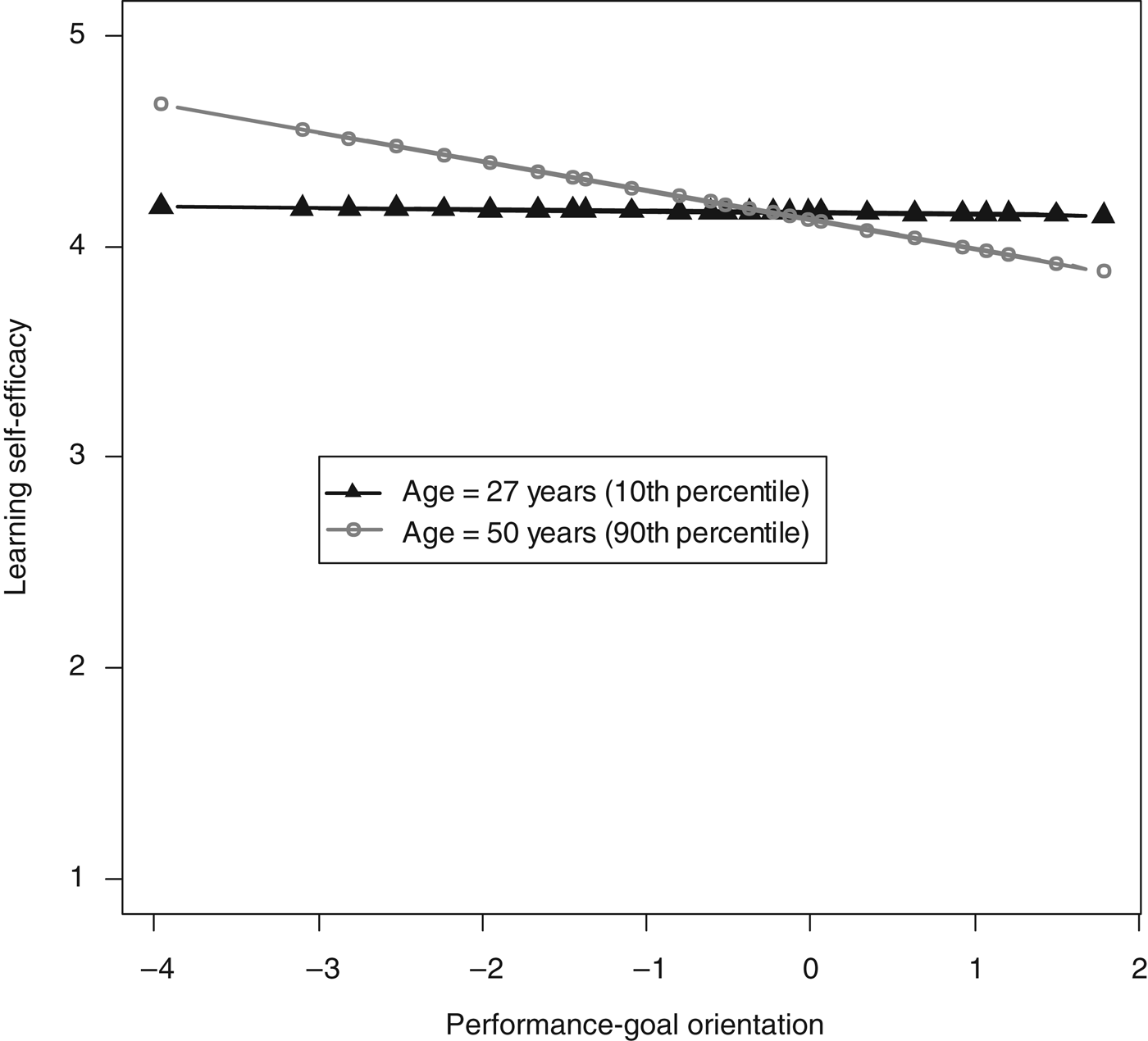
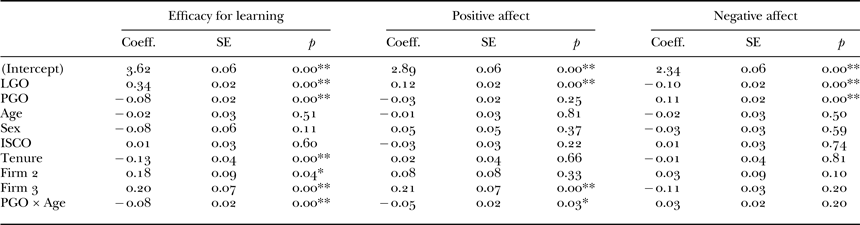
Finally, we tested whether a performance-goal orientation, which is related to believing in entity theory of intelligence, had more negative effects among older workers. Table 4 presents results of linear regression, with self-efficacy for learning and negative/positive affect at work being the dependent variables. As expected, a learning-goal orientation was associated with higher self-efficacy for learning (hypothesis 3a), whereas a performance-goal orientation had negative effects on self-efficacy (hypothesis 3b). Furthermore, and supporting hypothesis 3c, older workers' self-efficacy beliefs were more negatively affected by a performance-goal orientation than those of younger workers (see Figure 2). In the same manner, a performance-goal orientation interacted with age to predict positive affect in the workplace (hypothesis 3c). When negative affect at work was the dependent variable, age interacted with performance-goal orientation in the expected manner but the effect was too small to be significant (hypothesis 3c). That is, a performance-goal orientation had a larger negative impact on self-efficacy for learning and positive affective experiences at work among older employees.
Trait performance-goal orientation and self-efficacy for learning by age.
The effects of age and performance-goal orientation on self-efficacy for learning and affective wellbeing at work
Notes: Linear regression. Coeff.: fully standardised coefficient. SE: standard error of the coefficient. LGO: learning-goal orientation. PGO: performance-goal orientation. The effects of firms 2 and 3 are dummy-coded control variables.
Significance levels: * p<0.05, ** p<0.01 (two-tailed).
Discussion
Declines in performance with age are related to a gradual decline in fluid cognitive abilities over the lifespan (Schaie Reference Schaie1996). Fluid cognitive abilities, called ‘Gf’, are associated with working memory, processing speed, attention and the processing of novel information (Cattell Reference Cattell1987). Here, a decline in the neurophysiological basis of cognitive abilities gradually limits processing capacity with age. However, crystallised intellectual abilities can increase beyond middle-adulthood into old age. Crystallised intelligence, called ‘Gc’, is associated with general knowledge, vocabulary and comprehension (Cattell Reference Cattell1987). Due to potential growth in Gc, a decline in performance with age is not univocal. Older workers indeed have lower performance in job-related training (Kubeck et al. Reference Kubeck, Delp, Haslett and McDaniel1996). And a reduction of processing resources has a significant effect on the performance of older workers when there is a demand for effortful processing, such as the processing of new information. However, everyday job performance mostly depends on knowledge and expertise rather than speed and capacity (Ackerman Reference Ackerman1996, Reference Ackerman2000). This explains why job performance is often unrelated to age (Avolio, Waldman and McDaniel Reference Avolio, Waldman and McDaniel1990). But still, negative changes in cognitive resources point to the important role that motivation and incentives play in older workers' job performance. Motivation is more important for performance and learning when the resources needed to meet demands for effortful processing are increasingly limited. To investigate age differences in motivation, we examined the level and relative strength of four classes of achievement goals (the 2×2 framework). In these analyses, and because age serves as a proxy indicator of diverse age-related processes, we considered variables that may confound the relationship between age and achievement goals, including gender, skill level and one's tenure at the workplace. Furthermore, we examined whether motivational characteristics of work (i.e. affective commitment and the opportunity to engage in intrinsically satisfying tasks) compensate age-related losses in achievement motivation. Finally, we tested whether a performance-goal orientation, which has negative implications for control striving, has more negative consequences on self-efficacy for learning and affect at work, among older workers.
On-the-job learning and training are domains that give rise to age-related biases. In our sample, age was negatively related to self-efficacy for learning. According to Bandura (Reference Bandura and Ramachaudran1994), self-efficacy beliefs develop from four major sources: personal mastery experiences, social models, persuasion, and somatic as well as affective states. In the workplace, these sources are often less available to older workers (Maurer Reference Maurer2001). For instance, mastery experiences are denied to older workers if they are less likely to participate in training and development (Organisation for Economic Co-operation and Development (OECD) 2007; Warr and Birdi Reference Warr and Birdi1998), or are assigned less challenging tasks (Salthouse and Maurer Reference Salthouse, Maurer, Birren and Schaie1996). Additionally, both organisational activities and individual initiatives for career development and advancement are reduced for workers over 50 years old (van der Heijden Reference Van der Heijden2006; Taylor and Urwin Reference Taylor and Urwin2001). As a result, older adults are likely to have fewer mastery experiences and less opportunity to observe others of the same age to vicariously experience success. As a consequence, psychological resources that facilitate self-efficacy, such as the goals adults pursue in achievement settings, become increasingly important with age.
To investigate age-related differences in these goals, we examined goal levels and determined the relative strength of the 2×2 classes of achievement goals. Our finding that goal levels were negatively associated with age is in accord with previous evidence that achievement and growth become less relevant themes with age (Kanfer and Ackerman Reference Kanfer and Ackerman2004; Kooij et al. Reference Kooij, de Lange, Jansen, Kanfer and Dikkers2011). In our data, older employees scored significantly lower on three of the 2×2 classes of achievement goals. Only the negative effect of age on learning-avoidance was not significant. Thus, our data mostly support the notion that the average level of achievement motivation (i.e. goal level) is lower among older workers. Such a finding likely reflects age-related changes in developmental tasks and life situations (Salmela-Aro et al. Reference Salmela-Aro, Nurmi, Aro, Poppius and Riste1992). Until the 1960s, industrialised societies were characterised by a tripartite division of the lifecourse in three major stages: preparation for work, activity and retirement (Kohli Reference Kohli and Marshall1986). Despite a trend toward greater diversity and complexity in life paths, and a de-standardisation of women's life paths, in particular (Elzinga and Liefbroer Reference Elzinga and Liefbroer2007; Widmer and Ritschard Reference Widmer and Ritschard2009), implicit models of a uniform lifecourse still serve as a mental reference point for age-appropriate behaviour (Henretta Reference Henretta, Riley, Kahn, Foner and Mack1994), which may partly explain why the importance of achievement goals is negatively related to age.
Moreover, we investigated the relative strength of achievement goals within individuals to identify dominant goals (i.e. the relatively strongest goal). Unlike previous research (de Lange et al. Reference de Lange, Van Yperen, Van der Heijden and Bal2010), we did not find evidence that age was related to dominant learning-avoidance achievement goals. Instead, learning-avoidance achievement goals were more likely to be dominant goals among highly skilled individuals and those who reported low affective commitment to their work. That is, the fear that personal skills and knowledge could stagnate or deteriorate (i.e. learning-avoidance) was a concern among those who worked on more complex jobs and were thus more likely to experience high demands for skill updating. This finding matches previous evidence that learning goals have greater effects among those who work on complex tasks (Bell and Kozlowski Reference Bell and Kozlowski2002; Utman Reference Utman1997). A reason for this is that the effects of achievement goals mostly result from (mal)adaptive reactions to challenging situations or to failure (Dweck and Legett Reference Dweck and Leggett1988). Furthermore, to what extent workers experienced avoidance motivation with regard to learning depended on their affective commitment to work. That is, with low levels of affective commitment, learning activities were increasingly driven by the aim to avoid negative outcomes rather than to approach positive outcomes.
Complementing these findings, the likelihood that learning-approach was a dominant goal was positively related to intrinsic satisfaction with work tasks but not with age. Theory and results from developmental psychology may explain such a finding. Socio-emotional selectivity theory (Carstensen Reference Carstensen1992) posits that social goals are prioritised differently under temporal constraints: when people perceive time as limited they prefer emotionally meaningful goals over future-oriented goals (Carstensen Reference Carstensen1995; Carstensen, Isaacowitz and Charles Reference Carstensen, Isaacowitz and Charles1999; Fung and Carstensen Reference Fung and Carstensen1994). Similarly, the more limited time perspective of older workers may lead them to prioritise meaningful task engagement, and thus immediate emotional payoffs, over long-range outcomes.
Whereas dominant learning goals were unrelated to age, we found evidence that situations that involve excellence in comparison to others put older workers at a potential disadvantage. Older adults were more likely to endorse the most maladaptive of the 2×2 classes of achievement goals: performance-avoidance goals. The aim to avoid being outperformed by others was more likely a dominant goal among older workers. Such a finding puts older workers at risk, because performance-avoidance is associated with undesirable outcomes, including anxiety, lower self-set goals, and a reduced willingness to seek feedback (Payne, Youngcourt and Beaubien Reference Payne, Youngcourt and Beaubien2007). In particular, performance-avoidance goals may undermine self-efficacy beliefs (Gerhardt and Brown Reference Gerhardt and Brown2005). But more precisely, the relationship between age and performance-avoidance goals depended on gender. Older males were at the comparatively highest risk of adopting performance-avoidance goals in competence-related settings. Older female employees, by comparison, were actually less likely to endorse performance-avoidance goals than their younger female colleagues. Social role theory may explain such a finding. Social roles are consensual perceptions of qualities that are desirable for each sex. Expectations about ideal behaviour of men reflect men's occupancy of breadwinner and higher-status roles and pertain to agentic more than communal attributes (Eagly and Karau Reference Eagly and Karau2002; Eckes Reference Eckes1994). Agentic qualities, such as ‘ambitious’, ‘dominant’ and ‘independent’, are ascribed more strongly to men. Communal qualities, which involve a concern for the wellbeing of others, are ascribed more strongly to women (Eagly and Karau Reference Eagly and Karau2002). Thus, the beliefs people hold about ideal behaviours for each sex may explain males' greater inclination to define achievement in terms of excellence relative to others. Indeed, in our sample, men scored higher on both classes of performance goals, performance-approach and performance-avoidance, and were more likely to adopt dominant performance goals. With age, these performance goals may be increasingly driven by the wish to avoid being outperformed by others.
Eventually, we found evidence that trait performance-goal orientation had indeed more adverse effects among older workers. Age moderated the effect of a performance-goal orientation on self-efficacy for learning and positive affect (but not negative affect) at work. Aiming for high performance in comparison with others, as is implied by a performance-goal orientation, was less detrimental to self-efficacy and positive affect for younger workers. Conversely, at higher age, a performance-goal orientation affected self-efficacy and positive affect more negatively. To explain this finding, we referred to the fact that performance-goal orientation is partly rooted in entity theory of intelligence (Dweck Reference Dweck1986; Dweck, Hong and Chiu Reference Dweck, Hong and Chiu1993). Entity theory implies that ability is perceived to be fixed rather than malleable. As a consequence, performance-oriented individuals are more likely to make attributions to low ability rather than external forces in the face of difficulty. Importantly, such a tendency may become increasingly problematic for effective functioning with age. External attributions facilitate strategies of secondary control (e.g. detachment from blocked goals, flexible engagement in attainable goals), which become more relevant for effective goals striving with age (Brandtstädtter and Renner Reference Brandtstätter and Renner1990; Heckhausen and Schulz Reference Heckhausen and Schulz1995). Furthermore, believing in ‘entity theory of ability’ is also related to higher degrees of social stereotyping (Levy, Stroessner and Dweck Reference Levy, Stroessner and Dweck1998). As a result, older adults who endorse a performance-goal orientation may have greater perceptions of social stereotyping and may also engage in more negative self-stereotyping (Gordon and Arvey Reference Gordon and Arvey2004).
Finally, an action-theory perspective may contribute to explaining why a performance-goal orientation affects self-regulation more negatively with age. The model of selection, optimisation and compensation (SOC; see e.g. Baltes Reference Baltes1997; Freund and Baltes Reference Freund and Baltes1998) describes strategies of goal selection that promote a successful adaptation to negative age-related changes. The SOC model defines selection as choosing goals and setting priorities. Optimisation refers to the refinement of the means used to attain the selected goals, while compensation refers to the use of alternative means in the face of limited resources. Compensation typically involves creative solutions to everyday tasks using external means (e.g. wearing glasses) and seeking help from others. Within this model of optimal resource use, a performance-goal orientation may be increasingly maladaptive with age because it interferes with SOC strategy use. In particular, employees who score high on performance-goal orientation may fail to use strategies of compensation, such as creative alternative means and help-seeking (Butler and Neuman Reference Butler and Neuman1995; VandeWalle et al. Reference VandeWalle, Ganesan, Challagalla and Brown2000). If older workers shy away from strategies of compensation because these strategies are incommensurate with their aim to ‘demonstrate’ performance in the presence of others, this may have adverse effects on effective functioning in competence-relevant settings.
Implications for research and practice
The finding that age was unrelated to goal level when skill level and motivational characteristics of work were not controlled has implications for research and practice. When we controlled for affective commitment and intrinsic motivation, older workers had lower values on three of the four achievement goal scales. That is, older workers' more positive work attitudes compensated for age-related decline in general achievement motivation. Given that age-related losses in fluid cognitive abilities are inevitable, identifying compensatory processes is of great interest. An ageing workforce will require organisations to pay attention to two broad categories of compensating factors: knowledge and experience, on the one hand, and motivation, on the other hand. Therein, we provided evidence that age-related changes in the relative importance of motivational themes, such as achievement and growth, can be compensated for by older workers' more positive work attitudes. Moreover, the fact that intrinsic motivation and emotionally meaningful goals become more important with age (Carstensen Reference Carstensen1995; Kooij et al. Reference Kooij, de Lange, Jansen, Kanfer and Dikkers2011) is of particular relevance for managing highly skilled workers. Present findings suggest that if the expression of intrinsic motivation at work is limited, skilled workers may run the risk of adopting learning-avoidance achievement goals – which have negative consequences for performance and wellbeing. Such findings may stir renewed interest in the mechanisms that explain older workers' higher affective commitment and intrinsic motivation, including characteristics of the work environment, task demands as well as successful career paths. An underlying aim for research and practice is to foster individual and organisational initiatives that keep opportunity for career development and advancement available to workers over 50 years of age. Furthermore, our analysis of dominant achievement goals suggests that organisations may be wary of factors in the work environment that promote performance goals (i.e. excellence in comparison to others; demonstrating performance in the presence of others). Many business settings embrace competition and may thus unwittingly promote performance goals among workers (Heidemeier and Bittner Reference Heidemeier and Bittner2012). This may be of concern in an ageing workforce, particularly in view of evidence that the potentially maladaptive effects of performance goals become larger with age. Older workers – and older male workers, in particular – may become increasingly motivated to avoid situations of competitive excellence.
Limitations and future research
One of the primary limitations of this study is that we examined a cross-sectional sample that was not representative of the general population of working adults. Most notably, our sample was recruited from a predominantly male industry. Although participants were from three different firms and diverse occupational groups, contextual factors may have influenced the social identity of the women we sampled (cf. Swan and Wyer Reference Swan and Wyer1997). Accordingly, we do now know to what extent our findings regarding the relationships between gender and achievement goals generalise to other samples. Indeed, future research may investigate whether contextual factors such as gender composition influence the achievement goals that individuals adopt. Furthermore, as our analysis was based on cross-sectional data, we reported results on inter-individual differences rather than within-person change over time. Longitudinal data on achievement goals that cover a large age range are scarce, however. We were also not able to consider cohort differences, which might have provided additional insight into the relationship between age and achievement motivation. In conclusion, we hope that knowledge of age-related differences in the motivational preconditions of achievement may contribute to managing an ageing workforce successfully. Our findings suggest that de-emphasising competition, fostering positive job attitudes and the opportunity to engage in intrinsically satisfying work may compensate for age-related declines in motivational themes that are related to excellence and achievement.
Acknowledgements
This work was supported by the German Ministry of Education and Research, and the European Social Fund (grant number 01 FA0712).