Introduction
The coronavirus disease 2019 (Covid-19) pandemic started in December 2019 in Wuhan, in the Hubei province of China, and quickly spread all over the world.Reference Li, Guan, Wu, Wang, Zhou and Tong1 Severe acute respiratory syndrome coronavirus-2 (SARS-CoV-2) is responsible for Covid-19, and the most important route of transmission is through respiratory droplets. Since the beginning of the pandemic, efforts have been made to prevent its spread, and one of the major and most effective measures is the use of face masks.Reference Li, Liang, Gao, Ayaz Ahmed, Uy and Cheng2 In our country (Turkey) and elsewhere, mask-wearing and social distancing have been made compulsory through the laws enacted after the beginning of the pandemic.
Widespread mask use has resulted in mask-related problems in the community. It has been observed that individuals seek healthcare because of mask-related symptoms or they avoid wearing masks. Thus, there is a need for research on the problems related to mask-wearing.
This study aimed to investigate symptoms related to mask-wearing, to put forward precautions in order to reduce the unwanted effects of mask-wearing, and to shed light on the ease of mask use during the pandemic.
Materials and methods
A questionnaire was developed by five senior otorhinolaryngologists from a university hospital. Questions were formed according to the clinical problems observed in otorhinolaryngology practice during the coronavirus pandemic.
The population of this analytical and cross-sectional study consisted of medical school students, academics from a medical faculty, hospital staff (nurses, technicians, secretaries and physicians), and individuals aged over 18 years who presented to the ENT out-patient clinic with non-otological or non-rhinological symptoms. Individuals aged under 18 years, those with known dermatological disorders (e.g. psoriasis, pemphigus), those on immunosuppressive therapy, patients with external auditory canal or auricle deformities, patients with cancer, and individuals who had nasal breathing problems before the pandemic (e.g. allergic rhinitis, nasal septal deviation, nasal polyps, chronic rhinosinusitis) were excluded. The Mugla Sitki Kocman University School of Medicine ethical review board approved the study (approval number: 2021-2/I).
Because of pandemic measures and transmission risks, instead of face-to-face interviews, the data in our study were collected using an online questionnaire that was e-mailed to the participants, determined from the contact lists of the hospital and the university. Informed consent forms were also sent by e-mail. The volunteers completed the questionnaires, which consisted of 26 multiple-choice questions, including their demographic data. We also asked open-ended questions about the most bothersome problems associated with mask-wearing. Participants who did not complete the questionnaire were excluded from the study.
The demographic data, the types of masks used, hours of daily use, symptoms resulting from mask use, and the main issues experienced while wearing masks were recorded. Symptoms of earache, ear itching, difficulties in nasal breathing, nasal itching, difficulty in understanding speech and difficulties in expressing oneself were included in the 26-item questionnaire. The answers were recorded as ‘I have no symptoms’ or ‘I have symptoms’.
The data were statistically analysed using SPSS for Windows software, version 22.0 (SPSS, Chicago, Illinois, USA). Summary statistics are expressed as percentages and frequencies. The chi-square test was used to determine the relationship between the categorical variables. A p-value of ≤ 0.05 was considered statistically significant.
Results
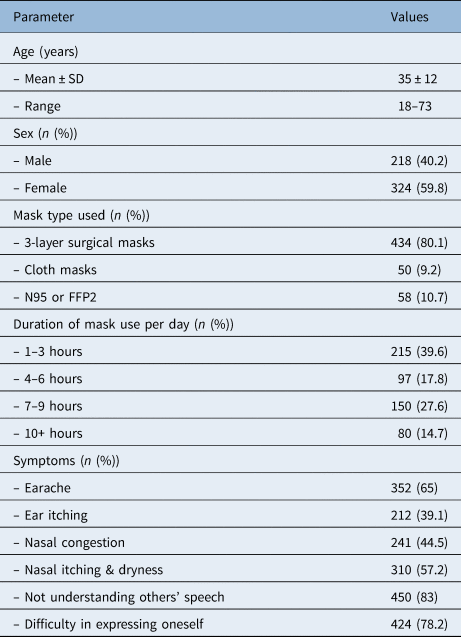
Among the 576 volunteers who completed the questionnaire, 542 individuals who wore masks and who completed the questionnaire in full were included in the study. The mean age (± standard deviation) of the participants was 35 ± 12 years (range, 18–73 years), and there were 218 (40.2 per cent) men and 324 (59.8 per cent) women (Table 1).
Study population demographics, type of face mask worn and duration of use

Total n = 542. SD = standard deviation; FFP2 = filtering facepiece code 2
The daily mask-wearing time reported by the 542 volunteers was: 1–3 hours, in 215 (39.6 per cent); 4–6 hours, in 97 (17.8 per cent); 7–9 hours, in 150 (27.6 per cent); and 10 hours or more, in 80 participants (14.7 per cent). The most common masks worn, in rank order, were three-layer surgical ear loop masks (n = 434, 80.1 per cent), followed by N95 or filtering facepiece code 2 (FFP2) masks (n = 58, 10.7 per cent), and cloth masks (n = 50, 9.2 per cent). A total of 224 individuals (41.3 per cent) were wearing double masks, and 10 individuals (1.8 per cent) were wearing three or more masks on top of each other. Of the individuals, 187 were wearing two surgical masks on top of each other. Thirty-eight individuals were wearing a three-layer surgical mask over N95 or FFP2 masks.
The open-ended questions regarding the most bothersome problems that participants experienced during mask-wearing highlighted the following issues: difficulty breathing, in 227 (41.8 per cent); nasal itching and pain, in 93 (17.2 per cent); earache, in 88 (16.2 per cent); difficulty in expressing oneself, in 73 (13.5 per cent); difficulty in understanding speech, in 56 (10.3 per cent); and ear itching, in 5 participants (0.9 per cent).
The questionnaire results for pain experienced behind the ear while wearing a mask revealed that 190 volunteers (35 per cent) had no pain and 352 (74.2 per cent) had pain. Of the 352 volunteers with pain, 194 had minimal pain, 136 had moderate pain and 22 had severe pain. Wearing more than one mask resulted in significantly more pain behind the ear compared with wearing a single mask (p < 0.001).
The duration of earache was less than 1 hour in 235 participants (43.3 per cent), 1–3 hours in 69 participants (12.7 per cent), 3–6 hours in 12 participants (2.2 per cent) and all day long in 36 participants (6.6 per cent); 192 individuals (35 per cent) indicated that they had no pain at all. When itching around the ears was analysed, it was determined that 330 individuals (60.8 per cent) did not have itching, but 212 individuals (39.1 per cent) did have itching. There was no statistically significant difference in terms of itching between those who wore more than one mask and those who wore a single mask (p = 0.325). Ninety-two volunteers (16.7 per cent) did not want to wear a mask or had to take it off frequently because of ear pain or itching. Interestingly, 55 participants (10.1 per cent) reported changes in ear shape after they started wearing masks.
One of the problems related to mask-wearing was communication; 118 participants (21.7 per cent) had no difficulties in expressing themselves, whereas 424 (78.2 per cent) had such difficulties. Of the participants, 450 (83 per cent) had problems in understanding the speech of a masked person, and 92 volunteers (16.9 per cent) had no problems. As the duration of mask-wearing increased, both the difficulty in understanding speech and the difficulty in expressing oneself increased significantly (p = 0.009 for both).
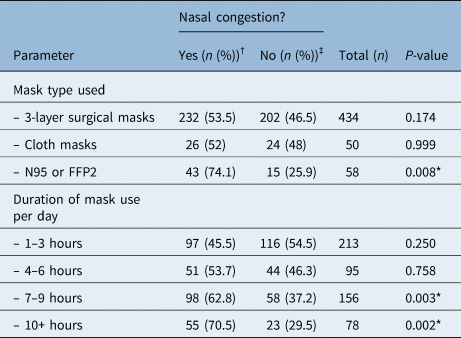
The primary mask-related symptoms experienced by the volunteers were nasal congestion, itching and dryness. Nasal obstruction was an issue for 301 participants (55.5 per cent); 241 participants (44.4 per cent) did not report nasal obstruction. This symptom was significantly more frequent in those wearing semi-respiratory masks (N95 or FFP2) (p = 0.008). Nasal obstruction was more frequent in individuals wearing semi-respiratory masks (N95 or FFP2) compared with those wearing three-layer surgical masks (p = 0.003). Nasal congestion was significantly more common in individuals who wore masks for 7 hours or more per day (p = 0.003 for 7–9 hours; p = 0.002 for 10 hours or more) (Table 2).
Face mask type and duration of use in relation to nasal congestion
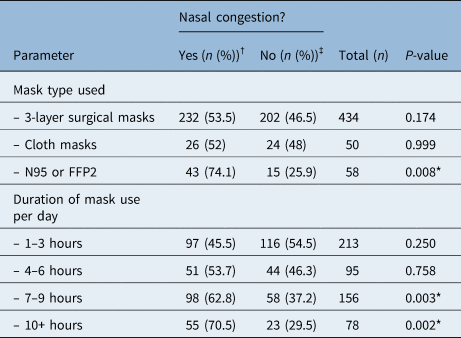
*Indicates significant difference. †n = 301; ‡n = 241. FFP2 = filtering facepiece code 2
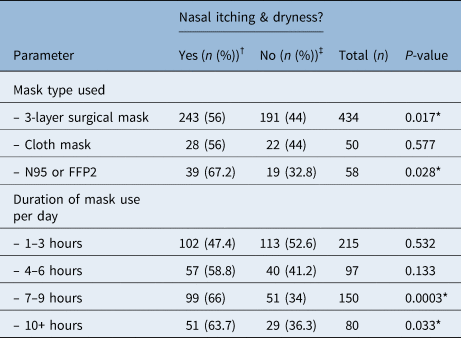
Among the 542 volunteers, 310 (57.2 per cent) experienced nasal itching and dryness. Nasal itching and dryness were significantly more frequent in those wearing three-layer surgical masks (p = 0.017), followed by participants wearing semi-respiratory masks (N95 or FFP2) (p = 0.028). Nasal itching and dryness were significantly more frequent in those who wore masks for 7 hours or more per day (p = 0.0003 for 7–9 hours; p = 0.033 for 10 hours or more) (Table 3).
Face mask type and duration of use in relation to nasal itching and dryness

*Indicates significant difference. †n = 310; ‡n = 232. FFP2 = filtering facepiece code 2
Discussion
Our results indicated that the most frequently used masks during the pandemic were three-layer surgical masks, followed by N95 or FFP2 masks. It was determined that the most bothersome problems experienced with mask-wearing were: difficulty in breathing (41.8 per cent), nasal itching and pain (17.2 per cent), earache (16.2 per cent), difficulty in expressing oneself (13.5 per cent), difficulty in understanding others (10.3 per cent), and ear itching (0.9 per cent).
Three-layer surgical masks are the most widely used personal protective equipment in the Covid-19 pandemic all over the world. N95 and filtering facepiece masks, on the other hand, are more difficult to use, but they provide greater protection and are suitable for use by healthcare professionals. Cloth masks are inexpensive, easy to access and easy to use. Research indicated that the protection afforded by homemade cloth masks against viral infections was three times lower than with microfibre surgical masks.Reference Davies, Thompson, Giri, Kafatos, Walker and Bennett3 Therefore, their use is limited worldwide. In this study, the rate of cloth mask use was determined as 9.2 per cent.
Nasal congestion and itching have been reported as the most frequent symptoms in individuals wearing masks. Recently, Monini et al. reported that individuals wearing surgical masks reported nasal obstruction subjectively; however, thanks to various compensation mechanisms, there was no significant change in objectively measured nasal airflow caused by mask-wearing.Reference Monini, Meliante, Salerno, Filippi, Margani and Covelli4
In a recent study, on 46 patients, a new form of irritant rhinitis associated with N95 mask use was reported; in addition to congestion of the nasal mucosa, there was an increase in sneezing, for which the polypropylene fibres in the mask were blamed.Reference Klimek, Huppertz, Alali, Spielhaupter, Hormann and Matthias5 In our study, nasal congestion was significantly more frequent in respiratory mask wearers. The participants wearing semi-respiratory masks (N95 or FFP2) had nasal congestion more frequently than those wearing three-layer surgical masks (74.1 per cent vs 53.5 per cent). Symptoms of nasal congestion increased significantly with mask use duration of 7 hours or more per day (p < 0.005).
An itchy nose was reported as a frequent symptom in healthcare workers during the Covid-19 pandemic.Reference Purushothaman, Priyangha and Vaidhyswaran6 Similarly, in our study, we found that nasal itching and dryness were frequent, and were significantly more common in three-layer surgical mask and respiratory mask wearers (p = 0.017 and p = 0.028, respectively). Moreover, we found that reports of an itchy and dry nose increased as the duration of mask-wearing increased (Table 3). Contrary to the increase in nasal symptoms in mask-wearers, it was reported that symptoms of nasal itching and discharge decreased in patients with allergic rhinitis who wore masks during the pandemic.Reference Dror, Eisenbach, Marshak, Layous, Zigron and Shivatzki7,Reference Mengi, Kara, Alpturk and Topuz8
No reports to date have comprehensively investigated earache and ear itching caused by mask-wearing. We found that 74.7 per cent of mask-wearers had earache of various intensities. Pain intensity was greater in the group wearing more than one mask. The rate of itching around the ears was 39.1 per cent among the mask wearers. In addition, 16.7 per cent of the participants stated that they did not want to wear a mask, or had to take it off frequently because of ear pain or itching. Symptoms were more common in those who had to wear masks for a long time (7 hours or more). Szepietowski et al. reported that face itching was more frequent in individuals wearing masks and that this was more common in atopic individuals.Reference Szepietowski, Matusiak, Szepietowska, Krajewski and Bialynicki-Birula9 This was also reported as an important reason for avoiding face mask use.
Instead of wearing multiple masks, wearing masks containing more than three layers, and using masks with softer and looser rubber ear loops may be recommended, to reduce symptoms of ear pain and itching. Jiang et al. suggested that plastic handles positioned over the occipital region that hold the ear loops of the mask avoided the problems caused by the pressure effect of the ear loop masks on the ear.Reference Jiang, Cao and Liu10
Various communication difficulties are experienced while wearing masks. Masks act as an acoustic filter; this causes someone talking to speak more loudly. It has been observed that mask use results in a 3–12 dB decrease in voice intensity, particularly in high frequencies, depending on their type.Reference Heider, Alvarez, Fuentes-Lopez, Gonzalez, Leon and Verastegui11 In our study, 83 per cent of participants reported difficulties in understanding the speech of another masked person. In addition, 78.2 per cent of the participants reported difficulties in explaining themselves to others. A recent study found distinguishing speech to be a frequent problem in patients with hearing loss because of the muffled voice and an inability to see the lip movements of mask-wearing individuals; the use of transparent masks and alternative communication methods were emphasised as solutions.Reference Naylor, Burke and Holman12,Reference Homans and Vroegop13 The high rates of communication problems detected in our study show that mask-wearing causes serious communication problems.
• The most bothersome problem experienced during mask-wearing was difficulty in breathing
• During the pandemic, communication problems increased with mask use
• Most participants had difficulties expressing themselves and problems in understanding speech of a masked person
• Nasal congestion and itching, ear pain and itching, and difficulty in understanding speech may result in avoidance of mask-wearing
• There is a need for new methods to reduce problems related to mask use, to increase their use in the community
Our study has some limitations. First, because this is a survey-based study, physical examination findings, as well as objective tests for nasal obstruction, are lacking. Physical examination findings could have been useful, particularly in those reporting earache, and objective tests of nasal patency before and after mask-wearing would have be useful in individuals reporting nasal obstruction.
Conclusion
Mask-wearing has been one of the most important methods of personal protection during the Covid-19 pandemic. In this study, the most bothersome symptoms caused by mask-wearing were nasal congestion and itching, ear pain and itching, and difficulty in understanding speech. These problems have a negative impact on quality of life, and have an additional financial burden associated with seeking healthcare. Another issue that should not be overlooked during the pandemic is the communication problems caused by mask-wearing, which may result in the avoidance of mask-wearing. Thus, there is a need for new methods that will reduce the problems associated with mask use and hence increase their utilisation within the community. Lastly, studies on voice problems, including the exacerbation of existing issues, may be useful, because wearing masks may lead to improper use of a loud voice.
Competing interests
None declared