Introduction
The growth in lone parenthood in recent decades, the common representation of lone mothers as ‘problematic’ and the role of social policy in relation to lone parents have been widely researched (Kiernan et al., Reference Kiernan, Land and Lewis1998; Lewis, Reference Lewis, May, Page and Brunsdon2001). International comparisons abound, often exploring lone mothers’ dual position as both mothers and potential workers (Duncan and Edwards, Reference Duncan and Edwards1997; Ford and Millar, Reference Ford and Millar1998; Millar and Rowlingson, Reference Millar and Rowlingson2001). The preoccupation among social policy analysts with lone parenthood has been argued to be a particular concern of the English-speaking countries (Lewis, Reference Lewis1997) and to be tied up with high poverty risks and low employment rates among lone mothers in these countries (Bradshaw, Reference Bradshaw, Ford and Millar1998; Pedersen et al., Reference Pedersen, Weise, Jacobs, White, Gallie and Paugam2000), and with a consequent focus on their use of income-related benefits or ‘welfare’ (Land and Lewis, Reference Land, Lewis, Ford and Millar1998).
Concerns with the poverty of lone parents have been closely related to political concerns about the use of welfare and costs to the state of maintaining lone mothers. In the US the former main income-related benefit, Aid to Families with Dependent Children (AFDC), was primarily used to support lone mothers. These lone mothers became the focus of welfare reform initiatives and the consequent transformation of AFDC into Temporary Aid for Needy Families (TANF) in 1997 (Ellwood, Reference Ellwood, Leisering and Walker1998). In the UK, while lone mothers have made up only a small proportion of the overall benefits bill (McKay and Rowlingson, Reference McKay and Rowlingson1999), a high proportion of lone parents have tended to be supported by the means-tested benefit, income support (Department for Work and Pensions, 2007a; Gregg et al., Reference Gregg, Harkness and Machin1999), resulting in a high level of policy interest. Moving lone mothers off benefit into work was a plank of welfare reform initiated in the 1990s, and continues in current proposals (Department for Work and Pensions, 2006a, 2007b). This is despite some increase in the employment rates of lone mothers over the last few years (Department for Work and Pensions, 2006b) and some reduction in their use of means-tested benefits and in their risks of poverty (Department for Work and Pensions, 2005a). Lone mothers have shown a greater tendency to take up part-time work, following the changes to the benefit system to support moves into work, although there is some regional variation (McKay, Reference McKay2004). However, lone mothers who leave benefit will not necessarily move into work. Partnership provides another route off means-tested benefits and, potentially though not necessarily, out of poverty (Bradshaw and Millar, Reference Bradshaw and Millar1991; Ermisch et al., Reference Ermisch, Jenkins, Wright and Duskin1990). Conversely, moves into work do not necessarily mean moves out of low income or off means-tested benefits (Millar and Gardiner, Reference Millar and Gardiner2004); although work of 16 hours or more, bringing with it entitlement to working tax credits, will tend to mean that lone parents’ incomes will be above the standard low-income cut-off, even if deprivation indicators suggest that they may still suffer higher rates of hardship than their incomes would suggest (Brewer et al., Reference Brewer, Muriel, Phillips and Sibieta2008).
In terms of families’ – and children's – well-being, it is increasingly recognised that it is the length of time spent poor that matters (Bradbury et al., Reference Bradbury, Jenkins and Micklewright2001; Hill and Jenkins, Reference Hill, Jenkins, Bradbury, Jenkins and Micklewright2001; Walker and Ashworth, Reference Walker and Ashworth1994). Moreover, it has been persuasively argued that a focus on poverty durations and exits shifts the policy focus from ameliorating the outcome, by, for example, provision of means-tested benefits, to focusing on the causes, and thus promoting exits from poverty or preventing people from becoming poor in the first place (Ellwood, Reference Ellwood, Leisering and Walker1998; Jenkins, Reference Jenkins2000; Jenkins and Micklewright, Reference Jenkins, Micklewright, Jenkins and Micklewright2007). Since Bane and Ellwood's (Reference Bane and Ellwood1986) important analysis of poverty spells using the US Panel Study of Income Dynamics, there has been a wide range of papers emulating and extending their approach and exploiting the burgeoning of longitudinal data sources across countries to estimate low-income durations (see the summary in Jenkins and Micklewright, Reference Jenkins, Micklewright, Jenkins and Micklewright2007). Longitudinal measures are included in the UK's annual monitoring of poverty targets (Department for Work and Pensions, 2006b) as well as in official low-income statistics (Department for Work and Pensions, 2007a).
Understandings of welfare use and welfare ‘dependence’ have also been transformed by a dynamic approach (Department for Work and Pensions, 2006a). The growth in evidence on poverty dynamics has been echoed by the development of welfare dynamics research, with studies analysing the times spent on benefit for different types of claimant and variations in their chances of leaving benefit at any given time (Ashworth et al., Reference Ashworth, Middleton and Walker1997; Ball and Wilson, Reference Ball and Wilson2002; Barrett et al., Reference Barrett, Krsinich and Wilson2003; Blank and Ruggles, Reference Blank and Ruggles1994; Evans et al., Reference Evans, Harkness and Ortiz2004; Noble et al., Reference Noble, Cheung and Smith1998a; Pavetti, Reference Pavetti1993; Platt, Reference Platt2006b; Shaw et al., Reference Shaw, Walker, Ashworth, Jenkins and Middleton1996). As with poverty dynamics, it is argued that a longitudinal approach to welfare receipt leads to a focus on potential triggers to move off benefit support (Bane and Ellwood, Reference Bane and Ellwood1994).
In the UK, despite considerable anxiety over the past few decades about the growth in lone parenthood, the discussion of lone parenthood and welfare dependence has not been racialised in the way that it has been in the US, where lone parenthood has been associated with a response to structural unemployment that particularly affects Black communities (Wilson, Reference Wilson1987) and where welfare dependency has been presented as a component of a developing and predominantly Black underclass that is out of touch with norms of employment and individual responsibility (Murray, Reference Murray1984). This is not to say, however, that there has not been substantial interest in differential patterns of family formation across ethnic groups and the diversity between minority groups in the UK (Berrington, Reference Berrington1994; Berthoud and Beishon, Reference Berthoud, Beishon, Modood, Berthoud, Lakey, Nazroo, Smith, Virdee and Beishon1997). There is substantial research on the prevalence of different family forms across groups, with substantial attention being paid in both qualitative and quantitative literature to the high rates of lone parents among Black Caribbeans. In 2001, nearly 50 per cent of Black Caribbean households with dependent children were lone parent households, with 36 per cent of Black African households being in this position. This compared with 22 per cent of White households and, only 13 per cent of Pakistani households and 10 per cent of Indian households with dependent children being lone parent households (Connolly and Raha, Reference Connolly, Raha, Dobbs, Green and Zealey2006). It has been argued that, following on from these differences in distributions, the discourse surrounding lone parents in general problematises Black mothers in particular (Reynolds, Reference Reynolds2005).
Nevertheless, we would argue that the question of Black lone parenthood has not been directly linked to issues of welfare dependency as it has in the US. Indeed, it is more frequent that the relatively high rate of Black Caribbean mothers who are in employment is used to frame discussions of lone parenthood (Reynolds, Reference Reynolds2001): despite high rates of lone motherhood, Black Caribbean women have the highest full-time employment rates of any ethnic group (Platt, Reference Platt2007).
Much less attention has been paid to lone parents from groups where they are more of a rarity, such as Pakistani and Indian lone parents, although we do know that there is variation in lone parents’ characteristics according to ethnicity in age, number of children, whether widowed, divorced or never married and so on (Berrington, Reference Berrington1994). The reasons for differences within and between family forms across ethnic groups have been discussed in a framework that predominantly stresses cultural difference and historical antecedents. Although there has been some evidence of trends and changes over time in patterns of family form and structure, with a rapid increase in the 1990s (from a very low base) in lone parenthood among those groups where it is least common, the representation of family forms is still distinctive across groups. It is diversity which has come to dominate discussions of the UK's minority ethnic groups, and this also extends to discussion of poverty risks (Berthoud, Reference Berthoud, Loury, Modood and Teles2005; Clark and Drinkwater, Reference Clark and Drinkwater2005; Modood et al., Reference Modood, Berthoud, Lakey, Nazroo, Smith, Virdee and Beishon1997; Platt, Reference Platt2007).
Berthoud (Reference Berthoud, Loury, Modood and Teles2005) linked these two aspects of diversity in family forms and poverty risks, by associating lone parenthood with higher poverty rates among Black Caribbeans, and large families with the high rates of poverty among Pakistanis and Bangladeshis. However, it is also clear that above-average poverty rates and differences in poverty between them cannot be solely understood as stemming from patterns of family formation (Iacovou and Berthoud, Reference Iacovou and Berthoud2006). Instead, discussion of ‘ethnic penalties’ has been used to indicate the extent to which there is unexplained divergence in outcomes between ethnic groups on a range of measures, and in particular between the various minorities and the majority (Heath and McMahon, Reference Heath, McMahon and Karn1997).
While we would concur with Heath and Yu (Reference Heath, Yu, Heath, Ermisch and Gallie2005) that we should not attempt to explain away all differences in disadvantage between ethnic groups on the assumption that we have simply to find better explanatory variables to account for it, we do think that an approach which focuses on constraining as many contextual factors as possible is potentially fruitful in helping us to understand the nature of ethnic group differences and sources of disadvantage. It has been argued that engaging in comparisons between ethnic groups often presupposes that differences found between groups can be ‘explained’ in some way by ethnicity. However, the resort to culturally deterministic interpretations of ethnic differences is increasingly being challenged (Ahmad, Reference Ahmad, Kelleher and Hillier1996; Fenton, Reference Fenton2003; Jenkins, Reference Jenkins1994; Mirza and Sheridan, Reference Mirza and Sheridan2003). Nevertheless, there is little research that has explicitly compared the outcomes for a comparable population group by ethnicity to attempt to unravel how far chances and limitations are common or different. This article aims to do just that by narrowing the gaze to lone parents and looking within that group at those who claim benefit and comparing their chances of benefit exit. By these means, we hope to clarify the extent to which those in similar circumstances do face different or similar barriers to moving off benefit and consequently the potential role of group-specific policies in improving outcomes for some of the most disadvantaged.
A further difficulty in understanding ethnic minority disadvantage has been the difficulty of disentangling area effects from ethnic group ‘effects’, due to the relative concentration of minority groups in different relatively disadvantaged areas (Clark and Drinkwater, Reference Clark and Drinkwater2002; Simpson et al., Reference Simpson, Purdam, Tajar, Pritchard and Dorling2006). One way of treating this issue is to explore ethnic group experience within a single town, as we do here, where local labour market variation is, therefore, held constant.
However, this study does not assume that movement off benefits necessarily implies a subsequent movement into paid employment, or increases in hours or pay for those already in work. The main alternative is that women repartner or that family income changes through children ceasing to be dependent and starting to earn. Some mothers may move out of the area, but these are likely to be associated with work or family change: moving directly to a fresh claim in a new authority is uncommon (Noble et al., Reference Noble, Smith and Cheung1998b). According to national administrative data, over half (55 per cent) of lone parents on income support left to take up work of 16 hours or more, while 23 per cent left because of partnership (Department for Work and Pensions, 2005b). Moreover, there is, as Paull (Reference Paull2007) has noted, some association between movement into work and repartnering, although she is unable to disentangle the causal processes. We might expect higher rates of moves into work of 16 hours or more (the threshold for receipt of tax credits) for the lone parents in our data than is the national average for lone parents on income support for two reasons. First, we are focusing on an economically vibrant town and one in which lone parents have relatively high employment rates; and, second, while over 80 per cent of the lone mothers in our sample are on income support, the remaining 20 per cent are claiming housing benefit or council tax benefit without income support and will thus be doing some work, with higher anticipated transitions into jobs with more hours or higher pay (Bell et al., Reference Bell, Brewer and Phillips2007). Unfortunately, our administrative data provide no information on the reason(s) why the lone mothers in our sample left benefit. We must, therefore, bear in mind the possible routes off benefit in addition to employment in our interpretation, but we make the broad assumption that the departure from benefit receipt represents some improvement in the economic circumstances of the lone parent according to conventional measures.
We go on to outline our research hypotheses before describing the data, the town in which our study is based and our analytical approach. We then present our findings and discuss the results. We end with some brief conclusions and implications.
Hypotheses
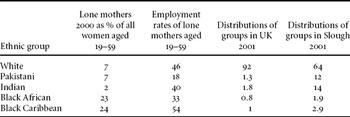
Rates of lone parenthood vary dramatically across ethnic groups. For example, Lindley et al. (Reference Lindley, Dale and Dex2004) have shown that in 2000–2002, the period covered by our study, among women aged 29–59, rates for lone parenthood varied from 24 per cent of Black Caribbean and 23 per cent of Black African women to 2 per cent of Indian women. Among Pakistani and White women of these ages, 7 per cent were lone parents with dependent children. Moreover, whether lone parents became lone parents after marriage (through divorce, separation or widowhood) or were single also varies with ethnic group: 77 per cent of Black Caribbean lone mothers were single, while the vast majority of Pakistani lone mothers (92 per cent) had been married (Lindley et al., Reference Lindley, Dale and Dex2004). There is also variation among the employment rates of lone parents (see Table 1).
Distributions of lone parents and employment rates by ethnic group in Great Britain, ethnic group distributions in England and Wales and Slough

Note: The employment rate given for Pakistani mothers in column 2 is in fact the combined figure for Pakistani and Bangladeshi lone mothers.
Sources: columns 1 and 2 adapted from Lindley et al. (Reference Lindley, Dale and Dex2004); column 3 adapted from Platt (Reference Platt2007); Column 4 from 2001 Census, ONS Neighbourhood Statistics.
Given the very different rates of lone parenthood across ethnic groups illustrated in Table 1 along with the differential tendency among lone parents to be in paid work, we expect that the chances of lone parents leaving benefit for work may be related to both their overall prevalence and the attachment to the labour market in the group. Prior work history is also strongly related to working as a lone parent, and so those groups where economic activity is more common within marriage might also be expected to leave benefit more swiftly for employment. However, exiting lone parenthood (and benefit) for partnership is clearly associated with age, with younger women more likely to repartner (Bradshaw and Millar, Reference Bradshaw and Millar1991; Noble et al., Reference Noble, Smith and Cheung1998b). The average ages of lone mothers in our sample show that Indian and Pakistani mothers tend to be slightly older (see Table 4). However, the story is complicated by the fact that, as Paull (Reference Paull2007) has shown, previously partnered lone mothers have higher employment rates than those who have been single throughout the period of motherhood. Thus, Black Caribbean lone mothers might be expected to exit benefit faster than those from other groups, given higher chances of prior labour market attachment, the existence of models of combining motherhood and work and their approximately average mean age. However, their greater likelihood of being single may mitigate against this. By contrast, we might expect Pakistani, and to a lesser extent Indian, lone mothers to exit more slowly, given a lower probability of extensive work history, older average age and the greater chance that these lone mothers are lone mothers through divorce or widowhood, characteristics which are negatively associated with the chances of benefit exit. However, the prevalence of Pakistani lone parents is increasing and ‘new’ lone parents may have different characteristics, including greater capacity to engage with the labour market and combine it with childcare. Nevertheless, on the basis of existing information we expect them to have lower probabilities of benefit exit than the White majority, even once age and number of children are held constant.
We would expect White lone mothers to have exit rates that place them somewhere between Black Caribbean women and Pakistani and Bangladeshi women. Those on benefit have been identified as forming a relatively residual group and thus with relatively long-term benefit spells (Platt, Reference Platt2006b). However, they will not face the ethnic penalties or discrimination in the labour market that have been identified for Pakistani women (Dale, Reference Dale2002; Dale et al., Reference Dale, Shaheen, Fieldhouse and Kalra2002) or for Caribbean women, and which are widely acknowledged to face the UK's minority groups (Heath and Cheung, Reference Heath and Cheung2006). Black African lone mothers may be particularly vulnerable in the labour market, given the group's more recent arrival on average, and fewer well-established community resources on which to draw, especially outside London. We might, therefore, expect these lone mothers to have the lowest probabilities of leaving means-tested benefits.
Such ethnic differences between lone mothers, if they are found, might suggest that policy would need to consider the circumstances of different groups of lone mothers and to be closely targeted on the work-readiness and employment opportunities of lone parents who otherwise face greater durations on means-tested benefits.
Overall, though, we hypothesise that we will not find dramatic variation in the benefit exit rates between lone mothers, given their roughly similar situation. We already know that lone parents’ poverty rates (unlike those for couple parent families) do not vary dramatically across groups, being high in all cases (Platt, Reference Platt2006a). This itself might indicate a certain degree of similarity across groups in relation to their risks of being supported by means-tested benefits in the first place and their chances of moving off them. We also expect that apparent differences will be attributable to age differences and variation in the number of children who need to be cared for, and other key relevant characteristics (Noble et al., Reference Noble, Cheung and Smith1998a). The implication of similarity would be that policy and policy reforms that are targeted at benefit-recipient lone parents will have a relatively consistent impact across lone parents from different ethnic groups, whether positive or negative, as long as they recognise the general barriers presented by age or family circumstances. If similarities outweigh differences in the experience of lone mothers across ethnic groups, this may also suggest a way of thinking about commonalities and differences across groups, with greater focus on structural determinants of differences and less focus on cultural accounts.
Data and methods
Data
Analysis of the welfare experience of lone mothers has been hampered by lack of appropriate data. The increasing use of administrative data for studying welfare dynamics has allowed a step-change in our understanding of the volatility of benefit experience and the characteristics associated with long-term compared to short-term receipt. However, such data are rarely ethnically differentiated. While panel survey data for the UK (such as the British Household Panel Survey or the Families and Children Survey) contain ethnic group information, small sample sizes inhibit extensive analysis of ethnic minority groups.
For this study, we are, therefore, fortunate in being able to draw on an administrative data set for a local authority with an ethnically diverse population and where ethnic group information was routinely asked of the claimant (even if not directly entered into the system). The data, provided by Slough Borough Council, comprise housing and council tax benefit records from Slough, a relatively economically buoyant local authority, for the period 2000–2002. We utilise three extracts of complete housing benefit/council tax benefit records from May 2000, January 2001 and April 2002. These data cover all those who had a live claim for either benefit at any of those dates and also include information on their immediate, co-resident family spouse/partner (if any), dependent children (if any) and non-dependent children still living with their parent(s).
Housing benefit assists those on a low income and in rented accommodation with their rental payments, and council tax benefit is paid to low-income individuals responsible for council tax (largely owner occupiers). Entitlement to these benefits is automatic for those in receipt of income support or job seeker's allowance (and thus not in paid work), but may also be claimed by those in work and on a low income. However, for those who gain paid employment there is a proportionate withdrawal of benefit with earnings; and the incentives provided by the tax credit system in terms of ‘making work pay’ have been noted as interacting with housing benefit in particular to reduce increases in income offered by tax credits where claimants are liable for high rental payments (Blundell and Hoynes, Reference Blundell, Hoynes, Card, Blundell and Freeman2004). Take-up rates of housing benefit are estimated to be high, particularly for lone parents for whom they approached 100 per cent in the period we consider (Department for Work and Pensions, 2008). Take up of council tax benefit is lower, but among lone parents it was still estimated at over 90 per cent for the years 2000–2002. There is, unfortunately, currently no analysis by ethnic group of benefit take-up, and circumstantial evidence does not indicate any particular pattern of variation – or in what direction it might be expected (see the discussion in Platt, Reference Platt and Millar2003a).
For the purpose of this study, we have selected only those records for lone mothers: female claimants without a spouse/partner and with dependent children. They may also have non-dependants (chiefly grown-up children who are nevertheless part of the family) living with them. The data consist of three approximately annual extracts allowing for analysis of movements on and off benefit. Annual extracts may miss some movement on and off benefit in between observations (Ashworth et al., Reference Ashworth, Middleton and Walker1997; Böheim and Jenkins, Reference Böheim and Jenkins2006; Pavetti, Reference Pavetti1993; Platt, Reference Platt2006b). However, studies comparing the different types of claimant (Ashworth et al., Reference Ashworth, Middleton and Walker1997) or families, both couple and lone parent, with dependent children (Ball and Wilson, Reference Ball and Wilson2002; Barrett et al., Reference Barrett, Krsinich and Wilson2003; Platt, Reference Platt2006b) have shown that lone mothers’ average benefit durations were longer than those for other groups of claimants. We drew on these findings to anticipate relatively slow exit from benefit support among our sample of lone parents, and thus selected an annual accounting period.
Ethnic group information was asked in the claim form, using the ONS Census categories. However, as it was not needed for the calculation of a claim, it was not entered on to the system with other claim information. Instead, we manually matched and entered the information for all the records from the original claims. This was a laborious and lengthy undertaking, but it gave us comprehensive coverage of ethnic groups for all the claims in our extracts. In around 7 per cent of cases, the claimant had not provided ethnic group information, resulting in missing information on ethnic group only in these instances.
Housing benefit/council tax benefit records, have been used for the analysis of benefit dynamics on previous occasions, and their advantages and limitations for these purposes have been discussed elsewhere (Noble et al., Reference Noble, Cheung and Smith1998a; Platt, Reference Platt2003b, Reference Platt2006b; Platt and Noble, Reference Platt and Noble1999; Smith and Noble, Reference Smith, Noble, Bradshaw and Sainsbury2000). One of their main limitations is the fact that they contain a relatively small amount of information on claimants and their families, restricting the extent to which multivariate analyses can take account of relevant factors, such as the mothers’ educational qualifications and work histories and, indeed, their benefit histories. However, as Hakim (Reference Hakim1983) notes, a compelling reason for using administrative data is that it may enable the investigation of research questions that would not be possible in any other way, as with the current study.
The study area
Slough is a town to the west of London with an ethnically diverse population and a relatively buoyant economy. Between 1991 and 2001 Slough had seen its overall minority ethnic population increase by 53 per cent (Lupton and Power, Reference Lupton and Power2004), and there were particularly large increases in the Black African population, which doubled over the period. By the time of the 2001 Census, which corresponds to the middle of the two-year period covered by our study, Slough had the highest proportion (over one third of the population) of ethnic minorities of any local authority outside London (Lupton and Power, Reference Lupton and Power2004). As we can see from Table 1, Indians and Pakistanis formed the largest of the minority groups, with substantial Black Caribbean and Black African populations (BLSC, 2002). In this study, therefore, we focus our analysis on these four minority groups and on White British lone mothers.
Contrary to Platt (Reference Platt2006b) and Noble et al. (Reference Noble, Cheung and Smith1998a), who used a similar source but for different local authorities, Slough is marked by strong employment levels, which might facilitate greater opportunities for lone mothers supported by benefit to move off benefit through employment. Women's labour market participation rates in Slough were higher than in the rest of the country at the time of the study, and this also extended to lone parents, who had full-time employment rates of round about 26 per cent compared to 20 per cent nationally (ONS, 2003a: 65; Lyttle, Reference Lyttle2003: 28). Given the increasing importance of part-time work for lone mothers outside the capital (McKay, Reference McKay2004), it is worth considering the overall employment rates, which for lone mothers with dependent children were, according to the 2001 Census, 42 per cent (ONS, 2003b). However, we know that employment rates vary both within groups by area, but also that there remains an ethnic penalty for minority groups within area (Simpson et al., Reference Simpson, Purdam, Tajar, Pritchard and Dorling2006). In Slough during the period of our study, unemployment rates for Pakistanis were twice as high as those for the rest of the local population, even if not as high as for Pakistanis in some other parts of the country.
Methods
We start with simple descriptive analysis of lone parents’ claiming patterns by ethnic group. We then move on to multivariate analysis to establish the role of relevant characteristics and to control for differences in these characteristics across lone mothers. Given that we only had three time points to consider and we did not have duration information on the stock sample, data were not amenable to survival analysis as in Platt's (2006b) study. Instead, we initially followed Noble et al. (Reference Noble, Cheung and Smith1998a) in modelling transitions off benefit for the whole sample. Moreover, we pooled lone mothers from the first two time points, following standard panel data approaches.
Analysis of this ‘stock sample’ can give us some insight into the movements of the benefit population as a whole, and is informative for those wishing to understand the claimant population (see the similar point made by Ashworth et al., Reference Ashworth, Middleton and Walker1997). However, the stock sample comprises both people who have recently moved on to benefit and those who have been on benefit support for a considerable period, and, clearly, we cannot distinguish which are which. Thus, two people with very different durations on benefit may exit at the same time, confounding our understanding of the factors associated with movement off benefit and expected duration. Moreover, those who have long durations on benefit will be over-represented (compared to the population who ever claim) as they ‘build up in the system’ (Bane and Ellwood, Reference Bane and Ellwood1994; Walker and Ashworth, Reference Walker and Ashworth1994). Therefore, analysis of this ‘stock sample’ will be looking at the probabilities of exit among a set of claimants whose characteristics tend to make them more likely to remain on benefit for a longer period, which may influence the conclusions we draw. These characteristics can include both observed characteristics – such as the focus of our interest, ethnic groups – as well as unobserved characteristics.
Observed ethnic differences in probabilities of exit from the stock may be indicative of, on the one hand, differences in durations already spent on benefit among these ethnic groups and, on the other, may represent differential probabilities of exit due to other (unobserved) characteristics that have an influence on benefit exit and are differentially associated with ethnic groups. Such differences could include access to childcare, job skills or risks of discrimination by employers.
To complement the analysis of the stock, therefore, we examined probabilities of exit among that group of lone mothers who were observed to join the benefit data between the extracts taken in 2000 and 2001. These lone mothers constitute a random sample of those who claim benefit, and thus analysis can focus more precisely on those characteristics which predict exit compared to those which imply rather longer durations on means-tested support. This latter analysis may be more relevant to policy as it attempts to target new claimants and to identify factors which may ease transitions off benefit or characteristics where additional support to exit may be necessary. The disadvantage of this is that it substantially reduces our sample size: analysis of exit probability one year later is restricted to those 441 lone mothers observed to join the benefit data between 2000 and 2001. However, by using this approach alongside that of the stock sample, where sample sizes are large, we can examine whether there is consistency between the stories offered by the two analyses.
Given the reduction in sample size, the probability of exit from the inflow sample was estimated with two versions of the ethnic group variable: first, the full range of categories, and then a version which aggregated White groups, Black groups, South Asian groups and other groups. While this aggregation of diverse groups is generally not desirable, we justified it on this occasion as it distinguished, in line with our hypotheses, between those where the prevalence of lone parenthood is greater than average (among both Black Africans and Black Caribbeans), and those where the prevalence of lone parenthood is lower than average (among Indians and Pakistanis).
In both analyses, we used logistic regression analysis to explore the probabilities of exit and its association, if any, with ethnic group, controlling for relevant factors. Studies which have focused exclusively on lone parents’ benefit dynamics have identified the following as associated with longer durations on benefit: being older, having more children, living in social housing, being in receipt of income support and not having a driving licence (Noble et al., Reference Noble, Cheung and Smith1998a; Shaw et al., Reference Shaw, Walker, Ashworth, Jenkins and Middleton1996). While we do not have information on whether claimants have a driving licence, we can – and do – include age (and age squared to check for non-linearities in the effect of age), number of children, housing tenure and income support receipt. We also take account of whether there was a child under five, which can be an important inhibitor to taking up paid work, and whether there were older, non-dependent children in the family.
Results
Patterns of claiming
In examining patterns of claiming, we rely on a pooled longitudinal data set which was created by merging individual housing benefit and council tax benefit records from May 2000 with those extracted in January 2001 and April 2002. Individual records were linked by housing benefit reference numbers, which remain the same and are retained for as long as a claim is active. They are also reallocated following interruption of a claim or a change in claiming status. The linkage procedures are robust, with reallocation using prior as well as current name and address information, and continuous claims, leaving little scope for erroneous reallocation of reference information. No ethnic group information was used in the allocation or reallocation of reference numbers. Information is available for each claimant for each extract at which they are observed.
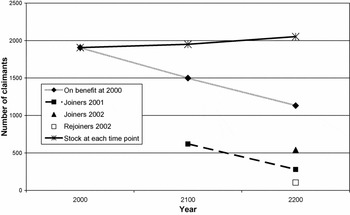
Overall, there were 2,885 women in our data who were observed at one of the three time-points. Of these, a large proportion (1,132 or nearly 40 per cent) were observed at all three time points, suggesting a high degree of long-term use of benefits, consistent with the overall experience of lone mothers and their low-income risks. However, there was also a substantial amount of mobility. Figure 1 illustrates the movements off and on to benefit over our three-year period. The top line shows the stock, or total number of claimant lone mothers at each time point, which increased slightly over the period, from 1,906 to 2,053. That stock is made up of those originally observed who remained on benefit, and new claimants for 2001 and 2002. There was also a small number of women (104) observed in 2000 who had left in 2001 and returned in 2002. We can see that a substantial proportion of both those observed in 2000 and those who joined in 2001 left in subsequent years but, nevertheless, the 1,132 ‘stayers’ made up 55 per cent of the 2002 stock.
Patterns of claimants on HB/CTB benefit 2000–20002
Source: Slough Borough Council housing/council tax benefit data, 2000–2002 (authors’ analysis).

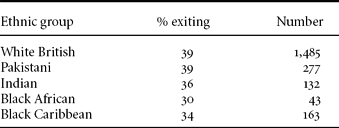
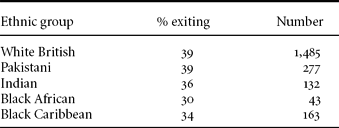
Table 2 illustrates the proportions observed to exit the data (including those who exit and return) across the five groups among those who are on or join the data. For the purposes of this calculation, those who join only at the third time point are excluded, as they cannot, by definition, be observed to exit. From Table 2 there do not appear to be substantial differences between groups in chances of moving off benefit once in receipt, although the chances look slightly lower for the two Black groups. However, this is without taking account of other factors associated with exit rates.
Lone mothers exiting benefit by ethnic groups
Source: Slough Borough Council housing/council tax benefit data, 2000–2001 (authors’ analysis)
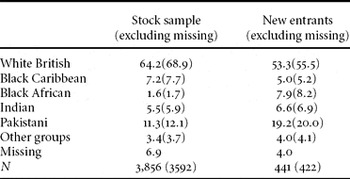
Table 3 shows how the ethnic group varies across those in the stock sample compared to the new entrants, with White British and also Black Caribbeans being over-represented in the stock relative to the inflow of new entrants, and Pakistanis, and to a lesser extent, Indians being under-represented. Most striking is the position of Black Africans who form a substantial share of new entrants, but barely feature among the stock, reflecting a swift increase in their presence in Slough and in their subsequent benefit eligibility as lone mothers. As well as indicating that they may be swifter to move off benefit support following a claim, it may also be a feature of more general shifts in the population, with Black Africans having increased their presence in Slough in the recent past. Similarly, with Pakistanis, population flows may partly account for the major differences between stock and flow samples. These differences may also reflect an increased likelihood of becoming lone parents in more recent years within this group, but overall, and contrary to our hypotheses, the difference indicates a greater level of benefit mobility among Pakistani lone mothers than among other groups.
Composition of ‘stock’ and ‘flow’ of lone mothers by ethnic group

Note: The stock sample is the combined stocks from 2000 and 2001 as used in the analysis below. The new entrants combine joiners in both 2001 and 2002, though only those who joined in 2001 can be used in analysis of exit probabilities carried out below.
Source: Slough Borough Council housing/council tax benefit data, 2000–2002 (authors’ analysis).
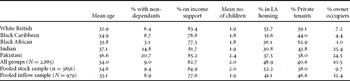
Looking at how our key characteristics are distributed across the lone mothers from the different ethnic groups, Table 4 shows the distribution in the stock sample and also in the inflow sample. As we would expect from other studies, the inflow sample is slightly younger, less likely to be on income support and less likely to be in local authority housing compared to the stock sample. We also see that in the sample as a whole, there are some differences between ethnic groups that might make us, prima facie, anticipate slightly different patterns of benefit receipt. Indians and Pakistanis are significantly older and White British significantly younger than the average, while Black Caribbeans and Black Africans are less likely to be on income support. Pakistani lone mothers have larger numbers of children, and a relatively large proportion of low-income Indian and Pakistani lone mothers live in owner-occupied housing: strikingly different from the experience of low-income lone mothers as a whole, although in line with a tendency towards high rates of owner occupation, even among less well off families, in the population as a whole.
Characteristics of low income (HB/CTB-recipient) lone mothers by ethnic group and whether in the stock or inflow samples

Source: Slough Borough Council housing/council tax benefit data, 2000–2002 (authors’ analysis).
When we turn to explore the presence of non-dependants in the family, interestingly rates are slightly lower among the inflow than the stock sample, but the big differences are between ethnic groups, with Indian and Pakistani lone mothers much more likely to have non-dependants living with them. Such non-dependants, who are primarily grown-up children offer, on the one hand, potential sources of childcare or additional income but, on the other hand, they may mean additional caring responsibilities. Overall, the characteristics of the minority groups may make them both less and more likely to move off benefit relatively fast.
Multivariate analysis
We now move to a more systematic, multivariate assessment of exit probabilities, looking first at exit probabilities among the stock sample and subsequently at exit probabilities among the ‘flow’ sample or new entrants.
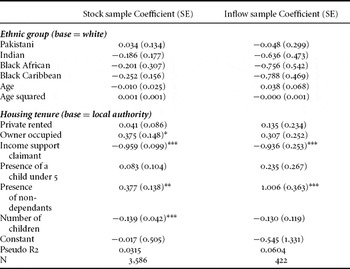
Modelling the chances of exit from the stock sample, Table 5 shows that being an income support or income-based job seeker's allowance recipient is strongly associated with a lower probability of exit, as is an increasing number of children. Both of these are consistent with our expectations. Being in owner occupation compared to local authority housing also facilitates exit, as we would expect. This is likely to be in part associated with the location of local authority housing and its accessibility to relevant employment opportunities, but may also be partly due to the interaction between housing benefit and tax credits (Blundell and Hoynes, Reference Blundell, Hoynes, Card, Blundell and Freeman2004). Having non-dependants, which indicates the presence of other adults in the household, also speeds benefit exit. Surprisingly, we find no significant effects of age, even although this was found to be important by Noble et al. (Reference Noble, Cheung and Smith1998a), nor for the presence of a pre-school-age child.
Logistic regression of exit among lone mothers at risk of exit (pooled)

Notes: Standard errors have been adjusted for repeat observations on individuals.
* = p<0.05 ** = p<0.01 *** = p<0.001.
Turning to ethnic group, despite the small positive coefficient for Pakistani lone mothers, indicating swifter exit, and the negative coefficients for the other groups (indicative of slower exit than for the White lone mothers), all these coefficients attract large standard errors and are not close to statistical significance. This does not mean that there are not different risks of being on benefit in the first place, but that, among those who are observed on benefit at a point in time, they do not appear to have different rates of exit. Interestingly then, the likelihood of being a benefit recipient does not appear to correlate with probability of benefit exit. It suggests that there are commonalities in the experience of both majority and minority once they come into contact with the system and it does not imply that particular targeted approaches to certain groups in order to engage with them and ‘lift them off the system’ are necessary. This is, however, taking the stock as a whole, and it may be that the length of time spent on benefit and, therefore, presence in the stock itself varies by ethnic group.
Table 5 also shows the results for the probability of exit from the flow sample. Among those variables that were statistically significant in the stock sample we see very similar coefficients in the flow sample, although in some cases the smaller sample size results in larger standard errors and the loss of statistical significance. This indicates, nevertheless, that the two models are telling broadly the same story. Turning to ethnic group, we again see no significant differences between ethnic groups, and the addition of ethnic group to the model does not improve the model fit. However, the magnitude of the negative coefficients has increased relative to the stock sample model, and for the Black Caribbean lone mothers is on the boundaries of statistical significance. There is a slight indication that the minority groups, with the exception of the Pakistani lone mothers, may experience slower exit from benefit than their White peers, which bigger samples or more settings might have enabled us to explore more fully. However, we cannot be confident that this is the case; and there is, therefore, no clear evidence that ethnicity represents differences in background or experience that are correlated with benefit duration. We cannot reject the possibility that experience of benefit in terms of chances of exit is comparable across groups and, once claiming, minority groups will have the same probabilities of leaving benefit after a year as the White majority.
Nevertheless, given the borderline significance of the Black Caribbean coefficient and the negative coefficients across the minority groups, we also employed a simplified version of ethnic group, which aggregated the South Asian groups on the one hand and the Black Caribbean and Black African groups on the other hand, and re-estimated the model on this basis. This did allow us to refute the null hypothesis for the Black lone mothers in aggregate (the coefficient for the South Asian groups did not attain statistical significance), indicating that they had a substantially lower chance of benefit exit after a year than the White majority. This finding contradicts our hypothesis that greater prevalence of lone parenthood within a group and greater attachment to the labour market within that group will result in faster benefit exit.
Clearly these findings are tentative and there is much that we cannot account for in this study, but, given the increasing emphasis on ethnic group diversity across a range of economic outcomes (Modood et al., Reference Modood, Berthoud, Lakey, Nazroo, Smith, Virdee and Beishon1997; Platt, Reference Platt2007), it is worthy of note that the experience of Pakistani lone mothers on welfare benefit does not appear to entail an additional ‘ethnic penalty’, despite the high rates of poverty and evidence for ethnic penalties in employment for this group. Of course, they may be exiting into partnership more often than employment, but, even so, to achieve higher rates of exit is worthy of note and is likely in part to be connected to labour market (re-)entry. Conversely, we have shown that there is some evidence that Black lone mothers struggle to exit benefit compared to other lone mothers and thus, despite relatively high levels of labour market attachment in the group as a whole, resuming work once circumstances have necessitated resort to income support is not an easy step. The relatively high levels of single lone mothers among this group and thus the more limited experience of, and possible prospects of, partnership may contribute to this pattern.
Overall, though, the analysis suggests that there are not strong differences in the experience of lone mothers from different ethnic groups. This would indicate that there is no obvious need for a targeted approach to supporting lone parents off benefit according to their ethnicity, but rather highlights the commonality in benefit claiming among lone parents and its tendency to be of longer rather than shorter duration. Furthermore, these findings indicate that comparative research across ethnic groups can be used to demonstrate commonality as well as difference, and in the process to dispel some stereotypes, when we take account of specific and shared circumstances. Such research can also draw attention to the structural nature of much disadvantage once context is taken into consideration.
Discussion and conclusions
This article contributes to our understanding of lone parents and benefit dynamics, developing a comparative ethnic group dimension and enhancing our understanding of ethnic group similarity and difference.
At the beginning of our paper, we established that lone parents continue to face high risks of poverty and this is common across ethnic groups, though particularly high for ethnic minority groups. The prevalence of lone parenthood varies substantially between groups, as does propensity of lone parents to be economically active, but neither of these factors appears to directly correlate with poverty rates. Consistent with their high poverty rates, a substantial proportion of lone parents are supported by means-tested benefits at some point. However, there is already substantial and increasing evidence that claiming means-tested benefits is not a ‘fixed state’, even if durations for lone parents tend to be longer than for other claimants. Welfare policy reform is strongly oriented towards moving lone parents off benefit and into work.
However, there is little knowledge about the benefit experience of lone mothers from different ethnic groups and comparative differences in movements off benefit support, whether into work or partnership. Given that policy is more appropriately focused on labour market policies than in encouraging partnership, we focus our discussion on the labour market policy implications, though noting that this not the only factor in benefit exit. We set the questions of whether policy is more or less successful for some groups than others, or whether it needs to be targeted to focus on those least likely to exit benefit.
We speculated that there would be some divergence in the experience of lone mothers by ethnicity related to the overall attachment of the group to the labour market, as well as their individual characteristics. We found no evidence to support this hypothesis. In fact, the findings suggested that, once we controlled for a limited set of characteristics, including age, it was if anything Pakistani lone mothers, among whom there are the lowest levels of female labour market participation in general, who were most likely to exit benefit within the year, and Black Caribbean women who were least likely to.
We also hypothesised that ethnic penalties in the labour market might disadvantage those minority groups trying to exit benefit. There was some indication that, when we controlled for relevant factors, minority groups faced greater difficulty in leaving benefit than the White majority. But again the differences were only statistically significant when we aggregated ethnic groups, and then only for Black Caribbean and Black African women. Our main hypothesis was that differences in patterns of benefit receipt between lone mothers from different ethnic groups would not be substantial; that is, that diversity at the level of family forms or overall poverty risks does not necessarily translate into diversity in experiences when we focus on a particular family form and those on low incomes making use of means-tested benefits. This was broadly supported by our findings.
The implications of our findings are threefold. First, there are implications for the extent to which policy should be targeted to those in particular situations. On the basis of this study, we would argue that policy towards benefit recipient lone parents and employment does not need to be ethnically differentiated by groups, although there may well be labour market discrimination to contend with. Instead, more attention may need to be focused on how mothers with children become means-tested benefit recipients in the first place. Second, we would argue that this study, emphasising as it does commonality, provides a counter to the range of research that has explored the diversity of ethnic groups. We suggest that narrowly constraining the subject of investigation may provide a way of interrogating understandings of ethnic group ‘effects’. It also takes us away from ‘cultural’ explanations of benefit use and ‘welfare dependency’ and leads to a focus instead on context, geography and the role of particular characteristics in experience.
Third, our findings point to the extent to which the characteristics of the UK's minority groups and the meaning of the groups is changing, as the prevalence of lone parenthood grows in groups where it has been rare, changing its composition in the process. Analysis based on past understandings of the group or its characteristics may lead to inappropriate or unrealistic assumptions. There is substantial heterogeneity within groups, and extrapolating from the ‘average’ may not do justice to the experience of subpopulations. Our analysis, therefore, suggests the need both to plot the experience of groups over time and to respond to their changing profiles. Groups may bear the same name, but vary on a range of dimensions over time.
Our analysis is, however, limited in a number of ways that we have discussed. In some cases it has produced results not consistent with the small number of extant studies in this area, for example in relation to the impact of age on benefit exit. We also acknowledge that it is harder to make a case for the substantive significance of ‘non-results’ and to refute the argument that they may be artefacts of data quality, sample sizes and so on (though such arguments can typically be levied against ‘results’ as well). Clearly, our findings can only be directly informative about Slough in the period at the beginning of this century, and the strength of our case would be substantially increased – or our conclusions modified – if we could replicate the study across a range of local authority areas and ones with different ethnic group and employment profiles. In this light we regard this study as provisional and as a beginning rather than a conclusion to the questions originally posed, which we feel are worthy of further consideration and investigation.
Acknowledgements
We are grateful to Slough Borough Council for enabling our access to administrative data records and preparing the extracts for us and for facilitating our manual addition of ethnic group information from the original forms. Platt is grateful for the support of ESRC core funding of ISER's Research Centre on Micro-Social Change and United Kingdom Longitudinal Studies Centre, and University of Essex.