Introduction
Shared storybook reading between parents and children provides a unique context for joint attention, collaboration, and interactional routines (Muhinyi & Hesketh, Reference Muhinyi and Hesketh2017; Saracho, Reference Saracho2017). A wide range of research demonstrates the positive influence of shared reading on children’s language measures, including vocabulary growth (Flack, Field & Horst, Reference Flack, Field and Horst2018), narrative skills, and syntactic development (Kaderavek & Justice, Reference Kaderavek and Justice2005). The area is of interest due to the multitude of proposed benefits shared reading brings to children’s language development, and its accessibility as a learning environment. Indeed, shared storybook reading is frequently promoted as an evidence-based and ecologically valid speech and language intervention context, and evidence from several reading programs suggests that simply providing families with storybooks leads to increased frequency of reading (Dickinson, Griffith, Golinkoff & Hirsh-Pasek, Reference Dickinson, Griffith, Golinkoff and Hirsh-Pasek2012).
However, studies show that it is not only the frequency of reading that influences language development but also the quality of ‘extratextual’ interactions that engage children in joint attention and support their comprehension of book content (Van Kleeck & Woude, Reference Van Kleeck, Woude, Van Kleeck, Stahl and Bauer2008; Zauche, Thul, Mahoney & Stapel-Wax, Reference Zauche, Thul, Mahoney and Stapel-Wax2016). During shared reading, the input children receive can be considered both in terms of: (a) the linguistic content of child-directed speech (CDS), and (b) the type of parent-child interactions that occur. Each contributes to what children gain, and strategies parents use can be instrumental in promoting child engagement and scaffolding learning (Grolig, Cohrdes, Tiffin-Richards & Schroeder, Reference Grolig, Cohrdes, Tiffin-Richards and Schroeder2020). One aspect of this social context is the specific book around which parents and children interact. Different types of books have been shown to influence both the linguistic content of parental talk and approaches used by parents (Leech & Rowe, Reference Leech and Rowe2014), and characterising patterns of interaction in different book contexts can contribute to our understanding of how reading tasks can be structured to influence communicative strategies used (Fletcher & Reese, Reference Fletcher and Reese2005). The present study aims to examine how parental language and strategies vary as a function of book format, in particular looking at the use of a wordless book compared to a book with text.
Linguistic content of child-directed speech during shared reading
CDS during shared storybook reading has been found to be more grammatically complex and more lexically diverse than in other communicative contexts (Hoff-Ginsberg, Reference Hoff-Ginsberg1991). Adults tend to use a longer mean length of utterance (MLU) when reading with typically-developing children compared to play (Crain-Thoreson, Dahlin & Powell, Reference Crain-Thoreson, Dahlin and Powell2001), exposing them to more mature syntactic structures. One reason for this is the linguistic content of the text within storybooks. While 3-to-5-year-olds spend 95% of the time looking at illustrations within storybooks and not the words (Evans & Saint-Aubin, Reference Evans and Saint-Aubin2005), the text gives parents a linguistically-enhanced script to follow. Several studies have demonstrated that narrative storybooks for pre-literate age groups provide exposure to linguistic content not found in everyday CDS, such as more extensive and diverse vocabulary including low frequency words (Grolig et al., Reference Grolig, Cohrdes, Tiffin-Richards and Schroeder2020; Massaro, Reference Massaro2017; Montag, Jones & Smith, Reference Montag, Jones and Smith2015), and more complex grammatical constructions (Cameron-Faulkner & Noble, Reference Cameron-Faulkner and Noble2013).
Consequently, shared storybook reading can be an important source of exposure to sophisticated forms of language for children. Usage-based accounts of language acquisition highlight positive associations between complexity and diversity of syntactic constructions in CDS and subsequent complexity of children’s own syntactic productions (Noble, Cameron-Faulkner & Lieven, Reference Noble, Cameron-Faulkner and Lieven2018), emphasising the role of input and exposure to complex grammatical forms in order for children to extract, store, and eventually use them (Cameron-Faulkner & Noble, Reference Cameron-Faulkner and Noble2013). However, the benefits of shared reading go above and beyond the text, as the style of what is often termed ‘extratextual’ parental talk during reading also offers unique benefits.
Parent-child interaction during shared storybook reading
A key theme that emerges from the literature is the value of interactivity when parents make shared storybook reading a two-way activity (Smeets & Bus, Reference Smeets and Bus2012). Broadly speaking, interactive reading occurs when parents prompt the child to join in through asking questions about book content and are verbally responsive to child contributions. An interactive or ‘dialogic’ style of reading is widely reported to be especially beneficial when compared to sticking to the text in a monologic, ad verbatim style (Flack et al., Reference Flack, Field and Horst2018; Whitehurst, Falco, Lonigan, Fischel, DeBaryshe, Valdez-Menchaca & Caulfield, Reference Whitehurst, Falco, Lonigan, Fischel, DeBaryshe, Valdez-Menchaca and Caulfield1988) to the extent that it has considerable support as an evidence-based strategy to promote language skills of preschool children (Hargrave & Sénéchal, Reference Hargrave and Sénéchal2000). For example, several studies indicate that the extent to which parents engage in interactive talk with 2-4-year-olds during shared reading is more predictive of vocabulary acquisition and later vocabulary development than how frequently they read to them (Hargrave & Sénéchal, Reference Hargrave and Sénéchal2000). This is consistent with research demonstrating that two-way adult-child conversations are robustly and positively associated with child language development, with ‘conversational turns’ between parents and children up to age six more predictive of later language skills than the amount of adult language exposure alone (Romeo, Leonard, Robinson, West, Mackey, Rowe & Gabrieli, Reference Romeo, Leonard, Robinson, West, Mackey, Rowe and Gabrieli2018).
Experimental studies comparing outcomes for children whose parents and teachers use dialogic reading strategies compared to sticking to the text suggest that more interactive reading styles facilitate enhanced language growth, narrative production skills (Grolig et al., Reference Grolig, Cohrdes, Tiffin-Richards and Schroeder2020), vocabulary acquisition (Blewitt & Langan, Reference Blewitt and Langan2016; Hargrave & Sénéchal, Reference Hargrave and Sénéchal2000) and understanding of socio-cognitive themes (Aram, Fine & Ziv, Reference Aram, Fine and Ziv2013). Dialogic interaction is a method by which parents can establish and maintain joint attention. Advocates of a bioecological model propose that the effects of shared storybook reading on outcomes are primarily indirect and facilitate proximal processes (i.e., those that directly influence learning) such as joint attention, which is an important pre-requisite for vocabulary development and word-object mapping (Farrant & Zubrick, Reference Farrant and Zubrick2011). Within a Vygotskian social constructivist framework, however, the scaffolding provided by parents during dialogic interaction supports the child’s understanding and hence maximises what s/he takes from shared reading (Fletcher & Reese, Reference Fletcher and Reese2005; Vygotsky, Reference Vygotsky, Rieber and Carton1987).
During dialogic reading, prompts are designed to elicit children’s active participation, with the aim for them to attend and bring more to the exchange. This provides more opportunities for children to rehearse and consolidate language: for example, using new vocabulary in different sentence constructions (Hindman, Connor, Jewkes & Morrison, Reference Hindman, Connor, Jewkes and Morrison2008; Zimmerman et al., Reference Zimmerman, Glikerson, Richards, Christakis, Xu, Gray and Yapanel2009). As a result, parents also have more opportunities to provide linguistically responsive feedback. Linguistic responsiveness describes how adults respond to child utterances, including positive reinforcement, correction of errors, evaluations, and expanding or modelling more grammatically correct versions of children’s own utterances (De Temple & Snow, Reference De Temple, Snow, Van Kleeck, Stahl and Bauer2008; Zauche, Thul, Mahoney & Stapel-Wax, Reference Zauche, Thul, Mahoney and Stapel-Wax2016). High levels of linguistic responsiveness in the form of adults responding promptly, contingently, and appropriately have been shown to support language development and to be associated with enhanced receptive and expressive vocabulary (Hoff, Reference Hoff2006; McGillion, Herbert, Pine, Keren-Portnoy, Vihman & Matthews, Reference McGillion, Herbert, Pine, Keren-Portnoy, Vihman and Matthews2013), word learning (Blewitt & Langan, Reference Blewitt and Langan2016), and syntactic development (Zauche et al., Reference Zauche, Thul, Mahoney and Stapel-Wax2016). Tailoring language input in response to the child rather than just reading off the page is also thought to encourage greater child language productivity (Girolametto, Hoaken, Weitzman & Van Lieshout, Reference Girolametto, Hoaken, Weitzman and Van Lieshout2000). This is supported by research showing that parental language promotes language development more effectively when based within a ‘zone of proximal development’ – that is, when neither too challenging nor simplistic (Zimmerman et al., Reference Zimmerman, Glikerson, Richards, Christakis, Xu, Gray and Yapanel2009).
The use of parental prompts aimed at engaging children in conversation during shared reading is thought to enhance learning through focusing attention and emphasising particular words or narrative elements (Lenhart, Lenhard, Vaahtoranta & Suggate, Reference Lenhart, Lenhard, Vaahtoranta and Suggate2019; Lever & Sénéchal, Reference Lever and Sénéchal2011) as well as promoting deeper learning of vocabulary (Blewitt, Rump, Shealy & Cook, Reference Blewitt, Rump, Shealy and Cook2009). Within the literature, facilitative prompts are identified as questions asked by the parent to the child during reading, which can spark conversations around new vocabulary (Horst, Parsons & Bryan, Reference Horst, Parsons and Bryan2011) or story content and meaning (Hargrave & Sénéchal, Reference Hargrave and Sénéchal2000). Word comprehension appears to be boosted when parents ask questions about words in a book when compared to no questions (Lenhart et al., Reference Lenhart, Lenhard, Vaahtoranta and Suggate2019). In a longitudinal study, prompts that encouraged labelling, reasoning, problem-solving, and inference were correlated with increased abstract language use by children when re-telling the story (Van Kleeck, Gillam, Hamilton & McGrath, Reference Van Kleeck, Gillam, Hamilton and McGrath1997). Similarly, Lever and Sénéchal (Reference Lever and Sénéchal2011) found that a dialogic reading intervention that trained parents to use elaborative, open-ended wh-questions as prompts improved the structure and context of children’s post-test narratives.
Levels of abstraction of parental prompts
The types of questions parents ask can differ according to level of abstraction along a continuum (McGinty, Justice, Zucker, Gosse & Skibbe, Reference McGinty, Justice, Zucker, Gosse and Skibbe2012), and evidence suggests that level of abstraction is a key factor mediating the impact of parental prompts on learning (Van Kleeck & Woude, Reference Van Kleeck, Woude, Van Kleeck, Stahl and Bauer2008). The widely used framework developed by Blank, Rose and Berlin (Reference Blank, Rose and Berlin1978) categorises prompts according to four levels of abstraction or ‘cognitive demand’. Levels 1 and 2 represent ‘lower’ cognitive demand focused on immediate or literal information such as labelling or describing perceptible aspects of a scene (e.g., “What can you see?” or “What is it doing?”). Levels 3 and 4 prompts pose ‘higher’ cognitive demand – for example, asking for inference or prediction (e.g., “What do you think will happen next?” or “Why are they doing that?”) – requiring the child to go beyond concrete aspects of the story and draw on his/her own knowledge.
Several studies have suggested that more abstract prompts, such as when parents ask children to predict, infer, explain, or expand upon book themes or vocabulary (Van Kleeck & Woude, Reference Van Kleeck, Woude, Van Kleeck, Stahl and Bauer2008), are particularly valuable for enhancing interactive book-reading and promoting deeper learning, as these types of questions pose greater cognitive demand that require the child to think beyond the story (Baker, Mackler, Sonnenschein & Serpell, Reference Baker, Mackler, Sonnenschein and Serpell2001; Leech & Rowe, Reference Leech and Rowe2014; Van Kleeck & Woude, Reference Van Kleeck, Woude, Van Kleeck, Stahl and Bauer2008). For example, asking questions about specific vocabulary within a story can significantly enhance children’s word learning through promoting deeper learning of words beyond incidental exposure (Blewitt et al., Reference Blewitt, Rump, Shealy and Cook2009). Raising levels of abstraction may also direct attention to aspects of the book the parent thinks are beneficial, encouraging the child to process specific content more deeply. Interestingly, parents have been shown to use cognitively more challenging talk and more abstract language when reading non-narrative texts than narrative books (DeTemple, Reference DeTemple, Dickinson and Tabors2001; Torr & Clugston, Reference Torr and Clugston1999).
A transactional framework considers parent-child interactions as reciprocal and bidirectional with each influencing the other’s behaviours and both being influenced by context and environmental processes (Sameroff, Reference Sameroff2009). Researchers applying this framework to shared reading have demonstrated how parent and child contributions influence one another. For example, Kang, Kim and Pan (Reference Kang, Kim and Pan2009) analysed ‘sequential dependencies’ between maternal questions and child contributions during book reading, i.e., how interactions unfolded in response to one another, and found mother and child extra-textual talk to be highly correlated, with children providing more contributions in response to more prompts. Use of questions and open-ended prompts positively predicted children’s story retelling abilities, and questioning was more facilitative than commenting. The researchers concluded that prompts solicit active participation of children and encourage attention to task, therefore positively influencing recall and understanding. In terms of levels of cognitive demand, Luo and Tamis-LeMonda (Reference Luo and Tamis-LeMonda2017) found reciprocal associations between parent-child contributions. Parents adjusted cognitive demand of prompts to match the cognitive level of contributions children provided, suggesting that parents are attuned to their child’s ability. Romeo et al. (Reference Romeo, Leonard, Robinson, West, Mackey, Rowe and Gabrieli2018) further posited that more conversational turns create a ‘feedback loop’ within which caregivers themselves become better at calibrating their language to facilitate the child’s learning.
Despite all the proposed benefits of parental prompts, some studies have indicated that many parents do not naturally employ these with traditional storybooks and instead just read the text (Van Kleeck & Woude, Reference Van Kleeck, Woude, Van Kleeck, Stahl and Bauer2008). In particular, parents appear to deviate less from text once children are older than three (Fletcher & Reese, Reference Fletcher and Reese2005). Therefore, interactive strategies have potential as an effective target for enhancing book-sharing dynamics (Luo & Tamis-LeMonda, Reference Luo and Tamis-LeMonda2017). Research is ongoing as to how to promote the use of more naturally-occurring interactive strategies during storybook reading (Kaderavek & Justice, Reference Kaderavek and Justice2002). A transactional model proposes that three components influence interactions that occur during shared reading: the adult, the child, and the book (Fletcher & Reese, Reference Fletcher and Reese2005). One approach to encourage different types of shared reading interactions between parents and children is thus to tailor the stimulus – the books that provide a foundation for the interactions (Noble et al., Reference Noble, Cameron-Faulkner and Lieven2018).
Effects of book characteristics on parent-child interaction
While individual differences in parental book reading styles have been observed, a growing body of research indicates that book characteristics can influence interactions and language use regardless of individual communicative styles (Nyhout & O’Neill, Reference Nyhout and O’Neill2013). Levels of interactivity appear to change according to book qualities such as genre or complexity (Saracho, Reference Saracho2017), so studying parental language and scaffolding while sharing different types of books is important for providing insights into how patterns of conversational exchanges may vary as a function of book characteristics. Various studies have used a quantitative approach and analysed linguistic properties of CDS or quality of parent-child interaction during reading sessions. Common linguistic measures include word type-to-token ratio (TTR) or vocabulary diversity (VOCD) to measure lexical diversity, and MLU in words or morphemes as indexes of grammatical complexity (Chaparro-Moreno, Reali & Maldonado-Carreño, Reference Chaparro-Moreno, Reali and Maldonado-Carreño2017). To measure parent-child interaction, coding schemes have been applied according to constructs researchers want to quantify: for example, the types of instructional support provided (Chaparro-Moreno et al., Reference Chaparro-Moreno, Reali and Maldonado-Carreño2017), amount of cognitively complex talk (Nyhout & O’Neill, Reference Nyhout and O’Neill2013; Ziv, Smadja & Aram, Reference Ziv, Smadja and Aram2013), or frequencies and types of questions asked by parents (Anderson, Anderson, Lynch, Shapiro & Kim, Reference Anderson, Anderson, Lynch, Shapiro and Kim2012). These measures have then been used to characterise trends during use of different storybooks.
One book characteristic studied is the presence of illustrations, which have been shown to promote more interactive reading and lead to improved story recall by children (Greenhoot, Beyer & Curtis, Reference Greenhoot, Beyer and Curtis2014). The researchers suggested that illustrations establish a high level of joint attention which supports children’s processing of book content. Other studies have examined genre, comparing how parents use narrative compared with expository (i.e., informational) books. In terms of linguistic properties, Price, Van Kleeck and Huberty (Reference Price, Van Kleeck and Huberty2009) found that parents’ extratextual talk was significantly longer and more lexically diverse when reading an expository book compared to a narrative. Other studies have indicated greater use of interactive strategies by parents when reading expository books compared to narratives (Robertson & Reese, Reference Robertson and Reese2017), although Anderson et al. (Reference Anderson, Anderson, Lynch, Shapiro and Kim2012) found the ratio of questions at low (65%) versus high-level cognitive demand (35%) to be consistent during reading of both genres with four-year-olds. Leech and Rowe (Reference Leech and Rowe2014) further documented more parental extended discourse and child contributions when parents read an expository rather than narrative book with 5-year-olds. However, Nyhout and O’Neill (Reference Nyhout and O’Neill2013) found that wordless narrative books provided greater stimulus for decontextualised maternal talk than wordless expository counterparts when parents read to children aged 1;06-2;01. The researchers concluded that the younger age of children may explain this contrasting finding but also suggested that wordless books offer “unique opportunities for more complex talk” (p. 128).
Wordless books, child-directed speech, and parent-child interaction
Wordless books convey a narrative almost solely through illustrations, minimising the role of print, and so readers need to co-construct meaning from visual images rather than relying on text (Chaparro-Moreno et al., Reference Chaparro-Moreno, Reali and Maldonado-Carreño2017). This promotes a greater degree of interactive prompts and encourages intense interaction and collaboration between parents and children (Hammett, Van Kleeck & Huberty, Reference Hammett, Van Kleeck and Huberty2003). Muhinyi and Hesketh (Reference Muhinyi and Hesketh2017) found that ‘low-text’ books facilitated the same amount and quality of extra-textual talk than ‘high-text’ books within a shorter time period, indicating that reducing the amount of text can lead to higher rates of dialogic interaction.
While there is no text available in wordless books to provide a linguistically-enhanced script for parents, Noble et al. (Reference Noble, Cameron-Faulkner and Lieven2018) found CDS during storytelling with a relatively simple book (one word per page) to be more complex than CDS during play, suggesting that the context of storytelling itself encourages linguistically-enhanced CDS. This may be overlooked in studies where the linguistic properties of storybook text are compared with everyday conversational CDS. For example, Cameron-Faulkner and Noble (Reference Cameron-Faulkner and Noble2013) and Montag et al. (Reference Montag, Jones and Smith2015) compared the linguistic content of storybooks with CDS using corpus data but did not distinguish between different contexts in which CDS occurred. However, CDS has been shown to vary according to context (Hoff-Ginsberg, Reference Hoff-Ginsberg1991) and Massaro (Reference Massaro2017) hypothesises that CDS during storytelling, even without a written story to follow, may be more linguistically complex or diverse than CDS in everyday play settings due to the need to construct a narrative.
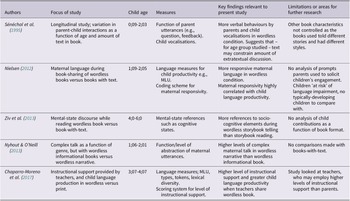
Wordless books also offer a less structured context for interaction (Nielsen, Reference Nielsen2012). Studies have suggested that caregivers are more linguistically responsive in less structured play contexts than traditional book-sharing (Girolametto et al., Reference Girolametto, Hoaken, Weitzman and Van Lieshout2000). Being linguistically responsive through tailoring language to the child rather than just reading off the page is thought to facilitate language development, including for children at risk of language delays (Girolametto et al., Reference Girolametto, Hoaken, Weitzman and Van Lieshout2000). While wordless books appear frequently as a stimulus for parent-child interactions in research when other factors are being examined, there are few focused studies looking specifically at how interactions vary as a function of amount of text. Table 1 summarises studies where wordless books have been a variable of interest.
Summary of studies comparing linguistic measures and parent-child interaction during wordless book reading.

Sénéchal, Cornell and Broda (Reference Sénéchal, Cornell and Broda1995) compared age-related differences in parent-child interactions using wordless books and books with text. They found that when sharing wordless books, parents of children up to age three asked more questions and infants produced more vocalisations than when sharing books with text. Infant verbal behaviours increased in response to parental questions and feedback provided. The researchers proposed that, for the age group studied, books without text promote verbal interactions through freeing the parent to discuss whatever they wish to emphasise, while when text is available parents tend to stick to it. Nielsen (Reference Nielsen2012) found higher levels of linguistic responsiveness (e.g., evaluations, imitations, and expansions) in maternal language during reading of wordless books to children ‘at risk’ of language impairment than reading of a book with text and this was correlated with greater child language productivity as measured by MLU, word types, and tokens.
Looking at the use of wordless books with older children, Ziv et al. (Reference Ziv, Smadja and Aram2013) found higher levels of maternal elaboration and decontextualized mental-state discourse when engaging in wordless storybook telling compared to traditional storybook reading with typically-developing 4-6-year-old children. The authors proposed that reading to children from a wordless book provides a unique context for rich mental-state talk. In an educational setting, Chaparro-Moreno et al. (Reference Chaparro-Moreno, Reali and Maldonado-Carreño2017) found that teachers demonstrated higher levels of instructional support when using wordless books compared to those with text, and in turn, children produced significantly more word types, tokens, and utterances.
A limitation of most aforementioned studies is that the books used differed in more ways than being just wordless or not. For example, Nielsen (Reference Nielsen2012) used books with two different stories. Chaparro-Moreno et al. (Reference Chaparro-Moreno, Reali and Maldonado-Carreño2017) matched books for some aspects of content, as both narratives contained animal characters, but with different storylines. Therefore, the results could be influenced by factors other than just the presence or absence of text. Additionally, most studies have looked at only the extra-textual interaction around book reading and not the storytelling itself, despite the fact that the linguistic content of the narrative is an important component of shared storybook reading (Crain-Thoreson et al., Reference Crain-Thoreson, Dahlin and Powell2001). This is true of the studies conducted by Sénéchal et al. (Reference Sénéchal, Cornell and Broda1995), Nielsen (Reference Nielsen2012), and Ziv et al. (Reference Ziv, Smadja and Aram2013). Nyhout and O’Neill (Reference Nyhout and O’Neill2013) only compared wordless books within two different genres so there was no comparison between wordless books and books with text.
The present study: overall aim and contribution
The present study contributes to the broader research context on the types of books that promote different qualities of parent-child interaction. In particular, it examines the nature of parental language use and interactions during shared storybook reading with typically-developing 3.5- to-5.5-year-old children when using a wordless narrative storybook versus a narrative book with text in a naturalistic home context. This study extends previous research as the children are older than those studied by Sénéchal et al. (Reference Sénéchal, Cornell and Broda1995) and Nielsen (Reference Nielsen2012), and evidence suggests that parental language changes with child age (Noble et al., Reference Noble, Cameron-Faulkner and Lieven2018). This age range was chosen as it is around age three that typically-developing children become more active conversational partners (Van Kleeck & Woude, Reference Van Kleeck, Woude, Van Kleeck, Stahl and Bauer2008). Chaparro-Moreno et al. (Reference Chaparro-Moreno, Reali and Maldonado-Carreño2017) examined the use of wordless books by teachers while the focus of the present study is parents. Importantly, the books chosen for the current study follow the same storyline allowing similar opportunities for discussion.
Parental use of prompts – defined as any question asked by parents directly inviting the child to respond – responsive utterances, and narration, and levels of child engagement are analysed, as well as the linguistic content (lexical diversity, grammatical complexity, etc.) of both parent and child talk. Examining linguistic content as well as interactional strategies is important in considering book reading episodes as a whole, and in the present study the entirety of parent and child verbal output including narration and conversational interactions are coded for linguistic diversity and complexity. While studies have shown greater linguistic diversity in children’s storybooks than in CDS, samples of CDS in similar conditions i.e., a storytelling context without the presence of a script, have not been compared. Most studies have also either focused on extratextual or dialogic discussion, or the text within storybooks, or collated both. In the present study, prompts and responsive utterances were collectively labelled as ‘dialogic’ utterances, representing conversational interactions, and separated from ‘narrative’ utterances for more in-depth analysis.
The following research questions were addressed:
-
1. Does parental use of prompts vary as a function of book format?
-
2. Is there a difference in the level of cognitive demand of questions asked during sharing of a wordless book versus one with text?
-
3. Is there a difference in the level of verbal participation and language productivity of children when reading a wordless book versus a book with text?
-
4. Does lexical diversity and grammatical complexity of parental input vary as a function of book format (wordless versus book with text) and utterance type (narrative versus dialogic)?
On the basis of the extant literature, it was hypothesised that:
-
I. Parents will use a higher rate and proportion of prompts when reading the wordless book compared to the book with text.
-
II. Parents will use a higher proportion of questions at higher levels of cognitive demand in the wordless than in the book with text condition.
-
III. Children will show higher levels of verbal engagement when reading the wordless book.
-
IV. Lexical diversity and grammatical complexity of narration will be higher when reading a book with text compared to a wordless book and during narration than dialogic utterances.
Method
Participants
Thirty-six parent-child dyads (25 mothers and 11 fathers) participated in the study (mean child age = 4;10, range = 3;07-5;06, 27 boys and 9 girls). The participants were asked to volunteer if they had a typically-developing child between 3.5 and 5.5 years old and were native English speakers. The level of education was high with 33 of 36 parents having a college degree. All were recruited through convenience sampling of personal acquaintances and snowball sampling. Convenience and snowball sampling are efficient and effective where some degree of trust is required to initiate contact (Ziv et al., Reference Ziv, Smadja and Aram2013) and deemed suitable given that participants were being asked to audio-record themselves and their young children.
Parents were excluded from the study if they reported typically reading with their children in a language other than English. They were also excluded if they reported that their child had a diagnosis or ongoing investigation of speech, language, communication, or cognitive impairment, as this has been shown to affect book reading interactions (Girolametto et al., Reference Girolametto, Hoaken, Weitzman and Van Lieshout2000).
Materials
Two narrative storybooks were used, both titled “The Lion and the Mouse.” The wordless
version was by Jerry Pinkney (Reference Pinkney2009) and the version with text by Miles Kelly (Reference Kelly2016). The books were carefully chosen to be matched for conceptual content to allow similar opportunities for discussion and vocabulary use. Both stories follow the same storyline and depict the traditional Aesop’s Fable of a lion that catches a mouse but sets it free. When the lion is later caught in a net set by hunters, the mouse bites through the ropes and releases him.
The narrative of the book with text was not rhyming as parents may be less likely to stray from the text if it interrupts the flow of rhyming elements. Therefore, a straightforward prose narrative allowed comparison of a wordless versus book-with-text condition without the added confounding factor of rhyme. While the books had different numbers of pages as conceptual content was prioritised, frequency measures were later normalised to give rates of occurrence of utterance types, controlling for lengths of reading sessions.
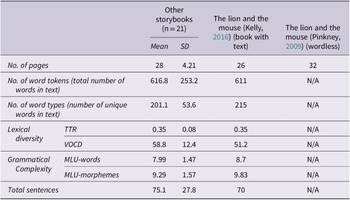
Textual properties of the book with text were analysed to ensure it was typical of the type of storybook parent-child dyads within the population read. ‘Prototypical’ properties of linguistic measures were drawn from analysis of 21 narrative storybooks aimed at this age group, selected by asking parents in the study what storybooks they most frequently read with their child. As shown in Table 2, all properties of the book with text were within one standard deviation from the group mean suggesting the book was typical of books parents were reading in terms of length, complexity, and lexical diversity.
Textual properties of the book with text and wordless book used in this study as compared to other children’s books.

Procedure
Parent-child dyads were matched for child age and each was allocated to a specific book condition: for example, the first child aged 4;0 was allocated to the book-with-text and the next child within two months of this age was allocated to the wordless book condition. Parents were then given a book, an audio-recorder, and an SD card and asked to share the book at home with their child ‘as they would do typically’ while audio-recording the session. They were not given any instruction in the use of particular dialogic strategies as the aim was to examine the extent to which the two conditions naturally gave rise to different styles of verbal interaction. Unlike many previous studies, the researcher was not present in the homes during reading sessions in order to preserve ecological validity, as the presence of a researcher could influence the way in which parents read, or the behaviour of the child in response to a visitor. By audio-recording sessions in their own time, it was anticipated that parents would read in a place and manner typical of their normal reading situations. Parents then returned all materials to the researcher and completed an online questionnaire to confirm demographic details and indicate home book-sharing practices and levels of enjoyment with shared reading in general and with the book provided.
Data analysis
The entirety of parent and child speech output was transcribed verbatim for each reading session, using the CHAT (Codes for the Human Analysis of Transcriptions) transcription system, a standardised format developed for the Child Language Data Exchange System (CHILDES; MacWhinney, Reference MacWhinney2000). Transcripts were segmented into C-units for analysis, with a C-unit defined as an independent clause with its modifiers (Hughes, McGillivray & Schmidek, Reference Hughes, McGillivray and Schmidek1997). Furthermore, C-units had to meet at least 2 of the following criteria: (i) they were followed by a pause of 1 second or more; (ii) they ended with a terminal intonation contour, or (iii) had a complete grammatical structure (Ratner & Brundage, Reference Ratner and Brundage2020, p.13).
Parent and child utterance types
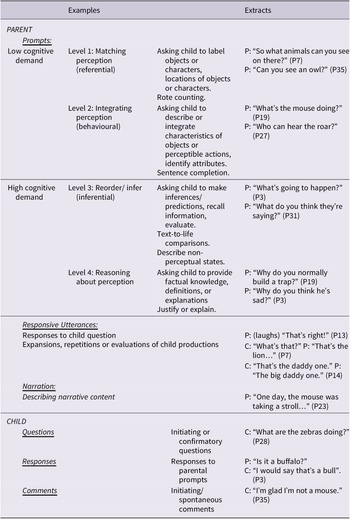
Parent and child utterances were categorised using a coding system adapted for the purposes of the study, as in previous studies (Price et al., Reference Price, Van Kleeck and Huberty2009). Codes were mutually exclusive though not exhaustive – as any talk not related to book or story content (e.g., talking about the recording) or book management prompts or directives was excluded from the analysis; since the study was interested in the discussion around story content. Criteria and examples are shown in Table 3.
Coding scheme for parent and child utterances.

Child utterances were categorised as a) comments, b) questions, and c) responses to questions. Finer-grained measurements were used for parental utterances, with three broader mutually-exclusive categories: a) prompts, b) responsive utterances, and c) narration. Prompts were then further coded for cognitive demand (Bernard, Reference Bernard1995, cited in Mackey & Gass, Reference Mackey and Gass2005) as follows:
-
(i) Prompts: Questions or ‘sentence-completion’ prompts directed towards the child and aiming to elicit a response, and further coded for level of cognitive demand (Blank et al., Reference Blank, Rose and Berlin1978) in line with previous studies (Hammett et al., Reference Hammett, Van Kleeck and Huberty2003; Price et al., Reference Price, Van Kleeck and Huberty2009; Van Kleeck & Woude, Reference Van Kleeck, Woude, Van Kleeck, Stahl and Bauer2008). Level 1 prompts were the least challenging (e.g., naming items) while Level 4 represented the most cognitively demanding prompts requiring reasoning, explanation, or judgements beyond the scope of the story.
-
(ii) Responsive utterances: Contingent feedback, evaluations, responses to questions posed, expansions, or repetitions of child’s productions within three utterances following the child’s contribution (Nielsen, Reference Nielsen2012).
-
(iii) Narration: Parental contributions read ad verbatim in the book with text as well as independent expansions of the text that were not prompt questions or responsive utterances, and in the wordless book condition any utterances contributing to the construction of a narrative that were not clear prompt questions or contingent responses to child contributions.
Linguistic content of child and parent utterances
Linguistic measures of parent and child utterances were automatically computed using CLAN, including: a) Total number of utterances (C-Units); b) Mean length of utterance in morphemes (MLU-m) as a measure of grammatical complexity; c) Vocabulary diversity (VOCD) as a measure of lexical diversity for parents; d) Word types and tokens for child utterances. Parental ‘narration’ and ‘dialogic’ utterances (prompts and responsive utterances combined) were extracted for MLU-m and VOCD to be calculated separately. MLU-m indicates the average number of morphemes per C-Unit and is a standard measurement of grammatical complexity. VOCD is based on analysing the probability that new vocabulary will be introduced in longer samples, and so is more reliable with varying sample sizes than type-to-token ratios (TTRs), which tend to vary as a function of numbers of tokens within transcripts. Higher VOCD values indicate more diverse vocabulary use (Price et al., Reference Price, Van Kleeck and Huberty2009). For child data, total utterances, word tokens (number of words used) and types (number of unique words) were used to measure verbal output and lexical diversity, as contributions were often too short for VOCD to be calculated.
Reliability
All transcription and coding were initially carried out by the first author. Intra-rater reliability was calculated by re-transcribing and re-coding 20% of transcripts from each condition three months following initial coding (Mackey & Gass, Reference Mackey and Gass2005). Cohen's κ was run on the main category measures (prompts, responsivity, narration) and levels of cognitive demand (n = 1054) to determine if there was agreement between the two sets of transcriptions. The results revealed almost perfect agreement (κ = .914 (95% CI, .892 to .936), p< .0005), based on Landis and Koch’s (Reference Landis and Koch1977) classification. In addition, a second researcher subsequently re-transcribed and re-coded 20% of transcripts, again for each condition, to calculate inter-rater reliability. Cohen's κ (n = 1051 items) revealed almost perfect agreement across transcribers (κ = .913 (95% CI, .891 to .935), p< .0005) based on Landis and Koch (Reference Landis and Koch1977). Any differences in the transcriptions were resolved by consensus.
Statistical analysis
The Statistical Package for the Social Sciences’ (SPSS; IBM Corp, 2016) was used for all statistical analyses to compare: a) Use of narration, prompts, and responsive utterances by parents in the book-with-text and wordless book condition; b) Levels of cognitive demand of parental prompts with the two books; c) Linguistic properties (MLU-m, VOCD) of narration versus dialogic utterances and in the book-with-text and wordless book condition; and d) Levels of child participation with the book with text and wordless book. Frequency counts for some linguistic measures (word types and tokens) and all coded categories were normalised by dividing raw numbers by time per session to give rates of occurrence per minute, controlling for session length (Robertson & Reese, Reference Robertson and Reese2017).
Preliminary analyses were conducted using independent t-tests for parent/child ages and chi-square tests for other questionnaire responses. For the main analyses, all measures were tested for normality using the Shapiro-Wilk test. Where normality was indicated, independent-samples t-tests were used to compare means. Where unequal variances were indicated by Levene’s test, degrees of freedom were adjusted accordingly. Cohen’s d is reported as a measure of effect size for all findings with a p-value of 0.05 or below. Nonparametric Mann-Whitney U-tests were used to compare levels of cognitive demand as non-normally distributed data were indicated in one or both conditions. Eta squared (η2) values are reported as a measure of effect size for all significant results. Finally, preliminary analyses involved the use of chi square tests to examine the relation between nominal variables, with Cramer’s V used as a measure of effect size.
Proportional analyses of utterance types and levels of cognitive demand were conducted using chi-square tests. Mixed-factorial 2x2 analysis of variance (ANOVA) was used to compare linguistic properties with book format as between-subject factors (wordless versus book with text) and utterance types as within-subject factors (narration versus dialogic). Partial-eta squared (ηp 2) values are reported and describe the amount of variance explained by a variable. SPSS syntax was used for simple main effects analysis following significant interactions. Finally, Pearson’s correlation analysis was used to examine the relationship between parental utterance types and total child utterances. The alpha level was 0.05 for all statistical tests.
Results
Preliminary analyses
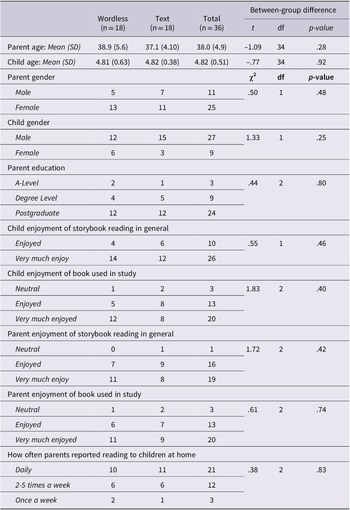
Preliminary analyses of questionnaire data were conducted using independent-samples t-tests for parent and child age and chi-square tests to examine differences between groups on variables that could influence the way in which participants responded to each book (Table 4). There were no significant differences on any of the variables between groups (all ps>.05).
Parent and child demographic details and questionnaire responses.

Parent utterance types: narration, prompts and responsivity
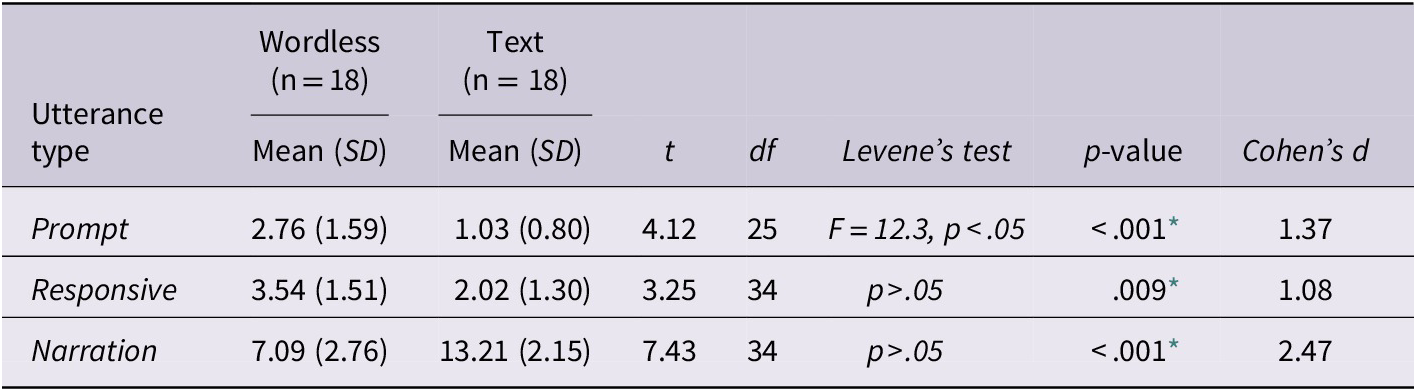
The coding scheme allowed comparison of three broad types of utterances used by parents, i.e., prompts, responsive utterances, and narration. Independent-samples t-tests were conducted with Bonferroni adjustments to p-values to control for familywise error rate (number of comparisons = 3). Mean rates of occurrence across categories and results of statistical tests are shown in Table 5.
Rate of occurrence of prompts, responsive utterances, and narration per minute with the wordless (wordless) and book with text (book with text).

* Significance at p<.05
The first research question asked if parental use of prompts would vary as a function of book format, with the hypothesis that when sharing a wordless book parents would use more prompts. The analysis revealed that parents sharing the wordless book produced a significantly higher rate of prompts and responsive utterances than those reading the book with text. Regardless of whether text was present or not, parents spent a similar amount of time per page (wordless book: M = 25 seconds; book with text: M = 22 seconds) which was not significantly different (t(34) = -1.3, p>.05). A chi-square test showed a significant difference in the distribution of parental utterance types in the wordless book versus book-with-text condition (χ2 = 289.5, df = 2, p<.001, V = .3), indicating that parents tended to use different approaches according to book format. Parents sharing the book with text produced a significantly higher proportion of narrative utterances, while parents sharing the wordless book engaged in a significantly higher proportion of dialogic interaction, as indicated by more prompts and responsive utterances. All observed differences had large effect sizes, with Cohen’s d > 2 for narration.
Parent utterance types: level of cognitive demand of prompts
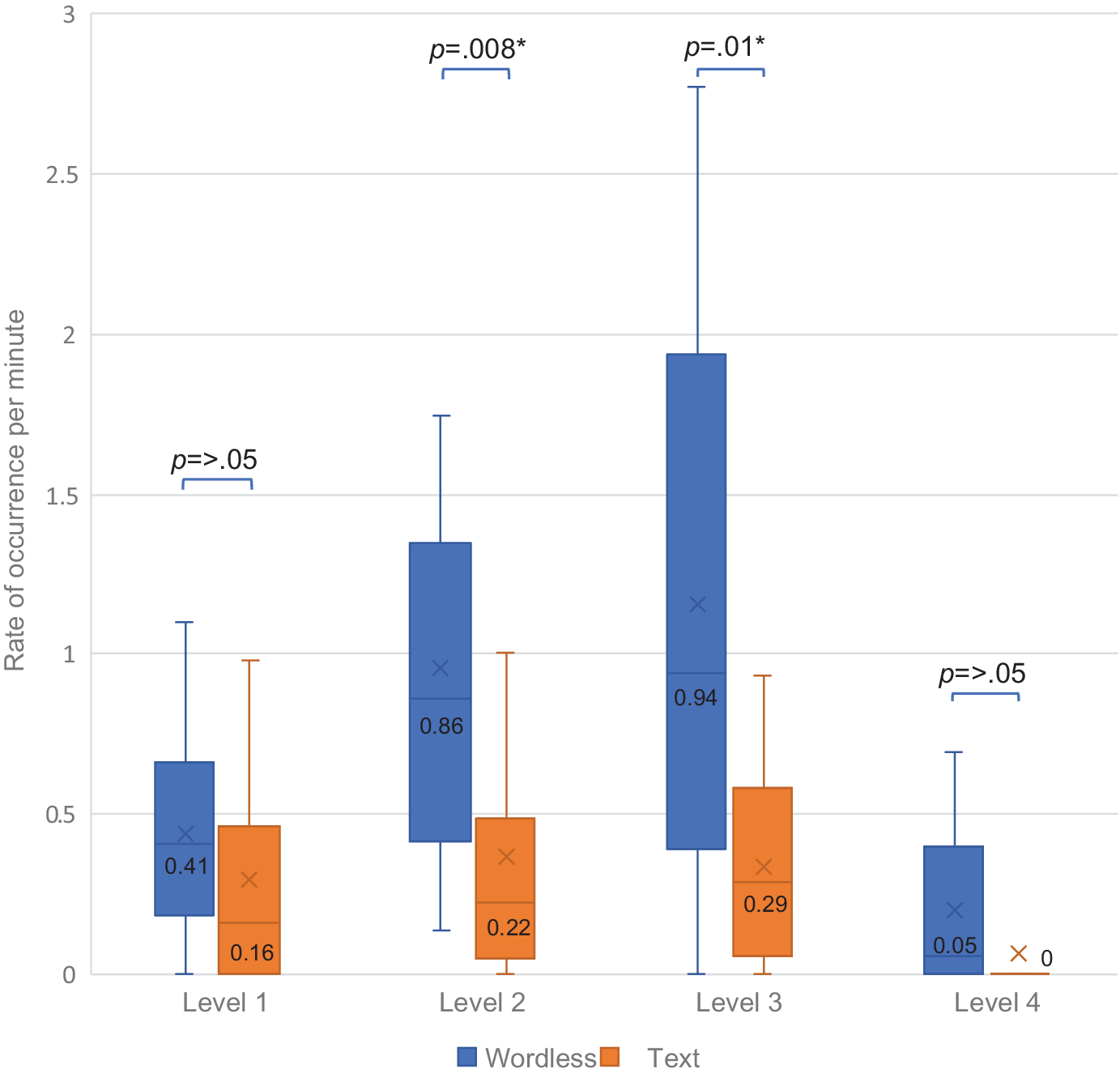
The level of cognitive demand of prompts used by parents was analysed in response to the second research question, in order to explore whether this varied according to which book parents and children shared. Shapiro-Wilk’s test showed non-normally distributed data for rates of occurrence of different levels of prompts, therefore Mann-Whitney U-tests were conducted with Bonferroni adjustments to p-values. Figure 1 shows median rate of prompts at each level.
Rate of occurrence of prompts across levels of cognitive demand (*Significance at p<.05).

During the wordless book, there was a significantly higher rate of Level 2 prompts (U = 65.0, p = .008, η2 = .262) and Level 3 prompts (U = 68.5, p = .01, η2 = .243). There was no significant difference between conditions in the rate of Level 1 prompts (U = 110, p = .39) or Level 4 prompts (U = 107, p = .15). Furthermore, a chi-square test indicated no significant difference between groups in the distribution of prompts across the four levels (χ2 = 6.08, df = 3, p = .11), indicating that while there were more prompts overall during wordless book-sharing, parents used similar proportions of the four levels of prompts in both conditions.
Child talk: contributions and linguistic content
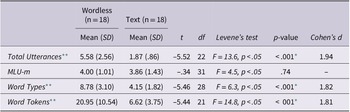
The third research question asked whether child language productivity and verbal participation would differ according to the type of book shared. Shapiro-Wilk’s test showed normal distribution for rate of occurrence of total child utterances, MLU-m of child utterances, and word types and tokens, therefore independent-samples t-tests were conducted. The extent to which children verbally participated is indicated by measures shown in Table 6 (all df were adjusted due to unequal variances indicated by Levene’s test). There were significantly higher rates of utterances offered by children during the wordless book. MLU-m was not significantly different between groups but children sharing the wordless book used a significantly higher rate of word tokens and word types compared to when the book with text was used. Results with significant differences showed large effect sizes (Cohen’s d > 1).
Descriptive statistics of linguistic properties of child talk.

* Significance at p<.05
** measures normalised to give rate of occurrence per minute
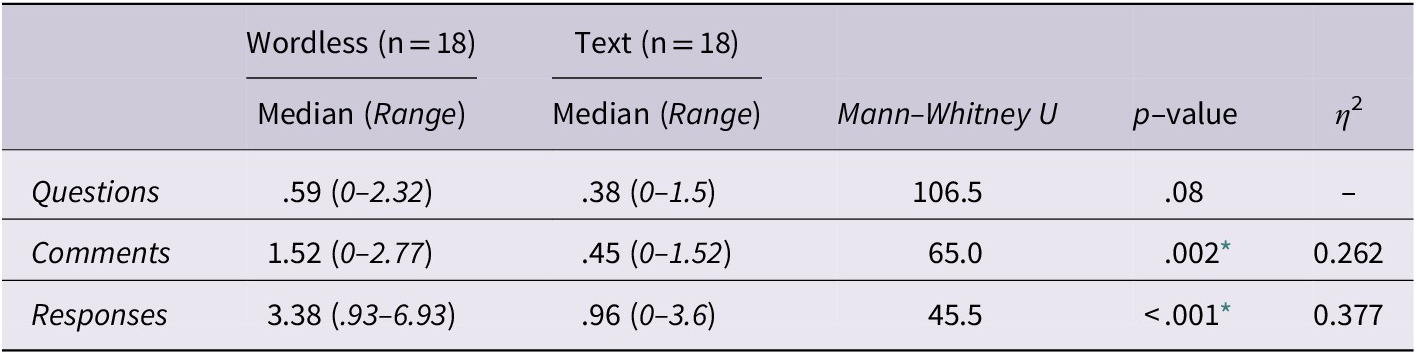
Children’s utterance types were further analysed using Mann-Whitney U-tests due to Shapiro Wilk’s test indicating non-normally distributed data. Table 7 shows median rates of occurrence per minute of each. On average, children produced more responses and initiating comments during the wordless book than the book with text, again exhibiting large effect sizes. There was no difference between groups in the rate of questions asked by the children.
Median rate of occurrence per minute and range of child utterances by type for each group.

* Significance at p<.05
Taking both parental and child contributions into account, children were responsible for 29% of verbal contributions during wordless book reading compared to 11% during the book with text, which a chi-square test indicated was a statistically significant difference (χ2 = 223, df = 1, p<.001, V = .3). This suggests that reading a wordless book may be more beneficial in creating contexts for children to use language than a book with text.
Pearson’s correlation analysis showed that the rate of child utterances was positively correlated with parental prompts (r = .84, p<.001) and responsive utterances (r = .84, p<.001) across conditions, suggesting that parents and children responded to each other's contributions.
Linguistic content of CDS during narration and dialogic interactions
The linguistic properties of the entirety of language produced by parents during the shared book reading conditions were initially compared. Independent t-tests were conducted to compare MLU-m as a measure of grammatical complexity, and VOCD as a measure of lexical diversity. This showed that the MLU-M of parental language overall was significantly higher when sharing the book with text (M = 8.98, SD = 0.54) compared to the wordless book (M = 7.62, SD = 1.60), t(34) = 3.4, p = 0.002. VOCD was also significantly higher during the book with text reading (M = 54.10, SD = 1.64) than during the wordless book (M = 43.92, SD = 11.08), t(34) = 3.9, p<.001.
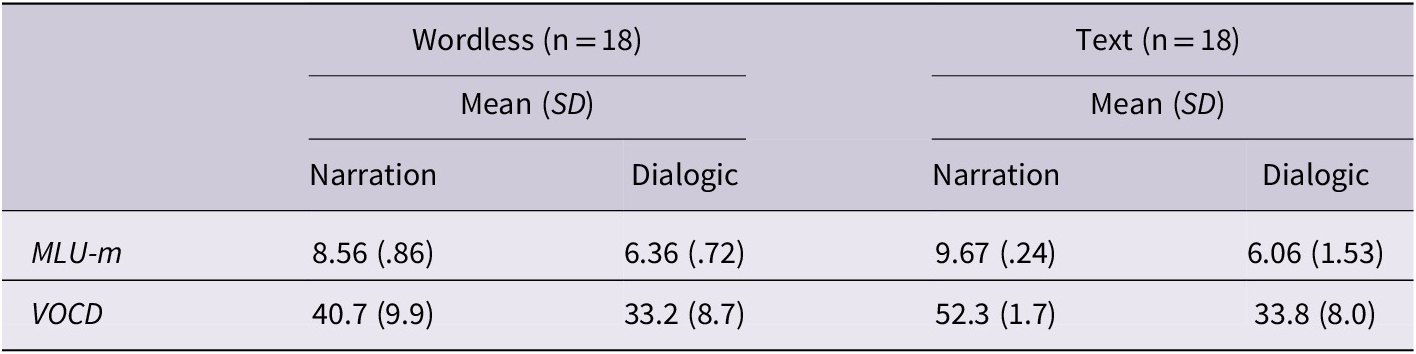
As shown in Table 8, narrative and dialogic utterances were then separated to examine measures of parental level of lexical diversity and grammatical complexity for each, in order to address the final research question asking whether these properties of parental language varied according to book format.
Mean and SD of MLU-m and VOCD of parent utterances during (i) narration and (ii) dialogic utterances (i.e., prompts and responsive utterances)

Two mixed-factorial ANOVAs were conducted to look at the effects of book format (wordless, book with text) as a between-subject factor and utterance types (narration, dialogic) as within-subject factors on the dependent variables, MLU-m and VOCD. In terms of grammatical complexity, there was a significant interaction between book format and utterance type (F(1, 34) = 10.1, p = .003, ηp 2 = .23), and so main effects must be interpreted in context of this interaction. There was a main effect of utterance type on MLU-m (F(1, 34) = 169, p<.001, ηp 2 = .83), indicating that utterance type influenced grammatical complexity and accounted for 83% of variance. There was no main effect of book format on MLU-m (F(1, 34) = 3.12, p = .09).
To investigate the interaction, simple main effects analyses were conducted with Bonferroni adjustments for multiple comparisons. This showed significantly higher MLU-m for narration during the reading of the book with text than the wordless book (F(1, 34) = 27.9, p<.001, ηp 2 = .45) but no significant differences between conditions for dialogic utterances (F(1, 34) = .60, p>.05). Pairwise comparisons showed significantly higher MLU-m for narration than dialogic utterances both with the book with text (F(1, 34) = 131, p<.001, ηp 2 = .79) and the wordless book (F(1, 34) = 48.1, p<.001, ηp 2 = .59). Effect of utterance type on MLU-m was stronger during the book with text.
In terms of lexical diversity, there was a significant interaction between book format and utterance type (F(1, 34) = 116, p<.001, ηp 2 = .32). There was a main effect of book format (F(1, 34) = 7.7, p = .01, ηp 2 = .19) accounting for 19% of variance and a main effect of utterance type (F(1, 34) = 91.2, p<.001, ηp 2 = .73) accounting for 73% of variance. The interaction suggests that effects of utterance type varied according to book, thus main effects must be interpreted in context of the interaction. Analysis of simple main effects with Bonferroni adjustments showed significantly higher VOCD for narration than for dialogic utterances both with the book with text (F(1, 34) = 92.2, p<.001, ηp 2 = .73) and the wordless book (F(1, 34) = 15.3, p<.001, ηp 2 = .31). Partial eta-squared values show that utterance type accounted for more variance during the reading of the book with text (73%) than the wordless book (31%). VOCD was also significantly higher for narration with the book with text than with the wordless book (F(1, 34) = 23.9, p<.001, ηp 2 = .41). However, there was no significant difference in VOCD of dialogic utterances between books (F(1, 34) = .05, p>.05). Thus, overall parents’ narratives were more lexically diverse when reading the book with text than the wordless book, and they were more lexically diverse than dialogic utterances in both conditions.
Discussion
The overall aim of the study was to examine narrative storybook reading between parent-child dyads using a wordless book versus a book with text. Linguistic content and types of utterances used by parents and children were analysed to explore the influence of the book format on conversational transactions. Research questions were addressed regarding: (1) parental use of prompts; (2) level of cognitive demand of prompts; (3) verbal participation of children; and (4) lexical diversity and grammatical complexity of parental language as a function of book format and utterance type.
The first hypothesis was supported as parents’ discourse was marked by a higher rate of prompts when sharing the wordless book. Overall distribution of prompts at the four levels of cognitive demand was not significantly different between conditions, supporting the null hypothesis for the second research question as there was no evidence that parents used a greater proportion of prompts at higher levels of cognitive demand when reading the wordless book. For both conditions, most prompts were at Levels 2 and 3.
The third hypothesis that children would provide more contributions when sharing a wordless book was supported, with higher rates of both responsive and spontaneous comments and significantly more verbal contributions overall. The fourth hypothesis was also supported as narration during the book with text exposed children to more grammatical complexity (as measured by MLU-m) and lexical diversity (as measured by VOCD) than narration generated during the wordless book. These results will be discussed in the context of what these findings indicate about parent-child interaction and the linguistic content that children may be exposed to when reading a wordless book versus a book with text, and the proposed benefits that each type of book may afford to children’s language learning.
Parent-child interaction: parental strategies and child participation
Parents produced a notably higher rate of prompts when sharing a wordless book, characteristic of dialogic reading. A proposed explanation is that parents engage children more in co-constructing meaning when the narrative is not explicit (Chaparro-Moreno et al., Reference Chaparro-Moreno, Reali and Maldonado-Carreño2017). For example, Level 2 prompts include ‘who’, ‘what’, ‘where’ questions, asking children to describe what they can see: for example, “What do you think is happening in this picture?” These types of prompts encourage attention to temporal and spatial aspects of illustrations (Chaparro-Moreno et al., Reference Chaparro-Moreno, Reali and Maldonado-Carreño2017), and a higher rate of these reflects the need for close joint attention to construct a story. Typical Level 3 prompts asked children to predict or consider what characters were feeling or saying – for example, “What do you think they might be thinking about a lion?” or “How do you think the mouse feels?” – which help construct a coherent narrative beyond just describing what is seen.
While parents used a higher overall quantity of prompts during wordless book reading, there was a stable approach to types of questions asked in both contexts. In other words, parents initiated similar types of discussions with both books, with more prompts at Levels 2 and 3 than Levels 1 and 4 in both conditions. Therefore, it appears that book format in the present study was not a moderator of the level of cognitive demand of prompts parents used. Inspection of the transcripts suggests that similar rates of Level 1 prompts were due to parents in both groups asking children to label animals at the beginning of the session. Studies indicate that adults are more likely to use prompts at higher levels of cognitive demand when children are already verbally engaged – while lower-level prompts serve to elicit engagement in the first place (McGinty et al., Reference McGinty, Justice, Zucker, Gosse and Skibbe2012). Once attention is gained, and children are successful in responding to questions, parents can increase the level of cognitive demand. Level 4 prompts tended to be ‘why’ questions expanding on themes – for example, “Why do you think he’s sad?” and “Why would the mouse want to save the lion?” – and were used infrequently by parents in both groups. It is possible that there were fewer prompts at higher levels of cognitive demand due to it being a first read of a novel book. Parents frequently re-read books with children, and the types of discussions that occur have been shown to change with increasing familiarity (Fletcher & Reese, Reference Fletcher and Reese2005).
Children offered more than twice the number of total utterances during the wordless book compared to the book with text, with more diverse vocabulary use as a result and a significantly greater overall proportion of child contributions (wordless: 29%; book-with-text: 11%). This means that parents had more opportunities to provide contingent, linguistically responsive feedback, as demonstrated by a higher rate of responsive utterances when sharing the wordless book. These results extend previous research demonstrating that wordless books can provide a suitable context in which parents can stimulate and encourage children’s communicative participation and abstract language use, in line with a transactional model (Chaparro-Moreno et al., Reference Chaparro-Moreno, Reali and Maldonado-Carreño2017; Nielsen, Reference Nielsen2012), as the more questions parents asked, the more verbally engaged children were for both conditions. Moreover, children produced a higher rate of spontaneous or initiating comments during wordless book reading (i.e., not in response to any particular question). This suggests that when parents actively engage children, children are more likely to comment and join in with constructing a narrative than when listening more passively to a story due to a qualitatively different pattern of interaction.
While the current study did not evaluate language outcomes, previous research has shown that when children are more active conversational partners in book reading, development of language and literacy skills is enhanced (Whitehurst et al., Reference Whitehurst, Falco, Lonigan, Fischel, DeBaryshe, Valdez-Menchaca and Caulfield1988). More conversational turns provide more opportunities for children to practise and consolidate language skills, and more opportunities for caregivers to provide tailored feedback (Romeo et al., Reference Romeo, Leonard, Robinson, West, Mackey, Rowe and Gabrieli2018; Zimmerman et al., Reference Zimmerman, Glikerson, Richards, Christakis, Xu, Gray and Yapanel2009). Other studies have demonstrated that higher levels of child engagement during book reading as a result of parental questioning and linguistic responsiveness enhance vocabulary development (Blewitt & Langan, Reference Blewitt and Langan2016; Smeets & Bus, Reference Smeets and Bus2012). As there is also evidence that children’s independent narrative skills are predicted by the extent to which mothers encourage their active participation (Kang et al., Reference Kang, Kim and Pan2009), parent-child interactions when sharing a wordless book may be a useful base upon which to build children’s narrative skills. More dialogic interaction through prompts during wordless book reading appears to reflect a higher level of scaffolding of narrative construction. Further longitudinal research should establish whether the types of interaction observed during wordless book reading have an effect on measures such as children’s narrative recall or word learning.
Linguistic content of parental talk
Previous research has indicated that storybook text provides exposure to more complex grammar and diverse vocabulary than other CDS (Cameron-Faulkner & Noble, Reference Cameron-Faulkner and Noble2013; Montag et al., Reference Montag, Jones and Smith2015). This was supported in the present study as, when sharing a book with text, children were exposed to greater diversity of vocabulary overall. Further analysis separating narrative utterances from questions and responsive utterances indicated that VOCD was higher when parents read a narrative from a book with text, than when they constructed the narrative with a wordless book. This provides further evidence that storybooks with text are valuable ‘lexical reservoirs’ (De Temple & Snow, Reference De Temple, Snow, Van Kleeck, Stahl and Bauer2008), allowing exposure to vocabulary that may not be in children’s everyday environment even within a matched storybook reading context. The narrative was also more grammatically complex with the book with text (MLU-m = 9.67) than with the wordless book (MLU-m = 8.56), consistent with Chaparro-Moreno et al.’s (Reference Chaparro-Moreno, Reali and Maldonado-Carreño2017) findings of greater MLU of teachers’ utterances when reading a book with text compared to the wordless book. Therefore, consistent with previous literature, reading aloud storybooks has the potential to provide children with input marked by grammatical forms and vocabulary that are infrequent in their immediate environment, or of a different style than that typically used by their parents.
The present study separated ‘narration’ and ‘dialogic’ utterances to explore how the two are characterised by different linguistic contexts as parents provide a narrative alongside more conversational interactions. This was evident for both book formats, despite there being no text to follow with the wordless book. This supports Massaro’s (Reference Massaro2017) hypothesis that language used when providing a narrative story, even in the absence of a textual ‘script’, is marked by more complex grammatical forms and diverse vocabulary than language used in other contexts. The very nature of constructing a narrative demands a broader use of grammatical structures and so provides children with exposure to constructions that may be less frequently used in everyday interactions. Analysis of CHILDES corpus data (MacWhinney, Reference MacWhinney2000) indicates an average MLU-m of 6.00 for parental utterances towards children at a similar age (4;09) as those in the present study (4;10). This is remarkably close to what was found for dialogic utterances (book with text: MLU-m = 6.06; wordless book: MLU-m = 6.36), while average MLU-m for narration was significantly longer for both books. This converges with Noble et al. (Reference Noble, Cameron-Faulkner and Lieven2018) who found that CDS during shared reading was grammatically enriched when compared to CDS during play, even when parents used a simple one-word-per-page book. This adds to previous research as studies examining grammatical complexity of book text did not consider CDS within a storytelling context (Cameron-Faulkner & Noble, Reference Cameron-Faulkner and Noble2013; Montag et al., Reference Montag, Jones and Smith2015).
The expressive abilities displayed by the children in the study as measured by MLU-m (book with text: 3.86; wordless book: 4:00) were also in line with those of children aged 4;09 in CHILDES corpus data (4.00; MacWhinney, Reference MacWhinney2000). MLU-m of parental dialogic utterances was slightly higher than children’s, consistent with Price et al. (Reference Price, Van Kleeck and Huberty2009) who also found that parental extratextual utterances of narrative and expository books were slightly longer than those of typically-developing children due to parents’ higher linguistic abilities and scaffolding approach during storytelling.
Evidence suggests that children with language impairment can be less engaged in shared storybook reading (Van Kleeck & Woude, Reference Van Kleeck, Woude, Van Kleeck, Stahl and Bauer2008), likely due to a combination of high linguistic expectations and the adult-led interactional context (Kaderavek & Justice, Reference Kaderavek and Justice2002). Wordless books have the potential to provide a context for shared reading in which more two-way conversations occur where adults are naturally linguistically responsive while maintaining elements of grammatically complex and lexically diverse storytelling. While the present study looked at interactions between parents and typically-developing children, further research can examine if findings extend to parents and children with language impairments.
Limitations and future research
The study focused on one book reading session, limiting the representativeness of results. Other studies have demonstrated that patterns of interaction can change with repeated readings: for example, children talk more when reading familiar books (Fletcher & Reese, Reference Fletcher and Reese2005) and so there may be more opportunities for parents to ask questions and extend discussions. Averaging results from repeated readings in future research would help improve representativeness of individual book reading styles or the type of questions parents ask with increasing familiarity. Contextual repetition through re-reading the same stories appears to be a factor that influences vocabulary development (Horst et al., Reference Horst, Parsons and Bryan2011) and it would be of interest for further research to see how language use or interactions change over repeated readings of wordless books. For example, children may be presented with similar vocabulary but in different sentence frames during repetitions of a wordless book. On the other hand, reading books with text is likely to present the child with the same words in the same constructions. As in all book sharing studies, results can only be interpreted in the context of the specific books used (Price et al., Reference Price, Van Kleeck and Huberty2009).
A significant limitation of the study is its limited sample size as a result of which the analyses we conducted lacked statistical power. Moreover, the implications of our study for early intervention are limited by the fact that the parents who participated in it were highly educated. It is well known that variables, such as educational background and socioeconomic status (SES), critically affect the way parents read to their children (Fletcher & Reese, Reference Fletcher and Reese2005). For instance, less educated parents have been shown to engage children of preschool age less in challenging discussions than more educated parents (Korat, Reference Korat2009; VanderMaas-Peeler, Nelson, Bumpass & Sassine, Reference VanderMaas-Peeler, Nelson, Bumpass and Sassine2009). Furthermore, a large body of research has shown that parents from lower SES backgrounds use a more restricted vocabulary, less complex syntactic patterns and more directive speech in interactions with their children, including during book reading, than those from higher SES backgrounds (Hart & Risley, Reference Hart and Risley1999; Hoff & Tian, Reference Hoff and Tian2005; Huttenlocher, Vasilyeva, Waterfall, Vevea & Hedges, Reference Huttenlocher, Vasilyeva, Waterfall, Vevea and Hedges2007). The findings presented are thus exploratory in nature and further research with a larger sample of parents from diverse economic and cultural backgrounds is needed to provide more robust insights into how far the results generalise.
Use of a coding scheme to classify different categories of talk requires reducing “a complex, messy, context-laden and quantification resistant reality to a matrix of numbers” (Orwin, Reference Orwin1994, p.140 as cited in Mackey & Gass, Reference Mackey and Gass2005). Thus, some measures in the study were broad in scope but chosen due to their quantifiable nature and standard use in research. More detailed levels of analysis could be applied to both parent and child contributions. Considering the interactional context of the study, it would be worthwhile for future research to analyse sequential dependencies between interactions in order to explore how parents and children dynamically adjust their utterances to one another’s: for example, looking further at complexity of child utterances in response to prompts at different levels of cognitive demand, and how parents might raise or lower cognitive demand accordingly. Storybook reading has been proposed to qualify as a ‘dynamic system’, with numerous factors affecting style and content of interactions, and Yaden (Reference Yaden, Van Kleeck, Stahl and Bauer2008) suggests the need for more sophisticated analytic tools to determine evolving interactions and links between storybook reading and language outcomes. The present study demonstrates that shared storybook reading is not a single linguistic environment but a combination of complex talk through storytelling and scaffolding through conversational interaction, both of which must be considered when looking at outcomes.
Finally, many studies have only included mothers. Of studies that have looked at paternal language, some studies have reported that fathers may be more interactive and use more complex language than mothers when talking to children (Duursma, Reference Duursma2014), but other studies have found similar or only subtly different interactional styles between mothers and fathers (Flack et al., Reference Flack, Field and Horst2018). Therefore, both mothers and fathers were included in the current study as both parents are important contributors to a child’s development. While no particular differences were observed in approaches used by mothers and fathers in the current study, of particular note was the low number of participants who were fathers. Recruitment issues may have contributed to this as convenience sampling meant more mothers known to the authors were recruited. Similarly, we did not systematise the child participants in terms of sex in the present study, although there is evidence that parents interact differently with preschool-aged girls and boys (Anderson, Anderson, Lynch & Shapiro, Reference Anderson, Anderson, Lynch and Shapiro2004). It thus would be useful for researchers to further explore interaction styles and language use of mothers and fathers with sons and daughters under different storybook reading contexts.
Conclusion and implications
In conclusion, lexical diversity and grammatical complexity of parental language varied as a function of book format and utterance type. The book with text exposed children to a narrative marked by more diverse vocabulary and grammatical complexity, while the wordless book stimulated a greater degree of parent-child interaction and conversational turns. In particular, parents provided more prompts and responsive utterances with a wordless book, which appeared to promote children’s engagement with the book as they displayed greater levels of participation and language productivity in response. Higher rates of prompts provided more opportunities for children to engage in discussion at different levels of cognitive demand. On the other hand, parental language when reading a book with text was more linguistically complex and diverse than when sharing a wordless book.
The results of the present study indicate that, with a wordless book, parents naturally engage in a type of reading interaction in which the child contributes more to co-construction of a narrative, supported by parental scaffolding. Children spend the majority of time during book reading paying attention to illustrations (Evans & Saint-Aubin, Reference Evans and Saint-Aubin2005), and a wordless book requires parents to do the same. In this way, wordless books appear to be a useful tool to equalise parent-child shared reading interactions and encourage co-production of a narrative. It is argued that the essence of shared storybook reading is the high level of joint attention it promotes, which is a proximal process on which language learning is based (Farrant & Zubrick, Reference Farrant and Zubrick2011), and makes vocabulary and grammatical constructions used more accessible (Cameron-Faulkner & Noble, Reference Cameron-Faulkner and Noble2013; Noble et al., Reference Noble, Cameron-Faulkner and Lieven2018). Shared reading with a wordless book maintains and potentially enhances the essence of this activity (i.e., joint attention), promoting conversational turn-taking while still providing a linguistically-enhanced environment with opportunities for flexible storytelling (Kaderavek & Justice, Reference Kaderavek and Justice2002). Higher levels of interactive discussion and conversational turns allow more opportunities for parents to scaffold learning according to the child’s ability (Romeo et al., Reference Romeo, Leonard, Robinson, West, Mackey, Rowe and Gabrieli2018).
In sum, shared storybook reading provides a valuable routine structure for parent-child interaction that encourages language development from a young age (Kaderavek & Justice, Reference Kaderavek and Justice2002). This study adds to previous research demonstrating that book choice can stimulate different kinds of discourse. Rather than just being told to increase frequency of reading, parents should be guided to include a variety of books in shared reading routines in order to provide opportunities for different types of input and interactions that are known to facilitate language development. Varied shared reading experiences are likely to benefit children as different approaches afford different benefits (Nyhout & O’Neill, Reference Nyhout and O’Neill2013). A narrative raises levels of linguistic demand and stimulates vocabulary and language growth through exposure to low-frequency vocabulary and more mature grammatical structures, and reading aloud storybook text takes this even further. On the other hand, prompting children to participate encourages expressive use of language and attention to narrative details. Therefore, recommending the inclusion of wordless books as a complement to more typical books with text in book sharing routines is a useful way of directing parents’ reading towards more dialogic interactions, allowing more opportunities for children to have an active role.
Acknowledgements
We have no conflict of interest to disclose.
This research did not receive any specific grant from funding agencies in the public, commercial, or not-for-profit sectors.