Introduction
In psychology, collusion is defined as an unconscious bond: the associated persons are tied together by a strong relational dynamic, which is triggered by a situation mirroring a common unresolved psychological issue. The situation is handled by the participants in either the same way (positive collusion) or in an opposite way (negative collusion) (Fox & Carey, Reference Fox and Carey1999; Nivoli et al., Reference Nivoli, Lorettu and Milia2014; Petriglieri & Wood, Reference Petriglieri and Wood2003; Stiefel et al., Reference Stiefel, Nakamura and Terui2017a). The denominations “positive” and “negative” characterizing the type of collusion are by no means judgments or moral considerations. The shared and unresolved issue produces an emotional echo in the colluders and can provoke suffering, unreflective behaviors, and an adverse effect on their relationship and medical care.
To illustrate the phenomenon of collusion, an example from the palliative care setting may serve. A patient with advanced cancer, who has great difficulties coping with separation since the time he experienced painful losses of loved ones during his childhood, now faces death, and thus separation again. The unresolved issue, separation, provokes intense anxiety, which pressures him to request assisted suicide as a way to hasten the process of separation he fears most (to “get it over with”). However, he does not conceive his request as such and denies the associated anxiety by arguing that he is “just tired of life.” If this patient encounters a clinician who is also haunted by separation anxiety, the clinician may either harshly reject the patient's request (“it's against the law and it's unmoral…”), thus distancing himself from the threatening issue (he also wants to “get it over with”), or blindly endorse the request and even take action to fulfill the patient's wish. Not conscious of the underlying dynamic, the physician defends his or her stance by arguing that “assisted suicide is not part” of medical treatment” or that he “just tries to help the patient.” In the first case, the collusion is a “negative collusion,” because the patient and the clinician have adopted opposite ways to conceive the request; in the second case, it is a “positive collusion,” because they agree on how to handle the situation. In neither of the two situations, a clinically meaningful and empathic exploration of the patient's underlying motivations takes place, and collusion hampers adequate care.
Collusion is related to transference-countertransference phenomena as they are described in the psychoanalytic literature. However, transference-countertransference operate on an extended field, their notions are somehow fuzzy, and definitions with regard to countertransference have evolved over time and are multiple (Jacobs, Reference Jacobs1999). Collusion can be understood as one specific modality of the broader category of transference-countertransference, but collusion 1) has a clear definition (Frankel, Reference Frankel, Aron and Harris1993; Nos, Reference Nos2014; Stiefel et al., Reference Stiefel, Nakamura and Terui2017a; Willi, Reference Willi1984); 2) is characterized by a reciprocal reaction, which fuels the relational dynamic; and 3) leads to a binary outcome; with 4) the colluding clinician not only reacting to a patient's relational attitude, but also to his or her own unresolved issue.
Collusion is also distinguished from empathy. Although a certain resonance of the patient's lived experience within the clinician may help to stimulate empathy, in collusion, the clinician undergoes psychological pressure, and resonance is not provoked by the patient, but by the unresolved psychological issue, which haunts the clinician, hampers his or her judgment and impedes the capacity to care. The struggle of the patient and clinician with the shared unresolved issue thus becomes the overriding principle of the encounter and determines its dynamics.
Collusion occurs everywhere and can be at the origin of intense relationships of attraction or hate (Willi, Reference Willi1984). Collusion has first been described in the psychiatric setting (Fox & Carey, Reference Fox and Carey1999; Frankel, Reference Frankel, Aron and Harris1993; Nivoli et al., Reference Nivoli, Lorettu and Milia2014; Nos, Reference Nos2014; Petriglieri & Wood, Reference Petriglieri and Wood2003; Willi, Reference Willi1984), where intense interpersonal relationships and unresolved psychological problems are prevalent. In the somatic setting, it has been described in oncology (Faulkner, Reference Faulkner1998; Gosney, Reference Gosney2007; Helft, Reference Helft2005) and palliative care (Chaturvedi et al., Reference Chaturvedi, Loiselle and Chandra2009; Davis et al., Reference Davis, Bruera and Morganstern2013; Low et al., Reference Low, Kiow and Main2009; Schwarz, Reference Schwarz2004; The et al., Reference The, Hak and Koeter2000), where sensitive psychological issues, such as “separation,” “control,” “intimacy,” or “dependency,” are frequently put into play by the disease or its treatment. Although the clinician may be aware of the associated emotions of collusion, such as anger or overwhelming sympathy, he or she ignores the underlying issue at stake, which he or she shares with the patient. A colluding clinician may thus explain his attitudes and rationalize his stance, but he is unable to identify the underlying dynamics, which ties him so strongly to his patient. However, retrospectively, and especially by means of supervision, collusion can be identified.
We have previously demonstrated that the concept of collusion has been blurred in the palliative care literature (Stiefel et al., Reference Stiefel, Nakamura and Terui2017a): 1) most often a definition of collusion is not provided; 2) collusion is erroneously conceived as a conscious phenomenon or 3) reduced to situations of information exchange; 4) the impact of collusion on the patient-clinician interaction and on clinical decision making is neglected; 5) no strategies for its detection and working through are proposed; and 6) the role of the clinician in collusion is not addressed (Stiefel et al., Reference Stiefel, Nakamura and Terui2017a, Reference Stiefel, Nakamura, Terui, Shinjo, Shinjo, Morita and Kiuchi2017b). In other words, in the current palliative care literature on collusion are listed phenomena that do not correspond to collusion. At the same time, although we have not searched the literature, it might be that some authors discuss collusion without naming it as such.
To obtain conceptual clarity and to initiate empirical research, we have developed the Collusion Classification Grid (CCG), based on a sound theoretical framework and our experience from clinical supervision (Stiefel et al., Reference Stiefel, Nakamura and Terui2018).
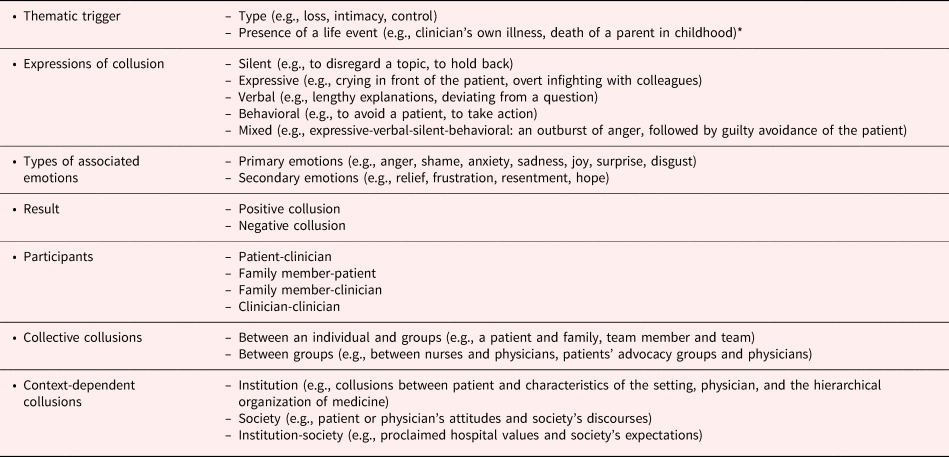
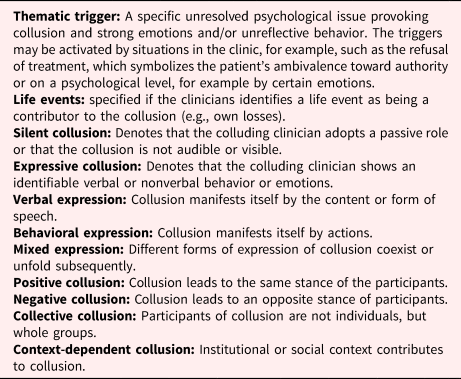
The CCG aims to identify different components of collusion (Tables 1 and 2; for further details, refer to the CCG publication). As mentioned, thematic triggers are situations symbolizing sensitive, unresolved psychological issues such as “loss,” “control,” “dependency,” “intimacy,” which trigger collusion. The trigger may be situated in the practical context; for example, a patient with difficulties to face authoritarian figures refuses medication and colludes with an authoritarian physician who reacts with anger. At other times, the trigger may be situated on a mental level; for example, as an excessive need of a patient and a clinician to control emotions. Among the unresolved psychological problems, life events that have not been metabolized can also lead to collusions.
The Collusion Classification Grid (CCG)

* Added to the original grid.
Glossary

The expressions of collusion may be silent, for example shame-induced avoidant behavior, or expressive, for example anger-induced verbal and behavioral outbursts. Outcome (or consequences) of collusion affects the involved participants, who may be individuals or collectives. Collusions implying collectives might be due to situations, which 1) provoke collusion in certain members of a team who share a same unresolved problem; 2) with the whole team, which has, for example, been recently traumatized by a recent medical event; or 3) with a team characterized by a dominant spirit, which leads to collusion. Finally, context-dependent collusions occur between individuals and the institution or society. For example, the hierarchical organization of medicine might provoke in a patient oppositional behavior, which in turn is responded by the colluding medical apparatus by a harsh recall of rules and law that govern the institution, leading to an escalation of the situation. Or the oppressive institutional culture provokes a collusion with a clinician who blindly executes orders without an attempt to understand or negotiate them. Society's dominant discourses, such as on how to face illness and death, conveyed through expressed opinions and attitudes, the media, or other channels, can also provoke collusions or at least potentiate collusions by “putting oil into the fire.” Examples are the widespread conception of “cancer treatment as a battle,” the expectations toward patients “to fight against the disease,” or injunctions for the dying (Armstrong, Reference Armstrong1987; Bell, Reference Bell2014; Yamazaki, Reference Yamazaki1996; Zimmermann, Reference Zimmermann2004).
The aim of this study was to evaluate the potential utility of the CCG for supervision and research.
Methods
The case material consists of 10 cases of collusion, two of which are detailed in a previous article on collusion (Stiefel et al., Reference Stiefel, Nakamura and Terui2017a) and another in a book chapter on communication in cancer care (Stiefel & Krenz, Reference Stiefel, Krenz and Antonella2013). All cases were presented in clinical supervision to the first author, a liaison psychiatrist, who has worked for many years as a supervisor of oncology and palliative care clinicians.
The ethics committee of the University Hospital Lausanne, invoked by the Swiss authors, cleared the study given that the material (supervised clinicians) was obtained from healthy and volunteering clinicians and anonymized. The material from clinical supervisions in Japan concerns three situations, two of which have already been published (Stiefel et al., Reference Stiefel, Nakamura and Terui2017a), and all of which involved the second author.
The first author, who co-developed the CCG, conducted the analysis of the situations and filled in the grid.
Because the CCG is not a psychometric instrument, but closer to clinimetrics, filling in the grid depends on how comprehensively the supervisor investigates the presented situation, on his or her understanding (and naming) of the trigger, ability to identify the associated emotions and the way collusions are expressed, and his or her ability to take into account contributing contextual factors. In the situations described, collusion was directly addressed and discussed during supervision; in all cases, the supervisee(s) agreed to the interpretation of the supervisor that collusion was at work in the presented situation. That all supervisees were highly motivated and introspective clinicians may explain this result; in some situations, one might expect that clinicians’ defenses might make it delicate to comment the collisional aspects of the presented situation.
Results
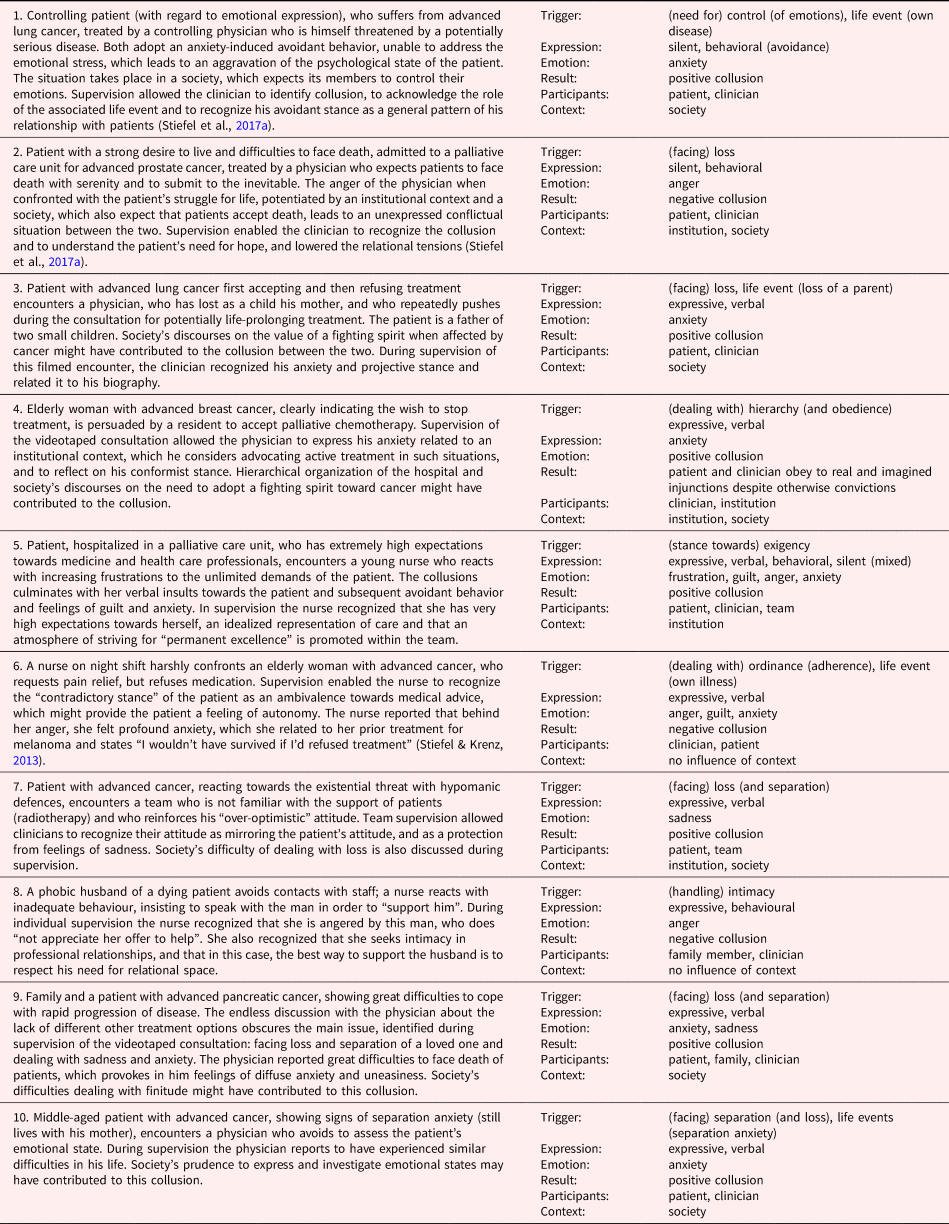
The summary of the supervised situations and the related CCG is detailed in Table 3.
Study material and related results obtained with the Collusion Classification Grid

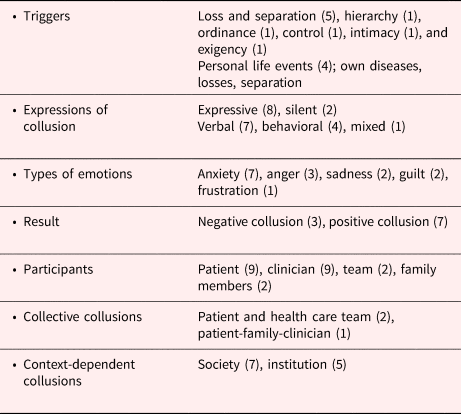
The description of the 10 situations of collusion with the CCG showed that 1) all items listed in the grid were mobilized at least once; 2) variation existed between collusions on an item level (e.g., type of associated emotions, means of expression, triggers); 3) there seems to be no need to add new items to the original CCG (Stiefel et al., Reference Stiefel, Nakamura and Terui2018), except for the reported personal life events; and 4) some specific items, for example, “anxiety” among the emotions and “loss” among the triggers, were more frequent than others (Table 4). The results illustrate that the CCG identifies different facets and types of collusions, and that it might differentiate subtypes that follow distinct patterns on an item level.
Synopsis of the 10 situations assessed with the CCG (number of occurrences)

Discussion
These results indicate that the CCG might be of help for the further investigation of collusion. One could, for example, hypothesize that the prevalence of subtypes of collusions may vary according to the medical setting: collusions around “loss and separation” might be more prevalent in oncology and palliative care, whereas in diabetes care, triggers such as “autonomy and control” might be more frequent. It might be that distinct patterns that cluster specific items emerge in larger samples; for example, “loss and separation” might be more often associated with anxiety and positive collusion, leading to avoiding addressing in oncology the transition to palliative care; or one might find that specific contextual elements, such as the metaphor of “the war on cancer” and the injunctions of having a “fighting spirit,” or institutional characteristics (e.g., tertiary care centers, which promote a more aggressive therapeutic stance) might contribute to collusions.
We have considerably enlarged the concept of collusion, which in the psychiatric and medical literature is restricted to a dynamic between patients and clinicians. We include contextual factors, such as dominant social discourses; for example, with regard to how to face death (Zimmermann, Reference Zimmermann2004), how to survive cancer (Bell, Reference Bell2014), or what can be expected from the medical sciences and physicians (Schaad et al., Reference Schaad, Bourquin and Bornet2015), including injunctions from the medial apparatus and the institution (Crowe et al., Reference Crowe, Clarke and Brugha2017), such as the hidden curriculum in medical school conveying specific representations about medicine (Lempp & Seale, Reference Lempp and Seale2004).
That we could identify context-dependent collusions confirms our view that collusion should not be restricted to the patient-clinician relationship. Indeed, medicine is not a two-person affair behind closed doors. This has already been underlined by Michael Balint (Reference Balint1955), who is the only author we identified as working with an enlarged concept of collusion. He included the institution when he commented on the dilution of responsibility in cases of patients, who mobilize their general practitioner and simultaneously different specialists, and called these situations “collusion of anonymity.” Although the social science literature abundantly addresses the different ways diseases are framed by processes of anchoring (to make something unfamiliar understandable by linking it to something familiar, using analogies) and objectification (abstract objects are transformed into concrete and commonsense realities, notably by means of metaphors), in clinical supervision, such elements are less often addressed, despite their well-known capacity to produce resonance and effects as do discourses articulated by individuals (Montgomery, Reference Montgomery1991).
If the CCG is meant to be used for research, a necessary next step will be to test its reliability and validity. Reliability testing could be conducted by means of video- or audiotaped supervisions, focusing on collusions, which are then separately assessed with the CCG by two or more researchers. Because collusion does not operate in all cases presented in supervision, instruction will have to be provided to present a case in which the clinician has been strongly involved with a patient and has felt intense negative or positive emotions. Validity testing is a more difficult task because no instrument for comparison exists; therefore, validity might be tested, for example, by questioning the supervisee if he or she has gained insight when confronted with the different facets of collusion mapped by means of the CCG. Or validity could be evaluated by testing hypotheses, such as the previously mentioned relationship between overtreatment and CCG documented collusion between patients and clinicians.
Study limitations
Given that this is a retrospective study, recall bias may be an issue; however, three of the 10 situations were comprehensively documented and published, and the others were analyzed based on the supervisor's notes. The limited number of cases also limits the informative value. As mentioned, the first author has co-developed the CCG, and therefore was familiar with it, which might not be the case for other supervisors. Reliability testing will answer the question, whether additional explanations or a coding system have to be associated to the CCG.
Conclusions
Given that collusion is a relevant phenomenon in daily clinics, we believe it merits more attention. The results of this exploratory study encourage the further evaluation of the CCG, especially with regard to reliability and validity.
Conflicts of interest
The authors hereby declare that they have no conflicts of interest to disclose.