1. Introduction
Over the past 15 years, corporate social responsibility (CSR) has come to elicit real enthusiasm, leading all the listed companies to define their social and environmental commitments and express them publicly. Although these practices are historically linked to paternalism, the genealogy of CSR may be traced more directly to the business ethics movement (Acquier and Gond, Reference Acquier and Gond2007). Its ancestry is thus North American – the founding text is Howard Bowen's Social Responsibilities of the Businessman (Bowen, Reference Bowen1953) – and its concept of responsibility individual, non-normative and highly moral.
This vision was to remain fundamental for nearly 40 years. One illustration is to be found in the work of Archie B. Carroll (Reference Carroll1979), who defines a ‘pyramid of responsibility’ mainly based on individual, moral considerations. Four levels of responsibility are thus assembled hierarchically, by analogy with Maslow's pyramid of consumer needs and with the same individualistic bias. Company heads must assume (by order of importance): their economic responsibilities (i.e. being beneficial/profitable); their legal responsibilities (remaining within the law/obeying the law); their ethical responsibilities (being fair/meeting the society's expectations); and their philanthropic responsibilities (being good citizens).
This initial period of CSR was essentially limited, however, to the USA, where it was seen as a ‘plus’ for executives in search of a vision broader than their sole economic interests. The phase underway for the past 15 years is of a different nature, as we shall see in section 2 of this article. Indeed, the companies are now called upon to meet structured social demands, whether these concern the ecological impact of their productive activity or their choice of governance. As a result, CSR is no longer solely the result of individual initiatives coming from entrepreneurs with ethical or moral concerns but becomes an issue which listed companies are required to address, even when their response is limited to a public relations strategy (de la Broise and Lamarche, Reference de la Broise and Lamarche2006). This situation has led to an institutionalisation process creating changes in the nature of the institutions concerned, the players’ activity and the very models underlying CSR, thus paving the way for a ‘regulatory potential’ which has assumed various forms to date (Brabet, Reference Brabet2009).
As we will show in section 2, if this institutionalisation process is aimed at responding to ecological problems, it has also emerged at a time of failing shareholder governance. In addition, it is based on a dynamics which is essentially decentralised at sectoral level, and even more so at company level. In such a context, do the companies opt for CSR as a means of resolving certain problems raised by the crisis of shareholder governance? In other terms, are we witnessing the emergence of a new ‘conception of control’ as set out by Neil Fligstein (Reference Fligstein1990) – namely a new and widely shared representation of the company, its objectives and its strategies – within which CSR would play a key role? These are the questions we will address in section 3 by proposing a new conception of control which we term shareholder–CSR compatible. By drawing on Fligstein's work in economic sociology, we attempt to explain the relations between corporate governance and CSR within an approach which is at once historical and institutional (Guthrie and Durand, Reference Guthrie and Durand2008).
2. CSR as an institutional process
Grasping CSR as an institutional process calls for adopting two distinct levels of analysis: on the one hand, the social demands it must confront, which explain the institutionalisation process (‘Social demands’ section); and on the other, the main clusters of tensions or trade-offs which determine the trajectory of the institutionalisation process underway (‘The crisis of shareholder governance’ section).
Social demands
CSR, as the ‘corporate chapter’ of sustainable development, is called upon, first of all, to provide responses to the ecological crisis; it is also supposed to help compensate for the failings of shareholder governance, or even to define a new mode of governance compatible with the stakes of the ‘new firm’.
The emergence of an ecological criticism
As Michel Capron and Pascal Petit (Reference Capron and Petit2011) show, it is possible to distinguish various phases in the development of CSR since the end of the Second World War. While it was initially based on the ethics of individual company heads, the conception of CSR has been transformed to become more ‘utilitarian’ (i.e. the company's social behaviour now serves its economic performance) and to address concerns of ‘sustainability’ in the face of pressure from public criticism. This trend is reflected in the research of Michael Porter and Mark Kramer (Reference Porter and Kramer2006), who identify these two facets in strategies based on CSR: a ‘strategic CSR’ aimed at increasing the company's competitive advantage, and a ‘responsive CSR’ which constitutes a de facto response to outside pressure.
In the recent period, companies have in fact had to confront multiple questions and protests stemming from ecological criticism (Chiapello, Reference Chiapello2009). This situation calls to mind the thesis of ‘justification’ (Boltanski and Thévenot, Reference Boltanski and Thévenot2006) concerning the role of criticism, where it is argued that capitalism owes its longevity to its ability to take criticism into account and assimilate it along with the ideas for reform it produces. According to Eve Chiapello (Reference Chiapello2009), ecological criticism has assumed a central position, notably because of its capacity for attracting the media and political figures. In this case, a combination of what Luc Boltanski and Eve Chiapello (Reference Boltanski and Chiapello2007) call ‘artistic’ criticism and conservative criticism is associated with a transformation of social criticism.
Following in the steps of paternalism, conservative criticism provides CSR policies with an ethical dimension, as reflected, for example, in corporate foundations. It converges with certain aspects of the artistic criticism (critique of consumer society, search for authenticity and sociability, attentiveness to the environment) and with a revival of social criticism, which is directed in particular at the exploitation of the southern hemisphere countries and the exacerbation of inequalities (thus entering into human-rights criticism as well).
The criticism thus contributes to the construction of the normativity accompanying capitalism and forces it to incorporate the very values which have served to criticise it. This is a new relationship, in the sense of a power relationship or the dialectical relationship between capitalism (via the firms and their top managers) and its critics (i.e. those who position themselves as representatives of individuals, companies and circles subject to exploitation or damages).
The extension of the registers of criticism leads to several interrelated legitimisation processes. CSR practices link up three levels of legitimacy, or rather, three legitimisation processes, which accompany the institutionalisation process:
(1) The internal legitimisation of the departments and players involved in sustainable development (i.e. within the company). The question here is how sustainability at the company scale, which is reflected in CSR policies, can produce order. In this sense, the nature of the ties between sustainability departments and the non-governmental organisations (NGOs) and social rating agencies explains how those internal and external actors produce a new field for their own legitimisation.
(2) The statement of responsibility. The voluntary, declarative nature of the action, as well as the absence of legal sanctions, gives the company the task of stating its own responsibility. Under these circumstances, various values and performances (pollutant emission, diversity, waste sorting, etc.) may be mobilised for the production of value.
(3) The definition of the rules of the statement and, more broadly, the definition of the institutional framework within which the company's responsibility is set out. This does not involve the practices and reporting themselves (see the previous point) but the rules of this reporting. In our view, this constitutes a specific category of the production world's collective intangible investment in face of the civil and financial worlds.
CSR is thus the tool chosen by the companies to respond to ecological criticism. It leads them to expand the field of their prerogatives by assuming an environmental responsibility along with their responsibility to shareholders. In this way, the top managers find themselves in a pivotal position in face of a double external constraint: the environment and the shareholders. They thus agree on expanding the company's social role in response to the institutionalist reading (i.e. considering the company as an institution, a representation which is out of phase with that of shareholder governance) (Eymard-Duvernay, Reference Eymard-Duvernay2004).
The crisis of shareholder governance
The other ‘social demand’ which CSR is supposed to meet, at least in part, is related precisely to the crisis of shareholder governance. In the view of Luigi Zingales (Reference Zingales2000), this crisis is to be explained by the appearance of a ‘new firm’ for which such governance, suited to the ‘traditional firm’, is structurally inappropriate.
Zingales's ‘traditional firm’ is based on the work of Alfred D. Chandler (Reference Chandler1990). Such a firm seeks economies of scale and scope but its size and capital intensiveness entail such great needs for capital that its stock ownership is dispersed. The separation of ownership and control then creates a problem of agency between salaried top managers and shareholders. By bolstering the shareholder's control, shareholder governance avoids under-investment in capital. Furthermore, the lack of competitors – since economies of scale and variety constitute effective entry barriers – makes the external labour market relatively tight for specialised skills, which allows the company to exert control over its employees.
The ‘new firm’ is not faced with the same problems. First of all, access to capital markets becomes easier, even though the investment in physical capital no longer guarantees the establishment of a rent. Conversely, creative and innovative capacities become essential. The human capital incorporated into the firm is now decisive (Appelbaum and Berg, Reference Appelbaum, Berg, Blair and Kochan2000), at the very time when the company's control over employees becomes less efficient, since the latter can set up their own company or benefit from increasing job opportunities with competitors or subcontractors. It should be recalled that unlike tangible resources (factories, facilities) and certain transferable intangible resources (patents, brands), human capital and skills cannot be appropriated, in the legal sense of the term, by the company.Footnote 1 In this sense, attaching the skills to the company, beyond the employees themselves, becomes an issue in order to compensate for the absence of legal appropriation.
This ‘new firm’ with its human-capital intensiveness, is also characterised by a vertical disintegration as a result of the refocusing undertaken in the 1990s (Cohen, Reference Cohen2005; Pavitt, Reference Pavitt2005). This movement goes far beyond a simple extension of traditional subcontracting because it can involve complex products and subsystems, or even lead to the total outsourcing of product manufacture, thus giving rise to a dissociation of conception and manufacture (Berger, Reference Berger2005; Weinstein, Reference Weinstein2010).
The appearance and gradual domination of this ‘new firm’ (Rajan and Zingales, Reference Rajan, Zingales and Vives2000) lead to a reconsideration of the role of corporate governance, which can no longer be reduced to the system whereby listed stock companies are owned and directed (Berle and Means, Reference Berle and Means1932) within a logic of consolidating the rights of residual claimants (Easterbrook and Fishel, Reference Easterbrook and Fishel1991; Shleifer and Vishny, Reference Shleifer and Vishny1997). It must now guarantee the specialisation and complementarity of human assets all along a value chain (Gereffi et al., Reference Gereffi, Humphrey and Sturgeon2005) which includes the network of subcontractors beyond the company's legal boundaries.
Various examples illustrate the governance problems posed by this ‘new firm’, beginning with the British advertising agency Saatchi and Saatchi, whose chairman, Maurice Saatchi, left the company with other managers to create a rival agency following a conflict with shareholders over his remuneration. Saatchi and Saatchi, renamed Cordiant, subsequently underwent a sharp devaluation of its assets, which were in large part intangible (Rajan and Zingales, Reference Rajan, Zingales and Vives2000). According to Zingales, the disciplinary role of shareholder governance would have worked in a ‘traditional firm’ whose boundaries were determined by the ownership of its physical assets but no longer functions in the ‘new firm’ where ‘human capital becomes essential’ (Zingales, Reference Zingales2000: 1645).
Vertical disintegration also poses governance problems which cannot be resolved by consolidating the rights of the main company's residual claimants. As a result, at the same time that the prime contractor refocuses on its ‘core activity’, it has to develop an ‘order-giver's savvy’ (‘savoir faire’; Mariotti, Reference Mariotti2004: 714) in order to avoid being held responsible for a subcontractor's failings. This was the case for Mattel in August 2007, when the manufacturer had to recall and destroy 18 million toys suspected of being dangerous because of a subcontractor's negligence in China. Even when the main company's responsibility is not directly engaged, moreover, the conduct of the subcontractors can devalue its assets by affecting its reputational capital. Nike and Puma, for example, faced sharp criticisms over the working conditions condoned by their respective subcontractors. Nike responded in 2005 by publishing a detailed report on the working conditions in the group's 704 subcontracting companies. For its part, Puma subsequently joined the Fair Labor Association, which has developed an accreditation procedure for the working conditions of all the member companies’ subcontractors (Palpacuer, Reference Palpacuer2008).
The traditional disciplinary and incentive mechanisms of shareholder governance are therefore unable to resolve the governance problems posed by the ‘new firm’. In this context, CSR seems to be a solution adopted by the companies to add measures which supplement shareholder governance rather than replacing it. These measures permit the company to assert its ownership of certain assets (Rubinstein, Reference Rubinstein2008), stabilise human capital by engaging its employees (Saatchi) and legitimise the main company's control over the subcontractors even though they are legally independent, in order to prevent problems of quality (Mattel) or reputation (Nike, Puma) which might affect its valorisation. It is noteworthy that even if CSR was mainly introduced in listed companies, it could also very much affect the subcontractors’ network as non-respect from subcontractors in relation to CSR can have significant impact on the main firm in terms of costs but also in terms of reputation.
Such use of CSR is illustrated by the case of France Télécom, the incumbent telecommunications operator, which was faced with a wave of suicides among its French employees in 2009. The CSR department immediately took over from the human resources department in order to deal with the social crisis and renew dialogue. An ambitious 900 million euro action plan asserted ‘the conviction that social performance and economic performance are inseparable for serving clients and acting in the interests of everyone’.Footnote 2 The group's CSR strategy is also aimed at safeguarding the company's assets, by reminding all employees that they must ensure the ‘protection and respect of the group's intellectual property and all other projects and know-how’, as well as the ‘appropriate use of the group's resources and the safeguarding of its assets’.Footnote 3
Where the management of its subcontractor network is concerned, France Télécom has had a tool for evaluating partners since 2004, including a criterion for assessing the respect of commitments in terms of business ethics, environmental issues and social responsibility. Since 2009, the group has also commissioned social audits in Asia based on the international SA8000 standard and has been cooperating with Deutsche Telekom and Telecom Italia in order to pool the CSR audits of Asian suppliers.Footnote 4 In addition, by virtue of the French Telecommunications Federation agreement of July 2010, France Télécom has joint access (with the French mobile phone companies SFR and Bouygues Telecom) to a tool for outside evaluation of subcontractors’ CSR performance on the basis of a detailed questionnaire available from an online platform developed externally.Footnote 5
These reorientations in the use of CSR correspond to the conclusions of Capron and Petit (Reference Capron and Petit2011), who analyse the findings of six surveys conducted by KPMG between 1993 and 2008 on the non-financial reports of the largest listed companies in various Organisation for Economic Co-operation and Development (OECD) member countries. The authors trace the changing content of these reports from the 1990s, when they were almost exclusively concerned with environmental questions, to the present decade, when their tone shifts abruptly to address social and economic issues and their scope expands to all sectors (including those where environmental issues are minor, such as finance, information and communication).
The CSR institutionalisation process
The analysis of the emergence of CSR rules and standards, which can be termed the institutionalisation process, is concerned with the institutional innovations (self-regulation, code and charter, reporting system, laws, etc.) undertaken by different categories of players. Like any institutionalisation process, that of CSR is marked by the interaction between legal rules and other, more flexible ones created by the companies in relation to their voluntary commitments. The specific feature of this process, as we will see in the ‘Voluntary participation and normativity’ section, is that it is initiated by voluntary company practices which are gradually transformed into rules. The CSR institutionalisation process thus brings out the companies’ decentralised action which serves to generate informal rules (codes, charters, etc.) coexisting with formal ones (regulations, laws, constitutions).
In addition, the pressure exerted by the different forms of activism prefigures a new category of players (individuals, NGOs, etc.) with an uncertain profile, whose objective is to make the commitments real by functioning as representatives of environmental, societal or human rights causes. The institutionalisation process gives rise to a group of structures, rules and standards which are thus set up in a contradictory, unplanned and non-centralised way and modify in turn the companies’ action schemes.
Voluntary participation and normativity
Attention has often been drawn to the relatively low level of CSR standardisation (Capron and Quairel-Lanoizelée, Reference Capron and Quairel-Lanoizelée2004). This may be explained by the period during which CSR practices spread, which was marked at once by the questioning of the Fordist model (as defined by Boyer and Saillard, Reference Boyer and Saillard2002), globalisation, the withdrawal of the social state, the logic of deregulation and a greater awareness of environmental hazards.
The influence of this historical context is expressed in various ways:
(1) The constraints generated by CSR practices link up the global nature of the issues (ecology, international division of labour, the scope of the company and its responsibility, notably through its supplier network) and local realities or impacts. A certain number of tensions between these two levels may emerge, in particular during the translation of global principles into locally grounded rules and laws. What is involved is the political context of an emerging worldwide governance and its interaction with local or national sovereignties;
(2) The institutionalisation process of CSR practices is occurring in a period which is hardly favourable to the elaboration of binding regulations (Bodet and Lamarche, Reference Bodet and Lamarche2007). This situation gives rise to a multiplicity of texts and positions which require action, if only in discursive form, but do not produce stable, formal rules of general scope.
The production of standards is thus heterogeneous and non-constraining. Contrary to many rules legally imposed on companies (in the areas of accounting, labour relations, etc.), CSR depends on voluntary participation. An overall analysis of its definitions (European Union, OECD, etc.) and international guidelines (Global Reporting Initiative, Global Compact, etc.) thus brings out certain constants, in particular voluntary participation and the declarative nature of the procedures. The European Commission, for example, indicates that: ‘Most definitions of corporate social responsibility describe it as a concept whereby companies integrate social and environmental concerns in their business interactions. . .’. Following the fourth Multi-Stakeholder Forum on CSR, this position was reiterated in the Commission's 23 March 2006 communication indicating that: ‘CSR is fundamentally about voluntary business behaviour. . .’. In fact, France is the only country to have instituted formal legislation in this area, with its law on new economic regulations which defines the companies’ reporting obligations (article 116 of the 2001 law on new economic regulations [Les Nouvelles Regulations Economiques, NRE]).
In this same non-regulatory spirit, the United Nations Global Compact is defined as a voluntary partnership between the United Nations, the companies, the states and civil society. Similarly, the Global Reporting Initiative, introduced at the World Summit for Sustainable Development in Johannesburg, indicates that its guidelines are intended for voluntary use in the companies’ reporting process. The voluntary nature of the responsibility measures, constantly reiterated in the official definitions, thus leaves the companies considerable leeway.
At the same time, and notwithstanding the fact that CSR initially spread through the publication of codes of conduct (as of the late 1980s in the USA and the second half of the 1990s in Europe; Jenkins, Reference Jenkins2001), their limited, biased nature, along with the absence of sanctions for false declarations, has led the companies to promote the elaboration of external indicators (standards, labels, etc.) in addition to the internal ones to be found in CSR reporting and public relations documents, but also to encourage the emergence of independent professional bodies responsible for assessing CSR practices, notably aimed at socially responsible investors (Rubinstein, Reference Rubinstein2006). This is the case for non-financial rating agencies (e.g., Vigeo, BMJ Ratings, Innovest), even if these are generally called upon by the companies themselves and are thus dependent on the very subjects of their audits.
By virtue of their heterogeneous nature, the existence of multiple guidelines allows the companies to shape the rules and conditions of the way their responsibility is defined. Even within this non-binding framework, however, a chain reaction arising from a practice which was initially voluntary confronts the companies with an obligation to report on what they do. This is what we will call, following Benjamin Coriat and Olivier Weinstein (Reference Coriat and Weinstein2002), a ‘type 2’ rule (i.e. one established by a group of agents and including particular agreements, contracts, customs and standards of behaviour).
However, a consideration of type 2 rules alone is insufficient to describe the institutionalisation process at work. According to Coriat and Weinstein (Reference Coriat and Weinstein2002), such a process is generally characterised by an interaction between type 1 rules (in the first instance those expressed in the legal system) and type 2 rules. This is also the case for CSR. Here, the French situation is probably the most clear-cut, because the type 1 rule (article 116 of the 2001 law on NRE), by imposing the production and dissemination of information on the companies’ social and environmental performances, stimulates the production of type 2 rules, whether through codes of conduct drawn up by the companies, the adoption of international benchmarks or the creation of labels and standards. Elsewhere, it is more often the threat of adopting restrictive type 1 rules which engages the production of type 2 rules.
In order to understand the institutionalisation process, it is thus necessary to consider the dialectical relationship between the two types of rules: in the case of CSR, it is clearly inappropriate to treat only the legal rule, but inexact to address only the decentralised process at the scale of the company or collective bodies (occupational, sectoral, etc.). Type 2 rules remain subordinated to type 1 rules but the evolution of the former also contributes to the transformation of the latter and in some way anticipates them. The interaction between level 1 and level 2, between ‘private’ rules and ‘public’ rules, is at the heart of the institutional dynamics in general, but is expressed here in an original way (i.e. the considerable preference for type 2 rules).
Commitment and sanctions
Given the fact that type 2 rules do not imply the same enforcement (North, Reference North1990) as type 1 rules, it is necessary to examine the extent to which the companies’ commitments are binding. The CSR dynamics stems in part from outside players shaping the ‘ecological criticism’ (see above). In particular, these include the NGOs, who function as ‘tribunes’ (e.g. Amnesty International or Greenpeace) and make use of the media without collaborating with the industrial groups. If this outside activism triggers certain practices, however, CSR still remains a voluntary measure. This voluntary participation is initially expressed through commitments, followed by an obligation to publicise them, thus giving rise to a dialectical process whereby the companies are bound by their declarations.
Voluntary participation and declaration thus lie at the origin of multiple commitments, charters, codes of conduct, labels and reporting documents (sustainable development report, etc.), immaterial productions which the company will evaluate as intangible assets. In other words, what has been initiated is thus a process of commitments on the part of the companies – commitments in relation to the society or of a commercial nature – without a corresponding system of clearly established legal sanctions in case of non-respect. The absence of legal sanction (France's New Economic Regulations law is no exception), even in the case of non-reporting, non-publication of data or even publication of groundless data, attests to a non-procedural dynamics.
This does not mean, however, that the sanctions facing the company are totally non-existent: they are incurred in terms of image or reputation, and may lead to a decline in the value of the intangible assets (brand) or so-called market sanctions (i.e. decrease in sales). In addition, the voluntary commitment system is not totally without laws but comes under other categories, notably business law, which explains the CSR literature's insistence on ‘soft law’. The increasing recourse to legal procedures in the name of commercial laws, constituting the lex mercatoria, is one significant development, because a space for appeal is opened on the basis of the disparities between the commitments and allegations (environment, human rights, etc.) and the reality of observable practices. This possibility of recourse to legal procedures, practically non-existent in continental Europe, is emerging in the USA (in connection with class action suits notably), even if it still remains quite limited (Daugareilh, Reference Daugareilh2009).
The idea of voluntary participation should thus not be associated with the absence of obligations: the impact on the company's reputation, damage to its image (NGO activism) and court decisions concerning non-respect of commitments, among others, constitute forms of enforcement proper to type 2 rules. Forms of public or media mobilisation are emerging, as may be seen in the case of Danone, which was hit with a boycott because of the disparity between its lofty social commitments and the redundancy programme it had implemented, even though the latter was not particularly austere. Thus, commitments do generate demands on the part of the media and consumers. These are not simply rhetorical; they impose certain transformations in corporate management (Swaen and Vanhamme, Reference Swaen, Vanhamme, Broise and Lamarche2006).
That said, given the weakness of the jurisprudence at the disposal of claimants, the unpredictable outcome of the proceedings and the complex, indirect nature of media pressures, the enforcement mechanisms remain uncertain. CSR constitutes a balance of power which is only slightly institutionalised.
Measures for the assessment and control of responsibility, whether developed internally or by extra-financial rating agencies under company control, constitute a particular category of intangible investments permitting the companies to anticipate and prepare legal weapons in order to counter proceedings which might be made possible by the nature of the commitments. Thus, reporting is not solely aimed at accounting for actions; it also prepares tools which might serve as justifications in different contexts (shareholders’ general meetings, commercial or even district courts, but also the media).
3. CSR, a new conception of control?
At the same time that CSR has rapidly spread to all the listed companies, its very conception has been evolving under pressure from the social demands it must meet – ecological criticism, crisis of shareholder governance – and the form its institutionalisation process has taken. In such a context, we may well ask what role CSR will play in the listed companies. We have seen the advantages it offers in terms of governance. Can its flexibility and voluntary nature permit it to become a component of a new ‘conception of control’? We would maintain that this theory developed by Fligstein (Reference Fligstein1990) allows us to analyse the role of CSR in a context which is at once historical and institutional in order to bring out the specific nature of the institutionalisation process. In this section of our study, we shall thus begin with a brief discussion of the ‘conception of control’ and the different forms it took during the 20th century (‘Changing conceptions of control in the 20th century’ section), followed by a description of the ‘shareholder–CSR compatible’ conception which, we would argue, has emerged in recent years (‘A new conception of control: conditions of emergence and attributes’ section). As in Fligstein (Reference Fligstein1990), our analysis will mainly focus on listed companies, even if CSR strategies include the subcontractors’ network (as any subcontractor's negligence could be costly for the main company and imply reputational risks).
Changing conceptions of control in the 20th century
According to Fligstein (Reference Fligstein1990), the way company heads exercise control depends on their conception of the appropriate behaviour. Conceptions of control are thus ‘totalizing world views that cause actors to interpret every situation from a given perspective. They are forms of analysis used by actors to find solutions to the current problems of the organization. At the center of conceptions of control are simplifying assumptions about how the world is to be analyzed’ (Fligstein, Reference Fligstein1990: 10). A conception of control aims to define the categories of objectives that the company sets for itself and the means of attaining them. It relies on a definition of organisational efficacy and a representation of company practices, of ‘normal’ structures and strategies. A given conception of control may be associated with forms of organisation, ‘normal’ strategies and a privileged method of assessing performances.
Organisational field and institutional isomorphism
Each conception of control is developed within a given organisational field. The latter is the privileged arena where the interactions essential to the company's activity take place and where the rules and standards organising and governing these interactions are forged. According to Fligstein (Reference Fligstein1990), its essential function is to promote stability (ibid.: 6). Dominated by the most powerful organisations in the field, it is the basic mechanism for control of the company's external environment. It should be noted that this organisational field may be compatible with a certain degree of heterogeneity among the organisations composing it. For this reason, the field is structured by a key issue around which these various organisations interact. Thus, for Andrew Hoffman (Reference Hoffman1999), an organisational field ‘is formed around the issues that become important to the issues and objectives of a specific collective of organisations’ (ibid.: 352). However, even if the organisational field may be made up of heterogeneous organisations (e.g., listed companies and ‘tribune’ NGOs) coming together around a single issue (such as the environment), the idea of ‘conception of control’ still remains both collective and normative. In order for a new vision of the company and its strategy to become a conception of control, it must therefore have been adopted already, or be in the process of adoption by most of the companies in the field. The forces leading to homogenisation are not necessarily the search for efficacy but what Paul DiMaggio and Walter Powell call ‘institutional isomorphism’ (DiMaggio and Powell, Reference DiMaggio and Powell1983), a homogenisation process guided by its own particular institutional dynamics. Three isomorphic processes would thus lead to such homogenisation:
(1) Coercion, ‘both formal and informal pressures exerted on organisations by other organisations upon which they are dependent and by cultural expectations in the society in which the organisations function’ (ibid.: 150);
(2) Imitation, which is particularly active in a context of uncertainty. The organisations then tend to model their behaviours on those of competing organisations belonging to the same organisational field;
(3) Normative dynamics. DiMaggio and Powell (Reference DiMaggio and Powell1983) cite in particular the creation and development of standards coming from universities and professional training institutions on the one hand and professional and training associations on the other.
From the manufacturing conception to the shareholder value conception
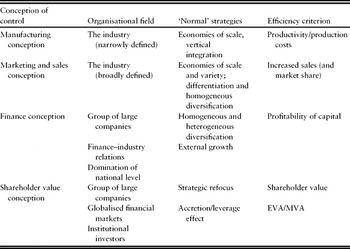
According to Fligstein (Reference Fligstein1990), from the beginning of the 20th century to the 1980s, there were only three successive conceptions of control (Table 1), which should be taken above all as ideal types. Thus, they do not exist in a pure form but may, to a certain extent, be combined over time. They nonetheless permit a broad outline of the successive changes in the large company and bring out the key role of institutional changes.
Conceptions of control in the 20th century

EVA, economic value added; MVA, market value added.
Source: Rubinstein and Weinstein (Reference Rubinstein and Weinstein2000), based on Fligstein (Reference Fligstein1990).
First, the manufacturing conception of control, dating from the beginning of the 20th century, was guided by the desire to control prices and entry into the sector. Typical strategies included large size to exploit economies of scale and vertical integration aimed in particular at the control of inputs and costs. The definition of the organisational field was relatively limited, including the companies manufacturing the same kind of products. In this context, efficiency essentially concerned productivity and production costs.
Second, the marketing and sales conception of control emerged after the crisis of the 1930s, parallel to rising demand and the development of strategies of differentiation and homogeneous diversification.Footnote 6 The representation of company activity was reconstituted around sales, now considered to be the essential goal, and this was accompanied by the so-called ‘marketing revolution’. This situation modified in turn the way company performance was assessed, with increases in turnover and market share becoming privileged indicators. The scope of the organisational field was not greatly modified: it was still based on the industry, but within a broader definition owing to the trends towards homogeneous diversification. Although the vision of a company's efficiency changed, it was still assessed, as in the previous case, relative to the other companies of the sector, even if the latter was now understood in a broader way.
These first two conceptions of control, marked by the search for size advantages (vertical integration, economies of scale and scope), may be compared with the analyses of Adolf Berle and Gardiner Means (Reference Berle and Means1932) who show that the evolution of US capitalism towards the public limited (or incorporated) company, a legal status associated with the large-size business entity, had as its corollary the rise of ‘managerial control’. Shareholders thus exchanged control for liquidity and became ‘passive owners’ no longer entitled to claim the full expression of their property rights: ‘the owners of passive property, by surrendering control and responsibility over the active property, have surrendered the right that the corporation should be operated in their sole interest – they have released the community from the obligation to protect them to the full extent implied in the strict doctrine of strict property rights’ (ibid.: 312).
Finally, the finance conception of control, which emerged in the 1960s, constituted a fundamental break. Here, the overall conception of the firm was modified: it now appeared as a collection of assets to be valued. This new vision was related to transformations of the firm's internal organisation and especially the spread of multi-divisional organisation and decentralisation which permitted management in terms of profit centres. The firm allocated its capital between different activities and product lines in function of their profitability.Footnote 7 New strategies were also introduced: the development of heterogeneous diversification (which could go all the way to conglomerate forms) and external growth. The change in the contour of the organisational field was fundamental here: the space in relation to which each firm situated its practices and assessed its performances no longer consisted essentially of its sector but, according to Fligstein, of all the large corporations. It also tended to include the financial markets and the players operating in them. The efficiency criterion was the profitability of the capital and already the company's stock prices (Fligstein, Reference Fligstein1990: 260), but within a context where securities prices were hardly dissociated from the fundamental value derived from anticipated profitability (Orléan, Reference Orléan1999).
The 1980s saw the emergence of a fourth conception of control (Rubinstein and Weinstein, Reference Rubinstein and Weinstein2000; Fligstein, Reference Fligstein2001) which may be termed the shareholder value conception (Table 1). This development was closely connected with the growing power of the institutional investors, related in turn to various institutional changes, notably the management of retirement pensions (Montagne, Reference Montagne2007).
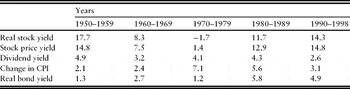
Deregulation, by increasing the liquidity of the financial markets, permitted the constant buying and selling of securities, which potentially gave investors greater power. Despite differences in the strategies of institutional investors, in particular with regards to the time frame, the growing concentration of financial capital in the hands of institutional investors, as managers of collective savings, called the company managers’ power into question.Footnote 8 During the 1970s, the latter had proven to be incapable of maintaining real stock yields which were higher than real bond yields (Table 2), or even positive (–1.7 % over the 1970–1979 period). The fundamental difference between the shareholder conception and the financial conception which preceded it is thus the refusal of shareholders, now organised as institutional investors, to remain passive owners as defined by Berle and Means. On the contrary, they sought to consolidate their rights as residual claimants and continuously increased real stock yield, which reached 11.7% over the 1980–1989 period and 14.3% over the 1990–1998 period.
US corporate stock and bond yields 1950–1998, annual averages (%)

CPI, consumer price index.
Source: Lazonick and O'Sullivan (Reference Lazonick and O'Sullivan2000).
Efficiency criteria were thus redefined in favour of the shareholders’ renewed power – this was clearly the case with the EVA (economic value added; Lordon, Reference Lordon2000) – and stock yields reached levels unknown since the end of the 1950s. The new organisational field was now composed of listed companies and institutional investors, who operated on the globalised financial markets.
In this new context, two kinds of strategies have been favoured for promoting ‘shareholder value’. The first is strategic refocus (Batsch, Reference Batsch2002), which does not exclude external growth strategies if they are aimed at acquiring a dominant position over the core activity, and simultaneously advocates the outsourcing of the other activities, including both functional ones (accounting, computers, logistics) and peripheral ones (cleaning, food service, surveillance, etc.). The second is stock redemption or ‘accretion’, which is aimed at increasing the profitability of the capital stock, notably through the leverage effect of indebtedness.
A new conception of control: conditions of emergence and attributes
It was thus within this organisational field, structured by the shareholder value conception of control, that CSR developed in the 1990s in the USA and then in Europe. At that time, listed companies spontaneously began to publish codes of conduct (Langlois and Shlegemilch, Reference Langlois and Shlegemilch1990) which stressed the socially responsible nature of their activity and subsequently participated in the elaboration of external standards (see above).
Does this mean that a new conception of control emerges with the development of CSR? This is the hypothesis that we are going to examine here, first of all by considering what accounts for the shift from one conception of control to another and then by defining the attributes of such a new conception.
Conditions of emergence
According to Fligstein (Reference Fligstein1990: 20), two conditions are necessary for a new conception of control to succeed a previous one: first, an economic crisis which no longer allows the earlier organisational field to guarantee stability, and second, changes in government regulation. In his work, Fligstein places particular emphasis on the role of changes in American anti-trust policy. He explains the passage from the marketing and sales conception of control to the finance conception, for example, by a tightening of anti-trust legislation which, by prohibiting operations aimed at external growth, whether horizontal or vertical, led to the development of diversification. In the case of the passage from the finance conception to the shareholder value conception, while it was tied to a decline in the real return on stocks during the 1970s (Lazonick and O'Sullivan, Reference Lazonick and O'Sullivan2000), it would also have resulted from the deregulation movement initiated during the presidency of Jimmy Carter and pursued by Ronald Reagan (Fligstein, Reference Fligstein2001). By focusing on the state's role in the changing conceptions of control, however, Fligstein's analysis favoured the type 1 rules which played a central role at the time. But this is less the case with CSR, where the institutionalisation process focuses on type 2 rules, even if type 1 rules continue to intervene (see ‘Voluntary participation and normativity’ section above on the dialectical relationship between the two types of rules).
If type 2 rules, and not just those of type 1, are included in the institutional dynamics, a new conception of control, according a larger role to CSR, would seem to emerge. The adoption of a CSR approach is clearly not a product of a change in the type 1 rules, whether they focus on CSR or on another aspect of the legal framework. Rather, what leads the companies to develop their social and environmental responsibility essentially stems from a change in ‘private’ rules of type 2 – and thus to the extent that CSR can, as we have shown in section 2, provide a response to the dual crisis confronting the company: the ecological crisis on the one hand and that of shareholder governance on the other. Can CSR then constitute a new conception of control, permitting the stabilisation of the companies’ environment and solving some of the problems they face? In order to support this hypothesis, we have to consider the attributes of such a conception of control within the analytical framework developed by Fligstein (Reference Fligstein1990).
The attributes of a new conception of control
According to Fligstein (Reference Fligstein1990), a conception of control is chiefly defined by its organisational field, its so-called normal strategies and its way of measuring efficacy. We shall now consider how these criteria apply to CSR.
The organisational field within which CSR is deployed includes the same players as before: large companies, institutional investors, financial markets. Indeed, the shareholder value conception and the shareholder–CSR-compatible conception are both part of the larger framework of globalised finance-led capitalism (Aglietta and Rebérioux, Reference Aglietta and Rebérioux2005), where financial motives, financial markets and financial players and institutions are increasingly important in the functioning of national and international economies alike (Epstein, Reference Epstein2005).
Nonetheless, several reorientations may be observed. First, certain institutional investors, in particular the pension funds and insurance companies, seek to limit the harmful effects of the volatility of financial markets which is proper to ‘financial capitalism’ (Aglietta, Reference Aglietta1998; Boyer et al., Reference Boyer, Dehove and Plihon2004) and set up longer-term investment strategies or even develop socially responsible investment (which in turn stimulates CSR). Second, on this environmental issue, we can observe a partial return to the sectoral dimension which had been effaced by the finance conception (with the conglomerate) and the shareholder value conception (because of the logic of sectoral and geographical diversification of investors). In fact, the CSR institutionalisation processes now underway often take place at sectoral level; the specifications and technical standards are delivered by professional authorities which transcend competitive relations and constitute spaces for compromise between the companies in the sector, relative to the public authorities, NGOs and so on. The elaboration of the REACH regulationFootnote 9 has thus shown how the companies in the chemical industry, represented by professional bodies, have played a role in reaching compromises between competitors. This does not, however, exclude ‘cherry-picking’, whereby a company on the borderline between various sectors can choose the definition of social responsibility which suits it.
The ‘normal’ strategies are also being redefined. In the shareholder value conception, the financial justification of strategic refocus was that it permitted portfolio diversification at institutional investor level and no longer at company level as had been the case with the finance conception (i.e. the conglomerates). This strategic refocus, adopted by the companies since the beginning of the shareholder value conception, has led them to yield assets remote from the ‘core activity’ and, conversely, to acquire – often through external growth – assets corresponding to the ‘core activity’ and then abandon all or part of their peripheral and functional activities. The other ‘normal’ strategy, meanwhile, was aimed at increasing financial profitability, notably through the leverage effect related to indebtedness (accretion, leveraged buyouts, etc.). Once the strategic refocus came to an end, the possibilities for increasing financial profitability, which had been largely exploited, led the companies to increase their level of indebtedness. What were the possibilities for new ‘normal’ strategies at that point? Each of the earlier strategies was aimed at increasing shareholder value. The same is true for this new ‘normal’ strategy, but with the difference that it now draws on CSR to stabilise or increase the value of intangible assets. It should be remembered that in the ‘new firm’, the share of these assets is constantly expanding: in the case of the S&P 500 companies, for example, Baruch Lev (Reference Lev2003) shows that the difference between the company's market value and its book value increased between 1985 and 2002. He estimates that at that time, between one-half and two-thirds of the company's market value was based on its intangible assets (see also Nakamura, Reference Nakamura2001). Similarly, Vivien Beattie and Sarah Jane Thomson (Beattie and Thomson, Reference Beattie and Thomson2005) observed in early 2004 that about 60% of the market value of the British FTSE 100 companies was not reflected on their balance sheets, a gap which might, in our view, be tied to the existence of intangible assets. CSR allows the value of intangible assets to be stabilised or increased by various means.
The first strategic direction is aimed at using CSR to exploit monopoly rents, whether through differentiation or the construction of entry barriers. The differentiation strategies may bear on processes (which are more or less polluting, for example) or products. In the case of product differentiation, the socially responsible approach acts on differentiation which is at once vertical and horizontal, subjective and objective (Lancaster, Reference Lancaster1966). If the price is the same, consumers will prefer a hybrid auto to the equivalent model which does not have this feature. Such vertical differentiation permits both a response to a particular segment of demand and an enhancement of the company's reputation (Fombrun and Shanley, Reference Fombrun and Shanley1990). CSR can also reinforce horizontal differentiation: certain consumers will prefer to use recycled paper, which is more consistent with their commitment to sustainability, while others will opt for a better quality of paper which is not recycled. And public relations campaigns around the company's (real or supposed) commitment to social responsibility are also a factor of differentiation, objective or subjective, serving to improve the reputation of the company concerned (McWilliams et al., Reference McWilliams, Siegel and Wright2006). The role of CSR in constructing entry barriers, meanwhile, appears, for example, when entrepreneurs already positioned on less polluting production methods become the leading promoters of regulatory barriers to entry aimed at limiting the production methods which are more polluting, or obtaining ecolabels for their products (Nadaï, Reference Nadaï1998). This kind of approach may be related to what Porter and Kramer (Reference Porter and Kramer2006) call ‘strategic CSR’, defined in function of its degree of interaction with the ‘value chain’.
The second strategic direction involving CSR is less well known, even though it also bears on increasing the value of the company's assets. This kind of strategy essentially attempts to define the company's boundaries more clearly and strengthen its property rights over intangible assets. As we have seen, CSR can compensate for the failings of the shareholder value conception in two ways:
(1) On the one hand, by improving governance of the subcontractors’ network, which has been expanded as a result of the strategic refocus. This situation poses particularly complicated management problems which can have serious consequences if they compromise the flagship firm's reputation. In this context, recourse to CSR serves to legitimise and ‘socialise’ the latter's demand by standardising the subcontractor's practices and procedures even if the form of co-ordination between the two parties is not hierarchical.
(2) On the other hand, by reinforcing both the hierarchical coordination within the company and its property rights through the creation of its own code of conduct. This aspect can be seen, for example, in the study by Élodie Béthoux et al. (Reference Béthoux, Didry and Mias2007) based on a body of codes of conduct coming from 166 multinational enterprises operating in various sectors. On the basis of a lexical analysis without prior categorisation, the authors examine the way the enterprises use CSR codes of conduct to reassert both the line of authority within the company and its property rights. These property rights bear on financial information concerning the enterprise, the data it produces and, last but not least, the intellectual production of its employees. This is notably the case in hi-tech companies where the value added is essentially created by discoveries and inventions, thus raising questions of intellectual property. In that case, the code of conduct serves to establish that such discoveries and inventions are an integral part of the company's assets. In addition, the assertion of property rights over information about the company and its production processes is also a way of keeping unsolicited looks from outside at a distance. What is involved is thus a strategy for enhancing the value of the company's assets in the eyes of clients, institutional investors and a certain number of intermediaries involved in establishing its reputation.
Third, the criterion of efficiency would be like the ‘triple bottom line’ proposed by John Elkington (Reference Elkington1999), namely the conjunction of economic, social and environmental performances. This conception of efficiency remains very general, however, and has a very limited impact in practice because the comparison of these three registers brings out many unresolved contradictions which are, in most cases, neither formulated nor formalised. There is no indication of how the contradictions are to be dealt with and studies on CSR generally have difficulty determining the conditions in which the trade-offs between these three levels of performance are made. Why? Because they are little, if at all, inclined to deal with the fundamentally controversial nature of the questions addressed and the power relations crystallising around production, profit distribution and the latter's effects on the former. Implicitly, the top managers are called upon to arbitrate. From this standpoint, the results of the most recent econometric studies, drawing on meta-analysis (Allouche and Laroche, Reference Allouche and Laroche2005; Margolis et al., Reference Margolis, Elfenbein and Walsh2007; Orlitzki et al., Reference Orlitzki, Schmidt and Rynes2003; Wu, Reference Wu2006), show that the arbitrages carried out do not weaken financial performance; on the contrary, it tends to be improved in companies taking a CSR approach. Two alternative explanations for these econometric findings emerge. First, it may be argued that CSR is above all ‘cosmetic’ and thus presents no obstacle to the company's financial performances. On the contrary, that because it is effective, CSR permits the company to increase the value of its intangible assets: by responding to ecological criticism through the production of proofs (indicators, sustainability report, etc.), the companies gain the informational quasi-rent developed by top management.
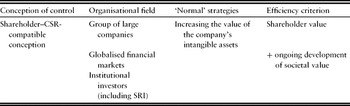
We propose to call the new conception of control whose attributes we have just described the shareholder value–CSR-compatible conception (Table 3) because it seems to be closer to a reorientation of the preceding shareholder conception than a complete break. Indeed, shareholder value remains central to the company, but the latter now relies on CSR, in tension with those responsible for it (i.e. the top management and sustainability departments within the enterprises). Thus, the enterprise is still run in the interest of the shareholders (shareholder value conception) but from a perspective which is compatible with the company's social and environmental responsibility (while avoiding the contradictions which might arise from this ‘triple bottom line’).
A new conception of control

CSR, corporate social responsibility; SRI, socially responsible investment.
4. Conclusion
CSR, initially defined by Bowen (Reference Bowen1953) to respond to the individual preoccupations of company heads concerned with ethics or morals, has changed: it has become a collective phenomenon and acquired formal and informal rules, with the result that no listed company can now avoid a consideration of its extra-economic responsibility. This evolution, which we explain by the double demand imposed on CSR – responding to both ‘ecological criticism’ and the governance problems raised by shareholder governance – and by the institutionalisation process it is undergoing, leads us to hypothesise the emergence of a new conception of control, which we would call the shareholder value–CSR-compatible conception.
This emergence, encouraged by the ecological and shareholder governance crises, is original insofar as it is based on a modification of private rather than public rules, unlike what Fligstein (Reference Fligstein1990) had brought out with regards to earlier shifts from one conception to another. This originality is related in particular to the specific nature of the CSR institutionalisation process, marked, as we have seen, by voluntary participation and a particular method of enforcement. One of the keys to the success of the shareholder value–CSR-compatible conception lies in this decentralised production of rules which the companies help to shape.
Like those preceding it, this new conception of control is defined in reference to an organisational field, ‘normal’ strategies and an efficiency criterion. We have attempted to trace their outlines here. The organisational field does not seem to be fundamentally different from that of the preceding period, except that it reintegrates a sectoral dimension which had disappeared since the time of the finance conception. The environmental aspects of production (negative externalities, use of natural resources, etc.) remain quite pronounced at sectoral level. The ‘normal’ strategies adopted by the shareholder–CSR-compatible conception are focused on increasing the value of the company's intangible assets, in a context where this kind of assets represents a constantly increasing share of the company's value. Nonetheless, these strategies remain compatible with the shareholder conception since they pose absolutely no threat to the financial performance of the enterprise and can even lead to increasing its value on the financial markets. What remains the most uncertain is the efficiency criterion, as well as the way that possible conflicts between economic, social and environmental performance will be arbitrated.
Top management's ability to work with a certain number of intermediaries (extra-financial agencies, consultants, etc.) in order to produce new conventions for evaluating responsibility within its professional environment seems to be a central issue. Indeed, the efficiency criteria which will emerge in this new conception of control will be shaped by a new kind of information which is more the province of the top managers than that of the shareholders.
The latter, through market finance, have relegated company labour issues to the background with the financialisation of the wage nexus, relayed by institutional mechanisms such as the pension funds (Montagne, Reference Montagne2007). In a more general way, the managers’ position brings out the tension they have to deal with in the context of financialisation and globalisation, as well as the dehumanisation of work, even if the situation is far from uniform on a national scale (Palpacuer et al., Reference Palpacuer, Seignour and Vercher2011). In the shareholder–CSR-compatible conception we have described, environmental and social responsibilities are now added to corporate responsibility to shareholders. Such a conception thus appears above all to be a compromise between demands of a financial nature and complex, changing societal demands which are advanced by actors in search of legitimisation and institutionalisation. The power that top managers wield within the company in the elaboration of this compromise is worth emphasising. It may lead to closer ties between shareholders and company executives, as was already the case in the shareholder value conception (Aglietta and Rebérioux, Reference Aglietta and Rebérioux2005) – the huge increase in remunerations was one symptom – to the extent that CSR permits the reinforcement of the company's property rights and enhances the value of its intangible assets. Since shareholders are not in a position to possess internal information, they cannot exercise strategic control over the firm. Reliance on the top managers thus constitutes a major phase in shareholder power.
Finally, it will be interesting to follow closely what the top managers view will be in the near future in relation to this new conception of control: will they continue to align with shareholders’ objectives or will they try to find a better balance between the different stakeholders, as Berle and Means (Reference Berle and Means1932) recommended? The answer to this question remains uncertain. It is also uncertain that ordinary wage earners have something to gain from this new conception of control, especially since the wage nexus receives no more attention than was the case with the preceding one. Wage relations are now treated within an overall discourse on the company's social and environmental performances, which gives de facto priority, discursively at least, to the environment and human rights.