Naniwa-bushi, also called rōkyoku Footnote 1and formerly known as ukare-bushi, is a genre of Japanese musical storytelling which enjoyed its greatest popularity from the late nineteenth to the mid-twentieth centuries. The period when it flourished in Japan coincided with the mass Japanese labour migration to Hawai‘i, and it found popularity among those who migrated as well. Although some scholars have written about Japanese music cultures in Hawai‘i, including topics such as the “Holehole-bushi” work songFootnote 2 and bon folk dance,Footnote 3 naniwa-bushi has to date not received much attention, perhaps because the genre abruptly disappeared in Hawai‘i with the coming of World War II as did other Japanese performing arts, and then was never fully recovered thereafter.
An examination of the two major Japanese newspapers published in Hawai‘i—Yamato Shimbun (est. 1896, and from 1906 renamed Nippu Jiji) and Hawai Hōchi (est. 1912)—reveals the great popularity of naniwa-bushi during the first half of the twentieth century. Articles and advertisements from 1896 to 1941, when the war began, contained 5,084 references to naniwa-bushi. Footnote 4 The number is extremely high compared to the number of references to other genres of Japanese performing arts; for instance, ondo, the most popular song repertoire associated with bon dance, was referenced 1,994 times, and biwa storytelling self-accompanied on the pear-shaped lute, 2,652 times. The numbers reveal the incomparable popularity of naniwa-bushi in prewar Hawai‘i, suggesting a disparity between Japanese musical culture of the time and current scholarship. Diasporic ethnomusicological studies have proliferated since the 1990s,Footnote 5 demonstrating the various ways in which people respond to new geographical, cultural, and social conditions through music, and how new cultural styles and expressions and/or new meanings and functions attached to music emerge. Still, studies on music in the Japanese diaspora remain limited, and most deal with the musical cultures of more recent generations and eras, such as jazz, taiko, and karaoke. Footnote 6 This article attempts to complement existing studies, disclosing the forgotten history of a once-prospering musical culture in the diaspora and explaining its disappearance through a close examination of the historical data.
As a mass entertainment spread by itinerant musicians and commercial recordings, naniwa-bushi exhibited great mobility. Its popularity in Hawai‘i was synchronised with its similar status in Japan, due to a continuous flow of travelling performers and record imports. It served as a cultural bridge between Japan and the Hawaiian diaspora, constructing a dynamic transnational relationship and movement of people centred around music. Here, I analyse the reasons behind its great popularity in Hawai‘i to illustrate how a transplanted genre helped sustain immigrant identity, as well as exploring the fatal effect the Pacific War had on the genre.
The importance of paying attention to transnational networks that link people and musical practices has been addressed in recent ethnomusicological studies on the Chinese diaspora, in a way that challenges the prevailing but old paradigm of “native-Chinese-versus-overseas-Chinese,” that is, of the cultural centre versus the periphery (Tan and Rao Reference Tan and Rao2016:7–9). Indeed, the idea of the home as compared to the host country in sociological studies on migration has led to a dichotomy in previous studies, in which a musical culture transplanted to the host society and transformed to adapt to the new environment is analysed in comparison with its counterpart in the home society. The latter is treated as a static reference point. However, further consideration of the ongoing and evolving relationship between diasporic and home cultures is needed; not only conditions in the host country, but also how migrants and their descendants renew their relationship with the home society through transnational networks of people, materials, practices, and ideologies—and how irresistible political forces such as war cause sudden ruptures to such networks—are all crucial to understanding how a diasporic culture is constructed and developed.
What Is Naniwa-bushi?
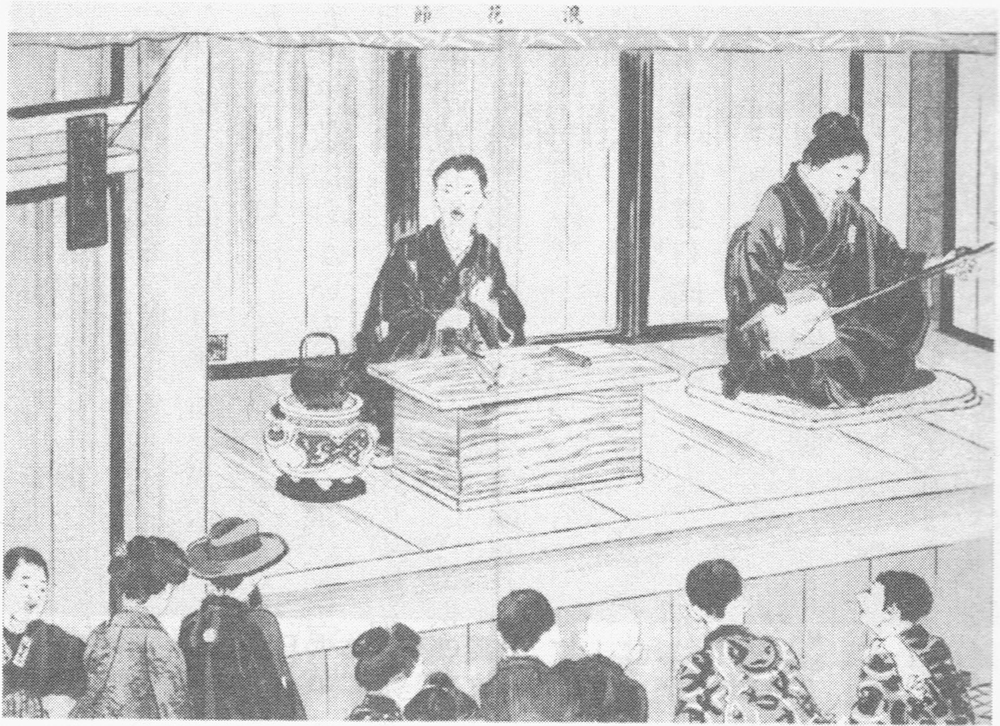
Naniwa-bushi is a form of expressive musical storytelling in which one person narrates and sings a story and also acts out all of the characters. The narration and action are accompanied by a shamisen (three-stringed lute), which provides dramatic sound effects (Figure 1).
Illustration of naniwa-bushi performance in the Meiji era (1868–1912) (Fūzoku Gahō, 10 October 1907; see also Hyōdō Reference Hyōdō2009:15).

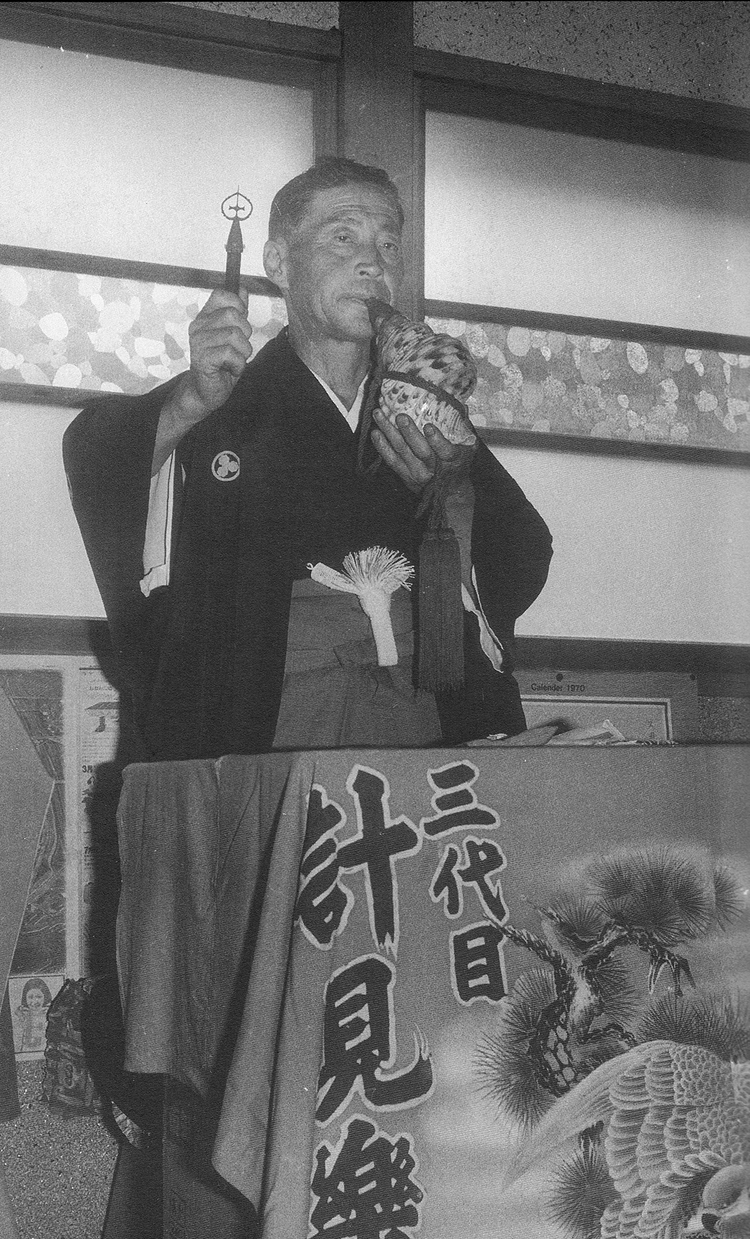
The prototype for naniwa-bushi emerged around the mid-nineteenth century as a fusion of several preexisting folk narrative genres, such as chongare, deroren saimon, and sekkyō-bushi. The first of these was a type of narrative street entertainment performed by mendicant Buddhist priests during the Edo period (1603–1868); the second, during the same period, included the nonsense interjection “deroren” accompanied by a blast on a conch-shell horn (see Figure 2); and the third derived from the chanting of Buddhist sermons around the fourteenth century.
Deroren saimon performer from Yamagata Prefecture around 1970s or 1980s (Ozawa Reference Ozawa2004:81).

Begun as a street performance, the newly-invented narrative genre was first called ukare-bushi. Footnote 7 Its performance venue gradually shifted to small theatres called yose, and by the early twentieth century the term naniwa-bushi began to replace ukare-bushi. Gaining great popularity, by 1900 naniwa-bushi was the central programme in 53 out of 120 yose theatres in Tokyo (Hyōdō Reference Hyōdō2000:184). The emergence of star performers such as Tōchūken Kumoemon further heightened naniwa-bushi fever, and with its diffusion through commercial recordings and radio broadcasts, the genre attained nationwide popularity by the 1920s.Footnote 8 During World War II, the Japanese government encouraged and promoted naniwa-bushi stories that emphasised loyalty and patriotism in order to raise public morale. This cultivated an image of the genre as militaristic and nationalistic, leading to its decline after the war ended. Nonetheless, it briefly regained popularity in the 1950s before beginning a gradual decline in the 1960s. That said, it still survives in present-day Japan, where some performers are attempting to revitalise the tradition.
As seen in a contemporary example of performance given by Fuji Kotomi on 3 May Reference Fuji2006 (Kotomi 2013)Footnote 9, naniwa-bushi effectively combines melodic parts (fushi) that evoke the storyline and the characters’ emotions, spoken character lines (tanka) delivered in various colours and tones, and narrative lines describing the action. Although at its inception naniwa-bushi was performed solely by males, female performers emerged during the 1930s and became as popular as their male counterparts; today, there are as many female performers as male, including up-and-coming young performers (see Kikuchi Reference Kikuchin.d.).Footnote 10
The Transplantation of Naniwa-bushi to Hawai‘i
There were two stages in the genre’s transplantation to Hawai‘i. First, it was brought from Japan in the late nineteenth century by immigrant labourers. Then, its popularity further increased due to tours by Japanese performers, which started at the beginning of the twentieth century.
Immigrant Performers
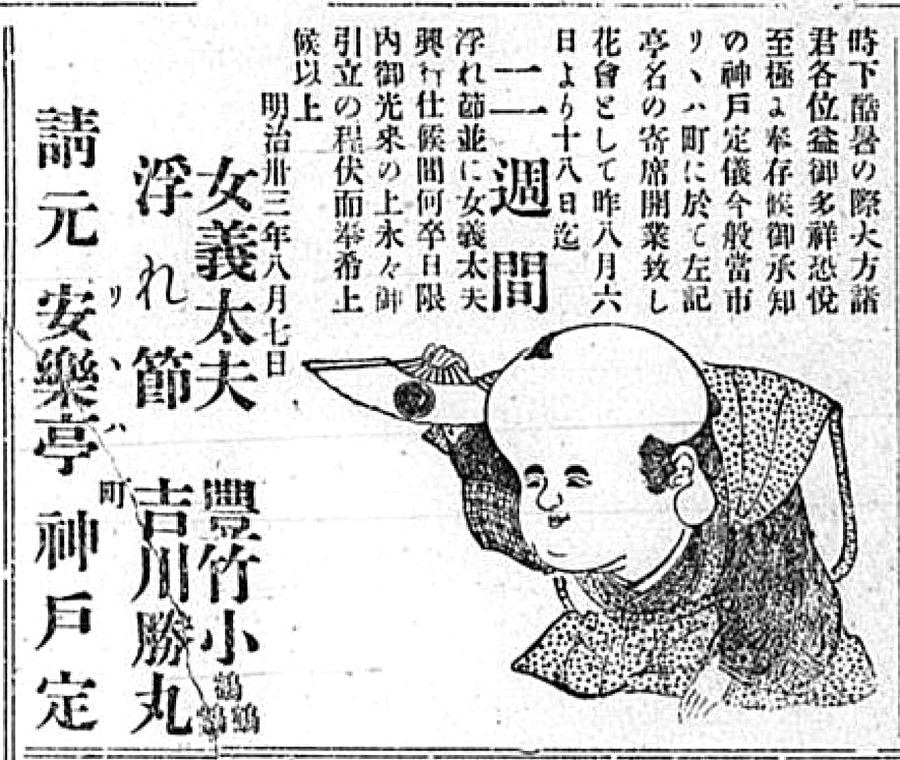
Systematic Japanese labour migration to Hawai‘i started in 1885 under a contract between the Kingdom of Hawai‘i and the Meiji government in Japan. At about this time, naniwa-bushi (then called ukare-bushi), was growing in popularity in Japan. Iwamoto Hōjirō emigrated to Hawai‘i in 1889 as a contract labourer and is remembered as a pioneer of ukare-bushi in the islands (Fujii Reference Fujii1900:67; see Figure 3). As soon as his three-year work contract expired in 1892, he began touring the islands, entertaining his fellow Japanese workers. By this time, there were more than 12,000 Japanese in Hawai‘i, most working on plantations; by 1900, their number had increased to 61,000 (Chūbachi Reference Chūbachi2007:35). Yearning for entertainment from the home country, these migrants are said to have greatly appreciated and enjoyed Iwamoto’s performances; he continued to perform until mid-1920s when performers visiting from Japan as well as Japanese movies had become a major part of Japanese entertainment in Hawai‘i (Tasaka Reference Tasaka and Yoshitami1985b).
Advertisement for a performance including ukare-bushi by Yoshikawa Katsumaru (Iwamoto Hōjirō’s stage name) (Yamato Shimbun, 11 August 1900).

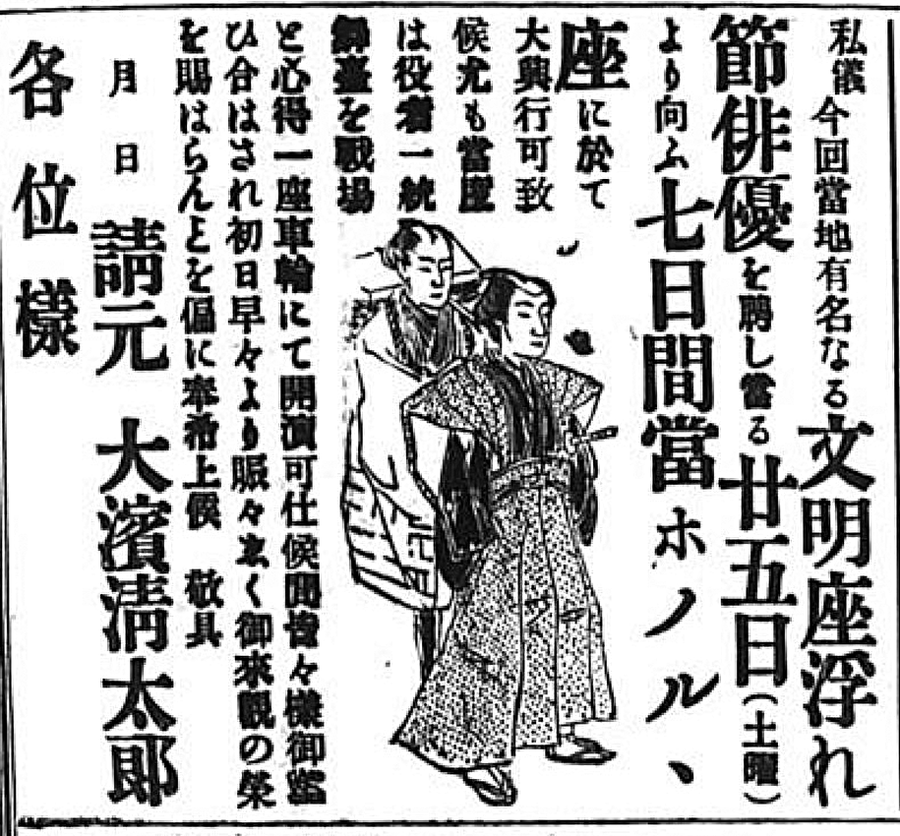
In 1902, the first ukare-bushi play (ukare-bushi shibai) was performed in Hawai‘i at the newly-opened Ebisu-za entertainment hall by a troupe led by Ogawa Yatarō (Yamato Shimbun, 23 December 1902). In this theatrical variant of the genre, each actor spoke his lines using the ukare-bushi style. A one-week run by the Ogawa troupe was advertised as “the latest popular entertainment, the ukare-bushi grand play,” suggesting the genre’s development and rising popularity (Yamato Shimbun, 15 December 1902). In 1906, a local troupe specialising in ukare-bushi plays, Bunmei-za, debuted and began performing at theatres including the Honolulu-za and Asahi Gekijō (Yamato Shimbun, 1 September 1906; see Figure 4). An advertisement from 1908 boasts that the house was full every night (Nippu Jiji, 7 March 1908).
Advertisement for a one-week performance run by the Bunmei-za troupe at Honolulu-za theatre (Nippu Jiji, 1 September 1906).

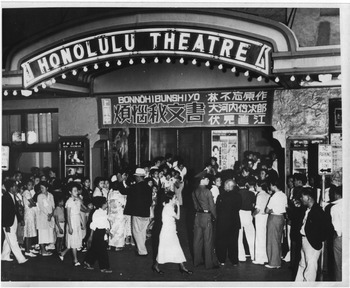
The Honolulu-za was a movie theatre specialising in Japanese films, built in 1903 in the ‘A‘ala district of downtown Honolulu—the centre of Japan Town at the time (Figure 5).
Honolulu-za in 1936 (owned by Hawai‘i State Archive; see also Suzuki Reference Suzuki and Hakubutsukan2019:109).

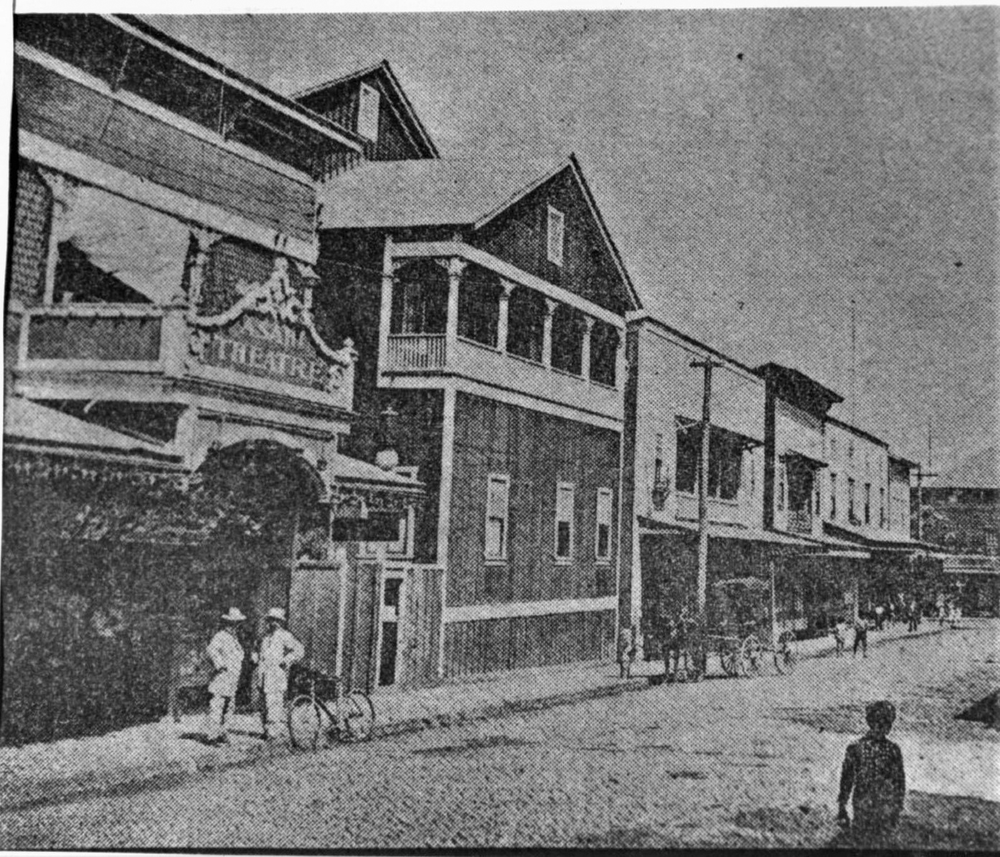
The Asahi Gekijō (Figure 6) was built in 1908 in the same district to replace the Asahi-za, the first Japanese theatre in Hawai‘i, which had been built in 1899 but destroyed in 1900 in the Great Honolulu Chinatown Fire, which also burned the entire Japan Town.
Asahi Gekijō (left-most building, with “Asahi Theatre” above its entrance) (Tasaka Collection; see also Suzuki Reference Suzuki and Hakubutsukan2019:108).

Both Honolulu-za and Asahi Gekijō became major centres for ukare-bushi, and later naniwa-bushi. In a 1906 popularity poll conducted by the Yamato Shimbun, votes were cast for thirty-four performers of ukare-bushi, with the winner garnering more than 26,000 votes (Yamato Shimbun, 11 August 1906). This suggests that ukare-bushi was flourishing, and that there was a proliferation of local performers and fans.
Itinerant Performers from Japan
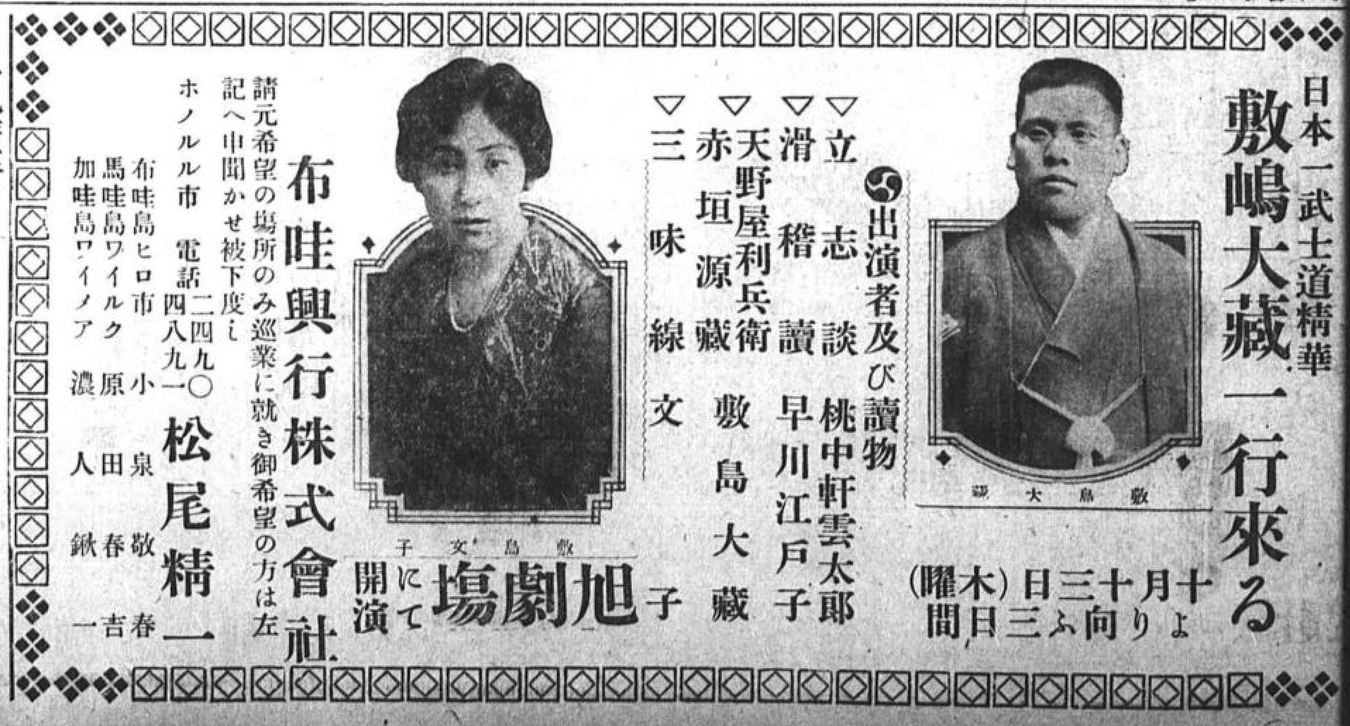
In the early twentieth century, Japanese naniwa-bushi performers began touring overseas, targeting diasporic communities in Sakhalin, Taiwan, Korea, Manchuria, and the United States (Yui Reference Yui and Eiichi1999:25). These tours essentially were extensions of domestic tours carried out since the 1880s. One of the earliest newspaper advertisements for a naniwa-bushi troupe from Japan dates to 1908 (Nippu Jiji, 11 July 1908). Although the early performers touring Hawai‘i were typically of lesser renown, Japanese entertainment promotion companies were eventually established that began inviting better-known performers. For instance, a troupe led by Shikishima Ōkura, widely known for his performance of “Akō Gishiden” (a collection of stories regarding the Loyal Retainers of the Akō Clan), was invited by the Hawai‘i Entertainment Company in 1921, their shows being advertised widely (Figure 7).
Advertisement for a performance tour by Shikishima Ōkura (right) (Nippu Jiji, 5 October 1921).

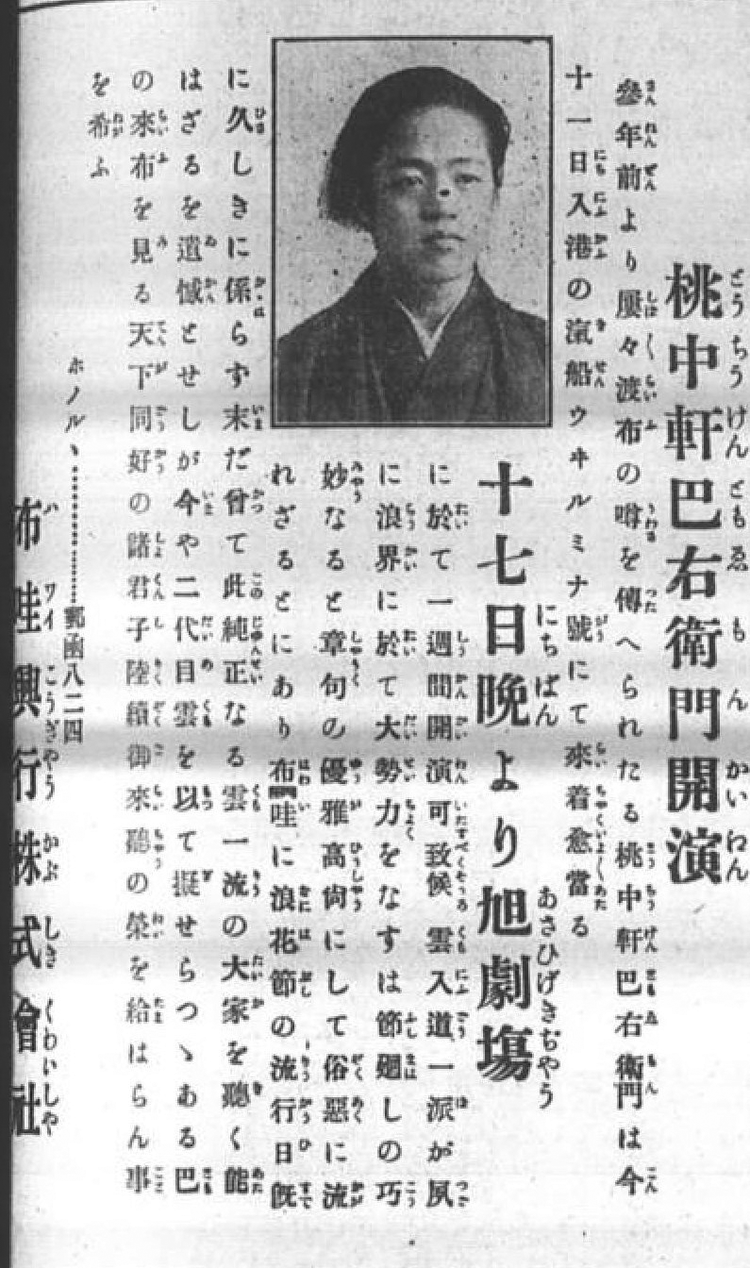
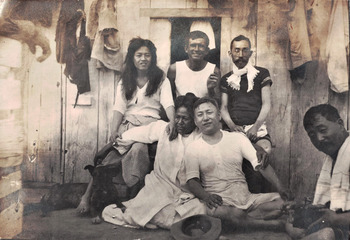
Although less famous than Shikishima, Tōchūken Tomoemon was invited by the Hawai‘i Entertainment Company in 1915. As the adopted son of the great authority of naniwa-bushi, Tōchūken Kumoemon and thus also known as Tōchūken Kumoemon II, he was promoted with great enthusiasm, extolling his skills (Figures 8 and 9).
Advertisement for Tōchūken Tomoemon (Nippu Jiji, 20 May 1915).

Tōchūken Tomoemon (upper left) relaxing in Hawai‘i with immigrant workers and an Hawaiian couple in the 1910s (Tasaka Collection).

A continuous stream of performers, both famous and lesser-known, made trips to Hawai‘i during the prewar era. Tōchūken Kumoemon complained that there were many dubious naniwa-bushi performers in the United States, including three impostors pretending to be him (Rafu Shimpo, 21 July 1915), and stories such as this suggest there was high demand for naniwa-bushi among the diaspora, which made possible the welcome and acceptance of lesser-known performers. (See Appendix 1 for a list of naniwa-bushi performers in Hawai‘i.)
The performers who visited Hawai‘i often also toured the U.S. West Coast, another centre of the Japanese diaspora. Touring periodically and often staying for extended periods, from a few months to as long as several years, performers helped satisfy the local appetite for home-country entertainment. Overseas tours held great merit for Japanese performers. Although their main audience abroad was limited to Japanese, their overseas experiences gave them greater prestige and made them more honourable. “The performance right after an overseas tour” (“kichō hirō rōkyoku kōgyō,” “kichō hatsu omemie kōgyō,” etc.) was a phrase often encountered in advertisements in Japan, boasting of the international success of performers (Manabe Reference Manabe2017:90; Ashikawa Reference Ashikawa2013:100).
Some naniwa-bushi performers from Japan also ended up settling in the diasporic community. An example was Kumoi Hototogisu, originally a newspaper reporter who subsequently changed course and became a naniwa-bushi professional in Japan (Kokuritsu gekijō 1999:421). The earliest record of a Hototogisu performance in Hawai‘i comes from 1915, and by 1920 he was introduced as “Mr. Kumoi of the Tsuboya”—a Japanese restaurant in Hawai‘i (Nippu Jiji, 7 October 1915 and 28 August 1920). By 1920, then, he had settled in Hawai‘i, married a geisha Footnote 11 in Honolulu, and was pursuing a double career as both the owner of a restaurant and a naniwa-bushi performer (Honda Reference Honda1973:290–291).
In 1920, the Nipponkan, a Japanese movie theatre, was built in the ‘A‘ala district. By the end of the decade, Japanese theatres were also built in other parts of the island, including the Waipahu Asahi-za, the Haleiwa Eiraku-za, and the Wahiawa Hōraku-za. Together with the Honolulu-za and Asahi Gekijō, which was rebuilt in 1928 as the Oahu Gekijō, these provided venues for touring naniwa-bushi performers until the start of the Pacific War.
Naniwa-bushi Repertoires in Hawai‘i
An examination of the naniwa-bushi repertoires performed in Hawai‘i mentioned in the Nippu Jiji from 1908 to 1941 reveals that about twenty-six percent were stories from “Akō Gishiden,” which is known as “Chūshingura” in kabuki dance-drama and in the bunraku puppet theatre (see Appendix 2).
This phenomenon may have been a direct reflection of the boom of these stories in Japan, driven by performances and recordings by two naniwa-bushi giants, Tōchūken Kumoemon and Yoshida Naramaru II. The stories in “Akō Gishiden” are based on an early eighteenth-century event in which forty-seven samurai avenged the death of their master and then committed seppuku ritual suicide for their crime of murder. Regarded as emblematic of the samurai spirit of loyalty, self-sacrifice, moral obligation, perseverance, and honour, the stories became very popular and were soon adapted for kabuki and bunraku dramatisations. Adaptation to naniwa-bushi brought further appeal among the Japanese masses in the first half of the twentieth century, since it coupled with rising nationalism and patriotism against the backdrop of the Russo-Japanese War (1904–1905) and the Sino-Japanese War (1937–1945). The traditional ideology emphasised by “Akō Gishiden” is in fact common to many other naniwa-bushi repertoires. This appears to be a major reason why naniwa-bushi became so popular at the time in both Japan and Hawai‘i: it matched the Japanese spirit of the era, and thus strongly appealed to the diasporic community who wanted to maintain that spirit.
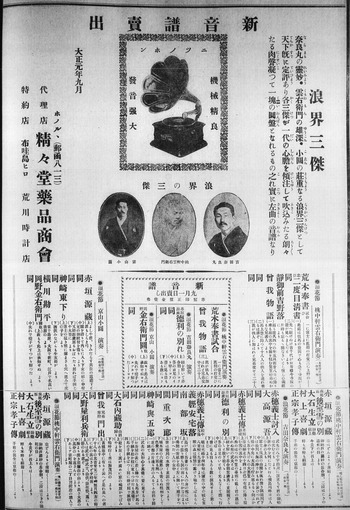
The second most popular story category of naniwa-bushi in Hawai‘i comprised tales of samurai other than those of the Akō clan. These stories, about a third of which featured Minamoto no Yoshitsune, a famous war hero of the Genji clan, accounted for about sixteen percent of the total performances. The next most popular category comprised new stories, called shindan, that dealt with people and events of the Meiji and later eras. Many of these stories also related the episodes of war heroes, such as Nogi shōgun (General Nogi) of the Imperial Japanese Army. Overall, the repertoires performed in Hawai‘i overlapped with those popular among their contemporary Japanese counterparts. This synchronicity was enabled by the continuous flow of touring performers, as well as the diffusion of Japanese disc recordings in Hawai‘i that began during the 1910s. Naniwa-bushi was the most recorded genre in prewar Japan. The pioneering Japanese record company which was founded in 1909, Nippon Chikuonki Kyōkai (Nipponophone, and later Nippon Columbia), had pressed about 2,500,000 discs by 1912, of which more than 500,000 were of “Akō Gishiden” performed by Yoshida Naramaru II. Tōchūken Kumoemon also recorded “Akō Gishiden” in 1912, and 72,000 discs were pressed (Kurata Reference Kurata and Shigeo1984:2802). Recordings of diverse stories from “Akō Gishiden” were sold in Hawai‘i, as seen in the newspaper advertisement reproduced in Figure 10.
Advertisement for naniwa-bushi records (Nippu Jiji 12 September 1912). (About half of the titles are drawn from “Akō Gishiden.”)

Recordings heightened naniwa-bushi fever and raised expectations of live performances by touring musicians. Also, a local Japanese-language radio programme featuring music, started in 1929 on station KGU, enabled listeners to enjoy naniwa-bushi recordings through broadcasts.Footnote 12
Naniwa-bushi Made in Hawai‘i: “Voyage to Hawai‘i”
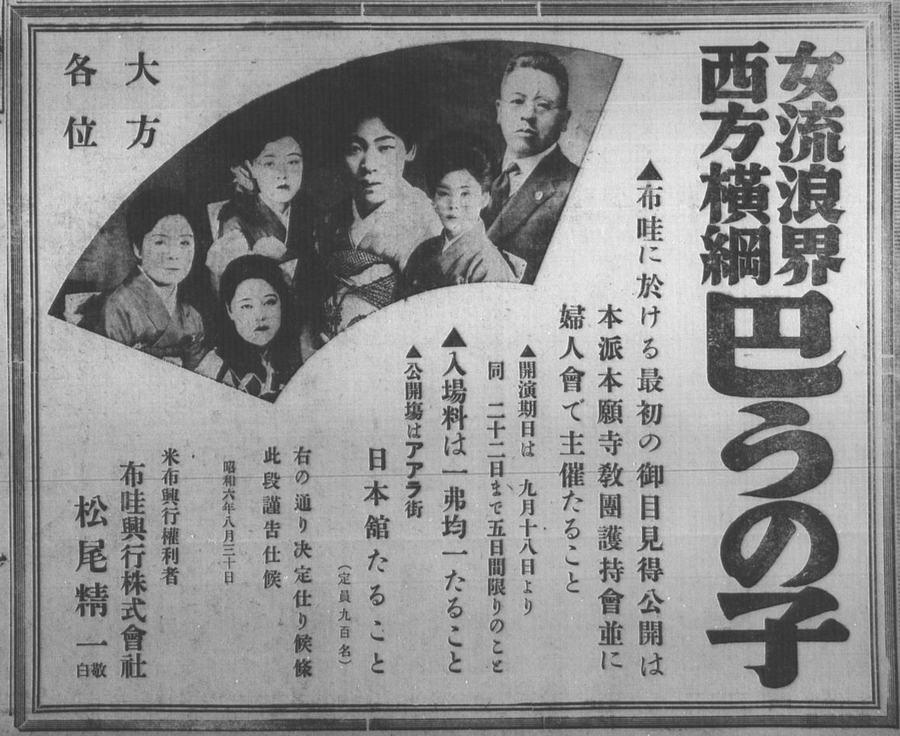
Undoubtedly inspired by the great popularity of naniwa-bushi, a new work, entitled “Hawai tokō makura” (“Voyage to Hawai‘i”), was written by a Japanese immigrant in 1931, for a Japanese female performer, Tomoe Unoko, on the occasion of her Hawai‘i tour (see Figure 11). The author was Honda Masai (a.k.a. Honda Rokusen), a reporter for the Hawai Hōchi. Tomoe recorded this work in Japan prior to her visit and then sold almost 2,000 recordings in Hawai‘i, to great acclaim.Footnote 13
Advertisement for the Tomoe Unoko troupe (Nippu Jiji, 30 August 1930).

The script is included in Honda’s Densha Nisshi o Kataru (Honda Reference Honda1956:105–108) and begins with Tomoe’s upcoming voyage to Hawai‘i, then refers to scenic sites and historic places that she will visit (Tomoe 1931; Supplementary Audio 1: “Voyage to Hawai‘i”).Footnote 14
The last section of the script faithfully echoes the essence of naniwa-bushi, praising the diasporic community’s perseverance and continued strong will and resolution, which finally lead to success and prosperity. It is a form of self-affirmation for the Japanese immigrants:
Factors Contributing to the Flourishing of Naniwa-bushi in Hawai‘i
As mentioned earlier, the popularity of naniwa-bushi in Hawai‘i paralleled that in Japan. The Japanese diaspora sympathised with the ideology expressed in naniwa-bushi as did their fellow Japanese back home. Touring performers and the flow of imported recordings made it possible for those in Hawai‘i to appreciate contemporary Japanese repertoires. Furthermore, two major factors contributed to the genre’s popularity: nostalgia for the home country and experiences of discrimination in the host society. Living far from home, the diaspora’s Japanese identity and patriotic sentiments grew stronger, while the shared experience of racial discrimination in the foreign land also made them more conscious of their Japanese identity, strengthening their shared sense of camaraderie. Hosokawa Shuhei points out that naniwa-bushi contained themes perfectly suited to Japanese migrants to Brazil, who were bound together by a common destiny which nurtured a collective sense of mutual support and obligations (Reference Hosokawa1995:49–50), and the same can be said of Japanese migrants to Hawai‘i. In naniwa-bushi stories, self-sacrifice forms a typical motif, usually leading to an idealised happy ending in which the poor and weak are saved and praised as being noble (Ashikawa Reference Ashikawa2013:37–41). Such stories enabled migrants to affirm their sense of Japanese-ness and justify, or even beautify, their hardships and sacrifices on foreign soil, where they encountered unfamiliar customs and social norms, and even prejudice.
Japanese immigrants were treated as aliens. They were ineligible for U.S. citizenship until 1952 and, as non-citizens, they had been forbidden to purchase land by a U.S. law passed in 1913. The so-called “anti-Japanese-language school legislation” was put into operation in Hawai‘i in 1921 to restrain their home-oriented activities, based on the notion that allowing the Japanese their own schools hindered their Americanisation. The 1920s also saw a movement in Hawai‘i to legally restrict Japanese fishing activity, reacting to its remarkable development (Ogawa Reference Ogawa2018:6). Shared community experiences of such legal maneuvers strengthened solidarity, a sense of community, and Japanese homeland identity. Hyōdō Hiromi maintains that the nationwide transmission and diffusion of naniwa-bushi stories filled with ideology valued in Japan nurtured Japanese cultural identity in a manner that transcended regional and class differences (Reference Hyōdō2000:83), and I would further argue that the genre functioned the same way across national boundaries, emphasising traditional Japanese values in nurturing cultural identity among the diaspora.
The Appearance of Hawaiian-born Naniwa-bushi Professionals
Naniwa-bushi was diffused not only among migrants, but also among their Hawaiian-born children. Among the latter were three women, introduced below, who received formal training in Japan and began performing professionally during the 1930s. Originally from Hawai‘i, the three were celebrated within the Japanese diaspora until the outbreak of war suddenly terminated their promising careers.
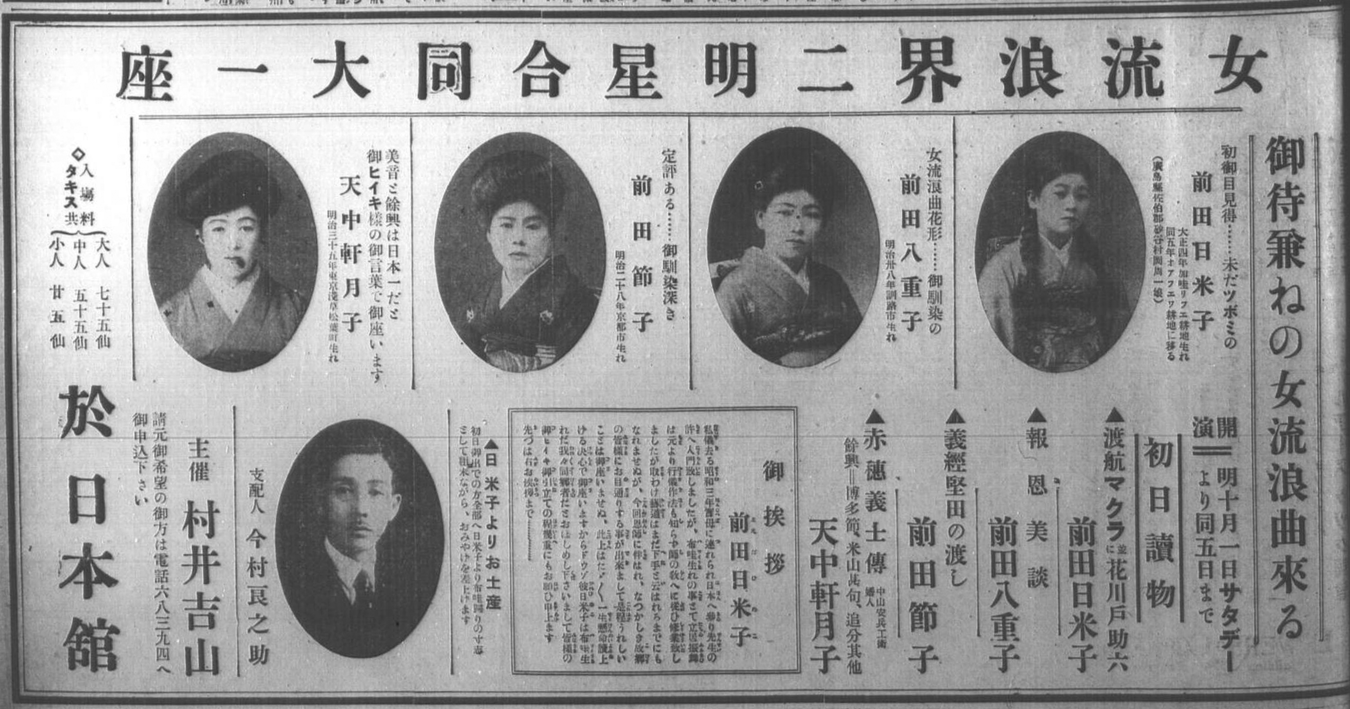
The pioneer among these Hawaiian-born naniwa-bushi performers was Maeda Himeko (a.k.a. Oka Kayoko), who was born in 1915 in Ewa, on the island of O’ahu. Aspiring to become a professional, she sailed to Japan in 1928 at the age of twelve to study under Maeda Setsuko. She made her debut in Japan in 1929 and began touring Japan with her master (Nippu Jiji, 20 April 1930). Between October 1932 and January 1933, she toured Hawai‘i as a member of the troupe led by Tenchūken Tsukiko (Figure 12).
Advertisement for Maeda Himeko (right) with the troupe led by Tenchūken Tsukiko (left) and Maeda Setsuko (second from left) (Nippu Jiji, 30 September 1932).

One newspaper article proudly reported that she was the only Hawaiian-born naniwa-bushi performer active in Japan at the time (Hawai Hōchi, 28 August 1932). When she toured Hawai‘i, commercial recordings of troupe members, including Maeda Himeko, were specially imported and sold (Hawai Hōchi, 2 October 1932), and after the tour she continued to perform in Japan. She visited Hawai‘i again in 1935 to see her parents (Nippu Jiji, 18 October 1935), but I have found no further information about her.
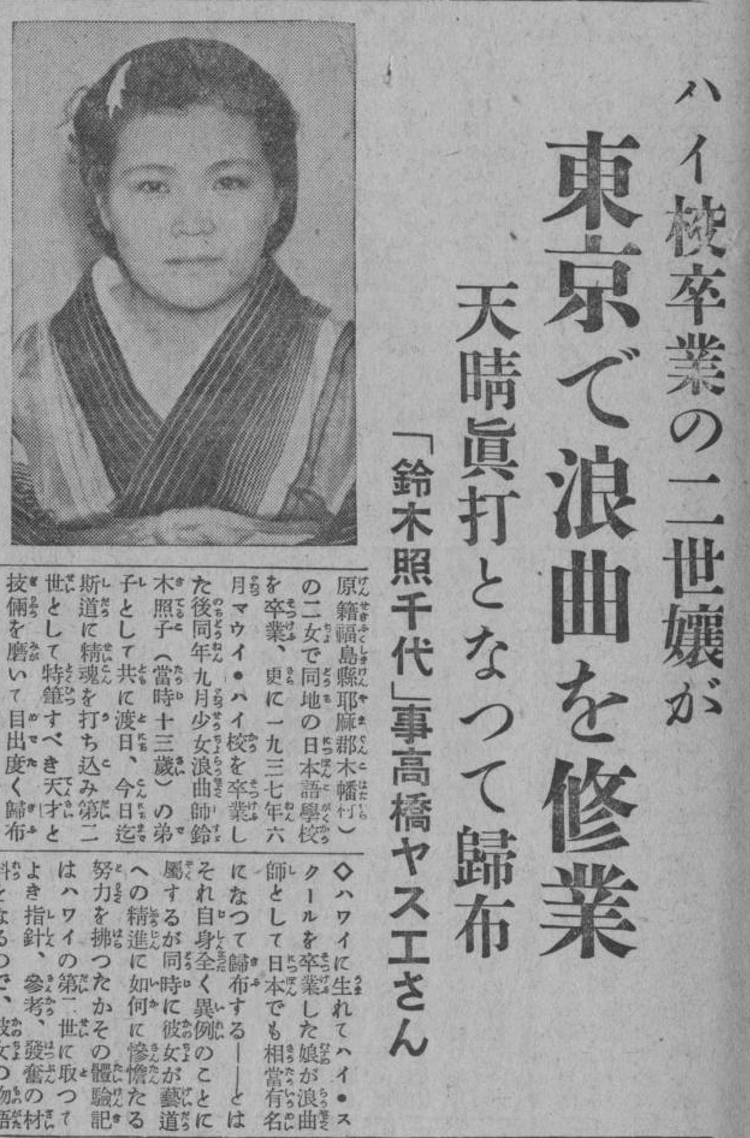
Suzuki Teruchiyo (a.k.a. Takahashi Yasue) was born in 1919 in Hamakuapoko, on the island of Maui. After graduating from Maui High School in 1937, she became a disciple of the prodigy Suzuki Teruko (who was thirteen years old at the time), when she was touring Hawai‘i. She followed Teruko back to Japan to study naniwa-bushi. After studying for three years, she returned to Hawai‘i in 1940 and began performing professionally (Nippu Jiji, 17 September 1940; see Figure 13). Nippu Jiji immediately released her biography in a series of articles, reflecting the public’s strong interest and pride in this Hawaiian-born performer (Nippu Jiji, 17–21 September 1940), and in early 1941 she performed across Maui and on the island of Hawai‘i, as well as in Honolulu (Nippu Jiji, 21 April and 23 May 1941). An article reported that she was meant to return to Japan later that year to join the renowned Shochiku Entertainment Company (Nippu Jiji, 18 July 1941), but this did not happen: the shipping line to Japan was suspended that same month, and then war broke out, triggered by the Japanese bombing of Pearl Harbor.
An article on Suzuki Teruchiyo, headlined “The second-generation Japanese graduate of Maui High School has returned to Hawai‘i as a star naniwa-bushi performer after her training in Tokyo” (Nippu Jiji, 17 September 1940).

Soon thereafter, the FBI began to arrest Japanese immigrants and their children, including reporters for Japanese newspapers, teachers at Japanese language schools, Buddhist monks, and fishermen, who were suspected of seditious connections with Japan. About 2,400 people of Japanese ancestry were detained at facilities either in Hawai‘i or on the U.S. mainland (Ogawa Reference Ogawa2013:111), and Teruchiyo was among them, detained first at the Sand Island Detention Camp, then at the Honouliuli Internment Camp on the island of O’ahu. Teruchiyo told a Japanese journalist held in the same camp that she had likely been arrested because she had been in Japan and had become a naniwa-bushi performer there (Hirai Reference Hirai1990:65), although the truth of the matter is unknown, because no further information is available about Teruchiyo.
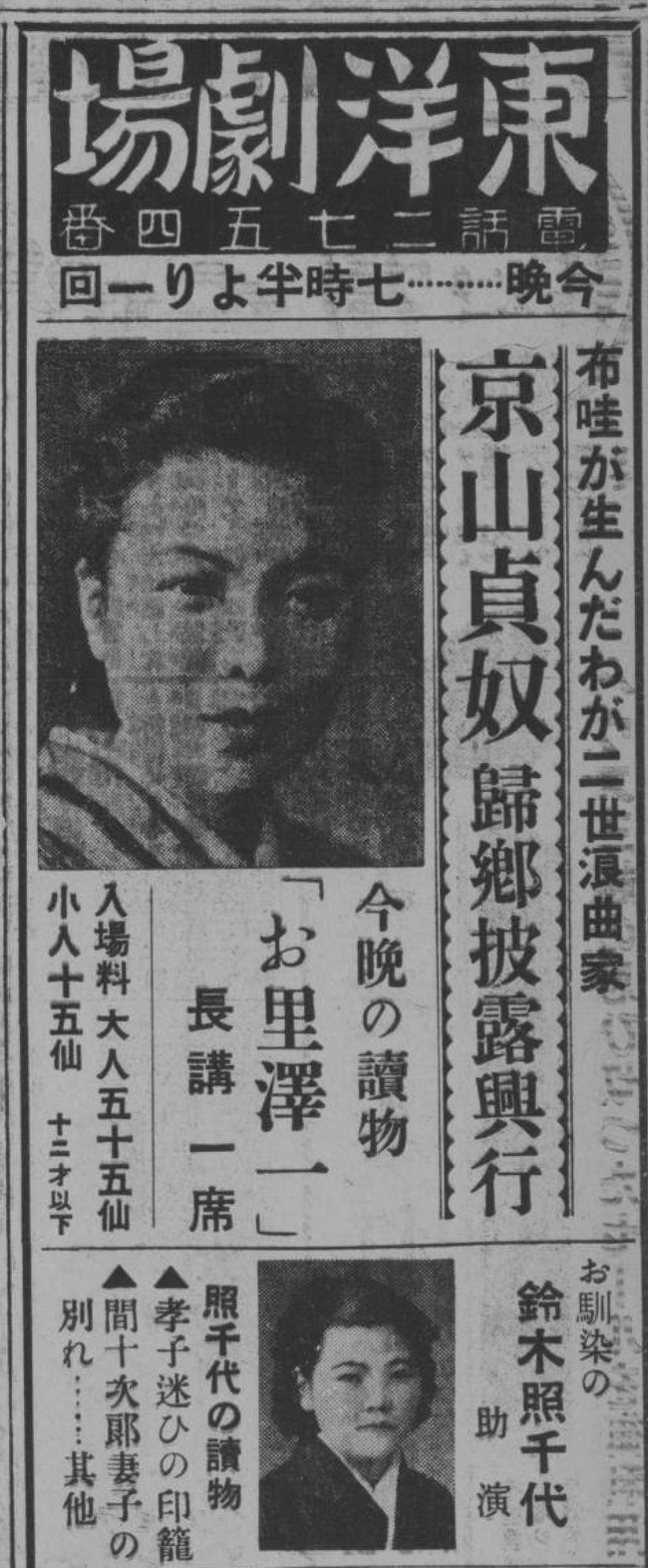
Kyōyama Sadayakko (a.k.a. Hirota Sadako) was born in Honolulu in 1917, and began studying in Japan in 1935 under Kyōyama Yoshiko. As a member of the troupe of her master’s daughter, Sugawara Umeko, she toured not only across Japan, but also to Sakhalin, Korea, and northern China. After six years abroad, she returned to Hawai‘i in 1941 to see her parents and also to perform.Footnote 16 Her plan was to invite her master’s troupe to Hawai‘i on tour, but the plan was never realised because the shipping line was suspended immediately after she arrived back in Hawai‘i. So, she decided to perform on her own (see Figure 14), and toured various parts of O’ahu (Nippu Jiji, 13 September 1941), as well as Maui (Maui Rekōdo, 25 November 1941). Still unable to return to Japan, Kyōyama was asked by a local Japanese-language radio station to perform a weekly programme that would start broadcasting on 7 December 1941 (Nippu Jiji, 6 December 1941), but, on that very day, Pearl Harbor was attacked.
Advertisement for a performance by Kyōyama Sadayakko in Honolulu, with guest performer Suzuki Teruchiyo, with the headline “The second-generation naniwa-bushi performer from Hawai‘i, Kyōyama Sadayakko, will hold her homecoming concert” (Nippu Jiji, 5 September 1941).

Naniwa-bushi in Wartime Internment Camps
After the Japanese attack on Pearl Harbor, those on the mainland regarded as suspicious were also arrested and jailed. Different to Hawai‘i, however, was the mainland’s mass incarceration of more than 120,000 people in concentration camps, under an act authorised by Executive Order 9066, passed in response to the escalating anti-Japanese sentiment and wartime hysteria on the U.S. West Coast. Although hostility and suspicion against people of Japanese ancestry was also present in Hawai‘i, given their total population of about 157,000, which constituted about 37% of the entire Hawaiian population in 1940 (Iida Reference Iida2003:18), it was impractical to move all of the diaspora to mainland camps. Moreover, it was deemed strategically unwise to lose those who laboured on the land. As a result, the Japanese immigrants and their children in Hawai‘i, though free, remained exposed to anti-Japanese hostility, which forced them to erase or hide anything that might suggest an ongoing relationship with Japan, including Japanese music practices.
Ironically, Japanese performing arts flourished in the mainland camps because camp administrators encouraged cultural and recreational activities as a form of relief for stress, anger, and anxiety. Internees were, indeed, strongly in need of such activities to relieve their psychological pain and provide comfort (Waseda Reference Waseda2005). Hence, naniwa-bushi was one of many genres performed and enjoyed in the concentration camps. A columnist in a camp newspaper published by internees at Poston Camp in Arizona expressed his pleasure at hearing naniwa-bushi in the camp, stressing that he was more moved by his fellow internees’ performances than he had been by any of the professional performers he had heard before the war (Poston Chronicle, 26 February 1943). The sad stories and nationalism expressed in the naniwa-bushi narratives must have had particular appeal to internees, resonating with their own fate.
Even though mass incarceration did not occur in Hawai‘i, about 700 Japanese immigrants were interned on Sand Island within sixty days after the outbreak of war (Ogawa Reference Ogawa2013:108–109). Hirai Ryūzō, a former internee, later recalled that his fellow internees frequently held variety shows to entertain themselves. One of the star performers was an amateur naniwa-bushi performer, Sugita Saburō, also known as Sunamaru (Kawazoe Reference Kawazoe1950; Kimura Reference Kimura1981; Hirai Reference Hirai1990:73). Due to blackouts, all lights had to be extinguished by 8:00 pm, so, in total darkness, Sugita would perform for thirty minutes straight, presenting repertoires of famous performers he had learned from recordings, as well as his own original stories. His repertoires included “Mori no Ishimatsu daisan” [Mori no Ishimatsu’s Visit to a Shrine for His Boss], a story of chivalry by Hirosawa Torazō, “Sado jōwa” [A Love Story of Sado] by Suzuki Yonewaka, and “Kudan no haha” [Mother in Kudan], a militaristic story by Tenchūken Ungetsu (Hirai Reference Hirai1990:73). Although Sugita had been born in Hawai‘i, his performances moved his fellow internees to tears and soothed the hardships of camp life (ibid.). Some of the internees were later moved to mainland facilities, in places such as Livingston, Louisiana; Jerome, Arkansas; and Lordsburg, New Mexico. Naniwa-bushi and even its plays were performed in these camps (Sōga Reference Sōga1948:162; Furuya Reference Furuya1964:165; Kimura Reference Kimura1981).
Post-Pacific War Naniwa-bushi
In wartime Japan, naniwa-bushi stories that emphasised nationalistic ideology were encouraged and promoted by the government. They were performed on battlefields (imon ensō) and broadcast on the radio to foster patriotism. After the war, however, naniwa-bushi was considered outdated and incompatible with the new notions of democracy. Moreover, the General Headquarters of the Allied Forces proclaimed militaristic and undemocratic naniwa-bushi stories undesirable, and began to censor their scripts. This official policy continued until around the fall of 1949 (Manabe Reference Manabe2017:188). These factors led to the rapid decline of naniwa-bushi and its disappearance from mainstream mass entertainment in Japan (Anzai Reference Anzai1975:62). In the 1950s, however, it was revived to a slight extent through the efforts of performers, with the help of commercial radio broadcasting, which started in 1951. Consequently, naniwa-bushi was also temporarily revived in Hawai‘i, with a series of performance tours undertaken by Japanese artists. However, the 1960s saw its final decline, as television and new types of entertainment were introduced. Although it still survives in Japan, naniwa-bushi has in recent times become nearly extinct in Hawai‘i. It has lost its performers, and the number of Japanese-speaking community members has declined. A rare exception to this story of decline was the return visit by Hirosawa Hyōemon to Hawai‘i in 1981, after he had first performed there in 1922. His performance after almost sixty years brought tears to the eyes of elderly Japanese, who were, in effect, the last generation of naniwa-bushi audiences in Hawai‘i (Horie Reference Horie1982:211).
Concluding Remarks
This study has traced the rise and fall of naniwa-bushi in Hawai‘i since the late nineteenth century, mainly by examining local Japanese newspapers and the written accounts of immigrants. First transplanted by immigrants as a home country entertainment in the host society, naniwa-bushi was further popularised by itinerant Japanese performers who toured extensively for extended periods of time, some even settling in Hawai‘i. The values and ideology emphasised in naniwa-bushi helped immigrants sustain and strengthen their sense of identity, while the development of commercial recordings, businesses that imported them, and radio broadcasts enabled contemporary Japanese naniwa-bushi to be heard in Hawai‘i. The emergence of Japanese theatres as venues for entertainment in Hawai‘i also contributed to the popularity of the genre, and through such cultural infrastructure naniwa-bushi was able to function as a cultural bridge between Japan and the diaspora.
The aesthetic values of naniwa-bushi were even appreciated by Hawaiian-born children of immigrants, to the extent that some decided to embark on formal training in Japan and became professionals. Suddenly interrupted by the war, however, the practice of naniwa-bushi was never fully revived in Hawai‘i. Its outdated ideology and moral values, as well as the loss of Japanese language among the community were certainly major factors in its decline.Footnote 17 However, if the Hawaiian-born performers of the 1930s and 1940s could have developed their careers without the interruption of the war, the genre might have survived much longer and perhaps would have taken a different path in Hawai‘i. Naniwa-bushi still survives in Japan, largely because of the efforts of performers who try to maintain the tradition while challenging themselves to renovate and further diffuse the genre to a broader audience. Haruno Keiko (b. 1973), for example, not only creates contemporary stories, but also performs beyond Japan in English, or using English subtitles (see Haruno Reference Harunon.d.)Footnote 18. Unlike earlier generations of naniwa-bushi performers, she targets not only a Japanese audience, but a larger group of English-speakers. The Japanese diaspora in Hawai‘i now includes fifth and sixth generations, and is no longer an extension of the Japanese diaspora whose appreciation, in the golden era of naniwa-bushi, gave it the status of an important art form. Still, as part of American society, the diaspora may in the future once again embrace naniwa-bushi, if revivalist efforts prove successful.
Glossary

Supplementary Materials
Tomoe, Unoko. 1931. “Voyage to Hawai‘i.” 78 rpm, 2 discs. Osaka, Japan: Nitto Records.
To view supplementary material for this article, please visit http://dx.doi.org/10.1017/ytm.2020.27
Appendices
Appendix 1. Chronological list of Japanese naniwa-bushi performers touring Hawai‘i, 1908–1941. Source: Nippu Jiji, Hawai Hōchi, Kihara (Reference Kihara1935), and Tasaka (Reference Tasaka and Yoshitami1985c).

Appendix 2. Naniwa-bushi repertoire performed in Hawai‘i, 1908–1941 (source: Nippu Jiji).