Introduction
To many outside observers Japanese decision-making is an enigma that defies conventional analysis. Post-war Japan is often characterized as having an ill-defined security policy and an opaque decision-making process, either because it is a reactive state which fails to undertake major foreign policy initiatives when it has the power and national incentives to do so, but rather responds to outside pressure for change, or because it is incapable of a ‘normal’ policy output.Footnote 1 This paper contends that Japan has always had a security policy and decision-making process, but one that does not fit well with the traditional Western rational actor model of decision-making, or even with alternative pluralist models proposed for the analysis of Western democracies.Footnote 2
Japan's security policy, like that of all states is gradually evolving, but that does not mean that it is about to become just like the West. There have been many ‘moments’ when Japan has been described as being at a turning point where it will inevitably be forced to change—the current debate about ‘normalization’ being only the latest. Such discourse essentially reflects myopic Western perceptions about the possible forms that institutions and the organizations of affairs in non-Western nations can take.Footnote 3 The language used implies a normative hierarchy with occidental ways seen as superior, and therefore ultimately destined to be adopted by all.
This paper addresses how the conjuncture of external factors (encouragement from allies and the international community, and perceived threats from adversaries) and internal factors (changes in the internal structure of Japanese decision-making and the rise of press and public opinion input) has stimulated important changes in Japanese security policy-making, which are frequently missed or misinterpreted by observers. In order to understand Japanese security policy-making, and to chart its future course, we require more complex and nuanced modelling techniques than those commonly employed. The next section considers whether there is such a thing as an independent Japanese security policy, and addresses the extent to which an occidental bias in the selection of decision-making model has led to a lack of recognition of Japanese security policy output.
An Irrational Non-Actor?
Kent Calder, the originator of the ‘reactive state’ hypothesis, sees Japan as occupying the unique position of having the power potential of a mid-range European state, but with the political leverage of much smaller and weaker reactive states.Footnote 4 Perhaps most importantly, Calder claims that the fragmented character of state authority in Japan makes decisive action more difficult than in countries with strong chief executives, such as the United States, thereby explaining Japanese passivity in international affairs when activism would have been both possible and beneficial for Japan.Footnote 5
Such has been the impact of Calder's hypothesis that the dominant view of Japan's international behaviour is one where Japan is portrayed as passive, risk-avoiding, and ineffective in conducting foreign policy.Footnote 6 Calder recently claimed that his major contentions have weathered the test of time, noting that Japan has not, despite a huge economy, emerged as an effective ‘rule-maker’ in international affairs.Footnote 7
Taira has claimed that ‘Japan has a psychological disadvantage in dealing with the United States’ which relegates it to the status of junior partner or pupil.Footnote 8 This deference finds its way into official Japanese government publications in which the United States is viewed as the ‘most important country for Japan,’ and the Japan-United States security system is viewed as ‘central to the relationship.’Footnote 9 Deference to, and security dependence on, the United States has even led Japan to be described as a ‘semi-sovereign state’.Footnote 10 Japan is essentially seen as a power that inevitably bandwagons on the policy initiatives of the global hegemonic leader.
Other commentators have been even more dismissive of Japanese security policy—or rather its absence.Footnote 11 It is bad enough that Japan is a ‘reactive’ state, but such interpretations seem to imply that Japan does not even react. However, much of the reasoning behind such analysis is based on attempts to apply Western models of decision-making to the Japanese case. Chief among these is the Rational Actor Model (RAM).
Rational Acting
The foundation of Western strategic analysis is the assumption of rational behaviour based upon calculating decision-making by unitary actors. These actors (states or statesmen acting on their behalf) rank potential outcomes in accordance with a preferential hierarchy and coldly assess the costs and benefits associated with different courses of action independently of ‘emotional tensions, sentimentality, crowd behaviour, or other irrational motivation.’Footnote 12 This representation of security decision-making has been variously referred to as the ‘rational calculation model’ or more commonly the ‘Rational Actor Model’ or simply RAM.Footnote 13
The rational actor model has dominated Western foreign and security policy decision-making and analysis since the collapse of the liberal internationalist paradigm during the inter-war ‘Twenty-Years’ Crisis’.Footnote 14 A generation of analysts share the core RAM assumptions of a unitary state as principal rational actor and believe that survival is the rational actor's most important objective, that states seek to dominate each other, and that states are inherently selfish and self-regarding in the pursuit of survival and security, unwilling to depend on other states for their vital interests or to compromise in their own security to enhance the security or well-being of others.Footnote 15
Since the end of the Second World War Japan has steadfastly refrained from developing power-projection capabilities (despite possessing the requisite resources) and has continuously relied on others for its vital interests. This can be seen from the traditional analytical perspective as demonstrating not only that Japan can be seen as an irrational state, but also (given the lack of policy output in the field of military capabilities), that Japan does not possess a security policy. Indeed, even many Japanese do not believe Japan has a coherent security policy, but rather is left ‘groping’ (mosaku) for strategy.Footnote 16
However, although Japan has not pursued a traditional (by Western standards) security policy, in many ways it has nevertheless followed a rational and strategic course. Essentially it is cost-effective for Japan to support the Pax Americana, receiving significant economic and security benefits from its protective status while committing to assist the United States from time to time by means of economic and technical cooperation.Footnote 17 Japan's reactivity itself can be seen as proactive, deliberately engineered by dexterous and visionary postwar Japanese planners who made a strategic choice to consistently punch below their weight in international politics.Footnote 18
Japan possesses one of the largest, most expensive and technologically-able defence forces in the world yet, counter to a traditional strategic vision, does not use these forces for power-projection (even when matters of national interest would seem to dictate this as a prudent course), or even for overseas forward defensive deployment. Yet much of the misunderstanding of Japanese security policy comes from a failure to recognize that Japan has been protecting its national interest and projecting power through a non-traditional security agenda. One of the best examples of this is Japan's strategic use of Official Development Assistance (ODA).
ODA cannot only be seen as an area of autonomous Japanese foreign policy formation that defies the reactivist hypothesis, but also as an alternative form of security policy formation. William Long notes that although Japanese economic assistance can be a response to foreign (primarily American) pressure (the so-called gaiatsu thesis), or can be motivated by Japan's desire to expand export and investment markets for Japanese firms (the neo-mercantile thesis) it can also be viewed as a form of ‘comprehensive security’.Footnote 19
In the early 1980s Japan adopted a ‘comprehensive security’ (sogo anzen hosho) policy under the direction of Prime Minister Zenko Suzuki.Footnote 20 Comprehensive security not only looked beyond the traditional security elements of individual self defence by focusing on regional and global security arrangements, but also stressed the need to take into account other aspects vital to national stability such as food, energy, environment, communication, and social security.Footnote 21 It was an explicitly inclusive approach that emphasized multilateralism, and the concept can be traced to Japanese thinking on security as far back as the 1950s.
Non-tradition security agendas are now in vogue in other parts of the world and are often termed ‘new’ security challenges. The characteristics of such challenges include some or all of the following:
• a focus on non-military rather than military threats;
• transnational rather than national threats;
• human security rather than state security;
• multilateral or collective, rather than self-help security solutions.Footnote 22
It may be that as other countries adopt elements of new or comprehensive security agendas (and there is evidence that Western commentators are looking at what lessons can be learned from Japan in this area) Japan's security policy will be seen as increasingly ‘normal.’Footnote 23
While content to play a reactive role on the global stage, and in the field of traditional security, rationally bandwagonning on American initiatives broadly in line with Japanese interests and content to follow the hegemon's lead, Japan has consistently been much more proactive in East Asia and in the non-traditional security arena. Japan was at the forefront of moves to establish APEC, the Asia Development Bank (ADB), East Asian community, ASEAN plus Three, the East Asia Summit (EAS), the Six-Party Talks, and Economic Partnership Agreements with ASEAN countries and the Republic of Korea.
Japan has followed a mixture of proactive and reactive policies to allay the misgivings of other Asian states. Following violent anti-Japanese demonstrations in Southeast Asian capitals in 1974 during visits by then Premier Kakuei Tanaka, Prime Minister Takeo Fukuda announced in 1977 what was to become known as the ‘Fukuda doctrine’, which stated that Japan would reject a military role in the region in favour of ‘heart-to-heart dialogues’.Footnote 24 This was a rational, clearly thought out, and ultimately effective non-traditional response to a threat to Japanese interests. Japan has continued with such overtures under successive administrations. Furthermore, Japan bears 20 per cent of the total UN budget, has extended hundreds of billions of dollars in ODA to 185 countries and regions, and has contributed extensively to peace-keeping, peace-building, humanitarian and reconstruction missions. Japan has despatched 280,000 experts and volunteers to 166 countries, and received 280,000 foreign trainees under its technical assistance programme.Footnote 25
Finally, Japan has been one of the most proactive states in the field of human security. The Commission on Human Security was established after a meeting between Mr Kofi Annan, UN Secretary General, and Mrs Sadako Ogata, former UN High Commissioner for Refugees, in Tokyo in January 2001, in response to Japan's call at the UN Millennium Summit in September 2000, with the aim of developing the concept of human security and proposing a concrete programme of action for the international community. Japan has continued to push the human security agenda, regularly hosts international symposia on the subject, and contributes significant sums of ODA in order to promote human security and protect individual wellbeing.
It is therefore clearly erroneous to dismiss Japanese security policy as nonexistent, and pre-conceived notions of what constitutes security policy in a ‘normal’ state are much to blame for the perceived opaqueness. However, further complications surround the agents of Japanese security policy and, again, traditional Western models come up short when dealing with the nuances of the Japanese policy decision-making process.
Leadership
A different interpretation can be placed upon the rational actor model, one in which, far from being an irrelevance, the individual policy maker assumes an enhanced profile. The state itself does not act—rather state action is taken by those acting in the name of the state. The role of the individual is of particular importance when it comes to crisis decision-making, for then you are likely to see the emergence of a small, isolated group of influential decision-makers in a war, or ‘kitchen’, cabinet in which the preferences and style of the key individuals become central to policy-formation.
Graham Allison also accepts this as a valid interpretation of the RAM noting that in the context of ultimate danger to the nation, a small group of men, unhitched from the bureaucracy, weigh options and decide, and that such central, high-level, crisis decisions would seem to be the type of outcome for which his Model I (RAM) analysis is most suited.Footnote 26 When it comes to the highest-level crisis decisions, the field narrows still further, as ‘war decision making is dominated by a single, strong leader’.Footnote 27
However, this does not help Western analysis of Japanese security policy decision-making, as analysis of post-war Japan policy-making reveals a dearth of single, strong leaders. Indeed, the Japanese polity seems specifically designed to prevent the rise of any supreme power-holding individual or institution with ultimate policy-making jurisdiction. The truncated structure of Japanese decision-making is difficult for Western (or even other Asian) observers to understand, and frustrating for foreign statesmen to engage—‘Take me to your leader’ just doesn't work in Japan.Footnote 28
Historically Japanese policy-makers have avoided trumpeting foreign policy initiatives, and politicians specializing in foreign affairs and defence matters tend to do rather poorly at the polls in Japan.Footnote 29 The populist and charismatic Junichiro Koizumi may be considered an exception to this rule, but when he was followed by the hawkish Shinzo Abe who followed a substantially similar foreign policy prioritization route it seemed that normal service was resumed. Disastrous election results in July 2007 saw Abe's Liberal Democratic Party lose its majority in the Upper House for the first time since 1956, and a series of scandals leading to the resignations of two ministers and the suicide of a third decimated opinion poll ratings for the Prime Minister and effectively hamstrung any attempts he might have made radically to alter the direction of Japanese security policy. Abe blamed his fall upon his security policy focus. It was a facet of Abe's programme of reform which centred on changing the pacifist nature of the constitution to reflect the country's actual defence posture and on giving greater emphasis to ‘patriotic education’ in schools which was, apparently, the immediate cause of Abe's resignation on 12 September, 2007. Ichiro Ozawa, leader of the opposition Democratic Party of Japan which had won most seats in the July elections, had threatened to block an extension to anti-terrorist legislation which would have allowed Japanese naval units to continue refuelling allied ships in the Indian Ocean in support of American-led operations in Afghanistan.Footnote 30
Abe's short-lived successor, Prime Minister Yasuo Fukuda, demonstrated less of an inclination towards controversial security policy initiatives, but had so little support that he was able to generate no real political platform or demonstrate leadership in any area. When, in September 2008, Fukuda was replaced by the flamboyant and hawkish Taro Aso, LDP supporters might have hoped for a new Koizumi. Famed for his assertive foreign policy statements (and gaffes) as well as his love of adult manga cartoons, the new premier who vowed to ‘build a bright and strong Japan’ also said he intended to extend Japan's refuelling mission in the Indian Ocean to assist American-led operations to fight terrorism in Afghanistan. He has called the refuelling mission ‘a responsibility that is most expected from Japan’, adding that Japan should fulfil the role as a member of the international community.Footnote 31 However, his elevation required the LDP dominated lower house to overrule the opposition dominated upper house, and, given the shelving of plans to call a snap-election due to the economic crisis, it is hard to see how he will be able to overcome the institutional obstacles that brought down his predecessor.
When the rational actor model in either of its incarnations has come up short in analysis of the foreign and security policy decision-making of Western states, analysts have turned to bureaucratic (sometimes referred to as ‘pluralistic’) models in order to provide better understanding and new insights. For Allison, the simplification of Model 1 (RAM) should not be allowed to conceal the fact that governments (and potentially other large entities such as multi-national organizations) consist of a ‘conglomerate of semi-feudal, loosely allied organizations, each with a substantial life of its own’.Footnote 32
Organizational theory provides the foundation for these alternative models, emphasizing the distinctive logic, capacities, culture, and procedures of the large organizations that constitute a government. According to these approaches, ‘acts’ and ‘choices’ are thought of instead as outputs of large organizations functioning according to regular patterns of behaviour.Footnote 33 Yet despite initial promise, there are considerable problems with trying to apply the bureaucratic models of the pluralist school of foreign policy analysis to Japanese security decision-making. The next section examines the internal mechanics of Japanese decision-making in relation to the pluralist school.
Bureaucratic Modelling
At first sight, Japanese security policy decision-making seems to accord well with bureaucratic models. Although a democracy of all countries, Japan appears the most tightly bound by the ‘iron law of oligarchy’ or domination by oligarchic elites.Footnote 34 According to van Wolferen, for the past four centuries the Japanese people have been told to consider socio-political loyalty as the supreme virtue, and the result is that truth is socially constituted by the elites within society.Footnote 35 Chihiro Hosoyo even claims that the bureaucratic politics model fits the case of Pearl Harbor better than it does the Cuban missile crisis [Allison's case study].Footnote 36 Before the end of the Second World War and the American occupation of Japan security policy was dominated by the Imperial officer corps—hence the tendency for the Japanese to see Manchukuo as a Japanese military colony. Immediately after the war, focus shifted to the roles played by administrative bureaucrats, and finally upon the restoration of sovereign powers, to the ‘Iron Triangle’ of bureaucracy, big business, and the LDP.
Japan's contemporary power elite has been characterized by both Japanese and Western observers as an Iron Triangle of kan-sei-gyo: bureaucracy (kan), the dominant party (sei), and major corporations (gyo).Footnote 37 This is reinforced by the practice known as amakudari (descent from heaven), whereby following retirement from government service bureaucrats descend from on high to toil in the earthly realms of business and politics.Footnote 38 Often amakudari cements or affirms pre-existing connections forged earlier through gakubatsu (university ties), kyodobatsu (prefecture ties), and keibatsu (marriage ties). Roger Bowen notes that although a democracy, in Japan it is the Iron Triangle that rules not the people.Footnote 39
However, each previously dominant echelon of security decision-makers in Japan has gradually lost its grip. First, the military lost their place of primacy with the end of World War II. Then the administrative bureaucrats gradually lost their dominance, first with the rise of keiretsu business conglomerates to replace the zaibatsu family businesses dismantled by the allies after the war, then with a frontal assault on the bureaucratic privileges carried out by political reformers.Footnote 40
The 1997 Asian financial crisis and ensuing economic slump in Japan hastened the demise of big business dominance which had already begun as Japanese companies outside the keiretsu system and foreign competitors began to outperform the conglomerates. Finally, in 1993 after nearly four decades in power, the LDP lost the general election. Although returned to power first as part of a coalition, and then as a majority party, as a result of electoral procedure changes it has never looked like returning to its former dominance, and indeed was soundly routed in elections to the upper house of the Diet in July 2007.Footnote 41
Thus each bureaucratic decision-making element of Japanese security policy making has at various times been undermined and found wanting, with none forming the apex of a decision-making hierarchical pyramid.Footnote 42 This would seem to rule out a bureaucratic model of decision-making in contemporary Japan, as none of the bureaucratic elements are able consistently to provide the degree of security leadership required. Indeed, for van Wolferen, the essential characteristic of Japanese security decision-making is that ‘no one is ultimately in charge.’Footnote 43
If then nobody is in charge, and nobody is making Japanese security policy decisions, if ‘Japanese negotiators cannot, in fact, negotiate, because of the constant potential of opposition at home against anything they might do’,Footnote 44 perhaps models of non-decision making or incremental drift would be most applicable. These models of non-decision describe a situation wherein policy is only created though a process of ‘disjointed incrementalism’ (i.e. small undirected steps), and that rather than decision-making or decisive policy change, for the vast majority of the time ‘incremental drift’ or slight modifications of existing policy is the norm.Footnote 45
However, as previously mentioned, Japan has managed to pursue some degree of independent security policy, in particular in the non-traditional security fields of soft and economic power, and increasingly related to influence in the Asia Pacific region. Unfortunately most commentators, exhibiting a narrow traditional security and occidental focus have missed the nuances of Japanese policy formation. Japanese security policy is being made, and, with changes in the internal distribution of power and influence combined with the changing demands of the international operating environment, a palpable shift is taking place in the nature of Japanese security priorities.
By focusing only on the latter set of conditions even those commentators who accept the existence of an independent Japanese security policy are likely to misjudge the nature and extent of security policy shift. The next section considers the identifiable focus of Japanese security policy, and also the degree to which there has been a change. This is followed with an explanation for the process of internal policy generation and identifies how changing political forces in Japan can impact upon security decision-making, thereby making the policy environment more susceptible to shift.
What Change?
A traditional Western exogenous (i.e. caused by external factors) interpretation of change in Japanese security policy runs as follows: the ‘uniqueness’ of Japanese security policy revolves around the country's constitutional constraints. In particular, the controversial ‘Article Nine’ which was written shortly before the onset of the Cold War, is fundamental to understanding the supposedly pacifist nature of Japanese postwar security policy. According to critics Article Nine gave Japan a constitutional excuse not to act as a ‘normal’ nation in international affairs.Footnote 46
The Yoshida Doctrine which involved placing the highest national priority on economic development, while simultaneously keeping a low diplomatic profile worked well until the end of the Cold War and the Gulf War that followed, when despite check-book diplomacy that underwrote much of the allied campaign, Japan was nevertheless severely criticized for not putting the Self Defence Force in harm's way.Footnote 47 As a result of the external pressures brought on by the Gulf War and its aftermath, on 15 June, 1992 the Japanese Diet passed the Law Concerning Cooperation in UN Peacekeeping and Other Operations,Footnote 48 effective from 10 August of that year, which meant that for the first time since World War II Japanese soldiers could be sent on missions outside Japan.Footnote 49
Further external impacts are identified with regard to Japan's near-neighbours and the regional security environment of Northeast Asia. In November 2006, in response to deteriorating relationships with North Korea and China, Japan took a second step away from pacifism when the new Abe administration established a defence task force to consider the new strategic situation in Northeast Asia. The Tokyo government ambiguously stated that while it had no intention of building nuclear weapons, it had every right to possess them, and that ‘from a purely legal standpoint, even Article Nine of the constitution does not bar our country from possessing minimum capabilities necessary for self-defence’.Footnote 50
However, proponents of the ‘normalization due to external pressures’ hypothesis fail to explain why such a process did not happen during the Cold War, when the threat posed by the Soviet Union was far greater than that posed by a rising China, or even a rogue North Korea. Likewise, by focusing on external pressures but ignoring the domestic constraints upon Japanese security decision-making that prevent Japan acting like a RAM or Westphalian state, the inevitability of ‘normalization’ is given too much credence. Senior members of the Japanese Ministry of Defence have, when interviewed, dismissed Christopher Hughes’ examination of ‘Japan's emergence as a “Normal” Military Power’ as wishful thinking given the stagnation of Japanese defence expenditure over the last five years.Footnote 51
Some commentators do address the role played by internal pressures such as public opinion. Alan Dupont has noted that Japan is moving away from its pacifist past towards a more hard-headed and outward-looking security posture characterized by a greater willingness to use the Self Defence Forces in support of Japan's foreign policy and defence interests. This shift is gaining momentum and represents a watershed in Japan's postwar security policy which is palpable, irreversible and broadly based.Footnote 52 In support of this contention he cites recent polls, including one conducted by the authoritative Asahi Shimbun newspaper, that ‘show a clear majority of Japanese people and parliamentarians are now in favour of constitutional revision (Kaiken), and nearly half want to abandon the prohibition on collective self-defence’. He also points to the significance of younger people being more inclined to support revising the constitution than their parents.Footnote 53
Yet this still assumes that Japan is a ‘normal’ democracy, and that what the people want is what will come to pass. Certainly, historically at least, Japanese popular opinion has counted for little when it comes to the formation of Japanese foreign policy. Pre-1945 Japan was not a democracy, but even since the end of military rule, a ‘rigged one-party system’ with democratically reassuring Diet debates which have ‘not the slightest influence on developments in the country's affairs’Footnote 54 means that post-war Japan has only borne the most superficial resemblance to Western democratic states after which it was patterned.Footnote 55
It is not enough therefore to state that Japanese public opinion has changed, we must also address the question of what changes in the decision-making structure have made Japanese public opinion important in the formation of Japanese security policy. Furthermore, commentators who focus on the inevitability of constitutional change, particularly with regard to Article Nine, overestimate domestic pressures in favour of such ‘normalisation.’ The final section looks at change from an internal perspective.
Who Changes?
As power recedes from the various elements of the Iron Triangle, increasingly the influence of zoku policy tribes is being felt in Japanese security policy decision-making. Zoku is a term used to describe Diet members who have a considerable amount of expertise and practical experience about a particular area of government policy, sufficient influence to affect policy, and can refer both to individuals and to groups of similar individuals. Usually excluded from this category are junior Diet members, with insufficient seniority to have much influence, and the party's most senior leaders, whose leadership extends across the full spectrum of policy issues.Footnote 56 In general they are young, bright, better (often foreign)-educated politicians with the confidence to buck the system.Footnote 57Zoku form alliances with groups of businessmen and bureaucrats against other groups in all domains, thus the rifts run diagonally through the truncated pyramid rather than vertically between the different bureaucratic elements of Allison's Model II.Footnote 58
Allison does have a third model of decision-making which focuses on the politics of a government in which events in foreign affairs are characterized neither as unitary choice nor as organizational outputs, rather they are seen as political resultants of bargaining games among players in the national government.Footnote 59 What happens results from compromise, conflict, and confusion between officials with diverse interests and unequal influence and is political in the sense that the activity is best characterized as bargaining along regularized channels among individual members of the government.Footnote 60
Thus ‘the governmental actor is neither a unitary agent nor a conglomerate of organizations, but rather a number of individual players. Groups of players constitute the agent for particular government decisions and actions. Players are individuals in jobs’.Footnote 61 Each player pulls and hauls with the power at his discretion for outcomes that will advance his or her conception of national, organizational, group, and personal interests. It may be possible therefore to characterize change in Japanese foreign and security policy-making as a result of an internal shift from Model II decision-making to Model III ‘pulling and hauling’. However, again, even this model does not do justice to the internal cultural elements of the Japanese structure.
Allison's Model III remains primarily focused on the official governmental decision-makers performing their duties within their roles and competing in a central political game, but this alone is not sufficient to explain what happens in Japan. As previously mentioned, although Japan possesses a hierarchical society, there are few strong political figures with roles sufficiently broadly defined to allow them to fight a decisive policy battle. This is further complicated by the ringisei or ‘piling up’ system-characteristic of Japanese administrative behaviour.Footnote 62 The ringisei refers to a system whereby administrative plans and decisions are made through the circulation of a document called ringisho (initially drafted by a low-ranking official) which is then discussed and examined separately by officials of all relevant bureaus and divisions until ultimately ‘the highest executive is expected to approve it without change or modification because of this long process of prior scrutiny by lower administrator[s]’.Footnote 63
In addition, Japanese cultural input again impacts through the importance of consensus decision-making. In Japanese society it is essential for the leaders of organizations to make a maximum effort to obtain the views of their constituents (even if only for the sake of appearance) in order to maintain the image of a harmonious society where a system of mutual reliance is dominant.Footnote 64 Through consensus-building, all sides of an issue are given extensive consideration in a process called nemawashi, which places emphasis on the maintenance of harmony (wa), indebtedness (on), and dependence on and concern for other people (amae).Footnote 65
This means that zoku leaders, unlike the leaders of the formerly sometimes dominant bureaucratic elements of the Iron Triangle, are forced to act as political entrepreneurs.The key characteristics of such a role noted by Michael Laver include:
• insufficient coercive resources to subjugate the group as a whole;
• the importance of reputation;
• and the notion of ‘providing, for reward, “political services” that help the group resolve their collective action problems’.Footnote 66
Hence the key internal shift for the production of Japanese foreign and security policy has been from an Iron Triangle of bureaucratic elements to zoku policy tribes which, by necessity, are more responsive to public opinion and the powerful policy-promoting gigantic daily newspapers. According to van Wolferen the newspapers, ‘Speaking mostly with one voice . . . tend to have much influence on popular sentiment concerning domestic issues and on attitudes towards international relations’.Footnote 67
This structural shift would not be so significant if the Japanese public shows little or no interest in foreign and security issues, or if there has been no shift in their attitudes. However, it is here that we can see a changing, but still uniquely Japanese, public opinion take of Japan's strategic role and relations. It is difficult to know whether the press is moulding public opinion or responding to it, but in a series of recent public opinion polls foreign policy revisionism has been at the fore.
The ‘rising China threat’ means that renewed interest and assertiveness has coincided with decline in ‘affinity’ towards China, and increase in negative perceptions. Likewise, opinion polls have become increasingly pessimistic with regard to North Korea and the Northeast Asian security environment as a whole.Footnote 68 Only slightly over 18 per cent thought that under current circumstances the North Korean nuclear problem could be resolved, while over 80 per cent supported a policy of providing neither economic nor energy assistance to North Korea as long as there is no progress on the issue of Japanese abductees (this issue being a prime example of public opinion playing a central role in foreign policy formation), yet less than 22 per cent thought progress was possible. Indeed less than half of the respondents showed any support at all for the Six Party Talks.Footnote 69 Takamine has identified the role played by information technology and mass media as key in overcoming bureaucratic and political inertia and indifference to public opinion.Footnote 70
It would be understandable therefore to detect a shift in both public opinion and in security policy-making towards a more ‘normal’ posture. Yet in recent months there seems to have been something of a retreat from support for a more assertive policy in traditional security roles. Opinion polls in 2007 and 2008 found only 39 per cent supported the renewal of the law (which initially expired on 1 November, 2007) permitting the dispatch of the Maritime Self Defence Forces to the Indian Ocean in support of antiterrorism measures in Afghanistan, and only 35per cent were in favour of allowing the Self Defence Forces to be dispatched overseas.Footnote 71
However, there is continued support for the Japanese government to play a more active role in non-traditional areas of foreign and security policy. Ninety-two per cent thought that Japan should be more forceful in its diplomatic efforts to persuade other countries to reduce their emissions of carbon dioxide and other gases.Footnote 72 Essentially there is support for a more independent pro-active Japanese security policy but not in line with a process of ‘normalization’ which would require revision of Article Nine of the constitution, or would require Japanese troops to be put in harms way. Before its fall the Fukuda administration appeared to be responding to these pressures. In his Policy Speech to the 169th Session of the Diet, Prime Minister Fukuda announced a desire to make Japan a ‘Peace Fostering Nation’ that plays an active role in addressing global issues, but he explicitly focused on non-traditional issues such as the environment and global economy.Footnote 73
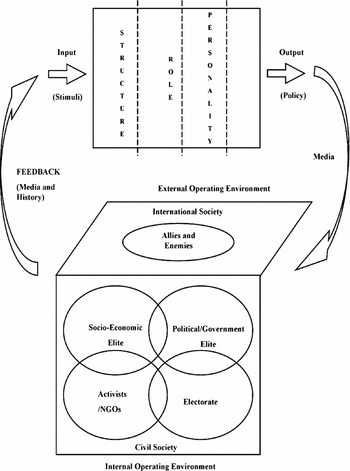
More recently (May 2008) Japan's Ministry of Foreign Affairs hosted an ‘International Symposium: From Okinawa to Toyako: Dealing with Communicable Diseases As Global Human Security Threats’ at which Prime Minister Fukuda delivered a speech on Japan's contributions and pledged a further 560 million dollars in the coming years to the Global Fund to Fight AIDS, Tuberculosis and Malaria.Footnote 74 Hence it is necessary to construct a model which demonstrates the impact of history, society, feedback, and internal and external constituencies upon the key political entrepreneurs in the field of Japanese security policy decision-making. A comprehensive model of Japanese security policy decision-making with regard to each political entrepreneur might therefore look like the cybernetic model presented in figure 1.Footnote 75
The Cybernetic Model of Policy Formulation

In its most basic form, the cybernetic model portrays the decision-making process as a ‘black box’ in the centre of a larger whole. Security policy is seen as a process by which ‘input’ of stimuli from the ‘operating environment’ (i.e. external conditions and the actions of other actors) is passed through the processing core (perceptions, beliefs, hierarchy of values of the decision-maker) and emerges on the other side as output (security policy decisions and actions). This output then impacts upon the operating environment, causing changes and a new set of input. The new input is termed feedback, and may be either positive (reinforcing) or negative (limiting). If a decision-maker responds to negative feedback by changing his policy, he is considered to be ‘steering,’ and is often seen to be acting in a legitimized political manner. If he declines to respond to negative feedback, but rather forces the change onto the operating environment, he is acting in a power political manner. Generally, the consensus culture of Japanese security decision-making tends to ensure legitimized political behaviour among key decision-makers.
More complex versions of this approach insert a number of filters (structure, role and personality) and divide stimuli and output into exogenous (external operating environment—foreign) and endogenous (internal operating environment—domestic). In forecasting one needs to know:
• what is the impact of the underlying structure?
• What is the network of roles and how widely are the roles defined (i.e. how much freedom does the decision maker have to act on his own initiative)?
• Where does personality fit in?
As explained above, the structure of Japanese security decision-making is perhaps the element that skews traditional analysis to the greatest degree, as the truncated pyramid severely restricts the freedom of manoeuvre and action of individuals. However, the role of the Prime Minister has changed over time, with something of a growth in power centralization, or at least in the possibility of a populist Prime Minister securing sufficiently large internal constituency support through political entrepreneurship to buck the system. This seems to be what occurred with Koizumi since, despite limited diplomatic experience and traditional power-base support, he managed to transform the fortunes of his party and his office. Since 2001, as pointed out by Tomohito Shinoda, the Japanese government's centre of gravity for foreign policy has shifted from the traditionally dominant Ministry of Foreign Affairs to the Kantei (Prime Minister's Office), which allowed Koizumi to exercise a top-down style of decision-making.Footnote 76
Personality comes into play only when structure and role are permissive, yet it is an essential element in forming the system-bucking political entrepreneurship. Greater input from internal constituencies (in particular the electorate and non-governmental organizations) has allowed an increased pro-activity in non-traditional security arenas while continuing to restrict the actions of political entrepreneurs in the traditional security realm of power projection capabilities and the willingness to deploy Japanese forces overseas. Thus in order to follow in Koizumi's populist footsteps, Premier Aso needed to be careful in espousing a proactive foreign policy, when the majority of the electorate was focused on economic woes and was resistant to supporting international adventures.Footnote 77
This more complex model is essential for use in the case of contemporary Japan, as traditional models are unable to reflect the relative enfeeblement of top-down decision-making pressures (whether RAM, individual, or organizational), the rise of non-traditional pressures (public opinion, NGOs, and the media), and the impact of Japanese culture and operational environment. But most importantly it is needed to address the political entrepreneurship of zoku as they go about the business of accruing sufficient support from both traditional and non-traditional sources for their foreign policy initiatives. Only this model accounts for the simultaneous push for a more assertive Japan and yet resistance to the use of conventional or ‘normal’ tools for achieving this.
Conclusion
This paper has demonstrated that the simplicity of RAM, whether in unitary state or single rational leader mode, despite laudable parsimony, is unable adequately to explain or even in some cases to recognize Japanese security policy-making. With the decline of all sides of the Iron Triangle, the various bureaucratic modelling approaches likewise now hold limited explanatory and predictive value. Internal structural changes, particularly the rise of zoku and their need to act as political entrepreneurs tendering for sufficient backing from sources within and without official governmental channels to achieve their political goals, have abetted the growing engagement of the public and press in security policy decision-making. Yet they also reveal the continued importance of Japanese culture and history in the process. Cybernetic analysis allows us a superior insight into and understanding of the process of Japanese security decision-making precisely because it takes into account the interaction of official and non-official forces.
Prime Minister Koizumi was able to garner enough support from a sufficiently wide domestic constituency so as to be able to buck the system and act independently of the bureaucracy—a move from politics based on interest groups to politics based on special interests that has skewed regional security relations in ways that the LDP and the MOFA cannot control.Footnote 78 Yet as previously mentioned Prime Minister Abe was not able to continue the dominance of what Samuels has termed the ‘normal nationalists’, and Prime Minister Aso was unable to restore their primacy.Footnote 79 Japanese bureaucrats continue to wield tremendous influence and remain extremely powerful when compared with other nations, but as a result incremental drift often seems best to characterize Japanese security decision-making.Footnote 80
Japan clearly has a security policy and internal changes in the structure of Japanese decision-making have made change to this policy in accordance with external stimuli more feasible, but such changes will not amount to ‘normalization’. Japan's internal political culture and traditions remain sufficiently unique that none of the traditional models of decision-making encompasses these nuances, or the degree of interaction between the internal and external components of foreign and security policy-formation.
Thus we need to turn to a cybernetic analysis of an individual decision-maker's political power not only in the context of their bureaucratic position but also in relation to the specific aspect of Japanese security policy for which they might be advocating greater pro-activity. There is often an opportunity for a political entrepreneur to buck the system and act proactively during periods of crisis or over controversial issues, if they have sufficient political capital. In general, however, in the day-to-day maintenance of security policy bureaucratic inertia remains to the fore.Footnote 81