First-time European and American visitors to the United Arab Emirates, where I live, are often surprised by the prevalence of heritage villages, festivals, and sports in hypermodern Abu Dhabi and Dubai. “Heritage” in the Arab Gulf, as elsewhere in the Middle East, is a central and growing industry, attracting the attention of scholars as well as investors and tourists. At the same time, much of the region's—and the world's—invaluable cultural heritage has been and continues to be obliterated by insurgents and governments alike. Spectacular assaults on historical sites, cultural institutions, and symbols of cultural-religious diversity in Afghanistan, Egypt, Iraq, Libya, Mali, Saudi Arabia, Tunisia, and Yemen demonstrate that the “new wars” of the 21st century are being fought on the terrain of cultural heritage as much as they are over other precious resources.Footnote 1 And yet, the interconnections between this heritage construction and destruction remain underexplored. In much of the scholarship produced in the burgeoning field of critical heritage studies, the duplexity of these processes is ignored. Instead, most edited volumes and “global” analyses of the field look to the Middle East and other Muslim-majority nations only in so far as they present case studies of heritage destruction—the bombing of the Bamyan Buddhas in Afghanistan and the looting of the National Museum of Iraq being iconic examples.Footnote 2
In this essay, I seek to do two things. First, I offer a preliminary overview of the development of cultural heritage (turāth) and heritage interventions in the (Arab) Middle East to provide context for the essays that follow. I present this as a corrective to the Western-centric histories of the development of heritage and heritage studies that predominate in the Anglophone scholarship. Second, I draw on examples from my own research on heritage produced, preserved, and deployed by laypersons for counterhegemonic purposes. Although scholars have begun to pay more attention to the work of heritage “from below”Footnote 3 —heritage maintained and mobilized by nonexperts and subaltern populations, which may resemble but is not synonymous with “vernacular” or “local” heritage—the majority of scholarship on heritage in the Middle East remains focused on the “top-down” (state-controlled and/or institutionally managed) engineering and erasures of cultural heritage in the region. Through these examples of subaltern heritage, I hope to demonstrate the political and symbolic salience of heritage in this tumultuous era.
As readers of IJMES surely know, cultural heritage in the Middle East and North Africa (MENA) region has long been a site of struggle against foreign domination and for political and cultural sovereignty. Starting in the late 18th and early 19th centuries, European powers used the modern, scientific language of protection and conservation to justify their imperial and colonial interventions across the region.Footnote 4 However, it was primarily Western travelers, antiquarians, and amateur archaeologists interested in Pharaonic artifacts and biblical archaeology who looted or damaged these sites—far more so than the “native” inhabitants who were regularly accused of iconoclasm. So dramatic was the hemorrhaging of Pharaonic artifacts from Egypt that its Ottoman ruler Muhammad ʿAli issued an ordinance in 1835 banning the unauthorized export of antiquities and established a state museum for their preservation and exhibition.Footnote 5 Similarly, the Ottoman Empire issued new antiquities legislation in 1874 to regulate European excavations and looting. And yet, the National Museum in Damascus (est. 1919) was founded as much to stem the removal of antiquities to the Imperial Museum in Constantinople (est. 1869) as to prevent their removal to Europe.Footnote 6 Throughout this period the Europeans in charge of the first modern museum, antiquities services, and excavation sites in the region showed little interest in the Islamic (“living”) past—although several museums or museum divisions of Arab or Islamic Art were founded in the 1880s and 1890s.
As in Europe and North America, it was in the early 20th century that the conservation of heritage in the Arab world developed into a professional, national, and state-controlled practice. Following the breakup of the Ottoman Empire, the fledgling governments of the emerging Arab nation-states struggled to wrest control of their museums, archaeological sites, antiquities, and other patrimony from imperial rule. In Iraq, for example, Anglo-Iraqi struggles over control of the new Iraqi National Museum and the division of archaeological finds resulted in the nationalization of the Iraqi Department of Antiquities in the mid 1930s, stricter antiquities legislation, and a growing orientation toward Iraq's Islamic (as opposed to its Mesopotamian) past.Footnote 7 At the same time, Arab intellectuals and nationalists sought in popular folklore (al-turāth al-shaʿbī) a bulwark against the impacts of urbanization and (Western) modernization. One sees this in the “nativist ethnography” of Palestinian intellectuals and folklorists in the 1920s and 1930s who sought to preserve what they considered an essential but threatened peasant heritage as the basis of a national Palestinian identity.Footnote 8 Nevertheless, what constituted the nation's essential heritage remained contested. A central issue among Arab nationalists in several countries was which one of their legacies, which turāth—Pharaonic, Mesopotamian, Phoenician, Islamic, Arab, Andalusi—they should draw on to consolidate their emergent national identities.
Upon achieving political independence in the 1940s through 1970s, many Arab states invested in cultural institutions and cultural production as a pathway toward modernization. The protection of cultural heritage through new institutions and legislation and the promotion of popular folklore was a part of this.Footnote 9 In the 1950s and 1960s, newly independent states including Algeria, Egypt, Syria, Tunisia, and Iraq established ministries of culture that provided centralized, public funding for the arts and supported “houses of culture” throughout their governorates and towns. In Morocco, the Levant, and much of the Arabian Peninsula, state-sponsored cultural production and the protection/production of cultural heritage took shape in the 1970s and later. But the strong influence of pan-Arabism during these decades left little room for the recognition of cultural, linguistic, or religious diversity. Most newly drafted constitutions designated the nation as Arab, Arabic as the official language, and Islam as the religion of the state. This was a clear shift away from colonial policies that had suppressed Arabic language and Islam and, in places such as Morocco and Algeria, favored the “indigenous” (Berber) populations.Footnote 10 Instead, states promoted a folkloric heritage as a national unifier or relegated it to the museum where cultural diversity could be contained—if not elided. In some places, the state's uncompromising approach to heritage preservation led to the violent displacement or further marginalization of subaltern groups.Footnote 11 In other places, including the occupied Palestinian territories during the First Intifada (1987–93) and Lebanon during its Civil War (1975–90), cultural heritage was among the many losses.Footnote 12
During the very decades that the modernizing Arab regimes were promoting a nationalist pan-Arab and popular heritage, the concept of a universal “world heritage” was born. It was midwifed, in fact, in the Arab world where the United Nations Educational, Scientific and Cultural Organization (UNESCO) mounted the world's first collaborative international campaign to save the ancient Nubian monuments of Egypt and Sudan from being flooded by the Aswan High Dam development. This unprecedented campaign resulted in the relocation and reconstruction of twenty-three monuments, the displacement of thousands of Nubians, and UNESCO's 1972 adoption of the Convention concerning the Protection of the World Cultural and Natural Heritage, which gave rise to the World Heritage site and brand. Whereas the global “heritage boom” of the 1970s–1990s is often associated with this development, the turn to heritage in the Arab world during this period was shaped as much if not more by regional politics.
Following the 1967 Arab defeat, for example, many Arab intellectuals questioned whether their Arab-Islamic heritage was the source of, or solution to, the perceived Arab-Muslim cultural stagnation. This was not the first time that Arab intellectuals had conceived of Arab-Islamic turāth as a buffer against the influences of a seemingly superior Western ḥadātha, or modernity—the relationship between turāth and ḥadātha had been a central debate of the 19th-century Arab “awakening.” What distinguishes the Arab intellectuals’ preoccupation with the “problematic of al-turāth” in the 1970s–1980s, however, was their reconceptualization of turāth in dynamic, progressive terms—as opposed to mere passive, imitative traditions (taqālīd).Footnote 13 In contrast to the conservative “traditionalists” who advocated a return to what they considered a sacred and incontrovertible Islamic turāth, “progressive” intellectuals (both religious and secular) called for a re-evaluation of inherited values and traditions so as to better adapt their Arab-Islamic turāth to the needs of the present. Having surfaced as a response to the defeat, these debates gathered steam in the wake of the 1979 Iranian Revolution and in the context of the Islamic revival. Indeed, for many pious Muslims, it was precisely their turn away from imitative taqālīd and toward an “authenticated” Islam that demonstrated their “modern-ness.”Footnote 14
At the same time, the rise of the now-global “heritage industry” characterized by the manufacture and marketing of heritage for economic development influenced heritage practices in the Middle East, too. In many nations, the commodification of heritage began with the economic liberalization of the 1980s. It then proliferated in the 1990s and 2000s due to, among other factors, the end of the Cold War and the related decrease in foreign funding to the region, an increase in US military and cultural power in the region in the wake of the 1990 Gulf War, the end of civil wars in Lebanon and Algeria and the reemergence of the Arab–Israeli “peace process,” and the promotion of cultural tourism as a form of economic development. During the past two decades, nearly all the MENA-region governments have extended their cultural policies, introduced legislation to protect cultural and natural heritage, created new government bodies responsible for heritage, increased the number of their heritage sites, and funded historical restoration projects.Footnote 15 In Jordan, for example, the normalization of relations with Israel following the Oslo Accords resulted in the development of a regional and international tourism industry based on the country's natural and cultural (“tangible” and “intangible”) heritage.Footnote 16 In the Arab Gulf states, the heritage “revival” has manifested itself in the restoration of old forts; the establishment of heritage villages and annual heritage festivals; the development of “heritage sports,” such as camel racing and falconry; televised competitions of colloquial (nabātī) poetry; and the proliferation of landmark national museums.Footnote 17 Moreover, as if eager to assume the mantle of (state-based) heritage preservation in the region, Bahrain established the Arab Regional Centre for World Heritage in 2010 to assist Arab states parties to implement the World Heritage Convention and, in 2014, Qatar hosted the thirty-eighth session of the World Heritage Committee—an event further contextualized in Trinidad Rico's contribution to this roundtable.
One of the most significant heritage-based developments to emerge in the past decade has been the turn toward the international and state recognition of intangible cultural heritage stimulated in part by UNESCO's 2003 Convention for the Safeguarding of Intangible Cultural Heritage. This shift could open the door to a renewed concern for an extranational (pan) “Arab” heritage. For example, in 2015 the governments of the United Arab Emirates, Saudi Arabia, Qatar, and Oman jointly nominated “Arabic coffee, symbol of hospitality” for inscription on UNESCO's Representative List of the Intangible Cultural Heritage of Humanity. (Notably absent as a nominating party is Yemen, the birthplace of Arab coffee.) Even more important in light of the current rate of language extinction is the 2003 convention's celebration of cultural and linguistic diversity. Algeria, the world's first member state to ratify the 2003 convention—and host to the Islamic Educational, Scientific and Cultural Organization's (ISESCO) 2004 session where the “Islamic Declaration on Cultural Diversity” was adopted—has been making strides in recognizing and promoting its country's cultural and linguistic diversity. In 2001, the Algerian government constitutionally recognized Amazigh as an official state language, alongside Arabic; in 2014, Algeria established a Regional Center for the Safeguarding of Intangible Cultural Heritage in Africa under the auspices of UNESCO.
Although these and other states’ measures are encouraging, some of the most significant shifts toward the recognition of marginalized peoples, languages, and cultures in the region have occurred as a result of political activism and popular mobilization. Whereas Tunisia and Morocco also took steps toward recognizing Amazigh (Berber) identity in the 2000s, it was only in response to the “Arab Spring” and the re-emergence of Berber activism in 2011—thirty years after the “Berber Spring” in Algeria—that Amazigh was constitutionally recognized as an official language of Morocco (in July 2011). In Yemen, too, it was the “Arab” uprisings in 2011 that paved the way to the National Dialogue Conference (2013–14) and a draft constitution declaring in Article 3 that “the State shall pay special attention to both the Mehri and Soqotri languages.”Footnote 18 Despite the prospects for this constitution becoming increasingly unlikely, this draft was a remarkable step toward the recognition of cultural diversity and minority heritage in a state long defined as Arab. Notably, this recognition of what Nasser Rabbat calls the “right to heritage” (see his essay in this roundtable) started gaining ground at the same time as cultural heritage sites in Syria and elsewhere came under attack.
As I noted earlier, critical heritage scholars working in Euro-American contexts have traced the gradual expansion of modern heritage practices and concepts. Most associate the rise of modern heritage conservation in the late 18th century with the nostalgic valorization of “wild” nature and the “traditional” past in response to industrialization and urban growth. The same scholars attribute the 1970s “heritage boom” in the West to the de-industrialization and neoliberal restructuring that occurred in the late 20th century—processes that heightened people's perceptions of vulnerability and risk, and nostalgia.Footnote 19 Although there are numerous reasons behind these and other shifts—from the initial professionalization of heritage interventions in the 18th and 19th centuries to their bureaucratization in the early to mid-20th century to their commercialization in the 1970s onward—they were all impacted by the modern politico-economic transitions from industrialization to corporate capitalism to neoliberalism.
To the extent that Arab states have been affected by these transformations, the development of turāth has undergone similar phases of professionalization, bureaucratization, and commercialization. And yet, as this overview indicates, these stages (in so far as one can delineate stages in the development of all that constitutes heritage across the region) map out less onto the West's transitions from industrialization to postindustrialization than they do onto the Middle East's transitions from Ottoman and European imperialism to colonial/Mandate rule to postindependence to the post–Gulf War (1990–91) era. In other words, while it is plausible to discuss the transformation of heritage in “the West” strictly in terms of nostalgia—notwithstanding the fact that all heritage is inherently political and contested—it is less tenable to shear turāth from the agonistic encounter with and struggle against Western imperialism and cultural hegemony. That is not to say that heritage is solely an imported concept, but rather to acknowledge that turāth, for this very reason, often has been and remains a contentious project.
In this regard, it is illuminating—if not often dismaying—to observe how and why various individuals, groups, and regimes have been mobilizing, deploying, and even weaponizing heritage in the Middle East today. At the time of writing, the “Arab states” region is home to 7 percent of UNESCO's World Heritage “properties,” but 38 percent of the world's properties “in danger.” The threats to cultural heritage come not only from insurrectionist groups such as the so-called Islamic State (ISIS), but also from the state parties responsible for its protection. As Rosie Bsheer demonstrates in the following essay, threats to heritage coexist with heritage as threat.
In my own work, by contrast, I have examined the efforts of Socotran poets, intellectuals, and émigrés to shape and maintain their island's cultural heritage—and Socotran identity—in the context of Socotra having been inscribed as a (“natural”) World Heritage Site in 2008. This is not about pitting a “local” heritage concept or framework against a “global” one, a point expounded on by Chiara De Cesari in her contribution. Rather, Socotran laypersons concerned about their endangered language, material culture, and cultural practices modeled their interventions on and against (state-sanctioned) multinational environmental conservation projects and (state-funded) regional museums, festivals, and competitions. Galvanized by these assertions, displays, and performances of Socotran cultural heritage and emboldened by the Yemeni revolution (thawra), Socotran activists found in “heritage” a rallying call for an end to their island's social and political marginalization. Far from being a conservative (or even conservationist) project, for these Socotrans, the work of turāth and the work of thawra had become one and the same.
Tragically, however, the horrific war in Yemen disrupted these efforts, in addition to having disrupted millions of lives. As in Syria and elsewhere, the loss of innocent lives and the forced displacement of entire communities has overshadowed the destruction and “displacement” of their (and the world's) cultural heritage, another “casualty” of stupefying proportions illuminated by Lamya Khalidi in her essay. And yet, with all that they have come to endure, Syrians and Yemenis alike have given their lives for and continue to make sense of their lives through heritage. A prominent example is the renowned Syrian archaeologist Khalid al-Asad, who was beheaded for refusing to cooperate with ISIS in Palmyra.
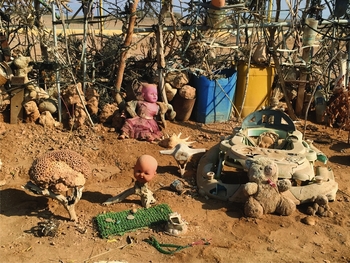
An incommensurable but nevertheless illustrative example can be found in the Markazi refugee camp in Djibouti, where ʿAbd Allahi Muhammad Bashrahil, a former road surveyor from Aden, lives amidst a self-constructed “museum” of Yemen's civil war. Enclosed by a makeshift hedge, Bashrahil's open-air museum depicts the graveyards, the turmoil, and the wreckage of Yemen. It does so through a series of displays curated from the various objects discarded in the camp's surrounding desert by a people on the move: a version of what Heghnar Zeitlian Watenpaugh, in this roundtable, calls “survivor objects.” Three small adjacent plots, outlined by conch shells, form the crux of this refugee museum/museum refuge. In their middle a rusted sewing machine, an old radio, a kerosene lantern, a coffee pot, a Yemeni midāʿa (shisha pipe), and scale weights represent the remnants of “civilization”; to the left, a miniature graveyard of bullets, casings, animal bones, and a decapitated doll depict the results of “the war”; to the right, a sun-bleached plastic baby walker, a teddy bear, and blue-eyed dolls expose the hopes pinned to future “life” (Fig. 1). This humble museum fashioned out of the detritus of displacement and war may not be commensurate with the cultural heritage whose losses scholars and civilians lament, but—like the émigré-founded museum of material culture in Socotra I discuss elsewhereFootnote 20 —it demonstrates the tangible significance of heritage even, or especially, to those who have lost far more. And it invites scholars to bridge the polarity between studies of heritage construction and destruction through other such examples of heritage in (the) ruins.
Nathalie Peutz, “Life” in Markazi, December 2016.

The essays that follow, penned by a social historian, an archaeologist, an architect, a cultural heritage studies specialist, an anthropologist, and an art historian, respectively, elaborate on and dissect many of the currents summarized above. Collectively, they demonstrate how an engagement with cultural heritage and heritage studies in the Middle East—a region where heritage is both “in crisis” and thriving—argues for a rethinking of the histories of heritage making and heritage studies more broadly. The cultural heritage that emerges from this roundtable discussion is neither lifeless nor benign. “It” governs and it neglects; it excludes and it mobilizes; it protects and it assaults. It witnesses and it speaks.