

Introduction
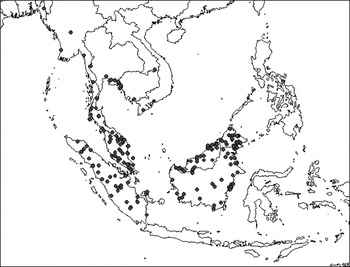
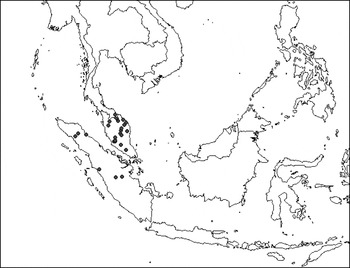
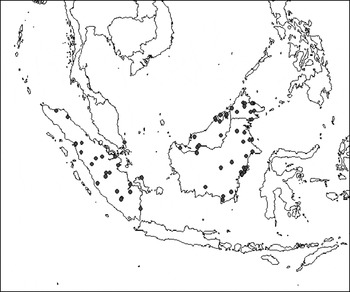
Scaphium Schott & Endl. is a genus of trees. Its distribution is centred around western Malesia (Fig. 1) but extends into continental Asia through Scaphium affine, which is found in Thailand and Cambodia, and S. scaphigerum, the most northerly distributed species, which is found in Bangladesh, Burma, Cambodia and Laos. The genus belongs to Malvaceae subfamily Sterculioideae (Bayer et al., Reference Bayer, Fay, De Bruijn, Savolainen, Morton, Kubitzki, Alverson and Chase1999), but was first described in Sterculiaceae as part of the tribe Sterculieae (Schott & Endlicher, Reference Schott and Endlicher1832).
Distribution map of Scaphium Schott & Endl.

The generic status of Scaphium has been much discussed. Schott & Endlicher (Reference Schott and Endlicher1832) recognised 14 genera in Sterculieae, one of which was Scaphium. Endlicher (Reference Endlicher1840), however, considered Scaphium to be one of 11 sections in Sterculia L. This sectional status was followed by Bentham (Reference Bentham, Bentham and Hooker1862), Baillon (Reference Baillon1872), Masters (Reference Masters and Oliver1868, Reference Masters and Hooker1874) and King (Reference King1891). Schumann (Reference Schumann, Engler and Prantl1890, Reference Schumann, Engler and Prantl1893, Reference Schumann and Engler1900) recognised Scaphium (and Hildegardia Schott & Endl.) as part of Firmiana Marsili. More recent accounts of the subfamily (Ridley, Reference Ridley1922; Hutchinson, Reference Hutchinson1967; Takhtajan, Reference Takhtajan1997; Bayer & Kubitzki, Reference Bayer, Kubitzki, Kubitzki and Bayer2003) have maintained Scaphium as a separate genus although Edlin (Reference Edlin1935a, Reference Edlin1935b) in his detailed account of the Malvales still maintained Scaphium as a subgenus of Sterculia.
Kostermans (Reference Kostermans1953, Reference Kostermans1956, Reference Kostermans1957, Reference Kostermans1959a, Reference Kostermans1959b, Reference Kostermans1988a) revised most of the Southeast Asian genera of Sterculioideae and brought order to them, mainly by the reduction of species and genera into synonymy. In his account of Scaphium (Kostermans, Reference Kostermans1953), he treated Carpophyllium Miq. as a synonym of Scaphium rather than Sterculia as Hutchinson (Reference Hutchinson1967) still maintained.
Species delimitation in Scaphium has been problematic and has led to confusion in identification. The genus was last revised by Kostermans (Reference Kostermans1953) who recognised four species. Since then five new species have been published and 13 species names are now attributed to the genus by the International Plant Names Index (IPNI) (http://www.ipni.org/index.html). A revision of the genus is therefore timely.
The close relationship of Pterocymbium R.Br. and Scaphium has been well documented (Masters, Reference Masters and Hooker1874; Merrill, Reference Merrill1929; Kostermans, Reference Kostermans1953, Reference Kostermans1973) and is supported by phylogenetic analyses of sequences of the plastid gene ndhF (Wilkie et al., Reference Wilkie, Clark, Pennington, Cheek, Bayer and Wilcock2006) and by more recent phylogenetic analyses of sequences of the nuclear internal transcribed spacer (ITS) region and the non-coding chloroplast regions trnL-trnF, trnH-psbA and trnS-trnG (Wilkie, Reference Wilkie2007). Morphologically, Scaphium is distinguished from Pterocymbium by the presence of mucilage cells in the seed wall, lack of a spur to the boat-shaped follicle, smaller flowers, larger fruit, and an irregularly clustered anther arrangement.
Materials and Methods
Over 700 herbarium specimens were studied during the taxonomic revision, from the following herbaria: A, BKF, BM, BO, E, K, KEP, L, P, SAN, SAR, SING and UC (see Index Herbariorum at http://sweetgum.nybg.org/ih/ for herbarium codes). All specimens cited have been seen by the author unless indicated otherwise. Collector names are cited as they are written on herbarium labels. For specimens where the collector name cannot be confidently interpreted a best guess has been made. This is indicated by a question mark after the name.
Most of the dimensions and character descriptions given are from dried material unless otherwise stated.
Field work was undertaken in Thailand, Malaysia and Indonesia. During this time herbarium material and silica-dried leaf material for molecular analyses was collected of Sterculioideae taxa, including Scaphium.
Species distributions are given; however, the collecting frequency of plant specimens for many parts of Malesia and Indo-China is very low and distributions may reflect this rather than the true distribution of species. Particularly little is known of Burma and parts of Kalimantan (Johns, Reference Johns1995).
Conservation assessments are proposed following the criteria set out by IUCN (2001).
Morphology
Characters of particular importance for species delimitation in Scaphium include: hair type and density on the petiole, leaf, inflorescence, flower and fruit; leaf shape; venation, especially the angle at which the basal and secondary veins join the midrib; the extent to which the calyx is divided, and the orientation and size of the seed.
Habit
All species of Scaphium are large subcanopy or canopy trees. They usually reach heights of between 25 and 40 m but Scaphium scaphigerum has been recorded as reaching 50 m. The diameters at breast height (dbh) are usually 10–40 cm, but the very largest trees can have a dbh of about 100 cm.
Buttresses
Several herbarium specimens record buttresses. The information is, however, incomplete and personal field observations have not clarified variation within species or the diagnostic value for recognising species. Richards (Reference Richards1996) noted that the family Sterculiaceae s.l. is one of several families with a propensity for producing buttresses and that stilt roots and buttresses are more common in swampy ground than in free-draining areas. Stilt roots and fluting of the bole do not appear to be a common feature of the genus.
Bark
The outer bark is variable in texture and colour. From field observations it is clear that the appearance often changes as the tree matures, making these characters unhelpful in identification. This said, the brown to grey-brown, smooth to fissured or dippled outer bark and brown-red to orange-brown inner bark of Scaphium parviflorum were found by Ashton (Reference Ashton1988) (cited as S. borneensis) to be sufficiently different from other species of Scaphium to aid identification. The outer bark of Scaphium is fibrous and stringy, a feature found in many other genera placed within the Malvaceae s.l. (Kochummen, Reference Kochummen and Whitmore1973; Corner, Reference Corner1997a).
Terminal branches
The terminal branches of Scaphium species often have distinctive leaf scars reflecting the clustering of leaves towards the apex of branches. This is not unique to Scaphium and is exhibited in several other genera of the Sterculioideae (Taylor, Reference Taylor1989). From herbarium specimens it appears that most Scaphium species are deciduous and lose their leaves before flowering. However, much more information is needed, especially from the most equatorial species, in order to establish if this is true for all species. It is possible that senescence may also occur without flowering, as has been recorded in closely related genera (Holttum, Reference Holttum1931, Reference Holttum1940).
Stipules
Although stipules are a common feature of the family Malvaceae s.l. (Bayer & Kubitzki, Reference Bayer, Kubitzki, Kubitzki and Bayer2003), they are caducous in Scaphium and were only ever found, and then very rarely, at the very apex of branches.
Petioles
Saplings often have much longer petioles than mature trees. Petiole indumentum is of some use in species delimitation, with Scaphium linearicarpum having dense stellate hairs, S. scaphigerum, S. burkillfilii and S. longipetiolatum glabrous or very sparse stellate hairs, and S. parviflorum minute flattened stellate hairs (resembling scales). All species have a pulvinus at each end of the petiole which is developed to varying degrees. These are often darker than the rest of the petiole; this is most pronounced in Scaphium longipetiolatum which has black pulvini and yellow-pale brown petioles.
Indumentum
Hair type and density can be useful for species delimitation. As hairs are often small they are best observed using a hand lens (×10) or compound light microscope. Three distinct hair types are found within Scaphium, stellate, minute flattened stellate, and simple.
Stellate hairs are the most common indumentum and are found in the majority of species. Minute flattened stellate hairs (resembling scales) are only found, and then often sparsely, on the terminal branches, petioles and leaves of Scaphium parviflorum. These hairs are much smaller and the branches are adpressed and cohere in the centre to give a fimbriate, scale-like appearance. Simple hairs are found at the base of the inner surface of the calyx in Scaphium longipetiolatum and S. burkillfilii, on the stipules of S. scaphigerum and S. longipetiolatum, and at the apex of the androgynophore of S. scaphigerum and S. linearicarpum.
Several species have been found to have red dots (possibly glands or the base of hairs) on the surfaces of the calyx and follicle but they are of no taxonomic utility.
The absence/presence and density of hair is variable between species and can be useful in species delimitation, in conjunction with other characters. In some cases the indumentum is caducous. In order to assess the density of the original indumentum, examination of apical parts of the inflorescence and midrib of leaves is useful because these tend to retain their hairs. In the taxonomic descriptions, the term sparse is used when hairs are distinctly separate from each other. The term dense is used when hairs are touching one another (or nearly so) or when they obscure the surface.
Leaves
Leaf shape and texture (terminology from Hickey (Reference Hickey, Metcalfe and Chalk1979) and Huxley (Reference Huxley1999)) can be variable in some species. In others these characters are constant and can help in species delimitation. For example, a distinctive suborbicular-ovate leaf shape and cordate to truncate leaf base is unique to Scaphium linearicarpum and small, narrowly ovate to narrowly elliptic leaves to S. parviflorum.
Some species (Scaphium affine, S. macropodum and S. scaphigerum) exhibit heteroblastic leaf development, with saplings and young trees having deeply lobed leaves and very long petioles. Corner (Reference Corner1997b) found that even in trees of intermediate stature there was often a mixture of deeply lobed leaves and the unlobed leaves characteristic of mature trees. From the material available it was not possible to assess if this occurs in all species of Scaphium. These differences in leaf morphology make the identification of juveniles difficult.
Venation type has been found to be a useful character in species delimitation. The palmate venation of Scaphium linearicarpum is distinctive, as is the angle (less than 40°) from which the basal and secondary veins join the midrib in S. longipetiolatum and S. burkillfilii. In this account, the term ‘basal vein’ is used only for those veins joining the base of the leaf where the petiole and lamina connect, and ‘secondary vein’ is used for veins which join the midrib above this point.
Inflorescence
The inflorescence in general does not provide good diagnostic species characters, although Scaphium linearicarpum is distinctive by its persistent dense rusty stellate hairs and S. longiflorum, S. macropodum and S. affine by their tight clusters of flowers towards the apex of the terminal branches of the inflorescence.
Scaphium is monoecious with both male and female flowers occurring on the same tree (occasionally hermaphrodite flowers are also present; see below). Separate panicles are usually composed of either male or female flowers, although both flower types have also been observed on the same panicle. In the specimens examined inflorescences composed of male flowers greatly outnumbered inflorescences composed of female flowers and frequency of inflorescences with only one sex outnumbered those with both sexes.
Flower sexuality
Male flowers have large polleniferous anthers which are irregularly arranged, covering the surface of a rudimentary carpel. Female flowers have rudimentary anthers (with or without rudimentary pollen) which are arranged around the base of a well-developed carpel. However, the size of pollen in female flowers and carpels in male flowers can be variable. For example, the male flowers of Scaphium macropodum have relatively well-developed carpels and the female flowers well-developed anthers and both are therefore possibly functionally hermaphrodite. Scaphium affine has mainly unisexual flowers but occasionally has male flowers with well-developed carpels and female flowers with well-developed anthers. Studies in the closely related genus Sterculia (Brown, Reference Brown1844; Bentham, Reference Bentham, Bentham and Hooker1862; Tantra, Reference Tantra1976) concluded that female flowers with smaller anthers than the normal male flower are functionally female.
Male flowers are the most common in specimens examined. The general lack of female flowers found on specimens is perplexing given the mass of fruits which are commonly produced by these trees. This may reflect the sampling, but other possible explanations include that the male flower is functionally hermaphrodite or that there is temporal separation of the maturation of the male and female parts within a hermaphrodite flower (dichogamy). Dichogamy is suggested in a specimen of Scaphium linearicarpum (Chan FRI 6656 (K)) in which the carpels have started to develop into young fruit at the base of which are small anthers. The only flower bud from the same specimen is of a polleniferous male flower. No data were found to suggest that andromonoecy is caused by the development of functionally male flowers after a certain number of hermaphrodite flowers have been pollinated in an inflorescence.
Calyx
The flowers of all species are apetalous and the calyx (which is cream to pale green when fresh) is often mistakenly referred to as the corolla. Colour variation between species is not distinctive enough to merit its use in species delimitation.
The calyx indumentum on the outer surface varies from glabrous to densely stellate hairy and is useful in species delimitation. External surfaces tend to be more hairy than internal surfaces and in glabrous species the calyx is often covered in red dots. In general, the margins of the calyx lobes are more hairy than the surface and these hairs tend to have longer branches.
Scaphium longipetiolatum and S. burkillfilii are distinct in having a tuft of dense, ascending, simple hairs emerging from the inside of the base of the calyx which brush tightly around the base of the androgynophore. A similar feature is found in a species of the closely related genus Firmiana (F. malayana Kosterm.) and was observed to trap nectar at the base of the flower which attracted birds (pers. obs.).
The depth to which the calyx is divided is an important character in species delimitation. In Scaphium scaphigerum, S. affine, S. longipetiolatum and S. linearicarpum the calyx is divided 2/3 its length, while in S. longiflorum it is divided 1/3 its length. In Scaphium macropodum and S. parviflorum the division of the calyx is more variable, with the former being divided 1/3–1/2 and the latter 1/2–2/3 the length of the calyx. In all species the calyx lobes are divergent. Kostermans (Reference Kostermans1953) suggested that the length of division of the calyx is highly variable and changes with developmental stage. Apart from in Scaphium macropodum and S. parviflorum I have found no such variation.
The number of lobes (4–5) is variable within species and is of little taxonomic utility.
Androgynophore
In Scaphium, as in all genera of the Sterculioideae, the sexual organs are borne on a structure formed from the elongation of the receptacle. Authors studying genera of the Sterculiaceae (Robyns, Reference Robyns1964; Taroda, Reference Taroda1984) have differentiated this structure into two types, using the term gynophore for pistillate flowers and androphore for staminate flowers. Tantra (Reference Tantra1976), revising Sterculia, also used the term androphore for the staminate flower but used gynandrophore for what he termed bisexual flowers. As male and female flowers contain both male and female sexual parts (even if rudimentary in some flower types) I follow previous authors (Guymer, Reference Guymer1988; Taylor, Reference Taylor1989) and use the term androgynophore to encompass the structure found in all flowers.
The length of the androgynophore is variable and it often elongates at anthesis. As such it is of little use in the delimitation of species. Unlike the closely related genus Sterculia (Taylor, Reference Taylor1989), no significant difference was found in androgynophore length between male, female and hermaphrodite flowers. In some specimens the apex of the androgynophore is distinctively recurved. However, this character is often variable within species and probably reflects the developmental stage of the flower (the apex probably straightening as the calyx opens).
The position and type of hairs on the androgynophore can be useful (in conjunction with other characters) for species delimitation.
Androecium
The filaments are short in all flowers and the anthers appear sessile. In male flowers the anthers are arranged in an irregular mass, which surrounds the carpels. In female flowers the anthers are arranged in a ring around the base of the carpels. Anthers and pollen grains are generally larger in the male flower than in the female flower. The pollen from female flowers was tested for cytoplasmic content using cotton blue in lactophenol (Radford et al., Reference Radford, Dickison, Massey and Ritchie Bell1974) and gave a positive result, indicating that it contains cytoplasmic content and is potentially viable.
Following the terminology of Erdtman (Reference Erdtman1969, Reference Erdtman1972) and Moore et al. (Reference Moore, Webb and Collinson1991) the pollen grains are small (10–25 μm), isopolar, radially symmetric, trizonocolporate, circular in polar view, oblate-spheroidal in equatorial view and have reticulate exine sculpturing.
A preliminary investigation of pollen morphology across the Sterculioideae showed it to be relatively homogeneous. It is therefore unlikely that pollen morphology will provide taxonomic characters within Scaphium.
Gynoecium
As is found in all species of this subfamily, the carpels of Scaphium species are secondarily apocarpous (Endress et al., Reference Endress, Jenny and Fallen1983; Jenny, Reference Jenny1983, Reference Jenny1985). In the male flower the carpels are rudimentary and usually completely obscured by the irregularly arranged anthers. Ovules, if present, are smaller than those found in the female flower. In female flowers the carpels are much more developed, taper towards the apex, and are easily visible with the anthers arranged in a ring around the base. Not all carpels usually develop into fruit (in most herbarium specimens examined only two carpels develop). In each carpel 1–2 ovules are found but usually only one develops. There are no obvious morphological differences in carpels between species.
Fruit
As the fruit develop the apocarpy of the carpels becomes more apparent with each carpel separating. At a very early stage the follicle also starts to dehisce and the seed is exposed. These fruits are united by a thickened androgynophore. The base of the carpels (carpophore) also develops to form the stalk on which the follicles are borne. Up to five follicles develop from a single flower (although it is usually less), forming a ‘hand’ of hanging follicles.
The follicles at early stages of development are red on the outside but quickly become paler, eventually becoming pale green, and the inside surface turns from pale red-pink to pale green (often with red specks) when mature. Follicle shape, size, texture and indumentum are relatively uniform between species and are not taxonomically useful.
However, seed indumentum, orientation and size are useful in species delimitation. Scaphium linearicarpum and S. longiflorum are distinctive by their covering of dense stellate hairs, as is S. parviflorum with its covering of minute round scales (only clearly visible using a compound microscope). Scaphium scaphigerum is distinctive in that the base of the follicle is recurved, clearly orienting the spherical seed away from the follicle, and S. burkillfilii is clearly distinguished by its seeds, which are two to three times larger than any other species, and its leathery follicle.
The seed coat of all species contains large mucilage-sacs which, when placed in water, expand to produce a jelly-like substance (Corner, Reference Corner1976). The biological purpose of this is unknown. Corner (Reference Corner1997a) reported that the mucilage ‘envelopes the germinating seeds and is eaten by monkeys’. Without detailed observations of the germinating seeds it is not possible to confirm if the mucilage plays a role in germination. However, I suggest that possible biological benefits of producing mucilage include: it functioning as a water capture device for use by the developing embryo during dry periods; aiding seedling establishment by reducing local soil erosion; acting as a repellent to insects; and promoting dispersal by monkeys during mast fruiting.
Taxonomic Treatment
Scaphium Schott & Endl., Melet. Bot. 33 (1832). – Type species: Scaphium scaphigerum (Wall. ex G.Don) G.Planch.
Carpophyllium Miq., Fl. Ned. Ind., Eerste Bijv. 401 (1861). – Type species: Carpophyllium macropodum Miq. (= Scaphium macropodum (Miq.) Beumée ex K.Heyne).
Canopy or occasionally emergent trees; mostly deciduous with flowering mainly occurring during leafless periods. Buttresses absent or present. Outer bark grey to brown, smooth, cracked, fissured, dippled or flaking. Inner bark fibrous with reticulate appearance. Sapwood white to brownish. Terminal branches pale brown to brown, striate to smooth, lenticels present or absent, glabrous to densely stellate hairy, leaf scars obvious. Petiole pale brown to brown, smooth to striate, glabrous to densely stellate hairy, often thickened at both ends with thickened parts often darker than main petiole. Stipules caducous or persistent at apex of stem. Leaves simple, alternate or spirally arranged; lamina papery to leathery, narrowly to broadly elliptic, ovate to ovate-elliptic, or suborbicular, symmetric or asymmetric, base acute, rounded or cordate, apex acute, acuminate or rounded, upper surface glabrous to sparsely stellate hairy, sometimes with red gland dots, lower surface glabrous to densely stellate hairy, occasionally with gland dots; margin entire; midrib flat or raised above, raised below; basal veins 1 or 2 pairs, palmate; secondary veins flat to slightly raised above, slightly raised to raised below. Inflorescence a lax, erect, axillary panicle, sparsely to densely stellate hairy, angular-striate, branches in more than one plane, flowers 1–6(–many), often tightly clustered towards apex, monoecious. Bracts caducous to persistent. Pedicel absent to 2(–4) mm long. Flowers male or female, small, (1–)4–9 mm long, pale green; calyx 4–5-lobed, lobes 1/3–2/3 the length of the calyx, ovoid to obovoid; corolla absent; sexual parts found at apex of androgynophore which often extends beyond the calyx lobes; anthers dithecate, up to 15, dehiscing longitudinally. Male flowers: carpels 3–5, free, often rudimentary, sparsely to densely stellate hairy, covered with irregularly arranged anthers, style absent, stigmas as many as carpels. Female flowers: carpels 3–5, free, densely stellate hairy, anthers arranged around base of carpels, often rudimentary, style elongated (often indistinct from carpels), densely stellate hairy, stigmas as many as carpels, glabrous. Fruits 2–5 follicles per flower, follicles papery or leathery, boat-shaped, 8–20(–30) cm long, reddish-pink turning green when fresh, glabrous to densely stellate hairy, venation net-like, calyx usually not persistent, stalk to 10(–20) mm long, densely stellate hairy. Seeds 1 per follicle, basal, spherical, globose to ellipsoid.
Distribution. A genus of eight species centred in western Malesia but found as far north as Bangladesh. Distributed in Bangladesh, Burma, Thailand, Cambodia, Laos, Vietnam, Sumatra, Peninsular Malaysia, and throughout Borneo (Fig. 1).
Habitat. Most species are found in undisturbed lowland rain forest below 700 m altitude. Two species (Scaphium burkillfilii and S. longiflorum) are restricted to swamp forest.
Phenology. From personal field observations, the collation of flowering time information from over 700 herbarium specimens, and from the literature (Browne, Reference Browne1955; Smythies, Reference Smythies1965), no clear flowering season for Scaphium can be identified. Corner (Reference Corner1997a) recorded a flowering season between February and June in the southern regions of Peninsular Malaysia, and Phengklai (Reference Phengklai, Santisuk and Larsen2001) noted flowering between December and February during the early dry (cool) season in Thailand. Flowers are borne on twigs before new leaves appear but leaf senescence is not necessarily associated with flowering (Holttum, Reference Holttum1931, Reference Holttum1940). Scaphium has been recorded as producing flowers as infrequently as every eight years (Medway, Reference Medway1972; Corner, Reference Corner1997b).
Very little information is to be found on herbarium specimens or in the literature about the pollinators of Scaphium species. A collection of Scaphium linearicarpum by Burley et al. 1525 (BO, L) mentions that the flowers were visited by bees, and Corner (Reference Corner1997a) wrote that the flowers of Scaphium attract bees, flies, beetles and butterflies ‘in variety and profusion that is seldom seen’.
Uses. The wood is used for plywood and as a general utility light hardwood (Smythies, Reference Smythies1965). More large-scale use is limited by the high silica content (making it difficult to saw) and the relatively low quantities available (Browne, Reference Browne1955). The fibrous bark is sometimes used for walls in temporary local houses (Kostermans et al., Reference Kostermans, Polman, Sudo, Lemmens, Soerianegara and Lemmens1994). No distinction in use is made between species.
The hydrated seed mucilage forms a jelly which is used as a febrifuge and to treat coughs, asthma and dysentery (Burkill, Reference Burkill1966). The dry seed is commonly found for sale in markets throughout Southeast Asia but is also exported to China and India. Laos exports some 1000 tonnes of the seed in years when these trees fruit (Joost Foppes, pers. comm., 2006). In China it is a popular medicine for sore throats and in Thailand the jelly has recently started to be sold as a health drink. It has been used medicinally in France since about 1850 (Ashton, Reference Ashton1988). The ASEAN (Association of Southeast Asian Nations) standard name for the timber is samrong (Wong, Reference Wong2002). In Peninsular Malaysia it is known as kembang samangkok or ‘fill a cup’, referring to the expanding properties of the seed (Corner, Reference Corner1997a). In Java it is traded as buah tampayang, in China as pandahai, in Laos as mak chong, and in Thailand as mak samrong. Seeds of all Scaphium species have the jelly-producing property and it is likely that no distinction of species is made when selling these at market.
Relationships. Based upon morphological characters the genus can be divided into two groups, one composed of Scaphium affine, S. macropodum, S. parviflorum, S. longiflorum and S. linearicarpum and the other of Scaphium longipetiolatum, S. burkillfilii and S. scaphigerum. The former group is distinguished by the leaves and venation drying brown and secondary venation joining the midrib at angles greater than 40°; and the latter by the pale brown-tan colour of the leaves when dry and the secondary venation joining the midrib at between 20 and 40°. Phylogenetic research by Wilkie (Reference Wilkie2007) using ITS and combined nuclear and plastid sequence data also supports these groups as monophyletic. As not all Scaphium species were included in the phylogenetic analyses and relationships between species were not fully resolved, species descriptions have been arranged alphabetically in this revision.
Nomenclatural notes. In the first publication of Scaphium the type species was given as Scaphium wallichii Schott & Endl. This is an illegitimate name because it lists Sterculia scaphigera Wall. (correctly Wall. ex G.Don) in synonymy, a name which has priority. Sterculia scaphigera was validated by Don (Reference Don1831) who attributed the name to Wallich. Planchon in Guibourt & Planchon (Reference Guibourt and Planchon1869) recombined Sterculia scaphigera Wall. ex G.Don into Scaphium scaphigerum (Wall. ex G.Don) G.Planch. Under Art. 7.5 of the rules of botanical nomenclature (McNeill et al., Reference McNeill, Barrie, Burdet, Demoulin, Hawksworth and Marhold2006) Wallich 1130 from Martaban, the specimen on which Scaphium wallichii is based, is the type of the genus.
Etymology. The name Scaphium comes from the Greek, skaphion, meaning a skiff (type of boat), and refers to the shape of the fruit.
Key to species
1a. Secondary venation joining midrib at angle of (15–)20–40°; leaves drying pale brown-tan above, pale brown-tan to pale brown below 2
1b. Secondary venation joining midrib at angle of 40° or more; leaves drying brown, dark brown to pale brown on both surfaces 4
2a. Follicle leathery; seed spherical, 2.5–3.5 cm long; tree of swamp forest 2. S. burkillfilii
2b. Follicle papery; seed spherical to ellipsoid, (0.7–)1–2.5 cm long; tree of non-flooded forest 3
3a. Base of calyx tube with dense ring of simple ascending hairs inside; basal veins joining midrib at (15–)20–30(–40)°; secondary veins 2–3(–4) pairs; outer surface of calyx densely stellate hairy; androgynophore densely stellate hairy along entire length; seeds partially enclosed in hollow of follicle; Borneo 5. S. longipetiolatum
3b. Base of calyx tube glabrous inside; most prominent basal veins joining midrib at 30–40°; secondary veins (2–)3–4(–5) pairs; outer surface of calyx sparsely stellate hairy; androgynophore sparsely simple hairy, sometimes with stellate hairs with long branches on upper half, glabrous on lower half; seeds oriented away from follicle; Bangladesh, Burma, Laos, Vietnam, Thailand, Peninsular Malaysia 8. S. scaphigerum
4a. Leaves narrowly ovate to narrowly elliptic, (2.2–)2.3–3.5 times as long as wide, 5–11(–19) cm long, 2–5(–8) cm wide; terminal branches, petioles, midrib and veins of the lower surface of the lamina with minute flattened stellate hairs (resembling scales) 7. S. parviflorum
4b. Leaves suborbicular-ovate, ovate, elliptic, ovate-elliptic, broadly elliptic to elliptic-oblong, 1–2(–2.8) times as long as wide, (5–)9–34(–46) cm long, 4–17(–35) cm wide; terminal branches, petioles, midrib and veins of the lower surface of the lamina without minute flattened stellate hairs (resembling scales) 5
5a. Follicle glabrous or sparsely stellate hairy; seeds glabrous; basal veins on lower leaf surface glabrous 6
5b. Follicle densely stellate hairy; seeds densely stellate hairy; basal veins on lower leaf surface sparsely to densely stellate hairy 7
6a. Calyx divided 2/3 its length; leaves thickly leathery to leathery, leaf base commonly cordate but can be truncate, rounded or sometimes acute, margin often recurved 1. S. affine
6b. Calyx divided 1/3(1/2) its length; leaves sub-leathery to papery (occasionally leathery), leaf base acute, rounded or shallowly rounded, margin not recurved 6. S. macropodum
7a. Leaves suborbicular-ovate, base cordate to truncate, apex rounded to shallowly acute or occasionally mucronate; calyx divided 2/3 its length; tree of non-flooded forest 3. S. linearicarpum
7b. Leaves elliptic to broadly elliptic, base rounded to acute, apex acute to rounded; calyx divided 1/3 its length; tree of swamp forest 4. S. longiflorum
1. Scaphium affine (Mast.) Pierre, Fl. Forest. Cochinch. 13: 193 (1889). – Sterculia affinis Mast. in Hook.f., Fl. Brit. India 1(2): 361 (1874). – Type: Peninsular Malaysia, ‘Malacca’, Maingay 1856 [ = Kew Distribution No. 225] (lecto K (Phonsena & Wilkie, Reference Phonsena and Wilkie2008)).
Sterculia lychnophora Hance, J. Bot. (n.s.) 5: 243 (1876). – Scaphium lychnophorum (Hance) Pierre, Fl. Forest. Cochinch. 13: pl. 193 (1889), as ‘lichnophorum’. – Type: Cambodia, Kampot, iv 1874, Pierre s.n. (in Herb. H.F. Hance 19219) (lecto K (Phonsena & Wilkie, Reference Phonsena and Wilkie2008)).
Scaphium beccarianum Pierre, Fl. Forest. Cochinch. 13: pl. 195c (1889). – Sterculia beccariana Pierre, Fl. Forest. Cochinch. 13: sub. pl. 201 (1889). – Type: Borneo, Sarawak, 1865–1868, Beccari 2286 (lecto P, designated here; iso BM, BO, K).
Tree to 42 m tall, bole to 85 cm in diameter, deciduous. Buttresses if present up to 2.5 m tall, 1.2 m long, 12 cm thick. Outer bark grey-brown, shallowly fissured. Inner bark reddish, fibrous. Sapwood yellow-white. Terminal branches pale brown to brown, smooth, rough or striate, lenticels present, with small stellate hairs. Petiole brown, 2.5–15 cm long, 1–3 mm wide, smooth to striate, glabrous to occasionally sparsely stellate hairy, both ends concolorous or slightly darker. Stipules caducous or persistent at apex, ovate to narrowly elliptic, to 7 mm long, 2 mm wide, densely stellate hairy on both surfaces. Leaf lamina thickly leathery to leathery, ovate, elliptic or elliptic-oblong, usually entire (sometimes lobed on lower branches or young trees), symmetric to slightly asymmetric, base commonly cordate or truncate, rounded or sometimes acute, apex acute to acuminate, 1.2–1.5 times as long as wide, (5–)9–18(–26) cm long, (4–)6–12 cm at widest point, upper surface glabrous, drying pale brown, shiny, lower surface glabrous to very sparsely stellate hairy, drying pale brown, shiny (not as much as upper surface); margin often recurved; midrib flat, occasionally slightly raised above, raised below; basal veins 1 pair joining midrib at (30–)50–60(–80)°, flat above, raised below, glabrous on both surfaces; secondary veins 4–9(–13) pairs joining midrib at 40–60°, flat above, raised below, glabrous on both surfaces; tertiary veins slightly raised below, drying same colour as lamina, inconspicuous above. Inflorescences (3–)8–19 cm long, densely rusty brown stellate hairy on younger parts. Bracts occasionally persistent, elliptic, 1–1.5 mm long, c.0.5 mm wide, outer surface densely stellate hairy, less so on inner surface. Flower buds drying brown, ovate, sparsely stellate hairy (occasionally dense), lobe margin distinct, densely stellate hairy. Pedicel 0.5–1.5 mm long, to 1 mm wide, densely stellate hairy. Flowers 3.5–7 mm long, light green and fragrant when fresh, drying brown, 4–5-lobed, calyx lobes 2/3 the length of the calyx, calyx outer surface glabrous to sparsely stellate hairy, calyx inner surface glabrous (including base), androgynophore c.3 mm long, protruding from calyx tube, straight, glabrous, densely stellate hairy only at apex or sparsely stellate hairy throughout its length, anthers 5–12, occasionally stellate hairy at base, carpels densely stellate hairy, 2–5, free or nearly so, styles 0.5(–1) mm long, stigmas flattened, superficially fused. Occasionally carpel size and anther size are intermediate between male and female flowers (possibly hermaphrodite flowers). Fruit: 1–2 follicles per flower, papery, 15–18 cm long, inner surface glabrous (often with red gland dots), shiny, outer surface glabrous or very sparsely stellate hairy (often with red gland dots), dull, follicle stalk 1–3(–20) mm long. Seeds 1 (very rarely 2) per follicle, subelliptic to elliptic, drying dark brown (often shiny), 20–25 mm long, 10 mm wide, glabrous, partially enclosed in hollow of follicle.
Diagnostic characters. This species is widespread and variable but is distinct by its leathery leaves which often dry pale brown and shiny. The truncate, rounded or cordate leaf base, deeply lobed flowers (calyx lobes usually 2/3 the length of the calyx), and dense rusty brown stellate hairs on the inflorescence are also key features.
Relationships. Morphologically this species belongs to the group containing Scaphium macropodum, S. longiflorum, S. parviflorum and S. linearicarpum and from leaf characters it appears most closely related to S. macropodum. This close relationship is supported by phylogenetic analysis of combined nuclear and chloroplast DNA sequence data (Wilkie, Reference Wilkie2007).
Conservation status. Although this species is found in forest which is under threat from logging and other human disturbances its wide distribution means a conservation status of Least Concern (LC) is most appropriate.
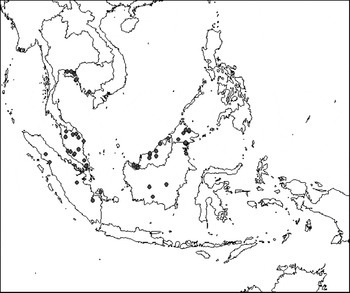
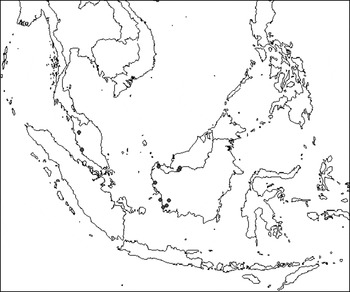
Distribution. Thailand, Cambodia, Vietnam, Sumatra, Peninsular Malaysia and Borneo (Fig. 2).
Distribution map of Scaphium affine (Mast.) Pierre.

Habitat. Tree of non-flooded forest on sandy, clay or loamy soil below 600 m altitude.
Nomenclatural notes. In the original description by Masters (Reference Masters and Hooker1874) and the subsequent combination in Scaphium by Pierre (Reference Pierre1889), a type specimen was not mentioned. Although King (Reference King1891) cited Maingay Kew Distribution No. 225, Malacca, he gave no indication that he was considering this the type and mentioned that the only collection he had seen was that in the Calcutta herbarium and that it ‘consists of leaves only, with a single detached fruit’. Phonsena & Wilkie (Reference Phonsena and Wilkie2008) proposed that the Kew specimen of Maingay 1856 [ = Kew Distribution No. 225], Malacca, which has good flowering material and fits well with the descriptions of both Masters and Pierre, be designated the lectotype of this species.
Ridley's combination of Sterculia affinis Mast. into Scaphium (Ridley, Reference Ridley1916) is a superfluous combination as it was preceded by Pierre (Reference Pierre1889).
Pierre considered Scaphium lychnophorum (Hance) Pierre similar to Sterculia scaphigera and Sterculia affinis (now in Scaphium) in its three-lobed leaves, but gave no reason why he considered it distinct. It is obviously close to both these species morphologically (as well as to Scaphium macropodum). I have synonymised it under Scaphium affine because of its leathery leaves, truncate leaf base, number of secondary veins and shape of seeds, all of which fall within the range of variation of this species.
Pierre (Reference Pierre1889) described Scaphium beccarianum and gave Beccari 2286 as the type. His reference to pl. 197 is in error and should be pl. 195. In the same publication (Fl. Forest. Cochinch. 13: sub. pl. 201) he also described Sterculia beccariana as a new species and gave the type also as Beccari 2286. Under the Code (McNeill et al., Reference McNeill, Barrie, Burdet, Demoulin, Hawksworth and Marhold2006) both names are validly published (for names published before 1953 – see Art. 34.2) and both have Beccari 2286 as the type.
Taxonomic notes. Kostermans (Reference Kostermans1953) recognised Scaphium affine as conspecific with Scaphium macropodum, stating that the flowers of the former were immature. From the many specimens of Scaphium affine I have examined I cannot agree as the flowers are mature and are deeply lobed.
Etymology. Latin, affinis = allied to; similar to another species of genus Sterculia.
Geographic selection of specimens examined. Thailand. Chachoengsao: Lum Chang Wat Wildlife Reserve, 16 ii 2004, Wilkie PW 428 (E). Chanthaburi: Kao Petcha Kut, 15 iv 1925, Nai Nae 81 (BM, K, L); Khao Soi Dao, just above waterfall, 13 ii 2004, Wilkie PW 418 (E). Chonburi: Makham, Ban ang, 6 xi 1933, Put Puraisurind 407 (BKF). Trat: Khlongsai (stream), Ko Chang, 18 x 1960, Bunnak Sangkhachand BKF 19961 (BKF); Khao Saming, 28 xi 1924, Kerr 9445(a,b,c) (BM, K). Yala: Betong, 2 viii 1923, Kerr 7466 (A, BM, K, L).
Cambodia. Kampot: iv 1874, Pierre 15 (K), 3781 (P); Samrang, 13 ii 1896, Hahn 130 (P).
Vietnam. Botanic Garden: Liioi uoi s.n. (P); Giarai, xii 1918, Chevalier 39.631 (P); South Vietnam, between Tong Klong and Tỏr Lung, 16 iv 1953, Schmid V.N. 791 (P).
Malaysia.Peninsular Malaysia: Johor: NW Gunong Blumut, 17 v 1968, Whitmore FRI 8833 (KEP, L, SAR, SING); Kulai, 24 vii 1937, Corner SFN 33599 (K, L, SING). Kelantan: Ulu Sat Forest Reserve, 18 vi 1968, Suppiah KEP 104590 (K, KEP, L, SAR, SING). Kuala Lumpur: Rimba Ilmu Botanic Garden, 14 vii 1999, Wilkie PW 47 (E). Negeri Sembilan: Pasoh Forest Reserve, 17 vii 1963, Rahim Ismail 94070 (KEP, L); Summit of Gunung Tampin Forest Reserve, 30 iv 1970, Everett FRI 14197 (KEP, L, SING). Pahang: Pahang Road, 17th mile, 29 v 1976, Kochummen FRI 18359 (K, KEP, L, SAN, SING). Perak: Near Gunung Boobo, vi 1885, Dr King's collector 7707 (K). Selangor: Sungai Buloh Forest Reserve, 17 vi 1970, Kochummen FRI 16108 (A, K, KEP, L, SAR, SING); Waterfall Hill, vi 1888, Wray 2066 (K). Terengganu: Bukit Jebak Puyoh, Ulu Besut, 4 v 1968, Cockburn FRI 8340 (K, KEP, L, SING); Ulu Sungai, 0.5 mile upstream from S. Calang, 1 vi 1968, Cockburn FRI 8403 (K, KEP, L); Ulu S. Trengan, 0.5 mile upstream from K. Petang, 4 vi 1968, Cockburn FRI 8456 (A, K, KEP, L, SAR, SING); Kemaman, Rasau Kerteh Forest Reserve, 11 v 1976, Chan FRI 25001 (K, KEP, L, SAN, SAR, SING). Borneo: Sabah: Beaufort: Weston, viii 1961, Wanota 26619 (SAN); Kota Marudu: Kudat, Hulu Melobang, 26 x 1940, Castro 55402 (KEP); Gunung Walker, Sapi Road, 19 xii 1964, Madani 44266 (n.t. 49) (SAN); Labuk Sugut: Sungai Sasau, 15 ix 1984, Aban & Soinin SAN 64598 (L, SAN, SAR); Pensiangan: Beluran, Sg. Kawanan, 10 vii 1963, Esah SAN 35713 (K, L, SAN, SAR); Sandakan: Leila Forest Reserve, 5 iv 1960, Meijer & Nicholson 20638 (n.t. 71) (SAN); Sepilok Forest Reserve, 15 miles west of Sandakan, 8 vii 1955, Wood SAN 15357 (A, K, KEP, L, SING); Mile 8 Telupid-Ranau Road, 15 iii 1974, Aban & Saikeh SAN 79390 (KEP, L, SAN, SAR, SING); Pembangunan Sabariah Sdn. Bhd., Sg. Kun-kun, 7 vi 1983, Aban Gibot SAN 96928 (K, KEP, L, SAN, SAR, SING); Sipitang: SFI Lumaku area, Mendalong, 12 xii 1986, Dewol Sundaling 108530 (SAN); Tawau: Serudong, 12 vii 1959, Meijer 19534 (K, L); Kebun cina, 30 v 1990, Meijer 124365 (K, L, SAN); Pinayas, 23 vii 1935, Orolfo 4787 (A, K, L, SING); Tenom: Pangie R.P. 15, 17 v 1964, Jawanting 42310 (SAN); Sample plot above Sapong, 11 i 1966, Francis 50261 (n.t. 299) (SAN). Sarawak: Bintulu: Ulu Stirau, Labang, 23 iii 1963, Ashton S. 16562 (K, KEP, L, SAN, SAR, SING); Kukus River, Minah camp, 26 ii 1964, Mitsuru Hotta 15784 (L, SAR); Kuching: Semengoh Arboretum, 8 v 1962, Galau S. 15633 (K, L, SAN, SAR); Gunung Stulang, Bau, 17 x 2001, Malcom, D SBC 639 (SAR); Miri: Lambir National Park, 3 vii 1983, Bernard Lee S. 46562 (K, KEP, L, SAN); Samarahan: Ulu Gedong, Sadong, 27 iv 1935, Wright A 0568 (600) (KEP, SAR); Sibu: 3rd division, Balingian, Arip, Ulu Sg. Bkt. Iju, 26 vii 1965, Sibat ak. Luang 23646 (K, L, SAR); Sadong, Sabal Forest Reserve, 28 iii 1961, Muas 13453 (K, L, SAN, SAR, SING); Ulu Selang Forest Reserve, 9 viii 1937, Egon FA 0629 (619) (KEP, SAR); Ulu Sungai, Balingian, Sebu, 13 x 1998, Rantai Jawa et al. S. 79010 (SAR); Sri Aman: Mabau Ridge, Ulu Sg. Engkari, Batang Ai, 15 xii 1994, Yii et al. S. 69742 (K, KEP, SAN, SAR).
Singapore. MacRitchie Reserve, about 2 km along Lornie trail, 26 vii 2005, Aidi SING 2005-293 (SING); Botanic Garden, 29 viii 1955, Sinclair S.F. 40722 (8510) (BM, E, K, KEP, L, P); Bukit Timah Reserve: 22 v 1940, Ngadiman 36149 (A, BM, K, KEP, SING).
Brunei. Bukit Puan, 12 iii 1956, Anderson S. 2231 (KEP, SAR, SING).
Indonesia. Bangka: G. Maras, 27 x 1949, Kostermans 1332 (L). Kalimantan: Central Kalimantan: Km 67 from Sangai, Sungai Mentaya, Kotawaringan Timur, 6 ii 1993, Argent 41006 (E); Moeara Teweh, Pepas, 14 v 1939, Boschbouwproefstation BB 27763 (L, SING); Sampit, near Kualakuajan, 3 viii 1953, Kostermans 8076 (L). East Kalimantan: Along Sobakis river (Bulungun), 10 i 1954, Kostermans 9327 (L). South Kalimantan: s.d.,West Koetei, Ned. For. Dept. BB 16854 (SING), BB 16914 (SING). Sumatra: North Sumatra: Central Tapanuli, Bonan Dolok-Barus, 22 vii 1985, Purnadjaja & Setiabudi TFB 5111 (L). Riau: Tigapuluh Mountains, 5 km west of Telanglakat on Rengat-Jambi road, Bukit Karampal area, 7 xi 1988, Burley et al. 1263 (L). South Sumatra: Palembang, 17 i 1924, Boschbouwproefstation E. 699 (193 e.2 P.699) (K, L, SING).
2. Scaphium burkillfilii Kosterm., Gard. Bull. Singapore 22: 444 (1968). – Type: Borneo, Sarawak, Bintulu District, Segan Forest Reserve, 21 xi 1961, Ilias Paie S. 15575 (holo SING; iso BO, K, L, SAR).
Large tree with bole up to 48 cm in diameter, unknown if deciduous. Buttress and bark characters unknown. Terminal branches brown, rough, lenticels absent, glabrous. Petiole pale yellow, 6–21 cm long, 2–3 mm wide, smooth to striate, glabrous, both ends darker. Stipules at apex of stalk, triangular to lanceolate, 3–15 mm long, glabrous. Leaf lamina leathery, elliptic to subovate, symmetric to slightly asymmetric, base acute to rounded, apex acute to shortly acuminate, 2–2.4(–2.8) times as long as wide, (8–)16–24(–37) cm long, (3–)8–10(–13) cm at widest point, upper surface glabrous, drying pale brown-tan, shiny, lower surface glabrous but occasionally with gland dots, drying pale brown, dull; midrib raised on both surfaces; basal veins 2 pairs, the most basal pair faint, running along the margin and reaching 1/5 the length of the leaf, the main basal pair joining midrib at 15–25°, reaching 2/3 the leaf length and with 3–4 pairs of lateral veins running towards margin, veins raised above and below, glabrous; secondary veins 2–3 pairs joining midrib at 20–30°, veins raised above and below, glabrous; tertiary veins flat above, slightly raised below, venation paler than lamina below, inconspicuous above. Inflorescence and flowers unknown (a fragment of calyx remains attached to some fruit and displays a dense mass of simple hairs at the base). Infructescence hardly branched, up to 25 cm long, with dense small stellate hairs. Fruit: number of follicles per flower and length of follicle unknown, follicle leathery, inner surface sparsely stellate hairy, shiny, outer surface densely stellate hairy, dull, stalk to 10 mm long. Seeds 1 per follicle, spherical, 2.5–3.5 cm long, glabrous, seed coat 4 mm thick, seed orientation unknown.
Diagnostic characters. The colour of the dry leaves, the basal veins joining the midrib at 15–25°, the low number of secondary veins (2–3), leathery follicle and very large, light seeds with thick seed wall make this species distinctive. Scaphium burkillfilii is restricted to swamp forest, unlike S. scaphigerum and S. longipetiolatum to which it is morphologically similar.
Relationships. Leaf morphology suggests this species is closely related to Scaphium scaphigerum and S. longipetiolatum. The presence of a dense mass of simple hairs at the base of the remnants of the calyx and its similar distribution to Scaphium longipetiolatum suggest it is most closely related to this species. No DNA sequence data are available to confirm this supposition.
Conservation status. As this species is only known from the type collection made in 1961 and has not been collected since, and as the reserve in which it is found only has IUCN reserve status VI (Managed Resource Protected Areas), a conservation status of Critically Endangered (CR B1ab(iii)) is proposed.
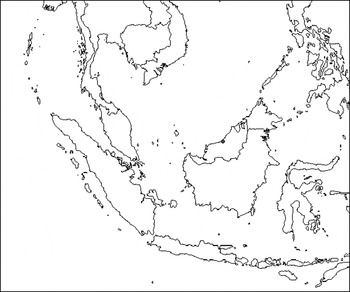
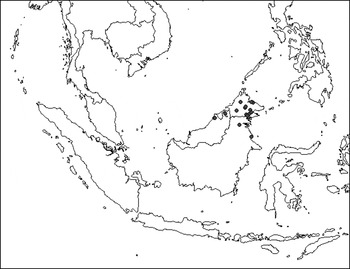
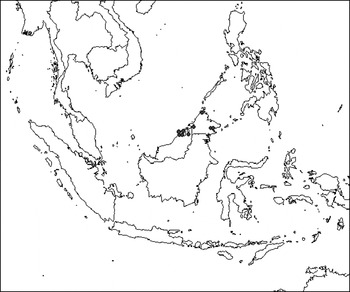
Distribution. Only known from the type locality in Sarawak (Fig. 3).
Distribution map of Scaphium burkillfilii Kosterm.

Habitat. Swamp forest.
Etymology. Named after H. M. Burkill, 1914–2006, Director of the Singapore Botanic Garden.
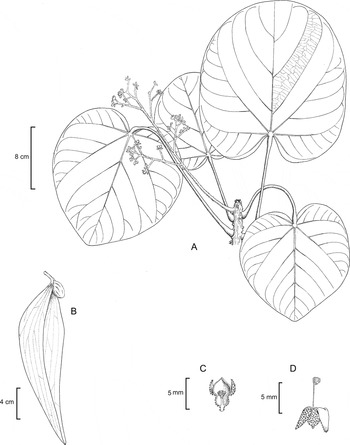
3. Scaphium linearicarpum (Mast.) Pierre, Fl. Forest. Cochinch. 13: 193 (1889). – Sterculia linearicarpa Mast. in Hook.f., Fl. Brit. India 1(2): 360 (1874). – Type: Peninsular Malaysia, Malacca, 3 vi 1865, Maingay 1854 [ = Kew Distribution No. 232] (lecto K, designated here). Fig. 4.
Scaphium velutinosum Kosterm., Reinwardtia 10(5): 478 (1988). – Type: Sumatra, Gunung Leuser National Park, 31 viii 1983, Whitmore & Sidiyasa TCW 3250 (lecto BO (fruit only), designated here; iso K, L) – see note below.
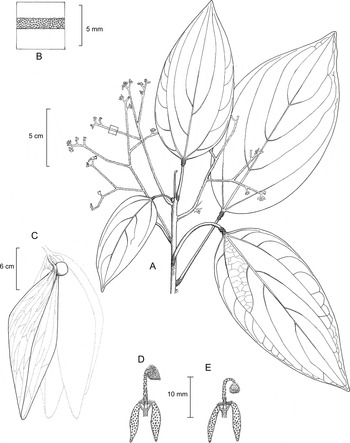
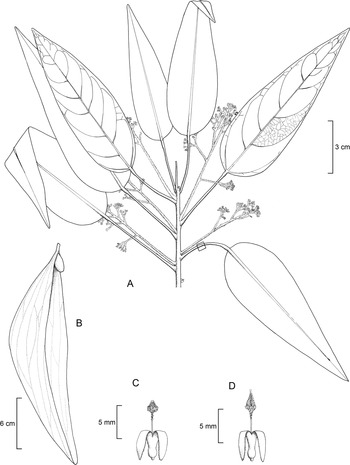
Scaphium linearicarpum (Mast.) Pierre. A, habit; B, fruit; C, flower bud; D, open male flower (A from Whitmore FRI 15154; B from Sinclair 40777; C, D from Burley et al. 1525). Drawn by Anna Dorward.

Tree to 45 m tall, bole 66 cm in diameter, deciduous. Buttresses, if present, often small but can reach 3 m tall. Outer bark brown to grey, smooth, irregularly fissured or scaly with orange patches beneath. Inner bark red-brown to pink, with cream flecks, fibrous. Sapwood yellow-brown. Terminal branches brown, rough to striate, thick, lenticels absent, densely rusty stellate hairy (often remaining only on apical parts). Petiole pale brown to brown, 6–23 cm long, 2–4 mm wide, striate, densely stellate hairy but hairs often rubbing off, both ends concolorous. Stipules caducous. Leaf lamina papery to sub-leathery, suborbicular-ovate, symmetric, base cordate to truncate, apex rounded to shallowly acute or occasionally mucronate, 1–1.3 times as long as wide, 9–16(–46) cm long, 8–16(–35) cm at widest point (leaves of saplings can be up to 40 cm long, 40 cm wide, have 5–7 lobes and petiole to 30 cm long), upper surface glabrous but occasionally sparsely stellate hairy along veins and midrib, drying dark brown, dull, lower surface glabrous to densely stellate hairy especially along veins and midrib, drying dark brown, dull; midrib flat to raised above, raised below; basal veins 1–3 pairs, main basal pair joining midrib at 40–60°, others at various angles, often with prominent lateral branchlets, veins flat to slightly raised above, glabrous or sparsely stellate hairy, veins raised below, with sparse to dense stellate hairs; secondary veins 2–6(–9) pairs joining midrib at 40–60°, veins above slightly raised, glabrous to sparsely stellate hairy, veins below raised, densely to sparsely stellate hairy; tertiary veins flat above, slightly raised below, slightly paler than lamina, especially below. Inflorescences 9–29 cm long, densely rusty stellate hairy. Bracts persistent, triangular to elliptic, 2–3(–10) mm long, 2–5 mm wide, outer surface densely stellate hairy, inner surface sparsely stellate hairy to glabrous. Flower buds drying brown, ovoid, occasionally slightly constricted about half way, densely stellate hairy, lobe margin densely stellate hairy (masked by hairs of calyx). Pedicel absent to 0.5 mm long, 0.5–1 mm wide, densely stellate hairy. Male flowers (female flowers unknown) 4–8 mm long, pale green-cream to yellow with red-purple base and fragrant when fresh, drying dark brown, 5-lobed, lobes 2/3 the length of the calyx, calyx outer surface densely stellate hairy, inner surface glabrous (including base), androgynophore 5–6 mm long, protruding from calyx tube, recurved at apex, dense simple hairs on upper half, glabrous on lower half, anthers 7–15, glabrous, polleniferous, pollen yellow, carpels rudimentary, densely hairy, 3–5, free or nearly so, styles absent to 0.5 mm long, stigmas glabrous, as many as carpels. Fruit: 1–3 follicles per flower, follicle papery, 12–30 cm long, densely stellate hairy on both surfaces, inner surface shiny, outer dull, stalk to 15 mm long, densely stellate hairy. Seeds 1 (very rarely 2), globose to ellipsoid, to 25 mm long, 15 mm wide, densely yellow stellate hairy, partially enclosed in hollow of follicle.
Diagnostic characters. This species is easily distinguished by the suborbicular to ovate leaf shape, cordate leaf base, rounded apex and densely stellate hairy follicle and seed.
Relationships. Morphologically this species is closely related to Scaphium affine, S. macropodum, S. parviflorum and S. longiflorum but differs in its leaf shape. This close relationship is supported by phylogenetic analysis of combined nuclear and chloroplast DNA sequence data (Wilkie, Reference Wilkie2007).
Conservation status. Although this species is found in forest which is under threat from logging and other human disturbances its wide distribution means a conservation status of Least Concern (LC) is most appropriate.
Distribution. Thailand, Sumatra and Peninsular Malaysia (Fig. 5).
Distribution map of Scaphium linearicarpum (Mast.) Pierre.

Habitat. Non-flooded lowland rain forest but often on hillsides below 500 m altitude.
Nomenclatural notes. Kostermans (Reference Kostermans1988b) was hesitant to describe Scaphium velutinosum as he only had a few fallen leaves and empty fruits. Looking at these specimens it is clear that they are a mixture of Scaphium fruits and Endospermum Benth. (Euphorbiaceae) leaves. The single seed with dense stellate hairs found on the K specimen and Sumatran locality allows the fruit to be named with confidence as Scaphium linearicarpum and it is the fruit on the Bogor specimen which has been lectotypified here.
Etymology. Latin, linearis = linear, carpus = fruit; referring to the linear fruit follicle.
Geographic selection of specimens examined. Thailand. Narathiwat: Bala, 20 vi 1998, Niyomdham 5528 (BKF).
Malaysia. Peninsular Malaysia: Johor: Ma'Okil Forest Reserve, 5 miles south of Labis, 29 viii 1950, Sinclair 6587 (E). Kedah: Telai keri, viii 1926, Jolesler Arshad 11252 (K, SING); Sungai Kali, Ulu Muda Forest Reserve, 26 vii 1930, Dolman 21714 (KEP, SING); Sungai Kaya Ara, 10 ii 1935, Corner s.n. (SING). Kelantan: Kemahang forest, 28 vi 1968, Chan FRI 6656 (K, KEP, L, SING); Kusail, Tana Merah, 3 x 1951, Unknown KEP 68062 (KEP); Pulau Timun, Langkawi, 4 v 1938, Symington 46761 (KEP). Kuala Lumpur: Kepong Forest Reserve, Forestry Research Institute Malaysia, 9 ii 2001, Wilkie & Kamarudin PW 123 (E). Pahang: Ulu Sg. Kepong, Gua Peningat, 15 vii 1970, Burgess FRI 19009 (KEP, L); S. Loh, near Kuala Datok, 5 vii 1968, Whitmore FRI 8960 (K, KEP); Taman Negara, Kuala Kenyam path to Gua Luas, 29 viii 1982, Wong Khoon Meng & Khairuddin FRI 32542 (K, KEP (as 32642), L, SAN, SING (as 32642)); Tembeling, 15 vii 1929, Henderson 21913 (E, K, KEP, SING); H.S. Sungai Tekam, near syst. Jengka and coco plantation, field centre hostel, 16 vi 1983, Ang Khoon Cheng FRI 27690 (K, KEP, SAN, SAR); Kuala Lompat, Krau Game Reserve, 16 iv 1967, Whitmore FRI 3541 (KEP); North East Gunung Benom, Ulu Sungai Krau, 22 ii 1967, Whitmore FRI 3363 (KEP); Pukat Reserve, 19 xii 1930, Unknown FMS 31510 (KEP); Kamasul Forest Reserve, 18 iii 1931, Nagsui? 14076 (KEP, SING). Perak: Hulu Perak, Grik Temenggor, Sg. Singor, Sg. Halong trail, 21 ix 1993, Noorsiha et al. FRI 39422 (K, KEP, L, SAN, SAR); Pautik Taujing Forest Reserve?, 25 vii 1915, Sing. Forest Dept. 1137 (SING); Pondok Tanjong Forest Reserve, vii 1916, Yeob? 1131 (C.F. 783) (KEP); Trolak Forest Reserve, 18 ii 1937, Browne KEP 43498 (KEP); Batang Padang, viii 1885, Dr King's collector 8114 (SING). Selangor: Ulu Selangor, 26 iii 1972, Baharudin Alias KEP 115225 (KEP); Ampang Forest Reserve, 6 vi 1970, Whitmore FRI 15154 (K, KEP, L, SAN, SING); Ulu Gombok Forest Reserve, 8 vi 1999, Wilkie & Angan PW 2 (E, KEP); Semangkok Pass, 21 ix 1923, Mud Mui 11411 (K, KEP, SING); Sungai Lalang Forest Reserve, 7 xi 1949, Mohd. Yattim 53623 (KEP); Bukit Sentosa, Rawang, 14 ix 1974, Mohd. Stariff? KEP 119835 (KEP). Terengganu: Ulu Sungai, near Jeram Galong, 31 v 1968, Cockburn FRI 8377 (K, KEP, L, SING); Kuala Terengganu-Besut road (west side), 34th mile, 8 ix 1955, Sinclair & Kiah bin Hj. Salleh 40777 (8562) (E, K, L, SING); Kemaman, Ulu Bendong, Kajang, 1 xi 1935, Corner 30143 (K, KEP, SING); Dungun, 23 vii 1955, Mohd. Hashim KEP 81263 (KEP); Sungai Besut, 1 v 1937, Corner 33504 (SING).
Singapore. Botanic Garden: 8 vii 1955, Sinclair S.F. 40666 (8463) (E, K, L); Nee Soon forest, 11 x 1956, Ahmat A (SING); MacRitchie jogging trail, 1996, Lai LJ 85 (SING); Sungai Jurong, 1894, Mat 6761 (SING).
Indonesia.Sumatra: Aceh: Gajolanden, from Pendeng via Oreng to Gadjah, 26 ii 1937, Van Steenis 9312 (BO, K, L, SING); West Aceh, Maulaboh?, 27 ii 1986, Laumonier YL 6739 (L). North Sumatra: Below Langkat, 8 iv 1932, Boschbouwproefstation BB 16610 (L). Riau: Sub-district Koeantan, Sungei Besar, 8 iv 1938, Boschbouwproefstation BB 24055 (L); Tigapulu mountains, 5 km west of Taslanglakat on Rengat-Jambi road, Bukit Karampal area, 16 xi 1988, Burley et al. 1525 (BO, L). West Sumatra: Ophir, Air Bangis, 24 iv 1935, Boschbouwproefstation BB 19856 (L).
4. Scaphium longiflorum Ridl., J. Straits Branch Roy. Asiat. Soc. 73: 143 (1916). – Type: Peninsular Malaysia, Perak, Scortechini 2077 (lecto K, designated here).
Scaphium velutinum Kosterm., J. Sci. Res. 2(1): 9 (1953). – Type: Peninsular Malaysia, Selangor, Sungei Buloh Forest Reserve, 30 i 1940, Symington F.D. 49928 (holo KEP; iso BO, L, SING).
Tree to 35 m tall, bole to 50 cm in diameter, deciduous. Buttresses to 1 m tall. Outer bark brown to grey-green, shallowly fissured to scaling off in rectangular flakes to leave red brown patches. Inner bark red to pale pink, fibrous, often with rays. Sapwood white. Terminal branches brown, striate to smooth, lenticels absent, glabrous. Petiole brown, (2–)4–8(–17) cm long, 1–3 mm wide, smooth to striate, glabrous or stellate hairy, both ends concolorous. Stipules caducous. Leaf lamina leathery to sub-leathery, elliptic to broadly elliptic, symmetric to slightly asymmetric, base rounded to acute, apex acute to rounded, 1.7–2.1(–2.8) times as long as wide, (8–)10–19(–22) cm long, (4–)6–9(–11) cm at widest point, upper surface glabrous or sparsely stellate hairy, drying brown, shiny, lower surface densely stellate hairy, if less hairy usually with reddish (gland) dots and stellate hairs along midrib, basal veins and secondary venation, dull, drying brown; midrib slightly raised above, raised below; basal veins 1 pair (occasionally with another pair of intermediates running along the basal area of the margin), joining midrib at (30–)40–50(–60)°, veins above flat to slightly raised, glabrous, veins below raised, densely to sparsely stellate hairy; secondary veins 5–9 pairs joining midrib at 40–50°, veins above flat to slightly raised, glabrous, veins below raised, densely to sparsely stellate hairy; tertiary veins flat above, slightly raised below, slightly paler than lamina below, not so above. Inflorescences 8–15 cm long, densely stellate hairy. Bracts occasionally persistent, elliptic-lanceolate, 1–2 mm long, c.1 mm wide, outer surface densely stellate hairy, inner surface sparsely stellate hairy. Flower buds drying brown, obovate, 1–5 mm long, 1–2 mm wide, glabrous, with red gland dots, lobe margin densely stellate hairy, indistinct until flower opens. Pedicel absent to 0.5 mm long, 1 mm thick, sparsely to densely stellate hairy, with red gland dots. Flowers 1–7 mm long, yellow-cream and fragrant when fresh, drying dark brown, 4–5-lobed, calyx lobes 1/3 the length of the calyx, calyx glabrous (including base), androgynophore to 7 mm long, protruding from calyx tube, straight or slightly recurved at apex, densely stellate hairy on upper half, glabrous on lower half, anthers 8–10, sparsely stellate hairy to glabrous, carpels densely stellate hairy, 2–5, free or nearly so, styles absent or to 0.5 mm long, stigmas glabrous, flattened. Fruit: 1–2 follicles per flower, follicle papery, 12–15(–18) cm long, outer and inner surface densely stellate hairy and with lots of red gland dots, inner surface shiny, outer dull, stalk to 9 mm long. Seeds 1 per follicle, elliptic, 10–20 mm long, 7 mm wide, pale brown, densely stellate hairy, partially enclosed in hollow of follicle.
Diagnostic characters. Scaphium longiflorum is distinctive by its densely stellate indumentum on the lower surface of the leaves, follicle and seeds, its glabrous tubular flowers, and its swamp habitat.
Relationships. Morphologically Scaphium longiflorum belongs to the group containing Scaphium affine, S. macropodum, S. parviflorum and S. linearicarpum. This close relationship is supported by phylogenetic analysis of ITS sequence data (Wilkie, Reference Wilkie2007).
Conservation status. Although Scaphium longiflorum is found in forest which is under threat from logging and other human disturbances its wide distribution and occurrence in forest reserves means a conservation status of Least Concern (LC) is most appropriate. Most collections were made between 1924 and 1963. As major forest conversions continue to take place in Borneo this status should be re-assessed regularly.
Distribution. Peninsular Malaysia and Borneo (Sarawak and West Kalimantan) (Fig. 6).
Distribution map of Scaphium longiflorum Ridl.

Habitat. A species of swamp forest and adjacent areas below 700 m altitude.
Nomenclatural notes. Ridley (Reference Ridley1916), in his description of this species, cites the collections Scortechini 2077 and Scortechini 2026. In examining these specimens from Kew it is clear that the former fits his description of Scaphium longiflorum well, but that the latter specimen is S. affine (having deeply lobed flowers and the lower surface of the leaves being glabrous). A note attached on the Scortechini 2077 specimen by Ridley (and a comment in his species description) indicates some confusion between these specimens and Maingay Kew Distribution No. 225 which is Scaphium affine.
Etymology. Latin, longus = long, florus = flower; referring to the long flowers.
Geographic selection of specimens examined. Malaysia. Sarawak: Kuching: Lundu District, Sungei Pirian Forest Reserve, 22 vii 1963, Paul Chai S. 18520 (K, L, SAN, SAR, SING).
Indonesia. West Kalimantan: Pontianak, 26 viii 1929, Boschbouwproefstation BB 13,716 (L); Limpang, Loebok, 10 x 1924, Boschbouwproefstation BB 7328 (L); Katapang, 17 x 1924, Boschbouwproefstation BB 7471 (L); Sukaraja, 14 ii 1924, Boschbouwproefstation BB 6273 (L); Below Matan, Kendawangan, 22 viii 1930, Boschbouwproefstation BB 14398 (L).
5. Scaphium longipetiolatum (Kosterm.) Kosterm., Reinwardtia 7(3): 234 (1966). – Microcos longipetiolata Kosterm., Reinwardtia 6(3): 301 (1962). – Type: Borneo, Sabah, Tawao River Forest Reserve, 7 vii 1959, W. Meijer SAN 19494 (holo K; iso BO, L, SAN, SAR, SING). Fig. 7.
Scaphium longipetiolatum (Kosterm.) Kosterm. A, habit; B, inflorescence hair covering; C, fruit; D, female flower; E, male flower (All from Bernard Lee S. 46567). Drawn by Anna Dorward.

Tree to 45 m tall, bole to 85 cm in diameter, unknown if deciduous. Buttresses, if present, often steep to 5 m tall and/or spreading. Bole sometimes fluted. Outer bark grey to brown, dippled to scaly. Inner bark yellow-orange to grey-brown, thick, fibrous. Sapwood yellow-white. Terminal branches grey to pale brown, often slightly shiny, striate, lenticels present, glabrous. Petiole yellow to pale brown, 2–12 cm long, 1–2 mm wide, smooth to striate, glabrous, both ends black. Stipules caducous or persistent at apex of stalk, triangular, 1–5 mm long, glabrous to stellate/simple hairy on both surfaces. Leaf lamina sub-leathery, ovate to elliptic, slightly asymmetric, base acute to rounded, often slightly cuneate, apex acute to acuminate, 1.3–2.3(–2.8) times as long as wide, 8–25 cm long, (3–)6–11 cm at widest point, upper surface glabrous, drying pale brown-tan, shiny, lower surface glabrous, drying pale brown-tan, dull; midrib sunken to raised above, raised below; basal veins 1 pair (occasionally 2 pairs with the most basal pair being less prominent and following the margin of the leaf for 10–30 mm), joining midrib at (15–)20–30(–40)°, reaching 1/2–2/3 length of leaf, veins flat to slightly raised above, glabrous, veins raised below, glabrous; secondary veins 2–3(–4) pairs joining midrib at (15–)20–30°, veins slightly raised to sunken in a groove above, glabrous, veins raised below, glabrous; tertiary veins flat and drying same colour as lamina on both surfaces. Inflorescences 10–21 cm long, densely stellate hairy. Bracts occasionally persistent, rounded to elliptic, 1–3 mm long, 1 mm wide, outer surface densely stellate hairy, inner surface sparsely stellate hairy or glabrous. Flower buds drying brown (colour masked by hairs), ovoid, densely stellate hairy, 1–3 mm long (young), to 8 mm long when more mature, lobe margin densely stellate hairy, not distinct from densely stellate hairy calyx. Pedicel absent to 1 mm long, 1 mm thick, densely stellate hairy. Flowers 7–10 mm long, outer surface pale green to cream, inner surface purplish when fresh, drying pale brown, 5-lobed, calyx lobes reaching 2/3 the length of the calyx, outer and inner surfaces densely stellate hairy, base of calyx tube with dense ring of simple ascending hairs inside, androgynophore 5–10 mm long, protruding from calyx tube, recurved at apex, densely stellate hairy along its entire length, the stellate hairs becoming longer branched and more dense towards base, anthers 8–12, glabrous, anthers of female flowers similar size to those of male flowers, carpels densely simple and stellate hairy, 2–5, free or nearly so, styles absent or to 1 mm long, densely stellate hairy, stigmas glabrous, as many as carpels. Fruit: 1–4(–5) follicles per flower, occasionally calyx persistent, follicle papery, 15–20 cm long, outer and inner surfaces sparsely to densely stellate hairy, inner surface shiny, outer dull, stalk 5–15 mm long. Seeds 1 per follicle, spherical to ellipsoid, 1.7–2.5 cm long, 0.7–1.3 cm wide, glabrous, partially enclosed in hollow of follicle.
Diagnostic characters. Scaphium longipetiolatum is distinctive because of the colour of the dry leaves, the basal veins usually joining the midrib at 20–30°, the low number of secondary veins (usually 2–3 pairs), the densely stellate hairy indumentum on the inner surface of the calyx, the stellate indumentum of the androgynophore throughout its length, the tufts of simple hairs on the inside of the calyx base, and the occasionally persistent bracts.
Relationships. Leaf morphology suggests Scaphium longipetiolatum is closely related to S. scaphigerum and S. burkillfilii. The presence of a dense layer of simple hairs at the base of the inside of the calyx and its similar distribution to Scaphium burkillfilii suggest it is most closely related to that species. No sequence data are available for Scaphium burkillfilii but the close relationship with S. scaphigerum is supported by phylogenetic analysis of combined nuclear and chloroplast DNA sequence data (Wilkie, Reference Wilkie2007).
Conservation status. Although this species is found in forest which is under threat from logging and other human disturbances its wide distribution means a conservation status of Least Concern (LC) is most appropriate.
Distribution. Endemic to Borneo (Sarawak, Sabah, Brunei and East Kalimantan) (Fig. 8).
Distribution map of Scaphium longipetiolatum (Kosterm.) Kosterm.

Habitat. Non-flooded lowland primary rain forest.
Nomenclatural notes. Kostermans (Reference Kostermans1966) highlighted a printer's error in the attempted new combination made by him (Kostermans, Reference Kostermans1965) indicating that the description under Scaphium longipetiolatum of the tree, inflorescence and flower is actually that of Aglaia breviracemosa (Kosterm.) Kosterm. The combination was not validly made in 1965 under Art. 33.4 of the Code (McNeill et al., Reference McNeill, Barrie, Burdet, Demoulin, Hawksworth and Marhold2006). It was validated by Kostermans in 1966 even though the year in which he states the basionym was published is wrong (it should be 1962 rather than 1963 – see Art. 33.5).
Etymology. Latin, longus = long, petiolatum = petiole; referring to the long petiole.
Geographic selection of specimens examined. Malaysia. Sabah: Keningau: 16 miles S.E. of Sook, N. of Nalaban, 15 vi 1969, Cockburn SAN 66225 (KEP, SAN, SAR, SING); Kinabatangan: Tongod, Kg. Tamoi, 11 vi 1983, Dewol Sundaling SAN 96699 (A, K, L, SAN, SAR); Lamag: mile 4.5 Tanegang Besar, 14 vi 1964, Singh 44810 (SAN); Sungai Pin virgin jungle reserve, 11 x 1965, Banang 51997 (SAN); Malua virgin jungle reserve, 21 x 1965, Banang 54098 (SAN); Royoh Forest Reserve, Block II, 12 vi 1964, Ahmad Ghafar 44852 (SAN); Sipitang: Ulu sungai Pangi, 13 xii 1986, Dewol Sundaling SAN 108542 (SAN); Lahad Datu: Ulu Segama Forest Reserve, 11 viii 1986, Joseph et al. SAN 116855 (K, KEP, L, SAN, SAR); Labuk Sugut: Beluran, Sungai Kawanan, 22 vii 1963, Esah SAN 35718 (SAN); Ranau: N.W. of Kampong Pinawantai, 11 v 1973, Shea & Aban SAN 76939 (A, K, L, SAN); Sandakan: Sepilok Forest Reserve, 27 ii 2003, Wilkie & Tangah PW 403 (E); Road to Mamanjang, 13 vii 1973, Madani SAN 77395 (K, KEP, L, SAN, SAR, SING); Garinono trail to plot 1, 20 vii 1967, Meijer 61184 (K, L, SAN, SAR); Tangkulap Forest Reserve, 24 vi 1996, Dewol & Mandani SAN 135160 (A, E, K, KEP, SAN); Kelumpang mile 15, Tawau Road, 15 xii 1961, Muin Chai SAN 26961 (SAN); Sungai Sapi slope, 4 vi 1964, Ampon Belog 43966 (SAN); Labuk mile 22, Labuk Road, 22 viii 1963, Meijer 37871 (SAN); Lungmanis Forest Reserve, 4 iv 1961, Charington SAN 24721 (SAN); Ulu Dusan area 1, 12 i 1981, Madani SAN 93715 (SAN); Tawau: Luasong Reserve, 3 ix 1968, Ogata 10802 (SAN 65502) (L); Tanjong Forest Reserve, Jalan Bawang Hutan, 26 v 1964, Pereira 43702 (K, KEP, L, SAN, SAR); Kalabakan, Bombay Burmah trading corporation concession, 30 miles W.N.W. of Tawau, 4 vii 1955, Wood 15351 (SING); Kalabakan, mile 35 main road, 14 vi 1969, Ahmad Talip SAN 65839 (SAN, SAR); Brantian Kalabakan, 23 v 1968, Bongsu Ahmad 63080 (SAN). Sarawak: Miri: 4th Division, Lambir Hills National Park, 5 vii 1999, Wilkie & Sang PW 32 (E).
Brunei.Temburong: Batu Apoi Forest Reserve, iv 1991, Tan et al. 285 (K), 453 (K), 474 (K), 532 (K), 552 (K).
Indonesia. East Kalimantan: Bengalun, Kabisan, Sg. Bengalun, 27 vii 1927, Boschbouwproefstation BB 11693 (L); Tidung, 20 xii 1933, Boschbouwproefstation BB 18148 (L).
6. Scaphium macropodum (Miq.) Beumée ex K.Heyne, Nutt. Pl. Ned.-Ind. (ed. 2) 2: 1068 (1927). – Carpophyllium macropodum Miq., Fl. Ned. Ind., Eerste Bijv. 401 (1861). – Type: Sumatra, Gedang Areta, Lampongs Tarabangi, Teijsmann 4225 (lecto L, designated here; iso BO, K).
Scaphium borneensis (Merr.) Kosterm., Reinwardtia 7: 441 (1969). – Firmiana borneensis Merr., Univ. Calif. Publ. Bot. 15: 192–193 (1929). – Type: Borneo, Sabah, Tawau, Elphinstone province, x 1922, Elmer 21759 (holo UC; iso A, BM, BO, GH, K, P, SING).
Tree 15–45 m tall, bole 15–90 cm in diameter, deciduous. Buttresses, if present, up to 1.5 m tall, 2 m long. Outer bark brown to brown-red, smooth, fissured to deeply fissured. Inner bark reddish, thick, fibrous. Sapwood whitish. Terminal branches brown, smooth to rough, lenticels sometimes present, glabrous but occasionally sparsely stellate hairy towards apex. Petiole brown, 3–22(–30) cm long, 1–4 mm wide, striate, often deeply so, glabrous but sometimes with sparse small stellate hairs, both ends concolorous. Stipules caducous. Leaf lamina sub-leathery to papery (occasionally leathery), elliptic to ovate-elliptic, occasionally elliptic-oblong (sometimes lobed if leaves are from lower sections of tree or from young trees), symmetric to subsymmetric, base acute, rounded or shallowly rounded, apex acute to acuminate, 1.7–2 times as long as wide, 7–34 cm long, 4–17(–24) cm at widest point, upper surface glabrous, sometimes very sparsely stellate hairy, drying brown to pale brown, shiny, lower surface glabrous, occasionally with stellate hairs near midrib or veins, drying brown, shiny to dull; midrib flat to slightly raised above, raised below; basal veins 1 pair joining midrib at (30–)35–55(–70)°, veins flat above, glabrous, veins raised below, glabrous; secondary veins 6–16 pairs joining midrib at (40–)50–70°, veins flat to slightly raised above, glabrous or very sparsely stellate hairy, veins raised below, glabrous or very sparsely stellate hairy; tertiary veins flat above, slightly raised below, drying paler than lamina below, concolorous above. Inflorescences 5–19(–23) cm long, sparsely to densely stellate hairy. Bracts mostly caducous, if persistent elliptic to lanceolate, 1–4 mm long, 1–2 mm wide, outer surface densely stellate hairy, inner surface glabrous. Flower buds pale green when fresh, drying brown, obovate and slightly narrowed towards base, glabrous, lobe margin distinct, densely stellate hairy. Pedicel 1–4 mm long, 0.5–1 mm wide, glabrous to densely stellate hairy. Flowers 4–7 mm long, white to green-white, fragrant, drying dark brown, 4–5-lobed, lobes 1/3(–1/2) the length of the calyx, if 1/2 still with a distinct narrowed tubular region below lobes, outer and inner surfaces glabrous (including base), androgynophore 4–10 mm long, protruding, straight or recurved at apex, glabrous to stellate hairy towards apex, anthers up to 10, glabrous or sparsely stellate hairy, anthers sometimes covering lower half of carpels in female flowers, carpels densely stellate hairy, 2–5, free or nearly so, styles 0.1–0.5 mm long, densely stellate hairy, stigmas as many as carpels, glabrous, superficially fused. Fruit: 1–2 follicles per flower, follicles papery, 8–19 cm long, inner surface glabrous, often with red dots, shiny, outer surface very sparsely stellate hairy, dull, stalk 1–20 mm long. Seeds 1 (very occasionally 2) per follicle, elliptic to subelliptic, 7–20 mm long, 3–11 mm wide, glabrous, partially enclosed in hollow of follicle.
Diagnostic characters. Scaphium macropodum is widespread and variable but is distinctive by its elliptic to ovate-elliptic leaf shape, papery to sub-leathery leaf texture and tubular flowers (calyx lobes 1/3(–1/2) the length of the calyx).
The male and female flowers are very similar and are possibly both functionally hermaphrodite.
Relationships. Morphologically Scaphium macropodum belongs to the group containing Scaphium affine, S. longiflorum, S. parviflorum and S. linearicarpum. This close relationship is supported by phylogenetic analysis of combined nuclear and chloroplast DNA sequence data (Wilkie, Reference Wilkie2007).
Conservation status. Although Scaphium macropodum is found in forest which is under threat from logging and other human disturbances its wide distribution means a conservation status of Least Concern (LC) is most appropriate.
Distribution. Sumatra (including offshore islands), Peninsular Malaysia and Borneo (Fig. 9).
Distribution map of Scaphium macropodum (Miq.) Beumée ex K.Heyne.

Habitat. Undulating land and ridges in non-flooded lowland primary forest below 180 m altitude.
Taxonomic notes. In my account of Scaphium for Central Kalimantan (Wilkie, Reference Wilkie, Argent, Saridan, Campbell and Wilkie1997) I considered Scaphium borneensis and S. macropodum separate, but now having considered all Scaphium specimens across its geographical distribution I have found it impossible to maintain them as distinct. There is continuous variation in leaf texture, shape and prominence of venation. Looking at the extremes of these morphological ranges the specimens appear to form distinct taxonomic groups. However, this breaks down once the entire range is considered. Most importantly the flower and fruit characters are the same, differing only slightly in dimensions. In his transfer of Firmiana borneensis to Scaphium Kostermans (Reference Kostermans1969) did not provide any description of the species or an explanation of why it was considered separate from S. macropodum. Ashton (Reference Ashton1988) acknowledged that these species were very closely related but kept them separate largely based on colour of the bark. In his publication he cited several collections for Scaphium borneensis. These, however, refer to specimens placed under Scaphium parviflorum in this account. In light of this and my own observations I consider Scaphium macropodum and S. borneensis conspecific, forming a single variable species.
My concept of Scaphium macropodum is close to that of S. affine. They differ in the shape of the flower (tubular in the former, deeply lobed in the latter), and in leaf shape and texture (ovate-elliptic and papery in the former and more broadly elliptic-rounded and leathery in the latter). Leaf shape and texture can be very variable in Scaphium and I accept that my decision to keep these species separate may be overturned as new information becomes available. A concerted effort to resolve the relationship between Scaphium affine and S. macropodum is needed and will require both ITS and chloroplast DNA sequence data from as many exemplars of both species as possible across their ranges of morphological variation and geographic distribution.
Etymology. Greek, macro = long, podum = foot; referring to the fruit follicle.
Geographic selection of specimens examined. Malaysia.Peninsular Malaysia: Johor: Sungai Sedili, 26 vii 1939, Ngadiman 36860 (A, K, KEP, SING). Negeri Sembilan: Pasoh Forest Reserve, 14 ii 2001, Wilkie PW 152 (E, KEP). Selangor: Kepong Forest Reserve, Unknown 16679 (BO). Borneo: Sabah: Beaufort: Beaufort hill, 1 v 1973, Dewol Sundaling SAN 77558 (K, L, SAN, SAR, SING); Keningau: 16 miles S.E. of Sook, N. of Nalaban, 15 vi 1969, Cockburn SAN 66216 (L, SAN); Kota Kinabalu: Beamport Forest Reserve, 15 v 1952, Sam 71661 (KEP); Kalabakan, Block 8, Sabah Foundation unlogged area, Seranum, 22 ix 1983, Fedilis & Matin 101245 (SAN); Gunung Wullersdorf, 2.5 acres plot, 30 xi 1967, Pitty Binideh 61490 (n.t. 58) (SAN); Labuk Sugut: Beluran, Sungai Meliau, 30 vii 1983, Rahim et al. SAN 99810 (A, BO, K, KEP, L, SAN, SAR, SING); Sungai Tinumbukan, 8 vii 1983, Aban Gibot SAN 90471 (K, L, SAN, SING); Lahad Datu: Silebukan Forest Reserve, Kennedy Bay, 12 x 1963, Sinanggul 39928 (K, KEP, L, SAN, SAR, SING); Ulu Segama, 19 vii 1970, Ahmad Talip SAN 70991 (L, SAN); Sandakan: Kalbili compartment 17, Elopura Forest Reserve, 28 vi 1948, Muliadi A814 (BO, K, KEP, P, SING); Mile 81, Labuk Road, along Japanese trail, 26 viii 1963, Meijer 38798 (K, L, SAN); Sepilok Forest Reserve, Elopura Forest District, 3 viii 1948, Caudara A 861 (K, KEP, L, SING); Danum Valley Forest Reserve, 19 vi 1999, Wilkie PW 16 (E); Telupid, Bukit Tawai Forest Reserve, 12 iv 1994, Zainudin 5056 (KEP, SAN); Tawau: Elphinstone province, x 1922, Elmer 21555 (A, BO, K, L, P, SING). Sarawak: Kapit: Sungai Kelimau Besai, Batang Katibas, 17 xi 1997, Mohizah et al. ITTO/BA 0986 (SAR); Kuching: Bukit Kawa, 18 ii 1925, Carroll 232 (F.28) (KEP, SAR); Rambungan, Mungu Ali, 11 x 2002, Rantai S. 88096 (SAR); Mount Matang, i 1915, Ridley s.n. (K); Miri: 30 km south of Miri, S.E. of Bukit Lambir above Bakam Village, 16 viii 1963, Fuchs 21340 (A, BO, K, L, SAR); Batu Belah Forest Reserve, iii 1953, Tready S. 1267 (SAR, SING); Riam Road, 21 vi 1955, Esmit S. 1460 (1909) (KEP, SAR, SING); Sibu: Loba Kabang protected forest, 20 v 1954, Anderson S. 2689 (1770) (KEP, SAR, SING); Sri Aman: Batang Ai, Mabau ridge, Ulu Sg. Engkari, 14 xii 1994, Yii Puan Ching et al. S. 69559 (K, KEP, SAN, SAR); Lubok Antu: Batang Ai, Ulu Sungai Enpran Lalang, 10 xii 1994, Lai Shak Teck S. 68116 (SAR).
Brunei. Temburong: Kuala Belalong field centre, 6 km north of Batang Duri, 30 vii 1992, Schatz et al. 3277 (K); Andulau Forest Reserve, 19 ix 1957, Ashton 593 (KEP, L, SAR, SING); Bukit Patoi, Ashton BRUN 3189 (K, KEP, L, SAR, SING); Gerang Buaya, 4 x 1936, Abidin 37051 (KEP).
Indonesia. Sumatra: Aceh: Near Langsa, 16 i 1922, Boschbouwproefstation BB 2557 (L). Jambi: Muarabungo, Pasir Mayang forest concession, x 1984, Torquebiau & Junaedi ET 510 (L); Tigapuluh mountain range, Bukit Pening Pening, 19 i 1984, Laumonier YL 5700 (L); Muara Enim District, Tjaban Forest Reserve, ix 1955, Kostermans 12002 (A, BM, K, L, P, SING); N.W. of Tapan river, 12 km east of Muarasako, Pesisir Selatan near Sungai Penuh-Kerinci (Jambi) border, 25 ii 1984, Laumonier YL 6080 (L). North Sumatra: Bangkinang, Simpang, 17 xii 1937, Boschbouwproefstation BB 23617 (L); Central Tapanuli, Bonan Dolok-Barus, 22 vii 1985, Purnadjaja & Setiabudi TFB 5127 (L); Tapus, Kwanten river, 24 i 1933, Koorders 10434b (BO). Riau: Indragiri highlands, Danau Mengkoeang, 20 iv 1939, Boschbouwproefstation BB 27522 (L); N. of Kampar district, River Mahato hulu (kiri) area, 13 iv 1983, Torquebiau & Laumonier TFB 4250 (L); Tjerenti, 17 viii 1938, Boschbouwproefstation BB 25209 (L). South Sumatra: Palembang, 13 i 1924, Boschbouwproefstation 122 T3 P347 (L); Banyuasin, xii 1919, Endert 54e1p 574 (K, L); Lematang, 4 vii 1939, Boschbouwproefstation BB 32268 (L); Semangus, Muara Enin, 20 ix 1958, Hartene 6 (K, L). Kalimantan: Central Kalimantan: Purukcahu, 19 vii 1926, Boschbouwproefstation BB 10020 (L); Sampit, 18 xi 1930, Boschbouwproefstation BB 14577 (A, L). East Kalimantan: Above Mahakam, D. Parei, 23 ii 1936, Boschbouwproefstation BB 20738 (K, L); Balikpapan, Mentawir village, 22 vi 1951, Sauveur 52 (BB 34952) (L); Berau, Km 25 from Labanan to Tanjung Redeb, Berau forest management project Swakelola, Labanan, 22 xii 1997, Arifin & Ambriansyah BERAU 1137 (A, E, K, KEP, SAN, SAR); Bukit Bangkari Forest Reserve, 15 iii 2000, Wilkie PW 110 (E); Bulungan, mensapa, 21 vii 1938, Ned. Ind. For. Ser. BB 26247 (L); E. Kutei, Sg. Tiram, 17 iv 1952, Kostermans BB 35029 (K, L); Kutei, 7 iv 1931, Boschbouwproefstation BB 15218 (L); Laban, 6 xii 1930, Boschbouwproefstation BB 14669 (L); Rentis Wartonokadri research site, 15 iii 2000, Wilkie PW 111 (E); Sangkulirang region, Sg. Mandu, 27 vii 1957, Kostermans 13244 (BM, BO, K, L, P, SING); Tdg. Bangko region, mouth of Mahakam river, 5 vi 1952, Kostermans 7179 (A, BM, K, L, P, SING); Tidung, 15 vii 1933, Boschbouwproefstation BB 17757 (L); W. Kutei, Bentuk on Kelindjau, 14 viii 1956, Kostermans 12624 (A, BM, K, P, SING); Wanariset Forest Reserve, 1.5 km off Wanariset-Semoi road, 17 i 1991, Ambri & Arifin W 611 (A, K); West of Samarinda, Loa Haur, 18 v 1952, Kostermans 6998 (K, L (not fruit), P, SING). South Kalimantan: Martapura, 22 x 1927, Boschbouwproefstation BB 12035 (L); Pleihari, 22 ii 1930, Boschbouwproefstation BB 14.201 (L). West Kalimantan: Singkadjang, Teijsmann S. 0609 (K, L); Bukit Baka National Park, 24 x 1993, Church et al. 337 (K, SAR, SING). Java: Cultivated in Bogor Botanic Garden, 1963, Kostermans J. 126 (A, BO, K, L, P, SAR, SING).
7. Scaphium parviflorum P.Wilkie, Edinburgh J. Bot. 65: 477 (2008). − Type: Borneo, Sarawak, Miri, Mulu District, Lambir National Park, 19 vi 1983, Bernard Lee S. 46416 (holo SAR; iso K, KEP, L, SAN). Fig. 10.
Scaphium parviflorum P.Wilkie. A, habit; B, fruit; C, open female flower; D, early stage of fruit development (A, C from Bernard Lee S. 46416; B from Aban Gibot SAN 99631; D from Ashton BRUN 272). Drawn by Anna Dorward.

Tree 15–40 m tall, bole 10–70 cm in diameter, unknown if deciduous. Buttresses, if present, to 90 cm tall, 2 m long. Outer bark brown to grey-brown, smooth to fissured or dippled. Inner bark brown-red to orange-brown, fibrous. Sapwood white, pink or yellowish. Terminal branches brown, smooth to striate, lenticels absent, glabrous but sometimes with sparse, minute, flattened scale-like, stellate hairs. Petiole brown to pale brown, 1–7(–10) cm long, 1–1.5 mm wide, striate, indumentum same as terminal branches, both ends concolorous. Stipules caducous. Leaves spirally arranged; lamina sub-leathery to papery, narrowly ovate to narrowly elliptic, symmetric to slightly asymmetric, base acute, rounded, apex acute to acuminate, (2.2–)2.3–3.5 times as long as wide, 5–11(–19) cm long, 2–5(–8) cm at widest point, upper surface glabrous, drying brown, shiny, lower surface glabrous (or with sparse minute flattened stellate hairs (resembling scales) along midrib), drying brown, shiny or dull; midrib flat, glabrous above, raised, with sparse minute flattened stellate hairs (resembling scales) below; basal veins 1 pair joining midrib at 30–50(–60)°, veins flat above, glabrous, veins flat below, glabrous, occasionally with sparse minute flattened stellate hairs (resembling scales); secondary veins 4–7(–9) pairs joining midrib at 40–60°, veins flat above, glabrous, veins slightly raised below, glabrous or with very sparse minute flattened stellate hairs (resembling scales); tertiary veins flat above and below, same colour as lamina on both surfaces. Inflorescences 2–8(–19) cm long, densely stellate hairy (hairs larger and more erect than on petiole and lamina). Bracts caducous to occasionally persistent, elliptic to lanceolate, 1–2 mm long, 0.5–1.5 mm wide, outer surface densely stellate hairy, inner surface glabrous. Flower buds drying brown, obovate and slightly elongated, lobe margin distinct, densely stellate hairy. Pedicel 0.5–1.5 mm long, 0.5–1 mm wide, glabrous to densely stellate hairy. Flowers (male flowers unknown) 5–9 mm long, white to pale yellow when fresh, drying dark brown, (4–)5-lobed, lobes 1/2–2/3 the length of the calyx, outer and inner surfaces glabrous (including base), androgynophore 3–5(–6) mm long, protruding, straight, densely stellate hairy on upper half (sometimes entire length), up to 10 anthers (possibly more), glabrous or sparsely stellate hairy, carpels densely stellate hairy, 2–5, free or nearly so, styles absent or to 0.5 mm long, densely stellate hairy, stigmas glabrous, superficially fused. Fruit: 1–2 follicles per flower, follicle papery, 11–12 cm long, inner surface glabrous with red dots, shiny, outer surface glabrous or very sparsely stellate hairy, dull, follicle stalk 10 mm long. Seeds 1 per follicle, subellipsoid, to 10 mm long, 4–5 mm wide, covered in minute round scales, partially enclosed in hollow of follicle.
Diagnostic characters. Distinctive by its smooth to fissured to dippled and brown to grey-brown bark, small narrowly ovate to narrowly elliptic leaves and the presence of sparse minute flattened stellate hairs (resembling scales) on the terminal branches, petioles, midrib and veins of the lower surface of the lamina. Although male flowers are not known some flowers are found with less developed carpels and anthers which are not restricted to the base of the carpels. This may represent a hermaphrodite flower.
Relationships. Morphologically Scaphium parviflorum belongs to the group containing S. affine, S. longiflorum, S. macropodum and S. linearicarpum. The flowers are intermediate between the tubular Scaphium macropodum and deeply lobed S. affine, and morphologically it appears most closely related to these. No sequence data are available to confirm this supposition.
Conservation status. Although Scaphium parviflorum is found in forest which is under threat from logging and other human disturbances its wide distribution and occurrence in forest reserves means a conservation status of Least Concern (LC) is most appropriate. Most collections were made between 1955 and 1966, with the last collection in 1983. As major forest conversions continue to take place in Borneo this status should be re-assessed regularly.
Distribution. Endemic to northern Borneo (Sarawak, Brunei and Sabah) (Fig. 11).
Distribution map of Scaphium parviflorum P.Wilkie.

Habitat. Primary non-flooded lowland rain forest, often on hillsides, below 300 m altitude.
Nomenclatural notes. Smythies (Reference Smythies1965) attributed the name Scaphium parviflorum to Kostermans. Ashton (Reference Ashton1988), citing it as a synonym of Scaphium borneensis, also attributed the name to Kostermans but indicated that it was a nomen nudum. Cockburn (Reference Cockburn1976) cited Ridley as the author. I can find no record of this species name having been validly published or used by either Kostermans or Ridley.
Etymology. Latin, parvi = small, florum = flower.
Geographic selection of specimens examined. Malaysia.Sabah: Beaufort: Pangi, 5 miles WNW of Tenam at mile 79 on North Borneo railway, 15 vi 1955, Wood SAN 16901 (BO, KEP, L, SING); Kudat: Kota Marudu, Side of Sg. Torintidon, 13 viii 1983, Aban Gibot SAN 99631 (K, KEP, L, SAN, SAR, SING); Lahad Datu: Mile 1 Silam, 26 viii 1966, Ahmad Talip 54981 (K, L, SAN); Gunung Silam, R.P. 310/12b, 5–9 ix 1983, Proctor 101073 (SAN), 101087 (SAN); Pulau Sakar, Look Magulang, 30 v 1961, Muin Chai SAN 21693 (K, KEP, L, SAN); Papar: right bank of Sungai Simpang kiri, 20 miles S.E. of Papar, 5 vii 1961, Sario SAN A1757 (SAN). Sarawak: Miri: 30 km south of Miri, North crest of Bukit Lambir above Bakam village, 16 viii 1963, Ashton 21309 (A, K, SAR); Baram District, Mount Trekan, vi 1895, Hose 633 (K); Marudi Forest Reserve, 21 vi 1955, Sahari S. 1482 (1901) (KEP, SAR, SING); Limbang, vi 1905, Hewitt Series 63 (SAR).
Brunei. Temburong: Andulau Forest Reserve, 8 x 1958, Ashton BRUN 2620 (K, KEP, L, SAR, SING); ibid., 15 vii 1957, Ashton BRUN 272 (BO, K, KEP, L, SAR, SING).
8. Scaphium scaphigerum (Wall. ex G.Don) G.Planch., Hist. Nat. Drogues Simples, 6th ed., 3: 646 (1869). – Sterculia scaphigera Wall. ex G.Don, Gen. Hist. 1: 517 (1831). – Scaphium wallichii Schott & Endl., Melet. Bot. 33 (1832), nom. inval. – Type: Martaban, 1827, Wallich 1130 (lecto K-W (Phonsena & Wilkie, Reference Phonsena and Wilkie2008); iso BM, E, K, SING).
Tree 15–50 m tall, bole 80–100 cm in diameter, deciduous. Buttresses often present, 1–2 m tall. Outer bark grey-green to brown, cracked to flaking. Inner bark reddish, fibrous, 10–15 mm thick. Sapwood white. Terminal branches pale brown to brown, striate to smooth, lenticels absent, glabrous. Petiole pale brown, 2–12 cm long, 2–4 mm wide, smooth to striate, glabrous or occasionally stellate hairy, both ends darker. Stipules caducous or persistent only at apex of stalk, rounded to triangular, 2–4 mm long, glabrous or with very minute simple hairs on both surfaces. Leaf lamina sub-leathery to leathery, occasionally papery, ovate, elliptic or elliptic-oblong, symmetric to asymmetric, base rounded to acute (occasionally truncate or slightly cordate), apex acute, 1.3–2.3 times as long as wide, 8–34 cm long, 6–17 cm at widest point, upper surface glabrous, occasionally with gland dots, drying pale brown-tan, shiny, lower surface glabrous, occasionally with gland dots, drying pale brown-tan, dull; midrib raised on both surfaces; basal veins 1–2 pairs, the most basal pair indistinct and running along the margin for 10–20(–30) mm and, if present, joining midrib at 50–60(–80)°, the most prominent basal pair joining midrib at 30–40°, reaching 1/3–1/2 length of leaf, with 3–4(–5) pairs of lateral veins running towards margin, veins raised above, sometimes in a groove, glabrous, veins raised below, glabrous; secondary veins (2–)3–4(–5) pairs joining midrib at 30–40°, veins slightly raised above, glabrous, veins raised below, glabrous; tertiary veins flat on both surfaces, slightly paler than lamina below, inconspicuous above. Inflorescences 5–12 cm long, densely stellate hairy. Bracts caducous. Flower buds drying brown, ovoid, slightly elongated towards apex, sparsely to densely stellate hairy, lobe margin densely stellate hairy, more or less distinct. Pedicel absent to 2 mm long, 0.5–1 mm wide, densely stellate hairy. Flowers 5–8 mm long, yellow with purple base when fresh, drying brown, 5-lobed, lobes 2/3 the length of the calyx, calyx outer surface sparsely stellate hairy, inner surface glabrous (including base), androgynophore 5–8 mm long, protruding, recurved at apex, sparsely simple hairy, sometimes with stellate hairs with long branches on upper half, glabrous on lower half, anthers c.10–12, glabrous or sparsely simple hairy, carpels rudimentary and sparsely hairy in male flower, fully developed and densely stellate hairy in female flower, 3–5, free or nearly so, style absent to 0.2 mm long in male flower, 1–1.5 mm long in female flower, stigmas glabrous, as many as carpels, superficially fused. Fruit: 2–5 follicles per flower, follicles papery, 9–26 cm long, inner surface sparsely stellate hairy, shiny, outer surface sparsely to densely stellate hairy (especially dense along venation), dull, follicle stalk to 7–25 mm long. Seeds 1 per follicle, spherical to elliptic, (0.7–)1–2 cm long, 1–1.5 cm wide, glabrous, seed oriented away from follicle.
Diagnostic characters. The colour of the dry leaves, the basal veins joining the midrib at 30–40°, the low number of secondary veins (3–4), the sparse to dense stellate indumentum of the outer surface of the calyx, and the orientation of the seed away from the follicle make Scaphium scaphigerum distinctive. Its distribution in Peninsular Malaysia, Thailand and surrounding areas helps separate it from Scaphium longipetiolatum and S. burkillfilii to which it is morphologically similar.
Relationships. Leaf morphology suggests Scaphium scaphigerum is closely related to S. longipetiolatum and S. burkillfilii. Scaphium scaphigerum has similar leaf venation to S. longipetiolatum but usually has fewer secondary veins. The angle at which the secondary veins join the midrib is greater, the flowers less hairy and the base of the inside of the calyx is without simple hairs. Scaphium scaphigerum also differs in its distribution. Scaphium burkillfilii also has similar leaf characters to S. scaphigerum, largely differing by the distinctive leathery follicle, size of seed, and swamp forest ecology. No floral characters are available for comparison. This close relationship suggested by morphological characters is supported by phylogenetic analysis of combined nuclear and chloroplast DNA sequence data (Wilkie, Reference Wilkie2007).
Conservation status. Although Scaphium scaphigerum is found in forest which is under threat from logging and other human disturbances its wide distribution means a conservation status of Least Concern (LC) is most appropriate.
Distribution. Bangladesh, Burma, Laos, Vietnam, Thailand and Peninsular Malaysia (Fig. 12).
Distribution map of Scaphium scaphigerum (Wall. ex G.Don) G.Planch.

Habitat. Non-flooded lowland primary rain forest, often near streams.
Nomenclatural notes. Sterculia scaphigera Wall. is a nomen nudum, later validated by Don (Reference Don1831). The specific name used by Don, ‘scatígera’, is clearly an orthographic error as other Wallich names in the same publication are unchanged from their original spelling. Planchon in Guibourt & Planchon (Reference Guibourt and Planchon1869) recombined this to Scaphium scaphigerum (Wall. ex G.Don) G.Planch.
Taxonomic notes. It is common for specimens collected from Thailand to be identified as this species as it was one of only two species recognised from this area (Phengklai, Reference Phengklai, Santisuk and Larsen2001). However, Scaphium affine is also found in this region (Phonsena & Wilkie, Reference Phonsena and Wilkie2008) and is often wrongly identified as S. scaphigerum.
Etymology. Latin, sciphus = skiff-bearing; referring to the fruit follicle.
Geographic selection of specimens examined. Bangladesh. Chittagong: Chittagong Hill Tracts, 1876, Lister 386 (L).
Burma. Ayeyarwaddy: Bawmi hills, 21 ii 1929, Parkinson 8775 (E). Mandalay: Yamethin District, Minbyin Reserve, 11 ii 1915, Rogers 588 (E). Martaban: 1885, Beddome 626 (BM). Mon: Salween, Pontum Chaung headwater, 31 iii 1929, Chin 6836 (E). Tanintharyi: Kallin Kwan Chaung, 10 ii 1926, Parkinson 1687 (K).
Thailand. Chanthaburi: Khao Soi Dao, 13 ii 2004, Wilkie et al. PW 417 (BKF, E). Chon Buri: Ang Pak Nam Waterfalls, 14 ii 2004, Wilkie et al. PW 422 (BKF, E); Sriracha District, Khao Kieo, 20 i 1976, Maxwell 76-28a (L); Ban Bung District, S.E. Khao Kieo, 24 vii 1976, Maxwell 76-438 (L). Chumphon: Ban Ta Ngaw, 15 i 1927, Kerr 11457 (BK, BM, BO, K). Kanchanaburi: Sangklaburi District, Thung Yai Naresuan Wildlife Reserve, Lai Wo sub-district, Ban Saneh Pawang area (Karen village) near Ro Kee stream, 15 iv 1994, Maxwell 94-531 (A). Nakhon Si Thammarat: Chawang, 25 i 1956, Thaworn 682 (BKF); Phung Song, Khuan Krot, 24 ii 1956, Thaworn 17906 (BKF). Phangnga: Bangto, 19 ii 1929, Kerr 17555 (BM, K). Phuket: Khao Phra Thaw Wildlife Forest, 19 v 1984, Unknown (Possibly Wirachai Nanakorn) W.N. 512 (BKF). Ranong: Kapor, 17 i 1929, Kerr 16701 (BK, BM, K); Klawng Kampuam, 5 ii 1929, Kerr 17026 (BK, BM, K); Khao Pawta Chongdong, 22 i 1929, Kerr 16814 (BK, BM, K). Satun: Thung Mai, 30 i 1961, Smitinand 7100 (BKF, K); Dong Chueak chang, 14 ii 1961, Smitinand 7171 (BKF); Kuan Kalong forest, 14 ii 1961, Smitinand 7171A (BKF). Surat Thani: Khlong Nam Wong, Nawng Wai, 6 iii 1927, Kerr 12243 (BM, K). Trang: Khao Chong, 25 i 1958, Smitinand 4104 (BKF). Yala: Than Tio Arboretum, 25 iv 1974, Geesink & Hattink 6451 (BKF, L).
Laos. Attopeu: iii 1879, Harmand 1431 (Pierre 2847) (BO, P). Champassak: Sé-Moun, 1875–1877, Harmand s.n. (mixed coll., fruit only) (P).
Vietnam. Ho Chi Minh City Botanic Garden, 15 iii 1916, Hiep (Chevalier) 649 (BO, P); ibid., 24 ii 1919, Hiep (Chevalier) 282 (E).
Malaysia. Peninsular Malaysia: Kedah: Bukit Kayu Hitam, 11 v 1938, Symington 46956 (KEP); Kokmoi Forest Reserve, 6 viii 1938, Awang 47817 (KEP). Kelantan: Kg. Machang, 2 v 1937, Corner s.n. (SING); West Kelantan, S. Nenggiri, near K. Jenera, 18 vii 1967, Whitmore FRI 4093 (KEP); Chabang Tongkat Forest Reserve, 28 iv 1967, Kochummen FRI 2313 (KEP). Negeri Perlis: Bukit Bintang, Hijau Reserve, 68.5 miles grit road, 1 viii 1935, Wilkinour 30324 (KEP); Mata Ayer Forest Reserve, 11 iii 1969, Kochummen KEP 2673 (KEP). Perak: Kuala Kangaar, Chior Forest Reserve, 11 vii 1967, Kochummen FRI 2412 (KEP).
Specimens of Insufficient Quality to be Identified to Species
Thailand. Chanthaburi: Soi Dao, 29 iii 1995, Santisuk s.n. (BKF); Khao Kitchakoot, 11 i 1999, Wongprasent et al. s.n. (BKF). Chumphon: Tha Sae, 1 vi 1967, Unknown s.n. (BKF); Krung Thep Maha Nakon: Bangkok market, 12 i 1922, Kerr s.n. (K). Nakorn Sri Thamarat: Unknown s.n. (BKF). Trat: Kaw Chang, Kao Faimai, 5 vi 1925, Rabil 10 (BM, K).
Cambodia. iv 1880, Pierre 805 (K).
Laos. Attopeu: 1875–1877, Harmand s.n. (K).
Vietnam. ii 1919, Chevalier s.n. (E); 1862–1866, Thorel s.n. (P); Hoàng-Hō 5335 (P).
Malaysia. Peninsular Malaysia: Johor: Gunung Muntahak-Panti, 1 ix 1967, Burkill 4559 (K, KEP, SAR, SING); Gunung Lambak, 28 viii 1950, Sinclair 6562 (E); Sungai Sedili, 26 vii 1939, Ngadiman 36862 (BM, K, KEP). Negeri Sembilan: Bukit Tangga, 1 xii 1923, Mud Mui 11819 (K, KEP, SING). Pahang: Kota Tinggi, 1891, Ridley 2568 (BM). Selangor: VJR Ulu Gombak, Ulu Gombak FR, 19 vii 2002, Bramley & Neale GB30 (E); Gombak, 15 km NW of Kuala Lumpur on west side of the Ipoh Highway, 03°12′N, 101°35′E, 20 ix 1987, Worthington 13301 (L); Below Semangkok Pass, 2 ix 1922, Mud Mui 11410 (K, KEP). Borneo: Sabah: Sandakan: Kebun China, 4 xi 1987, Meijer 121112 (SAN); ibid., 5 xi 1987, Meijer 119196 (SAN); 2.5 km upstream of main falls on Maliau river, Maliau Basin, 9 iv 1996, Maliau Basin Voucher 9 (SAN); Tenom: Crocker Range above Kallang, 13 x 1987, Meijer & Lamb ALFB 107/87 (K). Sarawak: Bintulu: Bukit Kana, 8 x 1994, Yii et al. S. 66457 (KEP); Kuching: Market in Kuching, 10 vii 1999, Wilkie PW 45 (E); R. Kenaban, upper Plieran, 9 x 1955, Pickles S. 3522 (L, SAR, SING); ibid., 25 ix 1955, Pickles S. 3490 (SAR).
Singapore. Bukit Timah Forestry Reserve, off Keruing Path, 27 v 1953, Sinclair 7464 (E).
Brunei. Belait: Labi Hills, 19 xi 1934, Smith 30470 (KEP). Temburong: Andulau Forest Reserve, iv 1963, Kostermans s.n. (L).
Indonesia. Bangka: Teijsmann s.n. (L). Kalimantan: Central Kalimantan: Kualakuajan near Sampit River, 25 vii 1953, Kostermans 10781 (L). South Kalimantan: Gunung Sakoembang, Korthals s.n. (L); Boven Mahakan, 21 ii 1936, Neth. Ind. For. Ser. BB 20723 (L). West Kalimantan: Melawi, B. Gontoek, 23 v 1939, Neth. Ind. For. Ser. BB 28139 (L). Sumatra: Jambi: Muarabungo, Pasir Mayang, Forest Concession P.T. IFS, xii 1984, Torquebiau et al. ET 538 (L). Lampung: 11 iv 1922, Boschbouwproefstation BB 3062 (L). North Sumatra: Below Langkat, 1924, Boschbouwproefstation 9044 (P); ibid., 22 x 1925, Boschbouwproefstation 9161 (P); South Tapanuli, Tapoes along Kwantan River, 21 ii 1891, Koorders 15713β (L). Riau: River Mahato Kiri area, 24 iii 1984, Laumonier YL 6193 (L); ibid., 25 iii 1984, Setiabudi SB 106 (L); Indragiri highlands, 2 vii 1939, Neth. Ind. For. Ser. BB 28511 (BM); ibid., 1 x 1970, Normand 619 (P). South Sumatra: Palembang, Batang Hari Lako, P.T. PADECO, 9 xii 1981, Upik Rosalina TFB 2913 (L); Moera Moera, Teijsmann 3870 (L). West Sumatra: Loeboek Ambatjang, 26 i 1891, Koorders 11292β (BO, L); Taram, East of Pajakumbuh, 24 viii 1957, Meijer 6930 (L).
Excluded Name
Scaphium javanicum Kochummen, Pocket Checklist of Timber Trees 345 (1964), nom. inval. = Pterocymbium javanicum R.Br.
Kochummen, in the first revision of the Pocket Checklist of Timber Trees (Wyatt-Smith & Kochummen, Reference Wyatt-Smith and Kochummen1964), used this name but it was invalidly published as it did not indicate the basionym or provide a reference to its author and place of valid publication. It appears to be a new combination of Pterocymbium javanicum R.Br. into Scaphium. Having searched the literature and various databases I cannot find any such new combination and in later revisions of the Pocket Checklist the name is omitted. In Kostermans’ treatment of Scaphium (Kostermans, Reference Kostermans1953) he suggested, but postponed, the merging of the two genera until a monograph of Pterocymbium could be undertaken. I can only assume that Kochummen was following Kostermans’ thinking even though a Pterocymbium monograph was never produced.
Acknowledgements
I would like to thank Dr Chris Wilcock and Dr Toby Pennington for sharing their expertise. Maureen Warwick is thanked for her SEM work and Anna Dorward for her illustrations. I am indebted to David Middleton for reviewing the manuscript and for the many helpful comments on nomenclature. Mark Hughes and Colin Pendry are thanked for testing the key.
I would like to thank the curators and staff of the following herbaria for loans of material, permission to work in their herbaria and help during my visits: A, BKF, BM, BO, K, KEP, L, NSW, P, QRS, SAN, SAR, SING. The two anonymous reviewers are also thanked for their constructive comments.
Index of Exsiccatae
The number after each collection refers to the number of the taxon in the text.
Aban & Saikeh SAN 79390 (1); Aban & Soinin SAN 64598 (1); Aban Gibot SAN 90471 (6), SAN 96928 (1), SAN 99631 (7); Abg. Suhaili 48463 (6); Abidin 37051 (6); Adrian Bin Majanil OU 51 (5), OU 71 (5), OU 72 (5); Ahmad Ghafar 44852 (5); Ahmad Talip 50996 (n.t. 5) (6), 54981 (7), SAN 65839 (5), SAN 70991 (6); Ahmat A (3); Aidi SING 2005-293 (1); Ambri & Arifin W 611 (6), W 672 (6), W 999 (6); Ampon Belog 43966 (5); Anderson S. 2231 (F.10) (1), S. 2689 (1770) (6); Ang Khoon Cheng FRI 27690 (3); Argent 41006 (1); Arifin & Ambriansyah BERAU 1137 (6); Arifin et al. BERAU 938 (6); Ashton 593 (6), 21309 (7), BRUN 272 (7), BRUN 2620 (7), BRUN 3189 (6), S. 16562 (1); Awang 47817 (8); Awing 40070 (n.t. 46) (1).
Baharudin Alias KEP 115225 (3), KEP 115226 (3); Banand? s.n. (3); Banang 51997 (5), 52047 (5), 54056 (5); Bangang 54098 (5); Beccari 2286 (1), 2479 (6); Beddome 626 (8); Bernard Lee S. 46416 (7), S. 46562 (1), S. 46567 (5); Bindeh 56870 (n.t. 106) (1), 59760 (5); Bindeh & Leopold 56867 (n.t. 82) (1); Bongsu Ahmad 63080 (5); Boschbouwproefstation BB 616 (6), BB 690 (6), BB 2557 (6), BB 3062 (Unk.), BB 6273 (4), BB 7328 (4), BB 7471 (4), BB 9691 (3), BB 10020 (6), BB 10703 (6), BB 10980 (6), BB 11693 (5), BB 11761 (6), BB 12035 (6), BB 14398 (4), BB 14577 (6), BB 14669 (6), BB 14676 (6), BB 14970 (6), BB 15218 (6), BB 15260 (6), BB 15262 (6), BB 15635 (6), BB 15642 (6), BB 15678 (6), BB 16264 (6), BB 16610 (3), BB 16859 (6), BB 16870 (6), BB 17757 (6), BB 17913 (6), BB 18148 (5), BB 18249 (6), BB 18447 (6), BB 18734 (3), BB 18856 (6), BB 19856 (3), BB 20738 (6), BB 23617 (6), BB 24055 (3), BB 24765 (6), BB 24971 (6), BB 25209 (6), BB 26989 (6), BB 27485 (6), BB 27522 (6), BB 27618 (6), BB 27763 (1), BB 28450 (6), BB 29984 (6), BB 30047 (6), BB 31689 (6), BB 32076 (6), BB 32235 (6), BB 32268 (6), BB 36917 (6), BB 122 T3p 393 (6), BB 13,716 (4), BB 14.201 (6), BB 54e 1p 616 (6), BB T. 393 (6), BB T3 P393 (6), 9044 (Unk.), 9161 (Unk.), E. 699 (193 e.2 P.699) (1), T. 347 (14 xi 1924) (6), T. 347 (vii 1940) (6), 122 T 3 p 99 (6), 122 T3 P347 (6); Brain anak Tada s.n. (1); Bramley & Neale GB30 (Unk.); Browne KEP 43498 (3); Bunnak Sangkhachand BKF 19961 (1); Burgess FRI 19009 (3); Burkill 4559 (Unk.); Burley et al. 1263 (1), 1525 (3).
Carroll 232 (F.28) (6); Castro 10,740 (1), 55402 (1); Caudara A 861 (6), A 907 (6); Chan FRI 6656 (3), FRI 25001 (1); Charington 20878 (1), SAN 21184 (5), SAN 24721 (5); Chevalier 39.631 (1), s.n. (Unk.); Chew Wee-lek 639 (4); Chin 6836 (8); Church et al. 337 (6); Cockburn FRI 8340 (1), FRI 8377 (3), FRI 8403 (1), FRI 8413 (1), FRI 8456 (1), SAN 66216 (6), SAN 66225 (5); Corner s.n. (3), s.n. (8), 30143 (3), 33504 (3), SAN 23661 (5), SFN 33599 (1).
Dewol Sundaling 108530 (1), SAN 77558 (6), SAN 96699 (5), SAN 108542 (5); Dewol & Mandani SAN 135160 (5); D.F.O. Tawau 62520 (5); Din Nakkan 365 (8); Dolman 21714 (3); Dr King's collector 7707 (1), 7843 (3), 8114 (3).
Egon FA 0629 (619) (1); Elmer 21555 (6), 21759 (6); Endert 193 e2p698 (6), 339 (6), 54e1p569 (6), 54e1p574 (6), 54e1p611 (6); Esah SAN 35713 (1), SAN 35718 (5); Esmit S. 1460 (1909) (6); Everett FRI 14197 (1), FRI 14319 (1).
Fedilis & Matin 101245 (6); FMS 37480 (3); Francis 50261 (n.t. 299) (1); Fuchs 21340 (6).
Galau S. 15633 (1); Geesink & Hattink 6451 (8); Griffith 601 (1).
Hahn 130 (1); Harmand 1431 (Pierre 2847) (8), Harmand s.n. (8), s.n. (Unk.); Hartene 6 (6); Hashim 33462 (1); Henderson 21913 (3); Henry Toipin 40716 (5); Hewitt Series 63 (7); Hiep (Chevalier) 282, 649 (8); Hj. Bayang KEP 83759 (3); Hoàng-Hō 5335 (Unk.); Hose 633 (7).
Ilias Paie S. 15575 (2); Ilias Paie & Sie S. 33525 (1); Iwatsuki & Fukuoka 7274 (8).
Jawanting 42310 (1); Jolesler Arshad 11252 (3); Joseph et al. SAN 116855 (5).
Kepis Sisiran 46973 (399) (1); Kerr 7466 (1), 9445(a,b,c) (1), 11457 (8), 12243 (8), 16701 (8), 16814 (8), 17026 (8), 17555 (8), s.n. (Unk.); Kochummen 76629 (1), FRI 2313 (8), FRI 2412 (8), FRI 16108 (1), FRI 18359 (1), KEP 2673 (8); Kodoh Tarodop 87935 (n.t. 83) (1); Koorders 10434b (6), 11292β (Unk.), 15713β (Unk.); Korthals s.n. (Unk.); Kostermans 1332 (1), 6998 (6), 7179 (6), 8076 (1), 9327 (1), 10781 (Unk.), 12002 (6), 12624 (6), 13244 (6), 21618 (6), BB 35029 (6), J. 126 (6), s.n. (Unk.).
Lai LJ 85 (3); Lai et al. S. 69632 (1); Lai Shak Teck S. 68116 (6); Laumonier YL 5700 (6), YL 6080 (6), YL 6193 (Unk.), YL 6739 (3); Liioi uoi s.n. (1).
MacAlpine(?) & Wenger 476 (8); Madani 44266 (n.t. 49) (1), SAN 77395 (5), SAN 93715 (5); Maingay s.n. [Kew Distribution No. 235] (3), 1579 [Kew Distribution No. 225] (1), 1854 [Kew Distribution No. 232] (3), 1855 [Kew Distribution No. 224] (6), 1856 [Kew Distribution No. 225] (1), 1858 [Kew Distribution No. 235] (3), 2561 [Kew Distribution No. 235] (3); Malcom SBC 639 (1); Maliau Basin Voucher 9 (Unk.); Mat 6761 (3); Mat Noor KEP 81082 (3); Matusop 7260 (1), 41393 (1); Maxwell 76-28a (8), 76-438 (8), 94-531 (8); Meijer 6930 (Unk.), 19534 (1), 37871 (5), 38798 (6), 61184 (5), 121112 (Unk.), 124365 (1), SAN 19494 (5), SAN 37857 (NT 506) (1); Meijer & Lamb ALFB 107/87 (Unk.); Meijer & Nicholson 20638 (n.t. 71) (1); Mimose 5216 (5); Mitsuru Hotta 15784 (1); Mohd. Hashim KEP 81263 (3); Mohd. Nur 5 viii 1929 s.n. (1), 22 v 1940 s.n. (1); Mohd. Stariff? KEP 119835 (3); Mohd. Yattim 53623 (3), 66882 (3), 74233 (3); Mohizah et al. ITTO/BA 0986 (6); Muas 13453 (1); Mud Mui 11410 (Unk.), 11411 (3), 11819 (Unk.); Muin Chai SAN 21693 (7), SAN 26961 (5); Muliadi A814 (6).
Nagamitsu & Momose 99 (5); Nagsui? 14076 (3); Nai Nae 35 (1), 81 (1); Naim KEP 74500 (3); Ned. For. Dept. BB 16854 (1), BB 28201 (1); Ned. For. Ser. BB 18934 (6), BB 20723 (Unk.), BB 26247 (6), BB 28139 (Unk.), BB 28511 (Unk.); Ngadiman 36149 (1), 36860 (6), 36862 (Unk.); Niyomdham 5528 (BKF) (3); Noorsiha et al. FRI 39422 (3); Normand 619 (Unk.).
Ogata 10802 (SAN 65502) (5); Orolfo 4787 (1); Othman Ismawi S. 36640 (1).
Parkinson 1687 (8), 8775 (8); Patrick 39489 (n.t. 252) (1); Paul Chai S. 18520 (4); Pereira 43687 (5), 43702 (5), SAN 37584 (1), SAN 43692 (5); Phengklai 6517 (8); Pierre 15 (1), 3781 (1), 5204b and 15 (8), s.n. (in Herb. H.F. Hance 19219) (1), Pierre? 195 (3), 805 (Unk.); Pitty Binideh 61490 (n.t. 58) (6); Proctor 101073, 101087 (7); Purnadjaja & Setiabudi TFB 5111 (1), TFB 5127 (6); Put Puraisurind 407 (1).
Rabil 10 (Unk.); Rahim Ismail 94070 (1); Rahim et al. SAN 99810 (6); Rantai S. 88096 (6); Rantai Jawa et al. S. 79010 (1); Ridley 2568 (Unk.), 6292 (1), s.n. (12107) (1), s.n. (6), s.n. (1); Rogers 588 (8).
Sahari S. 1482 (1901) (7); Sam 71661 (6); Santisuk BKF 70774 (8), s.n. (8), s.n. (Unk.); Sario SAN A1757 (7); Sauveur 52 (BB 34952) (6); Schatz et al. 3277 (6); Schmid V.N. 791 (1); Scortechini 2026 (1), 2030 (3), 2077 (4); Seidenfaden 2882 (8); Setiabudi SB 106 (Unk.); Shea & Aban SAN 76939 (5), SAN 76939A (5); Sibat ak. Luang 23646 (1); Sinanggul 39928 (6); Sinbumroong & Davies AS 59 (8); Sinclair 6562 (Unk.), 6587 (3), 7464 (Unk.), S.F. 40666 (8463) (3), S.F. 40671 (8468) (1), S.F. 40722 (8510) (1); Sinclair & Kiah bin Hj. Salleh 40777 (8562) (3), 40831 (8616) (3); Sing. Forest Dept. 1137 (3); Singh 44810 (5); Singing 40367 (3); Sisiron SAN 46954 (5); Smith 30470 (Unk.); Smitinand 4104 (8), 5455 (1), 7100 (8), 7171 (8), 7171A (8); Strugnell 11160 (3); Suppiah KEP 104590 (1); Symington 26948 (3), 46761 (3), 46956 (8), F.D. 49928 (4).
Tan et al. 285 (5), 453 (5), 474 (5), 532 (5), 552 (5); Teijsmann 3870 (Unk.), 4225 (6), S. 0609 (6), s.n. (Unk.); Thaworn 681 (BKF 14624) (8), 682 (8), 17906 (8); Thorel s.n. (Unk.); Torquebiau ET 634 (6); Torquebiau & Junaedi ET 510 (6); Torquebiau & Laumonier TFB 4250 (6); Torquebiau et al. ET 538 (Unk.); Tready S. 1267 (6).
Unknown (Wallich communication) s.n. (8), 799 (3), 3077 (8), 16679 (6), FMS 31510 (3), KEP 68062 (3), KEP 68062 (3); Unknown (Possibly Wirachai Nanakorn) W.N. 512 (8); Unknown s.n. (Unk.); Upik Rosalina TFB 2913 (Unk.).
Van Steenis 9312 (3).
Wallich 1130 (8); Wanota 26619 (1); Wenger s.n. (8); Whitmore FRI 3363 (3), FRI 3541 (3), FRI 4093 (8), FRI 8833 (1), FRI 8960 (3), FRI 15154 (3), FRIM 0149 (3); Wilkie PW 16 (6), PW 45 (Unk.), PW 47 (1), PW 110 (6), PW 111 (6), PW 139 (1), PW 152 (6), PW 418 (1), PW 428 (1); Wilkie & Angan PW 2 (3); Wilkie & Kamarudin PW 123 (3); Wilkie & Sang PW 32 (5); Wilkie & Tangah PW 403 (5); Wilkie et al. PW 417 (8), PW 417* (8), PW 422 (8); Wilkinour 30324 (8); Wong Khoon Meng & Khairuddin FRI 32542 (KEP & SING as 32642) (3); Wongprasent et al. s.n. (Unk.); Wood 15351 (5), 15353 (5), SAN 15357 (1), SAN 16901 (7); Wood & Kapis b. Sisirah SAN 16966 (6); Worthington 13301 (Unk.); Wray 2066 (1), s.n. (8); Wright A 0568 (600) (1), FA 0568 (586) (1).
Yeob? 1131 (C.F. 783) (3); Yii et al. S. 66457 (Unk.), S. 69742 (1); Yii Puan Ching et al. S. 69559 (6); Young 94514 (3), KEP 99982 (3).
Zainudin 5056 (6); Zainudin et al. 5002 (6).