




No CrossRef data available.
Article contents
Impairments of emotion and real-world complex behavior following childhood- or adult-onset damage to ventromedial prefrontal cortex
Published online by Cambridge University Press: 22 March 2006
Abstract
The behavioral syndrome resulting from damage to the ventromedial prefrontal (VM) region presents major challenges for clinical assessment and management, stemming from the absence of reliable neurologic or psychometric markers, coupled with often debilitating impairments of decision-making and behavior regulation. Damage to this region disrupts neural circuitry critical for emotion, which in turn may contribute to impairments in real-world competencies. Here we present findings from patients with focal lesions in the VM region acquired either in childhood or adulthood, and show that there is a relationship between emotional dysfunction and impairments in real-world behavioral competencies. Emotion was rated by participants' relatives on dimensions including frustration tolerance, lability, anxiety, and blunted affect. Real-world competencies were rated by the relatives on dimensions including judgment, planning, and initiation, and were evaluated by clinician ratings in areas including social, financial, and occupational function. VM damage resulted in severe disruption of emotion, and this emotional dysfunction accounted for a significant portion of impaired real-world competencies. The long-term impairments associated with childhood-onset lesions were at least as severe as those resulting from adult-onset damage. Greater focus on the contribution of emotional dysfunction to the real-world competencies of patients with damage in the VM region may sharpen their neuropsychological assessment and facilitate rehabilitation efforts. (JINS, 2006, 12, 224–235.)
Information
- Type
- SYMPOSIUM
- Information
- Journal of the International Neuropsychological Society , Volume 12 , Issue 2 , March 2006 , pp. 224 - 235
- Copyright
- © 2006 The International Neuropsychological Society
INTRODUCTION
Dysfunction in the ventromedial prefrontal (VM) region leads to impairments in real-world decision-making and regulation of behavior. These impairments generally occur in the context of substantially altered emotional behavior. The disruption of emotion may take various forms, including impaired evocation and modulation of emotion, hypo-emotionality, and incongruence of emotion with environmental context. The real-world behavior of patients with VM region dysfunction is marked by difficulty managing the exigencies of everyday life in social, professional, and personal affairs, often in spite of well-preserved intellect and memory. The importance of the association between the neural systems underlying emotion and those underlying decision-making and behavioral guidance has increasingly come into focus in cognitive neuroscience (Damasio, 1994), and clinical neuropsychology stands to benefit from this progress. The focus of the current study is on the potential association between these two realms of deficit, that is, disturbance of emotion on one hand, and impaired real-world behavioral competencies on the other.
The VM region includes the medial and varying sectors of the lateral orbitofrontal cortex, encompassing Brodmann's areas 25, lower 24, 32, and medial aspects of 11, 12, and 10, and the white matter subjacent to all of these areas. Dysfunction within the VM region is not uncommon (due to developmental, traumatic, vascular, neoplastic, and neurodegenerative causes), and clinicians generally are in want of better methods of evaluating and treating the behavioral consequences of such injuries. Inability to handle the more complex decision-making and behavior regulation demands of everyday life has been a hallmark of the clinical syndrome arising from damage to the VM region (e.g., Harlow, 1868; Eslinger & Damasio, 1985; Stuss & Benson, 1986; Shallice & Burgess, 1991; Stuss & Levine, 2002; Bar-On et al., 2003; Damasio & Anderson, 2003; Anderson et al., 2005). Impairments in social behavior often are particularly troubling, including deficits in social emotions such as empathy (Eslinger, 1998; Shamay-Tsoory et al., 2004) and regret (Camille et al., 2004). When onset of VM region damage is in childhood, there is a failure to develop normal competencies (Ackerly & Benton, 1947; Anderson et al., 1999; Eslinger et al., 2004). When VM region damage is acquired in adulthood, marked change from premorbid social and professional competency to abject dysfunction in these arenas is common.
One of the remarkable features of this syndrome is that it can occur in persons with generally normal intellectual abilities, memory, and language. Standardized tests of executive function, such as the Wisconsin Card Sorting Test, may not reveal any impairments (Grafman et al., 1990; Anderson et al., 1991). When onset is in adulthood, even knowledge of social/moral conventions and rules may be normal (Saver & Damasio, 1991). However, patients with damage to this region have been found to have deficits on decision-making tasks that simulate elements of real-world decision-making, such as uncertainty of outcome and complex patterns of immediate and long-term consequences (Bechara et al., 1996). The VM region also has been implicated as part of a network involved in self-referential cognition and in appreciating the mental states of other people (e.g., Gusnard et al., 2001; Kelley et al., 2002; Frith & Frith, 2003).
Although the behavioral syndrome arising from damage to the VM region has been well described, there has been limited systematic study of the real-world competencies of these patients. There is a particular dearth of such information regarding individuals who acquire damage to the VM region during childhood. Early dysfunction within this system plays a key role in models of childhood-onset psychopathology (e.g., autism), and thus the implications may extend beyond those children with known structural damage in the region (see Machado & Bachevalier, 2003, for a review).
The focus of the present study is on whether and how altered emotion may impact real-world competencies following damage to the VM region. Emotional dysfunction, alone or in interaction with other cognitive deficits (e.g., in aspects of memory, decision-making, executive functions, or self-referential abilities), may account for much of the difficulty these patients encounter in their daily activities. It should be underscored at the outset, though, that the disruption of emotion does not take one simple form, but rather is expressed variously and in interaction with environmental demands. For instance, it is common for patients to show diminished emotional responses to issues that are abstract or not immediately present, together with exaggerated emotional responses to immediately present stimuli. It has been shown that patients with VM region damage and impairments of real-world function have deficits on tasks requiring reappraisal of changing emotional or motivational aspects of stimuli (Rolls et al., 1994).
The primary purpose of the present study was to examine the relationship between emotional dysfunction and impairment of complex behavior in the real world following focal damage to the VM region, when that damage is acquired either early in life or in adulthood. We tested the general hypothesis that dysfunction in VM region neural systems underlying emotion contributes to impaired competencies in real-world activities. A secondary purpose was to consider the implications of this effect for neuropsychological assessment and rehabilitation.
METHODS
Research Participants
The participants were selected from the Patient Registry of the Division of Cognitive Neuroscience at the University of Iowa. There were 57 individuals with adult-onset focal brain lesions, and a separate group of 4 participants with childhood-onset lesions. The criteria for inclusion were: a stable, chronic lesion of at least 12 months duration, and no history of significant alcohol or substance abuse, psychiatric disorder, or other neurologic disorder unrelated to the lesion. A close relative (parent, spouse, or adult child) of each patient also participated in this study.
Neuroanatomical Classification
Neuroanatomical analysis was based on magnetic resonance (MR) data or, for 4 participants in whom an MR could not be obtained due to the presence of metal clips, it was based on computerized axial tomography data. All imaging data were obtained at least 3 months post-lesion onset, and lesion locations were mapped according to the standard procedures of the University of Iowa Human Neuroanatomy and Neuroimaging Laboratory (Damasio & Frank, 1992; Frank et al., 1997). Based on this neuroanatomical analysis, participants with adult-onset lesions were classified into 1 of 3 groups: ventromedial (VM; N = 7), prefrontal non-VM (PFnon-VM; N = 14), and nonprefrontal (Non-PF; N = 36). The VM group was defined by the presence of bilateral lesions in the VM region; however, it was not required that lesions be circumscribed to the VM region. For the 7 participants with bilateral VM lesions, 4 of the lesions had little or no extension beyond the VM region, 1 had additional minor involvement of the dorsolateral region on the left, 1 had significant additional involvement of the dorsolateral region on the right, and 1 had additional damage to the right frontotemporoparietal region. The PFnon-VM group was defined by the presence of a lesion within the prefrontal region, in conjunction with the absence of significant VM involvement. The 14 participants in this group had lesions that were heterogeneous neuroanatomically; some were circumscribed to the right or left dorsolateral or lateral orbital region, others were large frontotemporoparietal lesions. Of the participants in this group, 10 had lesions entirely outside the VM region, and 4 had lesions located almost entirely outside of the VM region but with minor, unilateral VM involvement (less than 25% damaged). The 36 participants in the nonprefrontal group (NonPF) had lesions that did not involve prefrontal cortex or subjacent white matter.
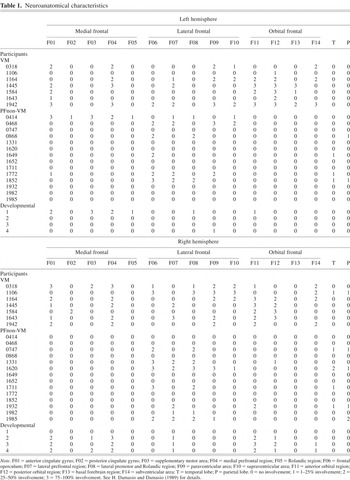
The 4 participants with childhood-onset lesions had focal prefrontal lesions that involved the VM region. D1 was a 52-year-old woman who had a left frontal hemorrhage with surgical evacuation at 7 years of age. On the medial frontal surface, her lesion extended from the pole to the level of the corpus callosum, but spared the orbital cortex. D2 was a 30-year-old man who had a right frontal tumor resected at 3 months of age. His lesion encompassed much of the right prefrontal region including medial, polar, and lateral sectors. The lateral half of the orbital region and the anterior cingulate were also damaged. D3 was a 15-year-old boy who sustained a skull fracture in a fall at 3 years of age. His lesion encompassed much of the right prefrontal region, including the anterior portion of the medial cortex and much of the orbital surface. D4 was a 27-year-old man who was born with a cystic lesion in the right frontal lobe and hydrocephalus. A shunt revision at 4 years of age resulted in an additional small area of damage in the left frontal lobe. Further details regarding the lesion locations in the VM, PFnon-VM, and Developmental groups are presented in Table 1.
Neuroanatomical characteristics

Background Neuropsychology
The participants completed a battery of standardized tests of intellectual abilities, memory, and executive functions. These tests included: the Wechsler Adult Intelligence Scale–Revised (WAIS-R), Auditory Verbal Learning Test (AVLT), Benton Visual Retention Test (BVRT), Wisconsin Card Sorting Test (WCST), Trail Making Test (TMT), and Controlled Oral Word Association (COWA).
Real-World Competencies
The Iowa Rating Scales of Personality Change
The IRSPC (Barrash et al., 2000) provides standardized assessment of a wide range of personality changes or abnormalities that might result from brain dysfunction. The information is elicited from a parent, spouse, or other family member who has had regular, extensive contact with the patient. The current level of a personality characteristic is quantified, and for patients with onset of their neurologic condition after childhood, the extent to which that characteristic has changed subsequent to the event also is rated. Thirteen aspects of real-world competency are characterized by collateral ratings—based on real-life functioning—on the IRSPC scales of Poor Judgment, Inflexibility, Lack of Planning, Disorganization, Indecisiveness, Lack of Initiative, Lack of Persistence, Behavioral Rigidity, Social Inappropriateness, Insensitivity, Self-Absorption, Impulsivity, and Dependency. The IRSPC also includes three “control scales,” Frugality, Manipulativeness, and Type A Behavior, to assist detection of possible response bias. These scales tap characteristics that are not systematically changed by most types of brain damage, regardless of etiology or lesion location (Barrash et al., 1997). The IRSPC scales are rated along 7-point scales (1–7), with 1 reflecting very good functioning, 3 reflecting the hypothetically “average” level of the characteristic (in the rater's estimation), 5 indicating that the characteristic is present to the degree that it is considered a problem, and 7 indicating a severe problem. Additionally, ratings on these 13 scales were summed to create a composite measure of informant-rated real-world competence. Scores in the highest quartile of the distribution of composite scores were considered to indicate an impairment in real-world competence. (Further details regarding the IRSPC are reported in Barrash et al., 2000.) The Developmental version of the IRSPC is nearly identical to the original, but there is no rating of change from a premorbid status. Adult patients with childhood-onset lesions were rated on the same characteristics included on the original IRSPC. For rating children and adolescents, a few scales that address behaviors that are normative in this age group were eliminated (e.g., Excitability, Disorganization), and some characteristic descriptions were altered to be age-appropriate (e.g., behavioral examples changed from employment to school setting).
Clinician Rating of Competency
This rating (CRC) is designed to quantify demonstrated competency in key domains of everyday functioning, including interpersonal behavior, employment/academic status, health and safety-related behavior, financial management, and leisure/recreational behavior. Behavior in each domain is rated on a 6-point scale ranging from evidence of severe incompetence to evidence of high competence. Scores in the highest quartile of the distribution of CRC scores were considered to indicate an impairment in real-world competencies. Behavior was rated for the period of time following initial recovery from the neurologic event, and including the present, by clinicians who were blind to the specific hypotheses of this study. Ratings were based on all evidence available in the participants' records of participation in our research program, which routinely includes interviews with the patient and collaterals regarding academic and employment history and current living situation, as well as relevant medical, legal, and academic records. The rating was meant to reflect demonstrated competency in the real world, not projected competency based on neuropsychological test scores. Competency was not rated for a given domain if there was no evidence available in the record, if the individual faced no demands in that area (e.g., “Employment competency” would not be rated for someone who was retired before the onset of their neurologic condition), or if incompetence within a domain was due to a nonneuropsychological factor (e.g., a laborer who became unable to work primarily because of a hemiparesis following stroke).
Emotion
The Iowa Rating Scales of Personality Change include several scales that reflect specific aspects of emotion. In addition, two broader types of emotional disturbances were analyzed: hypo-emotionality and emotional reactivity. Hypo-emotionality was operationalized as the summed ratings on scales included in the IRSPC to quantify aspects of this disturbance: Blunted Affect, Impoverished Emotions, Apathy, and Social Withdrawal (which is characterized as much by lack of motivation for family and social relationships as by decreased social contact). Emotional Reactivity was defined as the summed ratings of Emotional Lability, Poor Frustration Tolerance, Irritability, and Anxiety. These definitions were supported by the highly significant loading of the 8 scales on 2 factors reflecting hypo-emotionality and emotional reactivity in a factor analysis reported previously (Barrash et al., 1997).
Analysis
The 3 adult-onset groups were contrasted by testing for group differences on demographic, clinical and neuropsychological variables by analysis of variance (ANOVA). Significant differences were examined further by Tukey Honest Significant Differences follow-up tests. The relationships between lesion site and impairments in real-world competencies, specific emotional conditions, and the 2 higher-order dimensions of emotional disturbances to lesion site were assessed by Mann-Whitney U tests (nonparametric tests were used because real-world competencies and emotional disturbances were based on ordinally-scaled ratings). Between-group tests were used to test the hypothesis that relationships between real-world competencies and emotional disturbances were specifically associated with damage to the VM region. The associations of the presence of an emotional disturbance to impairments in real-world competencies among individuals with adult-onset brain damage were assessed by Fisher Exact Tests.
The multivariate relationship of the 2 emotional disturbances to real world competencies was assessed with multiple regression analyses. It turned out that the study groups differed in delayed memory, so the AVLT delayed-recall score was included as a predictor in these analyses to determine whether the association between lesion site and deficient real-world competencies was due to memory deficits. In these analyses, age was entered first to control for age effects on memory. Next, the 3 predictors—emotional reactivity, hypo-emotionality, and AVLT delayed recall—were each allowed to enter into the regression equation in stepwise fashion. The criterion for entry into the regression model was set at an extremely liberal level (p < .99) to ensure that all 3 predictors would enter into the model, allowing for evaluation of the relative contribution of each to real-world competence. The change in the squared multiple correlation coefficient is reported, reflecting the percentage of variance in the real-world competence accounted for by each predictor, given the effect of predictors already in the model.
Although multiple tests were conducted within each set of analyses, alpha was set at .05 due to small sample sizes and the limited power of the nonparametric statistical tests. In recognition of the increased risk of type I error, we refrain from interpretation of individual tests and focus instead on the pattern of results concerning the 2 dimensions of emotional disturbance.
RESULTS
Adult-Onset Lesions
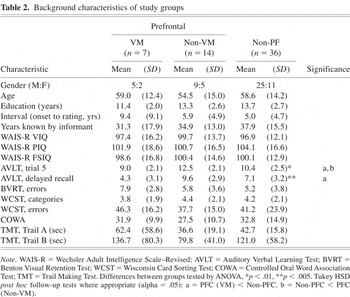
The 3 adult-onset lesion groups did not differ on basic demographic and clinical characteristics (Table 2). The groups also did not differ on cognitive performances with the exception of memory performance on the AVLT: The VM group showed weaker learning on AVLT trial 5 than did the PFnon-VM and Non-PF groups, and their delayed recall was significantly worse than the Non-PF group.
Background characteristics of study groups

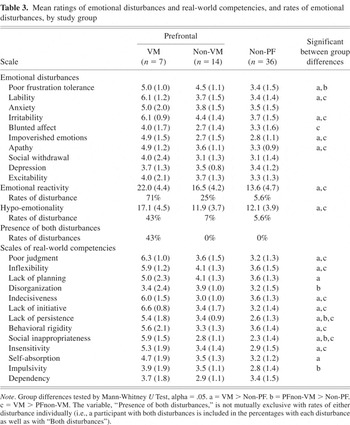
There was a consistent pattern of differences in the level of personality disturbances among the adult-onset lesion groups (Table 3). The VM group was rated as significantly more disturbed than the PFnon-VM group and the Non-PF group on all but 1 scale of emotional functioning or real-world competence, including significantly higher (more disturbed) ratings than the Non-PF group on 5 of 10 scales of emotional functioning, both emotional reactivity and hypo-emotionality, and on 10 of 13 real-world competencies. The VM group was also rated as having more disturbance than the Non-PF group on 5 of 10 scales of emotional functioning, both emotional reactivity and hypo-emotionality, and on 8 of 13 real-world competencies. In contrast to the several personality disturbances characterizing the VM group, the PFnon-VM participants were rated as having more disturbance than the Non-PF group on only 1 of 10 scales of emotional functioning, neither emotional reactivity or hypo-emotionality, and on only 4 of 13 real-world competencies. As would be expected, there were no group differences on the 3 control scales, and none of the study groups had mean ratings indicative of disturbances on any of the 3 control scales.
Mean ratings of emotional disturbances and real-world competencies, and rates of emotional disturbances, by study group

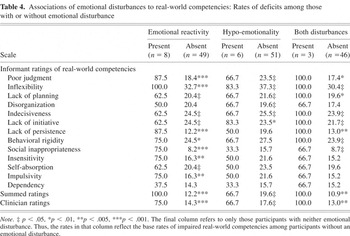
Associations between the presence of emotional disturbances and impairments in real-world competencies are presented in Table 4. There was an invariant pattern in which participants with emotional reactivity or hypo-emotionality had higher rates of real-world deficits than those without the emotional disturbances. Despite the lack of power in these analyses due to the small number of participants, the difference in rates depending on the presence of emotional reactivity reached statistical significance for 11 of 13 competencies, and 6 of 13 competencies depending on the presence of hypo-emotionality. Both disturbances were also highly associated with substantially higher rates of overall real-world competency as rated by informants and by clinicians. The presence of both types of emotional disturbance in the same patient was also associated with significantly higher rates of deficits in real-world competencies.
Associations of emotional disturbances to real-world competencies: Rates of deficits among those with or without emotional disturbance

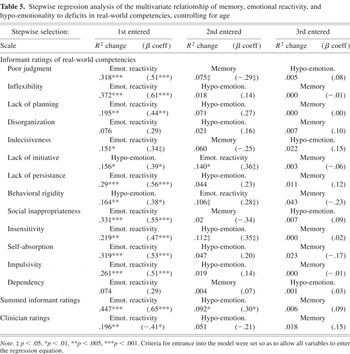
Multiple regression analyses of the 2 dimensions of emotional disturbance and memory with real-world competencies (Table 5) show that emotional reactivity was the most powerful predictor for 11 of 13 competencies, and hypo-emotionality was the most powerful predictor for the other 2 (lack of initiative and behavioral rigidity). Memory was not the most powerful predictor for any of the 13 competencies, and contributed significantly to the prediction of only 1 competency (poor judgment) after the more powerfully predictive emotional disturbance(s) is taken into account. Together, emotional reactivity and hypo-emotionality accounted for approximately 25% or more of the variance in 10 of 13 real-world competencies.
Stepwise regression analysis of the multivariate relationship of memory, emotional reactivity, and hypo-emotionality to deficits in real-world competencies, controlling for age

The relationships between clinician-rated competency and emotional disturbance revealed a generally similar pattern. The VM group was rated as incompetent (negative scores) in all 5 aspects of their daily activities on the CRC (mean total score = −6.6; SD = 1.4), in contrast to positive scores (indicating at least some degree of competency) in all domains for the PFnon-VM (mean total score = 2.0; SD = 3.2) and NonPF groups (mean total score = 3.0; SD = 2.8). CRC total score was correlated with emotional reactivity (−.39, p < .001), but not with hypo-emotionality. Multiple regression analyses (Table 5) indicated that the 2 dimensions of emotional disturbance could account for more than 20% of the variance in clinician rated real-world competencies.
Childhood-Onset Lesions
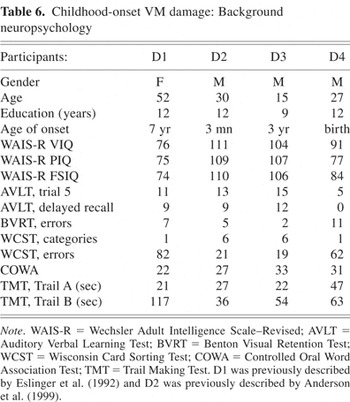
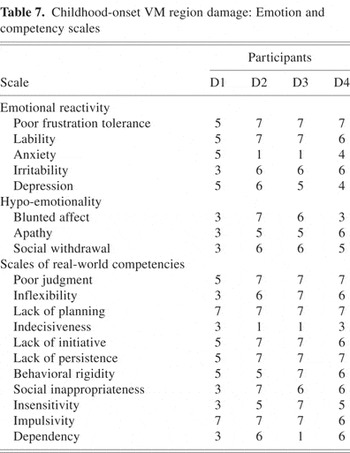
Similar to the participants with adult-onset VM lesions, the 4 participants with childhood-onset VM lesions had performances primarily within normal limits on tests of intellectual functions (3 of 4 within normal limits—WNL), memory (3 of 4 WNL), and executive functions (2 of 4 WNL) (Table 6). However, all 4 showed severe emotional disturbances and impairments of real-world competencies. Ratings on the dimensions of emotional reactivity and hypo-emotionality were adjusted for number of scales to allow comparison to the adult-onset participants. The adjusted mean rating on emotional reactivity was 30.9 (range 27.6–32.4), and on hypo-emotionality was 19 (range 12–24). These scores are as high or higher (more disturbance) than those of the adult-onset participants with VM damage. Of the scales reflecting real-world competencies, those rated as most disturbed included Lack of Planning, Impulsivity, Poor Judgment, and Lack of Persistence (Table 7). All were rated as highly incompetent on the CRC. None of these 4 participants were able to function independently. None were able to maintain independent employment or manage their personal finances, and all 4 had histories of dysfunctional social relationships.
Childhood-onset VM damage: Background neuropsychology

Childhood-onset VM region damage: Emotion and competency scales

DISCUSSION
The findings from this study illustrate certain relationships between emotional dysfunction and impaired ability to competently manage the exigencies of daily life following damage to the VM region of the brain. Data reflecting ratings from the patients' relatives and clinician ratings converge to indicate that emotional disturbances, in the form of heightened emotional reactivity and hypo-emotionality, make a substantial contribution to the impairments of real-world competencies that arise from VM region dysfunction, whether that damage is acquired in childhood or adulthood.
There are limitations to this study, including small participant groups, particularly for the childhood-onset patients. We have categorized patients into groups on the basis of anatomical criteria, but the lesions within each group are heterogeneous. Although the participants were logically grouped according to the primary location of damage, there is some anatomical overlap between groups, in that some participants in the non-VM prefrontal group have minor extension of damage into the VM region, and some participants in the VM group have lesions that extend into other brain regions. Also, no attempt was made in the 2 non-VM groups to control for damage to other neural structures involved in emotion, such as the medial temporal region. Although additional study will be needed to provide more definitive characterization, these findings suggest that the relationship between emotional dysfunction and daily competency following VM damage is of importance.
There likely are multiple mechanisms by which emotional disruption contributes to impaired competencies in daily life for these patients, and further specification of these will be valuable for devising more effective interventions. Both increased emotional reactivity and hypo-emotionality appear likely to disrupt the emotional biases that normally help guide decision-making and social behavior. Abnormal emotional responses to environmental events would be likely to also contribute to further deficits in attending to relevant aspects of the situation. In the case of heightened emotional reactivity, both the patient's cognitive resources and environmental resources (e.g., care provider behavior) may be directed toward alleviating the emotional distress rather than mastering the task at hand.
These emotional disturbances and concomitant deficits in real-world complex behaviors can arise whether there has been a normal developmental history followed by a brain injury acquired in adulthood, or a history of childhood injury influencing the course of development. While in the first instance there is a loss of competencies once held, and in the second there is a failure to ever develop normal competencies, the resultant long-term profiles are similar in most respects. These findings do not support the notion that the greater plasticity that characterizes the young brain is sufficient to readily mitigate the effects of early injury to this system. This observation must be regarded as preliminary because of the limited number of childhood-onset cases with focal VM damage who have been followed over any length of time. At least 2 factors may contribute to the substantial long-term deficits observed in childhood-onset cases such as the ones reported here. First, injury to this system at an early age appears to disrupt the learning of social information and adaptive responses in complex environments that normally takes place throughout childhood and adolescence. When a comparable lesion is acquired in adulthood, all of this learning is not undone, and this retained knowledge can help adult-onset patients compensate for the failure of implementation resulting from acquired VM damage. Focal VM damage in adulthood leaves many aspects of relevant conceptual knowledge relatively intact (e.g., regarding social situations, good vs. bad decisions, advantageous vs. disadvantageous behaviors), but disrupts the application of this knowledge when needed. Comparable early-onset damage can disrupt both the acquisition of this conceptual knowledge during development, and chronically handicap the system by which relevant information is brought to bear on the social challenges at hand. A second factor, albeit speculative at this time, that might contribute to the relatively severe behavioral disruption in the early-onset cases, is that the patients with childhood-onset injury tend to be younger than those with adult-onset lesions at the time of observation (i.e., adolescents and young adults vs. middle-aged and older adults), and it is possible that the general association of youth with rambunctiousness still applies when the VM region is damaged.
It is important to consider the association between emotional dysfunction and real-world competency in the context of the broader neuropsychological profiles of these patients. Consistent with several other reports, focal VM region damage was associated with primarily normal performances on standardized neuropsychological tests, and there was not a consistent pattern of impairments on tests of executive function. Although the VM group in our sample had weaker delayed memory performance than the other study groups, this weakness could not account for their real-world difficulties. However, this in no way implies that dysfunction in the neural systems underlying emotion is the sole cause of impairments of real-world competencies following VM damage. Even circumscribed lesions in the VM region may be associated with concomitant impairments in other aspects of cognition (e.g., elements of working memory, attention allocation, self-referential processing, awareness, sequencing, reversal learning). When brain damage involves the VM region and also other brain regions, the probability further increases that additional cognitive deficits will interact with emotional dysfunction to impair real-world competencies. Nonetheless, it is evident that emotional dysfunction is a major contributing factor to the difficulties in managing the demands of daily life that arise following damage in the VM region, and that neuropsychological assessment and rehabilitation can benefit from taking this into account.
Neuropsychological Assessment
When evaluating patients with known or suspected dysfunction in the VM region, it is particularly important to consider information from sources in addition to standardized neuropsychological tests. Circumscribed VM damage may result in little or no impairment on tests of intellectual abilities, attention, memory, language, visual perception, or executive functions. Yet, as many prior studies have shown, these patients may have substantial information-processing limitations with major real-world implications.
One source of information that provides a useful context for neuropsychological test scores is the patient's demonstrated behavior in the real world, based on objective evaluation of competencies in social, professional, and financial domains. Caution is due when considering prognoses for patients with known VM damage who have not yet faced real-world challenges (e.g., an adult-onset patient leaving rehabilitation, or a childhood-onset patient who has had strong parental support). Because damage to the VM region tends to be associated with unawareness and lack of concern regarding cognitive and behavioral problems, a patient's self-report may be misleading (see Stuss & Levine, 2002, for discussion), and it is important to use an objective collateral source if possible.
Another implication for neuropsychological assessment of patients with possible VM involvement is the value of evaluating emotion and considering the implications of emotional disturbance for real-world competencies. This issue is particularly salient and often more difficult when dealing with children. As has been pointed out by Benton and others, the emotional disturbances and real-world incompetencies of patients with VM dysfunction are, in many respects, puerile. Like a child, the individual may be blithely unaware or unconcerned about many issues that objectively ought to elicit concern (and thus attention), but at the same time be highly emotionally reactive to what objectively are relatively minor, but immediately salient, events. Beyond an exaggeration of these normal tendencies of childhood, it can be difficult to discern a clear impairment of emotion in some young patients with VM damage, until they reach an age at which more mature social-emotional behavior is expected. Much of the recent progress in understanding the development of executive functions has focused on the more cognitive aspects of the processes, rather than emotional or motivational components (see Happaney et al., 2004).
Rehabilitation
When considering neuropsychological rehabilitation for patients with damage to the VM region or other brain regions involved in the neural representation of emotion, the impact of emotional disruption on real-world competencies should be explicitly factored into treatment planning. As noted recently by Siegert et al. (2004), discussion about emotion is largely absent from most current rehabilitation texts, other than the effects of mood disorders on outcome.
Awareness training for patients, and adaptive coping by family members, can be facilitated by helping them to understand that emotions are subserved in part by brain operations, and that the disruption of emotion the patient is experiencing can be just as much a consequence of brain injury as are impairments of movement, language, or memory. It also is important that patients and caregivers understand that dysfunction in the neural systems underlying emotion can have implications for decision-making and social behavior. Providing patients and their families with a conceptual framework based on the cognitive neuroscience of emotion allows for the neuropsychological consequences of VM damage—which are often delicate topics—to be frankly and openly discussed as normal biological consequences of the injury.
In addition to this type of metacognitive training, patients with VM damage may benefit from training in specific self-regulatory strategies, such as physiological relaxation techniques to help curtail emotional responses and systematic verbal encoding of information that normally would be processed primarily via nonverbal channels. Systematic verbal compensation can be a particularly useful tool for parents of children with VM region damage, in the training of social rules and expectations that normally are acquired in large part through patterns of punishment and reward. For children with VM region injury who are not normally responsive to punishment or reward, explicit verbal encoding and over-learning of key information, coupled with training in self-instruction, may help compensate for the disruption of emotional information in the development of social competencies.
ACKNOWLEDGMENTS
This work was supported by NINDS PO1 NS19632. We thank Hanna Damasio for her help with the anatomical analysis. We would also like to thank Mieke Verfaillie, Kathleen Haaland, and two anonymous reviewers for many constructive comments on earlier versions of this manuscript.
References
REFERENCES
Ackerly, S.S. &
Benton, A.L.
(1947).
Report of a case of bilateral frontal lobe defect.
Research Publication of the Association for Research in Nervous and
Mental Disease,
27,
479–504.Google Scholar
Anderson, S.W.,
Bechara, A.,
Damasio, H.,
Tranel, D., &
Damasio, A.R.
(1999).
Impairment of social and moral behavior related to early damage in
the human prefrontal cortex.
Nature Neuroscience,
2,
1032–1037.Google Scholar
Anderson, S.W.,
Damasio, H., &
Damasio, A.R.
(2005).
A neural basis for collecting behavior in humans.
Brain,
128,
201–212.Google Scholar
Anderson, S.W.,
Damasio, H.,
Jones, R.D., &
Tranel, D.
(1991).
Wisconsin Card Sorting Test performance as a measure of frontal lobe
damage.
Journal of Clinical and Experimental Neuropsychology,
13,
909–922.Google Scholar
Bar-On, R.,
Tranel, D.,
Denburg, N.L., &
Bechara, A.
(2003).
Exploring the neurological substrates of emotional and social
intelligence.
Brain,
126,
1790–1800.Google Scholar
Barrash, J.,
Anderson, S.W.,
Jones, R.D., &
Tranel, D.
(1997).
The Iowa Rating Scales of Personality Change: Reliability and
validity.
Journal of the International Neuropsychological Society,
3,
27–28
(abstract).Google Scholar
Barrash, J.,
Tranel, D., &
Anderson, S.W.
(2000).
Acquired personality disturbances associated with bilateral damage
to the ventromedial prefrontal region.
Developmental Neuropsychology,
18,
355–381.CrossRefGoogle Scholar
Bechara, A.,
Tranel, D.,
Damasio, H., &
Damasio, A.R.
(1996).
Failure to respond autonomically to anticipated future outcomes
following damage to prefrontal cortex.
Cerebral Cortex,
6,
215–225.Google Scholar
Camille, N.,
Coricelli, G.,
Sallet, J.,
Pradat-Diehl, P.,
Duhamel, J.-R., &
Sirigu, A.
(2004).
The involvement of the orbitofrontal cortex in the experience of
regret.
Science,
304,
1167–1170.Google Scholar
Damasio, A.R.
(1994).
Descartes' error: Emotion, reason, and the human brain.
New York:
Grosset/Putnam.
Damasio, A.R. &
Anderson, S.W.
(2003).
The frontal lobes. In
K.M. Heilman &
E. Valenstein (Eds.),
Clinical neuropsychology
(4th ed.).
New York:
Oxford University Press.
Damasio, H. &
Damasio, A.R.
(1989).
Lesion analysis in neuropsychology.
New York:
Oxford University Press.
Damasio, H. &
Frank, R.
(1992).
Three-dimensional in vivo mapping of brain lesions in
humans.
Archives of Neurology,
49,
137–143.Google Scholar
Eslinger, P.J.
(1998).
Neurological and neuropsychological bases of empathy.
European Neurology,
39,
193–199.Google Scholar
Eslinger, P.J. &
Damasio, A.R.
(1985).
Severe disturbance of higher cognition after bilateral frontal lobe
ablation: Patient EVR.
Neurology,
35,
1731–1741.Google Scholar
Eslinger, P.J.,
Flaherty-Craig, C.V., &
Benton, A.L.
(2004).
Developmental outcomes after early prefrontal cortex damage.
Brain and Cognition,
55,
84–103.Google Scholar
Eslinger, P.J.,
Grattan, L.M., &
Damasio, A.R.
(1992).
Developmental consequences of childhood frontal lobe damage.
Archives of Neurology,
49,
764–769.Google Scholar
Frank, R.J.,
Damasio, H., &
Grabowski, T.J.
(1997).
Brainvox: An interactive, multimodal visualization and analyss
system for neuroanatomical imaging.
Neuroimage,
5,
13–30.Google Scholar
Frith, U. &
Frith, C.D.
(2003).
Development and neurophysiology of mentalizing.
Philosophical Transactions of the Royal Society of London,
358,
459–473.Google Scholar
Grafman, J.,
Jonas, B., &
Salazar, A.
(1990).
Wisconsin Card Sorting Test performance based on location and size
of neuroanatomical lesion in Vietnam veterans with penetrating head
injury.
Perceptual and Motor Skills,
71,
1120–1122.Google Scholar
Gusnard, D.A.,
Akbudak, E.,
Shulman, G.L., &
Raichle, M.E.
(2001).
Medial prefrontal cortex and self-referential mental activity:
Relation to a default mode of brain function.
Proceedings of the National Academy of Science,
98,
4259–4264.Google Scholar
Happaney, K.,
Zelazo, P.D., &
Stuss, D.T.
(2004).
Development of orbitofrontal function: Current themes and future
directions.
Brain and Cognition,
55,
1–10.Google Scholar
Harlow, J.M.
(1868).
Recovery from the passage of an iron bar through the head.
Publication of the Massachusetts Medical Society,
2,
329–347.Google Scholar
Kelley, W.M.,
Macrae, C.N.,
Wyland, C.L.,
Caglar, S.,
Inati, S., &
Heatherton, T.F.
(2002).
Finding the self? An event-related fMRI study.
Journal of Cognitive Neuroscience,
14,
785–794.Google Scholar
Machado, C.J. &
Bachevalier, J.
(2003).
Non-human primate models of childhood psychopathology: The promise
and the limitations.
Journal of Child Psychology and Psychiatry,
44,
64–87.Google Scholar
Rolls, E.T.,
Hornak, J.,
Wade, D., &
McGrath, J.
(1994).
Emotion-related learning in patients with social and emotional
changes associated with frontal lobe damage.
Journal of Neurology, Neurosurgery & Psychiatry,
57,
1518–1524.Google Scholar
Saver, J. &
Damasio, A.R.
(1991).
Preserved access and processing of social knowledge in a patient
with acquired sociopathy due to ventromedial frontal damage.
Neuropsychologia,
29,
1241–1249.Google Scholar
Siegert, R.J.,
McPherson, K.M., &
Taylor, W.J.
(2004).
Toward a cognitive-affective model of goal-setting in
rehabilitation: Is self-regulation theory a key step?
Disability and Rehabilitation,
26,
1175–1183.Google Scholar
Shamay-Tsoory, S.G.,
Tomer, R.,
Goldsher, D.,
Berger, B.D., &
Aharon-Peretz, J.
(2004).
Impairment in cognitive and affective empathy in patients with brain
lesions: Anatomical and cognitive correlates.
Journal of Clinical and Experimental Neuropsychology,
26,
1113–1127.Google Scholar
Shallice, T. &
Burgess, W.P.
(1991).
Deficits in strategy application following frontal lobe damage in
man.
Brain,
114,
727–741.Google Scholar
Stuss, D.T. &
Benson, D.F.
(1986).
The frontal lobes.
New York:
Raven Press.
Stuss, D.T. &
Levine, B.
(2002).
Adult clinical neuropsychology: Lessons from studies of the frontal
lobes.
Annual Review of Psychology,
53,
401–433.CrossRefGoogle Scholar
Neuroanatomical characteristics
Background characteristics of study groups
Mean ratings of emotional disturbances and real-world competencies, and rates of emotional disturbances, by study group
Associations of emotional disturbances to real-world competencies: Rates of deficits among those with or without emotional disturbance
Stepwise regression analysis of the multivariate relationship of memory, emotional reactivity, and hypo-emotionality to deficits in real-world competencies, controlling for age
Childhood-onset VM damage: Background neuropsychology
Childhood-onset VM region damage: Emotion and competency scales
 You have
Access
- 182
- Cited by