Effective hand hygiene is essential to prevent transmission of healthcare-associated pathogens. Although most hand hygiene programs in healthcare facilities have focused on compliance of healthcare workers, there is increasing appreciation that patients should also be engaged in hand hygiene interventions.Reference Boyce and Pittet 1 – Reference Burnett, Lee and Kydd 4 Hand hygiene may benefit individual patients by reducing the likelihood that organisms acquired on hands will contaminate devices and wounds or be ingested with subsequent colonization. Patient hand hygiene may also reduce the risk for transmission of pathogens to other patients through direct or indirect routes. Although evidence supporting patient hand hygiene is limited, a recent quasi-experimental hand hygiene intervention focused on patients and visitors was associated with a reduction in nosocomial methicillin-resistant Staphylococcus aureus (MRSA) infections.Reference Gagné, Bédard and Maziade 5
To develop effective patient hand hygiene interventions, there is a need to better define the frequency and burden of pathogen contamination on the hands of patients. Because most evidence of hand hygiene effectiveness is based upon removal of organisms artificially applied to hands of volunteers, there is also a need for evaluations of the effectiveness of patient hand hygiene in real-world settings. Here, we examined MRSA hand contamination in hospitalized MRSA-colonized patients and evaluated the effectiveness of alcohol disinfection. We hypothesized that positive hand cultures would be associated with factors such as decreased mobility and presence of devices or wounds, and that persistent MRSA recovery after hand hygiene would be associated with increased hand surface area.
Methods
The Cleveland VA Medical Center is a 215-bed hospital with an affiliated long-term care facility (LTCF). Surveillance for nares carriage of MRSA is conducted on all patients upon admission, ward transfer, and discharge. From September 2012 to December 2012, we conducted a cohort study of inpatients, including LTCF residents, with MRSA carriage to determine the frequency and burden of MRSA hand contamination and to evaluate the effectiveness of a single application of alcohol for hand disinfection. Cultures were collected once per subject. Information on medical conditions, medications, receipt of antibiotics with activity against MRSA at the time of culture collection, indwelling devices, patient mobility, LTCF residence, and hand hygiene practices and knowledge was obtained through chart review and patient interviews. LTCF residents were cultured in the LTCF or in the hospital if admitted. Hand surface area (cm2) was measured.Reference Lee, Choi and Kim 6 The study protocol was approved by the hospital’s institutional review board.
To obtain cultures, premoistened BD BBL CultureSwabs (Becton Dickinson, Cockeysville, MD) were applied to the entire surface of both hands (1 swab per hand). Two mL of 70% (vol/vol) ethanol gel (PURELL Advanced, GOJO Industries, Akron, Ohio) was applied, and patients were asked to rub their hands for 30 seconds with coaching to ensure proper technique.Reference Pittet, Allegranzi and Boyce 7 Hands were cultured again after they were dry. Swabs were plated onto ChromAgar plates (Becton Dickinson) containing 6 µg/mL cefoxitin and incubated at 37°C for 48 hours. Colonies consistent with S. aureus were counted and subjected to identification and susceptibility testing.Reference Stiefel, Cadnum, Eckstein, Guerrero, Tima and Donskey 2 PURELL Advanced alcohol based hand rub was provided by the VA Medical Center during the study.
Bivariate analyses were conducted to compare characteristics of MRSA carriers with positive versus negative cultures and with complete versus incomplete removal of MRSA. The frequency of hand contamination and the number of colonies recovered were compared before versus after hand hygiene. Fisher’s exact test was used for categorical data and Student’s paired t test was used for normally distributed data. Data were analyzed using SPSS statistical software version 10.0 (SPSS, Inc., Chicago, IL).
Results
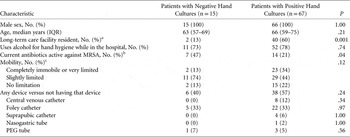
Of 188 MRSA carriers admitted during the study, 82 (44%) were enrolled. Of the 82 MRSA carriers enrolled, 67 (82%) had positive hand cultures. Table 1 shows the characteristics of the MRSA carriers, stratified by those with positive versus negative hand cultures. Positive hand cultures were significantly more common in LTCF residents, whereas negative cultures were more common in carriers currently receiving antibiotics with activity against MRSA. The presence of devices or wounds and decreased patient mobility were not associated with hand contamination. Of the 82 subjects surveyed, only 46 (56%) were aware that alcohol is effective against MRSA, and only 26 (32%) frequently used alcohol for hand hygiene.
Factors Associated with Hand Contamination by Methicillin-Resistant Staphylococcus aureus (MRSA) in MRSA-Colonized Patients

NOTE. IQR, interquartile range; PEG, percutaneous endoscopic gastrostomy.
a Long-term care facility residents were cultured either in the long-term care facility or in the hospital, if admitted.
b Antibiotics with activity against MRSA included vancomycin, linezolid, and daptomycin.
c Mobility score is a subcategory of the Braden score for prediction of pressure ulcer risk (1=completely immobile, 2=very limited, 3=slightly limited, 4=no limitation).
A single application of alcohol significantly reduced the percentage of positive cultures (67 of 82, 82% versus 27 of 82, 33%; P=.0001). For those patients with positive cultures, the number of MRSA colonies recovered from hands was significantly reduced after hand hygiene (mean±SD, 76±153 before versus 23±89 after hand hygiene; P<.0001).
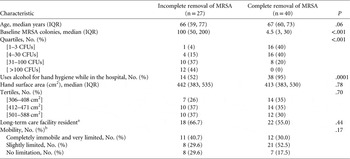
Table 2 shows the characteristics of the 67 carriers with positive hand cultures, stratified by those who did versus did not have negative cultures after alcohol hand hygiene. Having a high initial MRSA burden on hands was associated with persistent positive cultures after hand hygiene, whereas use of alcohol for hand hygiene while in the hospital was associated with negative cultures after hand hygiene. Increased hand surface area was not associated with positive hand cultures after hand hygiene.
Characteristics of Methicillin-Resistant Staphylococcus aureus (MRSA) Carriers with Incomplete Versus Complete Removal of MRSA After Alcohol Hand Hygiene

NOTE. CFUs, colony-forming units; IQR, interquartile range.
a Long-term care facility residents were cultured either in the long-term care facility or in the hospital if admitted.
b Mobility score is a subcategory of the Braden score for prediction of pressure ulcer risk (1=completely immobile, 2=very limited, 3=slightly limited, 4=no limitation).
Discussion
We found that 82% of MRSA-colonized inpatients had hand cultures positive for MRSA. Previous studies have identified decreased functional status, indwelling devices, wounds, and incontinence as risk factors for contamination of skin sites such as the groin and axilla with MRSA.Reference Stiefel, Cadnum, Eckstein, Guerrero, Tima and Donskey 2 However, in the present study, the presence of devices or wounds and decreased mobility were not associated with hand contamination. LTCF residence was associated with hand contamination, but contamination was also very common among carriers not residing in an LTCF. Current therapy with antibiotics having activity against MRSA was associated with negative hand cultures, suggesting that systemic anti-MRSA antibiotics may reduce levels of hand contamination. More than half of the MRSA carriers were not aware that alcohol is effective against MRSA, and only 32% frequently used alcohol for hand hygiene. Our results suggest that there is a need for hand hygiene interventions in MRSA colonized patients.
The finding that one-third of MRSA carriers had positive hand cultures after alcohol hand hygiene was unexpected. A larger volume of alcohol may have been more effective.Reference Macinga, Beausoleil and Campbell 8 However, increased hand surface area was not associated with positive cultures after hand hygiene. Organic material may reduce the activity of alcohol,Reference Loveday, Wilson and Pratt 9 and it is possible that a relatively high level of organic material was present on the hands of many carriers despite the fact that they were not visibly dirty. Finally, it is plausible that MRSA on the hands of carriers is analogous to resident skin flora in being more resistant to removal due to factors such as attachment to deeper layers of skin.Reference Boyce and Pittet 1 In contrast, bacteria acquired transiently on the hands of healthcare workers or artificially inoculated onto hands of volunteers may be more easily killed by alcohol.Reference Edmonds, Macinga and Mays-Suko 10
Our study has some limitations. The study included only men, and many were elderly and LTCF residents. We did not examine the effectiveness of multiple applications of alcohol or different volumes and only studied one formulation. We did not record the length of stay or the timing of hand hygiene prior to culture collection; it is possible that hand contamination may increase with longer length of stay or that residual disinfectants on hands could affect culture results. We only studied MRSA hand contamination. Additional studies are needed in patients colonized with other pathogens. Finally, although the source of hand contamination in MRSA carriers is likely to be from other contaminated skin, we did not investigate other potential sources such as the environment.
Acknowledgments
Financial support. This study was supported by the Department of Veterans Affairs.
Potential conflicts of interest. C.J.D has received research grants from STERIS, Pfizer, 3M, Clorox, and GOJO, and has served on scientific advisory boards for 3M and Merck. D.R.M. is an employee of GOJO. He had no role in the design of the study, and his technical assistance was sought when incomplete removal of MRSA on HCW hands was found following disinfection with Purell. He also provided input on the manuscript prior to submission.
All other authors report no conflicts of interest relevant to this article.