Je vous avais promis de faire dorénavant mes petites publications en Français, et il semble que je trompe déjà cette promesse; mais vous verrez que la date de ce que je publie est antérieure à celle de ma promesse. Du reste, dans la partie plus essentielle, le tableau, je me sers de la langue universelle des Mathématiciens.
Hieronymus Georg Zeuthen to Luigi Cremona, Copenhagen, 25 August, 1866Je bénis les invariants qui me procurent une si agréable surprise. Mais je maudis et les ingénieurs et la politique qui, depuis si longtemps, nous privent de vos travaux.
Georges-Henri Halphen to Luigi Cremona, Paris, 31 November, 1880In the aftermath of the French Revolution science offered itself as a concrete and increasingly effective tool for the construction of a modern society, made up of individuals who were all equal and emancipated, free to act and enrich themselves through their own work and their own intellect. The contribution of science was due, on the one hand, to the boost it gave to technological innovation and, on the other, to its role in the democratic transformation of education aimed at making it a structure of the State capable of contributing to the effective realization of the ideal of a society made up of equals, at least at the starting blocks of social competition – as Condorcet exemplarily claimed in his Rapport sur l'instruction publique in 1792. The contribution by science to the new bourgeois society inevitably led to the democratization of science itself. From an activity engaged in by a small group of philosophers, an authentic aristocracy of thought, it became a liberal profession (the “scientist”) a way of participating in society and of earning one's living for an ever-growing number of men. The French Revolution erected one institutional pillar of this process by establishing the École polytechnique, which, in Continental Europe, would become the model of an institution for higher scientific-technical training and was instrumental in transforming the engineer into a central profession in liberal society. However, paradoxically, no less an important contribution was made by Prussia – the European nation most reluctant to believe in the “universal genius of democracy” – to the transformation of science into an activity that blended in perfectly with the free market of industrial societies.
The participation of science in the process of modernization was experienced by the majority of scientists as a patriotic commitment. Indeed this participation and this democratization of science, although a process that took place in every country – and which was therefore an expression of the universal aspiration of the transforming pressure of the French Revolution – was articulated at the national level, that is, through national institutions, and the national languages came to play an unprecedented role in scientific communication. Since science provided continuous support for the retreat of tradition and the Christian religions during the nineteenth century, it was only natural that it should be associated with the new nation-religion.Footnote 1 An extensive body of research performed in recent years has involved an in-depth study of the process outlined above in the specific but particularly significant case of mathematics.Footnote 2 Until the early nineteenth century, European mathematics was an erudite “aristocratic” activity carried on by a small group of persons convinced they were participating in a universal intellectual undertaking, free of all space-time constraints, as they felt they were in an ideal dialogue with the Greek founders and with mathematicians of every language and era.Footnote 3 In the course of the century it was transformed into a “democratic” but also “patriotic” activity: the mathematical professions were potentially open to everyone; moreover, mathematics teachers, engineers, and actuaries were needed for modernization, and their role increased with the progress made in political and economic liberty. Thus, mathematics became part of national culture and was written in national languages, although (as Karen Parshall has pointed out) there were substantial analogies from the point of view of the dynamics underpinning the national evolution processes, albeit staggered in time. Each country wanted to have its own national mathematical society, its own national mathematics congresses, and its own national mathematical journal. The mathematicians of each country worked eagerly to increase the number of mathematicians and the level of mathematical learning in their own country, seeking alliances with political power, setting up new chairs in the centers of higher learning, training new ranks of young researchers, and improving the teaching of elementary mathematics. This effort was guided by national leaders, whose eminence and charisma stemmed not only from the intrinsic worth of their mathematical research, but also, and on occasion above all, from their patriotic inspiration, from the recognition by and contact with national politics and culture, and especially from their vision and capacity to guide the process of the democratization of mathematics and to focus the resolve of the members of their own national community of mathematicians.
Italy provides a paradigmatic example of the evolution of European mathematics in the post-revolutionary period. The Napoleonic invasion brought with it the experience of the Cisalpine Republic (1797), which in the course of the nineteenth century encouraged democratic aspirations against the authoritarian power of the monarchies who shared control of Italian territory, including that of the Pope.Footnote 4 These aspirations were perfectly in line with the reinforcement of the national spirit and with the political objective of attaining national unity. On 17 March 1861, the first Italian Parliament elected by census suffrage proclaimed Vittorio Emanuele II, King of Italy by the “grace of God and the will of the nation.” The unity of Italy was the final result of several revolts and military campaigns. Ten years later, Veneto (previously under Austrian control) and the Papal States became part of the new country and the capital of the new state was established in Rome. The extraordinary cultural and vital momentum of the Italian people that had made this possible, the Risorgimento, had a great influence on the history of mathematics in Italy: a blossoming of mathematicians, especially geometers, and an improvement of general mathematical culture. Most of these scholars shared a vision in which culture and education were intertwined with freedom and nationality, in which mathematics played a principal role in secular culture. As Gaspare Mainardi (1800–1879), a professor of differential and integral calculus at the University of Pavia, put it, in a letter addressed to Count Terenzio Mamiani, minister of religious affairs and education, on July 1st 1860: “I have told my beloved pupils that Garibaldi demands a million soldiers to make Italy free and that H.E. Sr. C° Mamiani would like millions of Philosophers to conserve it.”Footnote 5 This view of the role of science and mathematics in a liberal democracy was shared by all the great national leaders, many of them members of Parliament, including Enrico Betti (1823–1892), Francesco Brioschi (1824–1897), Luigi Cremona (1830–1903), and Ulisse Dini (1845–1918), a generation of mathematicians with a profound attachment to the national ideal and to the national secular religion (Bottazzini Reference Bottazzini1998; Lacaita and Silvestri Reference Lacaita and Silvestri2000–2003).Footnote 6 In the period that began with the unification, the most influential figure was perhaps Cremona.
Luigi Cremona: Mathematics, Democracy, and the Nation-Religion
Cremona was a volunteer in the “Free Italy” Battalion during the first Italian war of independence (1848–49), before he graduated in 1853 from the university in his native town Pavia (in northern Italy, close to Milan) as a civil engineer and architect. After a few years working as a high school mathematics teacher, in 1860 he was nominated Professor of higher geometry at the University of Bologna by the minister Mamiani. His opening address for the academic year 1860–1861 (November 1860) was published in the journal Il Politecnico, a “Monthly Repertory of Studies Applied to Prosperity and Social Culture,” directed by the Italian patriot and intellectual Carlo Cattaneo (1801–1869). The address was completely in line with the spirit of the journal, emphasizing the role of science and scholarship in national progress and civil coexistence. The final appeals made in his speech ran as follows:Footnote 7
Oh happy young people who have been granted the good fortune to witness your country's resurrection in the finest years of your life, awaken and rise up to contemplate the new sun burning bright on the horizon! While the dual tyranny of the Austrian thug and the livid Jesuit held you in idleness and faint-heartedness, liberty instead demands that you should be active and vigilant. With weapons and military exercises invigorate your body; in severe and constant studies remove all stain of servitude and in the light of science learn to be worthy of liberty. And the mother country's voice calls you into the field and you answer the call, fight, triumph or fall, always certain of victory: the battles for our independence are no longer lost. But if weapons are laid aside, return to your studies because also they serve and glorify Italy. Its destiny is in our hands; the courage of its brave sons will wrest it wholly from the claws of the foreigner, but it cannot live happily and supreme if the wisdom of its citizens does not render it honourable and to be feared. Once again, therefore, oh young people, I say to you: not the vile inertia that enfeebles body and soul but military and scientific studies will make you supporters of the greatness of this Italy of ours, which, before an astonished Europe, is about to return to the community of great and free nations, with one capital ROME, with one king VITTORIO EMANUELE, and with its one and greatest hero, GARIBALDI. (Cremona [1861] Reference Cremona1914, 253)
At the end of 1861 Cremona published his work Introduzione ad una teoria geometrica delle curve piane (Introduction to a geometric theory of plane curves) in the Proceedings of the Bologna Academy of Sciences, which was internationally appreciated. Many original contributions to the geometry of algebraic curves and surfaces followed until 1867, when he left Bologna.
Cremona was associated with Francesco BrioschiFootnote 8 in many scientific projects, such as the organization of the Reale Istituto Tecnico Superiore in Milan in 1863 (Brigaglia Reference Brigaglia, Lacaita and Silvestri2000) and the direction of the mathematical journal Annali di matematica pura ed applicata, as well as political-institutional commitments (at the National Education Council, and in Parliament). Their attachment to national culture and progress went hand in hand with their conviction of the need for a constant interaction with the other European scientific communities. In 1867 Cremona transferred to the Milan High Technical Institute and in 1873 he moved to the new capital, Rome, to organize the Scuola d'applicazione per gli ingegneri (School of Engineering). He was nominated senator in 1879 for special scientific merits. Cremona was intensely active in organizing secondary and higher education, in particular mathematics, both in Parliament and in writing textbooks (Giacardi Reference Giacardi2004; Brigaglia Reference Brigaglia and Giacardi2006; Di Sieno Reference Di Sieno and Giacardi2006). As Arcangelo Rossi pointed out, he supported an eclectic model of a higher university, combining French centralism and the German ideal of academic freedom and the imperative of research. Likewise, he considered it necessary to link the polytechnic schools with the university, thus trying to combine the German ideal of free, pure scientific research with applied research and technology. As he put it in his 1860 speech to his students:
Oh young people, shun the malicious words of those who, to conceal their own ignorance or to give vent to irate prejudice, will, with an ironic smile, ask you what is the point of these and other studies, and will speak of the practical impotence of men who devote themselves entirely to the progress of their beloved science. Even if geometry did not render, as instead it does, an immediate service to the fine arts, industry, mechanics, astronomy, and physics; even if a century-old experience did not show us that even the most abstract mathematical theories in a comparatively short space of time produce hitherto unsuspected applications; even if before our minds we did not have the history of many illustrious men who, without ever flagging in their pursuit of pure science, were the most effective promoters of our present civilization – still I would say to you: this science is worth loving; it possesses so many and such sublime beauties that it cannot fail to exert on the generous and unspoiled souls of young people a noble educational influence, raising them to the serene and inimitable poetry of truth! . . . Shun, therefore, these apostles of darkness; love truth and light; have faith in the services that science sooner or later renders to the cause of civilization and liberty. Believe in the future! This is the religion of our century. (Ibid.; emphasis added)Footnote 9
Cremona was twice offered the education ministry, first in 1881 and again in 1898. He also held many other posts, ranging from the reorganization of the Vittorio Emanuele National Library in Rome to the town planning development of the Italian capital.
Cremona's Network of Foreign Correspondents
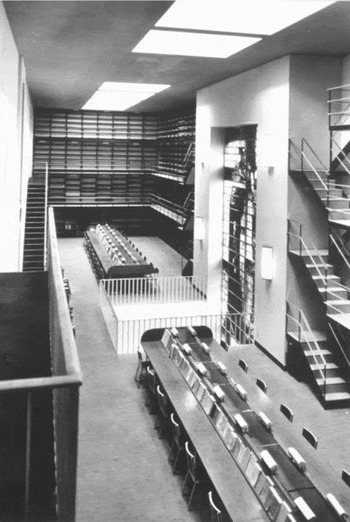
Cremona enjoyed great prestige outside his own country. He engaged in an intense exchange of letters with mathematicians from all over the world, as is shown by the collection of some 1350 letters conserved at the “Guido Castelnuovo,” Mathematical Library of La Sapienza, University of Rome (Israel and Nurzia Reference Israel and Nurzia1983; Nurzia Reference Nurzia1984).Footnote 10 The letters are dated from 1860 until Cremona's death in 1903 and were written by some 170 foreign fellow mathematicians who came from 18 different countries – but it should be taken into account that subjects from the Austro-Hungarian or the Russian Empires lived in areas such as Poland, Hungary, or Bohemia, which were to become independent European countries. To the historian sitting at one of the long tables of the main library room, the echo of the correspondents' voices seems to descend from the four tiers of open shelves, where many of the mathematical treatises written by them can be found (see fig. 1).Footnote 11 Cremona's foreign correspondents include mathematicians working at the cutting edge of research, especially in geometry, such as Michel Chasles, Gaston Darboux, Felix Klein, Julius Plücker, Max Noether, Arthur Cayley, James Joseph Silvester, and Sophus Lie. Narrowing the focus to fit this selected elite of scholars, the cultural context seems in perfect continuity with the European tradition of universalism and cosmopolitanism in the philosophy of nature. Specifically, the contents of many contributors to this epistolary exchange are of great interest for understanding the evolution of geometry research in the second half of the nineteenth century (see Menghini Reference Menghini1986 and Reference Menghini1993; Brigaglia Reference Brigaglia1991 and Reference Brigaglia, Lacaita and Silvestri2000; Brigaglia, Ciliberto, and Sernesi Reference Brigaglia, Ciliberto and Sernesi1994; and Hormigón and Millán Gasca Reference Millán Gasca1992).Footnote 12
Main library room (1935), Biblioteca Guido Castelnuovo, Dipartimento di Matematica, Università di Roma, “La Sapienza.”

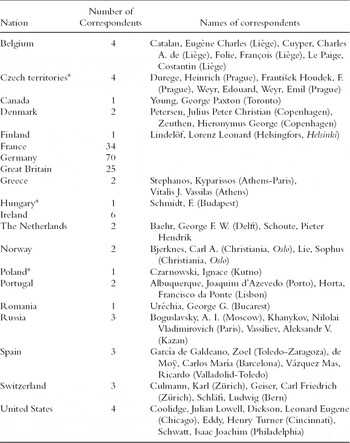
An overall perusal of this archival source, as outlined in Table 1, suggests it ought to be considered also from a wider point of view, in order to seek insights into the structure of the mathematical world of the second half of the nineteenth century. Information from Table 1 is in agreement with recent studies on the evolution of the modern mathematical profession, which came about as a result of the growth in the number and size of national communities organized around national leaders, national societies, and national journals.Footnote 13 The letters are written in 5 different languages (German, French, English, Italian, and Spanish). The bulk of the correspondents came from Germany, followed by France and Great Britain (but the German correspondents add up to more than the French and British taken together). These figures confirm both the quantity and the vitality of these three national communities. But perhaps even more striking is the variety of correspondents in other European countries, in addition to Canada and the United States.Footnote 14 In addition to the more famous names, the correspondents include also many university professors, upper technical and high school teachers, engineers and military personnel.Footnote 15 They include the names of mathematicians known above all for the important role they played in their own national communities: this is so for the Frenchmen Olry Terquem (1782–1862), Camille Gerono (1799–1892), and Eugène Prouhet (1817–1857), editors of Nouvelles Annales de Mathématiques, a journal addressed to young people and high school teachers interested in sitting for the entry exams to the École Polytechnique, as well as Georges Fouret (1845–1921), secretary and then president of the Société Mathématique de France. It is so also for the Englishman Thomas Archer Hirst (1830–1892), one of the prime movers behind the London Mathematical Society, secretary general of the British Association for the Advancement of Science; the Dane Hieronymus Georg Zeuthen (1839–1920), director of the Mathematisk Tidsskrift journal; or again the Greek Kyparissos Stephanos (1857–1917), professor at Athens University; the Spaniard Zoel García de Galdeano (1846–1924), professor at the University of Zaragoza and editor of the first Spanish mathematics journal, El Progreso Matemático; the Czech Emil Weyr (1848–1894), professor at Prague University; the Finn Lorenz Lindelöf (1827–1889), the father of the better known Ernst Leonard Lindelöf (1870–1946), a professor at Helsinki University (called Helsingfors at the time), member of parliament and high-ranking official in directing secondary education.
Luigi Cremona's foreign correspondents.

The letters received by Cremona contain many references to the development of national mathematical communities as well as evidence of the encouragement felt by many mathematicians, often extremely isolated in their countries of origin, as a result of the support of their foreign colleagues, who shared their political and cultural views and, at the same time, were united in the common effort to further the contemporary progress of mathematics regardless of ideological barriers and national frontiers. In addition to discussions on mathematical research, many of the letters in this correspondence bear on publishing issues (articles in journals, books, and translation of books), institutional matters, and scientific activities carried on in behalf of the State, as well as political questions. The letters thus offer an insight into the degree to which European mathematicians at the time were involved in the modernization of their own countries, in particular through the enhancement of mathematical knowledge.
The Mathematical World of the Late-Nineteenth Century as Reflected in the Letters to Luigi Cremona: Mathematicians and Politics during the Spread of the Liberal State
The early letters, which date back to the 1860s, contain numerous comments on the events related to the Italian Risorgimento, mixed with mathematical issues. The closing, fervent phrases of Cremona's 1860 opening address were well received by many French colleagues, including Eugène Prouhet:Footnote 16
M. Terquem, Bonnet, P. Serret, Mannheim have asked me to convey to you their thanks for sending them your introductory speech to the Higher Geometry course and I add my thanks to theirs. It is an exposition that is as faithful as it is eloquent of the progress made by modern Geometry and is dominated by lofty ideas. Your appeal to the patriotism of young people has moved us. Foreign scholars would be extremely churlish not to share the joy kindled in Italian hearts by the resurrection of Italy. Your beautiful mother country has preceded us in the creation of modern sciences and never, not even in the most difficult of times, has it ceased to make its contribution to the common work shared by all the civilized nations. Let us therefore hope that the Austrian thug and the livid Jesuit will no longer be a hindrance to the development of your magnificent nationality, above all provided that Italy, having learned from its longstanding misfortunes, no longer commits the error of being divided.
In subsequent letters from Prouhet several comments can be found on the evolution of the Italian political situation:
What are you doing in Italy? Have you put an end to Neapolitan brigandage? Are you going to capture Rome? and make it your capital? If it thus transpires, as I have not doubt it will, I will propose to the scientists of all nations to erect a statue to Galileo in the very church in which he abjured and even though I am not wealthy I would be willing to contribute one hundred francs to have the pleasure of seeing the last bastion of intolerance fall.
In the meantime, continue to enrich science with your fine work. (Prouhet to Cremona, Maine, September 22nd 1861 [original letter in French], now in Giacardi Reference Giacardi1994, 39)
Prouhet and Cremona shared democratic and anti-clerical beliefs, which they linked to their commitment to scientific progress. In a draft written by Cremona he reacted to Prouhet's words in the following terms:
You ask me what we are doing in Italy. If I am not mistaken our current ministry is behaving very badly and acting like a party (the moderates) dissatisfies everyone. The one who did his duty very well is Cialdini, the best swordsman in Italy after Garibaldi. Cialdini succeeded in winning the hearts of the Neapolitans and crushed brigandage so thoroughly that only an insignificant quantity of debris remains. You ask me about Rome . . . you should ask your Emperor. There is no doubt that Italy needs Rome, but it is equally certain that we cannot compel the French to evacuate the città eterna. Oh, what dismal interest leads your government to support the obscene barrel of pontifical despotism at bayonet point! Let France withdraw and you will see the bastion of intolerance collapse under its own weight, accompanied by the joyful chanting of all Italians. When this much longed-for event takes place, I shall be mindful of your idea to take up a subscription to erect a statue to Galileo in the church where he had to abjure and I will join you in achieving this noble project all the more willingly that, like you and many other free thinkers, I hate the degrading domination of priests!Footnote 17
This is Prouhet's answer:
I see from your last letter that you are waiting impatiently for the “obscene barrel of pontifical despotism to be overturned.” As I am not privy to the secrets of imperial politics, I am unable to predict the time in which what you so ardently desire will come about. The speeches by M. Billout in the Senate are proof of one's weariness after “ten years of ingratitude.” But one is apparently content to wait for some [additional event] that will facilitate what is difficult today. All this is filled with mystery. As for myself, without being as impatient as you are to see the end of a domination to which I am not subjected, I believe that everyone, above all the clergy, would be better off if religious matters were separated from those of the state. I am in no way an enemy of the priests; I am very fond of them and they do much good when they are dedicated to the evangelic mission: but I think they make the most despicable rulers. (Prouhet to Cremona, Paris, March 6th 1862 [original letter in French], now in Giacardi Reference Giacardi1994, 40–41)
Cremona was deeply involved in the tension in Italian politics between moderate, monarchist positions and radical republican ideas, and his French colleagues appear to be well aware of this. In March 1862, Olry Terquem wrote as a post scriptum: “Garibaldi is an excellent Italian patriot. Strength lies in moderation and in an appropriate march,” adding: “Mazzini is a more dangerous enemy of Italy than Austria” (Terquem to Cremona, Paris, 11 March 1862 [original letter in French]; see Millán and Nastasi Reference Nastasi1994, 51).Footnote 18
As attested by Thomas Archer Hirst, right from his very first meeting with Cremona, which took place in Italy in June 1859, “our conversation was first of all political and then mathematical” (quoted in Nurzia Reference Nurzia1999, 1).Footnote 19 In May 1866 Cremona wrote to Hirst with reference to the examinations of that academic year at the Bologna University:
They have been brought forward to enable young students to enlist in the regular army or as Redshirt volunteers. To this must be added also the political concern on everybody's mind: and you can easily understand that I am and have for some time been distracted from my studies.
The war that is about to break out is of extreme importance for us: Italy's future depends on it. Among us the parties have disappeared: all agree in wanting the War, the expulsion of the Austrians, the reclaiming of Venice and Rome. I am convinced that also the best wishes of the noble and free English nation are for us. (Cremona to Hirst, Bologna, 21 May 1866 [original letter in Italian], now in Nurzia Reference Nurzia1999, 105)
To Hirst's supporting remark, “It is indeed a critical time for Italy just now and I sincerely hope that all Austrian attempts at a compromise will be spurned by Italy with indignation,” (Hirst to Cremona, Ireland, 22 July 1866, now in Nurzia Reference Nurzia1999, 107), Cremona replied: “Politics, the destiny of the mother country subjected to a harsh ordeal, are a concern for all. Lucky Prussia! Its arms have triumphed as they were guided by science” (Cremona to Hirst, Bologna, 30th July 1866 [original letter in Italian], now in Nurzia Reference Nurzia1999, 109). In this way, the democratic Cremona shared his admiration of Prussia with a conservative like Charles Hermite in France!Footnote 20 The opinion of a scientist on Prussia could change radically also depending on whether the progress of science was considered to be a universal enterprise or whether the national spirit gained the upper hand, as in Zeuthen's letter written in the same period:
Now that the war no longer totally absorbs the interest of the Italians, I think I may again send you a small brochure on geometry. During the war our greatest hopes were that the brothers of the Italians could be delivered from the Austrian yoke; however, our sympathies were not extended to your allies. For – the Germans are the same everywhere – it is our neighbors the Prussians who played against us the same role as the Austrians against you. Moreover, we Danes will have no complaint if at the outcome of the war all the Schleswigers or at least the larger part of Schleswig, whose inhabitants are Danish and which has always been Danish, are allowed to choose by a free vote whether they prefer Denmark to Prussia; however, the Prussian would prefer to interpret article III of the peace as though there were only a few small districts in the North that would be free to choose. This interpretation is in no way compliant with the principle of nationalities. (Zeuthen to Cremona, Copenhagen, 25 August 1866 [original letter in French]; on this correspondence, see Gario Reference Gario1994b, the quotation on page 114)
Political passion gradually gave way to a concrete commitment by Cremona to the institutional construction of unified Italy. The public role of mathematicians in the national culture advanced at the same rate as the development of mathematical culture in all countries. A letter from Georges-Henri Halphen (1844–1889), written in the late 1880s, illustrates Cremona's transition from pure scholar, albeit involved as a private individual in the political events of his time, to a mathematician in the service of the State and of the institutions. On receiving a work written by Cremona, Halphen replied:
I bless the invariants that have afforded me such a pleasant surprise. But I curse the engineers and politics that have for so long deprived us of your works. (Halphen to Cremona, Paris, November 31, 1880 [original letter in French], now in Gario Reference Gario1994a, 24)
The New Covenant between Mathematics and National Culture
In 1877 Cremona was elected member of the French Mathematical Society (founded in 1872); Georges Fouret wrote: “this token of sympathy from such a distinguished geometrician is a fresh encouragement for our Society which is still in its infancy” (Georges Fouret to Cremona, Paris, 14 June 1877 [original letter in French], quoted in Gario Reference Gario1994d, 18). The presence of foreign members in the new national societies was in harmony with the tradition of the great academies of science, all of which had foreign correspondents. In the case of France, the Société mathématique de France was in any case an initiative that enjoyed the full support of a solid mathematics community, even in its efforts at reinforcement vis-à-vis German mathematics.
The quest for support founded on shared perceptions is even more apparent in letters from García de Galdeano and Zeuthen, respectively from Spain and from Denmark, both committed to the improvement of the appreciation of science and mathematics in their countries:Footnote 21
Mathematisk Tidsskrift, which you asked me about, is a Danish Mathematical journal. As our small country cannot produce a large number of geometricians or other mathematicians, this review does not contain many important articles, although it proves useful for spreading a taste for science. It often contains problems to solve and also young students can communicate their ideas in it. Higher geometry is cultivated here only to a small degree; I am practically the only one who has studied it specifically, although several others, for instance, Mr. Oppermann, are au fait with its fundamental theories. The new methods of analytical geometry have begun to spread here; they are studied in particular in the excellent books by Mr. Salmon; however so far they have not produced any original work. On the other hand, the Math. Tidsskrift contains interesting articles on elementary geometry, in particular on geometric constructions. (Zeuthen to Cremona, Copenhagen, March 26th 1866; emphasis in the original [original letter in French]; now in Gario Reference Gario1994b, 113).
And this is what Zoel García de Galdeano, the author of some highly laudable university mathematics textbooks, wrote several years later:
My aim in publishing the periodical is to see whether it can to some extent help disseminate the much neglected mathematical knowledge in Spain, where other ideas enjoy the general attention; and since each newborn thought must seek support in the esteem of noble souls, today I make so bold as to appear before you with a petition that may surprise you in view of the great distance separating us, since it would be a great honor for me to include your name among the contributors to my periodical and I would not be so bold as to address such a disproportionate request were I not convinced that the goodness of your heart and your enthusiasm for science needs must be equal to your superiority deriving from your universally acknowledged learning and culture. (García de Galdeano to Cremona, Zaragoza, February 2nd 1891 [original letter in Spanish]; now in Millán Gasca Reference Millán Gasca1992, 172)
Luigi Cremona's three Spanish correspondents – a provincial university professor García de Galdeano; a soldier, Ricardo Vázquez Mas, professor at the Army Academy; and an industrial engineer from Barcelona, Carlos María de Moy – are evidence of the growth of the Spanish mathematics community and represent professional profiles typical of this period of formation. In the decades that followed, and until the early twentieth century, Italian mathematicians were a point of reference for the fragile Spanish mathematics community. In nineteenth-century Spain, the question of science as the “secular religion” lay at the focus of the political debate between conservatives and progressives.
Another letter, in this case from Norway, written by Carl A. Bjerknes (1825–1903), professor at the University of Oslo (Christiania at that time), and regarding the appointment of Sophus Lie (1842–1899) to a professorship in his homeland, again shows the national spirit driving the organization of mathematics in all the small countries of Europe, as well as the support extended by Cremona and other mathematicians to national initiatives in the spirit of a common, international promotion of mathematics:
Dear Sir
I have the honor of informing you that, as a result of a resolution passed by our national assembly, our young geometrician, Lie, has today been definitively appointed to our university. The appointment was accorded on the initiative of the assembly itself and all that remains is the almost certain approval of the king and the subsequent nomination as professor of mathematics. This is also the best solution, for Sweden certainly has no lack of excellent mathematicians to whom the vacant chair of Lund can be awarded: it is possible to pick and choose; for us, who belong to a smaller country it thus becomes a pressing duty to conserve our modest forces; not that I think it is not necessary to give what one has in excess.
Dear Sir, this happy result for my country, for the university to which I am affiliated, and for my young fellow citizen, we owe to you; it is fitting to add, also to Mr. Clebsch. The warm recommendations to which the fame of these two names have given an extreme importance have been turned to gold in this country; they have yielded a chair of geometry which had hitherto been only a vain hope. I thought this letter might give you some pleasure; it is the only way in which I can express to you my gratitude. (Bjerknes to Cremona, Christiania [Oslo], 26 March 1872 [original letter in French]; now in Dell'Aglio Reference Dell'Aglio1992b, 173; emphasis in original).
On the other hand, the letters dating to the period of Cremona's institutional commitments are indicative of typical government initiatives that demanded the work of mathematicians as experts and led to the establishment of international contacts in pursuit of interactions and ideas. In 1878 the Belgian mathematician Charles-Antoine de Cuyper (1811–1892) published in the Revue Universelle des Mines a report on technical teaching in Italy; in 1877, with reference to the Rome school for engineers directed by Cremona and to the topic of the mathematical training of engineers in general, he wrote:
Of the various schools I was able to visit, that of Rome made a lasting impression on me: I noted the perfect harmony that reigned between the faculty staff and that of the Technical School, your highly appreciated talent [and also] everyone's cautious enthusiasm.
This harmony I hope will be long-lasting and will make the faculty of mathematical sciences a true school of preparation in which what for engineers is only a means will not be taken as an end.
In my view, it is not by raising pure mathematics to the stars but rather by the perfect study of the true principles that the Engineer, even when grey-haired, must remember and apply, which must establish which studies are necessary as preparation for the technical school.
While calculus must provide the engineer with a suitable and certain tool, not enough is ever known about technical drawing, and I highly favor the exercises in graphic calculation which accompany all the syllabus subjects. (De Cuyper to Cremona, Cremona, Liège, 23 July 1877 [original letter in Italian]; now in Nastasi and Nurzia Reference Nastasi and Nurzia1994, 129).
Another professor from the University of Liège, Francois Folie (1833–1905), instructed by the Belgian government to study the organization of higher teaching in Italy, addressed to Cremona a detailed request for information on the teaching staff, the relations between science faculties and technical schools, materials, means, and the organization of teaching centers (Folie to Cremona, Rome, 23 September 1879; see Nastasi Reference Nastasi1994). Lastly, Lorenz Lindelöf wrote to Cremona from Helsinki in the same years in his capacity of Chairman of the Finnish Weights and Measures Commission:
To the Director,
The Finnish government has just appointed a commission to investigate ways and means of introducing the metric system of weights and measures in this country. In order to fulfill this task satisfactorily the Commission will need to be informed of the procedures followed in this respect in countries which have already adopted the metric system. I would be grateful in particular to be able to consult the official documents, laws and regulations referring to the introduction of the metric system in Italy, as well as to the verification of weights and measures. In my capacity as chairman of this commission I should be extremely grateful if you could kindly procure the relevant documents for me. (Lindelöf to Cremona, Helsingfors [Helisinki], 6 November 1880 [original letter in French]; now in Dell'Aglio Reference Dell'Aglio1992c, 176–177)
Mathematics Handbooks in the National Languages
The intense activity of writing mathematics textbooks catering to all levels of teaching was an important indication of the new covenant between mathematics and national culture under the banner of democratization: mathematics for all, mathematics for the country. In 1873, in the preface to his successful projective geometry handbook for secondary technical schools, Elementi di geometria projettiva, Cremona wrote:
To write an elementary book, a book that is openly suitable for use in schools, is a very difficult task and takes up an enormous amount of time. For those who live for science, it is an undertaking fraught with doubts, sacrifices and disappointments: for months and months, and even years, to have to neglect one's cherished studies, to hide away from yourself on your bookshelves the latest and most intriguing books, set about arguing with the ABCs of science; do, undo and redo your work three or four times, in short, use up the best part of your forces. If you succeed, there will be no glory: indeed you did not hope for any, for these efforts are actually undertaken solely for the benefit of others. Forget about gain; in Italy it is not always the case that a reasonably well written book is successful; and yet you may be sure that somewhere rumors will arise accusing you of vile trafficking. (Cremona Reference Cremona1873, vii)
The main reason underpinning this undertaking was typical of this new phase of mathematics characterized by its inclusion in national culture, although on the horizon of universal culture:
More specifically in the learned and hard-working Germany we see new books come out every day, exposing projective geometry, either on its own or together with ordinary geometry, in an increasingly simple, more elementary form, more accessible to even mediocre intellects: these books, designed as they are for the Gymnasium and Realschule, show how the neuere Geometrie is constantly gaining ground in secondary education. Similar works, albeit with less well defined intentions, are published also in England and France.
Italy could not and did not remain indifferent to this movement: indeed, in this country, more promptly than elsewhere, the government measures responded to the wishes of the men of science. In 1871, after the radical reform of the technical institutes introduced by the Ministry of Agriculture, Trade and Industry, on which they depend, and an important section of which is designed to prepare the young people who will later be admitted to the polytechnics, projective geometry was firmly included in the second biannual syllabus; it was also established that its methods should be based on descriptive geometry. . . . The rigorous and nourishing education in geometry that the young people will thus receive in our technical institutes will multiply a hundred-fold the efficacy of the applied disciplines they will study in the higher schools, and so our educational system for the training of engineers will more than be able to sustain comparison with the best foreign institutions. We do not believe that we would be committing the sin of pride to expect that other Nations will follow our example in this bold innovation. (Ibid., vi-vii; emphasis added)
Indeed Cremona's innovations in teaching as outlined in this text and, more generally, as reflected in the Italian technical institutes inspired by the German Realschule (Di Sieno Reference Di Sieno and Giacardi2006), were echoed around Europe after the publication of the translation of this textbook into French in 1875, published by Gauthier-Villars, in 1882 into German by J. G. Cotta of Stuttgart, and in 1885 into English by Oxford University Press.
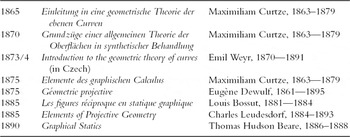
Cremona's papers conserved in Rome bear witness to the intense activity of translation of foreign texts typical of the nineteenth-century world of mathematics: a substantial number of these letters reflects the strong cultural motivation behind these initiatives that justified the considerable efforts made by the author and the translator as well as the risks undertaken by the publishing houses (Table 2). The aim was to select the best work at all levels regardless of the nationality or the language in which it was written, and to offer it in the national language and thereby contribute to the dissemination of mathematical culture in one's own country and implant it in the national culture in the broad sense. The translations were often undertaken by mathematics specialists who were not at the spearhead of research. Cremona himself, early in his career, translated a mathematics textbook, the Elements of mathematics by Richard Baltzer (1818–1887), which was published in several volumes in the years 1865–1868 and intended “for the secondary schools of the Kingdom of Italy,” and was as successful as the German original.
Translations of Cremona's books into French, English, German, and Czech in Cremona's correspondence.

The first proposal for the translation into French of his 1873 textbook on projective geometry Elements of Projective Geometry came from Charles Brisse (1843–1898), a polytechnician and teacher at secondary school level and at the École des Beaux Arts in Paris, who wrote the following to Cremona:Footnote 22
My heartfelt thanks for sending me your Elements of Projective Geometry, which I read with the greatest interest and which I feel from all points of view are suitable for facilitating the study of higher Geometry. If you would agree to allowing me to publish a translation thereof, I believe I would be rendering an important service to my mother country; it would perhaps enable courses similar to those established in Italy to be set up in France, of course following your advice. It is with this idea of placing teaching at the service of the progress of science in France that, in collaboration with an astronomer of the Observatory, M. André, I have published a Physics Course for use in the special mathematics classes. (Brisse to Cremona, Paris, 10th January 1873 [original letter in French]; emphasis added; now in Gario Reference Gario1994c, 9–10)
The English translator of Cremona's books on graphical methods, Thomas Hudson Beare (1859–1940), assistant lecturer in mechanical engineering at the time at the London University College Engineering Laboratory at London, wrote to Cremona in 1886 on the subject of the value of the translation he was desirous of undertaking for his country and for science:Footnote 23
For my own use & for the help of the Students working with me I have prepared a manuscript English translation of the work, and this I am very anxious with your consent & advice to publish. I am sure there would be a very fair, and I hope, as the book became through the translation accessible to a wider circle of students and Engineers, an increasing demand for it. It is an authorised text book at several of our English Colleges, in the curriculum for Engg students, but unfortunately few are able to derive the proper benefit from it. . . . I'm a very great admirer of Graphical methods, and very anxious to do all in my power to spread a knowledge of the methods in England, at present there is absolutely no reference book worthy of the name; a great want not only among Students, but to Engineers, [illegible] & many others, and I am confident that an English edition of your valuable book will supply a want long felt: and do much towards increasing the rise of the Graphical methods. (Beare to Cremona, London, 12 January 1886; now in Nurzia Reference Nurzia1996, 180)
But also the translation into Czech of Cremona's two principal monographs on geometry – Introduction to a Geometric Theory of Plane Curves (1862) and Preliminaries of a Geometric Theory of Surfaces (1866–67) – when the German translation by the historian of mathematics Maximilian Curtze (1837–1903) was already available, can be explained in terms of the context of the national spirit inspiring the work of the two brothers, Eduard (1852–1903) and Emil Weyr (1848–1894) and the mathematicians of the Czech Union of Mathematicians in Prague, when the Czech cultural area was still part of the Austro-Hungarian Empire.Footnote 24 Eduard, who stayed on as professor at the Czech Polytechnic of Prague despite the various offers of teaching posts in the empire, the last one in Vienna, was secretary of the Czech Union of Mathematicians from 1875 until his death. Emil's letters to Cremona also contain a discussion of the translation of mathematical terms into Czech, which demanded the coining of neologisms – an effort carried on in a number of countries, for instance, in Spain, and now often completely abandoned.
Mathematics for All, Mathematics for the Country
The fresh desire that was spreading among European mathematicians to develop autonomous mathematical research in their own national language might well have been detrimental to the universalistic ideal of mathematics and have acted as a concrete obstacle to communication. A brief mention of this problem is found in one of Zeuthen's first letters after the dispatch of a note in Danish, which Cremona certainly complained of not being able to read:Footnote 25
I promised you that from now on I would have my little works published in French and I feel I have already betrayed this promise; however, you will see that the date of what I have published is earlier than that of my promise. In any case, in the most essential part, the table, I use the universal language of Mathematicians. (Zeuthen to Cremona, Copenhagen, 25 August 1866 [original letter in French]; now in Gario Reference Gario1994b, 114)
Zeuthen's last letter to Cremona refers to another aspect of the process of democratization, the last in order of time, regarding the extension of rights, including that of education and professional practice, to women:
This is a good opportunity for sending you my best wishes [for a happy new year] as, not a young man but a young lady among my pupils, Miss Ellie, who wishes also to become one of your pupils, has begged me to recommend her to you. This I do gladly because she is deserving of my recommendations from all points of view: her qualities of young scientist in no way prevent her from being a lady of great modesty and breeding and she will not fail to profit from her stay in Rome to engage in serious studies. With her special interest in geometry, she was extremely happy to learn that in January you will be commencing lectures on geometry. I hope she may be admitted to the course and am certain that in any case you will not deny her your good advice whenever she should seek it. (Zeuthen to Cremona, Copenhagen, 29 December 1898 [original letter in French]; now in Gario Reference Gario1994b, 128: “parce qu'une – non pas un de mes élèves, M.elle Ellie”; emphasis in the original)
Years earlier, Cremona had intervened also in the sensational case of the candidature for a seat in the Swedish Academy of Sciences of Sonya Kovalesvskaya in 1886. Also as far as the inclusion of women in the world of mathematics is concerned, the universalistic ideal joined forces with the new liberal ideas that ultimately led to the extension of universal suffrage to women. With regard to Cremona's support of the Russian scholar, Hermite wrote: “You have defended the interests of Science, and the sacred interests of a woman who in all respects is worthy of our esteem and benevolence.”Footnote 26 Hermite's political stance is reflected in a short comment contained in a letter to Cremona written one year later, at the time of the Paris scandal which obliged the President Jules Grévy to resign:
You know, the whole world knows the events that plunge France into anxiety and the men of science who are not involved in politics play a part in the general anxiety. In my view, by changing the President the destiny of the Republic does not change, our unhappy history unfortunately tells us that the fall of Ministries and governments, the very violence of revolutions, can only change the unavoidable weaknesses of men and things from bad to worse. (Hermite to Cremona, Paris, 29 November 1887 [original letter in French]; now in Dell'Aglio Reference Dell'Aglio1992a, 91)
In the second half of the nineteenth century, there is no doubt that Prussia was the paragon of both economic and cultural excellence in the field of international competition. We have seen this in the case of mathematics and science in Cremona's words: “Lucky Prussia! Its arms have triumphed because they were guided by science”; and again: “in the learned and hard-working Germany we see new books come out every day, exposing geometry . . . in an increasingly simple, more elementary form, more accessible to even mediocre intellects.” However, politically speaking, Prussia represented a model of modernization that was the opposite of that represented by the French Third Republic or by Italy. Like Vittorio Emanuele II for unified Italy, Wilhelm I was proclaimed Deutscher Kaiser in January 18, 1871, but it was neither the decision of an elective assembly nor was it ratified by a democratic vote. Germany remained for decades an authoritarian state, until the end of the Great War, while Italy evolved a democratic political system. The strong political connotation of the German cultural model, also in the scientific and technological field, is clearly reflected also in the choice of the Japanese government starting in the 1880s, as Chikara Sasaki (Reference Sasaki, Parshall and Rice2002) has clearly shown. The desire to develop science was driven by nationalism also in Japan during the second half of the nineteenth century; initially it was not linked so much to economic competition as indeed to that at the military level after the defeat suffered by the country at the hands of Great Britain in 1863. The pioneer of autonomous mathematical research in Japan, Rikitaro Fukisawa (1861–1933), is a symbolic figure both due to his allegiance to the research imperative and to his work related to the development of the actuarial profession. As Sasaki recalls: “It is reported that when a student of his at the University of Tokyo asked why he studied mathematics, Fujisawa's answer was ‘For the nation!’ No words seem more appropriate to characterize not only why Fujisawa but also why Japanese mathematicians as a whole studied mathematics before 1945” (Sasaki Reference Sasaki, Parshall and Rice2002, 239).
While the initial byword of these efforts was generically “Eastern morality and Western techniques” (with reference to the technology strictly related to scientific development), Sasaki shows the influence on the development of Japanese mathematics exerted by the conservatives who theorized a choice of modernization following the Prussian political model, aimed at avoiding British and French influence, which was considered a harbinger of liberal ideas and radical republicanism.Footnote 27
From Cremona's correspondence it emerges how Italian mathematics, although dependent on the Prussian example, represented a second point of reference in a period of strong national sentiment. This was true above all for mathematicians who were still isolated within their own national culture, as well as for mathematicians with liberal leanings. In the first instance, unlike Prussia, Italy was still an essentially agricultural country, with an incipient industrial development, and thus was a model that was closer to those countries lacking a mathematical tradition: the model of Italy represented a strong stimulus, as it showed that mathematical culture could be reconstructed through an effort of political and cultural will. Secondly, Italian scientific and technical modernization was marked by the secular religion of science and of the nation, and by the desire to build a free society.
Mathematics and Modernity: The Tension between Universalism and Nationalism
Throughout the nineteenth century, in the case of several professional groups with a technical-scientific educational background, national passion – and democratic convictions themselves – found an outlet precisely through the establishment of national mathematics communities. The strong national thrust characteristic of this period is so conspicuous that it could suggest that the universal aspect of mathematics had disappeared during the transition from eighteenth-century mathematics to modern mathematics. By erecting a powerful barrier between the old “aristocratic” mathematics and the nineteenth-century mathematical world, such a historical interpretation could even suggest that the international nature of mathematics is “really an aspect of the discipline that has come about primarily in the twentieth century as a result of dynamic changes, especially during the closing quarter of the nineteenth century” (Parshall Reference Parshall1996, 295). Nevertheless, the very homogeneity of the single national processes actually points in the opposite direction. Indeed mathematics seems to be firmly entrenched in a national-universal tension that has traversed the last two centuries.
The national-universal tension in nineteenth-century mathematics was already apparent in one of the first specialist journals dedicated to mathematics, the Journal des mathématiques pures et appliqués, directed by Joseph Liouville (1809–1882) and published in Paris starting in 1836, a national enterprise that was nevertheless characterized by the attempt to build bridges with foreign countries (Lützen Reference Lützen, Parshall and Rice2002). Ivor Grattan-Guinness has claimed the need for a historiographical approach to Late Modern mathematics less narrowly focused on the single nations, and one that views scientific and technical activity in the framework of the developing culture of the time. This is apparent if we take a historiographic cornerstone such as the decline of French science in the period 1820–1870: if we bear in mind that circulation of French books through translations and avoid detaching mathematics from its strong links with engineering, which is one of the most striking contributions by enlightened and post-revolutionary French culture, the picture changes radically (Grattan-Guinness Reference Grattan-Guinness1993 and Reference Grattan-Guinness, Parshall and Rice2002). As Grattan-Guinness writes:
In other words, the decline in mathematics resembles an optical illusion caused by the rise of other countries. Throughout this period, levels of work were still achieved in France that exceeded those of most other countries.
France, then, was still a mathematical power to be reckoned with throughout the first three-quarters of the nineteenth century, but other nations – notably Germany and, to a lesser extent, Italy and Great Britain – also entered onto the international mathematical scene. Mathematics was no longer dominated solely by one nation; it increasingly reflected the achievements of a multinational effort. A look at some of the mathematical areas of interest during this period reveals the complexity of the interplay among the nations contributing to the research. (Grattan-Guinness Reference Grattan-Guinness, Parshall and Rice2002, 25)
The development of mathematics as a body of knowledge was driven by competition among nations as much as the development of industry, trade, and armies. However, this competition in mathematics was of quite a different nature as it was combined with the universal spirit which was a legacy of past mathematical research. A difference existed also regarding technological competition: it is only necessary to compare the intense activity of translation and the reviewing of mathematical essays with the industrial espionage typical of the nineteenth century, and even with the spirit of the universal expositions, which, although an exaltation of the idea of progress, also represented a showcase designed more to intimidate competitors than to actually spread technological progress (see, e.g., Bergier Reference Bergier1969). Leading mathematicians from every dawning national community aimed to be included in the international network through letters, diffusion of publications, and visits abroad. This inclusion was felt as the best way to establish the research imperative at the university and to stand in the forefront of modern, international mathematical culture.
In order to analyze the national-universal tension in mathematics it is thus necessary to examine the “complexity of the interplay among the nations,” and in particular, transnational relations among mathematicians: it is necessary to explore whether the network of international communication survived the political, social, and cultural upheavals of the revolution and the European wars of the early nineteenth century, whether it was transformed, and what may be learned through international contacts among individuals concerning the vision of one's own discipline and one's professional role in bourgeois society. One example of this is the correspondence between Charles Hermite (1822–1901) and his colleagues, which reflects his efforts to encourage the circulation of mathematical ideas between France and Prussia. Thomas Archibald has emphasized the role of both the political stance of a conservative like Hermite, who was naturally attracted by the German monarchy, and of the rivalry between France and Germany which “fueled interest in the work of their rivals and stimulated efforts on both sides of the border to be fully aware of the mathematical production of their competitors” (Archibald Reference Archibald, Parshall and Rice2002, 136). In the 1860s and 1870s Germany became the benchmark of the competition among western nations. And yet, in these same years, as Cremona's correspondence indicates, Italy came to represent a second pole of attraction, with a different political connotation.
In this phase, the national commitment of mathematicians, according to Cremona's letters, did not run counter to the universal spirit of mathematics. The European nineteenth-century mathematician was naturally a man of his time, a time in which, as François Furet wrote, “pride in one's national belonging penetrates the whole of European intellectual and social life.” Let us quote in detail Furet's inspiring depiction of the century, which had the great merit of demonstrating the key role played by the tension between national dimension and universal dimension in the deployment of the new principles brought by the French Revolution:Footnote 28
As for the celebration of the national idea, God knows that the men of the nineteenth century embraced it passionately, as they make it the focus of modern historiography as well as the most powerful driving force behind political activity. The pride of national identity penetrates the whole of European intellectual and social life. The French Revolution followed its path above all through this identity, which explains why it was admired, but also feared, in the name of the new principles it had caused to emerge: what was peculiar about it was that it authorized each nation accordingly to imitate it or fight it in the name of what it contained that was universal. And yet, none of the nineteenth-century wars – in any case few in number – presented the fearful nature of those of the twentieth century. Even in Germany, where it displayed most intensely the blindness and the perils involved in it, the national idea remains incorporated in that of culture. It does not propose as sufficient per se its pure substance, the particular election of the Germans, their superiority as human beings. It strongly enhances Germany's contribution to ethics, the arts, philosophy, culture. (Furet Reference Furet1995, 44–45)
The mathematical world of the nineteenth century developed and organized itself in accordance with the national ideal, with the “religion of the nation.” This was the case both in Prussia and then in unified Germany, under an authoritarian political regime, and in Great Britain or France, where liberal democracy was the elective regime, and also in other countries – not only in Europe but in any case gravitating around European culture – which were socially and economically more backward and with a less significant or weakened scientific tradition. Nevertheless, as Furet points out the national idea remained framed within that of culture, understood as having a universal value. What had been creative, fertile tension degenerated in the nineteenth century in the two ideologies of destruction of the twentieth century: fascism as the pathology of the national, communism as the pathology of the universal, according to Furet's convincing diagnosis (Furet 1996, 43). In the case of mathematics, a wide gap separates the intellectual atmosphere reflected in Cremona's letters both from the autarkic and racist views of the leaders of Italian mathematics during the fascist period, Francesco Severi (1879–1961) and Mauro Picone (1885–1977), and from the anti-Jewish racism driving the leaders of Aryan mathematics in Nazism. Indeed, Cremona's correspondence suggests that the incorporation of mathematics in the various national cultures was facilitated by the traditional conception of mathematics as a universal task, something that kept the communication networks between individual scholars alive. It is out of this cultural process, and in perfect continuity with it, that the efforts emerged that were directed towards the institutionalization of the relations among individuals, converting them into relations among nations. Indeed, as the international network, in a mathematics “of the masses,” could not be entrusted solely to the free exchange among mathematicians, journals were founded with a view to facilitating the international circulation of ideas (Acta mathematica in 1882, Rendiconti del Circolo Matematico di Palermo in 1887) and international mathematical congresses were promoted and attended by large “national delegations” (the five congresses of Zurich, Paris, Heidelberg, Rome, and Cambridge).
Acta and the Rendiconti, which are often considered the forerunners of present-day international journals (that is, not having any specifically national cultural connotations), although representing initiatives that were successful due to their cosmopolitan editors’ capacity to manage their international contacts and attract articles from the best mathematicians regardless of their nationality, were nevertheless born out of the desire to favor the development of national research: Acta was conceived of by Sophus Lie and Gösta Mittag-Leffler (1846–1927) as a showcase for Swedish or Scandinavian mathematics which also had the ability to stimulate its development (and the decision to publish research in non-Scandinavian languages was taken precisely for the purpose of facilitating the dissemination of the research), while the Palermo Mathematical Circle acted from its inception as a kind of Italian mathematical society (see Barrow-Green Reference Barrow-Green, Parshall and Rice2002 and Brigaglia Reference Brigaglia, Ausejo and Hormigón1993).
Also the idea of organizing international mathematics congresses was the direct offshoot of the way the national communities were gradually being consolidated and, at the same time, it was made possible by the supranational network of contacts among mathematicians. The main champion of this initiative was Georg Cantor (1845–1918), one of the prime movers behind the creation of the national society of German mathematicians which he also chaired for the first four years, between 1890 and 1893. In the three years that followed, Cantor set about involving French and German mathematicians in his idea (as well as the Russian Aleksandr V. Vasil'ev [1853–1929] in Russia), including Felix Klein, who championed the idea and maintained a close relationship with the principal American mathematicians; and the official support of the French, German, and American mathematics societies was obtained before the Swiss mathematicians accepted, in 1896, handling the organization of the first international mathematics congress in August 1897 in Zurich (Lehto Reference Lehto1998, Reference Lützen, Parshall and Rice2002)
As Lehto pointed out, the aftermath of World War I witnessed a new phase in international relations among mathematicians with the creation of the International Mathematical Union by the International Research Council, founded in 1919 in Brussels and directed by Émile Picard (1856–1941). What brought the promoters of this latter initiative together was essentially their hostility towards Germany and their attempt to reorganize scientific relations among nations by excluding this country. This initiative thus threatened to deprive the universal scholarly tradition in mathematics of its key role which, throughout the nineteenth century, had acted as a counterweight to the national spirit. But as far as the mathematical union experience is concerned, the rejection by many mathematicians of the exclusion policy advocated under the Treaty of Versailles led to its downfall, the only one of the scientific unions created by the International Research Council. This failure is a demonstration of the persistence of classical universalism in which mathematics was viewed as an enterprise conducted by a group of brilliant minds working with strong team spirit, human beings from all places and periods, and yet all offspring of their own cultural tradition. Universalism was kept alive in the period between the two world wars at Göttingen, in a Germany thirsting for revenge, at least until Nazism came to power. Instead, the lacerating crisis of liberal democracy dealt a harsh blow to the covenant between mathematics and nationalism on European soil.Footnote 29
Abbreviations
LCC stands for La corrispondenza di Luigi Cremona cf. the reference LCC