1 Introduction
Intensifiers and degree modifiers are two of the various labels which have been used in the literature to designate items like English very, terribly or completely. Intensifiers typically modify adjectives, adverbs or verbs, expressing the degree (very, terribly) or the precise value (completely) in which the quality expressed by that item is present. Research on intensifiers has enjoyed a very long tradition stretching back to the beginning of the twentieth century, with a renewed wave of scholarly attention emerging in the last decade. This recent interest has focused, among other issues, on the distribution of intensifiers across social groups, varieties, registers and text-types (Paradis Reference Paradis and Kirk2000a; Stenström Reference Stenström and Kirk2000; Bauer & Bauer Reference Bauer and Bauer2002; Tagliamonte & Roberts Reference Tagliamonte and Roberts2005; Pahta Reference Pahta, Dossena and Taavitsainen2006), on the competition of different intensifiers within a given period and across time (Ito & Tagliamonte Reference Ito and Tagliamonte2003; Méndez-Naya Reference Méndez-Naya2004; Nevalainen this issue; Tagliamonte this issue), and on the study of individual items, looking at the origin of their intensifying function, which has often been accounted for in terms of grammaticalization (Adamson Reference Adamson, Fischer, Rosenbach and Stein2000; Nevalainen & Rissanen Reference Nevalainen and Rissanen2002; Méndez-Naya Reference Méndez-Naya2003, Reference Méndez-Naya and Mazzon2007; Adamson & González-Díaz Reference Adamson and González-Díaz2004; Buchstaller & Traugott Reference Traugott, Kemenade and Los2006; Rissanen this issue), and at their development beyond the intensifier use (Tao Reference Tao2007; González-Díaz this issue). The present article belongs to this latter approach and sets out to shed some light on the origin and development of the intensifying function of downright, as in downright rude or downright nonsense. Although downright is not a high-frequency intensifier, it nevertheless offers an interesting case of the interplay of the processes of lexicalization and grammaticalization (Brinton & Traugott Reference Brinton and Traugott2005), and of the importance of context and inferencing in semantic change (Traugott & Dasher Reference Traugott and Dasher2002). In this article, I will focus on the different functions of the adverb and the adjective downright over time, the development of their intensifying function, as well as the relationship and interaction between their developmental paths.
Due to the low frequency of downright, the present study is intended as a qualitative rather than a quantitative one. In order to retrieve sufficient data for the study, I have surveyed several diachronic corpora covering the history of English (see Sources section), as well as the OED quotation database. For the syntactic functions of adverbs I will follow the framework proposed by Huddleston & Pullum et al. (Reference Huddleston and Pullum2002) and will use the term degree adjunct when downright assumes a verb phrase modifying role (e.g. oppose downright), and degree modifier when it has scope over adjectives and adverbs (e.g. downright rude).
The structure of the article is as follows: section 2.1 deals with downright adv, its origin and development and the different syntactic functions it realizes over time (spatial adjunct, degree adjunct and degree modifier). Section 2.2 goes on to discuss downright adj, the development of its reinforcer function and the influence it may have had on the intensifying adverb; finally, in section 3, the major conclusions are presented.
2 The adverb downright
In what follows it will be seen that the adverb downright starts as a spatial adjunct (fall ‘downright’), and develops an intensifying function, first as a degree adjunct, and then as a degree modifier of adjectives.
2.1 Downright as a spatial adjunct
According to the etymology provided by the OED (s.v. downright adv., a. and n.), downright Footnote 2 originates in the combination of the adverb down with the adjective or adverb right. The earliest examples of this combination in the data surveyed occur in BT and the DOEC, and are reproduced in (1)–(4) below:Footnote 3
(1)
Syn þa fet gebundene to ðam hehstan telgan, and
 heafod hangige ofdunrihte and þa fet uprihte.
‘Let the feet be bound to the highest branch and the head hang upside down and the feet upright.’
(Verc. Först, 110, 10; BTS s.v. ofdunrihte adv.)Footnote 4(2)
Fram þam crundelum oþ midne þone þone readan weg. Þonne adunrihte ut þurh þone sceagan.
‘From the barrow to the middle of the red path. Then/thence straight down out through the thicket.’
(Ch 414 (Birch 670) B15.8.125, DOEC)(3)
And swa forð on þa rugan hylle. Þonene adune rihte on ðone hæðenan byrgels.
‘And so forwards on to the uncultivated hill. From there right down to the heathen burial place.’
(Ch 586 (Birch 1030) B15.8.250, DOEC)(4)
Of wermundes tre adunricht inne ðe imade of ðane miðon anlang stremes on ðane ealde wdeforde on ðare grene wei on neðe heuedstokes.
‘From Wærmund's tree right down into/to the mouth of the river; from the mouth of the river along the stream to the old ford in the wood on the green path, to the head stumps below.’
(Ch 850 (Kem 641) B15.8.435, DOEC)

Example (1) illustrates the original form of the adverb down, ofdun, from the phrase of dune ‘off the hill or height’ (OED s.v. down adv.). The remaining examples show the weakened form adun(e) (OED s.v. adown adv. and prep., DOE s.v. adun). Downright can be spelt as a single orthographic word, as in (1), (2) and (4), or as two, as in (3). This raises the question of the status of the combination down+right in these examples. Since word division is not systematic in Old English (OE) manuscripts, there are two possible analyses here. One of the alternatives is to regard the combination as a compound adverb (Dieter Kastovsky p.c.). This analysis is favoured in BTS for ofdunrihte, which is given an independent dictionary entry, whereas neither BT nor Clark Hall has an entry for this form or for adunrihte. There is an entry for adunrihte in the comprehensive DOE, in which examples (2)–(4) are given as the only three occurrences of the word in Old English. However, an alternative analysis is also possible: down+right could also be interpreted as a phrase, in which the adverb right is a focusing modifier with scope over the directional adverb down, in analogy with examples such as (5) below, in which right modifies not a spatial adverb, but a spatial prepositional phrase (Méndez-Naya Reference Méndez-Naya2006: 151ff.). In such structures, the adverb right could precede or follow its head, as in (5) and (6) respectively:
(5)
& on ærne mergen þæs dæges up aras seo beorhte sunne riht on eastende þære heofone.
‘And in the early morning the bright sun rose right in the east of the firmament.’
(Byrhtferth's Manual BYRHTF 82, HC)(6)
He lay . . ., A ston under hise heued riƷt.
‘He lay . . ., a stone right under his head.’
(a.1250, Gen. & Ex. 1604; OED s.v. right adv. II. 7.a)
Posthead position was particularly common in Old and Middle English (ME) with adverbs like there, now, forth, down, adown or anon.Footnote 5 The position of right in focusing structures gradually became fixed, and this item was eventually restricted to preceding the focused element. The last example of focusing right in posthead position quoted in the OED occurs in connection with the adverb now and dates back to 1420 (OED s.v. right adv. II.6.b):
(7)
For ioy of a sweuene þat y haue mette now ryƷt.
‘For joy of a dream that I have had right now.’
(c.1420, Chron. Vilod. 2772; OED s.v. right adv. II.6.b)
Going back to downright, in the four Old English examples quoted above, right is postposed. However, it can also precede down (see (8) below), which would give support to a phrasal interpretation of the combination.
(8)
On ane healfe þæs minstres wæs an ormæte clif ascoren rihte adune, and seo deope ea Liger gehaten læg on oðre sidan.
‘At one side of the monastery there was an immense cliff cut straight down, and the deep river called Liger was on the other side.’
(ÆLS (Martin) B1.3.30, DOEC)
Both the MED and the OED have an entry for the form adownright, with examples going back to the twelfth, thirteenth and fourteenth centuries. As to the aphetic form downright, the earliest recorded examples cited in these historical dictionaries are from the thirteenth century (MED s.v. doun-right adv., OED s.v. downright A.1):
(9)
Þe drake . . . he flah dun rihte mid feondliche ræsen.
‘The dragon flew right down with a violent movement.’ (c.1275 (?a.1200), Lay. Brut
(Clg A.9) 25613; MED s.v. doun-right adv.1.a, OED s.v. downright A.1)
Irrespective of the analysis of the combination downright in these early examples as a compound or a phrase, what is clear is that it functions as a spatial adjunct indicating directional path ‘straight down; right down (to the ground); vertically; face down’ (MED s.v. doun-right adv.). In this directional sense, downright typically occurs with verbs or expressions evoking motion like hang, fly or fall,Footnote 6 as can be seen in the examples above and (10) below.
(10)
Gye smot Gayer wyth myght, / To þe erthe he feeledown ryght.
‘Guy beat Gayer with might. He fell down to the ground.’
(The Romance of Guy of Warwick. The second or 15th-century version 588, CME)
The question that now arises is whether in the previous examples downright can be regarded as a case of lexicalization. If so, when was the combination of the two adverbs lexicalized? Following the recent monograph by Brinton & Traugott (Reference Brinton and Traugott2005: 96), lexicalization is here taken to be:
the change whereby in certain linguistic contexts speakers use a syntactic construction or word formation as a new contentful form with formal and semantic properties that are not completely derivable or predictable from the constituents of the construction or the word formation pattern.
It seems clear that in the examples quoted so far the combination down+right is not yet lexicalized. To begin with, the meaning of the alleged new adverb is still easily recoverable from the constituents of the construction. Moreover, we can substitute down for downright in the examples and the meaning of the sentence changes little, as in (10ʹ).Footnote 7
(10ʹ) Gye smot Gayer wyth myght, / To þe erthe he feele down.
If we persist in assuming a phrasal origin for downright, another indication that lexicalization has not yet taken place is that until the fifteenth century, right could occur as a postmodifier in focusing structures (see (7) above), which suggests that the combination down+right could still be generated by productive rules of the language. The reverse ordering of the elements, right down, is also available (see (8) above and (11) below).
(11)
And smote the Duke with gret Ire . . . / That to the ground can he fall, / And the here with all the face / Fell ryght downe vnto the place.
‘And beat the duke with great anger . . . so that he fell to the ground. And the lord immediately fell right down flat on his face.’
(The Romance of Guy of Warwick. The first or 14th-century version 9960, CME)
The prevalent function of downright adv in Middle English was as a spatial adjunct, and as such it continued well into Modern English. According to the OED, the spatial sense ‘straight down, vertically downwards’ became obsolete in the eighteenth century, the last quoted example, dating from 1763, cited here as (12).
(12)
Several . . . were seen to sink downright, by some people who were on the cliffs.
(1763, Brit. Mag. IV. 554; OED s.v. downright A.1)
2.2 Downright as a degree adjunct
Alongside the directional sense of downright adv illustrated in the examples given so far, the Middle English period sees the evolution of the adverb into a degree adjunct, with the meaning ‘out-and-out, absolutely’ (Borst Reference Borst1902: 67; Mustanoja Reference Mustanoja1960: 318; MED s.v. doun-right adv. 2; OED s.v. downright A.2).Footnote 8
Locative and dimensional adverbs are, together with manner adverbs, a major source of degree modifiers, especially in Old English times (Fettig Reference Fettig1934: 60; Peters Reference Peters, Kellermann and Morrissey1992: 537). In what follows I will try to reconstruct the way in which spatial downright developed into intensifying downright. Following Traugott & Dasher's (Reference Traugott and Dasher2002: 34ff.) Invited Inferencing Theory of Semantic Change (IITSC), I concur with the view that new polysemies arise in specific contexts. Hence one way to search for the possible triggers of the change would be to take a look at the contexts in which downright adv is found, looking at the type of verbal predicates co-occurring with it in the Middle English period. As mentioned above, this adverb was at first associated with verbs of movement such as fall or fly, and denoted direction: ‘right down (to the ground)’. A survey of the different databases used for the present study shows that in Middle English texts downright very commonly occurs with verbs such as ME disten ‘to cast forcibly or violently; to strike or hit with violence’ (MED s.v. disten v., OED s.v. dust v.2), smite ‘to administer a blow . . . with the hand, a stick or the like’ (OED s.v. smite v. II.3.a.) or slay, whose original meaning is ‘to smite, strike, or beat’ (OED s.v. slay I.1.a); see (13) and (14). The blow would typically fall vertically downwards, that is, downright. Note the redundant PP to þer eorðe ‘to the ground’ in (13):
(13)
& duste him dunriht to þer eorðe
‘and hit him right down to the ground’
(c.1225 (?c.1200), St Marg.(1) (Bod. 34) 28/12; MED s.v. doun-right adv. 1)(14)
Whan þey had karoled alder best & ilkon schold han go to rest, So come þe geauntz þat ylke nyght, & on þe Troiens smyte doun ryght.
‘When they had sung their best and each one had gone to rest, then the giants came that same night and smote the Trojans to the ground.’
(a.1338, Mannyng, The Story of England. 1779–80, CME)
Sometimes the stroke was inflicted by means of a weapon, usually a cutting weapon like a sword or an axe, as in example (15), which contains the verb hew ‘to strike forcibly with a cutting tool’ (OED s.v. hew v. II.2):
(15)
Hewe him to þe grounde doun riƷt.
‘[He] hewed him right down to the ground.’
(c.1330, 7 Sages(1) (Auch) 22/488; MED s.v. doun-right adv. 1).
Downright is also found with verbs meaning ‘cut’, such as cleave, carve or slit, as in (16) and (17).
(16)
With that Guy his swerde vp heef, / And Morgadour down right all to-cleef / From the hede downe to the fote:
‘Then Guy lifted his sword and cleft Morgadour down to the ground, from his head down to his foot.’
(The Romance of Guy of Warwick. The first or 14th-century version, 4392–3, CME)
Such contexts invite the inference ‘completely’: in other words, to give a blow with a cutting weapon ‘straight down, down to the ground’ > to cut ‘from top to bottom’ > to cut ‘completely’.
In (13) and (15) above, the PP to þe grounde would render the directional sense of downright somewhat redundant, thus inviting the new degree reading. In the case of (16) the degree inference is reinforced by the presence of all (cf. Buchstaller & Traugott Reference Traugott, Kemenade and Los2006), and by the phrase from the hede downe to the fote. However, as the ‘original coded meaning is dominant or at least equally accessible’, the degree reading can be regarded as a generalized invited inference (GIIN) (Traugott & Dasher Reference Traugott and Dasher2002: 35).
In addition to the verbs mentioned above, two Middle English examples have also been recorded in which downright collocates with the verbs swithe ‘burn’ and burn; see (17) and (18). Here the original directional reading of downright ‘down to the ground’ still seems to be available, but the context clearly invites the degree reading: if something is burnt to the ground, it is burnt completely, to ashes (as in (18), tille askes).
(17)
þe lowe it swath sinful dounright.
‘The flame burnt the sinful downright.’
(a.1300, E.E. Psalter cv. 18; OED s.v. downright A.2)(18)
‘Philip left his machines without guard one night. The Saracens saw this and burnt them downright. He came in the morning. He wanted to make an assault, and found his machines ruined and burnt to ashes.’Philip left his engynes withouten kepyng a nyght, / þat perceyued þe Sarazines, with fire brent þam doun right. / For he com on þe morne, assaut he wild haf gyuen, / His Engyns fond he lorne, brent & tille askes dryuen.
(Peter Langtoft's Chronicle 176, CME)
Examples such as (18) and (19) seem to be more advanced in the development of the degree reading, since, although the original, spatial meaning of downright is still available, the new meaning is clearly dominant (cf. Heine's Reference Heine, Wischer and Diewald2002: 84 bridging contexts).
The obvious question which arises here is, when can we consider that the new degree meaning becomes semanticized as a new polysemy? In my opinion this takes place in contexts such as the ones reflected in examples (19)–(21) below. A stroke given with a cutting weapon like a sword or axe could cause death; thus, slay came to mean ‘to strike or smite so as to kill; to put to death by means of a weapon’ (OED s.v. slay II.5.a); and smite ‘to strike with a weapon, etc., so as to inflict serious injury or death; also, to strike hard with a cutting tool’ (OED s.v. smite 5.a.). The most common collocate of downright in the databases surveyed in the present study is indeed the verb slay, which in most cases has the meaning ‘to put to death by means of a weapon’. Alongside slay, we also find Middle English examples of downright with verbs such as die or quell in (19) and (20). Example (21) contains the expression smite to death. In this case, the fatal result of the blow is not yet codified in the verb itself, but rather in the prepositional phrase that accompanies it. With such verbs and expressions, the degree reading of downright is clearly foregrounded; what we observe here, then, is what Heine labels switch contexts, where ‘an interpretation in terms of the source meaning’ (Heine Reference Heine, Wischer and Diewald2002: 85) seems to be disfavoured (die, kill ?‘straight down’), and that the degree GIIN has become semanticized (Traugott & Dasher Reference Traugott and Dasher2002: 35).
(19)
For douke morgan sake Mani on dyd doun riƷt.
‘For Duke Morgan's sake many a one died outright/?*straight down.’
(c.1330 (?a.1300), Tristrem (Auch) 884; MED doun-right adv. 2)(20)
And when þe Englisshe-men saw þat, þai lopte on her hors, and fast pursuede þe Scottis; and alle þat abiden, þai quellede doune ryght.
‘And when the English saw that, they leapt on their horses and pursued the Scots fast, and they killed those that remained outright/ ?*down to the ground.’
(c.1400, The Brut 285, CME)(21)
Arwys . . . smote men to þe deþ doun ryƷt.
‘Arwys . . . smote men to death outright/ ?*‘down to the ground’.
(a.1400(c1303), Mannyng HS (Hrl 1701) 1373; MED doun-right adv. 2)
Taking up the issue of lexicalization (see section 2.1 above), the new meaning of the item ‘completely, out-and-out’ at this stage is no longer predictable from the constituents down+right. Moreover, as the semantic change described above was taking place, the adverb right also lost its ability to appear in posthead position in focusing structures. Therefore it would, then, be precisely at this time that a combination like downright would have developed both ‘formal and semantic properties that are not completely derivable or predictable from the constituents of the construction’ (Brinton & Traugott Reference Brinton and Traugott2005: 96), thus fulfilling the conditions for lexicalization. However, lexicalization is often associated with concretion (Brinton & Traugott Reference Brinton and Traugott2005: 108), while the new meaning acquired by downright is more general, representing the abstract domain of degree; it is also more centred on the speaker, evoking reference to a subjective norm. The acquisition of abstract, more subjective meanings is typically associated with the process of grammaticalization. It could therefore be argued that in the development of downright lexicalization takes place first, and once lexicalized, downright moves along the path of grammaticalization (cf. Lehmann Reference Lehmann, Wischer and Diewald2002).
The semantic change undergone by downright (spatial > degree) has an influence on word order. When downright is a spatial adjunct, it appears after the verb. This is also its typical position in the earliest degree examples. Postverbal position, however, becomes less and less common over the course of time, and eventually preverbal position becomes the typical option for the degree adjunct (see Quirk et al. Reference Quirk, Greenbaum, Leech and Svartvik1985: 596; Huddleston & Pullum et al. Reference Huddleston and Pullum2002: 579). This contrasts with the cases in which downright is still used in its literal, spatial sense, as in (12) above, in which end position is preferred.
Among the verbs collocating with intensifier downright in the OED quotation database and additional sources, we find the following:
16th century OED (1/0.04)Footnote 9 mock.
17th century OED (9/0.13) crave, burlesque, challenge, fall into a fit, indent, maintain, pay, swear, woe.
18th century OED (3/0.1) box, kill, persecute. Further examples from ECF are affront, cry, kiss, quarrel, refuse, seduce.
19th century OED split (1/0.01). Further examples from NCF include accept, apostatise, cut, love, oppose, reproach, win, worship.
20th century BNC starve.
As can be seen, most of the verbal collocates of downright are used to refer to something negative or unpleasant (die, mock, refuse, affront, etc.). However, in the NCF database, we do occasionally find downright with positive verbs like accept (see example (22)), love or worship. Note here the coordination between the intensifiers absolutely and downright:
(22)
But, Mr Knightley, are you perfectly sure that she has absolutely and downright accepted him?
(1816, Austen, Emma, vol. III ch. XVIII 338, NCF)
To judge from the evidence of the OED quotation database, degree adjunct does not seem to be a very common function of downright in earlier English. It is also certainly rare in Present-day English, with only one example in all the twentieth-century corpora surveyed for the present study. This was found in the BNC (100 million words) and is reproduced here as (23). A Google search, however, returned examples of the construction, as in (24), which testifies to the survival of this function to the present day.
(23)
While some downright starve, and others scrimp and save to afford the large cod and chips, not the small, a few spend thousands on sunken baths and antique rugs.
(BNC HGJ 486)(24)
Not only is he negative about the film, he downright hated it.
(www.canmag.com/news/4/3/2192)
2.3 Downright as a modifier of adjectives
This section is concerned with the use of downright adv as a degree modifier of adjectives, as in downright rude. The first examples of the adverb downright intensifying adjectives I have been able to trace go back to the seventeenth century, and are reproduced under (25) to (28).Footnote 10 This use remained rare until the nineteenth century, but even in nineteenth-century English and Present-day English downright cannot be regarded as a high-frequency intensifier (cf. Bäcklund Reference Bäcklund1973: 291).
(25)
Being possest with a deep melancholy, . . . he fell, as 'twere, downe right mad.
(1661, Wood, Life (O.H.S.) I. 395; OED s.v. possess v. 9.d)(26)
Your New Liturgy it self, is down-right Directorian.
(1661, R. L'Estrange, Relapsed Apostate Introd. B iij b; OED s.v. directorian a.)(27)
Unless you were down-right mad.
(1664, H. More, Myst. Iniq., Apol. 562; OED s.v. downright A.2)(28)
I found the Business of admitting the Emperor into the Guarantee, went downright lame.
(1670, Temple, Let. to Sir J. Temple Wks. 1731 II. 245; OED s.v. lame a. 2.a)
The adjectival heads recorded in the OED quotation database and additional sources include the following:
17th century OED (4/0.1) directorian, lame, mad (2).
18th century OED (3/0.1) angry, bantering and unintelligible, Swiss. ECF (12 exx.) affronting, anxious, bashful, extravagant, insolent, jealous, scandalous, scurrilous, sick, tired, tiresome, uneasy. CED rude.
19th century OED (13/0.17) audacious, drunk, Christian, earnest, English, finger-cold, hard, high-toned, savage, scared, tired, unevadable, weatherly. NCF (c. 40 exx.) among them: ashamed, bad, brutal, clear, corrupt, cowardly, detestable, enamoured, fond, frightful, glad, good, good-hearted, happy, honest, impossible, innocent, intolerable, mad, mean, rude, shameful, sick, silly, solemn, ugly, uncivil, unhappy, vulgar, weary, wicked, worth.
20th century OED (13/0.24) bad, creepy, horrid, hostile, mind-boggling, pernicious, porno dirty, rotten, rude, stupid, terrified, unbelievable, verry wickred. Brown (5 exx.) inhumane, nonsensical, pernicious, rude, worried. FLOB (2 exx.) dishonest, ignorant. Frown common. BNC (194 exx. downright + adjective) among them boring, clever, companionable, courtly, dangerous, delicious, depressing, enjoyable, essential, handsome, happy, hard-hearted, hostile, immoral, incompetent, infatuated, irritating, kinky, lucky, malicious, nasty, pessimistic, phoney, ridiculous, sanctified, selfish, sex-mad-filthy, specious, ugly, unattractive, unpatriotic.
As becomes clear from this list, the type of adjectival head conforms to a tendency to ‘emphasize something negative or unpleasant’ (OALD s.v. downright, see also Bäcklund Reference Bäcklund1973: 234), which has also been observed in connection with verbs. One may wonder why downright shows such a marked preference for negative collocates. Is negative polarity intrinsic to downright, as seems to be the case with intensifiers such as terribly or awfully, which derive from a negative lexical source (Lorenz Reference Lorenz, Wischer and Diewald2002: 144–5)? Or is it the context that endows downright with negative associations? The negative flavour of downright could be related to the up–down spatialization metaphor observed by Lakoff & Johnson (1988: 15–17), according to which happy is up–sad is down; good is up–bad is down; virtue is up–depravity is down, etc.Footnote 11 However, the fact that downright is also occasionally found with positive adjectives (in italics in the list above), both in the nineteenth-century sources and the BNC, could be seen as evidence that it is not an intrinsically negative item:
(29)
‘My good Utterson,’ said the doctor, ‘this is very good of you, this is downright good of you, and I cannot find words to thank you in.’
(1886, Stevenson, The Strange Case of Dr Jekyll and Mr Hyde 32, NCF)(30)
Some in disbelief that a car so beautiful, so fast and so downright delicious could cost as little as £27,000.
(BNC BM5 1909)
In any case, negative collocates clearly prevail, with only 11 out of the 194 examples of the intensifier downright recorded in the BNC modifying positive adjectives. Hence collocation with positive adjectives is marked, and can therefore be considered expressive (see Cacchiani Reference Cacchiani and Papi2006: 56).Footnote 12
As can be inferred from the meaning given in the dictionaries (‘out-and-out, absolutely’), downright is a totality modifier, namely a maximizer (Paradis Reference Paradis1997; Quirk et al. Reference Quirk, Greenbaum, Leech and Svartvik1985: 590). Following a principle of harmony (Paradis Reference Paradis1997: 66; Buchstaller & Traugott Reference Traugott, Kemenade and Los2006: 348), totality modifiers typically collocate with bounded adjectives, that is, adjectives indicating a definite value. Bounded adjectives can be conceptualized in terms of either-or, like mad or lame (limit adjectives Paradis Reference Paradis1997: 57) or may represent the extreme point on a scale (extreme adjectives Paradis Reference Paradis1997: 54), like intolerable. As can be seen in (25)–(28) above, the first recorded examples of downright intensifying adjectival heads contain limit adjectives. Extreme adjectives, in turn, are common collocates of this intensifier (e.g. detestable, intolerable). However, bounded heads are not the only possible collocates of downright over time. This intensifier modifies also some nongradable adjectives like directorian in (26) and Swiss, in (31). Note that by co-occurring with intensifiers nongradable adjectives are coerced into a degree reading, thus becoming gradable (Paradis Reference Paradis1997: 46, this issue).
(31)
My Valour is downright Swiss; I'm a Soldier of Fortune, and must be paid.
(1706–7, Farquhar, Beaux Stratagem v. v; OED s.v. Swiss B.1a)
Finally, adjectives indicating a range on a scale, that is, unbounded adjectives like happy in (32), are also common collocates of downright.
(32)
‘But it's all settled now,’ said Lily, ‘and I'm downright happy. I never felt more satisfaction, – never, Bell!’
(1864, Trollope, The Small House at Allington, ch. XX, 209, NCF)
When modifying unbounded (scalar) adjectives, downright evokes a range on a scale, thus being apprehended as a scalar modifier or booster (Paradis Reference Paradis1997; Quirk et al. Reference Quirk, Greenbaum, Leech and Svartvik1985: 591). This shift from bounded to unbounded readings has been shown to operate in the development of many intensifiers (see Paradis Reference Paradis1997: 82, this issue; Adamson & González-Díaz Reference Adamson and González-Díaz2004 on very; Buchstaller & Traugott Reference Buchstaller and Traugott2006 on all; Méndez-Naya Reference Méndez-Naya and Mazzon2007 on right), in connection with scalar particles (Traugott Reference Traugott, Kemenade and Los2006), and certain adjectives (Paradis Reference Paradis1997: 61; Buchstaller & Traugott Reference Traugott, Kemenade and Los2006: 348). Examples (29), (32) and (33) illustrate collocation with the scalar adjectives good, happy and dangerous.
(33)
The problem is that suppressing emotions is not only unsaintly; it is downright dangerous.
(BNC CA5 2163)
Due to the fact that the original meaning of downright has to do with absoluteness, when combining with scalar adjectives it indicates an extremely high degree, i.e. higher than very, which represents ‘the prototypical degree of intensification’ (Cacchiani Reference Cacchiani and Papi2006: 54). In this respect its development is similar to that undergone by extremely, whose original meaning was also ‘to the uttermost degree’ (OED s.v. extremely adv. 1), while nowadays it simply indicates a very high degree (OED s.v. extremely adv. 2; Bäcklund Reference Bäcklund1973: 175; Paradis Reference Paradis1997: 83). Most, all and right (Paradis Reference Paradis1997: 84, 86; Buchstaller & Traugott Reference Buchstaller and Traugott2006; Méndez-Naya forthcoming) are other former totality modifiers that, when collocating with scalar heads, have ‘continued to index the relatively high end of the scale’ (Buchstaller & Traugott Reference Traugott, Kemenade and Los2006: 365–6).
Examples (29) and (32) clearly show that downright expresses a very high degree: note that in (29) downright good of you further stretches the previous this is very good of you; in (32) Lily's superlative degree of happiness is further emphasized by the expression I never felt more satisfaction. It is often the case that downright appears in contexts which themselves evoke a gradation. This can also be observed in (33)–(37). Sometimes the high degree represented by downright is emphasized by focusing modifiers like even and just, or expressions such as if not downright X or not only X (but) downright Y.Footnote 13
(34)
He was barely civil to her, and downright rude to me.
(1747, B D5CHOADL 8, CED)(35)
In a sulky triumph, Drummle showed his morose depreciation of the rest of us, in a more and more offensive degree until he became downright intolerable.
(1861, Dickens, Great Expectations, vol. II, 115, NCF)(36)
Of these, a quarter took exception to general unfriendliness among the staff and management, while 16% found the staff ‘offhand, indifferent, surly or even downright offensive and insulting’.
(BNC K97 15311)(37)
It would be very difficult, if not downright negligent, for such a scheme to fail when it has been overloaded with money.
(BNC BM4 1023)
In contexts of this type it seems that besides expressing reference to a subjective norm (subjectification), downright has acquired an argumentative function, thus helping to organize discourse, in what could be considered an example of intersubjectification (see Traugott & Dasher Reference Traugott and Dasher2002: 31).
A remaining question to be answered is, what is the origin of the use of downright as an adjective modifier? Some intensifiers developed from adjuncts into degree adjuncts and finally into degree modifiers (see Nevalainen & Rissanen Reference Nevalainen and Rissanen2002; Rissanen this issue); it seems likely that downright could be considered a further example of this trajectory, even though degree adjunct is not a common function for the adverb. With some intensifiers this development took place via participles, which could be construed as either adjectives or verbs (e.g. OE swiþ e, Méndez-Naya Reference Méndez-Naya2003). However, no examples at all were found of downright in connection with participles in the sixteenth- and seventeenth-century OED quotations (the earliest examples of the degree modifier date back to the seventeenth century; see section 2.3). In my opinion, the trajectory pointed out above could have been reinforced by that of the adjective downright, which, both in its propositional and its reinforcing readings, may have played a decisive role in the development of the adverb downright, as discussed in section 3.
3 The adjective downright
Degree has usually been associated with adjectives and verbs. However, as maintained by Paradis (Reference Paradis, Bermúdez-Otero, Denison, Hogg and McCully2000b: 242 and the references therein, this issue), it is also a feature of some nouns. While adjectives are intensified by means of adverbs such as completely, terribly or downright, nouns are modified by certain adjectives, like complete in a complete fool, terrible in a terrible bore or downright in downright hatred. Such adjectives have ‘a heightening effect on the noun they modify’ (Quirk et al. Reference Quirk, Greenbaum, Leech and Svartvik1985: 429), thus conveying ‘the degree to which the property expressed in the head nominal applies in a given case’ (Huddleston & Pullum et al. Reference Huddleston and Pullum2002: 555). These adjectives have received various labels in the literature, among them intensifying adjectives (Quirk et al. Reference Quirk, Greenbaum, Leech and Svartvik1985: 429), reinforcing adjectives (Paradis Reference Paradis, Bermúdez-Otero, Denison, Hogg and McCully2000b), degree attributives (Huddleston & Pullum et al. Reference Huddleston and Pullum2002: 555) or simply intensifiers (Bolinger Reference Bolinger1972: 58ff.).
According to the OED, the adjective downright is first recorded in the sixteenth century.Footnote 14 The earliest examples show the original directional sense ‘directed straight downwards’, attested for the adverb from the very beginning. (38) below reproduces the first example quoted in the OED:
(38)
Downeright stroke, taille.
(1530, Palsgrave 215/1; OED s.v. downright B.1)
It is in the seventeenth century, contemporary with the emergence of the adjective modifier function described in section 2.3 for downright adv, that the adjective downright is found as a reinforcer, conveying the sense ‘absolute, out-and-out’ (OED s.v. downright B.2.b.). At precisely the same time, downright adj is also being used with the meaning ‘direct, straightforward, . . . plain’ (OED s.v. downright B.2.a; 1st OED quotation 1603), which was available for the adverb as well (OED s.v. downright A.3; 1st OED quotation 1600). To judge from the evidence drawn from the OED and the ECF databases, the adjective downright seems to be fairly common in the seventeenth and eighteenth centuries both with the meanings ‘absolute’ and ‘direct, straightforward’.
(39)
To be a downe-right Papist. ‘absolute, out-and-out’
(a.1628, Preston, Sermon before His Majestie (1630) 19; OED s.v. downright B.2.b)(40)
After this downe-right way of Creation. ‘direct, straightforward’
(1603, Shakespeare, Meas. for M. III.ii.12; OED s.v. downright B.2.a)
As an intensifier downright adj can be classified together with other reinforcing adjectives like absolute, complete, perfect, total or utter in the paradigm of totality modifiers (Paradis Reference Paradis, Bermúdez-Otero, Denison, Hogg and McCully2000b: 238). Reinforcer downright adj modifies nouns that define ‘some entity in a qualitative way’ (Bolinger Reference Bolinger1972: 84), and are ‘more adjective-like than typical nouns’ (Paradis Reference Paradis, Bermúdez-Otero, Denison, Hogg and McCully2000b: 241). These nouns ‘describe entities and phenomena’, can be the focus of exclamations (Such nonsense!), and are inherently evaluative. The degree nouns collocating with downright typically belong to two groups: (i) abstract nouns, like sorrow, violence, falsehood (cf. the corresponding adjectives sorrowful, violent, false), and (ii) evaluative nouns denoting a person (sometimes terms of abuse), like liar, fool or scoundrel.Footnote 15
The head nouns recorded in the OED quotation database and additional sources include:
17th century OED (22/0.57) among them: adorement, atheism, barbarism, beastliness, beggars, denial, honesty, hypocrite, illusion, lie, nonsense, papist, quarrel, sins, slaves, sorrow. CEDliberty, lie, pimp, Teague, thieving, tyranny.
18th century OED (32/1.16) among them: affront, atheism, bankrupt, beggars, clown, coxcomb, denial, devils, fib, fury, generosity, ignorance, impudence, kindness, lexiphanicism, perjuration, poverty, puerility, reprobate, revenge, shame, slaves. ECF (c. 50 exx.) among them: adulterydom, attack, butchery, confusion, contradiction, cruelty, defiance, disobedience, earnest, enthusiasts, folly, fool, force, frenzy, gaieté de coeur, hatred, hypocrisy, incest, kindness, love, lunatick, madman, martyr, murder, obscenity, opposition, passion, prostitute, pyrates, quarrel, refusal, roguery, scurrility, simplicity, tyranny, villainy, violence, wickedness.
19th century OED (37/0.48) among them: atheist, battle, calumny, craziness, dullness, earnest, emulation, fanaticism, fright, honesty, hustle, ignorance, ill-will, incompatibility, indecipherability, injustice, invective, lazing, looting, malignity, misca'ing, murder, naiveté, novelty, obedience, obstinacy, rebellion, revelation, rustle, scoundrels, servitude, slap in the face, stupor, womanism. NCF (over 100 exx.) among them: aberration, affection, arrogance, battle, charity, cruelty, curiosity, desperation, devil, disunion, driveller, extravagance, falsehood, fancy, fool, fun, honesty, idiocy, impossibility, inhumanity, insanity, insult, liar, lie, love, madness, mania, martyr, nonsense, obstinacy, passion, pleasure, quarrel, rebellion, refusal, robbery, ruin, scandal, scoundrel, secrecy, shame, shudder, slander, spoliation, stupidity, success, swindler, sympathy, terror, theft, truth, tyrants, vices, violence, wickedness.
20th century OED (8/1.16) barbarism, blub, despair, failure, heebee-jeebee, hooligan behaviour, lie, thought-policy. LOB sinfulness. Brown dishonesty, gluttons, incompetents. FLOB rejection. BNC (71 exx. of downright + noun) among them: abuse, badmouthing, belief, cheating, coercion, crap, deceit, disaster, disgrace, dishonesty, earnest, evil, falsehood, fraud, hostility, idiocy, incredulity, lie, mastery, obstinacy, rudeness, tyranny, vulgarity, weirdness.
As can be inferred from the list above, nouns modified by downright adj are mostly negative (cf. the tendency to co-occur with negative heads observed for both the degree adjunct and the modifier). However, as was also the case with the adverb downright, the intensifying adjective downright can occasionally collocate with positive heads like love or pleasure (in italics in the list above), as in (41):
(41)
It's hard to be blind, to be sure, else money comes in so easily now to what it used to do; and it's downright pleasure to earn it, for I do so like singing.
(1849, Gaskell, Mary Barton, vol I, ch. xii, 224, NCF)
The reinforcer downright also has some structural features which differ from those shown by the adjective when used in its propositional senses and which indicate that it is no longer a prototypical adjective. These are the following:
(i) The intensifier downright is restricted to premodifier position and favours indefinite contexts (e.g. he's a downright papist in (39) or it's downright pleasure in (41), (cf. Quirk et al. Reference Quirk, Greenbaum, Leech and Svartvik1985: 429–30; Paradis Reference Paradis, Bermúdez-Otero, Denison, Hogg and McCully2000b: 249; Huddleston & Pullum et al. Reference Huddleston and Pullum2002: 555)), while in its two propositional senses (i.e. ‘directed straight downwards’ and ‘direct, straightforward’) it can freely occur in predicative function; see (42) and (43).
(ii) When used in its propositional senses, the adjective downright can be modified by intensifiers like quite and very, as shown in (42) and (43). Intensification does not seem to be possible, however, with the reinforcer downright (*it's a very downright pleasure).
(42)
Its motion was . . . quite downright, i.e. perpendicular to the horizon.
(1759 Phil. Trans. LI. 299; OED s.v. downright B.1)(43)
The Minister can be very downright and brutal and dogmatic at times.
(Dáil Éireann vol. 53, 5 July 1934; http://historical-debates.oireachtas.ie/D/0053/D.0053.193407050009.html)
All this suggests that, when used as a reinforcer, downright adj has lost characteristics of its original lexical class (decategorialization, Hopper Reference Hopper, Traugott and Heine1991: 22). This, paired with the loss of its original propositional content, and the acquisition of the abstract notion of degree, indicates a certain degree of grammaticalization (cf. Paradis Reference Paradis, Bermúdez-Otero, Denison, Hogg and McCully2000b). The reinforcer use of the adjective downright was relatively frequent from the seventeenth century onwards, and it might well be the case that it boosted downright adv, contributing to the establishment of the modifier use of this adverb (see section 2.3).
In addition to the reinforcer downright, another construction involving downright adj which may have played a role in the development of downright adv into a degree modifier is the one illustrated in example (45), where the adjective downright ‘direct, straightforward, . . . plain’ (OED s.v. downright B.2.a) precedes a second, quasi-synonymous adjective:
(44)
and become a down-right, honest Oxford Bargeman.
(1681, B D4HOSAM 26, CED)
In attributive structures such as this, the adjective downright, being placed in the left-most position in the string, may have been understood as an evaluative rather than a descriptive adjective and, as a result, it may have been reinterpreted as a degree modifier, as has been shown to be the case with the adjective lovely and possibly with very (see Adamson Reference Adamson, Fischer, Rosenbach and Stein2000; Fischer Reference Fischer2006: 261 fn8; cf. also Mustanoja Reference Mustanoja1960: 326–7; Adamson & González-Díaz Reference Adamson and González-Díaz2004). We might contrast (44) with (45) below, where downright occurs in the rightmost position and is therefore descriptive (Adamson Reference Adamson, Fischer, Rosenbach and Stein2000: 46).
(45)
‘– I'll write to them, though, that you are a blunt untaught fellow.’ ‘Ay, ay,’ replied Craigengelt; ‘a plain, blunt, honest, downright soldier.’
(1830, Scott, The Bride of Lammermoor, vol. II, ch. XIII, 190, NCF)
This structure may have facilitated the extension of downright to positive adjectives, since the earliest examples include adjectives such as honest, good-natured, which have a similar meaning to that of downright (OED s.v. downright B.2.a), as in (46). In this example punctuation suggests that there is no intonational boundary between downright and the following adjective.
(46)
‘But she's a downright good-natured woman, for all that.’
(1859, Eliot, Adam Bede, vol. III, book 6th, ch. LIII, 309, NCF)
4 Summary and concluding remarks
The earliest instances of the syntactic combination/compound downright are found in Old English times. However, lexicalization does not seem to take place until the late Middle English period, when downright starts to combine with verbs incompatible with its original directional sense. It is also at this point that the adverb right can no longer appear in posthead position in focusing structures. Contemporary with this restriction, downright adv also experiences a change in meaning and is recruited into the domain of degree, thus starting to move towards a more grammatical status. From a semantic point of view this growing grammaticalization entails, in addition to the expression of the abstract notion of degree, that of the speaker's point of view and evaluation (subjectification). Moreover, downright also seems to have acquired some sort of argumentative function (intersubjectification). From a structural point of view the growing grammaticalization of downright adv materializes in a number of features, such as its premodifier position and its growing specialization as an adjective modifier (to the detriment of the degree adjunct function).
The adjective downright derives and takes its meanings from the adverb, including the degree meaning ‘out-and-out’. When used as a reinforcer it is restricted to indefinite contexts, can no longer occur in predicative function (*the nonsense is downright) or be intensified by a degree modifier (*it's a very downright nonsense), thus losing adjectival features.
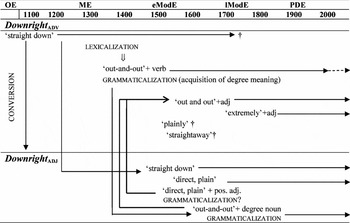
The relation between the adverb and the adjective works both ways: as mentioned above, downright adj derives from downright adv. In turn, the intensifying adverb downright, which was fairly infrequent in the seventeenth and eighteenth centuries, gained momentum under the influence of its adjectival counterpart, which at that time was by far the more common of the two items. The crucial period in the development of the intensifier downright (both the adverb and the adjective) is the seventeenth century: the earliest attested examples of the degree modifier (examples (25)–(28)), the reinforcing adjective (example (39)) and downright ‘direct, etc.’ in attributive structures preceding a second quasi-synonymous adjective (example (44)) all date to this period.
Figure 1 depicts the history of both downright adv and downright adj and tries to capture the connection between them.
The history of downright

The foregoing discussion shows that, although downright is a low-frequency intensifier, its history is nevertheless worthy of close attention. The evidence presented in this study shows that (i) the processes of lexicalization and grammaticalization can be at work in the history of a single item; (ii) the development of the degree reading of downright adv is a convincing example of Traugott & Dasher's IITSC; (iii) as is the case with other intensifiers, the histories of downright adv and downright adj are closely intertwined; finally (iv) this case study has provided a further example of the general tendency which intensifiers have of developing unbounded readings from bounded conceptualizations.
Sources
BNC = British National Corpus; Aston, Guy & Lou Burnard. 1997. The BNC handbook: Exploring the British National Corpus with SARA. Edinburgh: Edinburgh University Press.
CED = A Corpus of English Dialogues 1560–1760. 2006. Compiled under the supervision of Merja Kytö (Uppsala University) & Jonathan Culpeper (Lancaster University).
CME = Corpus of Middle English Prose and Verse. Available online at the Middle English Compendium. www.hti.umich.edu/c/cme
DOEC = Healey, Antonette diPaolo (ed.). 2004. Dictionary of Old English Corpus in electronic form. Toronto: University of Toronto. http://ets.umdl.umich.edu/o/oec
ECF = Eighteenth-Century Fiction. 1996. Electronic Book Technologies Inc./ Chadwyck-Healey. Cambridge.
HC = The Helsinki Corpus of English Texts. 1991. Helsinki: Department of English. http://helmer.aksis.uib.no/-icame/hc/index.htm
Hofland, Knut, Anne Lindebjerg & Jørn Thunestvedt (eds.). 1999. ICAME Collection of English Language Corpora, 2nd edn. University of Bergen. The HIT Centre. [Brown = The Brown Corpus of Present-Day American English; FLOB = Freiburg–Lancaster–Oslo–Bergen, Frown = The Freiburg–Brown Corpus of American English].
NCF = Nineteenth-Century Fiction. 1999–2000. Electronic Book Technologies Inc./ Chadwyck-Healey. Cambridge.