Service in the Roman army is the best attested of the routes by which provincials acquired Roman citizenship in the imperial period. The process is documented by the rapidly growing corpus of military diplomas, which now number more than 1,200. Yet few scholars have ventured even a rough estimate of the scale of the phenomenon. The handful of exceptions all envisage that the beneficiaries numbered several millions.Footnote 1 Friedrich Vittinghoff suggested in passing that at least two million soldiers and their children had been enfranchised by the middle of the second century.Footnote 2 Hartmut Wolff estimated that the army created between three and five million new citizens over the first two centuries.Footnote 3 Graham Webster envisaged three million each century.Footnote 4 Most recently, an article-length analysis by Alfredo Valvo implied between three and six million over the period 52–212 c.e.Footnote 5 This paper proposes that these figures significantly overestimate the scale of enfranchisement. Perhaps more provocatively, it contends that they also exaggerate the degree of uncertainty. I will argue that we can be confident that the total number of new citizens created by the army between 14 and 212 c.e. was somewhere between 0.9 and 1.6 million.
This paper makes three advances on past attempts to quantify enfranchisement. First, it includes consideration of the fleets and legions, whereas previous estimates have considered the auxilia alone (and still overestimated the overall scale of enfranchisement). Second, it takes account of the fact that the rate of enfranchisement must have fluctuated considerably over the course of the two centuries as, for example, the manpower of the auxilia expanded by around 50 per cent or when grants to auxiliaries’ children were discontinued in 140 c.e. All previous estimates have been based on extrapolation from a notional annual average — usually based on the situation in the mid-second century, when the rate of enfranchisement must have been at a peak — and fail to take account of these developments. Third, and most importantly, it offers a rigorous accounting of the uncertainties involved. The exercise of quantification entails working with input quantities that range from those that can be estimated with reasonable precision (for example, the nominal strength of the auxilia in the early second century) to the highly uncertain (for example, the manpower of the fleets). This paper uses probability as a measure of uncertainty in order to quantify how the uncertainties surrounding the input quantities affect the uncertainty about the overall scale of the phenomenon. The goal is not just to provide a best estimate of the number of beneficiaries, but also to quantify how uncertain it is.
Part I reviews what is known about grants of citizenship to soldiers, with particular attention to the uncertainties that remain. Part II examines the state of knowledge about the three most important variables for any attempt at quantification: the manpower of the auxilia, fleets and legions, the proportion of soldiers who survived to discharge and the number of children they had. Part III presents a mathematical model of enfranchisement and interprets the results.
I THE ARMY AND CITIZENSHIP
Before Claudius
The practice of granting citizenship to foreigners who fought for Rome goes back to the Republic.Footnote 6 But these were discretionary grants by magistrates, the antecedents of viritane grants by the emperors. This probably remained the norm even after Augustus reorganised the non-citizen forces into a permanent formation. It is widely assumed that the enfranchisement of auxiliaries and classici (men in the fleets) did not become regular practice until the reign of Claudius, though there remains some scope for doubt on this count.Footnote 7 It was certainly Claudius who introduced the practice of issuing beneficiaries with bronze diplomas.Footnote 8 That innovation may well have been linked to the introduction of a new system of regular grants. It would be consistent both with a wider Claudian programme of reforms to the army and with Claudius’ later reputation for being overly generous with Roman citizenship.Footnote 9
Nevertheless, it is clear from epitaphs that some auxiliaries were granted citizenship by Claudius’ predecessors.Footnote 10 On the other hand, we know of at least ten cases (including three discharged veterans) of soldiers who had served well over twenty-five years and yet did not have citizen-form names.Footnote 11 Perhaps the most poignant example is Nertus son of Dumnotalus, a Gaul serving in the ala Hispanorum I who appears to have been discharged as a peregrine after thirty-six years of service.Footnote 12 There is clearly no question before the reign of Claudius of automatic enfranchisement after twenty-five years of service.
It is nonetheless striking that most known veterans from the Julio-Claudian period do have citizen-form names.Footnote 13 We cannot rule out the possibility that, even under the first three emperors, most soldiers who survived to discharge did receive a grant of citizenship. In this case, the irregular pattern visible in the epitaphs would be the result of variation in the timing of the grant and the well-established variability of service length before Claudius (when some soldiers apparently served as long as fifty years while others were discharged after just twenty-five).Footnote 14 Nevertheless, the predominance of citizens among known veterans may just be an artefact of the epigraphic habit, if citizens were more likely to be commemorated with a Roman-style inscribed stone grave-marker. The conventional view that only a small proportion of soldiers could expect to benefit may well be correct. But it cannot be taken for granted.
Further uncertainty surrounds the treatment of classici and children. Given the absence of evidence for enfranchised classici before Claudius, it is possible that any grants were limited to the auxilia in this period. As for dependents, soldiers may have received conubium and citizenship for their children (as later beneficiaries did), but it is also possible that they only received personal grants of citizenship (as republican precedent suggests).Footnote 15 In short, the scale of enfranchisement before Claudius remains highly uncertain.Footnote 16
The Claudian System
We are relatively well informed about grants to the auxilia and fleets from the 50s c.e. thanks to the introduction of diplomas. These small bronze diptychs were issued to benefiting soldiers to document their privileges.Footnote 17 The diplomas were inscribed with copies of the imperial constitution that effected the grant along with the name of the beneficiary and any wife and children for whom they claimed benefits.
The normal grant formula specifies that soldiers had to serve at least twenty-five years to qualify.Footnote 18 But this was a minimum and some soldiers — we do not know how many — had to wait several years longer.Footnote 19 Since auxiliaries regularly served terms of at least thirty years under Claudius (they had served even longer under his predecessors), grants were initially made to soldiers while still in service.Footnote 20 The average term of service seems to have shortened further under the Flavians and there was a gradual shift to making the grant at discharge. The development can be traced in the evolution of the grant formula. Until c. 90 c.e., all grants are to serving soldiers (‘qui militant’). The next two decades see the appearance of mixed grants to serving soldiers and veterans (‘qui militant … item dimissis’) and a few grants to veterans alone (‘qui militauerunt’). From c. 110 c.e. grants to veterans become the norm.Footnote 21 Since a fixed twenty-five-year term does not seem to have become standard until the mid-second century (and even then a minority continued to serve longer), postponing the grant to discharge meant that some soldiers continued to wait somewhat longer than twenty-five years for their grant.Footnote 22
Auxiliaries received citizenship for themselves — if they did not already have it — and (until 140 c.e.) also for their children and descendants — ‘ipsis liberis posterisque eorum’ in the formula of the imperial grant.Footnote 23 Despite the implications of the open-ended reference to posteri (‘descendants’), it is likely that the grant itself only benefited living progeny (more specifically those named in the grant).Footnote 24 Any children or grandchildren born after the grant would have acquired their status at conception or birth in line with Roman law. Wives were excluded from the grant of citizenship, but the soldiers also received a grant of conubium with a current or future wife which would ensure that any future children by that wife would be citizens.Footnote 25 (In the absence of conubium, any children by a non-citizen wife would inherit their mother's status.Footnote 26) It is unclear whether the grant of conubium also extended to progeny — probably the most significant gap in our knowledge of the Claudian regime.Footnote 27
The same privileges were granted to classici in the Italian and provincial fleets. Indeed the earliest surviving diploma was issued to a rower in the Misenum fleet.Footnote 28 Unlike many other navies, there does not appear to have been any sharp distinction between sailors, rowers and marines: all alike were classed as soldiers (milites).Footnote 29 The only difference from auxiliaries was that classici had to serve a minimum of twenty-six (later twenty-eight), rather than twenty-five years.Footnote 30
The Change in 140 c.e.
Grants to auxiliaries’ offspring were abruptly discontinued in 140 c.e.Footnote 31 The content of the grant was reduced to citizenship and conubium for the soldier alone. The picture is complicated somewhat by a small minority of later diplomas that include an additional provision (introduced ‘praeterea praestitit …’) for the enfranchisement of children who had been born before their fathers enlisted.Footnote 32 Variations in the wording of the provision over the period 142–206 c.e. suggest that there was a transitional period of around fifteen years in which all auxiliaries were entitled to claim citizenship for children born before they entered service (presumably a small population, given an average age at enlistment around twenty), but that the exemption was soon (by the late 150s) restricted to centurions and decurions, and later extended in their case to include children born in service.Footnote 33 The overall effect will have been negligible in comparison to the scale of grants before 140 c.e.Footnote 34
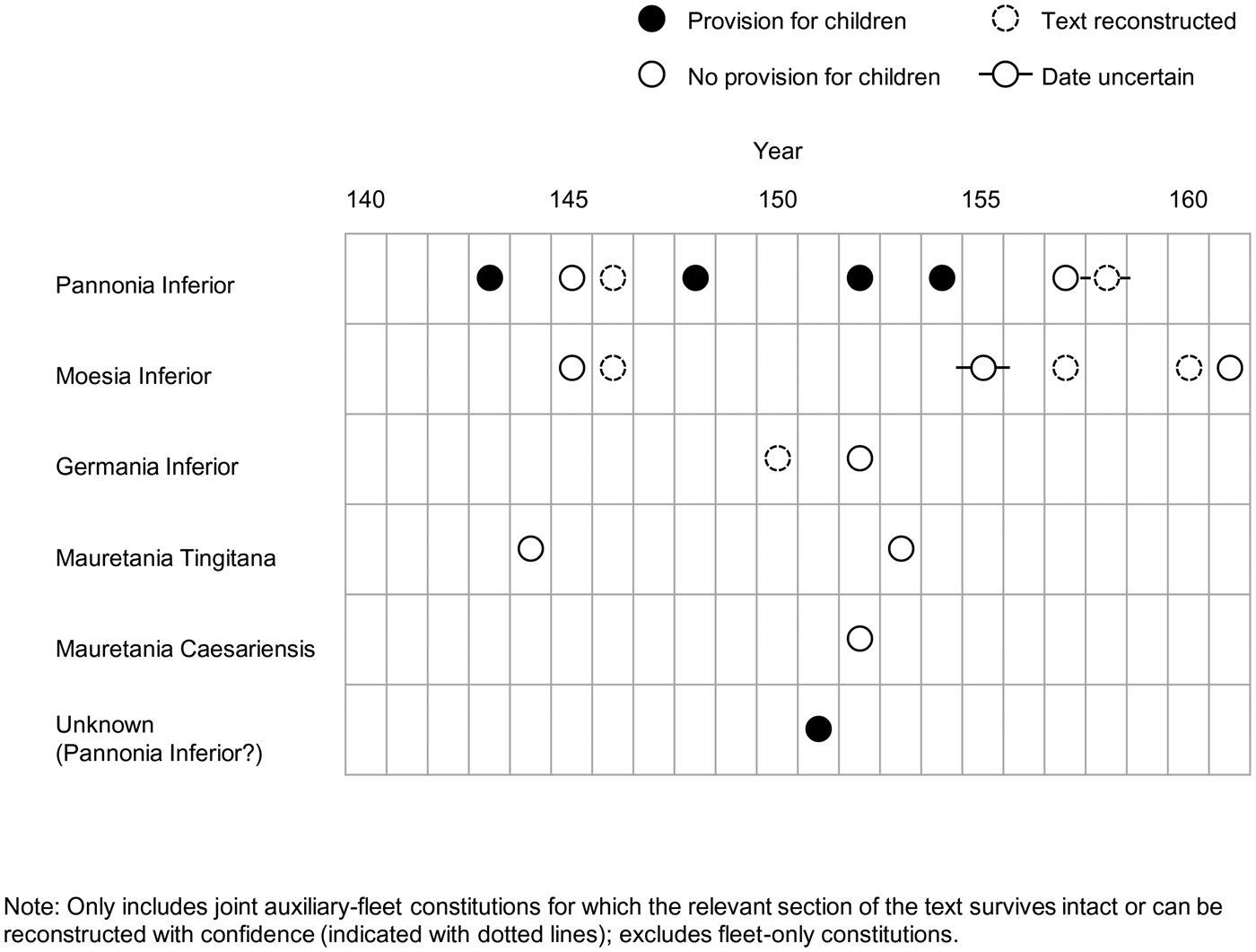
A much more significant exception is the fact that the soldiers in the Italian fleets continued to receive citizenship for their children as before. A minor change in 158 c.e. introduced a requirement to prove that children had been born of a recognised union (perhaps to combat fraudulent declarations, though the text may merely have codified existing practice). Otherwise classici in the Italian fleets continued to receive citizenship for their children through to 212 c.e. (and indeed after).Footnote 35 The situation in the provincial fleets post 140 c.e. is more obscure and has elicited conflicting interpretations.Footnote 36 The picture is slowly becoming clearer thanks to the expanding corpus of diplomas (see Fig. 1).Footnote 37 There were between seven and ten provincial fleets in the second century.Footnote 38 By 140 c.e., they were often (but not always) combined with the auxiliary units in the province in which they were based for the purposes of citizenship grants.Footnote 39 Four such joint auxiliary/fleet constitutions for Pannonia Inferior, dating between 143 and 154 c.e., include a grant of citizenship for the children of classici (‘item filiis classicorum’).Footnote 40 But the clause is missing from diplomas issued under joint constitutions for 145 and 157 c.e. and probably also on a constitution for 146 c.e. and another dating somewhere between 154 and 161 c.e.Footnote 41 More significantly, it does not appear on any of ten other joint constitutions attested for the provinces of Moesia Inferior, Germania Inferior, Mauretania Tingitana and Mauretania Caesariensis dating between 144 and 161 c.e.Footnote 42 It does appear on a diploma from a joint constitution for an unknown province from 151 c.e. Given the other evidence, however, this seems most likely to be from another constitution for Pannonia Inferior.Footnote 43
Grants for children of classici in joint auxiliary-fleet constitutions after 140 c.e.
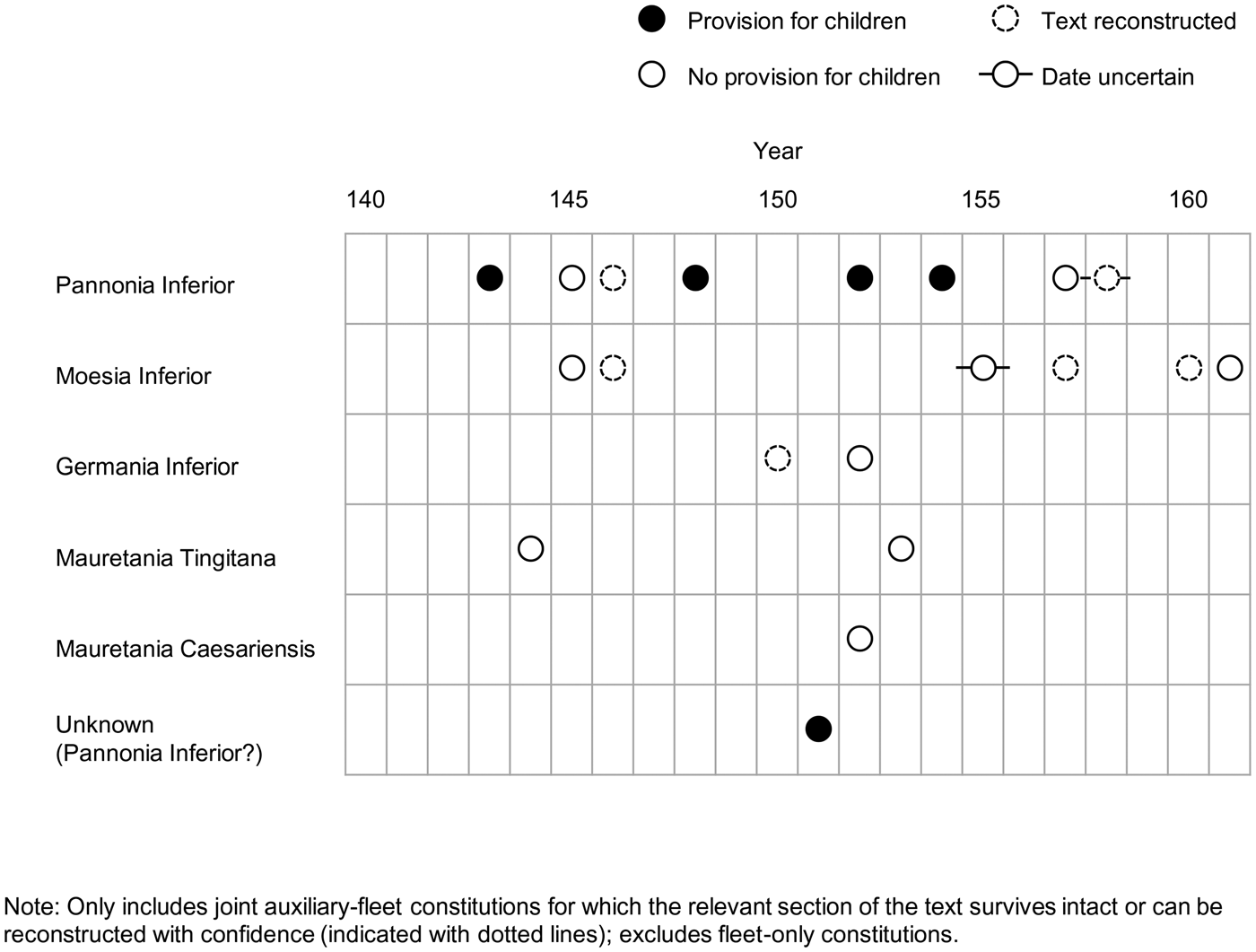
It is clear from the surviving diplomas that classici in Pannonia Inferior often received citizenship for their children through 154 c.e. Given the hiatuses in 145 and probably 146 c.e., it would be dangerous to assume that the absence of the formula in 157 and on the diploma of 154–161 c.e. indicates a permanent cessation of grants.Footnote 44 It is entirely plausible that irregular grants to the children of classici in Pannonia Inferior continued after the diploma evidence peters out. On the other hand, the fact that there is no provision for children on any of the joint constitutions attested for other provinces makes it extremely unlikely that the same privilege was enjoyed by all provincial fleets. It must have been limited to the Pannonian fleet and perhaps a few others.Footnote 45 The Pannonian fleet was one of the smaller fleets. The three largest — and hence most important for a quantitative analysis — were the British, German and Pontic fleets.Footnote 46 There is unfortunately no evidence at all for the first and last of these, but the two constitutions that provided for the German fleet suggest that its soldiers were among those normally denied citizenship for their children. In sum, it seems that a minority — probably a very small minority — of classici in provincial fleets continued to receive citizenship for their children until at least 154 and conceivably through to 212 c.e.Footnote 47
Universality
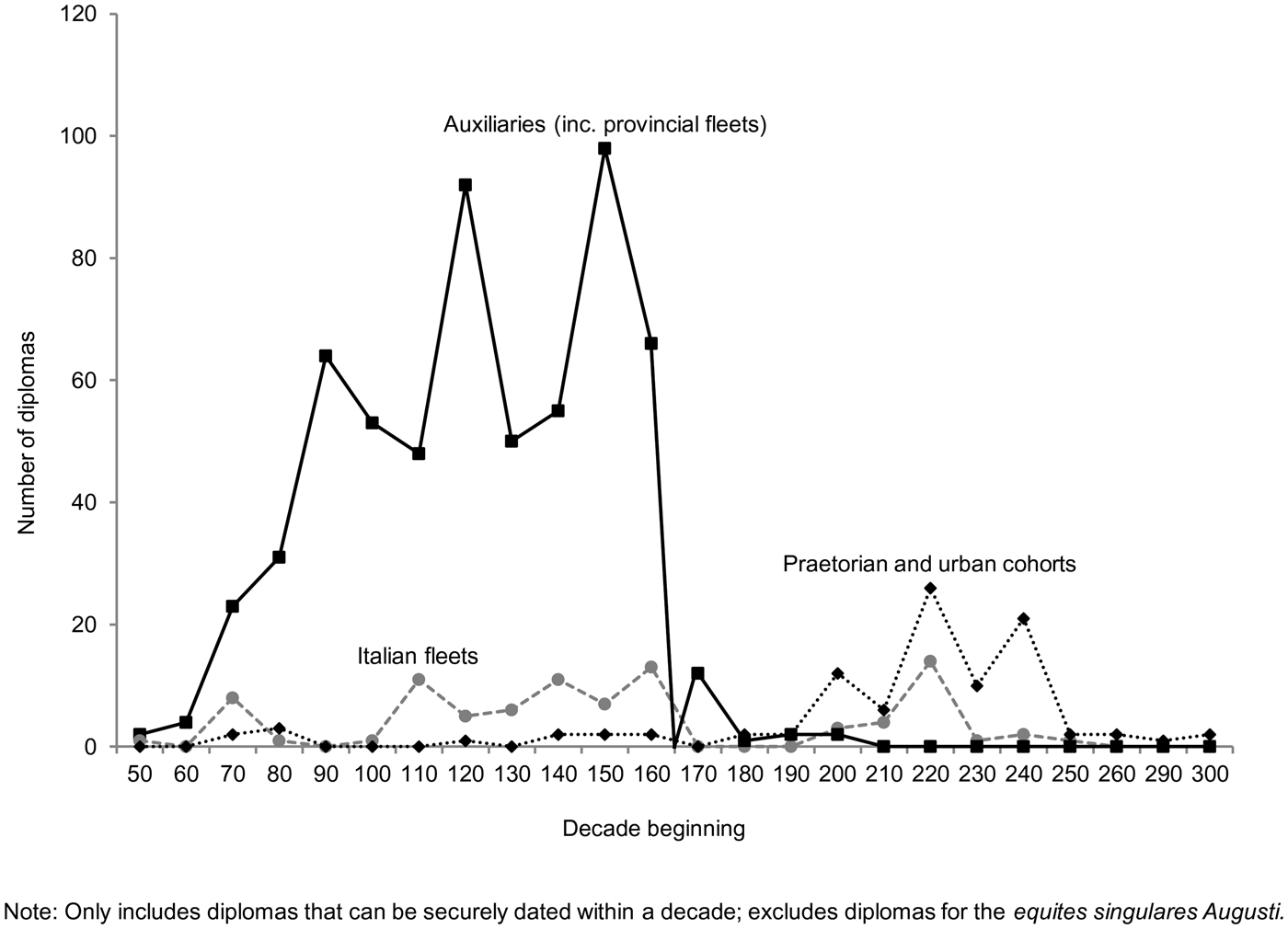
The scope of the Claudian system of grants used to be a matter of debate. Some argued that grants of citizenship remained a discretionary reward for exceptional service rather than the norm for all soldiers.Footnote 48 But the rapid proliferation of diplomas has made it very hard to escape the conclusion that most units received a grant almost every year from the 90s through the 160s c.e.Footnote 49 There remains, however, some room for doubt for the earlier first and later second centuries, because of the relative paucity of diplomas from those periods (Fig. 2).Footnote 50 The number of diplomas per decade rises rapidly from the reign of Claudius to the 90s and then more gradually through to the 160s c.e. There follows a complete hiatus from 167/8 to 177 c.e. (illustrated indicatively in Fig. 2), after which diplomas resume at a much lower rate.
Chronological distribution of surviving diplomas.

The fall-off in diplomas after 167 c.e. has drawn the most attention. Two explanations enjoy wide currency, neither of them convincing. Some cite an increase in the proportion of citizens serving in the auxilia, but that should have produced a gradual decline, not a sudden drop.Footnote 51 Others suggest that the reform of 140 c.e. reduced the value of diplomas, leading fewer soldiers to request one thereafter, but this ignores the fact that diploma volumes continue to grow for at least three decades after the reform.Footnote 52 With the growing volume of diplomas, however, it has become clear that the complete hiatus that lasted c. 167–177 c.e. was the result of an administrative decision to discontinue the issuance of diplomas, presumably related to the exigencies of the Antonine plague and the German wars. Continuity in the witness lists that attested to the validity of each diploma indicates that grants nonetheless continued in this period; they were probably documented on some more perishable medium.Footnote 53 The extremely low volume of auxiliary diplomas thereafter (up to the last known example in 206 c.e.) is probably also related to this temporary measure. Peter Weiss and Michael A. Speidel have recently suggested that Commodus resumed production of bronze diplomas but limited them to the Roman units and Italian fleets and that auxiliaries were henceforth issued diplomas only if they paid for them (which would explain why auxiliary diplomas slow to a trickle rather than ending altogether).Footnote 54 Again, continuity in the witness lists suggests that auxiliaries continued to receive the customary grant, which must normally have been recorded on ephemeral documents of the type introduced in 167 c.e. It thus seems likely, but not certain, that the Claudian system continued through to 212 c.e.
The expansion in diploma volumes over the period 50–160 c.e. has received far less comment. A small part can be explained by the expansion of the auxilia over the period (Part II), more if it is assumed that soldiers at first waited considerably longer than twenty-five years to receive a grant (meaning that fewer would survive to qualify). The expansion may also reflect changing behaviour on the part of diploma recipients: increased demand for diplomas (though the hypothesis that they were elective remains controversial) or an increase in the proportion of veterans settling in the Danubian provinces that have produced a disproportionate share of diplomas.Footnote 55 But it remains possible that it took several decades before all soldiers could be confident of receiving a grant if they survived long enough.Footnote 56
Grants ante emerita stipendia
In exceptional circumstances, soldiers could secure citizenship before having satisfied the normal requirement of twenty-five or twenty-six years of service. Some early examples are known from the Julio-Claudian period and the civil wars of 68–70 c.e.Footnote 57 At some point — probably under the Flavians — there emerged a regular practice of rewarding auxiliary units for outstanding service by making a block grant of citizenship ante emerita stipendia to serving soldiers. Two cases are documented by diplomas.Footnote 58 In 106 c.e., Trajan rewarded the soldiers of cohors I Brittonum milliaria Ulpia for their service in the Dacian War by granting them citizenship, without any provision for children or grant of conubium (both presumably delayed until the usual time).Footnote 59 In 120 c.e., Hadrian rewarded the cavalrymen of ala Ulpia contariorum by enfranchising them together with their fathers, mothers, brothers and sisters.Footnote 60 That was an act of extraordinary largesse and probably represents a unique reward for some extraordinary service performed by the ala.Footnote 61 The first grant probably represents the norm for these special awards. Only a small minority of units ever benefited from such a grant — the approximately 15 per cent of units that are attested with the epithet C(ivium) R(omanorum).Footnote 62 The main effect of a block grant would be to redistribute enfranchisement in time, bringing forward the enfranchisement of soldiers (but not their children) by on average a dozen years. So the impact on the overall rate of enfranchisement would have been modest.Footnote 63
Early enfranchisement has also been hypothesised for both the Italian fleets and the (much smaller) equites singulares Augusti. In both cases the hypothesis was invoked to explain an onomastic anomaly. In the second century, all known classici in the Italian fleets have citizen-form names (tria nomina), even though they continued to be recruited from the same peripheral areas — notably Thrace and Egypt — as before. Similarly all known equites singulares have citizen-form names (and around 75 per cent have the gentilicium of the emperor reigning at the time of their enlistment).Footnote 64 Three possible explanations have been proposed: (i) recruits were granted Roman citizenship;Footnote 65 (ii) they were given a personal grant of the Latin right;Footnote 66 or (iii) they were given new names in the Roman style, but their legal status remained unchanged.Footnote 67 The first hypothesis seems least likely. It is hard to reconcile with the fact that constitutions issued specifically for the Misenum and Ravenna fleets always provide for the enfranchisement of the soldiers themselves — like constitutions for auxiliaries and provincial fleets and unlike those for the citizen units in Rome. This remained the case even after significant revisions were made to the text of the grant formula for fleet constitutions in the 150s.Footnote 68 It has also emerged recently that the grants for the equites singulares were identical to those for auxiliaries, and not like those for the citizen units in Rome.Footnote 69 On the other hand, Mommsen's hypothesis of personal grants of the Latin right has been weakened by evidence that the citizens of Latin communities continued to use peregrine names rather than the tria nomina and doubt that Latin status was ever granted to free-born individuals as opposed to communities. This leaves the third hypothesis looking most likely. There is good evidence that some peregrines who enlisted in the army took or were given citizen-style names without having been awarded Roman citizenship.Footnote 70 In any case, even if these soldiers did receive citizenship at enlistment, the effect would only be to advance a small number of grants by twenty-five years.Footnote 71
Citizen Auxiliaries
The auxilia were nominally the non-citizen branch of the army, with citizens serving in the legions. Even under Augustus, however, there were some auxiliary units that were composed exclusively of citizens.Footnote 72 They would have accounted for 7–11 per cent of all auxiliaries in 14 c.e.Footnote 73 The representation of citizens in other units increased significantly over the following two centuries. Indeed, it is sometimes suggested that citizens had all but completely displaced peregrines by the end of the second century.Footnote 74 If true, this would have significant implications for the overall scale of enfranchisement (though citizen auxiliaries should still have stood to gain citizenship for any children born from a union with a peregrine woman).Footnote 75 But it is almost certainly an exaggeration.
Some cite the near disappearance of auxiliary diplomas after c. 167 c.e. as evidence for the displacement of peregrine recruits, but the fall in diploma volumes is too abrupt to be the result of a secular development like the spread of citizenship. Others note the addition of the qualification ‘qui eorum non haberent’ (‘[to] those who did not have [it]’) to the grant formula in auxiliary diplomas in 140 c.e., but that change cannot convey any quantitative information about the scale of citizen recruitment.Footnote 76 Better evidence can be found in Konrad Kraft's study of auxiliary epitaphs from the Rhine and Danube. Kraft found that the representation of citizens grew from 7 per cent in the Julio-Claudian period to 38 per cent under the Flavians and Trajan, 51 per cent from Hadrian to c. 170 c.e. and 96 per cent in the later second and third centuries.Footnote 77 But Kraft's final category — with its striking figure of 96 per cent — includes men who died after Caracalla's grant and so cannot give a reliable picture of the situation in 170–212 c.e. He also relied on the duo nomina as an index of citizen status, although we now know that some non-citizens used the duo and even tria nomina form, especially in the army.Footnote 78 His analysis is also vulnerable to distortion if citizens were more likely to receive Roman-style funerary commemoration than non-citizens. His figures may thus overestimate the representation of citizens in the Rhine-Danube region.
In any case, military records reveal a very different situation in the East.Footnote 79 At most 35 per cent of ninety-three equites in the ala veterana Gallica in Egypt in 179 c.e. were citizens, as were at most 30 per cent of the one hundred men who joined cohors XX Palmyrenorum at Dura Europus in the two decades before 212 c.e.Footnote 80 Nor can the difference be ascribed merely to a distinction between West and East. We lack good global data, but the equites singulares — recruited across all auxiliary alae — offer a potentially useful check. Michael P. Speidel observed that 75 per cent of 365 soldiers who were discharged from the equites singulares between 132 and 145 c.e. had the gentilicium of the emperor reigning at the time of their enlistment.Footnote 81 He proposed that these were peregrines who had adopted citizen-style names when they were enrolled in the unit. The suggestion is plausible, independent of whether the name change was accompanied by a grant of citizen status (as Speidel thought). If he is right, at most 25 per cent of these men were citizen recruits — just half of the level in Kraft's sample of men who died between 117 and 170 c.e. Caution is clearly in order. There was a significant increase in the scale of citizen recruitment over the period, but peregrines may well have remained a significant proportion of auxiliary recruits as late as 212 c.e.Footnote 82
Citizenship and the Legions
Service in the legions was notionally exclusive to Roman citizens. The norm can be seen, for example, in Cassius Dio's habit of referring to the legions as ‘the citizen formations’ (τὰ πολιτικὰ στρατόπεδα).Footnote 83 But it is clear that the norm was often broken during major conflicts. The wars of 68–70 c.e. offer several examples. Two legions (I and II Adiutrix) were raised from the peregrine soldiers in the Italian fleets.Footnote 84 A similar measure might explain an anomalous Domitianic constitution granting conubium and other privileges to veterans of X Fretensis who had been enrolled in 68 and 69 c.e., when the legion was fighting in the Jewish War.Footnote 85 There is also some circumstantial evidence for the extraordinary recruitment of men from peregrine communities in Syria and Gaul in this period.Footnote 86 Massive losses during the Bar Kochba revolt of 132–135 c.e. again elicited exceptional measures. The veterans discharged from X Fretensis (stationed in Jerusalem) in 150 c.e. included twenty-two men who had been transferred from the Misenum fleet by Hadrian, probably to replace losses in the revolt.Footnote 87 A spike in diplomas for the Misenum fleet in 160 c.e. (for men recruited in 134 c.e., most of them Thracians) reveals that there was a mass levy of Thracians in 134 c.e. to replenish the fleet, presumably because a significant number of its trained soldiers were transferred to the legions in Judea to replace losses there.Footnote 88
The recruitment of peregrines may also have been a regular practice in peacetime in units that had difficulty sourcing enough citizen recruits — most plausibly the eastern legions in the first century. Giovanni Forni's Reference Forni1953 monograph on legionary recruitment remains the only detailed study of the scale of the phenomenon.Footnote 89 He concluded that peregrines were recruited in significant numbers under Augustus and Tiberius, but only in the East, and that they became a rarity by the second century at the latest.Footnote 90 More recent discussions have essentially relied on his assessment of the scale of peregrine recruitment.Footnote 91 But the consensus view that peregrine recruitment was a local and transient phenomenon might be mistaken, since Forni's methodology was relatively conservative. For the period before Claudius, he relied on origin as an index of status, assuming that only legionaries who originated in a non-Roman community can have been peregrine recruits.Footnote 92 But his analysis conflated Roman and Latin communities in the West, ignoring the possibility that recruits from the latter might have been peregrines. For the period after Claudius, he focused instead on soldiers’ gentilicia. He posited that the only plausible candidates for enfranchised peregrines were men whose gentilicium was that of the emperor reigning at the time of their recruitment, and found they were a small minority.Footnote 93 But newly enfranchised recruits did not necessarily take the emperor's name. Indeed, the one incontrovertible case of a peregrine recruit to the legions certainly did not — L. Pompeius Niger, a native Oxyrhynchite who was granted citizenship by Claudius after discharge from legio XII Deiotariana.Footnote 94 Expanding the focus to other possible indices of peregrine origin, such as the tribe Pollia or the origo castris (whose function remains obscure) would increase the proportion of possible peregrine recruits, indicating that the regular recruitment of peregrines may have continued into the second century — and not just in the East. Further study is needed, but it is important to remain open to the possibility that the legions were and remained a route to citizenship for significant numbers of peregrines.Footnote 95 It is often asserted that any peregrine recruits were granted citizenship before being enrolled, but in at least some cases — such as Pompeius Niger — the grant was delayed to the end of their service.Footnote 96
There is further uncertainty as to whether legionaries normally received the other privileges that auxiliaries and classici did.Footnote 97 Most studies have concluded that it is unlikely that legionaries normally received conubium and even less likely that they normally received citizenship for any existing children.Footnote 98 There are two strong arguments for this position. First, we know from diplomas issued to men in the praetorian and urban cohorts that they received conubium but not citizenship for any non-citizen children. It would be surprising if soldiers of those elite units were denied a privilege that was normally granted to legionaries. Second, legionaries never received diplomas. Even if they only received conubium, one would expect them to have received the same official confirmation that was issued to praetorians and urbaniciani (not to mention auxiliaries and classici). On the other hand, there are several reasonably secure cases of legionary veterans who received conubium and/or citizenship for their children.Footnote 99 But they are all very close in date — mostly Domitianic — so they may well represent a temporary departure from the norm.Footnote 100 If legionaries were denied privileges that were granted to otherwise less-privileged auxiliaries, it was probably because the non-recognition of marriage was interpreted more strictly with regard to nominally citizen units.
Other Formations
The auxiliary cohorts and alae were permanent formations with relatively regular terms of service. But the Roman emperors continued to raise other units that might be irregular in organisation and/or terms of service. These are conventionally referred to as the numeri.Footnote 101 It is a matter of debate whether veterans of these units received any of the privileges of auxiliaries and classici. We have diplomas from three constitutions for soldiers in numeri.Footnote 102 But these are unit-specific grants that seem to be rewards for exceptional service rather than normal practice. It is notable that they merely enfranchise the soldiers without providing for children or conubium, as auxiliary grants do. Moreover, soldiers serving in numeri are never included in the constitutions for the provinces in which they served, as classici in provincial fleets were. It seems increasingly unlikely that veterans of the numeri received exactly the same privileges as auxiliaries and classici, as some early theories proposed.Footnote 103 While it remains possible that they regularly received citizenship for themselves alone (as the recipients of the surviving diplomas did), the balance of the evidence supports J. C. Mann's hypothesis that even those grants were a rare exception.Footnote 104 In any case, the numeri were a relatively late development and remained a small fraction of the size of the auxilia in 212 c.e., so even regular grants would not have a significant effect at the aggregate level.Footnote 105
Soldiers in the praetorian and urban cohorts did receive bronze diplomas at discharge, like auxiliaries and classici, from the 70s at the latest.Footnote 106 But they only received conubium, never citizenship for any non-citizen children. Despite two recorded cases in which it was discovered that some men serving in the praetorian cohorts were in fact peregrines, there is no reason to suppose that service in these units was a route to citizenship for significant numbers of peregrines.Footnote 107 These must have been exceptional cases.Footnote 108 The seven cohorts of vigiles, originally recruited primarily from the ex-slaves of the city (both citizens and Junian Latins), later recruited significant numbers of ingenui, some from as far afield as Pannonia and Egypt.Footnote 109 But there is no evidence that any peregrines secured citizenship this way and men in the vigiles do not seem to have received diplomas. There was, however, a separate provision for Junian Latins. A Lex Visellia (probably dating to 24 c.e.) provided that they could acquire Roman citizenship by serving in the vigiles for six years; a senatus consultum of unknown date later reduced that to three.Footnote 110 Again the numbers will have been too small to affect the overall scale of enfranchisement.Footnote 111
II SOLDIERS, SURVIVORS, CHILDREN
Any attempt at quantifying the scale of grants to soldiers and their children demands consideration of three crucial variables: the manpower of the relevant formations, the proportion of recruits who survived to receive a grant, and the average number of living children they had by that point.
Nominal Strength
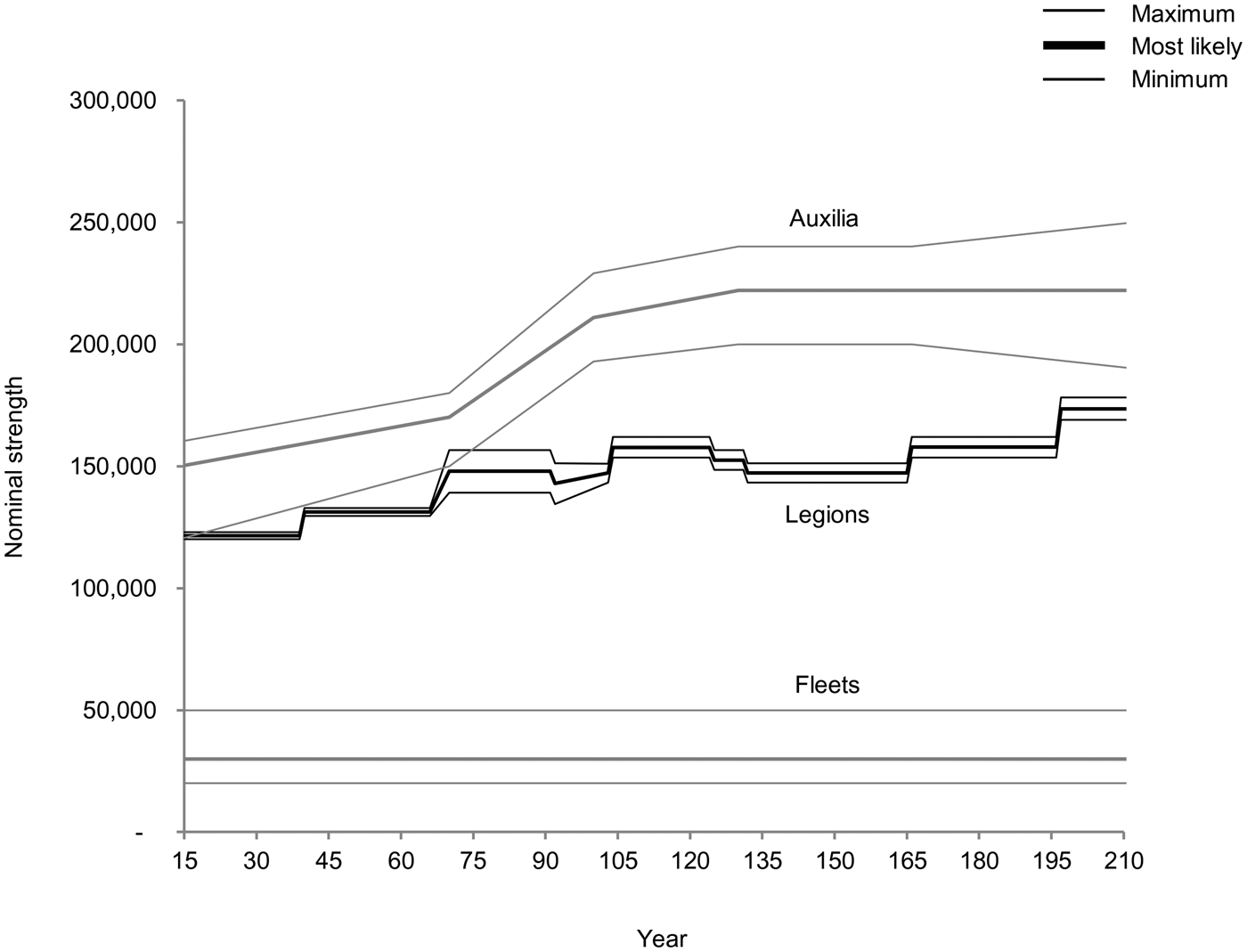
The strength — or rather the nominal strength (a qualification I will return to) — of the legions is well established. We can track the evolution of the total complement of legions from twenty-five in 14 c.e. to thirty-three in 212 c.e. with unusual precision.Footnote 112 There is some uncertainty about unit strength (related to questions about the size of the strengthened first cohort and when it was introduced and about whether the legionary equites were counted among the centuries), but it is relatively small.Footnote 113 Nominal strength grew from 120–123,000 in 15 c.e. to 154–162,000 in 104 c.e. and 169–178,000 in 197 c.e.
Establishing the strength of the auxilia is more difficult. Numerous figures circulate, not all of equal merit. The best are based on the painstaking tabulation of provincial garrisons as revealed by the diplomas. The proliferation of diplomas has allowed ever better estimates for the period 100–160 c.e. The most precise is Paul Holder's figure of 218,000 for the reign of Hadrian.Footnote 114 That excludes centurions and decurions, who benefited from the imperial grants alongside their men, so another 4,000 has to be added.Footnote 115 But even for this period, there remains some uncertainty about the precise number of units,Footnote 116 nominal unit strengthsFootnote 117 and the proportion of cohorts that were equitatae (i.e. had a cavalry component).Footnote 118 Given these uncertainties, anything in the region 200–240,000 seems possible.Footnote 119 The diplomas indicate that the complement of auxiliary units remained roughly constant through to the 160s c.e.Footnote 120 The following decades involve greater uncertainty because of the near disappearance of auxiliary diplomas. We know of a number of units that were raised after 161 c.e. (notably those with the epithets Aurelia or Septimia). Other units may have been eliminated or disbanded. But the net change is unlikely to have exceeded 10,000 men (~20 units) by 212 c.e.Footnote 121
Extrapolating back to 14 c.e. is more difficult. Holder has used the diploma evidence to reconstruct a complement of 207,000 men c. 99 c.e. Including officers and allowing for uncertainties as before gives a possible range of 193–229,000 men.Footnote 122 The rarity of diplomas before 90 c.e. makes it very difficult to reproduce the analysis for earlier periods, so we have to resort to cruder methods. The limited evidence suggests a force somewhere in the region of 130–180,000 in 70 c.e.Footnote 123 and 110–160,000 in 14 c.e.Footnote 124
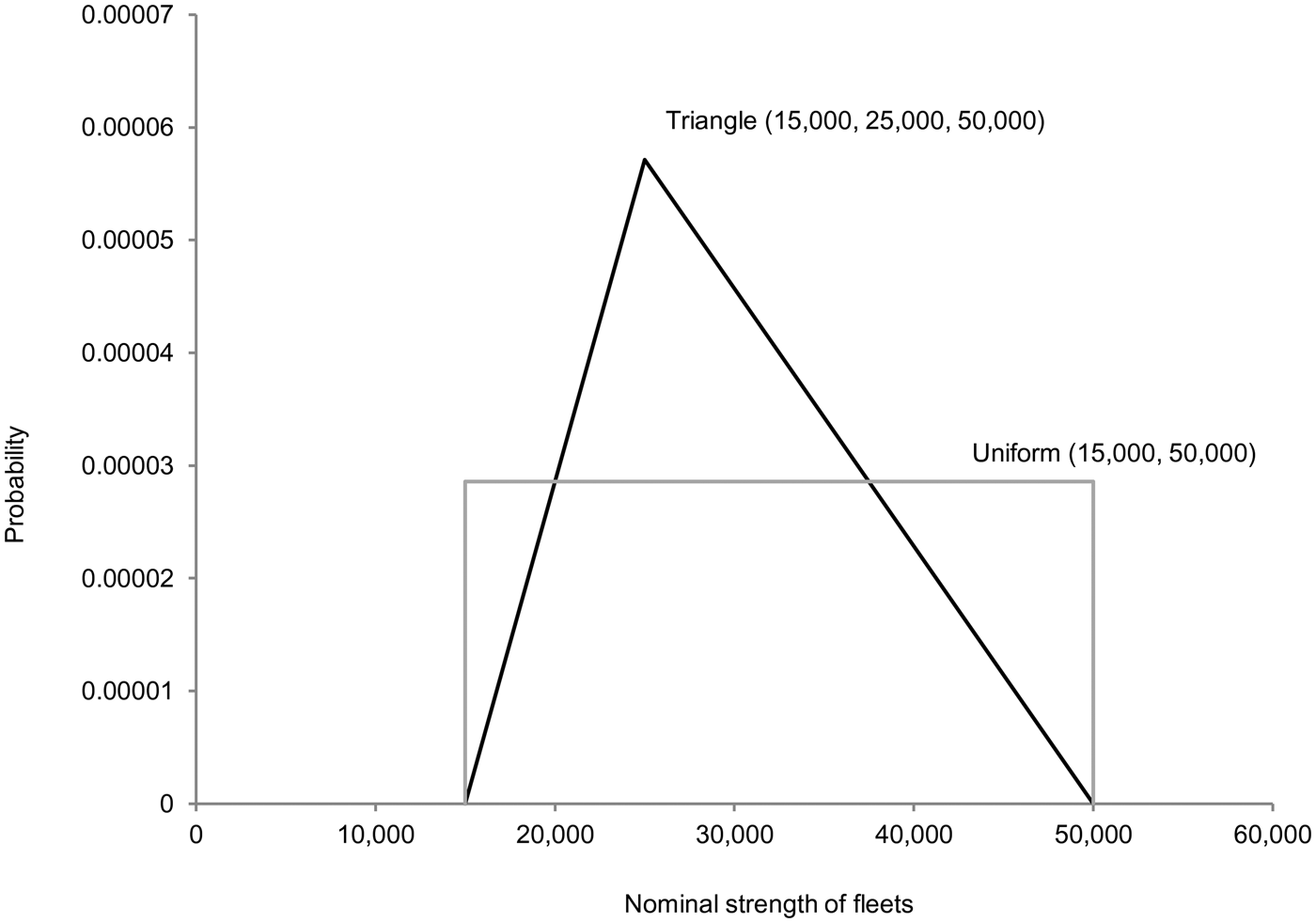
The manpower of the fleets is even more uncertain. I have argued elsewhere that a total complement of c. 25,000 is most likely, but that anything in the range 15–50,000 is possible.Footnote 125 Since several of the provincial fleets were established after 14 c.e. (though another at Forum Iulii was disbanded during the Julio-Claudian period), it may have taken the fleets some time to reach their peak strength. But the effect of any such growth is dwarfed by the uncertainty about the peak size.Footnote 126 Fig. 3 illustrates what we know about the strengths of the three formations, their development over the course of the period and — crucially — the varying degree of uncertainty.
Nominal strength of the auxilia, legions and fleets.

Actual Strength
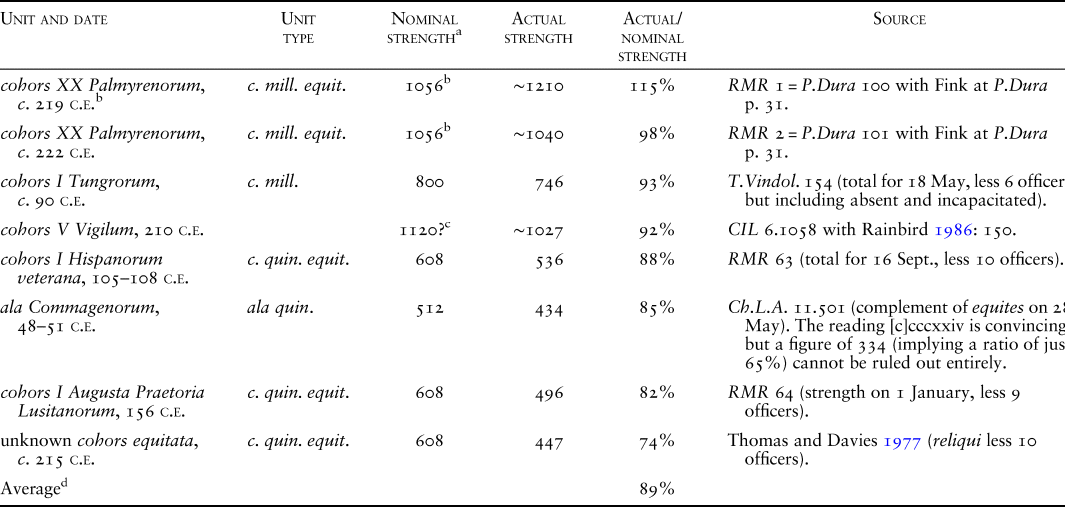
These totals are based on nominal unit strengths. Actual strength must have been significantly lower. Even under the best conditions, it is hard for armies to maintain manpower at nominal strength due to variability in loss and recruitment. The few scholars who have addressed this phenomenon in the Roman context have variously suggested ratios of 90–95 per cent, c. 90 per cent and c. 80 per cent.Footnote 127 There is a small documentary corpus against which these hypotheses can be tested. Strength reports and other lists that give the actual strength of a unit at a point in time make it possible to calculate the ratio of actual to nominal strength in each case, given our assumptions about nominal unit strengths (Table 1).
Actual/nominal strength.

Notes: (a) Nominal strengths (excluding centurions and decurions) for auxiliary units following Holder Reference Holder2003: 120, as in my assumption for the total nominal strength of the auxilia; (b) There is no independent evidence for whether this cohort was milliary or quingenary. It was clearly over-strength, perhaps massively so, probably as a response to an eastern threat. Rather than discount it entirely, I assume it was nominally milliary; (c) Rainbird's hypothesis. The resulting ratio is very close to the average, so it seems plausible; (d) Counts cohors XX Palmyrenorum once, at the average of the two reported strengths.
The two highest ratios are both associated with cohors XX Palmyrenorum, in two strength reports around three years apart. This poses two problems. First, the relatively high ratios may represent exceptional reinforcement in the face of an Eastern threat.Footnote 128 But we should be wary of discounting outliers as anomalous when the sample is so small. More problematic is the distorting effect of counting the same unit twice. For the purposes of estimating the overall average, I count it once at the average of two strength ratios (107 per cent). The average across the remaining seven cases is 89 per cent, in line with the estimates of MacMullen and Scheidel. But the sample is small and the variance high, so we should not have too much confidence in that point estimate. The average strength ratio for all units across the whole period could have been anywhere between 81 and 96 per cent.Footnote 129
Attrition Rates
Quantifying the number of beneficiaries of imperial grants requires an estimate of the proportion of soldiers who survived twenty-five years of service. Survival here is a question not just of mortality but also of discharge due to illness or injury (missio causaria) or misconduct (missio ignominiosa) — either of which would normally deny the soldier a grant of citizenship. A figure of c. 50 per cent has often been used as a rule of thumb, but the subject has been put on a new footing by Walter Scheidel's study of attrition rates in the legions.Footnote 130 (It is worth observing that there is no significant difference in the age profile of recruits between the legions and auxilia, once a correction is made for age rounding.Footnote 131) Scheidel estimated the effective twenty-five-year attrition rate in the legions at c. 55 per cent by inferring the normal annual complement of veterans discharged from a legion from several inscribed lists of soldiers discharged from a legion in a particular year.Footnote 132 More recent work has revealed that the total number of veterans on one of the four laterculi Scheidel relied on was significantly higher than originally thought. Taking this into account would reduce the implied attrition rate to just under 50 per cent.Footnote 133 But the sample is very small. We are not yet in a position to rule out an attrition rate as high as 60 per cent (closer to the rates Scheidel observed among the Roman units, which he attributed to the effect of excess mortality in the city)Footnote 134 or as low as 40 per cent (an optimistic estimate of the actual mortality rate among men of similar age in the civilian population)Footnote 135 — a range corresponding to an average discharge rate of 110–145 men per legion per year.Footnote 136 It is worth noting that this is an estimate of the average attrition rate in normal conditions and does not take account of excess mortality during major wars. But the effect of such spikes in mortality on the overall average survival rate, across all units and two centuries, was probably modest.Footnote 137
Children
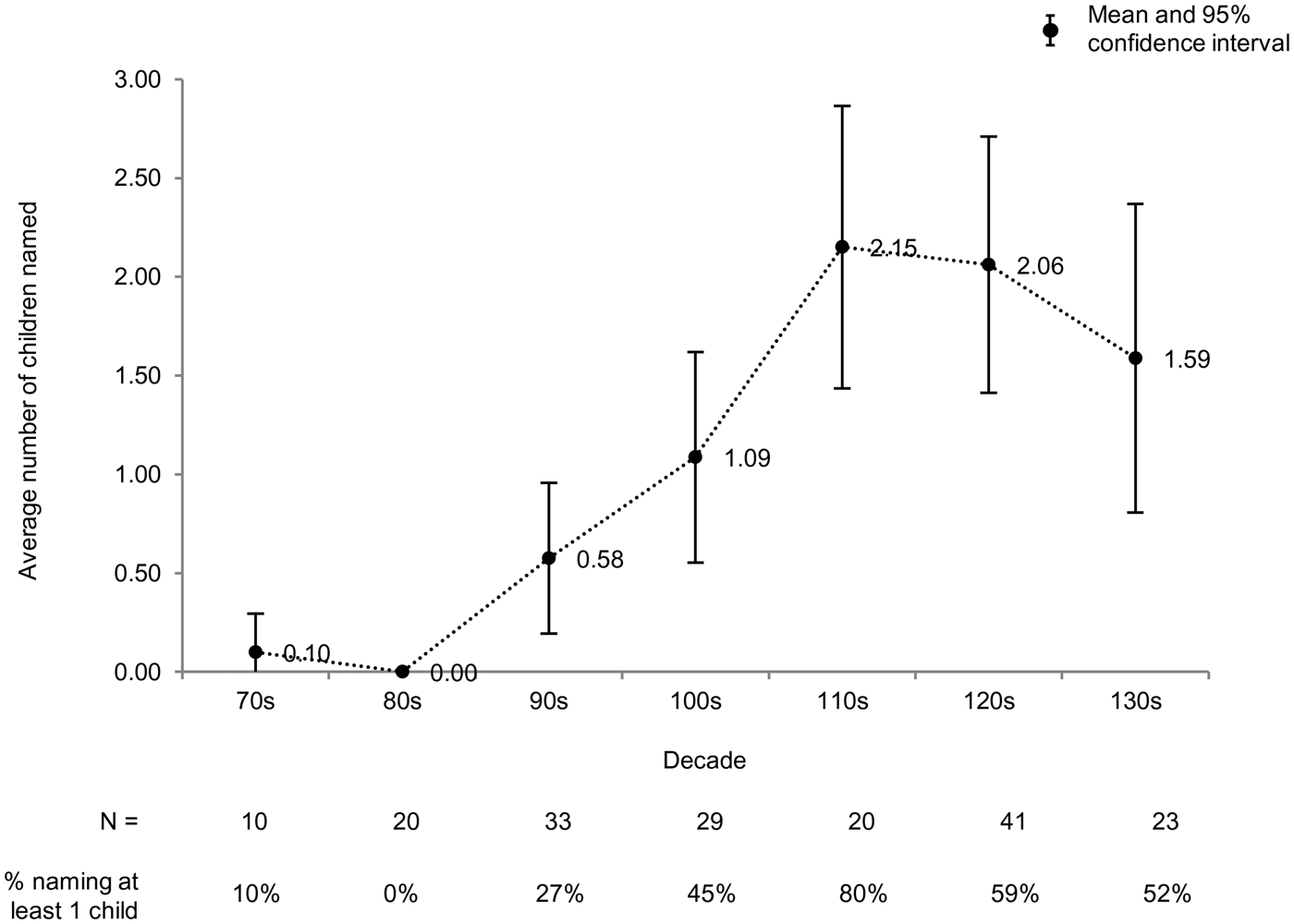
The third crucial variable is the average number of living children soldiers had when they received their grants. It is now well established that the so-called ‘marriage ban’ — better understood as non-recognition of marriage — did not prevent soldiers from forming unions and raising children.Footnote 138 It is also clear from epitaphs that the rate of family formation rose significantly from the first century into the second in all formations, probably due to increasing stability of service.Footnote 139 The development can be observed most clearly for auxiliaries, since the diplomas name any offspring to whom citizenship was granted. In the surviving diplomas, the average number of children declared is close to zero in the 70s and 80s, begins to increase rapidly in the 90s and 100s and peaks at around 2.1 in the 110s and 120s before declining slightly in the decade before the abolition of grants to children in 140 c.e. (Fig. 4).Footnote 140 There is insufficient data for the 50s and 60s to determine with any confidence whether they resembled the 70s and 80s or whether the latter represented a transient depression in the rate of family formation due to the shock of the civil wars of 69–70 c.e.Footnote 141 In any case, the increase beginning in the 90s and 100s coincides with a reduction in the frequency of redeployment and an increase in local recruitment, both of which are likely to have facilitated the formation and durability of families.Footnote 142 Even at its peak in that period, however, auxiliaries’ rate of social reproduction by the time of their discharge was probably somewhat lower than that of their peers in the civilian population.Footnote 143
Average number of children named on auxiliary diplomas.

Although the diploma data are relatively rich by the standards of Roman history, there remains some uncertainty about the actual average number of children. The sample data may well be biased. The most likely source of bias is the significant over-representation in the diploma corpus of men who served in the Danubian provinces.Footnote 144 This probably works to overestimate the overall average, since soldiers in other regions appear to have had fewer children.Footnote 145 Even discounting the possibility of bias, the high variance in the number of children and relatively small sample sizes mean that we cannot be confident that the sample means are precise estimators of the population means (see the breadth of the 95 per cent confidence intervals for the inferred means in Fig. 4). Nevertheless, the data are of sufficient resolution to show chronological change on a scale that demands to be taken into account in any quantification of citizenship grants.Footnote 146
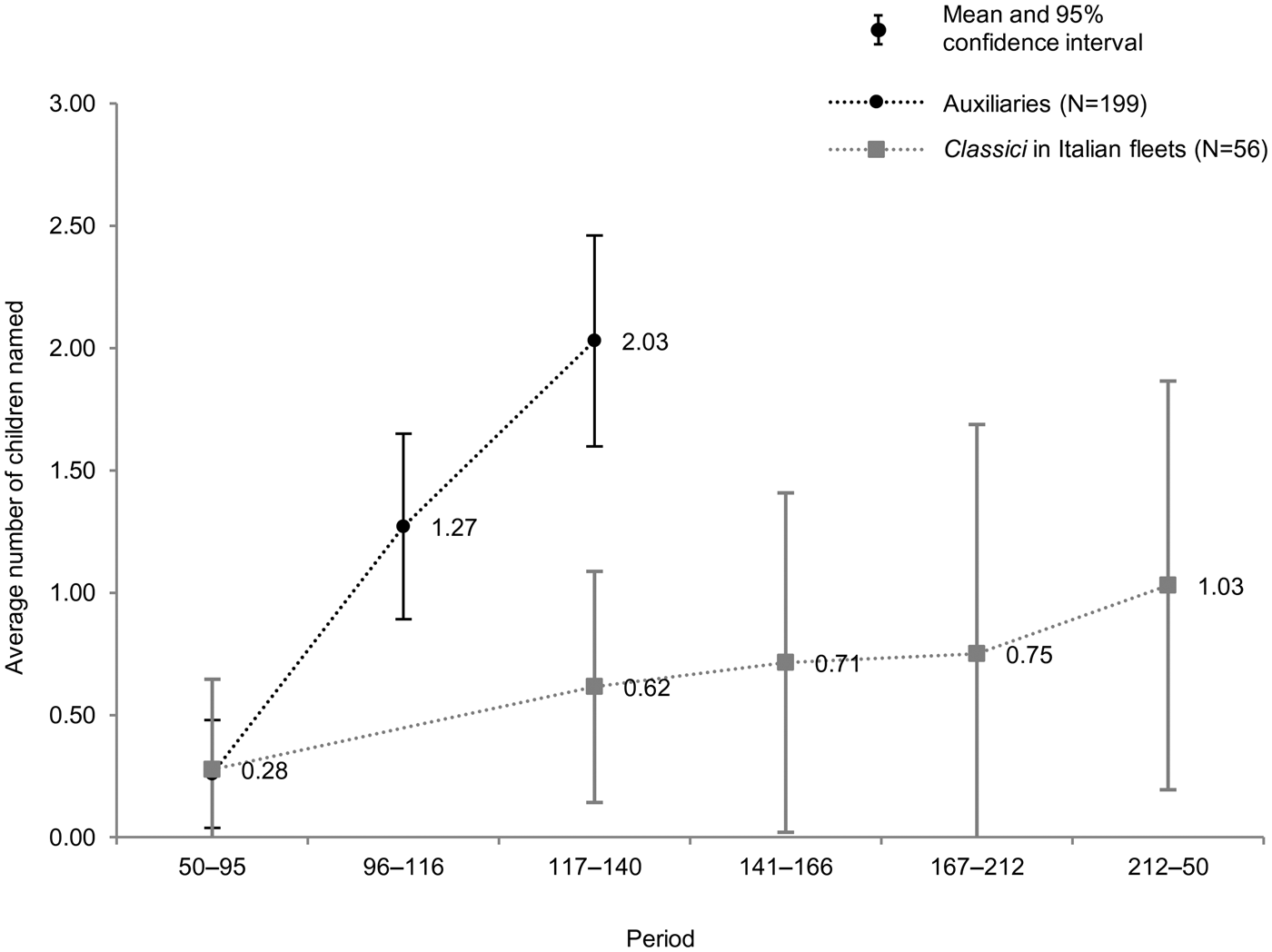
The sample of diplomas issued to soldiers in the Italian fleets is too small for analysis by decade, but still sufficient to demonstrate significant divergence from auxiliaries (Fig. 5).Footnote 147 The average number of children starts off at a similarly low rate in 50–95 c.e. but grows much more slowly through the second century (even after the discontinuation of grants to auxiliaries’ children), only just exceeding 1.0 after Caracalla's grant.Footnote 148 The meagre evidence for soldiers in the provincial fleets suggests that they were more like auxiliaries among whom they served than the other classici in Italy.Footnote 149 The analysis cannot be extended to the legions since legionaries did not receive diplomas.Footnote 150
Average number of children named on auxiliary and Italian fleet diplomas.

Conubium
The grants of conubium enabled veterans of the auxilia, fleet and Roman units (and possibly also the legions) to marry non-citizen women and still pass on their citizen status to their children. In theory, this could have facilitated rapid growth in the citizen population, since the number of citizens in benefiting families could have doubled in a single generation if all veterans married peregrines and had on average two children who survived to adulthood. In reality, however, the overall impact of conubium must have been much more limited. First, many veterans married citizen women, often the daughters of other soldiers, with the result that the grant of conubium proved redundant.Footnote 151 Second, even those who did marry peregrine women probably did not have enough children to replace themselves in the next generation. The diplomas show that even in the mid-second century auxiliaries tended to have somewhat fewer children than we would expect for men of their age. The gap is even more pronounced in the first century, and among classici. It is possible that veterans were able to make up the deficit after discharge, enabling them to replace themselves in the next generation, but this is far from evident, given that the youngest would have been in their mid-forties.
Third, conubium must be understood in the wider context of citizen soldiers’ capacity to reproduce themselves both biologically and as citizens. The surplus citizen children created by conubium were offset by a deficit of citizen children due to the depressed rate of family formation among citizens who enrolled in the army. I estimate that 1.2–1.8 million Roman citizens were recruited to the auxilia and legions over the first two centuries c.e.Footnote 152 Although many of them did have children during service, it is clear that they had fewer than the norm for men of their age. While it is possible (but unlikely) that those who survived to discharge were able to make up the deficit in subsequent years, 40–60 per cent died before they could do so. Moreover, some of the children they did have as serving soldiers would have been born to peregrine women: they would be born peregrines and would remain so if their fathers died before they could benefit from an imperial grant. As such, these citizen recruits’ rate of social reproduction as citizens (determined by the average number of citizen children who survived to adulthood) would have been even lower than their already depressed rate of biological reproduction (determined by the average number of children who survived to adulthood). These ‘missing’ citizen children of citizen soldiers will have offset most or all of the surplus citizen children produced by the portion of veterans who made use of the grant of conubium by marrying peregrine women. Quantification is complicated by the uncertainty about whether legionaries normally received conubium, whether the grant of conubium extended to a soldier's children and what proportion of citizen veterans formed unions with peregrine women.Footnote 153 These are complex questions that demand a separate study. But it seems prima facie unlikely that the indirect effects of conubium could have made up for the relatively modest impact of direct grants diagnosed by this paper.
III QUANTIFICATION
A Mathematical Model
It should by now be clear that an adequate estimate of the scale of enfranchisement cannot afford to focus on the auxilia alone but must include the fleets and should also take account of the legions. Nor is it acceptable to rely on extrapolation from an estimate of the scale of enfranchisement at a single point in time. The annual rate of grants must have varied massively over the course of the two centuries between Augustus and Caracalla, given on the one hand, the regularisation of grants by Claudius, the growth in the size of the auxilia and the parallel reduction in the length of service, the increase in the rate of family formation and, on the other, the growth in the representation of citizens in the auxilia (and concomitant decline in the recruitment of peregrines to the legions) and the end of grants to children in 140 c.e.
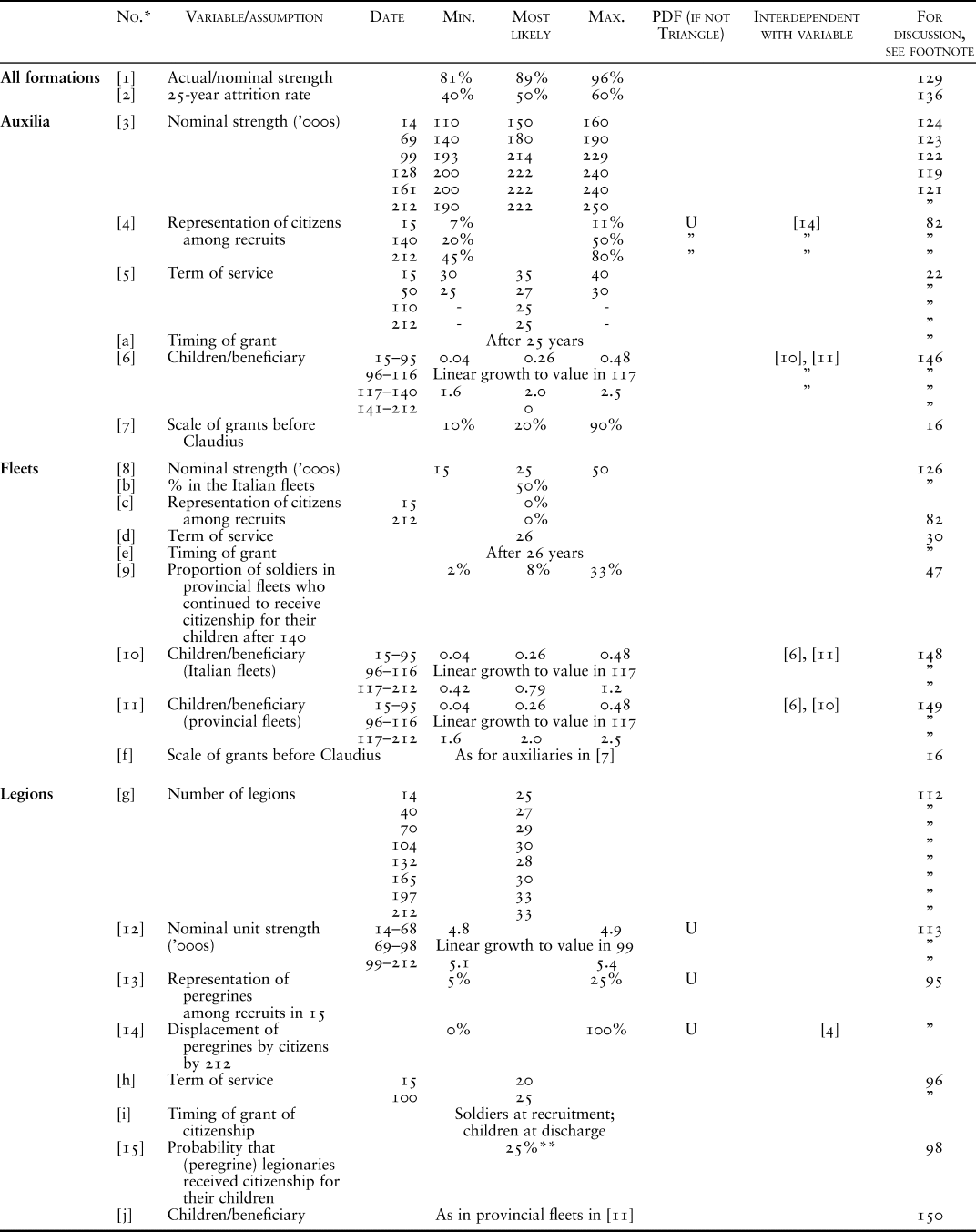
To simulate the effects of these developments on the annual volume of grants, I will model grants on a year-by-year basis for the period from 14 to 212 c.e. for each of the three formations. The mathematical model is available online and the assumptions are tabulated in Table 2 (to which I refer with numbers or letters in square brackets).Footnote 154 Several variables for which there is no evidence of long-term trends — such as the ratio of actual to nominal strength and the attrition rate — are modelled as static, i.e. with a constant value representing the average over the period. Any year-to-year variation in these variables is ignored on the assumption that it is stochastic and hence cancels out at the level of the model as a whole.
Variables and assumptions.

Notes:
* Variables are identified by number; fixed inputs by letter.
** In the case of events, this represents the probability that the hypothesis is true.
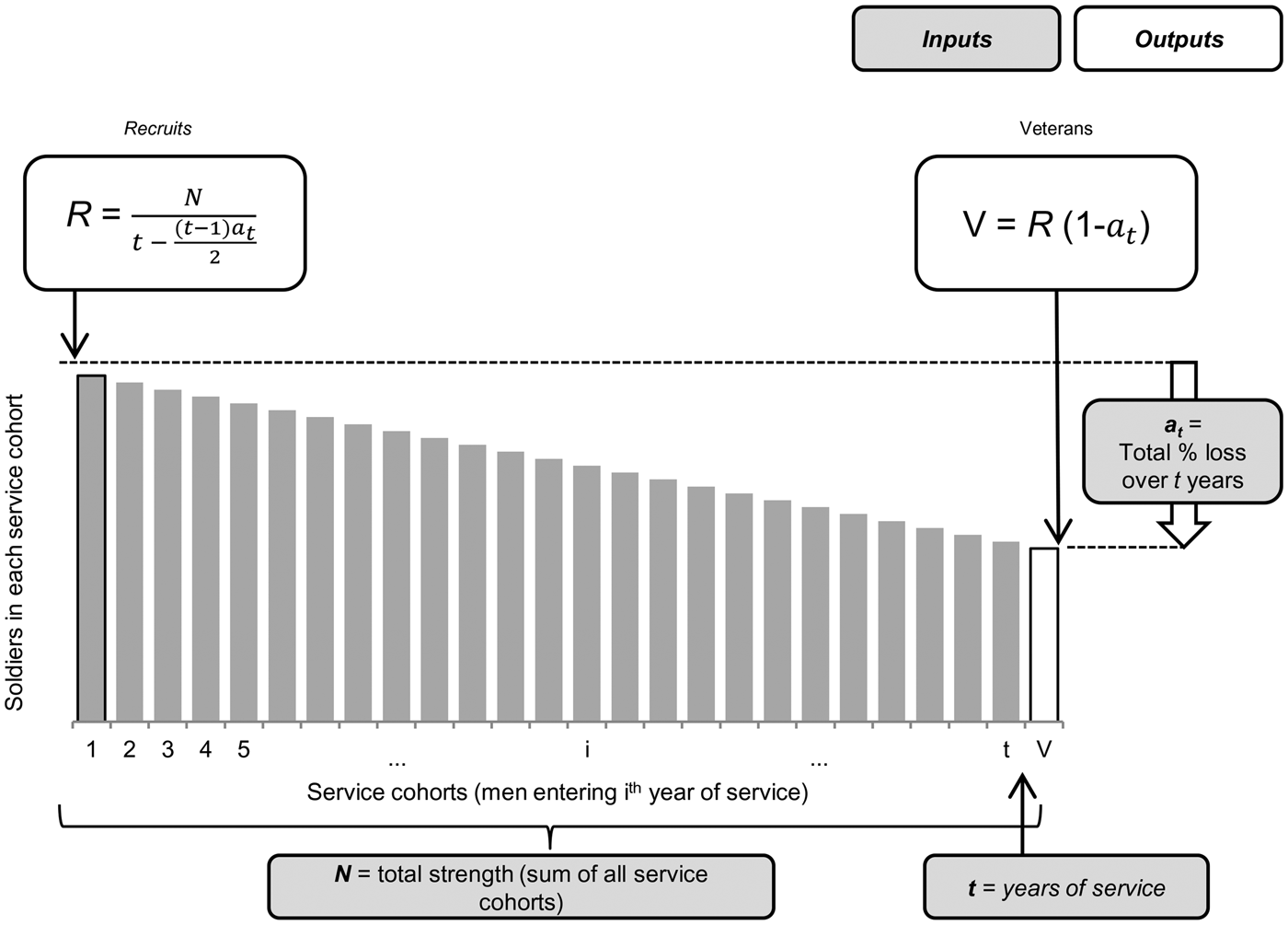
For the auxilia, the model starts from estimates of total nominal strength at several specified points (14, 69, 99, 128, 161 and 212 c.e.) [3]. It extrapolates to all intervening years, assuming constant linear growth between fixed points, and then calculates actual strength each year given an assumed ratio between actual and nominal strength (modelled as a constant) [1]. The model proceeds to estimate the number of recruits each year from 15 to 212 c.e. inclusive.Footnote 155 It does so on the basis of assumptions about the twenty-five-year attrition rate (a constant) [2] and the term of service in the year in question (decreasing stepwise over the period) [5], using a simple model of recruitment, attrition and discharge. This calculates the number of recruits as a function of total strength (N), length of service (t) and total attrition between recruitment and discharge (a t) (Fig. 6).Footnote 156 This allows the model to calculate the number of recruits needed to replace losses over the past year. Focusing on attrition alone would underestimate recruitment, especially in the first century, since additional recruits were required to supply the gradual increase in the strength of the auxilia (Fig. 3). So the model adds sufficient recruits to supply any increase in formation strength from the previous year.Footnote 157 The model then calculates the number of each cohort of recruits who were peregrines given an additional assumption about the prevalence of citizenship among recruits (which grows linearly between defined points, as with nominal strength) [4].
A model of recruitment, attrition and discharge.

These annual cohorts of peregrine recruits provide the basis for estimating (given the attrition rate [2]) the number of auxiliaries who qualified for a grant twenty-five years later.Footnote 158 (In other words, the model captures the fact that it took twenty-five years for changes in recruitment to affect the volume of grants.Footnote 159) Given a further assumption about the average number of children per qualifying soldier (which increases stepwise over time) [6], the model estimates the number of enfranchised children and hence the total number of grants each year. A scaling variable [7], which represents actual grants as a proportion of the theoretical maximum, is used to calculate the number of grants before Claudius’ reform, which is dated to 48 c.e.
Grants to classici are modelled in the same way, except that formation strength is represented as constant [8] because of the considerable uncertainty (the constant representing average strength over the period), all recruits are assumed to be peregrine [c], soldiers are assumed to serve twenty-six years [d, e] and the number of children is modelled separately for the Italian and provincial fleets [10, 11] to allow for the relatively low rates observed in the former. For the legions, the model starts from the number of legions in service [g]. This is multiplied by average unit strength [12] (which increases over the course of the second half of the first century) to calculate nominal strength for each year. The model then calculates annual cohorts of recruits and veterans as with the auxilia and fleets. It also calculates the number of recruits who were peregrines, given assumptions about how this proportion evolved over the period [13, 14]. It assumes that all peregrine recruits were enfranchised on enlistment; it also allows for the possibility that they received citizenship for any peregrine children born in service when they were discharged [15], assuming that legionaries had the same number of children as auxiliaries [j].
‘All models are wrong, some models are useful.’Footnote 160 One key element of model-design is identifying the right level of complexity. I have attempted to identify the key variables and uncertainties while omitting relatively minor details that would greatly increase the complexity of the model without significantly affecting the overall result. The model ignores grants to the numeri and Roman units, ante emerita stipendia grants to auxiliary units and the (unlikely) possibility of early enfranchisement for soldiers in the Italian fleets and/or the equites singulares. These omissions will tend slightly to underestimate the number of beneficiaries, but the effect should be offset by the fact that the model also ignores spikes in mortality during major wars, the effect of some men waiting longer than the minimum period to receive their grant, the fact that some peregrine recruits to the legions received citizenship at discharge rather than enlistment and the possibility that some auxiliaries were discharged without grants before 90 and/or after 160 c.e. The effects of these omissions should be individually small and should partly cancel out at the aggregate level.
Uncertainty
There are obviously many uncertainties involved, some concerning details of the system that remain obscure, others related to our imperfect knowledge of relevant historical quantities. This is not in itself an obstacle to quantification, because uncertainty can be quantified. The relevant question is how much uncertainty there is about the overall scale of enfranchisement. I will argue that the wide ranges that have been reported by the few scholars who have tackled the question exaggerate the degree of uncertainty (as well as overestimating the scale of enfranchisement).
Uncertainty can be quantified using probabilities. In the Bayesian or subjective interpretation of probability, all uncertainties are subjective in the sense that they arise from the limits of the knowledge of a particular observer. They can all be quantified with probabilities, which represent the observer's degree of belief in different possibilities, given the information available to them.Footnote 161 These probabilities are subjective, in the sense that they reflect the limits of knowledge rather than any objective randomness in the world. They are also conditional, meaning that they depend on a state of knowledge: they will change in response to new discoveries or new interpretations of existing data. Finally they are personal, in the sense that they reflect a particular observer's assessment of the evidence (as do all historical judgements). Your probabilities for the various uncertainties may not match mine, but the model provides a framework in which to aggregate your probabilities, if they are very different. Uncertainty and subjectivity are ubiquitous challenges for quantification in ancient history. Most estimates of historical quantities contain considerable uncertainty and they are always grounded in a particular historian's inferences from the limited information available. Two of the great merits of the Bayesian framework are that it incorporates uncertainties into the analysis and acknowledges the subjectivity that is inherent in the process of estimation, rather than treating these as points of weakness to be obscured by a misleading rhetoric of certainty and objectivity. Understood in this Bayesian framework, probability emerges as an ideal tool for representing and manipulating the epistemic uncertainties — i.e. uncertainties arising from the limits of our knowledge — that loom so large in ancient history. Indeed, probability is arguably the only way to manage uncertainty: ‘If you want to handle uncertainty, then you must use probability to do it, there is no choice.’Footnote 162
Almost all the relevant uncertainties concern the actual value of historical quantities, such as the proportion of auxiliary recruits who were citizens in 15 c.e.Footnote 163 In these cases, the uncertainty is represented by a probability density function over possible values, with the probabilities representing the historian's degree of belief in the various possibilities. In most cases, I use a Triangle distribution to assign probabilities. The Triangle distribution is a mathematical distribution whose shape is determined by three parameters corresponding to the minimum, most likely and maximum values. It is commonly used to represent epistemic uncertainties in forecasting and risk analysis.Footnote 164 Fig. 7 illustrates the use of a Triangle distribution to represent the uncertainty about the nominal strength of the fleets (Variable [8] in Table 2). It incorporates my beliefs both about what value is most likely and about how wide a range of values is possible. It offers a good approximation to how my degree of belief in different possible values falls away from the most likely value towards the minimum and maximum values and can easily accommodate any asymmetry (as here, where the plausible range extends further above the most likely value than it does below it). It is also computationally straightforward since its shape is determined by three parameters with an intuitive interpretation. In a few cases of very high uncertainty, where I can identify a range of possible values but not a most likely value or region, I use a uniform distribution, which assigns an equal probability to all values in the range. A corresponding Uniform distribution is illustrated for comparison on Fig. 7. Note that the area enclosed by a probability density function always sums to 100 per cent.
Probability density functions.

Table 2 lists the beliefs that underlie my estimate. By ‘belief’ I mean a set of evidence-based probabilistic judgements about uncertain quantities.Footnote 165 These are represented schematically by minimum, maximum and (where possible) most likely values for each quantity, which determine the Triangle (or Uniform) probability distributions used in the model. The table also notes a small number of interdependencies, a problem I will return to. Since the idea of assigning probabilities to uncertainties may appear outlandish on first acquaintance, it is worth reiterating that the purpose is not to estimate an objective probability that exists in the world, but rather to represent the uncertainty about the historical quantity. The probabilities are only ‘a language in which we express our state of knowledge or state of certainty’.Footnote 166 Seen in this light, it is easier to produce a probability distribution for the value of an uncertain quantity than to venture a precise estimate.
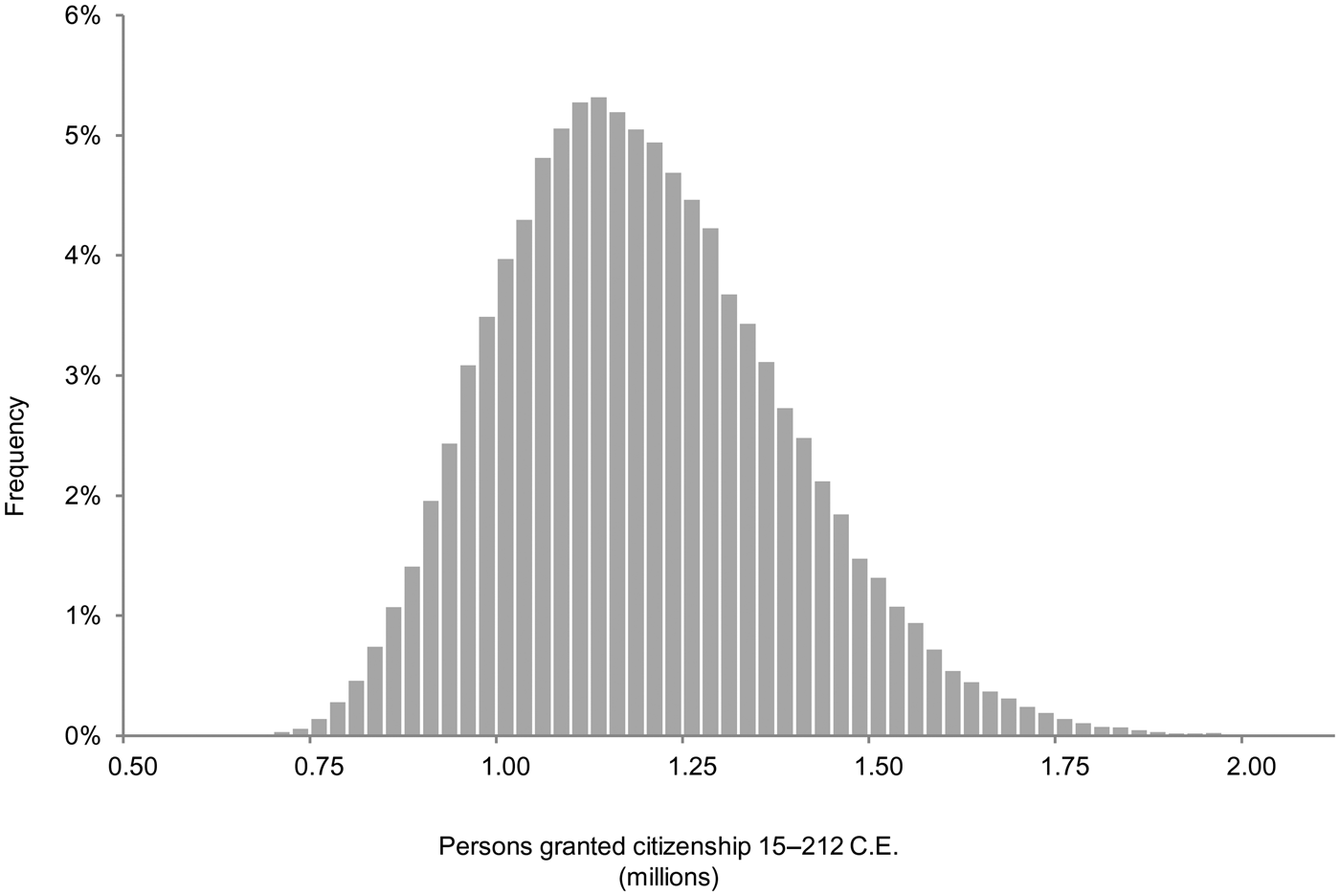
The next step is to calculate the implied probability distribution for the total number of new citizens by propagating these probability distributions through the model. This is done through Monte Carlo simulation. This involves generating a very large number of random scenarios using the probabilities established by Table 2, calculating the number of new citizens (and any other quantity of interest) in each scenario, and observing the distribution of values across all scenarios. This can be imagined as a process of sampling from the almost infinite number of possible pasts. As the sample size increases, the observed distribution of outcomes will converge on the shape of the underlying probability distribution. Fig. 8 shows the frequency distribution after 100,000 iterations. This probability distribution represents what I should believe about the level of enfranchisement, given the beliefs in Table 2. For the purposes of discussion, I will reduce this probability distribution (and those for other quantities of interest) to two summary statistics: the expected value and the 95 per cent credible interval. The expected value is the mean of the Monte Carlo simulation. This represents the probability-weighted average of all possible values and is the best point estimator of the quantity of interest.Footnote 167 The 95 per cent credible interval is the shortest range of possible values that includes 95 per cent of the probability mass.Footnote 168 It represents the range of what is plausible, after discounting the least likely values in the tails of the distribution.
Monte Carlo simulation. Frequency of outcomes after 100,000 iterations.

Results
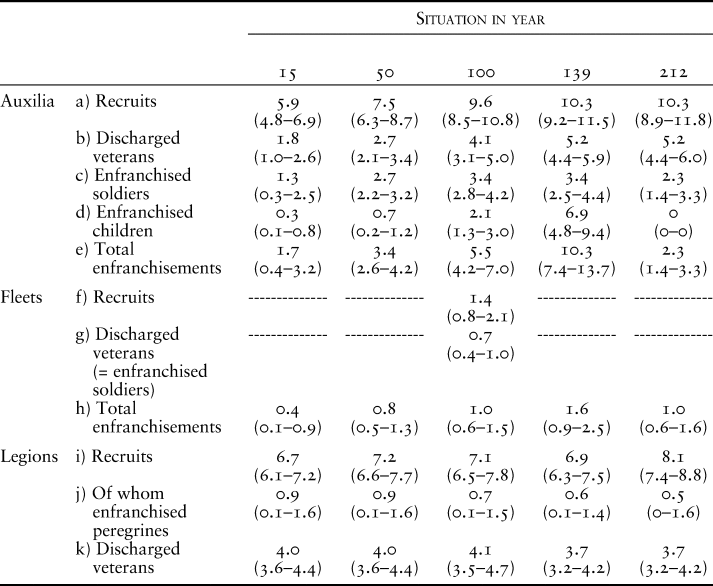
Tables 3 and 4 present a selection of the results of the simulation, rounded to the nearest thousand. Note that there is no rounding within the model, where precision is essential.Footnote 169 For each quantity, the tables report both the expected value and, in brackets, the 95 per cent credible interval.Footnote 170 Table 3 presents snapshots of key annual flows, such as the number of recruits, veterans and benefiting soldiers, for each formation in five different years. It illustrates the considerable variation over the two centuries studied here. For example, the number of recruits to the auxilia (row a) must have almost doubled from c. 6,000 in 15 c.e. to c. 10,000 in 139 c.e. as nominal strength increased from roughly 150,000 to 220,000 and service length decreased from more than thirty to around twenty-five years. Past estimates have been erratic in their assumptions about total strength and attrition and potentially misleading in focusing on a particular moment in time.Footnote 171
Annual flows in selected years. Expected value (95 per cent credible interval) (‘000s).

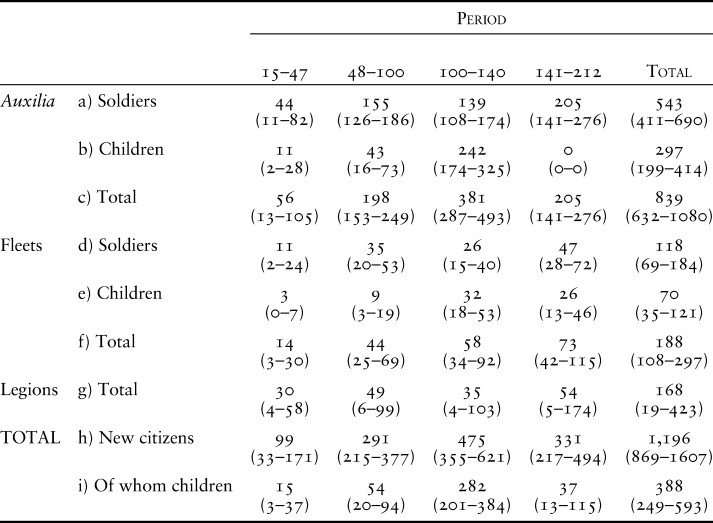
Total new citizens by period and formation. Expected value (95 per cent credible interval) (‘000s).

The number of auxiliary veterans discharged each year (b) grew even more steeply, from c. 1,800 to c. 5,200 men per year, as the effect of increasing recruitment was accentuated by falling attrition due to earlier discharge. (Note that the recruitment effect is lagged, since the number of veterans discharged in a given year depends on the number of men recruited several decades earlier, not those recruited in the current year.) The number of enfranchised soldiers (c) is lower because some of the veterans were recruited as citizens (in 15 and 50 c.e. this is partly offset by the fact that soldiers received the grant several years before discharge). The credible interval for 15 c.e. is particularly wide, reflecting the uncertainty about the scale of grants before Claudius. Including children, the total number of beneficiaries (e) grew from c. 3,400 at the outset of the Claudian regime to c. 10,000 on the eve of the reform of 140 c.e. (driven by simultaneous growth in the number of qualifying soldiers and the average number of children, despite an increase in the recruitment of citizens over the period), before dropping to c. 2,300 thereafter (after grants to auxiliaries’ children were discontinued).
Changes in the legions were more modest, because the effect of the significant increase in manpower in the late first century (with growth in both the number of legions and unit strength) was largely offset by an increase in the length of service. Hence (in Table 3) recruitment (i) in 100 c.e. should not have been significantly higher than in 15 c.e. (the increase in 212 c.e. reflects the expansion to thirty-three legions under Severus). The number of veterans (k) probably fell slightly in the second century, due to the higher attrition associated with later discharge. I have not attempted to model similar developments for the fleets, given the much greater uncertainty about formation size. But the number of citizenship grants (h) should have increased substantially between 15 and 140 c.e. due to an increase in average family size, before falling to a lower level (when only the Italian fleets and a minority of the provincial fleets continued to benefit from grants to children).
Table 4 reports the total number of grants by formation and period. We know enough about the auxilia to be able to estimate the number of persons granted citizenship with reasonable precision. Between 0.4 and 0.7 million peregrine soldiers received citizenship from 15 to 212 c.e. (a). They were supplemented by another 0.2–0.4 million children of peregrine recruits (b), for a total of 0.6–1.1 million persons enfranchised (c) — a fraction of what most previous scholarship has suggested. There are significant uncertainties involved but they are encompassed within this range, which includes 95 per cent of all the possible scenarios implied by the assumptions in Table 2. Though usually ignored, the fleets also made a significant contribution, not least because soldiers in the Italian fleets continued to receive citizenship for their children after 140 c.e. They added approximately one-quarter to the contribution of the auxilia: 0.1–0.3 million beneficiaries over the whole period (f). The auxilia and fleets together produced a total of 0.8–1.3 million citizens over the whole period. The contribution of the legions is much more uncertain, spanning more than an order of magnitude, from a few tens of thousands to a few hundred thousand (g). But the contribution to the uncertainty about the overall scale of enfranchisement is relatively small. Combining all three formations, 0.9–1.6 million peregrines received citizenship by imperial grant (h). Just under a third, 0.2–0.5 million, of the beneficiaries were children (i).
Caveats
The probability distributions summarised in Tables 3 and 4 are — it bears repeating — a representation of uncertainty, not estimates of some objective probabilities. They should be understood as an attempt to provide a careful and reasoned assessment of the current state of our knowledge. They depend on my understanding of the structure of the problem (as encoded in the selection of relevant variables and the mathematical model of the relationship between them) and on my assessment of what is known about the historical value of those variables (as specified in Table 2). These assessments can and should be interrogated. The model can be used to test the impact of different assumptions on the overall result.
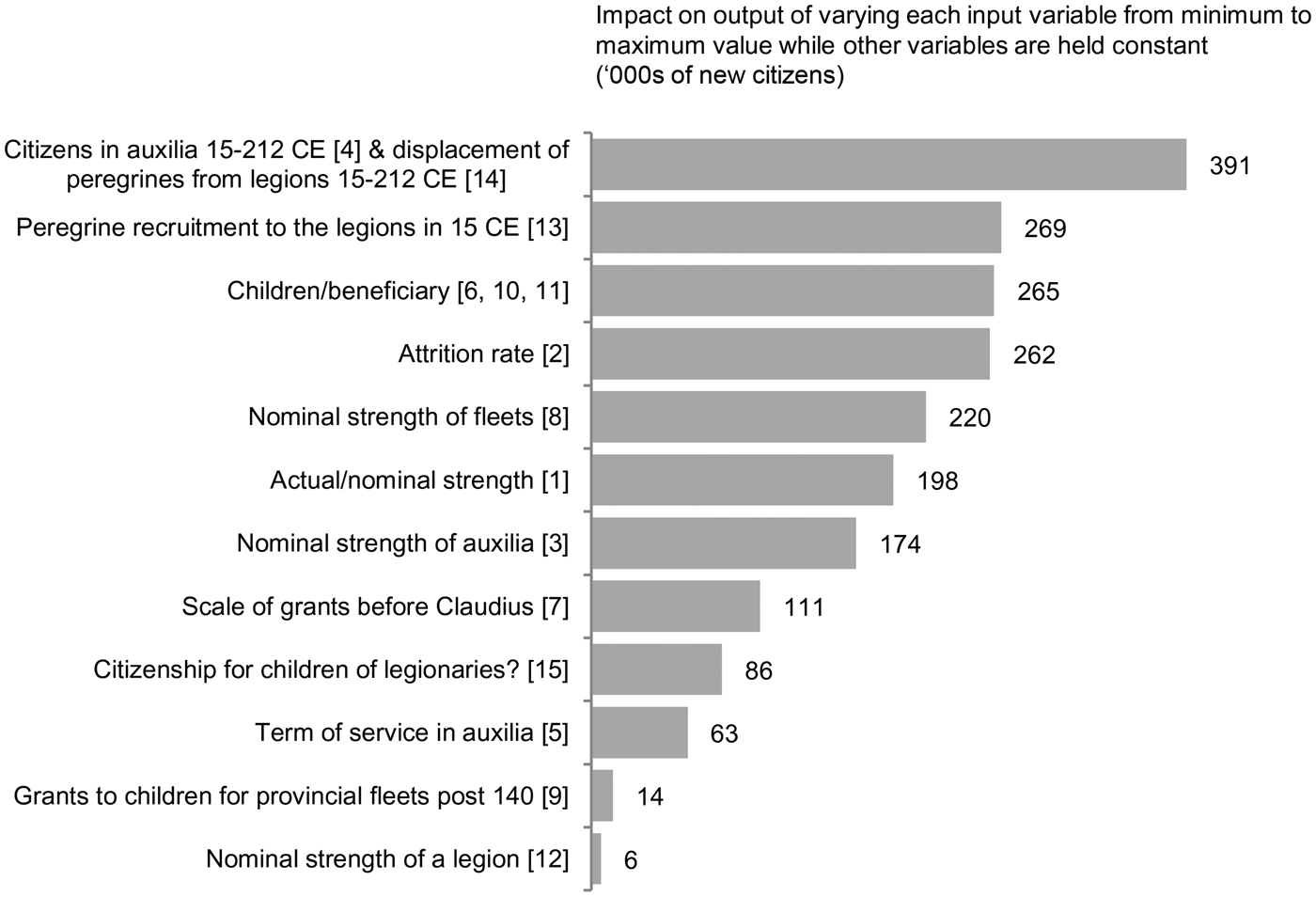
Given the large number of variables involved, it is worth bearing in mind that they do not have equal weight in the analysis. Fig. 9 shows the results of a sensitivity analysis in which the relative importance of the variables is evaluated by measuring the impact on the output (the number of new citizens) of increasing each variable (and any dependent variables) from its minimum to its maximum value, while keeping other variables at their mean value.Footnote 172 The variables related to the prevalence of citizens among auxiliary and legionary recruits [4, 13 and 14] rank high on this measure. So do those related to family size [6, 10 and 11] and the attrition rate [2]. These are the areas where new evidence, or new interpretations of existing evidence, would have the greatest impact on the estimate of the overall scale of enfranchisement. The nominal strength of the fleets [8], the ratio of actual to nominal strength [1] and the nominal strength of the auxilia [3] follow in diminishing importance. The rest are relatively insignificant.
Nominal range sensitivity.

In revisiting the assumptions in Table 2, it is important to beware the danger of overconfidence. Some of the ranges in Table 2 may appear too wide. They are certainly wider than other estimates in circulation. But great caution should be taken in reducing them. It is well established that assessments of uncertainty tend to be biased by overconfidence — a propensity to underestimate the range of values that are possible.Footnote 173 Table 2 attempts to represent the full extent of uncertainty given the current state of our knowledge. I do not see much scope to reduce the ranges without significant new information.
A final aspect that demands careful scrutiny is the question of interdependence, specifically epistemic interdependence.Footnote 174 The Monte Carlo simulation treats most uncertain quantities as independent random variables. The method can accommodate interdependence, but only if it is acknowledged and quantified. The test for epistemic interdependence is a hypothetical question: would acquiring new information about one quantity change an historian's beliefs about the second quantity? If so, the estimates are not independent. Most of the pairs of variables in the model pass this test of independence. For example, even if we somehow discovered exact figures for the representation of citizens in the auxilia, the uncertainty about family size would remain unchanged. But there are a number of pairs that are clearly not independent, such as the representation of citizens in the auxilia and in the legions. If we were to discover that the proportion of citizen recruits to the auxilia was approaching 100 per cent in 212 c.e., we would be in a position to rule out significant recruitment of peregrines to the legions at that point. The interdependencies that I have taken into account are noted in Table 2. The model accommodates them by exaggerating the interdependence and assuming a perfect linear correlation between the variables.Footnote 175
IV CONCLUSIONS
The army looms large in the social history of regions that supplied recruits or received discharged veterans in significant numbers. Studies often rely on rough assessments of the scale of recruitment and discharge. These are vulnerable to errors similar to those that have distorted estimates of the scale of enfranchisement. There is an understandable but unfortunate tendency to focus on the well-documented complement of legions at the expense of the auxiliary forces. But it has long been clear that the auxiliary forces were more numerous and we have ever better data for the auxilia in particular thanks to the proliferation of diplomas. There has also been insufficient attention to chronological developments in the scale of recruitment and discharge, perhaps because the changes were relatively modest in the case of the more familiar legions. But the number of auxiliary recruits and especially veterans must have increased massively over the course of the first two centuries. The principal danger is overestimating the number of veterans in the first century, when the auxilia was still growing and terms of service were long.
In the case of grants of citizenship, three key factors have led to a persistent tendency to overestimate the scale of the phenomenon. First, scholars have tended to extrapolate from a single estimate of the number of beneficiaries at some point in the early second century, without allowing for the fact that that was when the volume of grants was at a peak. Second, they have overestimated the number of offspring who benefited with their fathers. The recent proliferation in diplomas has revealed that soldiers had significantly fewer children than expected, particularly in the first century. Third, they made no allowance for the growth in the representation of citizens among auxiliary recruits.Footnote 176 Whereas past estimates have ranged from two million to as high as six million beneficiaries, the calculations in Part III show that the actual figure is unlikely to have exceeded a million. Even after making allowance for the fleets, the legions and grants before Claudius (all ignored by past estimates), the total number of beneficiaries should have been less than 1.6 million. There remains the question of the indirect contribution of conubium, which would have allowed veterans’ rate of social reproduction as citizens to exceed their rate of biological reproduction. While I have not attempted to quantify this effect here, it is likely to have been largely or wholly offset by the depressed rate of family formation in the larger population of citizen soldiers.
There are limits to the value of an aggregate statistic. The number of enfranchised soldiers and children may have been relatively modest at the level of the Empire as a whole, but still had a significant effect on specific populations. Many veterans settled in the frontier provinces where they had served. The cumulative effect on the prevalence of citizenship in those areas may have been significant. The effects could have been even more pronounced in important zones of recruitment when veterans returned home in significant numbers, as seems to have been the case with Batavians and Thracians.Footnote 177 Nevertheless, the aggregate figure is important for our beliefs about the rate at which provincials became Roman citizens over the two centuries between the death of Augustus and Caracalla's universal grant of citizenship, the constitutio Antoniniana. Indeed those scholars who have envisaged a system with as many as six million direct beneficiaries suggested that this meant that the impact of Caracalla's grant must have been relatively modest.Footnote 178 Even six million would be relatively small in relation to a provincial population of thirty to sixty million. But a figure of 0.9–1.6 million is clearly negligible at that level. I have argued elsewhere that scholars have tended to exaggerate the scale of enfranchisement between Augustus and Caracalla and suggested that citizens remained just 15–33 per cent of the free population of the provinces on the eve of the constitutio Antoniniana.Footnote 179 This paper aims to buttress that argument by showing that the contribution of the single best-documented route to citizenship has been consistently and significantly overestimated.Footnote 180
SUPPLEMENTARY MATERIAL
For Supplementary Material for this article please visit https://doi.org.10.1017/S0075435819000662.