



1 Introduction
Let R be a commutative Noetherian ring. In [Reference Iyengar and Takahashi32], Iyengar and Takahashi introduced the notion of the cohomological annihilator of a ring R, denoted
$ {\mathrm {\mathfrak {ca}}}(R)$
 (cf. 3.3). They observed a close relationship between the condition
$ {\mathrm {\mathfrak {ca}}}(R)\neq 0$
 and the strong generation of the category
$ {\mathrm {mod}}(R)$
 of finitely generated R-modules (cf. 2.9). It is established in [Reference Iyengar and Takahashi32] that
$ {\mathrm {mod}}(R)$
 has a strong generator when R is a localization of a finitely generated algebra over a field or an equicharacteristic excellent local ring.
For a commutative Noetherian domain R, Elagin and Lunts [Reference Elagin and Lunts23] observed that
$ {\mathrm {\mathfrak {ca}}}(R)\neq 0$
 if the bounded derived category of R, denoted
$\mathsf {D}^f(R)$
 , has a strong generator (cf. 2.11). Recently, Dey et al. [Reference Dey, Lank and Takahashi19] established that the condition
$ {\mathrm {\mathfrak {ca}}}(R/\mathfrak {p})\neq 0$
 for each prime ideal
$\mathfrak {p}$
 of R is equivalent to that
$ {\mathrm {mod}}(R/\mathfrak {p})$
 has a strong generator for each prime ideal
$\mathfrak {p}$
 of R, which in turn is equivalent to that
$\mathsf {D}^f(R/\mathfrak {p})$
 has a strong generator for each prime ideal
$\mathfrak {p}$
 of R. If these conditions hold, they show that
$ {\mathrm {mod}}(R)$
 has a strong generator. As an application, it is proved in [Reference Dey, Lank and Takahashi19] that
$ {\mathrm {mod}}(R)$
 has a strong generator for any quasi-excellent ring R with finite Krull dimension.
The singularity category of R, denoted
$\mathsf {D}_{\mathsf {sg}}(R)$
 , was introduced by Buchweitz [Reference Buchweitz13] and Orlov [Reference Orlov44] as the Verdier quotient of the bounded derived category by the full subcategory of perfect complexes. We are motivated by the natural question.
Question How can the (strong) generation of the singularity category be characterized?
We investigate the above question in Section 4. It turns out that there is a close connection between the strong generation of the singularity category of R and the nonvanishing of the annihilator of the singularity category of R, as well as the nonvanishing of the cohomological annihilator of modules.
The annihilator of the singularity category of R, denoted
$ {\mathrm {ann}}_R\mathsf {D}_{\mathsf {sg}}(R)$
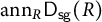 , is an ideal of R consisting of elements in R that annihilate all homomorphisms of complexes in
$\mathsf {D}_{\mathsf {sg}}(R)$
 (cf. 4.1). The ideal
$ {\mathrm {ann}}_R\mathsf {D}_{\mathsf {sg}}(R)$
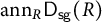 measures the singularity of R in the sense that R is regular if and only if
$ {\mathrm {ann}}_R\mathsf {D}_{\mathsf {sg}}(R)=R$
 . The annihilator of the singularity category has recently attracted increasing interest and has been studied in [Reference Dey and Mifune21, Reference Esentepe24, Reference Liu41]. In [Reference Esentepe24], Esentepe observed that the ideal
$ {\mathrm {ann}}_R\mathsf {D}_{\mathsf {sg}}(R)$
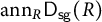 coincides with the cohomological annihilator
$ {\mathrm {\mathfrak {ca}}}(R)$
 when R is a strongly Gorenstein ring. For a commutative Noetherian domain R, if the singularity category of R has a strong generator, then the annihilator
$ {\mathrm {ann}}_R\mathsf {D}_{\mathsf {sg}}(R)$
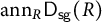 is nonzero (see Corollary 4.3). It is natural to ask whether the converse holds in general. We prove that if, in addition, the Krull dimension of R is less than or equal to one, the converse holds. This is an immediate consequence of Theorem 1.1(2).
Theorem 1.1 (See Theorems 4.16 and 4.24 and Corollary 5.21)
Let R be a commutative Noetherian ring. Then:
-
(1) The following two conditions are equivalent:
-
(a) $\mathsf {D}_{\mathsf {sg}}(R/\mathfrak {p})$
 has a generator for each prime ideal
$\mathfrak {p}$
of R.
-
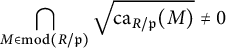
(b) $\displaystyle \bigcap _{M\in {\mathrm {mod}}(R/\mathfrak {p})}\sqrt { {\mathrm {ca}}_{R/\mathfrak {p}}(M)}\neq 0$
for each prime ideal
$\mathfrak {p}$
of R.
Moreover, if R has finite Krull dimension, the above are equivalent to $ {\mathrm {mod}}(R/\mathfrak {p})$
having an extension generator (cf. 5.7) for each prime ideal
$\mathfrak {p}$
of R. -
-
(2) Assume R is non-regular with isolated singularities. Then the following are equivalent:
-
(a) $\mathsf {D}_{\mathsf {sg}}(R)$
has a strong generator. -
(b) $R/ {\mathrm {ann}}_{R}\mathsf {D}_{\mathsf {sg}}(R)$
is Artinian. -
(c) $R/(\displaystyle \bigcap _{M\in {\mathrm {mod}}(R)} {\mathrm {ca}}_R(M))$
is Artinian. -
(d) $ {\mathrm {mod}}(R)$
has a point-wise strong generator (cf. 4.15).
-





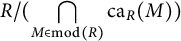

Theorem 1.1 is the main result in Section 4 regarding the characterization of the (strong) generation of singularity categories. The key input is the notion of the cohomological annihilator of a finitely generated R-module M, denoted
$ {\mathrm {ca}}_R(M)$
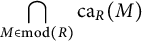
 , in Section 3. The key ingredient in the proof of Theorem 1.1 is the observation that
$ {\mathrm {ann}}_R\mathsf {D}_{\mathsf {sg}}(R)$
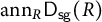 coincides with
$\displaystyle \bigcap _{M\in {\mathrm {mod}}(R)} {\mathrm {ca}}_R(M)$
 (see Corollary 4.3). When R is, in addition, a Gorenstein local ring, Theorem 1.1(2) was proved by Bahlekeh et al. [Reference Bahlekeh, Hakimian, Salarian and Takahashi5] in terms of the cohomological annihilator
$ {\mathrm {\mathfrak {ca}}}(R)$
 (see Remark 4.17).
For a finitely generated R-module M, it is known that the finite projective dimension locus of M,
$ \{\mathfrak {p}\in {\mathrm {Spec}}(R)\mid {\mathrm {pd}}_{R_{\mathfrak {p}}}(M_{\mathfrak {p}})<\infty \}, $
 is an open subset in the Zariski spectrum
$ {\mathrm {Spec}}(R)$
 (see [Reference Bass and Murthy8]). However, the same is not true for finite injective dimension locus, even when the module is the ring itself, that is, even the Gorenstein locus can fail to be open (see [Reference Nishimura43]). For an excellent ring R, Greco and Marinari [Reference Greco and Marinari29] observed that the Gorenstein locus is open. Takahashi [Reference Takahashi47] extended this result by proving that the finite injective dimension locus of a finitely generated module over an excellent ring is open.
In Section 5, we investigate the infinite injective dimension locus
$ {\mathrm {IID}}(M)$
 of an R-module M, which is the complement of the finite injective dimension locus. Namely,

We observe in Theorem 1.2 that the infinite injective dimension locus of a finitely generated module is always closed if
$ {\mathrm {mod}}(R)$
 has an extension generator (cf. 5.7). For a quasi-excellent ring R with finite Krull dimension and a finitely generated R-module M, it follows from [Reference Dey, Lank and Takahashi19] that
$ {\mathrm {mod}}(R)$
 has a strong generator. Consequently, by Theorem 1.2,
$ {\mathrm {IID}}(M)$
 is closed. In Section 5, we introduce the notion of the co-cohomological annihilator of an R-module M, denoted
$ {\mathrm {coca}}_R(M)$
 . The following result shows that, under some mild assumptions, this ideal is a defining ideal of the infinite injective dimension locus.
Theorem 1.2 (See Proposition 5.4 and Theorem 5.9)
Let R be a commutative Noetherian ring and M be a finitely generated R-module. Then:
-
(1) If $ {\mathrm {mod}}(R)$
has an extension generator, then
$ {\mathrm {IID}}(M)$
is closed in
$ {\mathrm {Spec}}(R)$
. Moreover,
$ {\mathrm {Sing}}(R)= {\mathrm {IID}}(G)$
holds for each extension generator G of
$ {\mathrm {mod}}(R)$
. -
(2) If $ {\mathrm {mod}}(R)$
has a strong generator, then $$ \begin{align*}{\mathrm{IID}}(M)=V({\mathrm{coca}}_R(M)).\end{align*} $$





We also compare the cohomological annihilator with the co-cohomological annihilator of a finitely generated module M. It turns out that these annihilators coincide when R is Gorenstein with finite Krull dimension and M is maximal Cohen–Macaulay (see Lemma 5.22).
Our third result, Theorem 1.3, establishes a connection between the existence of an extension generator of the module category and the finiteness of the Krull dimension. Moreover, Theorem 1.3(2) extends a recent result of Araya et al. [Reference Araya, Iima and Takahashi1] on the generation of syzygy modules out of a single module by only taking direct summands and extensions (see Remark 5.18).
Theorem 1.3 (See Propositions 5.17 and 5.20)
Let R be a commutative Noetherian ring. Then:
-
(1) If $ {\mathrm {mod}}(R)$
has an extension generator, then the Krull dimension of R is finite. -
(2) If the Krull dimension of R is finite and the singular locus of R is a finite set, then $ {\mathrm {mod}}(R)$
has an extension generator.


2 Notation and terminology
Throughout this article, R will be a commutative Noetherian ring. For each R-module M, let
$ {\mathrm {pd}}_R(M)$
 denote the projective dimension of M over R, and
$ {\mathrm {id}}_R(M)$
 denote the injective dimension of M over R. We write
$ {\mathrm {mod}}(R)$
 to be the category of finitely generated R-modules. Let
$\dim (R)$
 denote the Krull dimension of R, and
$ {\mathrm {gl.dim}}(R)$
 denote the global homological dimension of R.
2.1 (Strongly) Gorenstein rings
A commutative Noetherian ring R is called strongly Gorenstein provided that
$ {\mathrm {id}}_R(R)<\infty $
 . For instance, regular local rings and complete intersection rings are both examples of strongly Gorenstein rings.
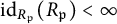
A commutative Noetherian ring R is said to be Gorenstein provided that
$R_{\mathfrak {p}}$
 is strongly Gorenstein (i.e.,
$ {\mathrm {id}}_{R_{\mathfrak {p}}}(R_{\mathfrak {p}})<\infty $
 ) for each prime ideal
$\mathfrak {p}$
 of R. Note that a commutative Noetherian local ring is Gorenstein if it is strongly Gorenstein.
For a Gorenstein ring R,
$ {\mathrm {id}}_R(R)=\dim (R)$
 ; this can be proved by combining [Reference Bass7, Corollary 2.3] and [Reference Bruns and Herzog12, Theorem 3.1.17]. In particular, a commutative Noetherian ring R is strongly Gorenstein if and only if it is Gorenstein with finite Krull dimension.
2.2 Regular rings
A commutative Noetherian local ring is called regular if its maximal ideal can be generated by a system of parameters. Auslander, Buchsbaum, and Serre observed that a commutative Noetherian local ring is regular if and only if its global homological dimension is finite (see [Reference Bruns and Herzog12, Theorem 2.2.7]).
A commutative Noetherian ring R is called regular if
$R_{\mathfrak {p}}$
 is regular for each prime ideal
$\mathfrak {p}$
 of R. Furthermore, a commutative Noetherian ring is regular if and only if every finitely generated module has finite projective dimension; see [Reference Bass and Murthy8, Lemma 4.5] for the forward direction, and the backward direction follows from the criterion of Auslander, Buchsbaum, and Serre.
For a regular ring,
$ {\mathrm {gl.dim}}(R)=\dim (R)$
 (see [Reference Lam39, Theorem 5.94]). In particular, a commutative Noetherian ring is regular with finite Krull dimension if and only if
$ {\mathrm {gl.dim}}(R)$
 is finite.
2.3 Annihilator and support of modules
For each R-module M, let
$ {\mathrm {ann}}_R(M)$
 denote the annihilator of M over R. That is,
$ {\mathrm {ann}}_R(M) := \{r\in R\mid r\cdot M=0\}$
 .
The set of all prime ideals of R is denoted by
$ {\mathrm {Spec}}(R)$
 . It is endowed with the Zariski topology; the closed subset in this topology is of the form
$V(I) := \{\mathfrak {p}\in {\mathrm {Spec}}(R)\mid \mathfrak {p}\supseteq I\}$
 for each ideal I of R.
For each R-module M, the support of M is

where
$M_{\mathfrak {p}}$
 is the localization of M at
$\mathfrak {p}$
 . Note that
$ {\mathrm {Supp}}_R(M)\subseteq V( {\mathrm {ann}}_R(M))$
 ; the equality holds if, in addition, M is finitely generated.
2.4 Syzygy modules
For a finitely generated R-module M and
$n\geq 1$
 , we let
$\Omega ^n_R(M)$
 denote the n-th syzygy of M. That is, there is a long exact sequence

where
$P^{-i}$
 are finitely generated projective R-modules for
$0\leq i\leq n-1$
 . By Schanuel’s lemma,
$\Omega ^n_R(M)$
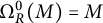
 is independent of the choice of the projective resolution of M up to projective summands. By convention,
$\Omega ^0_R(M)=M$
 for each finitely generated R-module M. Let
$\mathcal C$
 be a full subcategory of
$ {\mathrm {mod}}(R)$
 , we denote

We say that a finitely generated R-module M is an infinite syzygy if there exists an exact sequence
$ 0\rightarrow M\rightarrow Q^0\rightarrow Q^1\rightarrow Q^2\rightarrow \cdots , $
 where
$Q^i$
 are finitely generated projective R-modules for
$i\geq 0$
 .
2.5 Maximal Cohen–Macaulay modules
A finitely generated R-module M is said to be maximal Cohen–Macaulay provided that
$ {\mathrm {depth}}(M_{\mathfrak {p}})\geq \dim (R_{\mathfrak {p}})$
 for each prime ideal
$\mathfrak {p}$
 of R, where
$ {\mathrm {depth}}(M_{\mathfrak {p}})$
 represents the depth of
$M_{\mathfrak {p}}$
 over
$R_{\mathfrak {p}}$
 (see details in [Reference Bruns and Herzog12]). Let
$ {\mathrm {CM}}(R)$
 denote the full subcategory of
$ {\mathrm {mod}}(R)$
 consisting of maximal Cohen–Macaulay R-modules. A commutative Noetherian ring is Cohen–Macaulay if R is in
$ {\mathrm {CM}}(R)$
 .
Assume R is a Gorenstein ring. Note that a finitely generated R-module M is maximal Cohen–Macaulay if and only if
$ {\mathrm {Ext}}^{i}_R(M,R)=0$
 for all
$i>0$
 ; this can be proved by using Ischebeck’s formula (see [Reference Bruns and Herzog12, Exercise 3.1.24]). Then it follows from [Reference Buchweitz13, Theorem B.1.6] that, for each
$M\in {\mathrm {mod}}(R)$
 ,
$\Omega ^s_R(M)$
 is maximal Cohen–Macaulay for some
$s\geq 0$
 . On the other hand, any maximal Cohen–Macaulay R-module is an infinite syzygy (see [Reference Buchweitz13, Theorem B.1.3]).
2.6 Thick subcategories of Abelian categories
Let
$\mathcal {A}$
 be an Abelian category. A full subcategory
$\mathcal C$
 of
$\mathcal {A}$
 is called thick if
$\mathcal C$
 is closed under direct summands, and it contains objects that fit into a short exact sequence such that the other two objects are in
$\mathcal C$
 .
For each object X in
$\mathcal {A}$
 , let
$ {\mathrm {\mathsf {thick}}}_{\mathcal {A}}(X)$
 denote the smallest thick subcategory of
$\mathcal {A}$
 containing X; the notation
$ {\mathrm {\mathsf {thick}}}_{\mathcal {A}}$
 will have no confusion with
$ {\mathrm {\mathsf {thick}}}_{\mathcal {T}}$
 in 2.7 for a triangulated category
$\mathcal {T}$
 .
Set
$ {\mathrm {\mathsf {thick}}}_{\mathcal {A}}^0(X) := \{0\}$
 . Let
$ {\mathrm {\mathsf {thick}}}_{\mathcal {A}}^1(X)$
 be the full subcategory of
$\mathcal {A}$
 consisting of objects which are direct summands of finite direct sums of X. For
$n\geq 2$
 , let
$ {\mathrm {\mathsf {thick}}}_{\mathcal {A}}^n(X)$
 denote the full subcategory of
$\mathcal {A}$
 consisting of direct summands of objects in
$\mathcal {A}$
 that fit into a short exact sequence

where among the other two objects, one is in
$ {\mathrm {\mathsf {thick}}}^{n-1}_{\mathcal {A}}(X)$
 and the other is in
$ {\mathrm {\mathsf {thick}}}^{1}_{\mathcal {A}}(X)$
 . As mentioned before Definition 3.14 of [Reference Dey, Lank and Takahashi19], it is unclear whether the equality
$ {\mathrm {\mathsf {thick}}}_{\mathcal {A}}(X)=\bigcup _{n\geq 0} {\mathrm {\mathsf {thick}}}_{\mathcal {A}}^n(X) $
 holds; compare this with 2.7.
2.7 Thick subcategories of triangulated categories
Let
$\mathcal {T}$
 be a triangulated category with a suspension functor
$[1]$
 . A full category
$\mathcal C$
 of
$\mathcal {T}$
 is called thick if it is closed under suspensions, cones, and direct summands.
For each object X in
$\mathcal {T}$
 , let
$ {\mathrm {\mathsf {thick}}}_{\mathcal {T}}(X)$
 denote the smallest thick subcategory of
$\mathcal {T}$
 containing X. This can be constructed inductively as below (see [Reference Avramov, Buchweitz, Iyengar and Miller3, Section 2] for more details).
Set
$ {\mathrm {\mathsf {thick}}}_{\mathcal {T}}^0(X) := \{0\}$
 . Let
$ {\mathrm {\mathsf {thick}}}_{\mathcal {T}}^1(X)$
 be the smallest full subcategory of
$\mathcal {T}$
 containing X, and it is closed under suspensions, finite direct sums, and direct summands. For
$n\geq 2$
 , let
$ {\mathrm {\mathsf {thick}}}_{\mathcal {T}}^n(X)$
 denote the full subcategory of
$\mathcal {T}$
 consisting of direct summands of objects Y in
$\mathcal {T}$
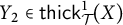
 that fit into an exact triangle

where
$Y_1\in {\mathrm {\mathsf {thick}}}^{n-1}_{\mathcal {T}}(X)$
 and
$Y_2\in {\mathrm {\mathsf {thick}}}_{\mathcal {T}}^{1}(X)$
 . Note that
$ {\mathrm {\mathsf {thick}}}_{\mathcal {T}}(X)=\displaystyle \bigcup \limits _{n\geq 0} {\mathrm {\mathsf {thick}}}_{\mathcal {T}}^n(X).$

2.8 Derived categories and singularity categories
Let
$\mathsf {D}(R)$
 denote the derived category of R-modules. This is a triangulated category with a suspension functor
$[1]$
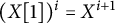
 ; for each complex X,
$(X[1])^i=X^{i+1}$
 and
$\partial _{X[1]}=-\partial _X$
 . The bounded derived category, denoted
$\mathsf {D}^f(R)$
 , is the full subcategory of
$\mathsf {D}(R)$
 consisting of complexes X such that its total cohomology, denoted
$\displaystyle \bigoplus _{i\in \mathbb {Z}} {\mathrm {H}}^i(X)$
 , is finitely generated over R; note that
$\mathsf {D}^f(R)$
 is a thick subcategory of
$\mathsf {D}(R)$
 .
A complex X in
$\mathsf {D}(R)$
 is called perfect if
$X\in {\mathrm {\mathsf {thick}}}_{\mathsf {D}(R)}(R)$
 . It turns out that a complex in
$\mathsf {D}(R)$
 is perfect if and only if it is isomorphic to a bounded complex of finitely generated projective R-modules; this can be proved by using [Reference Buchweitz13, Lemma 1.2.1]. Note that
$ {\mathrm {\mathsf {thick}}}_{\mathsf {D}(R)}(R)\subseteq \mathsf {D}^f(R)$
 .
The singularity category of R is defined to be the Verdier quotient

This category was introduced by Buchweitz [Reference Buchweitz13, Definition 1.2.2] under the name “stable derived category” and later also found by Orlov [Reference Orlov44, Section 1.2]. This category detects the singularity of R in the sense that
$\mathsf {D}_{\mathsf {sg}}(R)$
 is trivial if and only if R is regular.
The following definition of “strong generator” in 2.9 differs from that of Iyengar and Takahashi [Reference Iyengar and Takahashi32, Section 4.3]. Indeed, an arbitrary Abelian category need not have enough projectives (for instance, the category of coherent sheaves over a Noetherian scheme), so the notion of “syzygy” used in [Reference Iyengar and Takahashi32] to define strong generation may not be available. In contrast, 2.9 applies to any Abelian category. By [Reference Iyengar and Takahashi32, Corollary 4.6],
$ {\mathrm {mod}}(R)$
 has a strong generator in the sense of 2.9 if and only if
$ {\mathrm {mod}}(R)$
 has a strong generator in the sense of Iyengar and Takahashi [Reference Iyengar and Takahashi32, Section 4.3].
2.9 (Strong) generators of Abelian categories
Let
$\mathcal {A}$
 be an Abelian category and G be an object in
$\mathcal {A}$
 . The object G is called a generator of
$\mathcal {A}$
 if
$ {\mathrm {\mathsf {thick}}}_{\mathcal {A}}(G)=\mathcal {A}$
 , and G is called a strong generator of
$\mathcal {A}$
 if
$ {\mathrm {\mathsf {thick}}}^n_{\mathcal {A}}(G)=\mathcal {A}$
 for some
$n\geq 0$
 .
For example, if R is an Artinian ring R,
$R/J(R)$
 is a strong generator of
$ {\mathrm {mod}}(R)$
 , where
$J(R)$
 is the Jacobson radical of R. Moreover,
$ {\mathrm {mod}}(R)= {\mathrm {\mathsf {thick}}}^{\ell \ell (R)}_{ {\mathrm {mod}}(R)}(R/J(R))$
 , where
$\ell \ell (R) := \mathrm {inf}\{n\geq 0\mid J(R)^n=0\}$
 is the Loewy length of R.
2.10
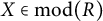
For each
$X\in {\mathrm {mod}}(R)$
 , Dao and Takahashi [Reference Dao and Takahashi17, Definition 5.1] introduced a construction of an ascending chain of full subcategories built out of X as follows.
Set
$|X|_0^R=\{0\}$
 , and denote
$|X|_1^R$
 to be the full subcategory of
$ {\mathrm {mod}}(R)$
 consisting of modules which are direct summands of any finite copies of X. Inductively, for
$n\geq 2$
 , denote
$|X|_n^R$
 to be the full subcategory of
$ {\mathrm {mod}}(R)$
 consisting of modules Y that appear in a short exact sequence

where
$Y_1\in |X|_{n-1}^R$
 and
$Y_2\in |X|_1^R$
 . If there is no confusion, we will use
$|X|_n$
 to denote
$|X|_n^R$
 .
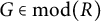
In [Reference Iyengar and Takahashi32, Corollary 4.6], Iyengar and Takahashi observed that
$ {\mathrm {mod}}(R)$
 has a strong generator if and only if there exist
$s,t\geq 0$
 and
$G\in {\mathrm {mod}}(R)$
 such that

2.11 (Strong) generators of triangulated categories
Let
$\mathcal {T}$
 be a triangulated category and G be an object in
$\mathcal {T}$
 . The object G is called a generator of
$\mathcal {T}$
 if
$ {\mathrm {\mathsf {thick}}}_{\mathcal {T}}(G)=\mathcal {T}$
 , and G is called a strong generator of
$\mathcal {T}$
 if
$ {\mathrm {\mathsf {thick}}}^n_{\mathcal {T}}(G)=\mathcal {T}$
 for some
$n\geq 0$
 (see details in [Reference Bondal and den Bergh10, Reference Rouquier45]). Note that
$\mathcal {T}$
 has a strong generator if and only if the Rouquier dimension (see [Reference Rouquier45]) of
$\mathcal {T}$
 is finite.
If R is an Artinian ring, then
$R/J(R)$
 is a strong generator of
$\mathsf {D}^f(R)$
 ; indeed,
$\mathsf {D}^f(R)= {\mathrm {\mathsf {thick}}}^{\ell \ell (R)}_{\mathsf {D}(R)}(R/J(R))$
 by [Reference Rouquier45, Proposition 7.37].
We end this section by recording the (strong) generators of the regular rings.
2.12
Let R be a commutative Noetherian ring. Note that, for each
$G\in {\mathrm {mod}}(R)$
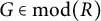 , G is a generator of
$\mathsf {D}^f(R)$
 if G is a generator of
$ {\mathrm {mod}}(R)$
 . Combining with this, the following are equivalent:
-
(1) R is regular.
-
(2) R is a generator of $ {\mathrm {mod}}(R)$
. -
(3) R is a generator of $\mathsf {D}^f(R)$
.


2.13
Let R be a commutative Noetherian ring and G be a module in
$ {\mathrm {mod}}(R)$
 . If
$ {\mathrm {mod}}(R)= {\mathrm {\mathsf {thick}}}_{ {\mathrm {mod}}(R)}^n(G)$
 , then
$\mathsf {D}^f(R)= {\mathrm {\mathsf {thick}}}_{\mathsf {D}(R)}^{2n}(G)$
 by [Reference Iyengar and Takahashi32, Lemma 7.1]. In particular, G is a strong generator of
$\mathsf {D}^f(R)$
 if G is a strong generator of
$ {\mathrm {mod}}(R)$
 . This yields
$(2)\Rightarrow (3)$
 below. Indeed, all the following conditions are equivalent:
-
(1) R is regular with $\dim (R)<\infty $
, equivalently
$ {\mathrm {gl.dim}}(R)<\infty $
(see 2.2). -
(2) R is a strong generator of $ {\mathrm {mod}}(R)$
. -
(3) R is a strong generator of $\mathsf {D}^f(R)$
.



$(1)\Rightarrow (2)$
 : If
$ {\mathrm {gl.dim}}(R)=d$
 is finite, then
$ {\mathrm {mod}}(R)= {\mathrm {\mathsf {thick}}}_{ {\mathrm {mod}}(R)}^{d+1}(R)$
 .
$(3)\Rightarrow (1)$
 : If
$\mathsf {D}^f(R)= {\mathrm {\mathsf {thick}}}^n_{\mathsf {D}(R)}(R)$
 , then [Reference Christensen14, Propositions 4.5 and 4.6] yields that
$ {\mathrm {pd}}_R(M)\leq n-1$
 for each
$M\in {\mathrm {mod}}(R)$
 , and hence
$ {\mathrm {gl.dim}}(R)\leq n-1$
 .
Moreover, if the above conditions hold, then
$ {\mathrm {mod}}(R)= {\mathrm {\mathsf {thick}}}_{ {\mathrm {mod}}(R)}^{d+1}(R)$
 and
$\mathsf {D}^f(R)= {\mathrm {\mathsf {thick}}}_{\mathsf {D}(R)}^{d+1}(R)$
 (see [Reference Christensen14, Theorem 8.3]), where
$d=\dim (R)$
 .
3 Cohomological annihilators for modules
The following definition of cohomological annihilators for modules is inspired by the definition of cohomological annihilators for rings introduced by Iyengar and Takahashi [Reference Iyengar and Takahashi32] (see their definition in 3.3). For a subset
$I\subseteq \mathbb {N}$
 and full subcategories
$\mathcal {C},\mathcal {D}$
 of
$ {\mathrm {mod}}(R)$
 , set
$ {\mathrm {Ext}}^I_R(\mathcal {C},\mathcal {D}) := \bigoplus \limits _{i\in I}\bigoplus \limits _{M\in \mathcal {C},N\in \mathcal {D}} {\mathrm {Ext}}^i_R(M,N)$
 .
3.1
For each finitely generated R-module M and
$n\geq 0$
 , we define the n-th cohomological annihilator of M to be

That is,
$ {\mathrm {ca}}^n_R(M)$
 consists of elements
$r\in R$
 such that
$r\cdot {\mathrm {Ext}}^i_R(M,N)=0$
 for each
$i\geq n$
 and
$N\in {\mathrm {mod}}(R)$
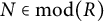 . Consider the ascending chain of ideals

the cohomological annihilator of M is defined to be the union of these ideals

Since R is Noetherian,
$ {\mathrm {ca}}_R(M)= {\mathrm {ca}}_R^n(M)$
 for
$n\gg 0$
 .
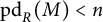
Note that
$ {\mathrm {ca}}_R^n(M)=R$
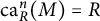 if and only if
$ {\mathrm {pd}}_R(M)<n$
 . Thus,
$ {\mathrm {ca}}_R(M)=R$
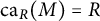 if and only if
$ {\mathrm {pd}}_R(M)<\infty $
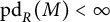 .
3.2
Let
$\mathcal C$
 be a full subcategory of
$ {\mathrm {mod}}(R)$
 , Bahlekeh et al. [Reference Bahlekeh, Salarian, Takahashi and Toosi6, Definition 5.7] introduced the concept of cohomological annihilator of
$\mathcal C$
 , denoted
$ {\mathrm {ca}}_R(\mathcal C)$
 . It is defined as

By definition, if
$\mathcal C$
 consists of only one module X, then
$ {\mathrm {ca}}_R(\mathcal C)= {\mathrm {ca}}_R(X)$
 .
3.3
For each
$n\geq 0$
 , following [Reference Iyengar and Takahashi32, Definition 2.1], the n-th cohomological annihilator of the ring R is defined to be

By definition,
$ {\mathrm {\mathfrak {ca}}}^n(R)=\displaystyle \bigcap \limits _{M\in {\mathrm {mod}}(R)} {\mathrm {ca}}_R^n(M)$
 and there is an ascending chain of ideals

The cohomological annihilator of the ring R is defined to be the ideal

Also,
$ {\mathrm {\mathfrak {ca}}}(R)= {\mathrm {\mathfrak {ca}}}^n(R)$
 for
$n\gg 0$
 as R is Noetherian.
Example 3.4 Let R be an equicharacteristic complete Cohen–Macaulay local ring with Krull dimension d. Wang [Reference Wang49, Theorem 5.3] observed that
$ {\mathrm {\mathfrak {ca}}}^{d+1}(R)$
 contains the Jacobian ideal of R (see also [Reference Iyengar and Takahashi34, Theorem 1.2]).
Lemma 3.5 (1)
$ {\mathrm {\mathfrak {ca}}}(R)\subseteq {\mathrm {ca}}_R( {\mathrm {mod}}(R))$
 .
(2)
$ {\mathrm {ca}}_R( {\mathrm {mod}}(R))=R$
 if and only if R is regular.
(3)
$ {\mathrm {\mathfrak {ca}}}(R)=R$
 if and only if R is regular with finite Krull dimension.
Proof (1) For each
$n\geq 0$
 , we have

Thus,
$ {\mathrm {\mathfrak {ca}}}(R)\subseteq {\mathrm {ca}}_R( {\mathrm {mod}}(R))$
 as
$ {\mathrm {\mathfrak {ca}}}(R)= {\mathrm {\mathfrak {ca}}}^n(R)$
 for
$n\gg 0$
 .
(2) By definition,
$ {\mathrm {ca}}_R( {\mathrm {mod}}(R))=R$
 if and only if
$ {\mathrm {ca}}_R(M)=R$
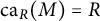 for each
$M\in {\mathrm {mod}}(R)$
 . This is equivalent to
$ {\mathrm {pd}}_R(M)<\infty $
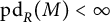 for each
$M\in {\mathrm {mod}}(R)$
 (see 3.1). This is equivalent to that R is regular (see 2.2).
(3) By [Reference Iyengar and Takahashi32, Example 2.5],
$ {\mathrm {\mathfrak {ca}}}(R)=R$
 if and only if
$ {\mathrm {gl.dim}}(R)<\infty $
 . The desired result now follows immediately from 2.2.
In general,
$ {\mathrm {\mathfrak {ca}}}(R)\neq {\mathrm {ca}}_R( {\mathrm {mod}}(R))$
 (see the example below). They are equal if, in addition, R is strongly Gorenstein (see Proposition 3.14).
Example 3.6 The inclusion in Lemma 3.5(1) can be proper. In [Reference Nagata42, Appendix, Example 1], Nagata constructed a commutative Noetherian regular ring R with infinite Krull dimension. In this case,
$ {\mathrm {\mathfrak {ca}}}(R) \subsetneqq {\mathrm {ca}}_R( {\mathrm {mod}}(R))=R$
 by Lemma 3.5.
3.7
Let
$M,N$
 be R-modules. If M is finitely generated, then it follows from [Reference Weibel50, Proposition 3.3.10] that there is a natural isomorphism

for each
$\mathfrak {p}\in {\mathrm {Spec}}(R)$
 and
$n\geq 0$
 .
Lemma 3.8 Let M be a finitely generated R-module and
$n\geq 1$
 . Then:
-
(1) $ {\mathrm {ca}}_R^n(M)= {\mathrm {ann}}_R {\mathrm {Ext}}^n_R(M,\Omega ^n_R(M))= {\mathrm {ann}}_R\ \underline { {\mathrm {End}}}_R(\Omega ^{n-1}_R(M))$
. -
(2) $\{\mathfrak {p}\in {\mathrm {Spec}}(R)\mid {\mathrm {pd}}_{R_{\mathfrak {p}}}(M_{\mathfrak {p}})\geq n\}=V( {\mathrm {ca}}_R^n(M))= {\mathrm {Supp}}_R {\mathrm {Ext}}_R^n(M,\Omega ^n_R(M)) $
. -
(3) $ {\mathrm {ca}}_R^n(M)= {\mathrm {ann}}_R {\mathrm {Ext}}^n_R(M, {\mathrm {mod}}(R))$
. -
(4) $ {\mathrm {ca}}_R^{n+i}(M)= {\mathrm {ca}}_R^n(\Omega ^i_R(M))$
for each
$i\geq 1$
. Hence,
$ {\mathrm {ca}}_R(M)= {\mathrm {ca}}_R(\Omega ^i_R(M))$
for each
$i\geq 1$
. -
(5) Let S be a multiplicatively closed subset of R. Then $S^{-1} {\mathrm {ca}}^n_R(M)= {\mathrm {ca}}^n_{S^{-1}R}(S^{-1}M)$
. In particular,
$S^{-1} {\mathrm {ca}}_R(M)= {\mathrm {ca}}_{S^{-1}R}(S^{-1}M)$
.









Proof (1) This follows from [Reference Dey and Takahashi22, Lemma 3.8] and [Reference Iyengar and Takahashi32, Lemma 2.14].
(2) Combining with 3.7,
$ {\mathrm {pd}}_{R_{\mathfrak {p}}}(M_{\mathfrak {p}})\geq n$
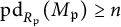 if and only if
$\mathfrak {p}\in {\mathrm {Supp}}_R {\mathrm {Ext}}^n_R(M,\Omega ^n_R(M))$
 . Since
$ {\mathrm {Ext}}_R^n(M,\Omega ^n_R(M))$
 is finitely generated over R,

Combining this with (1), the desired statement follows.
(3) It is clear that

By (1), these inclusions are equal.
(4) For each
$X\in {\mathrm {mod}}(R)$
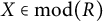 , consider the isomorphism

Combining with (3), we have
$ {\mathrm {ca}}_R^{n+1}(M)= {\mathrm {ca}}_R^n(\Omega ^1_R(M))$
 . Then the first statement of (4) can be obtained by induction on the number i. Thus, for each
$i\geq 1$
 ,

This completes the proof.
(5) The second statement follows from the first one. For the first statement, combining with (4), it suffices to prove the case of
$n=1$
 . By (1), we get an inclusion
$S^{-1} {\mathrm {ca}}^1_R(M)\subseteq {\mathrm {ca}}^1_{S^{-1}R}(S^{-1}M)$
 . For the converse, assume
$r/s\in {\mathrm {ca}}^1_{S^{-1}R}(S^{-1}M)$
 , where
$s\in S$
 and
$r\in R$
 . It remains to prove that
$r/s\in S^{-1} {\mathrm {ca}}^1_R(M)$
 . By (1), we get that the multiplication
$r/s\colon S^{-1}M\rightarrow S^{-1}M$
 factors through a finitely generated projective
$S^{-1}R$
 -module, and hence
$r/s\colon S^{-1}M\rightarrow S^{-1}M$
 factors through a finitely generated free
$S^{-1}R$
 -module. Combining with the fact that the isomorphism
$S^{-1} {\mathrm {Hom}}_R(X,Y)\cong {\mathrm {Hom}}_{S^{-1}R}(S^{-1}X,S^{-1}Y)$
 holds for
$X,Y\in {\mathrm {mod}}(R)$
 , we conclude that there is a factorization

where F is a finitely generated free R-module,
$s_1,s_2\in S$
 ,
$\alpha \colon M\rightarrow F$
 , and
$\beta \colon F\rightarrow M$
 . From the factorization, it follows that there exists
$t\in S$
 such that
$ts_2s_1r=ts\beta \alpha $
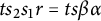 . Note that
$r/s=(ts_2s_1r)/(ts_2s_1s)$
 and
$ts_2s_1r=ts\beta \alpha $
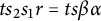 factors through F. By (1),
$ts_2s_1r\in {\mathrm {ca}}^1_R(M)$
 , and hence
$r/s\in S^{-1} {\mathrm {ca}}_R^1(M)$
 .
3.9
Let M be a finitely generated R-module.
(1) Following [Reference Takahashi48, Definition 2.9], the infinite projective dimension locus of M is defined to be

(2)
$\sup \{ {\mathrm {pd}}_{R_{\mathfrak {p}}}(M_{\mathfrak {p}})\mid \mathfrak {p}\notin {\mathrm {IPD}}(M)\}$
 is finite. Indeed, it follows from the proof of [Reference Bass and Murthy8, Lemma 4.5] that

for some
$n\geq 0$
 , and hence
$\sup \{ {\mathrm {pd}}_{R_{\mathfrak {p}}}(M_{\mathfrak {p}})\mid \mathfrak {p}\notin {\mathrm {IPD}}(M)\}\leq n$
 (see also [Reference Avramov, Iyengar and Lipman4, Theorem 1.1]).
Proposition 3.10 Let M be a finitely generated R-module. Then

where
$d=\sup \{ {\mathrm {pd}}_{R_{\mathfrak {p}}}(M_{\mathfrak {p}})\mid \mathfrak {p}\notin {\mathrm {IPD}}(M)\}$
 .
Proof The first equality follows from the following:

where the first two equalities follow from Lemma 3.8; the first equality also follows directly from the proof of [Reference Iyengar and Takahashi33, Lemma 2.3].
Next, we prove the second equality. The inclusion
$V( {\mathrm {ca}}_R(M))\subseteq V( {\mathrm {ca}}_R^{d+1}(M))$
 is clear. Combining with the first equality, it remains to prove
$V( {\mathrm {ca}}_R^{d+1}(M))\subseteq {\mathrm {IPD}}(M)$
 . If not, let
$\mathfrak {p}$
 be a prime ideal containing
$ {\mathrm {ca}}_R^{d+1}(M)$
 and
$\mathfrak {p}\notin {\mathrm {IPD}}(M)$
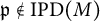 . By assumption,
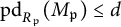
$ {\mathrm {pd}}_{R_{\mathfrak {p}}}(M_{\mathfrak {p}})\leq d$
 . However, it follows from Lemma 3.8 that
$ {\mathrm {pd}}_{R_{\mathfrak {p}}}(M_{\mathfrak {p}})\geq d+1$
 . This is a contradiction.
Recall that
$ {\mathrm {CM}}(R)$
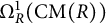
 is denoted to be the category of maximal Cohen–Macaulay R-modules (see 2.5). Set

(see the definition of
$\Omega ^1_R( {\mathrm {CM}}(R))$
 in 2.4). Next, we calculate the uniform degree of the cohomological annihilators. It turns out that the uniform degree behaves well when the ring is strongly Gorenstein (see Proposition 3.14).
Lemma 3.11 (1) Let M be a finitely generated R-module such that
$ {\mathrm {Ext}}^{i}_R(M,R)=0$
 for all
$0\leq m\leq i\leq n$
 , then
$ {\mathrm {ca}}^m_R(M)=\cdots = {\mathrm {ca}}^{n+1}_R(M). $

(2) If
$(R,\mathfrak {m})$
 is a d-dimensional Cohen–Macaulay local ring with a canonical module
$\omega $
 . If
$ {\Omega \text{ CM}}^\times (R)$
 is closed under
$ {\mathrm {Hom}}_R(-,\omega )$
 , then
$ {\mathrm {ca}}_R^{d+1}(M)= {\mathrm {ca}}_R(M) $
 for each
$M\in {\mathrm {mod}}(R)$
 . In particular,
$ {\mathrm {\mathfrak {ca}}}^{d+1}(R)= {\mathrm {\mathfrak {ca}}}(R)= {\mathrm {ca}}_R( {\mathrm {mod}}(R)). $

Proof (1) For each
$j\geq 0$
 , consider the short exact sequence

where P is a finitely generated projective R-module. Applying
$ {\mathrm {Hom}}_R(M,-)$
 to this short exact sequence, we get an exact sequence

Set
$j=m$
 . The assumption yields that
$ {\mathrm {Ext}}^m_R(M,P)=0$
 . Thus, the above exact sequence yields that
$ {\mathrm {ca}}^{m+1}_R(M)\subseteq {\mathrm {ca}}^m_R(M)$
 (see Lemma 3.8), and hence
$ {\mathrm {ca}}^m_R(M)= {\mathrm {ca}}^{m+1}_R(M)$
 . The desired result follows similarly by choosing
$j=m+1,\ldots ,n$
 .
(2) For each
$M\in {\mathrm {mod}}(R)$
 and
$i\geq d$
 ,
$\Omega ^{i}_R(M)$
 is in
$ {\mathrm {CM}}(R)$
 . Choose a minimal free resolution of
$\Omega ^i_R(M)$
 :
$ 0\rightarrow \Omega ^{i+1}_R(M)\rightarrow F\rightarrow \Omega ^i_R(M)\rightarrow 0, $
 where F is a finitely generated free R-module. In this case,
$\Omega ^{i+1}_R(M)$
 does not have a nonzero projective summand (see [Reference Herzog30, Lemma 1.4]), and hence
$\Omega ^{i+1}_R(M)\in {\Omega \text{ CM}}^\times (R)$
 . By assumption,
$ {\mathrm {Hom}}_R(\Omega ^{i+1}_R(M),\omega )\in {\Omega \text{ CM}}(R)$
 . It follows from [Reference Kobayashi and Takahashi38, Proposition 5.2] that there exists a short exact sequence

in
$ {\mathrm {mod}}(R)$
 . Note that
$ {\mathrm {Ext}}^{>0}_R(\Omega ^i_R(M),\omega )=0$
 as
$\Omega ^i_R(M)\in {\mathrm {CM}}(R)$
 . Applying
$ {\mathrm {Hom}}_R(\Omega ^i_R(M),-)$
 to the above short exact sequence,
$ {\mathrm {Ext}}^1_R(\Omega ^i_R(M),\Omega ^{i+1}_R(M))\cong {\mathrm {Ext}}^2_R(\Omega ^i_R(M),K). $
 We conclude from this that
$ {\mathrm {Ext}}^{i+1}_R(M,\Omega ^{i+1}_R(M))\cong {\mathrm {Ext}}^{i+2}_R(M,K)$
 . This isomorphism implies
$ {\mathrm {ca}}_R^{i+2}(M)\subseteq {\mathrm {ann}}_{R} {\mathrm {Ext}}^{i+1}_R(M,\Omega ^{i+1}_R(M))= {\mathrm {ca}}_R^{i+1}(M), $
 where the second equality follows from Lemma 3.8. Hence,
$ {\mathrm {ca}}_R^{i+1}(M)= {\mathrm {ca}}_R^{i+2}(M)$
 for each
$i\geq d$
 . This implies
$ {\mathrm {ca}}_R(M)= {\mathrm {ca}}_R^{d+1}(M)$
 .
For the second statement, it follows from Lemma 3.5 that
$ {\mathrm {\mathfrak {ca}}}^{d+1}(R)\subseteq {\mathrm {\mathfrak {ca}}}(R)\subseteq {\mathrm {ca}}_R( {\mathrm {mod}}(R))$
 . The desired result now follows from the following:

This finishes the proof.
We would like to thank the referee for pointing out the following remark.
Remark 3.12 (1) Assume the grade of M is n, namely,
$\min \left\{i\geq 0\mid\right.\left. {\mathrm {Ext}}^i_R(M,R)\neq 0\right\}=n$
 . By Lemma 3.11(1), there are equalities

(2) One can also deduce the equality
$ {\mathrm {ca}}_R^{d+1}(M)= {\mathrm {ca}}_R(M)$
 in Lemma 3.11(2) from [Reference Esentepe25, Proposition 2.5]. Indeed, together with Lemma 3.8, it is enough to prove that

for each
$X\in {\mathrm {CM}}(R)$
 . This is precisely the statement of [Reference Esentepe25, Proposition 2.5].
3.13
For a finitely generated R-module M, let
$ \mathrm{Rfd}_R (M)$
 denote the (large) restricted flat dimension of M. That is,

By [Reference Avramov, Iyengar and Lipman4, Theorem 1.1] with [Reference Christensen, Foxby and Frankild15, Proposition 2.2 and Theorem 2.4],
$ \mathrm{Rfd}_R (M) \in \mathbb {N} \cup \{-\infty \}$
 , and
$ \mathrm{Rfd}_R(M)=-\infty $
 if and only if
$M=0$
 .
Proposition 3.14 Let R be a Gorenstein ring. Then:
-
(1) For each $M\in {\mathrm {CM}}(R)$
,
$ {\mathrm {ca}}_R^1(M)= {\mathrm {ca}}_R(M)$
. -
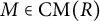
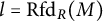
(2) For each nonzero finitely generated R-module M, $ {\mathrm {ca}}_R^{l+1}(M)= {\mathrm {ca}}_R(M)$
, where
$l= \mathrm{Rfd}_R(M)$
. -
(3) If, in addition, R has finite Krull dimension d, then there are equalities
$$ \begin{align*}{\mathrm{\mathfrak{ca}}}^{d+1}(R)={\mathrm{\mathfrak{ca}}}(R)={\mathrm{ca}}_R({\mathrm{mod}}(R))=\bigcap_{M\in {\mathrm{CM}}(R)}{\mathrm{ann}}_R\ \underline{{\mathrm{End}}}_R(M).\end{align*} $$



Proof (1) For each
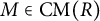
$M\in {\mathrm {CM}}(R)$
 , we have
$ {\mathrm {Ext}}^{>0}_R(M,R)=0$
 (see 2.5). The desired result now follows from Lemma 3.11.
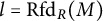
(2) Note that 3.13 yields that
$l= \mathrm{Rfd}_R(M)$
 is finite. By [Reference Bruns and Herzog12, Exercise 1.3.7],
$\Omega ^l_R(M)$
 is maximal Cohen–Macaulay over R. Let
$i\geq 1$
 be an integer. By Lemma 3.8, we have

Note that
$\ \underline { {\mathrm {End}}}_R(\Omega ^{l+i-1}_R(M))\cong \ \underline { {\mathrm {End}}}_R(\Omega ^l_R(M))$
 as
$\Omega ^{l}_R(M)\in {\mathrm {CM}}(R)$
 (see [Reference Buchweitz13, Theorem B.1.8]). Thus,
$ {\mathrm {ca}}_R^{l+i}(M)= {\mathrm {ca}}_R^{l+1}(M)$
 , and hence
$ {\mathrm {ca}}_R(M)= {\mathrm {ca}}_R^{l+1}(M)$
 .
(3) In [Reference Esentepe24, Lemma 2.3], Esentepe observed that
$ {\mathrm {\mathfrak {ca}}}(R)=\displaystyle \bigcap \limits _{M\in {\mathrm {CM}}(R)} {\mathrm {ann}}_R\,\ \underline { {\mathrm {End}}}_R(M).$
 By the same argument in the proof of Lemma 3.11, we have
$ {\mathrm {\mathfrak {ca}}}^{d+1}(R)= {\mathrm {\mathfrak {ca}}}(R)= {\mathrm {ca}}_R( {\mathrm {mod}}(R))$
 . This completes the proof.
Remark 3.15 (1) Keep the same assumption as Proposition 3.14(3), the first author and the second author proved
$ {\mathrm {\mathfrak {ca}}}(R)= {\mathrm {\mathfrak {ca}}}^{d+1}(R)$
 in [Reference Dey and Liu20, Proposition 3.4]. As mentioned in the proof, the equality
$ {\mathrm {\mathfrak {ca}}}(R)=\displaystyle \bigcap _{M\in {\mathrm {CM}}(R)} {\mathrm {ann}}_R\,\ \underline { {\mathrm {End}}}_R(M)$
 was due to Esentepe [Reference Esentepe24, Lemma 2.3].
(2) For a finitely generated R-module M, we define

Since R is Noetherian,
$ \mathrm{n}_R(M)$
 is always finite. For instance, if
$ {\mathrm {pd}}_{R}(M)$
 is finite, then
$ \mathrm{n}_R(M) = {\mathrm {pd}}_R(M)$
 . For a full subcategory
$\mathcal C$
 of
$ {\mathrm {mod}}(R)$
 , we set
$ \mathrm{n}_R(\mathcal C) = \sup \{ \mathrm{n}_R(M) \mid M\in \mathcal C \}$
 . If
$ \mathrm{n}_R(\mathcal C)<\infty $
 , then
$ {\mathrm {ca}}_{R}(\mathcal C) = \displaystyle \bigcap _{M\in \mathcal C} {\mathrm {ca}}_{R}(M) = \displaystyle \bigcap _{M\in \mathcal C} {\mathrm {ca}}^{k+1}_{R}(M)$
 for each
$k \geq \mathrm{n}_R(\mathcal C)$
 . Hence, if
$ \mathrm{n}_R( {\mathrm {mod}}(R))<\infty $
 is finite, then

Note that the ring R, under the assumption of Lemma 3.11(2) or Proposition 3.14(2), satisfies
$ \mathrm{n}_R( {\mathrm {mod}}(R)) $
 is finite.
(3) Let
$(R,\mathfrak {m})$
 be a commutative Noetherian local ring with
$\mathfrak {m}^2=0$
 . For each
$M\in {\mathrm {mod}}(R)$
 , the assumption that
$\mathfrak {m}^2=0$
 implies that
$\Omega _R^1(M)$
 is a direct sum of some finite copies of R and k. By Lemma 3.8(1), we conclude that
$ {\mathrm {ca}}^2_R(M)= {\mathrm {ca}}_R(M)$
 for each
$M\in {\mathrm {mod}}(R)$
 , and hence
$ \mathrm{n}_R( {\mathrm {mod}}(R))\leq 1$
 .
Let
$ {\mathrm {Max}}(R)$
 denote the subset of
$ {\mathrm {Spec}}(R)$
 consisting of all maximal ideals of R. In view of Remark 3.15(2), the following result may be regarded as a version of the local–global principle for projective dimensions.
Proposition 3.16 Let R be a commutative Noetherian ring. Then:
-
(1) For each $M \in {\mathrm {mod}}(R)$
,
$ \mathrm{n}_R(M)=\sup \{ \mathrm{n}_{R_{\mathfrak {p}}}(M_{\mathfrak {p}})\mid \mathfrak {p} \in {\mathrm {Spec}}(R)\} =\sup \{ \mathrm{n}_{R_{\mathfrak {m}}}(M_{\mathfrak {m}})\mid \mathfrak {m} \in {\mathrm {Max}}(R)\}$
. In particular,
$ \mathrm{n}_R( {\mathrm {mod}}(R)) =\sup \{ \mathrm{n}_{R_{\mathfrak {p}}}( {\mathrm {mod}}(R_{\mathfrak {p}})) \mid \mathfrak {p} \in {\mathrm {Spec}}(R)\}=\sup \{ \mathrm{n}_{R_{\mathfrak {m}}}( {\mathrm {mod}}(R_{\mathfrak {m}})) \mid \mathfrak {m} \in {\mathrm {Max}}(R)\}$
. -
(2) $ \mathrm{n}_R( {\mathrm {mod}}(R))\geq \dim (R) - 1$
. In particular, if
$ \mathrm{n}_R( {\mathrm {mod}}(R))$
is finite, then R has finite Krull dimension.





Proof (1) The second statement follows from the first one and the fact that the localization functor
$ {\mathrm {mod}}(R)\rightarrow {\mathrm {mod}}(R_{\mathfrak {p}})$
 is dense for each
$\mathfrak {p}\in {\mathrm {Spec}}(R)$
 . For the first statement, let
$n= \mathrm{n}_R(M)+1$
 . It follows that
$ {\mathrm {ca}}^n_R(M)= {\mathrm {ca}}_R(M)$
 . By Lemma 3.8(5), for each
$\mathfrak {p}\in {\mathrm {Spec}}(R)$
 , we have

It follows from this that
$ \mathrm{n}_R(M)\geq \sup \{ \mathrm{n}_{R_{\mathfrak {p}}}(M_{\mathfrak {p}})\mid \mathfrak {p} \in {\mathrm {Spec}}(R)\} \geq \sup \{ \mathrm{n}_{R_{\mathfrak {m}}}(M_{\mathfrak {m}})\mid \mathfrak {m} \in {\mathrm {Max}}(R)\}$
 . Assume
$m=\sup \{ \mathrm{n}_{R_{\mathfrak {m}}}(M_{\mathfrak {m}})\mid \mathfrak {m} \in {\mathrm {Max}}(R)\}+1$
 . Again by Lemma 3.8(5), we conclude that the localization of the inclusion
$ {\mathrm {ca}}^m_R(M)\subseteq {\mathrm {ca}}_R(M)$
 at each maximal ideal of R is equal, and hence
$ {\mathrm {ca}}^m_R(M)= {\mathrm {ca}}_R(M)$
 . It follows from this that
$ \mathrm{n}_R(M)\leq m=\sup \{ \mathrm{n}_{R_{\mathfrak {m}}}(M_{\mathfrak {m}})\mid \mathfrak {m} \in {\mathrm {Max}}(R)\}$
 .
(2) Let
$\mathfrak {p} \in {\mathrm {Spec}}(R)$
 , and let J be an ideal of
$R_{\mathfrak {p}}$
 generated by a maximal regular sequence of
$R_{\mathfrak {p}}$
 . Since J has finite projective dimension over
$R_{\mathfrak {p}}$
 , we obtain the first equality below

where the second equality is by our choice of J. Combining with (1), we conclude that
$ n_R( {\mathrm {mod}}(R)) \geq \sup \{ {\mathrm {depth}} (R_{\mathfrak {p}}) \mid \mathfrak {p} \in {\mathrm {Spec}}(R) \} \geq \dim (R) - 1, $
 where the second inequality is by [Reference Christensen, Foxby and Frankild15, Lemma 1.4].
4 (Strong) generation of singularity categories
In this section, we investigate the (strong) generation of the singularity category. The main result of this section is Theorem 1.1 from the introduction (see Theorems 4.16 and 4.24).
4.1
Let X be a complex in the singularity category
$\mathsf {D}_{\mathsf {sg}}(R)$
 . The annihilator of X over
$\mathsf {D}_{\mathsf {sg}}(R)$
 , denoted
$ {\mathrm {ann}}_{\mathsf {D}_{\mathsf {sg}}(R)}(X)$
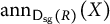 , is defined to be the annihilator of
$ {\mathrm {Hom}}_{\mathsf {D}_{\mathsf {sg}}(R)}(X,X)$
 over R. That is,

The annihilator of
$\mathsf {D}_{\mathsf {sg}}(R)$
 is defined to be

(see [Reference Liu41] for more details about the annihilator of the singularity category).
Proposition 4.2 Let M be a finitely generated R-module. Then

Proof First, we prove the
$ {\mathrm {ca}}_R(M)\subseteq {\mathrm {ann}}_{\mathsf {D}_{\mathsf {sg}}(R)}(M)$
 . Let
$r\in {\mathrm {ca}}_R^1(M)$
 . Note that
$ {\mathrm {ca}}_R^1(M)= {\mathrm {ann}}_R\ \underline { {\mathrm {End}}}_R(M)$
 (see Lemma 3.8). Thus, the multiplication map
$r\colon M\rightarrow M$
 factors through a projective R-module. In particular, the multiplication map
$r\colon M\rightarrow M$
 in the singularity category
$\mathsf {D}_{\mathsf {sg}}(R)$
 is zero. This yields that
$r\in {\mathrm {ann}}_{\mathsf {D}_{\mathsf {sg}}(R)}(M)$
 , and hence
$ {\mathrm {ca}}_R^1(M)\subseteq {\mathrm {ann}}_{\mathsf {D}_{\mathsf {sg}}(R)}(M)$
 . For each
$n>1$
 ,

where the equality is by Lemma 3.8, and the inclusion follows from the argument above. By the isomorphism
$\Omega ^{n-1}_R(M)[n-1]\cong M$
 , we have

Thus,
$ {\mathrm {ca}}_R^n(M)\subseteq {\mathrm {ann}}_{\mathsf {D}_{\mathsf {sg}}(R)}(M)$
 for all
$n>1$
 , and hence
$ {\mathrm {ca}}_R(M)\subseteq {\mathrm {ann}}_{\mathsf {D}_{\mathsf {sg}}(R)}(M).$

Now, we prove the converse direction. Assume
$a\in {\mathrm {ann}}_{\mathsf {D}_{\mathsf {sg}}(R)}(M)$
 . That is, the multiplication map
$a\colon M\rightarrow M$
 in
$\mathsf {D}_{\mathsf {sg}}(R)$
 is zero. This implies that the multiplication map
$a\colon M\rightarrow M$
 in
$\mathsf {D}^f(R)$
 factors through a perfect complex P. That is, in
$\mathsf {D}^f(R)$
 , there is a commutative diagram

Since P is perfect, there exists
$n>0$
 such that

for all
$i\geq n$
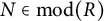
 and
$N\in {\mathrm {mod}}(R)$
 . Applying
$ {\mathrm {Hom}}_{\mathsf {D}^f(R)}(-,N[i])$
 on the above commutative diagram, we get that the multiplication map

is zero for all
$i\geq n$
 and
$N\in {\mathrm {mod}}(R)$
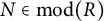 . Combining with the isomorphism

we conclude that
$a\cdot {\mathrm {Ext}}^i_R(M,N)=0$
 for all
$i\geq n$
 and
$N\in {\mathrm {mod}}(R)$
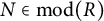 . That is,
$a\in {\mathrm {ca}}_R^n(M)$
 , and hence
$a\in {\mathrm {ca}}_R(M)$
 . It follows that
$ {\mathrm {ann}}_{\mathsf {D}_{\mathsf {sg}}(R)}(M)\subseteq {\mathrm {ca}}_R(M)$
 .
Corollary 4.3 Let R be a commutative Noetherian ring. Then

Proof Let X be a complex in
$\mathsf {D}_{\mathsf {sg}}(R)$
 . By choosing a projective resolution of X, we may assume that X is a bounded above complex of finitely generated projective R-modules with finitely many nonzero cohomologies. Then by taking brutal truncation, we conclude that
$X[n]$
 is isomorphic to a finitely generated R-module in
$\mathsf {D}_{\mathsf {sg}}(R)$
 for
$n\ll 0$
 . Assume
$X[n]\cong M$
 for some
$n\ll 0$
 and
$M\in {\mathrm {mod}}(R)$
 . Note that
$ {\mathrm {ann}}_{\mathsf {D}_{\mathsf {sg}}(R)}(X)= {\mathrm {ann}}_{\mathsf {D}_{\mathsf {sg}}(R)}(M)$
 . This yields the second equality below:

where the third equality follows from Proposition 4.2.
Let
$ {\mathrm {Sing}}(R)$
 denote the singular locus of R. That is,
$ {\mathrm {Sing}}(R) := \{\mathfrak {p}\in {\mathrm {Spec}}(R)\mid R_{\mathfrak {p}} \text { is not regular}\}$
 .
Lemma 4.4 For each finitely generated R-module M,
$V( {\mathrm {ca}}_R(M))\subseteq {\mathrm {Sing}}(R). $
 The equality holds if, in addition, M is a generator of
$\mathsf {D}_{\mathsf {sg}}(R)$
 .
Proof It follows from Proposition 3.10 that
$V( {\mathrm {ca}}_R(M))= {\mathrm {IPD}}(M)$
 . It is clear that

By [Reference Iyengar and Takahashi32, Lemma 2.6], the equality holds if M is a generator of
$\mathsf {D}_{\mathsf {sg}}(R)$
 .
4.5
Let
$(R,\mathfrak {m})$
 be a commutative Noetherian local ring. Assume there exist
$s,t\geq 0$
 and
$G\in {\mathrm {mod}}(R)$
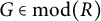 such that
$\Omega ^s_R(R/\mathfrak {m}^i)\subseteq [G]_t^R$
 for all
$i\geq 0$
 (see the definition of
$[G]_t^R$
 (i.e., the ball of radius t centered at G) in [Reference Dao and Takahashi17, Definition 2.1]). With the same argument in the proof of [Reference Sadeghi and Takahashi46, Proposition 3.2], one has
$\dim (R)\leq s$
 .
The following proposition characterizes the Krull dimension of R in terms of strong generation of
$ {\mathrm {mod}}(R)$
 (see 2.10 for the construction of
$|G|_t^R$
 ).
Proposition 4.6 Let R be a commutative Noetherian ring. Then:

In particular, if
$ {\mathrm {mod}}(R)$
 has a strong generator, then
$\dim (R)$
 is finite. In addition, if R is quasi-excellent and either admits a dualizing complex or is a local ring, then the equality holds.
Proof Let
$s,t$
 be nonnegative integers and G be a finitely generated R-module. Assume
$\Omega ^s_R( {\mathrm {mod}}(R))\subseteq |G|_t^R$
 . Since
$|G|_t^R\subseteq [G]_t^R$
 ,
$\Omega _{R}^{s}( {\mathrm {mod}}(R))\subseteq {\lbrack G\rbrack }_{t}^{R}$
 (cf. 4.5). Let
$\mathfrak {p}$
 be a prime ideal of R. We claim that
$\Omega _{R_{\mathfrak {p}}}^{s}( {\mathrm {mod}} (R_{\mathfrak {p}}))\subseteq {\lbrack G_{\mathfrak {p}}\rbrack }_{t}^{R_{\mathfrak {p}}}.$
 Combining with this, 4.5 yields that
$\dim (R_{\mathfrak {p}})\leq s$
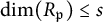 , and hence
$\dim (R) \leq s$
 as
$\mathfrak {p}$
 is arbitrary.
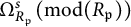
Now, we proceed to prove the claim. Let X be an object in
$\Omega _{R_{\mathfrak {p}}}^{s}( {\mathrm {mod}}(R_{\mathfrak {p}}))$
 . Since the functor
$(-)_{\mathfrak {p}}\colon {\mathrm {mod}}(R)\to {\mathrm {mod}}(R_{\mathfrak {p}})$
 is dense, there exists
$M\in {\mathrm {mod}}(R)$
 such that
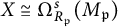
$X\cong \Omega _{R_{\mathfrak {p}}}^{s}(M_{\mathfrak {p}})$
 . On the other hand, there exist
$n,m\geq 0$
 such that
$\Omega _{R_{\mathfrak {p}}}^{s}(M_{\mathfrak {p}})\oplus R_{\mathfrak {p}}^{\oplus n}\cong \left (\Omega _{R}^{s}(M)\right )_{\mathfrak {p}}\oplus R_{\mathfrak {p}}^{\oplus m}$
 . Hence,

the inclusion here uses
$ \left (\Omega _{R}^{s}( {\mathrm {mod}}(R))\right )_{\mathfrak {p}}\subseteq ( [G]_{t}^{R})_{\mathfrak {p}}\subseteq {\lbrack G_{\mathfrak {p}}\rbrack }_{t}^{R_{\mathfrak {p}}}.$
 As
${\lbrack G_{\mathfrak {p}}\rbrack }_{t}^{R_{\mathfrak {p}}}$
 is closed under direct summands, one has
$X\in {\lbrack G_{\mathfrak {p}}\rbrack }_{t}^{R_{\mathfrak {p}}}$
 .
Suppose that R is a quasi-excellent ring of finite Krull dimension d and either admits a dualizing complex or is a local ring. Combining [Reference Iyengar and Takahashi32, Theorem 5.2] and [Reference Kimura37, Corollary 2.6], there exist
$t\geq 0$
 and
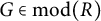
$G\in {\mathrm {mod}}(R)$
 such that
$\Omega ^d_R( {\mathrm {mod}}(R))\subseteq |G|_t^R$
 . This implies that the converse of the inequality stated in the proposition holds.
Remark 4.7 Let R be a commutative Noetherian ring, and let
$ {\mathrm {Max}}(R)$
 denote the set of all maximal ideals of R. By a similar argument as in the previous proposition, the following three values coincide:
-
(1) The Krull dimension of R.
-
(2)
$$ \begin{align*} \inf \left\{ s \geq 0 \, \middle| \begin{array}{l} \text{for every } \mathfrak{p} \in {\mathrm{Spec}}(R), \text{ there exist } t \geq 0, ~G \in {\mathrm{mod}}(\widehat{R_{\mathfrak{p}}}) \\ \text{such that } \Omega^s_{\widehat{R_{\mathfrak{p}}}}({\mathrm{mod}}(\widehat{R_{\mathfrak{p}}})) \subseteq |G|_t^{\widehat{R_{\mathfrak{p}}}} \end{array} \right\}. \end{align*} $$
-
(3)
$$ \begin{align*} \inf \left\{ s \geq 0 \, \middle| \begin{array}{l} \text{for every } \mathfrak{m} \in {\mathrm{Max}}(R), \text{ there exist } t \geq 0, ~G \in {\mathrm{mod}}(\widehat{R_{\mathfrak{m}}}) \\ \text{such that } \Omega^s_{\widehat{R_{\mathfrak{m}}}}({\mathrm{mod}}(\widehat{R_{\mathfrak{m}}})) \subseteq |G|_t^{\widehat{R_{\mathfrak{m}}}} \end{array} \right\}. \end{align*} $$


Additionally, in (2), the values obtained by replacing
$\Omega ^s_{\widehat {R_{\mathfrak {p}}}}( {\mathrm {mod}}(\widehat {R_{\mathfrak {p}}})) \subseteq |G|_t^{\widehat {R_{\mathfrak {p}}}}$
 with
-
• $\Omega ^s_{\widehat {R_{\mathfrak {p}}}}( {\mathrm {mod}}(\widehat {R_{\mathfrak {p}}})) \subseteq \lbrack G\rbrack _t^{\widehat {R_{\mathfrak {p}}}}$
, -
• $\Omega ^s_{\widehat {R_{\mathfrak {p}}}}(\widehat {R_{\mathfrak {p}}}/\mathfrak {p}^{i}\widehat {R_{\mathfrak {p}}}) \in |G|_t^{\widehat {R_{\mathfrak {p}}}} \text { for all } i\gg 0$
, or -
• $\Omega ^s_{\widehat {R_{\mathfrak {p}}}}(\widehat {R_{\mathfrak {p}}}/\mathfrak {p}^{i}\widehat {R_{\mathfrak {p}}}) \in \lbrack G\rbrack _t^{\widehat {R_{\mathfrak {p}}}} \text { for all } i\gg 0$



are all equal. The same holds for (3).
The equality
$ {\mathrm {Sing}}(R) = V( {\mathrm {\mathfrak {ca}}}(R))$
 in (3) below was established by Iyengar and Takahashi [Reference Iyengar and Takahashi32, Theorem 1.1] under the additional assumption that the finitistic global dimension is finite. Proposition 4.6 shows that this assumption is unnecessary.
Proposition 4.8 Let R be a commutative Noetherian ring. Then:
-
(1) If $\mathsf {D}_{\mathsf {sg}}(R)$
has a generator, then there exists
$M\in {\mathrm {mod}}(R)$
such that M is generator in
$\mathsf {D}_{\mathsf {sg}}(R)$
. Moreover, for any
$M\in {\mathrm {mod}}(R)$
which is a generator in
$\mathsf {D}_{\mathsf {sg}}(R)$
, $$ \begin{align*}{\mathrm{Sing}}(R)=V({\mathrm{ann}}_{\mathsf{D}_{\mathsf{sg}}(R)}(M))=V({\mathrm{ca}}_R(M))={\mathrm{IPD}}(M). \end{align*} $$
-
(2) If $\mathsf {D}_{\mathsf {sg}}(R)$
has a strong generator, then $$ \begin{align*}{\mathrm{Sing}}(R)=V({\mathrm{ann}}_R{\mathsf{D}_{\mathsf{sg}}(R)})=V({\mathrm{ca}}_R({\mathrm{mod}}(R))). \end{align*} $$
-
(3) If $ {\mathrm {mod}}(R)$
has a strong generator, then $$ \begin{align*}{\mathrm{Sing}}(R)=V({\mathrm{\mathfrak{ca}}}(R))=V({\mathrm{ann}}_R{\mathsf{D}_{\mathsf{sg}}(R)})=V({\mathrm{ca}}_R({\mathrm{mod}}(R))). \end{align*} $$
-
(4) $ {\mathrm {\mathfrak {ca}}}(R)\subseteq {\mathrm {ann}}_R\mathsf {D}_{\mathsf {sg}}(R)= {\mathrm {ca}}_R( {\mathrm {mod}}(R))$
. If, in addition,
$ {\mathrm {mod}}(R)$
has a strong generator, then they are equal up to radical.








Proof (1) Assume G is a generator of
$\mathsf {D}_{\mathsf {sg}}(R)$
 . With the same argument in the proof of Corollary 4.3, there exists
$n\in \mathbb {Z}$
 such that
$G[n]\cong M$
 in
$\mathsf {D}_{\mathsf {sg}}(R)$
 for some
$M\in {\mathrm {mod}}(R)$
 . Then M is also a generator of
$\mathsf {D}_{\mathsf {sg}}(R)$
 . Combining with Lemma 4.4 and Proposition 4.2,

The desired result follows as
$V( {\mathrm {ca}}_R(M))= {\mathrm {IPD}}(M)$
 (see Proposition 3.10).
(2) By Corollary 4.3,
$ {\mathrm {ann}}_R\mathsf {D}_{\mathsf {sg}}(R)= {\mathrm {ca}}_R( {\mathrm {mod}}(R))$
 . It remains to prove the first equality. Assume
$\mathsf {D}_{\mathsf {sg}}(R)= {\mathrm {\mathsf {thick}}}^s_{\mathsf {D}_{\mathsf {sg}}(R)}(G)$
 for some
$G\in \mathsf {D}_{\mathsf {sg}}(R)$
 and
$s\geq 0$
 . By definition,
$ {\mathrm {ann}}_R\mathsf {D}_{\mathsf {sg}}(R)\subseteq {\mathrm {ann}}_{\mathsf {D}_{\mathsf {sg}}(R)}(G)$
 . Combining with the assumption, it follows from [Reference Esentepe24, Lemma 2.1] that

Thus,
$ {\mathrm {ann}}_R\mathsf {D}_{\mathsf {sg}}(R)$
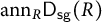 is equal to
$ {\mathrm {ann}}_{\mathsf {D}_{\mathsf {sg}}(R)}(G)$
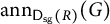 up to radical. This yields that

The desired result now follows immediately from (1); note that
$G[n]\cong M$
 in
$\mathsf {D}_{\mathsf {sg}}(R)$
 for some
$M\in {\mathrm {mod}}(R)$
 and
$n\in \mathbb {Z}$
 .
(3) The strong generation of
$ {\mathrm {mod}}(R)$
 implies the strong generation of
$\mathsf {D}_{\mathsf {sg}}(R)$
 (see 2.13). Combining with (2), it remains to show the first equality, and this follows immediately by combining Proposition 4.6 and [Reference Iyengar and Takahashi32, Theorem 1.1].
(4) The first statement follows from Corollaries 3.5 and 4.3. The second statement follows from (3).
Remark 4.9 (1) The equality
$ {\mathrm {Sing}}(R)= {\mathrm {IPD}}(M)$
 in Proposition 4.8(1) was due to Iyengar and Takahashi [Reference Iyengar and Takahashi33, Lemma 2.9]. The new input in (1) is the defining ideal of
$ {\mathrm {Sing}}(R)$
 via the annihilator over the singularity category.
(2) The first equality of Proposition 4.8(2) was established by the second author in [Reference Liu41, Theorem 4.6] through the localization of the singularity category. In contrast, our proof takes a different approach by employing the cohomological annihilators of modules and their connection to the annihilators of the singularity category. The inclusion
$ {\mathrm {\mathfrak {ca}}}(R)\subseteq {\mathrm {ann}}_R\mathsf {D}_{\mathsf {sg}}(R)$
 was observed in [Reference Liu41, Proposition 1.2].
(3) Assume
$\mathsf {D}_{\mathsf {sg}}(R)$
 has a strong generator. In [Reference Bahlekeh, Salarian, Takahashi and Toosi6, Corollary 5.8], Bahlekeh et al. observed that

Indeed, this inequality is an equality by Proposition 4.8(2).
Corollary 4.10 Let R be a commutative Noetherian domain. If
$\mathsf {D}_{\mathsf {sg}}(R)$
 has a strong generator, then
$ {\mathrm {ann}}_R\mathsf {D}_{\mathsf {sg}}(R)\neq 0$
 .
Proof By Proposition 4.8,
$ {\mathrm {ann}}_{R}\mathsf {D}_{\mathsf {sg}}(R)$
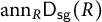 defines the singular locus of R. It follows from this that
$ {\mathrm {ann}}_{R}\mathsf {D}_{\mathsf {sg}}(R)\neq 0$
 . If not, the zero ideal of R, denoted
$(0)$
 , is in
$ {\mathrm {Sing}}(R)$
 . This contradicts that
$R_{(0)}$
 is a field. Hence,
$ {\mathrm {ann}}_{R}\mathsf {D}_{\mathsf {sg}}(R)\neq 0$
 .
Remark 4.11 (1) Corollary 4.10 is an analog of a result by Elagin and Lunts (Reference Elagin and Lunts23, Theorem 5) concerning the derived category. Specifically, for a commutative Noetherian domain R, they observed that
$ {\mathrm {\mathfrak {ca}}}(R)\neq 0$
 if
$\mathsf {D}^f(R)$
 has a strong generator.
In general, if
$\mathsf {D}^f(R)$
 has a strong generator, then
$\mathsf {D}_{\mathsf {sg}}(R)$
 also possesses one. However, the converse is not true, even when R is a domain; for instance, consider a regular domain with infinite Krull dimension constructed by Nagata [Reference Nagata42, Appendix, Example 1] (see 2.13). Additionally,
$ {\mathrm {\mathfrak {ca}}}(R)\subseteq {\mathrm {ann}}_R\mathsf {D}_{\mathsf {sg}}(R)$
 (see Proposition 4.8), and the inclusion can be proper, as illustrated by Nagata’s example (see Lemma 3.5 and Corollary 4.3). Therefore, there seems to be no implication between Corollary 4.10 and the aforementioned result of Elagin and Lunts.
(2) There exists a one-dimensional Noetherian domain with
$ {\mathrm {ann}}_R\mathsf {D}_{\mathsf {sg}}(R)=0$
 (see Example 4.25).
Example 4.12 Let R be a finitely generated algebra over a field or an equicharacteristic excellent local ring. Iyengar and Takahashi [Reference Iyengar and Takahashi32, Theorem 1.3] established that
$ {\mathrm {mod}}(R)$
 has a strong generator. Recently, this result was extended by Dey et al. [Reference Dey, Lank and Takahashi19, Corollary 3.12], who demonstrated that
$ {\mathrm {mod}}(R)$
 has a strong generator for any quasi-excellent ring with finite Krull dimension.
Corollary 4.13 Let R be a quasi-excellent ring with finite Krull dimension. Then

Remark 4.14 Assume R is a localization of a finitely generated algebra over a field or an equicharacteristic excellent local ring. Then R is excellent with finite Krull dimension, and hence Corollary 4.13 implies that
$ {\mathrm {\mathfrak {ca}}}(R)$
 is equal to
$ {\mathrm {ann}}_R\mathsf {D}_{\mathsf {sg}}(R)$
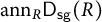 up to radical; in this case, this was proved in [Reference Liu41, Proposition 1.2].
4.15
Inspired by the observation of Iyengar and Takahashi in 2.10, we say that
$ {\mathrm {mod}}(R)$
 has a point-wise strong generator provided that there exist
$G\in {\mathrm {mod}}(R)$
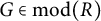 and
$t\geq 0$
 such that, for each
$M\in {\mathrm {mod}}(R)$
 ,
$\Omega _{R}^{s}M\in \left |G\right |{}_{t}$
 for some
$s\geq 0$
 .
We say that R has isolated singularities if
$ {\mathrm {Sing}} (R)\subseteq {\mathrm {Max}} (R)$
 , where
$ {\mathrm {Max}}(R)$
 consists of all maximal ideals of R.
Theorem 4.16 Let R be a commutative Noetherian ring with isolated singularities. Then the following are equivalent:
-
(1) $\mathsf {D}_{\mathsf {sg}}(R)$
has a strong generator. -
(2) $R/ {\mathrm {ann}}_{R}\mathsf {D}_{\mathsf {sg}}(R)$
is either
$0$
or Artinian. -
(3) $R/ {\mathrm {ca}}_{R}( {\mathrm {mod}}(R))$
is either
$0$
or Artinian. -
(4) $ {\mathrm {mod}}(R)$
has a point-wise strong generator.






Proof
$(1)\Rightarrow (2)$
 : By Proposition 4.8, one has
$ {\mathrm {Sing}} (R)=V( {\mathrm {ann}}_{R}\mathsf {D}_{\mathsf {sg}}(R))$
 . Since R has isolated singularities,
$ {\mathrm {Sing}}(R)$
 consists of maximal ideals. Hence,
$V( {\mathrm {ann}}_{R}\mathsf {D}_{\mathsf {sg}}(R))$
 consists of maximal ideals. This implies
$(2)$
 .
$(2)\Rightarrow (3)$
 : This follows from Corollary 4.3.
$(3)\Rightarrow (4)$
 : If
$R/ {\mathrm {ca}}_R( {\mathrm {mod}}(R))=0$
 , then R is regular (see Lemma 3.5). Thus, for each
$M\in {\mathrm {mod}}(R)$
 ,
$\Omega ^i_R(M)$
 is finitely generated projective for some
$i\geq 0$
 , and hence
$\Omega ^i_R(M)\in |R|_1$
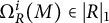 . This implies that
$ {\mathrm {mod}}(R)$
 has a point-wise strong generator. Next, we assume that
$R/ {\mathrm {ca}}( {\mathrm {mod}}(R))$
 is Artinian.
Set
$I := {\mathrm {ca}}_R( {\mathrm {mod}}(R))$
 and assume
${\boldsymbol {x}}=x_1,\ldots ,x_n$
 is a generating set of I. Let M be a finitely generated R-module. Then

for some
$i\geq 0$
 , where the second equality is by Lemma 3.8. This implies that

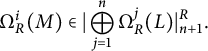
Combining with this, [Reference Bahlekeh, Hakimian, Salarian and Takahashi5, Theorem 3.1(1)] shows that there exists
$L\in {\mathrm {mod}}(R/I)$
 such that
$ \Omega ^i_R(M)\in |\displaystyle \bigoplus _{j=1}^n\Omega _R^j(L)|^R_{n+1}. $
 Since
$R/I$
 is Artinian,
$L\in |N|^{R/I}_{\ell \ell (R/I)}$
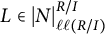 , where
$\ell \ell (R/I)$
 is the Loewy length of
$R/I$
 and N is the quotient of
$R/I$
 by its Jacobson radical. Restriction scalars along the map
$R\rightarrow R/I$
 , one has
$L\in |N|^R_{\ell \ell (R/I)}$
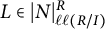 , and hence
$\Omega ^j_R(L)\subseteq |\Omega ^j_R(N)|^R_{\ell \ell (R/I)}$
 for each
$j\geq 0$
 . It follows from this that
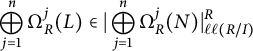
$\displaystyle \bigoplus _{j=1}^n\Omega ^j_R(L)\in |\displaystyle \bigoplus _{j=1}^n\Omega ^j_R(N)|^R_{\ell \ell (R/I)}$
 . By [Reference Dey, Lank and Takahashi19, Lemma 3.8],
$\Omega ^i_R(M)\in |\displaystyle \bigoplus _{j=1}^n\Omega ^j_R(N)|^R_{(n+1)\ell \ell (R/I)}$
 . Hence,
$\displaystyle \bigoplus _{j=1}^n\Omega ^j_R(N)$
 is a point-wise strong generator of
$ {\mathrm {mod}}(R)$
 .
$(4)\Rightarrow (1)$
 : This can be deduced by [Reference Bahlekeh, Salarian, Takahashi and Toosi6, Proposition 5.3].
Remark 4.17 (1) The implication
$(2)\Rightarrow (1)$
 of the above theorem follows from the third author’s work [Reference Dey and Mifune21, Corollary 4.3].
(2) Let R be a commutative Noetherian ring with isolated singularities, if
$\mathsf {D}_{\mathsf {sg}}(R)$
 has a strong generator and
$ \mathrm{n}( {\mathrm {mod}}(R))<\infty $
 , then
$ {\mathrm {mod}}(R)$
 has a strong generator. Indeed, this follows from the same argument as in the proof of Theorem 4.16
$(3)\Rightarrow (4)$
 .
Combining the above with Proposition 3.14, if R is a Gorenstein ring with isolated singularities and R is of finite Krull dimension, then the following are equivalent:
-
• $\mathsf {D}_{\mathsf {sg}}(R)$
has a strong generator. -
• $R/ {\mathrm {\mathfrak {ca}}}(R)$
is either
$0$
or Artinian. -
• $ {\mathrm {mod}}(R)$
has a strong generator.


The local case of this was established by Bahlekeh et al. [Reference Bahlekeh, Hakimian, Salarian and Takahashi5, Theorem 3.2].
Corollary 4.18 Let R be a one-dimensional Cohen–Macaulay ring. Assume that, for each maximal ideal
$\mathfrak {m}$
 of R of height
$0$
 , the local ring
$R_{\mathfrak {m}}$
 has minimal multiplicity. Additionally, assume that, for each maximal ideal
$\mathfrak {m}$
 of height
$1$
 ,
$R_{\mathfrak {m}}$
 is almost Gorenstein. If
$\mathsf {D}_{\mathsf {sg}}(R)$
 has a strong generator, then we have:
-
(1) $ {\mathrm {Sing}}(R)=V( {\mathrm {\mathfrak {ca}}}(R))$
. -
(2) If, in addition, R has isolated singularities, then $ {\mathrm {mod}}(R)$
has a strong generator.


Proof (1) We claim that
$ \mathrm{n}_R( {\mathrm {mod}}(R))<\infty $
 . By Proposition 3.16, this is equivalent to showing that
$\sup \{ \mathrm{n}_{R_{\mathfrak {m}}}( {\mathrm {mod}}(R_{\mathfrak {m}})\mid \mathfrak {m}\in {\mathrm {Max}}(R)\}<\infty $
 . If
$\mathfrak {m}$
 is a maximal ideal of height
$0$
 , then by hypothesis
$\mathfrak {m}^2R_{\mathfrak {m}}=0$
 , and hence
$ \mathrm{n}_{R_{\mathfrak {m}}}( {\mathrm {mod}}(R_{\mathfrak {m}})) \leq 1$
 by Remark 3.15(3). If
$\mathfrak {m}$
 is a maximal ideal height
$1$
 , then, if we can show that
$ {\mathrm {\Omega }} {\mathrm {CM}}^{\times }(R_{\mathfrak {m}})$
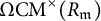 is closed under canonical dual, we can conclude by Lemma 3.11 that
$ \mathrm{n}_{R_{\mathfrak {m}}}( {\mathrm {mod}} (R_{\mathfrak {m}})) \leq~1$
 . So we now verify that for any one-dimensional almost Gorenstein local ring R,
$ {\mathrm {\Omega }} {\mathrm {CM}}^{\times }(R)$
 is closed under canonical dual. Indeed, if R is almost Gorenstein, then
$\mathfrak {m}^{\dagger }\in \mathrm { Ul}_{\omega }(R)$
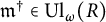 by [Reference Dao, Maitra and Sridhar16, Proposition 7.2 and Lemma 4.15]. Notice that for any
$M\in {\mathrm {\Omega }} {\mathrm {CM}}^{\times }(R)$
 ,
$M\cong {\mathrm {Hom}}_R(M^*, R)= {\mathrm {Hom}}_R(M^*,\mathfrak {m})\cong {\mathrm {Hom}}_R(\mathfrak {m}^{\dagger }, (M^*)^{\dagger })$
 , where the last module belongs to
$\mathrm {Ul}_{\omega }(R)$
 by [Reference Dao, Maitra and Sridhar16, Lemma 4.15]. Thus, by [Reference Dao, Maitra and Sridhar16, Corollary 4.27], we get
$ {\mathrm {Hom}}_R(M,\omega )\cong M^*\in {\mathrm {\Omega }} {\mathrm {CM}}^{\times }(R)$
 as we wanted. Therefore,
$ \mathrm{n}_R( {\mathrm {mod}}(R))\leq 1$
 . Combining this with Remark 3.15(2), we have
$ {\mathrm {\mathfrak {ca}}}(R)= {\mathrm {ca}}_R( {\mathrm {mod}}(R))$
 . Since
$\mathsf {D}_{\mathsf {sg}}(R)$
 has a strong generator, it follows from Proposition 4.8 that
$ {\mathrm {Sing}}(R)=V( {\mathrm {\mathfrak {ca}}}(R))$
 .
(2) By the proof of (1),
$ \mathrm{n}_R( {\mathrm {mod}}(R))<\infty $
 . Remark 4.17 now shows that
$ {\mathrm {mod}}(R)$
 has a strong generator.
Remark 4.19 For a Gorenstein local ring R, Bahlekeh et al. [Reference Bahlekeh, Hakimian, Salarian and Takahashi5, Theorem 3.3] observed that if
$\mathsf {D}_{\mathsf {sg}}(R)$
 has a strong generator, then
$ {\mathrm {Sing}}(R)=V( {\mathrm {\mathfrak {ca}}}(R))$
 . Thus, Corollary 4.18 provides a new class of rings satisfying the equality
$ {\mathrm {Sing}}(R)=V( {\mathrm {\mathfrak {ca}}}(R))$
 . Moreover, the rings satisfying Corollary 4.18(2) form a new class of rings for which all the conditions of [Reference Bahlekeh, Hakimian, Salarian and Takahashi5, Theorem 3.2] are equivalent.
The following result is a direct consequence of Theorem 4.16.
Corollary 4.20 Let R be a commutative Noetherian domain with
$\dim R\leq 1$
 . Then the following are equivalent:
-
(1) $\mathsf {D}_{\mathsf {sg}}(R)$
has a strong generator. -
(2) $ {\mathrm {ann}}_R\mathsf {D}_{\mathsf {sg}}(R)\neq 0$
. -
(3) $ {\mathrm {ca}}_R( {\mathrm {mod}}(R)) \neq 0$
. -
(4) $ {\mathrm {mod}}(R)$
has a point-wise strong generator.




Corollary 4.21 Let R be a commutative Noetherian ring with
$\dim R\leq 1$
 . Then the following are equivalent:
-
(1) $\mathsf {D}_{\mathsf {sg}}(R/\mathfrak {p})$
has a strong generator for each prime ideal
$\mathfrak {p}$
of R. -
(2) $ {\mathrm {ann}}_{R/\mathfrak {p}}\mathsf {D}_{\mathsf {sg}}(R/\mathfrak {p})\neq 0$
for each prime ideal
$\mathfrak {p}$
of R. -
(3) $ {\mathrm {ca}}_{R/\mathfrak {p}}( {\mathrm {mod}}(R/\mathfrak {p}))\neq 0$
for each prime ideal
$\mathfrak {p}$
of R.






Proof For each prime ideal
$\mathfrak {p}$
 of R,
$R/\mathfrak {p}$
 is a domain and
$\dim R/\mathfrak {p}\leq 1$
 . Thus, the equivalence
$(1)\iff (2)$
 follows from Corollary 4.20. The equivalence
$(2)\iff (3)$
 is a direct consequence of Corollary 4.3.
Remark 4.22 Due to Iyengar and Takahashi [Reference Iyengar and Takahashi33, Theorem 1.1], the following three conditions are equivalent for a commutative Noetherian ring:
-
(1) $ {\mathrm {mod}}(R/\mathfrak {p})$
has a generator for each prime ideal
$\mathfrak {p}$
of R. -
(2) $\mathsf {D}^f(R/\mathfrak {p})$
has a generator for each prime ideal
$\mathfrak {p}$
of R. -
(3) $\mathsf {D}_{\mathsf {sg}}(R/\mathfrak {p})$
has a generator for each prime ideal
$\mathfrak {p}$
of R.


Moreover, if these conditions hold, then
$ {\mathrm {mod}}(R)$
 ,
$\mathsf {D}^f(R)$
 , and
$\mathsf {D}_{\mathsf {sg}}(R)$
 all have generators.
Recently, Dey et al. [Reference Dey, Lank and Takahashi19, Theorem 1.1] showed that the following three conditions are equivalent for a commutative Noetherian ring:
-
(1) $ {\mathrm {mod}}(R/\mathfrak {p})$
has a strong generator for each prime ideal
$\mathfrak {p}$
of R. -
(2) $\mathsf {D}^f(R/\mathfrak {p})$
has a strong generator for each prime ideal
$\mathfrak {p}$
of R. -
(3) $ {\mathrm {\mathfrak {ca}}}(R/\mathfrak {p})\neq 0$
for each prime ideal
$\mathfrak {p}$
of R.


Furthermore, if these conditions hold, then
$\dim (R)<\infty $
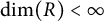 , and both
$ {\mathrm {mod}}(R)$
 and
$\mathsf {D}^f(R)$
 have strong generators.
A natural question arises: do Corollaries 4.20 and 4.21 still hold if we remove the assumption about the Krull dimension? Theorem 4.24 is a result related to this question. Keep the same assumption as Corollary 4.21, we don’t know whether
$\mathsf {D}_{\mathsf {sg}}(R)$
 has a strong generator when the conditions of Corollary 4.21 hold.
For a full subcategory
$\mathcal C$
 of
$ {\mathrm {mod}}(R)$
 , we define
$\sqrt { {\mathrm {ca}}}_{R}(\mathcal C) := \displaystyle \bigcap _{X\in \mathcal C}\sqrt { {\mathrm {ca}}_{R}(X)}$
 .
Lemma 4.23 Let R be a commutative Noetherian ring. Then:
(1)
$\mathfrak {ca}(R)\subseteq {\mathrm {ca}}( {\mathrm {mod}}(R))\subseteq \sqrt { {\mathrm {ca}}}_{R}( {\mathrm {mod}}(R))$
 .
(2)
$ {\mathrm {Sing}}(R) \subseteq V(\sqrt { {\mathrm {ca}}}_{R}( {\mathrm {mod}}(R))) \subseteq V( {\mathrm {ca}}( {\mathrm {mod}}(R))) \subseteq V(\mathfrak {ca}(R))$
 .
Proof (1) This follows from Lemma 3.5.
(2) By (1), it remains to prove
$ {\mathrm {Sing}}(R) \subseteq V(\sqrt { {\mathrm {ca}}}_{R}( {\mathrm {mod}}(R)))$
 . Let
$\mathfrak {p}$
 be a prime ideal of R such that
$\mathfrak {p}\notin V(\sqrt { {\mathrm {ca}}}_{R}( {\mathrm {mod}}(R)))$
 . Since the inclusion relation
$V(\sqrt { {\mathrm {ca}}_{R}(R/\mathfrak {p})})\subseteq V(\sqrt { {\mathrm {ca}}}_{R}( {\mathrm {mod}}(R)))$
 holds, the prime ideal
$\mathfrak {p}$
 does not belong to
$V(\sqrt { {\mathrm {ca}}_{R}(R/\mathfrak {p})})=V( {\mathrm {ca}}_{R}(R/\mathfrak {p}))$
 . This implies that
$\mathfrak {p}\notin {\mathrm {IPD}}(R/\mathfrak {p})$
 (see Proposition 3.10). Hence, the
$R_{\mathfrak {p}}$
 -module
$R_{\mathfrak {p}}/\mathfrak {p} R_{\mathfrak {p}}$
 has finite projective dimension. This implies that
$\mathfrak {p}$
 does not belong to
$ {\mathrm {Sing}} R$
 , and hence
$ {\mathrm {Sing}}(R) \subseteq V(\sqrt { {\mathrm {ca}}}_{R}( {\mathrm {mod}}(R)))$
 .
Regarding the generation of the singularity category and the vanishing of the cohomology annihilator, we have the following.
Theorem 4.24 Let R be a commutative Noetherian ring. Then
$\mathsf {D}_{\mathsf {sg}}(R/\mathfrak {p})$
 has a generator for each prime ideal
$\mathfrak {p}$
 of R if and only if
$\sqrt { {\mathrm {ca}}}_{R/\mathfrak {p}}( {\mathrm {mod}}(R/\mathfrak {p}))\neq 0$
 for each prime ideal
$\mathfrak {p}$
 of R.
Proof For the forward direction, assume that
$\mathsf {D}_{\mathsf {sg}}(R/\mathfrak {p})$
 has a generator for each prime ideal
$\mathfrak {p}$
 of R. To obtain the conclusion, it suffices to show
$\sqrt { {\mathrm {ca}}}_R( {\mathrm {mod}}(R)) \neq 0$
 under the assumption that R is a domain. By assumption and Proposition 4.8(1), there exists
$M\in {\mathrm {mod}}(R)$
 such that M is a generator of
$\mathsf {D}_{\mathsf {sg}}(R)$
 and
$ {\mathrm {Sing}}(R)=V( {\mathrm {ca}}_R(M))$
 . With the same argument in the proof of Corollary 4.10,
$ {\mathrm {ca}}_R(M)\neq 0$
 , and hence there exists
$f\neq 0$
 in
$ {\mathrm {ca}}^n_R(M)$
 for some
$n\geq 0$
 . Combining this with Lemma 3.8(1), we get that the projective dimension of
$M_f$
 over
$R_f$
 is finite. Note that
$M_f$
 is a generator of
$\mathsf {D}_{\mathsf {sg}}(R_f)$
 as M is a generator of
$\mathsf {D}_{\mathsf {sg}}(R)$
 . Hence,
$R_{f}$
 is a regular ring. Let X be a finitely generated R-module. Since the
$R_{f}$
 -module
$X_{f}$
 has finite projective dimension, there exists
$m\geq 0$
 such that

It follows that
$f^{r}\cdot {\mathrm {Ext}}_{R}^{m}(X, \Omega _{R}^{m} (X)) = 0$
 for some
$r \geq 0$
 . This yields that
$f\in \sqrt { {\mathrm {ca}}_{R}^{m}(X)} \subseteq \sqrt { {\mathrm {ca}}_{R}(X)}$
 . Thus,

For the backward direction, assume that
$\sqrt { {\mathrm {ca}}}_{R/\mathfrak {p}}( {\mathrm {mod}}(R/\mathfrak {p}))\neq 0$
 for each prime ideal
$\mathfrak {p}$
 of R. Then
$0 \in {\mathrm {Spec}}(R/\mathfrak {p})\setminus V(\sqrt { {\mathrm {ca}}}_{R/\mathfrak {p}}( {\mathrm {mod}}(R/\mathfrak {p}))) \subseteq {Reg}(R/\mathfrak {p})$
 in
$ {\mathrm {Spec}} (R/\mathfrak {p})$
 , where
$ {\mathrm {Reg}}(R/\mathfrak {p})= {\mathrm {Spec}}(R/\mathfrak {p})\setminus {\mathrm {Sing}}(R/\mathfrak {p})$
 ; the inclusion is from Lemma 4.23. This implies that
$ {\mathrm {Reg}}(R/\mathfrak {p})$
 contains a nonempty open subset. By virtue of [Reference Iyengar and Takahashi33, Theorem 1.1],
$\mathsf {D}_{\mathsf {sg}}(R/\mathfrak {p})$
 has a generator for each prime ideal
$\mathfrak {p}$
 of R.
We end with this section by showing that there exists a one-dimensional Noetherian domain satisfying
$ {\mathrm {ann}}_R\mathsf {D}_{\mathsf {sg}}(R)=0$
 .
Example 4.25 In [Reference Hochster31, Example 1], Hochster constructed a one-dimensional Noetherian domain R whose regular locus (i.e.,
$ {\mathrm {Spec}}(R)\setminus {\mathrm {Sing}}(R))$
 does not contain a nonempty open subset. According to [Reference Iyengar and Takahashi33, Theorem 1.1], there exists a prime ideal
$\mathfrak {p}$
 of R such that
$\mathsf {D}_{\mathsf {sg}}(R/\mathfrak {p})$
 does not have a generator. This implies that
$\mathfrak {p}$
 must be the zero ideal as R is a one-dimensional domain. Therefore,
$\mathsf {D}_{\mathsf {sg}}(R)$
 does not have a generator, and by Corollary 4.20, we conclude that
$ {\mathrm {ann}}_R\mathsf {D}_{\mathsf {sg}}(R)=0$
 .
5 Co-cohomological annihilators for modules
In this section, we introduce the notion of a co-cohomological annihilator of modules. The main result is Theorem 1.2 from the introduction.
5.1
For each R-module M and
$n\geq 0$
 , we define the n-th co-cohomological annihilator of M to be

In words,
$ {\mathrm {coca}}_R^n(M)$
 consists of elements
$r\in R$
 such that
$r\cdot {\mathrm {Ext}}^i_R(N,M)=0$
 for each
$i\geq n$
 and
$N\in {\mathrm {mod}}(R)$
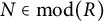 . By the dimension shifting, we have
$ {\mathrm {coca}}_R^n(M)= {\mathrm {ann}}_R {\mathrm {Ext}}^n_R( {\mathrm {mod}}(R),M)$
 . Consider the ascending chain of ideals

the co-cohomological annihilator of M is defined to be the ideal

Since R is Noetherian,
$ {\mathrm {coca}}_R(M)= {\mathrm {coca}}_R^n(M)$
 for
$n\gg 0$
 .
Combining with Baer’s criterion for injectivity, we conclude that, for each R-module M and
$n\geq 0$
 ,
$ {\mathrm {coca}}_R^n(M)=R$
 if and only if
$ {\mathrm {id}}_R(M)<n$
 . Thus,
$ {\mathrm {coca}}_R(M)=R$
 if and only if
$ {\mathrm {id}}_R(M)<\infty $
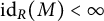 .
Lemma 5.2 For each R-module M and
$n>0$
 ,

Proof Note that
$ {\mathrm {id}}_{R_{\mathfrak {p}}}(M_{\mathfrak {p}})<n$
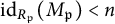 if and only if
$ {\mathrm {Ext}}^n_{R_{\mathfrak {p}}}( {\mathrm {mod}}(R_{\mathfrak {p}}),M_{\mathfrak {p}})=0$
 ; this can be proved by using Baer’s criterion for injectivity. This yields the first equality below:

where the second one follows from 3.7 and the fact that
$ {\mathrm {mod}}(R)\rightarrow {\mathrm {mod}}(R_{\mathfrak {p}})$
 is dense. This finishes the proof.
5.3
Let M be a finitely generated R-module, the infinite injective dimension locus of M is defined to be

Proposition 5.4 If
$ {\mathrm {mod}}(R)$
 has an extension generator G, then
$ {\mathrm {Sing}}(R)= {\mathrm {IID}}(G)$
 .
Proof We only need to prove
$ {\mathrm {Sing}}(R)\subseteq {\mathrm {IID}}(G)$
 , that is,
$ {\mathrm {Spec}}(R)\setminus {\mathrm {IID}}(G)\subseteq {\mathrm {Spec}}(R)\setminus {\mathrm {Sing}}(R)$
 . By hypothesis, there exists
$s\geq 0$
 such that
$ {\mathrm {\Omega }}^s_R( {\mathrm {mod}}(R))\subseteq \bigcup \limits _{t\ge 0}|G|_t$
 . Pick
$\mathfrak {p}\in {\mathrm {Spec}}(R)\setminus {\mathrm {IID}}(G)$
 . That is,
$ {\mathrm {id}}_{R_{\mathfrak {p}}} (G_{\mathfrak {p}})<\infty $
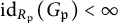 . Note that
$( {\mathrm {\Omega }}^s_R (R/\mathfrak {p}))_{\mathfrak {p}}\in \bigcup \limits _{t\ge 0}|G_{\mathfrak {p}}|_t$
 . Let
$ {\mathrm {\Omega }}^s_{R_{\mathfrak {p}}}$
 denote a minimal syzygy, then

for some
$n\geq 0$
 , where
$k(\mathfrak {p})$
 is the residue field of
$R_{\mathfrak {p}}$
 . It follows that
$ {\mathrm {\Omega }}^s_{R_{\mathfrak {p}}}(k(\mathfrak {p}))\in \bigcup \limits _{t\geq 0}|G_{\mathfrak {p}}|_t$
 . Since
$ {\mathrm {id}}_{R_{\mathfrak {p}}}(G_{\mathfrak {p}})<\infty $
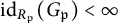 , each module in
$\bigcup \limits _{t\geq 0}|G_{\mathfrak {p}}|_t$
 has finite injective dimension over
$R_{\mathfrak {p}}$
 . In particular,
$ {\mathrm {id}}_{R_{\mathfrak {p}}}( {\mathrm {\Omega }}^s_{R_{\mathfrak {p}}} (k(\mathfrak {p})))<\infty $
 . Combining this with [Reference Ghosh, Gupta and Puthenpurakal28, Theorem 3.7], we conclude that
$R_{\mathfrak {p}}$
 is regular, that is,
$\mathfrak {p} \in {\mathrm {Spec}}(R)\setminus {\mathrm {Sing}}(R)$
 .
Lemma 5.5 For each R-module M and
$n>0$
 ,

In particular,
$ {\mathrm {IID}}(M)\subseteq V( {\mathrm {coca}}_R(M)).$
 Consequently,

Proof By Lemma 5.2, we have the first equality of the following:

Combining with
$ {\mathrm {coca}}_R^n(M)=\displaystyle \bigcap \limits _{N\in {\mathrm {mod}}(R)} {\mathrm {ann}}_R\ {\mathrm {Ext}}^n_R(N,M)$
 , the first statement of the lemma follows.
By the first statement, we get the inclusion below:

Combining with
$\displaystyle \bigcap _{n>0}V( {\mathrm {coca}}_R^n(M)) =V(\bigcup \limits _{n>0} {\mathrm {coca}}_R^n(M)) =V( {\mathrm {coca}}_R(M))$
 , we conclude that
$ {\mathrm {IID}}(M)\subseteq V( {\mathrm {coca}}_R(M))$
 , and hence
$ {\mathrm {IID}}(M)\subseteq V(\sqrt { {\mathrm {coca}}_R(M)})$
 . This yields the second inclusion below:

This implies the last statement.
The following gives a characterization of the singular locus of R in terms of the co-cohomological annihilator; compare with [Reference Iyengar and Takahashi32, Theorem 4.3]. Recall that a category
$\mathcal X$
 of
$ {\mathrm {mod}}(R)$
 is said to have finite radius provided that
$\mathcal X\subseteq [G]_t^R$
 for some
$t\geq 0$
 (see 4.5).
Proposition 5.6 Let
$\Omega _R^n ( {\mathrm {mod}}(R))$
 has finite radius for some
$n\ge 0$
 . Then R has finite Krull dimension and

for each
$d\geq \dim (R)$
 .
Proof By 4.5,
$\dim (R)$
 is finite. The last equality holds because
$ {\mathrm {\mathfrak {ca}}}^{n+d+1}(R)= \bigcap \limits _{M\in {\mathrm {mod}}(R)} {\mathrm {coca}}^{n+d+1}_R(M)$
 . Next, we prove the other equalities. By hypothesis, there exists
$G\in {\mathrm {mod}}(R)$
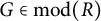 and
$t\geq 0$
 such that
$\Omega _R^n ( {\mathrm {mod}}(R)) \subseteq [G]_t^R$
 . It follows that
$ {\mathrm {\Omega }}^{n+d}_R( {\mathrm {mod}} (R))\subseteq [H]_t^R$
 , where
$H:= {\mathrm {\Omega }}^d_R(G)$
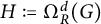 . For each
$M\in {\mathrm {mod}}(R)$
 , we have

where the first inclusion is by Lemma 3.8, the second one is due to [Reference Dao and Takahashi18, Lemma 5.3(1)], and the third one is by the inclusion
$ {\mathrm {\Omega }}^{n+d}_R( {\mathrm {mod}} (R))\subseteq [H]_t^R$
 . Thus,

This yields the second and third inclusions below:

where the first inclusion is by Lemma 5.5, and the last equality can be deduced by combining the assumption
$d\geq \dim (R)$
 with Lemma 3.8 and Proposition 3.10. The desired equalities now follow by combining with
$ {\mathrm {IPD}}(H)\subseteq {\mathrm {Sing}}(R)$
 .
5.7
(1) As mentioned in 2.10,
$ {\mathrm {mod}}(R)$
 has a strong generator if and only if there exist
$s,t\geq 0$
 and
$G\in {\mathrm {mod}}(R)$
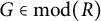 such that

Note that if
$ {\mathrm {mod}}(R)$
 has finite extension dimension in the sense of Beligiannis [Reference Beligiannis9, Definition 1.5], then
$ {\mathrm {mod}}(R)$
 has a strong generator.
(2) Suggested by above, we say that
$ {\mathrm {mod}}(R)$
 has an extension generator if there exists
$s\geq 0$
 and
$G\in {\mathrm {mod}}(R)$
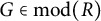 such that

in this case, we say that G is an extension generator of
$ {\mathrm {mod}}(R)$
 . By [Reference Bahlekeh, Hakimian, Salarian and Takahashi5, Remark 2.11], for each
$G\in {\mathrm {mod}}(R)$
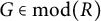 , the union
$\displaystyle \bigcup _{t\geq 0} |G|_t$
 is the smallest full subcategory of
$ {\mathrm {mod}}(R)$
 that contains G and is closed under extensions and direct summands.
By above, if
$ {\mathrm {mod}}(R)$
 has a strong generator G, then G is an extension generator of
$ {\mathrm {mod}}(R)$
 .
If
$ {\mathrm {mod}}(R)$
 has an extension generator G, then
$ {\mathrm {mod}}(R)$
 has a generator
$G\oplus R$
 . However, the next example shows that
$ {\mathrm {mod}}(R)$
 may not have an extension generator if
$ {\mathrm {mod}}(R)$
 has a generator.
Example 5.8 Let R be a regular ring with infinite Krull dimension. By 2.12, R is a generator of
$ {\mathrm {mod}}(R)$
 . However,
$ {\mathrm {mod}}(R)$
 doesn’t have an extension generator. If not, assume that there exist
$s\geq 0$
 and
$G\in {\mathrm {mod}}(R)$
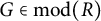 such that
$\Omega ^s_R( {\mathrm {mod}}(R))\subseteq \displaystyle \bigcup \limits _{t\geq 0}|G|_t$
 . Since R is regular, there exists
$n\geq 0$
 such that
$\Omega ^n_R(G)$
 is projective over R. This yields the second inclusion below:

where the first inclusion is by the horseshoe lemma. Thus,
$ {\mathrm {gl.dim}}(R)\leq t+s$
 . By 2.13, R has finite Krull dimension. This is a contradiction, and hence
$ {\mathrm {mod}}(R)$
 doesn’t possess an extension generator.
Theorem 5.9 Let R be a commutative Noetherian ring and M be a finitely generated R-module. Then:
-
(1) If $ {\mathrm {mod}}(R)$
has an extension generator, then
$ {\mathrm {IID}}(M)$
is closed in
$ {\mathrm {Spec}}(R)$
. -
(2) If $ {\mathrm {mod}}(R)$
has a strong generator, then $$ \begin{align*}{\mathrm{IID}}(M)=V({\mathrm{coca}}_R(M)).\end{align*} $$


Proof (1) Assume
$ {\mathrm {mod}}(R)$
 has an extension generator G. That is, there exists
$s\geq 0$
 satisfying: for each
$X\in {\mathrm {mod}}(R)$
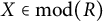 , there exists
$t\geq 0$
 such that
$\Omega ^s_R(X)\subseteq |G|_{t}$
 . For each
$n>0$
 , Lemma 5.2 yields the first equality below:

For each
$N\in {\mathrm {mod}}(R)$
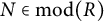 , it follows from the assumption that
$\Omega ^s_R(N)\in |G|_{t}$
 for some
$t\geq 0$
 . This yields that
$ {\mathrm {Supp}}_R {\mathrm {Ext}}^n_R(\Omega ^s_R(N),M)\subseteq {\mathrm {Supp}}_R {\mathrm {Ext}}_R^n(G,M). $
 Hence,

Taking intersections throughout all
$n>0$
 ,
$ {\mathrm {IID}}(M)\subseteq \displaystyle \bigcap \limits _{n>0} {\mathrm {Supp}}_R {\mathrm {Ext}}^n_R(G,M). $
 On the other hand, by Lemma 5.2,

Thus,

The desired result follows as
$ {\mathrm {Supp}}_R {\mathrm {Ext}}^n_R(G,M)=V( {\mathrm {ann}}_R {\mathrm {Ext}}^n_R(G,M))$
 is closed.
(2) By Lemma 5.5, it remains to prove
$V( {\mathrm {coca}}_R(M))\subseteq {\mathrm {IID}}(M)$
 . Let
$n>0$
 be an integer. Since
$ {\mathrm {mod}}(R)$
 has a strong generator, there exist
$s,t\geq 0$
 and
$G\in {\mathrm {mod}}(R)$
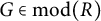 such that
$\Omega ^s_R( {\mathrm {mod}}(R))\subseteq |G|_t$
 (see 5.7). Hence,

It is routine to check that
$ {\mathrm {ann}}_R {\mathrm {Ext}}^n_R(|G|_t,M)\supseteq ( {\mathrm {ann}}_R {\mathrm {Ext}}_R^n(G,M))^t $
 . Thus,

where the second inclusion is due to
$V( {\mathrm {ann}}_R {\mathrm {Ext}}^n_R(G,M))= {\mathrm {Supp}}_R {\mathrm {Ext}}^n_R(G,M)$
 and 3.7; the equality here holds as
$ {\mathrm {Ext}}_R^n(G,M)$
 is finitely generated. Combining with
$ {\mathrm {coca}}_R^{n+s}(M)\subseteq {\mathrm {coca}}_R(M)$
 , we get

Since
$n>0$
 is arbitrary,

This completes the proof.
Remark 5.10 As noted in Example 5.8, there exist rings R such that
$ {\mathrm {mod}}(R)$
 has a generator but does not have an extension generator. Let R be a commutative Noetherian ring and
$M\in {\mathrm {mod}}(R)$
 . Motivated by Theorem 5.9(1), a natural question arises: is
$ {\mathrm {IID}}(M)$
 closed if
$ {\mathrm {mod}}(R)$
 has a generator?
Corollary 5.11 Let R be a quasi-excellent ring with finite Krull dimension. Then

Proof By Example 4.12,
$ {\mathrm {mod}}(R)$
 has a strong generator. The desired result now follows from Theorem 5.9.
Remark 5.12 (1) Let R be an excellent ring. Greco and Marinari [Reference Greco and Marinari29, Corollary 1.5] observed that
$ {\mathrm {IID}}(R)$
 is closed. Takahashi [Reference Takahashi47] then extended this to modules, proving that
$ {\mathrm {IID}}(M)$
 is closed for each
$M\in {\mathrm {mod}}(R)$
 . Recently, Kimura [Reference Kimura36, Theorem 1.1] generalized Takahashi’s result to acceptable rings.
(2) By Proposition 4.6 and Example 4.12, for a quasi-excellent ring R,
$ {\mathrm {mod}}(R)$
 has a strong generator if and only if R has finite Krull dimension.
Corollary 5.13 Let M be a finitely generated R-module. Assume
$ {\mathrm {mod}}(R)$
 has a strong generator; equivalently, there exist
$s,t\geq 0$
 and
$G\in {\mathrm {mod}}(R)$
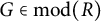 such that
$ \Omega ^s_R( {\mathrm {mod}}(R))\subseteq |G|_t. $
 Set
$d=\sup \{ {\mathrm {id}}_{R_{\mathfrak {p}}}(M_{\mathfrak {p}})\mid \mathfrak {p}\notin {\mathrm {IID}}(M)\}$
 . Then:
(1) d is finite.
(2)
$ {\mathrm {IID}}(M)=V( {\mathrm {coca}}_R(M))=V( {\mathrm {coca}}_R^{d+s+1}(M)). $

Proof (1) This follows from Proposition 4.6 and [Reference Bruns and Herzog12, Theorem 3.1.17].
(2) By Theorem 5.9,
$ {\mathrm {IID}}(M)=V( {\mathrm {coca}}_R(M))$
 . It is clear that

Assume this is not equal. Combining with
$ {\mathrm {IID}}(M)=V( {\mathrm {coca}}_R(M))$
 , there exists a prime ideal
$\mathfrak {p}$
 of R containing
$ {\mathrm {coca}}_R^{d+s+1}(M)$
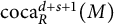 and
$\mathfrak {p}\notin {\mathrm {IID}}(M)$
 . Thus,
$\mathfrak {p}$
 contains
$ {\mathrm {ann}}_R {\mathrm {Ext}}^{d+s+1}_R( {\mathrm {mod}}(R),M)$
 . By the argument in the proof of Theorem 5.9(2),

for each
$n>0$
 . Thus,
$ {\mathrm {id}}_{R_{\mathfrak {p}}}(M_{\mathfrak {p}})\geq d+1$
 . This contradicts with
$\mathfrak {p}\notin {\mathrm {IID}}(M)$
 ; by assumption,
$ {\mathrm {id}}_{R_{\mathfrak {p}}}(M_{\mathfrak {p}})\leq d$
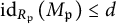 if
$\mathfrak {p}\notin {\mathrm {IID}}(M)$
 . This completes the proof.
5.14
(1) Let V be a specialization closed subset of
$ {\mathrm {Spec}}(R)$
 . Namely, V is a union of closed subsets of
$ {\mathrm {Spec}}(R)$
 . If, in addition, V is a finite set, then V is a closed subset of
$ {\mathrm {Spec}}(R)$
 and
$\dim (V)\le 1$
 . Indeed, the assumption yields that
$V=\displaystyle \bigcup _{\mathfrak {p}\in V}V(\mathfrak {p})$
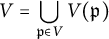 . Since V is finite, V is a finite union of closed subsets, and hence V is closed. It follows that
$V=V(I)$
 for some ideal I of R. If
$\dim (V)(=\dim (R/I))\geq 2$
 , then there exists a chain of prime ideals
$\mathfrak {p}_0\subsetneq \mathfrak {p}_1\subsetneq \mathfrak {p}_2$
 in
$V(I)=V$
 . By [Reference Kaplansky35, Theorem 144], V is infinite. This is a contradiction. Hence,
$\dim (V)\le 1$
 .
(2) If V is a closed subset of
$ {\mathrm {Spec}}(R)$
 , R is semi-local, and
$\dim (V)\leq 1$
 , then V is a finite set. In fact, the assumption yields that
$V=V(I)$
 for some ideal I of R. Since
$R/I$
 is semi-local and
$\dim (R/I)=\dim (V)\leq 1$
 , one has
$ {\mathrm {Spec}}(R/I)$
 is a finite set. It follows that
$V(I)=V$
 is finite.
Example 5.15 For a commutative Noetherian ring R, the singular locus
$ {\mathrm {Sing}}(R)$
 is finite in any of the following cases:
-
(1) R is a semi-local ring with $\dim (R)= 1$
. -
(2) R is semi-local with isolated singularities.
-
(3) R is a semi-local J- $0$
domain with
$\dim (R)=2$
. -
(4) R is a semi-local J- $1$
normal ring with
$\dim (R)=3$
.


For (1), since
$\dim (R)= 1$
 , R is semi-local, and the set of minimal prime ideals of R is finite, it follows that
$ {\mathrm {Sing}}(R)$
 is finite. (2) holds immediately by assumption.
For (3), since R is J-
$0$
 , we have
$ {\mathrm {Sing}}(R) \subseteq V(I)$
 for some nonzero ideal I of R, and as R is a domain, it follows that
$\dim (R/I)\leq 1$
 . Combining this with that R is semi-local, we conclude that
$V(I)= {\mathrm {Spec}}(R/I)$
 is finite, and hence
$ {\mathrm {Sing}}(R)$
 is finite.
For (4), since R is J-
$1$
 , we have
$ {\mathrm {Sing}}(R)=V(I)$
 for some ideal I of R, and as R is normal,
$V(I)$
 cannot contain any prime ideal of height
$0$
 or height
$1$
 . Thus, the height of I is at least
$2$
 . It follows that
$\dim (R/I) \leq 1$
 , and by the same reasoning as in (3),
$ {\mathrm {Sing}}(R) $
 is finite.
5.16
Let V be a closed subset of
$ {\mathrm {Spec}}(R)$
 . We define the arithmetic rank of V to be

If we write
$V=V(I)$
 for some ideal I of R, then the value
$ {\mathrm {ara}}(V(I))$
 coincides with the arithmetic rank of I as defined in [Reference Brodmann and Sharp11, Definition 3.3.2].
Proposition 5.17 Let R be a commutative Noetherian ring with finite Krull dimension d. Assume
$ {\mathrm {Sing}}(R)$
 is a finite set. Then
$ {\mathrm {Sing}}(R)$
 is closed. Moreover,

where
$n:= {\mathrm {ara}} ( {\mathrm {Sing}}(R))$
 . In particular,
$ {\mathrm {mod}}(R)$
 has an extension generator.
Proof By 5.14,
$ {\mathrm {Sing}}(R)$
 is closed. Assume
$ {\mathrm {Sing}}(R)=V(x_1,\ldots ,x_n)$
 for some elements
$x_1,\ldots ,x_n$
 in R. Let M be a finitely generated R-module. For each
$\mathfrak {p}\notin {\mathrm {Sing}}(R)$
 , we have

It follows that the non-free locus of
$\Omega ^d_R(M)$
 , given by
$\{\mathfrak {p}\in {\mathrm {Spec}}(R)\mid \Omega ^d_R(M)_{\mathfrak {p}} \text { is not free}\}$
 , is contained in
$ {\mathrm {Sing}}(R)$
 . By [Reference Bahlekeh, Hakimian, Salarian and Takahashi5, Theorem 3.1 (2)],
$\Omega ^d_R(M)\in \displaystyle \bigcup _{t\geq 0}\Big |\bigoplus _{i=0}^n \bigoplus _{\mathfrak {p}\in {\mathrm {Sing}}(R)} \Omega ^i_R(R/\mathfrak {p})\Big |_t$
 .
Remark 5.18 Proposition 5.17 extends a recent result of Araya et al. [Reference Araya, Iima and Takahashi1, Proposition 4.7(1) and (2)]. Specifically, if R is either a semi-local ring with isolated singularities or a semi-local J-
$0$
 domain with
$\dim (R) = 2$
 , then
$ {\mathrm {Sing}}(R)$
 is finite by Example 5.15(2) and (3), and hence
$ {\mathrm {mod}}(R)$
 has an extension generator by Proposition 5.17.
The following result concerns the relationship between the generator of the singularity category and the extension generator of the module category; compare Example 5.8.
Proposition 5.19 Let R be a commutative Noetherian ring with finite Krull dimension d. If
$\mathsf {D}_{\mathsf {sg}}(R/\mathfrak {p})$
 has a generator for each prime ideal
$\mathfrak {p} \in {\mathrm {Spec}}(R)$
 , then
$\Omega ^d_R( {\mathrm {mod}}(R)) \subseteq \displaystyle \bigcup _{t\geq 0} |G|_t$
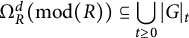 for some
$G \in {\mathrm {mod}}(R)$
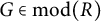 . In particular,
$ {\mathrm {mod}}(R)$
 has an extension generator.
Proof We prove it by induction on
$d = \dim R$
 . Note that when
$d = 0$
 ,
$R/\mathfrak {p}$
 is Artinian for every
$\mathfrak {p}$
 , and hence
$ {\mathrm {mod}}(R/\mathfrak {p})$
 has an extension generator. So we assume
$d> 0$
 .
First, we consider the case when R is a domain. By [Reference Iyengar and Takahashi33, Theorem 1.1],
$ {\mathrm {Sing}}(R)=V(I)$
 for some ideal I. As R is a domain, I is a nonzero ideal, so pick
$0 \neq x \in I$
 . Then
$R_x$
 is regular. As every prime ideal of
$R/(x)$
 is of the form
$\mathfrak {p}/(x)$
 for some
$\mathfrak {p} \in {\mathrm {Spec}}(R)$
 , and
$(R/(x))/(\mathfrak {p}/(x)) \cong R/\mathfrak {p}$
 , thus
$\mathsf {D}_{\mathsf {sg}} ((R/(x))/{\mathfrak {q}})$
 has a classical generator for each
$\mathfrak {q} \in {\mathrm {Spec}}(R/(x))$
 . Since R is a domain,
$n := \dim (R/(x)) < \dim (R) = d$
 . Thus, by induction hypothesis,
$\Omega ^n_{R/(x)}( {\mathrm {mod}}(R/(x)) \subseteq \displaystyle \bigcup _{t\geq 0} |G|_t^{R/(x)}$
 for some
$G \in {\mathrm {mod}}(R/(x))$
 . By [Reference Araya, Iima and Takahashi1, Lemma 4.5(2)], there exists
$H \in {mod}(R)$
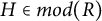 such that
$\Omega ^d_R( {\mathrm {mod}}(R)) \subseteq \displaystyle \bigcup _{t\geq 0} |H|_t^R$
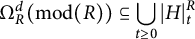 . This completes the case where R is a domain.
The proof of the general case now proceeds similarly to part (b) of the proof in [Reference Araya, Iima and Takahashi1, Proposition 4.6(3)]; note that each
$R/\mathfrak {p}_i$
 in loc. cit. is a domain and satisfies the same hypothesis on the singularity category.
The following result is related with Proposition 4.6;
$ \mathrm{Rfd}$
 represents the large restricted flat dimension (see 3.13). Recall that a full subcategory of
$ {\mathrm {mod}}(R)$
 is called resolving if it contains all finitely generated projective modules and is closed under syzygies, extensions, and direct summands. For each
$M\in {\mathrm {mod}}(R)$
 , let
$ {\mathrm {res}}(M)$
 denote the smallest resolving subcategory of
$ {\mathrm {mod}}(R)$
 that contains M. Note that
$|M|_t\subseteq {\mathrm {res}}(M)$
 for each
$t\geq 0$
 .
Proposition 5.20 Let R be a commutative Noetherian ring. If there exist an integer
$s\geq 0$
 and a nonzero finitely generated R-module G such that
$\Omega _R^s( {\mathrm {mod}}(R)) \subseteq {\mathrm {res}}(G)$
 , then R has finite Krull dimension and

In particular, if
$ {\mathrm {mod}}(R)$
 has an extension generator, then R has finite Krull dimension.
Proof By 3.13,
$ \mathrm{Rfd}(G)$
 is finite. Set
$ \mathrm{Rfd}(G)=n$
 . By [Reference Christensen, Foxby and Frankild15, Definition 2.1 and Theorem 2.4], we conclude that the category
$\mathcal {C} := \{M \in {\mathrm {mod}} (R) | \mathrm{Rfd}(M) \leq n\}$
 is a resolving subcategory of
$ {\mathrm {mod}}(R)$
 containing G, hence it contains
$ {\mathrm {res}}(G)$
 . It follows from the hypothesis that
$\Omega _R^s(M)\in \mathcal {C}$
 for each
$M \in {\mathrm {mod}}(R)$
 . Thus, for each
$M \in {\mathrm {mod}}(R)$
 ,
$ \mathrm{Rfd}(\Omega _R^s (M)) \leq n$
 . Again, by [Reference Christensen, Foxby and Frankild15, Definition 2.1 and Theorem 2.4], we conclude that
$ \mathrm{Rfd}(M) \leq s+n$
 for each
$M \in {\mathrm {mod}}(R)$
 . Since
$ {\mathrm {depth}} (R_{\mathfrak {p}})\leq \mathrm{Rfd}(R/\mathfrak {p})$
 , we get
$\sup \{ {\mathrm {depth}}(R_{\mathfrak {p}}) \mid \mathfrak {p} \in {\mathrm {Spec}}(R)\} \leq s+n$
 . Since prime ideals of localization are localization of prime ideals, [Reference Christensen, Foxby and Frankild15, Lemma 1.4] implies that
$\dim (R) -1 \leq s+n$
 .
In the following, we say that
$ {\mathrm {mod}}(R)$
 has a resolving generator provided that
$\Omega ^s_R( {\mathrm {mod}}(R))\subseteq {\mathrm {res}}(G)$
 for some
$s\geq 0$
 and
$G\in {\mathrm {mod}}(R)$
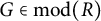 .
Corollary 5.21 Let R be a commutative Noetherian ring. Then the following are equivalent:
-
(1) R has finite Krull dimension and $\mathsf {D}_{\mathsf {sg}}(R/\mathfrak {p})$
has a generator for each prime ideal
$\mathfrak {p}$
of R. -
(2) $ {\mathrm {mod}}(R/\mathfrak {p})$
has an extension generator for each prime ideal
$\mathfrak {p}$
of R. -
(3) $ {\mathrm {mod}}(R/\mathfrak {p})$
has a resolving generator for each prime ideal
$\mathfrak {p}$
of R.


Moreover, if any of the above equivalent conditions holds, then
$ {\mathrm {mod}}(R/I)$
 has an extension generator for each ideal I of R.
Proof The second statement and the implication
$(1)\Rightarrow (2)$
 follows from Proposition 5.19. The implication
$(2)\Rightarrow (3)$
 follows from the definition.
$(3)\Rightarrow (1)$
 : Assume
$ {\mathrm {mod}}(R/\mathfrak {p})$
 has a resolving generator for each
$\mathfrak {p}\in {\mathrm {Spec}}(R)$
 . By Proposition 5.20,
$R/\mathfrak {p}$
 has finite Krull dimension for each prime ideal
$\mathfrak {p}$
 of R. Since the set of minimal prime ideals of R is finite, we conclude that R has finite Krull dimension.
Fix a prime ideal
$\mathfrak {p}$
 of R, assume G is a resolving generator of
$ {\mathrm {mod}}(R/\mathfrak {p})$
 . Note that the modules in
$ {\mathrm {res}}(G)$
 are contained in
$ {\mathrm {\mathsf {thick}}}_{\mathsf {D}_{\mathsf {sg}}(R/\mathfrak {p})}(G)$
 . Since each complex in
$\mathsf {D}_{\mathsf {sg}}(R/\mathfrak {p})$
 is isomorphic to some shift of a module M in
$ {\mathrm {mod}}(R/\mathfrak {p})$
 , we conclude that G is a generator of
$\mathsf {D}_{\mathsf {sg}}(R/\mathfrak {p})$
 . This finishes the proof.
We end this section by comparing the cohomological annihilators and the co-cohomological annihilators (see Proposition 5.24). Recall that R is said to be Gorenstein in codimension n if
$R_{\mathfrak {p}}$
 is Gorenstein for each prime ideal
$\mathfrak {p}$
 of R with height at most n.
Lemma 5.22 (1) Let
$(R,\mathfrak {m})$
 be a d-dimensional Cohen–Macaulay local ring with a canonical module
$\omega $
 . Set
$(-)^\dagger = {\mathrm {Hom}}_R(-,\omega )$
 . For each
$M\in {\mathrm {CM}}(R)$
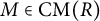 ,
$ {\mathrm {ca}}_R^1(M^{\dagger })\subseteq {\mathrm {coca}}^{d+1}_R(M)$
 , and equality holds if, in addition, R is Gorenstein in codimension
$d-1$
 .
(2) Let R be a Gorenstein ring with finite Krull dimension d. For each
$M\in {\mathrm {CM}}(R)$
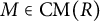 ,

(3) Let R be a commutative Noetherian ring. Then R is Gorenstein with finite Krull dimension if and only if
$ {\mathrm {ca}}_R(M)= {\mathrm {coca}}_R(M)$
 for each
$M\in {\mathrm {mod}}(R)$
 with
$ \mathrm{Rfd}_R(M)=0.$

Proof (1) For each
$X\in {\mathrm {mod}}(R)$
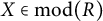 , since
$\Omega ^d_R(X)\in {\mathrm {CM}}(R)$
 , we get

Since this is true for any
$X\in {\mathrm {mod}}(R)$
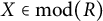 , we get
$ {\mathrm {ca}}_R^1(M)\subseteq {\mathrm {ann}}_R {\mathrm {Ext}}^{d+1}_R( {\mathrm {mod}}(R), M)= {\mathrm {coca}}_R^{d+1}(M)$
 .
Assume R is Gorenstein in codimension
$d-1$
 . Note that
$(\Omega _R^1(M^{\dagger }))^{\dagger }\in {\mathrm {CM}}(R)$
 . By [Reference Evans and Griffith27, Theorem 3.8],
$(\Omega _R^1(M^{\dagger }))^{\dagger }\cong \Omega ^d_R(Y)$
 for some
$Y\in {\mathrm {mod}}(R)$
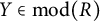 . This yields the first equality below:

where the last equality is by Lemma 3.8. This proves the converse direction.
(2) For each
$n>0$
 , assume
$r\in {\mathrm {coca}}_R^n(M)$
 . This yields

Since
$M\in {\mathrm {CM}}(R)$
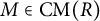 and R is strongly Gorenstein (see 2.1), M is an infinite syzygy. In particular, there is a short exact sequence
$ \xi \colon 0\rightarrow M\rightarrow P\rightarrow C\rightarrow 0, $
 where P is a finitely generated projective and
$C\in \Omega _R^{n-1}( {\mathrm {mod}}(R))$
 . By above,
$r\cdot \xi =0$
 . In particular,
$r\colon M\rightarrow M$
 factors through P. This implies that
$r\in {\mathrm {ann}}_R\ \underline { {\mathrm {End}}}_R(M)$
 , and therefore
$ {\mathrm {coca}}_R^n(M)\subseteq {\mathrm {ann}}_R\ \underline { {\mathrm {End}}}_R(M)$
 for each
$n>0$
 . It follows from this that
$ {\mathrm {coca}}_R(M)\subseteq {\mathrm {ann}}_R\ \underline { {\mathrm {End}}}_R(M)$
 .
By above,
$ {\mathrm {coca}}_R^{d+1}(M)\subseteq {\mathrm {coca}}_R(M)\subseteq {\mathrm {ann}}_R\ \underline { {\mathrm {End}}}_R(M)= {\mathrm {ca}}_R(M)$
 , where the equality here follows from Lemma 3.8 and Proposition 3.14. Next, we prove the inclusion
$ {\mathrm {ann}}_R\ \underline { {\mathrm {End}}}_R(M)\subseteq {\mathrm {coca}}_R^{d+1}(M)$
 . Assume
$a\in {\mathrm {ann}}_R\ \underline { {\mathrm {End}}}_R(M)$
 . Namely, there is a factorization

where Q is finitely generated projective. Note that
$ {\mathrm {id}}_R(Q)\leq d$
 (see 2.1). Hence,
$ {\mathrm {Ext}}^{d+1}_R(X,Q)=0$
 for each
$X\in {\mathrm {mod}}(R)$
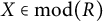 . Applying
$ {\mathrm {Ext}}^{d+1}_R(X,-)$
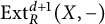 to the above diagram, we conclude that
$a\colon {\mathrm {Ext}}^{d+1}_R(X,M)\rightarrow {\mathrm {Ext}}^{d+1}_R(X,M)$
 is zero for each
$X\in {\mathrm {mod}}(R)$
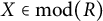 . That is,
$a\in {\mathrm {coca}}_R^{d+1}(M)$
 , and hence
$ {\mathrm {ann}}_R\ \underline { {\mathrm {End}}}_R(M)\subseteq {\mathrm {coca}}_R^{d+1}(M)$
 . Finally,
$ {\mathrm {ann}}_R\ \underline { {\mathrm {End}}}_R(M)= {\mathrm {ca}}_R(M)$
 follows from Proposition 3.14(1).
(3) For the forward direction, assume that R is Gorenstein with finite Krull dimension. For each
$M\in {\mathrm {mod}}(R)$
 , if
$ \mathrm{Rfd}(M)=0$
 , then M is maximal Cohen–Macaulay. By (2), this yields that
$ {\mathrm {ca}}_R(M)= {\mathrm {coca}}_R(M)$
 .
For the backward direction, assume that
$ {\mathrm {ca}}_R(M)= {\mathrm {coca}}_R(M)$
 for each
$M\in {\mathrm {mod}}(R)$
 with
$ \mathrm{Rfd}_R(M)=0$
 . In particular, since
$ \mathrm{Rfd}_R(R)=0$
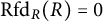 , we have
$ {\mathrm {ca}}_R(R)= {\mathrm {coca}}_R(R)$
 . It follows that
$ {\mathrm {coca}}_R(R)=R$
 as
$ {\mathrm {ca}}_R(R)=R$
 . Hence, there exists
$n\geq 0$
 such that
$ {\mathrm {coca}}^n_R(R)=R$
 . In particular,
$ {\mathrm {Ext}}^j_R(R/\mathfrak {p}, R)=0$
 for all
$j \geq n$
 and
$\mathfrak {p}\in {\mathrm {Spec}}(R)$
 . Localizing at
$\mathfrak {p}$
 , we conclude that
$ {\mathrm {id}}_{R_{\mathfrak {p}}}(R_{\mathfrak {p}})\leq n$
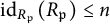 for each
$\mathfrak {p}\in {\mathrm {Spec}}(R)$
 , and hence
$ {\mathrm {id}}_R(R)\leq n$
 . This shows that R is Gorenstein with finite Krull dimension (see 2.1).
We thank the referee for pointing out the following remark.
Remark 5.23 Let R be a d-dimensional Gorenstein local ring with
$d\geq 2$
 , and M be a maximal Cohen–Macaulay R-module locally free on punctured spectrum. It follows from the proof of [Reference Esentepe26, Theorem 3.21] that

(see also [Reference Leuschke and Wiegand40, Proposition 13.7]). This precisely means that
$ {\mathrm {ca}}(M)= {\mathrm {ann}}_R {\mathrm {Ext}}^{d-1}_R(M,M)$
 (see Lemma 3.8).
Proposition 5.24 Let R be a commutative Noetherian ring and M be a finitely generated R-module. Assume M is an infinite syzygy, then:
-
(1) $ {\mathrm {coca}}_R(M)\subseteq {\mathrm {ca}}_R^1(M)= {\mathrm {ann}}_R\ \underline { {\mathrm {End}}}_R(M)\subseteq {\mathrm {ca}}_R(M)$
. All these inclusions are equal if, in addition, R is Gorenstein with finite Krull dimension. -
(2) If $ {\mathrm {mod}}(R)$
has a strong generator, then $$ \begin{align*}{\mathrm{IPD}}(M)=V({\mathrm{ca}}_R(M))\subseteq V({\mathrm{coca}}_R(M))={\mathrm{IID}}(M). \end{align*} $$



Proof (1) By Lemma 3.8, it remains to prove
$ {\mathrm {coca}}_R(M)\subseteq {\mathrm {ann}}_R\ \underline { {\mathrm {End}}}_R(M)$
 . This follows from the same argument as in the proof of Lemma 5.22(2). If, in addition, R is strongly Gorenstein, then M is in
$ {\mathrm {CM}}(R)$
 . Hence, by Lemma 5.22(2), we have
$ {\mathrm {coca}}_R(M)= {\mathrm {ca}}_R(M)$
 .
(2) The statement follows from Proposition 3.10, Theorem 5.9, and (1).
Proposition 5.25 Let R be a Cohen–Macaulay ring with finite Krull dimension d. Assume R has a canonical module. Then

for all
$i\geq \dim (R)+1$
 and
$\bigcap \limits _{M\in {\mathrm {mod}}(R)} {\mathrm {coca}}_R(M)= \bigcap \limits _{N\in {\mathrm {CM}} (R)} {\mathrm {coca}}_R(N)$
 .
Proof It is clear that

It remains to prove the converse inclusions.
Let
$\omega $
 be a dualizing module of R. Since
$R\in {\mathrm {CM}}(R)$
 and
$ {\mathrm {\Omega }}^d_R( {\mathrm {mod}}(R))\subseteq {\mathrm {CM}}(R)$
 , each module in
$ {\mathrm {mod}}(R)$
 has finite
$ {\mathrm {CM}}(R)$
 -resolution dimension in the sense of [Reference Auslander and Buchweitz2, Section 1]. Moreover, the subcategory
$ {\mathrm {add}}(\omega $
 ) is a cogenerator for
$ {\mathrm {CM}}(R)$
 in the sense of [Reference Auslander and Buchweitz2, Section 1]. By taking
${\textbf {X}}:= {\mathrm {CM}}(R)$
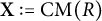 in [Reference Auslander and Buchweitz2, Theorem 1.1], for each
$M\in {\mathrm {mod}} (R)$
 , there exists
$X_M\in {\mathrm {CM}}(R)$
 and
$Y_M\in {\mathrm {mod}}(R)$
 which fits in an exact sequence

where
$Y_M$
 has finite
$ {\mathrm {add}}(\omega )$
 -resolution. It follows that
$ {\mathrm {id}}_R(Y_M)<\infty $
 , and hence
$ {\mathrm {id}}_R (Y_M)\leq d$
 (see [Reference Bruns and Herzog12, Theorem 3.1.17]). This yields that
$ {\mathrm {Ext}}_R^{\ge d+1}( {\mathrm {mod}}(R), Y_M)=0$
 , and hence we get that
$ {\mathrm {ann}}_R {\mathrm {Ext}}^i_R(L, X_M)= {\mathrm {ann}}_R {\mathrm {Ext}}^i_R(L,M)$
 for
$i\ge d+1$
 and
$L\in {\mathrm {mod}}(R)$
 . Thus, for each
$M\in {\mathrm {mod}}(R)$
 , there exists
$X_M\in {\mathrm {CM}}(R)$
 such that
$ {\mathrm {coca}}_R^i(X_M)= {\mathrm {coca}}_R^i(M)$
 for all
$i\ge d+1$
 . In particular,
$ {\mathrm {coca}}_R(X_M)= {\mathrm {coca}}_R(M)$
 . This yields that
$\bigcap \limits _{M\in {\mathrm {mod}}(R)} {\mathrm {coca}}_R^i(M)\supseteq \bigcap \limits _{N\in {\mathrm {CM}} (R)} {\mathrm {coca}}_R^i(N)$
 for
$i\ge d+1$
 and
$\bigcap \limits _{M\in {\mathrm {mod}}(R)} {\mathrm {coca}}_R(M)\supseteq \bigcap \limits _{N\in {\mathrm {CM}} (R)} {\mathrm {coca}}_R(N)$
 .
Corollary 5.26 Let R be a Gorenstein ring with finite Krull dimension d. For each
$i\ge d+1$
 ,

If, in addition,
$\mathsf {D}_{\mathsf {sg}}(R)$
 has a strong generator, then all the above ideals define
$ {\mathrm {Sing}}(R)$
 .
Proof The second statement is a consequence of the first and Proposition 4.8(2). For the first one, since R itself is a canonical module, by Proposition 5.25, it is enough to prove

By Lemma 5.22(2), we have
$ {\mathrm {coca}}_R^i(M)= {\mathrm {coca}}_R(M)= {\mathrm {ann}}_{\mathsf {D}_{\mathsf {sg}}(R)}(M)$
 for each
$M\in {\mathrm {CM}}(R)$
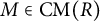 and
$i\geq d+1$
 . The desired equalities follow by combining this with
$ {\mathrm {ann}}_R\mathsf {D}_{\mathsf {sg}}(R)=\bigcap \limits _{M\in {\mathrm {CM}}(R)} {\mathrm {ann}}_{\mathsf {D}_{\mathsf {sg}}(R)}(M)$
 .
Acknowledgements
We would like to thank Kaito Kimura, Jan Šťovíček, and Ryo Takahashi for their helpful discussions and valuable comments related to this work. We are also grateful to the anonymous referee for providing valuable comments and suggestions, which have improved the article.


