


Introduction
It feels just like such an uphill battle. I mean, it definitely … feels like it is Sisyphus who pushes the rock up the hill every time.
This is what Lauren Novak said when we asked her about the greatest challenge in representing reproductive justice (RJ) cases. Ms. Novak is a criminal defense and civil rights attorney who spends about half of her time representing people facing prosecution for their behavior during pregnancy or for their pregnancy outcomes, cases consistent with the principles of the RJ movement. The Reproductive Justice movement is based on three human rights principles: Everyone has the human right: (1) to have children; (2) not to have children; and (3) to parent children in safe and healthy environments (Ross and Solinger Reference Ross and Solinger2017). RJ is a grassroots social movement that draws from the human rights framework, rather than the approach of the Reproductive Rights (RR) movement, which focuses on narrow legal “rights” framing, legal precedents, and winner-take-all litigation that focuses on individual wins instead of community organizing. In fact, the RJ movement developed in response to, and sometimes alongside, the Reproductive Rights (RR) movement.
The RR movement advocates for legal rights like choice, privacy, and freedom from government interference particularly related to access to abortion and contraception (the right not to have children), but it does not address related issues of importance to all women but especially to women of color and other marginalized groups—the other pillars in the RJ movement—such as forced sterilizations and forced removal of children from their families (interference with the right to parent children); and criminalization of behavior in pregnancy and violations experienced while laboring and giving birth (interference with the right to have children) (Kornbluh Reference Kornbluh2023; Ross and Solinger Reference Ross and Solinger2017). RJ is named by women of color and was built on the work of socialist feminists fighting sterilization abuse (interference with the right to have children), alongside Puerto Rican militants, Black Panthers, and Chicanx and Native American organizers. In short, the RJ movement is both a critique of the RR movement, for focusing on upper- and middle-class white women’s priorities at the expense of historically marginalized groups, and a new movement based on a human rights framework that brings many related issues around reproductive experiences together (Kornbluh Reference Kornbluh2023).
Kornbluh (Reference Kornbluh2023) traces the very complicated path from the RR movement to the RJ movement and argues, through careful historical and legal analysis, that there is not a bright line between RR and RJ. For example, some newer legal organizations are based on an RJ framework, including Pregnancy Justice, If/When/How, and Law Students for Reproductive Justice. Meanwhile, older RR organizations, like National Women’s Law Center (NWLC) and Center for Reproductive Rights (CRR), have expanded beyond the earlier focus on abortion and contraceptive access, thus shifting to incorporate some principles of RJ over time. Further, lawyers may have integrated RJ into a legal framework at least partly due to a multi-pronged assault on reproductive rights in the USA since the 1970s.
Other legal cases involving RJ principles include lawsuits against clinicians for obstetric violence or violations of informed consent and the defense of midwives from prosecution for professional and administrative violations, both of which interfere with the RJ right to have children. In these cases, it is often difficult for those who need representation to find an attorney. For example, Kimberly Turbin faced an uphill battle finding an attorney to represent her lawsuit over an unconsented episiotomy (a cut made in the perineum to enlarge the vaginal opening), despite having video evidence. Ms. Turbin gave birth to a baby boy in a Southern California hospital in 2013. While she was pushing the baby out, her physician told her he was going to cut an episiotomy. Ms. Turbin refused the procedure, but the doctor violated her right to informed consent and cut her perineum an astounding twelve times instead of the typical single cut. Ms. Turbin video-recorded this entire interaction on her cell phone and still found it difficult to find an attorney to represent her when she wanted to sue the physician for assault and battery. Ultimately, she found an attorney, sued, and settled out of court. However, an advocate who worked tirelessly to find her an attorney said this was largely due to the advocate’s social network and pure luck:
We were basically begging people to please sign on [as her attorney] before her statute of limitations prevent[ed] her from bringing any kind of a lawsuit … There [was] a total of three lawyers who even considered taking the case. One ended up being … conflicted out. One just didn’t even have the resources … And then this guy, Mark Merin, who we were like, “Please, God, please take this case.” I happen to know his niece … and it was like, “Is there any way you can help us convince this guy to take the case?” And she … saw [him] … [at] Thanksgiving or something, and she … read him the riot act … She was like, “Uncle Mark, you have to take this case … it’s so important, et cetera, et cetera, et cetera.” And he ended up taking the case shortly after that.
Despite a very clear violation of her legal right to informed consent and bodily autonomy and an interference with the human right to have children the way she chooses, Ms. Turbin struggled to find an attorney to represent her. This leads to a question: why are there so few attorneys who take pregnancy- and birth-related legal cases like Turbin’s?
Using data from fifty-six in-depth interviews, with forty-five attorneys who have provided legal representation in at least one pregnancy-related case in the RJ legal space and eleven birth advocates, we examine why so few attorneys take cases in the RJ legal space despite the large and growing need for lawyers to address violations of legal rights during pregnancy and birth. This legal space is just developing and may include cases in several areas of law, including tort law, family law, civil rights law, criminal defense law, employment law, environmental law, immigration law, and administrative law. However, the respondents who answered our call to interview attorneys who practice in the RJ legal space all practice in a limited range of legal areas (that is, civil rights law, tort law, family law, administrative law, and criminal law). Some cases they worked on involved individuals seeking legal recourse after negative or traumatic birth or pregnancy experiences. Others represented midwives who have been prosecuted under private civil law for practicing without a medical license or under other administrative restrictions. These two types of cases tend to involve “Public Interest” or “Social Justice” lawyers, or lawyers who have an RJ orientation and accept a few pro bono cases. Other attorneys, like Lauren Novak above, were criminal defense attorneys who represented women facing criminal prosecution for behavior during pregnancy (Flavin and Paltrow Reference Flavin and Paltrow2010). These criminal defense attorneys may or may not specialize in the defense of pregnant women. Additionally, attorneys we interviewed tend to have a primary focus but may cross over into other RJ issues.
We find that attorneys face multiple barriers to practicing in the RJ legal space, including challenges to attaining specific legal training on pregnancy- and birth-related legal issues and strategies for litigating them, a lack of mentors, cultural biases against plaintiffs, difficulties opposing well-resourced opponents, and the lack of financial compensation from clients with few resources. Their experiences highlight the cultural, financial, legal, and emotional barriers to taking RJ-related cases, and how these barriers make it difficult for women to find legal representation for violations of their rights during pregnancy and childbirth. Although there is extensive literature exploring the difficulties faced by public interest lawyers, hardly any research to date has focused on lawyers who practice in the RJ legal space (see Donofrio Reference Donofrio2018 for an exception). Our research highlights the unique challenges that attorneys face in the RJ legal space and the strategies that they use to navigate these challenges.
Literature Review
The legal profession has long engaged in “public interest” law, defined by Trubek (n.d., 49) as “the practice of law for social change.” Public Interest Law has its roots in the civil rights movement, and public interest law firms became established in the legal system by the end of the 1970s (Nielsen and Albiston Reference Nielsen and Albiston2005). The American Bar Association has attempted to make attorneys aware of their responsibility to community service by emphasizing this during their legal education (Granfield and Mather Reference Granfield and Mather2009). Yet some scholars are concerned that this is not having much of an effect. For example, Jacobowitz and Salter (Reference Jacobowitz and Salter2012) surveyed third-year law students to figure out why more students do not integrate public interest and pro bono work into their careers and did not find consistent themes on why this integration is rare. Further, some attorneys have advocated the importance of integrating public interest into all attorneys’ day-to-day work (Juergens and Galatowitsch Reference Juergens and Galatowitsch2016). However, feminist scholars point out that women are much more likely to be steered into public interest law than men (Simkins Reference Simkins2020). Overall, there is a concern in the legal profession that attorneys have a responsibility to serve the public.
Even fewer attorneys take public interest cases as their primary practice. They are more likely to occasionally take a case, typically pro bono (Rabin Reference Rabin1976). Lawyers’ involvement in justice-related pro bono causes is shaped by a combination of personal values, institutional structures, and professional incentives (Bartlett and Taylor Reference Bartlett and Taylor2016; Russell Reference Russell2004). While many lawyers express a commitment to public service, their actual engagement is limited, with most dedicating less than 2 percent of their professional time to pro bono work (Cummings and Sandefur Reference Cummings and Sandefur2013). Choices about which causes to support are often guided less by community need and more by firm culture, skill development opportunities, client preferences, and reputational considerations (Dreyer Reference Dreyer2008; Herman Reference Herman2021). Larger firms may encourage participation in pro bono work through formal programs, but this often favors high-visibility or low-risk cases over work that directly addresses structural inequality (Cummings Reference Cummings2004; Rhode Reference Rhode2008).
The few attorneys who focus primarily on public interest law tend to work for nonprofit organizations that rely on donations and grants, like the American Civil Liberties Union (ACLU). The ACLU was instrumental in recognizing and fighting for reproductive rights, going so far back as defending Mary Ware Dennet in the 1920s, whose sex education pamphlet was declared obscene by the government (ACLU 2002). The ACLU’s Reproductive Freedom Project began in 1974, the year after Roe v. Wade, and has focused on legislation and legal advocacy to protect reproductive rights. This is consistent with research that finds that public interest law is a two-tiered system where national organizations, like the ACLU, engage in broad-reaching social change actions, while smaller local organizations have limited actions and rely on government funding (Albiston et al. Reference Albiston, Li and Beth Nielsen2017). Often, public interest law firms seek out clients for issues they want to litigate (Rabin Reference Rabin1976), whereas RJ-related cases are typically based on direct legal service to an individual. The bottom line is that most public interest law tends to address collective social problems rather than individual claims.
In the 1970s, attorneys began discussing “critical lawyering,” as an antidiscrimination approach that focused on the lives of oppressed individuals (TrubekReference Trubek1996) 1991. This evolution of public interest law recognized the importance of law to human lives, the necessity of advocacy, and the ineffectiveness of bureaucratic solutions (Trubek Reference Trubek1991). Some feminist firms emerged, but most focused on issues of family law, including divorce, child custody, and domestic violence, not on issues more broadly that would include RJ-related issues (Trubek Reference Trubek1996). Other forms of social justice lawyering continually evolved and tried to find ways to survive (Trubek Reference Trubek1996). Lawyers also sought to represent those on the margins and to have public impact through multidisciplinary law firms that pair attorneys with nonlawyers and self-advocacy guidance (Trubek and Farnham Reference Trubek and Farnham2000). Social impact lawyers face similar problems to attorneys in the RJ legal space, including a need for funding, collaborations, and building networks (Trubek and Farnham Reference Trubek and Farnham2000).
In this context, legal networks, support groups, and organizations have developed to provide education and access to lawyers who specialize in RJ issues. RJ organizations often provide direct legal services, policy work, or education. These organizations also conduct research, which supports their policy work. The organizations dealing with RJ issues currently include Pregnancy Justice (formerly National Advocates for Pregnant Women); Birth Rights Bar Association (BRBA); If/When/How; Center for Reproductive Rights; ACLU Reproductive Freedom Project; Lawyers for Reproductive Justice; and Amplify Legal. These organizations are all privately funded. With only seven major organizations that deal with these issues, there are few attorneys who can help with the wide range of RJ legal issues, especially given the shifting terrain of reproductive health laws across states.
Although there is extensive literature exploring the difficulties faced by public impact and social justice lawyers (Reed Reference Reed2020; Trubek Reference Trubek1996; Trubek and Farnham Reference Trubek and Farnham2000; Rabin Reference Rabin1976; Nielsen and Albiston Reference Nielsen and Albiston2005), there is extremely limited literature looking at lawyers who practice in the RJ legal space (see Donofrio Reference Donofrio2018 for an exception). We find this omission important because, while the RJ legal space is similar to many other areas of public interest law, especially those that overlap with multiple legal specializations (for example, LGBTQ+ advocacy), law around RJ-related issues currently occupies a particularly volatile political space, where RJ advocates encounter a dizzying pace of legal change, at the national and state levels. This pace of change makes it hard to practice law to address RJ-related issues and exacerbates problems of access to justice for people who seek legal representation to redress injustices related to reproduction. While Donofrio (Reference Donofrio2018) explores the role attorneys play in the RJ movement, we turn this perspective around. We start with the premise that there are relatively few attorneys who work in the RJ legal space and explore why this is. We have two main research questions in this article. First, what are the financial, emotional, and legal challenges to doing RJ legal work? Second, what strategies do RJ lawyers and advocates use to promote RJ?
Theory
The RJ legal space is unique due to the highly politicized context surrounding reproduction. Further, the RJ legal area is connected to feminist causes, and it challenges longstanding cultural beliefs about motherhood, which both marginalizes the work and makes it particularly important to some dedicated attorneys. The self-sacrificing motherhood ideal can lead people, including juries and judges, to view women who seek legal action after traumatic birth experiences, choose to give birth outside a hospital, or face prosecution for less-than-model behavior during pregnancy as “bad” or selfish mothers, especially if they also fail to meet race, class, and sexuality-based standards for “good motherhood” (Ross et al. Reference Ross, Roberts, Derkas, Peoples, Bridgewater Toure and Feminist Press2017; Ross and Solinger Reference Ross and Solinger2017; Roberts Reference Roberts2015). Cultural discourses that frame fetuses as persons and pit women and fetuses against each other permeate legal cases in the RJ area and justify violations of pregnant women’s rights (Ziegler Reference Ziegler2025). Feminist efforts to dismantle harmful stereotypes and promote approaches to reproductive health that center women are key to RJ legal work. Broadly, feminist theory attempts to understand and transform gendered systems of power that intersect with other forms of oppression (Cummings and Sandefur Reference Cummings and Sandefur2013). Not only does feminist theory have a scholarly purpose but also a social justice one centering on lived experiences (Fonow and Cook Reference Fonow and Cook2005; hooks Reference hooks2014). Furthermore, feminist theory makes visible the gendered assumptions underlying our everyday lives (Fonow and Cook Reference Fonow and Cook2005; hooks Reference hooks2014). This is useful in analyzing how damaging gendered social beliefs undermine people’s perceptions of individual rights during pregnancy and birth.
Feminist scholars argue that the reproductive justice theoretical framework (RJT) foregrounds the intersections between people’s reproductive lives, gendered power, and social structures (Ross et al. Reference Ross, Roberts, Derkas, Peoples, Bridgewater Toure and Feminist Press2017; Morison Reference Morison2021; Reference Morison2023). Further, as a critical and intersectional feminist theory, RJT moves away from a focus on individual rights and investigates the larger social structures in which these rights are situated (Morison Reference Morison2023). Loretta Ross outlines RJT as being rooted in Black Feminist Thought and centered on how systems of inequality impact people’s ability to access reproductive rights, including the right to choose the conditions under which they give birth (Ross et al. Reference Ross, Roberts, Derkas, Peoples, Bridgewater Toure and Feminist Press2017). We apply RJT as a feminist theory to better understand how lawyers navigate these intersections within a legal structure that does not adequately address the relationship between unequal power and reproductive journeys, especially how gendered motherhood stereotypes become embedded in legal structures. As a result, lawyers have difficulties not only becoming experts in RJ law but also in effectively representing women who seek out legal recourse.
Methodology
To understand the challenges and opportunities of RJ-related legal work, we conducted in-depth interviews with lawyers and birth advocates who were involved in pregnancy- and birth-related legal cases. The data collection initially targeted attorneys who self-identified as working in the “birth justice” subfield of the RJ legal space. The attorneys who answered our call for research participants tended to focus on three types of cases in the RJ legal space: (1) cases of obstetric violence and violations of informed consent in birth; (2) licensing and/or prosecution of midwifery; and (3) criminal prosecutions of women for behavior during pregnancy. Attorneys working in other legal areas, such as environmental, immigration, and/or family law, may also view themselves as working within the RJ legal space, but no attorneys in these areas answered our call. As a result, they are not included in our sample. Further, none of the attorneys in our sample suggested that we interview attorneys working in these areas. Some of our respondents worked primarily in the RJ legal space, while others had represented RJ-related cases but identified primarily as having another legal specialization. Yet all the attorneys and advocates we talked to were committed to the goal of reproductive autonomy.
The target population was lawyers and advocates in the RJ legal space. The respondents represented key informants with specialized, firsthand knowledge about what is happening in RJ-related litigation and legislation. Key informant interviews are not intended to be representative, since their purpose is to capture experts’ understanding of specialized systems or processes and their interpretations of events. Because we aimed to interview people with expertise in a very small subfield within law, we obtained a targeted, nonrepresentative sample. First, the Principal Investigators (PIs) recruited participants through their social networks and by sending emails to the few legal groups in the USA that focus on RJ issues (for example, Birth Rights Bar Association, Pregnancy Justice, and If, When, How). Then, we used snowball sampling by asking all respondents to connect us to other attorneys who have worked on legal cases in the RJ legal space. Additionally, we sought out attorneys who had represented pregnant people or midwives in well-known cases. Our email requests used a script approved by the Institutional Review Board (IRB) at the University of Arizona.
We conducted all interviews on the Zoom video-conferencing platform and used Otter.ai software to generate rough transcripts. Interviews lasted an average of seventy-four minutes and ranged from thirty-three minutes to 163 minutes. Undergraduate research assistants (RAs) cleaned the rough transcripts, and the entire research team developed a list of codes. Then two teams of research assistants (each with one graduate RA and one or two undergraduate RAs) coded the transcripts through an iterative process. First, each member of the team independently coded each transcript. Then the team met and discussed the transcripts until they had 100 percent agreement on the codes. Next, the other team independently examined each transcript for agreement. As each team coded, they added new codes and then coded all interviews again with the full list of developed codes.
The sample of fifty-six interviews consisted of forty-five lawyers and eleven advocates from across the USA (see Table 1). Participants ranged in age from twenty-nine to eighty years old. As Table 1 illustrates, the sample has limited racial-ethnic and gender diversity, with a majority identifying as cisgender women and as White. Most respondents were married (70.4 percent) and had children (78.2 percent), with an average of 2.8 children. While the sample is not representative of the population of the USA, it may be representative of the small population of attorneys and activists involved in the RJ legal space. Respondents’ experience in law ranged from less than five years to over twenty-one years. Their annual income varied from less than $60,000 (22.2 percent) to over $1,000,000 per year (3.7 percent). To protect respondent confidentiality, we use pseudonyms for all respondents. We gave respondents the opportunity to choose their own pseudonyms and selected pseudonyms for those who declined the opportunity.
Descriptive Statistics for Lawyers and Advocates, N=56

Table 1 Long description
The table presents descriptive statistics for a sample of fifty-six interviews with lawyers and advocates. It includes data on gender, sexuality, racial-ethnic identity, marital status, years of experience, position, income, and average number of children. The table has 12 rows and 3 columns. Column headers are Descriptive, n, and Percentage. Row labels include categories such as Gender, Sexuality, Racial-ethnic identity, Marital status, Years of experience, Position, Income, and Parent n=42 with Average # children. Each row provides the count (n) and percentage for each category. For example, under Gender, there are 47 females (83.9 percent), 8 males (14.3 percent), and 1 queer individual (1.8 percent). The table also includes specific data points like the average number of children being 2.8.
Findings/Results
As discussed earlier, there are several different types of lawyers practicing in the RJ legal space. The primary focus of most reproductive rights laws and scholarship is on abortion rights (O’Connor and Yanus Reference O’Connor and Yanus2007; McCammon and Beeson-Lynch Reference McCammon and Beeson-Lynch2021). This singular focus neglects other serious reproductive injustices and leaves attorneys who wish to focus on pregnancy- and birth-related aspects of RJ with limited opportunities. Attorneys often face challenges obtaining training and experience in these types of cases. A primary focus on abortion access also means that individuals who seek legal recourse after negative or traumatic birth or pregnancy experiences, after being arrested for behavior during pregnancy, or who are told to cease and desist midwifery practice may have trouble finding legal representation (Cooper Reference Cooper2015; Morris and Robinson Reference Morris and Robinson2017). In this article, we explore why there are so few attorneys who specialize in the RJ legal space. This ultimately helps to understand why it is difficult for women who experience reproductive injustice to find an attorney.
Becoming an Attorney in the RJ Legal Space
Becoming an attorney who focuses on RJ issues is a hurdle, although this landscape is slowly changing. Attention to RJ in law schools is developing with Melissa Murray and Kristin Luker’s (Reference Murray and Luker2023) casebook (used in law schools), Cases on Reproductive Rights and Justice, now in its second edition. The Center for Reproductive Rights and Justice at Berkeley Law has also played an instrumental role in training attorneys in RJ issues. If/When/How maintains a list of law schools that offer courses in Reproductive Rights and Justice and offers an Internship and Fellowship Guide for careers in reproductive justice on its website. A few law schools offer fellowships in RJ. For example, the University of Texas’s Bernard and Audre Rapoport Center for Human Rights and Justice is offering such a fellowship for Summer 2026, and other universities offer Reproductive Justice legal clinics, like Yale Law School’s Reproductive Rights and Justice Project and NYU Law’s Reproductive Justice Clinic and Advanced Reproductive Justice Clinic. It will take time for these changes to broadly integrate into the legal community, since these are relatively recent developments and most of the attorneys we interviewed have been out of law school for a number of years and were trained when such courses, clinics, and fellowships were not widely available.
In fact, attorneys we interviewed told us that their own legal training about reproductive issues often focused primarily on Supreme Court decisions on contraception and abortion rather than the full spectrum of reproductive health. In addition, even when other RJ-related cases are integrated into the curriculum, attorneys in our sample said that many of the laws in the case books are not relevant, with the exception of the Murray and Luker case law book (Murray and Luker Reference Murray and Luker2023). Further, law school curriculum is designed to teach the existing case law, which reinforces the status quo and offers little in the way of re-envisioning law to achieve social justice. This means that attorneys who want to practice in the RJ legal space often need to find their own readings and legal cases from which to learn.
Mary Martin is a solo practitioner in the South who runs a very limited practice out of her home. She has only one or two cases at any one time, and they all involve RJ-related issues. For example, a recent case involved representing a woman who had experienced obstetric violence. She also helped to write midwifery licensure rules in her state. However, while there is demand for attorneys to do this type of work, she said that she had inadequate training on RJ-related issues in law school and had to supplement her legal education:
Find a mentor, join the Birth Right’s Bar … do so much self-educating on the framework …Even … [with] the move to have RJ courses in law school, … the case books that they use in those courses … might [have] one or two instances of … birth stuff … The emphasis is still primarily on birth control and abortion.
With some law students now, and especially in the past, finding little or no specialized training on RJ-related issues outside of contraception and abortion, including the violation of women’s rights during labor and birth, criminal prosecution for behavior during pregnancy, or how administrative law curtails the ability of midwives to practice midwifery, it is little wonder that few attorneys specialize in RJ law, especially outside the area of abortion and contraception.
Some attorneys can overcome their lack of training by completing a legal fellowship with an advocacy organization, like Pregnancy Justice or If/When/How, that focuses on pregnancy-related legal issues writ large. However, there are few organizations or experienced attorneys who offer training and mentorship in this area of law. Mentorship is a key part of the infrastructure attorneys need to develop expertise in the RJ legal space. It is also hard to be a mentor when the area is so undefined. Amanda Bower, a relatively new attorney practicing in the Midwest who completed an internship with one of the advocacy organizations, lamented the lack of mentorship available for attorneys who want to represent birth-related RJ cases:
I identify as a birth rights attorney, but it’s very hard to actually do that because there’s little mentorship available. There’s so little to look to, in terms of how … you even handle a case like this, … which is very scary for a young attorney who hasn’t really been practicing law all that much … So, if a client comes to me, I’m like, “Is this even something that I’m qualified to talk to this person about?”
Later in the interview, Ms. Bower brought up lack of mentorship again when we asked about the biggest challenge she faced in practicing reproductive justice law.
I think this goes back to what I was saying earlier, which is just … the mentors that are out there are great but … they’re still figuring it out … This is such a new area of legal practice that I think understanding what we’re doing and how we’re going to get paid for it is … I don’t think anyone’s quite put it all together yet.
Interestingly, Ms. Bower completed an internship with one of the advocacy organizations, but the number of cases in the RJ space that she takes since she started a solo, part-time law practice is negligible: she has one client who has her on a monthly retainer, and she runs an advocacy organization aimed at helping pregnant teens. The attorneys who strive to take on RJ legal cases, especially cases outside the traditional concerns with contraception and abortion rights, are often still the pioneers in this nascent field. Many of them feel they have too little experience or mentorship to feel confident in this role, especially when the legal terrain itself is continuously shifting. As a result, they take only a few cases involving RJ issues even though they are passionate about the area.
Finding employment in the RJ field, for at least part of their practice, is also a struggle. Simone Reynolds, an East Coast attorney, was unusual for our sample in that she learned and wrote about reproductive issues in law school. At the time of the interview, Ms. Reynolds was a law clerk for a federal circuit court. She planned to start a fellowship with a public defender’s office representing people who had their children removed from their care during pregnancy or birth. She framed this as a way of doing work in the RJ legal space. When she looked for employment in the RJ legal field after finishing law school, she found a lack of opportunities, even though she felt she had been trained well in law school to practice law to address RJ legal issues. As a result, she developed flexibility in her perspective on how to integrate an RJ framework into her employment. Here, she clearly articulated the problem of the lack of opportunities for an attorney to find a job practicing law in the RJ legal space, even if they had training:
I’m fresh out of law school. I have a ton of relevant experience. I am an eager beaver. I’m a hard worker … There’s nowhere that I can get a job doing this work. I have to maintain my own job doing this work, and we’re all in the same position … There’s a lack of mentorship and training available on these issues, as well as just straight up jobs … to do them.
In other words, Ms. Reynolds’ fellowship, although conceptualized as work in the RJ legal field, is not the job she had planned for herself. Ms. Reynolds went on to highlight that one of the few employment opportunities for a staff attorney position is to work for one of the “big” organizations that primarily focus on abortion rights:
You can get a job at the Center for Reproductive Rights. You can get a job at Planned Parenthood; you can get a job at any number of pretty well-funded organizations that have … dozens of staff attorneys who work on these [abortion] issues. I found that really challenging, and I’ve had conversations with all those big organizations, and they’re all interested in kind of getting into that area of work [other RJ areas], but they don’t have anybody there ... yet who does it or knows how to do it.
In short, attorneys interested in RJ legal issues other than contraception and abortion encounter few opportunities. This has overlaps with other types of public interest law, including the politicization of the area (for example, immigration issues, representing people on death row, etc.)Footnote 1 However, the RJ legal space has two important differences. First, other areas of public interest law (for example, LGBTQ+, voting rights, immigration law, etc.) are better defined, whereas the boundaries of RJ law are fuzzier. Second, lawyers and advocates in the RJ space encounter a dizzying pace of legal change and a volatile political context.
Practicing Law in the RJ Space
Attorneys who persevere in their desire to practice in the RJ legal space still face an uphill battle in their practice. We identify several obstacles that combine to make it difficult for attorneys to sustain an RJ focus in their legal practice. Few attorneys clear the first two hurdles we discussed: training and employment. What happens once attorneys overcome these initial hurdles and obstacles, become trained, and specialize in practicing law in the RJ field?
Cultural Bias in RJ-Related Cases
First, nearly all the attorneys to whom we spoke discussed how they face a deep cultural bias against the rights of birthing people and midwives. This bias affects all areas of their practice, from juries and judges to finding expert witnesses. Juries and judges are steeped in a culture that views pregnancy as inherently pathological and motherhood as a sacrifice. As a result, they often do not trust women’s words, especially if they are challenging a doctor and/or the medical system. Rachel Kaplan has both a law degree and a medical degree. In medical school, she realized that much of the way women are treated during pregnancy and birth is not evidence-based (for example, the mandate not to eat or drink during labor). She had some heated discussions with her attending physicians in medical school and ultimately developed and taught a midwifery course during medical school as a sophomore seminar. She has been practicing law for twenty years as a solo practitioner but, when we spoke, did not have any RJ cases. Her one case was a pro bono case about a wrongful death row conviction. However, she told us about several RJ cases she was considering taking. Ms. Kaplan told us about the culture cases in the RJ legal space:
Odds are, you’re up against a system and jury, and perhaps a judge … that generally thinks that doctors know best, that obstetricians are experts in a physiologic birth, and that we have to save the baby … And there are any number of reasons why it’s a total mythology, but lots of people buy into it, across cultures, across genders, across socioeconomic statuses.
This culture is something Ms. Kaplan confronted in medical school, and one of the reasons she practices law and not medicine. Serena Burns-Ellis is an attorney who proudly answered 95 percent when asked what percentage of legal cases she represented involved RJ or birth legal issues (the remaining 5 percent are in family law). Ms. Burns-Ellis also identified cultural bias as a significant obstacle to finding expert witnesses who will support the patient’s perspective:
[There is a] deep entrenchment of the violation of patient rights in the culture of obstetrics. It is so deeply entrenched that it’s hard to find obstetric experts who can speak clearly on how the law of informed consent is supposed to apply in L&D [labor and delivery]. I can count on one hand the number of OB’s who really get it.
In other words, from judges to juries to expert witnesses, the culture is biased against plaintiffs in birth injury and obstetric harm cases. This means that attorneys who practice in the RJ legal space who want to take these cases must work harder to convince courts that harm during birth was negligent, was harmful, and was caused by medical practice. The difficulty of confronting widespread beliefs that medical providers are heroes who save babies from the pathological process of birth is a strong deterrent against attorneys representing plaintiffs in the RJ legal space against physician or hospital defendants.
This cultural belief is also an obstacle for attorneys who represent midwives in cases that challenge their professional competence and expertise. Attorney Pamela Griffith is a solo-practicing attorney in the Midwest who went to law school to deal with “matters of birth,” and finds herself primarily defending health providers, mostly midwives, against disciplinary actions. Ms. Griffith pointed to how judges are embedded in a culture that devalues women, and she sees this in her defense of midwives. She told us: “A judge is a powerful individual. They’re in charge of their courtroom, and so it’s not a big step for a judge to believe … that, ‘It’s what a doctor says, so [it’s] reliable.’” The strong cultural reverence for a doctor’s opinion is part of the significant cultural bias that attorneys face. Linda Reeves, an attorney who was involved in the founding of “The Farm,” now called “The Farm Midwifery Center,” in Tennessee in 1970, gave birth to her daughter with The Farm’s midwives and later became a nurse and went to law school. As a practicing attorney for the past thirty years, she has a solo practice and primarily represents nurses and nurse practitioners, defending their licenses in front of regulatory boards. Ms. Reeves told us about a case in which a nurse midwife who attended deliveries at her birth center was sued for a bad birth outcome that was not her fault. She ultimately won the case but only after a long legal battle in which the basic safety of midwifery was continually questioned:
The nurse midwife … had to transfer [the patient to the hospital, and the baby died]. This young attorney just decided that it was the midwife’s fault that this baby died … But it turned out the baby had lymphocytic myocarditis, a viral disease caused by the mother being exposed during the pregnancy to certain types of foods or substances … The baby was born with a heart that was very enlarged … But this young attorney, she wasn’t going to listen to anything I said because she already made her mind up that … everybody should have their baby in the hospital. That was the safest place.
Attorneys had to be very well-educated about midwifery and birth to represent cases that confronted the widespread but biased cultural belief that hospitals are the correct place to have babies and doctors are the only clinicians who can safely deliver babies. This limited the number of attorneys who represented midwives in these cases.
Another area in the RJ legal space involves women who face criminal prosecution for their behavior during pregnancy, often because they used drugs. Lawyers who represent these cases typically specialize in criminal law, and they face even stronger cultural biases against their clients than attorneys who take cases involving violations of informed consent, obstetric violence, or midwifery. Prosecutors, judges, and juries often have strong prejudices against pregnant substance users, even though surveillance and criminalization go against best practices for proper birth care as well as substance abuse treatment (“Substance Abuse Reporting and Pregnancy: The Role of the Obstetrician–Gynecologist” 2011). Some hospitals use unconsented drug testing and have ties to law enforcement, which situates pregnant substance users in a vulnerable position that may deter them from receiving needed treatment or care. These women often distrust their doctors, have limited options for prenatal and perinatal care as well as substance abuse treatment, and face the risk of being prosecuted. Lawyers who represent these cases effectively described the double-bind these women face to unsympathetic juries and judges, who are part of a culture that demonizes women who do not live up to ideal standards of motherhood. Top this with the emphasis on fetal rights, and women who use illegal substances during pregnancy face a stiff uphill battle. The ideological beliefs that support criminalization as the answer to substance abuse add another layer to these cases, which further harms pregnant women who abuse substances.
Valerie Goldman attended law school to work on “core reproductive rights.” She interned at an RJ advocacy organization and, once she passed the bar, became a fellow at that same organization. After a career turn to city government, she came back to a different RJ advocacy organization to take a leadership position. This organization often represents women criminalized for drug use in pregnancy as well as offering legal support across the spectrum of RJ cases. She described:
When we’re talking about criminal law, people truly believe that criminalization fixes problems. There’s a deep ideology. I think it’s also like the criminal legal system is an industry. And you combine that with this belief that fetuses are people, … and you’ve got a really, really awful, deeply held belief that they’re going to save babies and punish wrongdoers, and cure addiction through criminalization.
Similarly, Paul Shulman is a criminal defense attorney whose career has focused on policy work and ending the war on drugs in the USA. It was because of his work on this issue that the director of one of the RJ advocacy groups contacted him to work on cases involving the increasing criminalization of women who use drugs. He said that the director persuaded him to see the targeting of pregnant users as a critical part of the war on drugs, and now up to 15 percent of his criminal defense cases are criminalization of pregnancy cases. He explained how drug laws are used in various ways to criminalize women for their behavior during pregnancy, creating a web that makes it difficult to defend these cases because of the widespread belief that drug use in pregnancy is morally indefensible, harmful to fetuses, and avoidable with adequate willpower and self-sacrifice on the part of pregnant women. These beliefs draw on gendered ideologies of appropriate behavior of mothers:
If you look at … criminal law, … there’s been a half a dozen different legal theories just in criminal law alone of how to criminalize pregnant or parenting women for drug use. … You criminalize someone for drug use and … delivering drugs to another person, in this case, a fetus or … a newborn, neonate? And so, there’s all these drug delivery statutes that have been attempted to be used to criminalize women … Any criminal statute that criminalizes drug possession, drug use, drug delivery, and any harm that can come from drugs has been attempted to be used [on] pregnant [women] … in the absence of any science showing any harm … Because that’s sort of the basis of our drug war to begin with, that drugs are bad. Drugs are harmful, and … there’s this sense that prosecutors don’t question and most judges don’t question, “Well, it must be doubly harmful for … a pregnant woman and a fetus or neonate to be exposed to those drugs,” even though the science does not support any of that.
Criminal defense attorneys like Mr. Shulman are willing to confront cultural biases against women who use controlled substances while pregnant. They recognize that it is unjust to penalize someone more for engaging in a behavior while pregnant than if they were not pregnant, and they know that pregnant substance users would be better off having medical treatment and support. However, relatively few criminal defense attorneys understand the intricacies of this bias in cases that involve pregnant women, which makes it difficult for women facing prosecution to find an attorney.
The cultural biases against women, midwives, and, especially, women who use drugs in pregnancy are so deeply embedded in our society that attorneys discussed losing cases often. It became clear how difficult it is to stay in practice in this area of law for long. It takes a committed attorney to always be in an uphill battle. When we asked him about his most challenging case, Josh Zimmer, a criminal defense attorney, said:
Every one [case] has been challenging. Really challenging. The last case that we had, in Oklahoma, was maybe the most difficult for us. The facts were very, very bad. It was a methamphetamine case, … and I handled the initial motion to dismiss at the trial level. The theory of our motion to dismiss at the trial level was that [the mother] could not be charged with killing her child because Oklahoma law didn’t define a fetus as a child, and it was clear that there had not been a live birth. The judge heard our arguments and ruled in our favor and dismissed the murder charge against her. Unfortunately, the prosecutor appealed that … It went to the highest criminal appeal appellate court in Oklahoma, and they said, “Look, if we haven’t been clear in any other cases about whether a fetus is a person, let’s be clear now: it’s from the moment of conception.” … It left her still indicted on a murder charge in an extraordinarily conservative county… The judge encouraged us to enter into a plea bargain. Of course, you know, as a criminal defense attorney, I’m always willing to talk about it with the prosecutor, and when we had that discussion with the prosecutor, his answer was, “I’m not going to give you an absolute number at this point in time, but I’ll tell you that whatever the number ends up being, it’ll be something she will most likely be able to survive.” How chilling is that?
Mr. Zimmer’s example, which involved a woman who was addicted to methamphetamine and had a stillbirth, illustrates both how difficult these cases can be for criminal defense attorneys, and how the legal terrain that they operate on can shift beneath their feet as political battles over reproductive rights play out in real time. Always feeling like one is engaged in an uphill battle is exhausting, and facing unconscious cultural assumptions that discredit the plaintiffs in RJ cases takes a toll on these attorneys.
Financial Challenges
Another part of this uphill battle is that attorneys not only fight against a culture that devalues women and their experience, but they also often fight against hospitals and medical associations that are well-resourced and have dedicated legal counsel (Galanter Reference Galanter1974). In criminal cases, they often battle prosecutors or legislators with government resources. In short, most cases involving RJ issues are battles of “one-shotters” against “repeat-players” (Galanter Reference Galanter1974). This puts most defendants that face RJ litigation at a significant advantage over individuals trying to file suits against them. Ms. Kaplan described this struggle, with clear frustration, when we asked her if she tried to represent cases that will win settlements before trial: “My thinking is every case is going to trial … You’re going up against the hospital. They have an incentive to try the case and to crush you [emphasis in original].” Later in the interview, she draws this analysis out even more with more effect: “They have endless, endless money to throw at it … I’m battling five attorneys all the same time. This is total David and Goliath … It’s the same thing, different day, just put in different players.”
Since plaintiffs in the RJ legal space are typically “one-shotters” with limited legal experience and few resources, it is financially infeasible for most attorneys to take RJ cases, which are expensive to litigate and have a low probability of success. For example, in medical negligence cases, the high cost of expert witnesses makes the cost of litigating a claim prohibitive, and there is often a small likelihood of receiving a substantial award if the suit is successful (Roth Reference Roth2021). Juries only award substantial damages if there is a clear violation of the standard of care and catastrophic damages, and many of these cases involve physical and psychological harm because of the standard of care (Roth Reference Roth2021). Further, many states have instituted tort “reform” that caps medical malpractice damage awards for pain and suffering, which is often the type of harm suffered by people who experience birth trauma. Also, juries often devalue reproductive harms so long as there was a healthy baby delivered, which further makes these cases impractical for the plaintiff’s bar to litigate (Chamallas Reference Chamallas2015). Additionally, most plaintiffs in these cases recover, at least physically. As a result, it is hard to win these cases. Because they usually pay on a contingency basis, it is also hard for lawyers to make a living representing them. Most attorneys in our sample confined their work in the RJ legal field to a small fraction of their practice - often taking only a handful of cases as pro bono work. Further, attorneys who represent RJ cases as a larger proportion of their practice often face financial precarity because their clients rarely have money to pay out-of-pocket and the potential rewards are too low to make much money on contingency. As a result, many attorneys experience this work as economically risky.
The few attorneys who focus a significant proportion of their practice on RJ were often unable to support themselves financially and must rely on someone or something else to make ends meet. Ms. Novak told us: “We have a joke in my house that I only take cases that basically don’t pay any money. So, I think that’s why … there’s so many of these cases. You just can’t make a living from them unless you work for a nonprofit.” Tara Devlin, an attorney practicing in the southwest who spends about half of her time on cases involving RJ issues (she jokingly told us that she litigates cases on “weed, midwifery, and abortion”), told us: “I want to represent all of these folks. And I don’t have enough time in the day. Oftentimes, I give away my services. And it’s hard … to be sustainable when you want to give away your services to people who need it most.” The few lawyers whose work focused more intensively on cases in the RJ legal space earned very little, and most relied on a spouse for financial support.
Jasmine Becker is a healthcare lawyer who is general counsel and regulatory counsel for a bundle of companies (mostly dentists). She was familiar with the challenges of representing cases in the RJ legal field, and described a balancing game she had to play when she took these cases, supplementing her pro bono representation of women in cases with criminal defense representation:
None of the birth cases that I did [paid]. I never charged anyone for a birth case. Never. That was 100% pro bono work … I had, for a decent period of time, a small criminal practice…. Drug dealers make the best clients. They pay in cash. They do not expect to get off. They just want you to … get them as fair a deal as possible.
Ms. Becker worked on a very famous RJ legal case during law school and stopped taking such cases some years ago after she got divorced and could no longer rely on a spouse for financial support. While she was passionate about RJ, she ultimately had to stop representing cases in the RJ legal space to support herself. Similarly, Jacob Gelb, a criminal defense attorney who takes pro bono work, described the heavy lift such cases take and requires support from family and colleagues. Further, pro bono cases involve a commitment from one’s legal practice colleagues and no concern about making money.
I would say, ‘go for it’ because it needs to be done. This is why we go to law school. This is why we practice law. We are not in business to make money. We are here to help people. This is why we do what we do. And if you can take one, you[’ve] got to get permission from your wife, your husband, or your significant other, or your business partner because they take a ton … of time, a ton of money. You have to get permission and say, ‘I’m going to be spending a lot of time on this, consider it … a pro bono case.
In other words, pro bono work is necessary, but it requires a certain mind frame and commitment from attorneys.
Emotional Challenges
To top off all these issues, cases in the RJ space are also emotionally draining. Ms. Griffith indicated that most of her clients’ lack of resources leads to a real struggle for attorneys who want to represent them, especially because these clients are emotionally vulnerable and need much time and attention, which she feels she cannot bill for:
I have to listen for a long time because my clients tend to be very emotional … And I really struggle with the fact that, first of all, it takes a lot of time. And my clients typically … are not people of great means, so adding an extra hour of billing is really unthinkable … I do free initial consultations. So, there is the struggle where I would like to reassure people and listen to their cases in great detail but, as an attorney, I really should… get to the center of the case quickly … That is a huge struggle for me.
Several attorneys we interviewed made similar remarks about the emotional labor of working in the RJ law area. They had compassion for the individuals who sought legal representation, but that compassion could lead to emotional labor and exhaustion because the attorneys know the individuals seeking legal representation need to be heard and likely haven’t been able to get others to listen to their concerns.
Cases that involve trauma to women or babies can also cause secondary trauma. Ms. Burns-Ellis talked about secondary trauma among her clients: “Are they angry at everyone all the time? You know what I mean. Including me? I get a lot of calls from women who’ve experienced trauma … I had to develop my own tools for secondary trauma years ago when I started this.” Secondary trauma is more typically discussed as a concern for healthcare and mental health providers (Elwood et al. Reference Elwood, Mott, Lohr and Galovski2011; Hesse Reference Hesse2002) but can also affect attorneys who represent individuals seeking to address their trauma through the legal system (Iversen and Robertson Reference Iversen and Robertson2021). This may be especially likely for attorneys who take cases involving RJ issues.
Similarly, Chelsea Edwards, a brand-new attorney who is working full time for a legal organization focused on birth issues, described this as a high-need type of law. When asked what the biggest challenge of her job is, Ms. Edwards responded:
It feels … urgent … in a real way… no offense to corporate attorneys, but at the end of the day, y’all are just dealing with money. The people that I talk to … their kids are going to get taken away from them or they are experiencing severe trauma from the violence that they experienced at the hospital and can’t function in their daily life. It’s extremely high stakes. It’s not about money. Ever. And I think that … adds to the feeling of, “You have to do it all, and you have to care for everybody.” And … there are only so many hours in a day.
Ms. Edwards described some of the ways that emotional exhaustion can set in because the individuals who come to these attorneys for help may be experiencing harm in more than one area.
The result of this cascade of challenges to practicing in this area of RJ law is clear. The lack of training opportunities, the financial precarity of the work, and the emotional labor of working on these cases lead to a shortage of attorneys. This leads to a circular struggle—limited training or mentorship, hard work, a shifting legal landscape, and few attorneys and mentors—and the cycle begins again. Even attorneys who want to take cases and can depend on others for financial support, like Ms. Devlin, simply cannot take them all. She told us: “Maybe every couple of weeks, I get an obstetric violence case … Almost all of them, I’d love to take on as medical batteries. But almost all of them, I have to tell folks, ‘Sorry, I can’t find an attorney.’ And I know I can’t do it.”
Strategies Used by Attorneys
These constraints lead some attorneys to develop strategies to continue doing this work. Lawyers in other specialties use some similar strategies, while others are specific to attorneys who take cases in the RJ legal space. What became clear to us, however, is that even strategies that are common across different legal specialties are especially common among attorneys practicing in the RJ area due to the constraints we have discussed previously in this article.
Strategies that are common to other areas of law start with seeking out a broad array of experience and training. Ms. Reynolds described this goal:
Get any kind of experience that you can get that you can then cross apply to birth rights issues. So, it’s hard to get the training … that you need to be able to deal with these issues. But, working on certain kinds of family law issues, working on certain kinds of employment law or civil rights issues, you can get some of the litigation skills and some of the kinds of frameworks that you can then creatively cross-apply to birth. I think just in recognition that those structures to help train you up and mentor you and teach you how to do these things are really scarce.
Ms. Reynolds made clear that creativity is important because most laws were not written to address obstetric violence and violation of informed consent. Prosecutors can also creatively use laws for other purposes to prosecute pregnant women for drug use. In other words, laws are often not written to address RJ issues, so attorneys must think outside the box (Soohoo Reference Soohoo2021).
Second, another type of advocacy involves lawyers, academics, and advocates writing amicus briefs and policy briefs that support women’s rights during pregnancy and birth. For eight years, Steve Koppel worked for a law firm that represented the American Medical Association (AMA) and often wrote amicus briefs for the AMA, including briefs on abortion access. He left that position to take an academic position and now teaches at a law school. Mr. Koppel told us about his work on writing briefs:
I was involved in writing a policy paper for the AMA on interventions during pregnancy, two kinds. One, [on] forced treatment … The doctor thinks we ought to do a cesarean section or a blood transfusion. Usually, it’s a pregnant woman who says no, and so they, doctors, will go to court. We talked about that. Should doctors go to court? And the answer is no … And then, prosecuting in the case … of the drug use during pregnancy? …. We said never prosecute … Based on that paper, now, we could go into court, file court cases.
Mr. Koppel described the practice of writing amicus briefs as an impactful strategy, because the arguments in the briefs could support future RJ legal action.
Ruth Maes O’Day, an attorney at an RJ organization who works on cases involving RJ issues as well as family formation cases, also talked about the importance of writing amicus briefs. She used a combined strategy of community organizing that involves writing letters to the prosecutor and judge and filing amicus briefs in the initial case rather than on appeal:
One … legal strategy … includes more community organizing than your average legal strategy. In this particular case, we had a sign-on letter that we … sent one to the prosecutor [and] … one to the judge at sentencing … We got a number of people involved, carrying eyes on this situation. And then we did submit an amicus brief … at the first level as opposed to waiting for an appeal, which is novel, but that’s the idea. Like, these issues require a little extra consideration … Hey, court Fact Finder, you should know some things about this kind of case. So, it’s really a combination of, hey, raising … raising a flag. Hey, whoa, hold up.
The process of community organizing by providing community input to the prosecutor and judge and amicus briefs to signal the legal nuances of the case is an important strategy that lawyers in this area use.
Third, attorneys seek the most impactful and/or sympathetic plaintiff to address RJ issues, which means they must address cultural concepts about what it means to be a good woman and a good mother. Ms. Kaplan put it simply: “These cases, generally, personal injury cases, they rise and fall on the credibility and likability of the person who’s injured.” Ms. Novak suggests that the cultural image of a good client in birth rights cases is normatively gendered:
They don’t like women who are sexually expressive … These are archetypes … You’ve got the Virgin Mary archetype and the good mother. And she’s young, and she’s great, and they love those. But if you fall outside of that archetype …, if you’re not … a sweet school mom, or a sweet mother, and you … have addiction issues, they don’t like you. If you have promiscuity, they don’t like you. If you make parental choices that are questionable, especially if there are drugs involved, they don’t like you … People pass a lot of judgment on women for who should be allowed and who shouldn’t be allowed to have kids, and they put it all on her.
In short, a “good” client is an individual that society values as a mother, especially for mothers who sue their obstetric providers or hospitals. This strategy makes cases easier to win but leaves many women outside of legal recourse – especially low-income, single mothers and many women of color. This is especially clear in cases involving prosecution of women for their behavior during pregnancy, but it also affects the likelihood of success for women who want to sue their providers. If they can meet the standard of a “good mother,” with all of its racial, class, and sexuality connotations, then they are more likely to be a successful plaintiff, and attorneys look for plaintiffs that can win.
Fourth, attorneys collaborate with other attorneys across the country. Violations of harm, restrictions on the practice of midwifery, and criminalization of behavior during pregnancy take place across the USA, but attorneys who practice in the RJ legal space are concentrated in New York and California. Often, when a case grabs the attention of RJ organizations or attorneys, they reach out to local attorneys to support them in the state where the case is being litigated. This means that collaboration is often regional, and the RJ organizations must identify local lawyers with a certain specialty (for example, criminal law, medical malpractice) who may have very limited or no experience with cases involving RJ issues. Ms. Goldman told us how her organization often coordinates with local attorneys where cases have been filed against women:
This type of collaborative arrangement is common. We always have to find local counsel. Often people already have court-appointed attorneys or public defenders. There are limited circumstances where … someone reaches out to us, or we get connected to someone who has no attorney yet. No matter what, we have to get them local attorneys, because … we’re based in [city], even if someone is admitted in that state, we’re not there and familiar with local practice … One thing that I’ve learned, having been here for a little bit of time now is [that] even in states like Oklahoma and Alabama, where the law is really against us, there’s still stuff we can do. We can still try to make it really expensive and time-consuming and laborious for prosecutors to succeed … We can try to get people out of jail, even if the charges are still there.
This type of collaboration suggests the necessity of finding local counsel, perhaps in a way that is more urgent than is used in other areas of the law. Because the law may make it difficult for them to win, and opposing counsel will often use delay tactics, collaborations with local counsel are critical to success.
Cases of criminal prosecution bring up new issues, including whether the RJ organization can find a local attorney who’s not biased against women who use drugs in pregnancy. Women who are prosecuted for behavior during pregnancy (for example, using drugs) are typically represented by public defenders and often languish in jail unless someone (usually an advocacy organization) decides to appeal on their behalf. These women are not seen as “good” victims because they fail to meet the standard of the self-sacrificing mother. When national advocacy organizations become involved, they bring in national legal experts, like Mr. Shulman, to organize the defense. This is how such a collaboration works, in Mr. Shulman’s words:
The first thing is to establish a rapport or make sure that that woman has a good local lawyer who is not buying into the myths and the hysteria and the stereotypes that have given rise to the charges to begin with… Lawyers are part of the culture[,] and so, it’s not uncommon to encounter a criminal defense attorney whose first reaction is, “Yes, shouldn’t she be behind bars? Shouldn’t we be protecting her fetus? What’s wrong with this?” … Typically, if that’s the first reaction, you want to get a new lawyer. In that case … it’s finding the … right lawyer who’s going to be aggressive, who’s going to work with and collaborate with me.
Collaboration is widespread among attorneys, and many collaborations involve first finding a collaborating attorney who agrees that the pregnant woman’s rights have been violated – and that means rejecting the punitive rhetoric around fetal rights.
Other strategies that are more unique to cases involving RJ issues include a focus on community organization and other types of advocacy. Ms. Griffith summed up the importance of working outside the legal system because the legal system and the medical industry are often the problem in RJ cases, especially cases involving midwifery or obstetric violence:
The structures aren’t there to protect birthing people or their doulas …Sometimes you can work in those cracks between the systems. Sometimes you can get a better result for your client, … which is why I do so much work outside my practice. Because otherwise my practice would just be too frustrating inherently. And I need to feel like I’m accomplishing something.
In a similar fashion, Ms. Devlin also identifies ways to work through the cracks: “A lot of the things that we deal with can’t be solved by the law. So, you need to figure out a way to work with bureaucrats, to work with elected representatives and represent your clients in that way. Because I’ve made more progress on the political side than I have in some of my legal cases.” In her view, political action to change legislation was critical to advancing RJ causes.
Ms. Goldman also focuses on public attention and community organizing, especially in cases where women are criminally prosecuted, but she recognized the uphill battle many women face:
We can get press coverage in progressive or mainstream outlets. Can we generate outrage in those local counties where those prosecutors are accountable to the voters? And, we’ve got very limited legal strategies in a lot of those places too, where courts have already said that a fetus is a child, where that’s becoming more and more normal. That’s a real challenge.
Ms. Goldman identifies a strategy of using the press, but the ever-present culture that accepts the idea that fetuses deserve protection is always in the background.
Other attorneys, such as Ms. Edwards, see their role as helping someone harmed to find a solution, which may or may not be a legal solution:
I sort of understand my role more as an advocate who meets people in what I would describe as an under-met space of needs, where someone has experienced harm and doesn’t yet know what … the full scope of their options is. With regards to getting accountability, not just legal accountability, but more broadly … healing from what happened. And we’ll meet with folks and talk about the full range of what they might be able to do, whether it’s … seeking justice through the court system … But maybe it looks like filing a discrimination complaint with the Office for Civil Rights at HHS, maybe it looks like telling their story in an advocacy space like the reproductive justice tribunal that’s coming up in the fall. Maybe it looks like filing a complaint with their local medical licensure board … It really depends on the person.
Another example of out-of-the-box thinking was recounted to us by attorney Paul Shulman. He told us about court cases in Wyoming in which he and his team had been striking out on all their legal and evidence-based arguments. They got creative and were able to slow down the prosecution of women by reminding the clinicians of their ethical and professional responsibilities:
I’m going to talk about a relatively recent series of cases involving many, many women being prosecuted … and detained in Wyoming, even though the state law didn’t support these types of charges. The court wasn’t listening. The prosecutor wasn’t listening. We really tried everything. We laid out the law and got nowhere saying the law doesn’t support this … We attempted scientific arguments, and we lost … And then we realized that sort of the linchpin to all of these cases was the willingness of somebody in the medical community testifying for the prosecutor that harm was being done … The professional organizations for all these clinicians … have very … strong statements saying, “We oppose the criminalization of pregnant women.” … We wrote these clinicians who were willing to testify for the state [and] said, “Do you understand that if you take the position in court, we will contact your professional organization, and we believe we have grounds to have you … kicked out of your professional organization.” … They then got cold feet, and they withdrew from helping the prosecution. And once the prosecution had no medical expert to call to the stand and give testimony, their case disappeared.
This example shows how creative attorneys must be in RJ legal cases by emphasizing extra-legal disciplinary mechanisms when other strategies do not work.
Further, the law uses a rights framework rather than a human rights framework that is at the core of the RJ vision, and most laws were not designed for women to seek justice when their rights are violated during pregnancy and birth. Perhaps this is because jurisprudence and the body of laws were and still are largely written by men, or because the powerful medical profession wrested control over childbirth over two centuries ago. This has forced attorneys to be creative in how they try to seek justice. For example, Ms. Maes O’Day told us:
Battery is … a legal theory that we’ve been trying to develop … Battery is an unconsented touch … It applies in a lot of these cases where people are seeking accountability for something that happened at the birth … So that’s a developing area. Each state also has those kinds of laws. So, we’re working on making it more possible to get accountability through those levers as well.
Another example of this type of strategy was described by Ms. Linnick, an attorney in California with a solo practice focusing on civil rights and antidiscrimination law. She said that in California, individuals cannot violate another individual’s civil rights. Ms. Linnick uses a civil rights lens to file RJ-related cases as civil rights violations, which make up a 5-to-35-percent range of her practice:
Civil rights laws that exist in California. God bless California, where private actors can commit civil rights violations and so we can hold private actors accountable for civil rights violations … We’ll use this law … as our vehicle to challenge this kind of behavior … not from … a med mal but from a civil rights lens … That’s my whole entry point for birth rights cases, is not medical malpractice, but a civil rights or anti-discrimination lens.
Ms. Martin also described a novel claim she proceeded with in an obstetric violence case in Mississippi:
I also was involved with a case where a mom experienced an unconsented episiotomy during the birth of her third baby and also a pretty egregious privacy violation, where she expressly told the staff that she didn’t want any visitors, any students, observing her birth. And, yet there were several students in the room when she was pushing … We filed a lawsuit alleging violations in tort assault and battery … invasion of privacy … It was always a risky case, and … I was willing to put in the time knowing that it might … not ever get any financial recovery because … the facts fit our precedent for bodily autonomy … and for invasion of privacy… It was just that there were fewer analogous cases that I could use as precedent.
What is clear from Ms. Martin is the problem of finding case precedents that support the novel legal claims.
Another example came from Sarah Wilson, a relatively new attorney practicing in the Northeast who has recently focused on cases involving racism in Labor and Delivery. She also used state and local laws creatively to litigate cases in the RJ legal space:
I started thinking, “Who can I sue?” … New York City had New York City [laws] and New York State [laws]. Both have very broad, very plaintiff-friendly, human rights anti-discrimination laws … In employment law, under federal law for discrimination, …There’s … a high standard for what the court system wants in front of them. Whereas, in New York City and New York State, the standard is just: are you treated less well? Or [for] New York City: were you treated less well because of your race or gender? … I decided to file cases using the New York City Human Rights law … using a disparate impact theory, representing patients of color in labor and delivery cases who were mistreated, and arguing that it was because of their race, pointing to the disparate impacts. We brought what I think is the first such case in the country … I’m not a med- mal lawyer. I’m not really a human rights lawyer. I’m just passionate about racism in health care.
Ms. Wilson’s quote shows us how attorneys think creatively as legal entrepreneurs as they seek justice for women harmed in birth. The poignancy of the quote is in how she lays out her exact thought process on how to seek justice.
Ms. Burns-Ellis told us of the claims she often uses in cases of obstetric violence or cases of a lack of informed consent: “Malpractice, battery, informed consent, negligent misrepresentation, fraud is an option. Those would be your main claims … Some states have specific statutes pertaining to gender justice, that you can pull on [too].” She went on to describe how challenging, however, it can be to use novel legal claims, in this case using negligent misrepresentation:
In both cases, the lawyers came back and moved to dismiss my negligent misrepresentation claims … They said fraud and negligent misrepresentation are only for business transactions, not for healthcare transactions. The nature of the claim is … “I’m going to sell you my car, and I tell you, ‘It’s a great, great car,’ and then you give me $15,000 … Now, it’s actually a broken car. I lied to you. You can get back your $15,000. Now, you can’t get damages, incidental damages for the fact that you drove that crappy car 200 miles and got stranded in the desert and then you got heat stroke…. I came back and I argued, childbirth is both a business transaction and a healthcare transaction with big, big bucks at stake…. In both cases, the judge has ruled for me that I get to proceed with these claims, which means in both cases, they acknowledged a brand-new precedent that this is about money as much as it’s about health care, which is going to let me run all the way to the bank with these cases, isn’t it?
Novel legal strategies like this are important because law was not made to address harm to women in birth. Once attorneys successfully use civil rights or fraud laws to argue cases in the RJ legal space, they can become precedents for others to employ in future cases.
A different strategy is to develop a stronger legal infrastructure for RJ-related cases, something that other areas of law already have. Such an infrastructure would acknowledge the difficulty of pursuing cases in the current system. Ms. Lopez, a civil rights attorney who came to cases involving RJ issues through her own birth and understanding of rights of bodily autonomy, said:
My focus is on law-building and seeking to create structures for accountability that can be a passageway for multiple people. So that everybody doesn’t have to be their own individual trailblazer. Acknowledgement of harm that people experience at birth as more than … an interpersonal one-off but rather as part of a structural problem that needs to be addressed by the state is … how I come to this as [An] RJ attorney or somebody who’s working in service of RJ, wanting to focus on … systemic change, because that … paves the way for individual accountability.
The need for systemic change is an echo from the themes we have discussed throughout this article and was the goal of attorneys who developed strategies that would allow them to take cases in the RJ space.
Discussion and Conclusion
This article discussed the uphill battles that attorneys face when they represent RJ-related cases. The attorneys we interviewed were, without exception, committed to practicing law in the RJ legal space. However, few of them could focus on it full time because the area has so many challenges. In other words, the lack of attorneys who practice in the area is not due to a lack of interest or a lack of need. Rather, the constraints come in the context of the cases and the social world in which they exist. We found that challenges in practicing in this area of law include cultural norms that devalue the importance of women’s birth experiences, the financial precarity of RJ legal work compared to other legal specialties, clients’ lack of resources relative to the powerful institutions that are their adversaries, a high need to perform emotional labor, a lack of resources and mentorship, and the need to confront courts and state legislatures that are hostile or uninformed. Some of these challenges are not unique to the RJ legal space but, when combined, they create a legal labyrinth that discourages many attorneys from practicing in this area. The dearth of lawyers makes it difficult for women or midwives who need legal representation to find an attorney to represent them. In short, despite the growing need for lawyers who take on RJ-related cases to address an ongoing assault on pregnant women’s rights, this is an area of public interest law that needs more attorneys.
This area of law is theoretically important because it addresses the shifting terrain of reproductive health laws in the USA and draws connections between pregnant women’s fundamental human rights across the spectrum of reproductive health issues. Stereotypes and cultural norms about gender and motherhood permeate cases in the RJ legal space, often remaining implicit but deeply embedded in how people view the behavior of pregnant women and the authority of medical professionals. RJT is an intersectional feminist theory that emphasizes the importance of bodily autonomy in reproductive life, connects intersecting social positions (gender, race, class, etc.) in their effects on reproductive autonomy, and makes the unstated gender norms visible (Ross et al. Reference Ross, Roberts, Derkas, Peoples, Bridgewater Toure and Feminist Press2017; Morison Reference Morison2021). In fact, cultural norms about gender and motherhood were the biggest obstacle we identified. Further, RJT stipulates that reproductive freedom includes the right to choose the conditions under which one gives birth, and highlights how systems of social power impede access to this right (Ross et al. Reference Ross, Roberts, Derkas, Peoples, Bridgewater Toure and Feminist Press2017). Lawyers who practice in the RJ legal space confront many obstacles in a legal labyrinth with no clear entry or exit. Yet the need is great.
This study illuminates the challenges to practicing in the RJ legal space and the legal barriers to justice in cases where individuals’ rights during pregnancy or birth were violated. We also discussed strategies that attorneys have developed to help women in the face of these obstacles. Their strategies include partnerships with national and community advocacy groups, creative use of state laws to attain reproductive justice goals, and the mobilization of a small number of lawyers in the USA who practice in the RJ legal space to serve as out-of-state counsel. Attorneys in other specialties use some of the strategies, like collaboration. Attorneys who take multiple cases involving RJ-related issues often use multiple strategies to make their practice feasible. In fact, strategizing on how to help women while also making a living is how many of these attorneys spend much of their time.
The limitations of the research include the fact that there is no “directory” of lawyers who work cases with RJ-related issues, which makes it difficult to define the population of relevant attorneys and to recruit them for interviews. As a result, we may not have identified or spoken to some lawyers with crucial insights, although we followed every lead that we found. In addition, our sample is not representative and, thus, not generalizable. Further, a limitation or complication is that the participants come from a wide range of legal specialties, and very few primarily practice in the RJ legal space. Although this is the nature of the RJ legal space in the US, it limits our ability to generalize our findings because we spoke to a diverse group of lawyers.
Future research should consider other research methodologies that may be helpful, including legal case analysis, a quantitative survey, ethnographic research, and focus groups. We encourage other researchers to study this topic because the legal terrain keeps shifting, the need for legal representation for RJ-related issues is likely to increase over time, and pregnancy and birth are important events in people’s lives. Most women give birth during their lifetime, violations of their rights are common, and some will need legal assistance during their reproductive journey. This research illuminates the difficult path for attorneys who want to provide this legal representation, as well as some strategies that make it possible for them to do so.
We end this article with a glimmer of hope in this burgeoning area of law by focusing on the strategies attorneys use to bring RJ into the open and prevent and address harm to women. Ms. Kaplan described her dream of starting an RJ law firm where she could fly around the country and partner with local counsel on any case involving RJ-related issues that needs representation:
If I decide … I want to do more of these [reproductive justice] cases, I’ll take a case anywhere. I would just get local counsel. I’ll just fly around the country and take these cases…. I’ll go if there’s a wrong that needs to be righted. And right now, I don’t have the bandwidth for it. Like I told you, I’m a solo practitioner at this point. But I can imagine growing a firm of people that all we do are these cases, and we just have a national practice. And we get local counsel and pro hoc into different jurisdictions.
We share this vision. Until some attorneys become specialists in RJ law, many women will not have representation. The root cause is that attorneys struggle to make a living in this area of law, to find mentorship, and to make an impact.
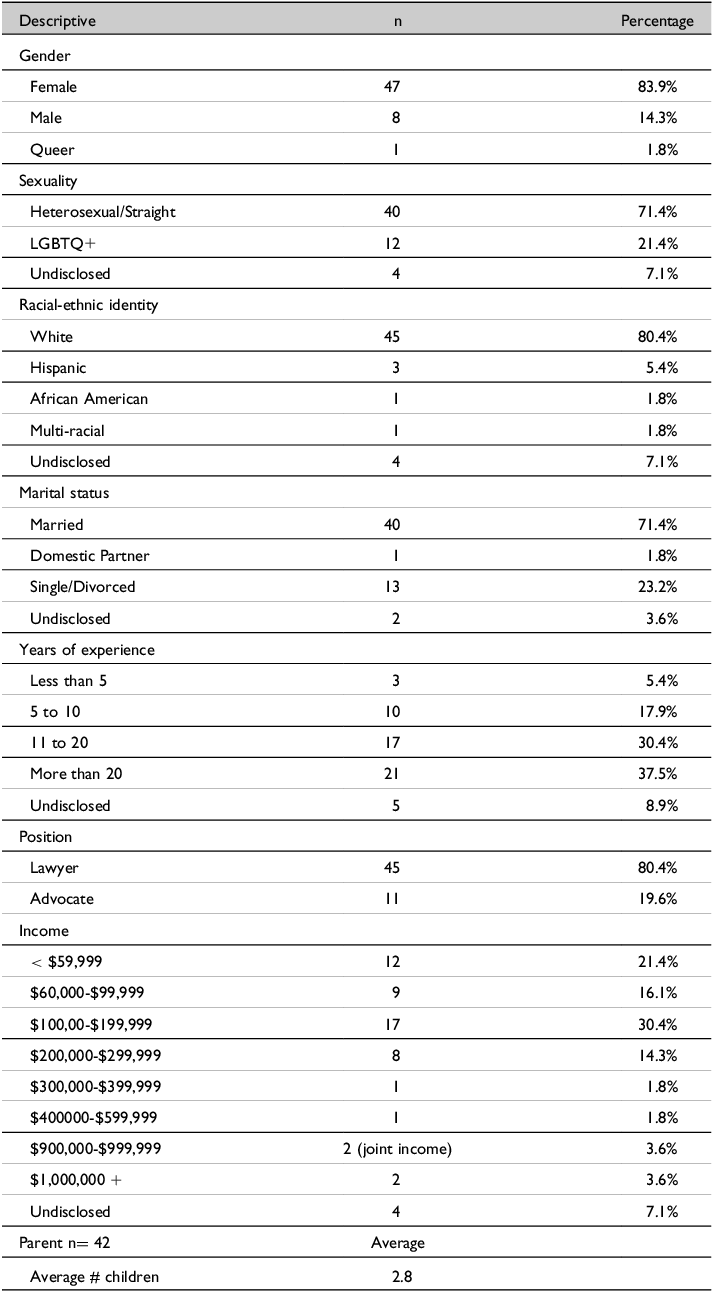

 Open access

