Introduction
Seeds of the invasive annual grass Bromus tectorum L. exhibit dormancy at maturity and become increasingly germinable through dry after-ripening (Bair et al., Reference Bair, Meyer and Allen2006). Hydrothermal time models have been developed to predict dormancy loss and germination under both laboratory and field conditions (Christensen et al., Reference Christensen, Meyer and Allen1996; Bauer et al., Reference Bauer, Meyer and Allen1998; Meyer and Allen, Reference Meyer and Allen2009). These models explain how the parameters time, temperature and water potential influence the range of potential germination outcomes.
The ascomycete fungus Pyrenophora semeniperda has been shown to cause high mortality in dormant B. tectorum seed banks, and can kill non-dormant seeds as well (Meyer et al., Reference Meyer, Quinney, Nelson and Weaver2007). Variable mortality of infected seeds is explained by Beckstead et al. (Reference Beckstead, Meyer, Molder and Smith2007) as a ‘race for survival’. This concept states that seeds that germinate quickly (e.g. fully after-ripened seeds incubated in water at optimum temperature) will be more likely to escape pathogen-caused mortality than seeds that germinate more slowly (Beckstead et al., Reference Beckstead, Meyer, Molder and Smith2007).
Dormancy status is unlikely to be the only variable determining outcomes within the Bromus tectorum–Pyrenophora semeniperda pathosystem. Varying temperatures and water potentials, which can dramatically alter germination behaviour, may likewise alter the fate of seeds exposed to this pathogen. For example, if seeds imbibe but do not remain sufficiently hydrated for radicle emergence to occur, P. semeniperda might still be able to infect and kill seeds. Studies on the combined effect of temperature and water availability to fungi, including Penicillium expansum, Penicillium citreoviride, Penicillium citrinum, Fusarium moniliforme and Fusarium proliferatum, have shown that these pathogens can grow and thrive at negative water potentials (Marin et al., Reference Marin, Sanchis, Teixido, Saenz, Ramos, Vinas and Magan1996; Lahlali et al., Reference Lahlali, Serrhini and Jijakli2005; Ji et al., Reference Ji, Zhu, Qian and Zhou2007). In fact, optimum growth occurred at various water potentials ranging from − 2.5 MPa to − 14.5 MPa (Marin et al., Reference Marin, Sanchis, Teixido, Saenz, Ramos, Vinas and Magan1996; Lahlali et al., Reference Lahlali, Serrhini and Jijakli2005; Ji et al., Reference Ji, Zhu, Qian and Zhou2007).
The present study was conducted to learn how temperature and water potential influence the Bromus–Pyrenophora pathosystem. We specifically sought to determine if P. semeniperda can infect and kill dormant and non-dormant seeds across a range of water potentials at constant temperature, and how the variables temperature and duration at reduced water potentials affect the fate of seeds. Results will allow us to better understand the seed–pathogen interaction, and to develop a conceptual framework to explain potential outcomes under a wide range of conditions, including those likely to occur in the field.
Materials and methods
Seeds of B. tectorum L. were collected from a wild population at the Brigham Young University Research Farm (Spanish Fork, Utah, USA) in June 2009. Seeds were cleaned by hand and stored in one of two ways: under ambient laboratory conditions to allow seeds to after-ripen, or in a − 10°C freezer to maintain seeds in the dormant condition. The P. semeniperda inoculum originated as a moderately virulent strain collected from Whiterocks, Utah, USA, and was produced as described by Meyer et al. (Reference Meyer, Stewart and Clement2010). Seeds in all experiments were inoculated with a 1:100 spore:talc mixture by placing seeds and an excess of inoculum in a test tube vial and shaking for 30 s. The first two experiments were conducted in 2010. The third experiment was conducted in 2012.
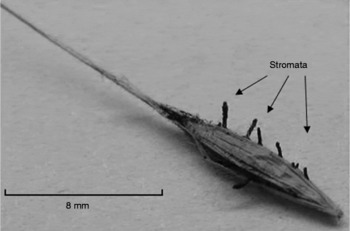
In the first experiment, inoculated dormant or fully after-ripened (non-dormant) seeds (50 seeds × 4 replicates) were imbibed at constant 20°C, which is near optimum for the pathogen (Campbell et al., Reference Campbell, Medd and Brown1995) and is also a typical mean autumn temperature during germination-triggering rainfall events (Meyer and Allen, Reference Meyer and Allen2009). Seeds were exposed to cycles of 12 h fluorescent light/12 h dark at one of five nominal water potentials (0, − 0.5, − 1.0, − 1.5, − 2.0 MPa) achieved using solutions of polyethylene glycol 8000 as described by Michel and Kaufmann (Reference Michel and Kaufmann1972). Seeds were placed in Petri dishes on the surface of two blue germination blotters (Anchor Paper, St. Paul, Minnesota, USA) that had been saturated to excess with the appropriate solution. Dishes were placed in plastic sleeves and then tilted at an angle of approximately 20° to allow a pool of polyethylene glycol to remain at the bottom of the dishes, preventing blotters from drying out and minimizing changes in water potential. Dishes were incubated for 28 d (hereafter referred to as a ‘pretreatment’). Germinated (radicle protruded at least 1 mm) or killed (macroscopic P. semeniperda stromata visible with no radicle present; Fig. 1) seeds were counted and removed on days 2, 4, 7, 11, 14, 21 and 28. On day 28, all remaining seeds were transferred from pretreatment to new Petri dishes containing two blotters saturated with water (0 MPa) and incubated for an additional 28 d. Germinated and/or killed seeds were again counted on days 2, 4, 7, 11, 14, 21 and 28. The remaining seeds were scored as viable but dormant if firm when pressed.
Microscopic view of a Bromus tectorum seed killed by Pyrenophora semeniperda. Emergence from an ungerminated seed of one to several finger-like stromata, fruiting bodies that produce spores, is evidence of seed death.

The second experiment was a factorial design that included two dormancy states (dormant or fully after-ripened) × four constant incubation temperatures (5, 10, 15, 20°C in 12:12 h light:dark cycles) × three incubation water potentials (0, − 1.5, − 2.0 MPa) × four pretreatment periods (7, 14, 21 or 28 d) prior to transfer to water (0 MPa at the same incubation temperature as for initial incubation) for 28 d × two replicates (50 seeds/replicate). The temperature range for this experiment (5–20°C) included germination-permissive temperatures that can be experienced by seeds during and/or after the first germination-triggering rainfall event (Meyer and Allen, Reference Meyer and Allen2009). Seeds were incubated and scored for germination or death as in the first experiment, except that scoring at low water potentials on days 11, 14, 21 and 28 d was possible only for treatment durations that included these days.
Based on results of the second experiment, a small third experiment was conducted using seeds collected in 2011 from the same site as the earlier experiments. Dormant or after-ripened seeds (as previously described) were pretreated at 5°C (0, − 1.5 or − 2.0 MPa) for 14, 21 or 28 d, then transferred to water (0 MPa) at 20°C for 28 d. Seeds (4 replicates of 25 seeds) were scored for germination or death as previously described.
Experimental data were analysed as fully randomized designs using the analysis of variance (ANOVA) procedure of SAS 9.2, 2007 (SAS Inc., Cary, North Carolina, USA). Data were arcsine transformed for analysis to account for heterogeneity of variance. However, original means are reported. Means separations were performed as appropriate using Duncan's multiple range test. In the second experiment, the treatment in which seeds were placed directly in water with no pretreatment was included in the analysis as a zero-duration pretreatment.
Results
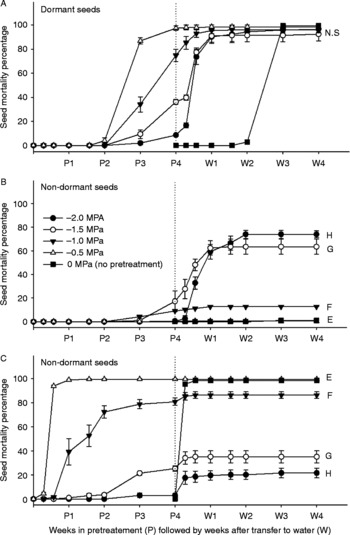
In the first experiment, nearly all dormant seeds were killed by the fungus, either during incubation (20°C) at low water potentials ( − 0.5, − 1.0 MPa pretreatments) or following transfer to water ( − 1.5, − 2.0 MPa pretreatments) (Fig. 2A). When dormant seeds were incubated directly in water, fungal stromata indicating seed death (Fig. 1) appeared between 14 and 21 d (Fig. 2A, ‘no pretreatment’ seeds). For dormant seeds incubated at − 0.5 or − 1 MPa, stromata most commonly appeared during the 28-d pretreatment period, while dormant seeds incubated at − 1.5 or − 2.0 MPa exhibited stromatal development within 4 d following transfer to water (Fig. 2A). In contrast, few non-dormant seeds were killed during pretreatment at higher water potentials. Following transfer to water, less than 20% of seeds previously incubated at − 0.5 or − 1 MPa were killed (Fig. 2B). However, pretreatment at the lowest water potentials resulted in non-dormant seed death of 63% ( − 1.5 MPa) or 75% ( − 2.0 MPa) following transfer to water. The appearance of P. semeniperda stromata on ungerminated seeds was used to define seed death. However, based on the rapid appearance of stromata following transfer to water, seeds were certainly infected and may actually have been killed during pretreatment. Incubation at the lowest water potentials apparently prevents the development of stromata, analogous to seed priming treatments wherein incubation at low water potentials can allow progress toward germination while restricting radicle emergence (Taylor et al., Reference Taylor, Allen, Bennett and Bradford1998). Nearly all non-dormant seeds incubated at 0 or − 0.5 MPa germinated (Fig. 2C). Fewer seeds germinated as pretreatment water potential decreased, even following transfer to water, because they had been killed.
(A) Mortality of dormant Bromus tectorum seeds when incubated in the presence of Pyrenophora semeniperda; (B) mortality of non-dormant seeds; and (C) germination of non-dormant seeds; each as a function of time in incubation at 20°C. Seeds were exposed to five water potentials for 4 weeks followed by incubation in water (0 MPa) for an additional 4 weeks. Vertical dotted lines mark transfer to water. Error bars represent the standard error of the mean. Final values associated with different letters (E–H) are significantly different (P< 0.05) as determined by a Duncan's multiple range means separation test following ANOVA.

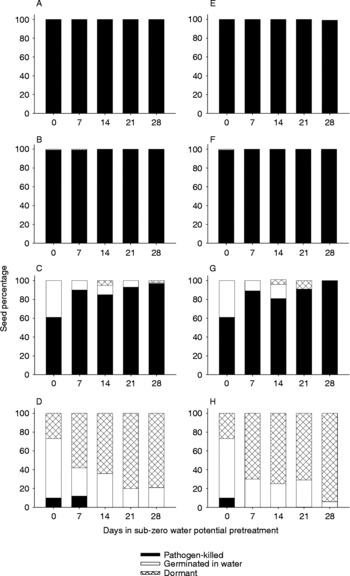
In the second experiment, incubation at the higher temperatures resulted in dramatic mortality of dormant seeds (Fig. 3). One-hundred percent of dormant seeds were killed at 15 and 20°C (Fig. 3A, B, E, F), regardless of incubation water potential or duration of the low water potential pretreatment. Mortality at 10°C ranged from 60% (incubation in water only) to nearly 100% (incubation at − 2.0 or − 1.5 MPa for 28 d) (Fig. 3C, G). Differences between water potentials ( − 2.0 versus − 1.5 MPa) were not significant, while water potential duration was marginally significant (P= 0.04), probably due to increased mortality with longer incubation at 10°C.
Percentage of initially dormant B. tectorum seeds killed by P. semeniperda, germinated after transfer to water or dormant (viable ungerminated) after 0–28 d pretreatment followed by 28 d in water. Seeds with no pretreatment (0 d at sub-zero water potentials) were only incubated in water (0 MPa). Pretreatments included a factorial combination of two sub-zero water potentials [(A–D) − 2.0 MPa; or (E–H) − 1.5 MPa] and four incubation temperatures: (A, E) 20°C; (B, F) 15°C; (C, G) 10°C; and (D, H) 5°C. Seeds remained at pretreatment temperatures when transferred to water.

Incubation at 5°C resulted in pathogen-caused death to less than 10% of dormant seeds when incubated only in water (0 MPa, Fig. 3D, H). Over 60% of putatively dormant seeds germinated in water, indicating that they were only conditionally dormant as a function of temperature. Incubation at − 2.0 or − 1.5 MPa rendered these conditionally dormant seeds incapable of germinating even after transfer to water for 28 d.
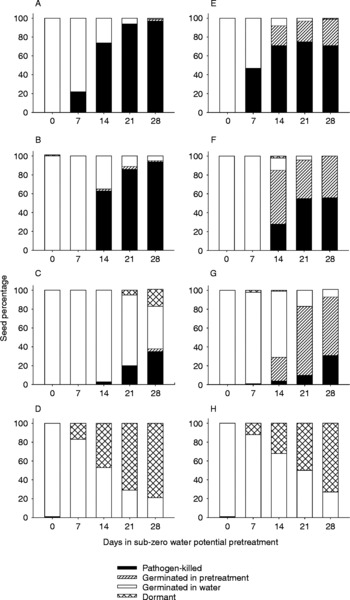
For non-dormant seeds, all main effects (temperature, water potential, duration) had highly significant impacts on levels of seed mortality (P< 0.0001). At 15 and especially at 20°C, a large fraction of non-dormant seeds were killed by the fungus with low water potential incubation periods of 14 d or greater (Fig. 4A, B, E, F). Almost complete mortality of non-dormant seeds occurred after incubation at − 2.0 MPa for 21 or 28 d. Prolonged incubation at low water potentials (>14 d) resulted in a progressive increase in the fraction of non-dormant seeds killed. At 10 or 15°C, − 1.5 MPa, incubation resulted in considerable germination prior to transfer to water (Fig. 4F, G). At 10°C incubation at low water potentials for 0 or 7 d, most non-dormant seeds germinated following transfer to water (Fig. 4C, G). Less than 5% of non-dormant seeds were killed during incubation at 5°C (Fig. 4D, H). All seeds germinated in water (i.e. no sub-zero water potential pretreatment) at this temperature, while increasing duration at low water potentials rendered a progressively greater fraction of the seeds dormant (i.e. secondarily dormant).
Percentage of initially non-dormant B. tectorum seeds killed by P. semeniperda, germinated in pretreatment, germinated after transfer to water or dormant (viable ungerminated) after 0–28 d pretreatment followed by 28 d in water. Seeds with no pretreatment (0 d at sub-zero water potentials) were only incubated in water (0 MPa). Pretreatments included a factorial combination of two sub-zero water potentials [(A–D) − 2.0 MPa; or (E–H) − 1.5 MPa] and four incubation temperatures: (A, E) 20°C; (B, F) 15°C; (C, G) 10°C; and (D, H) 5°C. Seeds remained at pretreatment temperatures when transferred to water.

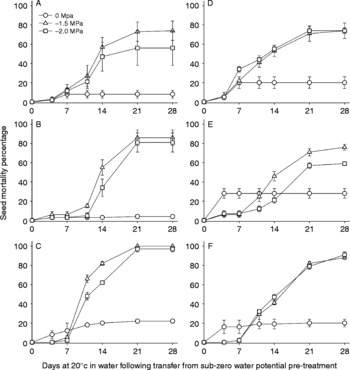
These results at 5°C prompted an additional experiment to evaluate whether non-dormant seeds at low incubation temperature were infected and killed at low water potentials, but with evidence of seed death (stromatal growth) inhibited at low temperature. If this were the case, we would expect rapid growth of stromata following transfer to water at 20°C. Few seeds incubated in water at 5°C were killed (Fig. 5A–F). However, some developed stromata following transfer to 20°C ( < 20% of non-dormant and < 30% of dormant seeds). This suggests that the fungus can infect at 5°C in water, but because even conditionally dormant seeds can germinate under these conditions, the fungus is not highly effective at killing seeds at low incubation temperatures in water.
Mortality of B. tectorum seeds inoculated with P. semeniperda. Seeds were pretreated (5°C) at the water potentials indicated for 14 (A, D), 21 (B, E) or 28 d (C, F), then transferred to water (20°C). No mortality as indicated by stromatal growth occurred during pretreatment. Error bars represent the standard error of the mean.

Seeds transferred from low water potentials at 5°C to water at 20°C were largely killed over time, but when the rate of stromatal development is compared to the rate at which previously unimbibed seeds developed stromata (‘0 MPa, no pretreatment’ seeds in Fig. 2A), it is possible that seeds that developed stromata later than about 14 d following transfer to water at 20°C were infected after transfer. Conversely, it is possible that incubation at low temperature and low water potential affects the rate at which the fungus can produce stromata when transferred to higher temperature. Using ‘visible stromata on ungerminated seeds’ as our indicator of seed death did not allow us to clearly distinguish seeds that were infected during the low temperature incubation from those that may have been infected later.
Discussion
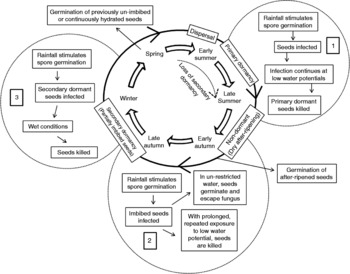
Results from the present study confirm that when B. tectorum seeds are incubated in the presence of P. semeniperda: (1) dormant seeds are likely to be killed under all conditions, except non-limiting water at low temperature; (2) non-dormant seeds escape death by germinating rapidly under favourable conditions; (3) incubation at low water potentials restricts germination of non-dormant seeds and greatly increases seed mortality; (4) non-dormant seeds held at low water potentials for increasing periods of time are more likely to be killed; and (5) incubation at low temperature and low water potential induces secondary dormancy, leading to death if seeds are transferred to water at a higher temperature. These insights into the B. tectorum–P. semeniperda pathosystem can be combined with results from field studies to create a conceptual model that explains the influences of time, temperature and water potential throughout the year (Fig. 6). This model expands the ‘race for survival’ concept originally proposed by Beckstead et al. (Reference Beckstead, Meyer, Molder and Smith2007).
The Bromus tectorum–Pyrenophora semeniperda pathosystem in a semi-arid environment. In the absence of the fungus, B. tectorum seeds follow the typical cycle for a winter annual (inner circle). Numbered outer circles indicate three main periods with different fungal–seed interaction sequences. (1) Summer: infected seeds, across a range of water potentials, are killed by the fungus; (2) Autumn: infected seeds escape death with sufficient rainfall due to rapid germination or are killed if radicle emergence is delayed by exposure to low water potentials; (3) Winter/Spring: fully imbibed secondarily dormant seeds are killed.

In the absence of the fungus, B. tectorum seeds exhibit behaviour characteristic of winter annual grasses (Fig. 6, inner circle). Seed populations have varying degrees of dormancy at maturity, and gradually lose dormancy through dry after-ripening. After-ripened seeds germinate in response to autumn rains, postpone germination until winter or early spring, or acquire secondary dormancy and carry seeds across years as components of the soil seed bank (Allen and Meyer, Reference Allen and Meyer2002).
As indicated by levels of Pyrenophora-killed seeds retrieved from soil seed banks, seeds mature at a time when maximum levels of the fungus are present (Beckstead et al., Reference Beckstead, Meyer, Molder and Smith2007; Meyer et al., Reference Meyer, Quinney, Nelson and Weaver2007); precipitation at this stage could potentially result in a high degree of infection (Fig. 6, outer circle 1). Surviving carryover seeds, which became secondarily dormant during the previous winter, are likewise present in the soil seed bank and experience similar vulnerability to the fungus. Most seeds are incapable of germinating at soil temperatures likely to be encountered during the summer, and precipitation is unlikely to wet the soil long enough for radicle emergence to be completed for the fraction of the seed population that is capable of germinating (Meyer and Allen, Reference Meyer and Allen2009). In the presence of P. semeniperda, seeds infected during the summer are likely to be killed.
As seeds lose dormancy through dry after-ripening during summer and early autumn (Bair et al., Reference Bair, Meyer and Allen2006), they have the potential to experience repeated imbibition episodes followed by drying. Rapid growth of stromata following transfer of seeds from low water potentials to water suggests that the fungus can likely grow and infect seeds over a series of hydration–dehydration events (Fig. 6, outer circle 2). However, an alternative outcome is possible for non-dormant seeds that become infected. With adequate moisture, seeds germinate quickly and avoid being killed by the fungus. This describes the only opportunity for successful seed germination following infection (Fig. 6, outer circle 2), and is supported by field studies showing that moderate temperatures associated with autumn storms kept the soil surface from drying (Meyer and Allen, Reference Meyer and Allen2009).
During late summer and early autumn, uninfected seeds will germinate in response to an autumn germination-triggering rainfall event, while seeds already infected during previous storms are likely to be killed before they can germinate. After-ripening of B. tectorum is associated with an increase in germination rate as well as an increase in the temperature range that allows germination (Christensen et al., Reference Christensen, Meyer and Allen1996). Seeds that germinate quickly are more likely to escape seed death than slow-germinating seeds. In the field, successful germination is most likely to occur during autumn, especially when fully after-ripened seeds encounter their first imbibition experience associated with a germination-triggering rainfall event at optimum temperatures.
In a field study aimed at characterizing the relationship between B. tectorum and P. semeniperda, wet autumn weather at one site allowed non-dormant seeds to germinate quickly, preventing secondary dormancy induction and associated pathogen-caused mortality (Beckstead et al., Reference Beckstead, Meyer, Molder and Smith2007). In this same study, sites receiving low levels of autumn precipitation had large numbers of seeds that became secondarily dormant. These dormant seeds carried over during the winter in the soil seed bank, with subsequently high pathogen-caused mortality. As a result, these drier sites often had high levels of pathogen-killed secondarily dormant seeds retrieved from soil seed banks in the spring. This interaction sequence is depicted in Fig. 6 as outer circle 3.
Precipitation at any time during the year likely permits P. semeniperda to infect seeds, including late autumn or winter (Fig. 6). Fully hydrated B. tectorum seeds can complete germination slowly at low temperatures during the winter, although low water potentials at near-freezing temperatures can induce secondary dormancy. Secondarily dormant B. tectorum seeds are highly susceptible to P. semeniperda under laboratory (Fig. 5) and field (Beckstead et al., Reference Beckstead, Meyer, Molder and Smith2007; Meyer et al., Reference Meyer, Quinney, Nelson and Weaver2007) conditions. In studies of soil seed banks conducted throughout the year on sites where the Bromus–Pyrenophora pathosystem is known to occur, we have repeatedly observed the highest numbers of fungus-killed seeds in late spring (Fig. 6, outer circle sequence 3; S. Meyer, unpublished data). Results from the present study suggest that dormant seeds may be killed during the winter but the evidence of death (presence of stromata) only appears at higher temperatures.
P. semeniperda can clearly infect seeds at negative water potentials as well as in water (0 MPa), although the outcome (seed death versus germination success) may depend on the sequence of environmental variables encountered (e.g. repeated hydration followed by dehydration, temperature fluctuations). Seed dormancy status, water potential and the interaction of these variables with temperature all contribute to the duality of outcomes (seed germination or seed death). Certain conditions clearly favour the fungus (highly dormant seed population, prolonged exposure to low water potential, non-optimal germination temperature) while other conditions (after-ripened seed population, optimum hydrothermal environment) favour successful germination. Based on our understanding of hydrothermal time and germination of B. tectorum seeds (Christensen et al., Reference Christensen, Meyer and Allen1996; Bauer et al., Reference Bauer, Meyer and Allen1998; Bair et al., Reference Bair, Meyer and Allen2006; Meyer and Allen, Reference Meyer and Allen2009), it is likely that the fastest-germinating seed fractions (i.e. those with the lowest base water potentials) are also those most likely to escape death due to the fungus. High germination rates for after-ripened seeds, which are associated with low population mean base water potentials in hydrothermal models (Bair et al., Reference Bair, Meyer and Allen2006; Meyer and Allen, Reference Meyer and Allen2009), may in part be the result of selection pressure imposed by this pathogen.
It has long been known that certain plant pathogens can infect and kill seeds at water potentials far below those that permit seed germination (e.g. Magan and Lacey, Reference Magan and Lacey1988). However, to our knowledge this study represents the first investigation of the consequences of seed infection at low water potential in a natural pathosystem. The ecological implications of this work are profound, especially for plant species that inhabit intermittently dry environments. Seeds of such species are likely to spend extended periods of time at water potentials conducive to pathogen attack. Plant pathogens are rarely considered in studies of desert ecosystems but these pathogens, particularly those that attack seeds, could potentially function as keystone organisms with major impacts on desert plant community structure (Dobson and Crawley, Reference Dobson and Crawley1994).