There is widespread consensus regarding the fact that, during very early childhood, it is possible to identify subjects whose trajectories predict a stable use of aggression in the future. This is particularly true in the case of the more concerning manifestations of this behavior, such as physical aggression (Côté, Vaillancourt, Barker, Nagin, & Tremblay, Reference Côté, Vaillancourt, Barker, Nagin and Tremblay2007; Tremblay, Vitaro & Côté, Reference Tremblay, Vitaro and Côté2018). Given the stability of aggressive behavior throughout the lifecycle, it is important to study the variables which contribute during childhood to the manifestation of aggressive behavior. There are numerous variables, both psychological and biological, which may be associated with aggressive behavior, and may even predict it. However, some have been the object of more research than others, and the information that is therefore available about them is much more plentiful.
Within the large body of research that associates different psychological variables with aggressive behavior, highly consistent results have been found in relation to some variables that either strengthen or attenuate aggression. Anger is one of the main psychological variables considered to increase aggression (Campbell, Reference Campbell2006), with several studies observing a positive association between anger and aggressive behavior (e.g. Daff, Gilbert, & Daffern, Reference Daff, Gilbert and Daffern2015). Anger is a negative emotion that is usually felt in response to threat, disruption of ongoing behavior or the potential infliction of harm by another individual, particularly when said harm is perceived to be unjustified (Campbell, Reference Campbell2006). Anger is a basic emotion which has a number of different components (state anger, trait anger, etc.), although the majority of research into the relationship between anger and aggression has focused exclusively on trait anger, i.e. the chronic tendency to feel and express that emotion (Fung, Gerstein, Chan, & Engebretson, Reference Fung, Gerstein, Chan and Engebretson2015). Anger does not necessarily lead to aggression, although it can predict it, and several studies have found a positive association between this psychological variable and aggressive or externalizing behavior in children, pre-adolescents and adolescents (e.g. Clay, Hagglund, Kashani, & Frank, Reference Clay, Hagglund, Kashani and Frank1996).
At the opposite end of the scale is empathy, a variable considered to reduce aggressive behavior (Campbell, Reference Campbell2006). As a general construct, empathy is defined as the ability to perceive and understand other people’s emotions and to react to them in an appropriate fashion (Leiberg & Anders, Reference Leiberg and Anders2006). It is widely accepted that empathy fosters prosocial behavior (e.g. Warden & MacKinnon, Reference Warden and MacKinnon2003) and inhibits, or at least mitigates, aggressive or antisocial conduct (Jolliffe & Farrington, Reference Jolliffe and Farrington2006). Individuals who are capable of understanding the negative emotional reaction of others tend to inhibit their own aggressive behavior, or are at least less inclined to continue engaging in this behavior or acting in an antisocial manner in the future (Feshbach, Reference Feshbach1975). Diverse studies have found a statistically significant negative relationship between empathy and aggressive behavior (e.g. Berger, Batanova, & Duncan, Reference Berger, Batanova and Duncan2015).
As regards the biological variables that influence aggression, many studies have focused on the impact of steroid hormones on this behavior. Of all the steroid hormones in our bodies, special attention has been paid to testosterone and cortisol. In general, the majority of studies have observed a positive association between aggressive behavior and testosterone levels, both in adults (Archer, Reference Archer2006, Reference Archer2009) and in children (Barzman et al., Reference Barzman, Mossman, Appel, Blom, Strawn, Ekhator and Geracioti2013; Sánchez-Martín et al., Reference Sánchez-Martín, Fano, Ahedo, Cardas, Brain and Azpíroz2000). However, the results reported for the relationship between cortisol and aggression are inconsistent. Although there is a large body of work which reports a negative relationship between cortisol levels and aggression (e.g. McBurnett et al., Reference McBurnett, Kumar, Kumar, Perez, Lahey and Shaw2000), there are also several studies which have observed a positive association between these two variables (e.g. Azurmendi et al., Reference Azurmendi, Pascual-Sagastizabal, Vergara, Muñoz, Braza, Carreras and Sánchez-Martin2016; Barzman et al., Reference Barzman, Mossman, Appel, Blom, Strawn, Ekhator and Geracioti2013).
In relation to establishing prototypes or profiles associated with aggressive behavior, it should be noted that, while psychological clusters have been established in association with this behavior (e.g. Belgrave, Nguyen, Johnson, & Hood, Reference Belgrave, Nguyen, Johnson and Hood2011), psychobiological clusters have yet to be determined. To the best of our knowledge, hardly any studies have established clusters integrating both hormone and psychological variables in association with aggression, either in adults or children, as part of an attempt to identify the different profiles which may underlie different aggression levels in the subjects studied.
One of the main arguments supporting the need to study those psychobiological clusters potentially associated with aggressive behavior is linked to recent evidence of an interaction between psychological and biological variables for explaining aggressive behavior, as well as to the existence of associations between psychological variables and hormones. Sánchez-Martín et al. (Reference Sánchez-Martín, Azurmendi, Pascual-Sagastizabal, Cardas, Braza, Braza and Muñoz2011) found interactive effects of anger and androstenedione on aggression in boys, and Pascual-Sagastizabal et al. (Reference Pascual-Sagastizabal, Azurmendi, Braza, Vergara, Cardas and Sánchez-Martín2014) also found that testosterone moderated the relationship between maternal authoritarian parenting style and aggressive behavior in boys and girls. Furthermore, evidence has also been found of an association between the psychological variables (anger and empathy) and hormones (testosterone and cortisol) analyzed in the present study. Thus, diverse studies have reported a positive association between high testosterone levels and anger measures (Hohlagschwandtner, Husslein, Klier, & Ulm, Reference Hohlagschwandtner, Husslein, Klier and Ulm2001; Persky, Smith, & Basu, Reference Persky, Smith and Basu1971; van Honk et al., Reference van Honk, Tuiten, van den Hout, Koppeschaar, Thijssen, de Haan and Verbaten2000; van Honk et al., Reference van Honk, Tuiten, Verbaten, van den Hout, Koppeschaar, Thijssen and de Haan1999; Wirth & Schultheiss, Reference Wirth and Schultheiss2007), while many others have found a negative relationship between testosterone and empathic capacity (Auyeung et al., Reference Auyeung, Baron-Cohen, Ashwin, Knickmeyer, Taylor and Hackett2009; Chapman et al., Reference Chapman, Baron-Cohen, Auyeung, Knickmeyer, Taylor and Hackett2006; Hermans, Putman, & van Honk, Reference Hermans, Putman and van Honk2006; Pascual-Sagastizabal et al., Reference Pascual-Sagastizabal, Azurmendi, Sánchez-Martín, Braza, Carreras, Muñoz and Braza2013; van Honk et al., Reference van Honk, Schutter, Bos, Kruijt, Lentjes and Baron-Cohen2011). Few studies, however, have focused on the relationship between cortisol and anger and cortisol and empathy. While some evidence has been found of a positive association between cortisol and empathy measures (Nakayama et al., Reference Nakayama, Takahashi, Wakabayashi, Ono and Radford2007; Zilioli et al., Reference Zilioli, Ponzi, Henry and Maestripieri2015), the findings linked to cortisol levels and anger measures are inconsistent, with some studies finding a positive association (Putman, Hermans, & van Honk, Reference Putman, Hermans and van Honk2007), others a negative one (Lerner, Dahl, Hariri, & Taylor, Reference Lerner, Dahl, Hariri and Taylor2007) and others no relationship at all (Lewis & Ramsay, Reference Lewis and Ramsay2005). Together, these findings support the idea of psychobiological clusters associated with different levels of aggression in children.
The approach proposed in our study, which combines both hormone and psychological variables, enables us to analyze the biological and psychological components of a holistic (psychobiological) system. In light of evidence showing that some psychological variables (anger) foster children’s aggressive behavior while others (empathy) inhibit it, and given that certain levels of some hormones have been associated with an increase in aggression, our aim here was to analyze the possible existence of psychobiological clusters in which specific levels (low or high) of psychological variables, alongside specific levels (low or high) of hormones, form a cluster characterized by a certain level of aggressive behavior. If, moreover, we also take into account the moderating effects described above (such as, for example, that of hormones on psychological variables) and the direct association between hormones and psychological variables, it seems only logical to search for the psychobiological markers of aggressive behavior, since their early detection would facilitate both prevention and interaction. Although analyzing the influence of psychological and biological variables separately serves to notably increase our knowledge of the mechanisms underlying aggression, their joint analysis, in the form of psychobiological profiles or markers, will provide even greater insight into the complex psychobiological mechanisms involved, and will therefore shed light, from an applied perspective, on how to prevent or mitigate this behavior, which has so many negative consequences at both an individual and social level.
In this study, we specifically expected the cluster containing the most aggressive subjects to also contain higher measures of anger, testosterone and cortisol, and lower measures of empathy. Moreover, we expected the clusters containing the least aggressive subjects to also contain lower measures of anger, testosterone and cortisol, and higher measures of empathy.
Method
Participants
The study sample comprised 139 eight-year-old children (80 boys and 59 girls) from a city in the north of Spain. Several authors have suggested that the transition between early and middle childhood is a “sensitive window” that is vital to the configuration of specific behavioral strategies, due to both children’s susceptibility to the effects of their environment and the plasticity potentially induced by hormones during this period (Del Giudice, Angeleri, & Manera, Reference Del Giudice, Angeleri and Manera2009; Del Giudice et al., Reference Del Giudice, Barrett, Belsky, Hartman, Martel, Sangenstedt and Kuzawa2018). During this childhood transition period, which takes place between the ages of 6 and 8 years, children engage in increased social activities with their peers and begin to complete effectively for dominance in group hierarchies. Richard Tremblay, one of the world’s leading experts in childhood aggression, argues that from this stage onwards (8 years), it is increasingly difficult to implement successful intervention strategies for combating aggressive behavior (Tremblay, Reference Tremblay2008). The socioeconomic status of the sample was considered medium and medium-high, based on our knowledge of the area in which participants live. Of the 4 participating schools, 3 were public ones and the fourth one was a semi-private one (i.e. a private school that receives some state funding), a ratio which reflects the predominance of public schools in the region. Moreover, all schools were co-ed (i.e. the student body was made up of both boys and girls). At the beginning of the academic year, a letter was sent to 201 families providing them with detailed information about the study. The letter also contained a document which they were asked to sign in order to give or refuse their consent for their child to participate in the study. Of the 201 families contacted, 165 gave their consent. Finally, for the statistical analyses, the sample group was reduced to 139 due to incomplete data (child being ill on the day of the test, families failing to return their questionnaires, etc.). None of the tests used during this study were invasive and all were carried out in the school itself; the project was approved by the ethics committee at the institution to which the authors belong.
Aggressive behavior measure
Aggressive behavior was assessed using the Spanish version of the Direct and Indirect Aggression Scale (DIAS) (Björkqvist & Österman, Reference Björkqvist and Österman1998), a peer-rating measurement instrument for aggressive behavior. Previous studies have shown that this test is a useful instrument for measuring different types of aggression in young children (e.g. Valles & Knutson, Reference Valles and Knutson2008). The DIAS comprises 24 items (e.g. Hits the other one?, Shuts the other one out of the group?) in which each child is asked to rate each of their same-sex classmates for behaviors linked to aggression on a 5-point Likert-type scale, ranging from 0 (never) to 4 (very often). More precisely, they rate behavior linked to physical aggression (7 items), verbal aggression (5 items) and indirect aggression (12 items).
In order to facilitate the collective administration of the test, the questions were asked in table format, thus allowing the participants to assess all their same-sex classmates in every question.
This test resulted in a total aggression measurement based on the scores obtained by participants in the three sub-scales (physical, verbal and indirect aggression), since the correlations between them were over r = .94. The reliability coefficient obtained in this questionnaire was Cronbach´s alpha = .97.
Empathy measure
The test used to measure empathy was the EQ-C (Empathy Quotient-Child Version), adapted for children by Chapman et al. (Reference Chapman, Baron-Cohen, Auyeung, Knickmeyer, Taylor and Hackett2006) from the adult EQ instrument developed by Baron-Cohen and Wheelwright (Reference Baron-Cohen and Wheelwright2004).
The test was administered to parents, who were asked to assess their child’s capacity for empathy. The questionnaire contains 27 items with four response options and three possible scores which are interpreted as follows: “definitely agree = 2”, “slightly agree = 1”, "slightly disagree = 1” and “definitely disagree = 0”. Examples of items include “My child likes to look after other people” and “My child would worry about how another child would feel if they weren’t invited to a party”. The maximum score that can be obtained in this test is 54. The reliability coefficient obtained in our sample was Cronbach´s alpha = .78.
Anger measure
Anger was measured using the STAXI-NA (State-Trait Anger Expression Inventory for Children and Adolescents, TEA), developed by del Barrio, Aluja, and Spielberger (Reference del Barrio, Aluja and Spielberger2004) for children aged between 8 and 17. This is a self-reporting test that assesses different components (Experience, Expression and Control) and facets (State and Trait) of anger through 32 items rated on a 3-point Likert-type scale (almost never = 1, sometimes = 2 and almost always = 3). Given the aims of the study, we decided to use the trait anger sub-scale (8 items), since it refers to children’s tendency to have more frequent and intense angry reactions (e.g. "I’m easily irritated" and "I lose my temper easily"). The reliability coefficient of the trait anger sub-scale was Cronbach´s alpha = .71.
Determination of salivary hormone levels
Two saliva samples were collected from each child by trained personnel in the classrooms on weekdays. Samples were collected at 09.00 hr, before lessons started, in order to avoid concentration changes due to diurnal hormonal fluctuations. Participants were asked to deposit a saliva sample into a plastic cup (sterile container for the hygienic collection of biological samples) by passive drool. To help them salivate they were offered a sweet on the condition that they were not allowed to eat it until they had given a large enough sample. The aim was to stimulate saliva production through the promise of an appetizing reward. Samples were frozen and stored in the laboratory at –80°C until analysis. On the day of the analysis, the samples were centrifuged at 3,000 rpm for 15 min to remove mucins. Both of the samples gathered from each subject were assayed in duplicate. The average of each duplicate test was used in the analyses. All samples were assayed using an enzyme immunoassay kit (Salimetrics, State Collage, USA). For hormone levels, the average intra-assay coefficient of variation (CV) was less than 3% and the inter-assay coefficient of variation (CV) was less than 14%, calculated on the basis of control samples.
Statistical analysis
All the variables were transformed into Z scores in order to cancel the effect of range disparity problems. Since they did not have a normal distribution, aggressive behavior, hormone levels, empathy and anger measures were normalized using the Bloom transformation, which is the most common inverse normal transformation (Maritz, Reference Maritz1982). The analysis of the correlations observed between the different variables studied is shown in Table 1. Analyses of variance (ANOVAs) were performed to analyze possible sex differences in the variables. The results revealed that girls scored higher in empathy, F(1, 137) = 14.36; p = .0001; d = 0.66, than boys. No statistically significant differences were found between boys and girls in any of the other variables.
Correlations between Aggression, Testosterone, Cortisol, Anger and Empathy

Note: **p < .01. *p < .05.
A cluster analysis was carried out using the hierarchical-clustering subroutine to cluster participants in accordance with their biological and psychological characteristics. A multivariate discriminant analysis was performed to investigate the integrity of those clusters derived from the cluster analysis. Finally an ANOVA was carried out to determine differences in aggressive behavior between clusters.
All the analyses were carried out using the IBM SPSS 21.00 statistical package.
Results
Clusters based on psychological and biological variables
With the aim of exploring profile differences among 8-year-old children, a Cluster Analysis was performed in accordance with biological (cortisol and testosterone levels) and psychological (empathy and trait anger) measures, in order to analyze possible disparities in terms of aggressive behavior. Ward’s clustering method was applied, in which similarities between each pair of subjects are measured in accordance with the squared Euclidian distance. A cut-off criterion was applied to the dendogram obtained using this clustering method in order to select the main clusters, with the cut-off point being equal to 8. Three clusters were thus obtained.
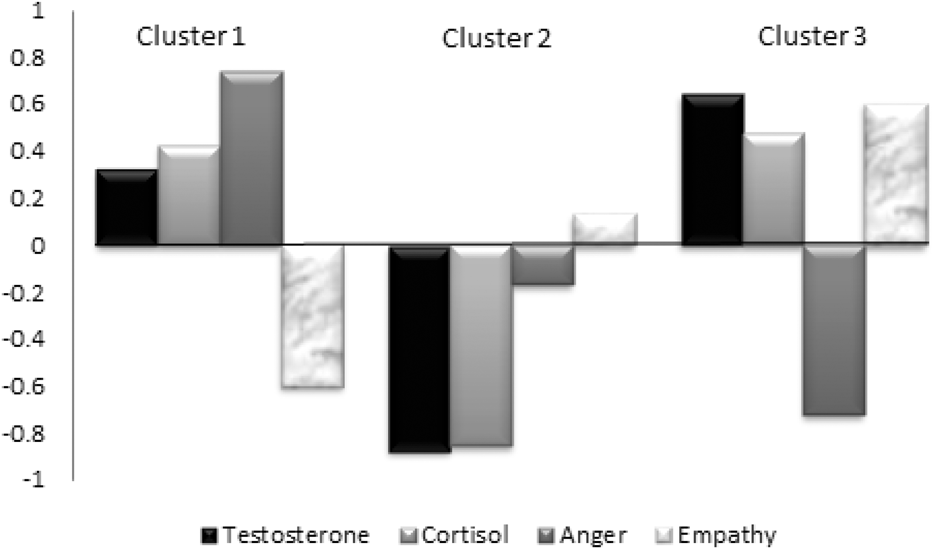
To study and confirm the goodness of fit of the clusters obtained, a discriminant analysis was conducted using Wilk’s Lambda step-by-step inclusion method (Figure 1). The discriminant model applied accounted for 100% of cases obtained by the cluster solution, confirming the statistical validity of these clusters, as well as their psychobiological description. The cluster analysis was then conducted once again with the psychological and biological variables included in the discriminant model.
Final cluster with the four variables included in the discriminant model (Testosterone, Cortisol, Empathy and Anger)

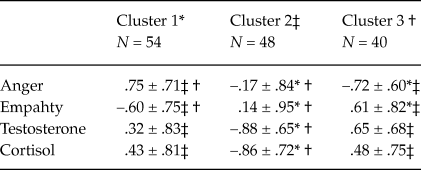
As shown in Table 2, this analysis revealed three clusters which were clearly different as regards their biological and psychological characteristics:
Cluster 1 (n = 51, 28 boys and 23 girls): Subjects with higher anger levels, lower empathy levels and higher testosterone and cortisol levels.
Cluster 2 (n = 48, 25 boys and 23 girls): Subjects with moderate anger levels, moderate empathy levels and lower testosterone and cortisol levels.
Cluster 3 (n = 40, 27 boys and 13 girls): Subjects with lower anger levels, higher empathy levels and higher testosterone and cortisol levels.
Descriptive Statistics for the Different Clusters and post hoc Analysis

Note: Post hoc comparisons were made using the Tuckey HSD test.
* Shows significant differences with the Cluster 1.
‡ Shows significant differences with the Cluster 2.
† Shows significant differences with the Cluster 3.
A one-way ANOVA and Tuckey’s post-hoc test were conducted to determine whether the three clusters found were significantly different as regards both hormone and psychological variables. The results revealed statistically significant differences between the clusters in relation to both kinds of variable: testosterone, F(2, 136) = 50.51, MSE = 27.97, p < .0001, η2 = .43; cortisol, F(2, 136) = 45.27, MSE = 26.59, p < .0001, η2 = .40; empathy, F(2, 136) = 22.05, MSE = 27.98, p < .0001, η2 = .45; and anger, F(2, 136) = 56.31, MSE = 16.08, p < .0001, η2 = .24. The post-hoc analysis revealed statistical differences between clusters in empathy and anger and in relation to hormones. The results showed that Cluster 2 was significantly different from Clusters 1 and 3 (Table 2 and Figure 1).
Differences in Aggressive Behavior
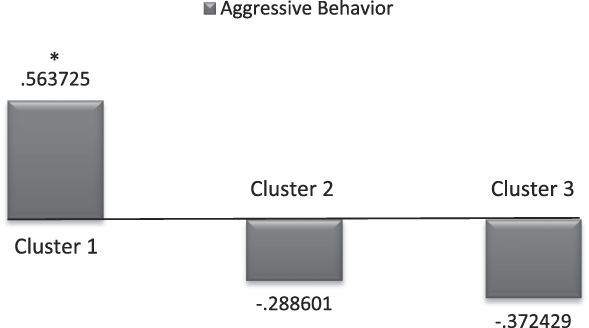
A one-way ANOVA and Tuckey’s post-hoc test were conducted to determine whether or not the different psychobiological clusters found were associated with differences in aggressive behavior. The results revealed statistically significant differences between the clusters in relation to aggressive behavior, F(2, 136) = 15.92, MSE = 12.87, p < .0001, η2 = .19. The post-hoc analysis revealed that the children in Cluster 1, characterized by having higher levels of anger, lower levels of empathy and higher levels of testosterone and cortisol, were more aggressive than their counterparts in the other two clusters (Figure 2).
Post-hoc analyses for comparing aggressive behavior between clusters

Discussion
The results of this study suggest that there are psychobiological clusters associated with aggressive behavior in school-aged children. The data analysis divided the sample group of 8-year-old children into three homogeneous clusters based on 4 variables, two psychological ones (anger and empathy) and two biological ones (testosterone and cortisol). The analysis of variance (ANOVA) revealed that the cluster characterized by having higher anger levels, lower empathy levels and higher testosterone and cortisol levels (Cluster 1) was more aggressive than the other two. This result is consistent with that reported in the literature, since although no studies on aggressive behavior to date have focused on both psychological and biological variables at the same time (in a cluster configuration), those that have analyzed psychological variables (anger and empathy) have found a negative association between empathy and aggression, and a positive relationship between anger and aggression (Fung et al., Reference Fung, Gerstein, Chan and Engebretson2015; Strayer & Roberts, Reference Strayer and Roberts2004). It is logical to assume that subjects with higher anger levels also have lower empathy levels and are therefore more aggressive, as the result of a kind of accumulation of different psychological factors. In addition to the studies by Fung et al. (2015) and Strayer and Roberts (Reference Strayer and Roberts2004), which have reported consistent findings in this sense, a cluster analysis conducted by Belgrave et al. (Reference Belgrave, Nguyen, Johnson and Hood2011) found that the “well-adjusted” prototype (11–14 years old) scored higher than the mean in attributes such as empathy and anger management, while the “poorly-adjusted” prototype scored below average in the same attributes.
The most aggressive cluster was found to contain subjects with relatively high levels of cortisol and testosterone. Nevertheless, we also found that subjects with higher levels of these hormones were split between two clusters (Cluster 1 and Cluster 3), which were associated with different levels of aggression (high and low, respectively) and had different levels of empathy and anger. Thus, subjects with relatively high testosterone and cortisol levels were found to be more aggressive when these biological variables were accompanied by higher anger and lower empathy scores (Cluster 1), and less aggressive when subjects had lower anger and higher empathy levels (Cluster 3). There was also another well-defined cluster that was characterized by low aggression levels, in which subjects had lower levels of both testosterone and cortisol, and moderate anger and empathy levels (Cluster 2).
Prior research has found a positive association between various steroid hormones (testosterone and cortisol) and aggressive behavior in children across different age groups (Azurmendi et al., Reference Azurmendi, Pascual-Sagastizabal, Vergara, Muñoz, Braza, Carreras and Sánchez-Martin2016; Lerner et al., Reference Lerner, Dahl, Hariri and Taylor2007; Sánchez-Martín et al., Reference Sánchez-Martín, Fano, Ahedo, Cardas, Brain and Azpíroz2000), a finding which has prompted some authors to postulate that said hormones contribute to the development and maintenance of aggression in school-aged children. Nevertheless, the results of this present study seem to demonstrate that it is psychological factors (anger and empathy) that best define or discriminate the psychobiological profile linked to aggressive behavior, more so than hormone ones, since under equal biological conditions (higher testosterone and cortisol levels), subjects with higher levels of anger and lower levels of empathy were found to be more aggressive. There are two possible ways of interpreting these results: a) it may be that the potential facilitating effect of high testosterone and cortisol levels on aggression is further enhanced by high levels of anger and low levels of empathy (Cluster 1) and attenuated by low levels of anger and high levels of empathy (Cluster 3); b) or alternatively, it may be that the potential facilitating effect of high anger and low empathy levels on aggression is further enhanced by high testosterone and cortisol levels (Cluster 1), and the attenuating effect of low anger and high empathy levels is not affected by higher levels of testosterone and cortisol (Cluster 3). It should not be forgotten that sex-differentiated profiles may also exist in which hormone levels would be different for boys and girls. However, due to the limited size of our sample we were unable to verify this.
Two possible models have been suggested to explain the association between low empathy and high anger scores and high aggression levels (Strayer & Roberts, Reference Strayer and Roberts2004). The first is a “main effects” model, in which a greater understanding of others (translated into empathy) at both a cognitive and emotional level brings about a decrease in both anger and aggression. The second is a “mediated model”, in which empathy decreases aggression levels by decreasing anger levels. Given that a number of studies have associated anger with testosterone (e.g. Wirth & Schultheiss, Reference Wirth and Schultheiss2007) and cortisol (e.g. Rausch et al., Reference Rausch, Gäbel, Nagy, Kleindienst, Herpertz and Bertsch2015), and others have also found a relationship between empathy and testosterone (e.g. Pascual-Sagastizabal et al., Reference Pascual-Sagastizabal, Azurmendi, Sánchez-Martín, Braza, Carreras, Muñoz and Braza2013) and cortisol (e.g. Wolf et al., Reference Wolf, Schulte, Drimalla, Hamacher-Dang, Knoch and Dziobek2015), it would be interesting in the future to consider integrating all these factors into one of the two models outlined above.
Nevertheless, our study does have some limitations which should not be overlooked. Firstly, it is important to clarify that the results found cannot be generalized, since the study sample is not representative. Secondly, only two saliva samples were collected, on different days, for the hormone measures. Finally, measuring other androgens, such as androstenedione, may have enriched the analyses at a biological level.
To conclude, we would like to point out that no studies to date have analyzed aggressive behavior from a psychobiological perspective, using clustering based on both biological and psychological characteristics. Our study seems to indicate that higher or lower levels of the psychological variables studied here (anger and empathy) are better able to define the prototype associated with more aggressive behavior than higher or lower levels of the biological variables analyzed (testosterone and cortisol). Detecting profiles of this nature in early development phases may provide useful insight into the psychobiological configuration underlying the development of aggressive behavior, which may subsequently give rise to severe maladjustment in an individual’s later psychosocial development. It may also be useful for implementing prevention strategies based on a more thorough knowledge of our organism’s holistic functioning. Thus, the perspective and approach adopted in this study are innovative and provide interesting information for the study of aggressive behavior during childhood.