INTRODUCTION
Theileria equi and Babesia caballi are intra-erythrocytic protozoa of equids that are transmitted by ixodid ticks in which they undergo sexual reproduction (reviewed by Friedhoff, Reference Friedhoff and Ristic1988). These equine piroplasms are probably endemic throughout Asia, with the exception of Japan, and occur in most tropical and subtropical regions of the world. Clinical signs of infection vary from asymptomatic to acute fever, anaemia and dyspnoe, and even death may occur (reviewed by Schein, Reference Schein and Ristic1988). Intra-uterine infections with T. equi may result in abortion and neonatal death (Potgieter et al. Reference Potgieter, de Waal and Posnett1992; Phipps and Otter, Reference Phipps and Otter2004). Horses that recover from acute infection may act as reservoirs for transmission to ticks which subsequently infect other equids. Various authors postulate that B. caballi persists for 1–4 years in its equine host whereas T. equi remains as a life-long infection (Hourrigan and Knowles, Reference Hourrigan and Knowles1979; Schein, Reference Schein and Ristic1988; de Waal and van Heerden, Reference de Waal, van Heerden, Coetzer, Thomson and Tustin1994).
During the reintroduction of Przewalski's horses (Equus ferus przewalskii) to the Gobi B strictly protected area (SPA) in southwest Mongolia, piroplasms have caused mortality in newly introduced individuals (Robert et al. Reference Robert, Walzer, Rüegg, Kaczensky, Oyunsaikhan and Stauffer2005). Therefore, it is important to investigate the epidemiology of these diseases in the local horse population. An essential part of such studies is to reliably detect these parasites using sensitive and specific diagnostic assays and to confirm the identities of the local parasite species and their transmission vectors. Diagnoses of piroplasmoses are achieved by microscopical examination of Giemsa-stained thin blood smears or by the polymerase chain reaction (PCR) (Böse et al. Reference Böse, Jorgensen, Dalgliesh, Friedhoff and de Vos1995; Bruning, Reference Bruning1996). For indirect diagnosis, the immunofluorescence antibody test (IFAT) is the most widely used technique (Gummow et al. Reference Gummow, de Wet and de Waal1996; Avarzed et al. Reference Avarzed, De Waal, Igarashi, Saito, Oyamada, Toyoda and Suzuki1997; Heuchert et al. Reference Heuchert, de Giulli, de Athaide, Böse and Friedhoff1999). In S.W. Mongolia, 6 tick species of the genera Dermacentor, Hyalomma and Rhipicephalus have been reported (Byambaa et al. Reference Byambaa, Dash and Tarasevic1994). However, in a study undertaken in 2001 in this region, only D. nuttalli was found on horses (Rüegg, Reference Rüegg2002). This species has been reported to transmit B. caballi (Friedhoff, Reference Friedhoff and Ristic1988; Qi et al. Reference Qi, Guangyuan and Genfeng1995) and transmission of T. equi has been postulated (Pomerantzev, Reference Pomerantzev1959). Indeed, its DNA has been detected in ground-collected specimens (Battsetseg et al. Reference Battsetseg, Xuan, Ikadai, Bautista, Byambaa, Boldbaatar, Battur, Battsetseg, Batsukh, Igarashi, Nagasawa, Mikami and Fujisaki2001) and in progeny of ticks collected from infected horses (Battsetseg et al. Reference Battsetseg, Lucero, Xuan, Claveria, Byambaa, Battur, Boldbaatar, Batsukh, Khaliunaa, Battsetseg, Igarashi, Nagasawa and Fujisaki2002) but transmission per se has never been demonstrated.
In this cross-sectional epidemiological study on domestic horses in S.W. Mongolia, PCR and IFAT were employed to determine their infection and serological status, respectively. Factors affecting the presence of parasites and specific antibodies were investigated using logistic regression and general additive models (GAM). The latter is an appropriate technique to examine potential non-linear and complex risk factor dependencies (Figueiras and Cadarso-Suarez, Reference Figueiras and Cadarso-Suarez2001). The infesting tick species were identified morphologically and evidence of piroplasm infection within these potential vectors was investigated using PCR.
MATERIALS AND METHODS
Study animals and clinical specimens
A total of 510 domestic horses from 22 herds of varying sizes living in the vicinity of the Gobi B SPA in Mongolia were sampled in April and May 2004 (see supplementary data in online version). They were aged between 2 days and 20 years as assessed by dentition and information provided by the owners. Of the 510 horses, 259 were females, 118 males, and 128 geldings. The sex of 5 animals was not determined. Anti-coagulated blood (EDTA) was taken from the jugular vein (from 9 horses no jugular blood could be taken). Blood fractions were separated by overnight sedimentation, and the plasma and the buffy coat including the top erythrocyte layer (containing piroplasm-infected cells, Böse et al. Reference Böse, Jorgensen, Dalgliesh, Friedhoff and de Vos1995) conserved at −10°C for 3 months (during field expedition) and later at −80°C in the laboratory. Buffy coat or plasma was not available from 8 and 2 horses, respectively. Further, thin blood smears were prepared from capillary blood, air-dried and fixed in ethanol (no slides were available for light microscopy from 13 animals). Ticks from 1 body side were collected, killed in hot water (approx. 2 min at 80°C) and stored in 70% ethanol.
Microsocopy
From each individual animal, 1 blood smear was Giemsa-stained in the laboratory and examined microscopically. The detected piroplasms were classified as B. caballi if large paired piriform or several large single inclusion bodies were found in the erythrocytes; they were attributed to T. equi if a maltese cross or several small single inclusion bodies were found.
PCR
DNA isolation
DNA was isolated from 100 μl of buffy coat fraction and eluted in 200 μl of buffer using commercial kits (Qiaamp DNA mini kit, Qiagen AG, Basel, Switzerland; Nucleospin blood, Macherey-Nagel, Oensingen, Switzerland) according to the manufacturers' instructions. Ticks were washed twice in sterile phosphate-buffered saline and once in distilled water. After freezing them at −20°C they were cut into small pieces using scissors. In order to raise the proportion of salivary gland cells in the sample, fully engorged ticks were divided diagonally from postero-dorsal to antero-ventral and the anterior part was used for further processing. Care was taken not to cross-contaminate the specimens. Cells were lysed after adding 400 μl of 25% Chelex (Bio-Rad, Reinach, Switzerland) by freezing/thawing (liquid nitrogen/100°C) 3 times. Further, the samples were incubated with proteinase K overnight (80 μg per sample, 56°C). DNA was isolated by phenol-chloroform-extraction and ethanol precipitation. DNA concentrations were measured using the Nanodrop® ND-1000 spectrometer (Nanodrop Technologies Inc., DE, USA), and 1 μg of DNA was used in the amplification reactions.
PCR conditions and sequencing
Primers targeting the gene of the rhoptry associated protein 1 (RAP-1) of B. caballi were selected from the literature (Battsetseg et al. Reference Battsetseg, Xuan, Ikadai, Bautista, Byambaa, Boldbaatar, Battur, Battsetseg, Batsukh, Igarashi, Nagasawa, Mikami and Fujisaki2001) and slightly modified (Table 1). For the detection of T. equi, 2 new primers complementary to the 18S rRNA gene were designed (Table 1) using a sequence alignment (Corpet, Reference Corpet1988). Two consensus sites of published T. equi sequences from South Africa (GenBank Accession number Z15105) and Spain (AY534883, AY150063, AY1-50064) were selected that differed from the corresponding sequences of T. buffeli (AF236094), T. sergenti (AB016074), B. microti (AB197940) and B. caballi (Z15104, AY534883, AY309955). The primer pairs were validated on samples with unequivocal light microscopical diagnoses and their specificity evaluated by running the 2 PCR protocols on 5 blood samples from previously unexposed Swiss horses.
Primer sequences and PCR conditions

For single target PCRs, the reaction volume of 100 μl contained PCR buffer (50 mm KCl, 20 mm TRIS-HCl, pH 8·4, 2·5 mm MgCl2, 0·5% Tween 20), 0·2 mm of each dNTP (using dUTP instead of dTTP), 1 μm of each primer and 0·5 U uracil DNA glycosylase (Sigma-Aldrich, Buchs, Switzerland). After a 10-min incubation step at 37°C and an UDG inactivation step of 12 min at 94°C, 2·5 U Taq polymerase (Sigma-Aldrich, Buchs, Switzerland) were added to the reactions. Cycling was performed according to Table 1 in a thermal cycler (DNA engine; MJ Research, Waltham, USA) with a final extension at 72°C for 10 min. Amplicons were visualized after electrophoresis of 15 μl of the PCR product on a 1·5% agarose gel stained with ethidium bromide. For each batch of 16 samples, a negative and a size-modified positive control (103 molecules) that was created using composite primers (Celi et al. Reference Celi, Zenilman and Shuldiner1993) were added.
Multiplex PCR was perfomed using the Qiagen multiplex PCR kit (Qiagen, Basle, Switzerland) and applying the cycling conditions given in Table 1. Notably, the annealing temperature of the T. equi-specific primers was raised by adding nucleotides to their 5′ ends to match the temperature of the B. caballi-specific primers (TE1323F-2, TE1685R-2, Table 1). All samples and the 5 negative horses were subjected to the multiplex PCR.
The PCR assays were optimized for use with tick-derived DNA regarding annealing temperature and number of cycles (Table 1). Possible inhibition of PCR in the tick-derived specimens was evaluated by spiking 24 samples with 103 molecules of the cloned, size-modified target (see above) in parallel control reactions.
For sequencing, the PCR products were purified with a commercial kit (PCR purification kit, Qiagen, Basle, Switzerland) and either sent directly for sequencing (Microsynth, Balgach, Switzerland) or after being cloned (Topo TA cloning, Invitrogen, Basle, Switzerland) if the amplicon concentration was low.
Indirect immunofluorescence antibody test (IFAT)
IFAT with antigen derived from USDA (United States Department of Agriculture) strains (Böse, Hildesheim, Germany) and commercial conjugate (rabbit-anti-horse-IgG, heavy and light chains; dilution 1:90 in PBS; Jackson Immunoresearch Laboratories Inc., West Grove, PA, USA) were performed as described by Tenter and Friedhoff (Reference Tenter and Friedhoff1986). All samples were diluted to 1:40, 1:80 and 1:160. Cut-off for seropositivity was a fluorescent signal at 1:40 for T. equi and 1:80 for B. caballi as recommended by the manufacturer.
Tick identification
All ticks collected on 39 horses randomly selected using the ‘simple random sample’ function of the Poptools add-in for Excel (Poptools version 2.6.9., http://www.cse.csiro.au/poptools) were morphologically identified. The genus of the ticks was determined based on the key of Wall and Shearer (Reference Wall and Shearer2001) and the species were morphologically identified with the consolidated keys of Arthur (Reference Arthur1960) and Pomerantzev (Reference Pomerantzev1959) for Eurasian Dermacentor spp. also considering the more recent morphological studies of Filippova and Panova (Reference Filippova and Panova1985), Voltzit (Reference Voltzit1991), Estrada-Peña and Estrada-Peña (Reference Estrada-Peña and Estrada-Peña1991) and Horak et al. (Reference Horak, Camicas and Keirans2002).
Statistical methods
Descriptive statistics were calculated using Excel (Office Excel 2003, Microsoft Corporation, Redmond, WA, USA), and statistical testing and modelling were performed with R 2.2.0 (The R Foundation for Statistical Computing, http://CRAN.R-project.org, source code and data file as supplementary data). The prevalences and seroprevalences of T. equi and B. caballi were calculated and the exact binomial confidence intervals were computed. Dependencies of PCR and IFAT results on age, herd affiliation, sex, date of sample collection and tick abundance on 1 body side were assessed with logistic regression using the function for generalized linear models (GLM) in R (glm(family=‘binomial’)). The abundance of ticks on horses was tested for dependence on the same parameters using the same GLM function, but allowing for an over-dispersed distribution of the ticks (glm(family=‘quasipoisson’)). To explore relationships between the response factors and the continuous independent parameters, which are possibly more complex than the logit transformation, generalized additive models (GAM) (Helfenstein et al. Reference Helfenstein, Steiner and Menghini1997; Figueiras and Cadarso-Suarez, Reference Figueiras and Cadarso-Suarez2001) were fitted to the data. The GAM function of R was used with default settings using a thin plate regression spline for age, date of sample collection and tick burden. Herd and sex remained as categorical variables. Approximation of all GLMs and GAMs was undertaken with the iteratively reweighted least squares method. The deviance of all models was used to select the better fitting model. To compare models with equal deviance, the Akaike's information criterion (AIC) was calculated based on a maximum likelihood estimate (binomial models) which is additionally penalised for the higher number of parameters in more complex models. To analyse interspecies differences of the PCR and serological results, the Fisher's exact test was applied.
Exact binomial confidence intervals for the prevalence of T. equi and B. caballi in ticks were computed as described above and compared. The Fisher's exact test was used to verify these results and to verify if the difference of prevalence of piroplasms in ticks from horses potentially harbouring infected erythrocytes in their capillaries to baseline prevalence in ticks was significant.
RESULTS
PCR validation
Blood samples from all individuals with blood smears showing morphologically unequivocal T. equi (n=28) or B. caballli (n=8) infections by microscopy were positive in the monospecific as well as in the multiplex PCRs, whereas the 5 samples from horses without piroplasm exposure were negative. Sequencing of the 2 amplicons from samples microscopically negative for T. equi and B. caballi, respectively, were 99% and 100% (AY534882) and twice 93% (AB017700) identical with the targeted organisms published in GenBank.
Infections in horses
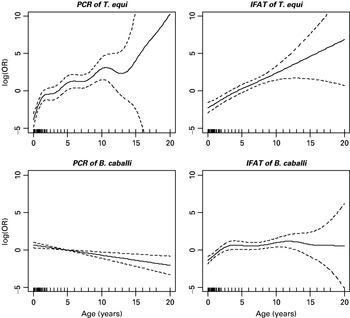
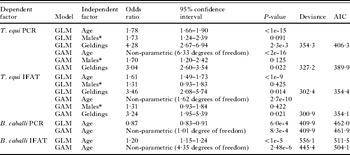
By light microscopy, an overall prevalence of T. equi of 5·7% (95% confidence interval: 3·7–8·1) was determined (n=495 horses), whereas the prevalence as analysed by multiplex PCR (n=493 horses) was 66·5% (95% CI: 62·1–70·7). The logistic regression model indicated that the prevalence increased with age and was higher in geldings (Table 2). Neither herd, date of sample collection nor abundance of tick infestation had a significant influence. The overall seroprevalence of T. equi (n=499 horses) was 78·8% (95% CI: 74·9–82·3). Again, the seroprevalence increased with age and was higher in geldings (Table 2). The lower AIC of the GAMs and degrees of freedom for age above 1 indicated that PCR- and IFAT-positive results had a complex dependence on age (Table 2, Fig. 1). However, the deviance from the linear model for the IFAT was relatively minor. In both the logistic model and the GAM, the continuous variables of date of sample collection and tick burden were non-significant.
Graphical representation of the smoothing function of age (i.e. the relation of the log of the odds ratio (logistic regression), adjusted for other significant variables in the model, to age (black line) and the 95% confidence limits (broken lines)) of PCR and IFAT assays from 493 and 499 domestic horses, respectively, for equine piroplasmoses performed in S.W. Mongolia in 2004. The tick marks above the x-axis represent the count of samples at the corresponding age.

Significant parameters of the generalized linear and additive models used to analyse the dependence of Theileria equi and Babesia caballi PCR and IFAT results and tick infestation on age, herd affiliation, sex, date of sample collection and tick infestation
(Analyses were performed using generalized linear models (GLM) or generalized additive models (GAM). The more suitable model was selected based on the lower Akaike's information criterion (AIC).)

* Sex is significant, but only geldings differ from the other classes.
The prevalence of B. caballi was 1·6% (95% CI: 0·7–3·1) as determined by light microscopy (n=495 horses) and 19·1% (95% CI: 15·6–22·9) by multiplex PCR (n=493 horses). The logistic regression model indicated that only age had an influence on the prevalence of this parasite (Table 2). Overall seroprevalence (n=499 horses) was 65·7% (95% CI: 61·3–69·9) and was age dependent (Table 2). No other of the investigated parameters had a significant impact on the IFAT result. The lower AIC of the GAMs and degrees of freedom for age above 1 indicated that PCR and IFAT had a complex dependence on age (Table 2, Fig. 1). However, the deviance from the linear model for the PCR results, although significant, was relatively small (Fig. 1). Other continuous variables were not significant in the GAM. The non-homogeneous age distribution of the sample is reflected by the large confidence intervals at high age (Fig. 1). Seven samples were IFAT negative and PCR positive for T. equi, whereas for B. caballi this was the case for 19 samples. The Fisher's exact test showed significant differences for both the PCR (P<2·2e-16) and the serological results (P=1·742e-05) between the 2 parasite species.
Tick identification
From a randomly selected subsample of 556 of a total of 7534 collected adult ticks, all were identified as Dermacentor spp. All males (279) were identified as D. nuttalli. Of the 277 females, 189 were attributed to the same species, whereas 88 could not unequivocally be identified.
Tick infestation
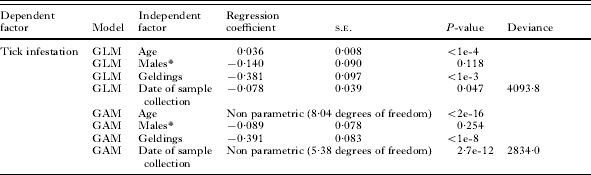
The infestation of horses with adult ticks varied from 0 to 161 ticks per horse side (n=510 horses). The variance of 503·7 being much larger than the mean of 14·8 indicates an aggregated distribution. The abundance of ticks increased with age, but decreased with the date of collection (Table 3). Geldings had significantly lower tick burdens. The herd affiliation had no influence. The deviance of the GAM was much lower than of the GLM, and age and date had a much higher degree of significance (Table 3) indicating a complex dependence of the tick infestation on both age of horse and date of sampling. The variation of tick infestation with sex remained significant in the GAM (Table 3).
Significant parameters of the generalized linear and additive models used to analyse the dependence of the tick infestation on age, herd affiliation, sex and date of sample collection
(Analyses were performed using generalized linear models (GLM) or generalized additive models (GAM). The more suitable model was selected based on the lower deviance.)

* Sex is significant, but only geldings differ from the other classes.
Piroplasm prevalences in ticks
Of 166 investigated ticks from 31 both IFAT- and multiplex PCR-negative horses originating from 8 herds, 1 was PCR-positive for B. caballi (95% CI: 0·1–1·7%), but none for T. equi (95% CI: 0·0–0·4%). Hence, there is no significant difference (P=0·99) in their prevalences. The sequence of the B. caballi isolate, which has 93% identity with known sequences (AB017700), is published in GeneBank (Accession number DQ987620). One of 47 ticks collected from 14 horses assumed to harbour piroplasms in their capillary beds despite showing no sign of infection in the jugular blood (IFAT positive, PCR negative, >6 months of age) was positive in the B. caballi-PCR (95% CI: 0·6–5·7%), and thus there was no significant difference to the baseline prevalence (P=0·39). No inhibition by tick-derived specimens was observed using the commercial multiplex PCR kit or the single-target PCRs.
DISCUSSION
In this study, we extensively investigated the infection status of piroplasms of horses by IFAT and PCR and explored the relationship between the animals' age, herd affiliation, sex, date of sample collection, tick infestation and the presence of antibodies or of the piroplasms in blood. GAMs and GLMs detected the same significant independent parameters. The presence of parasites and parasite-specific antibodies were significantly related to age. The additional flexibility of GAMs allowed the detection of a complex age-dependency of the log odds ratio of the presence of T. equi and of the presence of antibodies against B. caballi as depicted in Fig. 1. Besides the graphical presentation, the almost linear dependence of the other two dependent variables can be interpreted from the very small difference in the AIC between the GLM and the GAM analysis as well as the degrees of freedom close to unity in the GAM anlysis. Complex age-related variations in the prevalence of piroplasms have also been observed previously with B. bovis and B. bigemina in cattle (Mahoney, Reference Mahoney1962).
The observed prevalence of the parasites in the blood is a consequence of the relationship between the corresponding acquisition and elimination rate. The elimination rate depends on the effectiveness of the immune response of the host to the piroplasm infection. The presence of specific antibodies is epidemiologically useful to measure this immune response although it does not explicitly reflect the protective immunity. The prevalence of antibodies against both parasites increased with rising age, but the seroprevalence of B. caballi was significantly lower than that of T. equi. The high antibody titres determined in our study appear to correspond to what has been found in previous comprehensive sero-epidemiological studies from Central Asia, but the variance in age and the significant difference between the 2 parasites are contradictory. In Central Mongolia, sero-prevalences of 88·2% and 84·5% for T. equi and B. caballi, respectively, were observed (Avarzed et al. Reference Avarzed, De Waal, Igarashi, Saito, Oyamada, Toyoda and Suzuki1997). In contrast to the present study, these authors found a significant decrease in prevalence in animals between 11 and 16 years, which may be due to the large stratification intervals (1, 2, 3, 4, 5 years, 6–10 years, 11–16 years) and the small sample size in this particular stratum (n=5). The previous study in the Gobi B SPA determined seroprevalences of 88·6% (T. equi) and 75·2% (B. caballi) (Rüegg et al. Reference Rüegg, Torgerson, Doherr, Deplazes, Böse, Robert and Walzer2006). Boldbaatar et al. (Reference Boldbaatar, Xuan, Battsetseg, Igarashi, Battur, Batsukh, Bayambaa and Fujisaki2005) determined the seroprevalences of the 2 protozoa using ELISA on sera from 254 horses from 6 Mongolian provinces in different climatic zones revealing high variations from 39 to 96% for T. equi and between 17 and 63% for B. caballi, which, given the age and sex-dependence of the seroprevalence, may be due to sampling differences between the provinces. In China, prevalences of 14 and 81·6% were observed in endemic areas for T. equi and B. caballi, respectively (Wang cited by Yin et al. Reference Yin, Lu and Luo1997), but more comprehensive studies are not available from this neighbouring country.
Therefore, we assume that there is an increasing immunity against T. equi and B. caballi with rising age, which should result in an effective elimination of the parasites. Although this is the case with B. caballi, the prevalence of T. equi rises with age. Several authors have postulated that T. equi remains as a life-long infection, whereas B. caballi is eliminated after 1–4 years (Hourrigan and Knowles, Reference Hourrigan and Knowles1979; Schein, Reference Schein and Ristic1988; de Waal and van Heerden, Reference de Waal, van Heerden, Coetzer, Thomson and Tustin1994). However, the longest investigations with experimental infections with equine piroplasms lasted 16 months and included only serological analysis (Tenter and Friedhoff, Reference Tenter and Friedhoff1986). The time of persistence of equine piroplasms has thus never been verified experimentally or epidemiologically. Our results for the first time explicitly show the persistence of T. equi and the elimination of B. caballi with increasing age.
The parasite prevalences are further influenced by the rate of acquisition which depends on the tick infestation, prevalence of piroplasms in ticks and the proportion of infective tick bites resulting in infection. The regression analysis shows that there is a rise of tick infestation with age, and the decreasing tick burden with progressing date confirms the observation that tick numbers peak at the beginning of the season in this area (Byambaa et al. Reference Byambaa, Dash and Tarasevic1994; Rüegg, Reference Rüegg2002).
The prevalence of T. equi parasites and specific antibodies against this parasite as well as tick burden was significantly related to sex. Geldings appeared approximately 3 times more likely to be infected with T. equi than other horses and had lower tick burdens. This is in contrast to previous experimental reports with mice, showing that elevated testosterone levels both increased the likelihood of infections with piroplasms (Hughes and Randolph, Reference Hughes and Randolph2001b) and depressed their resistance to tick infestation (Hughes and Randolph, Reference Hughes and Randolph2001a). The present results may be due to sex-specific husbandry techniques and underline the importance of verifying laboratory results with field studies (Randolph and Nuttall, Reference Randolph and Nuttall1994).
No other independent factors had a significant effect on parasite or antibody prevalence. This could have been suspected for herd affiliation because, due to the transhumance of Mongolian herders, exposure to tick habitats was probably quite homogeneous. The date of sample collection did not influence the probability of infection. This is likely to be related to the persistence of the parasites in the host. Finally, as expected, tick infestation had no effect on the probability of piroplasm infection as transmitting ticks have left the host when serological evidence of piroplasm infection can be detected.
The multiplex PCR assay developed in this study correctly identified the microscopically unequivocal samples and we therefore assume that it will demonstrate T. equi and B. caballi if they are present in the blood. The prevalence determined with this assay showed an age-dependent increase in the case of T. equi but a decrease in the case of B. caballi. Such a decrease could be due to increased sequestration of the parasites in the microvasculature with rising age of infection. If this were the case, the true sensitivity of our PCR would depend on the time of blood collection in relation to the period of the parasitaemia. However, sequestration is known to occur, to a variable extent, in only a few haemoparasites (Plasmodium falciparum, P. chabaudi, P. knowlesi, B. canis and perhaps Babesia WA-1 isolate) but nothing is known for T. equi or B. caballi (Allred and Al-Khedery, Reference Allred and Al-Khedery2004). To evaluate the possibility of a decreased sensitivity of the B. caballi-PCR due to sequestration we assessed the infectivity of B. caballi-IFAT-positive and PCR-negative horses for ticks. According to Donnelly and Peirce (Reference Donnelly and Peirce1975), who performed a similar assessment for B. divergens using blood smears to evaluate the infection status of cattle, these animals would be “premune carriers” and infective for ticks. Unfortunately, too few ticks were collected from these horses to confirm or disprove this result with adequate power (β=0·12).
The use of morphological keys unequivocally identified all investigated male ticks as D. nuttalli. In contrast, species identification of 88 of 277 investigated females was not possible. The key separates Dermacentor females according to the presence or absence of cornua at the posterior margin of the basis capituli. In these 88 cases, rudimentary projections were present which would attribute these ticks to the species D. everestianus. However, because all males were identified as D. nuttalli, we postulate that this criterion is not reliable for the differentiation of these two species and that these females should be attributed to D. nuttalli. The exclusive infestation with D. nuttalli confirms previous findings in Mongolia where over 90% of the recovered ticks from horses were D. nuttalli, and this species was predominant in the Gobi steppe at altitudes of 1500 to 3200 m above sea level (Byambaa et al. Reference Byambaa, Dash and Tarasevic1994). These authors did not report D. everestianus. Tick larvae and nymphs were very difficult to collect systematically due to their small size and the thick winter coat of the horses. However, few collected nymphs were attributed to Dermacentor but could not be attributed to a species as no keys are available for Dermacentor nymphs of Central Asia.
The presence of T. equi and B. caballi was demonstrated in adult D. nuttalli and their progeny by Battsetseg et al. (Reference Battsetseg, Lucero, Xuan, Claveria, Byambaa, Battur, Boldbaatar, Batsukh, Khaliunaa, Battsetseg, Igarashi, Nagasawa and Fujisaki2002) and we therefore assume that both piroplasms are transmitted by these ticks. Thus, because the prevalence of both protozoa in ticks was not significantly different in our study, the diverging development of the two parasite prevalences in the mammalian host must be due to other factors. In the case of T. equi, it is evident that persistent infection leads to persistent antibody titres. Humoral immunity for B. caballi, on the other hand, persists despite the apparent decrease of the parasite's presence. As expected for a disease with a high transmission rate with consecutive seroconversion, 13 of 19 horses which tested IFAT negative/PCR positive for B. caballi were younger than 1 year of age. In contrast, for T. equi, the equivalent samples originated predominantly from older horses (5/7 were >5 years). Unfortunately the analysis with GAMs is descriptive and does not allow any inference on underlying mechanisms. Thus, more mechanistic mathematical models will be applied to better understand the true nature of these non-linear interactions.
The authors wish to acknowledge the International Takhi Group (http://www.itg.org) and in particular Professor Christian Walzer for making it possible to collect samples in Mongolia; Mr Ganbaatar, Mr Nyambuu and Mr Tsagaa for assistance in collections, and Mr Dominik Heinzmann for advice and enthusiastic discussions on mathematical solutions. Merit also goes to Dr Böse in Hildesheim (Germany) for providing the IFAT slides. This project was partially financed by the Forschungskredit der Universität Zürich 2003.